Russia calls out US over plans to militarize space
https://www.rt.com/russia/595548-moscow-us-militarize-space/ 7 Apr 24
Washington uses hostile rhetoric and baseless allegations to cover up its own intentions to send weapons into space, Moscow claims
The US has been seeking to dismantle legally-binding international security mechanisms and replace them with vague norms of the so-called ‘rules-based world order’, Russian Foreign Ministry spokeswoman Maria Zakharova said on Saturday.
The remarks were in response to statements from the outgoing US assistant secretary of defense for space policy, John Plumb, at a Defense Writers Group meeting on Friday. According to Zakharova, Plumb dismissed Russian-Chinese initiatives on the prevention of an arms race in space as a “political ploy,” claiming that adherence to the deal would not be verifiable.
“The US is an ardent opponent of Russian initiatives to prevent an arms race in outer space. Strong opposition to the aforementioned Russian-Chinese draft treaty has long been an integral part of American foreign policy,” Zakharova said in a Telegram post, referring to a 2008 draft agreement.
Instead, the US has been pursuing its own approach to keeping space free of weapons by promoting a “set of norms of ‘responsible’ behavior within the framework of their concept of a ‘rules-based world order,’” which is untenable both in technical and international legal terms, the spokeswoman said.
Plumb’s remarks, as well as Washington’s ongoing activities in the UN Security Council with regard to nuclear weapons in space, are part of its longstanding efforts to dismantle the system of legally-binding security treaties, she claimed.
The Russian Embassy in the US provided a similar assessment of Plumb’s remarks, suggesting they are part of a concerted campaign to divert attention away from Washington’s own pursuits. “We consider the Pentagon’s manipulations of information to be further proof of US attempts to use Russophobic slogans to justify its own plans for militarizing space,” the mission said in a statement.
Meanwhile, Washington has been promoting a resolution on the non-deployment of nuclear weapons in space. The UN Security Council is set to vote on the US- and Japan- backed document next week, which, if adopted, would reaffirm that countries must fully comply with their obligations under the 1967 Outer Space Treaty, which bans weapons of mass destruction in space.
The resolution comes amid claims in the US media early this year that Russia is seeking to deploy anti-satellite nukes, or at least mock-ups, into space. Moscow has strongly denied the claims, with Russian President Vladimir Putin describing them as “unfounded accusations.”
TEPCO plans new installations at Fukushima nuclear plant, to deal with radioactive leakage
In the wake of recent contaminated water leakage at Japan’s Fukushima
Daiichi Nuclear Power Plant, the plant’s operator Tokyo Electric Power
Company (TEPCO) has announced its plan for new installations as a
preventive measure, local media reported.
TEPCO is expected to install new
piping and ventilation ports designed to guide any spewing liquid to fall
within the building, thereby containing the spread of contamination,
national news agency Kyodo reported, citing the company’s announcement on
Friday. The construction is slated to commence on Monday and is expected to
be completed by the end of the month, according to the operator.
CGTN 6th April 2024
Nuclear Power Plants: NRC Should Take Actions to Fully Consider the Potential Effects of Climate Change
GAO-24-106326 Apr 02, 2024
Climate change is likely to exacerbate natural hazards—such as floods and drought. The risks to nuclear power plants from such hazards include damage to systems and equipment that ensure safe operation.
The Nuclear Regulatory Commission’s oversight process includes addressing safety risks at these plants. However, NRC doesn’t fully consider potential increases in risk from climate change. For example, NRC mostly uses historical data to identify and assess safety risks, rather than data from future climate projections.
We recommended that NRC fully address climate risks to nuclear power plants.
What GAO Found
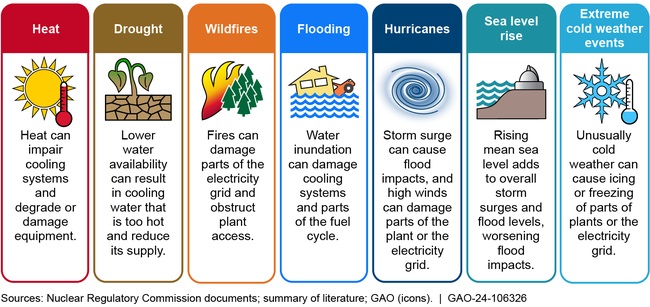
Climate change is expected to exacerbate natural hazards—including heat, drought, wildfires, flooding, hurricanes, and sea level rise. In addition, climate change may affect extreme cold weather events. Risks to nuclear power plants from these hazards include loss of offsite power, damage to systems and equipment, and diminished cooling capacity, potentially resulting in reduced operations or plant shutdowns.
The Nuclear Regulatory Commission (NRC) addresses risks to the safety of nuclear power plants, including risks from natural hazards, in its licensing and oversight processes. Following the tsunami that led to the 2011 accident at Japan’s Fukushima Dai-ichi nuclear power plant, NRC took additional actions to address risks from natural hazards. These include requiring safety margins in reactor designs, measures to prevent radioactive releases should a natural hazard event exceed what a plant was designed to withstand, and maintenance of backup equipment related to safety functions.
However, NRC’s actions to address risks from natural hazards do not fully consider potential climate change effects. For example, NRC primarily uses historical data in its licensing and oversight processes rather than climate projections data. NRC officials GAO interviewed said they believe their current processes provide an adequate margin of safety to address climate risks. However, NRC has not conducted an assessment to demonstrate that this is the case. Assessing its processes to determine whether they adequately address the potential for increased risks from climate change would help ensure NRC fully considers risks to existing and proposed plants. Specifically, identifying any gaps in its processes and developing a plan to address them, including by using climate projections data, would help ensure that NRC adopts a more comprehensive approach for assessing risks and is better able to fulfill its mission to protect public health and safety.
Why GAO Did This Study
NRC licenses and regulates the use of nuclear energy to provide reasonable assurance of adequate protection of public health and safety, to promote the common defense and security, and to protect the environment. Like all energy infrastructure, nuclear power plants can be affected by disruptions from natural hazards, some of which are likely to be exacerbated by climate change. Most commercial nuclear plants in the United States were built in the 1960s and 1970s, and weather patterns and climate-related risks to these plants have changed since their construction.
GAO was asked to review the climate resilience of energy infrastructure. This report examines (1) how climate change is expected to affect nuclear power plants and (2) NRC actions to address risks to nuclear power plants from climate change. GAO analyzed available federal data and reviewed regulations, agency documents, and relevant literature. GAO interviewed officials from federal agencies, including NRC, the Department of Energy, and the National Oceanic and Atmospheric Administration, and knowledgeable stakeholders from industry, academia, and nongovernmental organizations. GAO also conducted site visits to two plants.
Recommendations
GAO is making three recommendations, including that NRC assess whether its existing processes adequately address climate risks and develop and implement a plan to address any gaps identified. NRC said the recommendations are consistent with actions that are either underway or under development.
Recommendations for Executive Action
……………………………………………………………………………more https://www.gao.gov/products/gao-24-106326
West helping Ukraine attack deep inside Russia – CNN
https://www.rt.com/russia/595314-west-helps-ukraine-drone-attacks/ 5 Apr 24
Kiev’s foreign backers are coordinating the flight paths of kamikaze drones, a report says
Western countries are helping Ukraine to launch kamikaze drones deep into Russian territory, CNN reported on Tuesday, citing a source close to Kiev’s drone program.
An unnamed Ukrainian official who spoke to CNN described how Kiev uses UAVs with longer ranges and “more advanced capabilities” to strike targets located more than 1,000km (621 miles) from the border.
“The flights are determined in advance with our allies, and the aircraft follow the flight plan to enable us to strike targets with meters of precision,” the source said.
The admission of receiving guidance from abroad follows multiple reports that Western personnel are providing Ukrainian troops with intelligence and information about specific targets.
The Washington Post cited a senior Ukrainian official last year as saying that Kiev’s soldiers “almost never” use advanced weapons, including US-made HIMARS rocket launchers, without receiving coordinates from the Pentagon.
On Tuesday, Ukrainian drones targeted Russia’s Tatarstan, a region 650km east of Moscow (400 miles), which had not previously been attacked by UAVs. One drone was aiming to hit an oil refinery in Nizhnekamsk, a city located roughly 1,100km (680 miles) from the border. Mayor Ramil Mullin said that the aircraft was disabled by air defenses and caused no damage.
Another drone struck a student dormitory inside the industrial zone in Elabuga, injuring 13 people. The hub hosts several companies that make high-tech equipment, including drones, according to Russian media.
Moscow has repeatedly warned that the delivery of weapons and other military aid to Kiev makes Western countries de facto direct participants in the conflict. The Russian Defense Ministry and local authorities have said that Kiev uses Western-supplied arms to indiscriminately fire at civilians.
Ukrainian military leaders know they can’t win on battlefield – Guardian

https://www.rt.com/russia/595341-ukraine-gur-attacks-guardian/ 5 Apr 24
Their army’s weakness has prompted Kiev’s strikes on Russian infrastructure, senior officers have allegedly told the London newspaper.
Ukraine has no other option but to launch attacks inside Russia, including on its oil infrastructure, because its army faces continued setbacks on the battlefield, The Guardian has reported, citing the leadership of the country’s military intelligence service, the GUR.
Officers who allegedly spoke to the British newspaper were candid about Kiev’s desperate military situation. GUR Brigadier-General Dmitry Timkov said his country was like a patient on life support.
”We are attached to a drip. We have enough drugs to stay alive. But, if the West wants us to win, we need the full treatment,” he admitted, referring to the dwindling quantities of military aid coming from Kiev’s western backers.
Major General Vadim Skibitsky, the deputy head of the GUR, admitted that a Ukrainian victory, widely promised by Kiev, is impossible at the moment. Facing multiple setbacks, the agency had “no choice” but to launch strikes deep inside Russia. He described this as a “NATO-standard procedure, known as center of gravity, or COG.”
The concept was first developed by Carl von Clausewitz, the famous Prussian general and military theorist, and essentially refers to targets that have the most value for the enemy, physically or morally.
GUR officials that spoke to the Guardian claimed credit for a recent string of Ukrainian drone strikes on Russian oil infrastructure. This contradicts public statements by the head of SBU, the Ukrainian civilian security agency, Vasily Maliuk who said it was his agents who were responsible for the operations.
Both branches have been overhauled in the years since the 2014 armed coup in Kiev, with the CIA’s help, according to Western media reports. Both were allegedly involved in targeted assassinations of people deemed enemies of Ukraine, since before the conflict with Russia began in 2022.
The newspaper said GUR intends to launch a new major attack on the Crimean Bridge – and to disable it – “in the first half of 2024.” Ukraine has previously targeted the structure, twice in 2022 and 2023.
READ MORE: West helping Ukraine attack deep inside Russia – CNN
The first plot involved a powerful bomb hidden in a truck, which killed the vehicle’s driver and four other civilians in nearby cars. Moscow said GUR masterminded this attack. The second strike involved naval kamikaze drones that SBU said were deployed by its agents. That bombing killed two civilians.
Moscow has accused Kiev of engaging in terrorism as a method of war. The regime in Kiev has adopted the tactics, Russian officials are claiming, because it is unable to score victories on the battlefield.
St. Louis-area residents make plea for compensation for illnesses tied to nuclear contamination
People impacted by nuclear contamination in the St. Louis region are urging federal lawmakers to approve a plan to spend billions of dollars to compensate Americans exposed to radiation by the government
By JIM SALTER Associated Press, April 6, 2024, https://abcnews.go.com/US/wireStory/st-louis-area-residents-make-plea-compensation-illnesses-108900650
Karen Nickel has been dealing with lupus and other illnesses for years, illnesses she blames on childhood exposure to a suburban St. Louis creek where Cold War-era nuclear waste was dumped decades ago. It’s time, she said Friday, for the federal government to start making amends.
“People have died and are still dying,” Nickel, co-founder of the activist group Just Moms STL, said.
Nickel and others impacted by nuclear waste exposure in the St. Louis region joined Democratic U.S. Rep. Cori Bush at a news conference at a park that sits near long-contaminated Coldwater Creek. They urged renewal of a law initially passed more than three decades ago that would provide an estimated $50 billion to compensate Americans exposed to radiation by the government.
Last month, the Senate approved legislation by Republican Sen. Josh Hawley of Missouri and Democratic Sen. Ben Ray Luján of New Mexico that would not only extend the 1990 Radiation Exposure Compensation Act, but expand its scope to include Missouri and other states adversely affected by the nation’s nuclear weapons program.
But the compensation plan was excluded from a spending bill.
“The Senate did its job, but House leadership has failed to act,” Bush, of St. Louis, said. “This injustice cannot stand.”
The plan isn’t dead. It could still pass as a stand-alone bill, or be attached to another piece of legislation. But time is of the essence, Bush said. The RECA program expires June 7.
Uranium processing in the St. Louis area played a pivotal role in developing the nuclear weapons that helped bring an end to World War II and provided a key defense during the Cold War. But eight decades later, the region is still dealing with contamination at several sites.
In July, an investigation published by The Associated Press, The Missouri Independent and MuckRock showed that the federal government and companies responsible for nuclear bomb production and atomic waste storage sites in the St. Louis area were aware of health risks, spills, improperly stored contaminants and other problems but often ignored them.
While it is difficult to prove definitively that the waste caused residents’ illnesses, advocates argue that there is more than enough evidence that it has sickened people.
Since the RECA program began, more than 54,000 claims have been filed and about $2.6 billion has been awarded for approved claims in Nevada, Utah and Arizona.
In New Mexico, residents in the communities surrounding the area where the first atomic bomb was detonated in 1945 — the top-secret Manhattan Project — were not warned of the radiological dangers and didn’t realize that an atomic blast was the source of the ash that was raining down upon them.
Advocates also have sought to bring awareness to the lingering effects of radiation exposure on the Navajo Nation, where millions of tons of uranium ore were extracted over decades to support U.S. nuclear activities.
President Joe Biden signed an executive order in 2022 extending RECA for two years, into June. Hawley’s bill would extend the law for five years and expand coverage to include people in Missouri as well as Idaho, Montana, Colorado, Tennessee, Kentucky, Alaska and Guam.
The White House has indicated that Biden would sign the legislation.
“The President believes we have a solemn obligation to address toxic exposure, especially among those who have been placed in harm’s way by the government’s actions,” the White House said in a statement earlier this year.
Others worry about the cost. The taxpayer advocacy group Committee for a Responsible Federal Budget said that the legislation should include budget offsets to pay for it.
Nuclear waste stored near St. Louis’ Lambert Airport made its way into Coldwater Creek in the 1960s. Many people who grew up or live near the meandering creek believe the contamination is responsible for cancers and other illnesses, though experts say connecting radiation exposure to illness is complicated. Cancer concerns also have been raised by people in nearby St. Charles County, Missouri, where uranium was processed and a large quarry became contaminated, resulting in a Superfund cleanup.
In 2022, a St. Louis County grade school closed amid worries that contamination from Coldwater Creek got onto the playground and inside the building. The Army Corps of Engineers announced last month that it is testing a few homes near the creek after high radiation levels were found in their backyards.
Like Nickel, Democratic state Rep. Doug Clemens grew up along Coldwater Creek. He said every man in his childhood neighborhood eventually died of stomach or intestinal cancer.
“They knew they were poisoning us for 75 years,” Clemens said of the government. “RECA is a step. We must do RECA now.”
Israel Lets Some Aid Into Gaza So The US Will Keep Giving It Weapons To Kill People In Gaza
CAITLIN JOHNSTONE, APR 06, 2024
Israel has generously and compassionately reopened the Erez crossing to allow aid into Gaza, as it is the only way to ensure that the US will keep sending them weapons to kill the people in Gaza.
Biden sent Netanyahu one warning about a failure to protect civilians possibly costing Israel its US support and the crossing opened immediately, which proves (A) that Israel has been intentionally starving Gazans by closing entrances off from aid and (B) that Biden could have ordered this to stop at any time.
The Biden administration approved another weapons package for Israel on the same day Israel killed a bunch of international aid workers in Gaza and bombed the Iranian consulate in Syria. But please, tell me more about how frustrated and angry and outraged and upset Biden’s feelings are feeling toward Israel.
❖
The huge amount of western outrage and sympathy we’re seeing over the IDF assassination of an international aid convoy compared to the systematic extermination of Palestinians we’ve seen over the last six months confirms the west only regards white people as full human beings, which is a point we’d already seen driven home by the disproportionate amount of outrage and sympathy we saw over Ukraine.
But you know what? We’ll take it. Things are that desperate that if you can only support an end to the Gaza genocide if you see six westerners get killed, I say welcome aboard anyway. Hopefully this is the beginning of the formation of an actual conscience that’s worth a damn.
❖
The mass media are reporting that the preliminary IDF debrief into the killing of several World Central Kitchen employees in Gaza has found that the multiple strikes were not carried out with the intention of killing those workers, a report which if you ask me has big “CIA Says It Has Found No Link Between Itself and Crack Trade” energy.
Haaretz has a new article out titled “At Singapore Airshow, the Gaza War Was a Selling Point for Israeli Weapon Manufacturers,” which is exactly what it sounds like. One of the ugliest things about this dystopia is that acts of mass military slaughter are always immensely profitable for a specific industry. They’re profitable in and of themselves, even before you add in things like land and resource grabs, just by helping to market and sell more weapons.
❖
Stop calling this a “war”. A war doesn’t involve conversations about whether or not a walled-in population should be allowed to have food, medicine and electricity. If you have that much control over a population, you can’t be at war with it. You’re just killing a bunch of prisoners.
Biden and his cohorts aren’t mad at Netanyahu for committing a genocide, they’re mad at Netanyahu for not hiding a genocide………………………………………..more https://www.caitlinjohnst.one/p/israel-lets-some-aid-into-gaza-so?utm_source=post-email-title&publication_id=82124&post_id=143320632&utm_campaign=email-post-title&isFreemail=true&r=1ise1&triedRedirect=true&utm_medium=email
❖
British Rebellion Grows Against Arming Israel
London’s mayor, 50 Labour MPs and Winston Churchill’s grandson have joined widening calls to defy Israel’s impunity by demanding the U.K. stop sending it arms, reports Joe Lauria
Joe Lauria, in Bradford, England, Consortium News, April 4, 2024
Even Winston Churchill’s grandson is calling for Britain to stop shipping arms to Israel.
Asked whether it was time for Britain to stop sending weapons to Israel after it killed seven international aid workers this week, the Conservative peer Lord Nicholas Soames said, “It’s probably time that that happened now, yes, I think if we’re determined to show that we are not prepared to countenance these ongoing disasters.”
The rebellion within British ruling circles against knee-jerk support for is Israel is spreading after the killing of the aid workers and after leaked audio recordings on Saturday revealed the British government is ignoring the advice of its own lawyers not to continue supplying weapons to Israel for its Gaza operation without risking complicity in crimes against humanity.
[It took Westerners, including three Britons, being killed to spur this action after more than 32,000 Palestinians are dead. It also forced Israel on Friday to sack two military officers and reprimand two top commanders for “serious” errors in killing the aid workers, who were in marked cars. There’s nothing like the fear of an arms cutoff to make Israel try to do something.]
On Wednesday, more than 600 British lawyers, academics and retired senior judges — including three who sat on the country’s Supreme Court — wrote to Prime Minister Rishi Sunak imploring him to cut off military aid and even called for sanctions against the most senior Israeli leaders.
The rebellion is erupting in both major parties, as well as in the Liberal Democrats, which on Thursday wrote to No. 10’s ethics advisor to urge a probe into whether U.K. arms sales could be a breach of Britian’s ministerial code. The letter said “the UK must not be complicit in breaches of international humanitarian law,” The Guardian reported.
The Labour Party is in upheaval as the mayor of London and 50 Labour MPs on Thursday said Britain should no longer arm a state that is increasingly unable to hide its crimes. “In my view, the fact the government is not publishing the legal advice, one can only draw one conclusion,” Mayor Sadiq Khan told the Politics Joe website. “I think the government should be pausing all sales of weapons to Israel. I think we should be holding to account the Israeli government.” He added: It’s got to stop.”
As he tries to unify a fractious party over the issue, Labour leader Keir Starmer has not gone beyond calling for the legal advice mentioned in the leaked audio to be made public.
Britain exported £42 million of weapons to Israel in 2023. Figures since Oct. 7 last year have not yet been released. A British break with Israel on Gaza would be politically more significant than the size of the arms transfers.
Tories Imploding Too
Rebellion is breaking out in the ruling Conservative Party as well. Churchill’s grandson has been joined by Lord Hugo Swire and three Tory MPs – Paul Bristow, Flick Drummond and David Jones – in demands that arms shipments be halted.
Sir Alan Duncan, a figure reviled by Julian Assange supporters for gleefully organizing his arrest from the Ecuador Embassy in April 2019, is being investigated by the Conservative Party for potentially “anti-semitic” remarks after he criticized pro-Israel Tory “extremists.”
“The time has come to flush out those extremists in our own parliamentary politics, and around it, some of whom are at the very top of government, or have been,” he told a radio interviewer on Thursday. “They have never been called to account by journalists to say: Do you agree with your own party’s policy? Do you condemn illegal settlements?’”
Duncan, a former minister in Conservative Theresa May’s government, added: “Conservative Friends of Israel has been doing the bidding of [Benjamin] Netanyahu, bypassing all proper processes of government, to exercise undue influence at the top of government.”
David Cameron, the former prime minister, current foreign secretary and prospective Tory leader once again, is reportedly under pressure from these party “extremists” because he doesn’t share their fanatical devotion to Israel. This is a man who as prime minister once called Gaza an “open-air prison.” He is far more restrained in his criticism now. But he’s feeling the heat in party backrooms……………………………. more https://consortiumnews.com/2024/04/04/british-rebellion-grows-against-arming-israel/
**Nuclear in Scotland**
Letter Tor Justad: Nuclear Power, neither green, clean nor safe and very
costly for the environment. Nuclear proponents fail to mention nuclear
stations are often offline due to lengthy periods required for care and
maintenance; carbon is produced during construction and uranium mining;
nuclear power costs three times as much to produce compared to renewables.
(Not on the website)
Press & Journal 4th April 2024
https://www.pressandjournal.co.uk/category/opinion/letters
2
Dounreay workers vote to strike
Workers at the Dounreay nuclear power complex in Caithness have voted to
strike after long-running pay talks stalled. The GMB union said members at
the plant had overwhelmingly backed industrial action including strikes,
working to rule and an overtime ban. It comes after a pay offer was
rejected. GMB said its vote delivered a “crushing majority” on a
turnout of 85%. Other unions, Unite and Prospect, are also balloting
members.
Press and Journal 4th April 2024
TODAY. NATO/USA – dancing macabrely to World War 3?

The Danse Macabre consists of the dead, or a personification of death, summoning representatives from all walks of life to dance along to the grave, The effect is both frivolous and terrifying, beseeching its audience to react emotionally. – Wikipedia
I wonder did those lovely well-paid NATO representatives have a nice social time, too, in the Brussels Summit April 3 -4, surely a dinner, perhaps a dance? Well, they did, in a way, do a danse macabre, as they fell in like ninepins to the aims of Secretary General Jens Stoltenberg, and of my favourite sweetly spoken war-monger, Antony Blinken. ( All except Hungary, but they don’t count, as they’re on speaking terms with Russia.)
The danse macabre idea derived from the Middle Ages – when mass deaths happened from famine and plague – it was perhaps some kind of coping mechanism – and a way to face up to the fears of what was coming.
NATO representatives dutifully discussed $107b Ukraine military aid package, a multi-year financial commitment for Ukraine, dutifully agreeing that everyone must do more to ensure a Ukrainian victory against Russia, and “rock solid” that Ukraine will join NATO. “Our purpose at the summit is to help build a bridge to that membership,” – Antony Blinken.
NATO/USA aims to draw in “Indo-Pacific partners” – Australia, NZ. South Korea ,Japan, Singapore, Vietnam, Philippines, Saudi Arabia, Israel, Indonesia, Thailand, Taiwan. NATO/USA sees a Ukrainian victory as a necessity for global peace and freedom. And I guess that a Taiwanese victory over China will be visualised in the same way.
Did anyone raise matters like the situation of Ukrainian casualties, the crippling of Ukraine’s environment, economy, and social structure, the Russian success on the ground, the perils of Ukraine striking sites far inside Russia? Apart from Hungarian Foreign Minister Péter Szijjártó , did anyone suggest a negotiated end to the Ukrainian bloodbath?
The Ukrainian people are overwhelmed with the sufferings of fighting Russia on behalf of NATO/USA. But to NATO/USA – is it some sort of game of Russian roulette – how far can they push Russia? And is it preparatory to another game of Taiwan fighting China? And is it fun to toy with the chance of World War 3 ?
China’s quiet energy revolution: the switch from nuclear to renewable energy
By Derek Woolner and David Glynne Jones, Apr 6, 2024 https://johnmenadue.com/chinas-quiet-energy-revolution-the-switch-from-nuclear-to-renewable-energy/
There is now a policy dispute about the roles of nuclear and renewable energy in future Australian low emission energy systems. The experience of China over more than a decade provides compelling evidence on how this debate will be resolved. In December 2011 China’s National Energy Administration announced that China would make nuclear energy the foundation of its electricity generation system in the next “10 to 20 years”. Just over a decade later China has wound back those ambitious targets and reoriented its low emission energy strategy around the rapid deployment of renewable solar and wind energy at unprecedented rates.
Australia has seen a campaign against the use of renewable energy technologies and for the benefits of nuclear energy in developing Australia’s future low emission energy systems. The Federal Opposition has now adopted this position as their policy. The recent experience of China provides a compelling commentary on this decision.
In December 2011 China’s National Energy Administration (NEA) announced that China would make nuclear energy the foundation of its electricity generation system in the next “10 to 20 years”, adding as much as 300 gigawatts (GWe) of nuclear capacity over that period.
This was followed by a period of delay as China undertook a comprehensive review of nuclear safety in the aftermath of the Fukushima nuclear disaster.
Subsequently, moderated nuclear energy targets were established, aiming for a nuclear energy contribution of 15% of China’s total electricity generation by 2035, 20-25% by 2050 and 45% in the second half of the century.
However by 2023 it was becoming clear that China’s nuclear construction program was well behind schedule. The target for 2020 had not been achieved, and targets for subsequent 5-year plans were unlikely to be achieved.
In September 2023 the China Nuclear Energy Association (CNEA) reported that China was now aiming to achieve a nuclear energy contribution of 10% by 2035, increasing to around 18% by 2060.
The CNEA also indicated that ‘greenlighting’ of new construction would now be at the rate of 6-8 large nuclear power reactors per year – not the 10 per year previously targeted for 2020-2035 and beyond. This will result in new nuclear generation increasing by 60-80 terawatt-hours (TWh) annually.
Meanwhile the deployment of renewable energy (primarily solar and wind energy) was dramatically accelerated in 2023, with the installation of 217GWe of new solar capacity and 70GWe of new wind capacity.
This represents an increase of around 400TWh in annual low emission generation – the quantitative equivalent of 40 large nuclear power reactors, or four times the average annual output of the Three Gorges Dam hydroelectric system (the world’s largest power station).
In 2023 energy analysts started reporting that China was now expected to achieve or exceed its 2030 target of 1200GWe for the total installed capacity of solar and wind energy by 2025, and was now planning to triple the 2030 objective, to reach 3900GWe.
Previously China expected that its energy emissions would peak in 2030, but revised forecasts are now indicating that this could happen as early as 2024, 5-6 years ahead of target.
By the end of 2023 it was clear that nuclear energy was no longer going to be the foundation of China’s future electricity generation system, and that this task had shifted to renewable energy.
So what has happened? There’s no single answer, but two key factors appear to be at play.
The first is the emergence of renewable energy technologies at competitive scale and cost since 2011.
Between 2011 and 2022, the cost of solar PV modules declined by 85%, wind energy costs by 60-70%, and battery costs by 90%.
China now dominates the global production of solar PV panels, wind turbines and batteries, with costs expected to continue to decline significantly for the foreseeable future while performance improves.
The consequence is that renewable energy generation can now be deployed economically at rates five to eight times faster than nuclear energy, which is constrained by logistical and regulatory capability, safety, site availability and other factors.
The second is the slow delivery of new nuclear generation which contributed to continued ‘greenlighting’ of new coal-fired generation to underwrite energy security, as it became clear that deployment rates for new low emission electricity generation were insufficient to blunt demand from provincial governments for new coal-fired generators, even though many existing plants are operating at uneconomically low capacity factors
By 2035, under the original plan, combined nuclear, solar and wind generation would have been comparable to current coal generation but insufficient to meet significantly increased new electricity demand.
Under the new plans, combined solar, wind and nuclear generation is likely to match current coal generation and meet new demand, with solar and wind energy contributing around 85% of this low emission generation.
By 2030 another factor will come into play, with China’s battery giant CATL developing long duration utility battery systems that will provide dispatchable electricity from renewable sources at competitive or lower costs than either coal or nuclear generated electricity.
The central message here is that even in China – the world’s largest industrial economy and preeminent builder of advanced civil infrastructure in the 21st century – nuclear energy cannot compete with renewable energy to deliver low emission electricity generation at the deployment rates needed to meet mid-century emission targets.
1
M6.0 earthquake hits coast of Japan’s Fukushima: Japan Meteorological Agency
A magnitude-6.0 earthquake struck off the coast of Fukushima Prefecture in Japan on Thursday noon, said the Japan Meteorological Agency (JMA).
The quake hit at 12:16 local time at a depth of 40 kilometers, the JMA said.
No tsunami warnings have been issued and there’s no immediate information on damage or casualties.
Climate change and nuclear waste are a toxic stew

Building weapons and storing contaminated material safely is becoming harder
BY MARK GONGLOFF, BLOOMBERG, 4 Apr 24,
more https://www.japantimes.co.jp/commentary/2024/04/04/climate-change-nuclear-waste/
One of global warming’s more colorful dangers is the possibility that melting permafrost will revive prehistoric diseases and trigger horrific pandemics. But the more immediate candidates for a disastrous, climate-fueled comeback are newer and man-made.
A hotter and more chaotic atmosphere is making it harder to build nuclear weapons and store waste safely in an unhappy union of two of humanity’s biggest headaches. There’s little evidence we’re prepared for what could come next.
We got a stark reminder recently when one of the wildfires scorching the Texas Panhandle came perilously close to the Pantex nuclear-weapons facility just outside of Amarillo. The plant shut down briefly and workers scrambled to build a wildfire barrier — raising the question of why a nuclear-weapons facility in the parched Texas Panhandle didn’t already have a wildfire barrier.
Pantex builds and breaks down nuclear weapons and stores nuclear material on its 18,000-acre grounds in what is increasingly a tinderbox. Heavier-than-usual rainfall last year made undergrowth flourish in the Panhandle, creating more wildfire fuel. Then a freak winter heat wave fueled by hot, dry winds from Mexico made conditions perfect for the worst wildfires in Texas history.
This cycle — wetter wet seasons followed by hotter, drier dry seasons, leading to roaring wildfires — will become increasingly routine as the planet warms. The wildfire risk for Amarillo over the next 30 years ranges from “severe” to “extreme,” according to the climate-data group First Street Foundation. Such conditions will continue to threaten not only Pantex but nuclear sites around the world.
I am no J. Robert Oppenheimer, but I know enough about nuclear things to understand they do not mix well with fire. When the Rocky Flats Plant, a former nuclear weapons maker just outside of Denver, burned in 1957, it spewed plutonium and other radioactive dust across the city and its suburbs. Every wildfire that comes near nuclear material risks creating another Rocky Flats.
Consider Oppenheimer’s old stomping grounds, Los Alamos National Laboratory, which still builds nukes and stores waste in northern New Mexico. It’s also threatened by wildfires pretty often, most recently in 2000, 2011 and 2022. The 2000 fire burned a quarter of its land, though by some miracle it touched none of the nuclear material. Over the decades, the lab has moved most of its nuclear waste elsewhere and tried to bolster its fire protection. But a Department of Energy audit in 2021 found those steps were inadequate and there’s still more than enough waste at the facility to cause a serious environmental disaster.
Wildfires have also recently threatened the Idaho National Laboratory near Idaho Falls; the Santa Susana Field Laboratory outside of Los Angeles; and the Chernobyl cautionary tale in Ukraine (in 2020, before Vladimir Putin became its biggest threat). To name a few.
And then there are the many nuclear power plants that are also increasingly threatened by floods, hurricanes, wildfires and droughts. Most U.S. plants are unprepared for such disasters, according to the Nuclear Regulatory Commission, and about 60% of the country’s nuclear power capacity is directly threatened, according to the Army War College. Nuclear power could be a crucial part of a clean-energy transition, but not if it comes with a high risk of multiple Fukushima-like catastrophes.
That’s not all. Global warming could eventually thaw out nuclear waste the U.S. military buried deep in the ice in Greenland, a recent Government Accountability Office report pointed out. That same report warned rising sea levels could disturb and spread radioactive waste in the Marshall Islands, the site of dozens of Cold War bomb tests.
Worryingly, there is little evidence nuclear operations or governments are ready for such potential catastrophes, warns Nickolas Roth, senior director of nuclear materials security at the Nuclear Threat Initiative, a nonprofit group. He points to the COVID-19 pandemic as an example; few sites had planned for an extended crisis that made in-person management difficult. A rapidly changing climate makes such extended or serial crises more likely.
“We need to see more nuclear facilities developing resiliency mechanisms,” Roth told me. “Not just because of wildfires. We are entering an era where rapidly evolving risks are impacting nuclear operations.”
The first thing site managers can do is get nuclear waste to safer locations. That’s easier said than done; few places are exactly begging to import nuclear waste. But the time to look for alternatives was yesterday.
Operators can also help one another by freely sharing their experience and expertise, as Roth says happened during the pandemic. And they shouldn’t be left to fend for themselves. Some outfits are run by the U.S. government, but many others aren’t. All will need broad logistical and financial support to avoid disasters whose effects will reach across society.
Places like the Texas Panhandle face obvious climate risks, but we’re learning all the time there are no real safe havens when the atmosphere goes haywire. Everyone working with materials that could spoil the environment and human health for generations must get ready for the risks to come.
Ukraine aid will bankrupt future US generations – congressman

https://www.rt.com/news/595344-ukraine-aid-bankrupt-us/ 5 Apr 24
America risks getting bogged down in “yet another forever war,” Republican Eli Crane has warned.
The US should end its financial support for Ukraine and instead focus on how Kiev can settle the conflict, Republican congressman Eli Crane has said. His comments come as House Speaker Mike Johnson said the chamber is likely to vote soon on providing Kiev with new funding.
Several months ago, US President Joe Biden proposed a supplemental security package that would earmark around $60 billion in assistance to Ukraine, but it has since remained stalled in Congress as Republicans demand more focus on security at the Mexican border.
On Sunday, however, Johnson signaled that the package could come up for a vote soon, with “some important innovations.” Among these, he said, is a possibility of extending a loan to Ukraine – an idea favored by GOP presidential frontrunner Donald Trump – as well as seizing Russian sovereign assets frozen in the US and transferring the proceeds to Kiev.
Since the start of the Ukraine conflict, the West has frozen around $300 billion in Russian assets, most of which are under European control. While numerous Western officials have proposed seizing the funds to finance Ukraine, many have pointed out that there is no legal basis for doing so. Moscow, for its part, has called the blocking “theft,” warning of retaliation if its funds were to be confiscated.
Some GOP members, however, have argued against aiding Kiev. In this vein, Eli Crane told Fox News on Tuesday that Washington is “funding what appears to be yet another forever war.” This effort, the Arizona congressman suggested, “will bankrupt future generations – all while disregarding our own security as our southern border remains open.”
“It’s absurd that overnighting more tax dollars to Ukraine is even a consideration. It should be totally off the table and replaced with a push for peace talks,” he added.
This sentiment was also shared by Republican congresswoman Marjorie Taylor Greene of Georgia, who suggested on Tuesday that any talk of loaning money to Ukraine sounds “absolutely ridiculous.”
“It’s… laughable to even try to tell the American people that Ukraine will ever pay us back!.. Why isn’t our government brokering peace in Ukraine?” she said.
The US has provided Ukraine with $113 billion in various forms of assistance since the start of hostilities. Meanwhile, Russia has repeatedly condemned Western arms shipments to Ukraine, saying these will only prolong the conflict, while making the West a direct participant in the hostilities.
1 This Month
23-25 October – on Zoom – World BEYOND War’s annual global conferenc


Shut down the radiation-damaged Heysham nuclear reactors now
To see nuclear-related stories in greater depth and intensity – go to https://nuclearinformation.wordpress.com

Say No to NASA’s Reckless Nuclear Reactor on the Moon
Say No to NASA’s Reckless Nuclear Reactor on the Moon

-
Archives
- October 2026 (199)
- September 2026 (339)
- August 2026 (330)
- July 2026 (355)
- June 2026 (287)
- May 2026 (306)
- April 2026 (356)
- March 2026 (251)
- February 2026 (267)
- January 2026 (308)
- December 2025 (358)
- November 2025 (359)
-
Categories
- 1
- 1 NUCLEAR ISSUES
- business and costs
- climate change
- culture and arts
- ENERGY
- environment
- health
- history
- indigenous issues
- Legal
- marketing of nuclear
- media
- opposition to nuclear
- PERSONAL STORIES
- politics
- politics international
- Religion and ethics
- safety
- secrets,lies and civil liberties
- spinbuster
- technology
- Uranium
- wastes
- weapons and war
- Women
- 2 WORLD
- ACTION
- AFRICA
- Atrocities
- AUSTRALIA
- Christina's notes
- Christina's themes
- culture and arts
- Events
- Fuk 2022
- Fuk 2023
- Fukushima 2017
- Fukushima 2018
- fukushima 2019
- Fukushima 2020
- Fukushima 2021
- general
- global warming
- Humour (God we need it)
- Nuclear
- RARE EARTHS
- Reference
- resources – print
- Resources -audiovicual
- Weekly Newsletter
- World
- World Nuclear
- YouTube
-
RSS
Entries RSS
Comments RSS