Zelensky wants ten more years of US funding

https://www.rt.com/news/596736-ukraine-us-aid-decade/ 29 Apr 24
The Ukrainian leader has said he is working on getting a long-term assistance package from Washington.
The latest US aid package for Kiev, which was only approved by Congress after more than six months of partisan feuding, might be small potatoes compared to what Ukrainian President Vladimir Zelensky has in mind for his biggest benefactor.
Kiev is negotiating with the administration of US President Joe Biden on a long-term agreement that would put Washington on the hook to provide Ukraine with military, economic, and political support for the next decade, Zelensky said on Sunday in his daily video address. Such commitments are needed to ensure Ukraine has the “efficiency in assistance” it needs to stem recent battlefield advances by Russian forces and gain the upper hand, he said.
“We are working to commit to paper concrete levels of support for this year and for the next ten years,” Zelensky said. “It will include military, financial, and political support, as well as what concerns joint production of weapons.”
Ukraine has already signed bilateral security agreements with several NATO members, including the UK, Germany, and France. Zelensky said he wants the long-term deal under negotiation with Washington to be the strongest pact yet.
However, Ukraine’s bilateral agreements with Western countries so far have stopped short of mutual-defense commitments. The deals merely pledge long-term aid, including support in the event of a future attack, and they are not legally binding. The agreement with Berlin, for instance, can be terminated with six months’ notice.
Zelensky said he wants Ukraine’s bilateral pact with Washington to include specific levels of aid. “The agreement should be truly exemplary and reflect the strength of American leadership,” he said.
US lawmakers approved $61 billion in additional aid for Ukraine earlier this month, after House Speaker Mike Johnson (R-Louisiana) overrode opposition in his own party to pass the bill with unanimous Democrat support. The Biden administration ran out of funding for Ukraine aid earlier this year, after using up $113 billion in previously approved assistance packages.
Republican lawmakers have argued that Biden is merely prolonging the bloodshed in Ukraine without offering a clear strategy for victory or a peace deal with Russia. A poll released in February showed that nearly 70% of Americans want Biden to push for a negotiated settlement with Moscow, involving compromises on both sides, rather than continuing to fund the conflict.
Australian Parliamentarians renew their support for the Treaty for the Prohibition of Nuclear Weapons
Jemila Rushton, Acting Director, ICAN Australia
Australian parliamentarians from across party lines have renewed their support for Australia joining the Treaty on the Prohibition of Nuclear Weapons (TPNW).
In a new video, members of the Parliamentary Friends of the Treaty on the Prohibition of Nuclear Weapons show that action on nuclear disarmament is beyond party politics. Their joint message demonstrates how parliamentarians from across the political spectrum are working together to see the Treaty signed and ratified.
| Featured in the video are Susan Templeman MP (ALP), Member for Macquarie, Jordan Steele-John (GRN), Senator for Western Australia, Monique Ryan MP (IND), Member for Kooyong, Russell Broadbent (IND), Member for Monash, Sam Lim MP (ALP), Member for Tangney, Louise Pratt (ALP), Senator for Western Australia, Lidia Thorpe (IND), Senator for Victoria, Sharon Claydon MP (ALP), Member for Newcastle, Josh Burns MP (ALP), Member for Macnamara, and Josh Wilson MP (ALP), Member for Fremantle. In the video, they state: |
Today, 93 countries around the world are signatories to the Treaty on the Prohibition of Nuclear Weapons – the TPNW.
They are signed up to the legally binding commitment to comprehensively ban nuclear weapons.
Developing them, testing them, producing them, assisting with them, possessing them, threatening to use them, and using them are banned.
The TPNW is giving countries and citizens across the world hope, and a new and promising pathway towards the abolition of these weapons.
It’s about understanding that what we cannot prepare for and what we can adequately respond to, we must prevent.
It’s about continuing Australian leadership when it comes to nuclear disarmament.
It’s about working with our closest neighbours and collaborating with our Pacific family.
It’s about recognising and supporting victims of nuclear weapons testing. For First Nations survivors, for Australia’s nuclear veterans.
As members of the Australian Parliamentary Friends of the TPNW, we are working together to see the Nuclear Weapons Ban Treaty signed and ratified.
We are proud of our country’s commitment to getting rid of other inhumane weapons, like landmines, cluster munitions, biological, and chemical weapons.
We welcome Australia’s engagement with the TPNW under the Albanese Government and we pay tribute to the community activism being undertaken in support of Australia joining this treaty.
History is calling.
US Presidential candidate arrested at anti-Israel protest
https://www.rt.com/news/596726-jill-stein-arrested-protest/ 29 Apr 24
Jill Stein has accused the Jewish state of committing “genocide” in Gaza.
Jill Stein of the US Green Party has been arrested at a pro-Palestinian rally at Washington University in St. Louis, Missouri. Stein’s arrest came amid a nationwide crackdown on anti-Israel demonstrations.
Stein, her campaign manager, and her deputy campaign manager were among 100 people detained at a protest camp on Washington University’s campus on Saturday. Video footage shows the 73-year-old being led away from the camp by three police officers, her hands apparently bound behind her back with zip ties.
The encampment was set up to demand that the university divest from Boeing, which manufactures arms used by the Israeli military to strike Gaza, Stein’s campaign manager, Jason Call, said in a statement.
“The Stein campaign supports the demands of the students and their peaceful protest and assembly on campus,” Call said. “Student protest for peace and civil liberties has always represented the best part of our collective moral conscience. Solidarity.”
The Washington University camp was one of around four dozen set up at college campuses across the US and Canada in recent weeks. As well as demanding that their universities divest from Israel-linked companies, the protesters have called on the US government to cease its financial and military support for Israel over the war in Gaza.
Police officers arrested hundreds of demonstrators in raids on 21 campuses on Wednesday, then hundreds more in similar sweeps on Thursday, Friday, and Saturday. While this crackdown has been encouraged by mainstream Democrats and Republicans alike, they have been condemned by progressive leftists and libertarian-leaning members of the GOP.
Pro-Israel activists claim that the protests are anti-Semitic in nature, and that some demonstrators have openly expressed support for Hamas. In an effort to justify a police raid on a protest camp at Boston’s Northeastern University on Saturday, school authorities claimed that chants of “Kill the Jews” were heard at the encampment the night before. Pro-Palestinian demonstrators deny the allegation.
Stein is a Jewish-American activist, and a long-time critic of the state of Israel. She opposes the construction of Jewish settlements on Palestinian land, supports the BDS (Boycott, Divestment, and Sanctions) movement, and has accused Israel of “genocide” in Gaza.
Stein ran for president of the US in 2012 and 2016, taking just over 1% of the popular vote in the 2016 contest with Donald Trump and Hillary Clinton. In November, she announced that she would run for the White House again this year, promising environmental reforms and “a new foreign policy based on diplomacy, international law, and human rights.”
We need an exodus from Zionism
Naomi Klein, Wed 24 Apr 2024, https://www.theguardian.com/commentisfree/2024/apr/24/zionism-seder-protest-new-york-gaza-israel
This Passover, we don’t need or want the false idol of Zionism. We want freedom from the project that commits genocide in our name
.”……………………………..What I want to say to you tonight at this revolutionary and historic Seder in the Streets is that too many of our people are worshipping a false idol once again. They are enraptured by it. Drunk on it. Profaned by it.
That false idol is called Zionism.
Zionism is a false idol that has taken the idea of the promised land and turned it into a deed of sale for a militaristic ethnostate
It is a false idol that takes our most profound biblical stories of justice and emancipation from slavery – the story of Passover itself – and turns them into brutalist weapons of colonial land theft, roadmaps for ethnic cleansing and genocide.
It is a false idol that has taken the transcendent idea of the promised land – a metaphor for human liberation that has traveled across multiple faiths to every corner of this globe – and dared to turn it into a deed of sale for a militaristic ethnostate.
Political Zionism’s version of liberation is itself profane. From the start, it required the mass expulsion of Palestinians from their homes and ancestral lands in the Nakba.
From the start it has been at war with dreams of liberation. At a Seder it is worth remembering that this includes the dreams of liberation and self-determination of the Egyptian people. This false idol of Zionism equates Israeli safety with Egyptian dictatorship and client states.
From the start it has produced an ugly kind of freedom that saw Palestinian children not as human beings but as demographic threats – much as the pharaoh in the Book of Exodus feared the growing population of Israelites, and thus ordered the death of their sons.
Zionism has brought us to our present moment of cataclysm and it is time that we said clearly: it has always been leading us here.
It is a false idol that has led far too many of our own people down a deeply immoral path that now has them justifying the shredding of core commandments: thou shalt not kill. Thou shalt not steal. Thou shalt not covet.
It is a false idol that equates Jewish freedom with cluster bombs that kill and maim Palestinian children.
Zionism is a false idol that has betrayed every Jewish value, including the value we place on questioning – a practice embedded in the Seder with its four questions asked by the youngest child.
Including the love we have as a people for text and for education.
Today, this false idol justifies the bombing of every university in Gaza; the destruction of countless schools, of archives, of printing presses; the killing of hundreds of academics, of journalists, of poets – this is what Palestinians call scholasticide, the killing of the means of education.
Meanwhile, in this city, the universities call in the NYPD and barricade themselves against the grave threat posed by their own students daring to ask them basic questions, such as: how can you claim to believe in anything at all, least of all us, while you enable, invest in and collaborate with this genocide?
The false idol of Zionism has been allowed to grow unchecked for far too long.
So tonight we say: it ends here.
Our Judaism cannot be contained by an ethnostate, for our Judaism is internationalist by nature.
Our Judaism cannot be protected by the rampaging military of that state, for all that military does is sow sorrow and reap hatred – including against us as Jews.
Our Judaism is not threatened by people raising their voices in solidarity with Palestine across lines of race, ethnicity, physical ability, gender identity and generations.
Our Judaism is one of those voices and knows that in that chorus lies both our safety and our collective liberation.
Our Judaism is the Judaism of the Passover Seder: the gathering in ceremony to share food and wine with loved ones and strangers alike, the ritual that is inherently portable, light enough to carry on our backs, in need of nothing but each other: no walls, no temple, no rabbi, a role for everyone, even – especially – the smallest child. The Seder is a diaspora technology if ever there was one, made for collective grieving, contemplation, questioning, remembering and reviving the revolutionary spirit.
So look around. This, here, is our Judaism. As waters rise and forests burn and nothing is certain, we pray at the altar of solidarity and mutual aid, no matter the cost.
We don’t need or want the false idol of Zionism. We want freedom from the project that commits genocide in our name. Freedom from an ideology that has no plan for peace other than deals with murderous theocratic petrostates next door, while selling the technologies of robo-assassinations to the world.
We seek to liberate Judaism from an ethnostate that wants Jews to be perennially afraid, that wants our children to be afraid, that wants us to believe the world is against us so that we go running to its fortress and beneath its iron dome, or at least keep the weapons and donations flowing.
That is the false idol.
And it’s not just Netanyahu, it’s the world he made and that made him – it’s Zionism.
What are we? We, in these streets for months and months, are the exodus. The exodus from Zionism.
And to the Chuck Schumers of this world, we do not say: “Let our people go.”
We say: “We have already gone. And your kids? They’re with us now.”
- Naomi Klein is a Guardian US columnist and contributing writer. She is the professor of climate justice and co-director of the Centre for Climate Justice at the University of British Columbia. Her latest book, Doppelganger: A Trip into the Mirror World, was published in September
- This is a transcript of a speech delivered at the Emergency Seder in the Streets in New York City
Israel ‘undoubtedly’ committing genocide says Holocaust scholar Amos Goldberg
By MEE staff, 29 April 2024 https://www.middleeasteye.net/news/israel-undoubtedly-committing-genocide-holocaust-scholar-amos-goldberg
Israeli researcher from Hebrew University argues that what is happening in Gaza does not need to resemble the Holocaust to qualify as genocide.
A professor of Holocaust history at the Hebrew University in Jerusalem, Amos Goldberg, has said that Israel is committing genocide in Gaza.
In an opinion piece published by The Palestine Project, he argued that the scale of killing and destruction inflicted by Israel on Gaza, constitutes a “deliberate crushing of Palestinian existence in Gaza”.
“It’s so difficult and painful to admit it, but despite all that… we can no longer avoid this conclusion. Jewish history will be henceforth stained,” Goldberg said.
The professor argued that what is happening in Gaza does not need to resemble the Holocaust in order to qualify as a genocide, saying that although each genocide is different, they are all motivated by “an authentic sense of self defence”.
“Israelis mistakenly think that to be viewed as such a genocide needs to look like the Holocaust,” he wrote.
“They imagine trains, gas chambers, crematoria, killing pits, concentration and extermination camps, and the systematic persecution to death of all members of the group of victims to the last one.”
Equally, he said, Israelis imagine that the victims of a genocide are not involved in violent activity, as with the Holocaust. “This is also not the case in Gaza,” he wrote.
Citing a series of genocides including the Srebrenica massacre, where 8000 Bosnian Muslim men were murdered by Bosnian Serb forces, and the Tutsi genocide in Rwanda, where 800,000 people were slaughtered by the Hutus, he argued that, “in all these cases, the perpetrators of the genocide felt an existential threat, more or less justified, and the genocide came in response.”
In January, the International Court of Justice found a “plausible” risk that Israel is committing genocide in Gaza.
According to the Palestinian health ministry, Israel has killed at least 34,488 people in Gaza since 7 October, mostly women and children. Israel estimates that 129 hostages seized by Hamas-led fighters are still in Gaza, including 34 the military says are dead.
US vs China, Israel vs Iran, India vs Pakistan: Asia plays with fire as nuclear war safety net frays
- From the Korean peninsula to the Middle East, a string of nuclear flashpoints has emerged with the unravelling of the global post-Cold War detente
- Amid arms races, sky-high tensions – and the removal of guardrails to avert danger – proliferation ‘threatens to destabilise everywhere’, experts warn
A high-stakes game of geopolitical brinkmanship is playing out across the Middle East and Asia, with Israel and Iran trading missile strikes; India and Pakistan locked in a multi-headed rocket arms race; and power struggles on the Korean peninsula and in the South China Sea combining to create a perilous chain of potential nuclear-conflict zones.
In the past couple of weeks alone, Iran and Israel’s tit-for-tat exchanges amid the war in Gaza have highlighted their ability to target each other’s uranium-enrichment facilities, while the US has deployed mid-range ballistic missiles to the Philippines for the first time since the Cold War…………………………………………………. https://www.scmp.com/week-asia/politics/article/3260551/us-vs-china-israel-vs-iran-india-vs-pakistan-asia-plays-fire-nuclear-war-safety-net-frays?campaign=3260551&module=perpetual_scroll_0&pgtype=article
Dounreay & Scottish Nuclear Policy
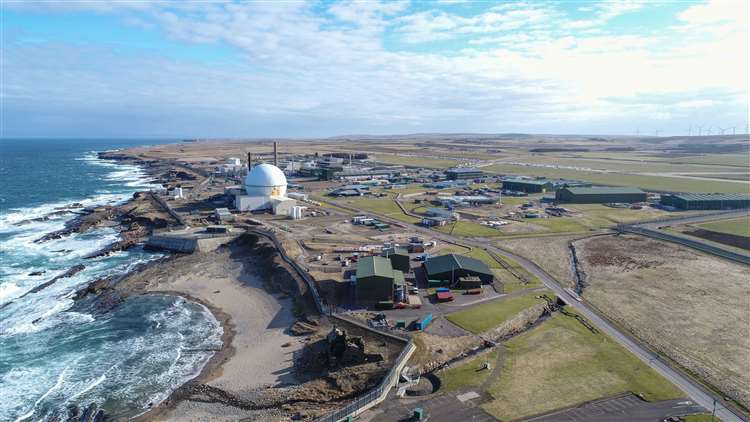
Allan Dorans , SNP MP for Ayr, Carrick and Cumnock:
Workers at the Dounreay nuclear power complex on Scotland’s north coast plan strike action
next month which will further delay the decommissioning of a plant which
started operating in 1955.
The Prospect, Unite and GMB unions are all
involved. The GMB, the main union for nuclear energy workers, champions
alongside Scottish Labour proposals for new nuclear power stations in
Scotland, despite widespread public opposition to them. The union also
helps to fund Labour candidates.
While it is always disturbing to hear of
industrial conflict at a nuclear plant, these strikes will in reality,
relatively speaking, make little difference to the decommissioning process.
Why? Decommissioning began in 2019 and the plan envisages taking 50-60
years to complete.
But “complete” doesn’t mean the same to the company
responsible for the clean-up and demolition of Dounreay, Magnox Ltd, what
it means to most of us, and the site will be under surveillance – ie, not
usable – for at least 300 years. Leaving aside for the moment the appalling
financial costs of nuclear decommissioning, rarely mentioned in Scottish
Labour’s campaign material, what about the costs for the local people and
the environment over the last nearly 70 years?
There have been three
significant accidents and countless smaller ones. On May 10, 1977, a
65-metre (213ft) deep shaft at the plant was packed with radioactive waste
with at least 2 kg of sodium and potassium. Seawater flooded in and
reacted violently with the sodium and potassium, blowing the huge steel and
concrete lids off the shaft. The explosion littered the area with
radioactive particles, with around 150 of these being found on the beach in
the following 20 years.
This was, according to the New Statesman in 1995,
the worst nuclear accident ever in the UK. Dounreay was never prosecuted.
Researchers based at Oxford University, reporting – conveniently for some
political forces – in July 2014 revisited earlier studies of the incidence
of leukaemia around Sellafield and Dounreay and concluded that children,
teenagers and young adults currently living close to the facilities were
not at an increased risk of developing cancers.
The researchers, who were
dependent upon UK Government grants for their survival, downplayed two
earlier studies that found a raised risk of leukaemia among 0 to
14-year-olds and 15- to 24-year-olds living within 12.5km of Dounreay
during the period 1979-84. A subsequent study in 1996 reported an excess of
childhood leukaemia and Non-Hodgkin’s Lymphoma (NHL) within 25 km of
Dounreay for the period 1968-93. The researchers do not tell us just how
many cases, how many more children and young adults than expected, had
developed these often-deadly cancers, but 1287 cases near seven nuclear
sites in Scotland were looked at in the second study.
Around Dounreay,
almost twice as many cases as expected were found. The difference was
greatest around Dounreay. If we share the 1287 cases among the seven sites,
we get around 180 cases near Dounreay, of which half or might not have
occurred if the plant had never been built. To, me that’s “significant”
and I feel sure it was for those young people and their families. With
every passing month, it becomes clearer that Scottish Labour must
reconsider their plans for a nuclear Scotland.
The National 29th April 2024
Rolls-Royce pulls plug on UK nuclear factory plans
Rolls-Royce has reportedly downscaled its ambitions to construct nuclear factories in the UK, citing delays in a government design competition for its small modular reactor programme
Dimitris Mavrokefalidis, 04/29/2024, https://www.energylivenews.com/2024/04/29/rolls-royce-pulls-plug-on-uk-nuclear-factory-plans/
Rolls-Royce has reportedly revised its plans to construct nuclear factories in the UK, citing ongoing delays in a government design competition for its small modular reactor (SMR) programme.
Initially proposing two factories, the company has decided to forgo building a pressure vessel manufacturing facility due to time constraints, opting instead to procure heavy pressure vessels from third-party suppliers.
While plans for a second factory focused on building modular units for SMRs continue, the decision highlights the challenges posed by the delayed design competition.
Rolls-Royce has indicated the possibility of revisiting its plans for a pressure vessel factory in the future, depending on the establishment of a robust order pipeline.
A Department of Energy Security and Net Zero spokesperson told Energy Live News: “Our world leading SMR competition aims to be the fastest of its kind, helping secure billions in investment for the UK, meaning cleaner, cheaper and more secure energy in the long term.
“We’ve ended the stop-start approach to nuclear and recently launched a roadmap setting out the biggest expansion of the sector in 70 years, simplifying regulation and shortening the process for building new power stations.
We have already launched the tender phase and Great British Nuclear aims to announce successful bidders by the end of 2024.”
Energy Live News has contacted Rolls-Royce for comment.
Opposing The Gaza Genocide While Supporting Biden Is A Dishonest, Nonsensical Position
CAITLIN JOHNSTONE, APR 29, 2024,
https://www.caitlinjohnst.one/p/opposing-the-gaza-genocide-while?utm_source=post-email-title&publication_id=82124&post_id=144126903&utm_campaign=email-post-title&isFreemail=true&r=1ise1&triedRedirect=true&utm_medium=email
Nobody who claims to oppose the Gaza genocide while simultaneously supporting Joe Biden actually opposes the Gaza genocide. They’re just saying what needs to be said to win approval in the political sector they want the approval of. They’re not taking a moral stand, they’re cultivating an image. They’re building a brand.
One of many possible examples of this ridiculous posturing is Instagram progressive Alexandria Ocasio-Cortez, who has called Israel’s atrocities in Gaza “an unfolding genocide” while continuing to support and defend the US president who’s currently backing that genocide, and who recently attended one of the pro-Palestine campus demonstrations which her president recently smeared as “antisemitic protests”.
What AOC is doing here is attempting to straddle the impossible divide between what progressive Democrats claim their party is about and what it’s actually about in real life. She’s paying lip service to opposing injustice, supporting a ceasefire and siding with anti-genocide activists because that’s the sort of thing progressives are supposed to do, while simultaneously throwing her political support behind an administration that is facilitating injustice, keeping the genocide going, and smearing those who protest against it.
You really couldn’t put together a more incoherent position if you tried. You can’t acknowledge that Israel is committing genocide without also acknowledging that the Biden administration has been actively participating in that genocide. If you acknowledge that Biden is guilty of genocide, then you are acknowledging that he is guilty of the most horrific crime a state leader can possibly commit short of initiating a nuclear exchange.
Once you’ve acknowledged that Biden is guilty of doing pretty much the worst thing any state leader could possibly do, you’ve crossed a threshold. After such an acknowledgement, it is not logically or ethically coherent to follow it by saying you support him anyway because at least he’s a bit nicer to LGBT people than Donald Trump would be, or because he might try a tiny bit harder to reduce global warming.
You’ve acknowledged that he is participating in genocide. Genocide. There’s no “but” that could possibly follow that. It’s like saying “Sure my husband’s a serial killer, but he’s great with the kids.” If someone said that to you, the only conclusion you could possibly come to is that they’re really not all that bothered by the serial killing.
Those who support Israel’s actions in Gaza are the worst people on earth, but at least their position has some kind of integrity. They’re not contradicting themselves by pretending to oppose what they’re actually fine with. They’re not tearing themselves in half trying to straddle two completely incompatible positions while smiling for the camera and pretending it doesn’t hurt. They’re not posturing as compassionate anti-imperialists while serving the evil empire.
Those who are supporting Biden while opposing the destruction of Gaza do not have any kind of integrity. They’re just wearing whatever mask is politically convenient based on the way the winds are blowing on a given moment, while continuing to support the US-centralized empire which cannot be sustained without nonstop tyranny and bloodshed. They are providing social media-friendly soundbites which pay lip service to peace, while their true loyalty lies with the globe-spanning power structure whose existence makes peace impossible.
72 Minutes Until the End of the World?

Carl Sagan’s conclusion is that the enemy is not a foreign nation, it’s the weapons themselves.
The generals that I refer to in that section on the SIOP [Strategic Integrated Operational Plan, the 1960s-era plan for general nuclear war] believed they could fight and win nuclear war, even if it meant killing 600 million people across the globe. That is insane. No one would argue that now.
A new book lays out the frighteningly fast path to nuclear Armageddon.

By KATHY GILSINAN, 04/29/2024 https://www.politico.com/news/magazine/2024/04/29/the-frighteningly-fast-path-to-nuclear-armageddon-00154591
Nuclear war would be bad. Everyone knows this. Most people would probably rather not think through the specifics. But Annie Jacobsen, an author of seven books on sensitive national security topics, wants you to know exactly how bad it would be. Her new book Nuclear War: A Scenario, sketches out a global nuclear war with by-the-minute precision for all of the 72 minutes between the first missile launch and the end of the world. It’s already a bestseller.
It goes without saying that the scenario is fictional, but it is a journalistic work in that the scenario is constructed from dozens of interviews and documentation, some of it newly declassified, as a factual grounding to describe what could happen.
That’s this, in Jacobsen’s telling: A North Korean leader launches an intercontinental ballistic missile at the Pentagon, and then a submarine-launched ballistic missile at a nuclear reactor in California, for reasons beyond the scope of the book except to illustrate what one “mad king” with nuclear weapons could do. A harried president has a mere six minutes to decide on a response, while also being evacuated from the White House and pressured by the military to launch America’s own ICBMs at all 82 North Korean targets relevant to the nation’s nuclear and military forces and leadership. These missiles must fly over Russia, whose leaders spot them, assume their country is under attack (the respective presidents can’t get one another on the phone), and send a salvo back in the other direction, and so on until 72 minutes later three nuclear-armed states have managed to kill billions of people, with the remainder left starving on a poisoned Earth where the sun no longer shines and food no longer grows.
Some scholars, particularly among those who favor large nuclear arsenals as the best deterrent to being attacked with such weapons ourselves, have criticized some of Jacobsen’s assumptions. The U.S. wouldn’t have to court Russian miscalculation by overflying Russia with ICBMs when it has submarine-launched ballistic missiles in the Pacific. Public sources indicate that the president’s six-minute response window is still about in line with what Ronald Reagan noted with dismay in his memoirs. But that assumes he’s boxed into a “launch on warning” policy, something Jacobsen’s sources characterize as a constraint to move before enemy missiles actually strike, but which government policy documents insist is merely an option and not a mandate. (The president could also just decide, contra the deterrence touchstone of “mutual assured destruction,” not to nuke anybody at all in response.)
The book arrives at a time when the countries with the world’s largest nuclear arsenals, the U.S. and Russia, are violently at odds in Ukraine, a Russian state TV host is calling a Russia/NATO conflict “inevitable,” and the Council on Foreign Relations is gaming out scenarios in case the Russians use tactical nukes in Ukraine. Oh, and Iran is closer to a nuclear weapon than ever before. It’s a fair time to ask Jacobsen’s central question — what if deterrence fails? Even if we’d rather not think about it.
This conversation has been edited for length and clarity.
Kathy Gilsinan: The book starts with two missiles out of North Korea and ends with essentially the end of the world 72 minutes later. And the subtitle calls this “a scenario.” Is it a realistic scenario?
Annie Jacobsen: The scenario I chose was pieced together from interviews I did with 46 on-the-record sources and dozens of sources on background, and I ran by them various scenarios to come up with the most plausible scenario that unfolds once it begins. And this is what I came up with. And so far, I haven’t had anyone who actually runs these scenarios for NORAD take issue with the choices that I’ve made and the way in which the decision trees unfold, which makes it all the more frightening.
Gilsinan: Can you walk me through why it would be inevitable that the North Koreans hit us with two and we hit them back with 80?
Jacobsen: Let’s look at the words of General [John] Hyten, former STRATCOM commander, when he did an interview with CNN during former President Donald Trump’s “fire and fury” rhetoric days. And General Hyten said on the record, in a rather “don’t you dare” way, speaking almost directly to North Korea: “If somebody launches a nuclear weapon against us, we launch one back. They launch two, we launch two.”
To drill down a little bit further on that I looked to Dr. Bruce Blair, a former missileer himself. Now he’s deceased, but he became one of the world’s experts on nuclear command and control systems and authority. And he explained in a monograph I cite in the book that it’s far more likely that if North Korea hit the United with one missile, America would send 82 in return. [The monograph, written under the auspices of the anti-nuclear group Global Zero, points to about 80 “aimpoints” relevant to North Korea’s nuclear and other military forces as well as its leadership, but also notes that “graduated and flexible strikes” would be possible. Jacobsen says she relied on other sources to support the assumption the U.S. would attack all the targets.] Everything I did, I linked to an open-source scenario that had been thought through by experts who have dedicated their intellectual prowess to these issues for decades.
Gilsinan: In this scenario, the U.S. responds with ICBMs that have to fly over Russia, with predictable consequences. Why, according to the folks you’ve spoken to, would we risk flying missiles over a nuclear power if we could use submarine-launched missiles from the Pacific Ocean?
Jacobsen: I asked that same question to numerous people, and the most powerful answer came from former Secretary of Defense Leon Panetta himself: “There’s not a lot of thought given to who the hell else may be thinking about doing what … at a time like this.”
Gilsinan: Maybe this is the point of the book. I would like very much to believe that STRATCOM is smarter than me and has thought this through ahead of time.
Jacobsen: Part of the terrifying truth about nuclear war, or if a nuclear exchange were to unfold, is the insane time clock that was put on everything from the moment nuclear launch is detected. This is fact. And so is the fact that the president has only six minutes, that’s the rough time to make this decision. And in that time, the Black Book gets opened; he must make a choice from a counterattack list of choices inside the Black Book. Those choices have been thought through for multiple scenarios, but you can’t possibly take into consideration every contingency in real time, which makes so clear to readers exactly how insane the truth is about the unfolding of the scenario. And the unpredictability of it. And for example, one of the few people that actually read the contents of the Black Book and spoke to me about it in general terms so as not to violate security clearances is Ted Postol [a former assistant to the chief of naval operations]. He’s the one who said to me that every decision was a bad decision.
Gilsinan: Why do we think it’s six minutes specifically? I know that’s in Reagan’s memoirs, but why do we think that is still the case?
Continue readingAlarm over nuclear safety lapses on the Clyde
The Ferret Rob Edwards, April 28, 2024
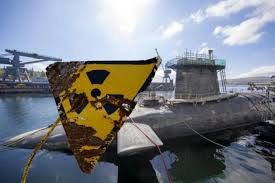
The number of safety incidents that could have leaked radiation at the Trident nuclear base on the Clyde has risen to the highest in 15 years, according to information released by the Ministry of Defence (MoD).
One incident in 2023 at the Faslane base, near Helensburgh, was given the MoD’s worst risk rating. This is the first time this has happened since 2008.
Another four incidents at the base in 2023, and one in 2024, were given the second worst rating. The number in 2023 was the highest since 2006.
According to the MoD’s definitions, all six incidents had “actual or potential for radioactive release to the environment”. In total the MoD logged 179 nuclear safety incidents on the Clyde in 2023 and 2024, though most of them were deemed to be less serious.
The MoD insisted that there had been no “radiological impact” or harm to health from any of the incidents. But it declined to provide any further details for national security reasons.
Campaigners described the rise in serious safety incidents as “alarming” and “chilling”. They condemned the secrecy surrounding the incidents, and called for the MoD to give a “full account” of what happened.
The MoD has released new figures to MPs summarising the number of “nuclear site events” in 2023 and 2024 at Faslane and the nearby nuclear bomb store at Coulport.
A total of 158 incidents of all kinds were recorded for 2023, plus 21 so far in 2024. All but six of the incidents were in three less serious categories, suggesting they posed lower risks.
According to the MoD, the incidents included “equipment failures, human error, procedural failings, documentation shortcoming or near-misses”. But it gave no further descriptions of any of the six more serious incidents.
One incident at Faslane in 2023 was rated as “category A”, the highest risk rating used by the MoD. It has defined such incidents as having an “actual or high potential for radioactive release to the environment” in breach of safety limits.
The last category A incident reported by the MoD was in 2008 when radioactive waste leaked from a barge at Faslane into the Clyde. There were also spillages from nuclear submarines at the base in 2007 and 2006.
The MoD’s figures disclosed four “category B” incidents at Faslane in 2023. This is the highest number of such incidents at the site since 2006, when there were five.
There was another category B incident at Faslane in the first four months of 2024, as well as two in 2022 and three in 2021. The MoD has defined such incidents as having an “actual or high potential for a contained release”, or an “actual or potential for radioactive release to the environment” below safety limits.
Nuclear weapons infrastructure ‘dangerously rotting’

“If you watch media followup, you’ll see NO reporting on the substance, e.g the fact that our nuclear weapons infrastructure is dangerously rotting & is tens of billions secretly in the hole, with huge knockon effects beyond its destructive effects on MoD which has got *even worse* & *even more lying* during the war.
The entire puerile election debate will be based on fake budget numbers that will then be given to Starmer on above-STRAP3 yellow paper, with him given the same nudge to classify, punt and lie. Nobody will report on all this & MPs will continue to ignore it...Dominic Cummins, Substack 31 Dec 2023
The latest figures were released in response to a parliamentary question by the SNP MP for Edinburgh North and Leith, Deidre Brock. In previous questions, she has obtained information on nuclear safety events at Faslane and Coulport back to 2006.
“My annual questions to UK ministers have exposed steadily declining nuclear safety standards at Faslane and Coulport, but the increase in the severity of incidents last year is particularly alarming,” she told The Ferret.
“Reports detailing these incidents should be made public again so that people of Scotland – including those who live near the bases – can weigh up for themselves the risks created by the storage of these nuclear warheads.”
She accused the MoD of “playing down” the safety breaches, pointing out that in December 2023 the former Prime Minister Boris Johnson’s senior advisor, Dominic Cummins, described the UK’s nuclear weapons infrastructure as “dangerously rotting”.
Brock said she would be submitting further parliamentary questions asking for details of the more serious incidents in 2023 and 2024. “But it shouldn’t take the digging of individual MPs or journalists to get piecemeal bits of information from the MoD,” she argued.
The Scottish Campaign for Nuclear Disarmament branded the category A incident at Faslane as “chilling”. The UK’s nuclear weapons were a “catastrophe in waiting”, said the campaign chair, Lynn Jamieson.
She accused the UK government of wanting to suppress “bad news” about nuclear weapons.
The Nuclear Information Service, which researches and criticises nuclear weapons, called for the MoD to give a “full account” of what happened. “This is very concerning, and shows there are clearly problems with safety standards at Faslane,” said the service’s director, David Cullen.
He pointed out that there had been another “serious workplace safety failure” on a Trident submarine at Faslane in August 2021. The UK Office for Nuclear Regulation issued an improvement notice after an “electrical overload”………………………………………………… https://theferret.scot/nuclear-safety-lapses-clyde-alarm/
Why Iran may accelerate its nuclear program, and Israel may be tempted to attack it
Bulletin, By Darya Dolzikova, Matthew Savill | April 26, 2024
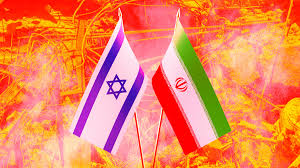
On April 19, Israel carried out a strike deep inside Iranian territory, near the city of Isfahan. The attack was apparently in retaliation for a major Iranian drone and missile attack on Israel a few days earlier. This exchange between the two countries—which have historically avoided directly targeting each other’s territories—has raised fears of a potentially serious military escalation in the region.
Israel’s strike was carried out against an Iranian military site located in close proximity to the Isfahan Nuclear Technology Center, which hosts nuclear research reactors, a uranium conversion plant, and a fuel production plant, among other facilities. Although the attack did not target Iran’s nuclear facilities directly, earlier reports suggested that Israel was considering such attacks. The Iranian leadership has, in turn, threatened to reconsider its nuclear policy and to advance its program should nuclear sites be attacked.
These events highlight the threat from regional escalation dynamics posed by Iran’s near-threshold nuclear capability, which grants Iran the perception of a certain degree of deterrence—at least against direct US retaliation—while also serving as an understandably tempting target for Israeli attack. As tensions between Israel and Iran have moved away from their traditional proxy nature and manifested as direct strikes against each other’s territories, the urgency of finding a timely and non-military solution to the Iranian nuclear issue has increased.
A tempting target. While the current assessment is that Iran does not possess nuclear weapons, the Islamic Republic maintains a very advanced nuclear program, allowing it to develop a nuclear weapons capability relatively rapidly, should it decide to do so. Iran’s “near-threshold” capability did not deter Israel from undertaking its recent attack. But Iran’s nuclear program is a tempting target for an attack that could have potentially destabilizing ramification: The program is advanced enough to pose a credible risk of rapid weaponization and at a stage when it could still be significantly degraded, albeit at an extremely high cost.
Iran views its nuclear program as a deterrent against direct US strikes on or invasion of its territory, acting as an insurance policy of sorts against invasion following erroneous Western accusations over its nuclear program, ala Iraq in 2003. That’s to say, during an attempted invasion, Iran could quickly produce nuclear weapons……………………………
Israel sees the Iranian nuclear program as an existential threat and has long sought its elimination. For this reason, reports that Israel might have been preparing to target Iranian nuclear sites as retaliation for Iran’s strikes against its territory came as little surprise……………………………………………………………………….
A range of bad options. The possibility of Iranian weaponization and Israeli attacks on Iran’s nuclear sites could lead to a serious escalation spiral and, potentially, a wider military conflict in the region……………………………………………………………
Following past instances of Israeli sabotage against the Iranian nuclear program, Tehran has doubled down—rebuilding damaged sites, hardening facilities, and ramping up its nuclear activity. The same is likely to be true should Iranian facilities be targeted directly this time, only to a greater degree. The shift from a proxy conflict between Iran and Israel to a direct engagement will only increase the value Iran places on its nuclear program as a deterrent against further direct attack on its territory and US military intervention. Should Iran assess that its regional proxies and its missile and drone capabilities have been insufficient to deter Israel from conducting direct strikes against its strategically significant nuclear program, Tehran may see the actual weaponization of its nuclear program as the only option left that can guarantee the security of the Iranian regime……………………………………………………………………………………………………………. more https://thebulletin.org/2024/04/why-iran-may-accelerate-its-nuclear-program-and-israel-may-be-tempted-to-attack-it/?utm_source=Newsletter&utm_medium=Email&utm_campaign=MondayNewsletter04292024&utm_content=NuclearRisk_IranNuclearProgramIsrael_04262024
Biden’s pledge to aid Palestinians is a big, murderous lie
Walt Zlotow, West Suburban Peace Coalition, Glen Ellyn IL 29 Apr 24
President Biden claims to be supporting food, water and medical aid to Palestinians now dying in Gaza from disease, starvation as well as being blown to bits by Biden’s 2000 lb. bombs.
But he knows full well Israel is violation his February 8th directive requiring assurances from Israel that it’s not using U.S. military aid to violate human rights law. Israel’s ongoing genocide of 2,300,000 Palestinians there puts Israel about as far from required compliance with Biden’s edict as the two sides of the Grand Canyon.
Biden’s February 8th directive states that Israel “will facilitate and not arbitrarily deny, restrict, or otherwise impede, directly or indirectly, the transport or delivery of United States humanitarian assistance.”
But Israel is not only blocking most aid from alleviating starvation and disease in Gaza, It’s using Biden’s bombs to attack Palestinian and foreign humanitarian workers from delivering that aid. When it comes to impeding, Israel know what works. Its already killed one American aid worker.
Biden knows this but maintains the fantasy, sadly swallowed whole by many of his reelection supporters, that he’s doing ‘everything he can to aid the staving, disease ridden Palestinians.’
’ Truth is he’s doing everything he can to enable Israel’s grotesque removal of the Palestinians from their Gaza land coveted by Israel.
He’s even conspiring with Israeli Prime Minister Netanyahu to derail the impending indictment of Netanyahu by the International Criminal Court. The indictment is expected this week unless the Netanyahu-Biden genocide tag team can prevent it.
President Biden has bigger problems that losing tens of millions of his 2020 voters, sealing his reelection defeat, by his enabling of Israeli genocide. He may end up a fellow indicted war criminal with Benjamin Netanyahu in the dock at The Hague.
Macron ready to ‘open debate’ on nuclear European defence
French President Emmanuel Macron is ready to “open the debate” about the role of nuclear weapons in a common European defence, he said in an interview published Saturday
https://www.france24.com/en/europe/20240427-macron-ready-to-open-debate-on-nuclear-european-defence 27/04/2024
It was just the latest in a series of speeches in recent months in which he has stressed the need for a European-led defence strategy.
“I am ready to open this debate which must include anti-missile defence, long-range capabilities, and nuclear weapons for those who have them or who host American nuclear armaments,” the French president said in an interview with regional press group EBRA.
“Let us put it all on the table and see what really protects us in a credible manner,” he added.
France will “maintain its specificity but is ready to contribute more to the defence of Europe”.
The interview was carried out Friday during a visit to Strasbourg.
Following Britain’s withdrawal from the European Union, France is the only member of the bloc to possess its own nuclear weapons.
In a speech Thursday to students at Paris’ Sorbonne University, Macron warned that Europe faced an existential threat from Russian aggression.
He called on the continent to adopt a “credible” defence strategy less dependent on the United States.
“Being credible is also having long-range missiles to dissuade the Russians.
“And then there are nuclear weapons: France’s doctrine is that we can use them when our vital interests are threatened,” he added.
“I have already said there is a European dimension to these vital interests.”
Constructing a common European defence policy has long been a French objective, but it has faced opposition from other EU countries who consider NATO’s protection to be more reliable.
However, Russia’s invasion of Ukraine and the possible return of the isolationist Donald Trump as US president has given new life to calls for greater European defence autonomy.
1 This Month
23-25 October – on Zoom – World BEYOND War’s annual global conferenc


Shut down the radiation-damaged Heysham nuclear reactors now
To see nuclear-related stories in greater depth and intensity – go to https://nuclearinformation.wordpress.com

Say No to NASA’s Reckless Nuclear Reactor on the Moon
Say No to NASA’s Reckless Nuclear Reactor on the Moon

-
Archives
- October 2026 (199)
- September 2026 (339)
- August 2026 (330)
- July 2026 (355)
- June 2026 (287)
- May 2026 (306)
- April 2026 (356)
- March 2026 (251)
- February 2026 (267)
- January 2026 (308)
- December 2025 (358)
- November 2025 (359)
-
Categories
- 1
- 1 NUCLEAR ISSUES
- business and costs
- climate change
- culture and arts
- ENERGY
- environment
- health
- history
- indigenous issues
- Legal
- marketing of nuclear
- media
- opposition to nuclear
- PERSONAL STORIES
- politics
- politics international
- Religion and ethics
- safety
- secrets,lies and civil liberties
- spinbuster
- technology
- Uranium
- wastes
- weapons and war
- Women
- 2 WORLD
- ACTION
- AFRICA
- Atrocities
- AUSTRALIA
- Christina's notes
- Christina's themes
- culture and arts
- Events
- Fuk 2022
- Fuk 2023
- Fukushima 2017
- Fukushima 2018
- fukushima 2019
- Fukushima 2020
- Fukushima 2021
- general
- global warming
- Humour (God we need it)
- Nuclear
- RARE EARTHS
- Reference
- resources – print
- Resources -audiovicual
- Weekly Newsletter
- World
- World Nuclear
- YouTube
-
RSS
Entries RSS
Comments RSS

