A new nuclear energy law will likely mean higher utility bills

RADIO IQ | By Michael Pope, May 2, 2024, https://www.wvtf.org/news/2024-05-02/a-new-nuclear-energy-law-will-likely-mean-higher-utility-bills
Customers of Dominion Energy and Appalachian Power might soon start seeing higher electric bills. That’s because of a new law signed by Governor Glenn Youngkin that allows for utilities to make customers pay for the costs of developing nuclear power facilities – things like permitting, for example. The bill was introduced by Senator Dave Marsden of Fairfax County.
“Ratepayers could be responsible for $1.40 a month for up to five years in creating the funds necessary to get through the nuclear regulatory commission process, which is hugely expensive,” Marsden says. “It takes four to five years.”
Utility customers don’t usually pay for things like development, and Josephus Allmond at the Southern Environmental Law Center says this poses a risk for ratepayers.
“The risk is that customers are footing the bill for this development several years, and if it doesn’t come to fruition, then they’ve just spent $500 million or $125 million, depending on the utility you’re talking about, going towards development of something that will never benefit them,” Allmond explains.
The new law goes into effect July 1st, but utilities would need to have any plans approved by the State Corporation Commission. Meanwhile, the clock is ticking on the goal for Virginia to be emissions free by 2050, a benchmark laid out in the Virginia Clean Economy Act.
This report, provided by Virginia Public Radio, was made possible with support from the Virginia Education Association.
US House votes to officially label Israel critics ‘antisemites’
“it would likely chill free speech of students on college campuses by incorrectly equating criticism of the Israeli government with antisemitism.”
Rights groups have warned that the definition could be used to target pro-Palestine protesters on university campuses
News Desk, MAY 2, 2024 https://thecradle.co/articles-id/24681
The US House of Representatives passed a bill on 1 May to expand the federal definition of antisemitism, coming in the wake of widespread pro-Palestine protests on university campuses across the country.
The bill passed in a 320 to 91 vote, and will now go to the Senate for consideration.
If successful, the bill would codify a definition of antisemitism established by the International Holocaust Remembrance Alliance (IHRA). IHRA defines antisemitism as “a certain perception of Jews, which may be expressed as hatred toward Jews. Rhetorical and physical manifestations of antisemitism are directed toward Jewish or non-Jewish individuals and/or their property, toward Jewish community institutions and religious facilities.”
The IHRA definition of antisemitism also includes the “targeting of the state of Israel, conceived as a Jewish collectivity.”
The definition says any comparison between “contemporary Israeli policy” and “that of the nazis” is antisemitic, as well as referring to Israel as “racist.”
This bill could potentially be used to bar funding of any institution perceived as advocating antisemitism, as many university campuses have been recently due to widespread support for the Palestinian cause.
Some have warned that it could specifically be used to confront pro-Palestine protests at US university campuses, which many have accused of being anti-Jewish.
Certain rights groups have criticized the bill for this reason. The American Civil Liberties Union (ACLU) called on members of the House to vote against it, clarifying that US federal legislation against antisemitism already exists.
The bill is “not needed to protect against antisemitic discrimination,” ACLU said, adding that, “Instead, it would likely chill free speech of students on college campuses by incorrectly equating criticism of the Israeli government with antisemitism.”
Campus protests have continued to rage in universities across the US, with violent police crackdowns taking place over the past few days. Dozens of protesters at New York’s Columbia University were aggressively detained by police on Tuesday night when the NYPD raided a building in which the students had barricaded themselves in.
Similar violent arrests involving the use of pepper spray took place at other universities.
Pro-Israel counter-protesters attacked the Gaza Solidarity Encampment at UCLA on 30 April, facing little to no backlash from campus authorities and police. The incident has spurred major outrage and criticism.
On Wednesday evening, riot police surrounded the pro-Palestine encampment at UCLA and are planning to move on the protesters and clear them out.
NATO state rejects €100 billion Ukraine war chest ‘madness’
https://www.rt.com/news/596896-hungary-nato-ukraine-madness/ 02 May 2024
Budapest is opposing a potential €100-billion ($107 billion), five-year NATO plan to fund Ukraine in its conflict with Russia,Hungarian Foreign Minister Peter Szijjarto has said. The draft plan on the military aid fund was presented to member states of the US-led bloc by Secretary General Jens Stoltenberg earlier this week, Szijjarto revealed.
The minister made the remarks on Thursday to Hungarian broadcaster M1 before heading for a ministerial meeting of the Organization for Economic Co-operation and Development (OECD) countries in Paris. Szijjarto said:
“On Tuesday, the NATO member states received the secretary-general’s proposal to raise 100 billion that NATO plans to spend on the war. Since the money is to be collected over five years, this means NATO expects the hostilities to continue for this period.”
Budapest will oppose the initiative and is not planning to participate in arming Kiev or training its soldiers, Szijjarto stressed. The draft plan was presented to the bloc’s member states in its “first reading” and is still a subject to negotiations, the senior diplomat noted.
“In the coming weeks during negotiations we will fight for Hungary’s right to stay away from this madness, from collecting these 100 billion and siphoning them out of Europe.”
Budapest prioritizes the security of its own people before anything else and will do its best to “stay out of war,” Szijjarto explained, adding Hungary’s opinion remains that the conflict can only be resolved through negotiations. Nonetheless, Budapest acknowledges mounting global security issues and wants to be ready to face them, he said.
Szijjarto urged:
“We cannot ignore the threat of a new world war and the preparations for a nuclear war. This madness here in Europe must be stopped.”
Hungary has consistently expressed its opposition to the ever-growing involvement of the US-led NATO bloc – and of the EU – in the Ukrainian conflict, refusing to send arms to prop up Kiev or to train its troops, and forbidding use of its territory to funnel such shipments from third countries.
Budapest has also publicly spoken out against the potential accession of Ukraine into NATO, which has long been one of the key goals of Ukrainian leadership.
New York Times Not Much Concerned About Israel’s Mass Murder of Journalists
HARRY ZEHNER, 1 May 24 https://fair.org/home/nyt-not-much-concerned-about-israels-mass-murder-of-journalists/
A devoted New York Times reader might get the impression that the paper cares deeply about protecting journalists from those who seek to suppress the press.
After all, the Times runs sympathetic features on journalists like Evan Gershkovich, a Wall Street Journal reporter who was detained by Russia over a year ago. The paper (6/3/22) has written stingingly of Russia’s “clamp down on war criticism,” including in a recent editorial (3/22/24) headlined “Jailed in Putin’s Russia for Speaking the Truth.”
It has castigated China for its “draconian” attacks on the press in Hong Kong (6/23/21). The Times has similarly criticized Venezuela for an “expanding crackdown on press freedom” (3/6/19) and Iran for a “campaign of intimidation” against journalists (4/26/16).
Times publisher A.G. Sulzberger, in his keynote address at the 2023 World Press Freedom Day, spoke forcefully:
All over the world, independent journalists and press freedoms are under attack. Without journalists to provide news and information that people can depend on, I fear we will continue to see the unraveling of civic bonds, the erosion of democratic norms and the weakening of the trust—in institutions and in each other—that is so essential to the global order.
‘Targeting of journalists’
Yet since October 7—as Israel has killed more journalists, in a shorter period of time, than any country in modern history—the Times has minimized when not ignoring this mass murder. Conservative estimates from the Committee to Protect Journalists (CPJ) estimate that 95 journalists have been killed in the Israel/Gaza conflict since October 7, all but two being Palestinian and Lebanese journalists killed by Israeli Defense Forces (IDF). Other estimates, like those from the Palestinian Journalists Syndicate (4/4/24), place the number closer to 130. All told, Israel has killed about one out every 10 journalists in Gaza, a staggering toll.
(Two Israeli journalists were killed by Hamas on October 7, according to CPJ, and none have been killed since. Other tallies include two other Israeli journalists who were killed as part of the audience at the Supernova music festival on October 7.)
CPJ (12/31/23) wrote in December that it was “particularly concerned about an apparent pattern of targeting of journalists and their families by the Israeli military.” It noted that, in at least two instances, “journalists reported receiving threats from Israeli officials and IDF officers before their family members were killed.” This accusation has been echoed by groups like Doctors Without Borders. Israel has demonstrably targeted reporters, like Issam Abdallah, the Reuters journalist who was murdered on October 13 (Human Rights Watch, 3/29/24).
In a May 2023 report, CPJ (5/9/23) found that the IDF had killed 20 journalists since 2000. None of the killers faced accountability from the Israeli government, despite the incidents being generally well-documented. Despite its demonstration that Israel’s military has targeted—and murdered—journalists in the past, important context like this report is generally absent from the Times. (The CPJ report was mentioned at the very end of one Times article—12/7/23.)
We used the New York Times API and archive to create a database of every Times news article that included the keyword “Gaza” written between October 7, 2023, and April 7, 2024 (the first six months of the war). We then checked that database for headlines, subheads and leads which included the words (singular or plural) “journalist,” “media worker,” “news worker,” “reporter” or “photojournalist.” Opinion articles, briefings and video content were excluded from the search.
Failing to name the killer
We found that the Times wrote just nine articles focused on Israel’s killing of specific journalists, and just two which examined the phenomenon as a whole.
Of the nine headlines which directly noted that journalists have been killed, only two headlines—in six months!—named Israel as responsible for the deaths. Both of these headlines (11/21/23, 12/7/23) presented Israel’s responsibility as an accusation, not a fact.
Some headlines (e.g., 11/3/23) simply said that a journalist had been killed, without naming the perpetrator. Others blamed “the war” (e.g., 10/13/23).
During this same six-month period, the Times wrote the same number of articles (nine) on Evan Gershkovitch and Alsu Kurmasheva, two US journalists being held on trumped-up espionage charges by Russia.
From October 7 until April 7, the Times wrote 43 stories that mentioned either the overall journalist death toll or the deaths of specific journalists. As noted, 11 of these articles (26%) either focused on the death of a specific journalist or on the whole phenomenon. But in the vast majority of these articles, 32 out of 43 (74%), the killing of journalists was mentioned in passing, or only to add context, often towards the end of a report.
Many of these articles (e.g., 10/25/23, 11/3/23, 11/21/23, 12/15/23) contained a boilerplate paragraph like this one from November 4:
The war continues to take a heavy toll on those gathering the news. The Committee to Protect Journalists said that more news media workers have been killed in the Israel/Hamas war than in any other conflict in the area since it started tracking the data in 1992. As of Friday, 36 news workers—31 Palestinians, four Israelis and one Lebanese—have been killed since Hamas attacked Israel on October 7, the group said.
Saying that “the war” was taking a heavy toll, and listing the number of journalists “killed in the Israel/Hamas war,” the Times‘ standard language on the death toll for reporters omits that the vast majority have been killed by Israel. It does note, however, that these deaths occurred “since Hamas attacked Israel,” suggesting that Hamas was directly or indirectly to blame.
It took a month for the Times to write a single article (11/10/23) focused on what had become “the deadliest month for journalists in at least three decades.” This November article, published on page 8 of the print edition, and apparently not even deserving of its own web page—named “the war” as the killer, managing for its entire ten paragraphs to avoid saying that Israel had killed anyone.
Again, the writing subtly implied that Hamas was to blame for Israel’s war crimes (emphasis added):
At least 40 journalists and other media workers have been killed in the Israel/Hamas war since October 7, when Hamas launched a surprise attack on Israel, making the past month the deadliest for journalists in at least three decades, according to the Committee to Protect Journalists.
There was no mention of Israel’s long pattern of targeting journalists.
Obscuring responsibility
It took until January 30, nearly four months and at least 85 dead journalists into the war, for the New York Times to address this mass murder in any kind of comprehensive manner. This article—“The War the World Can’t See”—aligned with the Times practice of obscuring and qualifying Israeli responsibility for its destruction of Gaza. Neither the headline, the subhead nor the lead named Israel as responsible for reporters’ killings. Israel’s responsibility for the deaths of scores of reporters appeared almost incidental.
The lead positioned the mass death of journalists and the accompanying communications blackout as tragic consequences of “the war”:
o many people outside Gaza, the war flashes by as a doomscroll of headlines and casualty tolls and photos of screaming children, the bloody shreds of somebody else’s anguish.
But the true scale of death and destruction is impossible to grasp, the details hazy and shrouded by internet and cellphone blackouts that obstruct communication, restrictions barring international journalists and the extreme, often life-threatening challenges of reporting as a local journalist from Gaza.
Remarkably, we have to wait until the 11th paragraph for the Times to acknowledge that Israel is responsible for all of the journalists’ deaths in Gaza. Palestinian accusations that Israel is intentionally targeting journalists were juxtaposed, in classic Times fashion, with a quote from the Israeli military: Israel “has never and will never deliberately target journalists,” spokesperson Nir Dinar said, and the suggestion that Israel was deliberately preventing the world from seeing what it was doing in Gaza was a “blood libel.”
This rebuttal was presented without the context that, as discussed earlier, Israel has for decades been accused by human rights groups and other media organizations of intentionally targeting journalists. The article leaves the reader with the general impression that a terrible tragedy—not a campaign of mass murder—is unfolding.
This review of six months of the New York Times’ coverage exposes a remarkable selective interest in threats to journalism. Despite Sulzberger’s lofty rhetoric, the Times seems to only care about the “worldwide assault on journalists and journalism” when those journalists are fighting repression in enemy states.
Australia and the F-35 supply chain: in lockstep with Lockheed

The Australian government has continued arms exports to Israel while assuring Australians it has not sent weapons to Israel for five years
MICHELLE FAHY. MAY 03, 2024, https://undueinfluence.substack.com/p/lockstep-with-lockheed-australia?utm_source=post-email-title&publication_id=297295&post_id=143751160&utm_campaign=email-post-title&isFreemail=true&r=1ise1&triedRedirect=true&utm_medium=email
Australia is one of six western countries that are complicit in the ‘genocidal erasure’ of the Palestinian people by continuing to supply Israel with arms, according to Dr Ghassan Abu-Sittah, a British-Palestinian surgeon and newly elected rector of Glasgow University.
Israel’s relentless bombing campaign has systematically destroyed all of Gaza’s 11 universities plus more than 400 schools, and killed 6,000 students, 230 teachers, 100 professors and deans, and two university presidents.
The elimination of entire educational institutions (both infrastructure and human resources) is ‘scholasticide’ and is a critical component of the genocidal erasure, says Dr Abu-Sittah.
He named the United States, Germany, the United Kingdom, Australia, Canada and France as comprising an ‘axis of genocide’ because they have been supporting the genocide in Gaza with arms, and had also maintained political support for Israel.
Dr Abu-Sittah worked in Gaza for 43 days in the immediate aftermath of the October 7 attacks. His experience was cited in South Africa’s genocide case at the International Court of Justice (ICJ).
In his submission to the ICJ, Dr Abu-Sittah wrote: ‘There was a girl with just her whole body covered in shrapnel. She was nine. I ended up having to change and clean these wounds with no anaesthetic and no analgesic. I managed to find some intravenous paracetamol to give her…her Dad was crying, I was crying, and the poor child was screaming…’
Australia defies the UN
The Albanese government has consistently denied it is supplying weapons to Israel, even as the United Nations pointed a finger directly at Australia, alongside the US, Germany, France, the UK, and Canada, asking these countries to immediately halt all weapons transfers to Israel, including weapons parts, and to halt export licences and military aid.
The Defence Department has refused to answer questions about whether it has halted the arms export permits for Israel that were in place before October 7, the day of Hamas’s deadly attack in Israel.
Defence approved new export permits to Israel after October 7
Defence approved three new export permits to Israel in October 2023, and none in November, December or January (to 29/1), according to figures Defence released following a Freedom of Information (FOI) request I lodged on 29 January.
In a Senate estimates hearing on February 14, the Defence Department revealed it had approved two new export permits to Israel since the Hamas attacks of October 7. Asked for clarification about the timing, Defence’s deputy secretary of Strategy, Policy, and Industry, Mr Hugh Jeffrey, said, ‘Two export permits have been granted since the time of the last estimates’. The previous estimates hearing had been on 25 October 2023.
The Senate Estimates and FOI evidence together show that Defence approved one export permit to Israel prior to October 7 and two in the period October 25–31.
Mr Jeffrey refused to say what items the two new permits covered. Instead he said they ‘would have been agreed on the basis that they did not prejudice Australian national interests under the criterion of the legislation’.
Possible implications
Israel has been using its F-35 fighter jets in its bombardment of Gaza. Australia is one of a number of countries that manufacture and export parts and components into Lockheed Martin’s F-35 fighter jet global supply chain. Given this, there are several reasons why the above information may be significant:
- The head of the F-35 joint program office, Lieutenant General Michael Schmidt, a US Air Force officer, said a year ago that the F-35 program was established with a ‘just in time’ supply chain, where parts arrive just before they’re needed and very little inventory is stockpiled. [Emphasis added.] Lt-Gen Schmidt described that situation as ‘too risky’.
In mid-December, a US Congressional hearing on the F-35 program revealed that the F-35 joint program office had been moving ‘at a breakneck speed to support…Israel…by increasing spare part supply rates’. [Emphasis added.]- More than 70 Australian companies are involved in the global supply chain for the F-35. Several of the companies are the sole global source of the parts they produce. Without them, new F-35 jets cannot be built and those parts in existing jets cannot be replaced. The US recently authorised the transfer to Israel of 25 more F-35s.
The F-35 global supply chain is vulnerable to disruption, which is why Australia could be under pressure to continue meeting supply contracts.
In his testimony to the December 12 Congressional hearing, Lieutenant General Schmidt also made clear the role of the F-35 joint program office in closely supporting Israel:
I had the opportunity to talk with [Israel’s] Chief of Staff just yesterday… [Israel is] very satisfied with [the] performance [the] sustainment enterprise is giving them. We could learn a lot from them in terms of the quickness with which they’re turning airplanes, [plus] all of the things we’re learning ourselves with moving parts around the world in support of a conflict. [Emphasis added.]
Defence Department and Australian industry partnering with F-35 program office
Defence issued a media release on October 30, around the same time it approved the two additional export permits to Israel.
The release announced that Melbourne company Rosebank Engineering had established an important regional F-35 capability that would also contribute to the global F-35 program. The release said Australian industry is playing an increasingly important role in the production and sustainment of the global F-35 fleet and that Rosebank and the Defence Department had partnered with the US F-35 joint program office and Lockheed Martin to establish the new facility.
Lockheed Martin removes information from its website
US multinational Lockheed Martin is the world’s largest arms manufacturer and the prime contractor for the F-35 fighter jet. As the horror of Israel’s war on Gaza has unfolded over the past seven months, there have been court cases and protests targeting the F-35 and its global supply chain.
In this context, Lockheed Martin recently edited the Australian page of its F-35 website to remove the ‘Industrial Partnerships’ section. The text had acknowledged that Australian parts were used in every F-35 fighter jet.
The deleted section can be viewed at the Wayback Machine web archive. This was the opening paragraph:[screenshot on original]
Lockheed Martin has also deleted other information from its website. A feature post about Marand Precision Engineering, another Melbourne-based company supplying the F-35 program, has been removed. The page had described how Marand engineered, manufactured, and now sustains ‘one of the most technically advanced mechanical systems’ ever created in Australia. The system, an engine removal and installation mobility trailer for the F-35, comprises 12,000 individual parts. The page said, ‘Marand has worked in close concert with Lockheed Martin on the F-35 program for many years’ and revealed that in 2022 the company had established a maintenance facility for its F-35 trailer in the US, ‘to better meet Lockheed Martin’s sustainment needs’. The deleted page can be viewed at the Wayback Machine web archive.
Sydney-based Quickstep Holdings is another long-term Australian supplier to the F-35 program. In December 2020, it announced it had produced its 10,000th component for the F-35 program. Quickstep estimated it had completed just 20% of its commitment to the program. The company revealed it manufactures more than 50 individual components and assemblies for the F-35, representing about $440,000 worth of content in each F-35.
Last year, Lockheed Martin also acknowledged that Queensland’s Ferra Engineering had been providing products for the F-35 since 2004 and that it remained a vital partner supporting delivery of the aircraft.
Despite the Albanese government’s persistent and misleading claim that no weapons have been supplied to Israel for the past five years, all of the above companies have supplied parts and components into the F-35’s supply chain during this period.
Threshold for genocide met, says UN Special Rapporteur
On March 26, Francesca Albanese, the UN Special Rapporteur on the Human Rights Situation in the West Bank and Gaza, said, ‘Following nearly six months of unrelenting Israeli assault on occupied Gaza, it is my solemn duty to report on the worst of what humanity is capable of, and to present my findings.’
Ms Albanese said there were ‘reasonable grounds to believe that the threshold indicating the commission of the crime of genocide… has been met’.
On April 5, the UN Human Rights Council adopted a resolution that included a call for an arms embargo on Israel.
Some 28 countries voted in favour of the resolution and 13 abstained. Israel’s two largest suppliers of weaponry, the US and Germany, along with four other countries, voted against it. (The Council has 47 members elected for staggered three-year terms on a regional group basis. Australia is not currently a member.)
The Vow from Hiroshima film is coming on PBS, this month

Gender and Radiation Impact Project 1 May 24, The Vow from Hiroshima film is coming on PBS, this month—You can use this tool, to network, teach and lobby about the nuclear ban treaty (TPNW) that brings HOPE when hope is so needed…
Following the introduction on this video, you will hear Setsuko telling her own story
Setsuko Thurlow survived the atomic bomb attack on her city of Hiroshima, August 6, 1945 and on that day vowed to rid the world of nuclear weapons that killed her friends and family. The Vow from Hiroshima is her story.
Thurlow gave her adult life, to this day, campaigning for the end of nuclear weapons. This film is a biography of a great woman, a civil rights leader, and also the story of the Treaty she helped imagine and bring into the world, the UN Treaty on the Prohibition of Nuclear Weapons. You are invited to join Thurlow in this quest by letting others know they can see this film on PBS, starting this month. The biggest reason anyone should watch this film is if they need to have hope renewed.
They can check their local listings here.
In 2017 Thurlow received the Nobel Peace Prize with ICAN for work to create the new Treaty on the Prohibition of Nuclear Weapons (TPNW). The Treaty continues to garner participation from nations of the world with 93 signatories, and of these, 70 have ratified (as of today May 1, 2024).
The VOW FROM HIROSHIMA tells these intertwined stories of the woman and the world in beautiful detail. It was made by two women who have had significant personal connections with Thurlow. Producer, Mitchie Takeuchi and Director, Susan Strickler did a masterful job creating a 55 minute version of their original feature film for the PBS audience.
This film is an amazing tool to educate yourself, and then share that with others—we all need hope—and Setsuko’s story and the story of the Treaty are brimming with it.
MORE INFO IS HERE: https://www.thevowfromhiroshima.com/
Barrels Of Radioactive Waste Turn Up Off The Coast Of California

by Trisha Leigh, 27 Apr 24, https://twistedsifter.com/2024/04/barrels-of-radioactive-waste-turn-up-off-the-coast-of-california/
Mysterious radioactive waste showing up anywhere would be cause for concern, but today it’s barrels full of it off the coast of Los Angeles.
There is a notorious “graveyard” of discarded barrels off the coast of Los Angeles. They’re half-sucked into the seafloor and now scientists believe they contain not only toxic chemicals, but low-level radioactive waste as well.
For a long time, people assumed the barrels contained a dangerous pesticide called DDT, but this new study, published in Environmental Science & Technology, suggests they contain radioactive isotopes tritium and carbon-14.
These chemicals were once used in hospitals, labs, and industrial operations in the area.
David Valentine, lead researcher at UC Santa Barbara, says this might not be the worst thing they could have learned.
“This is a classic situation of bad versus worse. It’s bad we have potential low-level radioactive waste just sitting there on the seafloor. It’s worse that we have DDT compounds spread across a wide area of the seafloor at concerning concentrations.”
To be clear, they’re both bad, even if one compound might be a little bit worse.
The barrels were first discovered in 2020, and scientists have been working since to analyze the surrounding sediment and water to understand what could be inside of them.
They also went through hundreds of pages of old records to find evidence for who might have been dumping waste in the area.
One of them, California Salvage, could have been dumping radioactive waste.
They had received a permit for disposing of the stuff, but the US Atomic Energy Commission claims this permit was never activated.
There’s pretty much no accountability and no way to retroactively apply any now, either. Researchers say it’s more than possible that the radioactive material was dumped within 150 miles of shore.
The Atomic Energy Commission has a map that shows that, between 1946 and 1970, more than 56,000 barrels of radioactive waste was dumped on the US end of the Pacific Ocean.
Marine radiochemist Ken Buesseler, who was not involved in the study, says these are grim findings.
“The problem with the oceans as a dumping solution is once it’s there, you can’t go back and get it. These 56,000 barrels, for example, we’re never going to get them back.”
As always, it seems today’s scientists are hamstrung by the actions of the past.
And all of the ways we have to correct them aren’t working fast enough to keep up
New Book – The Scientists Who Alerted Us to the Dangers of Radiation.
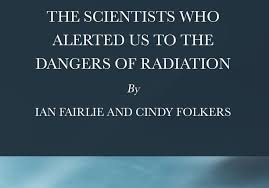
Jim Green, 2 May 24, A new book on radiation risks recently published by The Ethics Press International “The Scientists Who Alerted us to Radiation’s Dangers”. The book was written by myself and a US campaigner Cindy Folkers.
Recent epidemiology evidence clearly shows that radiation risks have increased and that previous denials on radiation risks by successive governments and their nuclear establishment on both sides of the Atlantic were and are wrong. Radiation is considerably more dangerous than official reports indicate, both in terms of the numerical magnitudes of cancer risks, and also in terms of new diseases, apart from cancer, ow shown to be radiogenic.
This is an up-to-date reference book for academics on the dangers and risks of radiation and radioactivity. The book also serves to help journalists and students counter the misrepresentations, incorrect assertions, wrong assumptions, and untruths about radiation risks often disseminated by the nuclear (power and weapons) establishments on both sides of the Atlantic. All scientific statements are backed by evidence via hundreds of references, 14 Appendices, 6 Annexes, a glossary and an extensive bibliography.
At present the book is only available in hardback from the Ethics Press. This is expensive but a 33% discount is available at
In addition, a paperback (~£30) version will be available in November 2024.https://www.amazon.co.uk/Scientists-Who-Alerted-Dangers-Radiation/dp/1804414468
In the meantime, the book’s first three chapters may be sampled at
INTERNATIONAL DARK SKY ASSOCIATION vs. FCC AND SPACEX

https://cellphonetaskforce.org/astronomers-in-court-against-fcc-and-spacex/ Arthur Firstenberg, 1 May 24
On December 29, 2022, the International Dark-Sky Association (IDA) sued the U.S. Federal Communications Commission over its decision to approve SpaceX’s application for up to 30,000 more low-orbit satellites, in addition to the 12,000 already approved and in process of filling our skies. This is Case No. 22-1337 before the United States Court of Appeals for the District of Columbia Circuit, and has not yet been decided by the court.
American plasma physicist Sierra Solter implored the FCC to “please save our night sky… Please, please, don’t take away my stars. To feel that my place of comfort and calm — a starry sky — is being taken away and given to billionaires is suffocating.”
On December 18, 2023, Ms. Solter published a scientific article detailing her fear for our planet. Each of the 42,000 planned Starlink satellites, she wrote, has a design lifespan of only 5 years, after which it will be de-orbited, burned up in the atmosphere, and replaced. She calculated that this will require 23 satellites per day — each the size of an SUV or truck — to be burned up in the atmosphere forever into the future, leaving an enormous amount of toxic chemicals and metallic dust to accumulate in the air we breathe and in the ionosphere
This is already happening, she wrote, and should be stopped if we value our lives. “Since the beginning of the space industry, approximately 20,000 tons of material have been demolished during reentry… This is over 100 billion times greater than [the mass of] the Van Allen Belts.” She estimated that if 42,000 Starlink satellites are deployed and regularly demolished — let alone the 1,000,000 satellites planned by other companies and governments — “every second the space industry is adding approximately 2,000 times more conductive material than mass of the Van Allen Belts into the ionosphere.”
“Unlike meteorites, which are small and only contain trace amounts of aluminum, these wrecked spacecraft are huge and consist entirely of aluminum and other exotic, highly conductive materials,” she explained in an April 16, 2024 article in The Guardian.
Much of the metallic dust will settle into the ionosphere where, she says, it could act as a magnetic shield, reducing the magnitude of the Earth’s magnetic field in space. If that happens, the atmosphere itself could eventually be destroyed, because the Earth’s magnetic field — the magnetosphere — is what deflects the solar wind and prevents it from stripping away Earth’s atmosphere, as she told Teresa Pulterova in an interview on Space.com.
Other astronomers involved in the litigation before the FCC and now the Court of Appeals include Meredith Rawls with the Vera C. Rubin Observatory in Chile; Gary Hunt with Action Against Satellite Light Pollution in the UK; Samantha Lawler at the University of Regina in Canada; Graeme Cuffy of Port of Spain, Trinidad and Tobago; Mark Phillips, President of the Astronomical Society of Edinburgh; Roberto Trotta of the Imperial Centre for Inference and Cosmology in London; Carrie Nugent, Associate Professor of Computational Physics and Planetary Science at the Olin College of Engineering in Massachusetts; and Cameron Nelson of Tenzing Startup Consultants in Virginia.
Other issues are also mentioned in the appeal. For example, the burned up aluminum produces aluminum oxide, which destroys ozone and contributes to climate change. So does the water vapor, soot, and nitrogen oxides in rocket exhaust.
Cameron Nelson told the FCC that “Humans, not to mention all other animal and plant life, have not given our consent for SpaceX to send the signals it is proposing into our bodies and irrevocably alter us.”
The BroadBand International Legal Action Network (BBILAN) mentioned “RF/EMF radiation from linked base and earth stations” in comments sent to the FCC. Starlink earth stations, also called Gateways, are far more powerful than the Starlink dishes that people are putting on their homes. The (as of March 2024) 2.6 million Starlink dishes each send one signal up to the moving network of satellites above them. All of this traffic is coordinated in space by thousands of lasers linking the satellites to one another, and on the ground by Gateways, which relay the thousands of signals in a large geographic area to and from the satellites. This is what a Gateway with 5 antennas (“radomes”) looks like:

Some Gateways have up to 40 radomes. Each of those domes weighs 1750 kilograms. Each aims a narrow beam at moving satellites. According to FCC filings by SpaceX, each beam can have an effective radiated power of more than 1,000,000 watts, which it can aim as low as 25 degrees above the horizon. If you are a bird you do not want to fly anywhere near a Starlink Gateway. And if you are a human you do not want to live near one either. When a satellite aims its beam containing thousands of signals at a Gateway, that beam is about 10 miles in diameter by the time it reaches the Earth.
Robin is a subscriber who lives in a remote area of Idaho less than 3 miles from the Starlink Gateway in Colburn. She writes about effects on her family and her animals…………………………….Robin knows many people in her area who are similarly affected. She adds that “when we first moved here in 2019 we had A LOT of birds. We now have a silent spring, it’s like a dead zone.
At last count there were 277 Starlink Gateways in operation or under construction in the world: 181 in North America and the Caribbean, 26 in South America, 2 in Africa, 26 in Europe, and 42 in Asia and the Pacific.
The FCC maintains a webpage listing thousands of licenses that it has handed out to hundreds of companies to operate both fixed and mobile satellite earth stations in the United States. Some of these stations are far more powerful than the Starlink Gateways. SES’s earth station at Bristol, Virginia emits up to 1,900,000,000 watts of effective radiated power, and it is allowed to aim it as low as 5 degrees above the horizon. SES’s earth station at Brewster, Washington is allowed to emit almost 1,000,000 watts in the actual direction of the horizon! SES owns O3b mPOWER, which is the satellite system that had its first radomes on board the Diamond Princess cruise ship, the ship that had the famous outbreak of disease blamed on COVID-19 at the beginning of the pandemic
Fears raised over Wales accident risk involving aircraft carrying nuclear materials

An air crash involving an RAF aircraft carrying US nuclear materials over South Wales may be the stuff of nightmares, but the Chair of the Welsh Nuclear Free Local Authorities has just written to the First Minister of Wales asking him to contemplate just that possibility.
The Campaign for Nuclear Disarmament and Nukewatch have just published a disturbing briefing titled ‘Special nuclear flights between the UK and US: the dangers involved’. The briefing references the transport of nuclear materials made by RAF C-17 Globemaster flying between RAF Brize Norton in Oxfordshire and airbases in the United States. Around ten such round-trips are made every year to transport nuclear materials utilised for the maintenance of Britain’s nuclear arsenal.
The report says of the route taken by these flights: ‘Aircraft fly from Brize Norton out into the Atlantic, overflying the Cotswolds and then the northern edges of Bristol and Cardiff to reach the Bristol Channel, flying south of Ireland to cross the Atlantic. A variation of this route takes the plane further to the north where it overflies Gloucestershire and the South Wales valleys, heading out to sea over Swansea and the Gower, and, again, South of Ireland.’
Although the C-17 Globemasters involved in these flights are four-engine aircraft, and are subject to an enhanced maintenance regime, so catastrophic mechanical failure is less likely, Welsh Forum Chair Councillor Sue Lent wants Welsh emergency planning authorities to properly consider the likely impact of any accident involving nuclear materials. Cllr Lent serves on Cardiff City Council, one of the municipalities flown over, and one of several South Wales local authorities who are members of the NFLAs.
The First Minister acts as Chair of the Wales Resilience Forum. The Forum ‘supports good communication and improves emergency planning across agencies and services’ acting as a coordinating body for local resilience forums across Wales. These ‘bring together all responder organisations that have a duty to co-operate under the Civil Contingencies Act. The groups also include other organisations who would respond to an emergency. Together, they ensure they prepare for emergencies by working in a coordinated and effective way.’[i]
The Minister of Defence hosts annual Astral Bend exercises ‘to practice and test the emergency response to an accident involving an RAF aircraft transporting special nuclear materials’, but investigative reporter Rob Edwards uncovered evidence that such an exercise held in February 2011 at the Caerwent military base in South Wales identified several failures in the actions of first responders which would have led to ‘“avoidable deaths” in a real-life situation’. The MoD has refused to release details of recent exercises held after 2012 in response to Freedom of Information requests; nonetheless the NFLA Secretary has just submitted one.
Councillor Lent asks First Minister Gething to ‘seek a reassurance from the MoD / RAF that such flights will be diverted out to sea, well away from our South Wales municipalities, and revisit emergency planning arrangements should an accident involving these special nuclear materials occur’ and suggests that as the last exercise conducted at Caerwent appears to be that held in 2011 a follow-up exercise to test the preparedness of Welsh emergency service agencies is ‘long overdue.’
UK government pushing institutional investors to support Sizewell C nuclear project
The UK is seeking institutional investment for its major nuclear project. Lauren Mills speaks to Julia Pyke about the efforts to make it investable
Julia Pyke: Sizewell C has been ‘heavily de-risked’ for pension funds.
Newspaper reports claiming that various UK pension funds will not be
investing in Sizewell C barely ruffle the feathers of Julia Pyke.
She is joint managing director of the £20bn (€23.3bn) nuclear power project on
the Suffolk coast of England. She is responsible for financing and oversees
wider development functions including legal and external affairs. Pyke’s
confidence that Sizewell C will receive both the public and private funding
it needs is based on facts.
The UK government and EDF have picked six
investors to progress to the second round of bidding for the £6bn equity
stake in the project. “UK institutional investors are already interested
and are part of the bidding process,” she says, although she stops short
of naming any names due to non-disclosure agreements.
Earlier this month, IPE Real assets revealed that the UK’s Universities Superannuation
Scheme, fund managers Schroders Greencoat, Equitix and Amber Infrastructure
were all weighing up final bids. All four declined to comment.
Real Assets 29th April 2024
G7 Countries Task IRENA to Monitor Group’s Renewable Energy Progress

IRENA, Abu Dhabi, United Arab Emirates, 30 April 2024 – Today, G7 leaders tasked the International Renewable Energy Agency (IRENA) to track and monitor the group’s collective contribution toward the global renewable tripling target by 2030. The target was established by the UAE Consensus last November at COP28, aligning global climate ambitions with IRENA’s 1.5°C pathway, mapped out by the Agency’s World Energy Transitions Outlook.
“Trust and transparency go hand in hand,” said IRENA Director-General Francesco La Camera, who is attending the G7 Ministers’ Meeting on Climate, Energy and Environment. “IRENA will respond swiftly to the request by G7 members to track the group’s progress toward the global target to triple renewable power capacity by 2030.”
Citing an IRENA brief for the G7, the communiqué indicates that the group’s solar PV expansion target by 2030 is on track if some enhancements to existing policies are made in a timely manner. It notes the need for further acceleration in offshore wind deployment through enhanced and flexible policy efforts, faster permitting, and offshore grid extension.
“The G7 is making notable strides in accelerating solar PV deployment, and there is commitment to the development of offshore wind. Advancing all forms of renewables, along with infrastructure modernisation, will be essential for G7 nations to realise their energy transition aspirations,” Mr. La Camera added.
The G7 communiqué commits the group to increase system flexibility through grid reinforcement, in line with IRENA analysis of key metrics that suggests efforts need to be accelerated. The group also called for the significant expansion of energy storage capacity, by more than six-fold by 2030, from 230 GW in 2022. This falls within the range of IRENA’s recommendations for energy storage capacity by 2030.
I
It also calls on international organisations, including IRENA, to continue their work on industrial decarbonisation particularly standards and technology development for hard-to-abate sectors as outlined in a second brief published as a contribution to the G7 discussions.
G7 countries also recognised the urgent need to increase the group’s efforts in developing countries, committing to supporting the Accelerated Partnership for Renewable Energy in Africa (APRA). Under the auspices of APRA, Kenya and IRENA will convene the first APRA Investment Forum in September 2024 to accelerate the deployment of renewables-based energy systems and green industrialisation in APRA Member countries…………………………. more https://www.irena.org/News/pressreleases/2024/Apr/G7-Countries-Task-IRENA-to-Monitor-Groups-Renewable-Energy-Progress
IAEA’s top nuclear salesman-cum-watchdog to visit Iran
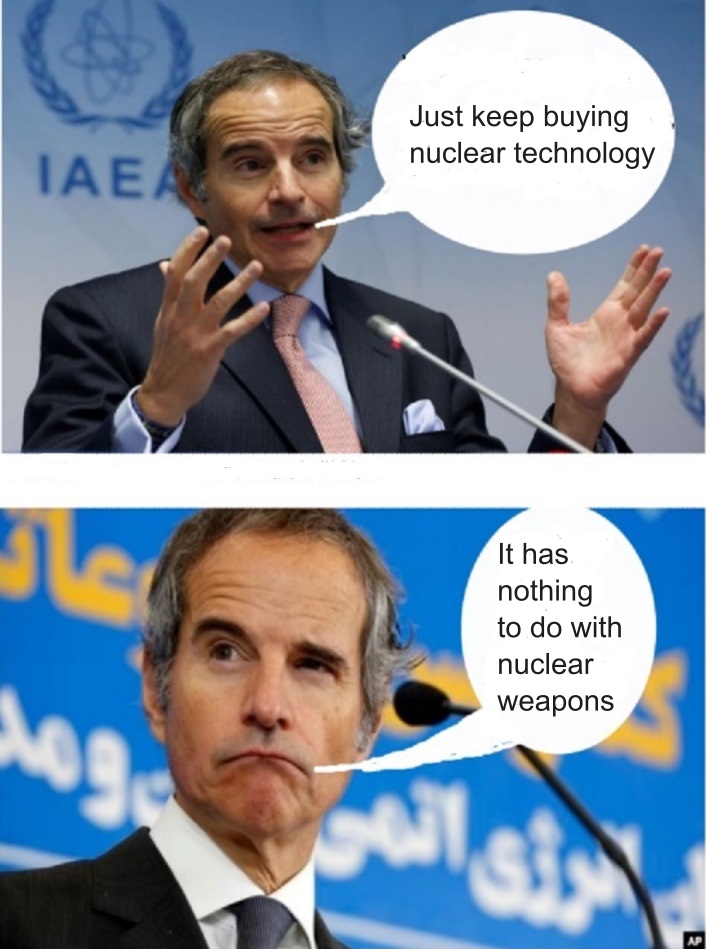
The International Atomic Energy Agency (IAEA) has confirmed that its Director-General, Rafael Grossi, will travel to Iran on May 6 to engage with high-ranking officials.
He will attend the International Conference on Nuclear Science and Technology during the visit, taking place in Isfahan, just months after officials in Iran claimed to be within reach of nuclear weapons. Grossi just days ago also claimed Iran was “weeks not months” from a nuclear weapon.
Im February Grossi admitted a “drifting apart” in relations between the agency and an increasingly defiant Iran.
Grossi noted in the same month that although the rate of uranium enrichment in Iran had decreased slightly since the previous year’s end, Iran continued to enrich uranium at a significant rate of approximately 7 kg per month to 60 percent purity, near weapons grade.
Under the terms of a 2015 agreement with world powers, Iran was only permitted to enrich uranium up to 3.67 percent.
However, after former President Donald Trump withdrew the United States from the agreement in 2018 and reinstated sanctions, Iran exceeded the limits. As a result, the IAEA has stated that the 2015 nuclear deal has “all but disintegrated”.
Industrial action by nuclear submarine workforce hits Rolls Royce
GMB members working on the company’s nuclear submarine programme have
begun industrial action. The action comes after 90 per cent of GMB members
at the company supported action if company bosses failed to present a pay
rise acceptable to union members. Known as ‘work to rule’, the
industrial action will see GMB members applying strict limits to working
outside of pre-agreed processes. Rolls-Royce is a world leader in the field
of submarine technology, as well as being the supplier to Britain’s
domestic nuclear submarine fleet.
UK Defence Journal 30th April 2024
https://ukdefencejournal.org.uk/industrial-action-by-nuclear-sub-workforce-hits-rolls-royce
UK/Ireland Nuclear Free Local Authorities to join new “Rock Solid2” art exhibition

The UK/Ireland Nuclear Free Local Authorities Secretary will be joining Cumbrian artists and activists at the launch of a new art exhibition at Kendal Museum next month.
Rock Solid 2 has been organised by co-ordinator and artist Marianne Birkby. Marianne supports local campaign groups Radiation Free Lakeland / Lakes against the Nuclear Dump in opposing plans to impose a Geological Disposal Facility upon Cumbria. This could be located by the coast in Mid- or South-Copeland to receive Britain’s legacy and future most toxic radioactive waste, which would be transferred from the Sellafield nuclear complex and buried in tunnels beneath the Irish Sea.
Marianne described the exhibition as “a must see for all those who love Cumbria.” She explained that it was “a unique celebration of Lakeland’s jewel-like geology, landscape, flora, and fauna seen through the lens of a ‘quixotic’ plan to bury atomic wastes deep under the Cumbrian coast and the sea. Altogether 20 artists have produced artworks including comic books, installations, sculpture, and multi-media in a vibrant and thought-provoking exhibition.”.
Winner of the John Moore’s Painting Prize, guest artist Martin Greenland will be joined by internationally renowned mountain painter Julian Cooper, record producer Russell Mills, Lake Artist Society award winners Kate Bentley and Andrea Pentecost, Steve Wallis, and Irene Rogan amongst others. Artists have spent time looking at the Museum’s natural history collection for inspiration.
The exhibition will open in the People’s Gallery on 9th May, but a special official launch will be held on Friday 10th May from 6pm to 8pm.
A follow-up talk, titled ‘Atomic Wastes Under Cumbria’, will be held on the following day on Saturday 11th May in The Venue, which is accessed through the Museum.
Kendal Museum can be found on Station Road, Kendal, LA9 6BT. It is a short distance from the railway station.
Everyone is welcome to both events, which are FREE, but attendees are asked to contact the Museum to book a place at the official launch and/or the meeting by email to info@kendalmuseum.org.uk or by telephone on 01539 815597.
NFLA Secretary Richard Outram has been asked to join radiation expert Dr Ian Fairlie in speaking at the official launch and at the meeting.
Following the events, the exhibition will be open to the public on Thursdays, Fridays, or Saturdays from 9.30am to 4.30pm until 29 June. There is also a related art trail to explore around the galleries and shops of Kendal.
Ends//… For more information please contact the NFLA Secretary Richard Outram by email at richard.outram@manchester.gov.uk
1 This Month
23-25 October – on Zoom – World BEYOND War’s annual global conferenc


Shut down the radiation-damaged Heysham nuclear reactors now
To see nuclear-related stories in greater depth and intensity – go to https://nuclearinformation.wordpress.com

Say No to NASA’s Reckless Nuclear Reactor on the Moon
Say No to NASA’s Reckless Nuclear Reactor on the Moon

-
Archives
- October 2026 (199)
- September 2026 (339)
- August 2026 (330)
- July 2026 (355)
- June 2026 (287)
- May 2026 (306)
- April 2026 (356)
- March 2026 (251)
- February 2026 (267)
- January 2026 (308)
- December 2025 (358)
- November 2025 (359)
-
Categories
- 1
- 1 NUCLEAR ISSUES
- business and costs
- climate change
- culture and arts
- ENERGY
- environment
- health
- history
- indigenous issues
- Legal
- marketing of nuclear
- media
- opposition to nuclear
- PERSONAL STORIES
- politics
- politics international
- Religion and ethics
- safety
- secrets,lies and civil liberties
- spinbuster
- technology
- Uranium
- wastes
- weapons and war
- Women
- 2 WORLD
- ACTION
- AFRICA
- Atrocities
- AUSTRALIA
- Christina's notes
- Christina's themes
- culture and arts
- Events
- Fuk 2022
- Fuk 2023
- Fukushima 2017
- Fukushima 2018
- fukushima 2019
- Fukushima 2020
- Fukushima 2021
- general
- global warming
- Humour (God we need it)
- Nuclear
- RARE EARTHS
- Reference
- resources – print
- Resources -audiovicual
- Weekly Newsletter
- World
- World Nuclear
- YouTube
-
RSS
Entries RSS
Comments RSS

