Kiev demands Israel-style security guarantees

https://www.rt.com/russia/596090-yermak-us-security-israel 18 Apr 24
The US must defend Ukraine like it did Israel last weekend, a spokesman for President Vladimir Zelensky has said
Kiev wants security guarantees from its Western backers similar to the level of protection that the US provides Israel, President Vladimir Zelensky’s chief of staff, Andrey Yermak, said on Wednesday.
The Ukrainian government is negotiating a series of treaties intended to seal the country’s pro-Western alignment until it is granted full NATO membership. Officials in Kiev say the deals will secure long-term military assistance from the US and its allies, regardless of political changes that might otherwise prompt donors to cut the aid.
“An agreement between the US and Ukraine must work no worse than the American memorandum with Israel, the effectiveness of which was confirmed by joint actions of the allies during the deflection of the mass attack on Israel by Iran,” Yermak wrote on social media.
Tehran launched a barrage of drones and missiles at Israel last weekend in retaliation for the April 1 airstrike on its consulate in Damascus, which it blamed on the Jewish state.
The long-anticipated move resulted in only “minor damage,” according to Israel, as the US, UK and France used their military assets to help stop most of the Iranian projectiles
The interceptions cost Israel $550 million, according to local defense experts.
Western officials have made it clear that Kiev should not expect the kind of intervention that Israel enjoyed last week.
“Putting NATO forces directly in conflict with Russian forces – I think that would be a dangerous escalation,” British Foreign Secretary David Cameron said on Monday. Instead of “Western planes over [its] skies trying to shoot things down,” Ukraine requires air defense systems, he explained.
Kiev has been urging the US for months to move forward with the appropriation of over $60 billion in aid, which is being blocked by House Speaker Mike Johnson. The discussions that Yermak participated in covered “the action plan right after the US Congress takes a decision on military aid for Ukraine,” he said.
Some US media have speculated that Johnson may yield to pro-Kiev pressure and submit the Senate-approved bill to a vote following the Iranian attack. The bill includes funds for Ukraine, Israel and Taiwan.
No more Russian language on air in three months – Kiev

COMMENT: It is a sad thing to see the Western world, supposed bastion of freedom, individual rights, “multiculture”…. complacently agreeing with the cultural repression that is going on in Ukraine.
Ukraine has long been a bilingual country, and also a country which valued the very good parts of its Russian heritage.
It’s one thing to trash and destroy Ukrainian cultural history, like the memory of Catherine the Great – who promoted public health and education, especially for women, and who established Kiev as a centre of the arts.
Even worse is the frenzied nationalism that punishes the quite large minority of Russian-only speakers across Ukraine, and especially in the Donbass area.
Thu, 18 Apr 2024 , https://www.sott.net/article/490743-No-more-Russian-language-on-air-in-three-months-Kiev
Ukraine’s goal of eradicating bilingual media content has almost been achieved, the government has claimed
Ukraine’s ban on using the Russian language in the media will take full effect three months from now, Kiev’s state language protection commissioner, Taras Kremin, has said.
Since gaining independence, Ukraine has been a bilingual nation, with most citizens able to speak or understand both Russian and Ukrainian. After the US-backed coup in Kiev in 2014, the new nationalist authorities adopted policies aimed at suppressing the Russian language, on the grounds of national unity and security.
The restrictions include a requirement for national media to predominantly use Ukrainian in broadcasts. The permitted share of content in Russian has declined from 40% in 2016 to an almost complete ban, which will come into force in July – the deadline that Kremin referred to in his statement on Wednesday.
“Today national television channels practice bilingual Ukrainian-Russian programming, in which participants use the Russian language without a translation or subtitles,” he said. “Starting on July 17, this practice will end. There will be more Ukrainian language!”
The push by Ukrainian nationalist leaders to impose the state language on Russian-speakers living in the east of the country was a major reason for locals’ rejection of the post-coup authorities. One of the first acts of those who seized power in Kiev was to abolish a law adopted in 2012, which gave the Russian language official regional status.
The new authorities have been adopting laws to eradicate Russian from all spheres of public life, including education, entertainment, and even services provided by private businesses.
In an interview last year, Kremin denied that some Ukrainian citizens could be called Russian-speaking, describing the term was “a marker introduced by Russian ideology,” and declared that “everyone in the country must have a command of the Ukrainian language.”
In contrast, this week the leader of another post-Soviet nation, Kazakhstan, rejected the notion that one language spoken by his people should be favored over others.
“Young people now are fluent in the state [Kazakh] language, in Russian language, in English and other languages, and that is good,” President Kassym-Jomart Tokayev said on Tuesday. “It’s ridiculous to ramp up hysterics over a language, let alone fight against one, as they did in some other states. We all see what they have now as a result.”
The Kazakh leader did not specify which other nations he was referring to.
Comment: The current policies of the Ukrainian government is what the collective west with few exceptions support. If voters in Western countries have difficulties finding out what their governments are about, keep the example of Ukraine in mind. if their government supports them, they might themselves not be far behind in how far they would be willing to go given the chance.
22 Nov, 2023 15:22
‘There are no Russian-speaking Ukrainians’ – Kiev
There is no such thing as a Russian-speaking Ukrainian citizen, Kiev’s state language protection commissioner, Taras Kremin, has declared. In recent years, the country has introduced a frenzy of measures to sever historical and cultural ties with Russia, as it scrambles to strengthen the status of its own language despite accusations of prejudice against national minorities.
In an interview aired by the Ukrainian branch of the US state-run Radio Free Europe/Radio Liberty (RFE/RL), Kremin rejected the suggestion that some Ukrainians could be called “Russophones,” describing the term as “a marker introduced by the Russian ideology.”
“We are all Ukrainian citizens… Ukrainian is the dominant language in all spheres of public life. Regardless of whether it is national communities or foreigners, everyone in the country must have a command of the Ukrainian language,” the ombudsman insisted.
Earlier this year, Kremin stated that Ukrainians who speak Russian should not be referred to as “Russian-speaking,” claiming that the term had been used for decades by “Russian propaganda” to promote internal divisions in Ukraine. Citing a 2021 Constitutional Court ruling, he also insisted there were only Ukrainian citizens who had been “Russianized.”
According to a March 2022 poll by the Sociological Group Rating, about 20% of Ukrainians considered Russian to be their native language. A Social Monitoring survey in 2021 suggested that more than 50% of Ukrainians were willing to read books and watch movies in Russian.
Ukrainian authorities embarked on a campaign to push Russian out of all areas of life immediately after the 2014 Western-backed Maidan coup. The measures sparked widespread public outrage and were among the key reasons behind the hostilities in Donbass.
In 2018, the Ukrainian Constitutional Court overturned a 2012 law granting regional status to the Russian language, while at the same time Kiev adopted initiatives seeking to curb its use in education, mass media, business, and culture.
Russia has repeatedly denounced Ukraine’s language policies. President Vladimir Putin said that Moscow’s military operation against its neighbor was partly to protect people who consider themselves part of Russian culture.
On Monday, the speaker of the Ukrainian parliament, Ruslan Stefanchuk, went as far as to deny the existence of Russian ethnic minorities, arguing that they had no special rights. The statement sparked outrage in Moscow, with Foreign Ministry spokeswoman Maria Zakharova saying the remarks came from “the Nazis of the 21st century.”
4 Apr, 2024 20:19
Zelensky’s comedy partner slams campaign against Russian language
Boris Shefir co-founded the Kvartal 95 (District 95) comedy studio in 2003 with Zelensky and a group of their school friends. Most of these comedians and producers – including Shefir’s brother, Sergey – followed Zelensky into politics, taking prime positions in his administration after he was elected president of Ukraine in 2019.
Shefir was not among them.Speaking to the Ukrainian branch of the US government-funded Radio Free Europe/Radio Liberty (RFE/RL) outlet on Thursday, he said that he has had “no relationship” with Zelensky since the conflict with Russia began in 2022.
“For two years, I have not called or talked to him,” Shefir said. “He is working with other people now. He does not communicate with me, does not call me. My calls remain unanswered.”
“Well, you see, I speak Russian,” he explained. “I love the Russian language, Russian culture…I can’t watch Pushkin’s monuments being destroyed in my country.”
Israeli Settlers, Soldiers ‘Wiping Palestinian Communities Off the Map’ in the West Bank
“While the attention of the world is focused on Gaza, abuses in the West Bank, fueled by decades of impunity and complacency among Israel’s allies, are soaring.”
Jake Johnson. 17 Apr 24, https://www.commondreams.org/news/west-bank-communities-israeli-settlers?utm_source=Common+Dreams&utm_campaign=4bdd8521e2-Top+News%3A+Wed.+4%2F17%2F24&utm_medium=email&utm_term=0_-37878a46b5-%5BLIST_EMAIL_ID%5D
Following the Hamas-led October 7 attack on southern Israel, the Israeli military drafted more than 5,000 settlers into “regional defense” units in the West Bank, Haaretzreported earlier this year. The Israeli newspaper noted that “alongside this large-scale mobilization, the [Israel Defense Forces] has distributed some 7,000 weapons to the battalions as well as to settlers who were not recruited into the army but received them as civilians whom the army considers eligible to carry military arms.”
HRW’s investigation found that “armed settlers, with the active participation of army units, repeatedly cut off road access and raided Palestinian communities, detained, assaulted, and tortured residents,
chased them out of their homes and off their lands at gunpoint or coerced them to leave with death threats, and blocked them from taking their belongings.”
“Israeli settlers and soldiers are literally wiping Palestinian communities off the map,” said Omar Shakir, HRW’s Israel and Palestine director.
“While the attention of the world is focused on Gaza, abuses in the West Bank, fueled by decades of impunity and complacency among Israel’s allies, are soaring.”
The new report comes days after Israeli settlers—escorted by IDF soldiers—went on their latest destructive and deadly rampage in the West Bank, killing at least two Palestinians, injuring dozens, and setting homes and vehicles ablaze. At least 20 households were displaced after Israeli settlers burned down their homes.
The wave of settler violence came after a missing 14-year-old Israeli boy was found dead in the area around the West Bank city of Ramallah. The Israeli military said the boy was killed in a “terrorist attack.”
Since October 7, according to the United Nations, Israeli settlers have launched more than 720 attacks on Palestinians in the West Bank, displacing at least 206 households comprised of 1,244 people—including 603 children. Israeli soldiers in uniform have been present at many of the attacks.
“Settlers and soldiers have displaced entire Palestinian communities, destroying every home, with the apparent backing of higher Israeli authorities,” Bill Van Esveld, associate children’s rights director at HRW, said in a statement Wednesday. “While the attention of the world is focused on Gaza, abuses in the West Bank, fueled by decades of impunity and complacency among Israel’s allies, are soaring.”
HRW’s new report examines five West Bank communities that have come under attack by Israeli settlers, including one in which uniformed Israeli men armed with assault rifles entered tents and destroyed or stole people’s belongings, abused residents, and threatened to kill them if they didn’t leave the area.
“One man in uniform kicked me in the back of my neck,” a Palestinian mother told HRW. “They said, ‘Go to the valley, and if you come back, we will kill you.'”
None of the families forcibly evicted from the five communities examined in the HRW report have been allowed to return home.
“Palestinian children have seen their families brutalized, and their homes and schools destroyed, and the Israeli authorities are ultimately to blame,” Van Esveld said Wednesday. “Senior state officials are fueling or failing to prevent these attacks, and Israel’s allies are not doing enough to stop that.”
Following the latest wave of settler violence in the West Bank this past weekend, a coalition of human rights organizations said in a joint statement Wednesday that “the international community must swiftly and decisively pressure the government of Israel to halt these attacks and urgently de-escalate the situation.”
“With international attention centered on Gaza, the government of Israel has not only allowed settler violence to spiral but also persisted in the expansion of Israeli settlements built on Palestinian land and unlawfully seized Palestinian territory by designating it as ‘state land,’ blatantly violating international law,” the groups noted. “Concerted efforts are needed to tackle the root cause of settler violence by permanently dismantling settlement outposts and ensuring the safe return of displaced Palestinians to their lands.”
Iran warns Israel it knows where its nukes are hidden

https://www.rt.com/news/596196-iran-israel-nuclear-facilities/— 18 Apr 24
An attack on Tehran’s facilities will trigger tit-for-tat retaliation, the IRGC officer in charge of their safety has said.
A senior officer of the Islamic Revolutionary Guard Corps (IRGC) has warned that Tehran is capable of striking Israeli nuclear facilities if its own are hit, according to local media.
Tensions have escalated in the Middle East this month following an alleged Israeli airstrike on the Iranian consulate in Damascus on April 1, in which seven IRGC officers were killed. Tehran retaliated last weekend with a massive barrage of drones and missiles, most of which were reportedly downed by the Jewish state and its Western backers.
The Israeli nuclear compounds “are identified, and the necessary information about all the targets is at our disposal to respond,” IRGC Brigadier General Ahmad Haghtalab, claimed, as quoted by Tasnim, a semi-official news agency associated with the regiment. “We have a hand on the trigger to launch powerful missiles and destroy those targets.”
Tehran has said it considers the incident resolved, but Israel has vowed to strike back without revealing how and when. Reportedly, West Jerusalem is considering further military action, possibly targeting the Iranian nuclear industry. IRGC Brigadier General Ahmad Haghtalab, the officer responsible for safeguarding the Iranian sites, said the Israeli nuclear industry could be hit in retaliation.
The Israeli nuclear industry has a public civilian component as well as a purported military component, the existence of which it neither confirms nor denies. West Jerusalem has an estimated 80 nuclear weapons at its disposal, including 30 gravity bombs and 50 warheads for medium-range ballistic missiles, according to the Stockholm International Peace Research Institute (SIPRI), a leading international security watchdog. Haghtalab didn’t specify which sites Iran had considered for its hypothetical operation.
Israel has been accusing Iran of secretly developing nuclear capabilities of its own for decades. Gilad Erdan, its representative at the UN, claimed last Sunday that Tehran was mere weeks away from building a nuclear weapon, as he urged members of the UN Security Council to consider what would have happened if Iran “could have launched a nuclear bomb” when it attacked his country. These claims were later dismissed by the International Atomic Energy Agency (IAEA).
The Iranian leadership has stated that it considers all weapons of mass destruction incompatible with Islam. Haghtalab, however, assessed that it would be “conceivable” for Tehran to reconsider its “nuclear doctrine and politics,” if Israel keeps threatening its nuclear facilities.
Nuclear sites are normally considered off limits for military action, the general said, but Israel’s attack on the consulate, an internationally-protected diplomatic mission, was proof that it does not care about playing by the rules.
U.S. is building first new nuclear warhead in decades

Gustaf Kilander, Sat, 20 April 2024
The United States is building its first new nuclear warhead in decades but will do so without nuclear testing, according to energy department officials on Wednesday.
The warhead, known as the W93, is set to be used on ballistic missiles launched from submarines. It is being built using funds, $19.8bn, requested by the National Nuclear Security Agency (NNSA) for the 2025 fiscal year, energy secretary Jennifer Granholm and NNSA Administrator Jill Hruby told the Senate Armed Services Committee, according to The Washington Times.
The warhead is in its early design stages at the Los Alamos National Laboratory, the main site for the Manhattan Project which built the first nuclear bombs during World War II.
Production on the warhead is set to begin in the middle of the next decade, the officials testified.
The issue of updating its nuclear capabilities is a top priority for the Pentagon and the nuclear-armed submarines are central to the US nuclear forces. Other parts of the strategic capabilities include bombers and intercontinental ballistic missiles.
“The W93 is a new program of record being established to meet requirements set by the [Department of Defense],” the NNSA states on its site.
“The Navy’s ballistic missile submarine force is the most survivable leg of the Triad and is currently equipped with two warhead types: the W76 and W88. These warheads provide approximately two-thirds of the total U.S. deployed force. The W93 will reduce current over-reliance on the W76 system and will allow the US to keep pace with future adversary threats.”
“All W93 key nuclear components will be based on currently deployed and/or previously tested nuclear designs, as well as extensive stockpile component and materials experience,” the NNSA adds…………………………………….
The Savannah River National Laboratory in South Carolina will produce plutonium pits for the new warhead, requested by now-retired Admiral Charles Richard in late 2020.
It will be built with help from the UK, which will also use the weapon. Admiral Richard had warned of nuclear developments in China, which has doubled its stockpile of nuclear warheads. https://au.news.yahoo.com/us-building-first-nuclear-warhead-143533346.html?guccounter=1&guce_referrer=aHR0cHM6Ly9uZXdzLmdvb2dsZS5jb20v&guce_referrer_sig=AQAAAExkFb73zWCbee9AK_vuFm2BTmp0kiQDmDUXiBzV6qklzWqYIFsX_LXu9LAxNrBCYBq1jiKFYYNtTql41UYxMkGOceFZGslm7ZB2DP56ACiY6zTGQry2jsKbYix7589Hu54kZpAcm6jfdeJQDJs1JEs77sAiMK0vhn8GH6AyXa6s
A new Iranian nuclear deal is being considered
A veteran of the Foreign Office told i: “I don’t think the world realises
how advanced the Iran nuclear programme has got. The issue has long been
how to bring Iran back to some form of a deal.” They suggested Tehran
could have been stepping up work on the nuclear programme while Western
powers were focussed on Russia and China, saying: “When the world’s
attention is elsewhere, they accelerate.”
A source close to the Biden
administration added: “Iran has made it quite clear that it has no
intention of attacking Israel again, unless Israel strikes back in response
to last weekend. The administration believes a diplomatic route is by far
the best route forward, and that both sides can be catered for. “The
president is doing everything he can to avert a war in the Middle East, and
a new Iran nuclear deal is one way being considered to achieve that. It’s
not the only strategy, but it’s on the table.”
iNews 17th April 2024
Biden could try to revive Iran nuclear deal to avert wider war, source says
Continuing Safety Problems with New Waste Isolation Pilot Plant (WIPP) Shaft.
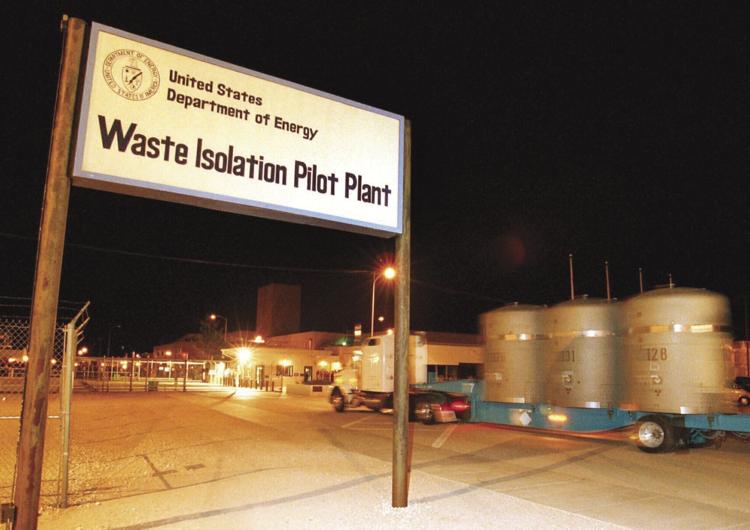
Recent monthly reports by the Defense Nuclear Facilities Safety Board relate disturbing stories about near-miss operational incidents in the fifth shaft, under construction, at the Waste Isolation Pilot Plant (WIPP). The underground federal radioactive waste disposal site is located 2,150 feet below ground surface in a salt formation almost 30 miles east of Carlsbad, New Mexico. The Board has reported broken cables, misaligned transport platforms for workers to reach the underground, and workers stuck in the new shaft. https://www.dnfsb.gov/
On November 20th, 2023, the third incident in that month occurred when a basket for transporting materials fell 2,150 feet down the new shaft. SIMCO, the management and operating contractor at WIPP, issued a formal stop work order to Harrison Western Shaft Sinkers JV, LLC, the subcontractor. Preliminary findings indicate the subcontractor did not implement formal controls for hoisting and rigging activities and allowed informal operator actions to take their place. https://www.dnfsb.gov/sites/default/files/document/29506/WIPP%20Monthly%20Ending%20November%202023.pdf and https://www.dnfsb.gov/sites/default/files/document/29776/WIPP%20Monthly%20Ending%20December%202023.pdf
The Shaft Sinkers hired a safety culture expert to make improvements to the operating practices and procedures. https://www.dnfsb.gov/sites/default/files/document/30376/WIPP%20Monthly%20Ending%20March%202024.pdf
More deficiencies in the @NuScale_Power standard design approval application
Ed Lyman (@NucSafetyUCS): More deficiencies in the @NuScale_Power standard
design approval application: @NRCgov staff are “unable to verify whether
the internal flood analysis has been performed to conclude equipment can
perform their safety function.”
USNRC 31st March 2024
Biden Administration Defies Australia’s Call To End Assange Case, Submits ‘Assurances’ To UK Court
Streamed live on 17 Apr 2024Join Kevin Gosztola, author of “Guilty of Journalism: The Political Case Against Julian Assange,” as he covers the U.S. government’s “assurances” that were submitted to a British appeals court. They represent a clear indication that President Joe Biden’s administration is not going to end the case. If Biden was “considering” a plea deal for Assange, as was reported, he has made the decision to keep pursuing extradition and a U.S. trial on Espionage Act charges.
Nuclear expert fears flooded radioactive dump sites in Siberia can threaten Arctic Ocean
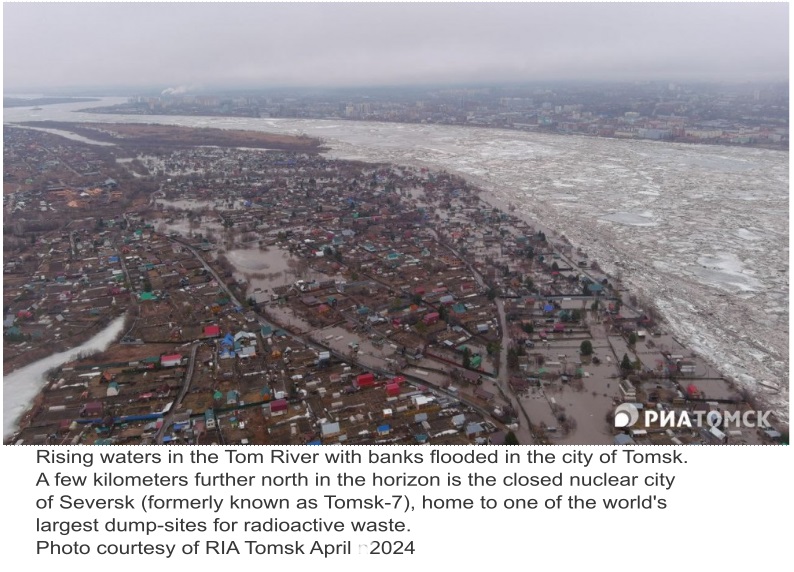
Floodwaters in Tomsk region threatens to submerge the river banks in Seversk where highly radioactive liquid waste from the Soviet Union’s nuclear weapons program for decades were injected into two unprotected underground reservoirs.
Water level on Monday continues to rise in the Tom River in Western Siberia.
The record floods are among the worst ever in the region and local emergency services help in evacuation of people living near tributaries of the Ob river system, including Tobol, Irtysh and Tom rivers.
Thousands of houses and tens of thousands of people live in the emergency zones, according to Kremlin information platform RIA Novosti. High snow falls in winter combined with swiftly rising spring temperatures and heavy rains are the reasons for the current extreme flood, Reuters reports.
Drone photos by RIA Tomsk shows how the swelling Tom River is inundating villages on the westside river banks. According to NEXTA news channel, water in Tom River has risen by nearly a meter over the day.
On the east side, a short 15 kilometers north of the city of Tomsk, is the closed city of Seversk. Until 1992, the secret city was code-named Tomsk-7 and was home to one of three production facilities for weapons-grade plutonium for the Soviet Union’s nuclear weapons program.
“There ain’t one single public message that Rosatom is monitoring the situation, that they have the situation under control,” says Aleksandr Nikitin, an exile nuclear safety expert working for the environmental foundation Bellona.
Nikitin was until the all-out war against Ukraine a member of Rosatom’s Public Council. The Council involved civic organizations and scientists in Russia and was aimed at raising public awareness of Rosatom’s core operations
“It’s surprising that there aren’t even simple statements like we have everything under control,” Nikitin adds.
According to the World Nuclear Association, the Siberian Chemical Combine in Seversk had five plutonium production reactors, an uranium enrichment plant and a processing plant for plutonium warheads. Although shut down, enormous amount of nuclear waste is still on site.
Most challenging are the liquid radioactive waste, both on the surface and pumped down in deep-well injections. The nuclear dump is likely Russia’s largest, by IAEA estimated to be 70 million cubic meters.
Widespread contamination in an area up to 28 kilometers came after a concrete cover blew off a reaction vessel at the plutonium extraction facility in 1993. The International Atomic Energy Agency (IAEA) listed it as a major radiological accident.
In 2000, a joint U.S.-Russian study found dangerous levels of radioactivity flowing into Russia’s Tom River from the Siberian Nuclear Combine.
Critics crumbled
Local environmentalists in Tomsk filed a lawsuit against the company in the late 1990s in an attempt to revoke a dumping permit for highly radioactive liquid waste down under. They feared for the city’s drinking water.
In Putin’s Russia, critical voices are gone. Environmental groups like Greenpeace, World Wide Fund for Nature, and Bellona are all listed as undesirable by law.
TV2 in Tomsk, known for its independent journalism and free debate since the early years after the breakup of the Soviet Union, got its broadcast shut down in 2014. After the start of the full-scale war in 2022, the reporters closed their YouTube producing newsroom and left Russia.
Aleksandr Nikitin is worried radioactivity could leak out to the river system under the current flood, but that information will not come before it is too late.
“Putin doesn’t give a fuck about these floods and other shitty lives of people in Russia.., he has a war and geopolitical goals of fighting the damned West,” Nikitin says.
For Rosatom, he adds, the logic is simple: “.. if you say that everything is under control, and then something happens, then you will have to answer for it.”
Nikitin says Rosatom is sure that in any case it will not bear any responsibility.
“Rosatom is today Putin’s “favorite child,” he explains.
It was Lavrenty Beria, director of Joseph Stalin’s secret police, who lead the establishment of the first plutonium production facilities east of the Ural mountains in the late 1940ties, early 1950ties. KGB and the Soviet nuclear establishment walked hand-in-hand for decades. What nowadays is Ulitsa Pervomayskaya (May 1st Street) in Seversk, was previously named Ulitsa Beria.
Arctic Ocean
A major concern for Aleksandr Nikitin and Bellona is that no one can exclude that leakages from a possible overflowed radioactive waste site could reach the Arctic Ocean.
Tom River is a tributary of the Ob which flows out in the Ob Bay and Kara Sea above the Arctic Circle.
During the years 1948-56, liquid radioactive waste from the Mayak reprocessing plant north of Chelyabinsk was discharged directly into the nearby river Techa which is connected to the river system Iset, Tobol, Irtysh and Ob. Especially Strontium-90, but also other isotopes, were carried by the water more than 2,000 kilometers downstream and measured in the Kara Sea, first time in 1951.
A joint Norwegian-Russian expedition to the Kara Sea in 1994 found traces of the same radionuclides, although in lower levels.
“Everything is now possible,” says Aleksandr Nikitin when seeing the photos of the flooded riverbanks of the Tom River.
“It all depends on the scale of leakages.”
“I’m sure the Siberian Chemical Combine sit quietly and wait. Hoping for it all to go over,” Nikitin says to the Barents Observer.
The climate crisis and nuclear weapons

It seems we haven’t the money to save the planet, but we can stump up any amount to fund nuclear death
NORTH EAST BYLINES, by Caroline Westgate, 15-04-2024
A massive and accelerating crisis faces all of us on Planet Earth: the climate is warming, and we will rapidly reach a point where the damage to our ecosystem will be irreversible. Dismayed by the political inertia which fails to address this emergency, increasing numbers of people are resorting to protest through nonviolent direct action.
International conferences regularly agree on aims but fail to implement action with the urgency and on the scale needed to challenge the hegemony of Big Oil. We are told that the money simply isn’t there.
But here in the UK there is one hugely costly project which, if it were cancelled, would release an income-stream which could be directed to the electorate’s real priorities: the climate crisis, the NHS, education and transport. I’m talking about Trident.
Nuclear weapons
I was five years old when America’s atomic bombs destroyed Hiroshima and Nagasaki. Those events ended WW2 but triggered the Cold War. When the Soviet Union, the UK, France and China acquired their own nuclear arsenals, the Cold War settled into a 35-year stalemate of Mutually Assured Destruction (appropriately dubbed MAD), in which it was assumed that a nuclear exchange would be prevented by a ‘balance of terror’.
But in the 1980s, NATO strategists dropped the MAD policy, because advances in military technology gave them the confidence that they could fight and win a nuclear war: their new nuclear-armed Cruise missiles could launch pre-emptive strikes, capable of destroying the Soviets’ nuclear weapons in their silos.
Ordinary people rapidly realised that this development posed an existential threat to millions of civilians on both sides of the Iron Curtain: we had all been conscripted as front-line troops, expendable pawns in NATO’s nuclear game. A re-energised peace movement vociferously opposed Cruise missiles when they arrived on British soil: they were totally under American control, but they made the UK a target.
Embrace the Base at Greenham Common
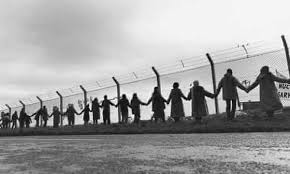
Greenham Common in Berkshire was one of the Cruise sites. In the summer of 1981, a small group of women from South Wales established a peace camp there. During the first winter of their protest they struggled to get any support or publicity. In conditions of great hardship, they kept the camp going. Their protest grew amid evictions, arrests, imprisonments, and physical attacks. One woman was killed. All of this was accompanied by often viciously mendacious press coverage.
In December 1982, I was one of 30,000 women who responded to an unsigned chain letter, inviting us to ‘Embrace the Base’. We joined hands and encircled Greenham’s 9-mile perimeter fence. We decorated it with objects of significance to us, transforming it into a nine mile work of art.
‘Embrace the Base’ was a high-profile event, but small-scale protests were frequently staged with daring, creativity and humour, either by the women who lived at the camp or by autonomous groups of women who travelled to Berkshire to carry out some anarchic plot of their own devising.
In September 1985, with a group of women from the North East, I made the 300-odd mile journey to Greenham again.
My group had hatched a plan to enter the base to access a small outbuilding on which they were going to paint anti-nuclear slogans, and I was there to support them. By that stage it was ludicrously easy to get through the fence because hundreds of women with bolt cutters had reduced it to shreds. The army kept patching it up, but their efforts were futile. The women from my group walked on to the base, slapped a lot of blue gloss paint on the wall of the outbuilding, then stood quietly, dripping brushes in hand, waiting to be arrested. A group of policemen duly arrived and handcuffed them. To my surprise, I was also arrested, even though I was outside the fence and hadn’t actually done anything wrong. We were all charged with criminal damage and summonsed to appear at Newbury Magistrates’ Court a few weeks later.
From the dock, I made a stirring speech to justify protesting at the base. It cut no ice whatsoever. I was found guilty of criminal damage and ordered to pay a fine and costs, which amounted to £67.75p. I refused to pay. The magistrates, who had seen it all before, wearily referred my case to my local court in Hexham. I knew that the length of time to be spent inside would be calculated pro rata from the amount of the fine I’d refused to pay. It worked out at less than a week in prison, which I felt confident I could cope with.
However, time wore on and nobody arrived to take me away. It was getting perilously near Christmas, when I really didn’t want to be away from my family. I enquired of the clerk to Hexham’s Magistrates when the law would come for me. He said:
“They don’t put people like you in prison. It’s much too expensive. We will contact your employer and put an Attachment of Earnings order on your salary.” I realised that my gesture of defiance would pointless if the only person who knew about it would be the wages clerk at County Hall. Since I was going to have to pay anyway, I decided to turn it into a stunt by making the payment on a novelty cheque……………………………………………………………………………………..
The carbon footprint of the UK military
All this is good for a laugh, but what it says about our priorities is far from funny. It is high time we looked at this issue from the perspective of the climate catastrophe, factoring-in what the military contributes to the UK’s carbon footprint. Dr Stuart Parkinson, of Scientists for Global Responsibility, calculates that the annual carbon footprint of the UK military is roughly equivalent to the carbon emissions of six million average cars. Trident must account for a sizeable proportion of that. Of course, the government omits all mention of those figures when it claims we are progressing nicely towards net zero.
The cost of Trident

We also need to challenge why we spend such colossal amounts of money on Trident, when there are so many urgent rival claims on the public purse. The arguments against the possession of nuclear weapons are as valid now as they were when I wrote my novelty cheque nearly forty years ago.
- the moral objection to threatening the deaths of countless numbers of people.
- nuclear weapons make their possessors a target.
- early-warning systems make it more likely that nuclear war will be triggered by accident.
- nuclear war will be followed by nuclear winter, causing ecocide and wrecking forever any chance of addressing climate change.
But let’s focus on the cost of Trident, which falls on the UK at a time when serious investment in public services is urgently needed on a huge scale. The figures bandied about are quoted not in millions but in billions. The difference between those two quantities is so vast it is hard to grasp, so try this analogy: a million seconds would last for about eleven days, but a billion seconds would last for 31 and a half years.
The Nuclear Information Service calculates the cost of Trident as £172 billion (including its new warheads and its running costs over its projected lifetime). That is a stupendous amount of money to lavish on maintaining the fiction that the UK is a world-class power. Neither the Tories nor Labour dares to question that expenditure. By contrast, Labour’s new idea for a Green Investment Fund (a mere £28 billion) was recently cancelled as unaffordable.
Apparently, we haven’t the money to save the planet, but we can stump up any amount to fund nuclear death.
Why are our priorities so badly skewed? https://northeastbylines.co.uk/the-climate-crisis-and-nuclear-weapons/
US Issues Assurances on Assange

The U.S. Tuesday filed assurances on the death penalty and the 1st Amendment, the latter of which Stella Assange called a “non-assurance.”
Joe Lauria, in London, Consortium News, 17 Apr 24, https://consortiumnews.com/2024/04/16/us-issues-assurances-assange/
The United States Embassy on Tuesday filed two assurances with the British Foreign Office saying it would not seek the death penalty against imprisoned WikiLeaks‘ publisher Julian Assange and would allow Assange “the ability to raise and seek to reply upon at trial … the rights and protections given under the First Amendment,” according to the U.S. diplomatic note.
Assange’s wife Stella Assange said the note “makes no undertaking to withdraw the prosecution’s previous assertion that Julian has no First Amendment rights because he is not a U.S citizen. Instead,” she said, “the US has limited itself to blatant weasel words claiming that Julian can ‘seek to raise’ the First Amendment if extradited.”
The note contains a hollow statement, namely, that Assange can try to raise the First Amendment at trial (and at sentencing), but the U.S. Department of Justice can’t guarantee he would get those rights, which is precisely what it must do under British extradition law based on the European Convention on Human Rights.
The U.S. Department of Justice is legally restricted to assure a free speech guarantee to Assange equivalent to Article 10 of the European Convention, which the British court is bound to follow. But without that assurance, Assange should be freed according to a British Crown Prosecution Service comment on extraditions.
In USAID v. Alliance for Open Society, the U.S. Supreme Court ruled in 2020 that non-U.S. citizens outside the U.S. don’t possess constitutional rights. Both former C.I.A. Director Mike Pompeo and Gordon Kromberg, Assange’s U.S. prosecutor, have said Assange does not have First Amendment protection.
Because of the separation of powers in the United States, the executive branch’s Justice Department can’t guarantee to the British courts what the U.S. judicial branch decides about the rights of a non-U.S. citizen in court, said Marjorie Cohn, law professor and former president of the National Lawyers’ Guild.
“Let’s assume that … the Biden administration, does give assurances that he would be able to raise the First Amendment and that the [High] Court found that those were significant assurances,” Cohn told Consortium News‘ webcast CN Live! last month.
“That really doesn’t mean anything, because one of the things that the British courts don’t understand is the U.S. doctrine of separation of powers,” she said.
“The prosecutors can give all the assurances they want, but the judiciary, another [one] .. of these three branches of government in the U.S., doesn’t have to abide by the executive branch claim or assurance,” Cohn said.
In other words, whether Assange can rely on the First Amendment in his defense in a U.S. court is up to that court not Kromberg or the Department of Justice, which issued the assurance on Tuesday.
The United States has issued a non-assurance in relation to the First Amendment,” said Stella Assange
Assange’s legal team now has the right to challenge the credibility and validity of the U.S. assurances filed on Tuesday. The U.S. would then have a right to reply to Assange’s legal submissions to the court, which will hold a hearing on May 20 to determine whether or not to accept the U.S. assurances.
If the court does, Assange can be put on a plane to the U.S. theoretically that day. If not Assange would be granted a full appeal against the Home Office’s 2022 order to extradite him. Assange is wanted in the U.S. on 17 charges under the 1917 Espionage Act and one on conspiracy to commit computer intrusion. He faces up to 175 years in a U.S. dungeon.
“The diplomatic note does nothing to relieve our family’s extreme distress about his future — his grim expectation of spending the rest of his life in isolation in US prison for publishing award-winning journalism,” Stella Assange said.
In its 66-page ruling on March 26, the two High Court judges wrote Kromberg wouldn’t have said Assange would be without First Amendment rights at trial “unless that was a tenable argument that the prosecution was entitled to deploy with a real prospect of success.”
“If such an argument were to succeed it would (at least arguably) cause the applicant [Assange] prejudice on the grounds of his non-US citizenship (and hence, on the grounds of his nationality),” the judges said. They added:
“The applicant wishes to argue, at any trial in the United States, that his actions were protected by the First Amendment. He contends that if he is given First Amendment rights, the prosecution will be stopped. The First Amendment is therefore of central importance to his defence to the extradition charge.”
This is the statement Stella Assange put out on X Tuesday at 11:36 am EDT:
“The United States has issued a non-assurance in relation to the First Amendment, and a standard assurance in relation to the death penalty. It makes no undertaking to withdraw the prosecution’s previous assertion that Julian has no First Amendment rights because he is not a U.S citizen. Instead, the US has limited itself to blatant weasel words claiming that Julian can ‘seek to raise’ the First Amendment if extradited. The diplomatic note does nothing to relieve our family’s extreme distress about his future — his grim expectation of spending the rest of his life in isolation in US prison for publishing award-winning journalism. The Biden Administration must drop this dangerous prosecution before it is too late.”
No Russian heavy weapons at Zaporozhye plant – IAEA boss
https://www.rt.com/russia/596018-no-heavy-russian-arms-zaporozhye/—16 Apr 24
Europe’s largest nuclear power plant was attacked by drones last week
Russia has not stationed heavy weapons at Zaporozhye Nuclear Power Plant, International Atomic Energy Agency (IAEA) Director General Rafael Grossi told reporters on Monday.
Moscow and Kiev have accused each other of shelling Europe’s largest nuclear plant, which sits close to the front line. Ukraine and its Western backers have also accused Moscow of using the facility as cover for its troops.
“There is no heavy weaponry there,” Grossi told reporters, after a UN Security Council meeting dedicated to the renewed strikes on the plant.
Although there are Russian “armored vehicles and some security presence at the plant,” IAEA monitors did not see any prohibited weapons, such as multiple rocket launchers, tanks, and artillery, Grossi explained.
He added that the IAEA does not have the mandate to determine which side has been attacking the facility, and argued that “indisputable evidence” is needed to establish who is responsible.
Addressing the Security Council, Grossi confirmed that Europe’s largest nuclear power plant was struck on April 7, which was the first direct attack on the site since November 2022. Inspectors have determined that the apex of the containment dome of the Unit 6 reactor building was hit, he added. “Whilst the damage to the structure is superficial, the attack sets a very dangerous precedent of the successful targeting of the reactor containment,” Grossi stressed, warning that “these reckless attacks must cease immediately.”
Russian UN Ambassador Vassily Nebenzia told the Security Council that Ukrainian forces have been “systematically” targeting the plant and surrounding areas. The Russian army has been “spotting and intercepting up to 100 drones per week,” Nebenzia added, insisting that Moscow has never placed heavy weapons at the facility or used the plant to stage attacks on Ukraine.
Officials in Kiev have denied striking the nuclear plant. “The position of Ukraine is clear and unequivocal: we are not conducting any military activities or provocations against nuclear sites,” Andrey Yusov, spokesman for Ukraine’s military intelligence, told national TV this month. Andrey Kovalenko, the head of the state-run Center for Countering Disinformation, has accused Moscow of spreading false information and “manipulating the IAEA.”
The agency said in its report this week that all of the facility’s six reactors are currently in cold shutdown. According to the plant’s management, only one reactor had been working since 2022 in order to keep the site operational. IAEA inspectors were deployed to monitor the facility in September 2022.
Survey by East Lindsay District Councillor and Guardians of the East Coast (GOTEC) say ‘85% don’t want nuclear dump’

A new survey by a Theddlethorpe campaign group has shown that after years of the campaign, public opinion remains the same – it’s still a ‘no’ to a nuclear waste dump.
Lincolnshire World, By The Newsroom, 16th Apr 2024,
Travis Hesketh, East Lindsey District Councillor for the Withern and Theddlethorpe Ward, joined forces with the Guardians of the East Coast to host public consultation events during March to gather public opinion on Nuclear Waste Services plans to store nuclear waste at Theddlethorpe Gas Terminal.
As well as asking residents of Theddlethorpe and Sutton on Sea in person and online, village hall events were also held in Carlton, Reston, Mablethorpe, Maltby le Marsh, and Withern.
The results showed that of the 1,008 registered votes, 85 percent of respondents did not want the GDF – the same result found in 2022’s survey – while 7.7 percent were undecided, and the remaining 7.7 percent were for a GDF.
In a statement within the results, Ken Smith, chairman of the GOTEC, said: “After a three year project, the view of the community remains the same – this community does not want a GDF. It is not a willing community.
“There is no change of opinion taking place despite NWS lobbying. It is reasonable therefore to conclude that there is no prospect of gaining community support for the GDF.”………………………………………………….. https://www.lincolnshireworld.com/news/environment/survey-by-eldc-councillor-and-gotec-say-85-dont-want-nuclear-dump-4592761
Eve of destruction. Can war in the Middle East be avoided?
by Stuart McCarthy | Apr 17, 2024 https://michaelwest.com.au/israel-iran-and-the-prospect-of-war/?utm_source=newsletter&utm_medium=email&utm_term=2024-04-18&utm_campaign=Michael+West+Media+Weekly+Update—
Stuart McCarthy dissects the forever conflict.
Spectacular footage of Iranian missiles being intercepted by Israeli air defences in the night skies last weekend is only a portend of what’s at stake if Middle East tensions continue to spiral. As horrific as the human suffering in Gaza has been since October, there’s a risk of worse to come if cool heads don’t prevail. According to UN Secretary-General Antonio Guterres, there is now “a real danger of a devastating full-scale conflict.”
“Benjamin Netanyahu has completely lost his mental balance due to the successive failures in Gaza and his failure to achieve his Zionist goals.”
A history of tension
Tensions between Israel, Iran, and other Middle East and Western actors involved in the escalation go back decades, pre-dating the emergence of Hamas and Al Qaeda’s September 11, 2001 attacks, which drew the West into a ‘global war on terror’ that shaped many of the current animosities.This broader context is crucial in understanding how the Israel-Gaza conflict might reach a ceasefire or the prospects of an enduring two-state solution.
Western interests in the region have long revolved around the flow of oil to the global economy, a too-easily forgotten strategic vulnerability previously exploited by Middle East states in targeting the West’s support for Israel.
Organisation of Arab Oil Exporting Countries’ embargo that triggered the first oil shock of 1973 was a response to western support for Israel during the fourth Arab-Israeli war. That war, in turn, was an attempt by Egypt and Syria to recover the territories lost to Israel during the third Arab-Israeli war in 1967. Those territories included the Golan Heights (Syria), the Sinai Peninsula (Egypt), and the Israeli-occupied territories of the West Bank and the Gaza Strip.
of 1973 was a response to western support for Israel during the fourth Arab-Israeli war. That war, in turn, was an attempt by Egypt and Syria to recover the territories lost to Israel during the third Arab-Israeli war in 1967. Those territories included the Golan Heights (Syria), the Sinai Peninsula (Egypt), and the Israeli-occupied territories of the West Bank and the Gaza Strip.
The second oil shock was a consequence of the 1979 Iranian Revolution. While the complex causes of that revolution remain the subject of debate, among them was a conservative backlash against the country’s secularisation of the Shah of Iran’s western-backed monarchy. The country is now a Shia Islamic theocracy.
The genesis of September 11 and the ensuing Afghanistan and Iraq wars is similarly complex, however among Al Qaeda’s grievances was the predominantly Sunni Arab states’ support of western military presence in the Middle East. Their main strategic objective was to provoke the West into invading the Holy Lands, thus sparking a popular Muslim uprising that would bring about regional or even global theocratic rule under a Wahhabi Caliphate.
The West obliged with its ill-fated 20-year military campaign in Afghanistan and the epic strategic blunder of invading Iraq on a false pretext. Among the outcomes of the latter was the rise of ISIS in Iraq, Syria and its affiliates elsewhere.
Status quo
Today’s Middle East instability – including the role of Islamist terrorism – is largely the result of western interventionism and strategic incompetence, even before we consider the specific question of the Israel-Palestine conflict.
As the West lost its way in a series of quagmires, Iran sought to bolster itself against the threat posed by Israel and its Western allies. Allegiances were forged with Hamas and other regional actors, motivated not necessarily by shared religious ideology but by shared strategic interests in countering Israel, its Western allies, and their Arab state enablers, including Saudi Arabia and Jordan.
Other allies include Hezbollah in Lebanon and, more recently, the Houthis in Yemen. Both have been designated as terrorist organisations by Western governments, each is estimated to have more than 100,000 fighters in addition to significant arsenals of conventional weapons.
Saturday night’s retaliatory missile strikes against Israel have been dismissed by some as a strategic miscalculation, a futile escalation easily thwarted by Israel’s sophisticated air defence systems.
“To dismiss this event so lightly would be to fail to appreciate the broader context, the details of the attack and Iran’s obvious strategic interests.”
Hamas’ importance
The name Hamas translates to “Islamic Resistance Movement.” The significance of the Iran-led strikes last weekend is that these are being heralded – even celebrated by some – as a transition from ‘shadow war’ to overt, conventional military confrontation by a more unified resistance against the Israeli occupation of Palestine.
In the case of Hamas, at least, this movement transcends Sunni-Shia sectarian interests. The movement now also seems prepared to defy western military support for Israel despite the high risks involved, evidenced by the Saudi and western bombing campaign against the Houthis in Yemen.
The resistance movement’s rhetoric has become popular among Western protesters who are pressuring their governments to withdraw support for Israel over concerns about violations of international humanitarian law in Gaza. Protest organisers are now using the explicit threat of “causing pain to the economy.”
Missile strikes no surprise
Saturday’s missile strikes, dubbed Operation True Promise by the IRGC, were telegraphed by Iran for a week. Not only did Iran forewarn Israel and the US, some reports suggest the IRGC also warned Jordan and other Arab states not to intervene “during the punitive attack against the Zionist regime.”
The aerial assault was preceded by the IRGC’s seizure of an Israeli-linked commercial vessel in the Strait of Hormuz, several days after the IRGC’s naval commander boasted of their ability to close the critical shipping lane. The prospect of an actual blockade triggering another global economic shock is one of the main reasons for western naval presence in the Persian Gulf, a subject we will return to in a moment.
According to Israeli and other military sources, the projectiles fired towards Israel on Saturday night included 170 drones, 30 cruise missiles and 110 ballistic missiles, launched from Iran, Iraq, Syria and Yemen. Iranian military leaders announced soon after the launches that this would end their retaliation for Israel’s attack on the Iranian consulate in Damascus if there was no further Israeli escalation.
Hezbollah said it also fired two barrages of rockets at an Israeli military base in the Golan Heights. Most of the Iranian projectiles appear to have been intercepted by Israeli air defences and aircraft from Israel, the US, the UK, France and Jordan. Among those reportedly destroyed by the US were a ballistic missile on its launcher and seven drones in Houthi-controlled areas of Yemen.
The drone and missile attacks apparently targeted Israeli military installations, including the Nevatim Air Force Base in southern Israel. Nevatim is home to Israel’s F-35 fighter jets, including those thought to be involved in the 1 April attack on the Damascus consulate. Four missiles reportedly struck the air base, A fifth was reportedly aimed at a military radar site in northern Israel but missed the target. One child was reportedly injured in southern Israel when an Iranian drone was intercepted overhead.
Iran’s strategy
While Israeli officials have played down any Iranian successes, several independent experts have suggested the strikes were ‘well calibrated’ by Iran. They wanted the strategic effect of retaliating for Israel’s attack on the consulate while deterring further escalation by Israel and minimising the risk of direct military intervention by the US and other Western allies. Ali Vaezoff of the International Crisis Group told CNN:
“This attack crossed a psychological threshold. It’s the first time Iran is striking Israel directly from its own soil, but I think it was also an attack that was designed to be flashy but not fatal.
At time of writing. the Netanyahu war cabinet is reportedly engaged in a “heated debate” over how to respond, while the head of the Iranian military has said, “Our response will be much larger than [Saturday night’s] military action if Israel retaliates against Iran.” President Biden, Arab state leaders and other world leaders have called for Israel and Iran to de-escalate.
The stakes for escalation into full-scale war stretch well beyond the Middle East, including the possibility of another global economic shock. As concerned as many Australians may be for the civilian population of Gaza, such a shock would likely hit home in a way few yet appreciate. One-fifth of the world’s total oil consumption transits through the Strait of Hormuz, with Iran well placed to cause a major disruption using supersonic or hypersonic anti-ship missiles should it wish to do so.
Risk for Australia
Australia is one of the advanced Western economies most vulnerable to such a shock. The demand-led economy of the Covid-19 pandemic saw a decrease in national petroleum fuel consumption of as little as 7%, a decline accounted for mainly by the collapse in air travel, while the road transport sector remained functional.
Our near total dependence on imported oil and refined fuels, our long and vulnerable supply chains, and our negligence in failing to make the necessary preparations promise a significantly worse shock should a full-scale Middle East war break out.
While civil society’s efforts towards an Israel-Palestine ceasefire are laudable, those criticising the parties to this conflict from the comfort of their lounge rooms should perhaps reflect on how their own complacent dependence on a non-renewable resource contributes to the cycle of violence once again engulfing the region.
They might also contemplate life under the theocratic rule espoused by some of the conflict’s main actors. None of this is to diminish Israel’s atrocities in Gaza, but it should give pause to those cheering their favoured ‘side’ in a conflict threatening to spiral out of control.
Meanwhile, let’s hope cool heads prevail in the Middle East.
1 This Month




PLEASE OPPOSE HR 8255 AND S.3639 – bills would accelerate satellite deployment, with no environmental review or safeguards – https://ncstd5li.quorum.us/campaign/169331/
To see nuclear-related stories in greater depth and intensity – go to https://nuclearinformation.wordpress.com
-
Archives
- September 2026 (330)
- August 2026 (330)
- July 2026 (355)
- June 2026 (287)
- May 2026 (306)
- April 2026 (356)
- March 2026 (251)
- February 2026 (267)
- January 2026 (308)
- December 2025 (358)
- November 2025 (359)
- October 2025 (375)
-
Categories
- 1
- 1 NUCLEAR ISSUES
- business and costs
- climate change
- culture and arts
- ENERGY
- environment
- health
- history
- indigenous issues
- Legal
- marketing of nuclear
- media
- opposition to nuclear
- PERSONAL STORIES
- politics
- politics international
- Religion and ethics
- safety
- secrets,lies and civil liberties
- spinbuster
- technology
- Uranium
- wastes
- weapons and war
- Women
- 2 WORLD
- ACTION
- AFRICA
- Atrocities
- AUSTRALIA
- Christina's notes
- Christina's themes
- culture and arts
- Events
- Fuk 2022
- Fuk 2023
- Fukushima 2017
- Fukushima 2018
- fukushima 2019
- Fukushima 2020
- Fukushima 2021
- general
- global warming
- Humour (God we need it)
- Nuclear
- RARE EARTHS
- Reference
- resources – print
- Resources -audiovicual
- Weekly Newsletter
- World
- World Nuclear
- YouTube
-
RSS
Entries RSS
Comments RSS

