The announcement of Wylfa as the favoured site for a new nuclear plant is nothing more than blatant electioneering

27 May 2024, Dylan Morgan, People Against Wylfa B (Pawb) https://nation.cymru/opinion/the-announcement-of-wylfa-as-the-favoured-site-for-a-new-nuclear-plant-is-nothing-more-than-blatant-electioneering/
The morning of May 22 certainly had a feeling of April Fool’s Day about it with the announcement by the energy minister, Claire Coutihno that Wylfa is in the government’s view, a favoured site for building large nuclear reactors.
In case you haven’t been following the planned renaissance of nuclear power in the British State over the past 20 years, Wylfa was included by Tony Blair’s government as one of eight possible new build nuclear sites in 2006.
It is well documented how the German consortium of REW and E.ON set up Horizon Nuclear Power in 2007 with a view to build new reactors at Wylfa.
Following the Fukushima nuclear disaster in 2011 and how that strengthened already strong anti-nuclear views in Germany, the consortium were lucky some months after announcing they would not proceed with Wylfa B in March 2012, to sell Horizon at a profit for £750 million to Hitachi in October 2012.
Hitachi then spent another £1.25 billion on the Wylfa B project until January 2019, before deciding to suspend any more investment.
The project was finally scrapped completely in September 2020.
So Wylfa has been in the government plans for the past 20 years. To pretend that this was somehow a new step was nonsense.
It was nothing more than blatant electioneering on behalf of Virginia Crosbie in her attempt to keep Ynys Môn in the Conservative fold.
Planning Inspectorate
Under Hitachi’s ownership, Horizon presented a full planning application for new nuclear reactors at Wylfa to the Planning Inspectorate who are responsible for evaluating all major infrastructure planning applications.
Independent inspectors were appointed to scrutinise the proposals at public sessions in October 2018 and early spring 2019 and in private group discussions among the inspectors.
Their final report was not published until Hitachi had announced a suspension of investment in the project. Their conclusions were striking to say the least.
“Expert planning officers felt that the proposals failed to meet some of the United Nations’ biological diversity standards and also listed concerns over the project’s impact on the local economy, housing stock and the Welsh language.
“The planning inspectors’ report said there was a lack of scientific evidence put forward by developers to demonstrate that the Arctic and Sandwich tern (seabird) populations around the Cemlyn Bay area would not be disturbed by construction.
There were fears that these birds would abandon the Bay as a result. It also raised wider concerns over the general impact on Cemlyn Bay, the Cae Gwyn site of special scientific interest and Tre’r Gof…
“… it found the influx up to 7500 workers during construction “could even with the proposed mitigation, adversely affect tourism, the local economy, health and wellbeing and Welsh language and culture”.
“It concluded: “Having regard to all the matters referred in this report, the ExA’s conclusion is that, on balance, the matters weighing against the proposed development outweigh the matters weighing in favour of it. The ExA therefore finds the case for development is not made and it recommends accordingly.”
‘Drop in the ocean’
It was reported in Jeremy Hunt’s final budget this spring that the government were going to pay Hitachi £160 million for the Horizon sites at Wylfa and Olbury, a loss of around £600 million for Hitachi.
Even if this payment is made, it is still only a drop in the ocean in the wider context of the cost of nuclear power stations.
When construction started on the only new nuclear project in England at Hinkley Point C in Somerset in 2015 led by the French nuclear developer EdF, the original cost estimate was £18 billion.
That sum has now rocketed to £46 billion with 2031 as the nearest possible completion date. EdF then want to turn their attention to Sizewell C to replicate the work carried out at Hinkley.
If the Hinkley project is completed by sometime in the 2030’s and work is started on Sizewell, that follow-up nuclear build would take another 15 to 20 years taking us to around 2050.
Nuclear skills
Nuclear industry insiders have publicly admitted that the British State only has enough nuclear skills to build one nuclear development in a given period. Indeed, Simon Bowen, the Chairman of Great British Nuclear stated clearly in that body’s blog on 9 September, 2023 that there is a “lack of skills to meet the coming nuclear challenge”.
In another interview on January 29, 2024 to World Nuclear News he underlines what we have always argued, that the civil and military nuclear sectors are intrinsically linked:“…unless we share skills and we find mechanisms for sharing skills across the nuclear sector, both in defence and civil and across the boundaries, then it is going to be very, very difficult to succeed”
Nuclear power is dangerous, dirty, outdated, a huge threat to environmental and human health as the Chernobyl and Fukushima disasters have shown, and extortionately expensive.
It goes totally against the flow of smart money investment in electricity generating projects world wide.
Net loss
The International Energy Agency Annual Report for 2023 published early this year showed another net loss of nuclear power generation leaving it with a 9.2% share of electricity generation worldwide.
For the same year, electricity from the various renewable technologies had increased to 30.2% of the global market. That figure is anticipated to increase to 42% by 2028.
That is just four years away and is a remarkable figure. At that rate of growth, within another decade, renewables can realistically expect to supply over 50% of global electricity.
The world is waking up despite the big oil and nuclear corporations desperately trying to hang on and be relevant.
Future generations will not forgive us if we plough huge amounts of money as taxpayers and through a nuclear tax on our electricity bills into new nuclear reactors in the next twenty years, thereby adding to the huge headache of the legacy radioactive waste of the past 60 to 70 years stored at the decaying Sellafield complex.
All hot radioactive waste produced from high burn up uranium which will be used at Hinkley Point and any other possible new nuclear reactors, will have to be stored on site for at least 150 years.
These are the brutal facts of nuclear power and politicians from all parties contesting the General Election should be challenged, especially if they blindly support nuclear technology which is limping towards irrelevance and oblivion.
WEBINAR 16 June. Gaza and Ukraine to WWIII: The NATO Problem

Start: Sunday, June 16, 2024 at 2:00 AM GMT+10
End: Sunday, June 16, 2024 at 3:30 AM GMT+10
Virtual event
Host Contact Info: david@worldbeyondwar.org
his webinar is free and open to the public. Participants all need to register on this page.
What does NATO have to do with current and looming wars? How does NATO work and what is it working on? How does an alliance whose members and partners make up 69.4% of the world’s military spending shape international relations? What alternatives exist? What is being planned by advocates for peace and demilitarization?
There will be a 24-hour peacewave on June 22:
https://24hourpeacewave.org
A counter-summit and rally will unwelcome NATO to Washington, D.C., in July:
https://nonatoyespeace.org
Click “Register” to sign up and get the Zoom link for this webinar!
NOTE: Be sure to click “yes, opt in…” in order to receive follow up emails about this event (including reminders, zoom links, follow up emails with recordings and notes, etc).
SPEAKERS:……………………………………………………………….more https://actionnetwork.org/events/gaza-and-ukraine-to-wwiii-the-nato-problem?source=direct_link&
—
Iran’s Near Bomb-Grade Uranium Stock Grows Ahead of Election
International Atomic Energy Agency inspectors verified on Monday that
Iran’s stockpile of highly enriched uranium rose 17% over the last three
months, according to a nine-page, restricted report circulated among
diplomats and seen by Bloomberg. That’s enough uranium to fuel several
warheads, should Iran make a political decision to pursue weapons.
Bloomberg 27th May 2024
https://finance.yahoo.com/news/iran-near-bomb-grade-uranium-154724858.html
Pledge sought that laid-up Rosyth subs won’t go to Australia
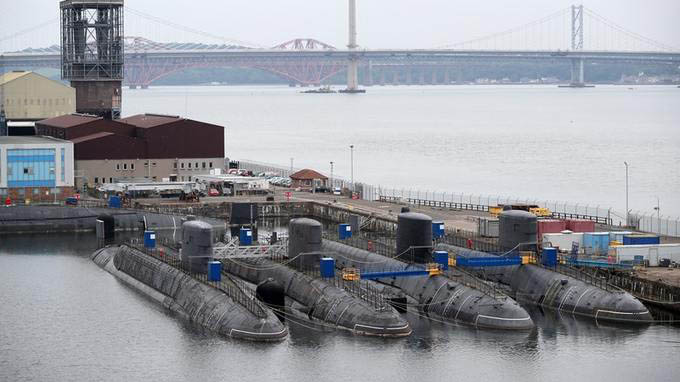
By Clare Buchanan 27 May 24, https://www.dunfermlinepress.com/news/24344727.pledge-sought-laid-up-rosyth-subs-wont-go-australia/
A ROSYTH councillor has called for assurances that rotting nuclear submarines will not be sent to Australia for disposal.
Brian Goodall, who is UK/Ireland Nuclear Free Local Authority’s spokesperson on nuclear submarine decommissioning, said he has written to the UK’s foreign and defence secretaries.
He’s asked for confirmation that vessels will not go overseas if a new Australian law passes without amendments.
Seven old subs have been laid up at Rosyth Dockyard for decades with Dreadnought being there for the longest – more than 40 years – waiting to be scrapped.
The UK and USA signed a pact with Australia to build and operate a new fleet of nuclear submarines which includes the provision of new conventionally armed, but nuclear powered, vessels for the Australian Navy.
To support the pact, legislators down under have proposed a new Australian Naval Nuclear Power Safety Bill 2024.
This appears to allow the disposal of high level radioactive waste from British and American submarines on Australian soil, and also for the storage of such materials in Australia from “a submarine that is not complete”.
In his letter to Lord Cameron and Grant Shapps, Cllr Goodall expressed concern that this could theoretically mean permitting “the towing of redundant UK boats from Rosyth and Devonport down under for disposal”.
He said he fears that this could result in the loss of local expertise and jobs if it comes into practice.
He adds: “Surely as the operators of our own submarines, the UK Government should remain responsible for the storage of the resultant high-level waste and for their safe decommissioning in home ports?
“Not only will this preserve the expertise in these matters that has developed after many years of trial and error, but, as a ward member for the Rosyth Dockyard, it will also preserve the jobs in my local community.”
Back in 2022, the Press reported pledges from the UK Government that all laid-up submarines would be gone as part of plans to “de-nuclearise Rosyth” by 2035.
Councillors were given an update on the programme to remove radioactive waste and turn the seven boats that have been parked at the dockyard for decades into “tin cans and razor blades”.
The Ministry of Defence have previously faced heavy criticism for the delays and sky-high costs in dealing with the nuclear legacy, with 27 Royal Navy subs to be scrapped in total.
US-NATO attack 3 Russian space early warning facilities
South Front 27 May 24
On May 24, the Ukrainian military launched drone strikes on the Voronezh-DM strategic over-the-horizon long-range radar in Armavir in the Krasnodar region. The radar antennas were reportedly damaged.
This facility has nothing to do with the ongoing military operations in Ukraine. Over-the-horizon long-range radar stations of the Voronezh-type are part of the Missile Attack Warning System aimed to detect the launch of ballistic nuclear missiles. This is an element of Russian strategic security, space defense at great distances. It operates in a range of up to 6,000 km and up to 8,000 km in near space, simultaneously monitoring up to 500 different objects.
The Voronezh-DM in Armavir partially controls the territory towards the Indian Ocean, Southern and Central Europe, the Mediterranean Sea, North Africa and the Middle East.
On May 26, there was another attack on the Russian missile warning system that ended in failure. An unidentified drone crashed in the Orenburg region. The incident occurred near the city of Orsk, where another Voronezh-M type radar station is located nearby, it controls the sector from the Taklamakan desert to the shores of the Mediterranean Sea.
It was also revealed that the target of the attack on Crimea on May 23 was the Center for Deep Space Communications, involved in the management of the GLONASS satellite system. The facility located near the city of Alushta was reportedly damaged by 4 US-made ATACMS missiles.
Against this background, it is worth expecting attempts to disable another Russian Voronezh-M type radar station in the Leningrad region. In addition, by the end of 2024, the upgraded Voronezh-type radar station near Sevastopol should be put into operation.
Despite attempts by some European leaders to hide their involvement in the escalation, such attacks are not an independent initiative of Kiev. They were launched by NATO military with NATO missiles, with the reconnaissance support of NATO aircraft………………………………………. https://southfront.press/nato-try-to-inflict-strategic-defeat-on-russia/
Wildfire closes 20+ miles of highway across Hanford nuclear site Saturday night
ICHLAND, WA More than 20 miles of Highway 240 across the Hanford nuclear site and part of Highway 24 was closed by a wildfire for a few hours starting at 6 p.m. Saturday. Wind gusts of up to 26 mph in the area fanning the flames Saturday night.
The Hanford site alerted its employees that Highway 240, sometimes called the Hanford highway, was closed from Highway 225 north of Benton City to the intersection with Highway 24. The highway runs between the section of the nuclear reservation closed to the public and Hanford Reach National Monument land, including Rattlesnake Mountain, also closed to the public. Highway 24 was closed from the Vernita Bridge across the Columbia River to the Silver Dollar cafe, according to Hanford officials.
About 7 p.m. the Washington state Department of Transportation announced the Highway 24 closure but both roadways reopened a few hours later. No information about the specific location of the size of the fire was immediately available.
Uncertainty in UK. Will a Labour government really tread that troubled nuclear power path?
Although technically wedded to the pursuance of new nuclear, whether
Labour in office continues to tread a nuclear path is far from certain.
Labour ministers would face a plethora of competing financial demands from
the onset of their new term in government. In its last period in office
(1997 to 2010), Labour built no new nuclear power plants; consequently, the
civil Nuclear Roadmap may eventually prove to be as washed out as Rishi
Sunak’s rain sodden jacket.
Announcement day was eventful from the onset.
Nuclear Minister Andrew Bowie had been scheduled to meet representatives
from anti-nuclear NGOs in-person at the London offices of his Department of
Energy Security and Net Zero. Others were due to join the Minister online.
Although the meeting had been arranged weeks in advance, Mr Bowie decided
instead to cut and run; there were rumours that Mr Bowie had decided to
make a last-minute trip to Wylfa in North Wales, but, as these have so far
been unsubstantiated, perhaps he was just clearing his desk?
Claire Coutinho in her last act as Energy Secretary had just announced the
non-news that the Wylfa site has been earmarked as the government’s
preferred location for the third gigawatt nuclear power plant. This has
been patently obvious to anyone observing developments in the nuclear
industry for some time. Mr Sunak, and before him Boris Johnson, have
positively gushed over the ‘virtues’ of developing this site over any
others and the recent acquisition of the site with Oldbury for £160
million by Great British Nuclear from former owners Horizon earlier this
year made this choice a certainty.
If built, and remember previous plans
have come to naught, the Wylfa B plant would be similar in size to those in
construction at Hinkley Point C in Somerset and announced for Sizewell C in
Suffolk. Both are being built by French state-owned electricity generator,
EDF, equipped with two European Pressurised Reactors (EPRs) with 3.2
Gigawatt generating capacity.
NFLA 26th May 2024
The Slow-Motion Execution of Julian Assange Continues .
Free speech is a key issue. If Julian is granted First Amendment rights in a U.S. court it will be very difficult for the U.S. to build a criminal case against him, since other news organizations, including The New York Times and The Guardian, published the material he released.
The ruling by the High Court in London permitting Julian Assange to appeal his extradition order leaves him languishing in precarious health in a high-security prison. That is the point.
CHRIS HEDGES, MAY 24, 2024, https://chrishedges.substack.com/p/the-slow-motion-execution-of-julian-986?utm_source=post-email-title&publication_id=778851&post_id=144930141&utm_campaign=email-post-title&isFreemail=true&r=ln98x&triedRedirect=true&utm_medium=email
The decision by the High Court in London to grant Julian Assange the right to appeal the order to extradite him to the United States may prove to be a Pyrrhic victory. It does not mean Julian will elude extradition. It does not mean the court has ruled, as it should, that he is a journalist whose only “crime” was providing evidence of war crimes and lies by the U.S. government to the public. It does not mean he will be released from the high-security HMS Belmarsh prison where, as Nils Melzer, the UN Special Rapporteur on Torture, after visiting Julian there, said he was undergoing a “slow-motion execution.”
It does not mean that journalism is any less imperiled. Editors and publishers of five international media outlets —– The New York Times, the Guardian, Le Monde, El Pais and DER SPIEGEL —– which published stories based on documents released by WikiLeaks, have urged that the U.S. charges be dropped and Julian be released. None of these media executives were charged with espionage. It does not dismiss the ludicrous ploy by the U.S. government to extradite an Australian citizen whose publication is not based in the U.S. and charge him under the Espionage Act. It continues the long Dickensian farce that mocks the most basic concepts of due process.
This ruling is based on the grounds that the U.S. government did not offer sufficient assurances that Julian would be granted the same First Amendment protections afforded to a U.S. citizen, should he stand trial. The appeal process is one more legal hurdle in the persecution of a journalist who should not only be free, but feted and honored as the most courageous of our generation.
Yes. He can file an appeal. But this means another year, perhaps longer, in harsh prison conditions as his physical and psychological health deteriorates. He has spent over five years in HMS Belmarsh without being charged. He spent seven years in the Ecuadorian Embassy because the U.K. and Swedish governments refused to guarantee that he wouldn’t be extradited to the U.S., even though he agreed to return to Sweden to aid a preliminary investigation that was eventually dropped.
The judicial lynching of Julian was never about justice. The plethora of legal irregularities, including the recording of his meetings with attorneys by the Spanish security firm UC Global at the embassy on behalf of the CIA, alone should have seen the case thrown out of court as it eviscerates attorney-client privilege.
The U.S. has charged Julian with 17 counts under the Espionage Act and one count of computer misuse, for an alleged conspiracy to take possession of and then publish national defense information. If found guilty on all of these charges he faces 175 years in a U.S. prison.
The extradition request is based on the 2010 release by WikiLeaks of the Iraq and Afghanistan war logs — hundreds of thousands of classified documents, leaked to the site by Chelsea Manning, then an Army intelligence analyst, which exposed numerous U.S. war crimes including video images of the gunning down of two Reuters journalists and 10 other unarmed civilians in the Collateral Murder video, the routine torture of Iraqi prisoners, the covering up of thousands of civilian deaths and the killing of nearly 700 civilians that had approached too closely to U.S. checkpoints.
In February, lawyers for Julian submitted nine separate grounds for a possible appeal.
A two-day hearing in March, which I attended, was Julian’s last chance to request an appeal of the extradition decision made in 2022 by the then British home secretary, Priti Patel, and of many of the rulings of District Judge Baraitser in 2021.
The two High Court judges, Dame Victoria Sharp and Justice Jeremy Johnson, in March rejected most of Julian’s grounds of appeal. These included his lawyers’ contention that the UK-US extradition treaty bars extradition for political offenses; that the extradition request was made for the purpose of prosecuting him for his political opinions; that extradition would amount to retroactive application of the law — because it was not foreseeable that a century-old espionage law would be used against a foreign publisher; and that he would not receive a fair trial in the Eastern District of Virginia. The judges also refused to hear new evidence that the CIA plotted to kidnap and assassinate Julian, concluding — both perversely and incorrectly — that the CIA only considered these options because they believed Julian was planning to flee to Russia.
But the two judges determined Monday that it is “arguable” that a U.S. court might not grant Julian protection under the First Amendment, violating his rights to free speech as enshrined in the European Convention on Human Rights.
The judges in March asked the U.S. to provide written assurances that Julian would be protected under the First Amendment and that he would be exempt from a death penalty verdict. The U.S. assured the court that Julian would not be subjected to the death penalty, which Julian’s lawyers ultimately accepted. But the Department of Justice was unable to provide an assurance that Julian could mount a First Amendment defense in a U.S. court. Such a decision is made in a U.S. federal court, their lawyers explained.
Assistant U.S. Attorney Gordon Kromberg, who is prosecuting Julian, has argued that only U.S. citizens are guaranteed First Amendment rights in U.S. courts. Kromberg has stated that what Julian published was “not in the public interest” and that the U.S. was not seeking his extradition on political grounds.
Free speech is a key issue. If Julian is granted First Amendment rights in a U.S. court it will be very difficult for the U.S. to build a criminal case against him, since other news organizations, including The New York Times and The Guardian, published the material he released.
The extradition request is based on the contention that Julian is not a journalist and not protected under the First Amendment.
Julian’s attorneys and those representing the U.S. government have until May 24 to submit a draft order, which will determine when the appeal will be heard.
Julian committed the empire’s greatest sin — he exposed it as a criminal enterprise. He documented its lies, routine violation of human rights, wanton killing of innocent civilians, rampant corruption and war crimes. Republican or Democrat, Conservative or Labour, Trump or Biden — it does not matter. Those who manage the empire use the same dirty playbook.
The publication of classified documents is not a crime in the United States, but if Julian is extradited and convicted, it will become one.
Julian is in precarious physical and psychological health. His physical and psychological deterioration has resulted in a minor stroke, hallucinations and depression. He takes antidepressant medication and the antipsychotic quetiapine. He has been observed pacing his cell until he collapses, punching himself in the face and banging his head against the wall. He has spent weeks in the medical wing of Belmarsh, nicknamed “hell wing.” Prison authorities found “half of a razor blade” hidden under his socks. He has repeatedly called the suicide hotline run by the Samaritans because he thought about killing himself “hundreds of times a day.”
These slow-motion executioners have not yet completed their work. Toussaint L’Ouverture, who led the Haitian independence movement, the only successful slave revolt in human history, was physically destroyed in the same manner. He was locked by the French in an unheated and cramped prison cell and left to die of exhaustion, malnutrition, apoplexy, pneumonia and probably tuberculosis.
Prolonged imprisonment, which the granting of this appeal perpetuates, is the point. The 12 years Julian has been detained — seven in the Ecuadorian Embassy in London and over five in high-security Belmarsh Prison — have been accompanied by a lack of sunlight and exercise, as well as unrelenting threats, pressure, prolonged isolation, anxiety and constant stress. The goal is to destroy him.
We must free Julian. We must keep him out of the hands of the U.S. government. Given all he did for us, we owe him an unrelenting fight.
If there is no freedom of speech for Julian, there will be no freedom of speech for us.
Q&A – Germany’s nuclear exit: One year after

CLEAN ENERGY WIRE, FACTSHEET, 16 Apr 2024, Benjamin Wehrmann
Decades of debates came to an end in April 2023, when Germany finally shuttered its last nuclear power plants after the energy crisis. One year on, predictions of supply risks, price hikes and dirty coal replacing carbon-free nuclear power have not materialised.
Instead, Germany saw a record output of renewable power, the lowest use of coal in 60 years, falling energy prices across the board and a major drop in emissions. Industry representatives warn that an effect on power costs may still become visible once Germany’s economy moves out of recession.
At the same time, many countries plan to expand nuclear power, suggesting the country’s phase-out has not found many followers. Yet, global nuclear power market numbers indicate that a nuclear revival is not imminent either. [UPDATES Government advisor says power prices higher due to exit; majority in survey says nuclear exit was a mistake]
Content
- How has the phase-out been conducted?
- Was there any supply security risk in the aftermath?
- What was the gap left by nuclear power filled with?
- What changed in electricity imports and why?
- Did power prices go up due to the phase-out?
- What happens with the retired nuclear plants and waste materials?
- How did the national debate about nuclear power develop?
- How did the nuclear debate move on in the rest of the world?
………………………………………………………………………………………………………………..more https://www.cleanenergywire.org/factsheets/qa-germanys-nuclear-exit-one-year-after—
UK Nuclear Plant Sizewell Continues Fundraising Before Election

- Banks offered to lend as much as £12.5 billion for Sizewell C
By Will Mathis, May 24, 2024
The developer of the UK’s Sizewell C nuclear power plant is pushing ahead to complete
financing for the project this year even as a looming election risks
complicating the timeline.
A group of banks offered to lend as much as
£12.5 billion ($15.9 billion) to help finance the plant in eastern
England, according to a person familiar with the matter. They include HSBC
Holdings Plc, NatWest Group Plc and Banco Santander SA, the person said.
Debt will play a role in a multibillion-pound funding effort that also
includes an ongoing effort to raise equity from private investors.
“The two main political parties are committed to Sizewell C and we are carrying
on with the capital raise, preparing for a final investment decision and
mobilizing teams on our site,” a spokesperson for Sizewell said,
declining to comment on the debt specifically.
HSBC and Santander declined to comment. NatWest didn’t immediately comment.
The government had vowed
to reach a final investment decision on the proposed 3.2-gigawatt Sizewell
C station in the current parliament, a process that was on track to
complete this summer. That means the final stage of the fund-raising
process could be among Labour leader Keir Starmer’s first acts if he
becomes prime minister. “Sizewell needs to move forward at pace,”
Starmer said during a visit to another nuclear plant last year. “New
nuclear has to be part of that mix.”
Bloomberg 23rd May 2024
Blinken lobbying for strikes on Russia – NYT

23 May 2024 , https://www.sott.net/article/491680-Blinken-lobbying-for-strikes-on-Russia-NYT
The top US diplomat wants Ukraine to be given permission to use American weapons beyond its borders
US Secretary of State Antony Blinken is pushing the administration of President Joe Biden to allow Ukraine to attack targets deep inside Russia with American weapons, the New York Times reported on Thursday, referring to unnamed US officials.
The ban, according to the White House, was imposed out of concern that if US arms were used inside what Washington acknowledges as Russian territory it would trigger an escalation and potentially World War III. Blinken has been advocating for scrapping the restriction after making a “sobering” visit to Kiev earlier this month, the newspaper said, citing insider sources.
Ukrainian officials have claimed that being unable to target Russian forces across the border with American weapons led to the failure of its troops to prevent the recent Russian advances in Kharkov Region.
Russian President Vladimir Putin has said that the offensive is a response to months of Ukrainian artillery and drone attacks in Russia’s Belgorod Region and that a buffer zone is required to deprive Kiev of the capability to make such strikes. The Times said that Ukrainian weapons “don’t pack the power and speed of the American weapons.”
Kiev has launched a lobbying campaign on Capitol Hill to pressure the White House over the issue and has some allies among lawmakers. A group of representatives signed a letter to Secretary of Defense Lloyd Austin on Monday calling for the Ukrainian request to be granted.
During a hearing in Congress on Tuesday, Senator Michael McCaul displayed a map showing the strike range of ATACMS missiles – a weapon the US has donated to Ukraine – if Kiev were allowed to use them inside Russia. He called the outlined territory a “sanctuary zone” for Russian troops and accused the Biden administration of tying the hands of the Ukrainians behind their backs.
Ukraine’s Vladimir Zelensky has urged increased NATO involvement in the conflict and has argued that the West should not fear Russia’s reaction. Moscow believes that Zelensky’s goal is to trigger an escalation to maintain his position.
Russia is currently conducting a military drill to test its capability to use non-strategic nuclear weapons, which Putin ordered in response to hostile rhetoric by Western officials. One such remark identified by Moscow came from British Foreign Secretary David Cameron, who said earlier this month that Kiev “has the right” to use weapons donated by his nation to attack targets inside Russia.
Comment:
1) The above news was published the same day as Boris Johnson and British MPs met with representatives of the Azov Brigade. See Russia reacts to UK MPs applauding Ukrainian neo-Nazis On the occasion, Johnson gave a speech in which he made recommendation similar to those promoted by Anthony Blinken:
2) Regarding: “British Foreign Secretary David Cameron, who said earlier this month that Kiev “has the right” to use weapons donated by his nation to attack targets inside Russia.”
Indigenous opposition to nuclear waste being transported through their territory

Concerns growing surrounding nuclear waste management
Anishinabek, The voice of the Anishinabek nation. May 22, 2024, By Rick Garrick
FORT WILLIAM — Fort William’s Elysia Lone Elk is raising concerns about the transportation of nuclear materials through Northern Ontario if the proposed nuclear waste site near Ignace in Treaty #3 territory gets the go-ahead.
The Trans-Canada Hwy. was closed for about 20 hours in 2001 after a head-on collision between two transport trucks, one of which was transporting two canisters of radioactive material — iridium — about 25 kilometres east of Dryden, 105 kilometres west of Ignace. The collision resulted in “widespread destruction” and the deaths of four people, two from each vehicle, according to a news report. Officials from the Canadian Nuclear Safety Commission eventually arrived on site, found there was no leakage, and removed the canisters to a safe location.
“Water is life, it’s our most sacred resource,” Lone Elk says. “We need that to survive, animals need that to survive, and I don’t think we should be drilling underground and playing with aquifers with a very toxic harmful material that has a half-life beyond my conception of time.”
The Nuclear Waste Management Organization (NWMO) has been following a process to select a site for Canada’s plan to safely manage used nuclear fuel long-term since 2010, and has since narrowed down the potential sites to two areas for Canada’s deep geological repository, the Wabigoon Lake Ojibway Nation-Ignace area in northwestern Ontario, and the Saugeen Ojibway Nation-South Bruce area in southwestern Ontario. If the Wabigoon Lake Ojibway Nation-Ignace area is selected as the site, nuclear materials would have to be transported across Northern Ontario to the site.
“If it’s so safe, then why are you even transporting it, just bury it where it is? We know how dangerous those highways can be,” Lone Elk says. “The fact that no one on the [potential transportation] corridor gets a say is a democratic problem, very frustrating.”
Lone Elk adds that the nuclear material would be transported across Northern Ontario for the operating life of the proposed deep geological repository. The NWMO states on their website that based on current projections of Canada’s inventory of used nuclear fuel, transportation is anticipated to take about 40 years to complete. The NWMO adds that they are exploring road and/or rail options for transporting used nuclear fuel to the deep geological repository.
“The (Fort William) Band Council has passed two resolutions, one focusing on the proximity principle and then the other one specifically outright stating we do not support nuclear fuel being transported through our traditional territory,” Lone Elk says. “We’re trusting their scientists, we’re trusting industry scientists, we’re trusting industry factors; so when does the First Nation get to participate with Indigenous knowledge?”
Fort William Chief Michele Solomon says Fort William passed two resolutions in the last four years opposing nuclear waste being brought into Fort William territory.
“I think that it’s fair to say we stand with other First Nations in Robinson Superior Treaty territory to say that there’s nothing that gives us comfort that there would be any safety with this being transported through our communities,” Solomon says. “We see the increase in accidents on the highways going through our homelands so we’re strongly opposed to it.”
Solomon adds that their community has not been consulted on this issue.
Based on how the community has responded to other possible threats to our homelands, the people have been strongly opposed to other things that have been proposed for our territory,” Solomon says. “If the government wants to proceed with this, then they need to consult with the rights holders of this territory. So if it needs to pass through Robinson Superior territory, you need to consult with all of those communities.”
Solomon says it is not enough for the Nuclear Waste Management Organization to say that it is safe.
“I think there should be independent research done and that has not happened as far as I know,” Solomon says, noting that unhealthy things have been brought into her community’s airspace and waterways before. “So we are strongly opposed.”
The Assembly of First Nations is holding four Regional Dialogue Sessions: A Dialogue on the Transportation and Storage of Used Nuclear Fuel at locations across the country, including on May 22 at the Delta Hotels by Marriott in Thunder Bay.
--
Nuclear-free councils hit out at ‘mad delusion’ of new reactor

By Alan Hendry – alan.hendry@hnmedia.co.uk, 25 May 2024
Calls for a nuclear revival in Scotland – including the possibility of a new Dounreay reactor – have been dismissed as “folly” and a “mad delusion”.
Scottish Nuclear Free Local Authorities (NFLAs), a grouping of councils opposed to civil nuclear power, insisted that renewables “represent the only way forward to achieve a sustainable, net-zero future”.
The secretary of state for Scotland, Alister Jack, confirmed last week that he had asked the UK energy minister to plan for a new nuclear site north of the border as part of a nationwide strategy.
Dounreay had been put forward among the possible locations for a small modular reactor (SMR), a series of 10 power stations that engineering giant Rolls-Royce was planning to build by 2035.
Jamie Stone, the Liberal Democrat MP for Caithness, Sutherland and Easter Ross, was quick to press the case for Dounreay to be considered. After a conversation with the Scottish secretary, Mr Stone claimed there was “all to play for”.
Ross-shire Journal 25th May 2024
“Nuclear War: A Scenario”: An Absolute Must-Read

Jonathon Porritt, 24 May 24
Every single person of influence here in the UK (and globally) absolutely
ought to read Annie Jacobsen’s “Nuclear War: A Scenario”. We somehow
seem to have forgotten that we’re still living in a world which could be
entirely destroyed (by design or by accident) by a nuclear war. At any
point.
Even Putin’s occasional flourish of his “big nuclear stick”
seems to stir few fears – outside of a group of extraordinarily
well-informed security and defence experts. I suspect that may have been
Annie Jacobson’s motivation in writing “Nuclear War: A Scenario”.
How have we become so complacent? Why is nuclear disarmament the poor cousin of
any international security gathering – a ghost at every G20/G7 Summit?
Why will nuclear disarmament barely feature in the manifestos of the major
parties in the UK General Election – and, so much more importantly, in
the presidential campaigns of either Biden or Trump?
Jonathon Porritt 24th May 2024
Altman-Backed Oklo Sees Data Centers Boosting Nuclear Demand, (though OKLO design not yet approved)

Will Wade, Bloomberg News
Bloomberg) — A day after announcing a deal to provide nuclear energy to a data center, Oklo Inc. says it expects to sign additional contracts from the power-hungry industry.
About 80% of Oklo’s inbound inquiries are coming from data center operators, according to Jacob DeWitte, chief executive officer of the company that is backed by Sam Altman, CEO of the AI firm OpenAI Inc. It went public this month through a merger with Altman’s AltC Acquisition Corp.
Oklo agreed Thursday to deliver 100 megawatts of power to Wyoming Hyperscalar to run a data center campus. “This is just a scratch on the tip of an iceberg,” DeWitte said in an interview Friday at Bloomberg’s headquarters in New York. “There’s going to be a lot more.”
While utilities are racing to meet demand that’s forecast by some analysts to soar thanks to artificial intelligence and data centers, it will be years before Oklo can help meet that need. The Santa Clara, California-based company has yet to receive regulatory approval to build its reactor and DeWitte said it’s unlikely one will be in service before 2027.
1 This Month



Shut down the radiation-damaged Heysham nuclear reactors now
To see nuclear-related stories in greater depth and intensity – go to https://nuclearinformation.wordpress.com

Say No to NASA’s Reckless Nuclear Reactor on the Moon
Say No to NASA’s Reckless Nuclear Reactor on the Moon
-
Archives
- October 2026 (256)
- September 2026 (339)
- August 2026 (330)
- July 2026 (355)
- June 2026 (287)
- May 2026 (306)
- April 2026 (356)
- March 2026 (251)
- February 2026 (267)
- January 2026 (308)
- December 2025 (358)
- November 2025 (359)
-
Categories
- 1
- 1 NUCLEAR ISSUES
- business and costs
- climate change
- culture and arts
- ENERGY
- environment
- health
- history
- indigenous issues
- Legal
- marketing of nuclear
- media
- opposition to nuclear
- PERSONAL STORIES
- politics
- politics international
- Religion and ethics
- safety
- secrets,lies and civil liberties
- spinbuster
- technology
- Uranium
- wastes
- weapons and war
- Women
- 2 WORLD
- ACTION
- AFRICA
- Atrocities
- AUSTRALIA
- Christina's notes
- Christina's themes
- culture and arts
- Events
- Fuk 2022
- Fuk 2023
- Fukushima 2017
- Fukushima 2018
- fukushima 2019
- Fukushima 2020
- Fukushima 2021
- general
- global warming
- Humour (God we need it)
- Nuclear
- RARE EARTHS
- Reference
- resources – print
- Resources -audiovicual
- Weekly Newsletter
- World
- World Nuclear
- YouTube
-
RSS
Entries RSS
Comments RSS

