Call for next UK government to make ‘big decisions’ on nuclear power projects

The manifesto also pressed for the building of a fleet of Small Modular Reactors.
Independent, Alan Jones, 1 June 24
The next government is being urged to make “big decisions” on nuclear power projects to help deliver jobs and energy security.
The Nuclear Industry Association (NIA) has published its manifesto, saying it was important to ensure continued momentum.
The association called for measures including pressing ahead with the planned Sizewell C power station, as well as extending the life of current power stations.
The manifesto also pressed for the building of a fleet of Small Modular Reactors (SMRs) across the country and a third large-scale station at Wylfa on Anglesey in north Wales.
Tom Greatrex, chief executive of the NIA, said: “Big decisions on new nuclear projects are needed as a matter of urgency during the next parliament……………………………….. https://www.independent.co.uk/business/call-for-next-government-to-make-big-decisions-on-nuclear-power-projects-b2554453.htm
On the Brink: The NATO-Russia Ukrainian War Comes to Europe
Russian and Eurasian Politics, by GORDONHAHN, June 2, 2024
The NATO-Russia Ukrainian for, the war for and against NATO expansion, is on the brink of expanding to the NATO countries that provoked Russia to invade Ukraine on 24 February 2024 and have supported its continuation ever since, save one—the United States of America—ironically, the real force behind the war’s genesis. Sixteen years ago today’s CIA Director, at the time US Ambassador to Moscow, William Burns was ignored when he informed Washington:
“Ukraine and Georgia’s NATO aspirations not only touch a raw nerve in Russia, they engender serious concerns about the consequences for stability in the region. Not only does Russia perceive encirclement, and efforts to undermine Russia’s influence in the region, but it also fears unpredictable and uncontrolled consequences which would seriously affect Russian security interests. Experts tell us that Russia is particularly worried that the strong divisions in Ukraine over NATO membership, with much of the ethnic-Russian community against membership, could lead to a major split, involving violence or at worst, civil war. In that eventuality, Russia would have to decide whether to intervene; a decision Russia does not want to have to face. ….“Russia’s opposition to NATO membership for Ukraine and Georgia is both emotional and based on perceived strategic concerns about the impact on Russia’s interests in the region. It is also politically popular to paint the U.S. and NATO as Russia’s adversaries and to use NATO’s outreach to Ukraine and Georgia as a means of generating support from Russian nationalists. While Russian opposition to the first round of NATO enlargement in the mid-1990’s was strong, Russia now feels itself able to respond more forcefully to what it perceives as actions contrary to its national interests” (https://wikileaks.org/plusd/cables/08MOSCOW265_a.html).
Rather than heed Burns’s warning and that of numerous objective experts, the US and NATO tried to remake Ukraine, funding anti-Russian forces and backing what became a violent, terrorist coup led by neofascists in February 2013, confounding an agreement worked out by regime, opposition, Europe, and Russia that would have resolved the crisis.
The post-coup NATO involvement in Ukraine was discussed in unusual pieces. One had purposes beyond the present discussion, The New York Times (NYT), acknowledged that the CIA was involved in Maidan Ukraine no later than immediately after the coup (https://www.nytimes.com/2024/02/25/world/europe/cia-ukraine-intelligence-russia-war.html).
In one rare objective opinion published in NYT on the subject, it was noted: “Over the next decade, the US and its allies built a powerful Ukrainian army while sabotaging the Minsk agreement and later (after the Russian invasion) also sabotaged the Istanbul negotiations. Weapon systems poured in, Ukrainian ports were modernised to fit American warships, and Ukraine was becoming a de facto NATO member. Top Ukrainian officials like Arestovich argued openly they were preparing for a war with Russia. A top adviser to former president Nicolas Sarkozy, warned that the US-Ukraine Charter on Strategic Partnership of November 2021 convinced Russia that it must attack or be attacked’” (https://www.nytimes.com/2022/05/31/opinion/us-ukraine-putin-war.html).
The decision to supply nuclear capable F-16 fighter jets to Kiev and the recent French and presumably other Western countries’ coming declarations making official their previous and future deployments of ‘instructors’ and ‘advisors’ to the Ukrainian front is dangerously escalatory enough. Moscow is required to respond with an answering escalation to save face internally before the Russian people and externally before the world. Now NATO, in the person of its GenSec, has opened up the Overton window by way of convening discussions with member-states on the introduction of troops and the use of Western-supplied mid-range rockets to hit deep inside Russian territory.
Poland is on the verge of deploying its missile defense systems to protect Ukraine from Russia attacks. Moreover, a claim is being circulated to the effect that decision of 12 NATO countries (UK, France, Netherlands, Denmark, Canada, Sweden, Finland, Poland, the Czech Republic, Estonia, Latvia, and Lithuania so far) to allow Kiev to use Western missiles to strike deep into Russia — as far as Moscow and Russia’s ‘second capitol’ of St. Petersburg. Germany, not included in the list, has apparently changed its position and now supports attacks on Russia using Western weapons, as Chancellor Olaf Shultz stated standing next to French President Emmanuel Macron last week. Berlin also is still considering sending long-range Taurus missiles to Kiev.
For its part, the US is considering giving permission to Kiev to use US weapons, such as ATACM missiles (180-mile range), against military targets deep inside Russia (https://www.wsj.com/world/blinken-signals-u-s-may-allow-ukraine-to-strike-inside-russia-with-u-s-weapons-61fedb10). The US has announced that it will allow the use of weapons it has supplied to Ukraine for attacks on Russian proper in the battle in the Kharkov (Kharkiv) border region now the focus of a Russian counteroffensive.
Otherwise, for the moment Washington will continue to pretend it is opposed to Ukraine’s use of American weapons against Russia proper, using official statements and media plants to this tune: “a U.S. official said Washington had expressed concerns to Kyiv over Ukraine’s strikes — using its own weapons — on Russian radar stations that provide conventional air defense and early warning of nuclear launches by the West.” (https://www.washingtonpost.com/national-security/2024/05/30/ukraine-us-strategy-disagreement-corruption/).
Ukraine’s armed forces could not have made this attack without US assistance. The US also will soon conclude a US-Ukraine Security Pact likely intended to institutionalize US weapons, training, intelligence, operational, and financial support to Kiev for the ‘long war.’ Fifteen European states have already concluded such long-term security agreements with Kiev over the last few months (https://www.pravda.com.ua/rus/news/2024/05/31/7458547/).
All this —added to the Western weapons, intelligence, training, operational planning, and undercover military personnel contributed to Kiev — makes Ukraine de facto a full-fledged NATO member-state. In other words, NATO countries — and thus de facto NATO itself — are preparing to do officially what they have been doing clandestinely since February 2022: fight Russia in Ukraine for the right to expand NATO when and where Washington and Brussels want. Before all this, Western countries — all the leading members of NATO — were de facto and de jure co-belligerents with Ukraine against Russia. Suffice it to note that Ukraine does not have space based reconnaissance data for targeting but is receiving such from French, German, US and other NATO militaries.
It appears that the recent Western escalations are driven in part by the need to prevent a Russian victory at all costs in order to save face for the US and NATO and, perhaps no less importantly, to salvage US President Joe Biden’s career in the coming presidential elections—a career that has been so disastrous for his family, Americans in general, and now the world. ………………………………………………
………………….. A kind of perfect storm is coming. This autumn there likely will be: the collapse of the Ukrainian front and/or army and/or regime; the Russian army’s approach to the Dniepr and perhaps encirclement of Zaporozhe, Kharkiv, even Kiev; and an American political crisis (given the guilty verdict against Republican presidential candidate Donald Trump). The possibilities are almost endless, and some rather dire ones are becoming increasingly more probable.https://gordonhahn.com/2024/06/02/on-the-brink-the-nato-russia-ukrainian-war-comes-to-europe/
Plutonium found in Indiana Street air filters near Rocky Flats; Boulder Commissioners reconsider trail project

High winds carry plutonium-laden dirt from former weapons plant to filters on Indiana Street, experts say
ARVADA PRESS, by Rylee Dunn, May 30, 2024
A recent discovery of plutonium in air filters on Indiana Street near Rocky Flats has given Boulder County Commissioners pause as they appear to reconsider involvement in the Rocky Mountain Greenway Project trail system.
The Greenway project began in 2016 as an effort to connect three National Wildlife Refuges — Rocky Mountain Arsenal, Two Ponds and Rocky Flats — through an interconnected trail system.
The project calls for the installation of an underpass connecting Rocky Flats to Boulder Open Space through the Rock Creek Corridor and an overpass to connect Westminster trails to the Greenway.
When gale-force winds hit on April 6, chemist and DU Professor Michael Ketterer and retired FBI agent Jon Lipsky — who led the 1989 raid of Rocky Flats that eventually led to the plant being shut down and designated as an EPA Superfund site — set up air filters in three locations nearby to conduct a study on the contaminated soil’s activities in high winds.
Ketterer said he has taken air filter samples near Rocky Flats a handful of times, but that the high wind event of April 6 drew special interest because dirt was visibly moving in the air.
“We both observed large, rapidly moving suspended dust clouds extending from ground level up to heights of hundreds of feet, originating from areas on the (Central Operating Unit of Rocky Flats) and/or contaminated buffer zone,” Ketterer said in an affidavit written after collecting the samples.
Two samples were collected along Indiana Street while high winds were blowing from the west. Ketterer sent the samples to the radiochemistry lab at Northern Arizona University, where scientists used mass spectronomy to study the filters.
“Plutonium was unequivocally detected in the two Indiana Street air filters,” a statement from Ketterer said. “With less than 30 minutes sample collection time, quantities ranging from 47 to 128 milligrams of filter ash were recovered from air filters; plutonium was detected in all six of the individual preparations of ash from the two Indiana Street samples.”
The concern surrounding Ketterer’s findings, he says, is that if the Greenway is constructed, increased foot traffic will spread the contaminated soil to neighboring communities.
“The more that people walk on the refuge, and the more land use that is taking place… undisturbed soil is pretty well protected against wind erosion, but once people and animals start walking on the development, then the erodibility, if you will, of the soil surface is going to greatly increase,” Ketterer said.
He added that this could mean more contaminated soil being transported off the refuge toward neighboring properties.
Radioactive plutonium is a material that is produced by nuclear reactors, and has been known to cause lung, bone and liver cancer in people exposed to it, according to the CDC.
The two isotopes of plutonium Ketterer found near Rocky Flats are 239 and 240, which have a “fingerprint” that confirms they originated at the former nuclear weapons plant.
Now, Ketterer’s findings are giving some governmental agencies pause about the construction of the Greenway Project, which calls for the Federal Highway Administration to install the underpass and overpass.
At an April 4 Boulder County Commissioners meeting, Lipsky warned county leaders of the dangers of building such structures on the site, referencing the Colorado State construction standard that forbids building when more than 0.9 picocuries per gram are found in soil.
Ketterer’s recent samples ranged from 0.15 to 1.19 picocuries of plutonium per gram of soil.
“I have a couple concerns: there is going to be digging, and the standard at Rocky Flats changes dramatically, exponentially, when it goes below three feet,” Lipsky said. “If it goes below six feet, there is no standard, and there’s no consideration for the workers, no consideration for the residents, like Superior, that will be receiving contaminants from this digging.”
Ketterer also gave comment at the April 4 meeting and did not mince words in his caution to commissioners.
“Commissioners, it’s not a marvelous idea to dig up and disturb plutonium-contaminated soils,” Ketterer said. “It’s all very unsettling to me. Not only do the soils near Rocky Flats and the Indiana Street corridor have plutonium in them, but a lot of it is in these discreet particles… I think this whole area is generously sprinkled with that.
“Commissioners,” Ketterer continued, “Rocky Flats is just one of the unsettling places in the U.S. and the world that we should worry about plutonium at — there’s a whole mess of uncontained plutonium at the central operating unit (of Rocky Flats) buried under… and we’re seeing a few breadcrumbs on the surface.”
………………………………………………………. legal action was brought in January when the advocacy group Physicians for Social Responsibility Colorado filed a lawsuit that seeks to block construction of trails in and around Rocky Flats. That litigation is ongoing as of press time…………………………………. https://coloradocommunitymedia.com/2024/05/30/plutonium-found-in-indiana-street-air-filters-near-rocky-flats-boulder-commissioners-reconsider-trail-project/
They Can’t Control The Gaza Narrative Because Too Much Has Been Seen
CAITLIN JOHNSTONE, JUN 02, 2024, https://www.caitlinjohnst.one/p/they-cant-control-the-gaza-narrative?utm_source=post-email-title&publication_id=82124&post_id=145222547&utm_campaign=email-post-title&isFreemail=true&r=1ise1&triedRedirect=true&utm_medium=email
A lot of mainstream-adjacent progressives act like Gaza is some radical deviation from normal US behavior, which is infantile nonsense. The US inflicts similar horrors on the world all the time; the only major difference is (A) this one’s being live-streamed and (B) there was a pro-Palestine movement in place before it began
With regard to (B), Gaza is really illustrating how much the US empire benefits from moving through its foreign military violence relatively quickly. When it can move from propagandizing the population about Evil Dictatorship X to destroying the country in question to moving on to its next war in the span of a few short years, there’s not enough time for public awareness to grow of exactly how evil the empire is being. It was years before a mainstream consensus developed that the invasion of Iraq was wrong, and it will probably be decades before there’s mainstream consensus about the evil shit the empire did in Syria from 2011 onwards.
With Gaza, people saw this one coming and were calling it what it is from the moment it began, because there was already a widespread political understanding — at least on the left — that Israel is a murderous settler-colonialist project and that the Palestinians are a colonized people. This widespread understanding occurred because the Israel-Palestine debate has been raging for generations, so the collective has had enough time to really examine the facts and circulate its arguments through public consciousness. Those facts and arguments were there ready to be picked up and understood and used — even by young people who are new to the situation — after October 7.
So what’s really hurting the empire’s information interests today is the fact that there was widespread social consciousness about Palestine already in place before the Gaza assault began, combined with the consciousness-expanding effects of social media and the ease with which ordinary people can now circulate raw video footage. Which really goes to illustrate the fact that consciousness and dysfunction cannot coexist, whether you’re talking about humans as individuals or as a collective. If we can really see something and deeply understand it, it’s much harder for depravity to function.
The light of awareness makes it very difficult for an empire which is fueled by human blood to operate, which is why so much effort has been going into shutting off the lights. Shutting off the lights here looks like circulating lies and propaganda, killing Palestinian journalists in record numbers, blocking western journalists from entering Gaza, banning TikTok, stomping out student protests, and smearing everyone who tries to spread awareness of Gaza as an anti-semite.
In that sense we actually kind of are seeing a struggle between the forces of light and the forces of darkness here — not in the sense the Zionist ideologues mean it, but in the sense that there are people who are trying to spread the light of awareness coming into direct conflict with people who are trying to shut that light down.
And that’s how humanity will eventually move into health: by the light of awareness spreading throughout our collective consciousness to all the various ways our species is still dysfunctional. This spreading of awareness happens in ways that are as diverse as investigative journalism, teaching, research, tweeting, making videos, writing blogs, informing others in interpersonal conversations, and expanding your own personal consciousness with inner disciplines like meditation and self-inquiry.
We can each participate in this unfolding of human consciousness in our own way throughout our lives, and every contribution we make toward that end makes a difference. Anything you do to make the unseen seen and cast the light of awareness on areas of dysfunction helps move humanity into a higher level of functionality, whether you’re spreading awareness of dysfunction out there in the world, or in yourself by bringing more consciousness to your own inner processes.
We can each do many things every single day to help move humanity into the light, so that we may one day become a fully conscious species. We can each cultivate a practice of constantly looking for opportunities to expand consciousness in this way from moment to moment.
In 2024, Gaza is very, very fertile ground for such expansion.
Presidents Who Gamble With Nuclear Armageddon
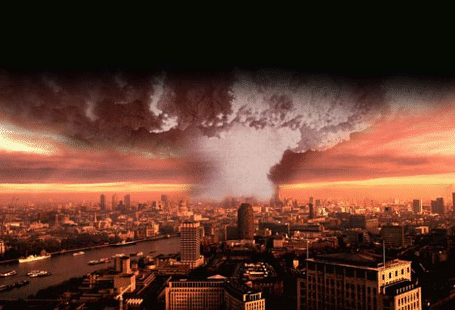
Each of the last five presidents, both Democrats and Republicans, have brought us closer to the brink. We desperately need leaders with a knack for peace who can steer the nation, and the world, toward a more secure and less dangerous future.
JEFFREY D. SACHS, May 29, 2024, https://www.commondreams.org/opinion/nuclear-armageddon
The overriding job of any U.S. president is to keep the nation safe. In the nuclear age, that mainly means avoiding nuclear Armageddon. Joe Biden’s reckless and incompetent foreign policy is pushing us closer to annihilation. He joins a long and undistinguished list of presidents who have gambled with Armageddon, including his immediate predecessor and rival, Donald Trump.
Talk of nuclear war is currently everywhere. Leaders of NATO countries call for Russia’s defeat and even dismemberment, while telling us not to worry about Russia’s 6,000 nuclear warheads. Ukraine uses NATO-supplied missiles to knock out parts of Russia’s nuclear-attack early-warning system inside Russia. Russia, in the meantime, engages in nuclear drills near its border with Ukraine. U.S. Secretary of State Antony Blinken and NATO Secretary-General Jens Stoltenberg give the green light to Ukraine to use NATO weapons to hit Russian territory as an increasingly desperate and extremist Ukrainian regime sees fit.
These leaders neglect at our greatest peril the most basic lesson of the nuclear confrontation between the U.S. and Soviet Union in the Cuban Missile Crisis, as told by President John F. Kennedy, one of the few American presidents in the nuclear age to take our survival seriously. In the aftermath of the crisis, Kennedy told us, and his successors:
Above all, while defending our own vital interests, nuclear powers must avert those confrontations which bring an adversary to a choice of either a humiliating retreat or a nuclear war. To adopt that kind of course in the nuclear age would be evidence only of the bankruptcy of our policy—or of a collective death-wish for the world.
Yet this is exactly what Biden is doing today, carrying out a bankrupt and reckless policy.
Nuclear war can easily arise from an escalation of non-nuclear war, or by a hothead leader with access to nuclear arms deciding on a surprise first strike, or by a gross miscalculation. The last of these nearly occurred even after Kennedy and his Soviet counterpart Nikita Khrushchev had negotiated an end to the Cuban Missile Crisis, when a disabled Soviet submarine came within a hair’s breadth of launching a nuclear-tipped torpedo.
The Doomsday Clock was at 17 minutes to midnight when Clinton came to office, but just 9 minutes when he left it. Bush pushed the clock to just 5 minutes, Obama to 3 minutes, and Trump to a mere 100 seconds. Now Biden has taken the clock to 90 seconds.
Most presidents, and most Americans, have little idea how close to the abyss we are. The Bulletin of Atomic Scientists, which was founded in 1947 in part to help the world avoid nuclear annihilation, established the Doomsday Clock to help the public understand the gravity of the risks we face. National security experts adjust the clock depending how far or how close we are to “midnight,” meaning extinction. They put the clock today at just 90 seconds to midnight, the closest that it’s ever been in the nuclear age.
The clock is a useful measure of which presidents have “gotten it” and which have not. The sad fact is that most presidents have recklessly gambled with our survival in the name of national honor, or to prove their personal toughness, or to avoid political attacks from the warmongers, or as the result of sheer incompetence. By a simple and straightforward count, five presidents have gotten it right, moving the clock away from midnight, while nine have moved us closer to Armageddon, including the most recent five.
Truman was president when the Doomsday Clock was unveiled in 1947, at 7 minutes to midnight. Truman stoked the nuclear arms race and left office with the clock at just 3 minutes to midnight. Eisenhower continued the nuclear arms race but also entered into the first-ever negotiations with the Soviet Union regarding nuclear disarmament. By the time he left office, the clock was put back to 7 minutes to midnight.
Kennedy saved the world by coolly reasoning his way through the Cuban Missile Crisis, rather than following the advice of hothead advisors who called for war (for a detailed account, see Martin Sherwin’s magisterial Gambling with Armageddon, 2020). He then negotiated the Partial Nuclear Test Ban Treaty with Khrushchev in 1963. By the time of his death, which may well have been a government coup resulting from Kennedy’s peace initiative, JFK had pushed the clock back to 12 minutes to midnight, a magnificent and historic achievement.
It was not to last. Lyndon Johnson soon escalated in Vietnam and pushed the clock back again to just 7 minutes to midnight. Richard Nixon eased tensions with both the Soviet Union and China, and concluded the Strategic Arms Limitation Treaty (SALT I), pushing the clock again to 12 minutes from midnight. Yet Gerald Ford and Jimmy Carter failed to secure SALT II, and Carter fatefully and unwisely gave a green light to the CIA in 1979 to destabilize Afghanistan. By the time Ronald Reagan took office, the clock was at just 4 minutes to midnight.
The next 12 years marked the end of the Cold War. Much of the credit is due to Mikhail Gorbachev, who aimed to reform the Soviet Union politically and economically, and to end the confrontation with the West. Yet credit is also due to Reagan and his successor George Bush, Sr., who successfully worked with Gorbachev to end the Cold War, which in turn was followed by the end of the Soviet Union itself in December 1991. By the time Bush left office, the Doomsday clock was at 17 minutes to midnight, the safest since the start of the nuclear age.
Sadly, the U.S. security establishment could not take “Yes” for an answer when Russia said an emphatic yes to peaceful and cooperative relations. The U.S. needed to “win” the Cold War, not just end it. It needed to declare itself and prove itself to be the sole superpower of the world, the one that would unilaterally write the rules of a new U.S.-led “rules-based order.” The post-1992 U.S. therefore launched wars and expanded its vast network of military bases as it saw fit, steadfastly and ostentatiously ignoring the red lines of other nations, indeed aiming to drive nuclear adversaries into humiliating retreats.
Since 1992, every president has left the U.S. and the world closer to nuclear annihilation than his predecessor. The Doomsday Clock was at 17 minutes to midnight when Clinton came to office, but just 9 minutes when he left it. Bush pushed the clock to just 5 minutes, Obama to 3 minutes, and Trump to a mere 100 seconds. Now Biden has taken the clock to 90 seconds.
Biden has led the U.S. into three fulminant crises, any one of which could end up in Armageddon. By insisting on NATO enlargement to Ukraine, against Russia’s bright red line, Biden has repeatedly pushed for Russia’s humiliating retreat. By siding with a genocidal Israel, he has stoked a new Middle East arms race and a dangerously expanding Middle East conflict. By taunting China over Taiwan, which the U.S. ostensibly recognizes as part of one China, he is inviting a war with China.
Trump similarly stirred the nuclear pot on several fronts, most flagrantly with China and Iran.Washington seems of a single mind these days: more funding for wars in Ukraine and Gaza, more armaments for Taiwan. We slouch ever closer to Armageddon. Polls show the American people overwhelmingly disapprove of U.S. foreign policy, but their opinion counts for very little. We need to shout for peace from every hilltop. The survival of our children and grandchildren depends on it.
Biden Lets Ukraine Strike Russia With US Weapons While Ukraine Attacks Russian Nuclear Defenses
CAITLIN JOHNSTONE, MAY 31, 2024, https://www.caitlinjohnst.one/p/biden-lets-ukraine-strike-russia?utm_source=post-email-title&publication_id=82124&post_id=145149954&utm_campaign=email-post-title&isFreemail=true&r=1ise1&triedRedirect=true&utm_medium=email
Well it finally happened: Biden is now letting Ukraine strike Russian territory with US-supplied weapons. Escalations in nuclear brinkmanship which would have been unthinkable a few short years ago are becoming increasingly common as Ukraine loses more and more territory and runs out of soldiers to fight.
In a new report from Politico titled “Biden secretly gave Ukraine permission to strike inside Russia with US weapons” which cites multiple anonymous US officials, the article’s authors correctly describe the new White House authorization as a “stunning shift the administration initially said would escalate the war by more directly involving the U.S. in the fight.”
This report comes shortly after an article by The New York Times titled “From Allies and Advisers, Pressure Grows on Biden to Allow Attacks on Russian Territory,” in which David E Sanger accurately forecast that “Biden is edging toward what may prove to be one of his most consequential decisions in the war for Ukraine: whether to reverse his ban on shooting American weapons into Russian territory.”
Politico reports that the approval for these attacks is limited to “solely near the area of Kharkiv,” but, again, these escalations were once unthinkable even for this administration, and every time a new escalation is authorized the warmongers are already well on their way to pushing for a further one. We will surely see increasing calls for Biden to authorize US-backed strikes deeper into Russian territory in the coming weeks.
This new development comes just after we learned that Ukraine has been repeatedly attacking Russia’s early warning systems for incoming nuclear strikes, with Ukrainian drones targeting Russian radar sites hundreds of miles from Ukrainian-controlled territory.
Just a few years ago if I had told you that a NATO proxy would soon be attacking Russia’s nuclear defense infrastructure, you’d probably have assumed we’d be pretty close to another Cuban Missile Crisis-level nuclear standoff, and that it would be receiving high levels of alarm and attention. But this report is barely in the news, and hardly anyone in the west even knows it’s happening.
This also comes as Reuters reports that France is preparing to send “several hundred” troops to Ukraine to train Ukrainian forces, which of course means we may soon be seeing the armed forces of a NATO power getting killed by the Russian military.
Any of these three new developments has the potential to lead to unpredictable events which spiral out of control into a nuclear war between NATO and the Russian Federation, which would be the single worst thing that could possibly happen on planet Earth. There is no excuse for anyone to be playing around anywhere remotely close to such a precipice, and yet here we are.
As we discussed last year, the terrifying thing about the west’s pattern of continually escalating against Russia every time it doesn’t get a nuclear ICBM in the kisser for the last escalation naturally incentivizes Russia to attack NATO directly in order to re-establish its credibility for deterrence. So far Russia has been content to respond to NATO’s escalations by just tearing into Ukraine with greater and greater ferocity, but if the western empire keeps interpreting every time Russia doesn’t attack NATO forces directly as a sign that it’s safe to keep escalating, at some point Russia’s going to have to hit NATO.
It is not sane or acceptable that any of this is happening. The empire knowingly provoked this war, and now it’s getting more and more casual about risking the life of everyone on this planet as its proxy runs out of lives to throw into its gears.
And it’s so hard to draw attention to this, because there are so many other horrible things happening in the world which the western empire is also directly responsible for. The empire is increasingly acting like a wounded, cornered animal as China rises and the US slowly sinks into post-primacy, the only major difference being that wounded, cornered animals have teeth and claws instead of weapons of armageddon.
Heatwaves increase risk of early births and poorer health in babies, study finds

Research that looked at 53 million births says Black and Hispanic mothers and those in lower socioeconomic groups most at risk
Heatwaves increase rates of preterm births, which can lead to poorer
health outcomes for babies and impact their long-term health, a new study
found. Black and Hispanic mothers, as well as those in lower socioeconomic
groups, are particularly at risk of delivering early following heat waves.
Extreme heat events are happening more frequently, lasting longer, and
increasing in intensity due to the climate crisis. Last year saw
record-breaking temperatures, with July 2023 bringing about the hottest day
ever recorded for four days in a row globally. Additionally, pregnant
people are among the most vulnerable to heat stress and are more likely to
experience heat stroke and heat exhaustion, according to the CDC. This can
adversely affect their unborn babies.
Guardian 29th May 2024
https://www.theguardian.com/lifeandstyle/article/2024/may/29/heat-waves-preterm-births-babies-study
Trump and Musk discussing advisory role in next administration
“There Have Not Been Any Discussions”: Musk Denies Report Of Trump Admin Advisory Role
Zero Hedge, BY TYLER DURDEN, 31 May 24
Musk denied today’s report that he’s been in discussions about a possible advisory role in a future Trump administration.
“There have not been any discussions of a role for me in a potential Trump Presidency,” Musk posted on X in response to user Herbert Ong, who posted a CNBC segment discussing the report
Inside Donald Trump and Elon Musk’s Growing Alliance • As per CNBC, sources are saying Trump might have been offered a special advisory role to Musk, possibly focusing on the economy or border security. • Musk has expressed interest in getting more involved if Trump wins in…
In a notable shift from past acrimony, Donald Trump, the presumptive Republican nominee, has engaged in discussions with Elon Musk about a possible advisory role for the Tesla mogul should Trump retake the White House, the Wall Street Journal reports. The move could see Musk influencing policies on border security and the economy.
Musk, known for his outspoken views and innovative leadership at Tesla and SpaceX, has increasingly voiced his concerns over national issues, aligning more with conservative viewpoints in recent months. Alongside billionaire investor Nelson Peltz, Musk has also taken a proactive stance against what they perceive as electoral vulnerabilities, briefing Trump on a data-centric project aimed at curbing voter fraud—a topic of significant controversy and debate.
The discussion around the advisory role and voting project took place at a March gathering at Montsorrel, Peltz’s sprawling oceanfront estate in Palm Beach, Fla., with a group of wealthy and powerful friends, some of the people familiar with the discussions said. The New York Times earlier reported the meeting had occurred, but details of the discussions haven’t been previously disclosed.
As guests nibbled on a Sunday morning breakfast of eggs, bacon and fresh fruit served by Peltz’s household staff, Peltz, Trump and Musk held forth on the November elections, criticizing Biden’s stewardship of the country, the people said. –WSJ
The discussions, still in preliminary stages and without definitive roles, would mark a notable pivot in Trump’s strategy – embracing influential tech and business leaders to bolster his campaign promises of economic revitalization and stringent border controls. The meeting with Peltz suggests a concerted effort to integrate Musk’s technological prowess and worldview into the fabric of Trump’s policy initiatives………………………………………………………………………….
As the election looms closer, these discussions underscore a critical realignment of influential figures in American politics, with Trump poised to capitalize on Musk’s vast resources and network. However, Trump’s campaign spokesperson, Brian Hughes, emphasizes that any official role would be solely at the discretion of Trump himself, reflecting the campaign’s cautious approach to formalizing such high-profile partnerships.
This evolving partnership between Trump and Musk, if solidified, could have significant implications for the upcoming presidential race, potentially altering the dynamics of electoral strategies and national policy debates. https://www.zerohedge.com/political/trump-and-musk-discussing-advisory-role-next-administration-report—
‘Offshore wind farms could have averted Fukushima disaster’

A global review led by the University of Surrey reveals that offshore wind farms could have prevented the Fukushima disaster and are now a cheaper energy alternative than nuclear power
Dimitris Mavrokefalidis, 05/30/2024 , https://www.energylivenews.com/2024/05/30/offshore-wind-farms-could-have-averted-fukushima-disaster/
A review conducted by researchers at the University of Surrey has concluded that offshore wind farms could have averted the Fukushima nuclear disaster by maintaining the cooling systems and preventing a meltdown.
The study highlights that wind farms are less vulnerable to earthquakes than nuclear power plants.
Suby Bhattacharya, Professor of Geomechanics at the University of Surrey, emphasised that wind power provides abundant clean energy and can enhance the safety and reliability of other facilities.
The review indicates that wind energy is now more cost-effective due to reduced construction costs and improved methods to minimise environmental impact.
The report finds that new wind farms can produce energy at a significantly lower cost than new nuclear power stations.
In the UK, the lifetime cost of generating wind power has dropped from £160/MWh to £44/MWh, covering all expenses from planning to decommissioning.
Professor Bhattacharya said: “What makes wind so attractive is that the fuel is free, and the cost of building turbines is falling. There is enough of it blowing around the world to power the planet 18 times over.
“Our report shows the industry is ironing out practical challenges and making this green power sustainable, too.”
2
The UK Is Ramping Up Its Nuclear Energy Ambitions

The cost of development has increased significantly since EDF first gained project approval in 2012, which could make it the world’s most expensive nuclear plant……..$58.4 billion earlier in the year. Its completion date has also been delayed by three to four years, expected to be completed by 2031. …….a government spokesperson …… the plant is “not a government project” and stated, “any additional costs or schedule overruns are the responsibility of EDF and its partners and will in no way fall on taxpayers.”
Oil Price, By Felicity Bradstock – May 30, 2024,
- The U.K. government aims to rapidly expand its nuclear energy sector, with two nuclear plants slated for the next decade and discussions around a third.
- The government hopes to meet up to 25 percent of the country’s electricity demand using nuclear power sources by 2050.
The U.K. government has ambitious plans for the rapid expansion of the country’s nuclear energy sector, with two nuclear plants slated for the next decade, and discussions around a third. EDF’s Hinkley Point C in Somerset and Sizewell C in Suffolk have both been approved by the government, expected to support the U.K.’s transition away from fossil fuels to greener alternatives in line with national climate pledges.
The U.K. government has announced ambitious nuclear plans in recent years, aiming for the biggest expansion in nuclear power for 70 years. It hopes to meet up to 25 percent of the country’s electricity demand using nuclear power sources by 2050. This will mean a fourfold increase in the U.K.’s nuclear power production, to achieve an output of 24 GW by the mid-century. The Civil Nuclear Roadmap outlines the government’s nuclear plans, including the development of major nuclear facilities, as well as its small modular reactor (SMR) technology. The government also plans to invest up to $381 million in the domestic production of the fuel required to power high-tech new nuclear reactors, known as HALEU, currently only commercially produced in Russia.
The cost of development has increased significantly since EDF first gained project approval in 2012, which could make it the world’s most expensive nuclear plant. EDF previously stated that it expected the plant to cost around $22 billion, but it increased that estimate to around $58.4 billion earlier in the year. Its completion date has also been delayed by three to four years, expected to be completed by 2031. The firm blamed inflation, Covid, and Brexit for cost increases and project delays. While there were some public concerns for the price increase, a government spokesperson made it clear that the plant is “not a government project” and stated, “any additional costs or schedule overruns are the responsibility of EDF and its partners and will in no way fall on taxpayers.”
In May, EDF was granted a site license by the U.K.’s nuclear regulator, the Office for Nuclear Regulation (ONR), for the development of its Sizewell C nuclear plant in Suffolk, in the south of England. This is the first of this type of license to be granted in over a decade. Sizewell C is expected to be a replica of the company’s Hinkley Point C. EDF is racing to reach a final investment decision on the project by the end of 2024.
Unlike Hinkley, EDF holds just under a 50 percent stake in Sizewell, with the government holding just over 50 percent. The company is now seeking new investment following the banning of China’s CGN from funding the development due to security concerns. The French firm hopes to use lessons learned from the development of Hinkley to construct Sizewell within around nine years.
Now, the U.K. government is in discussion over another potential nuclear plant development in Wales. The government announced it is holding conversations with major energy companies about the construction of a third new nuclear plant on a site at Wylfa on Anglesey in north Wales. The development of an additional site would help the U.K. to achieve its nuclear energy goals by the mid-century. There are reports that South Korea’s state-owned nuclear developer has been involved in early-stage discussions with the government about the multi-billion construction using APR1400 reactor technology. However, the American nuclear firm Westinghouse and the construction group Bechtel have shown interest in developing the project using Westinghouse’s AP1000 reactor technology………………………………….. https://oilprice.com/Energy/Energy-General/The-UK-Is-Ramping-Up-Its-Nuclear-Energy-Ambitions.html
Tribunal judge accused of covering up complaints – about bullying at Sellafield nuclear plant and other sites.
Seven women who claim they were bullied and intimidated by an employment
tribunal judge have accused the senior judiciary of trying to cover up
their complaints.
The allegation coincides with the Ministry of Justice and
Judicial Conduct Investigations Office (JCIO) being referred to the
Information Commissioner after failing to disclose the number of complaints
made about tribunal judges in response to a freedom of information request.
Both the ministry and the JCIO said that neither holds the information. But
a consultation on judicial discipline, published by both bodies two years
ago, revealed that the figure is estimated to be between 700 and 800
annually.
Of those complaints — which equate to an average of three every
working day — only a fraction result in action. The women who have spoken
to The Times have accused Judge Philip Lancaster of bullying and sexist
behaviour at separate hearings before him at the employment tribunal in
Leeds — with one claiming that he shouted at her 16 times.
Alison McDermott, formerly a human resources consultant at the nuclear fuel
reprocessing plant at Sellafield, first drew attention to Lancaster’s
alleged behaviour after he rejected her claim for whistleblowing detriment
in 2021. McDermott lost the case, but was allowed to appeal on 13 grounds.
Although she lost most of her appeal, the judge said that there were errors
and problems in the way her case was handled. That judge also criticised as
“unsafe” the award of costs against her and said that the tone of
Lancaster’s remarks on the issue were “troubling”.
Times 30th May 2024
https://www.thetimes.co.uk/article/complaints-covered-up-against-tribunal-judges-zkhmlz8bc
Searchlight Journalist Receives 2024 MOLLY Award for Story on Trucheña Whose Plutonium Count Was New Mexico’s Highest
Concerned Citizens for Nuclear Safety Basia Miller, 31 May 24
The Austin newspaper, the Texas Observer, chose Searchlight reporter Alicia Inez Guzmán, to receive its 2024 MOLLY Prize on May 30th. Guzmán holds a Ph.D. in Visual and Cultural Studies from the University of Rochester in New York. Her article, “Buried Secrets, Poisoned Bodies,” is exemplary investigative journalism. https://searchlightnm.org/buried-secrets-poisoned-bodies/ The prize, awarded to only one journalist a year, honors Molly Ivins, the Observer editor for six years in the 70’s.
Alicia, newly given the nuclear affairs beat at Searchlight, had been immediately intrigued on learning that a woman from Truchas was found at her death to have 60 times as much plutonium in her body as the average New Mexican. Alicia knew Truchas well. She’d grown up in the mountain village, elevation 8,000 feet and her grandfather and uncles had worked at Los Alamos National Laboratory (LANL) as had Alicia, who interned there one summer.
The reporter’s challenge was two-fold, both to identify the unknown woman and probe the origin of the very high plutonium readings. To that end, Truchas village offered the possibility of a deeply personal connection and at the same time could serve as a point of leverage to investigate, measure, and publicize the threat of nuclear contamination to New Mexico’s residents.
Guzmán first explored Trinity Site statistics, since places as far away as Rochester, NY—2500 miles away—saw their nuclear readings rise from the drift after the 1945 test explosion there, just before the U.S. dropped bombs on Hiroshima and Nagasaki. This takes Guzmán to the LAHDRA report (the Los Alamos Historical Document Retrieval and Assessment, a project of the U.S. Centers for Disease Control (CDC)) containing statistics on nuclear fallout. It includes autopsies–critical information in this case of questionable legality–for understanding how radiation affects the human body. Here Guzmán finds the very high readings for the Trucheña, still nameless. She says,
The only fact is the plutonium itself. Somewhere, somehow it
entered her body in the form of barely visible specks of alpha
radiation. And once there, those particles began a long migration,
from her bloodstream to her kidneys and, ultimately, to her liver. The
question is how?
…………………………………………………………Alicia Guzmán’s article comes full circle, as she has been able to give the unknown Trucheña a solid identity for the record, and bring a kind of justice to a small corner of the world by discovering many truths for the family. http://nuclearactive.org/—
TODAY. Turning Point .The bomb and the cold war. Episode 4: The Wall – outlines the nuclear weapons race.
Introduction: 2019, with Donald Trump in power Mike Pompeo, Secretary of announces that USA is ls leaving the Arms Control Treaty – the Intermediate Range Nuclear Forces Treaty with Russia. Only the New Start Treaty remains, due to expire soon . USA-Russia relations at a low point because of Ukraine, Russia withdraws from nuclear communications. Now other nations also have nuclear weapons, increasing the danger of confrontation, not co-operation, and of nuclear war.
************************
The Soviets were always insecure about American power. Americans also afraid of Soviet might. So Kruschev exaggerated Soviet nuclear weapons, to impress Americans. So USA in 1956 devised U2 spy plane. 1957 – Soviets develop Sputnik satellite- a space win, increasing USA’s fear. CIA satellite spying showed Soviet nuclear weapons much fewer. Daniel Ellsberg (Rand Corporation analyst 1959- 64) shows that Soviets were not trying for a first strike capability, not trying to dominate the world militarily. That discovery should have led to a change in USA thinking.
But it didn’t. USA propaganda continued, with the fraudulent belief that Russia ‘s foreign policy was world domination
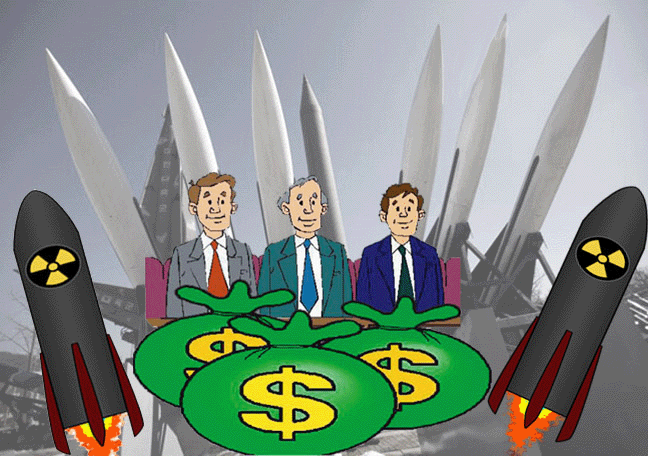
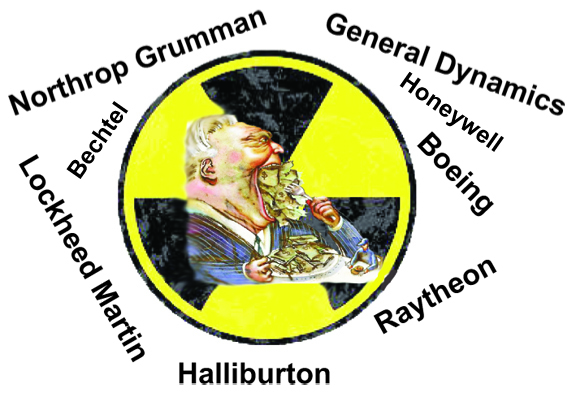
Why has this totally fraudulent belief persisted all this time? Because there are jobs in it, and it’s very profitable. So many companies – Boeing, Lockheed, IBM, Martin and more become reliant on the government and the defense industry, becoming “a nuclear-headed hydra”. It changed universities, with 75% of natural science funding coming from defense industries. Society becomes oriented around defense, security and nuclear weapons. Exponential increase in the number and diversity of weapons, with an unlimited budget. (Good visuals of many types of nuclear weapons) By 1961 23000 nuclear weapons, most of them thermonuclear- a thousand times more powerful than the one dropped on Nagasaki. Eisenhower finally realised what a threat that this permanent armaments industry was to democracy – and warned against the “military-industrial-complex”. So many congressmen were reliant on the armaments jobs in their district. Armaments were seen as good business by Republicans and Democrats.
Presidents Richard Nixon and then John Kennedy push for the weapons industry aiming to race the Soviets, beat the so-called “missile gap”. Confrontation increasing, between Kruschev and Kennedy, (told by Kruschev’s great-granddaughter). Focus on Berlin, – graphic coverage of the Wall going up, the guards, the repression, the “death strips” .
Meanwhile American missiles set up in Europe, aimed at Russia., in Turkey aimed at the Kremlin. So Soviets tried to set up a threat to USA in Cuba’s communist regime. A CIA-led insurgency there had failed, (told by veterans) .
Pressure on Kennedy to invade Cuba, but he was reluctant. Castro urged Kruschev to attack USA, but Kruschev was reluctant. Tortuous secret diplomacy. Privately both Kennedy and Kruschev wanted no nuclear war. But they were not really in control, and they publicly threatened with nuclear weapons. This crisis led to the PARTIAL NUCLEAR TEST BAN TREATY putting nuclear testing underground.
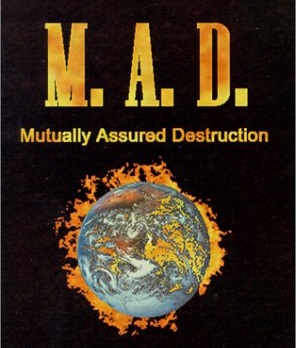
1963: Kennedy assassinated, 1964 – Kruschev deposed. Brezhnev took over, aiming to be ahead in nuclear missiles. Both USA and Soviet union raced for nuclear missile superiority, but aiming to never use these weapons – use would be a mutual suicide pact. They developed the policy of Mutually Assured Destruction. Use of thousands of these weapons within 30 minutes – would kill of the entire earth, cut out sunlight and plant growth, and coat the earth with radioactive fallout.
So – the battles between the Soviets and the USA were proxy battles in other countries, intervening in other countries ‘ civil wars – Nicaragua, Angola, North Yemen, Domenica, Bangladesh, East Timor, Mozambique. Congo, (brutish visuals) . In Vietnam China and Russia supported the North Vietnamese, while many Asian allies supported USA. USA used Latin American countries to mobilise the Cold War. In Chile USA orchestrated the overthrow of President Allende, and the takeover by fascist Augusto Pinochet. U.S. intervention left a chaotic rule in Guatemala , an authoritarian rule in Iran. Far from spreading democracy, USA “got into bed with anyone who called themselves anti-communist“.
1969 President Richard Nixon- publicly blustered about the evils of Soviet communism, but in reality, talked with the Soviets about negotiation, introducing “detente”. The Strategic Arms Limitation Agreement (SALT 1) 1n 1972, the first agreement to limit intercontinental ballistic missiles. The U.S. Anti Ballistic Missile System. But the number of warheads was increasing in both USA and Russia – to a total of 70.000 nuclear weapons. A movement in USA to not trust the Soviets will culminate in the 19080s with President Ronal Reagan. Still, Reagan’s hatred of nuclear weapons brought him and Russia’s Mikhail Gorbachev together.
Small modular nuclear reactors get a reality check in new report

New Atlas By Michael Franco, May 31, 2024
A new report has assessed the feasibility of deploying small modular nuclear reactors to meet increasing energy demands around the world. The findings don’t look so good for this particular form of energy production.
Small modular nuclear reactors (SMR) are generally defined as nuclear plants that have capacity that tops out at about 300 megawatts, enough to run about 30,000 US homes. According to the Institute for Energy Economics and Financial Analysis (IEEFA), which prepared the report, there are about 80 SMR concepts currently in various stages of development around the world.
While such reactors were once thought to be a solution to the complexity, security risks, and costs of large-scale reactors, the report asks if continuing to pursue these smaller nuclear power plants is a worthwhile endeavor in terms of meeting the demand for more and more energy around the globe.
The answer to this question is pretty much found in the report’s title: “Small Modular Reactors: Still Too Expensive, Too Slow, and Too Risky.”
If that’s not clear enough though, the report’s executive summary certainly gets to the heart of their findings.
“The rhetoric from small modular reactor (SMR) advocates is loud and persistent: This time will be different because the cost overruns and schedule delays that have plagued large reactor construction projects will not be repeated with the new designs,” says the report. “But the few SMRs that have been built (or have been started) paint a different picture – one that looks startlingly similar to the past. Significant construction delays are still the norm and costs have continued to climb.”
Too Expensive
The cost of SMRs is at the forefront of the report’s argument against the deployment of the reactors. According to some of the data it provides, all three SMRs currently operating (plus one now being completed in Argentina) went way over budget, as this graph shows.

The report authors also point out that a project in Idaho called NuScale had to be scrapped because during its development between 2015 and 2023, costs soared from $9,964 per kilowatt to $21,561 per kilowatt. Additionally, the costs for three other small plants in the US have all skyrocketed dramatically from their initial cost assessments.

Not only are the excessive costs of building SMRs problematic in and of themselves, says the IEEFA, but the money being poured into the projects is money that is not being spent on developing other sources of energy that are cleaner, quicker to deploy, and safer.
“It is vital that this debate consider the opportunity costs associated with the SMR push,” write the authors. “The dollars invested in SMRs will not be available for use in building out a wind, solar and battery storage resource base. These carbon-free and lower-cost technologies are available today and can push the transition from fossil fuels forward significantly in the coming 10 years – years when SMRs will still be looking for licensing approval and construction funding.”
Too Slow
That last bit gets to another of the report’s findings: that building SMRs simply takes too much time. The Shidao Bay project in China, for example, was supposed to take four years to build, but actually took 12; the Russian Ship Borne project had an estimated completion time of three years, but took 13; and the ongoing CAREM project in Argentina was supposed to be done in four years, but it’s now in its 13th year of development. (another excellent graph on original)………………………………………………………………………
Too Risky
Both the unpredictable costs and the extraordinary building delays makes SMR development just too big of a risk, says the IEEFA. But that’s not the only potential peril. Because the technology for this small-scale nuclear facility is fairly new and untested, risks could exist in terms of functionality and safety as well. For example, the authors question if the new SMRs will actually be able to output the kind of power they claim. Based on cost and development estimates going so widely afield, the sense in the report is that power output claims could also be off.
In terms of safety, the report quotes a 2023 study for the US Air Force that said: “Since SMR technology is still developing and is not deployed in the US, information is scarce concerning the various costs for [operations & maintenance], decommissioning and end-of-life dissolution, property restoration and site clean-up and waste management.”
The authors also point out that because many SMRs are being built using identical technologies, if a component of that tech fails, it could easily affect reactors around the world……………………………
Conclusion
So: too expensive, too slow, and too risky. And not at all where we should be focussing our, um – energy – these days, as the study authors make clear in their conclusion.
“At least 375,000 MW of new renewable energy generating capacity is likely to be added to the US grid in the next seven years,” they say. “By contrast, IEEFA believes it is highly unlikely any SMRs will be brought online in that same time frame. The comparison couldn’t be clearer. Regulators, utilities, investors and government officials should acknowledge this and embrace the available reality: Renewables are the near-term solution.”https://newatlas.com/energy/modular-nuclear-reactors/—
Fukushima nuclear debris removal to begin as early as August

Crucial work at devastated plant has been delayed for three years
AYAKA OTAKA, Nikkei staff writer, May 31, 2024,
TOKYO — Trial removal of melted fuel rods at the tsunami-hit Fukushima Daiichi nuclear plant will begin as early as August, Tokyo Electric Power Co. Holdings announced on Thursday, a critical step in a decommissioning process that is expected to take decades.
Removal of the fuel rods, which is now three years behind schedule, had been slated to start by October, but TEPCO now says it will happen between August and October. Necessary equipment will be set up at the plant in northeastern Japan as early as July.
“We will continue to proceed with the work carefully, with safety as our top priority, so as not to impact the surrounding environment,” said Akira Ono, the TEPCO official in charge of decommissioning efforts.
The radioactive debris consists of fuel and other materials that melted, then cooled and solidified, after the plant lost power in the devastating March 2011 tsunami. An estimated 880 tonnes of debris are in reactor units 1 to 3.
As the melted fuel is highly radioactive, people cannot come near it, and removal must be done in small amounts to prevent leakage during the process.
A device similar to a fishing rod will be used to carry out the work. On Tuesday, a video was released showing the device being tested at a Mitsubishi Heavy Industries shipyard in Kobe, using a full-scale model of a nuclear reactor.
According to TEPCO, a 3- to 4-meter cable with a mechanical claw will be hung from the device down towards the bottom of the reactor. Less than 3 grams can be collected at a time.
Shortening shifts to reducing workers’ exposure to radiation will be necessary. The trial removal is expected to take about two weeks.
Removal was originally to be carried out in 2021. The plan was to use a robot arm to remove the debris, but development of the arm was delayed. A large amount of non-fuel debris blocking access also caused delays………………………………
The government has said that it will take 30 years to 40 years from the 2011 incident to decommission the plant.
The reactor building cannot be dismantled unless the debris is removed. Cooling water, as well as rainwater, that comes in contact with the debris becomes contaminated.
TEPCO began releasing treated wastewater in August 2023, but as long as the debris remains, the cycle of water being contaminated and requiring treatment and release will continue.
Some critics say the government’s decommissioning plan is unrealistic. The process could take more than 100 years, say some scientists in the Atomic Energy Society of Japan. After the Chernobyl nuclear disaster in the former Soviet Union, decommissioning was abandoned, and a shelter structure was built to completely cover the area with radioactive waste.
There is also the issue of how to dispose of soil and rubble contaminated by scattered radioactive materials. The government has promised to transport this waste outside of Fukushima prefecture by 2045, but a destination has not been decided. https://asia.nikkei.com/Spotlight/Environment/Fukushima-nuclear-debris-removal-to-begin-as-early-as-August
1 This Month



Shut down the radiation-damaged Heysham nuclear reactors now
To see nuclear-related stories in greater depth and intensity – go to https://nuclearinformation.wordpress.com

Say No to NASA’s Reckless Nuclear Reactor on the Moon
Say No to NASA’s Reckless Nuclear Reactor on the Moon
-
Archives
- October 2026 (256)
- September 2026 (339)
- August 2026 (330)
- July 2026 (355)
- June 2026 (287)
- May 2026 (306)
- April 2026 (356)
- March 2026 (251)
- February 2026 (267)
- January 2026 (308)
- December 2025 (358)
- November 2025 (359)
-
Categories
- 1
- 1 NUCLEAR ISSUES
- business and costs
- climate change
- culture and arts
- ENERGY
- environment
- health
- history
- indigenous issues
- Legal
- marketing of nuclear
- media
- opposition to nuclear
- PERSONAL STORIES
- politics
- politics international
- Religion and ethics
- safety
- secrets,lies and civil liberties
- spinbuster
- technology
- Uranium
- wastes
- weapons and war
- Women
- 2 WORLD
- ACTION
- AFRICA
- Atrocities
- AUSTRALIA
- Christina's notes
- Christina's themes
- culture and arts
- Events
- Fuk 2022
- Fuk 2023
- Fukushima 2017
- Fukushima 2018
- fukushima 2019
- Fukushima 2020
- Fukushima 2021
- general
- global warming
- Humour (God we need it)
- Nuclear
- RARE EARTHS
- Reference
- resources – print
- Resources -audiovicual
- Weekly Newsletter
- World
- World Nuclear
- YouTube
-
RSS
Entries RSS
Comments RSS

