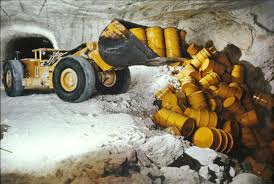
Germany’s dirty secret: Its leaking nuclear waste dump
Kiyo Dörrer, September 19, 2024
Germany has a dirty little secret. In the middle of the country, deep underground, a radioactive waste dump has been leaking for decades. And nobody really knows what do to with it.
Deutsche Welle 19th Sept 2024, https://www.dw.com/en/germanys-dirty-secret-its-leaking-nuclear-waste-dump/video-70237250
Global status report highlights parlous state of nuclear power sector

“the industry is essentially running to stand still.”
Jim Green, 20 Sept 2024, https://reneweconomy.com.au/global-status-report-highlights-parlous-state-of-nuclear-power-sector/
Two new reports have undermined the Dutton Coalition’s claims about nuclear power.
A report by the Institute for Energy Economics and Financial Analysis (IEEFA) undermines claims that nuclear power would reduce power bills, and the latest edition of the World Nuclear Industry Status Report undermines claims that nuclear power is on a growth trajectory and Australia risks being left behind.
The IEEFA report’s key findings are as follows:
– Under the Coalition’s nuclear plans, electricity bills could rise by $665 per year on average across jurisdictions and scenarios, for households using a median amount of electricity.
– The bill impact would be more acute for larger households, given their higher electricity consumption. For example, for 4-person households the average annual bill increase across regions and nuclear scenarios would be $972 and for 5+ person households it would be $1,182.
– The cost of electricity generated from nuclear plants would likely be 1.5 to 3.8 times the current cost of electricity generation in eastern Australia.
– Overnight capital costs (excluding financing costs) of recent nuclear power station builds analysed by IEEFA have blown out by a factor of between 1.7 and 3.4, creating significant financial difficulties for the companies involved.
World Nuclear Industry Status Report 2024
The World Nuclear Industry Status Report 2024 (WNISR-2024) was released yesterday. Since 1992, these reports have provided a wealth of factual information about the status and trajectory of nuclear power worldwide.
WNISR-2024 notes that as of 1 July 2024, a total of 408 nuclear power reactors were operating in 32 countries, 30 below the 2002 peak of 438 reactors.
At the end of 2023, nuclear capacity stood at 365 gigawatts (GW). As of mid-2024, operating capacity reached 367.3 GW, 0.2 GW more than the previous 2006 end-of-year record of 367.1 GW.
That’s something for the nuclear boosters to cheer about: record nuclear capacity. But some context is needed. Nuclear power has been stagnant for the past 30 years and a fleet of mostly young reactors is now a fleet of old reactors.
In 1990, the mean age of the global power reactor fleet was just 11.3 years. WNISR-2024 notes that the average age of the world’s operating reactor fleet has been increasing since 1984 and stands at 32 years as of mid-2024, up from 31.4 years in mid-2023.

As the rate of closure of ageing reactors increases, it will become increasingly difficult for the industry to maintain its 30-year pattern of stagnation by matching closures with start-ups, let alone achieving any growth.
Former World Nuclear Association executive Steve Kidd spoke to this problem in 2016, noting that “the industry is essentially running to stand still.”
In 2023, WNISR-2024 notes, there were five reactor start-ups (5 GW) and five permanent closures (6 GW) with a net decline of 1 GW in capacity. (This year has also been underwhelming: a net gain of 2 GW of nuclear capacity compared to several hundred GW of new renewable capacity.)
Nuclear’s share of global electricity generation declined from 9.2 percent to 9.1 percent in 2023, little more than half of its peak of 17.5 percent in 1996.
In the 20 years from 2004 to 2023, there were 102 startups and 104 reactor closures worldwide. Of these, 49 startups were in China with no closures. Outside China, there has been a net decline of 51 reactors over the same period, and net capacity declined by 26.4 GW.
As of mid-2024, 59 reactors were under construction worldwide, 10 fewer than in 2013. China had the most reactors under construction (27) but none abroad. Russia dominates the international market with 26 units under construction as of mid-2024, six of them in Russia and 20 in seven other countries.
WNISR-2024 states: “It remains uncertain to what extent these projects have been or will be impacted by sanctions imposed on Russia and other consequential geopolitical developments following Russia’s invasion of Ukraine.”
Construction started on six reactors in 2023 — down from 10 in 2022 — including five in China.
Chinese and Russian government-controlled companies launched all 35 reactor constructions in the world from December 2019 to mid-2024. Besides Russia’s Rosatom, only France’s EDF is currently building nuclear power plants abroad (two reactors in the UK) as lead-contractor.
Potential nuclear ‘newcomer’ countries
Peter Dutton claims that “50 countries are exploring or investing in next-generation nuclear technology for the first time.” That’s nonsense. WNISR-2024 notes that the number of countries building reactors fell by three from mid-2023 to mid-2024.
Reactors are under construction in 13 countries, down from 16 countries the previous year as the UAE and the US completed their last construction projects and Brazil suspended its only reactor construction project. Only three countries — China, India, and Russia — are building reactors at more than one site.
Just three potential nuclear newcomer countries had reactors under construction as of mid-2024: Egypt, Bangladesh and Turkiye.
WNISR-2024 notes that of 18 African countries analysed, only four would have grid systems large enough to meet minimum capacity criteria to host a large nuclear reactor (based on the rule of thumb that the largest unit in a grid system should not exceed 10 percent of total system capacity).
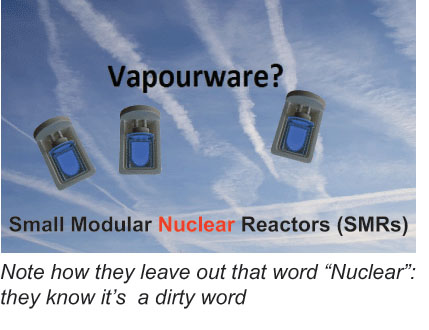
Small modular reactors might find a niche — but they don’t exist.
Small modular reactors
WNISR-2024 states: “The gap between hype about Small Modular Reactors (SMRs) and industrial reality continues to grow. The nuclear industry and multiple governments are doubling down on their investments into SMRs, both in monetary and political terms. So far, reality on the ground does not reflect those efforts.
“SMR projects continue to be delayed or canceled. Costs for nuclear projects in general and SMRs in particular are surging. The few available cost estimates for SMRs, especially when weighted by their electrical power generation capacities, show how expensive these are.”


Two developments over the past year have punctured the hype around SMRs. The first was NuScale’s decision to abandon its flagship project in Idaho after cost estimates rose to an absurd A$30,000 per kilowatt (A$14 billion for a 462 megawatt plant).
Then, French utility EDF announced that it had suspended the development of its Nuward SMR and reoriented the project “to a design based on proven technological building blocks.”
The two operating SMRs — a twin-reactor plant in China and a twin-reactor floating plant in Russia — weren’t built using serial factory construction methods so can’t be called SMRs. Nor are there plans to mass-produce these reactors types using serial factory construction methods, so the so-called SMRs in China and Russia can’t even be called prototype SMRs.
Dutton wants taxpayers to fund the construction of large reactors in the eastern states and SMRs in SA and WA. SA aims to reach 100 percent net renewable electricity generation as soon as 2027. Presumably Dutton wants to replace some of that renewable power generation with SMRs, for some unfathomable reason.
Nuclear vs renewables

Total investment in non-hydro renewable electricity capacity in 2023 was estimated by Bloomberg New Energy Finance (BNEF) at $US623 billion, up 8 per cent compared to the previous year. According to a WNISR estimate, this represents 27 times the reported global investment decisions for the construction of nuclear power plants of about $US23 billion for 6.7GW.
BNEF estimated investments in stationary storage capacity at around US$36 billion in 2023, which, for the first time, exceeded investments into new nuclear. Globally, utility-scale storage additions jumped from just over 10 GW added in 2022 to more than 25 GW in 2023.
In 2023, annual additions of solar and wind power grew by 73 per cent and 51 per cent, respectively, resulting in nearly 460 GW of combined new capacity, according to the International Renewable Energy Agency.
The solar PV market saw China alone adding around 217 GW — a 150-percent increase over 2022-additions — and the rest of the world 129 GW for a total of 346 GW or about 1 GW per day.
The Global Wind Energy Council reported a record of 117 GW of new wind installations, a 50 per cent year-on-year increase, with China accounting for 65 percent of total added onshore capacity and 58 per cent of total added offshore capacity. These numbers compare with a net addition of 1 GW nuclear capacity in China and a global decline of 1 GW in 2023.
WNISR 2024 states: “In 2021, the combined output of solar and wind plants surpassed nuclear power generation for the first time. In 2023, wind and solar facilities generated 50 percent more electricity than nuclear plants.
“Wind power alone generated 2,300 terawatt-hours (TWh) and is getting close to nuclear’s 2,600 TWh. Since 2013, non-hydro renewables added 3,500 TWh to the world’s power generation, 14 times more than nuclear’s roughly 250 TWh, and generated 80 percent more power than nuclear in 2023.”
In 2023, the European Union achieved its largest renewable capacity additions ever and the renewable share in total electricity generation reached a record 44 percent. Solar and wind plants together produced 721 TWh compared to nuclear’s 588 TWh.
For the first time ever, non-hydro renewables generated more power than all fossil fuels combined in 2023. Fossil fuel power generation dropped by a record 19 percent, reaching its lowest level ever and accounting for less than one-third of the EU’s electricity generation.
In China, solar PV produced a total of 578 TWh of electricity in 2023, 40 percent more than nuclear’s 413 TWh. Wind power generation first exceeded nuclear in 2012: in 2023, wind produced 877 TWh, more than doubling nuclear generation. Adding other non-hydro renewables like biomass to solar and wind, the net total generation of 1,643 TWh in 2023 was four times the nuclear output.
Keep in mind that China is the only country in the world with a significant nuclear power expansion program. It might be a stretch for WNISR-2024 to state that “nuclear power remains irrelevant in the international market for electricity generating technologies”, but it is heading in that direction.
Dr Jim Green is the national nuclear campaigner with Friends of the Earth Australia and a member of the Nuclear Consulting Group.
Labour backs nuclear – but at what cost?

for the UK consumer, nuclear new building means expensive electricity and offers little in terms of addressing climate change.
With new funding announced for the prospective Sizewell C plant, the government seems committed to nuclear power.
However, the cost of nuclear newbuild in the UK is staggering and,
even if built, sufficient new capacity will not arrive soon enough to help
mitigate climate change.
UK electricity consumers should hope that the
target of 24 GW of nuclear capacity by 2050 slips into obscurity. “We
will ensure the long-term security of the sector, extend the lifetime of
existing plants, and we will get Hinkley Point C over the line.” That was
Labour’s manifesto commitment to nuclear power, and the government has
already put money on the line.
In late August, it announced additional
funding of up to £5.5 billion for the proposed Sizewell C plant, which
would be only the UK’s second nuclear construction project since the
completion of Sizewell B in 1995, if built.
However, for the UK consumer, nuclear new building means expensive electricity and offers little in terms of addressing climate change. The UK’s operable nuclear capacity declined
from 12.2 GW in 1996 to 5.8 GW in 2023. Only nine reactors are still
generating power and two are under construction. Eight of the operable
reactors came online between 1983 and 1989, making the youngest 45 years
old. Last year, the Hartlepool and Heysham 1 plants gained modest life
extensions to 2026, and operator EdF hopes to extend the lives of its other
Advanced Gas Cooled (AGRs) reactors to 2028.
However, there is little likelihood that the eight remaining AGRs can continue in service beyond these dates. They were initially designed to last about 30 years, with the
decision to decommission based on the deterioration of irreplaceable
components such as the graphite core and boilers. Three AGRs – two built
in 1976 and one in 1983 – are already defueling, a preliminary step to
decommissioning. As a result, by 2030 at the latest, all of the UK’s AGRs
will be out of service.
Decommissioning costs the consumer money, and the
Nuclear Liabilities Fund has not kept up with the cost of decommissioning.
In its third report of 2022-23, the House of Commons Committee of Public
Accounts noted that the government had already been forced to provide
additional funding of £10.7 billion and that there remained “a strong
likelihood that more taxpayers’ money will be required”.
In addition, despite the first nuclear reactors coming into service in the 1950s, there
is still no clear plan for the permanent storage of the most hazardous
forms of radioactive waste.
The government’s most recent energy and
emissions projections, published in November 2023, forecast the
volume-weighted wholesale electricity price in 2030 at between £36.6/MWh,
in a low fuel price scenario, and £58.5/MWh in a high fuel price scenario.
The UK’s latest licensing round for renewable energy, the results of
which were announced in September, returned CfD prices for solar projects
of £50.07/MWh, onshore wind at £50.90/MWh and offshore wind at
£58.87/MWh (2012 prices).
At over £100/MWh in today’s money, even
without a further five years of inflation, Hinkley Point C is a chronic
deal for the UK electricity consumers. EdF wants a new funding model for
both the construction of Sizewell C and the lifetime extension of Sizewell
B, indicating that even the large CfD strike price for Hinkley Point C is
not enough to build new nuclear in the UK. This will almost certainly mean
UK consumers bearing more of the risk. The adoption of the proposed
Regulated Asset Base (RAB) model would see consumers paying for nuclear
plants years before they actually generate electricity.
Energy Voice 18th Sept 2024.
Biden’s Grand Alliance against Russia in Ukraine beginning to recognize the N word…Negotiations

Walt Zlotow, West Suburban Peace Coalition, Glen Ellyn IL, 20 Sept 24
The US 32 month long proxy war against Russia is not quite over. But everyone in America’s important NATO allies knows America’s Ukraine proxy is losing badly with its military near collapse. The two hundred billions the US and NATO have poured into Ukraine have made not a dent in achieving the ‘good guys’ war aims of taking back the Donbas and Crimea, receiving reparations from Russia, and gaining NATO membership.
While President Biden betrays nary a hint of that stark reality, his European NATO allies, greatly more affected by the economic consequences of this than America, certainly are.
German Chancellor Olaf Scholz recently said, “I believe that now is the time to discuss how to arrive at peace from this state of war, indeed at a faster pace.” Scholz further stated that he will impose a limit on open ended aid to Ukraine and is working on a diplomatic settlement that will include Ukraine ceding territory to Russia.
A senior French diplomat recently told Le Figaro the same thing, citing that the Donbas and Crimea are beyond Ukraine’s military capability and that France lines up with Germany that only a negotiated settlement will end the war.
Insulated from the economic angst of its Western European allies, the US sees no need to deal with reality. For President Biden and his war cabinet including VP Harris, the words ‘negotiated settlement’ and ‘ceding territory’ dare not pass the lips of US diplomats acting more like war generals than statespersons.
Biden and company are still running around like Chicken Little, chirping ‘The Russians are coming, the Russians are coming, to take over Poland on their march to the English Channel.’
That includes presidential candidate Kamala Harris who repeated that delusional meme in her presidential debate.
The US proxy war against Russia, with Ukrainians doing all the dying and the country in ruins, is headed to a negotiated settlement in spite of President Biden’s intransigence.
Microsoft deal propels Three Mile Island restart, with key permits still needed
By Reuters, September 21, 2024
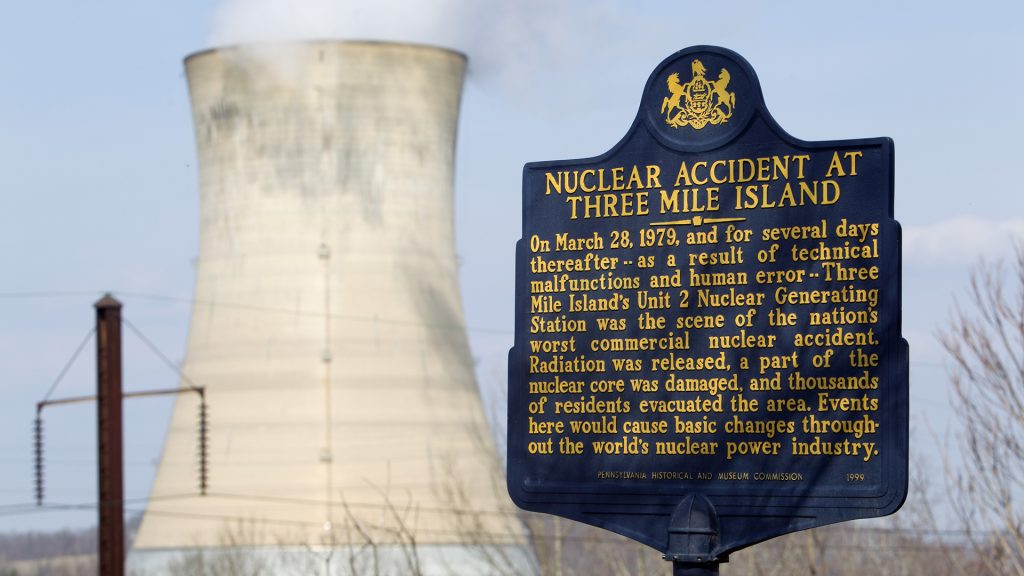
Sept 20 (Reuters) – Constellation Energy (CEG.O), opens new tab and Microsoft (MSFT.O), opens new tab have signed a power deal to help resurrect a unit of the Three Mile Island nuclear plant in Pennsylvania in what would be the first-ever restart of its kind, the companies said on Friday.
Key regulatory permits for the plant’s new life, however, haven’t been filed, regulators say.
Big tech has led to a sudden surge in U.S. electricity demand for data centers needed to expand technologies like artificial intelligence and cloud computing. ……………………………………..
Power from the plant would be used to offset Microsoft’s data center electricity use, the companies said.
A relaunch of Three Mile Island, which had a separate unit suffer a partial-meltdown in 1979 in one of the biggest industrial accidents in the country’s history, still requires federal, state and local approvals.
Constellation has yet to file an application with federal nuclear regulators to restart the plant.
“It’s up to Constellation to lay out its rationale for justifying restart, so we’re prepared to engage with the company on next steps,” said Nuclear Regulatory Commission (NRC) spokesperson Scott Burnell.
Constellation said it expected the NRC review process to be completed in 2027.
BILLION DOLLAR BET
The deal would help enable a revival of Unit 1 of the five-decades-old facility in Pennsylvania that was retired in 2019 due to economic reasons. Unit 2, which had the meltdown, will not be restarted. https://www.reuters.com/markets/deals/constellation-inks-power-supply-deal-with-microsoft-2024-09-20/
UN overwhelmingly votes to sanction Israel, impose arms embargo
The vote passed with 124 states in favor of ending the illegal Israeli occupation of the West Bank
SEP 19, 2024, https://thecradle.co/articles/un-overwhelmingly-votes-to-sanction-israel-impose-arms-embargo
The UN General Assembly voted on 18 September overwhelmingly in favor of ending Israel’s illegal occupation in the West Bank.
The Palestinian-drafted resolution called on Israel to end “its unlawful presence in the Occupied Palestinian Territory” within 12 months, including the presence of illegal settlements and hundreds of thousands of illegal settlers.
The vote passed with 124 in favor and 43 abstentions. Washington and Tel Aviv voted against the resolution, along with 14 others.
The resolution urged states to “take steps towards ceasing the importation of any products originating in the Israeli settlements, as well as the provision or transfer of arms, munitions and related equipment to Israel … where there are reasonable grounds to suspect that they may be used in the Occupied Palestinian Territory.”
The issue of Palestine is “the permanent responsibility” of the UN until it is solved in accordance with international law, the resolution states.
It also cites an advisory opinion issued by the International Court of Justice (ICJ) in July regarding the illegality of Israel’s West Bank occupation. Additionally, it calls on UN Secretary-General Antonio Guterres to issue a report on the resolution’s implementation three months into its adoption.
This was the first resolution officially advanced by Palestine since it took its seat among UN member states for the first time this month after being granted additional privileges following a General Assembly vote in May.
It was co-sponsored by 50 states at the General Assembly, including Turkiye.
Prior to the vote, Washington attempted to lobby states against voting in favor of it.
Washington’s UN envoy Linda Thomas-Greenfield on Tuesday urged UN members to vote against the resolution, telling reporters in New York that the Palestinian document has “a significant number of flaws,” claiming it goes “beyond the ICJ ruling” and does not recognize that “Hamas is a terrorist organization.”
Similarly, Israel’s envoy to the UN, Danny Danon, urged member states to vote against the resolution, calling it “an attempt to destroy Israel through diplomatic terrorism” and “ignores the truth, twists the facts and replaces reality with fiction.”
The Israeli Knesset passed a vote on 18 July, completely rejecting the establishment of a Palestinian state, including statehood as part of any future peace agreement.
Several countries, including Spain, Norway, and Ireland, recognized Palestine as a state in late May amid mounting criticism of Israel’s genocidal campaign in Gaza.
US Military Policy Is Stoking the Risk of Nuclear War on Korean Peninsula
As Trump and Harris bicker over North Korea, the US military lays plans that could bring nuclear tensions to a brink.
By Ju-Hyun Park , Truthout, September 19, 2024
U.S. politicians can’t stop talking about Kim Jong Un. The two major party conventions have come and gone, with both presidential candidates mentioning the North Korean leader by name. At the Republican National Convention (RNC), Donald Trump claimed Kim had endorsed him, adding, “He misses me.” Just weeks later at the Democratic National Convention (DNC), Kamala Harris alluded to her opponent’s claims, declaring before an enraptured audience that the “tyrant” Kim is “rooting for Trump.”
Neither candidate told the truth. The North Korea’s state news agency was swift to respond to Trump back in June, clarifying the position of the government with characteristically pointed remarks: “No matter what administration takes office in the U.S., the political climate, which is confused by the infighting of the two parties, does not change and, accordingly, we do not care about this.”
The fact-free treatment of North Korea by both parties is a sign of how the electoral cycle has reduced the Korean crisis to a political football. This is especially dangerous in a time when the risk of war in Korea is at its highest in decades. Significantly, neither Republicans nor Democrats seem interested in a public discussion about the concrete situation in Korea, or the major escalations the U.S. is undertaking there.
While the news cameras and the eyes of the electorate were trained on the DNC in Chicago, the U.S. military executed one of the largest war games on Earth in Korea: Ulchi Freedom Shield (UFS). UFS is the latest name for an annual series of military exercises conducted by the Combined Forces Command, the command structure under which the military of South Korea answers to U.S. generals. (The U.S. has had operational wartime command of South Korea’s armed forces since 1950.) Originating in 1976, UFS and its predecessors routinely deploy tens of thousands of troops, along with U.S. “strategic assets” such as aircraft carriers, heavy bombers and nuclear submarines.
This is a major, and widely misunderstood, component of the unfinished Korean War — that for over half a century, some of the largest military maneuvers on Earth are conducted on an annual basis in Korea within sight of the border bisecting the peninsula. Although the U.S. and Republic of Korea (ROK), South Korea’s official name, insist these exercises are defensive, many of them rehearse the invasion and occupation of North Korea.
These “war games,” by their very nature, look identical to the first steps of a real invasion. This year’s UFS featured a whopping 48 individual war drills, deploying 19,000 South Korean troops, 200 military aircraft and an unknown number of U.S. soldiers. What’s more, this year’s war games took place in the context of another significant escalation: emergent plans to potentially redeploy U.S. nuclear weapons to Korea.
Killing Peace
The Korean War was concluded with a ceasefire rather than a permanent peace treaty, making it the longest war in U.S. history. For over 50 years, relations between North and South Korea were structured through the paradigm of independent, peaceful reunification — a mutual commitment to nonviolently end both the Korean War and the division of the Korean people. And since the late 1980s, relations between the U.S. and North Korea were also based on the framework of denuclearization. Both of these diplomatic paradigms have now crumbled.
………………………………………………………………………………………………………………………………………… more https://truthout.org/articles/us-military-policy-is-stoking-the-risk-of-nuclear-war-on-korean-peninsula/
The World Would Be Better off Without NATO, Revisited
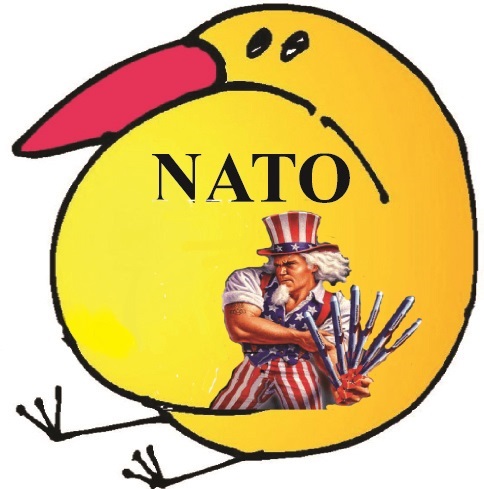
CounterPunch, by Eve Ottenberg, September 20, 2024
The hyper-capitalist terror state that plots to rule the world keeps its fist in a mailed glove called NATO. But NATO is in trouble. As its massive, disastrous Ukraine adventure fails, a key member, Turkey, applied to, uh, essentially join the other side, namely BRICS. When Ankara does so, how will that work? One foot in the Washington-dominated axis and the other in the Moscow and Beijing camp? That could require some political acrobatics, but Turkey has performed thus before. We got a smaller show of that with the spring 2022 Istanbul negotiations to settle the Ukraine War, until Boris “To the Last Ukrainian” Johnson, doubtless at Joe “Proxy War” Biden’s behest, scuttled them.
Things got stupendously worse September 12, with Anthony “World War III” Blinken’s trip to Kiev, along with his British sidekick, foreign secretary David Lammy, to promise long-range, possibly precision missiles to Volodymyr Zelensky, to strike deep into Russia.
At once Russian president Vladimir Putin took to the airwaves to announce that this would put NATO at war with Russia and that Moscow would adjust its plans accordingly. Never a good sign; one, in fact, that conjures images of bombed, radioactive American, Russian and European cities. But this was a reminder of Russia’s long-standing military policy: if existentially threatened, anything can happen. In short, one of the adults in the room had spoken. And Biden, with unexpected sanity, responded like an adult: no strikes deep into Russia. Let’s all hope to God, the west, Washington in particular, stops playing with fire – as one Kremlin bigwig accurately put it.
As for the Ukraine War itself, well, it’s a catastrophe for Kiev and for NATO. The stinging realization that Washington, the CIA in particular, bit off more than it can chew has commenced wounding the swelled heads of the more intelligent decision-makers in the imperial capital. Now, of course, Moscow is only interested in peace on the harshest terms for Ukraine, a change in posture, and not for the good for the west, thanks to the insane Ukrainian incursion into Russia.
It is unlikely that Recep Erdogan and Naftali Bennett can ride to the rescue, as they attempted two and a half years ago. In those elapsed years, hundreds of thousands of Ukrainian soldiers have perished, tens of thousands of Russian ones have too, Europe has swung into an economic and political tailspin, Germany’s broke (Deutschland boasted 10,702 corporate insolvencies in the first quarter of 2024 alone, a scalding indictment of its Russophobic foreign policy), NATO’s cupboards are bare of weapons, and Washington is losing interest. Quite the time for Ankara to approach BRICS – perhaps the first rat leaving the waterlogged Titanic. Can Hungary and Slovakia be far behind?
……………………………………………………………………………………………………………………………………………………………………… Obviously, the western decision to bring Ukraine into NATO was a catastrophic, colossal blunder. As Kiev loses, out-manned and out-gunned by Moscow, this can only focus the very legitimate criticism on NATO that it has essentially done nothing besides make very bloody trouble since the end of the cold war (vide NATO crimes in Yugoslavia, Afghanistan and Libya). Numerous American diplomatic and security state luminaries vociferously cautioned against NATO expansion after 1991. They were ignored. American presidents, in their supreme arrogance, starting with Bill “Bomb Belgrade” Clinton, broke Washington’s promise to Mikhail Gorbachev and expanded NATO right up to Russia’s doorstep. Evidently, they thought they could do so with impunity. They were wrong. Their gamble not only risks WWIII, it destroyed a country, Ukraine. Time to mothball NATO, so it can never cause such a catastrophe and endanger the entire world again.
Eve Ottenberg is a novelist and journalist. Her latest book is Busybody. She can be reached at her website. https://www.counterpunch.org/2024/09/20/the-world-would-be-better-off-without-nato-revisited/
Failed Machismo: Israel’s Pager Killings
September 20, 2024, by: Dr Binoy Kampmark, https://theaimn.com/failed-machismo-israels-pager-killings/
With each ludicrously diabolical move, Israel’s security and military services are proving that they will broaden the conflict ignited when Hamas breached the country’s vaunted security defences on October 7. Notions such as ceasefire and peace are terms of nonsense and babble before the next grand push towards apocalyptic recognition.
The pager killings in Lebanon and parts of Syria on September 17 that left almost 3000 people injured and 12 dead were just another facet of this move. On September 18, a number of walkie-talkies used by members of Hezbollah were also detonated, killing 14. (The combined death toll continues to rise.)
In keeping with the small script that always accompanies such operations, the coordinated measure to detonate thousands of deadly pagers had Mossad’s fingerprints over it, though never officially accepted as such. It featured the use of the Apollo AR924 pager, adopted by Hezbollah as a substitute for smartphone technology long compromised by Israeli surveillance.
The group had ordered 5,000 beepers made by the Taiwanese Gold Apollo manufacturer in the early spring, most likely via BAC Consulting, a Hungarian-based company licensed to use the trademark. According to a Reuters report, citing a “senior Lebanese source”, these had been modified “at the production level.” Mossad had “injected a board inside the device that has explosive material that receives a code. It’s very hard to detect it through any means. Even with a device or scanner.”
The manner of its execution stirred sighs of admiration. Here was Israel’s intelligence apparatus, caught napping on October 7, reputationally restored. French defence expert Pierre Servent suggested that, “The series of operations conducted over the last few months marks their big comeback, with a desire for deterrence and a message: ‘we messed up but are not dead.’” A salivating Mike Dimino, former CIA analyst and plying his trade at Defense Priorities, a US-based think tank, admired the operation as one of “classic sabotage” that would have taken “months if not years” to put into play and proved to be “[i]ntelligence work at its finest.
While admired by the security types as bloody, bold machismo, this venture remains politically stunted. However stunning a statement of power, it only promises temporary paralysis. It’s true that Hezbollah is in disarray regarding its communications, the extent of the compromise, and pondering the nightmarish logistics of it all. Its leader, Hassan Nasrallah, has every reason to feel rattled. But the pretext for an escalation, the temptation to reassert virility and strength, has been set, thereby creating the broader justification for a move into Lebanon.
The broader war, the death, and the calamity, beckons, and an excited DiMino proposes that, “If you were planning a ground incursion into Lebanon to push Hezbollah N[orth] of the Litani, this is exactly the sort of chaos you’d sow in advance.” An unnamed former Israeli official, speaking to Axios, confirmed that the modified pagers had been originally intended as a swift, opening attack “in an all-out war to try to cripple Hezbollah.” Their use on September 17 was only prompted by Israeli concerns that their operation might have been compromised.
Nasrallah, in his September 19 speech, complemented the dark mood. “Israel’s foolish Northern Command leader talks about a security zone inside Lebanese territory – we are waiting for you to enter Lebanese territory.” He also promised that the only way 120,000 Israelis evacuated from the North could return safely “is to stop the aggression on the Gaza Strip and the West Bank.”
Every resort to force, every attempt to avoid the diplomatic table, is another deadly deviation, distraction and denial. It is also an admission that Israel remains incapable of reaching an accord with the Palestinians and those who either defend or exploit their dispossession and grief.
On a granular level, the wide flung nature of the operation, while audacious in its execution, also suggests an absence of focus. The target range, in this case, was violently expansive: not merely leaders but low-level operatives and those in proximity to them. The result was to be expected: death, including two children, and broadly inflicted mutilations. In humanitarian terms, it was disastrous, demonstrating, yet again, the callousness that such a conflict entails. Bystanders at marketplaces were maimed. Doctors and other medical workers were injured. Lebanon’s hospital system was overwhelmed.
Human Rights Watch notes that international humanitarian law prohibits the use of booby–traps precisely because such devices could place civilians in harm’s way. “The use of an explosive device whose exact location could not be reliably known,” opined Lama Fakih, Middle East and North Africa Director at HRW, “would be unlawfully indiscriminate, using a means of attack that could not be directed at a specific military target and as a result would strike military targets and civilians without distinction.”
Amended Protocol II of the Convention on Certain Conventional Weapons, to which both Lebanon and Israel are parties, offers the following definition of a booby-trap: “any device or material which is designed, constructed or adapted to kill or injure, and which functions unexpectedly when a person disturbs or approaches an apparently harmless object or performs an apparently safe act.”
Quibbling over matters of international humanitarian law is never far away. Over the dead and injured in rarified air, disputatious legal eagles often appear. While the use of such devices “in the form of harmless portable objects which are specifically designed and constructed to contain explosive material” is prohibited by Article 7(2) of Amended Protocol II, the legal pedants will ask what constitutes specific design and construction. Ditto such issues as proportionality and legitimate targeting.
Jessica Peake of the University of California, Los Angeles School of Law, is mercifully free of quibbles in offering her assessment: “detonating pagers in people’s pockets without any knowledge of where those are, in that moment, is a pretty evident indiscriminate attack” and also a violation of the rule of proportionality.
The calculus of such killings and targeting enriches rather than drains the pool of blood and massacre. Its logic is not one of cessation but replication. No longer can Israel’s military prowess alone be seen as a reassurance against any retaliation and whatever form it takes. October 7 continues to cast its dispelling shadow. Deterrence through sheer technological power, far from being asserted, has been further weakened.
Why Putin’s nuclear saber-rattling on Ukraine sounds different this time
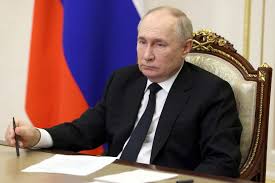
Christian Science Monitor, By Fred Weir, Special correspondent, September 19, 2024, Moscow
Over the course of the war in Ukraine, the Kremlin has drawn several “red lines” – with ostentatious references to Russia’s huge strategic nuclear arsenal – only to seemingly do nothing when these lines are crossed by Ukraine or its Western backers
Red lines:
- It happened when Ukraine acquired new and more powerful Western arms.
- It happened when Kyiv used its own drones to hit Russian airfields, refineries, and even the Kremlin itself.
- Most recently, it happened when Ukrainian forces actually invaded Russian territory. That has led Ukrainians, and many NATO officials, to conclude that Russian President Vladimir Putin’s nuclear saber-rattling is an elaborate bluff.
But when Mr. Putin warned last Thursday that Moscow will consider it a direct act of war by NATO if British, French, or U.S.-made missiles are used by Ukraine to strike targets deep inside Russia, he said this time is different.
Why We Wrote This
The Kremlin has had little success invoking its nuclear arsenal to deter Ukraine and the West from deploying new tactics and modern equipment to stop Russia’s invasion. But that may be changing.
Many Russian experts agree. And for now, Washington seems to be heeding his threat and holding off on permitting Ukraine to use the weapons.
“Russia’s frustration has been growing because the West appears to have lost all fear of nuclear war. Deterrence is absent,” says Sergei Strokan, an international affairs columnist with the Moscow daily Kommersant. During the Cold War, he says, that fear drove both sides to the bargaining table, aiming to limit conflicts and control nuclear weapons.
………………………………………………………………………………………………………………………………………………………….. more https://www.csmonitor.com/layout/set/amphtml/World/Europe/2024/0919/putin-ukraine-war-russia-nuclear-war-ww3?fbclid=IwY2xjawFZl3RleHRuA2FlbQIxMQABHTcSiRBIOeirIFfIogP4ISJt2uGrRaPn6u1PExNVwAUriNd55aENjnbTHw_aem_YYAKI4JyPWZbXh1b5xaDcw
MIT Coalition for Palestine Announces Major Divestment Win

09/17/2024, https://nlgmass.org/mit-coalition-for-palestine-announces-major-divestment-win/
The MIT Coalition For Palestine announces a major divestment win for its Scientists Against Genocide (SAGE) movement : MIT has ended the MISTI-Israel Lockheed Martin Fund. This is the first known shutdown of an American-Israeli weapons manufacturer partnership at a U.S. university since the war on Gaza has begun, and MIT has chosen to end this partnership despite renewing its other MISTI projects. The Fund had been a project by MIT International Science and Technology Initiative Israel (MISTI-Israel) to connect students and researchers at MIT to the global arms manufacturer’s Israeli offices.
Lockheed Martin has unquestionably profited from the genocide in Gaza, supplying the Israeli government with Hellfire missiles, attack aircraft, and heavy artillery directly used in destroying Palestinian lives, homes, and society, as well as enabling torture camps and a regime of apartheid. This win is a testament to the sustained pressure from activists, including MIT labor’s refusal to abet the apartheid state via contributing to its weapons research. NLG is proud to have supported and represented MIT SAGE via legal representation and legal observation, especially when they were under threat of police violence and unlawful arrests during the encampment of Apr-May 2024.
Israeli forces continue to escalate in their terror, and MIT maintains ongoing, direct research funding links to the Israeli military supply chain. MIT Coalition for Palestine will continue to fight and resist against the genocidal regime: the NLG will continue to support that fight. No science for apartheid, and free Palestine
Nuclear in Australia would increase household power bills
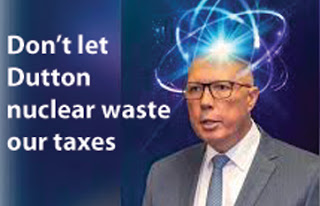
Report Nuclear Electric Grid Energy Policy Australia
September 20, 2024, Johanna Bowyer and Tristan Edis, https://ieefa.org/resources/nuclear-australia-would-increase-household-power-bills
Key Findings
Typical Australian households could see electricity bills rise by AUD665/year on average under the opposition Coalition’s plans to introduce nuclear to the country’s energy mix.
IEEFA analysed six scenarios based on relevant international examples of nuclear power construction projects; in every scenario, bills increased by hundreds of dollars.
For households that use more electricity, bills could rise more – for a four-person household, the bill rise was found to be AUD972/year on average across nuclear scenarios and regions.
The cost of electricity generated from nuclear plants would likely be 1.5 to 3.8 times the current cost of electricity generation in eastern Australia.
Australia’s main federal opposition, the Liberal-National Coalition, has proposed building seven nuclear power plants across the country, including both large-scale reactors and small modular reactors (SMRs). This report seeks to detail the likely impact on household consumers’ electricity bills from such a plan, based on recent real-world experience from construction costs for nuclear power plants around the world.
Rather than use theoretical projected costs, we have calculated the potential electricity bill impact for a range of nuclear cost recovery scenarios, based on the following real-world examples:
Finland: Olkiluoto Unit 3. France: Flamanville Unit 3. UK: Hinkley Point C. US: Vogtle Units 3 and 4.US SMR: NuScale SMR. Czech Republic: Dukovany proposed plant expansion.
The first four scenarios are based on actual, recent nuclear power plant construction costs and timeframes for countries in liberal democracies where costs are transparent. Commenting on nuclear construction cost estimates, electricity market economist Professor Paul Joskow states: “The best estimates are drawn from actual experience rather than engineering cost models.”
In the case of SMRs, no plants have been successfully completed in a democratic country, so we instead used the one example of a binding contract offer to build such a plant in the US, the now-cancelled NuScale project. We also used this approach for assessing the costs for a proposal to build South Korean APR technology (a design that the Coalition has cited for potential implementation in Australia) in a separate democratic country with laws protecting labour rights, outside of its country of origin – the Czech Republic.
Household electricity bills impact
We found that electricity bills would need to rise in order for nuclear costs to be recovered. The chart below illustrates the resulting increase in typical household power bills if nuclear power plants with similar costs and characteristics to the international examples were built in Australia. The average bill increase was AUD665/year across states and nuclear scenarios for households with a median level of electricity consumption. The lowest impact is equivalent to bill increases of AUD260-AUD353 per year, linked to estimated costs for the pre-construction project Dukovany, which is highly likely to underestimate final costs. The lowest impact from a nuclear plant successfully completed (Vogtle) is AUD383-AUD461 per year for an average household. Meanwhile, the UK experience with Hinkley Point C indicates electricity bill rises of more than AUD1,000 per year are possible.
Figure 1 [on original]: Increase in typical household electricity bill to recover cost of nuclear plants based on different countries’ experience (AUD/year)
The range of costs is wide due to the significant cost differentials for large-scale nuclear in different countries, and the significant cost uncertainty for SMR technology, which is still under development. The impact in each state can vary due to differing typical electricity consumption levels in each state, and different electricity bill cost structures.
For households using more electricity than the median level, the bill increases from nuclear would be higher. For example, for a four-person household the bill impact would be AUD972/year on average across nuclear scenarios and states, and for a five-person household AUD1,182/year.
How nuclear costs are reflected on electricity bills
These results might come as surprising to some, because large-scale nuclear is a mature technology currently in use across a wide range of countries. In addition, misinterpreted data on retail electricity prices (which also include the costs of powerlines and taxes, not just generators and so is misleading) can show some cases of nations that use nuclear who have lower retail prices than Australia.
However, in almost all cases around the world, the cost of nuclear power plant construction and financing is not fully reflected in market prices for power. This is because either nuclear power plants are very old and their costs are largely depreciated, or governments have acted to recover the costs either through taxpayers, or via levies which are independent of electricity markets – for example in France, the UK and Ontario, Canada. In other jurisdictions, such as a number of US states including Georgia where the Vogtle power plant is located, there isn’t actually an electricity market in operation, with consumers instead served by a regulated monopoly without any competitive choice.
The Coalition has outlined something different, ruling out taxpayer subsidies and stating that any government investments in nuclear plants would receive a commercial return. This implies that the Coalition expect that wholesale electricity market prices will be sufficient for nuclear power plants in each state to recover their construction costs plus a commercial level of return. The Coalition has also outlined that these nuclear power plants would operate at full capacity almost all of the time. Therefore, power prices would need to average out at the level a nuclear plant needs to be commercially viable – to recover their costs – almost all of the time.
High costs of recent nuclear projects
The reason bills increased in this study is because recent large-scale nuclear projects across Europe and North America involved very high costs. The European Pressured Reactor (EPR) program had promised to deliver more efficient, safer nuclear power. However, the three recent projects (Olkiluoto 3, Flamanville 3 and Hinkley Point C), which have either just been completed or are under construction, have all faced construction challenges, delays and cost-blowouts. If plants with similar costs and characteristics were built in Australia, they would require a levelised cost of electricity (LCOE) between AUD250 per megawatt-hour (MWh) and AUD346/MWh to recover their costs.
A few other types of reactors are being built or considered internationally of a similar design to what the Coalition indicates might be built in Australia: the South Korean APR1000 design proposed at Dukovany in the Czech Republic; and a Westinghouse AP1000 design recently completed at Vogtle in the US. The Vogtle plant experienced seven years of delays and actual capital costs (excluding financing costs) 1.7 times the original estimates. Those plants present LCOEs of between AUD197 and AUD220 per MWh in an Australian context – noting the Dukovany costs are only initial pre-construction estimates and could rise.
Based on NuScale, we estimate that the LCOE of nuclear SMR in an Australian context would be AUD289/MWh – but could be far higher if construction extends beyond the 3.25 years used in this study – as financing costs increase as construction timelines extend.
Capital costs (excluding financing costs) of recent nuclear power builds have tended to blow out by a factor of between 1.7 and 3.4, leading to financial difficulties for companies involved. All conventional nuclear projects built in recent years in the US and Europe – Vogtle, Olkiluoto 3, Hinkley Point C and Flamanville 3 – have contributed to financial difficulties for companies involved. Westinghouse, which was the technology provider for Vogtle, filed for bankruptcy protection in 2017. France’s AREVA, who was the original technology provider for Olkiluoto 3, Flamanville 3 and Hinkley Point C, came close to bankruptcy over 2015, which required a French Government-sponsored bail-out.
The chart below [on original] details the wholesale market prices required for each of the recently constructed or quoted nuclear plants to be commercially viable, relative to the current wholesale electricity costs being passed through in household electricity bills in the regions of Victoria, NSW, South East Queensland (SEQ) and South Australia (SA).
[Figure 2: Current wholesale energy cost (WEC) component of current household bills compared to commercial price to recover nuclear plant costs in Australian context (AUD/MWh)]
Australia would likely face even higher large-scale nuclear costs than these recent international examples, due to the country’s limited nuclear capability and the small size of any potential Australian nuclear build-out program. With seven nuclear power stations proposed (two of them SMR-only), all at separate sites, there will be limited scope to achieve learning-based cost reductions like those seen in a large continuous build program, for example the build program in South Korea on which CSIRO’s GenCost costings are based. South Korea has built 26 reactors since the 1970s. Further, the assumptions in this report have provided an optimistic levelised cost of electricity for nuclear, for example using a 60-year economic lifetime, 93% capacity factor, and a low discount rate.
Our analysis suggests household power bills would need to rise significantly for nuclear power plants to become a commercially viable investment in the absence of substantial, taxpayer-funded government subsidies. In IEEFA’s opinion, any plan to introduce nuclear energy in Australia – such as that proposed by the Coalition – should be examined thoroughly, with particular focus on the potential impact on electricity system costs and household bills, and with detailed analysis of alternative technologies such as renewables and firming.
Peter Dutton and the pursuit of fame.
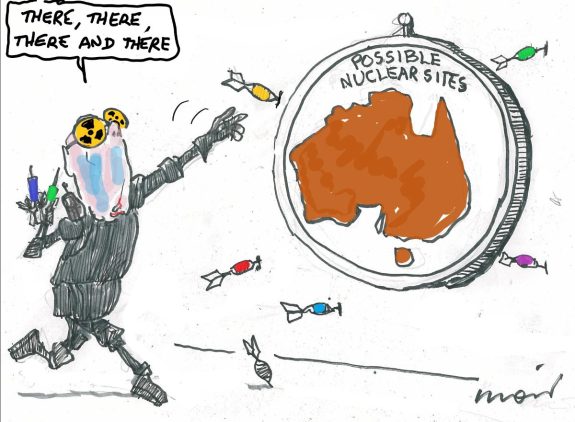
21 September 24 https://theaimn.com/peter-dutton-and-the-pursuit-of-fame/
Peter Dutton is the leader of Australia’s opposition party – the Liberal-National Coalition.
Which is pretty noteworthy and important, anyway. But of course, he would be more important if he is elected as Prime Minister in 2025. But is that enough fame for him?
Dutton aspires to a greater, global, significance. He would be the first world leader to introduce the commercial, peaceful, advanced nuclear industry to not just a country, but to an entire continent. And not to some “third-world” “undeveloped” country “in need of charity” – but to a prosperous, privileged, purportedly well-educated, and still mainly white population.
For the global nuclear industry – that would be a first! And not just any old first, but an extremely timely one. Just released this week, The World Nuclear Industry Status Report 2024 describes an industry on life support. Even back in 2016 Former World Nuclear Association executive Steve Kidd spoke to this problem, noting that “the industry is essentially running to stand still.”
For Australia to adopt a government-run nuclear industry involving both large and small nuclear reactors across a continent – what a wonderful shot in the arm for the global nuclear lobby. And Dutton – what a hero!
Dutton would be famous not just in Australia, but world-wide
Is this why Peter Dutton is promoting his nuclear policy?
I can’t think of any other reason.
Australia, especially in the State of South Australia, is becoming a world leader in renewable energy use – particularly in decentralised household rooftop solar, but also in large solar and wind programmes. Of course, Australia’s mining magnates are pretty happy with Dutton’s plan, as it will mean more mining, not just of uranium, but of coal and gas in the decades before nuclear power actually comes into use.
So – look – it’s a winner for Dutton’s fame.
And if that doesn’t work, there’s fame in another way
The last Liberal Prime Minister, Scott Morrison, is a great contender for the worst Prime Minister in Australian history. Just a few of his achievements to merit this award were:
- By 2022, Australia’s gross national debt was 42.5 per cent of GDP (Peak Whitlam government was 24.5. Peak Hawke-Keating was 24. Peak Rudd-Gillard Government debt was 20.)
- Notorious for taking a holiday during Australia’s 2019–20 bushfire season.
- Signed Australia up to the costly AUKUS nuclear submarine deal
- Secretly appointed himself to five ministerial positions without the knowledge of the public or his own government.
Economically, the nuclear power programme, added to the continuing AUKUS nuclear deal, could pretty well bankrupt Australia. Although Dutton claims that nuclear power will be cheap, he’s given no costings, and the over-riding opinion of energy and economics experts is that nuclear power would be the most expensive form of energy for Australia.
Environmentally, Dutton’s plan includes advanced nuclear reactors, which will require plutonium or enriched uranium – so this brings virtually eternal radioactive pollution into Australia (something that has been nearly avoided up until now). It also brings the hazards of nuclear weapons proliferation, and terrorism targets.
So – it’s a bold venture for Peter Dutton, to centre his election campaign on promoting the nuclear industry. He is to be commended for bravery in taking such a big risk.
If Dutton carries this through, as Prime Minister, he will rapidly gain world fame.
But also, as far as Australia is concerned, he could beat Scott Morrison into history as the nation’s worst Prime Minister.
Dutton’s big risk is that he might not get elected in 2025, and vanish very quickly from history.
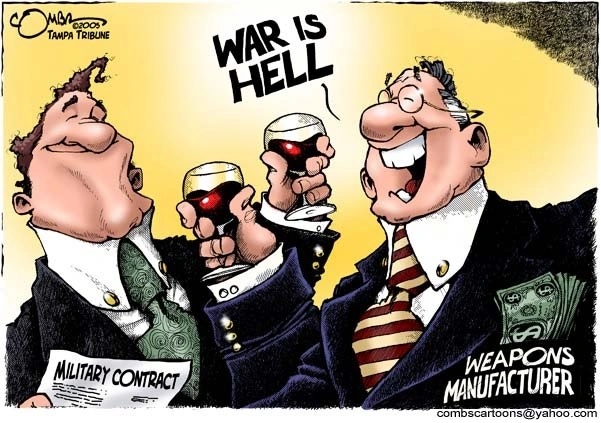
Selling War: How Raytheon and Boeing Fund the Push for NATO’s Nuclear Expansion
World Beyond War, By Alan Macleod, Mint Press, September 20, 2024
To “counter Russia’s nuclear blackmail,” the Atlantic Council confidently asserted, “NATO must adapt its nuclear sharing program.” This includes moving B-61 atomic bombs to Eastern Europe and building a network of medium-range missile bases across the continent. The think tank praised Washington’s recent decision to send Tomahawk and SM-6 missiles to Germany as a “good start” but insisted that it “does not impose a high enough price” on Russia.
What the Atlantic Council does not divulge at any time is that not only would this drastically increase the likelihood of a catastrophic nuclear war, but that the weapons they specifically recommend come directly from manufacturers that fund them in the first place.
The B-61 bombs are assembled by Boeing, who, according to its most recent financial reports, gave tens of thousands of dollars to the organization. And the Tomahawk and SM-6 are produced by Raytheon, who recently supplied the Atlantic Council with a six-figure sum.
Thus, their recommendations not only put the world at risk but also directly benefit their funders.
Unfortunately, this gigantic conflict of interest that affects us all is par for the course among foreign policy think tanks. A MintPress News investigation into the funding sources of U.S. foreign policy think tanks has found that they are sponsored to the tune of millions of dollars every year by weapons contractors. Arms manufacturing companies donated at least $7.8 million last year to the top fifty U.S. think tanks, who, in turn, pump out reports demanding more war and higher military spending, which significantly increase their sponsors’ profits. The only losers in this closed, circular system are the American public, saddled with higher taxes, and the tens of millions of people around the world who are victims of the U.S. war machine.
The think tanks receiving the most tainted cash were, in order, the Atlantic Council, CSIS, CNAS, the Hudson Institute, and the Council on Foreign Relations, while the weapons manufacturers most active on K-Street were Northrop Grumman, Lockheed Martin, and General Atomics.
These think tanks directly affect conflicts around the world. CSIS, for example, are among the loudest advocates for arming Ukraine, Taiwan and Israel, even as the latter carries out a genocide in Palestine. A recent report lays out a shopping list of U.S. weapons that would help the Israeli military, including Excalibur artillery projectiles, JDAM bomb guidance systems, and Javelin missiles. Those weapons are manufactured by Raytheon, Boeing, and Lockheed Martin, respectively, all of whom are among CSIS’ top funders.
U.S. arms are being used daily to carry out illegal and deadly attacks against civilian populations in Palestine, Lebanon, and Syria, making arms manufacturers directly complicit in war crimes.
One example of this is the recent Israeli bombing of the Al Mawasi humanitarian zone in Gaza. Israel dropped three one-ton MK-84 bombs on the camp, killing at least 19 people. Dozens more are still missing.
According to the UN, MK-84 bomb blasts rupture lungs, tear limbs and heads from bodies, and burst sinus cavities up to hundreds of meters away.
The MK-84 bombs were produced in the U.S. by General Dynamics and sent to Israel with Washington’s blessing. General Dynamics has made huge profits from the slaughter; the D.C.-based arms manufacturer’s stock price has jumped by 42% since October 7.
Conflicts and Conflicts of Interest
Think tanks are an essential part of K-Street, the collective term for the assembly of lobbyists, trade associations and other organizations that attempt to alter government policy……………………………………………………………………………………
There is obviously a massive conflict of interest if groups advising the U.S. government on military policy are awash with cash from the arms industry. This study attempts to quantify that conflict of interest. It analyzed the top 50 most influential foreign policy think tanks in the U.S., according to the University of Pennsylvania’s Global Go to Think Tank Index, and tracked the funding of these 50 organizations to ascertain how much money each received from the weapons industry. A comprehensive funding spreadsheet containing all the numbers used in this study can be found here.
Figures were taken from each group’s websites, funding lists, and financial declarations for the last financial year available. In total, the arms industry donated at least $7.8 million to those think tanks.
This, however, is certainly a significant underestimate for several reasons. ……………………………….
Tanks and Think Tanks
The results were both worrying and unsurprising, as this study found that giant arms manufacturers quietly bankrolled many of the largest and most influential groups advising the U.S. government on its foreign policy. The Atlantic Council alone is funded by 22 weapons companies, totaling at least $2.69 million last year. Even a group like the Carnegie Endowment for Peace, established in 1910 as an organization dedicated to reducing global conflict, is sponsored by corporations making weapons of war, including Boeing and Leonardo, who donate tens of thousands of dollars annually.
The five think tanks that received the most funding from the arms industry are: The Atlantic Council, $2.69 million; Center for Strategic and International Studies (CSIS), $2.46 million; Center for a New American Security (CNAS), $950,000; Hudson Institute, $635,000; and the Council on Foreign Relations, $300,000.
At least 36 weapons manufacturers provided funding to major American think tanks. The most “generous” among them were Northrop Grumman, $1.07 million; Lockheed Martin, $838,000; General Atomics, $510,000; Leonardo S.p.A., $485,000; and Mitsubishi, $443,000.
When presented with these findings, peace activist David Swanson, author of “War is a Lie,” appeared disgusted but not surprised. Swanson described the role of arms industry-funded think tanks as such:
They have to build up through endless repetition and through debates that remain within their bizarre parameters the idea that wars are won, that wars are defensive, that nuclear weapons deter wars, that enemies cannot be spoken with, that weapons spending is a public service that nations should do to the maximum extent possible while stripping funding away from human needs, and similar outrageous pieces of nonsense.”
He Who Pays the Piper
It is no coincidence that the groups receiving the most weapons industry money are home to some of the most hawkish, pro-war voices to be found anywhere. The arms industry, like all corporations, does not donate out of the goodness of their hearts but is instead looking for a return on their investments.
Influential think tanks like CSIS are certainly giving their benefactors bang for their buck, consistently agitating for more military spending and more war around the world, whatever the consequences.
………………………..European countries, CSIS also insisted, must “pull their weight” in NATO, transforming their societies into ones every bit as militarized as the U.S., for the sake of “global democracy.”
Meanwhile, writing in The Atlantic, Eliot A. Cohen, CSIS’ Arleigh A. Burke Chair in Strategy, demanded an escalation in the West’s involvement in Ukraine. “We need to see masses of Russians fleeing, deserting, shooting their officers, taken captive, or dead. The Russian defeat must be an unmistakably big, bloody shambles,” he wrote, adding that “To that end, with the utmost urgency, the West should give everything that Ukraine could possibly use.”
This included long-range missiles and F-16 and F-35 fighter jets.
What neither Cohen nor the Atlantic noted, however, was that the weapons he demanded to be bought and sent to Ukraine are made by General Dynamics and Lockheed Martin, groups that directly fund CSIS……………………….
the relentless pro-war voices were hardly limited to CSIS. In fact, every think tank taking substantial arms industry cash maintained a notably hawkish stance. The Atlantic Council, for instance, policed European nations’ NATO spending in an attempt to pressure them to purchase more arms and has advocated that the U.S. create a new “Indo-Pacific intelligence coalition” that would ramp up tensions with China. CNAS, meanwhile, has claimed that the U.S.’ supposedly muted response to “Chinese provocations” has eroded its “credibility” on the world stage.
Speaking on what think tanks have achieved, Swanson told MintPress:
They’ve normalized the idea of measuring war spending as a percentage of an economy, and the idea that there is no such thing as too much of it. They’ve normalized the idea of only one solution to all problems, even problems created by that one solution, namely war. [And] they present endlessly endlessly endlessly ‘defensive alliance NATO’ with not a soul noticing that NATO’s wars have all been blatantly aggressive.”
The American public is generally skeptical of war. Surveys show that two-thirds of the country wants Washington and Ukraine to directly engage in diplomacy with Russia, even if that means conceding Ukrainian territory. Most Americans are against sending more U.S. troops to the Middle East as well, even if it were only to “defend Israel.”
They hold these positions despite what they are constantly told in the media. A study by the Quincy Institute found that, when discussing Ukraine, 85% of all think tanks quoted in major outlets like the New York Times, Washington Post and The Wall Street Journal received funding from the military-industrial complex. Most prominent among these were CSIS and the Atlantic Council.
Making a Killing from Killing
In his hit 1970 song, “War,” Edwin Starr claimed that the practice was a “friend only to the undertaker.” But war has also been excellent news for weapons contractors. In the past five years, General Dynamics’ stock price has jumped by 103%, Lockheed Martin’s by 107%, and Northrop Grumman’s by 110%.
Arms industry shareholders have seen massive returns on investment, thanks to the actions of a nation addicted to conflict. The United States has been engaged in warfare for 231 of its 248 years as an independent country. According to a report by the Congressional Research Service, a U.S. government institution, America has launched 469 foreign military interventions between 1798 and 2022 and 251 since 1991 alone. This has included special operations, targeted assassinations of foreign leaders, military coups, and outright invasions and occupations of other countries.
More than half of all discretionary Federal spending goes to the military, whose budget is closing in on $1 trillion annually. American military spending rivals that of all other nations combined. The United States also maintains a network of around 1,000 bases around the world, including nearly 400 in a ring encircling China.
This feeds the insatiable appetites of weapons manufacturers, who, therefore, have even more money to spend buying influence and lobbying the government for more war and antagonistic policies that benefit them.
Part of their strategy is funding think tanks in Washington, D.C. For the likes of Lockheed Martin and Raytheon, it is a no-brainer, an astute business investment. A few hundred thousand dollars per year spent bankrolling think tanks like CSIS, CNAS or the Atlantic Council translates into billions of dollars worth of more orders for tanks, ships and aircraft.
By 2016, the United States was bombing seven countries simultaneously. And yet, militarism and the danger to the planet have only increased since then. The U.S. is currently gearing up for potential wars against both Russia and China – two of the largest and most populous states on the planet, and both ones with large stockpiles of atomic weapons. A war with either would risk Armageddon.
This is all great news for the military-industrial-complex, however, who are making a killing. And that is why it is imperative that they be stopped; it is literally a life-and-death issue for all of us.
Feature photo | The North Atlantic Council meeting begins to fill during the meeting of Defence Ministerials at NATO Headquarters, Brussels, Belgium, February 12, 2020. Photo |DVIDS
Alan MacLeod is Senior Staff Writer for MintPress News. After completing his PhD in 2017 he published two books: Bad News From Venezuela: Twenty Years of Fake News and Misreporting and Propaganda in the Information Age: Still Manufacturing Consent, as well as a number of academic articles. He has also contributed to FAIR.org, The Guardian, Salon, The Grayzone, Jacobin Magazine, and Common Dreams.
https://worldbeyondwar.org/selling-war-how-raytheon-and-boeing-fund-the-push-for-natos-nuclear-expansion/
The 2024 World Nuclear Industry Status Report now released.
The World Nuclear Industry Status Report 2024 (WNISR2024) assesses on 513
pages the status and trends of the international nuclear industry. It
provides a comprehensive overview of nuclear power plant data, including
information on operation, production, fleet age, and construction.
The WNISR discusses the status of newbuild programs in existing as well as in
potential newcomer nuclear countries; notably in the Türkiye Focus which
provides critical context to the ongoing construction of the country’s
first nuclear power plant. A section is dedicated to ambitions and
prospects for nuclear deployment in Potential Newcomer Countries in Africa,
while Taiwan Focus covers the current situation and implementation of the
nuclear phaseout policy.
WNISR 19th Sept 2024
https://www.worldnuclearreport.org/World-Nuclear-Industry-Status-Report-2024-1046
1 This Month
23-25 October – on Zoom – World BEYOND War’s annual global conferenc

To see nuclear-related stories in greater depth and intensity – go to https://nuclearinformation.wordpress.com

Say No to NASA’s Reckless Nuclear Reactor on the Moon
Say No to NASA’s Reckless Nuclear Reactor on the Moon
-
Archives
- October 2026 (149)
- September 2026 (339)
- August 2026 (330)
- July 2026 (355)
- June 2026 (287)
- May 2026 (306)
- April 2026 (356)
- March 2026 (251)
- February 2026 (267)
- January 2026 (308)
- December 2025 (358)
- November 2025 (359)
-
Categories
- 1
- 1 NUCLEAR ISSUES
- business and costs
- climate change
- culture and arts
- ENERGY
- environment
- health
- history
- indigenous issues
- Legal
- marketing of nuclear
- media
- opposition to nuclear
- PERSONAL STORIES
- politics
- politics international
- Religion and ethics
- safety
- secrets,lies and civil liberties
- spinbuster
- technology
- Uranium
- wastes
- weapons and war
- Women
- 2 WORLD
- ACTION
- AFRICA
- Atrocities
- AUSTRALIA
- Christina's notes
- Christina's themes
- culture and arts
- Events
- Fuk 2022
- Fuk 2023
- Fukushima 2017
- Fukushima 2018
- fukushima 2019
- Fukushima 2020
- Fukushima 2021
- general
- global warming
- Humour (God we need it)
- Nuclear
- RARE EARTHS
- Reference
- resources – print
- Resources -audiovicual
- Weekly Newsletter
- World
- World Nuclear
- YouTube
-
RSS
Entries RSS
Comments RSS

