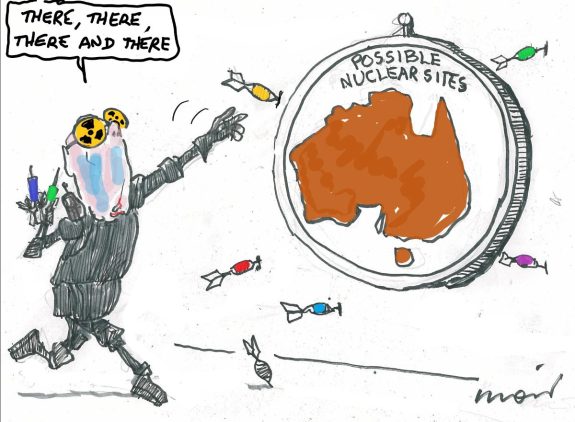
Peter Dutton and the pursuit of fame.
21 September 24 https://theaimn.com/peter-dutton-and-the-pursuit-of-fame/
Peter Dutton is the leader of Australia’s opposition party – the Liberal-National Coalition.
Which is pretty noteworthy and important, anyway. But of course, he would be more important if he is elected as Prime Minister in 2025. But is that enough fame for him?
Dutton aspires to a greater, global, significance. He would be the first world leader to introduce the commercial, peaceful, advanced nuclear industry to not just a country, but to an entire continent. And not to some “third-world” “undeveloped” country “in need of charity” – but to a prosperous, privileged, purportedly well-educated, and still mainly white population.
For the global nuclear industry – that would be a first! And not just any old first, but an extremely timely one. Just released this week, The World Nuclear Industry Status Report 2024 describes an industry on life support. Even back in 2016 Former World Nuclear Association executive Steve Kidd spoke to this problem, noting that “the industry is essentially running to stand still.”
For Australia to adopt a government-run nuclear industry involving both large and small nuclear reactors across a continent – what a wonderful shot in the arm for the global nuclear lobby. And Dutton – what a hero!
Dutton would be famous not just in Australia, but world-wide
Is this why Peter Dutton is promoting his nuclear policy?
I can’t think of any other reason.
Australia, especially in the State of South Australia, is becoming a world leader in renewable energy use – particularly in decentralised household rooftop solar, but also in large solar and wind programmes. Of course, Australia’s mining magnates are pretty happy with Dutton’s plan, as it will mean more mining, not just of uranium, but of coal and gas in the decades before nuclear power actually comes into use.
So – look – it’s a winner for Dutton’s fame.
And if that doesn’t work, there’s fame in another way
The last Liberal Prime Minister, Scott Morrison, is a great contender for the worst Prime Minister in Australian history. Just a few of his achievements to merit this award were:
- By 2022, Australia’s gross national debt was 42.5 per cent of GDP (Peak Whitlam government was 24.5. Peak Hawke-Keating was 24. Peak Rudd-Gillard Government debt was 20.)
- Notorious for taking a holiday during Australia’s 2019–20 bushfire season.
- Signed Australia up to the costly AUKUS nuclear submarine deal
- Secretly appointed himself to five ministerial positions without the knowledge of the public or his own government.
Economically, the nuclear power programme, added to the continuing AUKUS nuclear deal, could pretty well bankrupt Australia. Although Dutton claims that nuclear power will be cheap, he’s given no costings, and the over-riding opinion of energy and economics experts is that nuclear power would be the most expensive form of energy for Australia.
Environmentally, Dutton’s plan includes advanced nuclear reactors, which will require plutonium or enriched uranium – so this brings virtually eternal radioactive pollution into Australia (something that has been nearly avoided up until now). It also brings the hazards of nuclear weapons proliferation, and terrorism targets.
So – it’s a bold venture for Peter Dutton, to centre his election campaign on promoting the nuclear industry. He is to be commended for bravery in taking such a big risk.
If Dutton carries this through, as Prime Minister, he will rapidly gain world fame.
But also, as far as Australia is concerned, he could beat Scott Morrison into history as the nation’s worst Prime Minister.
Dutton’s big risk is that he might not get elected in 2025, and vanish very quickly from history.
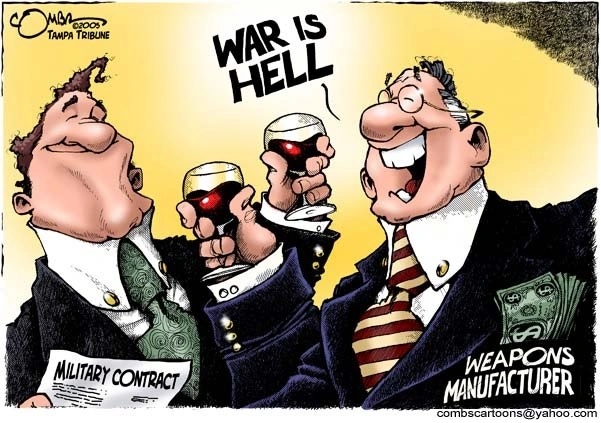
Selling War: How Raytheon and Boeing Fund the Push for NATO’s Nuclear Expansion
World Beyond War, By Alan Macleod, Mint Press, September 20, 2024
To “counter Russia’s nuclear blackmail,” the Atlantic Council confidently asserted, “NATO must adapt its nuclear sharing program.” This includes moving B-61 atomic bombs to Eastern Europe and building a network of medium-range missile bases across the continent. The think tank praised Washington’s recent decision to send Tomahawk and SM-6 missiles to Germany as a “good start” but insisted that it “does not impose a high enough price” on Russia.
What the Atlantic Council does not divulge at any time is that not only would this drastically increase the likelihood of a catastrophic nuclear war, but that the weapons they specifically recommend come directly from manufacturers that fund them in the first place.
The B-61 bombs are assembled by Boeing, who, according to its most recent financial reports, gave tens of thousands of dollars to the organization. And the Tomahawk and SM-6 are produced by Raytheon, who recently supplied the Atlantic Council with a six-figure sum.
Thus, their recommendations not only put the world at risk but also directly benefit their funders.
Unfortunately, this gigantic conflict of interest that affects us all is par for the course among foreign policy think tanks. A MintPress News investigation into the funding sources of U.S. foreign policy think tanks has found that they are sponsored to the tune of millions of dollars every year by weapons contractors. Arms manufacturing companies donated at least $7.8 million last year to the top fifty U.S. think tanks, who, in turn, pump out reports demanding more war and higher military spending, which significantly increase their sponsors’ profits. The only losers in this closed, circular system are the American public, saddled with higher taxes, and the tens of millions of people around the world who are victims of the U.S. war machine.
The think tanks receiving the most tainted cash were, in order, the Atlantic Council, CSIS, CNAS, the Hudson Institute, and the Council on Foreign Relations, while the weapons manufacturers most active on K-Street were Northrop Grumman, Lockheed Martin, and General Atomics.
These think tanks directly affect conflicts around the world. CSIS, for example, are among the loudest advocates for arming Ukraine, Taiwan and Israel, even as the latter carries out a genocide in Palestine. A recent report lays out a shopping list of U.S. weapons that would help the Israeli military, including Excalibur artillery projectiles, JDAM bomb guidance systems, and Javelin missiles. Those weapons are manufactured by Raytheon, Boeing, and Lockheed Martin, respectively, all of whom are among CSIS’ top funders.
U.S. arms are being used daily to carry out illegal and deadly attacks against civilian populations in Palestine, Lebanon, and Syria, making arms manufacturers directly complicit in war crimes.
One example of this is the recent Israeli bombing of the Al Mawasi humanitarian zone in Gaza. Israel dropped three one-ton MK-84 bombs on the camp, killing at least 19 people. Dozens more are still missing.
According to the UN, MK-84 bomb blasts rupture lungs, tear limbs and heads from bodies, and burst sinus cavities up to hundreds of meters away.
The MK-84 bombs were produced in the U.S. by General Dynamics and sent to Israel with Washington’s blessing. General Dynamics has made huge profits from the slaughter; the D.C.-based arms manufacturer’s stock price has jumped by 42% since October 7.
Conflicts and Conflicts of Interest
Think tanks are an essential part of K-Street, the collective term for the assembly of lobbyists, trade associations and other organizations that attempt to alter government policy……………………………………………………………………………………
There is obviously a massive conflict of interest if groups advising the U.S. government on military policy are awash with cash from the arms industry. This study attempts to quantify that conflict of interest. It analyzed the top 50 most influential foreign policy think tanks in the U.S., according to the University of Pennsylvania’s Global Go to Think Tank Index, and tracked the funding of these 50 organizations to ascertain how much money each received from the weapons industry. A comprehensive funding spreadsheet containing all the numbers used in this study can be found here.
Figures were taken from each group’s websites, funding lists, and financial declarations for the last financial year available. In total, the arms industry donated at least $7.8 million to those think tanks.
This, however, is certainly a significant underestimate for several reasons. ……………………………….
Tanks and Think Tanks
The results were both worrying and unsurprising, as this study found that giant arms manufacturers quietly bankrolled many of the largest and most influential groups advising the U.S. government on its foreign policy. The Atlantic Council alone is funded by 22 weapons companies, totaling at least $2.69 million last year. Even a group like the Carnegie Endowment for Peace, established in 1910 as an organization dedicated to reducing global conflict, is sponsored by corporations making weapons of war, including Boeing and Leonardo, who donate tens of thousands of dollars annually.
The five think tanks that received the most funding from the arms industry are: The Atlantic Council, $2.69 million; Center for Strategic and International Studies (CSIS), $2.46 million; Center for a New American Security (CNAS), $950,000; Hudson Institute, $635,000; and the Council on Foreign Relations, $300,000.
At least 36 weapons manufacturers provided funding to major American think tanks. The most “generous” among them were Northrop Grumman, $1.07 million; Lockheed Martin, $838,000; General Atomics, $510,000; Leonardo S.p.A., $485,000; and Mitsubishi, $443,000.
When presented with these findings, peace activist David Swanson, author of “War is a Lie,” appeared disgusted but not surprised. Swanson described the role of arms industry-funded think tanks as such:
They have to build up through endless repetition and through debates that remain within their bizarre parameters the idea that wars are won, that wars are defensive, that nuclear weapons deter wars, that enemies cannot be spoken with, that weapons spending is a public service that nations should do to the maximum extent possible while stripping funding away from human needs, and similar outrageous pieces of nonsense.”
He Who Pays the Piper
It is no coincidence that the groups receiving the most weapons industry money are home to some of the most hawkish, pro-war voices to be found anywhere. The arms industry, like all corporations, does not donate out of the goodness of their hearts but is instead looking for a return on their investments.
Influential think tanks like CSIS are certainly giving their benefactors bang for their buck, consistently agitating for more military spending and more war around the world, whatever the consequences.
………………………..European countries, CSIS also insisted, must “pull their weight” in NATO, transforming their societies into ones every bit as militarized as the U.S., for the sake of “global democracy.”
Meanwhile, writing in The Atlantic, Eliot A. Cohen, CSIS’ Arleigh A. Burke Chair in Strategy, demanded an escalation in the West’s involvement in Ukraine. “We need to see masses of Russians fleeing, deserting, shooting their officers, taken captive, or dead. The Russian defeat must be an unmistakably big, bloody shambles,” he wrote, adding that “To that end, with the utmost urgency, the West should give everything that Ukraine could possibly use.”
This included long-range missiles and F-16 and F-35 fighter jets.
What neither Cohen nor the Atlantic noted, however, was that the weapons he demanded to be bought and sent to Ukraine are made by General Dynamics and Lockheed Martin, groups that directly fund CSIS……………………….
the relentless pro-war voices were hardly limited to CSIS. In fact, every think tank taking substantial arms industry cash maintained a notably hawkish stance. The Atlantic Council, for instance, policed European nations’ NATO spending in an attempt to pressure them to purchase more arms and has advocated that the U.S. create a new “Indo-Pacific intelligence coalition” that would ramp up tensions with China. CNAS, meanwhile, has claimed that the U.S.’ supposedly muted response to “Chinese provocations” has eroded its “credibility” on the world stage.
Speaking on what think tanks have achieved, Swanson told MintPress:
They’ve normalized the idea of measuring war spending as a percentage of an economy, and the idea that there is no such thing as too much of it. They’ve normalized the idea of only one solution to all problems, even problems created by that one solution, namely war. [And] they present endlessly endlessly endlessly ‘defensive alliance NATO’ with not a soul noticing that NATO’s wars have all been blatantly aggressive.”
The American public is generally skeptical of war. Surveys show that two-thirds of the country wants Washington and Ukraine to directly engage in diplomacy with Russia, even if that means conceding Ukrainian territory. Most Americans are against sending more U.S. troops to the Middle East as well, even if it were only to “defend Israel.”
They hold these positions despite what they are constantly told in the media. A study by the Quincy Institute found that, when discussing Ukraine, 85% of all think tanks quoted in major outlets like the New York Times, Washington Post and The Wall Street Journal received funding from the military-industrial complex. Most prominent among these were CSIS and the Atlantic Council.
Making a Killing from Killing
In his hit 1970 song, “War,” Edwin Starr claimed that the practice was a “friend only to the undertaker.” But war has also been excellent news for weapons contractors. In the past five years, General Dynamics’ stock price has jumped by 103%, Lockheed Martin’s by 107%, and Northrop Grumman’s by 110%.
Arms industry shareholders have seen massive returns on investment, thanks to the actions of a nation addicted to conflict. The United States has been engaged in warfare for 231 of its 248 years as an independent country. According to a report by the Congressional Research Service, a U.S. government institution, America has launched 469 foreign military interventions between 1798 and 2022 and 251 since 1991 alone. This has included special operations, targeted assassinations of foreign leaders, military coups, and outright invasions and occupations of other countries.
More than half of all discretionary Federal spending goes to the military, whose budget is closing in on $1 trillion annually. American military spending rivals that of all other nations combined. The United States also maintains a network of around 1,000 bases around the world, including nearly 400 in a ring encircling China.
This feeds the insatiable appetites of weapons manufacturers, who, therefore, have even more money to spend buying influence and lobbying the government for more war and antagonistic policies that benefit them.
Part of their strategy is funding think tanks in Washington, D.C. For the likes of Lockheed Martin and Raytheon, it is a no-brainer, an astute business investment. A few hundred thousand dollars per year spent bankrolling think tanks like CSIS, CNAS or the Atlantic Council translates into billions of dollars worth of more orders for tanks, ships and aircraft.
By 2016, the United States was bombing seven countries simultaneously. And yet, militarism and the danger to the planet have only increased since then. The U.S. is currently gearing up for potential wars against both Russia and China – two of the largest and most populous states on the planet, and both ones with large stockpiles of atomic weapons. A war with either would risk Armageddon.
This is all great news for the military-industrial-complex, however, who are making a killing. And that is why it is imperative that they be stopped; it is literally a life-and-death issue for all of us.
Feature photo | The North Atlantic Council meeting begins to fill during the meeting of Defence Ministerials at NATO Headquarters, Brussels, Belgium, February 12, 2020. Photo |DVIDS
Alan MacLeod is Senior Staff Writer for MintPress News. After completing his PhD in 2017 he published two books: Bad News From Venezuela: Twenty Years of Fake News and Misreporting and Propaganda in the Information Age: Still Manufacturing Consent, as well as a number of academic articles. He has also contributed to FAIR.org, The Guardian, Salon, The Grayzone, Jacobin Magazine, and Common Dreams.
https://worldbeyondwar.org/selling-war-how-raytheon-and-boeing-fund-the-push-for-natos-nuclear-expansion/
The 2024 World Nuclear Industry Status Report now released.
The World Nuclear Industry Status Report 2024 (WNISR2024) assesses on 513
pages the status and trends of the international nuclear industry. It
provides a comprehensive overview of nuclear power plant data, including
information on operation, production, fleet age, and construction.
The WNISR discusses the status of newbuild programs in existing as well as in
potential newcomer nuclear countries; notably in the Türkiye Focus which
provides critical context to the ongoing construction of the country’s
first nuclear power plant. A section is dedicated to ambitions and
prospects for nuclear deployment in Potential Newcomer Countries in Africa,
while Taiwan Focus covers the current situation and implementation of the
nuclear phaseout policy.
WNISR 19th Sept 2024
https://www.worldnuclearreport.org/World-Nuclear-Industry-Status-Report-2024-1046
World demands end to Israel’s illegal occupation of Palestine, in landslide UN vote
The vast majority of the world voted at the UN General Assembly to demand an end to Israel’s unlawful occupation of Palestinian territory within 12 months, with 124 countries (64%) in favor, 14 (7%) against, and 43 (22%) abstentions.
GeoPOliticalEconomy, By Ben Norton, 19 Sept 24
The countries that voted against the resolution, in effect supporting Israel’s illegal occupation, were the United States, Israel, Argentina, Czechia, Hungary, Malawi, Papa New Guinea, and Paraguay, plus the tiny Pacific island nations of Fiji, Micronesia, Nauru, Palau, Tonga, and Tuvalu.
These small island countries that consistently echo Washington’s unpopular votes in the UN are essentially unofficial US colonies, and mostly use the US dollar or Australian dollar as their currencies. Together, the six have a combined population of just over 1 million people, making them some of the smallest nations on Earth.
Among the large countries that abstained were India, Australia, Canada, the Democratic Republic of the Congo, and Ethiopia.
However, in a break with Washington, a few longtime US allies voted in support of the resolution, most notably Japan, as well as France, Ireland, Portugal, and Spain…………………………….
The resolution was not controversial; it simply called for the implementation of a decision by the International Court of Justice (ICJ), the UN’s top legal body.
On July 19, the ICJ issued a historic ruling stating:
– the State of Israel’s continued presence in the Occupied Palestinian Territory is unlawful;
– the State of Israel is under an obligation to bring to an end its unlawful presence in the Occupied Palestinian Territory as rapidly as possible;
– the State of Israel is under an obligation to cease immediately all new settlement activities, and to evacuate all settlers from the Occupied Palestinian Territory;
– the State of Israel has the obligation to make reparation for the damage caused to all the natural or legal persons concerned in the Occupied Palestinian Territory;
– all States are under an obligation not to recognize as legal the situation arising from the unlawful presence of the State of Israel in the Occupied Palestinian Territory and not to render aid or assistance in maintaining the situation created by the continued presence of the State of Israel in the Occupied Palestinian Territory.
The US government is essentially the only obstacle standing in the way of the implementation of international law, and the recognition of Palestine as a full UN member state.
In May, 143 countries voted in the General Assembly to admit Palestine as a full UN member. At present, it is only an observer state.
This May General Assembly vote came after an April session of the Security Council, in which the US used its veto power to kill a resolution that requested full membership for Palestine.
Since war broke out in Gaza in October 2023, Washington has repeatedly vetoed Security Council resolutions that call for peace and a ceasefire.
US President Joe Biden has strongly supported Israel as it has brutally bombed civilians in Gaza, in what UN experts say is a campaign of genocide.
In a press conference in Tel Aviv in October, Biden asserted that “if Israel didn’t exist, we’d have to invent it”, given how strategic the colonial state is for US imperial interests. https://geopoliticaleconomy.com/2024/09/19/end-israel-occupation-palestine-un-vote/
‘The Genocide Gentry’: Weapon Execs Sit on Boards of Universities, Institutions
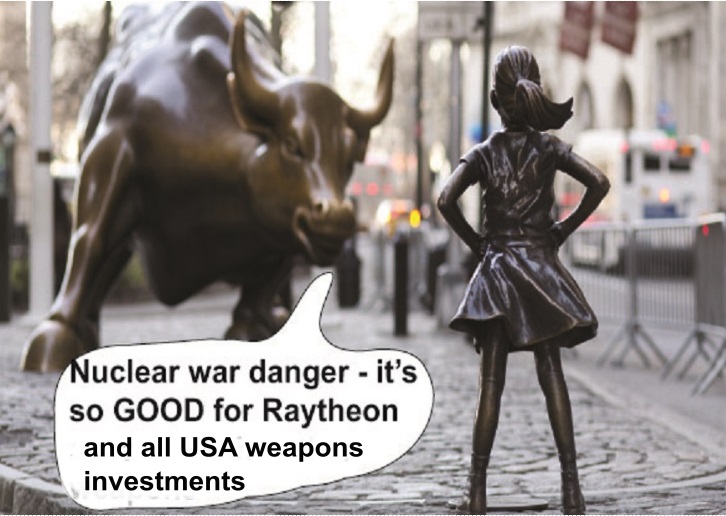
“This research provides a view into just how embedded the corporate, profit-fueled war machine is in our higher education and cultural institutions,” said one campaigner.
Brett Wilkins, Sep 18, 2024, https://www.commondreams.org/news/u-s-universities-weapons-companies
A trio of human rights groups on Wednesday announced a new interactive initiative exposing what the coalition is calling a “Genocide Gentry” of weapons company executives and board members and “54 museums, cultural organizations, universities, and colleges that currently host these individuals on their boards or in other prominent roles.”
The coalition—which consists of the Adalah Justice Project, LittleSis, and Action Center on Race and the Economy (ACRE)—published a map and database detailing the “educational and cultural ties to board members of six defense corporations” amid Israel’s ongoing annihilation of Gaza, for which the U.S.-backed country is on trial for genocide at the International Court of Justice.
” Israel has destroyed every university in Gaza and nearly 200 cultural heritage sites since October 2023, using bombs and weapons manufactured by the companies included in the Genocide Gentry research,” the coalition said. “As of April, these attacks have killed more than 5,479 students and 261 teachers and destroyed or critically damaged nearly 90% of all school buildings in Gaza.”
“Universities across the country including the likes of Columbia University, Harvard University, the University of Southern California, and New York University have remained largely silent on Israel’s genocidal campaign in Gaza,” the groups added. “Behind closed doors, these same universities are hosting executives and board members of the companies manufacturing the weapons used in these attacks as board members, trustees, and fellows.”
Members of the Genocide Gentry include:
- Jeh Johnson, Lockheed Martin board of directors: Johnson is currently a Columbia University trustee, and sits on the board of directors at MetLife and U.S. Steel. Columbia University notably shut down student protests demanding divestment from weapons companies like Lockheed Martin.
- Brian C. Rogers, RTX board of directors: Rogers is currently a trustee of the Harvard Management Company, tasked with managing the $50 billion endowment. Notably Harvard administrators have cracked down on students demanding divestment from weapons companies like RTX, formerly Raytheon.
- Catherine B. Reynolds, General Dynamics board of directors: Reynolds is a trustee of the Kennedy Center and sponsors a fellowship at New York University, which has also cracked down on anti-genocide protests and recently enacted a policy equating anti-Zionism with antisemitism.
“Students on university campuses across the country have not only been demanding divestment, but transparency,” said Sandra Tamari, executive director of the Adalah Justice Project. “Transparency about their institutions’ investments, partnerships, donors, and decision-makers, and their connections to individuals and companies directly enabling and profiting off war and genocide.”
“This research helps provide some of this transparency by illuminating just how embedded the interests of the weapons industry are within our institutions, so we can begin chipping away at the power and influence that they wield,” she added.
ACRE campaign director Ramah Kudaimi noted that “as part of its genocide since October 2023, Israel has targeted universities and cultural centers across Gaza, destroying campuses, museums, libraries, and more.”
“That this is all backed by the United States means U.S. educational and cultural institutions have a responsibility to consider what their role is in helping end these war crimes, and that starts with reconsidering their connections with the weapons companies profiting from the destruction,” Kudaimi said.
Munira Lokhandwala, director of the Tech and Training program at LittleSis, said: “This research provides a view into just how embedded the corporate, profit-fueled war machine is in our higher education and cultural institutions. Through this research, we show how the defense industry shapes and influences our civic and cultural institutions, and as a result, their silence around war and genocide.”
“We must ask our institutions: What role are you playing in whitewashing war and destruction by inviting those who profit from manufacturing weapons onto your boards and into your galas?” she added.
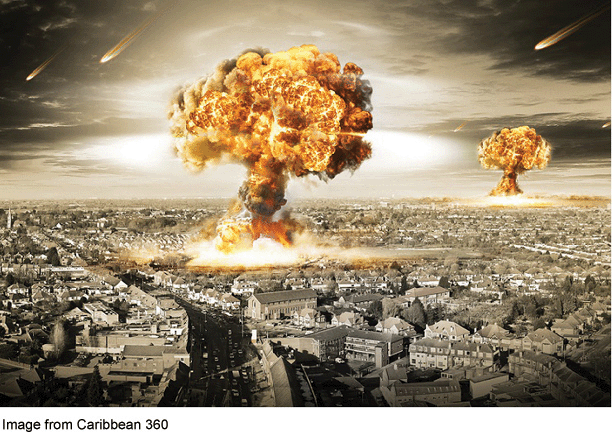
Are the World’s Ongoing Conflicts in Danger of Going Nuclear?
Global Issues, by Thalif Deen (united nations), Tuesday, September 17, 2024, Inter Press Service
UNITED NATIONS, Sep 17 (IPS) – The constant drumbeat of nuclear threats seems never ending—emanating primarily from the Russians, Israeli right-wing politicians and North Koreans.
The threats also prompt one lingering question: Can there be a World War III without the use of nuclear weapons?
In a report August 27, Reuters quoted a senior Russian official as saying the West was playing with fire by considering allowing Ukraine to strike deep into Russia with Western missiles—and cautioned the United States that World War III would not be confined to Europe.
Sergei Lavrov, Russia’s longstanding foreign minister and former UN ambassador, said the West was seeking to escalate the Ukraine war and was “asking for trouble” by considering Ukrainian requests to loosen curbs on using foreign-supplied weapons.
Putting it in the right context, the Washington-based Arms Control Association (ACA) pointed out last week, “the global nuclear security environment could hardly be more precarious.”
Carol Giacomo, chief editor of Arms Control Today, the ACA’s flagship publication, said that weeks before the US elects a new president, the global nuclear security environment could hardly be more precarious.
“Russia continues to raise the specter of escalating its war on Ukraine to nuclear use; Iran and North Korea persist in advancing their nuclear programs; China is moving to steadily expand its nuclear arsenal; the United States and Russia have costly modernization programs underway; and the war in Gaza threatens to explode into a region-wide catastrophe entangling Iran and nuclear-armed Israel, among other countries,” she pointed out.
Meanwhile, Russia and China are refusing to enter arms control talks with the United States, new countries are raising the possibility of acquiring nuclear weapons and decades of arms control treaties are unraveling.
The situation has also prompted Rafael Mariano Grossi, director-general of the International Atomic Agency (IAEA), to warn, in an interview with The Financial Times on August 26, that the global nonproliferation regime is under greater pressure than at any time since the end of the Cold War.
The U.S. presidential election campaign has not engaged publicly on most of these issues in any serious way despite the fact that whichever candidate wins will, once inaugurated, immediately inherit the sole authority to launch U.S. nuclear weapons, wrote Giacomo, a former member of The New York Times editorial board (2007-2020).
Dr M.V. Ramana, Professor and Simons Chair in Disarmament, Global and Human Security, School of Public Policy and Global Affairs, Graduate Program Director, MPPGA at the University of British Columbia, Vancouver, told IPS the dangers posed by nuclear arms, and the very powerful institutions and governments that possess these weapons of mass destruction, have never been greater.
“In the last 16 months, we have seen government officials from Russia (Dmitry Medvedev) and Israel (Amihai Eliyahu) threatening to use, or calling for the use of, nuclear weapons against Ukraine and Gaza respectively” he noted.
The rulers of these countries have already shown the willingness to kill tens of thousands of civilians. “Going further back, we can remember U.S. President Donald Trump threatening to “totally destroy” North Korea. Coming from a person like Trump and a country like the United States that is the only one to use nuclear weapons in war, there is good reason to take such a threat with utmost seriousness”.
Such great dangers, he argued, can be ameliorated only with great visions, by people demanding that no one should be killed in their name, especially using nuclear weapons but not only using nuclear weapons.
This would require people to make common cause with people all over the world, and refuse to be divided by the “narrow nationalisms” that Albert Einstein identified as an “outmoded concept,” as far back as 1947…………………………………………………………………………………………………………………… more https://www.globalissues.org/news/2024/09/17/37679
Putin ally warns West of nuclear war over Ukraine

By Reuters, September 20, 2024, Reporting by Reuters; writing by Mark Trevelyan and Guy Faulconbridge, Editing by William Maclean
Summary
Russian missile ‘could hit Strasbourg in minutes’
Volodin says Russia will use ‘more powerful weapons’
Lawmaker reinforces Putin warning
MOSCOW, Sept 19 (Reuters) – A close ally of President Vladimir Putin warned Western governments on Thursday that a nuclear war would ensue if they gave the green light for Ukraine to use long-range Western weapons to strike targets deep inside Russia.
Vyacheslav Volodin, speaker of the lower house of parliament and a member of Putin’s Security Council, was responding to a vote in the European Parliament urging EU countries to give such approval to Kyiv.
“What the European Parliament is calling for leads to a world war using nuclear weapons,” Volodin wrote on Telegram.
His message was entitled “For those who didn’t get it the first time” – an apparent reference to a warning by Putin last week that the West would be directly fighting Russia if it let Ukraine fire the long-range missiles onto Russian territory.
The Ukraine war has triggered the biggest confrontation between Russia and the West since the 1962 Cuban Missile Crisis, which is considered to be the time when the two Cold War superpowers came closest to intentional nuclear war.
The outgoing head of NATO, Jens Stoltenberg, told The Times this week that the Kremlin leader had declared “many red lines” before but not escalated conflict with the West when they were crossed. Putin’s spokesman said his comment was dangerous and provocative.
In a non-binding resolution adopted on Thursday, the European Parliament asked EU countries to “immediately lift restrictions on the use of Western weapons systems delivered to Ukraine against legitimate military targets on Russian territory.”
Volodin wrote: “If something like this happens, Russia will give a tough response using more powerful weapons. No one should have any illusions about this.” He said it appeared to Moscow that the West had forgotten the vast sacrifices made by the Soviet Union in World War Two.
He said Europeans should understand that it would take Russia’s RS-28 Sarmat intercontinental ballistic missile, known in the West as Satan II, just 3 minutes and 20 seconds to strike Strasbourg, where the European Parliament meets.
Three Mile Island nuclear reactor to restart to power Microsoft AI operations
Three Mile Island will also be renamed the Crane Clean! Energy Center
Pennsylvania plant was site of most serious nuclear meltdown and radiation leak in US history in 1979
Guardian, Richard Luscombe, 21 Sept 24
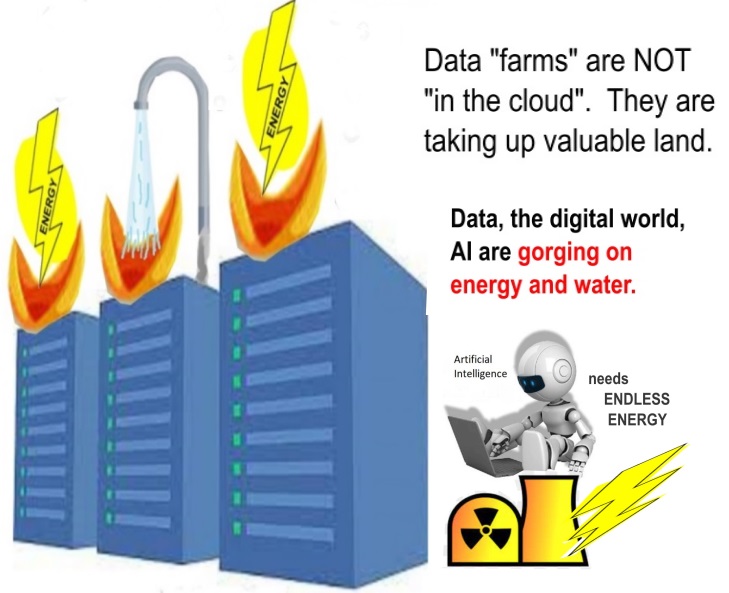
A nuclear reactor at the notorious Three Mile Island site in Pennsylvania is to be activated for the first time in five years after its owners, Constellation Energy, struck a deal to provide power to Microsoft’s proliferating artificial intelligence operations.
The plant was the location of the most serious nuclear meltdown and radiation leak in US history, in March 1979 when the loss of water coolant through a faulty valve caused the Unit 2 reactor to overheat. More than four decades later, the reactor is still in a decommissioning phase.
Constellation closed the adjacent but unconnected Unit 1 reactor in 2019 for economic reasons, but will bring it back to life after signing a 20-year power purchase agreement to supply Microsoft’s energy-hungry data centers, the company announced on Friday……………
As part of the agreement, Three Mile Island will also be renamed the Crane Clean Energy Center to recognize Chris Crane, the former chief executive of Constellation’s parent company………………….
Significant investment will be required to restore the plant, including replacing or refurbishing the turbine, generator, main power transformer and cooling and control systems, Dominguez said.
There will also be a comprehensive safety and environmental review by the US Nuclear Regulatory Commission before it issues a permit for the restart of the reactor, which is scheduled to be online sometime in 2028. Constellation said it would seek licenses that will extend plant operations to at least 2054.
Tech giants including Microsoft, Google, Amazon, Meta and Apple are consuming ever-greater amounts of energy to power the boom in artificial intelligence. According to Goldman Sachs, demand will grow 160% by 2030, when data centers are expected to account for 8% of the power generated in the US.
With the spike in demand, however, comes rising concerns over the impact on the environment. An analysis by the Guardian published this week found that data center emissions of four of the biggest tech companies, Google, Microsoft, Meta and Apple, are probably about 662% – or 7.62 times – higher than officially reported. https://www.theguardian.com/environment/2024/sep/20/three-mile-island-nuclear-plant-reopen-microsoft
Jewish Council disappointed at Australia’s UN abstention, calls for strong international action to prevent Israeli war crimes

By Jewish Council of Australia, September, 19, 2024
The Jewish Council of Australia says it is deeply disappointed at Australia’s abstention from a critical United Nations General Assembly resolution calling on Israel to end its occupation of the Palestinian territories within 12 months. The resolution passed with 124 votes in favour, highlighting global frustration with Israel’s actions.
In a statement, the JCA said Australia’s abstention did not align with its commitments to international law and peace-building. While the Australian Government had indicated support for many aspects of the resolution, its failure to vote in favour was s a missed opportunity to show stronger, principled leadership, the Jewish group said.
“This vote comes at the same time as further apparent Israeli attacks on Lebanon, a day after the pager attacks,” a statement from the JCA said.
“The Jewish Council of Australia condemns these attacks. Their indiscriminate nature, killing dozens and injuring thousands of civilians, is an apparent war crime which underscores the urgent need for a collective international response to prevent Israel further breaching international law.
“We call on the government to join with other countries in condemning the killing of innocent civilians, and reiterate our calls for Australia to take material action by imposing sanctions and throwing its weight behind a global arms embargo.
JCA executive officer Sarah Schwartz said:
“We condemn the loss of any innocent life. Australia and the international community must take material steps to prevent, and ensure accountability for, the commission of war crimes. These indiscriminate attacks, which have killed innocent bystanders, are the behaviour of a rogue state and should be treated as such.”
JCA executive officer Dr Max Kaiser added:
“We urge the Australian government to join the vast majority of countries in the international community that are taking a firm stance. Australia can and should be doing more to hold Israel accountable for its unlawful presence in Palestinian territories. The time for decisive action is now.”
The World’s Chance To Confront US-Israeli Genocide
Popular Resistance, By Medea Benjamin and Nicolas J. S. Davies, Consortium News., September 18, 2024
As nations come together in the U.N. General Assembly on Wednesday, they face both a serious challenge and an unprecedented opportunity.
On Wednesday, the General Assembly is scheduled to debate and vote on a resolution calling on Israel to end “its unlawful presence in the Occupied Palestinian Territory” within six months.
Given that the General Assembly, unlike the exclusive 15-member Security Council, allows all members to vote and there is no veto in the General Assembly, this is an opportunity for the world community to clearly express its opposition to Israel’s brutal occupation of Palestine.
If Israel predictably fails to heed a General Assembly resolution calling on it to withdraw its occupation forces and settlers from Gaza, the West Bank and East Jerusalem, and the United States then vetoes or threatens to veto a Security Council resolution to enforce the ICJ ruling, then the General Assembly could go a step further.
It could convene an emergency session to take up what is called a Uniting For Peace resolution, which could call for an arms embargo, an economic boycott or other sanctions against Israel — or even call for actions against the United States.
Uniting for Peace resolutions have only been passed by the General Assembly five times since the procedure was first adopted in 1950.
The Sept. 18 resolution comes in response to an historic ruling by the International Court of Justice (ICJ) on July 19, which found that “Israeli settlements in the West Bank and East Jerusalem, and the regime associated with them, have been established and are being maintained in violation of international law.”
The court ruled that Israel’s obligations under international law include “the evacuation of all settlers from existing settlements” and the payment of restitution to all who have been harmed by its illegal occupation.
The passage of the General Assembly resolution by a large majority of members would demonstrate that countries all over the world support the ICJ ruling, and would be a small but important first step toward ensuring that Israel must live up to those obligations.
Israel’s President Benjamin Netanyahu cavalierly dismissed the court ruling with a claim that, “The Jewish nation cannot be an occupier in its own land.”
This is exactly the position that the court had rejected, ruling that Israel’s 1967 military invasion and occupation of the Occupied Palestinian Territories did not give it the right to settle its own people there, annex those territories, or make them part of Israel.
Settler Violence
While Israel used its hotly disputed account of the Oct. 7 events as a pretext to declare open season for the mass murder of Palestinians in Gaza, Israeli forces in the West Bank and East Jerusalem used it as a pretext to distribute assault rifles and other military-grade weapons to illegal Israeli settlers and unleash a new wave of violence there, too.
Armed settlers immediately started seizing more Palestinian land and shooting Palestinians. Israeli occupation forces either stood by and watched or joined in the violence, but did not intervene to defend Palestinians or hold their Israeli attackers accountable.
Since last October, occupation forces and armed settlers in the West Bank and East Jerusalem have now killed at least 700 people, including 159 children.
The escalation of violence and land seizures has been so flagrant that even the U.S. and European governments have felt obligated to impose sanctions on a small number of violent settlers and their organizations.
In Gaza, the Israeli military has been murdering Palestinians day after day for the past 11 months. The Palestinian Health Ministry has counted over 41,000 Palestinians killed in Gaza, but with the destruction of the hospitals that it relies on to identify and count the dead, this is now only a partial death toll.
Medical researchers estimate that the total number of deaths in Gaza from the direct and indirect results of Israeli actions will be in the hundreds of thousands, even if the massacre were to end soon.
Israel and the United States are undoubtedly more and more isolated as a result of their roles in this genocide. Whether the United States can still coerce or browbeat a few of its traditional allies into rejecting or abstaining from the General Assembly resolution on Sept. 18 will be a test of its residual “soft power.”……………………………………………………………………………………………………………….. more https://popularresistance.org/the-worlds-chance-to-confront-us-israeli-genocide/
The experts comment: Key nuclear questions that the US presidential candidates should answer
Bulletin, By François Diaz-Maurin, John Mecklin | September 19, 2024
The US presidential race is entering its final weeks after a turbulent campaign that has included rhetorical drama, dramatic debates, the late withdrawal of a sitting president, and two assassination attempts. The economy, immigration, and abortion have taken center stage as the issues that the candidates—Democratic Vice President Kamala Harris and Republican former president Donald Trump—and US media outlets have emphasized. The existential threat of nuclear war has received only brief and tangential attention.
But the next president will be confronted with a highly challenging security environment and a daunting array of new and continuing nuclear risks. The use of nuclear weapons becomes more likely as the Russia-Ukraine war drags on. Growing tensions among China, Russia, and the United States and the collapse of the nuclear arms control regime create the prospect of an unrestrained arms race between the three nuclear superpowers. The war in Gaza and the resulting face-off between Israel and Iran could lead to unabashed nuclear proliferation in the Middle East. And China’s growing regional ambitions and North Korea’s increasingly aggressive behavior worry other East Asian countries that wonder about the credibility of the US security guarantees and increasingly express interest in possessing nuclear arsenals of their own.
As a service to citizens and the journalists who will cover the final weeks of the campaign, we asked leading nuclear policy experts to suggest questions that the presidential candidates should be asked about the nuclear threat and how best to reduce it. The commentaries below provide a framework for assessing the strategic plans of the two candidates for moving the world away from nuclear catastrophe. If such plans exist.
American voters, allies, and adversaries are watching. The presidential candidates should be explaining……………………………………………………………………………………….more https://thebulletin.org/2024/09/key-nuclear-questions-that-the-us-presidential-candidates-should-answer/?utm_source=Newsletter&utm_medium=Email&utm_campaign=ThursdayNewsletter09192024&utm_content=NuclearRisk_KeyNuclearQuestionsIntroduction_09192024
‘Genocide Can and Should Never Be Just a Normal Story’CounterSpin interview with Gregory Shupak on Palestinian genocide
Janine Jackson, https://fair.org/home/genocide-can-and-should-never-be-just-a-normal-story/ 19 Sept 24
Janine Jackson interviewed the University of Guelph-Humber’s Gregory Shupak about the Palestinian genocide for the September 13, 2024, episode of CounterSpin. This is a lightly edited transcript.
Janine Jackson: The September 11 New York Times reports a fatal Israeli airstrike hitting part of the Gaza Strip that Israel had declared a humanitarian zone. On a separate matter, we read that Secretary of State Antony Blinken rebuked Israel for the killing in the West Bank of 26-year-old US human rights activist Aysenur Eygi.
While it relayed terrible news, the Times story also contained the mealy-mouthing we’re accustomed to. Blinken rebuked Israel’s killing Aysenur Eygi “after the Israeli military acknowledged that one of its soldiers had probably killed her unintentionally.” People did dig with their bare hands through bomb craters in the dark to search for victims, but “health officials in Gaza do not distinguish between civilians and combatants when reporting casualties.” And while it notes that the UN and other rights organizations have said “there is no safe place in Gaza,” the Times repeats that “Israel insists that it will go after militants wherever it believes them to be.”
What’s happening in Gaza and the West Bank is horrific, the possibility of an expanded war in the Middle East is terrifying, but for elite US news media, it’s as though war in the Middle East, and Palestinians being killed, is such a comfortable story that there’s no urgency in preventing the reality.
Joining us now to talk about this is media critic, activist and teacher Gregory Shupak. He teaches English and media studies at the University of Guelph-Humber in Toronto, and he’s author of the book The Wrong Story: Palestine, Israel and the Media, from OR Books. He joins us now by phone. Welcome back to CounterSpin, Gregory Shupak.
Gregory Shupak: Hi.
JJ: So the New York Times September 10 had a story about how health workers are trying to vaccinate children in northern Gaza against polio, but supplies of fuel and medicine are being obstructed by Israeli forces, including one convoy of UN groups that was held at gunpoint for eight hours. So the meat of the Times story is here:
The Israeli military said in a statement that it had intelligence suggesting that there were “Palestinian suspects” with the convoy, but did not say what they were suspected of doing. In another statement on Tuesday, it said that “Israeli security forces questioned the suspects in the field and then released them.” The episode highlighted the challenges facing humanitarian efforts, like the vaccination campaign, and what UN officials say is increasing Israeli obstruction of aid deliveries to Gaza.
So Israel holds up a humanitarian group at gunpoint for eight hours, and they don’t offer anything resembling a reason, and the upshot is “this highlights challenges”; “UN officials say” that this is an obstruction of aid. Knowing reporters, we know that some of them are saying, “Look how we pushed back against Israel here. We said they couldn’t say what the suspects were suspected of.”
But it doesn’t read as brave challenging of the powerful to a reader. And of course we know that that language is a choice, right? So what are you making of media coverage right now?
GS: Two main observations come to mind, not specifically with regard to the story you’re talking about–although that does continue, as you said, the longer-term trends of this mealy-mouthed refusal to just report what has flatly and plainly and obviously happened, and who’s responsible for it. But setting that aside, I would note a couple of other things that have troubled me.
One is that I think so much of the Palestinian issue right now has just been metabolized into US election coverage, so that most of what the public is getting on the issue is “how is the political theater going to be affected by the fact that a genocide is occurring in which the US is a direct participant?” rather than more urgent questions, such as “how can this genocide be immediately stopped?” So I think that that’s a real case of focusing on the wrong question.
I think, likewise, you get some attention to, “Well, how is the Harris campaign going to suffer because the Biden administration, of which she’s a part, has alienated so many Arab and/or Muslim voters in the United States because of the Gaza genocide?” Again, that just reduces the Palestinians and their supporters amongst Arabs and Muslims–not to say that there aren’t many other segments of American society that do support Palestinians to one extent or another–they’re just here reduced to, “Well, how’s this going to factor into the electoral calculation?”
And so that, I think, is, again, really not at all adequate to the challenge of responding to one of the worst series of massacres that we’ve seen since World War II. In fact, the UN special rapporteur just the other day, said that this is the worst campaign of deliberate starvation since World War II. So just treating this as a subset of US domestic politics is not proportional to the severity of what’s unfolding.
The second observation I was going to make is that I think, to a really, really depressing extent, the mass murder of Palestinians, the mass starvation of Palestinians, the total destruction of essentially every structure in Gaza by this point, it’s becoming a “dog bites man” story, in that it’s just become, and I hate to use the word “normalized,” because I think it’s totally overused these days, but this is sort of a case study where it’s barely even newsworthy, that really just shocking atrocities are dropping day by day.
So last week, Israel bombed a shelter within the compound of the Al-Aqsa hospital, I believe it’s the Al-Aqsa Martyrs’ Hospital in Deir al-Balah, and this has, as far as I can tell, effectively zero coverage in major English-language American or Western media broadly. But, again, that is a real travesty to just allow this to not be a leading story every day because it keeps happening; in fact, the fact that it keeps happening ought to be in itself proof of how dire and urgent these matters are.
JJ: You wrote for Electronic Intifada back in July about how even after credible source after credible source confirms that Israel is carrying out a genocide against Palestinians, you said “we find ourselves living through a mass public genocide denial,” and without at all trying to be coy, I wonder, are we now at acceptance?
GS: Yeah.
JJ: Now it’s just kind of a factor. And I wrote down “dog bites man” because it very much gives that feeling of, “Oh, well, these folks are at war with one another. That’s just a normal story.”
GS: Yeah, and first of all, genocide can and should never be just a normal story, but that is very much what it’s being treated like. And second of all, it’s also: yes, brutal, violent oppression of Palestinians has been the case since Israel came into existence in 1948, and, in fact, in the years leading up to it, there were certainly steps taken to create the conditions for Israel. So it is a decades-old story, but there is a kind of hand-waving that creeps into public discourse, and I think does underlie some of this lack of attention to what continues to happen in Gaza and the West Bank.
In reality, this is a very modern conflict, right? It’s a US-brokered, settler-colonial insurgency/counterinsurgency. It’s got very little to do with religion and everything to do with geopolitics and capitalism and colonialism. But it’s easier to just treat it as, “Oh, well, these backwards, savage barbarian and their ancient, inscrutable blood feuds are just doing what they have always done and always will. So that’s not worthy of our attention.” But that, aside from being wildly inaccurate, just enables the slaughter and dispossession, as well as resistance to it, to continue.
JJ: Finally, to promote the idea or to support the idea that this genocide is kind of OK, or par for the course, anyway, and that protesting it is misguided, or worse–that requires mental gymnastics, including charges of antisemitism against Jewish people. Jewish people are leaders in the opposition to Israel’s actions, including on college campuses. And I would encourage folks to read Carrie Zaremba’s piece on Mondoweiss about the lengths that university administrators are going to right now to crack down on and impossibleize dissent and political expression.
But the point is, we still see the dissent. So even the problems that we’re talking about, that media are ratifying and pushing out day after day, people are seeing through them, and there is dissent. And I just wonder what your thoughts are, in terms of, maybe not to use the word hope, but where do you see the resistance happening? You’re a college professor.
JJ: Finally, to promote the idea or to support the idea that this genocide is kind of OK, or par for the course, anyway, and that protesting it is misguided, or worse–that requires mental gymnastics, including charges of antisemitism against Jewish people. Jewish people are leaders in the opposition to Israel’s actions, including on college campuses. And I would encourage folks to read Carrie Zaremba’s piece on Mondoweiss about the lengths that university administrators are going to right now to crack down on and impossibleize dissent and political expression.
But the point is, we still see the dissent. So even the problems that we’re talking about, that media are ratifying and pushing out day after day, people are seeing through them, and there is dissent. And I just wonder what your thoughts are, in terms of, maybe not to use the word hope, but where do you see the resistance happening? You’re a college professor.
GS: Certainly on campuses and many other places as well. Labor organizations: there was a coalition here called Labor for Palestine, and I know there are similar outfits in the United States and other parts of the world. Religious organizations of all sorts, Christian, Muslim, Jewish, likely others as well.
I would, in addition, say that certainly, in terms of just getting out analysis and information, that one of the very few advantages or bright spots that we have, I think now as compared to the past, is that it is easier for independent sources like FAIR, Electronic Intifada, Mondoweiss and others to circulate quickly to wide audiences. And that, I think, has been a big reason why the Palestinian counternarrative has been able to puncture, I think, the public consciousness more so than it could in the past. I think it’s totally the independent educational efforts by the Palestine solidarity movement that has done that.
And one major tool at their–perhaps I will dare say our–disposal is independent media, because this is where you’re getting much more information, much more accurate information, and much more rigorous analysis than the fluff and pablum that you get on the editorial pages of the New York Times, the Washington Post, much less the blood-curdling racism you get on the Wall Street Journal and its editorial pages. So I think that this era does have one serious advantage, and that’s that outlets like those that I’ve mentioned have
a much greater capacity to reach people who might not otherwise be exposed to this anti-Zionist narrative.
JJ: We’ve been speaking with Gregory Shupak. He teaches English and media studies at the University of Guelph-Humber, and his book The Wrong Story: Palestine, Israel and the Media is still out now from OR Books. Greg Shupak, thanks so much for joining us this week on CounterSpin.
Miliband urged by US nuclear giant to abandon large reactors in favour of mini-nukes

GE-Hitachi Nuclear boss says investors have ‘scars’ from large projects’ cost overruns
Matt Oliver, Industry Editor
An American nuclear power giant has urged
Ed Miliband to focus on building a new generation of mini reactors instead
of vast megaprojects such as Hinkley Point C. Andrew Champ, the UK country
director for GE-Hitachi Nuclear, said small modular reactors (SMRs) offered
“the best route” to expanding Britain’s nuclear capacity as the
Energy Secretary draws up plans to overhaul the power grid.
By comparison, many investors have “scars” from budget overruns and delays with bigger
nuclear projects and view them as too risky, he claimed. Mr Champ pointed
to the large cost of Hinkley Point C in Somerset as an example. The
project’s budget has ballooned from £20bn to as much as £46bn when
inflation is included.
His comments come as the Government is reconsidering
proposals to build a large-scale nuclear power station in Wylfa, a
taxpayer-owned site on the Welsh island of Anglesey.
GE-Hitachi, which also builds larger-scale reactors, is among those currently trying to
commercialise SMR technology and is vying to secure funding from the UK
under the Government’s current mini-nuke development competition. SMRs
have been hailed as a potential breakthrough for nuclear power because they
would be built in chunks by factories and then assembled rapidly on site,
potentially meaning they can benefit from economies of scale.
So far the technology remains unproven on a commercial basis and no such reactors are
in operation. He also said the UK’s current target to build out 24
gigawatts of nuclear capacity was likely to prove too conservative, partly
due to the huge growth in power demand from data centres being used to
develop artificial intelligence software.
Telegraph 16th Sept 2024
https://www.telegraph.co.uk/business/2024/09/15/miliband-urged-ge-hitachi-prioritise-mini-nukes/
Dounreay nuclear wastes : new snake like robot to access off limits areas
A new robot has been trialled at Dounreay in order to reach “severely
restricted” areas at the former experimental nuclear plant. During
decommissioning of the reactor, engineers have had to come up with
innovative solutions to access parts of the plant that are off limits to
humans.
John O’Groat Journal 17th Sept 2024
US Navy chief unveils plan to be ready for possible war with China by 2027
The announcement of the goals comes as US leaders are treading a fine line, pledging a commitment to the defence of Taiwan while also working to keep communication open with Beijing to deter greater conflict.
Beijing regards Taiwan as part of China to be reunited, by force if necessary. Most countries, including the US, do not recognise Taiwan as an independent state.
But Washington opposes any attempt to take the island by force and is legally bound to support Taiwan’s military defence capability.
Admiral Lisa Franchetti says lessons from combat in the Red Sea and Ukraine’s Black Sea fight can help the US prepare for an attack on Taiwan
SCMP, Associated Press, 19 Sep 2024
The US Navy is taking lessons from its combat in the Red Sea over the past year and what Ukraine has done to hold off the Russians in the Black Sea to help US military leaders prepare the service for a potential future conflict with China.
From drones and unmanned surface vessels to the more advanced operation of shipboard guns, the US Navy is expanding its combat skills and broadening training. It is also working to overcome recruiting struggles so it can have the sailors it needs to fight the next war.
Admiral Lisa Franchetti, chief of naval operations, is laying out a series of goals, including several that will be highly challenging to meet, in a new navigation plan she described in an interview. The objective is to be ready to face what the Pentagon calls its key national security challenge – China.
“I’m very focused on 2027. It’s the year that President Xi [Jinping] told his forces to be ready to invade Taiwan,” Franchetti said. “We need to be more ready.”
The new plan, released on Wednesday, includes what she considers seven priority goals, ranging from removing delays in ship depot maintenance to improving US Navy infrastructure, recruiting and the use of drones and autonomous systems.
One significant challenge is to have 80 per cent of the force be ready enough at any given time to deploy for combat if needed – something she acknowledged is a “stretch goal”. The key, she said, is to get to a level of combat readiness where “if the nation calls us, we can push the ‘go’ button and we can surge our forces to be able to meet the call”.
The announcement of the goals comes as US leaders are treading a fine line, pledging a commitment to the defence of Taiwan while also working to keep communication open with Beijing to deter greater conflict.
Beijing regards Taiwan as part of China to be reunited, by force if necessary. Most countries, including the US, do not recognise Taiwan as an independent state.
But Washington opposes any attempt to take the island by force and is legally bound to support Taiwan’s military defence capability.
An important element in any Asia-Pacific conflict will be the need to control the seas. Franchetti said the US can learn from how the Ukrainians have used drones, air strikes and long-range unmanned vessels to limit Russian ship activity in the western Black Sea and keep access open to critical ports.
“If you look at the Ukrainian success in really keeping the Russian Black Sea fleet pushed all the way over into the east, that’s all about sea denial and that’s very important,” Franchetti said. She added that Ukraine has been innovating on the battlefield by using existing systems, such as drones, in different ways.
The US Navy’s months-long battle with the Iran-backed Houthi rebels in Yemen has provided other lessons…………………………………………………………………. https://www.scmp.com/news/world/united-states-canada/article/3279048/us-navy-chief-unveils-plan-be-ready-possible-war-china-2027
1 This Month
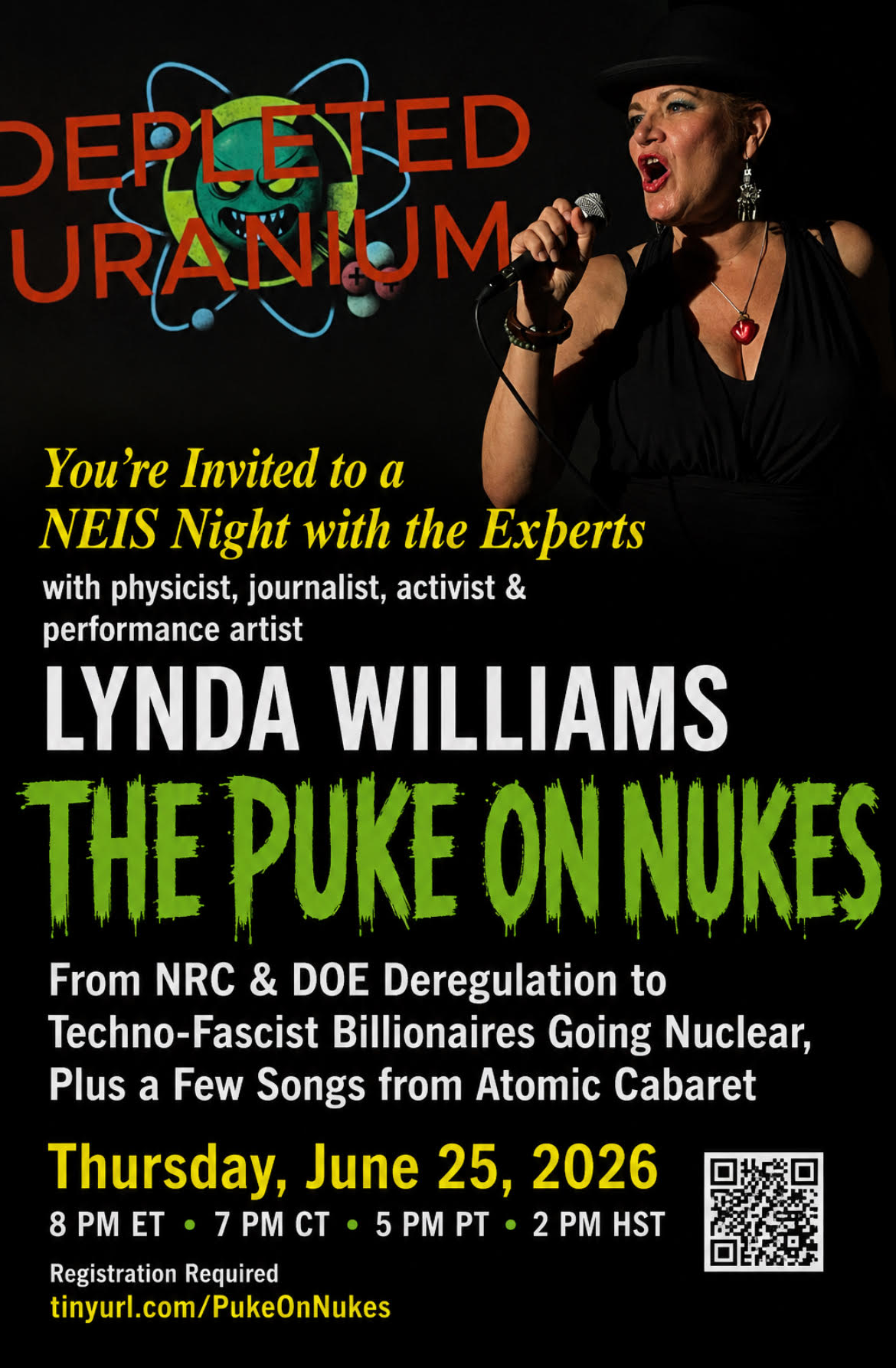
25 June- THE PUKE ON NUKES
Thursday, June 25, 2026
7pm Central Time (8pm ET, 6pm MT, 5pm PT) UTC – 5
From NRC & DOE Deregulation to Techno-Fascist Billionaires Going Nuclear, Plus a Few Songs from Atomic Cabaret REGISTER
26 June – Radiation Trainwreck at the NRC / Join the Protect Better Campaign – https://us02web.zoom.us/meeting/register/4ZlZ5_qLSHGiLSCg8FF6Bg#/registration

1st July – Webinar Waste of Space: The Environmental Harm of Military and Civil Space Activity st July, 7 pm

Report Launch Online: We are seeing an increasing exploitation of space for military and commercial purposes. This must change.

Protect Sazan Island from the Trump family! https://secure.avaaz.org/campaign/en/protect_sazan_island_from_the_trump_family_loc/?bqFCVab&v=174511&cl=22707147157&_checksum=5e9dde668860e8231c33699735e16a1fbf22ab2cb01da50c999fe8732b9775ef&utm_source=email&utm_medium=blast_email&utm_campaign=174511


Cuba Is Not a Failed State – It Is a Besieged State
PETITION: “Global Appeal to Endorse Palestinian Right of Return of Refugees”
To see nuclear-related stories in greater depth and intensity – go to https://nuclearinformation.wordpress.com
-
Archives
- June 2026 (230)
- May 2026 (306)
- April 2026 (356)
- March 2026 (251)
- February 2026 (268)
- January 2026 (308)
- December 2025 (358)
- November 2025 (359)
- October 2025 (376)
- September 2025 (257)
- August 2025 (319)
- July 2025 (230)
-
Categories
- 1
- 1 NUCLEAR ISSUES
- business and costs
- climate change
- culture and arts
- ENERGY
- environment
- health
- history
- indigenous issues
- Legal
- marketing of nuclear
- media
- opposition to nuclear
- PERSONAL STORIES
- politics
- politics international
- Religion and ethics
- safety
- secrets,lies and civil liberties
- spinbuster
- technology
- Uranium
- wastes
- weapons and war
- Women
- 2 WORLD
- ACTION
- AFRICA
- Atrocities
- AUSTRALIA
- Christina's notes
- Christina's themes
- culture and arts
- Events
- Fuk 2022
- Fuk 2023
- Fukushima 2017
- Fukushima 2018
- fukushima 2019
- Fukushima 2020
- Fukushima 2021
- general
- global warming
- Humour (God we need it)
- Nuclear
- RARE EARTHS
- Reference
- resources – print
- Resources -audiovicual
- Weekly Newsletter
- World
- World Nuclear
- YouTube
-
RSS
Entries RSS
Comments RSS
 nuclear-news