Canada’s future generations: affordable clean energy vs. legacy nuclear debt?
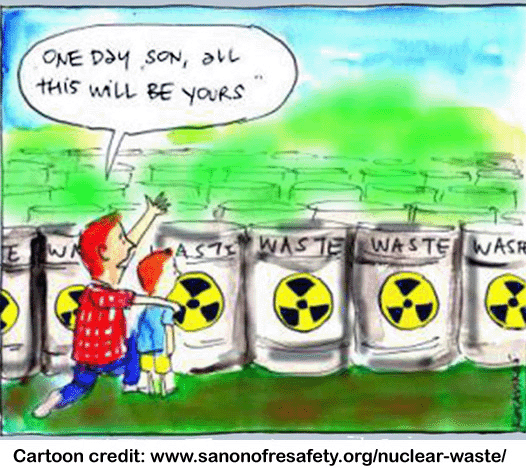
For the sake of today and tomorrow’s young, Canada needs to follow a ‘sustainable renewables path to net zero’ using all of our people and financial resources.
Our government must not saddle the generations to come with the debt for nuclear ‘white elephants’ when affordable, clean, renewable power can meet our needs now and theirs in future, writes Gail Wylie.
BY GAIL WYLIE | August 1, 2024, https://www.hilltimes.com/story/2024/08/01/canadas-future-generations-affordable-clean-energy-vs-legacy-nuclear-debt/429822/
Canadians concerned about climate change want Canada to meet its obligations to future generations by addressing climate change rapidly and responsibly. This requires us to implement current technologies for efficiency, renewable power, modern storage, and electrical grid options.
Instead, the federal government has placed inordinate bets on nuclear power expansion. This includes tens of millions of dollars in funding and loans for experimental small modular reactors, and $50-million in federal predevelopment funding to assess new generation opportunities for Bruce Power’s facility. Nuclear expansion, however, fails Canada’s decarbonization goals of speed and affordability, and takes limited resources away from lower cost, proven climate solutions.
On affordability, Ontario’s lowest cost decarbonized power sources are: efficiency 1.6 cents per kWh, solar plus storage 10 cents per kWh, onshore wind plus storage 10.5 cents per kWh and Quebec water power 5.2 cents per kWh. Nuclear falls among higher costs at 10.5 cents per kWh in 2024, rising to 13.7 cents projected with refurbishments for 2027, and future new nuclear reactors 24.4 cents per kWh.
Ontarians are still paying down the original $38.1-billion in debt and liabilities from Ontario Hydro in 1999 when its finances were over-extended during the period of expanded nuclear power facilities.
The lengthy approval and construction times and costs for new nuclear are a further caveat highlighted by the World Nuclear Industry Status Report. France renationalized Électricité de France in 2023 facing $70-billion in debt, including the Flamanville reactor at 19.1 billion euros and 17-year completion for 2024. The United Kindgom’s Hinkley Point C which began in 2018 is delayed to 2027 projecting costs of $44-billion. The first of two Vogtle U.S.A. reactors, going live in 2023, took 10 years at $35-billion in cost estimate for the pair. International banks have rebuffed plans by 22 countries at COP28 to “triple nuclear power by 2050,” indicating the lack of a business case for such investment.
The hope of faster, cheaper small modular reactors (SMRs) is fading as the lead developer, NuScale, lost its Utah Utilities investor as projections rose from $3-billion in 2015 to $9.3-billion in 2023. Two SMR designs in New Brunswick are also unlikely to be commercialized.
Future generations who will pay for the power capacity being built in this decade cannot afford these unnecessary financial risks and delays of expanding nuclear assets. The young urgently need affordable housing with energy prices ensuring ‘affordable to heat, cool, and cook-in housing.’
The federal government falsely claims “no path to net zero without nuclear.” The industry mantra of nuclear reliability over renewables “when the sun doesn’t shine and the wind doesn’t blow” has been debunked by science-based modelling studies. The Suzuki Foundation’s report, Shifting Power: Zero-Emissions Electricity Across Canada by 2035, and Mark Jacobson’s work at Stanford University, A Solution to Global Warming: Air Pollution, and Energy Insecurity for Canada, both outline the mix of solutions for reliable, affordable, rapid decarbonization across this country by 2035 without new nuclear. The International Renewable Energy Agency’s 2024 analysis confirms that affordable, worldwide transition is attainable with renewables.
Shrinking battery costs for power storage (kWh in 2022 costing US$159 down as low as $59 currently) and modern electrical grid technologies facilitate renewables’ reliability as reflected in energy strategist Michael Barnard’s analysis. Outages at New Brunswick’s Point Lepreau Nuclear Generating Station during peak winter periods in 2021 and 2022/23, and its 2024 extended maintenance, reflect nuclear’s vulnerability.
Dealing with nuclear waste is the other elephant in the room with financial and environmental impacts for generations in perpetuity. Phasing out nuclear power—not expanding it—reduces future costs.
So why is Canada not on a renewables path to net zero? Are we too balkanized to co-operate, leading Ontario to expand gas and nuclear power after rejecting Quebec’s 2019 20-year offer of five cents per kWh hydro power?
Or is this the ‘siren song’ of the nuclear lobby, funded with ratepayers’ money, seducing governments with the caché of ‘top tier’ status in the international nuclear club? Nuclear-armed club members—U.K., France, the United States, and Russia—need civil nuclear as a ‘nuclear supply chain.’ Canada does not!
No comments yet.
1 This Month
23-25 October – on Zoom – World BEYOND War’s annual global conferenc


Shut down the radiation-damaged Heysham nuclear reactors now
To see nuclear-related stories in greater depth and intensity – go to https://nuclearinformation.wordpress.com

Say No to NASA’s Reckless Nuclear Reactor on the Moon
Say No to NASA’s Reckless Nuclear Reactor on the Moon

-
Archives
- October 2026 (247)
- September 2026 (339)
- August 2026 (330)
- July 2026 (355)
- June 2026 (287)
- May 2026 (306)
- April 2026 (356)
- March 2026 (251)
- February 2026 (267)
- January 2026 (308)
- December 2025 (358)
- November 2025 (359)
-
Categories
- 1
- 1 NUCLEAR ISSUES
- business and costs
- climate change
- culture and arts
- ENERGY
- environment
- health
- history
- indigenous issues
- Legal
- marketing of nuclear
- media
- opposition to nuclear
- PERSONAL STORIES
- politics
- politics international
- Religion and ethics
- safety
- secrets,lies and civil liberties
- spinbuster
- technology
- Uranium
- wastes
- weapons and war
- Women
- 2 WORLD
- ACTION
- AFRICA
- Atrocities
- AUSTRALIA
- Christina's notes
- Christina's themes
- culture and arts
- Events
- Fuk 2022
- Fuk 2023
- Fukushima 2017
- Fukushima 2018
- fukushima 2019
- Fukushima 2020
- Fukushima 2021
- general
- global warming
- Humour (God we need it)
- Nuclear
- RARE EARTHS
- Reference
- resources – print
- Resources -audiovicual
- Weekly Newsletter
- World
- World Nuclear
- YouTube
-
RSS
Entries RSS
Comments RSS


Leave a Reply