Chinese hackers gain access to US oversight of nuclear weapons in widespread Microsoft hack: report
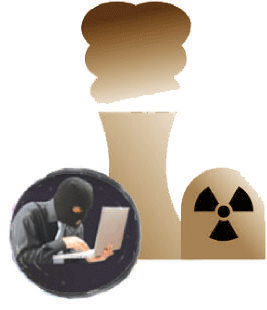
The tech giant blamed a vulnerability in its SharePoint document software
Anthony Cuthbertson,Rhian Lubin, Wednesday 23 July 2025, https://www.the-independent.com/tech/security/china-hack-nuclear-microsoft-sharepoint-b2795333.html
Chinese hackers gained access to the U.S. government agency that oversees nuclear weapons in a widespread Microsoft hack.
Microsoft issued an alert Tuesday warning that hackers affiliated with the Chinese government have been exploiting cybersecurity vulnerabilities in the company’s SharePoint software.
Tens of thousands of servers hosting the software, which is used for sharing and managing documents, were said to be at risk as a result.
The National Nuclear Security Administration, a semi-autonomous agency within the U.S. Department of Energy responsible for maintaining the nation’s stockpile of nuclear weapons, was breached in the attacks on July 18, Bloomberg first reported.
The agency is responsible for providing the Navy with nuclear reactors for submarines and responds to nuclear and radiological emergencies in the U.S. and overseas. No sensitive or classified information has leaked in the cyber attack, according to Bloomberg.
“On Friday, July 18th, the exploitation of a Microsoft SharePoint zero-day vulnerability began affecting the Department of Energy,” an agency spokesman said in a statement to the outlet. “The department was minimally impacted due to its widespread use of the Microsoft M365 cloud and very capable cybersecurity systems. A very small number of systems were impacted. All impacted systems are being restored.”
Security firm Eye Security said that 400 organizations and agencies globally were impacted, including national governments in Europe and the Middle East.
Microsoft linked the attack to two main groups, Linen Typhoon and Violet Typhoon, and flagged that another China-based group, Storm-2603, had also targeted its systems.
The Education Department, Florida’s Department of Revenue and the Rhode Island General Assembly were also breached in the attack, according to Bloomberg.
Eye Security warned that the breaches could allow hackers to impersonate users or services by stealing cryptographic keys — alphabetical codes or sequences of characters — even after software updates. Users should take further steps to protect their information, the firm said.
Microsoft said in a message to customers that it has since released “new comprehensive security updates” to deal with the incident.
But security researchers warned that the full extent of the breach and its consequences are yet to be fully revealed.
“This is a critical vulnerability with wide reaching implications,” Carlos Perez, director of security intelligence at TrustedSec, who previously trained U.S. military cyber protection teams, told The Independent.
“It enables unauthenticated remote code execution on SharePoint servers, which are a core part of enterprise infrastructure. It is already being actively exploited at scale, and it only took 72 hours from the time a proof of concept was demonstrated for attackers to begin mass exploitation campaigns.
“What makes it even more severe is the way it exposes cryptographic secrets, effectively allowing attackers to convert any authenticated SharePoint request into remote code execution. That is a dangerous capability to put into the hands of threat actors.”
Microsoft said it had “high confidence” that firms who do not install the new security updates could be targeted by the groups.
The tech firm said the attackers had been uploading malicious scripts which are then “enabling the theft of the key material” by hackers.
In a statement, the company added: “Investigations into other actors also using these exploits are still ongoing.”
Additional reporting from agencies.
Four Major News Agencies Warn Gaza Staff Face Starvation Due to Israeli Blockade
Gaza’s Health Ministry said two more Palestinians starved to death under the siege
by Dave DeCamp | July 24, 2025, https://news.antiwar.com/2025/07/24/four-major-news-agencies-warn-gaza-staff-face-starvation-due-to-israeli-blockade/
Four of the world’s major news agencies have issued a rare joint statement warning that their journalists in Gaza are unable to feed themselves due to the US-backed Israeli blockade, as Palestinians continue to starve to death under the siege.
“We are desperately concerned for our journalists in Gaza, who are increasingly unable to feed themselves and their families,” AFP, The Associated Press, Reuters, and BBC News said. “For many months, these independent journalists have been the world’s eyes and ears on the ground in Gaza. They are now facing the same dire circumstances as those they are covering.”
The news agencies said that journalists “endure many deprivations and hardships in war zones. We are deeply alarmed that the threat of starvation is now one of them.” They urged the “Israeli authorities to allow journalists in and out of Gaza” and said it was “essential that adequate food supplies reach the people there.”
On top of the starvation, journalists in Gaza continue to be targeted by the IDF. On Wednesday, Walaa al-Jabari, who worked for local news outlets, was killed along with her husband and four children. Al-Jabari was pregnant at the time of her killing, and the Gaza Government Media Office said her death brought the total number of journalists killed by Israel since October 7, 2023, to 231.
The statement from the news agencies came as Gaza’s Health Ministry said another two Palestinians had starved to death over the previous 24-hour period. Starvation deaths have spiked over the past week, with dozens, mostly children, dying of malnutrition due to Israeli-imposed restrictions and the killing of aid seekers. The Health Ministry said it has recorded a total of 113 starvation deaths.
Palestinians in Gaza also continue to be gunned down while attempting to reach food aid. Since the end of May, more than 1,000 aid seekers have been killed by Israeli forces, mainly near distribution sites run by the US and Israeli-backed Gaza Humanitarian Foundation (GHF).
Sabreen Abu al-Kass, a mother of 10 in Gaza, told Al Jazeera on Thursday that she attempted to get aid from a GHF site on Thursday but failed. “I went to get food, to support my children, and I fainted there. No one helped me,” she said. “I couldn’t bring back any aid at all. We returned home empty-handed, just like we came. Out of maybe 50 attempts, I was only able to get some food once. One time, among thousands of women.”
Trump’s Ukraine Plan: Power Play or Exit Strategy?

Beneath the rhetoric lies a fundamental truth: America is disengaging. Not with a decisive withdrawal, but through a form of diplomatic sleight-of-hand. By recasting its role from arsenal to arms dealer (insisting NATO nations pay “a hundred percent” for U.S.-made weapons) the United States transforms the principle of collective defense into a commercial transaction.
Beneath the rhetoric lies a fundamental truth: America is disengaging. Not with a decisive withdrawal, but through a form of diplomatic sleight-of-hand. By recasting its role from arsenal to arms dealer (insisting NATO nations pay “a hundred percent” for U.S.-made weapons) the United States transforms the principle of collective defense into a commercial transaction.
Uncover the hidden logic behind Trump’s delayed weapons aid, NATO rifts, and realpolitik tactics reshaping U.S. foreign policy and Ukraine’s fate.
Post-Liberal Dispatch, Jul 24, 2025, This piece was written by guest contributor Sérgio Horta Soares and has been reviewed and edited by Paulo Aguiar, founder of Post-Liberal Dispatch.
In geopolitics, there are no saints, only actors grappling for advantage, cloaking raw interests in the language of freedom, democracy, and humanitarian concern.
The recent choreography surrounding former U.S. President Donald Trump’s ostensible reentry into the Ukraine conflict lays bare the mechanics of power as they actually function: not through moral imperatives, but through calculated ambiguity, resource preservation, and the exploitation of time.
What masquerades as renewed support for Ukraine is, in substance, a meticulously engineered performance, designed not to rescue Kyiv, but to extricate Washington. Trump’s pronouncements of “billions” in arms, and his threats of tariffs against nations buying Russian oil, are not expressions of strategic commitment; they are instruments of political theater, signals issued to multiple audiences with competing agendas, none of whom are meant to receive a clear message.
To understand this gambit, one must first understand the war’s trajectory. Since Russia’s full-scale invasion of Ukraine in February 2022, Western countries (led by the United States) have supplied billions in weapons, economic assistance, and intelligence to Ukraine in an effort to repel Russian advances and prevent the collapse of the post–Cold War European security order.
Initially, this support was framed in terms of values: defending sovereignty, democracy, and international law. But as the war dragged on into its third year, cracks emerged in the Western coalition (rising costs, strained defense stockpiles, and growing domestic opposition to what many now view as an open-ended commitment).
Beneath the rhetoric lies a fundamental truth: America is disengaging. Not with a decisive withdrawal, but through a form of diplomatic sleight-of-hand. By recasting its role from arsenal to arms dealer (insisting NATO nations pay “a hundred percent” for U.S.-made weapons) the United States transforms the principle of collective defense into a commercial transaction.
NATO, once a bastion of mutual obligation, is being refashioned into a procurement agency. The nations of Europe are no longer being asked to fight beside the U.S.; they are being asked to shop.
That this approach incites confusion and resentment among allies is the point. Strategic ambiguity, long a hallmark of Trump’s foreign policy, is not a flaw but a deliberate tactic. By maintaining a posture of conditional engagement, the U.S. preserves its leverage, avoids definitive entanglement, and keeps both adversaries and allies on edge. This calculated vagueness allows for plausible deniability and quick reversals. It ensures that commitments can be revoked, blame can be shifted, and outcomes can be rebranded.
What emerges is not policy, but posture, a stance of strength unmoored from obligation. The imposition of delayed tariffs and the promise of weapons that will not arrive in time to affect the current Russian offensive are not strategic errors; they are expressions of strategic intent. They buy time; not for Ukraine, but for Russia.
Intelligence suggests that Russian commanders believe they can achieve key battlefield objectives within weeks, before weather and logistics slow their operations. Trump’s 50-day deadline for triggering sanctions likely falls outside of that window. This is not coincidence; it is complicity, veiled beneath performative deterrence.
Ukraine, under siege and starved of arms, is left to decipher whether the promised aid is a lifeline or a leash. Meanwhile, Washington hedges its bets, calibrating its involvement to extract maximum geopolitical return with minimum exposure.
The material realities further erode any illusion of robust support. Western arsenals are depleted. Since 2022, the U.S. and its NATO allies have shipped tens of thousands of artillery shells, air defense systems, and armored vehicles to Ukraine. Yet the West’s military-industrial base is still operating on peacetime rhythms, struggling to keep pace with the demands of high-intensity warfare. Arms production in the U.S. and Europe cannot meet short-term demand, and weapons systems, such as Germany’s promised Patriots, are delayed by months.
These constraints reveal a widening gap between political intent and logistical feasibility. Without urgent expansion of industrial capacity, Western efforts risk falling behind Russia’s war economy, rendering even well-publicized support strategies operationally irrelevant
The fragmentation of NATO in response to the Trump plan is less an aberration than a revelation.
France and Italy reject participation outright, prioritizing domestic industry and fiscal restraint. Hungary abstains on ideological grounds, and the Czech Republic prefers alternative aid mechanisms. Even those nations nominally listed as partners (Finland, Denmark, Sweden) were reportedly blindsided by the announcement. This is improvisation, and it exposes the brittle scaffolding of transatlantic unity, where each state calculates its own interests and distances itself from burdens it cannot (or will not) carry.
Within this fractured landscape, Ukraine is not a partner but a bargaining chip, leveraged between competing powers with conflicting priorities. Trump’s ultimate objective is not Ukrainian victory but………………………………………………..(Subscribers only) https://postliberaldispatch.substack.com/p/trumps-ukraine-plan-power-play-or?utm_source=post-email-title&publication_id=4747899&post_id=169097642&utm_campaign=email-post-title&isFreemail=true&r=ln98x&triedRedirect=true&utm_medium=email
The Flamanville EPR is still shut down: we know more after the visit of the nuclear regulator
Shut down since mid-June 2025 due to a leak on a protection valve, the Flamanville EPR received a visit from a team from ASNR, the nuclear regulator.
The Flamanville EPR is still shut down: we know more after the visit of the
nuclear watchdog. Shut down since mid-June 2025 due to a leak on a
protection valve, the Flamanville EPR received a visit from a team from
ASNR, the nuclear regulator.
La Presse de la Manche 22nd July 2025, https://actu.fr/normandie/flamanville_50184/lepr-de-flamanville-est-toujours-a-larret-on-en-sait-plus-apres-le-passage-du-gendarme-du-nucleaire_62944598.html
Predictably, there was no progress in Istanbul peace talks
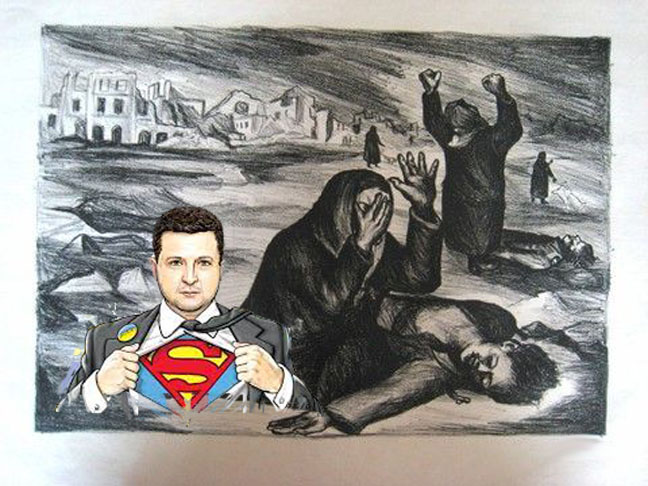
Citizens have been fed a non-stop diet of propaganda about Zelensky our savior from the terrors of the Vlad the terrible. Yet now cracks have appeared and people are asking whether Zelensky is in fact just as corrupt as every Ukrainian leader who came before him
Will war now stretch into 2026 or has Zelensky’s anti-corruption blunder changed the game?
Ian Proud, The Peacemonger, Jul 24, 2025
Below my article of yesterday in Responsible Statecraft. I predicted there would be no progress at the Istanbul peace talks yesterday and there was no progress. The meeting apparently lasted just 40 minutes or so, with little to show except for further agreement on a further round of POW exchanges.
Zelensky didn’t need to cut a deal in Istanbul because he figures that the US will impose harsh secondary sanctions on Russia’s trading partners on 2 September, amounting to a 100% tariff. I have written previously about why I believe that will backfire on the US.
In any case, Zelensky stalling on peace talks in Istanbul may soon be overtaken by events closer to home, in Kyiv and other Ukrainian cities.
It would be easy, I think, to underestimate just how big an impact this will have on public perceptions of Zelensky in western nations that have supported Ukraine to the hilt in the war, and to the impoverishment of their own people. Citizens have been fed a non-stop diet of propaganda about Zelensky our savior from the terrors of the Vlad the terrible. Yet now cracks have appeared and people are asking whether Zelensky is in fact just as corrupt as every Ukrainian leader who came before him. More on that in my next article.
But having started yesterday certain that war would drag into 2026, I am coming round to the idea that it could be over this year. The Ukrainian front line is cracking in various places. European leaders may find it harder than ever before to justify feeding the Zelensky gravy train. One thing I do know, it’s going to be a rocky ride in Kyiv for a while. And more people will die on the front line while the drama unfolds.
Time to end this nonsense now.
President Volodymyr Zelensky of Ukraine has said that a further round of talks between Ukraine and Russia could start as early as this week, and indicated that “everything had to be done to get a ceasefire.” Yet it is far from clear that a ceasefire will be possible. And it’s likely that the war will continue into 2026.
In June, Zelensky was pressing the European Union to go further in its sanctions against Russia, including calling for a $30 per barrel cap on Russian oil shipments. Washington effectively vetoed a lowering of the oil price cap at the recent G7 Summit in Canada. However, on July 18 the European Union agreed its 18th round of Russian sanctions since war began, overcoming a blocking move by Slovakia in the process.
This imposes a cap on Russian oil shipments at 15% below market value ($47.60 at the time the package was agreed) and places further restrictions on Russia’s energy sector. But, there is scepticism that this will dent Russian revenues without the U.S. mirroring the measures, as the prior $60 per barrel G7 cap made no noticeable difference. Zelensky hailed the package as “essential and timely.”
Despite the overtures towards peace talks, economic sanctions against Russia continue to be the preferred approach for both Zelensky and for the EU. And the clock is ticking for the focus to shift back to President Trump’s proposed secondary sanctions. Having given Russia 50 days to agree a peace deal with Ukraine or face tariffs of 100% against its major trading partners, Trump has effectively set a deadline of September 2.
…………………………………………………………………………………………………….this limited agenda will not be enough to satisfy the Kremlin that Ukraine is ready to negotiate and make progress towards an agreement on Russia’s so-called underlying concerns, the key concern being Ukraine’s NATO aspiration. Without the negotiations seriously getting into this and other such substantive issues as the disposition of forces and territory when the fighting stops, don’t expect a leader-level meeting any time soon.
…………………This dynamic of Europe and the U.S. threatening Russia with sanctions unless progress towards peace is made, while no expectations are placed on Ukraine to make concessions, has been locked in since March of 2015. It simply will not work.
Calling on Putin to meet in Istanbul is therefore, like it was in May, an act of political theater by Zelensky. He needs to keep his Western sponsors on side and for the flow of money and arms into Ukraine to continue. He also wants to polish his image as a putative global statesman.
Meanwhile, at the most recent Contact Group of Support for Ukraine meeting, then Ukrainian Prime Minister Denis Shmyhal requested an additional $6 billion to cover this year’s deficit in defense procurement. He also urged “partners to allocate funds for Ukraine in their budget proposals for 2026, right now.”
Anyone who believes that Zelensky is really committed to accelerating moves towards peace in Ukraine may, I fear, be overly optimistic. I am increasingly convinced that war will continue into next year. https://thepeacemonger.substack.com/p/predictably-there-was-no-progress?utm_source=post-email-title&publication_id=3221990&post_id=169121725&utm_campaign=email-post-title&isFreemail=true&r=1ise1&triedRedirect=true&utm_medium=email
Anas Sarwar urged to break silence on Labour’s ‘nuclear tax’ for Scots
ANAS Sarwar has been urged to clarify whether he backs a plan to apply a
“nuclear tax” to Scots with bills set to go up due to the rising cost of an
English nuclear plant. Energy Security Secretary Ed Miliband has confirmed
the Sizewell-C plant will cost £38 billion, nearly double the previous
estimate of £20bn.
Miliband snuck out a statement hours before Parliament
was due to go into a six-week summer recess, admitting energy bill payers
would face a decade-long levy as a result of the price hike. This is
despite Labour promising ahead of the General Election that their flagship
GB Energy policy would save people £300 a year on their energy bills. In
actual fact, bills are on average 10% higher than they were this time last
year.
The National 23rd July 2025, https://www.thenational.scot/news/25335813.anas-sarwar-urged-break-silence-labours-nuclear-tax-scots/
Reaction to Sizewell C deal: too expensive, too slow

by Green Party https://greenparty.org.uk/2025/07/22/reaction-to-sizewell-c-deal-too-expensive-too-slow/
Commenting on news that the Government has struck a deal with private investors to progress the Sizewell C nuclear power plant in Suffolk – a deal in which the government will have a 45% stake – co-leader of the Green Party and Waveney Valley MP, Adrian Ramsay, said:
“The tax-payer will pick up nearly half of the estimated £38bn bill for Sizewell C but see not a single watt of electricity from it for at least a decade. Bill-payers will also have to stump up the cash for this plant through an increase in their energy bills by around £12 a year.
“New nuclear is a vastly more expensive way to produce electricity than renewables, with electricity from Sizewell C estimated to cost around £170 per megawatt hour compared to offshore wind at around £89/MWh. Hinkley C has also shown how the costs of developing nuclear power plants mushroom and are beset by endless delays.
“The billions of our money being squandered on this nuclear gamble would be far better spent on insulating and retrofitting millions of homes, which would bringing down energy bills and keep people warm in winter and cool in summer. We should also be investing in genuinely green power such as fitting millions of solar panels to roofs, and in innovative technologies like tidal power. All this would create many more jobs than nuclear ever will and deliver clean electricity much more quickly.”
US congresswoman labels Zelensky ‘dictator’
23 Jul, 2025 , https://www.rt.com/news/621871-us-congresswoman-zelensky-dictator/
Marjorie Taylor Greene has urged Washington to stop backing the Ukrainian leader, accusing him of refusing peace and clinging to power
US Representative Marjorie Taylor Greene has labeled Ukrainian leader Vladimir Zelensky “a dictator” and called for his removal, citing mass anti-corruption protests across Ukraine and accusing him of blocking peace efforts.
Her comments came after Zelensky signed a controversial bill into law that places the Specialized Anti-Corruption Prosecutor’s Office (SAPO) and the National Anti-Corruption Bureau (NABU) under the authority of the prosecutor general.
Critics argue that the legislation effectively strips the bodies of their independence. The law has sparked protests across Ukraine, with around 2,000 people rallying in Kiev and additional demonstrations reported in Lviv, Odessa, and Poltava.
“Good for the Ukrainian people! Throw him out of office!” Greene wrote Wednesday on X, sharing footage from the protests. “And America must STOP funding and sending weapons!!!”
Greene, a longtime critic of US aid to Kiev, made similar comments last week while introducing an amendment to block further assistance. “Zelensky is a dictator, who, by the way, stopped elections in his country because of this war,” she told the House.
“He’s jailed journalists, he’s canceled his election, controlled state media, and persecuted Christians. The American people should not be forced to continue to pay for another foreign war.”
Her statements come amid mounting speculation over Zelensky’s political future. Journalist Seymour Hersh has reported that US officials are considering replacing him, possibly with former top general Valery Zaluzhny.
Senator Tommy Tuberville also called Zelensky a “dictator” last month, accusing him of trying to drag NATO into the conflict with Russia. Tuberville claimed that Zelensky refuses to hold elections because “he knew if he had an election, he’d get voted out.”
Zelensky’s five-year presidential term expired in 2024, but he has refused to hold a new election, citing martial law, which has been extended every 90 days since 2022.
US President Donald Trump has also questioned Zelensky’s legitimacy, calling him “a dictator without elections” in February.
Russian officials have repeatedly brought up the issue of Zelensky’s legitimacy, arguing that any agreements signed by him or his administration could be legally challenged by future leaders of Ukraine.
Google Helped Israel Spread War Propaganda to 45 Million Europeans

By Alan MacLeod / MintPress News, July 10th, 2025 https://www.mintpressnews.com/israel-europe-youtube-ad-campaign/290163/
While it continues its conflict with its neighbors, Israel is fighting another war just as intensely, spending gigantic amounts of money bombarding Europe with messaging justifying their actions, and scaremongering Europeans that Iranian nuclear missiles will soon be turning their cities into rubble.
A MintPress study has found that, since it struck Iran on June 13, the Israeli Government Advertising Agency has paid for tens of millions of advertisements on YouTube alone. In clear breach of Google’s policies, these ads justify and lionize the attack as a necessary defense of Western civilization, and claim that Israel is carrying out “one of the largest humanitarian missions in the world” in Gaza.
The countries most targeted by this campaign include the United Kingdom, France, Italy, Germany, and Greece.
Information War
“A fanatical regime firing missiles at civilians, while racing towards nuclear weapons. While Iran deliberately targets cities, Israel acts with precision to dismantle this threat.” Thus starts one Israeli government ad that hundreds of thousands of YouTube viewers in Europe have been compelled to watch.
“Terror architects behind the elimination of Israel plan: eliminated. Israel targets only military and terror sites, not civilians. But the threat remains,” the voiceover continues, over ominous music and high-tech graphics. “We will finish the mission for our people, for humanity. Israel does what must be done,” it concludes.
“Iran’s ballistic missile program isn’t just a threat to Israel, it is a threat to Europe and the Western world,” another, seen by 1.5 million viewers in just three weeks, claims. “Iran is developing missiles with ranges of approximately 4000 km. That places Europe within the regime’s striking distance,” it adds, as graphics show virtually the entire continent turning blood red, signifying a nuclear attack. “This isn’t tomorrow’s threat. It is today’s reality. The threat posed by the Iranian regime must be stopped. Israel does what must be done.”
Ominous messages like these, translated into multiple languages, have reached tens of millions of people across Europe. Other Israeli government ads take a different tack, attempting to present Israel as a virtuous victim and an unwilling participant in war. As one commercial notes:
Imagine this: you are holding your newborn in a hospital room. Then the air raid sirens go off. Iran fires ballistic missiles at hospitals, at innocent Israelis. Patients, doctors, newborn babies: deliberately targeted. While Iran aims at families and children, Israel responds with precision, striking military sites. This is not a war of choice. Those who target civilians and hospitals become the target.”
The claims made in such videos are often highly questionable. For example, around 935 Iranians were killed in Israeli strikes, compared to just 28 Israelis, suggesting Israel is far less careful to avoid civilian deaths than its opponent. Indeed, since October 2023, Israel has repeatedly and deliberately targeted hospitals. The World Health Organization has documented at least 697 Israeli strikes on medical facilities.
Ninety-four percent of Gaza’s hospitals have been destroyed or damaged, and more than 1,400 medical personnel have been killed. This includes Dr. Adnan al-Bursh, head of orthopedics at al-Shifa Hospital, who was reportedly raped to death by Israeli prison guards. According to UNICEF, Israel has killed or injured over 50,000 Palestinian children. An American nurse who worked in Gaza told MintPress News that IDF soldiers regularly shoot boys in the genitals to prevent them from reproducing.
Despite this, Israeli advertising presents the country as the savior of the Palestinian people. One Ministry of Foreign Affairs video, set to epic, inspiring music, describes Israel as undertaking “One of the largest humanitarian operations in the world right now.” “This is what real aid looks like. Smiles don’t lie. Hamas does,” it concludes.
Francesca Albanese, the United Nations special rapporteur on the Occupied Palestinian Territories, called the commercial “scandalous” and directly challenged YouTube: “How can this be allowed?” The video has been translated into Italian, French, German, and Greek, and has been viewed by nearly seven million people on YouTube alone.
Transparently Inorganic
All referenced videos appear in the Google Ads Transparency Center as paid content from the Israeli Government Advertising Agency, and there is strong evidence that few, if any, of their millions of views are organic. The five versions of the “Gaza Humanitarian Aid” video, for example, collectively have only a few thousand “likes”—barely 1% of what would be generally expected of videos with this amount of views—and only two comments in total.
The difference between organic and paid content is clearer in videos that Israel has not promoted. Other videos on Israel’s Ministry of Foreign Affairs YouTube channel receive only tens of views per day, not millions, which strongly suggests that close to 100% of their traffic is paid advertising.
The scale of this public relations operation is difficult to overstate. Even as the Israeli government hikes taxes and slashes domestic spending, its foreign PR budget has grown by more than 2,000%, the Foreign Ministry receiving $150 million more for public diplomacy.
Much of that money is evidently being spent on ads. In the past month, the Israeli Ministry of Foreign Affairs has uploaded videos that have topped 45 million views on YouTube alone. The countries most targeted include the United Kingdom, France, Italy, Germany, and Greece.
Greece is a particularly noteworthy case. Over the past 12 months, the Israeli government advertising agency has funded 65 separate YouTube ad campaigns targeting the country.
The Greek version of a recent ad—titled “An efficient system is in place, delivering aid where it’s needed”—presents Israel as a benevolent bringer of life to Gaza and has garnered over 1 million views in just four days, equivalent to nearly 10% of Greece’s entire population. The video currently has no comments and fewer than 3,000 likes.
The Israeli Ministry of Foreign Affairs uploads its videos in English, French, German, Italian, and Greek. Countries that do not speak these languages—such as Slovakia, Denmark, and the Netherlands—are still targeted, though users there generally receive the English version.
Israel has avoided targeting nations whose governments have formally condemned its actions, such as Ireland or Spain, spending nothing to reach those populations. The Netanyahu administration, evidently, has decided to attempt to shore up support in allied countries, even as their populations increasingly turn against Israel.
While many of these figures might shock readers, this investigation only examined the advertising campaign of a single organization, the Israeli Government Advertising Agency, and on a single platform, YouTube. It does not include other Israeli government and non-governmental groups, nor the myriad organizations collectively comprising the pro-Israel lobby in the West.
Israel has also attempted to influence the debate on other platforms, including Facebook, Instagram, TikTok, and Twitter. What is presented here is merely the thinnest slice of a much broader operation.
Israel and Silicon Valley
Some videos the Israeli government has released attempt to portray Israel in a positive light, but instead perpetuate racist stereotypes about Western civilization and its supposed superiority. In one ad, Benjamin Netanyahu states (emphasis added):
I want to assure the civilized world, we will not let the world’s most dangerous regime get the world’s most dangerous weapons. The increasing range of Iran’s ballistic missiles would bring that nuclear nightmare to the cities of Europe and eventually to America.”
Thus, the Israeli prime minister implies that Iran’s threat matters only if it endangers the so-called “civilized world,” that is, Europe and North America. “Never again is now. Today, Israel has shown that we have learned the lessons of history,” Netanyahu continues, directly comparing the 12-Day War (which Israel started) to the Holocaust. “When enemies vow to destroy you, believe them. When enemies build weapons of mass death, stop them. As the Bible teaches us, when someone comes to kill you, rise and act first.”
Google’s advertising rules explicitly prohibit commercials that “display shocking content or promote hatred, intolerance, discrimination, or violence.” Yet many of the ads described here explicitly justify Israeli aggression.
MintPress News contacted Google to ask how much the Israeli government’s advertising agency spent on ads, how many impressions those ads generated, whether the company had a response to Albanese’s comments, and whether the videos violated its policies.
Google did not answer the first three questions and reiterated that it has “strict ad policies that govern the types of ads we allow on our platform.” “These policies are publicly available, and we enforce them consistently and without bias. If we find ads that violate those policies, we swiftly remove them,” the company added, implying that it does not consider the ads a violation of its standards.
Few who have studied Google’s connections to the Israeli government will be surprised that the Silicon Valley giant grants enormous leeway to the Netanyahu administration. Former CEO Eric Schmidt is known as one of Israel’s most vocal supporters. Google has been financially invested in Israel since at least 2006, when it opened its first offices in Tel Aviv. In 2012, at a meeting with Netanyahu himself, Schmidt declared that “the decision to invest in Israel was one of the best that Google has ever made.”
Company co-founder Sergey Brin has also come to the defense of Israel, denouncing the United Nations as “transparently anti-Semitic” and telling Google staff that using the word “genocide” to describe Israeli actions in Gaza is “deeply offensive to many Jewish people who have suffered actual genocides.”
Earlier this year, with the Israeli economy in dire straits following its 18-month campaign against its neighbors, Schmidt’s company came to the rescue, injecting billions into Israel in a record-setting acquisition. Google purchased local cybersecurity firm Wiz for $32 billion. The monumental sum paid—equivalent to 65 times Wiz’s annual revenue and boosting the Israeli economy by 0.6%—left some analysts wondering if the deal had more to do with underwriting the Israeli economy than making a shrewd business investment.
It also raises questions about the safety of Google users’ most sensitive personal data, given that Wiz was founded and continues to be staffed by former Israeli spies from the intelligence group, Unit 8200.
Google has a long history of working closely with Israeli intelligence. A 2022 MintPress News investigation identified at least 99 former Unit 8200 agents employed by Google.
Among them is Gavriel Goidel, head of strategy and operations for Google Research. Goidel joined Google in 2022 after a six-year career in military intelligence, during which he rose to become Head of Learning at Unit 8200. There, he led a large team of operatives who sifted through intelligence data to “understand patterns of hostile activists,” according to his own account.
The Turning Tide
Google is far from the only tech giant recruiting Israeli spies to run their most politically sensitive departments. The same study found that hundreds of former Unit 8200 intelligence agents are employed at companies such as Meta (formerly Facebook), Microsoft, and Amazon. And a significant amount of what America reads about the Middle East is also written by ex-Israeli spies.
A MintPress investigation from earlier this year uncovered a network of Unit 8200 alums working in top newsrooms across America.
Wikipedia is another key theater of war for the Israeli state. A project overseen by future Prime Minister Naftali Bennett deployed thousands of young Israelis to monitor and edit the online encyclopedia, removing troublesome facts and framing articles more favorably in Israel’s favor. Those who made the most edits would receive rewards, including free hot air balloon rides.
The Ministry of Foreign Affairs has also launched a campaign to harass and intimidate American students, establishing a “task force” to carry out psychological operations aimed at, in its own words, “inflicting economic and employment consequences” against pro-Palestine protestors. While Foreign Minister Eli Cohen heads the task force, it stresses that its actions “should not have the signature of the State of Israel on it.”
Amid mounting criticism, the Israeli government has sought to turn the tide by inviting influencers for direct talks with Netanyahu. In April, the Israeli prime minister met face-to-face with conservative internet personalities, including Tim Pool; Dave Rubin; Sean Spicer; Bethany Mandel; David Harris Jr.; Jessica Krause; Seth Mandel; and Mollie Hemingway, where they discussed how best to sell war with Iran to Western publics, and how to counter anti-Zionist sentiment online.
Other social media personalities report having been offered large sums of money in exchange for a few words of support for Israel.
In terms of turning the tide of European public opinion, Israel has its work cut out for it. A recent YouGov survey found the country was widely reviled across the continent. More than 20 times as many Italians, for instance, hold “very unfavorable” (43%) views of Israel than “very favorable” ones (2%).
Even in Germany, where popular support for Israel is highest, only 21% said they hold favorable opinions of the state (including only 4% highly favorable), with 65% displaying open opposition (including 32% who strongly dislike it).
A massive plurality of Britons, meanwhile, agreed with the statement: “Israel treats the Palestinians like the Nazis treated the Jews.” Forty-eight percent answered in the affirmative, as opposed to just 13% who disagreed. This is despite European governments offering full-throated support to Israel, and even criminalizing pro-Palestine protests and persecuting journalists who oppose Western support for Tel Aviv.
The government of Israel is spending millions of dollars daily on gigantic advertising campaigns aimed at turning the tide of public opinion. To that end, it is developing a PR network as sophisticated as the advanced weapons systems it uses on its neighbors. On YouTube alone, its paid advertising, translated into five languages, has reached at least 45 million people in the past month. Whether this strategy will ultimately prove effective remains unclear. After all, it is difficult to convince the public to support a genocide.
UK Government drops plans to include smaller nuclear fusion energy plants in NSIP regime
The government has announced it will incorporate all nuclear fusion energy facilities generating at least 50 megawatts (MW) in England into the streamlined nationally significant infrastructure project (NSIP) planning regime, but will drop its proposal to include such developments that fall under this threshold.
by Natasha Norris, Planning 24th July 2025,
https://www.planningresource.co.uk/article/1926726/government-drops-plans-include-smaller-nuclear-fusion-energy-plants-nsip-regime
2
Israel’s genocide is big business – and the face of the future

“Gaza not only looks like a dress rehearsal for the kind of combat US soldiers may face. It is a test of the American public’s tolerance for the levels of death and destruction that such kinds of warfare entail.”
21 July 2025, https://www.jonathan-cook.net/2025-07-21/israel-genocide-big-business/
US corporations and military planners welcome the ‘legal maneuver space’ Israel has opened up for them to profit from warfare that slaughters and starves civilians
[An audio version of this article is available here]
The Financial Times revealed this month that a cabal of Israeli investors, one of the world’s top business consulting groups and a think-tank headed by former British prime minister Tony Blair had been secretly working on plans to exploit the ruins of Gaza as prime real estate.
The secret consortium appears to have been seeking practical ways to realise US President Donlad Trump’s “vision” of Gaza as the “Riviera of the Middle East”: transforming the small coastal enclave into a playground for the rich and an enticing investment opportunity, once it can be ethnically cleansed of its Palestinian population.
Meanwhile, the UK government has declared Palestine Action a terrorist organisation – the first time in British history that a direct-action campaign group has been banned under Britain’s already draconian terrorism legislation.
Notably, the government of Keir Starmer took the decision to proscribe Palestine Action after lobbying from Elbit Systems, an Israeli weapons maker whose factories in the UK have been targeted by Palestine Action for disruption. Elbit supplies Israel with killer drones and other weapons central to Israel’s genocide in Gaza.
These revelations came to light as the United Nation’s special rapporteur on the occupied Palestinian territories, Francesca Albanese, published a report – titled “From economy of occupation to economy of genocide” – exposing Big Business’ extensive involvement in, and profits from, Israel’s crimes in Gaza.
Albanese lists dozens of major western companies that are deeply invested in Israel’s oppression of the Palestinian people.
This is not a new development, as she notes. These firms have exploited business opportunities associated with Israel’s violent occupation of the Palestinian people’s lands for years, and in some cases decades.
The switch from Israel’s occupation of Gaza to its current genocide hasn’t threatened profits; it has enhanced them. Or as Albanese puts it: “The profits have increased as the economy of the occupation transformed into an economy of genocide.”
The special rapporteur has been a growing thorn in the side of Israel and its western sponsors over the past 21 months of slaughter in Gaza.
That explains why Marco Rubio, Trump’s secretary of state, announced soon after her report was issued that he was imposing sanctions on Albanese for her efforts to shed light on the crimes of Israeli and US officials.
Revealingly, he called her statements – rooted in international law – “economic warfare against the United States and Israel”. Albanese and the UN system of universal human rights that stands behind her, it seems, represent a threat to western profiteering.
Window on the future
Israel effectively serves as the world’s largest business incubator – though, in its case, not just by nurturing start-up companies.
Rather, it offers global corporations the chance to test and refine new weapons, machinery, technologies, data collection and automation processes in the occupied territories. These developments are associated with mass oppression, control, surveillance, incarceration, ethnic cleansing – and now genocide.
In a world of shrinking resources and growing climate chaos, such innovative technologies of subjugation are likely to have domestic, in addition to overseas, applications. Gaza is the corporate world’s laboratory, and a window into our own future.
In her 60-page report, Albanese writes that her research “reveals how the forever-occupation has become the ideal testing ground for arms manufacturers and Big Tech… while investors and private and public institutions profit freely”.
Her point was underscored by the Israeli arms firm Rafael, which issued a promotional video of its Spike FireFly drone that showed it locating, chasing and killing a Palestinian in what it called “urban warfare” in Gaza.
As the UN special rapporteur points out, quite aside from the issue of genocide in Gaza, western companies have been under a legal and moral obligation to sever ties with Israel’s system of occupation since last summer.
That was when the world’s highest court, the International Court of Justice, ruled Israel’s decades-old occupation was a criminal enterprise based on apartheid and forcible transfer – or what Albanese refers to as policies of “displacement and replacement”.
Instead, the corporate sector – and western governments – continue to deepen their involvement in Israel’s crimes.
It is not just arms manufacturers profiting from the genocidal levelling of Gaza and the occupations of the West Bank and East Jerusalem.
Big Tech, construction and materials firms, agribusiness, the tourism industry, the goods and services sector, and supply chains have also got in on the act.
And enabling it all is a finance sector – which includes banks, pension funds, universities, insurers and charities – keen to continue investing in this architecture of oppression.
Albanese describes the mosaic of companies partnering with Israel as “an eco-system sustaining this illegality”.
Escaping scrutiny
For these corporations and their enablers, international law – the legal system Albanese and her fellow UN rapporteurs are there to uphold – serves as an impediment to the pursuit of profit.
Albanese notes that the business sector can escape scrutiny by shielding behind other actors.
Israel and its senior officials are on notice for committing genocide, crimes against humanity and war crimes.
When she wrote to 48 companies to warn them that they were colluding in this criminality, they either responded that this was Israel’s responsibility, not theirs, or that it was for states, not international law, to regulate their business activities.
Corporations, Albanese points out, can secure their biggest profits in the “grey areas of the law” – laws they have helped to shape.
Lockheed Martin’s F-35 jets, whose “beast mode” has been shop-windowed by Israel as it has destroyed Gaza, depend on some 1,600 other specialist firms operating in eight separate states, including Britain.
Late last month the UK high court, while admitting British-made components used in the F-35 were likely to contribute to war crimes in Gaza, ruled that it was up to Starmer’s government to make “acutely sensitive and political” decisions about the export of these parts.
UK foreign secretary David Lammy, by contrast, told a parliamentary committee it was not for the government to assess whether Israel was committing war crimes in Gaza, using British arms, it was “a decision for the court”.
Lockheed Martin has joined the buck-passing. A spokesperson said: “Foreign military sales are government-to-government transactions. Discussions about those sales are best addressed by the US government.”
Big Tech collusion
Albanese also points the finger at leading tech firms for rapidly and deeply embedding in Israel’s illegal occupation, including by acquiring Israeli start-ups that exploit expertise gained from the oppression of Palestinians.
The NSO Group has developed Pegasus phone spyware that is now being used to surveill politicians, journalists and human rights activists around the world.
Last year the Biden administration signed a contract with another Israeli spyware firm, Paragon. Will we learn one day that the US used exactly this kind of technology to spy on Albanese and other international law experts, on the pretext that they were waging so-called “economic warfare”?
IBM trains Israeli military and intelligence personnel, and is central to the collection and storage of biometric data on Palestinians. Hewlett Packard Enterprises supplies technology to Israel’s occupation regime, prison service and police.
Microsoft has developed its largest centre outside the US in Israel, from which it has fashioned systems for use by the Israeli military, while Google and Amazon have a $1.2 billion contract to provide it with tech infrastructure.
The prestigious research university MIT, the Massachusetts Institute of Technology, has collaborated with Israel and companies like Elbit to develop automated weapons systems for drones and refine their swarm formations.
Palantir, which supplies the Israeli military with Artificial Intelligence platforms, announced a deeper strategic partnership in January 2024, early in Israel’s slaughter in Gaza, over what the Bloomberg news agency termed “Battle Tech”.
Over the past 21 months, Israel has been introducing new automated programs driven by AI – such as “Lavendar”, “Gospel” and “Where’s Daddy?” – to select huge numbers of targets in Gaza with little or no human oversight.
Albanese calls this “the dark side of the start-up nation that is so embedded, so intimately related to the military industry aims and gains.”
Not surprisingly, tech firms are falling back on all-too-familiar smears against the special rapporteur and the UN for pulling back the veil on their activities. The Washington Post reported that, in the wake of Albanese’s report, Google’s co-founder, Sergey Brin, called the UN “transparently antisemitic” in a chat on a staff forum.
Concentration camp
There are a long list of other household names in Albanese’s report: Caterpillar, Volvo and Hyundai are accused of supplying heavy machinery to destroy homes, mosques and infrastructure in Gaza and the West Bank.
Leading banks such as BNP Paribas and Barclays have underwritten treasury bonds to boost market confidence in Israel through the genocide and maintain its favourable interest rates.
BP, Chevron and other energy firms are profiting from existing gas fields in the eastern Mediterranean and pipelines that pass through Palestinian maritime waters off Gaza. Israel issued exploration licences for Gaza’s own undeveloped gas field, off the coast, shortly after launching its genocidal slaughter.
Israel’s latest plan to create, in its own words, a “concentration” camp inside Gaza – where Palestinian civilians are to be tightly confined under armed guard – will doubtless rely on business partnerships similar to those behind the bogus “aid distribution hubs” Israel has already imposed on the enclave’s people.
Israeli soldiers have testified that they are being ordered to shoot into crowds of starving Palestinians queueing for food at these hubs – explaining why dozens of Palestinians have been killed daily for weeks on end.
Those hubs, run by the misleadingly named Gaza Humanitarian Foundation, were in part the brainchild of the Boston Consulting Group, the same management consultants caught this month plotting to turn Gaza into Trump’s Palestinian-free “Riviera of the Middle East”.
Israel’s planned concentration camp built on the ruins of the city of Rafah – to be termed, again deceptively, a “humanitarian zone” – will require all those entering to be “security screened”, using biometric data, before their incarceration.
Doubtless other contractors, using largely automated systems, will control the camp’s interior until, in the Israeli government’s words, “an emigration plan” can be implemented to expel the population from Gaza.
Albanese points to the many precedents for private corporations driving some of the most horrifying crimes in history, from slavery to the Holocaust.
Albanese urges lawyers and civil society actors to pursue legal avenues against these firms in the countries in which they are registered. Where possible, consumers should exert what pressure they can by boycotting these corporations.
She concludes by recommending that states impose sanctions and an arms embargo on Israel.
Further, she calls on the besieged International Criminal Court – four of whose judges are, like her, under US sanctions – as well as national courts “to investigate and prosecute corporate executives and/or corporate entities for their part in the commission of international crimes and laundering of the proceeds from those crimes”.
Psychopathic culture
All of this is crucial to understanding why western capitals have continued to partner in Israel’s slaughter, even as Holocaust and genocide scholars – many of them Israeli – have reached a firm consensus that its actions amount to genocide.
Governing parties in western countries like the US and Britain are largely dependent on Big Business, both for their electoral success and, after victory at the polling booth, in maintaining popularity through the promotion of “economic stability”.
Keir Starmer reached power in the UK after spurning the popular grassroots funding model of his predecessor, Jeremy Corbyn, and wooing instead the corporate sector with promises that the party would be in its pocket.
His reassurances were also key to making sure the billionaire-owned media – which had ferociously turned on Corbyn, constantly vilifying him as an “antisemite” for his democratic socialist and pro-Palestinian positions – smoothed Starmer’s path to Downing Street.
In the US, the billionaires even have one of their own in power, in Donald Trump. But even his campaign depended on funding from big donors like Miriam Adelson, the Israeli widow of casino magnate Sheldon Adelson.
Adelson is among a number of top donors, funding both main parties, who make no bones about their number one political priority being Israel.
Once in power, parties are then effectively held to ransom by major corporations on large areas of domestic and foreign policy.
The financial sector had to be bailed out by taxpayers – and still is through so-called “austerity measures” – after its reckless excesses crashed the global ecomomy in the late 2000s. Western governments considered the banks “too big to fail”.
Similarly, Israel – the world’s biggest incubator for the arms and surveillance industries – is just too big to be allowed to fail as well. Even as it commits genocide.
Critics of the rise of globalised corporations over the past half century, such as famed linguist Noam Chomsky and law professor Joel Bakan, have long noted the inherently psychopathic traits of corporate culture.
Corporations are legally obligated to pursue profit and prioritise shareholder value over other considerations. Limitations on their freedoms to do so are near non-existent after waves of deregulation from suborned western governments.
Bakan observes that corporations are indifferent to the suffering or safety of others. They are incapable of maintaining enduring relationships. They lack any sense of guilt, or capacity for self-restraint. And they lie, cheat and deceive to maximise profits.
These psychopathic tendencies have been on show in scandal after scandal, whether from the tobacco and banking industries, or from pharmaceutical and energy companies.
Why would Big Business behave any better in pursuing profits tied up in the Gaza genocide?
Bakan addresses those who confuse his argument with a conspiracy theory. The psychopathic behaviours of corporations simply reflect the legal imperatives on them as institutions – what he calls their “logical dynamic” – to maximise profit and sideline rivals, whatever the consequences for the wider society, future generations or the planet.
Growing fat on genocide
The stakes in Gaza are high for western governments precisely because they are so high for the business world growing fat on Israel’s genocide.
Governments and corporations have an overwhelming shared interest in protecting Israel from scrutiny and criticism: it serves as their colonial attack dog in the oil-rich Middle East, and it acts as a cash-cow for the weapons, surveillance and incarceration industries.
Which explains why Trump and Starmer, on one side, and university administrations, on the other, have invested so much political and moral capital in crushing the spaces, especially in academia, where free speech and protest are supposed to be most prized.
The unversities are far from a disinterested party. Before their campus encampments were trashed by police, student demonstrators sought to highlight how heavily invested the universities are in the economy of occupation and genocide, both financially and through research partnerships with the Israeli military and Israeli universities.
The need to ringfence Israel from scrutiny also explains rapid moves in the West both to impute “antisemitism” to every effort to hold Israel, or its genocidal army, to account.
The desperate lengths to which governments will go was on display this month as UK officials and the establishment media kicked up a storm of outrage after a punk band at Glastonbury chanted “Death, death to the IDF!” – a reference to Israel’s genocidal army.
And as the power of the antisemitism accusation has weakened from misuse, western capitals are now rewriting their statutes to designate as “terrorism” any attempt to put a spoke in the wheels of the genocide economy, by for example sabotaging weapons factories.
Morality and international law are being scattered to the winds to keep the West’s most important colonial spin-off a money-maker.
Business as usual
Israel’s indispensability to the corporate sector and a captured western political class extends far beyond tiny Gaza. Israel is playing an outsize role as a war-industries incubator on a global battlefield in which the West seeks to ensure its continuing military and economic primacy over China.
Last month the global business elite – comprising tech billionaires and corporate titans, joined by political leaders, media editors, and military and intelligence officials – met once again at the publicity-shy Bilderberg summit, this year hosted in Stockholm.
Prominent were the CEOs of major “defence” suppliers and arms manufacturers such as Palantir, Thales, Helsing, Anduril and Saab.
Drone warfare – being used in innovative ways by key military clients like Israel and Ukraine – was high on the agenda. The greater integration of AI into drones appears to have been a mainstay of the discussions.
The subtext this year, as in recent years, was a supposed rising threat from China and an associated “authoritarian axis” comprising Russia, Iran and North Korea. This threat is seen chiefly in economic and technological terms.
In May, Eric Schmidt, the former head of Google and a Bilderberg board member, wrote with alarm in the New York Times: “China is at parity or pulling ahead of the United States in a variety of technologies, notably at the AI frontier.”
He added that the West was in a race against China over the imminent development of super-intelligent AI, which would give the winner “the keys to control the entire world”.
Schmidt, like other Bilderberg regulars, predicts that the power-draining needs of super AI will lead to ever-intensifying energy wars for the West to stay top dog.
Or as a Guardian report on the conference summed up the mood: “In this desperate winner-takes-all race for the keys to the world, in which the ‘geopolitics of energy’ becomes ever more important, power stations – along with the data centers they feed – are going to become the No 1 military targets.”
Israel’s slaughter in Gaza is seen as playing a critical role in opening up the “battlescape”.
The same corporations cashing in on the Gaza genocide stand to benefit from the more permissive environment – legally and militarily – created by Israel for future wars, ones where massacred civilians count only as “incidental deaths”.
An April article in the New Yorker magazine set out the challenge facing US military planners, who have considered themselves hobbled since the 1980s by the rise of a human rights community that developed an expertise in the laws of war independently from the Pentagon’s self-serving interpretations.
The result, say US generals regretfully, has been a “general aversion to collateral damage risk” – that is, killing civilians.
Pentagon military planners are keen to use the slaughter in Gaza as a precedent for their own genocidal violence in subduing future economic rivals like China and Russia who threaten the official US doctrine of “global full-spectrum dominance”.
The New Yorker sets out this thinking: “Gaza not only looks like a dress rehearsal for the kind of combat US soldiers may face. It is a test of the American public’s tolerance for the levels of death and destruction that such kinds of warfare entail.”
According to the magazine, the genocidal violence being unleashed by Israel is opening up the “legal maneuver space” – the space needed to commit crimes against humanity in full view.
This is where much of the impulse comes from in western capitals to normalise the genocide – present it as business as usual – and demonise its opponents.
The arms makers and tech companies whose coffers have been swollen by Israel’s genocide in Gaza stand to make far greater riches from a similarly devastating war against China.
Whatever the script we are sold, there will be nothing moral or existential about this coming battle. As ever, it will be about rich people keen to get even richer.
Nuclear waste exposure in childhood associated with higher cancer incidence

Harvard T.H. Chan School of Public Health, Jul 17 2025, https://www.news-medical.net/news/20250717/Nuclear-waste-exposure-in-childhood-associated-with-higher-cancer-incidence.aspx
Living near Coldwater Creek-a Missouri River tributary north of St. Louis that was polluted by nuclear waste from the development of the first atomic bomb-in childhood in the 1940s, ’50s, and ’60s was associated with an elevated risk of cancer, according to a new study led by Harvard T.H. Chan School of Public Health. The researchers say the findings corroborate health concerns long held by community members.
The study will be published July 16 in JAMA Network Open. It coincides with Congress having passed an expanded version of the Radiation Exposure Compensation Act (RECA) as part of the Trump tax bill, through which Americans, including Coldwater Creek residents, can receive compensation for medical bills associated with radiation exposure.
Most studies of radiation exposure have focused on bomb survivors who have had very high levels of exposure; far less is known about the health impacts of lower levels of radiation exposure.
Nuclear waste exposure in childhood associated with higher cancer incidence

Harvard T.H. Chan School of Public HealthJul 17 2025
Living near Coldwater Creek-a Missouri River tributary north of St. Louis that was polluted by nuclear waste from the development of the first atomic bomb-in childhood in the 1940s, ’50s, and ’60s was associated with an elevated risk of cancer, according to a new study led by Harvard T.H. Chan School of Public Health. The researchers say the findings corroborate health concerns long held by community members.
The study will be published July 16 in JAMA Network Open. It coincides with Congress having passed an expanded version of the Radiation Exposure Compensation Act (RECA) as part of the Trump tax bill, through which Americans, including Coldwater Creek residents, can receive compensation for medical bills associated with radiation exposure.
Most studies of radiation exposure have focused on bomb survivors who have had very high levels of exposure; far less is known about the health impacts of lower levels of radiation exposure.
For this study, the researchers used a subsample of 4,209 participants from the St. Louis Baby Tooth – Later Life Health Study (SLBT), a cohort composed of many individuals who lived near Coldwater Creek as children and who donated their baby teeth beginning in 1958 to measure exposure to radiation from atmospheric nuclear testing. The participants, who lived in the Greater St. Louis area between 1958 and 1972, self-reported incidences of cancer, allowing the researchers to calculate cancer risk in accordance with childhood residence proximity to Coldwater Creek.
The findings showed a dose-response effect-those living nearest to the creek had a higher risk for most cancers than those living farther away. There were 1,009 individuals (24% of the study population) who reported having cancer. Of those, the proportion was higher for those living near the creek-30% lived less than one kilometer away, 28% between one and five kilometers away, 25% between five and 20 kilometers away, and 24% 20 kilometers or more away).
The researchers estimated that those living more than 20 kilometers away from the creek had a 24% risk of any type of cancer. Compared to this group, among those who lived less than one kilometer away from the creek, the risk of developing any type of cancer was 44% higher; solid cancers (cancers that form a mass, as opposed to blood cancers), 52% higher; radiosensitive cancers (thyroid, breast, leukemia, and basal cell), 85% higher; and non-radiosensitive cancers (all except thyroid, breast, leukemia, and basal cell), 41% higher. The risk went down among those who lived between one and 5 kilometers away from the creek, and then down a little more among those who lived 5-20 kilometers away, but was still slightly higher than those living more than 20 kilometers away.
“Our research indicates that the communities around North St. Louis appear to have had excess cancer from exposure to the contaminated Coldwater Creek,” said corresponding author Marc Weisskopf, Cecil K. and Philip Drinker Professor of Environmental Epidemiology and Physiology.
These findings may have broader implications-as countries think about increasing nuclear power and developing more nuclear weapons, the waste from these entities could have huge impacts on people’s health, even at these lower levels of exposure.”
Marc Weisskopf, Cecil K. and Philip Drinker Professor, Environmental Epidemiology and Physiology, Harvard T.H. Chan School of Public Health
Other Harvard Chan School authors included Michael Leung, Ian Tang, Joyce Lin, Lorelei Mucci, Justin Farmer, and Kaleigh McAlaine.
Source:
Harvard T.H. Chan School of Public Health
Journal reference:
Leung, M., et al. (2025) Cancer Incidence and Childhood Residence Near the Coldwater Creek Radioactive Waste Site. JAMA Network Open.
Does Israel have secret nuclear weapons?
26 Jul 2025 If You’re Listening | ABC News In-depthI
srael is steadfast that Iran can’t have a nuclear weapon. But at the same time, there’s more than a sneaking suspicion that Israel has a nuclear weapon of their own. The Israeli government has never officially confirmed or denied that it possesses a nuclear arsenal. In truly one of the most extraordinary stories we’ve told on this show, we get to the bottom of how Israel hides its nukes, how we found out about them, and why the global community seems to be fine with it.
Why Nuclear Power in Scotland is not Needed, Economic, Wanted or Safe
John Drummond in conversation with Energy Scotland’s John Proctor and Leah Gunn Barrett
Leah Gunn Barrett, Dear Scotland, Jul 24, 2025
Last evening, John Proctor of Energy Scotland and I were guests on The Nation Talks podcast with John Drummond. We discussed why more nuclear power in Scotland should be a non-starter. It’s notNeeded, Economic, Wanted or Safe. And yet English Labour – from Kid Starver to Viceroy Murray to Anus Sarwar – are rabidly pro-nuclear, pushing this costly and dangerous energy source onto Scotland without our consent.
The video link to the programme is below. I’ve also provided notes below that I used to prepare, many taken from my previous posts.
Why Nuclear power is being pushed onto Scotland
The Corporate Nuclear Lobby has conducted one of the most aggressive lobbying and public relations campaigns of all energy sources. It pushes politicians and the public to support nuclear based on sketchy information and outright lies which aren’t challenged in the Scottish media.
The nuclear industry is funding lobby group Britain Remade, which launched a campaign to lift the ban on new Scottish nuclear power at a May 1 meeting in Dunbar, near the Torness power plant. English Labour’s Scotland manager Anus Sarwar accused the SNP of depriving Scotland of billions in investment and thousands of jobs, which is a lie. This is the same dude who wouldn’t save Grangemouth and its 500 jobs, after vowing he would.
And Viceroy Murray is pushing nuclear, even removing his name from the International Campaign to Abolish Nuclear Weapons (ICAN) pledge.
English Labour is bankrolled by the nuclear lobby. Tony Blair is one of its biggest beneficiaries and cheerleaders. The Nuclear Energy Association loved his Institute’s 2024 pro-nuclear power report.
Nuclear power subsidises nuclear weapons production
Here’s the dirty little secret – the UK Government needs nuclear power. Without it, there’d be no nuclear weapons programme, the flaccid UK’s national virility symbol.
All the processes of the nuclear fuel cycle – uranium mining, refining and U-235 enrichment – are used for both civilian and military purposes; the UK Capenhurst facility makes nuclear fuel for both reactors and Trident submarines; and nuclear reactors create tritium (the radioactive isotope of hydrogen), which is necessary for nuclear weapons.
A 2017 University of Sussex study found that the costs of the Trident programme would be “unsupportable” without “an effective subsidy, from electricity consumers to military nuclear infrastructure”. Consumers, bearing the costs of uneconomic nuclear power, are also subsidising nuclear weapons that don’t even work! The Trident delivery system has failed two tests in a row, in 2016, and 2024. Despite these fiascos, the UK government insists that Trident “remains the most reliable weapons system in the world.”
Westminster won’t allow the southeast of England to be polluted by these nuclear rustbuckets so has confined them to “north Britain.” Nor will it tell its northern colony how badly they’re polluting the land and water. In 2017, the MoD stopped publishing annual reports from its internal watchdog, after the reports for 2005-2015 flagged “regulatory risks” 86 times. It has also blocked Scotland’s environment agency from releasing information about radioactive pollution from the Clyde nuclear bases at Faslane and Coulport for the last ten years.
Scots are getting the mushroom treatment – kept in the dark and fed a load of shite.
I. Nuclear is Not Needed – Renewables are far cheaper and safer………………………………………………………………………………………………………………
So, English Labour is trying to force onto Scotland plants that aren’t even commercially viable. It’s regurgitating the marketing hot air from a desperate industry that’s frantically funding pathetic careerists like Sarwar, Starmer and the Viceroy who are pushing this crap.
……………………………………………………………………………………………………………………….. • With no solution to nuclear waste, the UK is starting a new nuclear building program which will worsen the waste problem and result in vastly increased radioactivity from spent fuel and other highly radioactive wastes which will have to be stored indefinitely at vulnerable sites scattered around the UK coast.
The UK won’t give up on its never-ending quest to screw Scotland. It has stolen our oil and gas and now our renewables, and now is trying to force us to accept not needed, not economic, not wanted and not safe nuclear power.
Please sign the petition calling on the Scottish Administration to implement the International Covenant on Civil and Political Rights to give Scots the tools to exercise their sovereignty and the ability to say NO to nuclear. https://dearscotland.substack.com/p/why-nuclear-power-in-scotland-is
Origins of Israel’s nuclear ambiguity lie in a secret deal forged between Richard Nixon and Golda Meir – podcast
Israel has never officially confirmed or denied having nuclear weapons and has never signed the nuclear non-proliferation treaty. Instead, even as evidence has emerged about its nuclear capabilities, Israel has maintained a policy of nuclear ambiguity.
The origins of this opacity lie in a secret deal forged in a one-on-one meeting between Israeli prime minister, Golda Meir, and the US president, Richard Nixon, at the White House in September 1969.
In this episode of The Conversation Weekly podcast, we speak to Avner Cohen, professor of non-proliferation studies at the Middlebury Institute of International Studies at Monterrey in the US, about that 1969 deal and why it has endured for more than 50 years. Cohen is the author of Israel and the Bomb, considered the definitive work on Israel’s nuclear programme, and has been interrogated by the Israeli state for his research.
Cohen tells us that the understanding between Meir and Nixon meant the US accepted Israel as a special kind of nuclear weapon state. In turn, Israel committed to restraint, not to test nuclear weapons, and not to be the first to introduce them to the region. Neither side has confirmed the existence of a deal, and there are only hints at it in the historical record. Cohen explains:
Once you realise that there is actually a deal, it explains a great deal of the situation. Why the US [is] looking the other way, why the issue is determined to be removed from the diplomatic agenda, and why many other countries, especially in the west, prefer not to see the Israeli nuclear issue.
Listen to the conversation with Avner Cohen on The Conversation Weekly podcast.
1 This Month





PLEASE OPPOSE HR 8255 AND S.3639 – bills would accelerate satellite deployment, with no environmental review or safeguards – https://ncstd5li.quorum.us/campaign/169331/
To see nuclear-related stories in greater depth and intensity – go to https://nuclearinformation.wordpress.com
-
Archives
- October 2026 (67)
- September 2026 (339)
- August 2026 (330)
- July 2026 (355)
- June 2026 (287)
- May 2026 (306)
- April 2026 (356)
- March 2026 (251)
- February 2026 (267)
- January 2026 (308)
- December 2025 (358)
- November 2025 (359)
-
Categories
- 1
- 1 NUCLEAR ISSUES
- business and costs
- climate change
- culture and arts
- ENERGY
- environment
- health
- history
- indigenous issues
- Legal
- marketing of nuclear
- media
- opposition to nuclear
- PERSONAL STORIES
- politics
- politics international
- Religion and ethics
- safety
- secrets,lies and civil liberties
- spinbuster
- technology
- Uranium
- wastes
- weapons and war
- Women
- 2 WORLD
- ACTION
- AFRICA
- Atrocities
- AUSTRALIA
- Christina's notes
- Christina's themes
- culture and arts
- Events
- Fuk 2022
- Fuk 2023
- Fukushima 2017
- Fukushima 2018
- fukushima 2019
- Fukushima 2020
- Fukushima 2021
- general
- global warming
- Humour (God we need it)
- Nuclear
- RARE EARTHS
- Reference
- resources – print
- Resources -audiovicual
- Weekly Newsletter
- World
- World Nuclear
- YouTube
-
RSS
Entries RSS
Comments RSS

