Why Palantir Australia Sparks Growing Privacy Fears

8 May 2026 AIMN Editorial By Denis Hay
Palantir Australia is expanding into defence, policing, and corporate systems. What dangers could this pose to ordinary Australians?
Introduction – The Surveillance Expansion Most Australians Never Voted For
Palantir Australia is becoming deeply embedded inside Australian government agencies, defence systems, intelligence operations, and potentially private corporate networks. Yet most Australians know little about the company, the technologies it develops, or the long-term consequences these systems could have for privacy, democracy, and civil liberties.
Another intelligence technology company, Babel Street Australia, is also involved in cyber intelligence and AI-driven monitoring systems. Together, these companies represent a rapidly growing surveillance technology Australia industry built around mass data analysis, predictive behaviour modelling, and artificial intelligence.
Supporters argue these technologies improve national security and risk management. Critics warn they may be laying the foundations for a future where governments and corporations can monitor citizens at unprecedented levels.
This debate matters because once surveillance systems become normalised, they are rarely rolled back.
If you value independent, fact-based analysis that challenges concentrated corporate and political power, please consider supporting Social Justice Australia.
What Is Palantir Australia?
A Company Born from Intelligence Agencies
Palantir Technologies was founded in the United States in 2003 with support linked to the CIA investment arm In-Q-Tel.
The company developed software capable of combining enormous amounts of information into highly searchable intelligence platforms.
Its major systems include:
- Gotham, primarily used by military, intelligence, and policing agencies.
- Foundry, used for data integration across governments and corporations.
These systems can combine data from:
- Financial records.
- Communications metadata.
- Government databases.
- CCTV systems.
- Social media platforms.
- Travel records.
- Online activity.
Palantir markets its systems as tools for security, fraud detection, military coordination, and operational efficiency.
What Is Babel Street Australia?
AI Monitoring and Social Media Intelligence
Babel Street is another US-based intelligence technology company specialising in open-source intelligence and AI-driven analysis.
However, civil liberties groups argue the same systems can also enable mass surveillance and excessive concentration of informational power.
According to The Guardian, Palantir has expanded aggressively in
Its technology focuses on:
- Social media monitoring.
- Behavioural analysis.
- Cyber intelligence.
- Risk assessment.
- Investigative analytics.
The company markets its products to:
- Governments.
- Defence agencies.
- Cybersecurity organisations.
- Law enforcement.
- Corporate intelligence sectors.
Unlike Palantir, Babel Street has maintained a much lower public profile in Australia. However, reports suggest it has been connected to cyber intelligence operations and digital risk analysis systems.
The concern raised by critics is not simply the existence of these tools, but how rapidly AI systems are becoming capable of monitoring, analysing, and predicting human behaviour at scale.
How Active Is Palantir Australia?
Expanding Across Government and Defence
Palantir Australia has expanded into several major areas.
Defence and Military Operations
Australia’s Department of Defence has awarded contracts involving:
- Data integration.
- Battlefield analytics.
- Cyber operations.
- Intelligence coordination.
According to Crikey, Palantir has secured substantial Australian defence-related contracts.
Financial Monitoring
AUSTRAC, Australia’s financial intelligence agency, has used Palantir-linked systems for transaction analysis and financial monitoring.
Intelligence and Policing
Reports suggest Australian intelligence agencies have used Palantir software to analyse large volumes of investigative and communications data.
Critics argue this raises serious concerns around:
- Oversight.
- Transparency.
- Privacy protections.
- Data misuse risks.
Government Financial Investments
Australia’s Future Fund has invested heavily in Palantir shares, creating additional debate about public institutions financially benefiting from surveillance technology companies.
Which Australian Corporations Could Be Using These Technologies?
Surveillance Is Not Just a Government Issue
One of the most important aspects of this debate is that surveillance technology Australia is not limited to intelligence agencies.
Around the world, large corporations increasingly use advanced AI analytics systems to:
- Analyse customer behaviour.
- Detect fraud.
- Monitor workers.
- Assess risks.
- Predict trends.
- Track online activity.
Public reporting and procurement records suggest sectors potentially interested in technologies linked to Palantir-style systems include:
- Banking and finance.
- Telecommunications.
- Airports and logistics.
- Mining companies.
- Insurance corporations.
- Defence contractors.
- Major retailers.
In some cases, corporations use these systems for legitimate operational purposes. However, critics warn the same technologies can also create highly invasive forms of digital profiling.
For example:
- Workers could be monitored more aggressively.
- Consumers could be profiled behaviourally.
- Financial risk scoring could become increasingly automated.
- AI systems could make decisions affecting people without transparency.
Ordinary Australians may not even realise these technologies are operating behind the services they use every day.
The Rise of Surveillance Technology Australia
Australians Are Becoming Digital Profiles
Modern surveillance technology Australia extends far beyond traditional policing.
AI systems can now combine information from multiple sources to build extremely detailed digital profiles.
This can include:
- Spending habits.
- Location tracking.
- Social media activity.
- Communication patterns.
- Search histories.
- Online behaviour.
- Travel records.
Supporters argue this improves efficiency and security.
Critics warn it creates unprecedented concentrations of power over ordinary citizens.
The issue is not simply whether people have “something to hide.” The issue is whether democratic societies should allow governments and corporations to collect and analyse massive quantities of personal information.
Predictive Policing and AI Profiling
The Danger of Automated Suspicion…………………………………………………………………………………………
…………………………………… https://theaimn.net/why-palantir-australia-sparks-growing-privacy-fears/
With launches slated to grow a hundredfold, Space Force seeks more sites, money, people, and AI

Even today’s accelerated pace strains decades-old launch facilities.
Defense One Thomas Novelly, Senior Reporter, May 7, 2026
CAPE CANAVERAL, Florida—The guardians manning screens in the mission-ops center here oversaw the launch of five types of rockets in April, a new record that involved NASA’s Artemis II, the first reused New Glenn booster, and a Falcon 9 lofting the final GPS III satellite. But tomorrow’s Space Force may have no time to mark even epochal missions. Within a decade, service leaders say, Cape Canaveral Space Force Station will be launching hundreds of rockets a year.
To facilitate the Pentagon’s fast-growing demand for orbital capability, the Space Force is looking for more launch sites, more money, more troops, and more AI.
“In 2025, the Space Force saw a drastic increase in mission requirements across space access, global mission operations, and space control. This trend shows no signs of slowing,” Gen. Chance Saltzman, the Space Force’s top uniformed leader, told House lawmakers last week. “The Space Force we have today is not the Space Force we will need in the future.”
Nestled on a thin stretch of land just miles from nature preserves and cruise-ship ports, the historic Cape Canaveral facility launched 36 rockets in 2021, its first year as a Space Force facility. Last year, it sent 110 into the heavens, while its California counterpart, Vandenberg Space Force Base, launched another 65.
This year, Space Force leaders intend to launch more than 200 rockets from their two main launch sites. And by 2036, they project, the pair will launch as many as 3,000 annually, according to a service document released last month.
That’s going to take more launchpads…………………………………………………………………………………………………………….
Pushing policy
The Space Force’s top brass has been making that pitch as well.
Last month at the Space Symposium in Colorado, Chief of Space Operations Gen. Chance Saltzman unveiled “Objective Force 2040,” an ambitious vision with a section on expanding the service’s launch capabilities.
“As the space domain becomes increasingly linked both to national security and to economic prosperity, the importance of space access grows commensurately,” the document said. “This is a significant challenge because the Space Force has supported exponential growth in launch cadence over the past few years using the same physical infrastructure first built decades ago. The future operating environment will only exacerbate this strain, with booming government and commercial demand as well as new mission requirements for responsive and scalable space access.”…………………………………………………………………………………………………………………………..
People problems
Increasing the number of launches will require more than money. Top Space Force officers have recently called for doubling the service’s end-strength over the next decade.
But even that won’t be enough, they say. Guardians will need to lean on AI to help. ………………………….. The Objective Force document calls for a service that can “operate at machine speed, leveraging artificial intelligence and autonomous systems while maintaining the primacy of human judgment for critical decisions.”……………………. https://www.defenseone.com/threats/2026/05/launches-slated-grow-hundredfold-space-force-seeks-more-sites-money-people-and-ai/413403/?oref=defense_one_breaking_nl&utm_source=Sailthru&utm_medium=email&utm_campaign=Defense%20One:%20Breaking%20%285/7%29%20launches&utm_term=newsletter_d1_alert
CNN journalist Christiane Amanpour expresses ‘concern’ over the future of the network, citing ‘idealogical realignment at CBS

Dominick Mastrangelo, Thu, May 7, 2026 , https://www.yahoo.com/news/articles/amanpour-expresses-concern-over-future-171317075.html?ncid=redditnewsus&guccounter=1&guce_referrer=aHR0cHM6Ly93d3cucmVkZGl0LmNvbS8&guce_referrer_sig=AQAAAHVoY-FvEsZDNw98FelEskBLQG1bup54CvssULXm_j7NIF2G4lS4nTZgIgRg7TW1unhwmBehMPDJ92nP0Ge8HQEiYxCZaEHey9RdUVWhQUvjBXQhW4CBjRKIFsNBA-a6eqQwTBIVcFc-wbaf2WviF1SKDvhT-D8aQ0WSKJvWMiua
CNN journalist Christiane Amanpour voiced discomfort with the possibility of Paramount Skydance taking over her outlet if the cable channel’s parent company is allowed to merge with the David Ellison-led media conglomerate.
“Clearly I’m concerned, and I’m not sure how much I’m allowed to say about a corporate thing that’s underway, but I am obviously as a person as a journalist with a record, concerned,” Amanpour said during a journalism summit this week. “And I’m concerned based on what’s happened to the other things that he’s taken over already, like CBS News, right? I mean do I have to list what’s happening there?”
Amanpour also bemoaned what she called the “ideological realignment of CBS and the destruction potentially of ’60 Minutes.’”
The journalist’s comments were first highlighted by Mediaite.
Paramount Skydance is seeking to purchase Warner Bros. Discovery, which owns CNN, a network President Trump has sparred with for years. He said in recent months that he wishes to see the network operate under new ownership.
The president on Wednesday marked the death of CNN founder Ted Turner by saying the news outlet he founded has been “destroyed” by what Trump called the channel’s “woke” coverage.
The president on Wednesday marked the death of CNN founder Ted Turner by saying the news outlet he founded has been “destroyed” by what Trump called the channel’s “woke” coverage.
David Ellison, a media mogul that is seen as an ally of the president, has retooled CBS News in recent months to cater to what he has called a more “diverse” audience, a move seen by many as a rightward shift at the network.
“I would to think we would have the very basic which is editorial independence,” Amanpour said. “And I don’t think I need to say more about that.”
Russia’s Threat Of A Massive Retaliatory Strike On Kiev Likely Isn’t A Bluff
Andrew Korybko, May 07, 2026, https://korybko.substack.com/p/russias-threat-of-a-massive-retaliatory
Russia can’t afford to discredit itself abroad, nor can Putin’s ruling United Russia party afford to discredit itself at home four months before the next polls, by threatening overwhelming retaliation against Ukraine if it attacks Moscow’s Victory Day parade only to symbolically retaliate or do nothing at all.
The Russian Defense Ministry warned local civilians and the staff of diplomatic missions in Kiev of their country’s plans to launch a massive retaliatory strike on the city center if Ukraine goes through with Zelensky’s threat to attack Moscow’s Victory Day parade on 9 May. This was followed by Russia announcing ballistic missile tests from Kamchatka from 6-10 May. Shortly afterwards, the Russian Foreign Ministry reiterated the Defense Ministry’s warning, thus ensuring that the world is aware of it.
This threat likely isn’t a bluff for three sequential reasons. The first is that Russia wants to deter Ukraine from attacking Moscow’s Victory Day parade for self-evident reasons, both relating to optics and the security of its VIPs, to which end it threatened overwhelming retaliation if this happens. The second reason is that Russia cannot threaten such a response without actually going through with it if provoked, otherwise it would irredeemably discredit itself, and more audacious attacks would then likely follow.
And third, Russia is finally signaling its willingness to overwhelmingly retaliate against decision-making centers in Kiev per the Foreign Ministry’s additionally specified threat in the event of Ukraine carrying out this high-profile provocation due to its hardline Kremlin faction partially superceding its moderate one. To explain, Putin hitherto restrained his military due his belief in “The Historical Unity of Russians and Ukrainians” as well as his concerns about an uncontrollable escalation spiral sparking World War III.
Once Trump returned and responded positively to Putin’s offer of dialogue for resolving the NATO-Russian proxy war in Ukraine, which Biden rejected, Putin and his fellow moderates dangled a resource-centric strategic partnership for incentivizing compromises. The US was receptive to such a partnership, but Russia rejected its demanded compromises that were presented as a precondition, while the US rejected Russia’s own such demands and didn’t coerce compliance from Ukraine or NATO either.
While Trump declined to escalate the Ukrainian Conflict amid this impasse, he still greenlit the rolling back of Russian influence across the world in a bid to coerce Putin into the US’ demanded compromise, namely freezing the conflict in exchange for sanctions relief without resolving the root issues. Informally known as the “Neo-Reagan Doctrine”, it’s placed Russia under pressure in at least 15 different countries, thus discrediting the moderate faction and prompting some among it like Putin to rethink their views.
The Third Gulf War, in which Iran attacked regional US bases without triggering an uncontrollable escalation spiral, then convinced Putin to finally listen to the hardliners who’ve been urging massive strikes on Ukrainian decision-making centers in Kiev since the get-go. Public opinion, which is important ahead of September’s next Duma elections, has long aligned with the hardliners on this issue. Putin now seems to have assented but only in retaliation to Ukrainian attacks against Moscow’s Victory Day parade.
These factors make it unlikely that Russia is bluffing, in which case the country itself wouldn’t just be discredited abroad, but so too would the ruling United Russia party be discredited in voters’ eyes four months before the next polls. There’s already speculation of a protest vote in support of the communist and nationalist opposition parties, which might prompt various reforms if it happens, but a large-scale one driven by any hypothetical bluff could herald an era of uncertainty that Putin would prefer to avoid.
Will the Trump administration’s ‘nuclear campus’ plan break the US nuclear waste gridlock?

The Energy Department’s compressed timeline risks inviting hastily assembled nuclear development plans that may appear viable on paper but lack the stable funding streams, operational specificity, and negotiated community agreements required to succeed.
By bundling spent fuel siting with advanced reactor deployment, the Energy Department’s nuclear campus plan exposes nuclear waste policy to the broader politics of nuclear deregulation.
Bulletin, By Vincent Ialenti | Analysis | May 6, 2026
Imagine a vast industrial landscape taking shape at the edge of a rural community in your region. Survey stakes trace the outlines of future access roads, rail spurs, and transmission corridors. Earthmovers sit beside graded pads where nuclear reactors, fuel fabrication lines, and waste-handling systems are expected to be built. The site is expansive—a terrain engineered to co-locate several stages of the nuclear fuel cycle: uranium enrichment, advanced reactors, reprocessing, and waste disposal. The projections arrive early, years before the infrastructure does. Plans circulate in briefing decks and glossy pamphlets. And the numbers are impressive: 50,000 direct jobs, up to 150,000 more across supply chains and regional services, 10,000 new housing units, and billions in projected annual wages.
In late January, the Energy Department moved to translate this vision into policy when it invited states to express interest in hosting what it calls “Nuclear Lifecycle Innovation Campuses.” The model draws on industrial clustering strategies used in sectors such as semiconductor manufacturing and petrochemicals. Through voluntary federal-state partnerships, states are asked to compete for the campuses as engines of economic development, workforce training, and infrastructure investment.
But the proposal also serves a second purpose. It reframes a longstanding political obstacle: securing a host for the deep geological disposal of spent fuel from US nuclear power plants.
By bundling nuclear waste management within a larger economic development package, the Energy Department is inviting states to compete for nuclear campuses that include facilities long considered politically untenable on their own. A state willing to include a deep geologic repository in its proposal could allow the Trump administration to claim victory on a policy impasse that has persisted for more than four decades—even as questions of geological suitability, facility financing, and host community consent remain unresolved.
The federal-state partnership approach responds to state-level resistance, which has been an Achilles’ heel of US nuclear waste policy. In 2010, the Energy Department halted the Yucca Mountain repository after sustained opposition from Nevada officials. Soon after, the Skull Valley Private Fuel Storage project was stymied by litigation and resistance from Utah leadership. Most recently, Holtec abandoned its New Mexico interim storage project in 2025 following a 2023 state law barring spent fuel storage without explicit state consent. And despite the Interim Storage Partners’ project in Texas securing a legal victory last June when the Supreme Court ruled that the state lacked standing to challenge its Nuclear Regulatory Commission (NRC) license, it continues to face opposition and has yet to translate that ruling into forward progress.
The Trump administration’s nuclear campus plan attempts to lower political barriers like these. But it harbors significant structural vulnerabilities. The history of the defunct Yucca Mountain repository shows how fragile nuclear consent can be. A single misstep in the siting process or safety perception can trigger litigation, political backlash, cascading mistrust, and delays or even the cancellation of projects. Embedding the US nuclear waste program in a financially uncertain, logistically underspecified, fast-tracked campus plan risks further eroding public confidence in the federal government’s ability to sustain a durable, long-horizon spent nuclear fuel strategy.
Fast timelines, uncertain financing. The Trump administration’s nuclear campus plan operates on an unusually aggressive timeline. The solicitation gave states just over two months to identify specific sites and provide supporting details on geology, community engagement, and transportation access. It also expressed a preference for states willing to proceed on “more ambitious timelines,” asking them to identify pathways for regulatory streamlining and expedited permitting. The Energy Department envisions facilities coming online as early as 2027. This ambition is complicated by the initiative’s unresolved financial structure.
A geological repository would, in principle, draw on the US Nuclear Waste Fund, the reactor-operator fee-based account established for long-term storage and permanent disposal of commercial spent fuel. However, the Energy Department asks states to look to the private sector for funding most of the other nuclear campus facilities. The solicitation gave states just over two months to propose financing plans built around private capital—venture firms, technology companies, nuclear industry partners, or private equity—alongside state and local contributions. Federal support is limited to near-term coordination, cost-sharing, technical assistance, and loan guarantees to de-risk early investments.
The Energy Department’s compressed timeline risks inviting hastily assembled nuclear development plans that may appear viable on paper but lack the stable funding streams, operational specificity, and negotiated community agreements required to succeed. Including spent fuel siting in such a fragile arrangement introduces a legitimacy risk to the nation’s nuclear waste program. Prospective host states might reasonably question whether a 25-page solicitation—covering the entire nuclear fuel cycle—constitutes a credible multi-generational development framework or, rather, an overextended political vision vulnerable to market volatility.
The nuclear campus initiative also arrives amid a wave of deregulatory pressure.
In May 2025, the Trump administration directed the NRC to revise its rules to accelerate nuclear licensing timelines, raising questions about the agency’s independence. National policy directives emphasize fixed deadlines for reactor licensing decisions and reduced staff for advisory review. Oversight of nuclear waste has also weakened. In July 2025, the White House dismissed seven members of the Nuclear Waste Technical Review Board, leaving the body with a single sitting member. More recently, the Energy Department expanded National Environmental Policy Act exclusions for advanced nuclear reactors, allowing some projects to proceed without full environmental review. In February, an NPR investigation reported that the Energy Department revised reactor safety rules—reportedly cutting roughly 750 pages of requirements, including protections for groundwater, security, and oversight—for reactors on its property.
By bundling spent fuel siting with advanced reactor deployment, the Energy Department’s nuclear campus plan exposes nuclear waste policy to the broader politics of nuclear deregulation. Prospective host communities may question whether pressures on regulatory independence are being adequately weighed in state proposals—and whether core health, safety, and environmental protections will remain intact.
Policy whiplash and the limits of public trust. The nuclear campus plan is the latest move in a multi-decade saga of nuclear waste policy reversals. After the Obama administration cut funding for the Yucca Mountain repository in 2009, the Blue Ribbon Commission on America’s Nuclear Future proposed a new siting strategy grounded in voluntary participation and community consent—an approach that had proven effective in Finland, Sweden, and Canada. A consent-based siting model was launched by President Barack Obama, shelved by President Donald Trump, revived by President Joe Biden, and is now sidelined again under Trump’s second administration. Each change of administration introduced new visions before prior commitments had time to mature. The cumulative effect of these recurrent policy resets has been to signal that federal assurances may be short-term and provisional rather than long-term and binding. A prospective host community might reasonably ask: Will the Energy Department’s nuclear campus vision endure beyond the current administration—or is it another turn in a cycle of partisan whiplash?
………………………………………………………………………………………………….From acceleration to endurance. The nuclear campus plan wedges a long-term strategy for managing the nation’s spent fuel into a near-term push for accelerated reactor deployment. This creates three core legitimacy risks: that fast-tracked timelines will exacerbate financial and logistical uncertainty; that deregulatory pressures will undermine public safety perceptions; and that recurrent policy resets will weaken the Energy Department’s credibility in issuing long-term assurances to prospective host communities. This third risk is perhaps the most consequential. Without institutional structures capable of enduring beyond political cycles, the effort risks becoming just another episode in the long-running pattern of stop-start partisan reversals that has defined US nuclear waste governance for decades.
……………………………………………………….In a polarized US political environment, bipartisan enthusiasm for nuclear power is a rare point of convergence. Nuclear energy is increasingly framed as a solution for climate mitigation, grid reliability, national security, economic growth, and the electricity demands of artificial intelligence data centers. But if the nuclear campus plan becomes a quiet pathway for states to advance communities as hosts for nuclear waste repositories—without the level of geological prescreening, institutional trust, and durable local consent that underpinned progress in Finland, Sweden, and Canada—the United States risks reintroducing volatility into nuclear waste siting while allowing federal officials to claim premature progress on a problem that remains politically unresolved. https://thebulletin.org/2026/05/will-the-trump-administrations-nuclear-campus-plan-break-the-us-nuclear-waste-gridlock/?utm_source=ActiveCampaign&utm_medium=email&utm_content=What%20the%20Pentagon%20s%20missing%20on%20its%20%20critical%20technologies%20%20list&utm_campaign=20260507%20Thursday%20Newsletter
Mother’s Day Pivots to Peace

Jodie Evans & Marie Goodwin, 10 May 26, https://scheerpost.com/2026/05/10/mothers-day-pivots-to-peace/
In 1870, Julia Ward Howe penned her “Mother’s Day Proclamation,” calling for peace. Her words still ring with truth, calling us not to raise our children to kill another mother’s child but rather to gather together to “promote the alliance of the different nationalities, the amicable settlement of international questions, the great and general interests of peace.” She wrote this following the ravages and violence of the Civil War, a war like the wars today waged for the needs of the rich. Now the War Economy has consolidated in the hands of the rich to a level never seen in history.
We live deep inside the War Economy — the extractive, destructive, oppressive economy founded upon greedy capitalism and imperialism. With the years-old genocide in Gaza ongoing, the continued dehumanizing blockade of Cuba, and the inhumane and strategically disastrous war on Iran all coinciding, we see how war serves the War Economy. Proof of this violence is served up, ubiquitous and relentless, via our phones, those devices we hold so near and dear to us. The War Economy has mesmerized us into participating in its cynical lullaby: we accept domination, dehumanization, demoralization, cynicism, and apathy as normal and natural, allowing War Economy thinking to pervade everyday interactions with our families, communities, and even our relationship to ourselves. The War Economy knows that, individually, we have little power to stop it. Convincing us that we are alone and powerless is its greatest trick.
These, however, are lies. We know this intuitively. We can understand that the War Economy is trying to lull us into a fugue of forgetfulness of our own nature. How do we remember what care and connection feel like? How can we begin to practice something other than the addictions the war economy forces on us? What experiences that we perceive as normal and natural are just internalized War Economy thinking and behaviors?
The Peace Economy is how humans have survived for millennia; it is how we have served each other and the world since humanity began tens of thousands of years ago. It is how people across the ages and the globe have learned to survive and thrive through the experience of community, collaboration, and connection. It is showing up for the needs of each other with generous and caring hearts. It is the giving, sharing, caring, thriving, relational, resilient economy that serves all life on this planet. Whether we know it or not, it is fundamental to serving life and cultivating peace. We can’t end war until we end the War Economy, so we who desire peace must create a future built on the habits of peace.
The Peace Economy is rooted in maternal care. When we are born, most of us experience love and connection effortlessly. We are provided for without the need for transactional thinking and relationships. The War Economy lies to us and says we can find love and connection through the purchase of things and transactional relationships. An insidious lie.
Think about it. How do you experience connection and care in your life? How do you experience joy and creativity? How do you play? How do you give of yourself to others and to things that matter to you? When you disconnect from phones and computers and walk out into the more-than-human world, how do you relate to what surrounds and sustains you? None of those things has a purchase price. They are freely given, like a mother’s love.
The War Economy forces addictions on us to survive its abusive thrall. We can break those addictions just by practicing habits of peace and walking through life with the care and connection of a mother’s love. Habits of peace, which we like to call “Pivots to Peace,” build muscles that will help us thrive and participate in the creation of a more beautiful future. It is a way to “mother” the world. A pivot is a commitment you can make on this Mother’s Day, a day hijacked by the War Economy to be one of consumption. Let us be as committed to peace as the war mongers are to war; they all do it for transaction and money — together let us build a future that serves life with love.
Here are some Pivots to Peace.
Pivot from Transactional Relationships to Relational Connections: Our relationships are what keep us alive and thriving. One of the ways our War Economy has isolated us from each other is by turning our relationships into transactions. Transactions do not support life and relationships. Instead, transactional interaction steals what nourishes you and your community. Because our culture is based on transactions, this pivot can be especially challenging. It will require some self-honesty to witness what drives you. This will take a lifetime of practice, and the reward is life itself. How might you decrease transactionality in your everyday interactions with your family, friends, and neighbors?
Pivot from Feelings of Scarcity to Abundance: The War Economy takes those things that were once free — food, water, land, entertainment, etc. — and monetizes them, forcing us to experience them as scarce. The War Economy also forces us to think we need an excess of things that are not essential to life; these things don’t really bring us true joy and pleasure, but rather distract us. How do you experience scarcity in your life? What feels out of reach to you? Which of your needs are unmet? What always feels out of your reach, and how does that make you feel? Ideas to pivot to abundance: Start with defining what is “enough.” What is it that you really need? What do you already have? What can you share with others who have less than you? Give something away every day this week — not as a transaction but as a way of relating.
Pivot from Self-Oriented to Community-Engaged: It’s easy to see why we’re all alienated from each other when we live in a society that emphasizes individual achievement and self-directed actions over community care and engagement with those around us. What if our culture valued community care and engagement with those around you as the highest virtue? What are some ways you retreat into self-directed actions and individual achievement? Reflect on what nourishes you when you are community-engaged. Take some opportunities to see those who are caring for and creating your community — the teachers, healers, caretakers, nurses, essential workers, gardeners, etc., who enrich all of our lives. Thank them.
Pivot from Reactionary to Investigative: In the War Economy, the corporate elites and warmongers control the media and the cultural narrative that is so pervasive in our lives. They capture your heart and mind to support their goals of domination and control. Often, they are weaponizing you to serve their goals, maneuvering you into a reactive stance. Mainstream media relies on us becoming reactive so that we will support the agenda of the War Economy. Instead of swallowing what the media is serving up, begin to practice investigating. What stories are seeking a reaction? What stories are investigative and nuanced? Begin to pay attention to who is benefiting. Where do you notice informed journalism that is not serving the War Economy? Notice what changes when you practice investigative and discerning media intake.
Pivot from “Us vs. Them” to All of Us: Have you noticed that in most movies, the solution to the problem is to kill the villain? From an early age, we are fed the “good guy vs. bad guy” narrative. What are some ways this has permeated your own life and thinking? Where do you hold on to an “us vs. them” attitude? How does this serve your life? Can you transform your idea of separation from “them” into a more complex understanding of how relationships to the larger systems are affecting all of us — instead of placing blame on an individual or particular group of people? The War Economy thrives on divide and conquer, and people are the power if we stay connected.
Pivot from Consumption to Creativity: The War Economy is fueled by consumption. Through the lifestyle the War Economy creates, we are forced into an addiction to consuming — be that the consumption of material goods, media, entertainment or something else. Most of the things we consume are not what we need but what we are taught to need. Often, they distance us from joy and pleasure, creating a cycle of dissatisfaction and emptiness. Creativity is usually the way to truly fill the void we are seeking to fill through consumption. We are fulfilled through connections. We are fulfilled when we create avenues for feeling, art, expression and for life to thrive. How can you create space for creativity in your life?
Pivot from Limitation to Imagination: Limitation of ourselves is one of the great crimes of the War Economy; it gets us locked into transaction, productivity, and patterns of comfort that sever us from free thinking, creative action, and imagination. The War Economy convinces us that we need to stay narrow to survive, and often, we don’t even realize how narrow our bandwidth for creative thought, wild expression, and imagination has become. Where in your life does your imagination find expression and value? Take time each day to let your mind wander beyond what feels safe or familiar. Gather with your community and discuss what frustrates you. Then start a free flow of ideas that could address the frustrations. The more “out there” the idea, the better. Being in relationship with new pathways and new potential realities is a great way to expand creativity and birth the future.
Pivot from Restraint to Pleasure: The War Economy shakes in its boots because the things that bring us joy and pleasure are free and abundant — a secret they don’t want us to realize. What would you be doing with your time and energy if you made decisions based on a feeling of deep, erotic yes? Often, the first thing we need to remove to find pleasure is transaction. Where do you experience restraint in your life? How is it imposed on you? By your habits? By self-limiting beliefs? By the culture? What scares you about pleasure? What excites you? Even when we do things we think will give us pleasure, we are sometimes so lost in transaction and productivity that instead we find emptiness and frustration. What were some times, have you sought pleasure and it has been beyond your reach? What were the circumstances? What one thing can you do today that will make you feel joy without having to purchase something?
These are a few of the 23 pivots you can find at peaceeconomy.org. They are offerings to serve you as you take your life away from serving the War Economy and cultivate a future on the foundation of a peace economy. It all starts small and local. Peace-making starts with our circle of influence right around us — in our families and communities — and that is where our personal actions and their impacts are felt and create effect. What can you choose to practice this week, right where you live? How might you care for others the way a mother might care for her child?
What would it look like if peace came alive in your community, connection by connection, family by family, and eroded the grip of the War Economy habits? What if we all remembered the connection and unconditional love given to us as our birthright by our mothers? Remember, we may be just one drop in an ocean of our culture, but oceans are made, drop by drop, little by little, to become the most powerful force in nature. Together, let us be an ocean of peace.
“No matter what you do it will never amount to anything but a single drop in a limitless ocean. What is an ocean but a multitude of drops.” ― David Mitchell, Cloud Atlas
Jodie Evans is a co-founder of CODEPINK, creator of the PeaceEconomy.org project and editor of the upcoming book, China Is Not Your Enemy.
Marie Goodwin Marie Goodwin is CODEPINK’s Local Peace Economy Coordinator.
Combatants must address root causes to end Ukraine, Iran wars

Walt Zlotow West Suburban Peace Coalition Glen Ellyn IL , 8 May 26
Ukraine cannot win its war with Russia, now in its 51st month. Why? Russia will never allow Ukraine to join NATO which would allow NATO nukes on Russia’s borders to weaken, isolate Russia from the European political economy. Nor will Russia give back the Donbas containing mostly Russian leaning Ukrainians being brutalized and killed for 8 years prior to the Russian invasion.
Isolating, weakening Russia while ignoring Russia’s security concerns represent the root causes of the war which for Russia is an existential threat to their national security. The Biden administration knew both threats would provoke a Russian invasion but did so anyway figuring war would weaken, if not collapse Russia.
The opposite occurred. Russia has prospered both economically and militarily while Ukraine is a failed state near collapse and totally supported by hundreds of billions in US, NATO aid. But even a trillion in aid will not prevent Ukraine’s inevitable defeat.
Russia always preferred the West negotiate the war’s root cause, their sensible security demands both for themselves and their Russian speaking Ukrainian brethren. While the US is not averse to this now, European NATO countries continue to pour tens of billions into the lost cause to weaken, isolate Russia. Therefore, Russia is committed to resolve the root causes of the war on the battlefield.
All this could have been avoided in November 2021 if the Biden administration had the decency and common sense to negotiate Russia’s national security interests, the root cause of their invasion three months later.
Failure to address the root causes of war also applies to the current US, Israeli war against Iran. For Israel the root cause of the war has nothing to do with Iran’s nuclear program which is not developing a nuclear weapon. It is simply Israel’s lust to destroy Iran as a hegemonic rival for Middle East supremacy. The US, supplying most of the fire power, has no dog in Israel’s quest. We can only lament that Israel exerts such malicious control over the Trump administration that it willingly engaged in suicidal war to please Israel.
Just like with Ukraine, the US attack had the opposite effect of a quick collapse of our imagined enemy. Iran prepared a robust defense that has largely destroyed US Gulf States bases, inflicted heavy damage on Israel and Gulf States oil infrastructure. Unless the root causes of Israel’s quest to destroy Iran and Iran’s determination to survive intact are addressed, the Strait of Hormuz will remain closed, possibly crashing the world economy.
The war in Ukraine now in its 51st month, and war in Iran now in its 3rd month, will not be resolved till the root causes of both are addressed. Neither the US, NATO nor Israel show any desire to bring peace by addressing them.
FIFA-Backed “Board of Peace” Plan for Gaza Stadium Ignores Needs of Palestinians

By Dalia Abu Ramadan, May 7, 2026, https://scheerpost.com/2026/05/07/fifa-backed-board-of-peace-plan-for-gaza-stadium-ignores-needs-of-palestinians/
How can recreational projects be proposed when even the most basic foundations of life have not yet been rebuilt?
In February, Donald Trump’s so-called “Board of Peace” struck a $50 million agreement with the football-governing body FIFA, with grand promises to build a national stadium, sports academy, and over 50 “mini-pitches.” The initiative seeks to redirect global attention away from Gaza through so-called “peace agreements” that do not exist on the ground — mere labels placed over unremoved ruins.
How can more than 50 football fields be planned while no real effort is made to establish peace first? How can sports projects be discussed in a place still under daily bombardment, where infrastructure has collapsed and conditions continue to worsen with every passing season?
The only change is that the intensity of the fighting has slightly decreased, but life has not become any easier. It is not simple to live while constantly expecting death — your own or that of your loved ones — at any moment.
On April 28, I went out with my mother to shop when we suddenly heard a heavy bombardment. I called my father, who was also outside, and the sound was very close to us. He told us he had heard the same intense bombardment. Minutes later, people in the street began saying that a car had been targeted and completely burned, killing civilians nearby. Among the victims were four people, including Khaled Naeem Abu Nahl, a child who was killed at the door of his home.
This is one of many stories that followed the announcement of a ceasefire in Gaza.
On April 29, we had an appointment with a seamstress, but we found her shop closed. My mother called her to ask where she was. The answer came as a shock: Her husband, from the Al-Shawa family in the Al-Saha area, had been killed the day before. “Didn’t you hear?” she asked. My mother hung up in disbelief. How can a simple seamstress, trying to earn a living, suddenly become a widow responsible for an entire family?
In March, a story spread that caused widespread fear, revealing a part of the tragedy we are living through in Gaza away from the rest of the world’s eyes: A father said the screams of his newborn son woke him up one night, and he found the 28-day-old baby’s face covered in blood after a large rat had bitten him on the cheek.
Since the beginning of 2026, some of the most severe crises we have been facing are the spread of rodents amid the continued failure to remove rubble, and the fact that many people are still trapped beneath the debris. Imagine life in a city reduced to ruins — a place turned into a dumping ground for waste and destroyed homes, where we struggle to survive. Rats consume whatever little furniture remains, while we live in tents surrounded by destruction, with sewage seeping from beneath them.
The World Health Organization has reported more than 17,000 cases of disease among displaced people in Gaza linked to rodents and external parasites since the beginning of this year, amid a severe deterioration in health and humanitarian conditions as a result of Israel’s ongoing aggression.
How can a life that resembles hell, deprived of the most basic necessities, be reduced to discussions about building football stadiums, while Gaza’s entire infrastructure has been destroyed? How can recreational projects be proposed in a place where even the most basic foundations of life have not yet been rebuilt?
Trump, together with FIFA President Gianni Infantino, promote projects presented as symbols of peace and prosperity, while the basic needs of people are being ignored.
Imagine building stadiums amid rubble, disease, and a toxic and dangerous environment, while this is being framed as a vision of peace and development.
“It is strange how everything has been set aside in favor of building stadiums. What about stopping the bombardment first? What about the basics?” my friend Lama said.
She points out that some things have slightly improved, such as the entry of food compared to before, yet daily shortages remain — basic items like eggs are still not consistently available. She says the image presented to the world suggests that famine has ended, while the reality on the ground is different.
Lama asks: Do they believe that building stadiums will give the world the impression that Gaza has been rebuilt and is now living in peace?
One day, I was speaking with my friend Ahed, who is about to graduate, and asked her about Trump’s idea. She laughed sarcastically and said, “Instead of building stadiums, focus on securing students in schools and universities — and provide them with transportation first.”
For a moment, and through Ahed’s words, I realized how much we have lost the true meaning of life. I was speaking about the diseases we are facing — dehydration, severe diarrhea, hepatitis, and meningitis — caused by the spread of rodents and the weakened immunity resulting from famine, effects that we are still suffering from today.
Suddenly, Ahed brought me back to another reality that is no less harsh: the destruction of universities, schools, and transportation — as if we are living between two layers of suffering at the same time.
We have forgotten the meaning of luxury; it no longer even crosses our minds. We ask for nothing more than a warm home and genuine safety. But who can truly understand how we feel, if they have not lived our reality?
This article was originally published by Truthout and is licensed under Creative Commons (CC BY-NC-ND 4.0).
Infant mortality rates in San Luis Obispo County in proximity to the Diablo Canyon Nuclear Power Plant.

Radiation and Public Health Project (RPHP) Joseph J. Mangano MPH MBA, April 29, 2026
EXECUTIVE SUMMARY
The two Diablo Canyon nuclear reactors in San Luis Obispo County CA began operations in 1984
and 1985. They have generated enormous amounts of highly radioactive waste. Most is stored at
the site, but some is routinely released into the environment – and into humans through breathing,
food, and water. However, no studies on health effects to the local population have been done.
Exposure to radiation is especially harmful to the fetus and infant. This report analyzes trends and
current patterns of newborn and infant health in San Luis Obispo County, compared to the state of
California. Results show that county rates have shifted from below to above the state:
Infant Deaths. Before Diablo Canyon opened (1968-1984), the county death rate under one year
was 16% below the state. Most recently (2010-2024), the county was 1% above the state, including
11% and 23% higher for white non-Hispanics and white Hispanics.
Premature Births. In the earliest period available (1995-1999), the county rate of premature births
(<36 weeks gestation) was 21% below the state. Most recently (2020-2024), the rate was 3% above
the state (8% and 31% higher for white non-Hispanics and white Hispanics).
Birth Defects. In the period 2016-2024, the county rate of 12 types of birth defects was 114%
greater than (more than double) the state, 3rd highest among the 35 largest California counties.
Other Newborn Health Measures. In addition, the county also has higher current (2016-2024) rates
of common newborn risk factors, including those requiring assisted ventilation, those with low
five-minute Apgar scores (a measure of infant health), and newborns transferred to another facility.
Child Cancer. Child cancer is believed to often be an adverse outcome that began in pregnancy.
Early in Diablo Canyon’s operation (1988-1992), county cancer incidence 0-19 was 26% below
the state; in the 30 years since then (1993-2022), the county rate was just 2% below the state.
No explanation for these findings is apparent, as risk factors in the county are not elevated.
Compared to the state, the county has low rates of minorities, uninsured, foreign born, and
languages other than English spoken at home; and similar rates of income, education, and poverty.
The county rate of the most common maternal birth risk factors are below the state
(overweight/obese mothers, mothers <20 or >35, mothers on WIC or Medicaid, and previous
Cesarean section).
Further review of county health patterns is warranted to assess what role exposures to radioactivity
from Diablo Canyon has played in these trends. Results should be made available to officials and
the public. No major decision on the future of the plant should be made without a thorough
understanding of the impact exposures have had on local health………………………………………………………………………………………………………………………………………………………………………………………………………………………………https://radiation.org/wp-content/uploads/2026/04/Diablo-Canyon-report-November-2025.pdf
Epic Nonsense: Trump Shelves Project Freedom

8 May 2026 Dr Binoy Kampmark , https://theaimn.net/epic-nonsense-trump-shelves-project-freedom/
The waxwork figures of the Pentagon recently glowed with excitement with the announcement that the US military would be finally called upon to reopen the Strait of Hormuz. With the ceasefire between Teheran and Washington barely holding, President Donald Trump, as far as his attention span would allow, gingerly put Operation Epic Fury to the side in favour of a new mission. The effort to protect and navigate stranded and blocked vessels with US armed might would be dubbed Project Freedom.
As with everything in this cerebrally cloudy and foolish conflict, descriptions and names are untethered to a discernible reality. Was Project Freedom separate from the blockade of Iran? Yes, said certain administration officials. Was it an annex to Operation Epic Fury? No one quite knew.
Some details were provided on May 5 by the US Secretary of War, Pete Hegseth, at a press briefing. “To be clear [Project Freedom] is separate and distinct from Operation Epic Fury. Project Freedom is defensive in nature, focused in scope and temporary in duration, with one mission: protecting innocent commercial shipping from Iranian aggression.” Iran had been “the clear aggressor” in the Strait, “harassing civilian vessels, threatening mariners from every nation indiscriminately and weaponizing a critical chokepoint for its own financial benefit, or at least trying to.” No mention, naturally, on why Iran had resorted to such measures in the first place.
Much of Hegseth’s press address was a bleat, a complaint that the Iranians had simply not played by the rules, rules happily broken by the Trump administration and their Israeli allies when they felt necessary. Iran had attempted to “impose a tolling system,” using “a form of international extortion.” Project Freedom was the celebrated antidote. “Two US commercial ships, along with American destroyers, have already transited the strait, showing the lane is clear.”
The account untethered to reality followed on cue. Iran had been “embarrassed” by the successful transit of these two vessels. “They say they control the strait. They do not. So, American ships led the way, commercial and military shouldering the initial risk from the front, as Americans always do. And right now, hundreds more ships from nations around the world are lining up to transit.” With lavish immodesty, the Secretary noted that US Central Command (CENTCOM) had, along with partner nations, “been in active communication with hundreds of ships, shipping companies and insurers.” The US had provided a “direct gift” to the world in the form of “a powerful red, white and blue dome over the strait.”
With the counterfeit, grubby appeal of an advertiser’s pitch, Hegseth went on to declare Project Freedom “humanitarian” in nature. “By breaking Iran’s illegal stranglehold, we’re protecting the lives and livelihoods of sailors from dozens of countries, securing global energy routes and preventing shortages that hit the world’s poorest people the hardest.”
Chairman of the Joint Chiefs of Staff Gen. Dan Caine was also on hand to explain that CENTCOM had “established an enhanced security area on the southern side of the strait that is now protected by US land, naval and air assets to help defeat further Iranian aggression against commercial shipping.” He noted that Iranian fast boats and attack drones had been defeated. And how could they not be, given the presence of “more than 100 fighters, attack aircraft and other manned and unmanned aircraft, synchronized by the 82nd Airborne Division” engaged in the air for 24 hours a day guarding “the enhanced security area and its approaches.”
With twenty-four hours, this elaborate, exaggerated, purplish vision of American deliverance from Iranian control to an anxious world had collapsed. On May 6, Trump announced that he would be halting Project Freedom. Another round of proposals had been placed on the carousel of confusing diplomacy that might negate the need to resume bombing under Operation Epic Fury. Claiming that Pakistan and other specified countries had wished so, and given “the fact that Great Progress has been made toward a Complete and Final Agreement with the Representatives of Iran,” the blockade would remain in place but “Project Freedom (The Movement of Ships through the Strait of Hormuz) will be paused for a short period of time to see whether or not the Agreement can be finalized and signed.”
Later that day, Trump posted another message. “Assuming Iran agrees to give what has been agreed to, which is, perhaps, a big assumption,” he declared on Truth Social, “the already legendary Epic Fury will be at an end, and the highly effective Blockade will allow the Hormuz Strait to be OPEN TO ALL, including Iran.” The inevitable, clownish threat followed: “If they don’t agree, the bombing starts, and it will be, sadly, at a much higher level and intensity than it was before.”
The rapid demise of Project Freedom, more aborted than halted, had less to do with the emergence of a new desire to pursue negotiations so much as logistical inconvenience. The Gulf States, by and large, have not been impressed by the impulsive measure, given the potential resumption of hostilities. Tehran was always going to blunt US efforts to break the blockade of the Strait, a point demonstrated by attacks on the United Arab Emirates on May 4 that left an oil refinery in the eastern emirate of Fujairah ablaze and three Indian nationals wounded.
According to a report from NBC News, the Kingdom of Saudi Arabia was disgruntled enough by the American initiative in the Strait to inform Washington that it would deny the US military any use of the Prince Sultan Airbase to enforce the mission or permit US aircraft to use Saudi airspace to that end. This was despite a call taking place between Trump and the Saudi Crown Prince Mohammed bin Salman.
An unnamed Saudi source was cited as saying that Saudi Arabia was “very supportive of the diplomatic efforts” led by Pakistan in aiding Iran and the US terminate the conflict, while a US official put it in simple terms as to why Project Freedom could only dissipate in impotence: “Because of geography, you need cooperation from regional partners to utilize their airspace along their borders.”
From the embers of the Trump administration’s latest bungle emerged a one-page memorandum of understanding Washington has reportedly drawn up for further discussions with Tehran. It reportedly contains 14 points, covering, for instance, a declaration ending the war and the commencement of a 30-day period of negotiations on a detailed agreement that would see Iran reopen the Strait over that duration. This would be complemented by the lifting of the US naval blockade. Restrictions on Iran’s nuclear program and the lifting of US sanctions also feature. Failing all that, the blockade or a resumption of military operations could take place. How chillingly close this is to those remarks of T. S. Eliot in the Four Quartets: “What we call the beginning is often the end/And to make and end is to make a beginning. The end is where we start from.” This war was a beginning, and an end, we never needed.
Sweden generates 99% of electricity from clean sources. So why is wind power under attack?
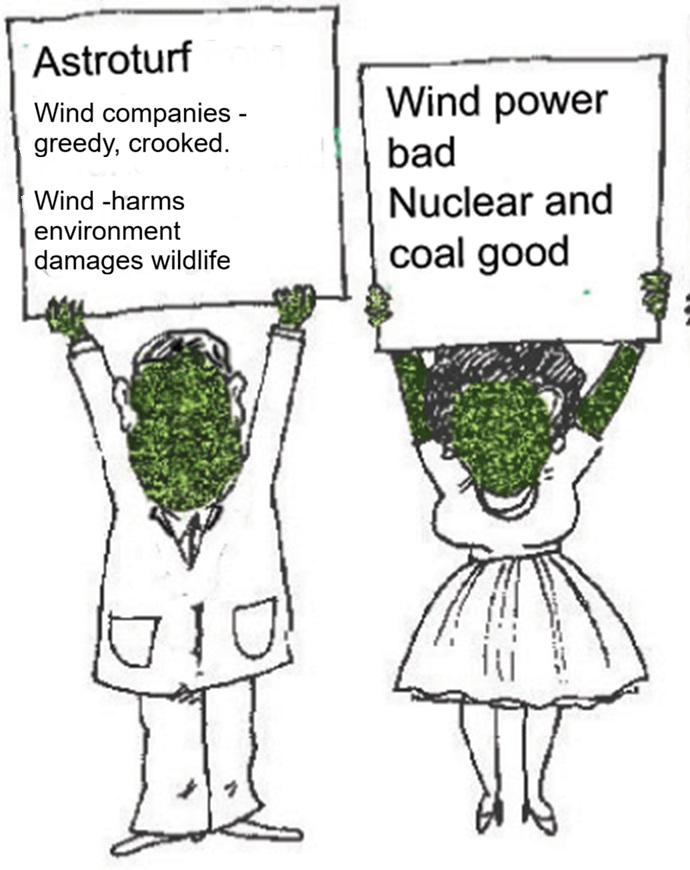
Sweden generates 99% of electricity from clean sources. So why is wind
power under attack? Thousands of anti-wind social media posts have been
analysed, as researchers warn that Europe’s energy security could be
threatened. Sweden has been hit the hardest by a coordinated attack on wind
power, according to a new analysis.
Euro News 6th May 2026, https://www.euronews.com/2026/05/06/sweden-generates-99-of-electricity-from-clean-sources-so-why-is-wind-power-under-attack
A small northern Ontario town refused radioactive waste. It’s gone to Sarnia instead

Decades-old mine tailings in Nipissing First Nation sparked outrage after the province tried to move the material to another community without consultation, but it has quietly moved them again
the Narwhal By Leah Borts-Kuperman (Local Journalism Initiative Reporter), May 6, 2026
Summary
- The Ontario government intended to move radioactive waste from the shore of Lake Nipissing to a former mine site outside Sudbury, Ont.
- A lack of consultation around the new location led to strong local opposition, and delayed the remediation project conducted by Nipissing First Nation.
- The waste has now been moved to a disposal site outside Sarnia, Ont., and Aamjiwnaang First Nation, where emissions from the industrial area known as Chemical Valley have affected local air quality.
For decades, radioactive waste sat near the shore of Lake Nipissing. It looked like an innocuous pile of gravel in what was otherwise a stretch of forest. People began using it to backfill lots, fill spaces under decks and build fire pits. In the 1970s and ’80s, Nipissing First Nation began using it to build roads.
It wasn’t normal gravel, though. It was mine tailings, containing the metal niobium, left there when the Nova Beaucage mine shuttered in 1956 after just seven months of operation.
“The company just walked away and left it with no remediation at all,” Geneviève Couchie, business operations manager at Nipissing First Nation, said. Couchie led a project to clean up the tailings, which first started in 2019. After being interrupted by COVID-19 shutdowns, the remediation resumed in spring 2024 and lasted almost two years.
In the meantime, Couchie told The Narwhal, she fielded concerns about groundwater and lake contamination from residents living close to the site or to a nearby property owned by Ontario’s Ministry of Transportation that also stored the low-level radioactive tailings. Couchie said she struggled to get satisfactory answers from government agencies.
“The workers wore hazmat suits, and I remember saying from the beginning, ‘How can I tell people they have nothing to worry about when these guys are in full on suits?’ They’re literally 20 feet from someone’s window,” Couchie said. The majority of the workers remediating the site were from the nation, and dressed in protective gear so as not to carry radioactive dust home on their clothes.
The plan was to load the waste into trucks to be transported to a tailings management area at Agnew Lake, in Sudbury District. It is the decommissioned site of a former mine, near the Township of Nairn and Hyman, and about 150 kilometres from Nipissing First Nation. The nation first had to excavate nearly 50,000 metric tonnes of the radioactive material — enough to build the Statue of Liberty, twice.
But the project faced another unexpected delay. The province had attempted to relocate the waste without consulting the Nairn community, sparking public outcry. Locals organized public meetings to raise awareness and ultimately stop the transfer.
Eventually, in July 2025 — after nearly a year of advocacy in Nairn, and delay for Nipissing First Nation — the province capitulated, finding another place for the waste to go. This was welcome news for Nipissing First Nation, which is now hoping to transform the scarred land into a lakeside green space for the community to enjoy after years of worry.
“We just wanted to see this material moved off [Nipissing First Nation] lands, and so it was an unexpected disappointment that things were delayed like they were,” Couchie said. “We were pleased that they did end up finding another disposal site.”
“But,” Couchie said, it was “eye opening as well, that there was only one other facility in Ontario that was prepared to accept this.”
That facility is close to another Indigenous community — Aamjiwnaang First Nation, in the Sarnia region, where emissions from refineries and petrochemical plants have earned the area the moniker “Chemical Valley.”
Sarnia facility accepting radioactive waste from Nipissing
The new destination for the radioactive tailings is Clean Harbors, a hazardous waste facility in Corunna, Ont. — 645 kilometres from its original dumping ground. It’s close to both Aamjiwnaang and Sarnia, which have experienced persistent air quality issues related to nearby industry.
Clean Harbors is the only government-licensed hazardous waste management complex in Ontario, and is “uniquely positioned,” its website reads, to offer safe disposal of naturally occurring radioactive material like the niobium tailings.
But the facility’s history is dotted with dust-ups over environmental safety. In 2013, neighbours of the Clean Harbors site won a civil lawsuit over the impact of the waste facility’s emissions on their health and daily lives.
In 2019 the company was fined $100,000 for discharging contaminated smoke after a filter cloth soaked with coolant, oils and metal particles caught fire.
When the province conducted a study on environmental stressors in the Sarnia area in 2023, it found that while the majority of the 870 reports from residents about industrial pollution were related to petrochemical industries and refineries, a significant minority — 219 — were “related to the waste incineration facility in the area (Clean Harbors).”
And in 2025, the Ministry of Environment fined Clean Harbors $100,000 for failing to comply with an equipment requirement for monitoring the excavation of a waste-holding basin.
Clean Harbors did not respond to The Narwhal’s questions about these claims and findings.
In a section of their 2025 annual report on legal, environmental and regulatory compliance risks, Clean Harbors asserted: “We are now, and may in the future be, a defendant in lawsuits brought by parties alleging environmental damage, personal injury and/or property damage, which may result in our payment of significant amounts.”
Aamjiwnaang First Nation Chief Janelle Nahmabin told The Narwhal she had not received any information about the niobium waste that was trucked to Clean Harbors nearly a year ago. Other environmental groups The Narwhal reached out to, including Climate Action Sarnia-Lambton, had not heard of this waste transfer, either.
“The plan now has been executed in a very different way,” said Brennain Lloyd, project coordinator at Northwatch, a northeastern Ontario environmental advocacy group. “It’s moving the waste into the territory of another First Nation that is already heavily impacted by all of the industrial activities.”
‘Under a real nuclear shadow’: radioactive waste in northern Ontario
…………………………………………………………………………………………………………………………………………. https://thenarwhal.ca/northern-ontario-radioactive-waste-sarnia/
Carbon dioxide levels in the atmosphere just hit a ‘depressing’ new record

These data come from the National Oceanic and Atmospheric
Administration’s Mauna Loa Observatory, which may soon be shut down
because of proposed government budget cuts. The amount of carbon dioxide
detected in the atmosphere hit a record high in April. CO2 levels averaged
about 431 parts per million (ppm) over that month, according to data
collected at the National Oceanic and Atmospheric Administration’s Mauna
Loa Observatory in Hawaii.
Scientific American 5th May 2026, https://www.scientificamerican.com/article/carbon-dioxide-levels-in-the-atmosphere-just-hit-a-depressing-record-high/
Am I the only one who doubts the need for more electricity?

Ken Collier, Fri, May 8, 26
Am I the only one who doubts the need for more electricity? There might be an argument for a better grid as a security and safety measure. Do we really need more electricity to manufacture cars that clog the roads and pollute the environment? More plastic? More disposable consumer goods? More entertainment of dubious quality? Manipulate huge amounts of data anf faster?
Most of the debate seems to be about whether solar, wind, hydro, etc. are better able to meet the increasing demand than nuclear or fossil fuels. Some of it is about how best to provide employment, especially for the union organized sector.
I think cutting back, or at least making better judgements about goals for energy use, would be a more productive way to exercise our actions in a way that recognizes how damaging it is to just seek more and better energy while providing our insights free to the energy industry. (even if they don’t heed it).
1 This Month

of the week – THE ONENESS of HUMANITY
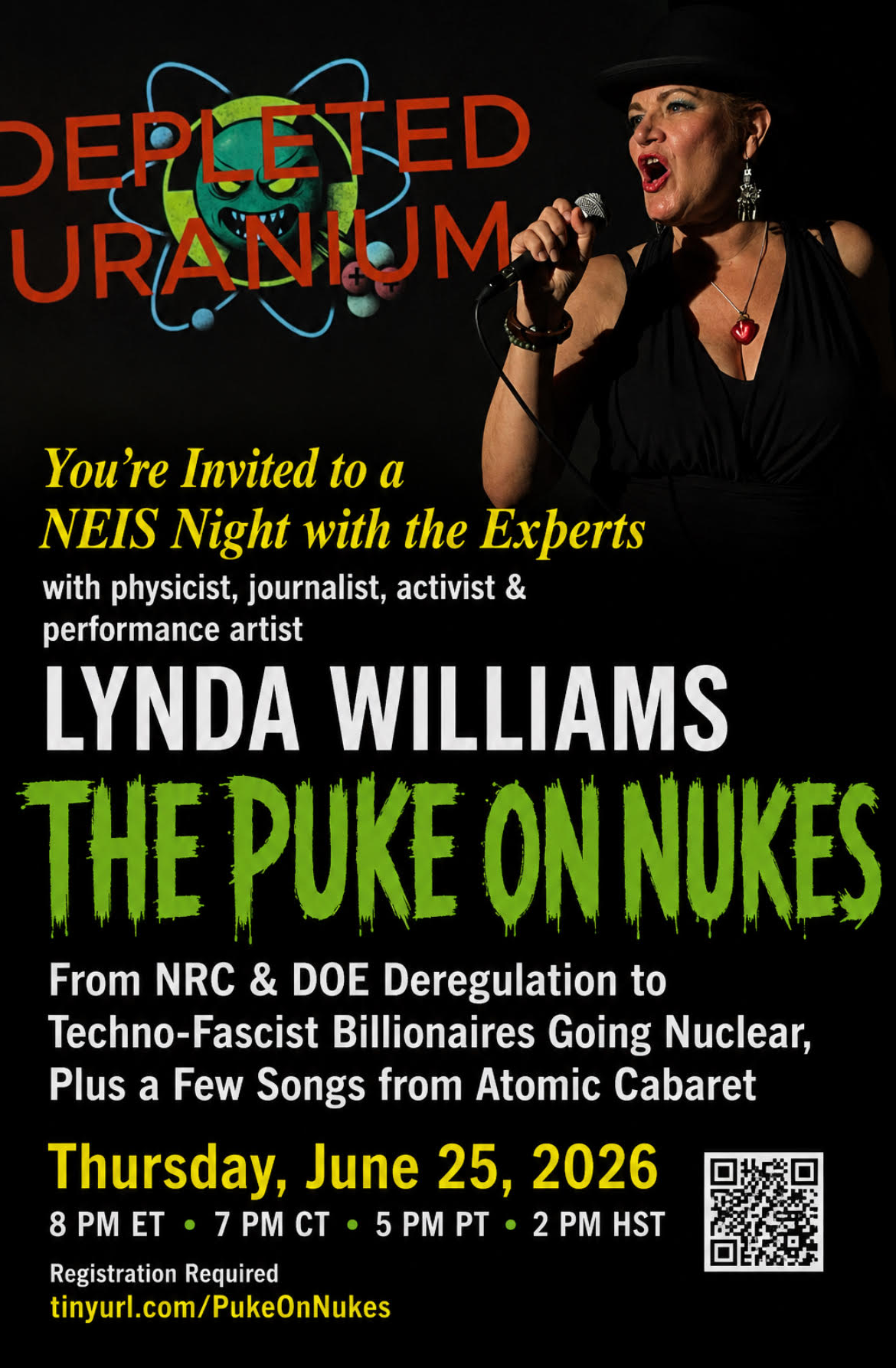
25 June- THE PUKE ON NUKES
Thursday, June 25, 2026
7pm Central Time (8pm ET, 6pm MT, 5pm PT) UTC – 5
From NRC & DOE Deregulation to Techno-Fascist Billionaires Going Nuclear, Plus a Few Songs from Atomic Cabaret REGISTER
26 June – Radiation Trainwreck at the NRC / Join the Protect Better Campaign – https://us02web.zoom.us/meeting/register/4ZlZ5_qLSHGiLSCg8FF6Bg#/registration

1st July – Webinar Waste of Space: The Environmental Harm of Military and Civil Space Activity st July, 7 pm

Report Launch Online: We are seeing an increasing exploitation of space for military and commercial purposes. This must change.

Protect Sazan Island from the Trump family! https://secure.avaaz.org/campaign/en/protect_sazan_island_from_the_trump_family_loc/?bqFCVab&v=174511&cl=22707147157&_checksum=5e9dde668860e8231c33699735e16a1fbf22ab2cb01da50c999fe8732b9775ef&utm_source=email&utm_medium=blast_email&utm_campaign=174511


Cuba Is Not a Failed State – It Is a Besieged State
PETITION: “Global Appeal to Endorse Palestinian Right of Return of Refugees”
To see nuclear-related stories in greater depth and intensity – go to https://nuclearinformation.wordpress.com
-
Archives
- June 2026 (251)
- May 2026 (306)
- April 2026 (356)
- March 2026 (251)
- February 2026 (268)
- January 2026 (308)
- December 2025 (358)
- November 2025 (359)
- October 2025 (376)
- September 2025 (257)
- August 2025 (319)
- July 2025 (230)
-
Categories
- 1
- 1 NUCLEAR ISSUES
- business and costs
- climate change
- culture and arts
- ENERGY
- environment
- health
- history
- indigenous issues
- Legal
- marketing of nuclear
- media
- opposition to nuclear
- PERSONAL STORIES
- politics
- politics international
- Religion and ethics
- safety
- secrets,lies and civil liberties
- spinbuster
- technology
- Uranium
- wastes
- weapons and war
- Women
- 2 WORLD
- ACTION
- AFRICA
- Atrocities
- AUSTRALIA
- Christina's notes
- Christina's themes
- culture and arts
- Events
- Fuk 2022
- Fuk 2023
- Fukushima 2017
- Fukushima 2018
- fukushima 2019
- Fukushima 2020
- Fukushima 2021
- general
- global warming
- Humour (God we need it)
- Nuclear
- RARE EARTHS
- Reference
- resources – print
- Resources -audiovicual
- Weekly Newsletter
- World
- World Nuclear
- YouTube
-
RSS
Entries RSS
Comments RSS
 nuclear-news