26 September – International Day for the Total Elimination of Nuclear Weapons
Yesterday (August 29) at the United Nations in Geneva, a group of civil society organizations including UNFOLD ZERO launched NuclearAbolitionDay.org, a platform for actions and events to commemorate the International Day for the Total Elimination of Nuclear Weapons (‘Nuclear Abolition Day’).
Nuclear Abolition Day has been observed annually on September 26 since 2013, when it was established by the United Nations General Assembly to enhance public awareness and education about the threat posed to humanity and the planet by nuclear weapons, and on the necessity for their total elimination. The day serves to mobilize international efforts towards achieving the common goal of a nuclear-weapon-free world.
The NuclearAbolitionDay.org initiative, which is open for any anyone to join, encourages individuals and organizations around the world to organize or join an action or event on the day. It also calls on governments to announce concrete plans, at the September 26 UN High Level Meeting on nuclear disarmament, on the prevention of any use of nuclear weapons and the achievement of a nuclear-weapons-free world no later than 2045.
The initiative was launched at a special event at the UN commemorating the International Day Against Nuclear Tests. For more information see Stop Nuclear Weapons: Peace is in our Hands: New initiative launched for Nuclear Abolition Day 2025
Joint appeal to governments on NuclearAbolitionDay
NuclearAbolitionDay.org, launched at the United Nations in Geneva yesterday, includes a joint appeal from civil society to governments and legislators to:
- Affirm the inadmissibility of the threat or use of nuclear weapons;
- Implement this by standing down nuclear forces;
- Commit to achieving the global elimination of nuclear weapons no later than the 100th anniversary of the UN;
- Cut nuclear weapons budgets and investments; and
- Redirect these funds to strengthen the UN, advance peacekeeping and conflict resolution, accelerate steps to protect the climate, and meet other human and economic needs.
The appeal which is open for endorsement by individuals and organizations, will be presented to the United Nations, governments and inter-parliamentary bodies on September 26. https://www.nuclearabolitionday.org/post/stop-nuclear-weapons-peace-is-in-our-hands
Nuclear-armed states should come clean after 80 years of nuclear testing harm.
29 August 2025, https://www.icanw.org/nuclear_armed_states_should_come_clean_after_80_years_of_nuclear_testing_harm
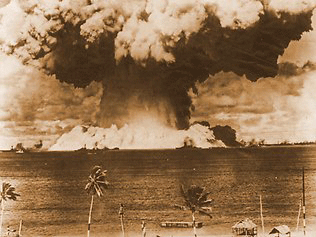
Today, the United Nations International Day Against Nuclear Testing, ICAN is calling on the nuclear-armed states that have detonated over 2,000 nuclear devices between them to take full responsibility for the harm they have caused people and the environment.
The first detonation was in New Mexico a few weeks before the nuclear bombings of Hiroshima and Nagasaki 80 years ago this month. Between 1945 and 2007, more than 2000 nuclear tests were carried out, across the world in Algeria, Australia, French Polynesia, Kazakhstan, Kiribati, the Marshall Islands, and the southwestern United States, as well as Alaska, western China, India, North Korea, Pakistan, Russia and Ukraine.
The majority of these explosions were detonated in what were then colonies and/or regions inhabited by Indigenous peoples or other ethnic communities. The communities involved are engaged in efforts for justice and to prevent any return to nuclear testing.
Nuclear testing left a legacy beyond test site boundaries
Radiation cannot be contained geographically; it respects no country’s border. Fallout patterns are complex and the full humanitarian consequences of the fallout of years of particular atmospheric nuclear testing is not known. Fallout is not comprehensively documented in this resource, although some studies on these impacts may be included. For a detailed study on the fallout of a few French nuclear weapons tests in the Pacific – and French efforts to cover it up – see The Moruroa Files.
Nuclear testing is banned
The first international treaty to completely outlaw nuclear testing, the Comprehensive Test Ban Treaty was adopted in 1996, although the treaty has not yet entered into force. The Treaty on the Prohibition of Nuclear Weapons is the only international treaty in force that prohibits nuclear testing. Other treaties ban types of nuclear testing or nuclear testing in certain regions.
What is being done to help those impacted?
The Treaty on the Prohibition of Nuclear Weapons (TPNW) is the first international treaty to ban all nuclear weapons activities, it also requires states parties to provide assistance for survivors of nuclear weapons use and testing and to begin to remediate contaminated environments in Articles 6 and 7. While the primary responsibility for this implementation rests with affected countries, all countries in a position to do so, should help those countries with this work.
Articles 6 and 7 of the TPNW establish a framework of responsibility that offers solidarity and support to affected states parties to address present-day humanitarian and environmental harm from past use and testing. They also serve to place these issues on the agenda of the wider international community, including donors and international organisations. They provide an opportunity for states parties to make a practical difference with and for affected communities.
In some countries where nuclear weapons have been tested there are programs to provide financial or health assistance to survivors or to clean up the environment but none sufficiently address all needs of survivors. Dozens of identified sites around the world remain contaminated by nuclear weapons use, production and testing and there is no one standard for their remediation. Notably there is no widely accepted standard to determine how clean is clean, or how to monitor radiation levels over time. This article in Global Policy reviews existing approaches and looks at what else can be done.
ICAN Calls for states to come clean
ICAN’s Executive Director, Melissa Parke, was in New Mexico last month for the commemorations of the world’s first explosion of a nuclear weapon and to meet communities whose lives were changed forever by the radioactive fallout from the detonation that poisoned their land, air and water. The ‘Trinity Test’ detonated the plutonium bomb design that was used a few weeks later to kill 74,000 people in Nagasaki.
Ms Parke said: “Trinity was followed by more than 2000 nuclear explosions all over the world and the countries responsible – the nuclear-armed states – have never fully acknowledged the catastrophic harm they have caused to people and environments. These countries must stop the cover-up, come clean and provide the support and recognition these communities deserve. The nuclear armed states also need to heed the calls from affected communities for the urgent abolition of nuclear weapons, so that these weapons of total destruction are eliminated before they eliminate us.”
“We gave for France… now that’s enough”: La Hague residents reject Orano’s nuclear pools project

by Marie du Mesnil-Adelée, 08/31/2025, https://france3-regions.franceinfo.fr/normandie/manche/cherbourg-cotentin/on-a-donne-pour-la-france-maintenant-ca-suffit-des-habitants-de-la-hague-rejettent-le-projet-des-piscines-nucleaires-d-orano-3205250.html
“It’s never too late to say: we don’t want it.” Gathered at a public meeting, residents of La Hague spoke out against the “Downstream of the Future” project at the Orano site. A project that includes the installation of three new nuclear pools for storing spent fuel.
An extraordinary nuclear project in La Hague
An extraordinary nuclear project at La Hague, presented by Orano as “the largest industrial project in the world”, costing several tens of billions of euros, “Downstream of the Future” (that’s its name), plans the construction of three new nuclear pools for storing spent fuel and also new workshops and factories on the La Hague site by 2040-2050.
How is this project received by residents?
How is this project being received by residents? In his documentary “Encore de l’énergie” broadcast on Thursday, September 4 on France 3 Normandie and france.tv, Laurent Pannier filmed a public meeting.
Yannick Rousselet, a nuclear expert for Greenpeace, spoke: ” There was no consultation . We would like to debate the appropriateness, the justification of something like this. Today is good. We have given for France, for the nuclear industry and that’s enough. Let’s stop, let’s move on. We want our future to be shaped differently. I think it’s never too late to say we don’t want it.”
A resident adds: “I find it a bit easy for Orano to be able to do whatever they want in terms of construction, however they want, while all the residents of La Hague, as soon as they want to have a window transformed, put in a veranda, do anything, they can’t do anything.”
And a third:
“Today we only have 4 or 5 small hectares of moorland left. It’s more than a relic now, it’s become a symbol. People are saying to us: well, since there’s more than that left, we’re going to remove it and I think that’s a real shame.”
The words are powerful. But the room is far from full… Here, as elsewhere, nuclear power divides. And
those who oppose it are a minority.
Anti-nuclear activists of yesterday and today
In April 2006, the city of Cherbourg held its largest demonstration since the Liberation. Twenty years after Chernobyl, 30,000 activists gathered to protest the proposed construction of a new reactor in Flamanville, the EPR.
Yet, fifteen years later, despite construction delays, despite the additional costs, despite the Fukushima disaster, distrust of nuclear energy has virtually disappeared. Environmental movements are divided between pro- and anti-nuclear supporters. And the announcement of the revival of nuclear power in France, particularly in Normandy, has been generally welcomed by the population.
Laurent Pannier’s new documentary explores this reversal. What happened to the former activists? Is there a new generation? In the face of climate change, is nuclear power a necessary evil?
“Encore de l’énergie” by Laurent Pannier, a documentary to watch this Thursday, September 4 at 10:55 p.m. on France 3 Normandie and on france.tv , for one month.
Government ‘replanning’ £53.3bn geological disposal facility project
“Successful delivery of the project appears to be unachievable. “There are major issues with project definition, schedule, budget, quality and/or benefits delivery, which at this stage do not appear to be manageable or resolvable.”
02 Sep, 2025 By Tom Pashby
Government ‘replanning’ £53.3bn geological disposal facility project.
Construction of a UK geological disposal facility (GDF) for long-term
nuclear waste disposal is being “replanned” after recent revelations
about its cost and deliverability, according to the government.
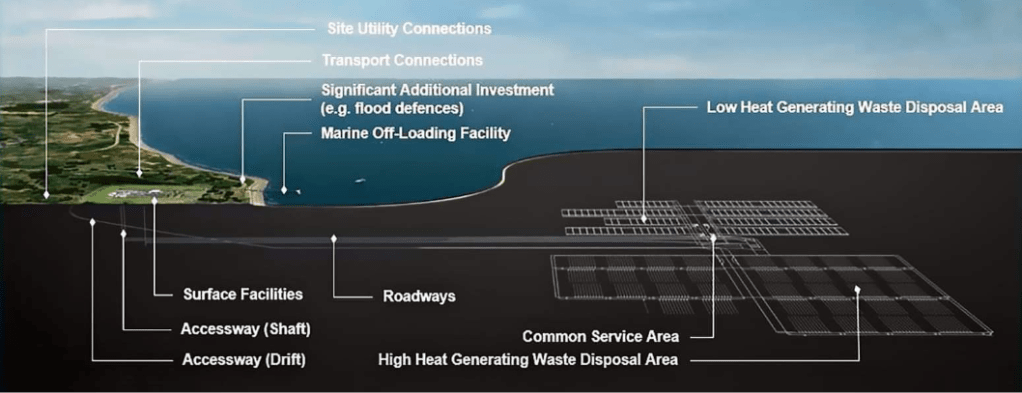
A GDF represents a monumental undertaking, consisting of an engineered vault placed between 200m and 1km underground, covering an area of approximately 1km2 on the surface. This facility is designed to safely contain nuclear waste while allowing it to decay over thousands of years, thereby reducing its radioactivity and associated hazards.
The National Infrastructure and
Service Transformation Authority (Nista), a Treasury unit, assessed the GDF
in its Nista Annual Report 2024-2025 and gave it a Red rating in Delivery
Confidence Assessment. This means: “Successful delivery of the project
appears to be unachievable. “There are major issues with project
definition, schedule, budget, quality and/or benefits delivery, which at
this stage do not appear to be manageable or resolvable. The project may
need re-scoping and/or its overall viability reassessed.” In addition,
the Nista annual report lists the “whole life cost” of the GDF as
£20bn as a mid-range assessment and £53.3bn as a high-end assessment.
Government says GDF project facing ‘replanning’ by NDA, but remains
necessary
New Civil Engineer 2nd Sept 2025, https://www.newcivilengineer.com/latest/government-replanning-53-3bn-geological-disposal-facility-project-02-09-2025/
The final furlong: EDF announces further lifetime extension for aging AGR reactors

Britain’s aging Advanced Gas Cooled reactors may, like exhausted
racehorses, be on their last legs, but operator EDF Energy is clearly
intent on keeping them running for as long as possible.
The company
announced yesterday a twelve month extension in operations at their Heysham
1 and Hartlepool AGR plants until March 2028, citing the retention of jobs
and a desire to contribute to the UK achieving net zero and energy security
– but the NFLAs suspect a more pressing motivation.
In a comment to
industry media, NFLA Secretary Richard Outram said: ‘The EDF announcement
is unsurprising. Although company bosses may crow a lot about the
preservation of local jobs, the NFLAs suspect this is about the
preservation of EDF’s bottom line. ‘Given the parlous state of the
French parent company’s finances, the intermittent output of the domestic
fleet, and the vast overspend on Hinkley Point C, EDF have a clear
incentive to keep open for as long as possible any nuclear plant in their
portfolio which operates and generates profits.’
Dr Ian Fairlie, an
independent consultant on radioactivity in the environment and a former
advisor to the UK Government and European Parliament, is also sceptical as
to EDF’s motives: “The real reason why French parent company
Électricité de France wants to prolong the lives of their obsolete,
past-it, reactors is financial.
NFLA 3rd Sept 2025, https://www.nuclearpolicy.info/news/the-final-furlong-edf-announces-further-lifetime-extension-for-aging-agr-reactors/
NATO has outlived its purpose – Jeffrey Sachs

The military bloc should have been dissolved after the collapse of the Soviet Union, the US economist has argued
2 Sep, 2025 , https://www.rt.com/russia/623964-sachs-nato-outlived-purpose/
NATO has outlived its purpose and should have been dissolved decades ago, prominent American economist and Columbia University professor Jeffrey Sachs believes.
Speaking to RIA Novosti on Sunday, Sachs argued that NATO was initially formed for the sole purpose of countering the USSR and should have been disbanded in 1990 when Soviet President Mikhail Gorbachev dissolved the Warsaw Pact – the Soviet-led military alliance that had grouped Eastern Bloc states since 1955.
“NATO was a treaty to defend against the Soviet Union, which doesn’t exist. So in this sense NATO definitely outlived its role. It became instead a mechanism of US power expansion, which is not what NATO should be,” Sachs told the news agency.
He further argued that NATO’s eastward expansion since 1990 has been “wholly unjustified and contrary to Western promises,” referring to assurances given by US officials after the dissolution of the USSR that the bloc would not move closer to Russia’s borders.
Sachs stressed that the organization’s enlargement has had no legitimate security rationale and instead deepened divisions on the European continent.
Russia has repeatedly condemned NATO’s expansion and has described the bloc as a tool for confronting Moscow which destabilizes Europe by fueling tensions. Moscow has pointed to NATO’s attempts to bring Kiev into the bloc as one of the root causes of the Ukraine conflict.
Sachs also noted that Washington still believes it runs the world, a view he described as outdated and dangerous. He said that this delusion is a “source of danger” as the world has become multipolar and new “centers of power” have emerged.
His comments came ahead of the upcoming Eastern Economic Forum, which is set to take place in Vladivostok from September 3 to 6. The economist is scheduled to participate in a session dedicated to the UN’s development agenda beyond 2030, alongside discussions on international cooperation in a changing world order.
Sizewell C Funded Decommissioning Programme: Contingent Liability (Public on the hook)
I am pleased to have laid a departmental minute describing the contingent
liabilities arising from the signing of the funded decommissioning
programme and Government support package for Sizewell C. The funded
decommissioning programme at Sizewell C will be funded via the regulated
asset base. The regulated asset base contains a series of protections that
aim to minimise the risk that public funds will be required to meet
decommissioning costs.
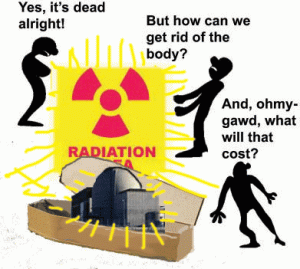
However, in certain remote circumstances whereby all
the protections afforded by Sizewell C’s economic licence fall away or a
shortfall in the fund materialises, public funds could be used to
contribute towards decommissioning costs and this liability would
crystalise. Based on best estimates by the Government Actuary Department,
the maximum potential exposure from the liability is £12 billion—in 2022
terms. This has been estimated on a worse-case scenario whereby the
Government were required to meet the full costs of decommissioning the
Sizewell C power plant.
Hansard 1st Sept 2025, https://hansard.parliament.uk/commons/2025-09-01/debates/25090137000015/SizewellCFundedDecommissioningProgrammeContingentLiability
A Folly Too Far?

In 2020 the cost was set at £20bn. but the ultimate cost by 2040, when it might begin operating, could well be north of £40bn. By 2040 it will be too late to make any impression on Net Zero and, if it ever gets finished, Sizewell C will be an expensive and inflexible white elephant cranking out power that is not needed but which will impede the development of the array of renewable systems.
2 September 2025, https://www.banng.info/news/regional-life/folly-too-far/
Andrew Blowers tackles this question in the BANNG column for July 2025
On a fine summer’s day, in early June, Varrie and I travelled to Suffolk to show BANNG’s support for the Outrage Rally against Sizewell C. There were around 300 people assembled on the dunes to protest against the outrageous project and to commemorate the life of one of the great environmental and anti-nuclear campaigners, Pete Wilkinson, who had died in January. There were speeches from his two daughters, Amy and Emily and from Jonathon Porritt, the veteran campaigner who drew attention to the scene before us – the invisible power of the wind and sea on the one hand and the unseen threat of radioactivity posed by the hulk of Sizewell A and the operating Sizewell B on the other.
The protesters marched along the sandy beach to the site of Sizewell C where we tied yellow ribbons to the perimeter security fence in tribute to the outrage and courage that Pete had displayed through his life, successfully campaigning against mining in the Antarctic, dumping of radioactive waste in the Atlantic and stopping up the Sellafield outflow pipe into the Irish Sea. Beyond the fence could be seen the removal of ancient woodland, construction of roads and destruction of countryside and wildlife bordering the precious RSPB Minsmere Reserve in preparation for construction. And the subsequent construction of a huge and dangerous complex of reactors, turbines and long-term, highly radioactive waste stores on a precarious coast was terrifying to imagine.
There was a sense of an unequal struggle, a local community fighting together against an uncompromising government and powerful and well-resourced industry. While the mood was defiant there was an underlying sense of impending defeat.
And, sure enough, three days later came the long-anticipated announcement that Sizewell C was to go ahead, backed by £14.2bn. subsidy for the first four years of construction and up-front payments loaded onto consumer bills. A Final Investment Decision has not been taken, awaiting the commitment of private investors to match the public investment. If private investors do not come forward then either the project must be ditched (too embarrassing for the government) or we (taxpayers and consumers) are in hock for the total cost.
The Sizewell project is the type of big investment that encourages government ministers to don hard hats and suitably logoed high-vis jackets to proclaim a new golden age of clean energy. They haughtily dismiss the ‘blockers’ – we who strive to defend precious communities and landscapes and prevent the financial incontinence that inevitably flows from such complex and uncertain projects.
So, as the Sizewell protesters say, Sizewell C could become Suffolk’s HS2: half-built and unfinished because of finance.
EDF’s Heysham 1 and Hartlepool nuclear plants to operate for further 12 months
New Civil Engineer, 02 Sep, 2025 By Tom Pashby
The operational lives of the Heysham 1 and Hartlepool nuclear power plants have been extended by 12 months by their operator EDF………………
Hartlepool, Heysham 1, Heysham 2 and Torness all underwent reviews by EDF in December 2024 to assess how long they can continue to generate electricity. Heysham 1 and Hartlepool were scheduled to stop producing power in March 2027.
At the time, an EDF spokesperson explained to NCE that the best-case scenario for the Heysham 1 and Hartlepool power stations was that they could justify a one-year extension. However, that was caveated with a need to await the outcomes of “important inspection and safety case milestones”, which were due to be completed in 2025.
Those milestones have now passed and the results were positive for the power stations. When EDF’s executive and licensee boards met yesterday, 1 September, they gave approval to extend the lives of the nuclear stations, so Heysham 1 and Hartlepool will now likely operate through to at least March 2028.
A statement from EDF on 2 September said: “Heysham 2 and Torness, which are both scheduled to generate until March 2030, were not in scope for this review after a two-year extension was granted last year.”
EDF still hopes to see all four AGRs continue producing electricity for as long as possible, so it can be expected to conduct further reviews down the line, but these reviews do not have set dates for completion, the spokesperson told NCE……………………………………………………………………………………………………………………………
AGRs now well past their sell-by date’ – anti-nuclear campaigner
Nuclear Free Local Authorities secretary Richard Outram told NCE that the extension of the plants’ operating lives raises concerns about the possibility of graphite cracking.
“The EDF announcement is unsurprising. Although company bosses may crow a lot about the preservation of local jobs, the NFLAs suspect this is actually about the preservation of EDF’s bottom line,” he said.
“Given the parlous state of the French parent company’s finances, the intermittent output of the domestic fleet, and the vast overspend on Hinkley Point C, EDF has a clear incentive to keep open for as long as possible any nuclear plant in the portfolio which actually operates and generates profits.
“The NFLAs have previously expressed our concerns with the Office for Nuclear Regulation that these ageing AGRs are now well past their sell-by date, with graphite cracking being a real worry, as seen recently at the sister AGR plant at Torness.
“We shall continue to monitor the situation and ask challenging questions of regulators and the industry because public safety and environmental harm must never be compromised in favour of company profit.”………………………………………………. https://www.newcivilengineer.com/latest/edfs-heysham-1-and-hartlepool-nuclear-plants-to-operate-for-further-12-months-02-09-2025/
U.S. Government Is Taking Historic Steps To Restart Nuclear Plants
The Nuclear Regulatory Commission is considering allowing a Michigan
nuclear plant to restart after approving in July its first such plant
resumption with Palisades Nuclear Plant to increase U.S. energy output for
data centers. The NRC held a series of public meetings from July 31 through
August 6 to gather feedback about enabling a restart of a former Three Mile
Island Unit 1 that permanently stopped operating after 40 years in
September 2019.
Forbes 28th Aug 2025, https://www.forbes.com/sites/noelfletcher/2025/08/28/us-government-is-taking-historic-steps-to-restart-nuclear-plants/
This week’s non-corporate nuclear news
Some bits of good news – Small Chinese County Reverses Desertification with Arduous Tree-Planting Method Across 240,000 Acres. WHO Declares Kenya Free of This Deadly Tropical Parasite After Decades of Suffering.
Washington State Protects the Old-Growth Forests of Tomorrow, Creates 77,000 Acres of ‘Legacy Forests’.
TOP STORIES.
The Detached Cruelty of Air Power– From Guernica to Gaza Mass Killers Have Been Above It All.
How France’s nuclear dream became a financial nightmare.
Is the UK’s giant new nuclear power station “unbuildable”? -ALSO AT https://nuclear-news.net/2025/08/30/1-a-is-the-uks-giant-new-nuclear-power-station-unbuildable/
Unaudited Power: The Military Budget That Nobody Controls.
Dauntingly long, and with an inflammatory title, this article is nevertheless a compelling read – Gaza to Donbass: How Israel and Ukraine Built a Fascist, Transnational War Machine.
AUSTRALIA. Think Tanker Demands for AUKUS: What Australia Should do with US Submarines.
Point of Order: Antisemitism Summit raises ethics eyebrows.
NUCLEAR ITEMS
ART and CULTURE. Atomic Bill and the Payment Due.
PATRICK LAWRENCE: Trump & the Russophobes.
ATROCITIES. Entire UN Security Council Except US Says Gaza Famine ‘Man-Made’ as 10 More People Starve to Death.
Eighteen Palestinians Starve to Death in Gaza Over Three Days Due to Israeli Siege – https://www.youtube.com/watch?v=7p5UVrz1KLg
Report: Smotrich Told IDF Chief That Anyone Who Doesn’t Evacuate Gaza City Can ‘Die of Hunger or Surrender’.
Why has Donald Trump not spoken out about the famine in Gaza? | Inside Story.
| ECONOMICS. The World Bank can now fund nuclear energy projects: Here’s what’s next.The lunacy of Britain’s Sizewell C nuclear project – ALSO AT https://nuclear-news.net/2025/08/31/2-a-the-lunacy-of-britains-sizewell-c-nuclear-project/On fusion liability, UK Energy Minister completely sidelines the issue. |
| ENVIRONMENT. ‘It doesn’t make sense’: Marine biologist on Kenya’s proposed nuclear power plant. |
| EVENTS. 2nd September CND Webinar – From Hiroshima to Today: Jeremy Corbyn & Caroline Lucas report back – Register here. 9th September (7 – 8 pm AEST) – ZOOM- What Remains: Nuclear Legacies of the Montebello Islands. Please join us by registering here. 15 September – Webinar -AUKUS – End it Now! – https://events.humanitix.com/aukus-end-it-now |
MEDIA. Israel’s Killing of Journalists Follows a Pattern of Silencing Palestinian Media That Stretches Back to 1967. Israel Bombs Gaza Hospital, Kills 5 Journalists from AP, Al Jazeera, Reuters, NBC – https://www.youtube.com/watch?v=6k9PdldBcwY
Chicago Tribune letters again avoid reality of Ukraine’s impending battlefield defeat.
| OPPOSITION to NUCLEAR . Ecological Justice group explains impacts of the nuclear project on Alberta. |
| PERSONAL STORIES. The evolution of Volodymyr Zelenskyy and the Israel-Ukraine connection. |
| PLUTONIUM. Government allocates £154m for plutonium disposal. |
| POLITICS. Peace in Ukraine spells disaster for mainstream political parties in Europe. Why won’t 519 other congresspersons join Rep. Marjorie Taylor Green and 13 other congresspersons in condemning US enabled Israeli genocide in Gaza? East Lothian Council calls for a study into new nuclear at Torness. |
| POLITICS INTERNATIONAL and DIPLOMACY. Russia outsmarts France with nuclear power move in Niger. Iran accuses Europe of surrendering nuclear deal to Trump’s veto. UN inspectors back in Iran as IAEA chief gets protection over Tehran threat. Iran parliament presses government to apply law limiting IAEA cooperation. |
SAFETY. OUR NUCLEAR WORLD: PICK YOUR TARGET.
Fears are rising about the safety of a nuclear power plant in Russia after a Ukrainian attack overnight. What will happen if the Ukrainian Armed Forces attempt to strike the Kursk Nuclear Power Plant?- ALSO AT https://nuclear-news.net/2025/08/31/2-b1-what-will-happen-if-the-ukrainian-armed-forces-attempt-to-strike-the-kursk-nuclear-power-plant/
Donald Trump’s assault on U.S. nuclear watchdog raises safety concerns- ALSO AT https://nuclear-news.net/2025/08/30/1-b1-donald-trumps-assault-on-u-s-nuclear-watchdog-raises-safety-concerns/
Japan exploring whether AI could help inspect its nuclear power plants.
| SECRETS and LIES. UK aware of Israel’s ‘terror’ for over 20 years.Russian engineer-physicist Ozharovsky spoke about deportation from Mongolian- ALSO AT https://nuclear-news.net/2025/08/31/2-b1-russian-engineer-physicist-ozharovsky-spoke-about-deportation-from-mongolia/ |
| SPACE. EXPLORATION, WEAPONS. Is Nasa’s nuclear moon plan sheer lunacy? |
| SPINBUSTER. Alberta Revives Its Nuclear Energy Dreams. |
| TECHNOLOGY. Indonesia Bets On Thorcon’s Molten Salt Reactor, But History Suggests Trouble Ahead. The nuclear fusion delusion -Government proposals re Nuclear Fusion Siting Policy. How AI and surveillance capitalism are undermining democracy. |
| WASTES. ‘Nuclear Priests’ could warn future people about wastes under the Irish Sea – ALSO AT https://nuclear-news.net/2025/08/27/2-a-nuclear-priests-could-warn-future-people-about-wastes-under-the-irish-sea/ Wastewater release from Fukushima nuclear plant enters third year. Podcast | The 30-year journey to an underground facility for long-term nuclear waste storage. Assessment of Asse storage chamber conditions begins. Radioactive waste burning by nuclear transmutation: CoRWM position paper. |
| WAR and CONFLICT. Russia reports blaze at one of its biggest nuclear power plants. Ukraine Drone Strikes Hit Russia’s Nuclear Plant & Fuel Terminal | War Escalates – https://www.youtube.com/watch?v=bVmxyRaffmU |
| WEAPONS and WEAPONS SALES. An Elbit-Bain Consortium is Nightmare Fuel: the UK Government Must Not Award £2bn Contract to These Corporate Horrors. Biggest nuclear tests in history: Tsar Bomba, Castle Bravo and their global impact. |
Iran accuses Europe of surrendering nuclear deal to Trump’s veto
Foreign ministry official says US will be dictating what happens once UN-wide sanctions are reimposed.
Patrick Wintour in Tehran, 2 Sept 25, https://www.theguardian.com/world/2025/sep/01/iran-accuses-europe-surrendering-nuclear-deal-trump-veto
Europe is on the verge of abandoning its role as a mediator between the US and Iran and instead handing the Iran nuclear file over to Donald Trump’s veto, Iran’s foreign ministry spokesperson has said in an interview with the Guardian in Tehran.
Esmail Baghaei said that as soon as UN-wide sanctions were reimposed at Europe’s demand in less than 30 days’ time, the US would regain its security council veto over what happens next, including the continuance of sanctions.
“The Europeans are doing what Trump dictated to them,” he said. “The Europeans’ role is going to be diminished. If you go back to the European foreign policy leaders in the history of the nuclear deal, Javier Solana, Cathy Ashton, Federica Mogherini, Josep Borrell, they all tried to liaise between Iran and the US.
“They tried to prove they were credible negotiating partners. But now the Europeans have decided to be the proxy of the US and Israel. It is absolutely irresponsible of them to hand over that role to the US.”
He highlighted the claim by Friedrich Merz, the German chancellor, that Israel was doing “the dirty work … for all of us” by attacking Iran’s nuclear sites in June. “In a way, all of the European countries condoned what Israel did, and very likely provided information to the Israeli regime,” Baghaei said.
His remarks may be designed to put pressure on European capitals to distance themselves from the US and tone down the conditions they have set before they will agree to defer UN sanctions.
Baghaei also said the Iranian government was not constitutionally able to block Iran’s withdrawal from the nuclear non-proliferation treaty (NPT) if the Iranian parliament went ahead and passed a law withdrawing from it in response to the European reimposition of UN sanctions. Withdrawal from the treaty was the prerogative of parliament, he said.
The number of MPs backing an NPT withdrawal bill is due to be revealed on Tuesday but MPs said the measure was likely to be rushed through parliament with overwhelming support. Withdrawal from the NPT would mean the UN loses all rights to oversee Iran’s nuclear programme and would inevitably raise US concerns about whether Iran will build a nuclear bomb covertly or overtly.
The powerful factions in the parliament seem convinced that Iran has the firepower to inflict heavy damage on Israel in the event of a second western attack.
We are prepared because this is a matter of our dignity and sovereignty,” Baghaei said. “I think you in the UK had your blitz spirit when attacked by Nazi Germany. We have the same spirit because we knew this war imposed on us in the middle of negotiations was so unjust.”
The three European signatories to the original nuclear deal – France Germany and the UK – notified the UN last Thursday that they intended to use their right to reimpose UN-wide sanctions at the end of September unless Iran met three conditions: a return of UN weapons inspectors to the bombed Iranian nuclear sites, the handover of details of the whereabouts of its 400kg stockpile of highly enriched uranium, and agreement to open talks with America on the future of its nuclear programme.
Europe says there is still room for diplomacy in the coming four weeks to reach an agreement on these conditions. Baghaei described the European conditions as “a sign they are not serious and they do not have good faith”.
He said: “There is an extreme trust deficit between the UN weapons inspectors from IAEA and Iran. There is a real concern that the information gathered at the sites by the IAEA would end up being passed on to Israel.
“It has been a real concern especially after the highly politicised approach of the IAEA. We cannot ignore the fact that previous IAEA reports were abused by America and Israel to craft the resolution to the IAEA board which claimed that Iran was not in compliance with its obligations.” He said that resolution was used as a pretext for the Israeli attack on Iran in June.
He conceded that Iran’s room for diplomatic manoeuvre at the UN in the next month was limited because of the public mood in Iran.
“The fact is our public is outraged because of the unlawful attacks on our facilities and as a government we have to be accountable to our people and to our parliament,” he said.
“The western media goes on about our cooperation with the IAEA and stockpiles, but the western public has to remember the outrageous [acts] committed by Israel and the US. They torpedoed the diplomatic process, they attacked the rule of international law because our facilities have been under inspection 24 hours a day for throughout the past three decades.”
Iranian officials insist that the aim remains to reach a compromise in the next month that will allow the weapons inspectors to return. Iranian diplomats have given assurances to the IAEA that the stockpiles have not been moved. They also insist they are willing to speak to the Americans, but repeated messages sent to Washington have not been met with any response so far.
Baghaei said Iran was willing to reduce the purity level to which it enriched uranium back to 3.67%, the level set in the old nuclear deal, so long as an overall agreement was reached that preserves Iran’s right to enrich uranium domestically.
He questioned why the US was so intent on removing Iran’s right to enrich if, as Trump claimed, Iran’s ability to undertake such enrichment had been already destroyed by the joint US-Israeli attacks.
15 September – Webinar -AUKUS – End it Now!

15 September – Webinar -End it Now – https://events.humanitix.com/aukus-end-it-now
7.30-8.30 pm AEST
Guest speaker: Jim Green (FOE)on AUKUS and nuclear waste. Reports on anti-AUKUS activities around Australia. Discussion on building the movement to Cancel AUKUS and the Force Posture Agreement (FPA)
| Here’s two recent unwanted AUKUS actions by the Australian Government:* Liberal Coalition and Labor voted together to pass a Bill through the Senate to fund housing for 1,000 United States military personnel working on their AUKUS project- what about the thousands of Australians that are homeless? * The Labor Government signed a new AUKUS agreement with the UK government to last 50 years with Australia paying the UK upwards of $47 billion to their shipyards. |
9th of September (7 – 8 pm AEST) – ZOOM- What Remains: Nuclear Legacies of the Montebello Islands.

Please join us by registering here.
In the 1950s, the Montebello Islands off the Pilbara coast in Western Australia were the site of three British nuclear tests. The first, in 1952, detonated inside a warship anchored off Trimouille Island, followed in 1956 by two larger blasts as part of Operation Mosaic.
In July 2025, a group of artists, writers, researchers, and nuclear survivors travelled to the Montebello Islands to explore the lasting impacts of British nuclear testing there. Next Tuesday the 9th of September (7 – 8 pm AEST) they will come together in a conversational panel to reflect on what they witnessed and experienced, and discuss what they will carry forward from their time on the islands.
Featuring:
- Jesse Boylan – Artist and ICAN Media and Comms Adviser (Convener).
- Maxine Goodwin – ICAN Ambassador and nuclear veteran descendant.
- Dr Liz Tynan – Writer and Academic. Tynan is author of The Secret of Emu Field: Britain’s Forgotten Atomic Tests in Australia & Atomic Thunder: The Maralinga Story. Her new book on the history of the Montebello Islands nuclear tests is due out in 2026.
- Merilyn Fairskye – Visual artist living in Sydney. Her work explores the relationships between technology, atomic landscapes and community and have taken her on location to the Polygon in Kazakhstan, Sellafield, Chernobyl, and other key nuclear sites.
- Paul Grace, Writer and nuclear veteran descendant. Author of Operation Hurricane: The story of Britain’s first atomic test and the legacy that remains.
- Gary Blinco – Nuclear veteran descendant.
- Tobias Holden – Student.
This discussion is free and open to all.
The lunacy of Britain’s Sizewell C nuclear project

Tom Burke:
All of these problems have been pointed out to the Government
very often, by many energy experts for several years. Even so this only
tells you part of the lunacy of this project. Britain’s electricity
consumers will start paying for Sizewell C now and will go on doing so
without receiving any electricity from it for the next 12-15 years.
They are in effect compulsory investors. However, unlike the private sector
investors in the project they will not receive a handsome double digit
returned on their forced capital investment. Instead they will then be
forced, as the Bloomberg diagram shows, to pay about three times as much
for Sizewell C’s electricity than would otherwise be available to them from
other sources as cheaper electricity will be forced off the grid in order
to preferentially take that from Sizewell C. It is truly said that those
whom the Gods destroy they first make mad.
FT 27th Aug 2025,
https://www.ft.com/content/ee89bce2-a3e9-48ed-82eb-85916eb24777#comments-anchor
1 This Month





PLEASE OPPOSE HR 8255 AND S.3639 – bills would accelerate satellite deployment, with no environmental review or safeguards – https://ncstd5li.quorum.us/campaign/169331/
To see nuclear-related stories in greater depth and intensity – go to https://nuclearinformation.wordpress.com
-
Archives
- October 2026 (81)
- September 2026 (339)
- August 2026 (330)
- July 2026 (355)
- June 2026 (287)
- May 2026 (306)
- April 2026 (356)
- March 2026 (251)
- February 2026 (267)
- January 2026 (308)
- December 2025 (358)
- November 2025 (359)
-
Categories
- 1
- 1 NUCLEAR ISSUES
- business and costs
- climate change
- culture and arts
- ENERGY
- environment
- health
- history
- indigenous issues
- Legal
- marketing of nuclear
- media
- opposition to nuclear
- PERSONAL STORIES
- politics
- politics international
- Religion and ethics
- safety
- secrets,lies and civil liberties
- spinbuster
- technology
- Uranium
- wastes
- weapons and war
- Women
- 2 WORLD
- ACTION
- AFRICA
- Atrocities
- AUSTRALIA
- Christina's notes
- Christina's themes
- culture and arts
- Events
- Fuk 2022
- Fuk 2023
- Fukushima 2017
- Fukushima 2018
- fukushima 2019
- Fukushima 2020
- Fukushima 2021
- general
- global warming
- Humour (God we need it)
- Nuclear
- RARE EARTHS
- Reference
- resources – print
- Resources -audiovicual
- Weekly Newsletter
- World
- World Nuclear
- YouTube
-
RSS
Entries RSS
Comments RSS

