This week’s NOT the corporate nuclear-related news

Some bits of good news – Planting Billions of Trees Turned Barren Desert into a Carbon Sink That Lowers CO2.
Town Enthusiastically Switches to Restorative Justice and Reoffending Almost Vanishes.
Dramatic recovery of various fish species after California’s ban on trawling
TOP STORIES
Israel used weapons in Gaza that made thousands of Palestinians evaporate.
What if Nuclear Deterrence was an Obsolete Concept?
Why can’t western leaders accept that they have failed in Ukraine?
Murica: US throws pennies at massive UN debt.
Climate. The Apocalyptic President. Donald Trump has revoked the official doctrine that carbon dioxide is a danger to human health. Brace for Trump’s brave new world of 1.7°C global warming.
The challenges in projecting future global sea levels. Excruciating tropical disease can now be transmitted in most of Europe, study finds.
AUSTRALIA.
- British submarine arrives for ‘extraordinary’ AUKUS visit.
- Submarine boasts, yet nuclear waste dumps submersed in secrecy.
- Radiation Protection -worker and public health protection standards at risk.
- China’s Retaliation: when will it happen
- Australia-based Bannerman Energy join China’s CNNC for debt-free construction of its Namibian uranium project.
- Australia’s culture of complicity.
NUCLEAR RELATED ITEMS
| ECONOMICS. A $33 billion nuclear bailout is coming to your electric bill. Cost of Hinkley Point C nuclear plant jumps again to nearly £50bn. – EDF has further pushed back the start-up of the UK’s flagship HinkleyPoint C nuclear plant. British taxpayers bankroll French nuclear giant while Hinkley Point C quietly receives 500-tonne reactor heart. Investigation: France’s future nuclear reactors could cost three times more than expected. Scotiabank subsidiary fully divests from Israeli arms firm. Nuclear power: EDF assesses the cost of reactor modulation for the first time (but its calculation is incomplete). |
| ENERGY. Why can’t people grasp that there’s much more to renewables than wind? |
| ENVIRONMENT. Major leak at Highland nuclear site triggers hunt for mystery bunkers. New Mexico Environment Department Holds LANL Accountable for Hexavalent Chromium Plume. |
| ETHICS and RELIGION. Pope Leo rejects Trump invitation to join Gaza ‘Board of Peace’ |
| HEALTH. DNA Mutations Discovered in The Children of Chernobyl Workers. Harrowing six final words of nuclear worker as his skin fell off during 83 days of agony. |
| LEGAL RAF Lakenheath protesters to face no further action. Further charges on health and safety offences at a nuclear construction site. |
| MEDIA. Fukushima review – a devastating account of disaster and denial in 2011 nuclear catastrophe. https://www.youtube.com/watch?v=m8HuMGIsiTo Ch4 doc shows Starmer’s ban on Palestine Action was done to protect the arms industry. DoJ Released Much More on Epstein’s Israel Ties—But Media Still Aren’t Much Interested. |
POLITICS. Democrats Aren’t Resisting Trump’s Iran War Because They Secretly Support It. A Dangerous Equation: Trump’s Iran Plans and the Democrats Who Expect to Benefit.
The Unelected Overlord: How Kushner Turned the White House into Israel’s Backroom Deal Den. Trump Team Didn’t Just Collude with Israel, Kushner was Acting as Foreign Agent for Tel Aviv.
POLITICS INTERNATIONAL and DIPLOMACY.
- Iran will not bow down to US pressure in nuclear talks, Pezeshkian says. Iran war described as‘biggest opportunity’ at US oil lobby’s DC summit. No US War on Iran: An Open Letter to the UN Security Council. Very traumatic for whom Mr. Trump?
- The Veto May be the Weapon of Elimination in the Election of Next UN Chief.
- Rubio Declared a Return to Brutal Western Colonialism – and Europe applauded. Rubio at Munich: No More Guilt for Colonialism.
- More Shockingly Honest Confessions From The Empire Managers.
- No Netanyahu pushing to turn US into ‘slave state for Israel’s expansionist dreams’: Analyst
- Trump officials plan to build 5,000-person military base in Gaza, files show .
- 66 years of US sanctions and embargo degrading Cuba have become depraved under Trump.
| SAFETY. Ministry of Defence’s nuclear clean-up project brings new risks – ALSO AT https://nuclear-news.net/2026/02/22/3-b1-ministry-of-defences-nuclear-clean-up-project-brings-new-risks/ Massive military convoy carrying ‘nuclear weapons’ passes through Glasgow.. |
| SECRETS and LIES. The global elite in the shadow of Jeffrey Epstein. The Israeli Government Installed and Maintained Security System at Epstein Apartment. Why Epstein’s Links to the CIA Are So Important. Epstein, Yermak and Zelensky. Uranium Neo-colonialism in Mongolia: Crime but No Punishment. Beijing moves to contain Mossad’s expanding reach in Iran. |
| SPACE. EXPLORATION, WEAPONS. Space-based missiles, killer robots key to U.S. effort to gain orbital dominance. |
| SPINBUSTER. Lies Of Omission As Fresh American War Crimes Loom. |
| TECHNOLOGY. Algorithms and AI have turned Gaza into a laboratory of death.Small modular nuclear reactors for developing countries: Expectations and evidence Open Access. Deep Fission Wins Fresh Investor Backing for Nuclear Reactor Burial |
| WASTES. “Dumping Radioactive Wastewater into the Hudson River” https://www.youtube.com/watch?v=cxf4e1j5Zr4 |
WAR and CONFLICT.
Israel and American Hawks are pushing US to Iran War with Catastrophic Consequences. Munich Security Conference Evangelizes European War. The Ticking Time Bomb Looming Over Gaza, And Other Notes.
WEAPONS and WEAPONS SALES.
- Proposed Saudi-U.S. deal could allow uranium enrichment, arms control experts warn.
- Trump buildup for war with Iran mimics George W. Bush’s buildup for 2003 Iraq war.
- German Chancellor urging France to beef up ‘Europe’s nuclear deterrent”.
- Air Force urged to build 200 B-21 bombers.
- What a naval ‘hellscape’ in the Pacific could actually entail: New Navy drone warship and undersea robot weapons.
Cost of Hinkley Point C nuclear plant jumps again to nearly £50bn
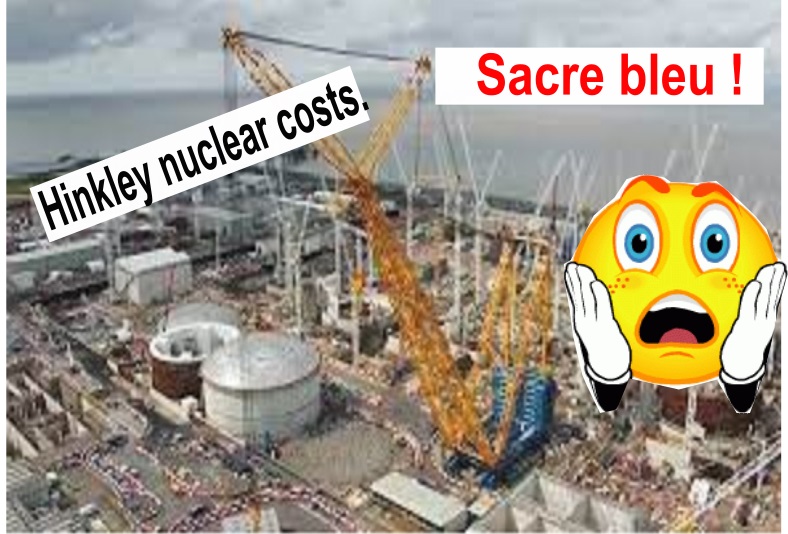
The rising cost — and a further delay to the completion date — will be seen as a blow to the UK’s energy security and an indictment of its infrastructure record. The cost of the Hinkley Point C nuclear power station has ballooned to nearly £50 billion and the date when it is expected to be in service has been put back again to 2030.
It does not
augur well either for a second major new nuclear power station, Sizewell C
in Suffolk, which is in the early stages of construction. The news was
revealed in statements in Paris on Friday by EDF, the state-owned French
energy company contracted to build Hinkley Point and Sizewell C.
The company estimated that the cost of Hinkley C was now £35 billion at 2015
prices. Adjusted for inflation, that translates to up to £49 billion. The
original projected cost was £15 billion. The plant is already years late,
as it was originally expected to go into commission in the mid-2020s.
Some argue that the date could yet be pushed back into the 2030s, leaving a
significant gap in UK energy policy after coal-fired power stations were
closed, leaving the country increasingly dependent on giant wind farms in
the North Sea. Consumer energy bills are at historically high levels.
Times 20th Feb 2026, https://www.thetimes.com/business/companies-markets/article/hinkley-point-c-nuclear-power-station-rise-nearly-50bn-gncq0j6rp
EDF has further pushed back the start-up of the UK’s flagship HinkleyPoint C nuclear plant.

EDF has further pushed back the start-up of the UK’s flagship Hinkley
Point C nuclear plant, taking a €1.8bn charge and pushing up the final
bill for a project that has suffered several delays and cost overruns.
The French state energy company said the first of the two reactors at the 3.2
gigawatt project in Somerset would now begin operating in 2030, blaming
delays in “electromechanical work”. That compares with a previous
“best case” target of 2029, itself a two-year delay from an earlier
timetable.
When the project was given the go-ahead in 2016, it was due to
come online in 2025. EDF said the plant was now expected to cost £35bn in
2015 prices — or almost £49bn at today’s prices — compared with a
previous range of £31bn-£34bn. The project was costed in 2016 at £18bn
in then-current prices. EDF warned that a further delay to 2031 would add
another £1bn.
FT 20th Feb 2026, https://www.ft.com/content/3a1ccd4b-1faf-40e9-a53a-f7961cf16d62
A $33 billion nuclear bailout is coming to your electric bill.

the “advanced” nuclear power plants being promoted today are decades-old designs that didn’t work then and are now being wheeled out as new-and-improved nuclear power plants.
By Karl Grossman, Feb 20, 2026, https://riverheadlocal.com/2026/02/20/a-33-billion-nuclear-bailout-is-coming-to-your-electric-bill/
$33 billion.
That’s the amount of money the New York State Public Service Commission—its members appointed by the state’s governor—has just approved for you as an electric ratepayer, and every other ratepayer in the state including all businesses and non-profit institutions, to pay from 2029 to 2049 to bail out four nuclear power plants upstate.
The $33 billion would be included as a charge in the bills electric utilities send to all the state’s ratepayers.
In 2017, the PSC approved a $7.6 billion 12-year bail-out of the plants, which their owners had wanted to shut down because they said they were not economical.
They include the oldest nuclear power plant of the 94 now operating in the United States, the Nine Mile Point 1 nuclear power plant in upstate Oswego, which began operating in 1969, and the second-oldest nuclear plant running in the nation, the R.E. Ginna plant, near Rochester.
Nuclear power plants, when they were first introduced in the U.S. in the 1950s, were licensed for 40 years. After 40 years, it was determined that internal parts, especially metals, would become so embrittled by radioactivity that the plants would not be safe to operate.
Now, our money, to the tune of $33 billion, would be used in the coming two decades to keep Nine Mile Point 1, having run in 2026 for 57 years, and Ginna, running for 56 years, going far longer.
If there is an accident at any of these plants, upstate is not that far from Suffolk County, as the radioactivity would blow in the wind. A check on Google says they are in the range of 200 air miles, and a little more depending on what part of Suffolk.
Consider taking a drive in a 57-year-old automobile upstate, or anywhere. How confident would you be in its mechanical ability?
But Hochul is totally enamored of nuclear power. She seemingly believes that the Chernobyl, Three Mile Island and Fukushima disasters never happened. She has been calling for New York State to become the “center” of a nuclear revival in the U.S.
As she said in her “State of the State” address last month, in 2025 “I took the bold step of greenlighting the first nuclear power project in a generation….We set a goal of building one gigawatt of nuclear power,” the equivalent of one large nuclear power plant. She went on that for 2026, it’s “go big” on nuclear power. “So I’ve decided to raise the bar to five gigawatts. That’s more nuclear energy than has been built anywhere in the United States in the last 30 years.”
She is pushing particularly so-called “advanced” nuclear power plants—even though, as a comprehensive analysis by the Union of Concerned Scientists, and other studies, have found they are not “advanced.”
“If nuclear power is to play an expanded role in helping address climate change, newly built reactors must be demonstrably safer and more secure than current generation reactors. Unfortunately, most ‘advanced’ nuclear reactors are anything but,” concluded its report.
“Not So Advanced: Hype vs. Reality for Nuclear Technology,” was the headline of a piece from the Natural Resources Defense Council.
But, as Hochul declared recently, “This is not your grandmothers’ and your grandfathers’ nuclear. This is advanced. This is state-of-the-art. This is safe.”
In fact, the “advanced” nuclear power plants being promoted today are decades-old designs that didn’t work then and are now being wheeled out as new-and-improved nuclear power plants.
Meanwhile, Hochul also keeps insisting that nuclear power is “zero-emission” and thus an antidote to climate change. But the nuclear-fuel-cycle—mining, milling and enrichment of nuclear fuel—is heavily carbon-intensive, and nuclear power plants also emit carbon, a radioactive form of carbon, Carbon-14.
She is fond of old nuclear plants, too, like the four upstate plants the $33 billion bail-out would keep running. “They’re all up on Lake Ontario and one is actually the oldest operating nuclear facility in the United States going strong and safe since 1969,” Hochul claims
Of the bail-out and Hochul’s push for nuclear power, Laura Shindell, the New York State director of the organization Food & Water Watch, says: “It’s outrageous that New Yorkers will once again be forced to bail out this toxic, money-burning industry with billions and billions more in the coming years. Despite decades of evidence that nuclear power is both inherently dangerous and cost-foolish, Governor Hochul insists on throwing good money after bad, with everyday families footing the bill. We’re fed up with the governor’s repeated failure to deliver on promises of clean, affordable energy for this state. She claims she cares about affordability, and then approves this rate increase.”
Says Avni Pravni-Buck, deputy director of Alliance for a Green Economy: “Governor Hochul and her Public Service Commission have locked New Yorkers into an expensive and inefficient scheme to enrich Constellation Energy, while taking New York further away from our renewable energy and climate goals. Every dollar spent on Constellation’s reactors is a dollar that could have gone to building renewable energy and storage, which is cheaper, cleaner, and better for our electricity grid. We’re dismayed to hear that electric ratepayers will now be footing a $33 billion bailout for the upstate nuclear reactors, without any forward-looking plan to transition to renewable resources…”
Tim Judson, executive director of the Nuclear Information and Resource Service, says: “New York’s nuclear bailout program has always been a classic ‘bridge-to-nowhere’—forcing households and businesses to fork over pots of gold, only to leave us with an ever-growing pile of radioactive waste. Since 2017, we have been charged over $4 billion to prop up old, uneconomical nuclear power plants—12 times more than we have spent on incentives for renewable energy. The bailout program was supposed to be expensive but temporary, a $7 billion ‘bridge to renewable energy.’ Here we are years down the road, and the PSC has decided not only to make the bailout basically permanent, but to dramatically increase the cost to $33 billion over an extra 20 years. New York needs to pull the plug on it.”
A true green energy path is before us. This is not it.
MIT Weapons Expert and Former Pentagon Adviser Calls Donald Trump’s Golden Dome Missile System “Total Delusion” and “Crazy Idea” with “No Merit.”

Jeremy Kuzmarov, Feb 20, 2026, https://covertactionmagazine.com/2026/02/18/mit-weapons-expert-and-former-pentagon-adviser-calls-donald-trumps-golden-dome-missile-system-total-delusion-and-crazy-idea-with-no-merit/
In January 2025, Donald Trump, the newly inaugurated U.S. president, signed an executive order directing the U.S. armed forces to construct a missile defense system called the “Golden Dome,” aimed at establishing space weapons in orbit for the first time in history.
Legitimized in part by the expiry of the New Strategic Arms Reduction Treaty (START) with Russia on February 5, Trump placed the cost of the Golden Dome—which Russia called “highly provocative”—at around $175 billion, though congressional estimates have put the real cost at more than a trillion dollars.
Lockheed Martin—which stands to profit massively from Golden Dome’s construction—asserted on its website that Golden Dome for America is a “revolutionary concept to further the goals of peace through strength and President Trump’s vision for deterring adversaries from attacks on the homeland. This next generation defense shield will identify incoming projectiles, calculate trajectory and deploy interceptor missiles to destroy them mid-flight, safeguarding the homeland and projecting American strength.”[1]
A more critical assessment was provided by Theodore Postol, a Massachusetts Institute of Technology (MIT) physicist and former Pentagon weapons adviser who, in a January YouTube lecture, called Trump’s Golden Dome a “total delusion” and “crazy idea” with “no merit.”
Postol said that the actual cost of the Golden Dome should be in the ballpark of $10 to $15 trillion and that there is not much likelihood that the system would even be functional if that amount were spent.
The reason is because the Russians and Chinese are likely to develop counter-measures that would nullify the impact of space-based interceptors that are at the heart of the Golden Dome, and because the creation of debris would destroy the interceptors and other space-based satellite systems the U.S. has set up.
Though Trump promised that the Golden Dome would be built in three years, little work has actually been done so far because of technological and logistical hurdles that even current senior Pentagon officials consider to be “insurmountable.”[2]
Postol began his lecture by noting that the Golden Dome would add a space-based component to the already-existing, ground-based U.S. missile defense system in which newly created interceptors orbiting the Earth would have the capacity to shoot down nuclear-armed Intercontinental Ballistic Missiles (ICBMs) fired at the U.S. mainland.
Part of the novelty is that the space-based interceptors would have the capability of detecting decoy missiles the ground-based system could not differentiate from missiles with real warheads.
Postol said, however, that the missile interceptors would have to be replaced every six or seven years, after which time they would normally slow down and fall into the atmosphere.
Also, to stop just one ICBM, between 1,000 and 1,200 interceptors would have to be created. Thus, to stop 100, which Russia and China are capable of firing, about 120,000 interceptors would have to be developed—at a ridiculously high cost.
Trump’s Golden Dome system attempts to revitalize Ronald Reagan’s Strategic Defense Initiative (SDI), or “Star Wars,” which proposed creation of space battle stations from which direct energy and laser weapons set off by a hydrogen bomb were to be refracted through large mirrors and guided by internal computers and sensors that could be deployed against incoming ballistic missiles and nuclear war-heads.
SDI was influenced by alarmist CIA proclamations of the Soviet military “threat” put out by Team B—a renegade group of defense intellectuals directed by CIA Director George H. W. Bush and his deputy, Theodore Shackley, and headed by CIA-linked Harvard Professor Richard Pipes.
SDI’s former Deputy of Technology, Michael D. Griffin, an aerospace engineer and former National Aeronautics and Space Administration (NASA) executive, formed the Space Development Agency during the first Trump administration, which worked on the development of a space-based missile tracking system that is to be further developed under the Golden Dome.[3]
Postol was a Pentagon adviser in the 1980s when SDI was initiated and called it “ridiculous” and a “hallucination”—much like Trump’s Golden Dome.
When he was working at the Pentagon, Postol said that he was “absolutely stunned” by the reaction of “otherwise technically informed people” who “accepted SDI and were even overjoyed by it.”
Postol noted this was a radicalizing experience for him that made him “realize how people in government follow orders” and “don’t think for themselves.” If they did the latter, he said, “they would be pushed aside—if they are lucky.”
After a speech by Reagan on SDI, Postol saw a senior Navy Captain that he knew, Linton Brooks who served as Under Secretary of Energy for Nuclear Security from 2002 to 2007, dancing while proclaiming that SDI would save lives. When Postol asked Brooks “where is the science,” Brooks “literally froze” and otherwise had no response.
Dr. Richard Garwin, author of the first hydrogen bomb design, was part of a network of nuclear physicists in the 1980s who called for banning weapons in space and referred to Ronald Reagan as “Darth Vader” after the Star Wars villain.[4]
New Mexico Environment Department Holds LANL Accountable for Hexavalent Chromium Plume.
Concerned Citizens for Nuclear Safety, 20 Feb 26
Today’s Update is continuation of our reporting on the diligent and thorough work done by the New Mexico Environment Department to hold Los Alamos National Laboratory (LANL) accountable for not responsibly addressing the hexavalent chromium plume beneath LANL that has now spread beneath Pueblo de San Ildefonso.
On Tuesday, February 11th, the New Mexico Environment Department issued two Administrative Compliance Orders under the New Mexico Hazardous Waste Act and the New Mexico Water Quality Act to address the on-going migration of hexavalent chromium into the sole source regional drinking water aquifer that feeds the Rio Grande and those living downstream. The Orders proposed civil penalties for multiple violations of both laws that total nearly $16,000,000. https://www.env.nm.gov/wp-content/uploads/2026/02/2026-02-11-COMMS-NMED-acts-to-hold-DOE-accountable-for-legacy-waste-Final.pdf
Both Orders provide detailed histories of what has led the Environment Department to issue civil penalties for contamination of groundwater, which was first discovered in 2004 in a newly drilled monitoring well in Sandia Canyon.
Since then LANL has not done everything in its power to properly investigate and protect against the groundwater contamination. It has drilled wells at least 1,000 deep to reach the contaminated waters, extracted those waters, treated the waters on the surface, and returned them back into the deep aquifer. Due to the findings of contamination beneath Pueblo de San Ildefonso, in November 2025, the Environment Department ordered the cessation of these operations. This is not the first time the Environment Department ceased operations.
Why Epstein’s Links to the CIA Are So Important
The word unclassified potentially gives Trump and the CIA wide latitude to hold back Epstein-related materials that they claim are too sensitive to release.
We won’t know the full truth about his crimes until the extent of his ties to US intelligence are clear.
Jeet Heer, January 2026, https://www.thenation.com/article/society/jeffrey-epstein-cia-ties/
On November 18, Donald Trump suffered a major political defeat when the House of Representatives passed the Epstein Files Transparency Act by a nearly unanimous vote: 427–1. But while emphatic, the House measure included a significant proviso that might yet prevent a full reckoning with Jeffrey Epstein’s crimes.
Trump had fought for months against the bill, which was drafted by a bipartisan coalition created by California Democrat Ro Khanna and Kentucky Republican Thomas Massie. In the end, the strong public revulsion for Epstein’s crimes made opposing the bill untenable. But the final version specified that the Department of Justice must make public “all unclassified” documents on Epstein
The word unclassified potentially gives Trump and the CIA wide latitude to hold back Epstein-related materials that they claim are too sensitive to release. In this, they have the support of House Speaker Mike Johnson, who insisted that US intelligence agencies be allowed to “protect their critical sources and methods. It is incredibly dangerous to demand that officials or employees of the DOJ declassify material that originated in other agencies and intelligence agencies.”
Johnson’s words stand in stark contrast to the remarks by Marjorie Taylor Greene, one of four dissident House Republicans who forced Trump to abandon his opposition to the Epstein bill. “The real test will be: Will the Department of Justice release the files, or will it all remain tied up in investigations?” she asked in a November 18 press conference. “Will the CIA release the files?” Greene—perhaps feeling too bruised by the clash with Trump, who attacked her repeatedly over her Epstein heresy—subsequently announced that she will be retiring from Congress. But her words still cut to the heart of why getting……………………………………..[Subscribers only]
Ministry of Defence’s nuclear clean-up project brings new risks.
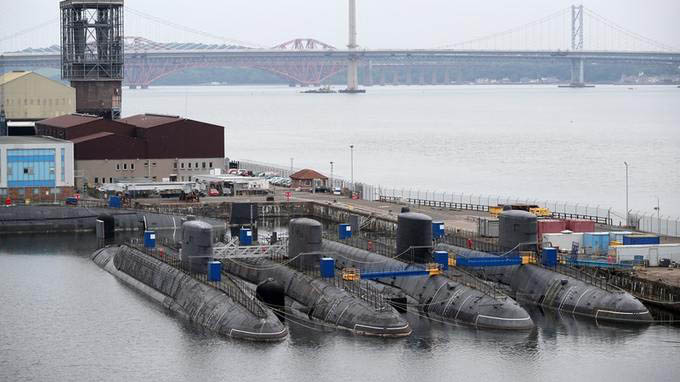
21st February, By Lynn Jamieson, chair, Scottish Campaign Nuclear Disarmament:
ROSYTH dockyard leads in the clean-up of retired nuclear
submarines as part of the Submarine Dismantling Project (SDP). Addressing a
legacy mess affords opportunities for building a skilled workforce.
But please, no more mess. Rosyth may become more deadly if operational
nuclear-armed submarines station there. As a contingency docking station
for the nuclear-weapon system now under construction, radioactive risks
will increase from nuclear reactors and weapons. T
he Ministry of Defence
(MoD) has not ruled out nuclear bombs being onboard a temporarily docked
submarine at Rosyth. In 40 years, newly built reactors become a long-term
legacy of nuclear waste, sitting in another generation of retired
submarines to be decommissioned at enormous cost.
Since the 1980s,
intermediate-level radioactive waste in the form of retired nuclear-powered
submarines – currently seven in total – sit at Rosyth, a hazard costing
money every day. Fifteen more sit in Devonport Royal Dockyard, Plymouth. Of
the 15 vessels at Devonport, 10 retain the highly radioactive fuel rods
that once powered them.
The National 21st Feb 2026,
https://www.thenational.scot/politics/25874840.mods-nuclear-clean-up-project-brings-new-risks/
The Apocalyptic President

a science fiction novel with a distinctly bizarre premise: that, at some future moment, thanks to the endless burning of fossil fuels, we humans would essentially threaten to burn ourselves off planet Earth. And when the voters of the world’s largest democracy heard that such a thing might, sooner or later, actually happen to us, they would respond by freely electing a genuine madman — who ran his second candidacy in 2024 on the all-too-bluntly apocalyptic slogan “drill, baby, drill” — to “lead” us into a literal hell on earth.
the American people elected as president, twice, a man who, as a businessman, had either four or more likely six bankruptcies to his name,
Our planet is melting in a climate broiler that we control and we’re not only not turning down the heat fast enough, but we Americans elected someone (twice!) determined to turn it up ever higher.
The Personification of an Imperial Power (and Planet) in Decline
February 18, 2026 , By Tom Engelhardt, https://tomdispatch.com/the-apocalyptic-president/
Once upon a time, if you had described Donald Trump’s America to me (the second time around), I would have thought you mad as Alice in Wonderland‘s proverbial hatter — or, if you were a fiction writer, I would have considered your plot so ludicrous that, after reading a few pages, I would undoubtedly have tossed your book in the trash.
And yet here we are, not once (yes, all of us can make a mistake once, can’t we?) but twice!
And the one thing you should take for granted is that Donald Trump in the White House a second time around is the all-too-literal personification of imperial decline. In fact, decline is hardly an adequate word for it. We just don’t happen to have another word or phrase that would describe him and his crew aptly enough in all their eerie strangeness. Yes, this country, even in the best of (imperial) times, certainly had its problems. (Remember the Vietnam War, for instance, or President “Tricky Dick” Nixon and the Watergate scandal.) Still, nothing was ever quite like this, was it? Never.
The First American King?
A literal Mad Hatter in command in Washington, D.C. Once upon a time, who would have believed it? In fact, if we could indeed travel into the past and I were able to take you back to 1991 when the Soviet Union collapsed, ending the Cold War, while China had not yet faintly “risen,” the world of that moment might essentially have been considered American property, lock, stock, and proverbial barrel.
This planet could have been thought of then as the property of just one great power — my country, of course — that, in imperial terms, had essentially been left alone on planet Earth in a fashion that might never have happened before in the history of humanity. And if I had then been able to see into our future and had tried to fill you in on the Trumpian world we’re now living through a mere three decades later, you would have quite literally laughed me off the planet (and, believe me, that’s putting it politely).
Truly, who could have ever (ever!) imagined this bizarre Trumpian era of ours in which the joker (in the worst sense of the term) in the ultimate deck of cards is indeed sitting in the White House. Yes, unbelievably enough, he was elected a second time in 2024 by a “sweeping,” “landslide,” “historic” 49.7% of American voters. It’s true, not even 50% of us voted to make him the first American king a second time around.
And if that made you chuckle just a little, well, stop doing so right now! Yes, what happened to us in Trumpian terms was and remains genuinely absurd. Still, given this deeply endangered world of ours, it should be anything but funny. Just imagine for a moment, a president who, before entering the White House, was essentially known for only one thing: being the host of the TV show The Apprentice (“You’re fired!”). Once upon a time, if you had described the (ir)reality we’re now living through, you would have been laughed not just out of the room but off this planet. You would, in short, have been fired.
In fact, if what we’re now experiencing were a novel, it would be considered to have the most ludicrous plot imaginable and, a few pages in, you would undoubtedly have tossed it into — yes, again! — the trash. (Unfortunately, it’s not just you or me but this planet itself that Donald Trump now threatens to toss into that garbage pail.)
So here we are in February 2026 and, like it or not, we’re all apprentices to one Donald J. Trump — oops, sorry, one President Donald J. Trump. And the ongoing TV show he emcees these days from the White House is undoubtedly the wackiest one in our history, as he fires not just everyone but everything that rubs him the wrong way from the Kennedy Center (gone!) to the East Wing of the White House (now rubble) to the U.S. Agency for International Development (once upon a time…).
One way to think about all of this is to go back in time and imagine that, long, long ago, Isaac Asimov or Ray Bradbury wrote a science fiction novel with a distinctly bizarre premise: that, at some future moment, thanks to the endless burning of fossil fuels, we humans would essentially threaten to burn ourselves off planet Earth. And when the voters of the world’s largest democracy heard that such a thing might, sooner or later, actually happen to us, they would respond by freely electing a genuine madman — who ran his second candidacy in 2024 on the all-too-bluntly apocalyptic slogan “drill, baby, drill” — to “lead” us into a literal hell on earth. Now, of course, that “president” is insisting that he be given the largest iced island on this planet, Greenland, that, were all its ice to melt (as indeed is already beginning to happen), could send global sea levels up by 23 feet and quite literally drown this world’s coastal cities. Imagine that!
And now, try to imagine this: in 2026, such terrible fiction is, in fact, our reality and one thing is guaranteed (excuse the colons inside colons but this is a strange, strange world to try to sum up): it’s only going to get worse in the three years to come before Donald Trump’s presidency is officially ended, if, of course, it ever does end. (As he typically said at one point last year, “Based on what I read, I guess I’m not allowed to run. So we’ll see what happens,” and he’s now talking about “nationalizing” — think “Trumpifying” — our elections!)
Given him and everything that’s gone on so far in his second term in office, including the way he recently had Director of National Intelligence Tulsi Gabbard accompany FBI agents to an election voting hub in Fulton County, Georgia, where they “seized hundreds of boxes containing ballots and other documents related to the 2020 election,” I wouldn’t count on anything Trumpian ending according to plan. Whew! That was one long sentence!
Continue readingChina’s Retaliation: when will it happen?

And more appropriately, what form will it take?
Jerrys take on China, Feb 18, 2026, https://jerrygrey2002.substack.com/p/chinas-retaliation-when-will-it-happen?utm_source=post-email-title&publication_id=1744413&post_id=188346536&utm_campaign=email-post-title&isFreemail=true&r=ln98x&triedRedirect=true&utm_medium=email
A few comments about why China is like it is – first of all, in the last 45 years, there has been no invasions, despite what people like little Marco Rubio of the US and Richard Marles the Australian Defence Minister might say, China is not and does not pose a threat to any of these countries – Japan might think there is a threat, China does not agree, in fact the opposite is true, Japan poses a much larger threat to China than China has ever posed to Japan.
China is concerned about, and in fact does feel threatened by Japan’s military expansion because the last time it happened literally millions of Chinese were murdered by the Japanese. Australia’s defence minister, Marles, asks us to consider why China has the world’s largest military expansion but he’s wrong – we have to hope he’s wrong because he’s been misinformed and is too dim to check out for himself, but more likely he knows he’s lying about this as China spends considerably less money than the US, in terms of not only its population but its geographical size, it’s quite entitled to spend more cash, when on a per capita basis, the amount is tiny compared to the US, on a ratio to GDP, it’s smaller than the US, it’s one third or less than NATO has been required to spend in terms of percentage of GDP and there’s one more very important factor that the US with only two neighbouring countries doesn’t have – that is 14 neighbouring countries with a shared land border.
Here’s another thing. China was invaded when they were weak, the British did it, the Americans did it, the eight nations alliance did it, Britain carved up part of Burma and took away some of China, it carved up India and took away parts of China, the Russians carved up Mongolia and Heilongjiang, taking away parts of China, the Japanese invaded and occupied China for 14 years. The classic twists and mental gymnastics people like Marles make would have us believe that the hundreds of US bases around China are to prevent China from doing what they’ve NEVER done – going out to invade other countries.
He, and several pundits would like us all to believe is that the US is keeping the world safe from China by arming their neighbours, interfering in the Provinces, Regions and the SARs but the reality is, China is building a military that will defend Chinese people inside China and Chinese land that belongs to China now – it’s not looking to reclaim land back, except in disputed regions.
Those disputed regions include parts of Tibet that the British took away and gave to India, parts of the South China Seas that the Japanese took away and both the US and UK, at the end of the Second World War, agreed would come back to China. There’s one military base in Africa, which is in a region shared with many other countries, including the USA, Japan, France, Italy, Germany Spain and even Saudi Arabia. Taiwan is NOT one of these disputed regions – the entire world whether they recognise Beijing or Taipei as the capital, recognises that there is one China and Taiwan is part of it – anyone who suggests that Taiwan is a country is either a liar, deliberately misleading us, or is far too dim to read the Constitution of the Republic of China, which not only claims all of the Chinese Mainland, it also wants those disputed regions back too.
China has something else which its detractors hate to admit and will lie about – that’s a policy of non-interference in the affairs of a sovereign nation – when it invests in another nation, it doesn’t call for democracy or elections, it doesn’t even ask that Communism or Socialism are accepted, it doesn’t send military to protect its assets, it won’t send missionaries to convert their subjects and it won’t impose conditions that force countries to give up their national assets or utilities if they can’t make the payments – if that sounds familiar and if it’s because you’ve been hearing that China will do all of those things and, if you think they have, I’d implore you to find me an example of where it’s happened, outside of opinion pieces written by people who want you to believe they have, almost every incident where we can find any of these things alleged, will be speculative – they’ll tell us what China might do, what China could do, what China may be doing, is alleged to have done or suspected to be involved in.
We might find individual cases of rogue Chinese people, Chinese criminals even and they use these tiny individual examples to tell you that this is “what China does” when that person who has broken the law has usually already been punished by the time they report it in western media and, if they mention that at all, it’ll be after the third paragraph where most of us have stopped reading.
On the other hand, I can find literally hundreds of examples where the USA is doing these things, where the UK and France have done these things, where Germany, Belgium, even Spain and Portugal have done them.
So then some of the comments I have been getting relate to the Port in Darwin, the ports in Panama and the Pirelli saga in Italy. Just for some background here, Sinochem owns 37% of Pirelli, the big Italian tyre company which wants to expand into the USA, of course the US won’t allow that while China has such a controlling interest. The share of Sinochem hasn’t changed, the only change is that the board, and remember Sinochem had controlling interest being the largest single shareholder, has declared that Sinochem no longer has control, giving the board more autonomy, – Sinochem agreed to this, so this isn’t a situation where anything has been taken from China, merely an agreement that the board retains control which a Chinese corporation retains more shares.
Erich, one of my followers said this: “if China doesn’t protect its assets it will lose them like Pirelli in Italy, the Ports in Panama, etc. Maybe at some point China will start caring about these things.”
My response is that it’s not just Erich, it’s literally hundreds of people, probably thousands but many in my responses who are misunderstanding China. China cares very deeply about the assets its people and corporations invest in, particularly overseas, but it will not break international laws, or contractual Agreements in order to protect them from people or governments which do break laws.
China will react to this in the same way it reacts to every other illegal action against it, by negotiations, and where they fail, arbitration, it will, when all else fails, take the appropriate legal action, which might be appeals to the WTO and perhaps even the UN or more likely the local courts – it knows there will be no satisfaction from those appeals but they are the legal mechanisms open to Chinese corporation. China as a government participates in legal and lawful bodies and does not want to overthrow them, to do so, makes China another USA – so the actions China takes, which will definitely be retaliatory, will be legal, they can, and probably will reduce purchases from offending countries, and of course, they will be much more careful in the decisions when investing in those countries both of which are well within their legal rights.
What China will not do is: unilaterally sanction anyone, any country or even any organisation within the country, it will not militarily defend its assets, it will not interfere in the internal affairs of another country but there is no doubt in my mind that if any country persists and acts on threats to China’s investments, there will be repercussions, probably it’s best not to call them retaliations, they are simply normal responses to a situation of risk.
In Australia for example, if they persist with this challenge to the legal investments Landbridge has made, investments that are compliant in every way and even beneficial to the people of the Northern Territory in jobs and payroll taxes, as well as increased business going through it’s port and beneficial to the people of Australia in 4.5 million income tax paid last year, those are the people who will suffer – China will find other suppliers for the things Australia sends – so far, the only one which is not directly sourced elsewhere is iron ore and, if China stops buying that in any great quantity, it will kill Australia’s economy.
Just continuing to use Darwin Port as an example, it is a critical trade hub in Northern Australia, handling minerals, agriculture, and livestock, with 2,295 vessel visits recorded in 2024-25, marking a 31.07% increase on the previous year. Darwin serves as a key gateway to Asia, managing significant exports of manganese, titanium, iron ore, and livestock. Given that China is the major trading partner of Australia, a huge proportion, unfortunately, there’s no way I can find out, would be Chinese owned, flagged, operated or destined ships, they would be travelling between China and Darwin – that’s 44 ships a week, many of which will simply divert to other ports, or, if the asset has been seized they’re more likely to simply stop coming altogether – how can that possibly benefit the warehouses, the truckers, the waste management, the catering and hospitality venues that the sailors use, the customs brokers, the security and surveillance companies – there’s an entire eco-system of industries deriving their income from a well-operated port and Darwin, which is a small city will feel a very heavy impact from no Chinese ships arriving and departing there. There will also be a lot of farmers, miners and other suppliers using that port to ship to China – it will all stop.
So, to think China will just sit back and do nothing is wrong, they are very mindful that their investments are not just at risk but under threat – business leaders in China understand this and are already taking action – there’s an April 2024 KPMG report, that’s almost 2 years old now showing that China’s investments in Australia have declined from a peak in 2016, just after the Free Trade Agreement was signed to the lowest level since 2006. It’s well worth a read if you’re interested, the report defines all kinds of factors but fails to mention the obvious one – Australia simply doesn’t want Chinese investment, they feel threatened by perceptions given to them by media which are completely false.
In keeping with the maxim that one person’s loss is another’s gain, the vast majority of China’s Overseas Direct Investment is now going to One Belt One Road countries – these are safe destinations, they are countries that welcome trade with and investments from China. In the Western world, that’s not many countries. Leaders of Canada and the UK were recently in China seeking investment opportunities, in both cases, they returned to their home countries to media criticism. It remains to be seen how they will handle this but they, as leaders, and their business leaders all know the truth – the media is lying, a few politicians who are actually paid by Washington to further lie about China are losing influence. Some people will assume that I’m either exaggerating about this but the reality is there for all to see, if you don’t believe me, go look up who are the main funders of the Inter Parliamentary Alliance on China (IPAC). It states clearly on its website that it does not accept funds from governments. But then lists the Taiwan Foundation for Democracy, the National Endowment for Democracy, the International Republican movement, Hello Taiwan the National Democratic Institute and others, all of which are government funded and almost all of which can trace their funds back to Washington DC and congressionally approved expenditure.
The vast majority of the Non-US aligned world realises – there is no threat from China and, once again I reiterate something I’ve said many times, the people telling you China is a threat are more likely to damage your economy and your global standing than China ever will – China isn’t a threat, it’s those people telling you it is, who are.
Rubio Declared a Return to Brutal Western Colonialism – and Europe applauded.

Old-school, white-man’s-burden colonialism is unapologetically back
Rubio used the Munich conference to lay bare the new reality: Washington will no longer pay lip service to being the nice guy or abiding by any red lines
By Jonathan Cook Middle East Eye, 19 February 2026
In Munich, the US announced its intent to crush all opposition to its permanent status as imperial top dog, even if that means destroying everything, and all of us, in the process.
S Secretary of State Marco Rubio’s speech at the Munich Security Conference last weekend was another troubling declaration of intent by the Trump administration.
The explicit goal of US foreign policy, according to Rubio, is to resurrect the western colonial order that persisted for some five centuries until the Second World War.
Old-school, white-man’s-burden colonialism is unapologetically back.
In Rubio’s preposterous retelling, Europe’s colonisation of much of the planet, and the rape and pillage of its resources, was a glorious era of western exploration, innovation and creativity. The West brought a “superior” civilisation to backward peoples while maintaining global order.
Reflecting on the era before 1945, he observed: “The West had been expanding – its missionaries, its pilgrims, its soldiers, its explorers pouring out from its shores to cross oceans, settle new continents, build vast empires extending out across the globe.”
That course went into reverse 80 years ago: “The great western empires had entered into terminal decline, accelerated by godless communist revolutions and by anti-colonial uprisings that would transform the world and drape the red hammer and sickle across vast swaths of the map in the years to come.”
According to Rubio, that decline was accelerated by what he dismissed as the “abstractions of international law”, established by the United Nations in the immediate postwar period. In the pursuit of what he derisively termed “a perfect world”, these new universal laws – ones that treated all humans as equal – served only to hamstring western colonialism.
Rubio neglected to mention that the purpose of international law was to prevent a return to the horrors of the Second World War: the extermination of civilians in death camps and the firebombing of European and Japanese cities.
During his speech, Rubio offered Europe the chance to join the Trump administration in reviving “The West’s age of dominance” to “Renew the greatest civilisation in human history.”
“What we want is a reinvigorated alliance that recognises that what has ailed our societies is not just a set of bad policies but a malaise of hopelessness and complacency. An alliance – the alliance that we want is one that is not paralysed into inaction by fear – fear of climate change, fear of war, fear of technology,” he said.
No peace, no order
Quite astonishingly, Rubio was greeted with enthusiastic applause throughout his speech from an audience comprising heads of state, politicians, diplomats and military officials. He is reported to have received a standing ovation from half of the attendees.
They seemed swept up in Rubio’s triumphalist account of empire, one utterly oblivious to the well-documented realities of “western domination” – not least its brutal colonial tyrannies, its industrial-scale genocides and the mass enslavement of native populations.
These were not unfortunate episodes or mistakes in the West’s imperial past. They were integral to it. They were the coercive means by which colonised peoples were stripped of their assets and labour to finance empire.
He also appeared blind to another downside of the colonial West, which was all too evident over those five centuries. Ruthless competition between European states, vying to be first to pillage resources in the Global South, led to endless wars in which Europeans, as well as the people they colonised, were killed.
Empire did not ensure order, let alone peace. Colonialism was about systematised theft – and, as the saying goes, there is rarely honour among thieves.
In the dog-eat-dog world that preceded international law, each colonial power was out for its own advancement against rivals. That culminated in two terrible wars in the first half of the 20th century that decimated Europe itself.
Because Rubio does not understand the past, his vision of the future is inevitably defective as well. Any attempt by the Trump administration to restore overt western colonial rule will prove suicidal. As we shall see, such a venture would spell doom for us all. In fact, we may already be well advanced on that path.
Imperial muscles
There are a number of glaring flaws in Rubio and the Trump administration’s thinking.
First, Rubio’s assertion that the West gave up colonialism some 80 years ago is flatly wrong. At the end of the Second World War, Europe’s physically battered and economically exhausted colonial powers passed the baton of empire to the US. Washington did not end colonialism. It rationalised and streamlined it.
Washington continued the European tradition of overthrowing nationalist leaders and installing weak, obedient clients in their stead.
It also seeded the globe with hundreds of US military bases to project hard power, while exploiting new globalising technologies to project soft power. Economic carrots and sticks, wielded largely out of view through the World Bank and International Monetary Fund, incentivised submission to its diktats by non-western leaders.
……………………………………………………………………………………………………………………………………………………………………………………………………………………………………………………… Nuclear Armageddon
The biggest misdirection in Rubio’s remarks was his omission of the real reason the West abandoned overt colonialism after the Second World War and built international institutions such as the United Nations.
It was not an acceptance of defeat or decline by the US, but rather a recognition that, with the rapid development of nuclear arsenals by the superpowers in the wake of the war, a system capable of mediating the worst excesses of power had become a necessity.
It was the only hope of preventing reckless colonial competition and confrontation that could trigger a Third World War likely to spiral quickly into nuclear armageddon.
Nothing has changed over the past eight decades.
Russia and China still have large nuclear arsenals, and Moscow now has hypersonic missiles capable of carrying these warheads at unprecedented speeds.
There is still no failsafe mechanism to prevent misunderstandings from rapidly escalating into mutual attack.
Human nature has not changed since the 1940s – only the arrogance of a superpower determined to prevent great powers like China or Russia from ever ousting it from its imperial perch.
The threat of nuclear annihilation has not diminished. It has grown exponentially as limitations on global resources – those needed to sustain western consumption and endless “economic growth” – put ever greater pressure on the US to discard its mask as the guardian of superior values.
Rubio used the Munich conference to lay bare the new reality: Washington will no longer pay lip service to being the nice guy or abiding by any red lines.
The US is determined to crush all opposition to its permanent status as imperial top dog – even if it means destroying everything, and all of us, in the process. https://www.middleeasteye.net/opinion/us-rubio-declared-war-humanitys-future-and-europe-applauded
Trump officials plan to build 5,000-person military base in Gaza, files show
Exclusive: approximately 350-acre compound planned as base for multinational force, according to records reviewed by the Guardian
Aram Roston and Cate Brown, Thu 19 Feb 2026, https://www.theguardian.com/us-news/2026/feb/19/trump-gaza-military-plan
The Trump administration is planning to build a 5,000-person military base in Gaza, sprawling more than 350 acres, according to Board of Peace contracting records reviewed by the Guardian.
The site is envisioned as a military operating base for a future International Stabilization Force (ISF), planned as a multinational military force composed of pledged troops. The ISF is part of the newly created Board of Peace which is meant to govern Gaza. The Board of Peace is chaired by Donald Trump and led in part by his son-in-law Jared Kushner.
The plans reviewed by the Guardian call for the phased construction of a military outpost that will eventually have a footprint of 1,400 metres by 1,100 metres, ringed by 26 trailer-mounted armored watch towers, a small arms range, bunkers, and a warehouse for military equipment for operations. The entire base will be encircled with barbed wire.
The fortification is planned for an arid stretch of flatlands in southern Gaza strewn with saltbush and white broom shrubs, and littered with twisted metal from years of Israeli bombardment. The Guardian has reviewed video of the area. A source close to the planning tells the Guardian that a small group of bidders – international construction companies with experience in war zones – have already been shown the area in a site visit.
The Indonesian government has reportedly offered to send up to 8,000 troops. Indonesia’s president was one of four south-east Asian leaders scheduled to attend an inaugural meeting of the Board of Peace in Washington DC on Thursday.
The UN security council authorized the Board of Peace to establish a temporary International Stabilization Force in Gaza. The ISF, according to the UN, will be tasked with securing Gaza’s border and maintaining peace within the area. It is also supposed to protect civilians, and train and support “vetted Palestinian police forces”.
It is unclear what the ISF’s rules of engagement would be if there is combat, renewed bombing by Israel, or attacks by Hamas. Nor is it clear what role the ISF is meant to play in disarming Hamas, an Israeli condition to proceed with Gaza’s reconstruction.
While more than 20 countries have signed up as members of the Board of Peace, much of the world has stayed away. Although it was set up with the UN’s approval, the organization’s charter appears to grant Trump permanent leadership and control.
“The Board of Peace is a kind of legal fiction, nominally with its own international legal personality separate from both the UN and the United States, but in reality it’s just an empty shell for the United States to use as it sees fit,” said Adil Haque, a professor of law at Rutgers University.
Experts say the funding and governance structures are murky, and several contractors have told the Guardian that conversations with US officials are often conducted on Signal rather than over government email.
The military base contracting document was issued by the Board of Peace, according to a person familiar with the process, and prepared with the help of US contracting officials.
The plans say there is to be a network of bunkers each 6 metres by 4 metres and 2.5 metres tall, with elaborate ventilation systems where soldiers can go for protection.
“The Contractor,” says the document, “shall conduct a geophysical survey of the site to identify any subterranean voids, tunnels, or large cavities per phase.” This provision is likely referencing the large network of tunnels Hamas has built in Gaza.
One section of the document describes a “Human Remains Protocol”. “If suspected human remains or cultural artifacts are discovered, all work in the immediate area must cease immediately, the area must be secured, and the Contracting Officer must be notified immediately for direction,” it says. The bodies of about 10,000 Palestinians are believed to be buried under the rubble in Gaza, according to Gaza’s civil defense agency.
It is unclear who owns the land where the military compound is set to be built, but much of the south Gaza area is currently under Israeli control. The UN estimates that at least 1.9 million Palestinians have been displaced during the war.
Diana Buttu, a Palestinian-Canadian lawyer and former peace negotiator, called building a military base on Palestinian land without the government’s approval an act of occupation. “Whose permission did they get to build that military base?”
Officials from US Central Command referred all questions about the military base to the Board of Peace.
A Trump administration official declined to discuss the military base contract: “As the President has said, no US boots will be on the ground. We’re not going to discuss leaked documents.”
The Veto May be the Weapon of Elimination in the Election of Next UN Chief.
the Trump administration is definitely conscious that they have the power to reshape the political culture of the organization if they find someone who aligns with their views”.
By Thalif Deen, February 17, 2026, https://www.globalissues.org/news/2026/02/17/42361
UNITED NATIONS, Feb 17 2026 (IPS) – As the campaign for the next Secretary-General gathers momentum – at a relatively slow pace – there is widespread speculation that any candidate running for the post of UN chief will have to abide by the dictates of a politically hostile White House or face a veto in the Security Council.
So far, there are only two declared candidates: former Chilean President Michelle Bachelet and former Director-General of the International Atomic Energy Agency (IAEA) Rafael Grossi from Argentina—with more candidates expected to join the race.
The winning candidate, who will take office in January 2027, will be elected by the 15-member Security Council and subsequently ratified by the 193-member General Assembly (UNGA).
Annalena Baerbock, the president of UNGA, said the selection process is already underway, and the interactive dialogues with candidates have been scheduled for the week of 20 April, where they will present their “vision statements”.
Meanwhile, the US has publicly declared its opposition to some of the basic goals in the UN’s socio-economic agenda, including gender empowerment and policies relating to diversity, equity and inclusion (DEI), while dismissing climate change as “a hoax” and a “giant scam.”
The Trump administration has also downplayed human rights and adherence to international laws—two concepts ingrained in the UN system.
In an interview with the New York Times last January, President Trump said he does not “need international law” to guide his actions, arguing that only his own “morality” and “mind” will constrain his global powers.
So, what would be the fate of any candidate— male or female—who advocates these UN goals? Will there be a battle of the vetoes – as it happened in a bygone era?
Richard Gowan, Program Director, Global Issues and Institutions, International Crisis Group (ICG), who oversees ICG’s work on geopolitics, global trends in conflict and multilateralism, told IPS nobody knows how this race will end.
Obviously UN-watchers will be tracking the initial candidates’ vision statements and public appearances over the coming months, he pointed out.
“But diplomats in New York have a suspicion that the veto powers in the Security Council may suddenly announce support for a new candidate at the last minute to circumvent the entire public process. There is a strong sense that the U.S., China and Russia don’t want to be boxed in by the General Assembly.”
There is also a scenario, he said, where the veto powers cannot agree on a candidate, and the Council ends up grinding out discussions of a candidate right through to December.
“UN officials have even done some contingency planning for what happens if there is not an agreed candidate on 1 January 2027. It is possible that the Security Council might ask Guterres to hang on for a few months, although I don’t think either diplomats or Guterres want that outcome.”
There are definitely a few senior UN officials and ambassadors in New York who wonder if the Council could call on them at the very last minute, said Gowan.
Thomas G. Weiss, Presidential Professor Emeritus, Political Science, and Director Emeritus, Ralph Bunche Institute for International Studies at the CUNY Graduate Center, told IPS it is hard to imagine anyone running for UNSG who would not run into a veto from Washington in a candidacy necessarily addressing the values of cooperation (multilateralism of any shape) as well as honestly discussing such issues as climate, gender (male or female), nuclear proliferation, Palestine, and sovereignty—all “hoaxes” or “con jobs” according to DJT (President Trump) and his junta.
Both the 1996 and 1981 elections, he said, provide “models.”
“The Chinese vetoes probably are the most relevant precedent for Washington going to the mat indefinitely until an “acceptable” candidate emerges. Let’s hope that person is as competent as the compromise of 1996, Kofi Annan”, he declared.
In 1981, Salim Ahmed Salim of Tanzania, was backed by the Organization of African Unity, the Non-Aligned Movement and China. But his bid was blocked by a US veto.
In 1996, a second five-year term for Boutros Boutros-Ghali of Egypt was vetoed by the US – even though he received the support of 14 of 15 members in the Security Council.
In 1981, China cast a record 16 vetoes against Kurt Waldheim to prevent a third term, leading to his withdrawal and the selection of Javier Pérez de Cuéllar.
Meanwhile, there has been an intense campaign for a female UN chief, the first in the 81-year history of the UN. But the US has remained tight-lipped on the widely supported proposal.
The last 9 secretaries-general, all males, include:
António Guterres (Portugal), who took office in January 2017;
Ban Ki-moon (Republic of Korea), from January 2007 to December 2016;
Kofi A. Annan (Ghana), January 1997 to December 2006;
Boutros Boutros-Ghali (Egypt), January 1992 to December 1996;
Javier Pérez de Cuéllar (Peru), January 1982 to December 1991;
Kurt Waldheim (Austria), January 1972 to December 1981;
U Thant (Burma, now Myanmar), who served from November 1961, when he was appointed acting Secretary-General (he was formally appointed Secretary-General in November 1962), to December 1971;
Dag Hammarskjöld (Sweden), from April 1953 until his death in a plane crash in Africa in September 1961; and
Trygve Lie (Norway), who held office from February 1946 to his resignation in November 1952.
As for the U.S., said Gowan, “I don’t believe that Washington has settled on a candidate yet. But the Trump administration is definitely conscious that they have the power to reshape the political culture of the organization if they find someone who aligns with their views”.
A lot of UN members assume that the U.S. won’t accept a female Secretary-General but I think that Washington could back a woman if she was a strong social conservative and willing to make large cuts to the UN system, he argued.
Right now, there is not an obvious female candidate meeting those criteria, though. I think some candidates who could never align with the U.S. on things like development and diversity are already stepping out of the race.”
Meanwhile, there is a reason that Mia Mottley has gone from being the putative front runner to refocusing on domestic politics.
“I also think that all candidates recognize that they are going to have to talk a lot more about how they will advance the UN’s work on peace and security, which is a priority not only for the U.S. but a lot of member states.”
“That said, one senior UN diplomat recently told me that they cannot see Global South countries accepting another Western candidate after Guterres, regardless of gender. The non-Western members of the Security Council could create a blocking minority in the Security Council to keep candidates from U.S. allies out,” declared Gowan.
He said U.S. diplomats have told other veto powers that they will hold back on various reform proposals and cuts until they have their own candidate as Secretary-General.
A lot of UN members assume that the U.S. won’t accept a female Secretary-General but I think that Washington could back a woman if she was a strong social conservative and willing to make large cuts to the UN system, he argued.
IPS UN Bureau Report
The Israeli Government Installed and Maintained Security System at Epstein Apartment
Security equipment and alarms were installed by the Israeli government at a notorious Manhattan residence frequented by former PM Ehud Barak.
Ryan Grim and Murtaza Hussain, Feb 19, 2026 https://www.dropsitenews.com/p/israeli-government-surveillance-epstein-apartment-66th-street-ehud-barak
The Israeli government installed security equipment and controlled access to a Manhattan apartment building managed by convicted sex offender Jeffrey Epstein, according to a set of emails recently released by the Department of Justice. The equipment was installed starting in early 2016 at 301 E. 66th Street—the residence where former Israeli Prime Minister Ehud Barak frequently stayed for stretches at a time.
The security operation at “Ehud’s apartment” was in place for at least two years, emails from the DOJ disclosure show, with officials from the Israeli permanent mission to the United Nations corresponding regularly with Epstein’s staff regarding security. The apartment was technically owned by a company connected to Epstein’s brother, Mark Epstein, but was effectively controlled by Jeffrey Epstein. Units in the building were frequently loaned out to Epstein’s contacts and used to house underage models.
Rafi Shlomo, then-director of protective service at the Israeli mission to the United Nations in New York and head of Barak’s security, corresponded with Epstein employees to arrange meetings to discuss security and coordinate installation of specialized surveillance equipment at the 66th Street residence. Shlomo personally controlled access to the apartment for guests and even conducted background checks on cleaners and Epstein’s employees.
Under Israeli law, former prime ministers and other high ranking officials typically receive security services after they leave office. According to the emails, Epstein personally approved the installation of the equipment and authorized meetings between his staff and Israeli security officials.
Ehud Barak and the Israeli mission to the United Nations did not respond to requests for comment.
At the time of Epstein’s death in 2019, Barak downplayed his connection to the disgraced financier, stating that while he had met with Epstein several times, he “didn’t support me or pay me.”
Prime Minister Benjamin Netanyahu recently suggested that Epstein’s close ties to Barak, a longtime Labor Party official and rival of Netanyahu, undermine rather than strengthen the case for Epstein’s ties to Israel. “Jeffrey Epstein’s unusual close relationship with Ehud Barak doesn’t suggest Epstein worked for Israel. It proves the opposite,” Netanyahu said. “Stuck on his election loss from over two decades ago, Barak has for years obsessively attempted to undermine Israeli democracy by working with the anti-Zionist radical left in failed attempts to overthrow the elected Israeli government.”
A January 2016 email exchange between Barak’s wife, Nili Priell, and an Epstein employee—whose name is partially redacted but appears from other communications to be his longtime assistant Lesley Groff—discussed installing alarms and surveillance equipment at the residence, including six “sensors sticked to the windows,” and the ability to remotely control access to the premises. Priell informed Epstein’s staff that, “They can neutralize the system from far, before you need somebody to enter the appartment. the only thing to do is call Rafi from the consulate and let him know who and when is entering.”
The correspondence also indicated that the work done by the Israeli government was significant enough that it required Epstein to personally approve it. “Jeffrey says he does not mind holes in the walls and this is all just fine!” Groff wrote to Barak and Priell.
The mission was in regular touch with Epstein’s representatives over multiple visits by Barak and his wife throughout 2016 and 2017.
In a January 2017 email to Shlomo—with the subject line “Jeffrey Epstein RE Ehud’s apartment”—an Epstein assistant provided Israeli officials with a list of employees who would need access to the apartment, adding, “I understand from you already have a copy of her ID from awhile ago…she is the maid and has been going in and out of the apartment for a long time now!” A few weeks later, they wrote to Epstein himself that, “Rafi, the head of Ehud”s security, is asking if I could meet him at 4pm on Tues. 14th at his office (800 2nd Ave and 42nd) re Ehud’s apartment.” Epstein approved the meeting.
The correspondence continued throughout that year—in August an assistant for Epstein reached out again to Shlomo to inform him of yet another stay by Barak and his wife at the Epstein residence. By November 2017, Shlomo had been replaced by another Israeli official who managed security and surveillance for Barak.
Barak’s longtime aide Yoni Koren, who died in 2023, was another frequent guest at Epstein’s 66th Street apartment. Koren stayed at the apartment on multiple occasions—including in 2013, while he was still actively serving as “bureau chief” for the Israeli Ministry of Defense, according to calendars released by the House Oversight Committee investigation into Epstein and emails released by Distributed Denial of Secrets. Email correspondence from Barak’s inbox also showed Koren exchanging information with Epstein for a wire transfer, as previously reported by Drop Site.
New emails released by the Department of Justice showed that Koren continued to stay at Epstein’s apartment while receiving medical treatment in New York up until the second arrest and death of the financier in 2019.
The challenges in projecting future global sea levels

It is well understood that human-caused climate change is causing sea
levels to rise around the world. Since 1901, global sea levels have risen
by at least 20cm – accelerating from around 1mm a year for much of the
20th century to 4mm a year over 2006-18.
Sea level rise has significant
environmental and social consequences, including coastal erosion, damage to
buildings and transport infrastructure, loss of livelihoods and ecosystems.
The Intergovernmental Panel on Climate Change (IPCC) has said it is
“virtually certain” that sea level will continue to rise during the
current century and beyond.
But what is less clear is exactly how quickly
sea levels could climb over the coming decades. This is largely due to
challenges in calculating the rate at which land ice in Antarctica – the
world’s largest store of frozen freshwater – could melt. In this
article, we unpack some of the reasons why projecting the speed and scale
of future sea level rise is difficult.
Carbon Brief 17th Feb 2026, https://www.carbonbrief.org/guest-post-the-challenges-in-projecting-future-global-sea-levels/
1 This Month
Chernobyl: The Lost Tapes – A good documentary on Chernobyl on SBS available On Demand for the next 3 weeks– https://www.sbs.com.au/ondemand/tv-program/chernobyl-the-lost-tapes/2352741955560

of the week–London Campaign for Nuclear Disarmament

Tell the Ukrainian Government to Drop Prosecution of Peace Activist Yurii Sheliazhenko
To see nuclear-related stories in greater depth and intensity – go to https://nuclearinformation.wordpress.com
-
Archives
- April 2026 (114)
- March 2026 (251)
- February 2026 (268)
- January 2026 (308)
- December 2025 (358)
- November 2025 (359)
- October 2025 (376)
- September 2025 (257)
- August 2025 (319)
- July 2025 (230)
- June 2025 (348)
- May 2025 (261)
-
Categories
- 1
- 1 NUCLEAR ISSUES
- business and costs
- climate change
- culture and arts
- ENERGY
- environment
- health
- history
- indigenous issues
- Legal
- marketing of nuclear
- media
- opposition to nuclear
- PERSONAL STORIES
- politics
- politics international
- Religion and ethics
- safety
- secrets,lies and civil liberties
- spinbuster
- technology
- Uranium
- wastes
- weapons and war
- Women
- 2 WORLD
- ACTION
- AFRICA
- Atrocities
- AUSTRALIA
- Christina's notes
- Christina's themes
- culture and arts
- Events
- Fuk 2022
- Fuk 2023
- Fukushima 2017
- Fukushima 2018
- fukushima 2019
- Fukushima 2020
- Fukushima 2021
- general
- global warming
- Humour (God we need it)
- Nuclear
- RARE EARTHS
- Reference
- resources – print
- Resources -audiovicual
- Weekly Newsletter
- World
- World Nuclear
- YouTube
-
RSS
Entries RSS
Comments RSS
 nuclear-news