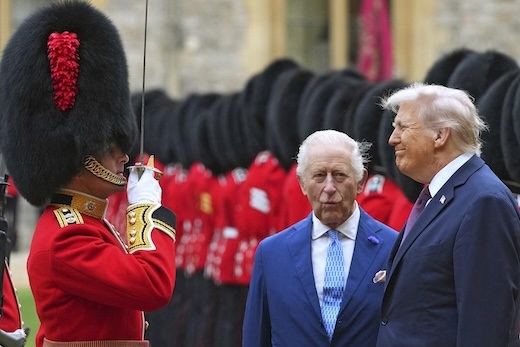
Aside from the spectacle of our leaders openly prostrating before Trump, the truth of Britain’s “special relationship” with the US was mostly found in unscripted moments around his visit.
I don’t know about you, but I find myself increasingly at a loss to put into words the extraordinary times we are living through.
Even the best satirists cannot compete with the astonishing, comic scenes offered to us by the British and US ruling classes during Donald Trump’s visit to Windsor Castle and Chequers.
King Charles giving Trump the run-around of his taxpayer-funded mansion and grounds simply served to underscore Britain’s vassal status.
But the king’s flaunting of his, and our, servitude to the US imperial order somehow failed – as it might have done in times of old – to contribute any greater stature to the perma-tanned gangster-in-chief. He just looked even more the spoilt, giant toddler in need of constant distraction and pacification.
Stuff him in the golden carriage-pram and let him roll around the grounds, out of sight, for an hour or so. Let him play with some soldiers and watch fast planes flying overhead. Let him dress up and have a party in the big dining hall.
All of this in the hope that he wouldn’t throw a temper tantrum and stick nasty tariffs on our goods.
Maybe his scriptwriter understood that postmodern irony was the only proper response. He slipped into Trump’s after-dinner speech an approving reference to George Orwell, the author of the dystopian novel 1984 about a society where everyone is enslaved to Big Brother.
What might Orwell have made of that?
Aside from the spectacle of our ruling class openly prostrating before Trump, the truth of Britain’s “special relationship” with the US was mostly found in the unscripted moments around his visit.
It was Trump explaining to a rogue Australian reporter, who tried to question the US President about his corrupt personal affairs, the implicitly transactional relationship between world leaders and the media: journalists get access to the centres of power but only if they don’t probe too deeply.
Trump made clear: “You are hurting Australia very much right now. They want to get along with me. Your leader is coming to see me soon. I’m going to tell him about you.”
Which career-minded journalist wants to lose their job – or to be held personally responsible for the imposition of a new round of US tariffs?
Which perhaps explains why, when Trump and Starmer faced the press after their meeting today, the journalists selected to address the pair obediently delivered only softball questions.
Those not in fear of their professional standing – that is, ordinary people – were free to take to the streets to protest the visit. So long as there was no danger Trump might be exposed to their clamour.
Four members of the group Led By Donkeys who dared to organise a protest that might actually be heard were arrested for “malicious communication”. They projected onto one of Windsor Castle’s towers a nine-minute documentary charting the decades-long, intimate relationship between Trump and notorious child-sex trafficker Jeffrey Epstein.
According to the 1988 law, a communication is malicious if it is “threatening, indecent, grossly offensive, or a known falsehood”. As the film was entirely truthful and nothing in it indecent or threatening (except to the US President’s reputation), the British police are presumably interpreting “grossly offensive” to mean anything that might offend Trump – which covers a huge number of truthful things.
It is not just journalists who have an entirely transactional, principle-free relationship with power. The visit was a potent reminder that politicians do too.
Yvette Cooper, the new foreign secretary, warmly greeted Trump as he stepped off his Air Force One plane in London. That is the same Cooper who a few years ago, when safely in opposition of course, made an impassioned speech denouncing Trump in no uncertain terms as a sexual predator we should have nothing to do with.
If that turnaround seemed baffling, Tory politician Penny Mordaunt was on hand to remind us what political principle looks like.
Questioned by the new Green Party leader Zack Polanksi, she called out as “student politics” his – and presumably most reasonable people’s – opposition to Trump banning books, militarising the police and reversing women’s long-fought-for reproductive rights.
Mordaunt, like King Charles, Keir Starmer and Yvette Cooper, is an adult in the room. They understand that principles are a luxury we cannot afford.
Let genocide in Gaza roll on. Describe the starvation of children as “self-defence”. Define anyone trying to stop it a “terrorist”.
Because the worst crime in the world is to behave like principles matter, and to imagine that saving innocent lives is more than just silly “student politics”.
The UN Security Council’s rejection of sanctions relief for Iran marks the final collapse of the JCPOA, pushing Tehran toward confrontation and closing the door on future diplomacy.
This Friday, the United Nations Security Council (UNSC) voted to reject the continuation of sanctions relief for Iran, meaning that the end result of the Obama-era nuclear deal has been an even greater economic blow to Tehran. Not only does this send the message of war, but it also eliminates any hope for future agreements and cooperation.
The UNSC vote represented a death blow to the Joint Comprehensive Plan of Action (JCPOA), otherwise known as the Iran Nuclear Deal. As a result of this vote, a major shift is about to occur that will have enormous violent reverberations.
When the JCPOA was originally negotiated back in 2015, part of the agreement was an in-built mechanism that would permit “snap-back” sanctions to be applied against Iran, should it fail to apply to its side of the agreement.
In late August, the E3 countries – Britain, France, and Germany – had initiated a 30-day process, which would lead to the imposition of these “snap-back” sanctions, unless Iran decided to meet unrealistic demands that they knew wouldn’t be met. Now, as per the UNSC vote to block sanctions relief on Iran, the Islamic Republic has been given until September 28 to reach a significant deal to block the imposition of sanctions.
In response to this, Russia, China, Algeria, and Pakistan, who had voted for the continuation of sanctions relief, condemned the move of the Security Council and even indicated they would not comply with such sanctions.
So, why is this a bombshell decision?
Some media commentators and analysts are treating this UNSC decision as a simple road to more sanctions and pressure on Tehran. As is usually the case, however, the devil is in the details, and to understand this, we must look to the knock-on effects.
To begin with, there are the implications of domestic Iranian politics. The current President of Iran, Masoud Pezeshkian, is from what is known as the Reformist Camp in Iranian politics. This political movement appealed to more liberal leaning Iranians and advocates opening up ties with the West, making the JCPOA one of their primary projects.
Under the former leadership of Hassan Rouhani, the Iranian negotiating team that was headed by Javad Zarif, managed to pull off the Nuclear Deal with the administration of then US President Barack Obama. At the time, it was hailed as a major deal and had even convinced many Iranians that the path of pursuing cordial relations with the West was not only possible, but favorable.
It wasn’t long, however, until the agreement began to come under greater scrutiny, due to an American-European refusal to implement their sides of the bargain. Then came the Presidency of Donald Trump, who in 2018 decided to unilaterally withdraw from the deal and impose a “maximum pressure” sanctions campaign on Iran instead.
At this stage, not only did it appear that the deal had completely fallen apart, but now the sanctions that were being imposed were even more severe than they were prior to the JCPOA in 2015. Yet, there were still efforts being made between the Iranian government and its European counterparts, despite the lack of the EU nations’ willingness to disobey the United States.
Meanwhile, the sanctions against Iran were blocking vital medical supplies from entering the country and further impacting their already suffering economy. Amidst this, the US attempted to stir civil unrest inside of Iran and in 2020 launched an assassination strike against Iran’s top General, Qassem Soleimani, of the Islamic Revolutionary Guard Corps (IRGC)’s Quds Forces.
When it came time for a political change inside the United States, during Joe Biden’s campaign, he had promised to revive the Iran deal. Yet, he failed to follow up on this pledge upon taking office in 2021. Instead, he continued to implement the sanctions of his predecessor…………………………………………………
Ultimately, the Biden administration stalled and failed to achieve any breakthrough, refusing to revive the deal, instead requesting all kinds of additional elements that were considered non-starters by Iran.
On May 19, 2024, tragedy struck inside Iran as its President and other prominent officials were killed in a helicopter crash. This led to a new election cycle, where the Reformists yet again gained power.
Iran’s President, Massoud Pezeshkian, has repeatedly made it clear that he seeks to open up relations with the West and, through his foreign minister, Abbas Araghchi, has sought to make this happen.
When the Trump administration took power, it was clear that the Israelis and the US sought to attack Iran, not to pursue genuine dialogue. Yet, the reformist government pursued diplomacy regardless, as Oman stepped in to mediate talks between delegations headed by Abbas Araghchi and his American counterpart Steve Witkoff.
During the course of these negotiations, on June 13, the Israelis decided to launch an attack that assassinated Iranian generals and nuclear scientists, while striking Iran’s nuclear project. This led to the 12-day war, as it is now being called. The Iranian public, whom the Israelis and US had expected to rebel against their government, did the very opposite and decided instead to rally behind the flag.
The US decided to participate in the Israeli attack, even further weakening the credibility of the United States. What’s more is that Iranian military officials had accused the head of the International Atomic Energy Agency (IAEA), Rafael Grossi, of providing the Israelis with sensitive information about Iran’s nuclear program.
As a result of this, the Iranian parliament passed a bill that barred the IAEA from the country, as various lawmakers called for pressing legislation that would lead to Tehran’s withdrawal from the Nuclear Non-Proliferation Treaty (NPT).
Instead, the reformist government decided to still desperately pursue talks with the Europeans, signed another agreement that re-invited the IAEA into their country to monitor the nuclear program, and reached out to try to pursue talks to revive the JCPOA.
This brings us to the broader implications of the UNSC vote and where this leads……………………………………………………………………………..
Either way this goes, the result is going to be conflict, and the more that the reformists attempt to desperately negotiate and are humiliated, the more aggressive the US and Israelis are likely going to be. What this UNSC vote signals is a major shift that has just occurred, from which there can be no going back………………………………………………………………
REACTORS: A tremor yesterday posed minimal danger to Kinmen, but a greater risk would come from tsunamis striking Chinese coastal nuclear plants, an expert said
Taiwan’s nuclear engineers and the Central Weather Administration (CWA) yesterday said that an earthquake near Kinmen County was less concerning than the potential risk posed by earthquake-triggered tsunamis striking nuclear power plants along China’s coast.
A magnitude 5.0 quake on the Richter scale, the strongest recorded in the Kinmen region in 32 years, struck at 6:56am yesterday.
The CWA said its epicenter was in the Taiwan Strait, about 93.9km east of Kinmen County Hall, at a depth of 17.2km.
Nuclear engineer Ho Li-wei (賀立維) said that while nuclear power plants are designed to withstand strong earthquakes, their cooling systems are more vulnerable.
Ho cited the 2011 Fukushima Dai-ichi disaster, where the plant’s cooling system was damaged by a tsunami triggered by the Tohoku earthquake, ultimately leading to hydrogen explosions that destabilized the facility.
If the same happened to Chinese coastal nuclear power plants, irradiated water could seep into underground aquifers or be carried into the sea, posing a devastating threat to Taiwan’s fisheries, he said.
Kinmen and Lienchiang counties would face particular risk due to their proximity to China, he said.
On the issue of spent fuel pools, Ho said that used fuel rods are stored in pools to dissipate heat and radiation, often requiring years of cooling before they can be transferred to dry storage.
The number of spent fuel rods in pools far exceeds those in active reactors, making them a significant security risk, he said.
CWA Seismological Center Director Wu Chien-fu (吳健富) said that the Kinmen earthquake was not on a fault line and carried little risk of causing a major quake.
Tsunami-generating earthquakes must reach at least magnitude 7 on the Richter scale and occur at depths of less than 30km, Wu said, adding that the likelihood of such conditions arising in the Taiwan Strait is not high.
While the Strait’s shallow waters make it theoretically vulnerable to tsunamis, Wu said that even waves generated by distant quakes would be greatly diminished by the time they reached the area.
The crowd broke into laughter as the audience was invited to attend a planned “fun day” to learn more about nuclear.
“This event really highlighted the deep level of community concern and opposition to AUKUS … The officials did all they could to avoid answering the hard questions,” -WA Greens MLC Sophie McNeill
The agency in charge of arming the nation with nuclear submarines has sought to earn the trust of residents in Perth’s south by holding a community information session.
The event drew protesters opposed to the AUKUS pact and a local defence hub being used to maintain nuclear submarines.
The Australian Submarine Agency assured event attendees about nuclear’s safety and Australia’s sovereignty, but many people seemed unconvinced.
Rigour, precision and safety, safety, safety — these are the values of the “nuclear mindset” the agency in charge of arming the nation with nuclear submarines has urged Australians to adopt.
The Australian Submarine Agency (ASA) has taken its self-described first steps towards earning the trust of the public.
A line-up of uniformed naval officers and delegates travelled to Western Australia to front the City of Fremantle’s community on Thursday night.
The meeting was touted as an “information session”, but a protest outside the town hall just before it started gave an early indication of how the night would go.
Nuclear fun day
The agency’s AUKUS advocate, Paul Myler, leaned on the US and UK’s seven decades of nuclear experience to assure the crowd of its safety credentials.
“We don’t get to automatically rely on that reputation. We have to earn that part, that legacy, and build our trust with our communities — and that’s what we’re starting here,” he said.
But the delegates made it clear they were not there to pitch AUKUS.
“That decision has been made by a succession of Australian governments,” the crowd was told in a preamble before the floor was opened to questions.
The crowd broke into laughter as the audience was invited to attend a planned “fun day” to learn more about nuclear.
WA Greens MLC Sophie McNeill, who attended the session, said it was alarming how removed the government was from the communities on the doorsteps of AUKUS.
“This event really highlighted the deep level of community concern and opposition to AUKUS … The officials did all they could to avoid answering the hard questions,” she said.
“It felt like an episode of Utopia.”
S for safety and sovereignty
Safety and sovereignty were the hot topics being thrown at the ASA.
One local questioned the record of Australia’s AUKUS partners on nuclear, citing the UK’s weapons testing in the 1950s which has left nuclear contamination at the Monte Bello Islands off WA’s coast and at Maralinga and Emu Field in South Australia.
“Nuclear weapons and nuclear testing are a completely separate issue … Australia’s position on that is very, very clear,” the crowd was told in response.
“We are not, and will not be, a nuclear weapon state.”
The agency also returned with its own S-word, stewardship, which it said described the “responsible planning, operation, application and management of nuclear material”.
Part of that stewardship includes planning for how nuclear waste will be managed.
In short, low-level nuclear waste will be temporarily stored at the HMAS Stirling naval base on Garden Island.
“The technical solutions can keep that waste safe for many years, decades I believe as a contingency, [but] we do expect the waste to be able to be moved much sooner,” a spokesperson said.
There are no plans as of yet for where high-level nuclear waste and spent nuclear fuel will be stored long term or disposed of. However,ASA said it would not be required until at least 2050.
The public also queried who would have command of Australia’s nuclear-powered submarines once they were built.
“I get asked a lot of hard questions. That one has a simple answer,” ASA director-general Vice Admiral Jonathan Mead said.
“Australian sovereignty, Australian officers, the Australian government — no other answer.”
Murmurs in the crowd indicated they were not convinced.
Protected or pawns
The room filled with claps and cheers when one local questioned the true intentions of AUKUS and labelled it an “appalling waste” of taxpayer dollars.
“We are being used as pawns to line up in a war against China, and it’s just not acceptable,” the resident said.
Mr Myler insisted it was about defence, and said developing Australia’s “strike capability” was key to protecting the nation.
“I can’t convince you, but I can only give you my own insight,” the AUKUS advocate said.
“Australian defence staff and Australian diplomatic staff and Australian government staff fight every day. Our sovereignty is absolutely at the core of everything we do.”
“They [Rio Tinto] paid no penalty, and then we found out that the maximum penalty for dropping [the capsule] in WA is only a thousand dollars,” they said.
Mr Myler offered a contrary view, describing the response to the missing capsule as impressive.
“It proved that West Australians had their act together, knew how to do this, knew how to respond, and the whole ecosystem coordinated and got that solved,” he said.
Mr Myler went on to say the “nuclear mindset” put the agency at a level “well above where private sector industry is”.
Australian Nuclear Science and Technology Organisation (ANSTO) social licence adviser Cassandra Casey noted Australia’s nuclear experience with research and nuclear medicines at a facility in Engadine, in New South Wales.
“The community, which is also my community, has grown up around ANSTO, and today the nearest homes in Engadine are just 820 metres … from that facility,” she said.
The information session began with an introduction about ASA earning the nation’s trust. The reaction of attendees indicated few minds were changed, something Mr Myler acknowledged.
“We all understand the risks around some nuclear programs. We have to do a lot more to build confidence in our nuclear program,” he said.
Iran has hit out at European states that have threatened to revive international sanctions over the monitoring of its nuclear programme.
Tehran officials on Friday accused the European states, which have said they will reimpose international sanctions if Tehran does not meet conditions, of “political bias” and insisted that they have presented fair proposals to resolve the issue.
The complaints come ahead of a scheduled United Nations Security Council (UNSC) vote later on Friday on a resolution that would permanently lift UN sanctions.
The resolution is unlikely to get the nine votes needed to pass, diplomats told news agencies, and if it did, it would be vetoed by the United States, Britain or France.
Britain, France and Germany – known as the E3 – launched a 30-day process in late August to reimpose sanctions unless Tehran meets their demands.
Iranian officials have accused the trio of abusing the dispute mechanism contained in the 2015 Treaty on the Non-Proliferation of Nuclear Weapons (NPT), which allows for the application of sanctions under a “snapback mechanism”.
“What Europeans are doing is politically biased and politically motivated … They are wrong on different levels by trying to misuse the mechanism embedded in the Joint Comprehensive Plan of Action (JCPOA),” Deputy Foreign Minister Saeed Khatibzadeh said.
The Europeans offered to delay the snapback for up to six months if Iran restored access for UN nuclear inspectors and engaged in talks with the US.
However, French President Emmanuel Macron said on Thursday that sanctions are likely to be reinstated, with European officials claiming that Iran has not engaged seriously in negotiations.
Following Macron’s statement, Iran’s Foreign Minister Abbas Araghchi had said that Tehran had presented a “reasonable and actionable plan” and insisted Iran remains committed to the NPT.
Khatibzadeh cautioned that “all options are on the table if diplomacy fails,” although he did not offer details.
“If Europeans go on this path, they are making the level of unpredictability to the highest level possible, and they are responsible for… any possible future risks,” he declared.
Dirty work
The E3 accuse Tehran of breaching the Joint Comprehensive Plan of Action (JCPOA), which was signed by Iran, the US, China, Russia, and the EU.
Under the deal, Iran agreed to curb its nuclear programme in return for sanctions relief. The agreement unravelled in 2018 after then-US President Donald Trump pulled out and reimposed unilateral sanctions.
Tensions escalated further earlier this summer, when Israel launched a 12-day war on Iran, with Israeli and US forces striking several nuclear facilities.
German Chancellor Friedrich Merz caused anger in Tehran at the time when he declared: “This is dirty work that Israel is doing for all of us.”
Iranian officials have also criticised the UN nuclear watchdog, the International Atomic Energy Agency (IAEA), for accusing Tehran of noncompliance with its nuclear obligations ahead of the attacks.
Iran has repeatedly denied seeking a nuclear weapon, while Israel is widely believed to possess an undeclared nuclear arsenal of dozens of atomic bombs.
Last month, France, Germany and the UK triggered the snapback provision of the deal after Iran refused to cooperate with International Atomic Energy Agency (IAEA) inspectors, which is tasked with monitoring implementation of the deal.
Two weeks later, Iran agreed to resume cooperation with the IAEA, but it has not yet been able to carry out all of its inspection activities and the body’s ability to operate in the country has been restricted for years.
Since the initiation of the snapback mechanism, intense diplomacy has taken place between mainly European powers and Iran to reach a deal to prevent the sanctions. Talks have not been fruitful, though the UK indicated on Friday after the vote that it was still open to diplomacy.
“The United Kingdom remains committed to a diplomatic solution. We are ready for further engagements diplomatically in the next week and beyond to seek to resolve differences,” said Barbara Woodward, the British ambassador to the UN.
The Iranian foreign ministry said in a Friday statement that it had consistently kept the path of diplomacy open and that it viewed the reimposition of sanctions as “unlawful, unfounded and proactive”.
Iran is still dealing with the impact of the 12-day Iran-Israel war, when Israel launched surprise attacks that it said was a pre-emptive move against the country’s nuclear programme. Iran insists that its nuclear programme is of a civilian nature and that it does not seek to create a nuclear bomb.
If a reactor’s spent fuel pond storage system was hit, the likely radiological releases could force millions of people to evacuate……………… In an attack against a spent fuel storage facility, US Nuclear Regulatory Commission staff conservatively estimate the radiological release could be 100 times greater than that of the Fukushima accident.20
Today, nuclear plants can be disabled in many ways without risking harmful releases of radiation. The Russians, in the Russia-Ukraine War, have demonstrated several disabling techniques
Russia’s attacks afford a clear example of disabling critical civilian objects (reactors) to its military advantage without releasing hazardous radiation
By: Henry Sokolski, Nonproliferation Policy Education Center, September 16, 2025
For nearly a decade, protecting civilians and civil objects from disproportionate military assaults has been a top priority of the Pentagon. Two Department of Defense secretaries from the first Donald Trump administration championed quantifying and reducing harm to civilians and civil objects. Under the Joe Biden administration, the Pentagon further focused on protecting civilians and civil objects, and, in 2023, Congress created a Civilian Protection Center of Excellence within the Department of Defense. This center, consisting of a staff of 30 people with an annual budget of $7 million, helped military commands execute their missions while minimizing collateral damage.1
In early 2025, however, the Pentagon cut the funding and eliminated almost all the staff in the Civilian Harm Mitigation and Response office and the Center and asked Congress to eliminate the legal requirement for its continued operation. Rattled, some wondered if the Department of War was rescinding its previous guidance on limiting civilian harm. The answer to the question was unclear.2
Trump administration officials stated the Civilian Protection Center of Excellence jeopardized war fighters’ abilities to do their jobs. But those officials did not discuss a deeper set of developments: Hamas’s October 7 attack against Israeli citizens; Israel’s crushing response, which killed thousands of noncombatants; and Russia’s attacks against Ukrainian civilians and civil infrastructure. Each development challenged many experts’ previous beliefs about what proportionality should prohibit.
Both Vladimir Putin and Benjamin Netanyahu insist their military operations are proportionate. These claims, in turn, rely on an American view of proportionality Abraham Lincoln’s top military and legal adviser, Francis Lieber, promulgated in the 1860s. The Lieber Code (General Orders No. 100) championed avoiding attacks on civilians and civilian objects. But the code also allowed, if a compelling military objective emerged whose achievement incidentally entailed harming civilian people and objects, that attacks were permissible. Commanders on the front lines should decide what actions are militarily justified or not, according to the code.3
Some have argued Lieber’s view renders proportionality hopelessly subjective. If commanders were free to determine what actions are justified, proportionality would seem to be little more than a standard of behavior the weak may demand of the strong, but the strong can effectively ignore. Victorious nations rarely litigate against their own officials or officers for disproportionate military actions (that is, for ignoring or violating the requirements of proportionality).4
Therefore, enforcing proportionality against defeated foreign nations might be attractive, but demanding one’s own military enforce proportionality is less realistic or practical. At best, realists argue, limiting harm to civil persons and objects is advisory; institutionalizing or promoting proportionality by creating Pentagon centers goes too far.
This line of thinking is intuitive and appealing. But it ignores a critical point: Sparing civilians and civilian objects unnecessary harm is often essential to achieving military victory.
Carl von Clausewitz, known for championing the necessity of violence in battle, was just as emphatic that wars could only be won by reaching political solutions the enemy’s military and leadership—and the enemy’s population—could accept. Needlessly killing civilians and destroying infrastructure critical to their welfare only complicates reaching lasting political solutions. For Clausewitz, the need to inflict violence in war had to be measured against the war’s ultimate objective, which is always political. Violence against civilians is self-defeating if it undermines the achievement of the war’s ultimate political objective.5
Thus, Winston Churchill and Dwight D. Eisenhower resisted calls in 1944 for the indiscriminate bombing of French cities and infrastructure during World War II because though such bombings would weaken German defenses, they would also dramatically undermine French political support of the Allied powers and the Allies’ resistance to the Nazis. Indiscriminate bombing would also complicate the reconstruction of the French economy after the Allies won the war.6
For similar reasons, President Harry S. Truman rejected the advice of his commander in the field, General Douglas MacArthur, who wanted to use nuclear weapons on North Korea and China. Truman feared attacking these states with nuclear weapons would escalate the conflict, cause unnecessary destruction, and turn international public opinion against the United States. Truman understood maintaining international support was essential to containing China and deterring Russia’s use of nuclear weapons after the end of the Korean War.7
One of Adolf Hitler’s best generals—Erwin Rommel—also refrained from using excessive force against civilians to protect his communications and supply lines from local disruption. Rommel understood that, in some cases, good military discipline and order required restraint, as did pacific relations with the local population (for example, in Northern Africa). Rommel’s attention to these points helped secure supply lines and reduced local resistance to his forces’ operations.8
Nazi troops terrorized enemy populations, but General Walther Wever, who served as the Luftwaffe’s chief of staff in the mid-1930s, argued such actions. Responsible for formulating Germany’s military air doctrine, Wever rejected the idea of bombing cities to break the will of the people. Wever believed such attacks were, at best, distractions from the Luftwaffe’s main mission: destroying the enemy’s armed forces. Wever also believed terror bombing was militarily self-defeating because it increased, rather than reduced, local resistance, jeopardizing the achievement of the Luftwaffe’s prime military missions.9
Besides these arguments, there are additional reasons for not hitting certain civilian facilities. Attacking chemical plants and nuclear facilities can poison the theater of operations with dangerous contaminants and hamper military operations (for example, if a dam is attacked, flooding the terrain). Such attacks can also prompt major evacuations which, in turn, retard military movements.
However, another advantage of avoiding conducting military assaults on civilian objects relates to military cohesion. As I noted in a previous Parameters article, Protocol I of the Geneva Conventions specifically discourages nations from attacking civilian objects, especially if doing so would risk releasing “hazardous forces” that could inflict “severe harm” on innocent civilians. Although the United States has signed the protocol, 174 nations took the additional step of ratifying it. The United States chose not to do so. As such, the United States is at odds with most of its NATO Allies.10
Thus, in 2022, foreign and military ministers in the European Union, the United Kingdom, and Germany declared Russian strikes against Ukrainian infrastructure and the Zaporizhzhya nuclear power plant were prosecutable war crimes. The United States took no position. In a war game conducted in 2022, close US Allies that have ratified Protocol I were at odds with Washington regarding how to respond to Russian attacks on Allied reactors. The United States’ Allies wanted to respond strongly to what they saw as a war crime, whereas the United States did not. In the game, the other NATO members were concerned NATO would be drawn into a larger conflict if Poland and Ukraine jointly attacked Russia. These concerns held up war operations and resulted in the United States using Article 5 of the North Atlantic Treaty to keep Poland from participating in a Ukrainian strike against Russia.11
Finally, temporarily disabling civilian infrastructure (for example, water, gas, and oil pumps; energy pipelines; telecommunications lines; and electrical-supply systems) can afford clear military advantages over physically obliterating civilian infrastructure, even if no hazardous forces are released. The temporary disablement of civilian infrastructure deprives one’s enemy of the ability to use infrastructure facilities, facilitates their subsequent use by one’s own forces in war, and allows for their speedy repatriation once the war is over.12
All of these points recommend fostering effective military applications of proportionality against civilian objects. The question is how.
………………………………………………………………………………………………………………………………………….If a reactor’s spent fuel pond storage system was hit, the likely radiological releases could force millions of people to evacuate, as confirmed by US Nuclear Regulatory Commission, government-sponsored, and private studies. The areas rendered uninhabitable could also be quite large: from 30,000 to 100,000 square kilometers (the latter area is larger than the entire state of New Jersey). In an attack against a spent fuel storage facility, US Nuclear Regulatory Commission staff conservatively estimate the radiological release could be 100 times greater than that of the Fukushima accident.20
The case of an attack against a spent fuel storage facility is extreme. A less dramatic scenario is the radiological release attendant to a loss of coolant induced by a military assault. Still, a wholesale, indiscriminate attack against Iran’s Bushehr power reactor could release significant radiation and force the evacuation of hundreds of thousands to millions of nearby civilians.21
Wholesale, indiscriminate attacks are precisely the kind of assault diplomats and lawyers aimed to prevent when they crafted Protocol I to the Geneva Conventions a half century ago. This international framework has several provisions that focus on the most likely type of military assault against nuclear power plants at the time: wholesale aerial attacks, which were almost certain to trigger massive releases of radioactivity. Today, things are different. With precision targeting and tailored munitions, nuclear power plants can be disabled in many ways without releasing radiation.22
Oddly, this transition to precision is still not fully reflected in the Pentagon’s legal guidance on targeting nuclear plants. …………………………………………………………………………………
Today, median miss distances for precision weapons are measured in meters or in smaller units. As a result, nuclear plants can be disabled in many ways without risking harmful releases of radiation. The Russians, in the Russia-Ukraine War, have demonstrated several disabling techniques……………
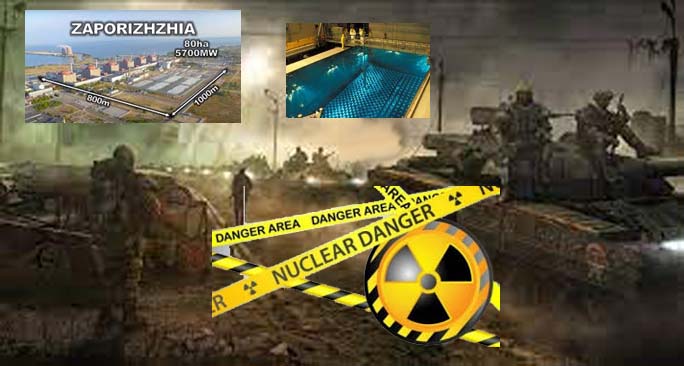
Through repeated strikes on these nonnuclear components, Russia has succeeded in shutting down Europe’s largest nuclear power plant—the Zaporizhzhya nuclear power plant. In addition, Putin can now collapse Ukraine’s entire electrical-supply system at a time of his choosing. Meanwhile, Russia says it could restart the Zaporizhzhya nuclear power plant to supply electricity to territories occupied by Russia in a matter of months.
More could be said about Russia’s studied targeting of Ukraine’s nuclear power plants and electrical-power systems. But Russia’s attacks afford a clear example of disabling critical civilian objects (reactors) to its military advantage without releasing hazardous radiation.26
Of course, other nuclear examples should be considered. Some states use portions of their civilian nuclear programs to make nuclear-weapons materials—for example, China, India, and North Korea. Disabling the facilities used to make nuclear-weapons materials would be a worthy military objective. Physically, obliterating those facilities and risking the widespread dispersal of harmful radiation, however, could be militarily counterproductive.median miss distances for precision weapons are measured in meters or in smaller units. As a result, nuclear plants can be disabled in many ways without risking harmful releases of radiation. The Russians, in the Russia-Ukraine War, have demonstrated several disabling techniques. These techniques exploited the nuclear-safety requirement for irradiated reactor fuel to be cooled continuously to prevent it from overheating, failing, and releasing dangerous, radioactive by-products.24
Rather than prompting such failures, analysis suggests Russia has been careful to target the electrical power–supply systems needed to keep the nuclear plants’ cooling and safety systems running. Russia’s aim is twofold: first, to force the plants’ operators to shut them down for safety reasons, and second, to increase the credibility of making follow-on strikes that might risk a significant release of radiation.25
The power-system components Russia has targeted include on- and off-site electrical transformers; high-voltage lines running in and out of the plants; cooling water supply systems; a major dam critical to supplying water to the Zaporizhzhya nuclear power plant; and major, off-site electrical power–generating plants needed to stabilize the electrical-supply grid supporting the nuclear plant’s safe operation…………………………
Recommendations
What steps can the US military take to update its plans and operations for targeting and protecting civil infrastructure?
First, the Pentagon should publicly share much more information about its thinking than it has to date, which would allow for greater civilian oversight, sharpen military planning, and increase the clarity of current policy and legal guidance.
Second, the Pentagon should work with private industry and other government departments focused on civil-infrastructure protection—the US Department of Homeland Security and the US Nuclear Regulatory Commission—to produce convincing public narratives about why and how civil objects should be protected and to improve existing protection schemes. Planning to protect this infrastructure has long been underway, but under the protection of the Federal Energy Regulatory Commission’s Critical Energy / Electric Infrastructure Information, which keeps these plans from the public. What’s needed is a sensible tear sheet for public consumption.27
Third, the Department of War should offer Congress routine public reports about matters related to protecting civil infrastructure. The US government must prepare the public for a future in which the United States’ electrical-supply systems, energy pipelines, biological research facilities, potentially dangerous petrochemical plants, telecommunications systems, and civil nuclear facilities may come under attack. Setting the public’s expectations about what can and should be done, actively and passively, to defend these systems should not wait until an attack occurs.
Finally, training is critical. The Department of War’s military education training institutions should offer dedicated, unclassified courses that provide technical and historical instruction on the targeting and defense of civil objects. The instruction should be fortified by unclassified government simulations for civilians and military officials, which play out alternative targeting plans against civil objects that could release hazardous forces.
How will the US government accomplish these objectives? The first step is to make mastering these matters a requirement for military promotion. This step could be done quietly, without top-down scolding, legal hectoring, or creating centers. The best US military operators and planners already know civil objects and nuclear facilities are becoming increasingly significant military targets. The Pentagon should reward and support efforts to clarify what should be done to disable and protect civil objects and nuclear facilities.
Acknowledgments: I would like to thank Caitlyn Collett for providing essential assistance in the production and editing of this special commentary.
US President Donald Trump’s summit in Alaska last month with Russian leader Vladimir Putin failed to revive long-stalled nuclear negotiations or advance efforts to preserve the last major arms control pact between Washington and Moscow, which is set to expire in February.
Trump’s subsequent push for trilateral “denuclearisation” talks involving China elicited a firm refusal from Beijing, underscoring challenges to extending the New Strategic Arms Reduction Treaty (New START) amid fears of a fresh nuclear arms race, analysts said.
When you drive into Sebastopol, an official city sign welcomes you to town and informs you that you have entered a Nuclear Free Zone.
Those too young to remember the anti-nuclear movement of the 1970s and 80s can be excused for thinking, “Wha…?”
This is the story of that sign and the movement behind it.
The long march of the anti-nuclear movement
The anti-nuclear movement in the United States began almost as soon as the United States dropped two atomic bombs on Japan in August of 1945. J. Robert Oppenheimer, often called “the father of the atomic bomb,” became part of a growing movement opposed to the development of nuclear weapons in the 1950s. He paid for his opposition with the loss of his U.S. security clearance and the loss of his job at the Atomic Energy Commission.
But the movement continued apace, growing over the years on college campuses, eventually blending with the anti-war movement of the sixties and the burgeoning environmental movement of the 1970s.
To be clear, nuclear energy and nuclear weapons are separate things. One heats your home, the other blows it up. But they’re entwined because the process of producing nuclear energy also produces material that can be used in nuclear weapons. Nuclear energy production also produces radioactive waste, which is difficult (some say impossible) to store safely.
But it wasn’t until the nuclear accident at Three-Mile Island in 1979—which was turned into a 1983 hit movie, “Silkwood,” starring Meryl Streep and Cher—that opposition to nuclear energy went mainstream……………………………………
From the sixties onward, there was also a sea change in people’s attitude toward authority.
“People tended to believe that the government was looking out for their best interests and slowly, people came to realize that the government doesn’t always look out for your best interest,” said James. “Therefore, you have to question what they’re doing.”
Sebastopol picks up the gauntlet
It was in this environment that, in 1984, Sebastopol architect John Hughes formed a group called Nuclear Free Sebastopol, which worked to get the Nuclear Free Zone initiative on the Sebastopol ballot.
………………………………………………………… the council voted 3 to 2 to place the measure on the ballot.
The measure was initially scheduled to go on the November 1986 ballot, but after pressure from activists, that was moved up to the June 1986 ballot. It was named Measure A, and it passed with 73% of the vote.
According to a Sebastopol Times article, dated June 12-June 18, 1986, activists made sure the city posted the new “Nuclear Free Zone” sign the day after the vote was made official.
…………………………………..Sebastopol’s Nuclear Free Zone ordinance reads as follows:
The City Council shall place and maintain a sign reading “Nuclear-Free Zone” at all City limit signpost locations. The sign shall be clearly visible and its letters at least equal in size to those on the nearest City limit sign.
…………………………………………………….Other nuclear-free zone efforts in Sonoma County
There were two other attempts in Sonoma County to declare other nuclear-free zones: one in Camp Meeker, which took place before the Sebastopol campaign, and a county-wide measure, Measure B. Both went down to defeat.
………………………………………………………………………………………………………. Ernie Carpenter, who lives in West County, was on the Sonoma County Board of Supervisors at the time.
“The issue of war comes and goes, but it never really goes. And the issue of nuclear weapons never really goes.” said Carpenter.
“There were a couple of businesses that kind of led the charge against [Measure B], because it hurt them. I think the populists mainly turned it down because they didn’t see it as the business of local government,” he said.
“[But] it must have worked, because we haven’t had any nuclear weapons or applications to build bombs in Sonoma County. It’s really an expression of the people, and the people need to keep making these expressions and keep pushing on the gates. It does have an impact, but it’s not always clear-cut. Ask the suffragettes—it takes a long time.”
Looking forward
When asked if he saw a future where the production of any bombs or weapons would be prohibited from being manufactured or transported through Sonoma County, Carpenter said, “Never say never.”
The people of Sebastopol hereby declare it to be a nuclear-free zone. No nuclear weapon shall be produced, transported, stored, processed, disposed of, nor used, within Sebastopol. No facility, equipment, supply or substance for the production, storage, processing, disposal or use of nuclear weapons, except radioactive materials for medical purposes, shall be allowed in Sebastopol.
Janine Jackson interviewed CEPR’s Alex Main about Trump’s Venezuelan boat assault for the September 12, 2025, episode of CounterSpin. This is a lightly edited transcript.
Janine Jackson: The US military struck a small boat in the southern Caribbean September 2, killing 11 people. The next day, the New York Timestold readers, “Pentagon officials were still working Wednesday on what legal authority they would tell the public was used to back up the extraordinary strike in international waters.”
As telling and concerning as that is, it seems it might’ve been generous in posing it as a question to be asked. In an online exchange, Vice President JD Vance declared that “killing cartel members who poison our fellow citizens is the highest and best use of our military.” And when someone pointed out that killing the citizens of another nation who are civilians, without any due process, is called a war crime, Vance replied, “I don’t give a shit what you call it.”
It does matter what things are called, how they relate to the law as we understand it, and how such an act is responded to. We’re joined now by Alex Main, director of international policy at the Center for Economic and Policy Research. Welcome back to CounterSpin, Alex Main.
JJ: Reporting on this strike is full of qualifiers. Politicosays it was “against an alleged drug vessel leaving Venezuela, which President Donald Trump said was aimed at the Venezuelan Tren de Aragua group, killing 11 suspected traffickers.” But as the story gets told and retold, qualifiers morph into facts, and it becomes a matter of how else should we kill narco terrorists, if not in international waters?
And you want to say, “Wait, wait, wait. No. We have to first properly understand the events themselves.” So before we get to the pretenses behind it, the uses sure to be made of it, what do we actually know about this strike attack on a boat, that killed 11 people last week?
AM: Yeah, excellent question, and one that still needs to be figured out. And I’m really glad you bring up the fact that from the outset, so much of the media really took at face value what the Trump administration said about this boat and its occupants and its origin, and didn’t really seem to question this idea that they were all drug traffickers, that they might be associated with the Tren de Aragua. And we can talk more about the Tren de Aragua, which is a very nebulous sort of organization indeed.
And there was no effort whatsoever made, at least initially, to try to identify who the victims were, who were these 11 people that were shot in a small boat, that was clearly not a military boat of any kind. There was no indication that these individuals were armed, and all we know about them is what we see from aerial footage that was proudly posted by President Trump and Secretary of State Marco Rubio—just shows this grainy footage of a small boat, with what looks like people inside, and then a big flash of light, and that suggests that the boat was blown up.
And that’s really all we had. But, again, you immediately saw a lot of the media just go along with the narrative that was put out there by the Trump administration, and that itself is very problematic.
And to this day, I haven’t seen, really, any sort of major media, certainly from the US, make any sort of effort to try to identify the victims. The most I’ve seen in that regard has been from local media in Venezuela, where it seems that a small village, where there does seem to be drug trafficking, they had lost eight people from that village, and other people from neighboring villages. I mean, this sort of remains hearsay, but this is the most that I’ve really seen in terms of any kind of documentation. But I haven’t really seen any journalists investigate this, in any depth. And that doesn’t seem to be a priority………………………………………………………………………………………………………..
In fact, it’s just been revealed that the video, that was heavily edited and was then posted by President Trump and by Secretary Rubio, that editing, what it didn’t show—according to sources, apparently within the military, that spoke to the New York Times—is that the boat was shot at repeatedly. The boat had turned around, and headed in the other direction. So if it wasn’t bad enough that this boat had been shot up without any clear justification, it’s becoming clear that the boat had actually turned away and was heading in the opposite direction, thereby not posing, really, any kind of threat whatsoever, if ever it had posed a threat…………………………………………………………………………………… https://fair.org/home/media-really-took-at-face-value-what-trump-said-about-this-boat-and-its-occupants/
In June, the Nuclear Waste Management Organization (NWMO) posted a “discussion paper” outlining their intention to site a second deep geological repository (DGR) for radioactive waste.
The NWMO announcement of an additional DGR has caused confusion. MPs are having trouble keeping the story straight among the various nuclear waste schemes. Already constituents are receiving letters from MPs that clearly confuse the two, which puts MPs’ credibility on the line, as well further reducing public trust in the nuclear industry.
The latest NWMO DGR proposal is for a mix of “intermediate level” radioactive and – as an add on – high-level radioactive waste from future reactors.
The NWMO, a collaboration between the provincial utilities that generate and own the high-level nuclear fuel waste produced by nuclear reactors, has a mandate under the Nuclear Fuel Waste Act (2002) to develop an option to manage the highly-radioactive nuclear fuel waste long-term.
Making a careful distinction between government policy and industry strategy, the Minister of Natural Resources had acknowledged the nuclear industry’s proposed strategy for low and intermediate level wastes, framing the proposed strategy as one of “two fundamental recommendations” (the other related to low level wastes). The Minister summarized the plan thus: “Intermediate-level waste and non-fuel high-level waste will be disposed of in a deep geological repository with implementation by the NWMO.”
However, over the last 18 months the NWMO has increasingly been adding to the proposed DGR mix the high-level waste fuel waste from future small modular reactors and from the mega-reactors proposed for both the Bruce Nuclear Generating Station in southwestern Ontario and the Peace River area in Alberta.
The siting process for the DGR for high-level waste was extremely divisive and since the selection of the Revell site in northwestern Ontario in November 2024 there has been rising opposition and now a legal challenge from a nearby First Nation. The new DGR proposal promises more of the same divisiveness, opposition, and political pressures.
With many Arab nations feeling a rising threat from Israel, the Saudi-Pakistan defense pact announced this week brings Pakistan – and its nuclear umbrella – into the region’s security equation. The “Strategic Mutual Defense Agreement” signed between Pakistan and Saudi Arabia on Wednesday effectively marries Riyadh’s money with Pakistan’s giant nuclear-armed military, analysts said.
EVENTS. 22 September – Spazio Europa, Rome – Global Launch of the World Nuclear Industry Status Report 2025 To attend in person, please register here, The event will be live-streamed on YouTube here. Note: The full 589-page report will be available for free download as of 22 September 2025 at 10:00 CET here
I am ANTIFA. Or so says President Donald Trump, branding me and millions like me as terrorists in the same breath he decries “fake news” and “radical left” bogeymen.
It’s a label that stings not because it’s novel – God knows we’ve heard worse – but because it erases the very soil from which it springs.
Let me tell you who I really am, before the algorithms and outrage machines bury the truth. My father fought in World War II. He was one of the Diggers who stormed the beaches, dodged the shells, and stared down the abyss in places whose names still echo like ghosts: Tobruk, El Alamein, New Guinea.
When the war spat him out, he landed in a Soldier Settlers camp on the dusty fringes of rural Australia – a patchwork of tin shacks and hopeful paddocks where broken men tried to stitch lives from the scraps of peace. Everybody’s father there had fought. The camp was a republic of the scarred: limps from shrapnel, coughs from gas, eyes that flickered away when thunder rolled like distant artillery.
Nobody talked about the war. Not really. The soldiers wore their deep wounds like second skins – visible to all, but spoken of in silences around the communal fire, or in the way a man’s hand trembled pouring tea. Their lives were irrevocably changed, folded and refolded like old maps no longer leading anywhere familiar. But they carried on. They planted crops in unforgiving soil, raised kids who knew the taste of damper bread and the sting of billy tea, and built a world where freedom wasn’t a slogan but a hard-won breath.
We’d eventually learn, piecing it together from half-heard stories and library books, that they weren’t just fighting other armies. They were battling ideals – the poison of fascism that choked Europe, Asia, and beyond. Ideals that promised order but delivered ovens and gulags, that crushed the human spirit under the boot of blind obedience.
My father and the thousands around the world – Allies from every corner of the globe – were the antidote. They were anti-fascists, plain and simple. Not with hashtags or headlines, but with bayonets and bullets, with the sweat of reconstruction and the vigilance of survivors.
And so were we, the children, schooled in the camp’s unspoken creed: Guard the light. Question the shadows. Forgive the man, but never the machine that marched him to madness.
As scarred as those soldiers were, something extraordinary happened in that camp. Former enemies – Germans, Italians, even Japanese migrants fleeing their own ruins – washed up on Australian shores, seeking the same fragile peace. Friendships formed over shared fences and shearing sheds. My father put it to me one evening, his voice gravel from years of unspoken grit: “Michael, I forgave the enemy the day the war ended. The ordinary bloke on the other side? He was just like me – sent to die for a lie. But not the government that shipped us off like cannon fodder. And never the belief that drove those governments to war. That’s the real enemy. That’s what we fought.”
That forgiveness wasn’t weakness; it was the ultimate defiance of fascism’s divide-and-conquer rot. It built bridges where bombs had fallen. It echoed the Nuremberg trials, the Universal Declaration of Human Rights, the quiet revolutions of decency that followed. Anti-fascism wasn’t a club or a costume – it was the air we breathed, the legacy etched into every settler’s callused hand.
Yet now, in 2025, President Trump tells me – and millions like me – that I belong to a terrorist organisation. ANTIFA, he calls it, a shadowy cabal of chaos when, in truth, it’s the ghost of that very fight: a refusal to let authoritarianism creep back in, disguised as populism or “America First.” As a result, I see good people – everyday folks with ‘settler blood in their veins’ – being abused on social media. Labeled “warmongering ANTIFA bastards” for daring to call out lies, for marching against wars and white nationalism, for remembering that fascism doesn’t die; it just rebrands. I seem to have missed something.
What changed? The weapons? No – the ideals are the same: the cult of the strongman, the demonisation of the “other,” the march toward unchecked power. The difference is the battlefield. It’s not Normandy or the Pacific; it’s Twitter feeds and town halls, where words are the new front lines. And the soldiers? We’re still here, the children of those camps, scarred by our own wars – of inequality, climate denial, eroded truths – but carrying on.
Trump’s slur isn’t just an insult; it’s an erasure. It paints the anti-fascist as the fascist, the defender as the destroyer. But history doesn’t bend that way. My father’s forgiveness teaches me to pity the man behind the microphone, twisted by his own government’s machine. Yet it also demands I fight the belief that fuels him – the one that whispers war is glory, division is strength, and truth is optional. So yes, Mr. President, call me ANTIFA. I’ll wear it like my father’s medals: not for the shine, but for the weight. Because in the end, the real terrorists aren’t the ones who remember the war. They’re the ones who want to start another.
There’s a concerted attempt to attack Scotland’s long-standing commitment to no new nuclear power, alongside a full-scale assault on the idea of Net Zero, and the very basics of climate policy (however inadequate mainstream policy is).
This is being led by Nigel Farage who has called Net Zero ‘the New Brexit’, whatever that means. All this has been echoed by Tony Blair’s intervention this week where he argued that any attempt to limit fossil fuels in the short term or encourages people to limit consumption is “doomed to fail”. Alongside this we can see Scottish Labour’s recent commitment to the cause of new nuclear power in Scotland.
Today The Scotsman ran with a front-page splash all about how ‘SNP voters back nuclear power’ by Deputy Political Editor David Bol and Alexander Brown.
The article was replete with quotes from Labour MSP for East Lothian, Martin Whitfield, Scottish Conservative MP, John Lamont, who said the Scottish Government embracing nuclear power would be “basic common sense”. Then there’s a quote from Sam Richards, founder and campaign director for Britain Remade, who, it turns out commissioned the poll and was also enthusiastically pro-nuclear.
What The Scotsman didn’t explain though, was who ‘Britain Remade’ are? They’re presented as if they’re maybe pollsters or some independent think-tank.
But Britain Remade is a Tory think-tank and lobby group campaigning on behalf of nuclear power. Jason Brown is Head of Communications for Britain Remade, a former No. 10 media Special Adviser and Ben Houchen’s comms Adviser.
Jeremy Driver is the Head of Campaigns at Britain Remade, a former Lloyds Banker and Parliamentary Assistant to Ann Soubry. Sam Dumitriu is Head of Policy at Britain Remade who formerly worked at the Adam Smith Institute. These are Tory SPADS working on their own campaign to support new nuclear in Scotland: Lift The Ban On New Scottish Nuclear Power.
Britain Remade claimed they are not affiliated: “We’re an independent grassroots organisation. We are not affiliated with, or part of, any political party” their website says. They may not be officially affiliated to any party, but it’s very clear where their politics (and their staff) come from.
So here we have the Scotsman giving over its front-page to a Tory lobby group to promote their campaign. On the same day they published a similar piece in the Telegraph “SNP’s ‘senseless’ nuclear ban ‘damaging Scotland’” so it’s really working for them.
This is not just a question of client journalism, it’s a question of how far right-wing forces, often working with dark money, will attempt to derail even the most modest (and completely inadequate) environmental policies. Quite why Saudi-funded Tony Blair should jump on the anti Net Zero bandwagon is anybody’s guess, but it’s quite clear there is a coordinated pro-nuclear lobbying group in action in Scotland that pans across the Conservatives and Labour parties, and is supported by astroturf groups and pliant media friends. Watch this space for more on the new nuclear lobby.