Letter Nicholas Malins-Smith: : The comment by Sir David King, the former chief scientific adviser, about how the eastern side of Britain is “tilting into the sea”, particularly around Norfolk and Suffolk, is the result of more than just aggressive coastal erosion caused by climate change (“Residents lambast ‘nuts’ location of Sizewell C as coastal erosion gains pace”, Report, February 24).
Britain is still experiencing land mass movement where the north and western parts are slowly rising, while the south and eastern parts are sinking. This phenomenon is a very gradual geological process known as “glacial isostatic adjustment” (GIA). During the last ice age, the weight of massive ice sheets pressed down on Scotland and northern Britain, forcing the land to subside. Meanwhile, the southern part of Britain acted as a counterweight and was raised slightly. The melting of the ice sheets resulted in the land that was pressed down to begin slowly rising, causing a “see-saw” effect that lowers the south by an approximate equal amount.
The “tilting” effect of GIA has been going on quite independently of more recent concerns about sea-level rise caused by climate change, although the combination exacerbates the likely impact on certain coastal areas.
The Suffolk shoreline has long known about the effects of coastal erosion. Most of the original town of Dunwich was lost to the sea in storms a very long time ago. The little that is left of Dunwich is about 3.5 miles north of where the Sizewell C nuclear power station will be built.
I’ve spent the last three days obsessively refreshing the New York Times app. Every few minutes there are updates: missiles raining down in Tehran, nearly 200 girls massacred by a bomb “accidentally” hitting their school in southern Iran, retaliatory attacks carried out by the country’s (few) allies, the death of the tyrannical Ayatollah Khamenei. But nowhere on the screen—no matter how far past the fold I read—is there coverage of the Ebrahimi family and what has become of them. Instead, I find locations that have been bombed and I enter them into Google Maps, plotting how far they are from my family’s apartment. I look at the red, inverted teardrop pinpointing their building, and I wonder if they will make it through this alive………………………………………………………………………………………………………..
My anger reaches back to the past, all the way to 1953 and the coup. So few Americans know that Iran wasn’t always an Islamic regime. The democratically-elected Prime Minister Mohammad Mossadegh nationalized Iran’s oil so that his country could benefit from their primary natural resource. The US couldn’t have that. So the CIA orchestrated a coup, overthrowing Mossadegh, and reinstalling Reza Pahlavi, the former Shah, who was essentially a puppet of the West. The 1979 Iranian Revolution was a direct response to this, and that’s when the Islamic Republic of Iran was born. And it has suppressed and terrorized its people ever since.
……………………………………………………………… From the constant fear of internal crackdowns and external war, to the failing economy and assault on civil liberties, Iranians haven’t known peace in decades. But they continue to stand up and fight for their rights, they continue to educate themselves to contribute to their society and the world, and they continue to sacrifice their lives so that their children can know a better day.
…………………………………………………………… I’m no historian or political scientist, but even I know that regime change cannot come from external forces. It has to come from within. Khamenei may have been killed, but there is no organized opposition coming to step in and rule, there is no charismatic leader around which the people can coalesce, there is no one to save the day and liberate Iran. Instead, there is the Iranian Revolutionary Guard Corps (IRGC), the military that protects the interests of the Islamic Regime, and it is still very much alive. No one knows how this war will play out, but the likeliest scenario is that the IRGC will retain control, and whoever they tap to lead Iran will be even worse than Khamenei.
………………….. I have a hard time believing that’s what this is. This is Epstein. This is midterm elections. This is a narcissist vying for a Nobel Prize. But most of all, to Trump and the others, this is a game. It even has a game’s name: Operation Epic Fury. They don’t give a fuck if their own people die, why would they care about some brown people halfway across the globe.
As the Trump administration continues to grapple with the fallout from the betrayal of its core campaign promise to abandon the cycle of endless wars in the Middle East that have marred U.S. history since the dawn of the new millennium, the American public isn’t the only target of the barrage of propaganda it has unleashed in a hapless attempt to save face. The administration has undertaken the same tactics with the hopes of brainwashing its military in order to build support for Trump’s war in Iran. Instead of political rhetoric, the propaganda aimed at U.S. troops is rooted in a darker Messianic message that underscores the ulterior motives driving the conflict.
According to the Military Religious Freedom Foundation (”MRFF”), a non-profit civil rights watchdog aimed at protecting the religious liberties of enlisted personnel, U.S. military commanders are accused of telling troops that Trump’s war in Iran is designed to be the apocalyptic catalyst that brings forth the Second Coming of Jesus Christ. According to the MRFF, it has received over 100 complaints from troops across 40 different units spanning 30 different military sites making this accusation. One complaint from a non-commissioned officer filed with the MRFF distilled the nature of these allegations by detailing how their combat-unit commander claimed that Trump has been “anointed by Jesus to light the signal fire in Iran to cause Armageddon and mark his return to Earth.” The complaint goes on to read that “He [the commander] urged us to tell our troops that this was ‘all part of God’s divine plan,’ and he specifically referenced numerous citations out of the Book of Revelation referring to Armageddon and the imminent return of Jesus Christ.”
When confronted with the volume of complaints filed with the MRFF by U.S. military personnel, a White House official denied the accusation that commanders were invoking any end times prophecies to cultivate support for Operation Epic Fury. Instead, the White House official responded by reiterating the objectives the Trump administration has put forward: destroying Iran’s ballistic missile program, its munitions industry, and its navy. Pentagon officials did not respond to requests for comment regarding the complaints filed with the MRFF.
………………………………….. The eschatological narrative U.S. commanders are accused of conditioning troops with in complaints made to the MRFF follows a troubling tone instilled by senior officials of the Department of Defense. No official has been more vocal with this rhetoric than Secretary of Defense Hegseth, who has long echoed the views of conservative theologian Douglas Wilson in advocating for the restoration of guiding principles rooted in Christianity over U.S. governance and society.
However, like most members of the Trump administration, Hegseth’s version of Christianity is perverted by the contradictory belief in “Judeo-Christianity.” This corruption of Hegseth’s “Christian” worldview is evidence from remarks he made in 2018, when speaking during the Arutz Sheva conference at the King David Hotel in Jerusalem. During his speech, Hegseth categorized the decision of the first Trump administration to recognize Jerusalem as the capital of Israel as a miracle. Hegseth then proclaimed that “there’s no reason why the miracle of the re-establishment of the temple on the Temple Mount is not possible,” going on to proclaim that “a step in that process, a step in every process, is the recognition that facts and activities on the ground truly matter.” Years later after being appointed Secretary of Defense in the second Trump Administration, Hegseth now appears to be manifesting that vision by leading the U.S. assault on Iran.
Christian leaders aligned with the Trump administration have also amplified the message that war with Iran is a sign of the coming Apocalypse in an effort to cultivate support for the conflict…………………………………………………………………………………………………………………………………………………………..
While remarks from Secretary of State Marco Rubio and Senator Mark Warner illustrate the Israel-driven interests behind entering into war with Iran, the speech made by Secretary Hegseth in 2018 reveals a deeper motive that goes far beyond the political realm, revealing the esoteric forces ultimately shaping it to do their bidding. The remarks made by Hegseth in 2018 center on the sacred tenet of the building of the Third Temple at the core of Jewish eschatology. Moreover, they highlight how the version of “Christian” nationalism shamelessly espoused by members of the Trump administration like him and U.S. Ambassador to Israel Mike Huckabee is nothing more than a vehicle to further instill Zionism as the driving force behind U.S. policymaking. The complaints filed with the MRFF reveal how deeply that influence has corrupted the Trump administration, erasing any doubt that its decision to wage war on Iran is not a religious mission anointed by any Christian concept of God. Instead, it is one being done at the behest of its masters in Israel, who, as its actions show, the Trump administration has come to revere more than Christ. https://ddgeopolitics.substack.com/p/us-military-leaders-tell-troops-trump?utm_source=post-email-title&publication_id=1769298&post_id=189851466&utm_campaign=email-post-title&isFreemail=true&r=1ise1&triedRedirect=true&utm_medium=email
A WIRRAL company that transports uranium overseas will be prosecuted for health and safety offences following an incident involving a leak at its facility. The Office for Nuclear Regulation (ONR) has notified Capenhurst-based Urenco ChemPlants Ltd that it faces prosecution alongside contractor Babcock Critical Services Ltd after the incident in 2024. According to the ONR in February 2024 at the Tails Management Facility on the Urenco UK Ltd. nuclear licensed site in Capenhurst, a metal container holding almost 11 tonnes of uranium oxide powder fell from a forklift truck, striking surrounding equipment within the facility.
by repeatedly bringing up Iranian state brutality, US corporate media effectively distract from the brutality of the strikes on Iran
the fact that the government “oppresses women”—forever a favorite talking point of the same media outlets that advocated for bombing Afghan women to save them from the Taliban.
the media’s tendency to humanize Iranians only when they can be portrayed as victims of their own government.
The United States and Israel launched attacks on Iran on February 28, propelling the entire region into a predictable cataclysm of unprecedented proportions.
This puts paid to the alleged “peacemaking” project of US President Donald Trump, who was supposed to be keeping the country out of international wars rather than actively seeking to expedite the end of the world.
The attacks put an abrupt end to the negotiations underway between the US and Iran—to the delight of Israeli Prime Minister Benjamin Netanyahu, who has always viewed as anathema anything remotely resembling diplomacy or the pursuit of peace.
‘Trigger Iran to retaliate’
Three days before the joint strikes, a Politico exclusive (2/25/26) reported that “senior advisers” to Trump “would prefer Israel strike Iran before the United States launches an assault on the country.” As per the report, administration officials were “privately arguing that an Israeli attack would trigger Iran to retaliate, helping muster support from American voters for a US strike.”
So much for subsequent US/Israeli attempts to cast the assault as “preemptive” in nature. Indeed, there is nothing at all “preemptive” about forcing Iran to retaliate; this is instead what you would call a deliberate provocation.
Unfortunately for the “senior advisers,” Trump and Netanyahu ultimately opted to pull the trigger simultaneously, thus depriving the US administration of its fabricated casus belli.
‘A clear explanation of the strategy’
In the aftermath of the strikes, certain US corporate media outlets unleashed ostensible critiques of the war—having apparently spontaneously forgotten their own fundamental role in paving the warpath by devoting the past several decades to demonizing the Iranian government (or “regime,” as we are required to refer to imperial foes).
The New York Times editorial board (2/28/26), for example, immediately penned an intervention titled “Why Have You Started This War, Mr. President?”—the headline of which was later amended to “Trump’s Attack on Iran Is Reckless.”
This is the same New York Times, of course, that has been known to publish such masterpieces as “To Stop Iran’s Bomb, Bomb Iran” (3/25/15), a 2015 call to arms by former US ambassador to the United Nations John Bolton.
Now, after calling out Trump’s “reckless” attack, the Times editorial board proceeds to undertake its own rationalization of war on Iran—provided it is overseen by “a responsible American president” who takes the time to offer “a clear explanation of the strategy, as well as the justification for attacking now, even though Iran does not appear close to having a nuclear weapon.”
Because Trump could give fuck all about being “responsible,” however, the US newspaper of record assumes the duty of laying out the litany of Iranian transgressions for its readers, such as the killing of “hundreds of US service members in the region”—decisive proof that “Iran’s government presents a distinct threat because it combines this murderous ideology with nuclear ambitions.”
Never mind the hundreds of thousands of regional deaths wrought in recent years by the (already nuclear-equipped) US military, including on account of the 2003 US invasion of Iraq, which the Times and like-minded media did their best to shove down the throats of the American public.
‘Few recent parallels’
Following the weekend’s strikes on Iran, many US media were quick to mention the Iranian government’s response to protests that erupted in December against high inflation. The Washington Post (2/28/26), for instance, specified that the “strikes come in the wake of a violent crackdown by Iran’s security forces…on anti-government demonstrations.”
Citing reports of “more than 7,000 people dead,” the Post went on to lament that “the level of violence against protesters has few recent parallels, human rights groups say.”
Not mentioned in such reports is the key role devastating US sanctions on Iran—a form of lethal violence in themselves—played in fomenting the protests in the first place. Ditto for Israel’s own admitted interference; Mossad’s Farsi-language X account urged Iranians to “Go out together into the streets. The time has come.” The Jerusalem Post (12/29/25) reported that the intelligence agency continued: “We are with you. Not only from a distance and verbally. We are with you in the field.”
“Foreign actors are arming the protesters in Iran with live firearms, which is the reason for the hundreds of regime personnel killed,” Tamir Morag of Israel’s right-wing Channel 14 remarked (Times of Israel, 1/16/26). “Everyone is free to guess who is behind it,” he winked.
But by repeatedly bringing up Iranian state brutality, US corporate media effectively distract from the brutality of the strikes on Iran, which happen to be perpetrated by two states that have zero “parallels” in terms of “levels of violence.” The ongoing US-backed Israeli genocide in the Gaza Strip has officially killed more than 72,000 Palestinians since October 2023, though household surveys indicate the true toll could be substantially higher (Lancet, 2/18/26).
In its own antiwar-but-not-really dispatch, the Times editorial board also took care to reference how Iran “massacred” protesters, as well as the fact that the government “oppresses women”—forever a favorite talking point of the same media outlets that advocated for bombing Afghan women to save them from the Taliban.
Unuseful victims
It can be safely filed under the “can’t make this shit up” category that among the first casualties of the current war on Iran were the at least 175 people confirmed dead in a missile strike on a girls’ elementary school in the city of Minab.
While the establishment media initially treated this particular atrocity as a brief aside (Washington Post, 12/28/26; Wall Street Journal, 12/28/26)—leaving the job of actual reporting to independent outlets like Middle East Eye (2/28/26) and Drop Site News (2/28/26)—it eventually became unavoidable. As the corpses of young children are of no use to the imperial narrative when they are killed by the US and Israel rather than by Iran, however, the requisite moral condemnation has been in short supply.
Nor has much attention been paid to the hundreds of other casualties of the US/Israeli strikes, which is unsurprising given the media’s tendency to humanize Iranians only when they can be portrayed as victims of their own government. While the death toll made headlines in outlets like Al Jazeera (3/2/26) and Truthout (3/2/26), in major US media like the New York Times (3/2/26) and Washington Post (3/2/26), it was basically a footnote.
Three US troops killed in Iran’s retaliatory strikes, on the other hand, have received considerable airtime, with the Associated Press (3/1/26) noting that these were “the first American casualties in a major offensive that President Donald Trump said could likely lead to more losses in the coming weeks.”
And as the entire region rapidly goes up in flames, it seems those senior US advisers may have gotten their casus belli, after all.
Walt Zlotow West Suburban Peace Coalition Glen Ellyn IL, 5 Mar 26
President Trump bet his entire criminal attack on Iran as a quick 3 day operation which would force Iran’s capitulation. Kill its leader Ayatollah Ali Khamenei and the 90 million Iranians would rise up against their government and make peace with new master America.
It has backfired spectacularly. The vast majority of Iranians have rallied around the Islamic government. When Trump demanded Iran surrender, the remaining government publicly told Trump, ‘Go to hell.’ Instead, they have launched thousands of missiles and drone explosives on US instillations thruout the region. American deaths and injuries are occurring. They are successfully bombing America’s criminal war partner Israel, the real mastermind of this self-destructive war. Iran has closed the Strait of Hormuz which will quickly destabilize the world economy over oil pricing. Iran’s attacks on US resources in the Gulf States will possibly destabilize the entire region.
Trump, realizing he’s both failed and trapped, is becoming increasingly more detached from reality. The US is already running low munitions to fight a long war, but Trump claims we have enough to fight multiple wars “forever”. But he quickly contradicted himself by claiming any shortages are due to negligence of his predecessor he only refers to as “Sleepy Joe”. This from a debilitated president falling asleep at public events. He’s cut off all trade with Spain because they refuse to help Trump wage his criminal war. Trump hints at boots on the ground in Iran, setting congressional critics’ hair on fire.
Why doesn’t Iran fold against the largest military in the world and its criminal war partner Israel? Simple. After trying to negotiate peace with these two brutal, vicious countries for decades, Iran realizes both represent an existential threat to their existence. Facing obliteration, proud Iran has decided to go down fighting, taking America and Israel with them.
Knowing it was coming, Iran has been preparing years for all out war. It has tens of thousands of missiles and drones scattered and well-hidden to prevent US, Israeli destruction. The US, Israeli hunters are now becoming the hunted. US embassies in the region, some already under attack, are telling their staffers they cannot help evacuate them.
Trump has nearly 3 years left in office. His failed 3 day quickie war to destroy Iran as an Israeli hegemonic rival may turn his last 3 years into an unrelenting personal catastrophe. Alas, it may also be a catastrophe for Israel, America, the Middle East, possibly the entire world.
It’s only Day Five of the war, but surely the epic stupidity of Australia so cravenly backing the US-Israeli invasion of Iran is evident by now. Michael West reports.
We are led by fools and sycophants. The illegal, unprovoked invasion of Iran is not just garden-variety stupidity. This is stupidity on a grandiose, stratospheric scale.
The Israeli propaganda narrative that Iranians would sprinkle rose petals at the feet of their invaders has not come to pass. It has already been demolished in fact.
Instead of bringing freedom and democracy – ‘regime change’ – we have brought chaos, possibly a world war, and definitely the destruction of the Middle East. The world economy is being hit hard as we write; oil prices spiralling, energy prices about to soar, and the inexorable spectre of inflation and recession.
“And it didn’t have to happen.“
This was a war of choice. Even without the “Epstein Coalition” – as the Iranian media so aptly dubs their invaders – murdering 168 Iranian school girls on day one, ‘peace through strength’ was never going to happen.
Quite the contrary. The illegal and unprovoked invasion of Iran has hardened the resolve of Iranians, who are massing in their hundreds of thousands across the country to mourn their dead and chant Death to America, to back their regime.
Where was the advice?
The Epstein Coalition killed the Ayatollah, who was actually against nuclear power; he was a moderate. Did Albo and Penny Wong not seek advice from Foreign Affairs that attacking Iran was folly, that the anti-regime protestors were a minority, that the pre-invasion protests were a Mossad and CIA psyop, that Iran might attack US proxy states in the region, that invasion would be a Brobigdadgian mistake?
Or did they ignore the advice in favour of a Washington regime compromised by the Epstein pedophile scandal?
And now, we see the feeble, hypocritical whining by Israel and its supporters about Iran attacking the Gulf states. Is that our only moral defence? Decades of supporting these regimes: Bahrain, Qatar, Kuwait, Saudi Arabia, and the United Arab Emirates – US proxy states all – regimes now unravelling, the oil price is soaring, inflation and recession are beckoning globally.
Images are emerging from Bahrain of locals cheering on the Iranian missiles. Were DFAT and our politicians unaware of popular angst in the Gulf states against American imperialism?
And what did they expect Iran to do in the face of this existential threat? Not blow up American bases and infrastructure while the US attacked them; after the US betrayed them at the very negotiating table when they were offering significant concessions on nuclear enrichment, all to avoid war? This war.
Australia, the US flunkies
Yet here was Australia, Saturday night, first out of the blocks worldwide to throw its support behind Donald Trump and his preposterous “Operation Epic Fury”, a probable pedophile being blackmailed and led around by the genocidal Benjamin Netanyahu like a pony at the fairground show.
“Operation Epstein Fury”, it was fast labelled. The soaring, craven stupidity is hard to grasp. Both major parties backing it. Albo first, then Angus Taylor rushing to tow the Donald’s line. Then, Pauline Hanson, too, who even congratulated and praised Netanyahu. We are led by fools and sycophants.
The flawed defence of atrocity
To address the empty rhetoric of the pro-war lobby, criticism of this war does not equate to support for the regime in Iran. Defenders of the US-Israel atrocity are busy with their swarms of social media bots peddling the argument that “you are an Islamist terror supporter” if you criticise the invasion.
This is the 2026 version of “You are a Hamas supporter” if you argue against genocide in Gaza.
The cold facts of this debacle are that regime change does not work, that Iran did not want this war, that Iran appears to be exceptionally well prepared – even winning the war – that the Epstein Coalition, which Australia supports, is daily backing war crimes: blowing up hospitals, schools and civilian infrastructure.
“This is a war which has already been lost.“
The obvious reality is that regime change wars are a demonstrable failure. Vietnam. Iraq. Afghanistan. Iraq – a million dead, irretrievable regional stability. In Afghanistan, 20 years, trillions of dollars spent, four US presidents, six Australian PMs – all to replace the Taliban with the Taliban.
And here we are, the world’s busybodies, doing it again.
Who would ever negotiate with the US in good faith again, or Israel for that matter? Iran did not want this war. Iran has not attacked another country in 300 years.
The US lured them to the negotiating table, then, without warning, murdered their leadership. This echoes last year’s 12-day war, where Israel and the US lured them in on the premise of good faith talks, then murdered them and now play the victim.
What did they expect Iran to do in the face of this existential threat?
The record speaks for itself. The US is the biggest invader of other countries in history. Israel has, last year alone, attacked Iran, Iraq, Lebanon, Yemen, Jordan, Palestine, Qatar, Tunisia, Malta, and Greece.
Six illegal attacks of sovereign nations, as well as three illegal attacks in international waters equals 9 all up. In one year. And now they are invading Lebanon again, seizing more territory as their puppets, America, fight their campaign against Iran.
Albo, what are you doing?
We know who the war mongers are. We are the war mongers. Yet, in his bizarre statement of support, Prime Minister Anthony Albanese was the fastest out of the blocks of all the allies on the weekend, issuing a false statement.
The claim, echoed by the usual warmongers of the Lib-Lab establishment, is that Iran is guilty of attacks on Australian soil, referencing alleged attacks on a deli in Bondi.
We know who the war mongers are. We are the war mongers. Yet, in his bizarre statement of support, Prime Minister Anthony Albanese was the fastest out of the blocks of all the allies on the weekend, issuing a false statement.
The claim, echoed by the usual warmongers of the Lib-Lab establishment, is that Iran is guilty of attacks on Australian soil, referencing alleged attacks on a deli in Bondi.
Then there is the age-old claim that Iran is about to produce nuclear weapons. The US and Israel’s nuclear risk claims have been so roundly discredited it’s a joke.
Benjamin Netanyahu has been trying to instigate a war against Iran for 30 years – claiming Iran is days away, weeks away, months away from nuclear missiles.
And they were at the negotiating table again when the Epstein forces murdered them.
The propaganda
We are now seeing mainstream media decry the ‘illegal attacks’ on Israel and the Gulf states. Yet the ‘victim card’ is tapped out. Around the world, outside the legacy media propaganda, there is little sympathy for Israel having razed Gaza and slaughtered between 72,000 and 700,000 Palestinians while stealing more land in the West Bank daily.
It will continue. The media and political classes have failed so majestically that they can only try to salvage their authority with more propaganda.
The deplorable coverage of the murdered schoolgirls in Iran is a case in point. The “40 beheaded babies” and the “mass rapes” of Hamas filled the headlines in the West on October 8, 2023. Yet real murders – 170 murdered schoolgirls – have hardly rated a mention. Yes, a mention perhaps, but a side story, buried, no headlines of outrage.
Can’t handle the truth?
Is the truth too hard to handle? Is it not evident to everybody except the most brainwashed advocate of the Epstein lobby that Israel – the government, the state – is the problem here?
Netanyahu has won his ambition to drag America into a war against Iran, and if you follow the money, while world stock markets teeter, the stock market in Tel Aviv is surging, replete with weapons companies as it is.
Meanwhile, the ASX is tanking, ergo our savings. Oil prices are surging, ergo higher energy prices and inflation. The Houthis, Iran’s allies, are shooting again in the Red Sea while, on the other side of the Arabian peninsula, Iran has blocked the Straits of Hormuz, choking off a large chunk of the world’s oil supply.
Higher prices in India and China will mean higher prices for imports and inflation around the world.
The lessons of history have not been learnt; in fact, they have been discarded in spectacular fashion.
The truth is, the United States has no idea what will happen if the Iranian government does fall. They are killing one leader after another, thinking they will eventually find someone who will work with the U.S. as Delcy Rodriguez has in Venezuela.
I’m aware of no one who actually studies Iran who thinks that is going to happen. It’s even less likely now that he’s killed most of the people he thought might fit that bill.
The U.S.-Israeli war on Iran has been built on lies. Here is the truth about Iran’s nuclear weapons program, the claim that Iran was an imminent threat, and the lie that Trump has a plan for what happens next.
When the United States invaded Iraq in 2003, many of us knew, and argued loudly, that the American public was being lied to. We knew that Iraq had no weapons of mass destruction and could back up our claims. The war went ahead anyway, but eventually, the lies were exposed.
Rather than build up support for his illegal and immoral war on Iran, as George W. Bush did nearly a quarter century ago, Donald Trump elected to simply ignore public opinion and start the war on his own. But, while Trump has his war and is not likely to be stopped by domestic forces until the war runs its course, he has found a need to justify his criminal actions.
As is their way, Trump and his minions simply lie. They’re not convincing many people, as polling shows that only about one in four Americans supports the Israeli-American attack on Iran.
This time, the lies are coming in true Trumpian fashion: they are inconsistent, contradictory, and confusing, meant more to overwhelm the audience than to convince it. But we shouldn’t be complacent about these lies. They have a way of both framing the debate and taking on a life of their own over time.
It’s important to examine some of these lies, and we should start with the biggest one.
The “Iran nuclear weapons program” lie
Over and over, we hear about the threat of an Iranian nuclear weapon. But rare indeed are the arguments for why this should be considered a casus belli when all reliable intelligence assessments have agreed that Iran has not pursued a nuclear weapon since 2003.
That assessment never wavered and never changed. It remains in place today. In the United States, it was reinforced by Donald Trump’s own intelligence services, collectively, just last year.
Moreover, while Trump’s endless boasting about having “obliterated” Iran’s nuclear program was always a lie, it is undeniable that significant damage was done to Iran’s key nuclear facilities last year. Yet we are somehow meant to believe that Iran’s nuclear potential is a threat, a mere eight months later.
The issue of a nuclear weapon has been a chimera from the start. Unfortunately, it was also manipulated by Iran at times. Having little real leverage against the United States, either militarily or diplomatically, Iran would sometimes turn to nuclear enrichment to try to get leverage in its efforts to either confront the West or press for sanctions relief.
That was a dubious strategy, even if it was understandable under the circumstances, as it gives the United States all it needs to falsely characterize Iran’s nuclear program as an effort to acquire a nuclear weapon. Iran would also, from time to time, diminish or even suspend cooperation with the International Atomic Energy Agency (IAEA). This, too, was an understandable strategy under the circumstances, but it had the same effect of creating evidence for arguments about the covert and dangerous nature of Iran’s nuclear program.
These tactics have been part of Iran’s game plan for 20 years. It’s not often discussed in those terms in the West, but it’s well understood in most governments and, coupled with the consistent intelligence assessments, makes it clear that Iran has not been in pursuit of a nuclear weapon. Whether Donald Trump can grasp this is, of course, an open question.
Yet when presented with a deal they perceive as in their interests, Iran has shown remarkable flexibility. The 2015 JCPOA, often called the Iran Nuclear Deal, provided for far more intrusive inspections than any country has ever been forced to undergo. Iran agreed and upheld its part of the bargain, despite the fact that the United States—which had agreed not only to lift certain nuclear-related sanctions but also to encourage investment in Iran to help its economy recover—had been actively discouraging economic support for Iran’s recovery. And despite the fact that its main regional adversary, Israel, had its own secret, undeclared, and unmonitored nuclear weapons stockpile of dozens, perhaps hundreds, of warheads.
This time, Iran agreed not only to IAEA inspections that were at least as intrusive, it also agreed not to stockpile enriched uranium. That means they would enrich only what they needed for their civilian use, and any excess would be handed over to whomever the IAEA agreed to send it to.
That’s what the Omani foreign minister announced to the world the day before Israel and the United States launched their attack on Iran. Given how closed-mouth Oman is in general and how close to the chest they have always kept information during all the negotiations they have mediated, this declaration was unprecedented. That he made that statement indicates he knew the attack was coming and hoped to thwart it. Sadly, he failed because neither Israel nor the Trump administration cares about being embarrassed by being caught in an outright lie.
The nuclear lie is the root of all of this, but many other lies are a part of the picture.
The “imminent threat” lie
The Trump administration has argued that there was an imminent threat to U.S. troops in the region. When Secretary of State and National Security Adviser Marco Rubio was asked to detail the threat, he said that, “It was abundantly clear that if Iran came under attack by anyone, … they were going to respond and respond against the United States. If we stood and waited for that attack to come first, before we hit them, we would suffer much higher casualties. We knew that there was going to be an Israeli action, we knew that that would precipitate an attack against American forces.”
So, Rubio is arguing that we had to attack Iran because otherwise Israel, beyond our control, was going to attack Iran and precipitate an attack on U.S. troops in the region. That, he argued, was the “imminent threat.”
The circular reasoning here is fallacious to the point that one would think it was spoken by a kindergartener.
There can’t be an imminent threat spurred by something you yourself have control of.
Moreover, just last June, we saw Trump literally force Israeli warplanes to reverse course mid-flight. He is more than capable of stopping an Israeli attack before one happens. Netanyahu would not dare spit in Trump’s face in that manner.
The U.S. was well aware that Iran had no plans to attack it. On Sunday, the Pentagon revealed, in a congressional briefing, that there was no intelligence in American possession whatsoever that indicated Iran was planning an attack. There simply was no imminent threat.
The “underground missiles” lie
“They’re totally fanatic about this, about the goal of destroying America. So they started building new sites, new places, underground bunkers that would make their ballistic missile programs and their atomic bomb programs immune within months if no action was taken.”
That was Netanyahu spelling out his cover story for this war of choice. This is a different kind of lie: it’s not exactly false, but it is decontextualized and deeply misleading.
Iran was reinforcing its underground facilities. This is only sensible. They had been attacked in June by two nuclear powers, both of which are militarily much stronger, especially in terms of air power, than Iran.
Iran was obviously aware that their nuclear facilities and ballistic missile stock and program were the main targets. Building underground facilities for the nuclear program and missiles is simply good sense, and absolutely Iran’s right. Further, all the United States had to do regarding the nuclear program was strike an agreement with Iran, and the IAEA would have had full access to the underground nuclear facilities.
Again, the idea that this justifies an unprovoked attack is absurd and well outside what is permissible under international law.
The Pahlavi lie
I’m using Reza Pahlavi, the son of the long-deposed Shah of Iran, as a marker for the general lack of any vision of what happens as a result of this criminal attack.
For Israel, this question is less pressing. While an Iran that looks like Syria or Libya would mean considerably less security for Israeli citizens, that is not a bad thing from Netanyahu’s point of view. His brand of demagoguery literally feeds off the fear of the citizens he rules, and threats only enhance his ability to eliminate the democracy that exists for Jews in Israel.
For the U.S., it’s a more pressing matter, yet one they apparently haven’t thought through.
They seem initially to have believed that Pahlavi could be brought in to lead Iran in place of the Islamic Republic, although Trump has expressed his lack of confidence in Pahlavi. He offered flowery words about being a stopgap leader who was simply going to usher in a new, pro-Western, pro-Israel, Iranian democracy.
But let’s recall who Pahlavi is. His father, Mohammad Reza Pahlavi was a brutal dictator, reinstalled by the United States in 1953 after the democratically elected prime minister, Mohammad Mosaddegh, was ousted in a CIA-backed coup.
Pahlavi himself lived in exile from the time his father was ousted, and after his father’s death, he named himself the new king of Iran. In 1982, Pahlavi was part of a plot, backed by the U.S. and Israel, to launch a coup in Iran, but it was abandoned when the Israeli leadership changed and the new prime minister, Yitzhak Shamir, thought the venture unwise. There are other instances like this in his history.
Pahlavi denies being connected to Israel or to American intelligence, but that is hardly credible. He is the son of a monarch, and his calls for democracy, given his history, ring hollow. More to the point, while there are some who have called his name during protests, Pahlavi, like other exiled Iranian figures and groups, has no coordinated support within Iran.
The Trump administration is currently encouraging Kurdish and other ethnic militias to help overthrow the Islamic Republic government, but the efforts have thus far been met with skepticism. That’s not surprising given the American history of abandoning such people after they rise up, reinforced only recently during the protests in Iran.
The truth is, the United States has no idea what will happen if the Iranian government does fall. They are killing one leader after another, thinking they will eventually find someone who will work with the U.S. as Delcy Rodriguez has in Venezuela. I’m aware of no one who actually studies Iran who thinks that is going to happen. It’s even less likely now that he’s killed most of the people he thought might fit that bill.
Deception is the main characteristic of American planning here, and one aspect of that is self-deception. Trump has allowed Netanyahu to convince him to engage in this foolish and reckless endeavor. It says much that none of Trump’s predecessors, going all the way back to the days of Ronald Reagan, were this stupid.
Make no mistake, this is an American war, even as it fulfills Netanyahu’s dearest and oldest dream. Trump was not forced or even tricked into this. He, and others on his staff (chiefly Marco Rubio) are flush with their apparent success in Venezuela, and Trump has visions of going down in history as the man who eliminated the hated Islamic Republic, a target of widespread, bipartisan American scorn since 1979.
There was never any possibility of a diplomatic resolution, as evidenced by what Iran offered just before Israel struck the first blow. For both Israel and the Trump administration, this war is rooted in the deep desire to eliminate the one country that has defied American and Israeli hegemony for years. The threat of a nuclear weapon is a lie, the concern about Iran’s quite abysmal human rights record is a complete sham.
It’s a war of choice, built on lies. We’ve been here before, two decades ago. Most Americans learned a lesson from that, which is why so few support this calamity. Unfortunately, the ones making the decisions are among the few who learned nothing.
“While they kick 17 million Americans off their healthcare, Republicans want to spend billions on Trump’s reckless war of choice,” said the chair of the Congressional Progressive Caucus. “Hell no.”
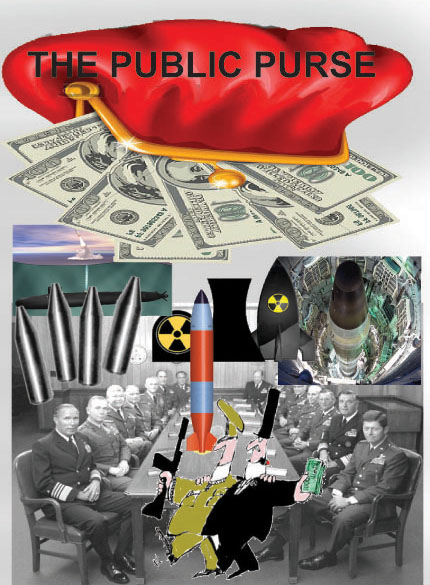
The Pentagon is reportedly planning to ask Congress to approve a supplemental funding package of around $50 billion to help finance the Trump administration’s unauthorized war on Iran, which has already cost billions of dollars and many lives.
Progressives were quick to reject the idea of providing the bloated, fraud-ridden Pentagon with additional funds to sustain a war that lawmakers did not approve and that is broadly unpopular with the American public.
“While they kick 17 million Americans off their healthcare, Republicans want to spend billions on Trump’s reckless war of choice,” said Rep. Greg Casar (D-Texas), chair of the Congressional Progressive Caucus. “Hell no.”
Reutersreported Tuesday that “Deputy Defense Secretary Steve Feinberg has been leading Pentagon work in recent days on a supplemental budget request of around $50 billion that could be released as soon as Friday.”
“The new money would pay for replacing the weapons used in recent conflicts including those in the Middle East,” the outlet added. “The figure is preliminary and could change.”
Sen. Lindsey Graham (R-SC), the most vocal cheerleader of the war in Congress, told reporters Tuesday that he believes “there will be a supplemental” funding request from the Pentagon.
“We’ll have to approve that,” said Graham.
“If this war continues at the same pace, Americans could see their government burn through tens of billions of dollars, funds that would amount to the cost of Medicaid for millions in the United States.”
The push for a supplemental funding package is the latest indication that the assault on Iran—launched with no clear justification, objective, or timeline and in violation of domestic and international law—could drag on indefinitely, even as Trump administration officials deny that the president who ran on avoiding wars has embroiled the nation in another disastrous quagmire in the Middle East.
Dylan Williams, vice president for government affairs at the Center for International Policy, wrote Tuesday that Congress should approve “not one damn penny” for Trump’s war on Iran.
The Center for American Progress (CAP) estimated Tuesday that the Iran war has likely already cost US taxpayers more than $5 billion.
“At more than $5 billion and counting, the costs of Operation Epic Fury—in only its first few days of operations—could cover Supplemental Nutrition Assistance Program (SNAP) benefits for more than 2 million Americans for a year,” noted CAP’s Allison McManus. “If this war continues at the same pace, Americans could see their government burn through tens of billions of dollars, funds that would amount to the cost of Medicaid for millions in the United States.”
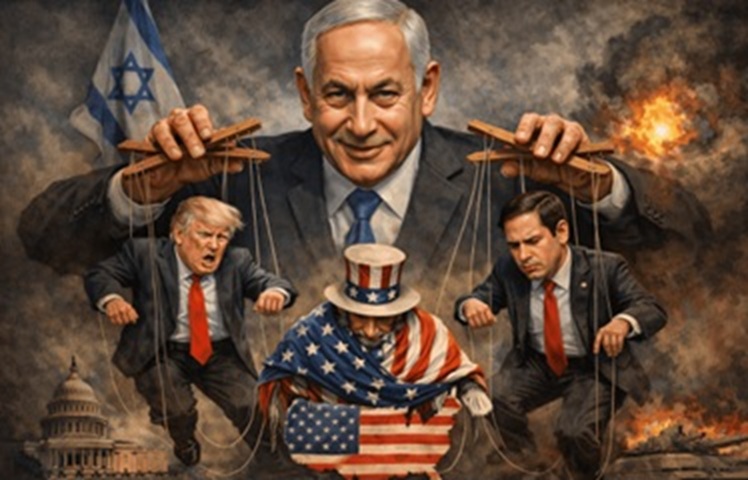
Israel is dictating foreign policy, with Trump’s throat-clearing, unwavering support for Israel attacking the country despite the American population not supporting this misadventure.
Secretary of State Marco Rubio acknowledged this week that the United States anticipated Israeli military action against Iran and believed it would trigger retaliatory strikes on American forces — a scenario that ultimately led Washington to join the offensive.
Speaking to reporters at the Capitol, Rubio said U.S. officials “knew that there was going to be an Israeli action” and expected it would “precipitate an attack against American forces.” He added that failing to strike first would have meant “higher casualties.”
This shows how Israel is dictating foreign policy, with Trump’s throat-clearing, unwavering support for Israel attacking the country despite the American population not supporting this misadventure.
Couldn’t Trump have been more like Biden and Harris, who scolded Bibi and yet allowed the genocide to take place in the first place?
Remember Biden’s delusion in claiming he had “done more for the Palestinian community than anybody.”
That assertion stands in sharp contrast to accounts from within his own administration. Maryam Hassanein, a former Interior Department political appointee who resigned, directly rejected that narrative.
“I think his legacy is the opposite,” Hassanein said. “He’s the president who’s done the most harm to Palestinians.”
To go off on a long tangent about the great foreign policy and immigration failures of the Biden White House would be too much to recount here. However, they were only revealing what is now clear as day: the Democratic Party is complicit in the empire. The question now is not whether that is true, but how to confront and change it.
What this demonstrates is something that has long been known: Israel is the United States’ ride-or-die friend. But at this point, it has become a Thelma & Louise moment — driving off a cliff and taking the whole world with them.
The remarks suggest the Trump administration viewed participation in the war as a preemptive necessity rather than an independent strategic choice. Critics argue the statement instead underscores Washington’s unwillingness to restrain Israel — even when U.S. forces would be drawn into direct conflict.
Netanyahu’s Long-Pursued Campaign
Israeli Prime Minister Benjamin Netanyahu openly described the operation as the culmination of decades of advocacy for confronting Iran militarily. He said the strikes were carried out with “the assistance of the United States” and framed the campaign as something he had sought to achieve for 40 years.
The comments reinforced concerns among some analysts that Israel’s strategy effectively shaped U.S. decision-making.
Could Washington Have Prevented the Escalation?
Brian Finucane, a former State Department lawyer now with the International Crisis Group, argued that the U.S. maintains substantial leverage over Israel due to its military and financial support. According to data from Brown University’s Costs of War Project, the U.S. has provided over $21 billion in military aid to Israel since October 2023 and more than $300 billion in total assistance since Israel’s founding.
Finucane suggested that if Washington had strongly opposed Israeli strikes, it may have been able to delay or deter them. Whether Iran would have refrained from retaliatory action is a separate question, he noted.
Mounting Casualties and Political Fallout
The joint U.S.–Israeli campaign has resulted in significant casualties. Iranian authorities report hundreds killed, including civilians. U.S. Central Command confirmed American service members have also died in the fighting.
Meanwhile, members of Congress — including senior Democrats on foreign affairs and armed services committees — have requested clarification from the administration regarding the legal justification for the operation, its objectives, and what would constitute mission success.
The war marks the second major U.S.–Israeli confrontation with Iran in less than a year, deepening instability across the region and intensifying debate in Washington over executive war powers.
A Question of Agency
Rubio’s framing raises a deeper question: was the United States genuinely compelled by strategic necessity — or simply unwilling to restrain an ally intent on escalating the conflict? The truth is that Washington’s worldview has become increasingly unmoored from any sense of proportionality or restraint. This same person in Rubio has defended coilionelism.
The U.S. provides Israel with extensive military assistance and diplomatic cover, making it difficult to claim neutrality in moments of crisis. There was no imminent threat of an attack, and Iran did not possess a nuclear weapon — a point underscored by Tulsi Gabbard, but whats she know, shes just the Director of National Intelligence. The fact remains that a far smaller nation is effectively pulling the last global superpower into a widening regional confrontation — one that carries risks far beyond the immediate battlefield.
How this ends is anyones guess most likely not well but don’t worry you can still gamble on and profit from it.
Walt Zlotow West Suburban Peace Coalition Glen Ellyn IL , 7 Mar 2
US Middle East bases are being pounded by Iranian drones and missiles. So is Israel.
Yet virtually none of this massive damage, signaling major failure of the US, Israeli war on Iran, is being shown to the American public which overwhelmingly opposes this senseless, self-destructive war. A CNN reporter in Tel Aviv admitted they could not show the destruction occurring around her due to government censorship.
All the Gulf States that house US bases are running out of defensive interceptors. So is Israel. Trump’s crazed War Secretary Pete Hegseth is so anxious to suppress the bad news, he’s accused mainstream media of trying to embarrass President Trump by focusing on the 6 dead Americans Trump got killed for nothing. Don’t publicize dead US service members Hegseth moans….publicize our war fighters’ victories.
Trump’s war to destroy Iran on behalf of Israeli Prime Minister Benjamin Netanyahu may crash the US economy, push America out of the Middle East, incur major US casualties, and find Iran still standing at the end. Remember, the US supported Iraq’s 1980 war against Iran which united its 90 million souls to support their Islamic government. After 8 years and hundreds of thousands of casualties, Iran survived.
The lesson of that war was to prepare for the next major attempt by the US to destroy Iran on behalf of Israel. Thirty-six years on, that preparation has upended Trump’s plan for a quick 3 day war to replace the Iranian Islamic government with a US puppet. Knowing he’s failing, Trump may, as early as tomorrow, unleash a massive bombing campaign using B-1’s. B-2’s and ancient B-52’s to pulverize the 90 million Iranians and their government refusing Trump’s surrender terms. All that will accomplish is add untold thousands of deaths to Trump’s war crime record.
After one week it’s time for mainstream media stop self-censoring Trump’s senseless war. It’s’ time to tell the unvarnished truth about its criminality incurring unprecedented US, Israeli destruction. The sooner they do, the sooner Congress might step in to defund and stop Operation Epic Failure.
Ripping the US president’s “flagrant disregard for European sovereignty—and security,” co-general coordinator of Progressive International declared: “Close the bases. All of them.”
President Donald Trump on Tuesday threatened to cut off all trade with Spain over the Spanish government’s refusal to allow US aircraft to use its military bases for the war that the United States and Israel are waging on Iran.
Speaking with reporters at the White House beside German Chancellor Friedrich Merz just after noon Eastern time, Trump initially signaled that he’d already taken action against Spain, but less than 10 minutes later, the president suggested he was still deciding.
Referring to Treasury Secretary Scott Bessent, who was also in the room, Trump said: “Spain has been terrible. In fact, I told Scott to cut off all dealings with Spain.”
Trump claimed that “it started” last year, when every other NATO member caved to US pressure to aim for spending 5% of gross domestic product on defense by 2035, “and Spain didn’t do it.”
“And now Spain actually said that we can’t use their bases. And that’s all right. We could use their base if we want. We could just fly in and use it. Nobody’s going to tell us not to use it. But we don’t have to. But they were unfriendly,” the president continued. “Spain has absolutely nothing that we need other than great people. They have great people but they don’t have great leadership.”
Again complaining about their refusal to commit to 5%, he said that “we’re gonna cut off all trade with Spain. We don’t want anything to do with Spain.”………………………………………………………………………………………………………………………………………….
“The peoples of Europe do not want to be complicit in a system that kills children and protects those who profit from their blood,” Albanese said. “Europe deserves better, and you are already part of that change. Thank you.”https://www.commondreams.org/news/iran-spain
The narrative that Israel was ready to act alone has holes in it, considering Israel has relied on US air defenses to intercept Iranian missiles in previous conflicts, and POLITICO reported a few days before the war started that Trump officials thought it might be better for the “politics” if Israel attacked on its own at first, provoking Iranian attacks on US assets to justify US intervention.
The president made the comments in response to a question about Rubio saying the US launched the war because Israel planned to attack
Adding to the mixed messaging coming from the Trump administration regarding the war with Iran, President Trump suggested on Tuesday that he may have “forced Israel’s hand” when the conflict started.
The president was responding to a question about Secretary of State Marco Rubio, who said on Monday that one reason why the US launched the war on Saturday was that Israel was planning to attack and that the US assessed Iran could respond with attacks. on US bases.
Senior Trump officials said the same thing during classified briefings with members of Congress on Monday, which was confirmed by House Speaker Mike Johnson (R-LA) and other lawmakers. “Because Israel was determined to act with or without the US, our commander in chief and the administration and the officials [in the Cabinet] had a very difficult decision to make. They had to evaluate the threats to the US, to our troops, to our installations, to our assets in the region in beyond,” Johnson said.
Amid soaring U.S. electricity use, new analysis from the American Council for an Energy-Efficient Economy (ACEEE) finds that the fastest and cheapest way to alleviate rapid electric load growth is through expanding investment in energy efficiency and demand flexibility. Even as families are already struggling with energy affordability, utility regulators are being asked to approve new gas power plants, putting utility customers on the hook for expensive projects that may not be needed.
A PUBLIC meeting of the Hunterston Site Stakeholder Group will take place at Seamill Hydro on Thursday, March 5, to discuss the ongoing decommissioning of the former Hunterston A and B nuclear power stations
EDF is handing Hunterston B over to Nuclear Restoration Services (NRS), the decommissioning subsidiary of the Nuclear Decommissioning Authority, which will take ownership of the site and manage the long‑term clean‑up programme.










 nuclear-news