Russia is ready to discuss nuclear fuel at Ukraine’s Zaporizhzhia with US – RIA

By Reuters, September 5, 2025, https://www.reuters.com/world/russia-is-ready-discuss-nuclear-fuel-ukraines-zaporizhzhia-with-us-ria-2025-09-05/
VLADIVOSTOK, Russia, Sept 5 (Reuters) – The head of Russia’s State Atomic Energy Corporation Rosatom Alexei Likhachev said on Friday the company was ready to discuss with the U.S.’s Westinghouse the issue of nuclear fuel at Ukraine’s Zaporizhzhia nuclear power plant, RIA news agency reported.
In June, Russia asked the U.N. nuclear watchdog to mediate between Moscow and Washington to resolve the question of what to do with U.S. nuclear fuel stored at the Ukrainian power plant controlled by Russian forces.
Westinghouse and U.S. energy officials had previously raised intellectual property concerns with Russia in connection with the fuel issue, according to Likhachev.
Reporting by Vladimir Soldatkin and Olesya Astakhova; Editing by Christopher Cushing
Euratom: €9.8 billion for nuclear research in the next EU budget
The European Commission has put forward a €9.8 billion budget proposal for the EU’s next nuclear research programme, Euratom, giving a huge boost to fusion research. The next edition of Euratom, starting in 2028, will be almost five times bigger than the current €1.98 billion nuclear research programme. Most of this funding will go towards fusion energy projects, fuelling Europe’s ambition to become the first to develop and commercialise the technology.
A peculiarity of the Euratom programmes is that they are legally required to run for five years, which puts them out of step with the seven-year EU budget cycle. So, it is now usual for each programme to have a two-year extension to keep it in step. The present
proposal sets aside €6.7 billion from 2028 and 2032, with the extension bringing the total to €9.8 billion.
Science Business 4th Sept 25, https://sciencebusiness.net/news/nuclear-fusion/euratom-eu98-billion-nuclear-research-next-eu-budget
Trump Is Renaming the Defense Department the Department of War

President Trump will sign an executive order on Friday renaming the Department of Defense the Department of War, the White House said, fulfilling his pledge to realign the military’s mission by restoring the name the agency held until shortly after World War II……………… (Subscribers only) https://www.nytimes.com/2025/09/04/us/politics/trump-department-of-war-defense.html?campaign_id=190&emc=edit_ufn_20250904&instance_id=161936&nl=from-the-times®i_id=60047519&segment_id=205306&user_id=432fc0d0ad6543e820e2dfcd39f76c35
Anglesey planners to consider relocation of Wylfa building
North Wales Chronicle 4th Sept 2025 , 4th September
ANGLESEY planners are to consider the removal and relocation of a redundant building for the processing of ‘non-active waste’ at the island’s former nuclear power station.
Anglesey County Council will to asses a full application regarding ‘Building 187’ for use as a ‘non-active waste clearance facility’ at the decommissioning Wylfa site.
Plans state: “The relocated facility will allow for a larger, safer and more efficient building as Wylfa moves further into the decommissioning preparations phase.”………
The plans concerns a 0.10 hectare site, and incorporate areas to “store and aid the collection of waste.”…………………………………………………. https://www.northwaleschronicle.co.uk/news/25441505.anglesey-planners-consider-relocation-wylfa-building/
Attacks on nuclear plants are being normalised – and the consequences could be disastrous

Nuclear power plants have become significant pawns in the Russia-Ukraine war
Molly Blackall, Global Affairs Correspondent, iNews 29th Aug 2025
Attacks on and around nuclear sites have become increasingly normalised during the war in Ukraine and the consequences could be disastrous, military watchers have warned.
Russia accused Ukraine this week of launching a drone attack which damaged Kursk nuclear power plant, which sits around 37 miles from the Ukrainian border, on Sunday.
The power plant authorities said that air defences shot down a drone that detonated near by just after midnight.
The incident damaged an auxiliary transformer and caused the plant capacity to drop by 50 per cent, they said.
The incident came on the day that Ukraine marked its 34th anniversary of independence from the Soviet Union.
Ukraine has not commented on the incident, but one Ukrainian military insider told The i Paper that troops had been ordered not to attack the plant during previous operations near by.
Another insider indicated it may have been accidental, saying that drone pilots work seven days a week and that unexpected outcomes sometimes cropped up.
There have long been fears of a nuclear incident as a result of the Russian invasion, with fighting taking place close to two major plants: Kursk and Ukraine’s Zaporizhzhia, which is the largest nuclear plant in Europe.
The International Atomic Energy Agency, the UN’s nuclear watchdog, reported that radiation was at normal levels around the Kursk plant following the attack.
‘Previously shocking acts’ are now normal
Military experts said that fighting in and around nuclear plants was becoming increasingly normalised……………..
Dr Marina Miron, a war studies expert at King’s College London, said that attacks on nuclear plants “may becoming somewhat normalised, which is in itself disconcerting”.
“When it happens the first time everyone is shocked and you see all the headlines. Then the IAEA reports that there was no rise in radiation levels and then things calm down and after an nth time this becomes sort of normal.”
The plants have become significant pawns in the war.
“When Ukraine counter-invaded Russia last year, the idea was to take the Kursk power plant and probably exchange it for Zaporizhzhia power plant, so that they could then say, we’ll trade you; give us that one, and we’ll give you yours back,” Miron said.
Darya Dolzikova, a nuclear expert at the Royal United Services Institute (RUSI) in London, previously warned that military activity around nuclear sites “should not be normalised” but that such attacks may become more common.
“The expected growth of the importance of nuclear power in the global energy mix in the coming decades may increase the likelihood that future armed conflict will see greater targeting of nuclear energy infrastructure,” she said.
As well as causing infrastructural damage to an adversary or sending strong military signals, the “psychological salience” of nuclear sites mean they may be used for “escalatory, deterrent or coercive purposes”.
It may also be a deliberate tactic to release radioactive material to make an area into a no-go zone, but could inadvertently expand to “friendly” areas or escalate the conflict it it seeps into a third country.
Attacks on nuclear sites ‘increasing danger’ of radiological accident
Lukasz Kulesa, director of nuclear policy at RUSI, said that while most nuclear reactors were relatively “well protected against attacks and accidents through their reinforced structures, this is not always the case”.
“Some reactors in Russia, including at the Kursk nuclear power plant, lack such a protective concrete dome, which makes them more vulnerable and dangerous in case of an attack,” he said.
“Artillery or drone attacks and other military activities can also threaten staff and personnel working at the site, and damage or destroy support infrastructure crucial for the functioning of the power plant, such as water supply and power grid connections and generators, or spent nuclear fuel storage sites.
“All such attacks disturb the operations of nuclear power plants and increase the danger, and the most serious ones can cause a direct threat of a radiological incident.”
Kulesa warned that “the fact that previous incidents related to the nuclear security of Zaporizhzhia power plant had not resulted in a nuclear accident should not be a reason for complacency”.
“There remains a danger that international norms with regards to the prohibition of military attacks against nuclear power plants, and the efforts by the IAEA to clarify and strengthen nuclear safety and security norms during armed conflicts would be ignored in other conflicts.”
However, Bollfrass said that these attacks were “unlikely to bring about the next Chernobyl”.
“The most serious damage has been to facilities themselves and their ability to deliver electricity, and the integrity of Ukraine’s energy grid as a whole,” he said.
“Something like a missile hitting stored spent fuel or an operating reactor would create a serious radiological hazard, but neither side has shown any interest in doing so. Most hits on or near nuclear power plants have been inflicted by drones with much less powerful warheads.”
https://inews.co.uk/news/world/attacks-nuclear-plants-normalised-consequences-disastrous-3878805
The world moves on without Trump

For Trump, being ignored may be worse than being opposed. He thrives on conflict, boasting of tough deals and headline-grabbing summits. But as more leaders refuse his calls, sideline him in negotiations, and leave him off the guest list, the reality sets in: the world can get along without him
3 September 2025 Michael Taylor, https://theaimn.net/the-world-moves-on-without-trump/#comment-12111
President Trump entered his second term promising to “make America respected again.” Yet nearly nine months in, the opposite has happened. Far from restoring U.S. influence, his confrontational diplomacy and transactional worldview have pushed the United States to the margins of global affairs. Allies are charting their own course, rivals are filling the vacuum, and Washington – once the indispensable power – is finding itself ignored.
Canada fights back
Canada, historically one of America’s closest partners, has become a frontline example of this new dynamic. Trump reignited a tariff war in early 2025, slapping duties on Canadian steel, timber, and dairy imports. Ottawa wasted little time retaliating with its own tariffs on U.S. agricultural products and manufactured goods. Instead of cowing Canada into submission, Trump’s threats hardened its resolve. Prime Minister Mark Carney openly declared that Canada “will not be bullied,” signaling a rare breakdown in a relationship that for decades symbolised North American unity.
India hangs up the phone
Trump once basked in his self-styled friendship with Prime Minister Narendra Modi, frequently recalling their joint rally in Houston during his first term. Today, that relationship is in tatters. Indian officials confirm that Modi has not returned several of Trump’s calls in recent weeks, a deliberate snub reflecting New Delhi’s frustration with Washington’s unpredictable trade policies and waning reliability as a strategic partner. For Trump, who prizes personal relationships with world leaders, the silence from Modi is a humiliation.
Excluded from history
Perhaps the most symbolic snub came when China marked the 80th anniversary of the end of World War II – and excluded the United States from the guest list. For decades, Washington had been at the heart of such commemorations, both as a wartime victor and as the principal architect of the postwar international order. This time, however, the stage belonged to the world’s three dominant authoritarian leaders – Xi Jinping, Kim Jong Un, and Vladimir Putin – delivering a stark message: America was no longer considered essential. Trump, clearly agitated at being left out by his supposed “friends,” dismissed it all as a “conspiracy.”
Europe moves on
Across the Atlantic, the European Union is steadily disentangling itself from Washington’s orbit. Frustrated by Trump’s climate skepticism and unilateral tariffs, Brussels has accelerated trade and renewable energy partnerships with Asian economies. Even Britain – long America’s closest ally – launched its own Middle East ceasefire initiative without so much as consulting Washington. The “special relationship” now feels like an afterthought.
Asia hedges
In Asia, longtime U.S. allies Japan and South Korea are building closer defense ties with each other and with Australia. The moves reflect deep concern over Trump’s erratic handling of security commitments, especially his repeated threats to withdraw U.S. troops unless allies pay more for their presence. For decades, Washington was the cornerstone of regional stability; now, partners are learning to do without it.
Africa and Latin America assert independence
The African Union recently declined Trump’s request to address its annual summit, citing his history of disparaging remarks about African nations. Instead, EU and Chinese envoys were welcomed. In Latin America, regional powers including Brazil, Mexico, and Argentina are forging trade agreements that deliberately exclude the United States. Where once Washington dominated hemispheric affairs, its neighbors now treat it as just another power to manage.
The cost of isolation
What unites these developments is not simply Trump’s personal unpopularity, but a structural shift in global politics. For decades after World War II, the United States was seen as indispensable – the partner of first resort in security, trade, and diplomacy. Today, countries are discovering that they can move forward without Washington. Trump’s “America First” doctrine, intended to project strength, has instead revealed weakness: allies no longer trust the U.S., and rivals no longer fear it.
Echoes of decline
There are historical echoes here. Britain, once the world’s preeminent power, found itself increasingly sidelined after World War II as its empire collapsed and the U.S. rose. Now America is experiencing a similar moment. The difference is that while Britain yielded to a trusted ally, the U.S. is ceding ground to China and other powers less committed to liberal democracy.
Trump’s personal frustration
For Trump, being ignored may be worse than being opposed. He thrives on conflict, boasting of tough deals and headline-grabbing summits. But as more leaders refuse his calls, sideline him in negotiations, and leave him off the guest list, the reality sets in: the world can get along without him. For a man who equates personal validation with national success, nothing cuts deeper.
Conclusion
The United States remains a powerful nation, with unmatched military strength and vast economic clout. But power unused wisely is power wasted. Under Trump, Washington has squandered goodwill, alienated allies, and emboldened rivals. The result is a geopolitical landscape where America is no longer central. The world is moving on – and Trump, watching from the sidelines, is discovering the true price of isolation.
£154m plan hatched to move UK’s 140-tonne cache of powdered plutonium from nuclear reactor waste at Sellafield.

Britain could finally solve the problem of
what to do with its radioactive waste by converting it into ceramic
pellets, The Telegraph can reveal. Government scientists want to store the
radioactive plutonium, which is a national security risk because it can be
used to make nuclear weapons, in an underground nuclear graveyard. The
UK’s cache of 140 tonnes of powdered plutonium from nuclear reactor waste
is currently under armed guard at Sellafield in Cumbria.
Telegraph 28th Aug 2025 https://www.telegraph.co.uk/news/2025/08/28/britain-solution-radioactive-waste-problem-cumbria/
Satellite images show construction at site linked to Israel’s suspected nuclear weapons programme
Israel does not confirm or deny having atomic weapons
Jon Gambrell, Independent , Wednesday 03 September 2025
Intensified construction work has been seen at a facility central to Israel’s long-suspected atomic weapons programme, according to satellite images analysed by experts. The development at the Shimon Peres Negev Nuclear Research Center near Dimona could signify a new reactor or a facility designed for assembling nuclear arms, though the programme’s inherent secrecy makes precise identification difficult.
This activity is set to reignite questions surrounding Israel’s widely believed status as the Middle East’s only nuclear-armed state. It also risks drawing international criticism, particularly as it follows joint operations in June where Israel and the United States bombed nuclear sites across Iran, including the heavy water reactor at Arak, amid concerns Tehran could pursue atomic weapons.
Seven experts who examined the images all said they believed the construction was related to Israel’s long-suspected nuclear weapons program, given its proximity to the reactor at Dimona, where no civilian power plant exists. However, they split on what the new construction could be.
Three said the location and size of the area under construction and the fact that it appeared to have multiple floors meant the most likely explanation for the work was the construction of a new heavy water reactor. Such reactors can produce plutonium and another material key to nuclear weapons.
The other four acknowledged it could be a heavy water reactor but also suggested the work could be related to a new facility for assembling nuclear weapons. They declined to be definitive given the construction was still in an early stage……………………………………………………………………………………… https://www.independent.co.uk/news/world/middle-east/israel-nuclear-shimon-peres-negev-b2818997.html
Small reactors: cash flow alert for Newcleo, Europe’s largest nuclear start-up.
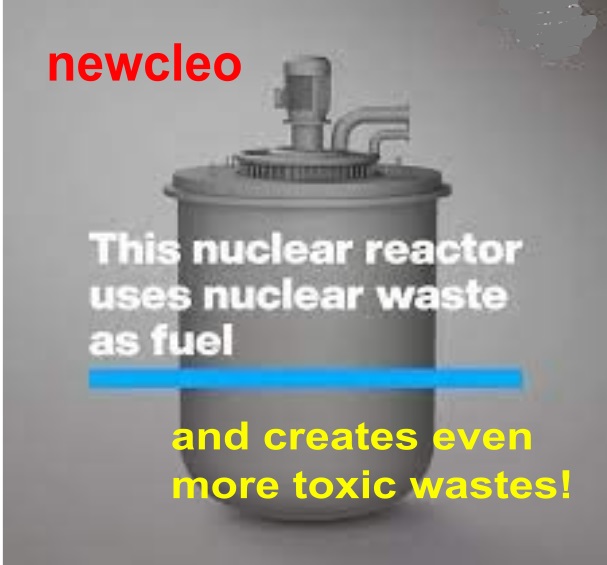
The company, which employs a thousand people, is burning through
too much cash. Its continued existence could be threatened without a new
round of financing.
But both private and public stakeholders remain
cautious. While waiting for fresh money, Newcleo is scaling back. Without a
new capital increase in the next twelve months, the company’s continued
existence is threatened, the Italian press reported in early August. The
articles, notably published in the business daily Il Sole 24 Ore , are
based on the findings of an audit of Newcleo’s 2024 accounts conducted by
KPMG, which La Tribune has seen.
The startup has notably abandoned its
ambitions in the United Kingdom, leading to the elimination of 150
positions. It also intends to reduce its engineering contracts with
external service providers.
La Tribune 29th Aug 2025, https://www.latribune.fr/climat/energie-environnement/petits-reacteurs-alerte-sur-la-tresorerie-de-newcleo-plus-grosse-start-up-europeenne-du-nucleaire-1031500.html
These countries are sinking into the sea. What happens when they disappear forever?

Can these small island nations still be considered states if their land disappears?
Small island nations such as Tuvalu, Kiribati, the
Maldives and Marshall Islands are particularly vulnerable to climate
change. Rising seas, stronger storms, freshwater shortages and damaged
infrastructure all threaten their ability to support life. Some islands
even face the grim possibility of being abandoned or sinking beneath the
ocean. This raises an unprecedented legal question: can these small island
nations still be considered states if their land disappears? The future
status of these nations as “states” matters immensely. Should the worst
happen, their populations will lose their homes and sources of income. They
will also lose their way of life, identity, culture, heritage and
communities.
Independent 29th Aug 2025, https://www.independent.co.uk/climate-change/climate-change-un-maldives-kiribati-islands-states-icj-b2816719.html
Rolls-Royce denies report of IPO ( Initial Public Offering) plans for small nuclear reactor unit
By Reuters, August 31, 2025
Aug 30 (Reuters) – Rolls-Royce Holdings (RR.L), opens new tab on Saturday denied a report it was exploring an initial public offering for its small nuclear reactor unit.
The Financial Times, citing people familiar with the situation, reported on Saturday the company was considering an IPO as well as other funding options. It said talks with investment houses and banks were at an early stage.
“Rolls-Royce SMR is not planning for, or in the process of launching, an initial public offering,” a spokesperson for the unit said in an emailed statement to Reuters.
In June, the Rolls-Royce SMR unit was selected to build Britain’s first Small Modular Reactors as part of its plan to speed up the decarbonisation of the power network from the mid-2030s. The unit, majority-owned by the British engineering firm, plans to build three reactors.
The British government pledged 2.5 billion pounds ($3.4 billion) for the SMR programme over the next four years, aiming to launch one of Europe’s first small-scale nuclear industries…. https://www.reuters.com/business/energy/rolls-royce-denies-report-ipo-plans-small-nuclear-reactor-unit-2025-08-30/
Rolls-Royce explores small nuclear reactor unit funding options including IPO (Initial Public Offering) .

An Initial Public Offering (IPO) is the process where a private company sells its shares to the public for the first time, thereby becoming a public company listed on a stock exchange. (The process involves significant costs, ongoing reporting requirements, a loss of some control, and increased exposure to litigation)
The consortium led by the UK engineer is in talks to finalise a
contract with the government later this year. Rolls-Royce has held
exploratory talks with advisers over financing options for its small
nuclear business, including an initial public offering, amid growing
investor excitement about the nascent technology.
The FTSE 100 engineer was
selected to build Britain’s first fleet of small modular reactors in June
as part of a plan by the Labour government to make the UK a world leader in
the technology. The Rolls-Royce-led SMR consortium is in talks to finalise
a contract with the government later this year.
The talks with investment
houses and banks focused on future funding requirements of the business,
according to two people familiar with the situation. “There is a live
debate within the shareholder base,” said one of the people, noting that
a listing at a high valuation would generate significant funding. Other
members of the consortium include CEZ Group, the Czech utility, which holds
a 20 per cent stake as part of a wider partnership with Rolls-Royce, the
Qatar Investment Authority and BNF Resources.
There were “different
views” among shareholders, the person added. Discussions were at an early
stage, with the Rolls-Royce board not in a rush to make any decision, said
the other person. The UK government would be eager to ensure that any
listing occurred in London, which has suffered a marked slowdown in
flotations in recent years, they added. The government has said it will
pledge £2.5bn to small modular reactors during this three-year spending
review period, helping to develop Rolls-Royce’s technology as well as
develop sites for the reactors.
FT 30th Aug 2025,
https://www.ft.com/content/234b4c2e-5e1a-46ba-82fd-472e271a289f
Microsoft joins World Nuclear Association amid rapid AI expansion plans

World Nuclear Association’s director general Dr Sama Bilbao y León said: “Microsoft’s membership with the Association is a game-changing moment for our industry.
Edie 3rd Sept 2025
Microsoft has become the newest member of the World Nuclear Association, joining as it, and other tech heavyweights, strive to source low-carbon energy to meet the demands of expanding intelligence (AI) and data centres.
As part of the commitment, the company will take part in the World Nuclear Symposium in London this week. The Symposium includes an Energy Users summit where the nuclear sector, technology industry, and other energy-intensive industries will discuss new partnerships, regulatory hurdles and supply chain needs.
Microsoft has already signed long-term nuclear energy deals, including a 20-year agreement with Constellation Energy to restart the Crane Clean Energy Centre (formerly Three Mile Island) and an agreement with fusion energy start-up Helion.
Key areas of collaboration with the Association are expected to include small modular reactors (SMRs) and other advanced nuclear technologies, streamlined licensing processes and supply chain resilience.
Microsoft’s Energy Technology team, led by Dr Melissa Lott with Todd Noe and Archie Manoharan, will represent the company in the Association’s technical working groups.
Dr Lott said: “Microsoft’s entry into World Nuclear Association’s membership reflects the strategic moment that our industry is working in as we work to meet our carbon-free energy goals.”
It bears noting that the nuclear fuel cycle produces significant volumes of radioactive waste. Some of this waste remains highly radioactive for thousands of years. However, proponents highlight its low-carbon nature and ability to reliably generate energy at any time of day or year, at scale.
World Nuclear Association’s director general Dr Sama Bilbao y León said: “Microsoft’s membership with the Association is a game-changing moment for our industry…………………………………………..
https://www.edie.net/microsoft-joins-world-nuclear-association-amid-rapid-ai-expansion-plans/
Golden Dome is already a turning point for American space policy.
As the space community awaits the upcoming deadline for a Golden Dome architecture, perhaps the biggest story on Golden Dome is how the program is resonating through the industry.
Last month, a new report by the Aerospace Corporation’s Center for Space Policy and Strategy identified Golden Dome (and its prominence within the Trump administration’s fiscal year 2026 defense budget request) as a significant turning point for American space policy, Pentagon spending priorities and the role of the Space Force.
The report said that “the introduction of Golden Dome is arguably the most important development affecting the defense space budget since the inception of the Space Force.”
As SpaceNews’ Sandra Erwin wrote:
For the relatively young Space Force, established in 2019, Golden Dome represents a significant expansion of resources and responsibilities. Sam Wilson, budget analyst at the Center for Space Policy & Strategy and author of the report, views the initiative as creating “a major opportunity for the Space Force as it brings extra resources for some of Space Force’s priorities such as missile warning satellites that the service already was planning to develop.”
“This is an opportunity to get those funded at higher levels,” Wilson told SpaceNews.
The article describes how Golden Dome’s prominence – and the level of attention paid to it – is elevating space issues within broader defense planning. It’s also a program that could benefit new and old space firms alike while calling broader public attention to the military’s role in and influence over space.
Investors feel the same. A note from Capital Alpha Partners this week highlighted that “Golden Dome gave something new for U.S. contractors to talk about and position for,” but so far details are scarce. At last month’s industry summit in Huntsville, Alabama, defense firms got little more than high-level overviews.
“Even if it’s classified, clarity on the architecture may provide something more meaningful for companies to discuss in the October-November earnings season,” the Capital Alpha note read….(Read more at link –
https://spacenews.bluelena.io/index.php?action=social&chash=980ecd059122ce2e50136bda65c25e07.830&s=d7cea81a8b3dc478fa14dbee41fab337)
Why are saltmarshes such effective carbon sinks?
The invisible yet lethal threat of radioactive pollution is an ever-present risk to the Blackwater. Even a small leakage of nuclear material from the decommissioned Bradwell reactor cores or radioactive waste stores could negatively affect the role that the estuary’s marshlands play in trapping carbon, known as carbon sequestration. In short, radioactive leakage may erode the amount of carbon that can be sequestered in future. This risk alone should be enough to deter any further development of new nuclear power at the Bradwell site.
2 September 2025
David Humphreys explains the role of saltmarshes in the struggle against our heating climate in the August 2025 column for Regional Life
The saltmarshes and mudflats of the Blackwater Estuary are an important yet fragile environment rich in birds, flora, invertebrates, fish and oysters. But saltmarshes are also highly effective in storing carbon, thereby acting as carbon sinks with a vital role to play in tackling increases to the global temperature.
Like all forms of plant life, the vegetation that thrives in marshlands absorbs carbon from the atmosphere through photosynthesis to create food for the plants.
Carbon sinks may release their carbon back into the atmosphere in two ways. First, combustion generates carbon dioxide emissions, for example during forest fires. Second, carbon dioxide is realised when living organisms respire. Respiration is how life forms, including plants, obtain energy. If plants are in an oxygen-rich (aerobic) environment they create more carbon dioxide when breathing than if their environment is lacking in oxygen (anaerobic).
Why are saltmarshes such effective carbon sinks?
2 September 2025
David Humphreys explains the role of saltmarshes in the struggle against our heating climate in the August 2025 column for Regional Life
The saltmarshes and mudflats of the Blackwater Estuary are an important yet fragile environment rich in birds, flora, invertebrates, fish and oysters. But saltmarshes are also highly effective in storing carbon, thereby acting as carbon sinks with a vital role to play in tackling increases to the global temperature.

Like all forms of plant life, the vegetation that thrives in marshlands absorbs carbon from the atmosphere through photosynthesis to create food for the plants.
Carbon sinks may release their carbon back into the atmosphere in two ways. First, combustion generates carbon dioxide emissions, for example during forest fires. Second, carbon dioxide is realised when living organisms respire. Respiration is how life forms, including plants, obtain energy. If plants are in an oxygen-rich (aerobic) environment they create more carbon dioxide when breathing than if their environment is lacking in oxygen (anaerobic).
And here’s why saltmarshes are such effective sinks: they are anaerobic, so plants breathe without oxygen. Anaerobic respiration generates less energy than aerobic respiration and produces less carbon dioxide. This enables carbon stocks to build up. Coastal marshlands also receive a constant influx of tide-borne sediment, which buries organic matter in sediment layers, a further factor that enables carbon to accumulate. The result is that coastal marshlands are more effective at carbon storage per hectare than any other ecosystem, including tropical forests.
The Blackwater Estuary forms part of a broader category of carbon sink known as ‘blue carbon’. This is carbon that has been captured and stored by living coastal ecosystems such as saltmarshes, mangrove forests and seagrass beds. Blue carbon ecosystems also provide other environmental services such as protection against sea-level rise and storm surges. Given the global sea-level increases projected for this century, the importance of blue carbon ecosystems cannot be overstated, both for coastal protection and trapping carbon.
The saltmarshes of Essex, then, are a vital asset in the fight against global heating. At the same time, they are threatened by the impacts of climate change, in particular coastal retreat from sea-level rise.
Marshland ecosystems are also at the mercy of pollution, which can reduce their carbon storage capacity. The invisible yet lethal threat of radioactive pollution is an ever-present risk to the Blackwater. Even a small leakage of nuclear material from the decommissioned Bradwell reactor cores or radioactive waste stores could negatively affect the role that the estuary’s marshlands play in trapping carbon, known as carbon sequestration. In short, radioactive leakage may erode the amount of carbon that can be sequestered in future. This risk alone should be enough to deter any further development of new nuclear power at the Bradwell site.
This is a further reason to ‘BANNG the drum’ against new nuclear at Bradwell and to resist further nuclear power construction in the United Kingdom.
David Humphreys is Emeritus Professor of Environmental Policy at the Open University.
1 This Month
26 April – Chernobyl: Inside the Meltdown airs on National Geographic on Sunday 26th April from 4pm

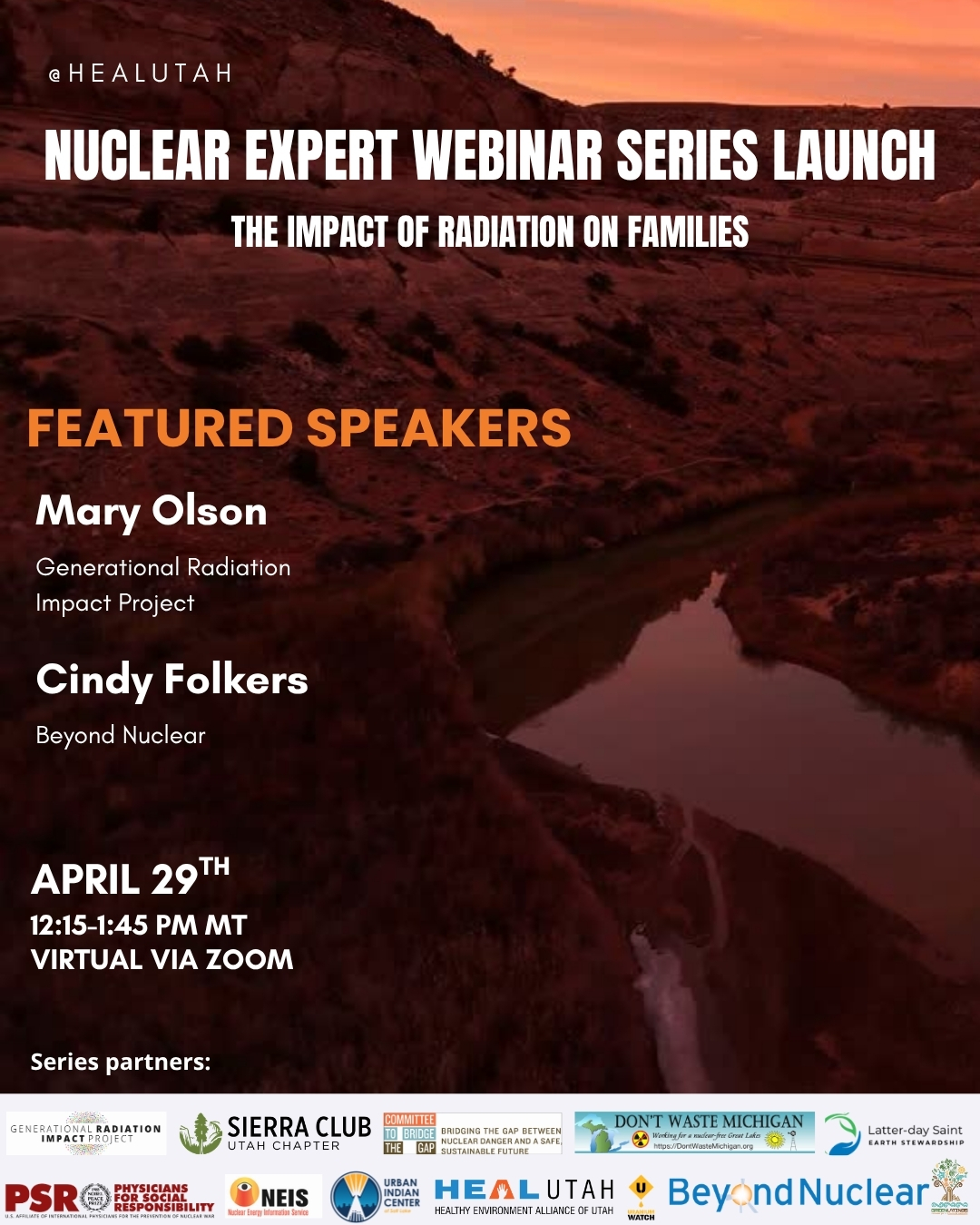
29 April – Nuclear Expert Webinar #1 – Radiation Impacts on Families with Mary Olson and Cindy Folkers
- 12:15 PM MT – 1:45 PM MT
- Location: Virtual – REGISTER TODAY

4 May -West Suburban Peace Coalition to discuss Iran war at May Educational Forum
Monday, May 4, 7:00 – 8:00 PM Central Standard Time
Title: : How Trump’s Narrative Tries to Shape the Reality of the War on Iran.
Contact Walt Zlotow, zlotow@hotmail.com 630 442 3045 for further information
14 May – online event From Bombs to Data Centres: the Face of Nuclear Colonialism

Pine Ridge Uranium is the real threat, not Tehran- Tell Burgum: Stop the Extraction.
Chernobyl: The Lost Tapes – A good documentary on Chernobyl on SBS available On Demand for the next 3 weeks– https://www.sbs.com.au/ondemand/tv-program/chernobyl-the-lost-tapes/2352741955560
To see nuclear-related stories in greater depth and intensity – go to https://nuclearinformation.wordpress.com
-
Archives
- May 2026 (12)
- April 2026 (356)
- March 2026 (251)
- February 2026 (268)
- January 2026 (308)
- December 2025 (358)
- November 2025 (359)
- October 2025 (376)
- September 2025 (257)
- August 2025 (319)
- July 2025 (230)
- June 2025 (348)
-
Categories
- 1
- 1 NUCLEAR ISSUES
- business and costs
- climate change
- culture and arts
- ENERGY
- environment
- health
- history
- indigenous issues
- Legal
- marketing of nuclear
- media
- opposition to nuclear
- PERSONAL STORIES
- politics
- politics international
- Religion and ethics
- safety
- secrets,lies and civil liberties
- spinbuster
- technology
- Uranium
- wastes
- weapons and war
- Women
- 2 WORLD
- ACTION
- AFRICA
- Atrocities
- AUSTRALIA
- Christina's notes
- Christina's themes
- culture and arts
- Events
- Fuk 2022
- Fuk 2023
- Fukushima 2017
- Fukushima 2018
- fukushima 2019
- Fukushima 2020
- Fukushima 2021
- general
- global warming
- Humour (God we need it)
- Nuclear
- RARE EARTHS
- Reference
- resources – print
- Resources -audiovicual
- Weekly Newsletter
- World
- World Nuclear
- YouTube
-
RSS
Entries RSS
Comments RSS
 nuclear-news