Japanese govt rules out new nuclear reactors for 10 years
Here the Asahi Shimbun, generally a neutral and independent news source, appears to buy the myth of nuclear as a climate change cure, and of small nuclear reactors
|
Cabinet minister rules out new nuclear reactors for 10 years, THE ASAHI SHIMBUN, November 12, 2020 Industry minister Hiroshi Kajiyama is signaling that the government will not allow for the construction of new nuclear reactors to replace aging ones or to be installed additionally at nuclear plants for the next decade.His position suggests the Ministry of Economy, Trade and Industry, which oversees the nuclear industry, is unlikely to discuss the option of building new reactors in the new Basic Energy Plan it has been developing.
The plan has been revised twice since the 2011 Fukushima nuclear disaster. Heeding a national sentiment exceedingly anxious of nuclear energy, the government has passed up discussing building new reactors in past revisions of the plan. In an interview with The Asahi Shimbun on Nov. 10, Kajiyama acknowledged it is still premature to discuss the issue now. “Public faith has yet to be restored,” he said of public sentiment toward nuclear energy after the triple meltdown at the Fukushima plant. “How can we proceed (without it) in constructing new reactors to replace aging ones or to make additions? We are simply not at the stage where we can talk about the next move.” Kajiyama said the government’s priority over the next 10 years will be regaining public faith in the nuclear industry, rather than pushing for the construction of new reactors…….. The minister said the number of nuclear reactors that will be reactivated over the coming decade will be a point that the government will take into account as an indication of the public’s acceptance of nuclear energy when it comes to mulling over constructing new reactors. “It is also related to the government’s goal of achieving carbon neutrality in 2050,” he said. His comments suggest the government may begin considering constructing new reactors if more local governments approve restarting nuclear plants that were idled after the Fukushima accident. Currently, only one reactor at the Genkai nuclear plant in Saga Prefecture is operating in Japan after a reactor at the Oi nuclear plant in Fukui Prefecture was shut down for maintenance earlier this month. Kajiyama underlined the need to develop small modular reactors, which are smaller than conventional reactors. He said engaging in a modular reactor project would be meaningful when it comes to maintaining the nation’s technology for safeguarding nuclear power and nurturing scientists in the field–not to mention the potential for spinoffs. “It could lead to the development of new materials and other technologies,” he said. Last month, Prime Minster Yoshihide Suga laid out Japan’s plan to achieve net zero greenhouse gas emissions by 2050.,,,,,,, http://www.asahi.com/ajw/articles/13924315 |
|
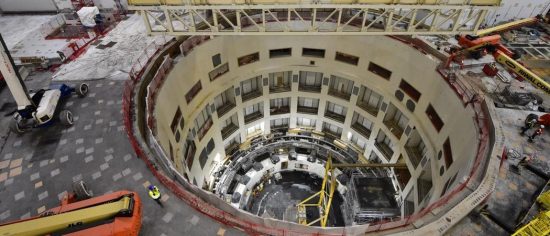
New European Court of Auditors report has concerns about the EU’s nuclear fusion project.
|
Auditors say EU’s nuclear fusion project still causing concern https://sciencebusiness.net/news/auditors-say-eus-nuclear-fusion-project-still-causing-concern–13 Nov 20, New European Court of Auditors report finds there is a risk of further cost increases and delays to the ITER project. All other Horizon 2020 joint undertakings have ‘healthy’ financial management but some are behind schedule on implementation
By Florin Zubașcu The EU could see its financial contribution to the International Thermonuclear Experimental Reactor (ITER) project going up at a time when a new report by the European Court of Auditors says there are weaknesses in procurement procedures, the management of its human resources and in project monitoring.
ITER is part of Fusion for Energy (F4E), the 35-year long public-private partnership set up to manage Europe’s contribution to the building of the pilot nuclear fusion reactor in southern France. “F4E’s weaknesses in procurement planning, as well as human resource and project management, place its operational effectiveness at risk,” the auditors say. Nuclear fusion Within the ITER project, the EU is coordinating the contribution of a 35 countries to the construction of the world’s largest tokamak, a magnetic fusion device designed to provide proof of concept that nuclear fusion that powers the sun can be harnessed as a carbon-free source of energy. Europe is paying 45.6 per cent of construction costs, of which 80 per cent is funded from the EU budget and 20 per cent by France as the ITER host country. The remainder is shared equally by China, India, Japan, Korea, Russia and the US (9.1 percent each). After various delays, in November 2016, the ITER Council approved new timelines, putting the start of the operational phase back to 2025 and the completion of the construction phase to 2035. The previous estimate was that construction would be completed in 2020. The EU’s contribution to the construction phase was revised to €12 billion euros (in 2008 prices), up from the €6.6 billion approved by the EU Council in 2010. However, these figures do not include the contingency of up to 24 months in terms of schedule, and 10-20 per cent in terms of budget, that the commission has recommended the project should have. “While positive steps have been taken to improve the management and control of the JU’s contribution to the project construction phase, there remains a risk of further cost increases and delays in project implementation compared to the current approved baseline,” the auditors say. The future of research partnerships F4E is one a number of joint undertakings the EU established with industry in 2014 to carry out research in fusion energy, bio-based industries, clean air transport, fuel cells and hydrogen, medicines, air traffic management, electronic components and innovative rail solutions. According to the audit, in 2019, the European Commission contributed around €1.9 billion to these research and innovation activities. The private partners include industry, various research groups, and international organisations that provide in-kind contributions. The undertakings are slated to continue in some form alongside new partnerships on driverless cars, space and clean steel under the EU’s next research programme, Horizon Europe. In their report published today, the auditors signed off the 2019 accounts of all joint undertakings. However, the auditors noted that while internal controls on payments were generally effective, several undertakings still had weaknesses in their procurement, grant payments and recruitment procedures. “Our audit for 2019 confirms that their financial management is healthy, although several aspects can be further improved, for instance the management of procurements, grant payments and human resources,” said Ildikó Gáll-Pelcz, the member of the European Court of Auditors responsible for the audit. The auditors also checked how much progress the joint undertakings have made to date. Some undertakings under Horizon 2020 fell short of targets, and on average only 51 per cent of Horizon 2020 and related activities had been implemented so far in the partnerships, which have a life span of 10 years, from 2014 to 2024. |
|
Over one million tons of radioactive water will be discharged into the sea from the Fukushima nuclear power plant
|
Almost Unnoticed Nuclear Pandemic Is Spreading in Japan, https://www.indepthnews.net/index.php/the-world/asia-pacific/3967-almost-unnoticed-nuclear-pandemic-is-spreading-in-japan By Manlio Dinucci, 13 Nov 20,This article was originally published in Italian on Il Manifesto. It is being republished from Global Research. Manlio Dinucci is a Research Associate of the Centre for Research on Globalization (CRG).
MONTREAL (IDN) – It was not Covid-19, therefore the news went almost unnoticed: Japan will release over a million tons of radioactive water from the Fukushima nuclear power plant into the sea. The catastrophic incident in Fukushima was triggered by the Tsunami that struck the north-eastern coast of Japan on March 11, 2011, submerging the power plant and causing the core of three nuclear reactors to melt. [The links between nuclear power and nuclear weapons: Nuclear weapons and nuclear power share several common features. The long list of links includes their histories, similar technologies, skills, health and safety aspects, regulatory issues and radiological research and development The power plant was built on the coast just 4 meters above sea level with five-meter-high breakwater dams, in a tsunami-prone area with waves 10-15 meters high. Furthermore, there had been serious failures by the private company TEPCO (the Tokyo Electric Power Company) managing the plant, in the control of the nuclear plant: the safety devices did not come into operation at the time of the Tsunami. Water has been pumped through the reactors for years to cool the molten fuel. The water became radioactive and was stored inside the plant in over a thousand large tanks, accumulating 1.23 million tons of radioactive water. TEPCO is building other tanks, but they will also be full by mid-2022. TEPCO must continue pumping water into the melted reactors and has decided to discharge, in agreement with the government, the water accumulated so far into the sea after filtering it to make it less radioactive (however, to what extent it is not known) with a process which will last 30 years. There is also radioactive sludge accumulated in the decontamination filters of the plant, stored in thousands of containers, and huge quantities of soil and other radioactive materials. As TEPCO admitted, the melting in reactor 3 is particularly serious because the reactor was loaded with Mox, a much more unstable and radioactive mix of uranium oxides and plutonium. The Mox for this reactor and other Japanese ones was produced in France, using nuclear waste sent from Japan. Greenpeace has denounced the danger deriving from the transport of this plutonium fuel for ten thousand kilometres. Greenpeace also denounced that Mox favours the proliferation of nuclear weapons, since plutonium can be extracted more easily and, in the cycle of uranium exploitation, there is no clear dividing line between civilian and military use of fissile material. Up to now, around 240 tons of plutonium for direct military use and 2,400 tons for civil use (nuclear weapons can however be produced with them), were accumulated in the world (according to 2015 estimates), plus about 1,400 tons of highly enriched uranium for military use. A few hundred kilograms of plutonium would be enough to cause lung cancer to 7.7 billion inhabitants of the planet, and plutonium remains lethal for a period corresponding to almost ten-thousand human generations. A destructive potential has thus accumulated, for the first time in history, capable of making the human species disappear from the face of Earth. The nuclear bombings of Hiroshima and Nagasaki; the more than 2,000 experimental nuclear explosions in the atmosphere, at sea and underground; the manufacture of nuclear warheads with a power equivalent to over one million Hiroshima bombs; the numerous accidents involving nuclear weapons and those involving civilian and military nuclear plants, all this has caused radioactive contamination that has affected hundreds of millions of people. A portion of approximately 10 million annual cancer deaths worldwide – documented by WHO – is attributable to the long-term effects of radiation. In ten months, again according to the World Health Organization data, Covid-19 caused about 1.2 million deaths worldwide. This danger should not be underestimated, but it does not justify the fact that mass media, especially television, did not inform that over one million tons of radioactive water will be discharged into the sea from the Fukushima nuclear power plant, with the result that it will further increase cancer deaths upon entering in the food chain. [IDN-InDepthNews – 04 November 2020] |
|
Governor of Miyagi Prefecture approves plan to restart Onagawa nuclear reactor.
Here’s another article that quietly accepts the myth that nuclear power combats climate change.
Japan Could Restart Nuclear Reactor Damaged In 2011 Disaster, Oil Price By Tsvetana Paraskova – Nov 12, 2020, A local governor in Japan has approved plans from utility Tohoku Electric Power to restart one of its nuclear reactors that was damaged in the 2011 earthquake and the following tsunami, the same that caused the reactor meltdown at Fukushima.
Tohoku Electric Power received approval from the governor of Miyagi Prefecture, Yoshihiro Murai, to restart unit 2 at the Onagawa nuclear power plant, a spokesman for the company told Reuters.
In its strategy for the medium and long term, the company said in February this year that “On the premise of secured safety, we will aim for the prompt restart of Onagawa Nuclear Power Unit 2 with the local community’s understanding.”
Last month, Japan pledged to become a net-zero emissions economy by 2050, joining the UK and the European Union (EU) in those commitments. Due to the closure of nuclear reactors after Fukushima, Japan relies on coal for around a third of its electricity generation.
Long-delayed remediation of a nuclear waste site near Pittsburgh
Residents of the area have expressed concern about potential cancer and other health problems caused by exposure to radioactivity on the site, though no one asked questions or expressed those concerns during the meeting.
The site initially was owned by Nuclear Materials and Equipment Corp., which operated the nuclear fuel plants.
Ohio Attorney General takes legal action to stop nuclear bailout
“The people of Ohio are about to be shaken down for money they should not pay and will never be able to get back,” reads the lawsuit filed in Franklin County Common Pleas Court.
and abundant natural gas. “The corrupt enterprise and its billion-dollar payout is no longer a theory, but an admitted fact,” the suit contends. “Recently, two members of the corrupt enterprise entered guilty pleas in federal court. Those actors were Energy Harbor’s H.B. 6 lobbyist,
According to the plea deals, the scheme was to conceal cash received from Energy Harbor’s former parent company,
The scheme then continued to push House Bill 6 over the finish line and subsequently kill a petition effort to convince voters to
November 13 Energy News — geoharvey

Opinion: ¶ “Hitting Net Zero Is Not Enough – We Must Restore The Climate” • The climate crisis is here now. No matter how quickly we reach zero emissions, the terrible impacts of the climate crisis will not just go away. They will continue to cause millions to suffer for centuries to come. Just cutting […]
November 13 Energy News — geoharvey
German Court rules that government must review compensation for exit from nuclear power
German Court Demands Gov’t Review Compensation for Nuclear Exit, Courthouse News, November 12, 2020 FRANKFURT , Germany (AFP) — Germany’s highest court said Thursday the government must revise the terms of compensation paid to energy companies forced to switch out of nuclear power, calling current arrangements “unreasonable.”
Ruling on a case brought by Swedish group Vattenfall, the constitutional court took aim at a payout condition set by Berlin in 2018 that would essentially require energy companies to make the change first before knowing how much compensation they would receive.
Judges in Karlsruhe urged the government to “revise the regulation as soon as possible”, saying the 2018 amendment to nuclear energy legislation, which is still not in force, was tainted by irregularities.
Environment Minister Svenja Schulze said the government respects the decision, and that it will “thoroughly analyse the ruling and swiftly initiate a legal regulation that meets the requirements of the court.” https://www.courthousenews.com/german-court-demands-govt-review-compensation-for-nuclear-exit/
Guardians of UK’s precious habitat in Suffolk are fearful of government decision on Sizewell nuclear plan.
East Anglian Daily Times 12th Nov 2020, Guardians of one of Britain’s most precious habitats are waiting to see
how Prime Minister Boris Johnson’s 10-point plan for the environment will
affect their Suffolk site.
https://www.eadt.co.uk/news/rspb-minsmere-sizewell-c-damage-1-6926669
Nuclear disarmament for health: time to rejoice — IPPNW peace and health blog
For decades people have marched, protested, sung songs, made films and written books calling for the abolition of nuclear weapons, and for decades the nuclear weapons states have stymied all efforts to force them to disarm. …The Treaty on the Prohibition of Nuclear Weapons is very explicit. There can be no misinterpretation or waffling on its provisions. It prohibits the development, testing, production, stockpiling, transfer, use and threat of use of nuclear weapons. It also prohibits countries giving assistance and encouragement to the prohibited activities. Finally, any direct or indirect control over nuclear weapons or other nuclear explosive devices is forbidden.
Nuclear disarmament for health: time to rejoice — IPPNW peace and health blog
Canada’s Greens call on federal government to abandon nuclear and invest in renewables

Small nuclear reactor plan by Rolls Royce consortium – not likely to be economically feasible
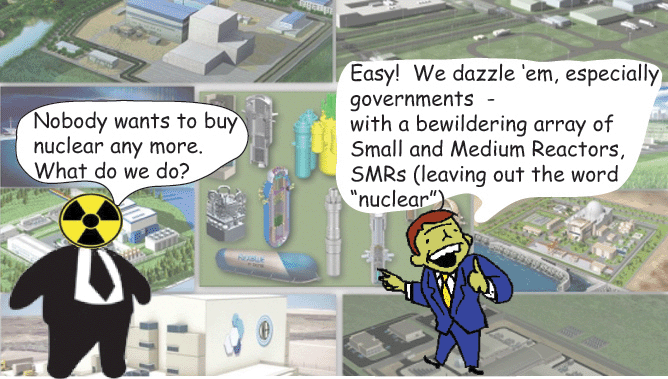
Rolls-Royce vows to create 6,000 UK jobs with nuclear power station plans, Engineering firm is part of consortium pushing for government backing, Jasper Jolly, Wed 11 Nov 2020
‘……….However,it faces opposition on the grounds of safety, security and cost.
The consortium this week signed agreements with the US company Exelon Generation and the Czech power company CEZ to consider the reactors.
Small nuclear reactors were first developed in the 1950s to use in nuclear-powered submarines. Since then Rolls-Royce has designed reactors for seven classes of submarine and two separate land-based prototype reactors.
However, to be cost-effective for civilian use the power generated by the reactors has to compete with renewable sources such as wind and solar power. The costs of installing renewables have fallen dramatically in the last decade and they do not pose the same safety concerns.
The Financial Times last month reported that the government was backing the plans to commit between £1.5bn and £2bn, and that it would form part of Boris Johnson’s 10-point plan for the environment. However, the second wave of coronavirus has caused the delay of the Treasury’s multiyear spending review. …..
a 2017 study by the consortium partner Atkins found that the electricity produced from the small reactors would be a third more expensive than traditional plants……. https://www.theguardian.com/business/2020/nov/11/rolls-royce-vows-to-create-6000-uk-jobs-with-nuclear-power-station-plans
UK’s Royal Society for the Protection of Birds condemns the Sizewell nuclear project
 The Government looks set to fail in its first major domestic test over its declared commitment to the environment ahead of an upcoming speech by the Prime Minister.
A recent PR charm offensive by the energy company EDF extolling the green credentials of its proposals to build the Sizewell C nuclear reactor seems to be swaying government opinion, despite the fact that the project may irreversibly damage one of the UK’s most important and well protected wildlife sites. It is rumoured that the Prime Minister will announce the importance of future nuclear energy development in his upcoming 10-point speech on the environment.
The Royal Society for the Protection of Birds ’s Chief Executive, Beccy Speight, said: “The Government has committed to protect 30% of the UK’s land by 2030 to boost biodiversity, so allowing the destruction of one of the most nature rich places we already have in the UK would be a crazy decision. The Prime Minister must not let EDF pull the wool over his eyes regarding what a damaging project this would be.
“If EDF were to be given permission to build a brand-new twin nuclear reactor slap bang on the border of a globally important wildlife haven, then we believe that contrary to the ambition set out by this Government, nowhere in the UK is sacred anymore. The Government has stated that we are in an ecological emergency as well as a climate emergency and it simply cannot afford to waste taxpayer’s money destroying flagship reserves which mean so much to wildlife and people.”
The RSPB has waited for over a decade for EDF Energy to show them evidence that RSPB Minsmere won’t be irrevocably damaged if the energy giant builds the UK’s latest white elephant: Sizewell C. That evidence has never materialised and EDF continue to try and paint the development as environmentally friendly despite evidence to the contrary.
Home to a whopping 6000 species, Minsmere is widely acknowledged as one of Europe’s most important wildlife sites and has legal protection at both the national and international level. Protected animals that call the Suffolk coast home like otters, water voles, marsh harriers, bats and many more could all fall victim to this huge infrastructure project and legally protected land, Sizewell Marshes SSSI, could be built directly on. The concerns extend to marine life too with proposals suggesting waters off the local beaches could warm and that toxic chemicals could be pumped into the sea along with worrying numbers of dead fish.
Beccy Speight continued: “We could be witnessing the horrors of HS2 all over again, wasting tax payers’ money on destroying irreplaceable homes for nature. If Sizewell C was to be built, it should come as no surprise to us all that we would once again be witnessing chainsaws and diggers decimating precious habitats which are not only important to wildlife, but to people’s health and wellbeing too. For this to happen as we attempt to recover from a pandemic caused by a zoonotic disease only adds to the bitter irony of the situation. We urge the Government to think again.”
Harris and Biden – what are their views on nuclear power?
The Democrats don’t say much about nuclear power, -but the Party seems to be well in favour of it.
During the campaign,The Washington Post questioned Democrat presidential candidates on their views on nuclear power.
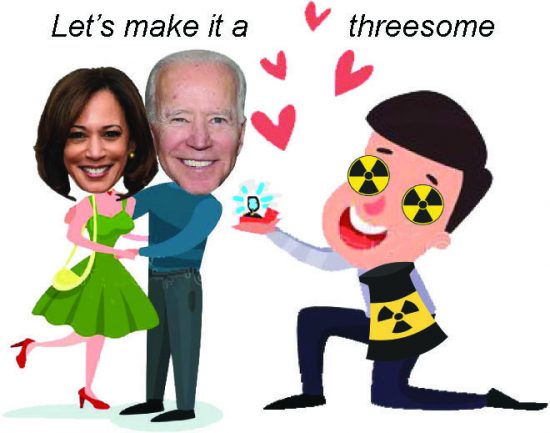 At that time 10 Democratic contenders said ”No new plants”
Australian government’s plan for nuclear waste dump on farming land bombs in the Senate
 Pauline Hanson’s One Nation torpedoes Kimba nuclear waste dump in SA, Claire Bickers, Federal Politics Reporter, The Advertiser, November 11, 2020
Pauline Hanson will torpedo the Federal Government’s bid to build a radioactive waste dump in regional South Australia.
The One Nation leader, who aims to win a seat in SA at the next federal election, has confirmed she will not back legislation to build the nuclear waste storage site at Napandee farm, near Kimba.
Without One Nation’s two crucial votes – and Labor, the Greens, and independent senator Rex Patrick not backing the Bill – the government does not have enough votes for it to pass parliament without changes.
Senator Hanson told The Advertiser she had serious concerns about the process to select Napandee, the level of community support, the waste site being built on farming land, and the facility storing intermediate radioactive waste above ground.
“I want to make the right decision, not for the interim, I want to make the right decision for future generations,” Senator Hanson said.
“I’m not going to be badgered or pushed into this.
“It’s about looking after the people of SA, but also the whole of Australia.”
Senator Hanson said One Nation wanted to win a seat in SA at the next election, and she hoped South Australians would take into account her strong stance on the waste site.
One Nation adviser Jennifer Game, who ran as the party’s SA Senate candidate at the 2019 election, has been leading research and consultation on the Kimba site.
“I think the government has rushed the decision to have it there,” Senator Hanson said.
Almost 62 per cent of 734 Kimba residents supported the facility in a postal vote in 2019 but Senator Hanson said locals had indicated to the party that closer to half of the town did not support the facility.
The region’s native title holders, the Barngarla people, were also not given a say in the official vote.
Senator Hanson was concerned other locations that may be suitable were not investigated, such as an old mining site in Leonora, in Western Australia, which may be able to store the waste underground.
“We don’t know what the future is going to hold, we don’t know if war is going to touch our shores,” she said.
“Do we really want a facility that is above ground that could be problems further down the track, if anything happens?”…https://www.adelaidenow.com.au/news/south-australia/pauline-hansons-one-nation-torpedoes-kimba-nuclear-waste-dump-in-sa/news-story/9043c46fa44ecd8a1b4e46be111745f3
1 This Month

Tell Congress: Prevent Nuclear Catastrophe in Iran

Tell Congress: Prevent Nuclear Catastrophe in Iran

Read the Public Inquiry Report, the Commissioners’ report, Surrendering Australia: The AUKUS Deception is available to download for free at aukuspublicinquiry.com. Or just watch the replay of the National Press Club Luncheon.


Shut down the radiation-damaged Heysham nuclear reactors now
To see nuclear-related stories in greater depth and intensity – go to https://nuclearinformation.wordpress.com

Say No to NASA’s Reckless Nuclear Reactor on the Moon
Say No to NASA’s Reckless Nuclear Reactor on the Moon
-
Archives
- November 2026 (269)
- October 2026 (302)
- September 2026 (339)
- August 2026 (330)
- July 2026 (355)
- June 2026 (287)
- May 2026 (306)
- April 2026 (356)
- March 2026 (251)
- February 2026 (267)
- January 2026 (308)
- December 2025 (358)
-
Categories
- 1
- 1 NUCLEAR ISSUES
- business and costs
- climate change
- culture and arts
- ENERGY
- environment
- health
- history
- indigenous issues
- Legal
- marketing of nuclear
- media
- opposition to nuclear
- PERSONAL STORIES
- politics
- politics international
- Religion and ethics
- safety
- secrets,lies and civil liberties
- spinbuster
- technology
- Uranium
- wastes
- weapons and war
- Women
- 2 WORLD
- ACTION
- AFRICA
- Atrocities
- AUSTRALIA
- Christina's notes
- Christina's themes
- culture and arts
- Events
- Fuk 2022
- Fuk 2023
- Fukushima 2017
- Fukushima 2018
- fukushima 2019
- Fukushima 2020
- Fukushima 2021
- general
- global warming
- Humour (God we need it)
- Nuclear
- RARE EARTHS
- Reference
- resources – print
- Resources -audiovicual
- Weekly Newsletter
- World
- World Nuclear
- YouTube
-
RSS
Entries RSS
Comments RSS

