Iran Awards Military Medal To Nuclear Scientist Assassinated Last Month
Iran Awards Military Medal To Nuclear Scientist Assassinated Last Month NDTV 13 Dec 20, Tehran:
Iran’s supreme leader Ayatollah Ali Khamenei on Sunday posthumously awarded a prestigious military decoration to top nuclear scientist Mohsen Fakhrizadeh, who was assassinated last month, state television reported.
Fakhrizadeh was killed on a major road outside Tehran in late November in a bomb and gun attack that the Islamic republic has blamed on its arch foe Israel……. https://www.ndtv.com/world-news/iran-awards-military-medal-to-nuclear-scientist-mohsen-fakhrizadeh-assassinated-last-month-2338031
NUCLEAR-ARMED RIVALRY IN SOUTHERN ASIA
|
NUCLEAR-ARMED RIVALRY IN SOUTHERN ASIA, Arms Control Wonk,by Michael Krepon | December 13, 2020 “……….. Deterrence alone doesn’t make nuclear-armed rivals safer because nuclear deterrence is based on credible threats and because these threats generate counter-measures. Nonetheless, rivals continue to compete, either in search of advantage or to avoid disadvantage.The threat of escalation is inherent in nuclear deterrence since threats that do not convey the potential for greater violence cease to deter. Herein lies an insoluble problem for nuclear deterrence strategists. How can escalation be controlled when it is premised on seeking advantage?
o resolve this conundrum, deterrence strategists must on truly heroic assumptions. One assumption is that nuclear-armed rivals can signal each other effectively because they have sufficient information and are on the same page. Another assumption is that command and control remains intact and that there will be no panic and unauthorized use of nuclear weapons. A third assumption, most heroic of all, is that the disadvantaged side will accept loss without resorting to spasm attacks that seek to destroy cities that are the repositories of world history. These are the unspoken and mostly unexamined assumptions behind the deterrence constructs of escalation control and escalation dominance. These are the rationales behind the fielding of counterforce capabilities that target opposing nuclear capabilities. These intellectual constructs can collapse like a house of cards after first use. After first use, nuclear-armed rivals may not be on the same page. Even if a rival chooses escalation control instead of escalation dominance, this targeting strategy has to be backed up by the threat of further escalation. And then what? This systemic problem applies to all nuclear-armed rivals, but is even more pronounced on the subcontinent because one of the rivals — India — has declared a policy of massive retaliation in the event of first use by Pakistan. This declaration is meant to deter, but if deterrence fails, this nuclear posture skews decisions toward a cataclysmic outcome whether or not this declaratory doctrine is a ruse. After first use, massive retaliation looses its deterrent value, becoming instead an existential threat to both rivals. India’s embrace of massive retaliation is as dangerous as Pakistan’s embrace of first use. The intellectual constructs of escalation control, escalation dominance, and massive retaliation work on the printed page and in war plans but are likely to fail catastrophically once the nuclear threshold is crossed and retaliation begins. Once nuclear deterrence dies, escalation takes over……….. Washington and Moscow have accomplished much by way of treaties in part because they accepted roughly equivalent capabilities. Essential equivalence is harder to imagine or to accept in bilateral accords between India and Pakistan or between India and China. A numbers-based, bilateral India-Pakistan or India-China treaty requires not only rough equality or an acceptable hierarchy but also acceptable and effective monitoring arrangements. These are significant hurdles. Trilateral China-India-Pakistan accords also seem very unlikely, since India would be outnumbered and since triangular nuclear competitions are prone to instability. Other treaty-based avenues to stabilize the triangular competition in Southern Asia also face long odds. Multilateral diplomacy on a fissile material cut-off treaty is moribund. India and Pakistan have not signed or ratified the Comprehensive Test Ban Treaty; China has signed but not ratified. The United States could prompt a cascade of stabilizing ratifications, but this seems a tall order in the Biden administration, given the partisan divide on Capitol Hill. ……………. Because deterrence dies with first use, the most essential responsibility for those who possess nuclear weapons is not to use them in warfare. The stigma attached to nuclear testing reaffirms the norm of non-use. Diplomacy can be resurrected atop these norms, which are the fundamental building blocks for other measures of reassurance. As numbers grow, norms become even more important. At a time when political relations are sour and diplomacy is dormant in Southern Asia, extending the 75-year-long norm of non-battlefield use and the norm against testing, now over two decades long, are absolutely central. https://www.armscontrolwonk.com/archive/1210453/nuclear-armed-rivalry-in-southern-asia/ |
|
British government’s “perpetual” lack of knowledge about £130bn clean-up of 17 old nuclear sites.

Public accounts committee calls for ‘clearer discipline’ in managing sites, Nathalie Thomas in Edinburgh Ft.com NOVEMBER 27 2020 MPs have warned there is a “perpetual” lack of knowledge in government about the state of Britain’s 17 earliest nuclear power sites, which are expected to cost taxpayers about £130bn to clean up over the next 120 years.
Nuclear developers keenly await UK government support for new reactors large and small
Nuclear Developers Dust Off Plans for More Reactors in U.K. Bloomberg,By Rachel Morison, 11 December 2020,
Industry sees shift to allow more reactors to be built
Government is due to release a paper on financing projects. Nuclear power developers are refreshing plans for new reactors in the U.K. after speculation that the government could be willing to support building more plants than the industry had been expecting.
A little-noticed paper issued by the Treasury on Nov. 25 said it is important that the U.K. can “maintain options by pursuing additional large-scale nuclear projects,” assuming they can be done in a cost-effective way. That wording, with a notable plural on the word “projects,” went beyond a recommendation made two years ago that Britain should build only one more major atomic facility.
After years of waiting for a signal, the document was read by nuclear industry executives as evidence that energy policy could be shifting their way. They anticipate the government may soon look more favorably on nuclear after more than a decade of tilting toward renewables. Electricite de France SA, Hitachi Ltd. and China General Nuclear Power Corp. are looking at ways to revive designs that were shelved in the past few years.
“Large-scale projects have a bright future in Britain if the government backs a financing model to cut the cost of capital,” said Tom Greatrex, chief executive officer of the Nuclear Industry Association. “There are a number of viable sites.
For its part, government insists its policy on nuclear hasn’t changed — even with all the debate about exiting the European Union. It’s allowing EDF to seek planning permission for the Sizewell plant in east England, but ministers have been quiet about what, if any, further plants might win favor.………
China’s Bid
One of the biggest question marks is whether China will be able to move ahead with a long-planned reactor in the U.K. despite a political chill toward investment from that nation. Under pressure from the U.S., the government has clamped down on the spread of 5G mobile technology from Huawei Technologies Ltd.
China General Nuclear’s Chief Executive Officer Rob Davies said the company is willing to self-finance the Bradwell B project in southeast England. His remark suggests the company would take a market power price for electricity sold from the plant, a break from EDF’s move at Hinkley Point to secure a long-term contract before moving ahead.
The project would be a Chinese-designed reactor, called HPR1000. It would showcase the nation’s technical skill in Europe. Davies said CGN is committed to nuclear development in the U.K. regardless of the political winds.
We plan to maintain our support for Hinkley Point C, to help Sizewell C to reach a Final Investment Decision, to complete the general design assessment for the HPR1000 and to continue with Bradwell. That’s our plan and that’s our offer to the U.K. And we’ll self finance,” he said at an industry event this month.Hitachi in Wales
The CEO of Hitachi Ltd.’s Horizon Nuclear Power Ltd. subsidiary said he’s lining up a project for the Wylfa site in Wales. His remark is an indication that the project may still be revived even after Hitachi exited it in September after failing to agree on financing.EDF’s Work in Moorside
In June, EDF revamped plans for the Moorside site in Cumbria that Toshiba Corp. pulled out of in 2018. The proposed Clean Energy Hub includes a large nuclear plant, the same design as Hinkley Point and Sizewell, small modular reactors and advanced modular reactors…….
Not all of these projects will be built. In the U.K., EDF is building the Hinkley Point C nuclear plant in Somerset and next in line is the Sizewell site in Essex northeast of London. The government is keen on small modular reactors that are quicker [?} to build and cheaper [?]. If it gets enough of those, there may not be a need for any more large scale stations. That’s what policy makers will hope to avoid tying themselves into. ……https://www.bloomberg.com/news/articles/2020-12-11/nuclear-developers-dust-off-plans-to-build-more-reactors-in-u-k
More Countries Ratified Nuke Ban Treaty & Next Step — limitless life

Another country just ratified the TPNW and here’s what we’re planning to do next Hi — Did you think we’d slow down when we reached 50 ratifications of the Treaty on the Prohibitions of Nuclear Weapons? No chance – here’s what just happened this last week: On 4th December, Zimbabwe signed the Treaty On 9th […]
More Countries Ratified Nuke Ban Treaty & Next Step — limitless life
Tokyo 2021 Radioactive Olympics – Newsletter December 2020 — limitless life
Tokyo 2021 – The Radioactive Olympics – Newsletter December 2020 Dear Friends, I am sending you my message sent to President Thomas Bach of the IOC , transmitting the mail sent to me from Dr. Alex Rosen, IPPNW. With warmest regards, Mitsuhei Murata Sent: Friday, December 11, 2020 3:31 PMTo: ‘Boîte […]
Tokyo 2021 Radioactive Olympics – Newsletter December 2020 — limitless life
Trying to test for cracks in nuclear waste containers that have to last for over a million years

Waste from nuclear fuel must be stored for more than a million years/
“Salt can be present in the ambient air and environment anywhere, not just near the ocean. We need to be able to plan for extended long-term storage of spent nuclear fuel at nuclear power plants for the foreseeable future — it’s a national reality,”
 Sandia to put nuclear waste storage canisters to the test, https://www.newswise.com/articles/sandia-to-put-nuclear-waste-storage-canisters-to-the-test, Scientists will explore science of cracks caused by corrosion, 10-Dec-2020 , by Sandia National Laboratories Newswise — ALBUQUERQUE, N.M. — Sandia National Laboratories is outfitting three 22.5-ton, 16.5-feet-long stainless-steel storage canisters with heaters and instrumentation to simulate nuclear waste so researchers can study their durability.
The three canisters, which arrived in mid-November and have never contained any nuclear materials, will be used to study how much salt gathers on canisters over time. Sandia will also study the potential for cracks caused by salt- and stress-induced corrosion with additional canisters that will be delivered during the next stage of the project.
Currently there is not an operating geologic repository in the U.S. for the permanent disposal of spent nuclear fuel. As a result, spent fuel is being stored at commercial nuclear power plants in both storage pools and dry storage canisters. The storage canisters currently holding the spent nuclear fuel were designed to have a useful life of a few decades but will now likely need to be used longer than planned, said Tito Bonano, Sandia’s nuclear energy fuel cycle senior manager.
Data is urgently needed to validate and guide how industry should manage storage canisters for longer than originally anticipated, Bonano said.
“Salt can be present in the ambient air and environment anywhere, not just near the ocean. We need to be able to plan for extended long-term storage of spent nuclear fuel at nuclear power plants for the foreseeable future — it’s a national reality,” he said.
The researchers expect the project could have long-reaching implications for public health and safety, industry practices, regulatory framework and defining future research paths, said Bonano.
The three-year project is funded by the Department of Energy’s Nuclear Energy office. Overall, fifteen never-used, never-irradiated DOE-owned canisters are being distributed for large scale testing to Sandia and two other national laboratories, an industry research institute and an independent storage facility at an existing nuclear power plant.
Waste from nuclear fuel must be stored for more than a million years
Nuclear power plants use uranium pellets inside a metal-cladded tube, called a fuel rod, to power reactors to create the heat needed to make electricity. After the fuel rods can no longer be used in the reactor, they need to be stored onsite until they are taken offsite to another facility and eventually permanently disposed because they will be radioactive for a long time, said Samuel Durbin, a mechanical engineer and Sandia’s canister project lead.
“When fuel is removed from a reactor, it’s very hot, both in temperature and radioactivity” Durbin said. “The utility loads it into a pool for about five years to cool down. After that, the spent fuel can be offloaded into a dry storage canister.”
A storage canister starts as a flat piece of stainless steel that is rolled into a cylinder and then welded where the seams come together. The heat from the welding creates heat-affected zones in the seams of the canister that experience tensile, or pulling, stress. This stress makes these areas around the welds more susceptible to corrosion from salt over time, said Durbin.
Research will test how much salt deposits on canisters over time
Sandia received three canisters Nov. 13. The research team will outfit each of them with 32 electrical heaters to simulate the decay heat, which is heat released as a result of radioactive decay, from the 32 spent fuel assemblies that would typically be stored in this type of canister. No radioactive materials will be used in the testing, Durbin said.
Instruments called thermocouples, which measure temperature, and other sensors for diagnostic testing and surface sampling also will be added, he said.
Once the outfitted canisters have been tested and repacked for transport at Sandia, the team plans to move them to a storage pad at an independent spent fuel storage installation on the West Coast where they will experience the same real-life conditions of in-use canisters. The Sandia team, led by managers Sylvia Saltzstein and Geoff Freeze, Durbin, and chemists/corrosion scientists Charles Bryan and Rebecca Schaller, along with partners from other national laboratories will monitor the test canisters and record surface deposits, especially chloride-bearing salts, for three to more than 10 years, depending on how much the data varies over time.
“Sodium-chloride, or salt, that settles on the surface of spent nuclear-fuel canisters can lead to chloride-induced stress corrosion cracking, and right now there is inadequate data on these surface deposits,” said Durbin.
In real-life storage of nuclear waste, Durbin said the decay heat from the spent fuel creates natural convection around the storage canisters, causing outside air to be drawn over the canister surface. This process helps cool the spent fuel over time. As ambient air is drawn in, salt and other particulates in the air are drawn in as well and can settle on the canister surface. During the test, the electrical heaters installed inside the canisters at Sandia will replicate this decay heat-driven convection without using nuclear materials.
In hot, dry conditions, Durbin said salt deposits alone don’t cause any issues, but over time, as the decay heat decreases and the canister cools, water can condense on the canister surface and a brine can form.
“These conditions can occur nationwide and are seen as precursors to chloride-induced, stress-corrosion cracking. Back when these canisters were being designed, people weren’t thinking about this as an issue because we had a plan for permanent disposal. The current national nuclear waste situation forces canisters to be stored onsite for the foreseeable future, which could be 100 years or longer, so stress corrosion cracking becomes more of a concern,” Durbin said.
In addition to the long-term heating and surface deposition test, Sandia will use up to another three canisters for laboratory-based tests to conduct fundamental research on cracking caused by salt and stress, especially on the welded seams and intersections of the canisters. Researchers will measure the effectiveness of commercially available crack repair and mitigation coatings.
To test these seams, the team will cut the canisters into small segments and test pieces with and without welded seams to study the pre-cursor conditions for salt and stress to cause the corrosion that leads to cracks, he said.
Shutdown of 3 uranium mines in midst of dispute could lead to ecological disaster in Ukraine
World Socialist Web 10th Dec 2020, Three uranium mines have been shut down in the Kirovohrad region of central Ukraine over disputed payments between the state nuclear energy company Energoatom and the state-owned enterprise operating the mine, Eastern Mining and Processing. As a result of the alleged nonpayment, approximately 5,000 miners have been placed on unpaid leave. They are still owed approximately $5 million in months of back pay.
The shuttering of the mines could also lead to an ecological catastrophe if the mines lose power and water pumps fail to operate, creating a toxic mixture of radioactive uranium-contaminated groundwater that could spread throughout the vast river systems of central Ukraine.
Sizewell C nuclear power station, thrown into doubt as China ponders pulling out of £20bn project
Sizewell C nuclear power station, thrown into doubt as China ponders pulling out of £20bn project, This Is Money, By FRANCESCA WASHTELL FOR THE DAILY MAIL 12 December 2020
China is considering pulling out of the Sizewell C nuclear plant in a move that throws the future of the project into doubt.
The country’s nuclear agency, China General Nuclear Power (CGN), is planning to duck out of the next phase of the £20billion project, claim industry sources.
CGN holds a 20 per cent stake in the Suffolk plant and has spent years developing it with French energy giant EDF.
The agency has not revealed how much it has invested in the Sizewell C development phase, though it is estimated to be hundreds of millions.
Its departure at the construction stage could leave a huge hole in the project’s funding – and could deal another body blow to the Government’s energy strategy.
The reports come as tensions between London and Beijing have flared since the Government’s decision to exclude Huawei’s equipment being used in new 5G networks.
The recent clampdown on foreign investment and takeover rules have also added to the hostility.
An industry source said: ‘If the UK were to lose Chinese know-how in nuclear it would be a shame given their expertise in building and operating the reactors that would be used at Sizewell C.’………. https://www.thisismoney.co.uk/money/markets/article-9044795/Sizewell-C-nuclear-plant-doubt-China-ponders-pulling-out.html
Japan’s power companies consider opening up Aomari nuclear waste site to other utilities
Aomori spent nuclear fuel site may be opened up to other utilities, https://www.japantimes.co.jp/news/2020/12/11/national/shared-nuclear-fuel-facility-a Dec 11, 2020
The Mutsu facility is held by Recyclable-Fuel Storage Co., which is jointly owned by Tokyo Electric Power Company Holdings Inc. and Japan Atomic Power Co. Recyclable-Fuel Storage aims to start facility operations in fiscal 2021, which starts next April.
The federation is in talks with parties including Tepco on allowing power firms other than Tepco and Japan Atomic Power to use the temporary spent fuel storage facility if they pay fees, informed sources said.
The joint use initiative is partly aimed at supporting Kansai Electric Power Co., according to the sources. The Fukui Prefectural Government is urging Kansai Electric, which has nuclear plants in the prefecture, to show by the end of this year a candidate site outside of the prefecture for temporary storage of spent nuclear fuel.
Selecting a candidate location early is a key challenge for Kansai Electric, which heavily relies on nuclear power generation, because it is a condition for local authorities to decide whether to approve the restart of the No. 1 and No. 2 reactors at the firm’s Takahama nuclear plant and the No. 3 reactor at its Mihama plant, all of which have seen more than 40 years pass since the launch of their operations.
“There’s been no contact” from the power industry group about the shared use plan for the temporary storage facility, Mutsu Mayor Soichiro Miyashita told reporters Thursday. “If they are proceeding with the plan within themselves, that shouldn’t be the case.”
A media report said in 2018 that Tepco was considering a joint use of the facility with Kansai Electric and others. The reported plan went nowhere after the mayor opposed it.
Shared use of the facility requires approval by the Aomori Prefectural Government and the city of Mutsu. But it remains to be seen at the moment if such local permission can be obtained.
As of the end of September this year, the amount of spent fuel from nuclear power stations in Japan stood at about 19,000 tons.
Of the total, about 16,000 tons have been kept at locations including storage pools at nuclear power plants. The amount is about 75% of storage capacity as work to reprocess spent nuclear fuel has stalled, a situation stoking concerns among nuclear plant host municipalities.
Growing political opposition in Canada to Small Nuclear Reactors
 Hill Times -Political opposition growing to new nuclear reactors, https://wordpress.com/read/feeds/74740422/posts/3066856410 By EVA SCHACHERL DECEMBER 9, 2020 The nuclear industry and Liberals have not only been laying the groundwork for government funding. It appears they have been ensuring that the framework for nuclear energy in Canada gets even more accommodating. Natural Resources Minister Seamus O’Regan has been hyping so-called next-generation reactors for months, portraying the industry as a future utopia.
Many Canadians are anxious to see what our energy future will be. Politically, it’s a question that stirs passions from Alberta’s oil patch to Ontario’s cancelled wind farms. But political debate is picking up around our nuclear energy future. And with good reason. Government-funded expansion of the nuclear industry, and a simultaneous watering-down of regulations, could be the Liberal government’s toxic legacy.
Natural Resources Minister Seamus O’Regan has been hyping so-called next-generation reactors for months. A recent nuclear industry summit—hosted with federal funding—portrayed nuclear energy expansion in Canada as a future utopia. The Green Party caucus, the NDP’s natural resources critic Richard Cannings, and the Bloc Québécois’s environment critic Monique Pauzé have all slammed O’Regan’s expected small modular reactor (SMR) “action plan.” They say it does not belong in a plan to reduce greenhouse gas emissions. Energy efficiency, wind, solar, and storage technologies are ready to build, and much cheaper, according to Lazard, a financial advisory and asset management firm. The prototype reactors will take years, if not decades, to develop, and could absorb hundreds of millions, even billions, in taxpayer subsidies, according to Greenpeace Canada.
That would mean opportunities lost for those dollars to build many times the amount of zero-emission energy with renewables and energy-efficiency projects. The latter would not create toxic radioactive waste for future generations to contend with. Independent research says that a nuclear solution for remote communities (as proposed by the government) is likely to cost 10 times more to build and operate than the alternatives. It seems inevitable that the Liberal action plan will soon be launched with generous handouts for the nuclear industry, whose aspiring players in Canada today include SNC-Lavalin and U.S. corporations like Westinghouse and GE-Hitachi Nuclear Energy. Few Canadians are aware that “Canadian” Nuclear Laboratories (CNL) is owned by a consortium of SNC-Lavalin and two U.S. firms, Fluor and Jacobs.
In recent years, the nuclear industry and Liberals have not only been laying the groundwork for government funding. It appears they’ve also been ensuring that the framework for nuclear energy in Canada gets even more accommodating. The biggest step was exempting most new reactors from the Impact Assessment Act, which, in 2019, replaced the Canadian Environmental Assessment Act. This was deemed so important to the nuclear industry’s future that the Canadian Nuclear Safety Commission (CNSC) lobbied the Liberal government to exempt small reactors—and won. So much for the CNSC, the regulator that’s supposed to oversee the industry, being seen as objective and “world class.”
The Impact Assessment Act was intended to create “greater public trust in impact assessment and decision-making.” But there will be no federal assessment of nuclear reactors up to 200 thermal MW in size, nor of new reactors built at existing nuclear plants (up to 900 MWth). Yet new tidal power projects, as well as offshore wind farms with 10 or more turbines, need an assessment under the regulations, as do many new fossil fuel projects.
Also exempted from federal assessment is the “on-site storage of irradiated nuclear fuel or nuclear waste” associated with small modular reactors. This will make it easier for SMRs’ radioactive waste to be potentially left in the northern, remote, and First Nations communities, where they are proposed to be built. The nuclear regulator has also been responsible for introducing a suite of “regulatory documents” on reactor decommissioning and radioactive waste that environmental groups have called “sham regulation.”
Meanwhile, the bureaucrats at the CNSC have been busy signing a memorandum of cooperation with the U.S. Nuclear Regulatory Commission on Small Modular Reactors. This agreement means that Canada can recognize U.S. reviews of reactor designs in order to “streamline the review process.” CNSC has also outlined its plan in a document called Strategy for Readiness to Regulate Advanced Reactor Technologies. In a nutshell, the document says that regulations for new reactor designs will have to be flexible. It notes that CNSC regulated the earlier generation of water-cooled reactors (such as CANDUs) at first based on “objectives” in the 1950s and ‘60s. Then, as experience with these reactors evolved, regulations became more detailed and prescriptive. It says the same may have to happen with the new next-gen reactor designs.
In the 1950s, there were indeed few “prescriptive requirements” for the newfangled reactors. In 1952, the NRX reactor at Chalk River, Ont., had a meltdown. It was the first large-scale nuclear reactor accident in the world and took two years to clean up—which, by 1950s standards, included pumping 10,000 curies of long-lived fission products into a nearby sandy area. Then in 1958, the NRU reactor at Chalk River—a test bed for developing fuels and materials for the CANDU reactor—had a major accident, a fuel-rod fire that contaminated the building and areas downwind. It took 600 workers and military personnel to do the top-secret clean-up. Let’s hope today’s regulators and lawmakers can learn from history. Does Canada really need or want to be the “leading-edge” testing ground for new experimental nuclear reactors? Canadians should have their say in a referendum—or at the ballot box. |
For safety the 40 year limit on nuclear reactor’s life should be kept

 Limiting life of nuclear plants to 40 years should be continued, http://www.asahi.com/ajw/articles/13964250?fbclid=IwAR1_ti6_xxCiBWrXIU94MSDTh6c6mKSygmlV4FVvNORcpuAJU4Cn_QCn708 November 26, 2020 Following the 2011 Fukushima nuclear disaster, new nuclear safety regulations were created to impose a 40-year limit on the operational lifespan of nuclear reactors in Japan.The rule was designed to ensure decommissioning of aging reactors that are more vulnerable to accidents and make Japanese society less dependent on nuclear power.
But a provision that allows one extension of the legal lifespan by up to 20 years in exceptional cases, introduced in response to concerns about a power shortage, has been widely exploited to gain permission to extend operations years or even decades beyond the 40-year cap.
This troubling trend should not be ignored. The original principle should be maintained.
The municipal assembly of Takahama, Fukui Prefecture, on Nov. 25 approved the restarts of the No. 1 and No. 2 reactors at Kansai Electric Power Co.’s (KEPCO) Takahama nuclear plant, which first went into service in the 1970s.
The move came four years after the Nuclear Regulation Authority (NRA), a government agency to ensure the safety of nuclear power plants, gave the green light to plans to extend operations of these aging reactors, which went offline in 2011 following the triple meltdown at the Fukushima No. 1 nuclear power plant.
While the consent of the Takahama mayor, the Fukui prefectural assembly and the Fukui governor is still needed to bring the reactors back on stream, the municipal assembly’s approval is a first step toward operating a reactor that is more than 40 years old for the first time in Japan.
Behind the town assembly’s decision is the fact that the nuclear power plant has been supporting the local economy. But the move has raised the question of whether the assembly has given sufficient consideration to issues concerning the safety of local residents.
In a meeting to explain the plans to residents in Takahama held at the end of October, some attendees voiced concerns about the risk of multiple natural disasters disrupting traffic on the prefectural road designated to be used as part of the evacuation route in the event of serious accidents at the plant. There remain serious safety concerns as to the planned operations of the reactors.
Even more questionable is the government’s stance toward the issue.
Prime Minister Yoshihide Suga’s administration has vowed to reduce Japan’s reliance on nuclear power generation as much as possible by making all-out efforts to promote energy conservation and use of renewable energy sources.
But the Suga administration’s stance toward nuclear power generation is showing no notable difference from the policy of the previous government led by his predecessor, former Prime Minister Shinzo Abe.
The Abe administration left decisions concerning reactor restarts to the NRA and the local governments involved and didn’t hesitate to bring reactors back online once the procedures for the step were completed.
In a sign that casts doubt on the administration’s commitment to reducing nuclear power generation, a senior official at the Agency for Natural Resources and Energy, an industry ministry body, has repeatedly visited the local governments of the host communities in Takahama to seek their consent for the plans.
In Fukui Prefecture, another aging reactor, the No. 3 unit of KEPCO’s Mihama nuclear power plant in Mihama, located along the coast of the Wakasa Bay, has been cleared by the NRA for operation beyond the 40-year legal lifespan. The Mihama town assembly is expected to decide on the restart in December.
KEPCO, which has been operating 11 reactors in Fukui Prefecture, including those at its Oi nuclear plant in the town of Oi, has decided to decommission four reactors at the Mihama and Oi plants. But it will still have seven reactors in service in the prefecture if the lives of three reactors are extended beyond the 40-year limit.
This means the local communities will continue being threatened by the safety risks posed by a concentration of reactors, which were underscored in a graphic way by the Fukushima calamity.
The government should demonstrate a clear commitment to scrapping aging reactors while supporting private-sector investment in renewable energy sources. It also should work with the local administrations in areas that have been dependent on nuclear plants for their economic well-being to carve out futures not dependent on atomic energy and provide policy support to their efforts to achieve the visions.
It is time for KEPCO to change its business strategy.
The utility is still halfway to its goal of regaining the public confidence that has been deeply undermined by a series of scandals including one in which company executives received gifts from a former top official at the Takahama municipal government.
The utility has promised the prefectural government to find a location outside the prefecture for an interim storage facility for spent nuclear fuel at its nuclear plants in Fukui Prefecture. But the outlook of this mission remains murky.
A responsible utility would pull the plug on the operations of aging reactors whose viability is in doubt economically as well as technologically and reinvent its business strategy accordingly.
The new way to hide the money splurged on nuclear weapons – via Small Nuclear Reactors

|
A military bromance: SMRs to support and cross-subsidize the UK nuclear weapons program, Industry and government in the UK openly promote SMRs on the grounds that an SMR industry would support the nuclear weapons program (in particular the submarine program) by providing a pool of trained nuclear experts, and that in so doing an SMR industry will cross-subsidize the weapons program. Such arguments are problematic for several reasons. Firstly, the weapons program is problematic and the UK’s compliance with its Nuclear Non-Proliferation Treaty obligations is questionable. Secondly, why subsidize an SMR industry to subsidize the weapons program ‒ why not simply invest more in the weapons program directly? Thirdly, there are strong reasons to firewall civil nuclear programs from military programs yet there is no longer any pretense of a firewall. The arguments are clearly stated in a 2017 report by Rolls-Royce.1 The company trumpets its role in powering and maintaining the UK Royal Navy submarine fleet. But its recent interest in civil SMRs isn’t a case of swords-to-ploughshares … it’s ploughshares-supporting-swords. The report states:1 “The indigenous UK supply chain that supports defence nuclear programmes requires significant ongoing support to retain talent and develop and maintain capability between major programmes. Opportunities for the supply chain to invest in new capability are restricted by the limited size and scope of the defence nuclear programme. A UK SMR programme would increase the security, size and scope of opportunities for the UK supply chain significantly, enabling long-term sustainable investment in people, technology and capability. “Expanding the talent pool from which defence nuclear programmes can draw from would bring a double benefit. First, additional talent means more competition for senior technical and managerial positions, driving excellence and performance. Second, the expansion of a nuclear-capable skilled workforce through a civil nuclear UK SMR programme would relieve the Ministry of Defence of the burden of developing and retaining skills and capability. This would free up valuable resources for other investments.” So SMRs will relieve the Ministry of Defence of the “burden” of paying for its own WMD programs! Andy Stirling and Phil Johnstone have carefully studied the links between the UK’s nuclear power program and the weapons program.2 They wrote in The Guardian in March 2018:
“Although unstated, by far the most likely source for such support is a continuing national civil nuclear programme. And this where the burgeoning hype around UK development of SMRs comes in. Leading designs for these reactors are derived directly from submarine propulsion. British nuclear submarine reactor manufacturer Rolls-Royce is their most enthusiastic champion. But, amid intense media choreography, links between SMRs and submarines remain (aside from reports of our own work) barely discussed in the UK press. “This neglect is odd, because the issues are very clear. Regretting that military programmes are no longer underwritten by civil nuclear research, a heavily redacted 2014 MoD report expresses serious concerns over the continued viability of the UK nuclear submarine industry. And Rolls-Royce itself is clear that success in securing government investment for SMRs would “relieve the Ministry of Defence of the burden of developing and retaining skills and capability” for the UK’s military nuclear sector. Other defence sources are also unambiguous that survival of the British nuclear submarine industry depends on continuation of UK civil nuclear power. Many new government initiatives focus intently on realising the military and civil synergies. “Some nuclear enthusiasts have called this analysis a conspiracy theory, but these links are now becoming visible. In response to our own recent evidence to the UK Public Accounts Committee, a senior civil servant briefly acknowledged the connections. And with US civil nuclear programmes collapsing, the submarine links are also strongly emphasised by a former US energy secretary. Nuclear submarines are evidently crucial to Britain’s cherished identity as a “global power”. It seems that Whitehall’s infatuation with civil nuclear energy is in fact a military romance.” |
|
|
With Small Nuclear Reactors (SMRs) Canada is back in the nuclear weapons business
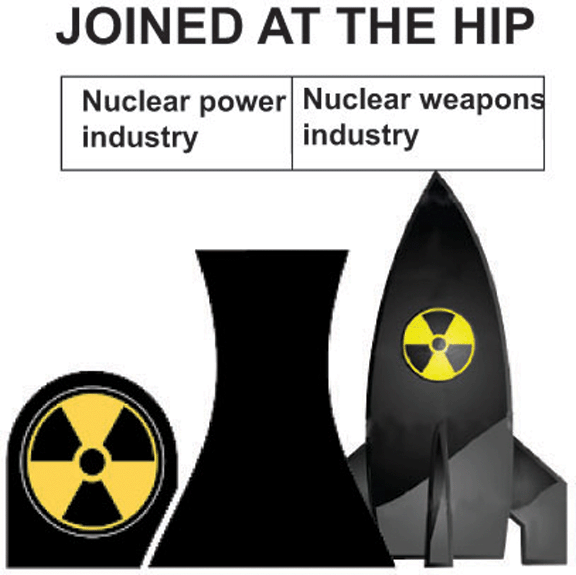 Canada re-engages in the Nuclear Weapons Business with SMRs, December 3, 2020, WWW.HILLTIMES.COM/2020/12/03/CANADA-RE-ENTERS-NUCLEAR-WEAPONS-BUSINESS-WITH-SMALL-MODULAR-REACTORS/274591
Natural Resources Minister Seamus O’Regan is expected to announce within weeks his government’s action plan for development of “small modular” nuclear reactors (SMRs).
SMR developers already control the federally-subsidized Chalk River Laboratories and other facilities owned by the crown corporation, Atomic Energy of Canada Limited (AECL). Canada is now poised to play a supporting role in the global nuclear weapons business, much as it did during World War II.
Canada was part of the Manhattan project with the U.S. and U.K. to produce atomic bombs. In 1943 the three countries agreed to build a facility in Canada to produce plutonium for nuclear weapons. Researchers who trained at the Chalk River Laboratories went on to launch weapons programs in the U.K. and France. Chalk River provided plutonium for U.S. weapons until the 1960s.
Canada’s Nuclear Schizophrenia describes a long tradition of nuclear cooperation with the United States: “For example, in the early 1950s, the U.S. Navy used Canadian technology to design a small reactor for powering its nuclear submarines.” C.D. Howe, after creating AECL in 1952 to develop nuclear reactors and sell weapons plutonium, remarked that “we in Canada are not engaged in military development, but the work that we are doing at Chalk River is of importance to military developments.”
The uranium used in the 1945 Hiroshima bomb may have been mined and refined in Canada. According to Jim Harding’s book Canada’s Deadly Secret: Saskatchewan Uranium and the Global Nuclear System, from 1953 to 1969, all the uranium mined in Saskatchewan went to make U.S. nuclear weapons. Canada remains the world’s second-largest producer of uranium. North America’s only currently operating uranium processing facility is owned by Cameco in Port Hope, Ontario.
Canada built India’s CIRUS reactor, which started up in 1960 and produced the plutonium for India’s first nuclear explosion in 1974. Canada also built Pakistan’s first nuclear reactor, which started up in 1972. Although this reactor was not used to make weapons plutonium, it helped train the engineers who eventually exploded Pakistan’s first nuclear weapons in 1998.
In 2015 the Harper Government contracted a multi-national consortium called Canadian National Energy Alliance – now comprised of two U.S. companies, Fluor and Jacobs, along with Canada’s SNC-Lavalin – to operate AECL’s nuclear sites, the main one being at Chalk River. Fluor operates the Savannah River Site, a South Carolina nuclear weapons facility, under contract to the U.S. Department of Energy (DOE). Jacobs also has contracts at DOE weapons facilities and is part of a consortium that operates the U.K. Atomic Weapons Establishment.
Joe McBrearty, the president of the consortium’s subsidiary that operates Chalk River and other federal nuclear sites, was a U.S. Navy nuclear submarine commander and then chief operating officer for the DOE’s nuclear laboratories between 2010 and 2019.
All three consortium partners have investments in SMRs and are ramping up research and development at AECL’s Chalk River facility. Some SMR designs would use uranium enriched to levels well beyond those in current reactors; others would use plutonium fuel; others would use fuel dissolved in molten salt. All of these pose new and problematic weapons proliferation risks.
Rolls Royce, an original consortium partner that makes reactors for the U.K.’s nuclear submarines, is lead partner in a U.K. consortium (including SNC-Lavalin) that was recently funded by the U.K. government to advance that country’s SMR program.
A military bromance: SMRs to support and cross-subsidize the UK nuclear weapons program, says “Industry and government in the UK openly promote SMRs on the grounds that an SMR industry would support the nuclear weapons program (in particular the submarine program) by providing a pool of trained nuclear experts, and that in so doing an SMR industry will cross-subsidize the weapons program.”
The article quotes a 2017 Rolls Royce study as follows: “expansion of a nuclear-capable skilled workforce through a civil nuclear UK SMR programme would relieve the Ministry of Defence of the burden of developing and retaining skills and capability.”
The SMR connection to weapons and submarines could hardly be clearer – without SMRs, the U.S. and U.K. will experience a shortage of trained engineers to maintain their nuclear weapons programs.
With the takeover of AECL’s Chalk River Laboratories by SMR developers, and growing federal government support for SMRs, Canada has become part of a global regime linking nuclear power and nuclear weapons.
Uranium Film Festival 2020 – a huge success under difficult circumstances
 Uranium Film Festival 2020 – a huge success under difficult circumstances https://www.icbuw.eu/uranium-film-festival-2020-a-huge-success-under-difficult-circumstances/ (Manfred Mohr)5. Dezember 2020 The Berlin event marked the tenth anniversary of the International Uranium Film Festival (IUFF). The fact that it took place at all in the times of Corona and that there was such a great response from the public, as well as high-quality content was a huge success that one could not have expected. ICBUW was there from the beginning as we were „promoted“ to be co-organizer this year and were even more involved than before, also in the form of the ICBUW team (Eliah Buchholz, Ilia Kukin, Arina Shpanova).
ICBUW spokesman Prof. Manfred Mohr opened – alongside IUFF producer Jutta Wunderlich – the Berlin festival and proceeded to the opening film “Vom Sinn des Ganzen” (English: „Of the sense of the whole“), which had its world premiere at the festival. This was followed by a conversation about the film, which focused on the researcher Hans-Peter Dürr. Among other things, there was a question of whether our new, younger generation is ready to replace the older one (the one of e.g.Biegert and Mohr) in peace and disarmament matters. The answer was affirmative… There was another moderation from the side of ICBUW for the film „The Beginning of the End of Nuclear Weapons“. An intensive conversation developed with the present producer Tony Robinson, ICAN, and IPPNW representatives. Among other things, it concerned whether there is – in addition to or in connection with the Nuclear Weapons Prohibition Treaty – an international law ban on the use or threat of use of nuclear weapons. This could be derived from customary international law, as expressed in the 1996 International Court of Justice opinion on nuclear weapons. As expected, a highlight of the festival was the performance and discussion of the film “Balentes”, which was awarded as the best documentary film. It led to an exciting, stimulating panel discussion with the director Lisa Camillo and the Sardinian ICBUW friend Pitzente Bianco. The central issue was whether and in what way the specific, culturally and traditionally shaped commitment of the Sardinian population to the protection of the island’s homeland must be strengthened through external structures and networking. ICBUW spokesman Mohr pointed out the potential of UN human rights complaints procedures for protecting depleted uranium and environmental victims. The end phase of the festival, which the ICBUW special event on October 18 in Marienstrasse 19/20 belonged to, was marked by the award-winning film “Valley of the Gods” by Lech Majewski. In his short closing speech as well as in his festival greeting, the ICBUW spokesman expressed the hope that the IUFF will continue: „… It is essential in its bringing together of the public, artists and civil society actors concerning existing, unsolved humanity issues. We’ll stick with it in any case.“
|
|
1 This Month

Tell Congress: Prevent Nuclear Catastrophe in Iran

Tell Congress: Prevent Nuclear Catastrophe in Iran

Read the Public Inquiry Report, the Commissioners’ report, Surrendering Australia: The AUKUS Deception is available to download for free at aukuspublicinquiry.com. Or just watch the replay of the National Press Club Luncheon.


Shut down the radiation-damaged Heysham nuclear reactors now
To see nuclear-related stories in greater depth and intensity – go to https://nuclearinformation.wordpress.com

Say No to NASA’s Reckless Nuclear Reactor on the Moon
Say No to NASA’s Reckless Nuclear Reactor on the Moon
-
Archives
- November 2026 (269)
- October 2026 (302)
- September 2026 (339)
- August 2026 (330)
- July 2026 (355)
- June 2026 (287)
- May 2026 (306)
- April 2026 (356)
- March 2026 (251)
- February 2026 (267)
- January 2026 (308)
- December 2025 (358)
-
Categories
- 1
- 1 NUCLEAR ISSUES
- business and costs
- climate change
- culture and arts
- ENERGY
- environment
- health
- history
- indigenous issues
- Legal
- marketing of nuclear
- media
- opposition to nuclear
- PERSONAL STORIES
- politics
- politics international
- Religion and ethics
- safety
- secrets,lies and civil liberties
- spinbuster
- technology
- Uranium
- wastes
- weapons and war
- Women
- 2 WORLD
- ACTION
- AFRICA
- Atrocities
- AUSTRALIA
- Christina's notes
- Christina's themes
- culture and arts
- Events
- Fuk 2022
- Fuk 2023
- Fukushima 2017
- Fukushima 2018
- fukushima 2019
- Fukushima 2020
- Fukushima 2021
- general
- global warming
- Humour (God we need it)
- Nuclear
- RARE EARTHS
- Reference
- resources – print
- Resources -audiovicual
- Weekly Newsletter
- World
- World Nuclear
- YouTube
-
RSS
Entries RSS
Comments RSS

