Britain’s push for nuclear power makes no sense, unless it is a hidden subsidy for the Royal Navy
Britain’s push for nuclear power makes no sense, unless it is a hidden subsidy for the Royal Navy
The Government can fund a robust nuclear deterrent if it so desires, but should stop pretending that it is energy policy Telegraph, AMBROSE EVANS-PRITCHARD16 December 2020 – (subscribers only)
Is Energy Harbor cutting nuclear plant workers’ benefits in violation of labor deal?
|
Energy Harbor is cutting nuclear plant workers’ benefits in violation of labor deal, union says
By Jeremy Pelzer, cleveland.com, Ohio—A labor union is claiming that Energy Harbor is cutting health benefits for its employees at the Perry Nuclear Power Plant in violation of a 2019 deal that allowed the company to emerge from bankruptcy.
Utility Workers Union of America Local 270 is seeking arbitration with Energy Harbor after the company notified the union that, starting next month, it would no longer pay into about 30 plant workers’ health coverage at the same rate it did when it was part of FirstEnergy Corp., according to emails provided by the union. Under Energy Harbor’s proposal, these employees — who include mechanics, plant operators, and warehouse and maintenance workers — would have to pay amounts ranging from an additional $61.06 per month for single employees to $168.78 more per month for family coverage, according to the emails. William W. Thompson, Energy Harbor’s compensation and benefits manager, justified the change to the union on the grounds that the 2019 labor deal states that employee premiums should be calculated using the same methodology that was being used at the time……….
Joyce Goldstein, an attorney representing Local 270, noted in an interview that the dispute comes as state lawmakers are considering what to do about House Bill 6, a scandal-ridden energy law that, if left untouched, would start collecting fees from ratepayers next month to fund a $1 billion-plus bailout to Energy Harbor’s Perry and Davis-Besse nuclear plants. “I mean, their greed never stops,” Goldstein said. As Energy Harbor — then called FirstEnergy Solutions — went through bankruptcy proceedings last year, it attempted to replace workers’ pension plan with a 401(k) plan. The dispute led a federal judge to hold up approval of Energy Harbor’s bankruptcy restructuring plan until the company reached a deal to guarantee the pension plan and existing employee benefits. https://www.cleveland.com/open/2020/12/energy-harbor-is-cutting-nuclear-plant-workers-benefits-in-violation-of-labor-deal-union-says.html
|
|
Doubts about planned Berkshire ”garden town”, because it’s too close to AWE nuclear weapons factory
 BBC 15th Dec 2020, Plans to build a new “garden town” could be scrapped over concerns about a
potential nuclear emergency. The proposed 15,000-home development in
Grazeley is within a couple of miles of nuclear weapons factory AWE
Burghfield. The Office for Nuclear Regulation has extended a “detailed
emergency planning zone” (DEPZ) for the plant, taking in most of the site
earmarked for homes.
That means anyone living in the zone could be affected
by a “reasonably foreseeable” radiation emergency. Three Berkshire councils
that have worked jointly on the plans are now considering shelving the
project, according to the Local Democracy Reporting Service (LDRS).
Turkey’s unfinished nuclear plant already redundant
Critics say Turkey’s unfinished nuclear plant already redundant
Turkey’s power plant building spree has resulted in an enormous idle capacity but the construction of new plants continues at the expense of taxpayers despite the country’s bruising economic woes. Al-Monitor Mustafa Sonmez Dec 15, 2020
Turkey’s ruling Justice and Development Party (AKP), in power for 18 years, is under increasing fire for poorly planned, prodigal investments whose long-term financial fallout is coming into sharper relief as the country grapples with severe economic woes. Standing out among the most dubious investments is a series of power plants, including a nuclear energy plant still under construction, that have created an idle capacity threatening to haunt public finances for years.
The miscalculations date back to the AKP’s early years in power, when the Turkish economy — fresh from an IMF-backed overhaul — enjoyed unprecedented inflows of foreign capital that stimulated economic growth of up to 7% per year. The AKP’s economic credentials thrived, translating to lasting political gains. The government encouraged construction as the main driver of growth, even if it relied almost entirely on the continued flow of foreign funds. While the country’s energy consumption grew its power production lagged behind and required larger imports of gas, oil and even coal to power electricity plants.
…….The government-backed investment frenzy rested on the assumption that the economy would sustain its growth pace of 6-7% per year. This belief, however, was not justified. Amid ups and downs since 2014, the economy has slowed and so has its energy demand. Consumption has increased only 44% over the past decade, according to official figures, meaning that a significant capacity is now idle while the investments continue to gulp bulky public funds and many of them have caused lasting environmental damage.
………Chief among the ongoing projects is the nuclear power plant that Russia’s state-owned nuclear energy company Rosatom is building in Akkuyu, on Turkey’s southern Mediterranean coast, under an intergovernmental agreement signed in 2010. The facility, scheduled to become operational in 2023, will be the country’s first nuclear power plant, with a capacity of 4,800 megawatts. The build-operate-transfer project has been granted a 49-year production license that expires in June 2066.
Under the deal, the Russians assumed the financing of the project, estimated to cost $20 billion, while the Turkish government provided the land free of charge and promised to purchase 70% of the plant’s electricity production for 15 years at the price of 12.35 cents/kWh. The estimate was that the cost of the 15-year purchase guarantee would total 57 billion liras, but amid the dramatic deprecation of the currency since 2018, the sum has already swelled to 140 billion liras.
Even before the currency turmoil, the project risked delays due to financing snags. Whether it could be finished on time or whether the builders and Ankara could now face additional costs remains to be seen. But given the country’s energy consumption trend, one thing is already clear: the project was a gross, prodigal misstep economically, not to mention the safety and environmental concerns over the plant’s location in an earthquake-prone area.
Ankara, however, seems to have not learned a lesson. Plans remain underway for a second nuclear power plant in Sinop, on the country’s northern Black Sea coast. The government is looking for new partners after a Japanese-led consortium abandoned the project due to prohibitive costs.
According to the Energy Ministry’s 2019-2023 strategy paper, Ankara will seek an intergovernmental deal different from that with Russia and the details of the project, including its capacity and fuel and reactor types, will be decided once the builder is found.
https://www.al-monitor.com/pulse/originals/2020/12/turkey-nuclear-plant-become-redundant-before-completion.html#ixzz6gpABtCr7
Russian hackers evaded layers of U.S. security to attack America’s military and intelligence agencies
 New York Times 14th Dec 2020, The scope of a hack engineered by one of Russia’s premier intelligence agencies became clearer on Monday, when some Trump administration officials acknowledged that other federal agencies — the State Department, the Department of Homeland Security and parts of the Pentagon — had been compromised. Investigators were struggling to determine the extent to which the military, intelligence community and nuclear laboratories were affected by the highly sophisticated attack.
https://www.nytimes.com/2020/12/14/us/politics/russia-hack-nsa-homeland-security-pentagon.html
Why is UK govt taking the financial and flooding risk of Sizewell nuclear, when renewables are clearly safer and cheaper?
 Tax Research UK 16th Dec 2020, There is an article in the FT this morning that suggests something that
should be obvious, but needs saying. And that is that renewable energy is
now bringing deflation into the energy market.
Management. As he puts it: With the US poised to rejoin the Paris Agreement
under the incoming Biden administration and the proliferation of net-zero
commitments from various governments, the romance between equity markets
and renewable-energy goes from strength to strength.
overlooked: the underlying reason for the astonishing transformation of
renewables over the past decade from niche to mainstream competing
head-to-head with fossil fuels is economic rather than environmental.
fuels are intrinsically inflationary. This has huge implications for the
distribution of value across the global energy system over the next three
decades.
on the Suffolk coast where the chance that it will be flooded within the
foreseeable future is high? I wish I knew. We now have the option of viable
energy to sustain the transition we need. More investment in it only
increases its appeal. And yet still we stick with the harmful solutions. I
have never got this. I never will.
Nuclear energy -neither clean nor safe, but back on East Bay Community Energy Board’s Agenda on Dec. 16
 Nuclear is Back on East Bay Community Energy Board’s Agenda on Dec. 16 https://www.sierraclub.org/san-francisco-bay/blog/2020/12/nuclear-back-east-bay-community-energy-boards-agenda-dec-16 December 15, 2020 By Melissa Yu
Tomorrow, December 16th, at 5:00 PM, the East Bay Community Energy (EBCE) board will vote on whether or not to accept nuclear energy from PG&E, with the aim of re-selling it to a third party.
EBCE, Alameda County’s public power agency, exists to provide more renewable energy to its customers and reinvest its earnings back into the community to create local green energy jobs, local programs, and clean power projects.
Nuclear energy is not safe or clean. The Sierra Club remains unequivocally opposed to nuclear energy and encourages the decommissioning of nuclear power plants. We oppose even the buying and selling of nuclear power.
Time and time again we’ve fought to keep nuclear out of EBCE’s power content. Simply promoting nuclear in another form does not make it acceptable — even for slight financial gains.
We urge you to join us in asking the Board to reject this latest proposal. Let’s make sure EBCE stays cleaner and greener than the incumbent utility.
The meeting agenda, speaker sign up, and Zoom link will be posted and updated here. Sometimes these meetings can be long. If you would like us to text you when the agenda item is being discussed, please message Melissa Yu at melissa.yu@sierraclub.org.
Treaty on the Prohibition of Nuclear Weapons – theme for January 2021
The Treaty on the Prohibition of Nuclear Weapons, the first international ban on nuclear weapons, will take full legal effect on Jan. 22, 2021.
It joins the Chemical Weapons Convention and the Biological Weapons Convention as a treaty prohibiting weapons of mass destruction . It joins those international agreements that prohibit and eliminate weapons based on their humanitarian harm. The treaty has widespread support in the international community — 122 countries voted for its adoption in 2017, and these countries have continued to express their support for the treaty .
The Traty is not merely symbolic. It prohibits states parties from developing, testing, producing, manufacturing, transferring, possessing, stockpiling, using (or threatening to use) nuclear weapons, or allowing nuclear weapons to be stationed on their territory. It also prohibits states parties from assisting, encouraging, or inducing states to engage in any of these prohibited activities.
A NATO State may join the Treaty and remain in the alliance as long as that state renounces participation in the nuclear dimension of the alliance and indicates that it does not support activities prohibited by the treaty.
About compliance concerns in the Treaty. international treaties reinforce norms and provide a forum to discuss and condemn violations of international standards for peace and security.
The treaty will continue to grow and integrate into the international system well beyond its entry into force in January and first meeting of states parties. The norm established by previous weapons prohibitions impacted banks, companies, and government policies in countries that had not joined the treaty, and the same can be expected for the nuclear prohibition norm.
The Treaty on the Prohibition of Nuclear Weapons will impact the norm against nuclear weapons and in the meantime will provide concrete assistance for victims of nuclear weapons use and testing and contribute to remediating radiologically contaminated areas.
These notes adapted from https://warontherocks.com/2020/11/five-common-mistakes-on-the-treaty-on-the-prohibition-of-nuclear-weapons/
Law and Disorder: The case of Julian Assange
 In the case of Julian Assange, what is on trial is nothing less than our right to know what is done by governments in our name, and our capacity to hold power to account.

Law and Disorder: The case of Julian Assange, DiEM25, By Pam Stavropoulos | 10/12/2020,
What kind of law allows pursuit of charges under the 1917 United States Espionage Act — for which there is no public interest defence — against a journalist who is a foreign national?
The closing argument of the defence in the extradition hearing of WikiLeaks founder and publisher Julian Assange has been filed. For this and other reasons it is apposite to consider the authority invested in the law before which, in democratic societies, we are ostensibly all equal.
In fact, notwithstanding the familiar claims of objectivity (and as `everybody knows’ in Leonard Cohen’s famous lyric) the reality is somewhat different. Jokes about the law attest to this:
‘One law for the rich…’
‘Everyone has the right to their day in court — if they can pay for it’
‘What’s the difference between a good lawyer and a great one? A good lawyer knows the law. A great lawyer knows the judge’
The term ‘legal fiction’ calls into question the relationship between law, objectivity, and truth. On the one hand, law is the essential pillar of a functioning society. On the other, it is replete with anomalies both in conception and execution. To what extent can these perspectives be reconciled? High stakes are attached to this question.
Questioning claims of objectivity in the context of law.
Britain: Controversial funding arrangements for unnecessary Sizewell C nuclear project ?
 Sizewell C: government reignites £20bn nuclear power station row, Talks with EDF could lead to energy customers being charged for construction costs, Guardian, Jillian Ambrose Energy Energy correspondent, Tue 15 Dec 2020 The government has reignited a row over Britain’s nuclear energy ambitions by agreeing to restart talks with EDF over plans to build a reactor at Sizewell C in Suffolk.The talks could lead to the government taking a direct financial stake in the project before the end of the current parliamentary term in 2024, and using a new financial model that would make the public liable for cost overruns. The formal negotiations over the £20bn nuclear plant will hinge on whether the French state-owned EDF can prove it has learned lessons from its Hinkley Point nuclear project in Somerset, and that a successor plant would offer the public value for money. If it succeeds it may be offered a multi-billion-pound deal that allows it to charge energy customers for the cost of construction while it builds the reactor, effectively putting bill payers on the hook for delays or cost overruns. Ed Miliband, Labour’s shadow business secretary, accused the government of “kicking big decisions into touch” and failing to offer a “definitive statement today one way or the other on financing, costs or an overall plan. The decision to restart talks is also expected to reopen a debate over whether nuclear energy can offer good value for money, and whether the UK needs new nuclear reactors to help meet a steep rise in demand for low-carbon electricity to power a boom in electric vehicles, induction hobs and heat pumps. …….. The decision to restart formal negotiations follows a hiatus in talks that have been dogged by concerns over cost, and the involvement of China General Nuclear Power (CGN), which owns 20% of the project. But environmental campaigners, including Greenpeace, have warned that nuclear reactors are “unnecessary” and expensive compared with renewable energy combined with battery storage technology. The community group Stop Sizewell added that the reactor posed a risk to the natural habitats along the Suffolk coast and the nearby Minsmere nature reserve. ……. The government said it would only consider playing a greater role in the Sizewell project if there was “clear value for money for consumers and taxpayers”. It is also planning to back a new generation of small modular nuclear reactors, or “mini nukes”, which can be built at a lower cost…… https://www.theguardian.com/business/2020/dec/14/sizewell-c-government-talks-nuclear-power-station-edf-suffolk |
|
European Leadership Network appeals to nuclear weapons States to reduce nuclear risks
Group statement | 14 December 2020
European Leadership Network ELN Group Statement: Appeal for P5 states to reduce nuclear weapons risks.
Over the past decade, geopolitical relations among the major powers have deteriorated and the threshold of nuclear use has lowered due to the near-total erosion of arms control, the modernisation of nuclear arsenals in all P5 states as well as a move, by some P5 states, to include “limited nuclear use” in their national security strategies. These developments, and the fiftieth anniversary of the Nuclear Non-Proliferation Treaty’s entry-into-force, are stark reminders of the risks stemming from nuclear weapons.
Against this strained security environment, the ELN has issued a group statement, signed by 140 security experts from 30 countries, calling upon the five recognised nuclear-weapon states by the Nuclear Non-Proliferation Treaty (NPT) – China, France, Russia, the United Kingdom, the United States (the P5) – to launch a sustained, open-ended and regular panel on strategic risk reduction.
Full statement reproduced below……….. (Many signatories from many States ) https://www.europeanleadershipnetwork.org/group-statement/eln-group-statement-appeal-for-p5-states-to-reduce-nuclear-weapons-risks/
Investigation of mass alterations of data on nuclear safety by Japanese company
 Japanese nuclear power firm inspected following mass data alterations https://mainichi.jp/english/articles/20201214/p2a/00m/0na/012000c December 14, 2020 (Mainichi Japan) TOKYO — Japan’s Nuclear Regulation Authority (NRA) launched an on-site inspection at the Japan Atomic Power Co.’s head office in Tokyo on Dec. 14 after it was learned earlier this year that the firm rewrote data related to safety reviews necessary to restart its Tsuruga Power Station Unit 2 in central Japan. The nuclear watchdog will check related documents and interview Japan Atomic Power employees, based on the nuclear regulation law, through Dec. 15. It is rare for the NRA to make an on-site inspection of a company over issues related to safety reviews. At around 9:30 a.m. on Dec. 14, workers of the Secretariat of the Nuclear Regulation Authority entered the building in the capital’s Taito Ward housing the Japan Atomic Power head office. The NRA apparently plans to also conduct an inspection on the trouble-ridden power station’s No. 2 unit located in Tsuruga, Fukui Prefecture, depending on how the probe at the head office develops. NRA Chairman Toyoshi Fuketa has said, “We hope to clarify the Japan Atomic Power’s vision through the inspection.” Regarding Tsuruga Power Station Unit 2, it has been pointed out that there lies an active fault directly beneath the reactor building, which Japan Atomic Power has argued against, claiming that it’s not an active fault line. If it is determined that an active fault runs beneath the building, the firm will not be able to restart the power station. The NRA had temporarily halted its safety review of the Tsuruga plant’s No. 2 unit after finding 80 data alterations and deletions in documents related to the power plant’s geological condition. (Japanese original by Hisashi Tsukamoto, Science and Environment News Department) |
|
USA House Armed Servcies Chairman very sceptical of New Plutonium “Pit” Plans for Nuclear Warheads
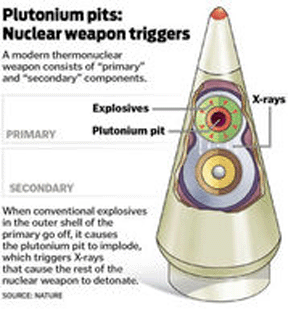 New Plutonium “Pit” Plans for Nuclear Warheads Questioned by House Armed Servcies Chairman, Doubts NNSA Competency, EIN Presswire, NEWS PROVIDED BY Savannah River Site Watch, December 14, 2020, 1Chairman of the powerful House Armed Services Committee, Rep. Adam Smith, casts doubt on plans for expanding plutonium pit production for nuclear weapons at SRS
COLUMBIA, SC, US, December 14, 2020 /EINPresswire.com/ — Chairman of House Armed Services Committee Reveals Great Skepticism in NNSA’s Ability to Covert Terminated Plutonium Fuel (MOX) Facility at DOE’s Savannah River Site into Plutonium Bomb Plant (PBP), Refers to $6 Billion Project as Potential “Rat Hole”
Representative Adam Smith Asserts that Failed Plutonium Fuel (MOX) Project at SRS is “Pretty Close to White Collar Crime”. The powerful chairman of the House Armed Services Committee, Representation Adam Smith, has raised great doubt about the U.S. Department of Energy’s ability to pull off the project at the Savannah River Site (SRS) in South Carolina to produce plutonium “pits,” or cores, for nuclear warheads.
In an on-line presentation on December 11 with the Center for Strategic and International Studies, Rep. Smith (D-WA) expressed deep concern in the ability of the DOE’s National Nuclear Security Administration (NNSA) to pull off the project to convert the partially finished plutonium fuel (MOX) plant, halted in 2017, into the proposed Plutonium Bomb Plant (PBP) at SRS. The event featured Rep. Smith talking about nuclear weapons matters coming before Congress in 2021. The transcript of the event was released late in the afternoon of December 11.
The skepticism of Rep. Smith about pit production at SRS was based in part on his continued concern about NNSA’s role in the failed MOX project at SRS: “Because the thing that really sticks in my craw on this basic competency issue is the Savannah River Site and the MOX facility. OK, that is pretty close to white collar crime, all right?” The public interest group Savannah River Site Watch believes Congress should follow through and conduct investigations into the MOX debacle.
Smith’s comments on pit production at SRS were harsh and, noting the mismanaged construction of the MOX building, said “So I am highly skeptical that they’re going to be able to turn that building into an effective pit production facility – highly skeptical.” He reiterated skepticism in NNSA’s ability and said “I am highly skeptical of the level of competence within the NNSA.”
Concerning the potential monetary waste on the pit project at SRS, Rep. Smith recognized parochial financial interests near SRS pushing for the pit project at the site and said “But if they’re going to have that say, they’d better not use that say to take $6 billion and dump it down a rat hole in South Carolina. That’s what I would argue.”…..
Los Alamos, which has not been able to produce its mandated 20 pits per year, is slated to make 30 or more pits per year by 2026 and SRS, which has zero pit experience and little recent experience handling plutonium, is being presented with the daunting challenge to produce 50 or more pits per year by 2030……. https://www.einnews.com/pr_news/532745444/new-plutonium-pit-plans-for-nuclear-warheads-questioned-by-house-armed-servcies-chariman-doubts-nnsa-competency
Iran’s Rouhani: No conditions or negotiations on nuclear deal
Iran’s Rouhani: No conditions or negotiations on nuclear deal
The US tried to include Iran’s missile programme and regional issues in the original nuclear deal but it is non-negotiable, president says. Aljazeera, By Maziar Motamedi, 14 Dec 2020, Tehran, Iran – President Hassan Rouhani said Iran will not accept any preconditions in returning to the nuclear deal it signed with world powers and will not negotiate its missiles programme or regional activities.
The United States and European powers have said in recent weeks they remain committed to revitalising the nuclear deal – formally known as the Joint Comprehensive Plan of Action (JCPOA) – which outgoing US President Donald Trump unilaterally abandoned in 2018……….. https://www.aljazeera.com/news/2020/12/14/irans-rouhani-no-conditions-or-negotiations-on-nuclear-deal
China has 350 nuclear warheads, compared to USA and Russia’s many thousands of them
The report, written by Hans Kristensen, the director at the Nuclear Information Project at the Federation of American Scientists, and Matt Korda, a research associate at FAS, arrived at the number by counting both operational warheads and newer weapons “still in development.”…….
the report noted that the size of the Chinese nuclear stockpile is still significantly below that of the United States and Russia, which have thousands of nuclear weapons in their respective stockpiles. The authors wrote that claims by the Trump administration’s special envoy for arms control, Marshall Billingslea, that China is striving for a form of “nuclear parity” with the U.S. and Russia “appears to have little basis in reality.”
It also added that China has traditionally maintained a low alert level for its nuclear forces, with most warheads at a central storage facility and smaller numbers kept in regional equivalents…….
China refers to its nuclear posture as at a “moderate state of alert,” with the report suggesting that in peacetime this “might involve designated units to be deployed in high combat-ready condition with nuclear warheads in nearby storage sites under control of the Central Military Commission that could be released to the unit quickly if necessary.” https://www.defensenews.com/global/asia-pacific/2020/12/14/report-estimates-chinese-nuclear-stockpile-at-350-warheads/
1 This Month

Tell Congress: Prevent Nuclear Catastrophe in Iran

Tell Congress: Prevent Nuclear Catastrophe in Iran

Read the Public Inquiry Report, the Commissioners’ report, Surrendering Australia: The AUKUS Deception is available to download for free at aukuspublicinquiry.com. Or just watch the replay of the National Press Club Luncheon.


Shut down the radiation-damaged Heysham nuclear reactors now
To see nuclear-related stories in greater depth and intensity – go to https://nuclearinformation.wordpress.com

Say No to NASA’s Reckless Nuclear Reactor on the Moon
Say No to NASA’s Reckless Nuclear Reactor on the Moon
-
Archives
- November 2026 (269)
- October 2026 (302)
- September 2026 (339)
- August 2026 (330)
- July 2026 (355)
- June 2026 (287)
- May 2026 (306)
- April 2026 (356)
- March 2026 (251)
- February 2026 (267)
- January 2026 (308)
- December 2025 (358)
-
Categories
- 1
- 1 NUCLEAR ISSUES
- business and costs
- climate change
- culture and arts
- ENERGY
- environment
- health
- history
- indigenous issues
- Legal
- marketing of nuclear
- media
- opposition to nuclear
- PERSONAL STORIES
- politics
- politics international
- Religion and ethics
- safety
- secrets,lies and civil liberties
- spinbuster
- technology
- Uranium
- wastes
- weapons and war
- Women
- 2 WORLD
- ACTION
- AFRICA
- Atrocities
- AUSTRALIA
- Christina's notes
- Christina's themes
- culture and arts
- Events
- Fuk 2022
- Fuk 2023
- Fukushima 2017
- Fukushima 2018
- fukushima 2019
- Fukushima 2020
- Fukushima 2021
- general
- global warming
- Humour (God we need it)
- Nuclear
- RARE EARTHS
- Reference
- resources – print
- Resources -audiovicual
- Weekly Newsletter
- World
- World Nuclear
- YouTube
-
RSS
Entries RSS
Comments RSS

