Unacceptable secrecy by the nuclear industry in Sizewell documentation
|
Sizewell C documentation secrecy just a continuation of lack of transparency by the nuclear industry http://drdavidlowry.blogspot.com/2020/12/sizewell-c-documentation-secrecy-just.html Dr David Lowry, 22 Dec 20, Between 18 November and 18 December 2020, NNB Generation Company (SZC Co.) carried out a public consultation on the proposed changes (dated 23 October 2020) for an Order Granting Development Consent for The Sizewell C Project. The document launching this supplementary consultation noted: “In January 2021, SZC Co. will submit a formal application to change the Sizewell C DCO application, as well as some Additional Information (i.e. information that has been developed in response to continuing engagement with stakeholders and which adds to the detail available within the application (but does not change it)).”
One of the supplemental documents submitted by SZC co. was on “Main Development Site Flood Risk Assessment,” a not inconsequential matter, in the context of climate change –induced sea-level rise, and greater perturbations in extreme weather ( storms, rainfall increase etc) over the time period SZC would operate, if ever built. (https://infrastructure.planninginspectorate.gov.uk/wp-content/ipc/uploads/projects/EN010012/EN010012-001715-SZC_Bk5_5.2_Appx1_7_MDS_Flood_Risk_Assessment_Part_1_of_14.pdf) The new mini-consultation letter then added under the headline Information Redacted or Marked as Confidential, the following: “The Procedural Decision requested clarification on the reasons for redactions and confidential marking on a number of the application documents. A summary of reasons is provided in Table 2. SZC observes in these reasons for redaction that “comprehension of the report is not affected by this redaction.”
The Planning inspectorate was not convinced by this assertion, and responded in a rejoinder letter on 22 December stating it was dissatisfied with “the extent and nature of the commercially sensitive aspect of these documents” and pointedly asked “why this could not be redacted without rendering them incomprehensible?”
Here is the full section outlining the Planning Inspectorate’s disquiet with SZC Co’s secrecy. Request for further clarification and documents from the Applicant Confidential documents “The Applicant’s response letter dated 16 November 2020 [AS-006] to the ExA’s procedural decision [PD-005] sets out at Table 2 a summary of its reasons for redactions and confidential markings. For certain documents [APP-292 to APP-295], the Applicant states that: “As these reports are not required in order for the Examining Authority to examine the application, we therefore request that these reports are withdrawn from the application.”
However, the commercial sensitivity of the investigations and data set out in these Environmental Statement (ES) Appendices is not immediately apparent. Furthermore, they comprise part of the ES which was submitted as part of the application and considered as such when the decision [PD-001] to accept the application was made. The Applicant is therefore requested to provide a further explanation in relation to:
(i) The extent and nature of the commercially sensitive aspect of these documents and why this could not be redacted without rendering them incomprehensible;
(ii) The justification for them not being required in order for the ExA [Examining Authority] to satisfactorily examine the application and to properly assess the basis for the related conclusions and findings in the main parts of the ES.” It adds: The additional information that is sought in respect of these confidential documents will assist the ExA to assess the potential implications of that course of action and reach an informed decision on the question of their withdrawal.” (National Infrastructure Planning, Planning Inspectorate, Document Reference: EN010012, 22 December 2020; https://infrastructure.planninginspectorate.gov.uk/wp-content/ipc/uploads/projects/EN010012/EN010012-002699-Sizewell%20PD4%20-%20Rule%2017%20VE%20Q.pdf)
This is just the latest of a very, very long line of unacceptable secrecy incidents by nuclear power plant operators, and demonstrates that notwithstanding their protestations as to transparency, they remain in fact addicted to secrecy.
|
|
USA’s $128 billion next-generation submarine program at risk of cost overruns
|
Next-Generation U.S. Nuclear Sub Facing Cost Overruns, Delays, Bloomberg, Anthony Capaccio December 24 2020, — The U.S. Navy’s plan to deliver the first vessel in its $128 billion next-generation submarine program on time is at risk by a dependence on inexperienced contractors with spotty quality control track records, according to a congressional watchdog.
The Government Accountability Office, in a restricted Nov. 6 report to the Pentagon and congressional defense committees, said the design contract for the first vessel in the Columbia-class sub fleet being built by General Dynamics Corp. could have a cost overrun of as much as 14%, or $384 million.
The GAO report outlines in detail the myriad challenges facing contractors and the Navy in the design and construction of a 12-vessel program that advocates say is most survivable leg of the U.S. nuclear triad, comprising land, air and sea-based warheads. Trump’s 5-Year Budget Plan for Navy Would Add 82 New Vessels (2) As an example, the report says that General Dynamics “continues to identify problems with non-destructive testing and welding across the supplier base, including suppliers responsible for piping, valves and large mechanical equipment.” More broadly, the report signals the difficulties the Navy will face in trying to carry out the Trump administration’s vision for a 355-to-500 vessel fleet by 2045 up from 297 today.
Those difficulties will be one of the first defense-procurement challenges confronting the Biden administration when it takes office next month amid a U.S. economy hobbled by the Covid-19 pandemic. The Columbia’s five-year plan envisions $30 billion being spent on the program through 2026, increasing from $4.7 billion planned for next year to $8.2 billion in 2026.
But first, several quality-control issues have to be addressed………….. https://www.bloombergquint.com/business/next-generation-u-s-nuclear-sub-facing-cost-overruns-delays : https://www.bloombergquint.com/business/next-generation-u-s-nuclear-sub-facing-cost-overruns-delays
|
|
Ohio House Fails To Take Any Action On Nuclear Bailout Law.
Ohio House Fails To Take Any Action On Nuclear Bailout Law, WOSU Radio, By ANDY CHOW 24 Dec 20, • Ohio House Republican leadership says 2020 will end without a vote on any proposal to change HB6. With no delays or repeal, the law stays in place despite being connected to the largest alleged bribery scandal in Ohio history.
When it comes to HB6, the nuclear bailout law connected to a racketeering investigation, House Speaker Bob Cupp (R-Lima) has gone from saying the House will find a way to repeal and/or replace the law, to wanting more discussion on the issue, to saying the House ran out of time to come to a consensus.
That was in the span of five months. Now it appears the House will finish the legislative session without making a single change to HB6……….
In their lawsuit, the cities of Columbus and Cincinnati argued that HB6 amounted to an unconstitutional lending of state credit to a private entity. https://radio.wosu.org/post/ohio-house-fails-take-any-action-nuclear-bailout-law#stream/0
Iran nuclear deal: ‘Heated rhetoric and the heightened risk of miscalculation’ widen differences
The JCPOA was signed by Iran alongside the European Union and five permanent members of the Security Council: China, France, Russia, the United Kingdom, and the United States. However, Washington withdrew in May 2018.
Ms. DiCarlo noted that recent years have been characterized by “attacks on critical infrastructure, heated rhetoric and heightened risk of miscalculation.
“Such actions deepen the differences related to the Plan and render efforts to address other regional conflicts more difficult”, she said. “We call on all concerned to avoid any actions that may result in further escalation of tensions.”
Withdrawal and reduced commitments
Ms. DiCarlo described the move as contrary to the goals of the JCPOA and Security Council Resolution 2231 on its implementation.
“We regret the steps taken by the United States when it withdrew from the Plan, as well as the steps taken by Iran to reduce some of its nuclear-related commitments under the Plan”, she told ambassadors.
The JCPOA guarantees that the UN-backed international nuclear watchdog, the International Atomic Energy Agency (IAEA), will have regular access to sites in Iran and information about its nuclear programme.
While the country had complied with some provisions, the IAEA reported it had surpassed stipulated limits for enriched uranium, a critical component in nuclear power generation.
Iran nuclear deal: a summary
- What is the Iran nuclear deal? The 2015 “Joint Comprehensive Plan of Action” (JCPOA), sets out rules for monitoring Iran’s nuclear programme, and paves the way for the lifting of UN sanctions.
- Which countries are involved? Iran, the five members of the Security Council (China, France, Russia, UK, US), plus Germany, together with the European Union.
- What is the UN’s involvement? A UN Security Council resolution to ensure the enforcement of the JCPOA, and guarantee that the UN’s atomic energy agency, the IAEA, continues to have regular access to and more information on Iran’s nuclear programme, was adopted in 2015.
- Why is the deal at risk? The current US Administration pulled out of the deal in 2018 and re-imposed sanctions. In July 2019, Iran reportedly breached its uranium stockpile limit, and announced its intention to continue enriching uranium, posing a more serious proliferation risk. https://news.un.org/en/story/2020/12/1080592
EU visit to Belarus nuclear plant called off, deepening safety concerns
EU visit to Belarus nuclear plant called off, deepening safety concerns
A visit by European experts to the controversial and newly-operational Belarusian nuclear plant was cancelled after local officials failed to participate in an organizational meeting, Bloomberg reported, citing the European Union energy commissioner. Bellona, December 23, 2020 by Charles Digges
The Belarusian nuclear power plant.Credit: Rosatom
A visit by European experts to the controversial and newly-operational Belarusian nuclear plant was cancelled after local officials failed to participate in an organizational meeting, Bloomberg reported, citing the European Union energy commissioner.
Belarus’s nuclear energy regulator responded by saying it was willing to hold the meeting at a later date, the agency said.
The plant, located in Ostrovets, was expected to be visited by the European delegates after neighboring Lithuania alleged safety issues while the first reactor was coming into service in November. During a summit earlier this month, EU leaders emphasized the importance of ensuring safety at the site, Bloomberg said.
Among the alleged safety violations at the plant, Lithuania said in a memo circulated ahead of the summit, was cooling system malfunction that occurred on November 30. That was preceded on November 8 by a breakdown of four voltage transformers, which forced the plant to go offline shortly after it was started.
Lithuania also complained that the plant had come online without implementing the vast majority of EU or International Atomic Energy Agency recommendations, the EU Observer reported, citing the memo.
Warning that the plant could pose “significant risks” to the EU, the Lithuanian memo said that the nuclear plant’s “hasty commissioning and growing incidents indicate a real risk, which is amplified by limited management and competence abilities.” The memo went on to urge EU nations to boycott electricity produced by the Belarusian plant………….
In comments reported by Bloomberg last week, EU Energy Commissioner Kadri Simson called the delay “very regrettable.”
Commenting at a European Parliament committee meeting last Wednesday, she said, “The Belarusian regulator didn’t participate in the necessary preparatory technical meeting” to prepare the visit and “in these circumstances the physical visit to the Ostravets site would have no value.” As a result, the team called off the visit.
“The mission continues to call on Belarus to act responsibly and cooperate so that the peer-review exercise can be completed safely and in full transparency,” she said. The EU Commission aims to reschedule the visit as soon as possible and complete the review before the station begins commercial operations, she said…….https://bellona.org/news/nuclear-issues/2020-12-eu-visit-to-belarus-nuclear-plant-called-off-deepening-safety-concerns
Nuclear weapons agency updates Congress on hacking attempt
|
Nuclear weapons agency updates Congress on hacking attempt
Officials from the Department of Energy told Hill staffers this week that they don’t believe their systems were compromised. Politico, By NATASHA BERTRAND, 12/22/2020 The Department of Energy and the National Nuclear Security Administration, which maintains the U.S. nuclear weapons stockpile, told congressional staffers in several briefings this week that there is currently no known impact to its classified systems from a massive hack that targeted its networks, according to an official with direct knowledge of the briefings. The officials told staffers, however, that the incident has proven how difficult it is to monitor the Energy Department’s unclassified systems, and acknowledged that an issue with a network extension within the Office of Secure Transportation — which specializes in the secure transportation of nuclear weapons and materials — had been discovered………. The internal investigation has been complex and time-consuming because the compromised SolarWinds software was used widely throughout the nuclear security administration, officials told the staffers — including at the Los Alamos, Lawrence Livermore, and Sandia national labs; NNSA headquarters; NNSA’s Emergency Communication Network; NNSA’s Mixed Oxide Fuel Fabrication Facility, where fuel is made for reactors; the Nevada National Security Site, a disposal site; and Naval Reactors, which provides propulsion plants for nuclear powered ships. …….https://www.politico.com/news/2020/12/22/nuclear-weapons-agency-congress-hacking-450184 |
|
The Madness of Nuclear Deterrence
The Madness of Nuclear Deterrence, The dangers have only become more acute in the decades since I tried to convince Thatcher. WSJ, Mikhail Gorbachev, April 29, 2019
‘Deterrence cannot protect the world from a nuclear blunder or nuclear terrorism,” George Shultz, William Perry and Sam Nunn recently wrote. “Both become more likely when there is no sustained, meaningful dialogue between Washington and Moscow.” I agree with them about the urgent need for strategic engagement between the U.S. and Russia. I am also convinced that nuclear deterrence, instead of protecting the world, is keeping it in constant jeopardy.
I recall my heated discussions of this issue with Margaret Thatcher. We argued about many things and often found common ground, but on this question she fought to the last. Nuclear weapons, she insisted, prevented World War III.
I asked her: “Are you really comfortable sitting on a nuclear powder keg?” I showed her a diagram representing the world’s nuclear arsenals, grouped into hundreds of squares. Each square, I told her, is enough to eliminate human civilization as we know it. I was unable to persuade Margaret Thatcher. We hear the same arguments today, including in the U.S. and Russia.
Yet nuclear weapons are like a rifle hanging on the wall in a play written and staged by a person unknown. We do not know the playwright’s intent. Nuclear weapons could go off because of a technical failure, human error or computer error. The last alarms me the most. Computer systems are now used everywhere. And how many times have computers and electronics failed—in aviation, in industry, in various control systems?
Nuclear weapons might also be launched in response to a false alarm. If the flight time of the missiles is reduced, leaving less time to detect a false alarm, the probability of a mistaken retaliatory launch is bound to rise……. (subscribers only) https://www.wsj.com/articles/the-madness-of-nuclear-deterrence-11556577762
Nuclear news – week to 22 December
‘Tis the season to be jolly. But, honestly, I can’t. If you want to know what’s really going on in this human-species-afflicted planet, I recommend Radio Ecoshock. Here you will learn about Climate Collapse & The Plastic Plague
It’s not about some distant future problem. It’s about now, and how we are living on a trashed planet. And we’re and adding more to this with all our festive junk and unnecessary gifts.
Having said that – there are so many good people trying to clean up, and keep clean, our fragile planet. For some examples – I recommend 99 Good News Stories From 2020 You Probably Didn’t Hear About.
Also, I am reading “The Good Germans – resisting the NAZIs 1933 – 1945“, by Catrine Clay. I find this book a very timely reminder that in very worst of modern times, there were so many people who saw evil being done, and resisted it, and also helped the persecuted, as best they could.
Sleepwalking Toward the Nuclear Precipice.
The insanity of nuclear power in space.
About writing about the nuclear crisis. We’re in a storytelling crisis”: Advice for writing on nuclear issues, from the author of “Fallout”.
Unveiling New Billboards: “Nukes Are Now Illegal!” (Nuclear Weapons) .
AUSTRALIA. 2020 in Australia – a successful year for resistance to nuclear pollution.
CANADA. Canada’s Small Modular Nuclear Reactor ‘Action Plan’ banks on private sector nuclear pipe dreams. NuScale exultant that their scam small nuclear reactors have conned the Canadian government. Many Canadian organisations dispute the government’s plan for small nuclear reactors.
JAPAN.
75% of the Japanese public want Japan to join the Treaty on the Prohibition of Nuclear Weapons. Major Japan life insurers shun investing in nuclear weapons-linked firms.
Uninhabitable: Booklet by citizen scientists uncovers true extent of radioactive contamination in Japan’s soil and food.
2 million yen ($19,300) incentive for families to move to near crippled Fukushima No. 1 nuclear power plant.
Investigation of mass alterations of data on nuclear safety by Japanese company.
Mutsu Mayor Soichiro Miyashita made it clear that spent nuclear fuel facility will not go ahead. 44 year old Mihama nuclear station, with waste disposal problem may be allowed to restart. Nuclear waste plan spells doom for a Hokkaido fishing community.
UK.
- Law and Disorder: The case of Julian Assange.
- Disabled Russian nuclear-powered feighter to pass through UK and European waters.
- Sizewell C nuclear project. No “green light” for £20bn Sizewell nuclear project, but the UK govt “in talks” with EDF. UK’s Sizewell nuclear project could be a costly fiasco like Hinkley Point C. Controversial funding arrangements for unnecessary Sizewell C nuclear project? Why is UK govt taking the financial and flooding risk of Sizewell nuclear, when renewables are clearly safer and cheaper?. Ipswich Council raises fresh worries about Sizewell nuclear power plan. Sizewell C nuclear plan – a disastrous and expensive mistake. EDF did a small survey of Suffolk community opinion –weighted to favour nuclear industry?
- Doubts about planned Berkshire ”garden town”, because it’s too close to AWE nuclear weapons factory.
USA.
- Investigative journalism – A Legacy of Contamination, How the Kingston coal ash spill unearthed a nuclear nightmare.
- Investigative journalism – USA government resists paying compensation to nuclear workers made ill by ionising radiation.
- For the USA, despite the “Green Nuclear Deal” propaganda, solar power is looking a whole lot better.
- David and Goliath fight to repeal crooked nuclear plant bailouts in Ohio. Following huge bribery scandal, Energy Harbor still manipulating to keep nuclear bailout law.
- Is Energy Harbor cutting nuclear plant workers’ benefits in violation of labor deal?
- USA House Armed Servcies Chairman very sceptical of New Plutonium “Pit” Plans for Nuclear Warheads.
- Russian hackers evaded layers of U.S. security to attack America’s military and intelligence agencies. In a massive cyber-attack, U.S. nuclear agency has been hacked. Hacking of U.S. nuclear weapons agency went undetected for 9 months. 6 Things to Know about the 2020 Cyberattack and Nuclear Power Plants.
- In midst of pandemic crisis, more U.S. tax-payer money to go to nuclear power in space. USA to turn the moon into a nuclear weapons site.
CHINA. China has 350 nuclear warheads, compared to USA and Russia’s many thousands of them.
RUSSIA. Russian environmental defenders under attack.
IRAN. World powers renew commitment to preserve Iran nuclear deal. Iran’s Rouhani: No conditions or negotiations on nuclear deal. Iran builds at underground nuclear plant. Iran Rejects New UN Report over Nuclear Violations. West yet to condemn Iranian nuclear scientist’s assassination.
US Navy nuclear-powered guided-missile submarine and 2 warships sail through Strait of Hormuz, (Persian Gulf-Gulf of Oman).
EUROPE. European Leadership Network appeals to nuclear weapons States to reduce nuclear risks.
UKRAINE. 34 years later, food crops near Chernobyl still contain ionising radiation.
TURKEY. Turkey’s unfinished nuclear plant already redundant.
DENMARK. Big boasts for small nuclear reactors on ships – but are they a recipe for disaster?
JORDAN. Did a research reactor in Jordan leak?
Small Nuclear Reactor unicorns for Canada

Canada’s SMR ‘Action Plan’ banks on private sector nuclear pipe dreams, Burgess Langshaw-Power / December 21, 2020 For many kids who grew up in the 1980s and 1990s, Star Trek was a big part of our childhoods. The series is filled with strange new worlds, futurist politics, and advanced technology that is almost indistinguishable from magic. Yet even as a child I knew the show was a work of science fiction. Warp speed, transporters and phasers were all gadgets I could comprehend, but in my rational mind I knew they would never exist within my lifetime.
Unfortunately, recent announcements by Canada’s Natural Resources Minister Seamus O’Regan—a self-professed fan of science fiction—demonstrate that the government has yet to arrive at the same conclusion I did as a kid watching Star Trek.
On December 18, the Trudeau government launched Canada’s Small Modular Reactor (SMR) Action Plan, to great fanfare. This new action plan builds on the 2018 SMR Roadmap, which made the promise that, “SMRs are a re-scaling and repurposing of nuclear technology for wider markets. They represent a paradigm shift for nuclear reactor technology—analogous to the shift of steam engines from mineshafts into ships and vehicles, or the movement of computers from mainframe to desktop and then to laptop.”
This idea of a paradigm shift channels Star Trek-level aspirations, yet the new Action Plan is significantly more hesitant: “Small modular reactors (SMRs) could be a source of clean, safe and affordable energy, opening opportunities for a resilient, low-carbon future and capturing benefits for Canada and Canadians while supporting reconciliation with Indigenous peoples as essential enabling partners.”
In just two years, from the launch of the Roadmap to the announcement of the Action Plan, the government has gone from a paradigm shift to the possibility that SMRs could be a source of clean energy. It’s as though there is something else about SMRs that the government doesn’t want us to consider in more depth.
Before we go any further, what are SMRs, anyway? Well, it turns out that’s a very good question. In fact, the Globe and Mail notes that “SMR lacks a universally agreed definition, and the Canadian Nuclear Safety Commission regards it as a marketing rather than a technical term.” In other words, SMRs are a group of many different technologies, none of which have actually been proven or tested, with only one project proposed and no timeframe for its realization. None of the technologies currently under consideration have solved any major issues with nuclear energy, including the problem of high-level radioactive waste management, however some are less likely to have meltdown-like events and cannot produce isotopes for creating weapons.
The Statement of Principles section of the Action Plan notes that, “Markets around the globe are signalling a need for smaller, simpler, and cheaper nuclear energy.” However, there is simply no evidence to support this claim. In fact, the polar opposite is true, with many major governments and large corporations exiting the nuclear sector entirely. Meanwhile, German experts have stated that, “SMRs are always going to be more expensive than bigger reactors due to lower power output at constant fixed costs, as safety measures and staffing requirements do not vary greatly compared to conventional reactors.”
The British press is even more blunt about the prospects of a more ‘tactile’ nuclear future: “There is no commercial case for giant new reactors in any developed country. They cannot meet post-Chernobyl and post-Fukushima safety demands at viable cost and have been priced out of the global energy market. Precipitous falls in renewable costs over the last five years have rendered the technology effectively obsolete in the West.”
This doesn’t sound like a bold future to me………..
The theory is that SMRs will be cheaper and safer than conventional nuclear reactors. Again, German experts disagree on the cost front. In terms of levelized energy costs, says Nicolas Wendler of industry association Nuclear Technology Germany (KernD), SMRs will always be more expensive than big plants. Moreover, he says, “nuclear power plant owners have repeatedly rejected the idea that the nuclear exit be reversed, arguing the technology is no longer economically viable anyway.”
In the United States, some nuclear plants are being decommissioned early, while other projects are being cancelled at a huge financial loss. Why? They aren’t competitive. This does not even account for the fact that we have yet to successfully build even a single SMR. Yet, if we were to, how much would they cost? The record for delays and cost overruns in Canada is not positive, and nuclear facilities have an unusually poor record in this regard. After 1970, the average nuclear facility saw cost overruns exceed 241 percent (not including the added burden of construction delays).
This does not even begin to address the costs and hazards associated with cleaning up nuclear sites, such as expensive remediation projects now underway in the US and the UK. Perhaps unsurprisingly, these failures and cost overruns sound a lot like the last major federal investment in the energy sector—the Trans Mountain pipeline fiasco.
There is no doubt Canada will need new energy sources for our clean energy transition to address the climate crisis. The Government of Canada claims, “At the same time, international experts are telling us that new nuclear energy, together with the full range of low-carbon technologies, are needed to combat global climate change and meet federal, provincial and territorial emissions targets for 2030 and 2050.”
However, international examples do not inspire confidence that nuclear needs to be a part of this solution. Germany is close to achieving half its energy supply from renewables excluding nuclear. In the UK, some estimates show that not including nuclear energy in the mix will save hundreds of millions of pounds and that the only justification for pursuing nuclear energy in the UK or France is to support a nuclear military strategy (which Canada obviously does not have).
At least the UK is putting its money where its mouth is, with over half a billion pounds invested into nuclear, while Canada’s new SMR Action plan includes precisely $0 of investment, as opposed to our new federal hydrogen strategy, which received $1.5 billion.
Why would we choose nuclear over other cheaper and readily available renewable technologies? It is true that there are still major flaws with renewables, but given that most SMRs are a decade away (at least), and the cost of solar has already dropped 89 percent in the last decade, it seems unlikely that SMRs—whenever they are ready—will be competitive.
One of the theoretical selling points is the deployment of SMRs in rural and remote communities to replace diesel. Yet, many Indigenous and northern communities have expressed trepidation towards SMRs dotting their territory, and are building solar arrays instead. Another argument is that SMRs could be used for industrial facilities such as those in the mining sector, or the Alberta oil sands (this was a terrible idea in the past, and its terrible idea now). However, others suggest that SMRs are only capable of, “ticking off the Financial and Consumer Services Commission’s checklist on how to spot a scam.”
Canada’s SMR Action Plan is nothing more than science fiction: idle dreams of an indefinite group of technologies which may be ready in a decade, with no financial support or investment by the government. In the meantime, renewable energy continues to leap ahead, mostly without any federal support.
One can only imagine how government investment, if effectively pursued, could push our renewable energy potential by the time the first SMRs are ready for deployment. Given these considerations, perhaps the reason this “Action Plan” is so empty, is that the federal government is in fact aware of how little potential SMRs hold. Like nuclear fusion, maybe SMRs will always be just around the corner. In which case, why bother launching this plan at all? Let’s save our time and investment for renewable energy projects that have viability today, not somewhere down the road.
Burgess Langshaw-Power is a former policy analyst currently completing his PhD in Global Governance at the Balsillie School, University of Waterloo. His policy expertise includes energy technologies, regulatory approvals, climate change, and energy infrastructure. Views expressed here are his own and not necessarily those of his employer. https://canadiandimension.com/articles/view/canadas-smr-action-plan-banks-on-private-sector-nuclear-pipe-dreams
“Mutual admiration society” -between civilian and military nuclear experts
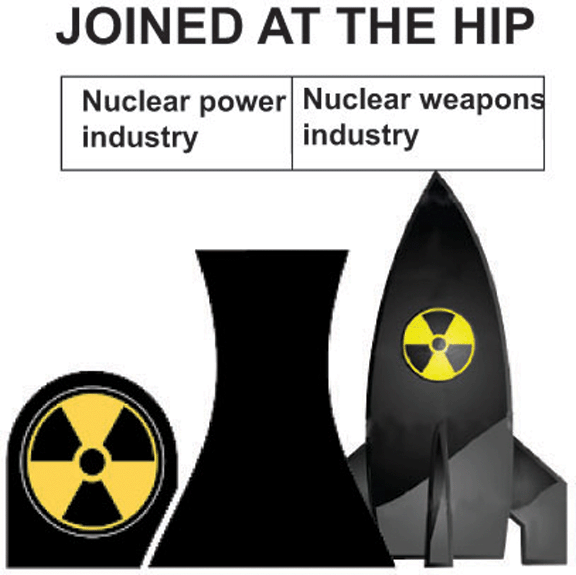 Civilian nuclear and military nuclear members of a “mutual admiration society” ~
 Dr. Gordon Edwards, https://concernedcitizens.net/2020/12/19/civilian-nuclear-and-military-nuclear-members-of-a-mutual-admiration-society/ Dr. Gordon Edwards, President of the Canadian Coalition for Nuclear Responsibility, December 19, 2020
Civilian nuclear and military nuclear have always been friendly room-mates, members of a “mutual admiration” society. In today’s announcement of an SMR Action Plan, Natural Resources Minister Seamus O’Regan said that nuclear power in Canada is a “home-grown” technology and referred to C. D. Howe’s role in this connection. In fact C.D. Howe arranged for all Canadian uranium extracted from Canadian mines to be sold to the US military for use in tens of thousands of nuclear weapons from 1945 to 1965. C D Howe was also on the Committee that met in Washington DC in 1944 to approve the first nuclear reactors to be built in Canada (at Chalk River) as part of the ongoing effort to produce plutonium for use as a nuclear explosive. Mr. Howe approved of the policy of selling plutonium produced at Chalk River to the US military for weapons use, a practice that continued until 1975 and beyond. Plutonium from Chalk River was sent to Britain (it was the first sample of plutonium that Britain had ever obtained) just a few months before Britain detonated its first A-Bomb in the Monte Bello Islands off Australia.
To the best of my knowledge, no civilian nuclear power agency – not the Canadian Nuclear Association, nor the Canadian Nuclear Society, nor the Canadian Nuclear Safety Commission, nor Atomic Energy of Canada Limited, nor Canadian Nuclear Laboratories, NOBODY – has ever issued a clear statement denouncing nuclear weapons or even calling for a nuclear weapons free world. Most nuclear scientists and engineers feel a strong kinship and camaraderie with those who are in the nuclear weapons business. The same goes for those in the nuclear division of Natural Resources Canada. I remember on one occasion (prior to the exchange of nuclear tests between India and Pakistan) I expressed alarm at the fact that both neighbours are developing a nuclear war-fighting capability and a couple of senior civil servants said “Would that be so bad? Maybe that’s just what the world needs. More deterrence. Creates stability”
Despite regular denials from our puppet masters that civilian nuclear has nothing to do with military nuclear, it is clear that civilian nuclear (including the frankly discriminatory provisions of the NPT) has adopted an appeasement policy that will never succeed in bringing about a nuclear weapons free world. Why does Canada continue to sell uranium to countries that are in the process of investing hundreds of billions to improve and modernize the nuclear arsenals in utter defiance of the NPT, knowing that the vast bulk of Canadian uranium that is rejected from enrichment plants as DU end up as the raw material for producing plutonium for Bombs, and that the lion’s share of the explosive power – and the overwhelming share of the radioactive fallout – of every H-bomb comes from the fissioning of DU atoms that are freely accessed by the military even if they are the leftovers of “peaceful” fuel production for nuclear power plants?
“See ‘The Nuclear Fudge’ at https://www.youtube.com/watch?v=0lK65S5eHRQ&feature=youtu.be“. This 16-minute W5 segment from the Regan era is very informative.
75% of the Japanese public want Japan to join the Treaty on the Prohibition of Nuclear Weapons
 Japanese Public Opinion, Political Persuasion, and the Treaty on the Prohibition of Nuclear Weapons, Taylor Francis Online, Jonathon Baronb,Rebecca Davis Gibbons &Stephen Herzog– 21 Dec 20, ABSTRACT
The Treaty on the Prohibition of Nuclear Weapons (TPNW) poses a challenge to decades of Japanese nuclear policy. While Japan has relied on the US nuclear umbrella since the aftermath of World War II, numerous pro-disarmament groups – including the Hibakusha – are calling for Tokyo to join the Treaty. We contribute to these discussions with commentary on a new national survey we conducted in Japan (N = 1,333). Our results indicate that baseline support for the Prime Minister signing and the Diet ratifying the TPNW stands at approximately 75% of the Japanese public. Only 17.7% of the population is opposed, and 7.3% is undecided. Moreover, this support is cross-cutting, with a wide majority of every demographic group in the country favoring nuclear disarmament. Most strikingly, an embedded survey experiment demonstrates that the Japanese government cannot shift public opinion to oppose the Ban through the use of policy arguments or social pressure. Such broad support for the TPNW indicates that the Japanese government will not be able to hide from the Treaty and must take action to restore its credibility as a leader on nuclear disarmament………… https://www.tandfonline.com/doi/full/10.1080/25751654.2020.1834961?src=& |
|
US Navy nuclear-powered guided-missile submarine and 2 warships sail through Strait of Hormuz, (Persian Gulf-Gulf of Oman)
|
“The nuclear-power Ohio-class guided-missile submarine USS Georgia (SSGN 729), along with the guided-missile cruisers USS Port Royal (CG 73) and USS Philippine Sea (CG 58), transited the Strait of Hormuz entering the Arabian Gulf, Dec. 21,” the Navy said in a statement using an alternative name for the Persian Gulf.
The vessels’ entrance into the area comes amid heightened tensions with Iran, with Secretary of State Mike Pompeo blaming Iranian backed militias for a rocket attack on the US Embassy compound in Baghdad, on Sunday.
Some US officials have expressed concern that Iran may use the anniversary of the killing of General Qasem Solemani to carry out a strike on the US.
The US Navy rarely discusses the movement of its submarines, but Monday’s announcement also included details on the vessel’s capabilities, including its “ability to carry up to 154 Tomahawk land-attack cruise missiles.”……………… https://edition.cnn.com/2020/12/21/politics/us-nuclear-sub-hormuz/index.html
|
|

Following huge bribery scandal, Energy Harbor still manipulating to keep nuclear bailout law
 Energy Harbor seeks option of turning down HB6 nuclear bailout money, Cleveland.com Dec 21, 2020; Ohio. Energy Harbor is lobbying for Ohio lawmakers to let it choose whether it should be eligible for House Bill 6 nuclear bailout money,
COLUMBUS, Ohio—Energy Harbor is lobbying for state lawmakers to allow it to decide whether to accept more than $1 billion in House Bill 6 bailout money for its two nuclear power plants because a federal regulatory ruling might otherwise make the subsidies a liability, according to a top lawmaker.
It’s still unclear whether legislators will agree to the proposal, which is being crafted by House Majority Leader Bill Seitz, or whether they will pass any reforms to HB6 at all on Tuesday, expected to be the final day of the current legislative session.But it shows that Energy Harbor, a former subsidiary of FirstEnergy, is working behind the scenes to influence what reforms might be made to HB6, which is at the center of what authorities say is the largest bribery scheme in Ohio history. Federal authorities say $60 million in FirstEnergy bribery money was used to pass the law and keep it on the books.
Under the 2019 law, Energy Harbor’s Davis-Besse and Perry nuclear power plants are set to get $150 million per year from ratepayers from 2021 until 2027. Energy Harbor officials have said without the bailout, they will have to close the plants, though they’ve offered no financial data to back their claims.
But after the HB6 scandal broke last summer, GOP lawmakers have been working on possible changes to the law — including requiring yearly audits to see how much money the nuclear plants need to break even, then adjusting accordingly the amount of subsidies paid to Energy Harbor.
House and Senate leaders are still working to craft an HB6 reform plan that has the votes to pass both chambers. The main reform plan, House Bill 798, would delay the start of the bailout until 2022 to provide time for an audit to be conducted.
When asked whether lawmakers were close to a deal, Seitz said, “That’s kind of above my pay grade.”
“Energy Harbor is a corporation under investigation for orchestrating the largest bribery scandal in Ohio history,” Leland said, “and now Republicans want to let it decide whether to take $1.3 billion straight out of the pockets of everyday Ohioans.” https://www.cleveland.com/open/2020/12/energy-harbor-seeks-option-of-turning-down-hb6-nuclear-bailout-money.html
Major Japan life insurers shun investing in nuclear weapons-linked firms
 Major Japan life insurers shun investing in nuclear weapons-linked firms, https://www.japantimes.co.jp/news/2020/12/14/national/major-japan-life-insurers-investing-nuclear-weapons-linked-firms/ 14 Dec 20, Four major Japanese life insurers do not invest in or extend loans to producers of nuclear weapons or companies related to them, Kyodo News learned Saturday, as part of their efforts toward socially responsible investing.The revelation comes as various lenders in Japan, Europe and the United States have refrained from investing in companies involved in the nuclear weapons industry.It also precedes the entry into force in January of a United Nations treaty that will ban such weapons. The four life insurers which managed a combined ¥151 trillion in assets in fiscal 2019 — Nippon Life Insurance Co., Dai-ichi Life Insurance Co., Meiji Yasuda Life Insurance Co. and Fukoku Mutual Life Insurance Co. — did not disclose lists of targeted companies. The restraint shown by the life insurers reflects a growing trend toward valuing environmental, social and governance (ESG) factors in making investment decisions. It is believed that such investing strategies will give a boost to the advancement of green technologies while cutting funding for developing nuclear weapons. Three of the insurers, with Nippon Life being an exception, say they do not invest in companies involved in the maintenance of nuclear warheads or manufacturing of ballistic missiles, in addition to those making nuclear weapons. According to PAX, an international nongovernmental organization for peace, U.S. Lockheed Martin Corp., which develops the long-range Minuteman intercontinental ballistic missile, is among such companies. More than 300 lenders including major Japanese banks invested a total of $748 billion in companies involved in the nuclear weapons industry between January 2017 and January 2019, according to the NGO. In April, Dai-ichi Life published a basic policy that excludes weapons producers from its portfolio. The company told Kyodo News that companies linked to nuclear weapons raise concerns from the viewpoint of ESG. Meiji Yasuda said it does not invest in or extend loans to companies that are found to have links to nuclear and other inhumane weapons based on undisclosed internal rules. Categorizing companies related to nuclear weapons as “socially problematic,” Fukoku has excluded them from its investible universe in line with its own guidelines adopted in February 2019. Nippon Life, meanwhile, said it does not invest in shares or bonds of nuclear weapons producers. The Treaty on the Prohibition of Nuclear Weapons will become the first international pact outlawing the development, testing, possession and use of nuclear weapons, though the world’s major nuclear powers have not joined it. Japan, the only country to have suffered a nuclear attack, has not taken part, to the disappointment of many atomic bomb survivors in Hiroshima and Nagasaki, as it is protected under the U.S. nuclear umbrella. Sumitomo Life Insurance Co., which does not have guidelines on investing in nuclear weapons companies, said it will consider exercising restraint as investing in such companies would hurt its reputation once the nuclear ban treaty takes effect. |
|
World powers renew commitment to preserve Iran nuclear deal
Remaining parties to landmark 2015 deal reaffirm commitment as Iran’s nuclear programme’s chief slams a Parliament bill. Aljazeera, Maziar Motamedi, 21 Dec 2020, Tehran, Iran – The remaining parties to a landmark nuclear deal they signed with Iran in 2015 have renewed their commitment to preserving the accord in an online meeting.
The foreign ministers of Iran, Germany, France, the United Kingdom, China and Russia participated in a two-hour meeting chaired by the European Union’s foreign policy chief, Josep Borrell, on Monday.
In a tweet before the meeting, Borrell said the aim is to “re-emphasise our commitment to preserve” the Joint Comprehensive Plan of Action (JCPOA), as the nuclear deal is formally known.
A joint statement following the meeting said the ministers “discussed that full and effective implementation of the JCPOA by all remains crucial and discussed the need to address ongoing implementation challenges, including on nuclear non-proliferation and sanctions lifting commitments”.
The foreign ministers recognised the deal, enshrined in Resolution 2231 of the United Nations Security Council, as a “key element” in the global non-proliferation regime and a diplomatic achievement contributing to regional and international peace……..
US President-elect Joe Biden has promised to bring his country back into the deal and lift sanctions but has hinted that more negotiations are needed on Iran’s missiles programme and regional influence.
The European signatories of the nuclear deal have also made similar remarks, but Iran has categorically rejected any further negotiations, saying the nuclear deal must be implemented as negotiated and signed in 2015…………….. https://www.aljazeera.com/news/2020/12/21/world-powers-renew-commitment-to-preserve-iran-nuclear-deal
1 This Month

Tell Congress: Prevent Nuclear Catastrophe in Iran

Tell Congress: Prevent Nuclear Catastrophe in Iran

Read the Public Inquiry Report, the Commissioners’ report, Surrendering Australia: The AUKUS Deception is available to download for free at aukuspublicinquiry.com. Or just watch the replay of the National Press Club Luncheon.


Shut down the radiation-damaged Heysham nuclear reactors now
To see nuclear-related stories in greater depth and intensity – go to https://nuclearinformation.wordpress.com

Say No to NASA’s Reckless Nuclear Reactor on the Moon
Say No to NASA’s Reckless Nuclear Reactor on the Moon
-
Archives
- November 2026 (269)
- October 2026 (302)
- September 2026 (339)
- August 2026 (330)
- July 2026 (355)
- June 2026 (287)
- May 2026 (306)
- April 2026 (356)
- March 2026 (251)
- February 2026 (267)
- January 2026 (308)
- December 2025 (358)
-
Categories
- 1
- 1 NUCLEAR ISSUES
- business and costs
- climate change
- culture and arts
- ENERGY
- environment
- health
- history
- indigenous issues
- Legal
- marketing of nuclear
- media
- opposition to nuclear
- PERSONAL STORIES
- politics
- politics international
- Religion and ethics
- safety
- secrets,lies and civil liberties
- spinbuster
- technology
- Uranium
- wastes
- weapons and war
- Women
- 2 WORLD
- ACTION
- AFRICA
- Atrocities
- AUSTRALIA
- Christina's notes
- Christina's themes
- culture and arts
- Events
- Fuk 2022
- Fuk 2023
- Fukushima 2017
- Fukushima 2018
- fukushima 2019
- Fukushima 2020
- Fukushima 2021
- general
- global warming
- Humour (God we need it)
- Nuclear
- RARE EARTHS
- Reference
- resources – print
- Resources -audiovicual
- Weekly Newsletter
- World
- World Nuclear
- YouTube
-
RSS
Entries RSS
Comments RSS

