Judge’s refusal to extradite Julian Assange is still part of cowardly process to deny freedom of information
The personal conveniently distracts from the political in the Assange story, https://www.theage.com.au/national/the-personal-conveniently-distracts-from-the-political-in-the-assange-story-20210107-p56siu.html
Elizabeth Farrelly Judge Vanessa Baraitser’s refusal to extradite Julian Assange for “mental health” reasons may look humanitarian but is in fact a deft political move. In reducing what should be an argument of law and principle to a test of personality, Baraitser managed at a blow to impugn Assange’s stability, repudiate any suggestion of innocence and open the door for America to prove the comforts of its solitary confinement and thereby win his extradition.
It’s a story of many twists and turns but underlying it throughout is a profound and widespread moral cowardice.
Baraitser’s 132-page ruling found that although the UK-US Extradition Treaty of 2003 specifically prohibits extradition for “political offence”, this provision never became law in the UK and therefore has no effect. In essence, the treaty is worthless.
The court also supported all 18 of the espionage charges against Assange, arguing that WikiLeaks’ hacking and publication “would amount to” offences in English law. Baraitser identified eight charges under the UK Official Secrets Act that would be, she said, equivalent.
Interestingly, this “would have” construction does not apply to the treaty question. Had Assange engaged in the same conduct in America, targeting British government information, he could not have been extradited because America’s “monist” system regards any treaty as law once signed. So it’s ironic that undermining this particular protection is a key US argument.
Anyone who saw the 2019 docudrama Official Secrets, chronicling the leakage by GCHQ analyst-turned-whistleblower Katharine Gun of information on US-UK dirty dealing in drumming up UN support for the Iraq war, will understand just how murky and terrifying such prosecutions can become.
This fear, and the persistent cowardice of yielding to it, is the theme of Assange’s story. I’ve written about Assange several times. I visited him in Ecuador’s embassy. Yet each time, I’ve found myself reluctant.
Seven years ago, when I met him, Assange was ebullient and hopeful, even funny. Now, as Baraitser says, he is “a depressed and sometimes despairing man who is genuinely fearful about his future”. Assange, she said, was at “high risk of serious depression leading to suicide if he were to be extradited and placed in solitary confinement for a long period”.
Baraitser noted the “bleak” conditions of Assange’s likely US confinement would include “severely restrictive detention conditions designed to remove physical contact and reduce social interaction and contact with the outside world to a bare minimum”, with family limited to one supervised 15-minute phone call a month. Detailing Assange’s mental state, she opined that his risk of suicide, in such conditions, was “very high”. This is the loophole she offers the appellant US prosecutor.
Those fears – his of 175 years in solitary (honestly, who wouldn’t top themselves?) and hers of his suicide – underpin her judgment. But there are other, more insidious fears at play here.
Such fears, I see now, feed my reluctance to revisit the Assange story: fear, in particular, of confronting the terrifying truth about our imperial system. Regardless of Assange’s innocence or guilt, the simple facts of what our controlling powers can do to you if you step out of line are terrifying.
But this small, individual fear also operates, very effectively, at nation level.
From the start, the case against Assange has contrived to turn issues of principle into questions of personality. The initial Swedish rape charges, since dropped for lack of evidence as the witness’s recollections after so long were clouded, were extremely personal, spinning off the cancellation of his credit cards upon his arrival in Stockholm, forcing him to accept hospitality; the seductions, the sex – which everyone agrees was consensual – his failure to wear a condom although asked and reluctance to take an STD test. Then the left turned against him because of the Clinton leaks – which one suspects would have been fine, had they been directed at the other side – and perceptions about Assange’s ego. He was vain, it was said, and narcissistic. As if that itself were a crime, reason enough to let him rot in solitary.
The personal and emotive nature of all this – the Swedish prosecutor’s refusal to interview him in London, Britain’s willingness to imprison him for a year on bail charges, America’s determination to prosecute him for exposing their war crimes (in the Iraq War Logs of October 2010 and the film Collateral Murder showing air crew shooting unarmed civilians from a helicopter) and the description of WikiLeaks by US Secretary of State Mike Pompeo as “a hostile non-state intelligence service” – all suggest a bigger picture, and smaller values, than mere truth or justice.
It’s often said that Assange endangered the lives of US informers but, as Baraitser notes, no causality has been shown. Even the Senate Committee on Armed Service said, “the review to date has not revealed any sensitive sources and methods compromised by disclosure”. It is said that Assange, by dumping hacked emails from Hillary Clinton’s campaign, gave us Trump. But if she was engaged in skulduggery as alleged, wasn’t it better for the world to make its own judgment?
When you look coldly at the facts it’s hard not to suspect that Sweden was coerced into the original charges and that Britain and Ecuador have been similarly pressured. Certainly Australia’s persistent refusal to intervene for Assange, an Australian citizen who has broken no Australian law, suggests a similar abject timidity in the face of US might.
That’s the fear that guys like Assange and Edward Snowden make us confront. And it’s why they deserve, at the very least, a fair and open trial.
What happens to the nuclear bomb codes, if Trump avoids the inauguration of Biden?
Here’s what happens to the ‘nuclear football’ if Trump skips Biden’s inauguration, Business Insider, RYAN PICKRELL, DEC 16, 2020,
- American presidents are accompanied by a military aide carrying a briefcase with the tools necessary for nuclear war.
- During presidential inaugurations, nuclear command authority and the “nuclear football,” as the briefcase is called, are transferred to the new president.
- But President Donald Trump says he will not participate in President-elect Joe Biden’s inauguration, which could complicate the transfer.
- The Pentagon told Insider there was a plan for the transfer in that scenario but declined to provide details. Nuclear-weapons experts and a former military aide who carried the briefcase were able to offer some insight though.
Trump said Friday that he “will not be going to the Inauguration on January 20th.” He did not say where he will be instead.
So what happens to the “nuclear football” that accompanies the president if Trump doesn’t show? How does it get to Biden?
“That’s a good question,” Hans Kristensen, a nuclear weapons expert at the Federation of American Scientists, told Insider. “It is an unprecedented situation.” In the nuclear age, no president has skipped their successor’s inauguration.
The transfer of the nuclear football is supposed to occur at noon as the new president is sworn in. The military aide who has been carrying the briefcase hands it off to the newly designated military aide, former Vice President Dick Cheney said in a past Discovery documentary. This traditionally happens off to the side and is not a part of the show.
If Trump is not at the inauguration, then the transfer process will be different. Still, the transfer will need to be instantaneous, said retired Air Force Lt. Col. Buzz Patterson, who carried the football for former President Bill Clinton.
USA Congress Speaker Nancy Pelosi asks military to stop Donald Trump accessing nuclear codes
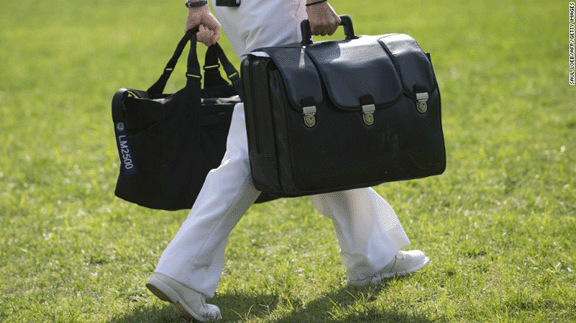 US politics live updates: Nancy Pelosi asks military to stop Donald Trump accessing nuclear codes https://www.abc.net.au/news/2021-01-09/us-politics-live-updates-donald-trump-nuclear-codes/13043904 Peter Marsh House Speaker Nancy Pelosi says she has spoken to the chairman of the Joint Chiefs of Staff, General Mark Milley (pictured with Donald Trump above), about stopping Donald Trump from launching a nuclear strike during his final days in office. “The situation of this unhinged president could not be more dangerous, and we must do everything that we can to protect the American people from his unbalanced assault on our country and our democracy,” Pelosi said in a letter to colleagues. Reuters is reporting that Milley’s office said that Pelosi had initiated the call and Milley “answered her questions regarding the process of nuclear command authority.” A US official, speaking on condition of anonymity to Reuters, said that any use of nuclear weapons is a highly deliberative process. A person familiar with Friday’s call said Pelosi has told them that Milley has told her there are precautions in place that would prevent Trump from launching a nuclear strike, according to the Associated Press. |
|
Fossil fuels benefited from the push for nuclear power, and the delay in renewables growth.
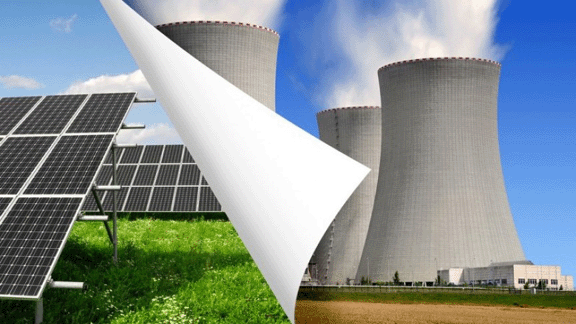
it’s time to let nuclear technologies retire to a well earned place in our history books. It’s deeply unfortunate that nuclear geopolitics massively extended our use of fossil fuels and hence the power of the fossil fuel industry to pivot to gas generation and delay renewables, but their time has come as well.
|
Geopolitics Of Nuclear Generation Delayed Renewables By Decades To Fossil Fuel Industry Benefit, Our Detriment, Clean Technica, December 28th, 2020 by Michael Barnard Recently someone asked me to do a thought exercise: what if we’d built renewables instead of nuclear generation? They were curious about the implications. I thought it was an interesting question, and didn’t have a great answer at hand, so I thought I’d work out what might have been.Remember, of course, that this is a thought exercise, and hence like asking how many angels could dance on the head of a pin. Well, actually, it’s a lot more sensible a discussion with a much greater likelihood of being correct than that, but undoubtedly theological-quality arguments will be made by pro-nuclear types who assert that I’m wrong. The history of electrical generation has had several phases: renewables and coal early (85,000 dams in USA alone), then nuclear and coal, then renewables and gas, and now renewables. To be clear, lots more renewables earlier with the nuclear would have been a lot better than all of that coal and gas. However, the question was whether we could have skipped nuclear entirely and gone straight to renewables. The answer is, very probably and most likely with major advantages. Let’s look at the major components. First off, storage. Closed-loop pumped hydro storage is 1890s technology. We have vastly more storage potential than we need. And we’ve built an awful lot of pumped hydro, mostly to give inflexible nuclear generation something to do at night, but still. We have a lot more options today with mature lithium-ion and strongly emerging redox flow solutions which will dominate different segments of the storage market, but closed-loop pumped hydro storage could have been built globally in large enough quantities at reasonable prices decades ago. There is no storage problem. Second off, hydroelectric. The first generation of electricity from hydro power was in the 1880s………… There’s tons of capacity left in almost empty lands in Canada and other northern countries that could have been exploited long ago. Third off, the solar power cell was invented in 1839. It was made into an effective, manufacturable product about 50 years later. Silicon-based cells were first created in 1954, around the same time as Eisenhower’s Atoms for Peace push. If the world had turned hard into the manufacturing and distribution of solar energy in the 1950s when the first cheapish ones were possible, the cost of solar energy would have plummeted decades earlier, probably by the 1980s. They would have been the lowest cost form of electrical generation by 1990 instead of by 2030 as we have now. 80% of the cost reductions of solar aren’t technological, after all, but policy and the global supply chain. If we’d pivoted to solar, we’d probably have a lot more solar power being delivered globally today than nuclear. Fourth off, wind power. The first electrical generation with wind turbines was done by three different inventors in three different countries within a couple of years of each other around 1890. In 1941, the first 1.25 MW capacity wind turbine was put on an electrical grid in Vermont. There’s nothing magical about wind energy. The physics was obvious 130 years or more ago, and a utility-scale turbine was in place 80 years ago. If Eisenhower’s speech had been “Renewables for Peace,” it would have been much more accurate, and if all the global resources that went into nuclear had gone into renewables instead, including the geopolitical strategic pushes, the federal government’s heavy hand on the scales of regional decision making, federal purchasing power and the like, we could have been ahead of where we are today by 1990 at the latest. All of the economies of scale and incremental improvements would have been already baked in. This was all very achievable, if the will had been there. There’s nothing magical or special about harvesting water, wind, and solar…… There would have been many positives. Given the very reasonable fears of nuclear proliferation, nuclear generation was restricted to roughly 30 countries globally, and its tight strategic linkages to nuclear weapons meant that it faced headwinds that renewables didn’t. Wind and solar already being dirt cheap around the time China was massively building out its economy would have averted a tremendous amount of the coal build out there. China’s nuclear generation program, which is underperforming massively compared to its wind and solar programs, was established around 1995, and while it might have continued, the reality is that if China had been building as much wind and solar in 1990 as it is in 2020, absurd amounts of greenhouse gases would have been avoided. Ditto if it had done the Three Gorges Dam in 1970 instead of 2012. We would have had utility-scale wind and solar generation in every country in the world by 2000 at the latest, providing clean, safe electricity to a much larger percentage of the population. It’s probable that natural gas generation would never have achieved a major foothold because instead of displacing coal, it would be competing with cheap, low-carbon, zero-pollution wind and solar instead. The wasted couple of decades from 1990 to 2010, when absurd amounts of natural gas generation came on line, would have seen a lot more wind and solar instead. Natural gas as a bridge fuel is already seeing the end of its lifetime approaching fast. It’s flat now, and likely to be exceeded by renewables by 2028 at the latest, and then it will see the diminished capacity factors and bankruptcies endemic to coal generation for a couple of decades before it disappears. But in the meantime, a whole lot of CO2, methane, and NOx air pollution will have been emitted which could have been avoided……….. The coal industry in North America would have disappeared a lot faster, and those workers would have been building pumped hydro storage instead, becoming part of the new economy, not lamenting the dead economy that the remain tied to. The fossil fuel industry would have had a lot less power and money. Without conservative parties being co-opted by the fossil fuel industry in the 1990s, a tremendous amount of the deny and delay program success would have been avoided. And there would have been some downsides………. However, I can’t see a path that would have led to this alternative history in the aftermath of World War II, the use of the first nuclear weapons in Japan, the Cold War and its resultant arms race and mutually assured destruction. Sadly, the worse angels of our nature meant that the major, industrialized and militarized countries had to double down on nuclear weapons, which meant a similar doubling down on its nuclear generation twin sister. ………. it’s time to let nuclear technologies retire to a well earned place in our history books. It’s deeply unfortunate that nuclear geopolitics massively extended our use of fossil fuels and hence the power of the fossil fuel industry to pivot to gas generation and delay renewables, but their time has come as well. https://cleantechnica.com/2020/12/28/geopolitics-of-nuclear-generation-delayed-renewables-by-decades-to-fossil-fuel-industry-benefit-our-detriment/? |
Assange denied bail after extradition blocked, will appeal to UK High Court
 Assange denied bail after extradition blocked, will appeal to UK High Court, WSW
District Judge Vanessa Baraitser handed down the decision Wednesday in Westminster Magistrates Court, after ruling on Monday against Assange’s extradition to the United States on mental health grounds. Assange will remain in custody until the prosecution’s appeal of that ruling is heard.
WikiLeaks editor-in-chief Kristinn Hrafnsson announced afterwards that Assange’s legal team would be taking the bail decision to the High Court.
Baraitser’s refusal to grant bail confirms that her decision not to extradite was motivated by political considerations and not any genuine concern for Assange’s health. Assange will be kept in conditions which have had a grave impact on his mental health, during a massive escalation of the UK’s COVID-19 epidemic.
Speaking to the Sydney Morning Herald Tuesday, Nick Vamos, former head of special crime and head of extradition at the Crown Prosecution Service, indicated that the appeal process would likely take two to three months.
In her decision, Baraitser accepted the prosecution’s insistence that Assange’s flight into the Ecuadorian embassy in 2012—after a UK court had granted him bail in connection with Sweden’s trumped-up sexual assault investigation and extradition request—was proof of his willingness to abscond in the future. This is an absurd and vindictive position……..
Assange now has a court ruling in his favour. He is, regardless, prepared to submit to stringent bail conditions amounting to effective house arrest with a GPS tag—conditions which have allowed terror suspects to receive bail. His experience of claiming asylum in an embassy has proved it “unpleasant”, in Fitzgerald’s words, and led “to him being effectively confined for some seven years” before having his asylum revoked. “That is not something that he is ever likely to repeat.”
Assange also now has a family, a partner and two children, in the UK. Besides being a reason for Assange not to abscond, Fitzgerald argued, his family provides significant human rights grounds for his release on bail. On account of COVID-19 restrictions in the prison, Assange “hasn’t seen his family in person since March 2020”. He has never been able to live with them, having spent 15 months held on remand pending his extradition hearing.
Assange’s family, Fitzgerald noted, is highly relevant to the question of his mental and physical wellbeing. “The grant of bail”, he said, “would allow actual physical contact with his family, that would… alleviate mental distress”.
Baraitser had acknowledged the benefit of his family’s support to Assange in her ruling on extradition, which described him as a “depressed and sometimes despairing man, who is genuinely fearful about his future.”
Bail would also “considerably reduce” the risk of Assange’s exposure to COVID-19. Fitzgerald pointed to the “severe outbreak” of the virus suffered by Belmarsh Prison recently and said there had been 59 positive cases prior to Christmas. He added, “on any view, the position [the state of the UK’s epidemic] is worse now and, on any view, he would be safer isolating with his family than if he was in Belmarsh.”
Baraitser dismissed these concerns, declaring “this prison is managing prisoners’ health during this pandemic in an appropriate and responsible manner.”………. https://www.wsws.org/en/articles/2021/01/07/assa-j01.html?pk_campaign=assange-newsletter&pk_kwd=wsws
Government control over nuclear and radiation information; firing of sociologist Christine Fassert

 Le Monde 6th Jan 2021, Nuclear researchers worried after Fukushima specialist fired. The Institute for Radiation Protection and Nuclear Safety (IRSN) firmly denies having fired sociologist Christine Fassert because of the results of her work.
Is the independence of nuclear social science research weakened? After the dismissal of Christine Fassert by the Institute for Radiation Protection and Nuclear Safety (IRSN), a dozen French and foreign researchers are worried about a “resumption of control” over the production of nuclear knowledge, in a column in the World published Wednesday January 6.
Ten compelling reasons to stay away from nuclear power
|
Ten compelling reasons to stay away from nuclear power Proponents of nuclear power argue that it is safe, clean, infinite and the way of the future. They are wrong. Here are ten good reasons. https://www.dailymaverick.co.za/opinionista/2021-01-07-ten-compelling-reasons-to-stay-away-from-nuclear-power/
The South African government recently released an invitation for comments on its proposal to instal 2.5 gigawatts of new nuclear power. There are at least 10 compelling reasons not to – a few of which you may not have thought of before. Described briefly below, they are arranged in what I consider to be a rough order of importance.
If a nuclear power station – such as Koeberg – blows up, we might have to abandon the City of Cape Town for 200 years. Nuclear plants can’t be too far from urban centres due to the high cost of transmitting power over long distances. So, even if better sited, there is low risk, maybe, but unimaginable consequences, as well as long-term and, in the case of radiation, invisible ones.
At least equally important, however, is the risk of mismanagement and corruption. Nuclear is simply out of the question as a safe option in a state characterised by any degree of dodgy tendering and procurement, corrupt construction, or incompetent leadership and operation. We have seen enough issues within Eskom to say that this is a major and real concern — incompetent design checks, cheating on materials, and so on. Even just faulty welding in constructing a coal-fired power station – which we have heard about recently – is simply not an option in the case of a nuclear reactor. Cost is basic common sense, but the current South African governance context is perhaps the strongest single argument against the nuclear option.
Constructing a nuclear power station creates a lot of jobs, but only for a few years. It has long been established that renewables, as well as energy efficiency measures, create far more jobs on a long-term or permanent basis. They also create jobs which are spread out regionally, as opposed to a huge project at just one location. One example: making homes and buildings more energy efficient requires thousands of jobs, spread all over the country and, in addition, these are conventional jobs for building trades, including for unskilled and semi-skilled workers.
Nuclear energy results in hundreds of tons of incredibly hazardous waste, which our descendants will have to police for thousands of years after our time. This is simply irresponsible to the human race (and to the environment). After more than 50 years, almost no “permanent” safe storage facilities for nuclear waste have ever been created. We don’t need to talk about “nuclear fear”; it’s just a disgusting thing to leave to our children.
The risk of nuclear material getting into the hands of violent states or terror organisations is considerable. We have already seen dissidents being poisoned with polonium, probably with the backing of the Russian state. And North Korea making noises about nuclear bombs? How great is this threat? Even in light of strict international controls, this is still a powerful threat.
Hence, it would take decades — time we don’t have — for nuclear to become the major world energy source. Even longer in the poor countries, which are in most need. And that delay will also enable the “dirty energy” guys, the oil, coal and gas multinationals, to carry on wrecking the planet and making billions for a few more decades.
Nuclear energy is based on uranium. But uranium, like coal, gas and oil, is a limited resource; there’s only enough for a few decades, perhaps for 100 years. So why not go straight to the renewables, which are here forever?
Let us add that various newer forms of biomass energy can also become a major source of energy. There is a huge emerging industry of plant-based materials, including bioplastics, already used for many motor vehicle parts, textiles and consumer goods; as well as for renewable bioenergy. In many countries, very productive plants can be grown as “energy crops” — without competing with agriculture, as the US ethanol industry unfortunately did. One might also recall that South African John Fry was a world pioneer of biogas in the 1950s. Much of Brazil’s “petrol” is produced from waste from the sugar plantations. Bioenergy is thus also a new potential source of income for farmers and rural areas.
This is a common false argument in favour of nuclear power. For sure, the sun doesn’t always shine and the wind doesn’t always blow. But that has long been recognised as a minor problem. If the energy system as a whole contains both wind, solar, hydropower, biomass and some other option such as gas (or even, for some more years, a little coal) – then the energy system as a whole is diverse and robust all year round. We might remember that the wind blows mainly in winter, when we need the power most, and that we enjoy far more sunshine hours than many other countries that are “going solar”. The key point is that any energy system needs a certain amount of “base-load” power for times when there is neither wind nor sun, and if the dams are nearly empty too. This is where fossil fuels like coal, gas and oil are so useful because we can burn them when needed to produce power. And quickly, if there is a sudden surge in demand. But nuclear, on the other hand, is not very flexible; it takes 10 to 14 days to close down a nuclear reactor or fire it up to maximum output.
Other arguments against renewables Even after all these years, the nuclear lobby continues to spread fake arguments. For example:
As for “clean fossil fuels”, it’s fiction: coal is never clean, carbon capture and storage, as well as oil sands and fracking, are very expensive and environmentally damaging.
The low climate emissions from nuclear power are often cited as a reason in its favour. Yes, the emissions of climate gases such as carbon dioxide are low. But so are those of the renewables. Even cleaner are energy-efficiency measures. So why make a nuclear pact with the devil in order to reduce the carbon emissions? Reducing consumption A final point that must be made, is that the way out of the energy crisis is not, and can never be, endless continued growth in energy supply, or in resource use generally. All state-of-the-art research and policies are now turning towards the challenge of reducing our consumption; of meat, petrol, electrical gadgets, air miles and consumer goods. We know that with today’s solutions we can have exactly the same standard of living, the same life quality, with just a quarter of the energy. That means no need for more power stations — and certainly not nuclear. Hence, energy authorities are starting to turn their focus far more towards ways of reducing our consumption of energy. And this path, by the way, is in many cases free. |
|


Seven beautiful Italian regions furious at sites recommended for nuclear trash
We’ll fight it’: Uproar over nuclear dump plan in scenic Tuscany, https://www.theage.com.au/world/europe/we-ll-fight-it-uproar-over-nuclear-dump-plan-in-scenic-tuscany-20210108-p56skh.htmly Nick Squires, January 8, 2021 Some: Italian regional leaders are fighting against plans to dump nuclear waste in some of the most picturesque areas of the country.
Some of the 67 potential sites earmarked to become a national contaminated waste facility include the rolling valleys of Tuscany and the countryside around the southern ancient town of Matera, famed for its cavernous homes.
The governors of the seven affected regions, including Piedmont, Puglia, Basilicata, Sardinia and Sicily, have accused the national government and SOGIN, Italy’s nuclear decommissioning agency, of failing to consult them. Italy closed down its nuclear power plants after a referendum in 1987 – held in the wake of the 1986 Chernobyl disaster.
The new deposit site would store waste from those power plants as well as radioactive material that is still produced by industry, hospitals and research centres.
Manolo Garosi, the mayor of Pienza, a Tuscan hill town, said he was incredulous about the prospect of a nuclear dump being located in his region.
“How can they be considering a region like ours, which has World Heritage recognition? It is totally unacceptable. This is an area of natural beauty,” he told Corriere della Sera newspaper. “I can’t imagine what tourists would say when they come here looking for beauty and discover instead radioactive waste dumps.”
Domenico Bennardi, the mayor of Matera, said locating the dump near the town would be a “slap in the face”, particularly as it was a European City of Culture in 2019. It was also used as a location for the forthcoming Bond film No Time To Die. “We’ll fight it at every level,” he said.
More than 20 of the potential dump sites are in the northern part of Lazio, famed for its Etruscan heritage, small villages and farmland. One of the sites is near the village of Gallese, where William Urquhart, a British businessman, helps run a country estate that his family has managed for more than a century.
“Of course, no one wants buried nuclear waste where they live, but it needs to be an open, transparent process. Instead, it has come as a bombshell that will frighten a lot of people.”
The publication of the map of potential sites is the first stage in a long process that could last years.
“Now that people have seen the list, they can participate in the process and express their views,” said Deputy Environment Minister Roberto Morassut.
The government said the nuclear deposit site could bring benefits to a region – there would be 4000 jobs during the four-year construction phase and up to 1000 jobs when it is operational. The 370-acre facility would cost about €900 million ($1.4 billion).
183 workers at Waste Isolation Pilot Plant infected with COVID-19
|
183 workers at Waste Isolation Pilot Plant infected with COVID-19, Adrian Hedden
Carlsbad Current-Argus, 8 Jan 21,
Six more cases of COVID-19 were reported at the Waste Isolation Pilot Plant last week, bringing the facility’s total caseload to 183 as coronavirus continued to spread in New Mexico.All six of the cases reported at the nuclear waste facility near Carlsbad were from employees of Nuclear Waste Partnership (NWP), the primary operations contractor at WIPP. The employees were last at the site between Dec. 3 and 18, and the positive results were reported between Dec. 22 and 28……. https://www.currentargus.com/story/news/local/2021/01/05/183-workers-waste-isolation-pilot-plant-infected-covid-19/4125844001/ |
|
|
Lebanon’s Hezbollah chief says nuclear button with “crazy fool” Trump
“God protect the world from what he can do.”
Reporting By Maha El Dahan and Laila Bassam
UK and Ireland Nuclear Free Local Authorities Urge Council to Reconsider Radiation Issues of Coal Mine —

Originally posted on Keep Cumbrian Coal in the Hole: Radiation Free Lakeland are delighted that the UK and Ireland Nuclear Free Local Authorities have thrown their weight behind our Keep Cumbrian Coal in the Hole campaign to stop the Cumbrian Coal mine under the Irish Sea and just five miles from Sellafield. Sellafield B30 Pond…
UK and Ireland Nuclear Free Local Authorities Urge Council to Reconsider Radiation Issues of Coal Mine —
TAKE ACTION! We Have Already Delayed the Coal Mine … Now We Need to Stop It. —

Originally posted on Keep Cumbrian Coal in the Hole: Dear Friends,THANKS TO ALL who are donating and sharing, writing and campaigning – without you this mine would already be underway!! We have delayed it repeatedly, now we need to stop it. The Bad News!Robert Jenrick MP the Communities Secretary has decided not to call…
TAKE ACTION! We Have Already Delayed the Coal Mine … Now We Need to Stop It. —
UK and Ireland Nuclear Free Local Authorities (NFLA) oppose underground coal mine – dangerously close to Sellafield’s radioactive wastes .
result of the coal mine has gone to the Sellafield site for internal review.https://www.nuclearpolicy.info/news/nfla-troubled-uk-communities-minister-not-calling-in-decision-deep-underground-coal-mine-west-cumbria/
Taiwan ban on Japanese food looks set to stay — Fukushima 311 Watchdogs

Fukushima Prefecture, which is the second-largest producer of peaches in Japan, saw the reputation of its local produce take a nosedive after the March 2011 nuclear disaster Dec 8, 2020 Taipei – Two years ago, Taiwanese voters approved a referendum to continue a ban on food from five Japanese prefectures after the 2011 Fukushima nuclear […]
Taiwan ban on Japanese food looks set to stay — Fukushima 311 Watchdogs
Local despair over Fukushima’s radioactive mushrooms — Fukushima 311 Watchdogs

December 10, 2020 An autumnal delight that used to attract tourists to Fukushima Prefecture still grows in the region’s mountains and forests, but these ones are forbidden to eat. Wild mushrooms continue to record high levels of cesium almost a decade since the 2011 disaster at the Fukushima Daiichi nuclear plant resulted in extensive radioactive […]
Local despair over Fukushima’s radioactive mushrooms — Fukushima 311 Watchdogs
1 This Month

Tell Congress: Prevent Nuclear Catastrophe in Iran

Tell Congress: Prevent Nuclear Catastrophe in Iran

Read the Public Inquiry Report, the Commissioners’ report, Surrendering Australia: The AUKUS Deception is available to download for free at aukuspublicinquiry.com. Or just watch the replay of the National Press Club Luncheon.


Shut down the radiation-damaged Heysham nuclear reactors now
To see nuclear-related stories in greater depth and intensity – go to https://nuclearinformation.wordpress.com

Say No to NASA’s Reckless Nuclear Reactor on the Moon
Say No to NASA’s Reckless Nuclear Reactor on the Moon
-
Archives
- November 2026 (269)
- October 2026 (302)
- September 2026 (339)
- August 2026 (330)
- July 2026 (355)
- June 2026 (287)
- May 2026 (306)
- April 2026 (356)
- March 2026 (251)
- February 2026 (267)
- January 2026 (308)
- December 2025 (358)
-
Categories
- 1
- 1 NUCLEAR ISSUES
- business and costs
- climate change
- culture and arts
- ENERGY
- environment
- health
- history
- indigenous issues
- Legal
- marketing of nuclear
- media
- opposition to nuclear
- PERSONAL STORIES
- politics
- politics international
- Religion and ethics
- safety
- secrets,lies and civil liberties
- spinbuster
- technology
- Uranium
- wastes
- weapons and war
- Women
- 2 WORLD
- ACTION
- AFRICA
- Atrocities
- AUSTRALIA
- Christina's notes
- Christina's themes
- culture and arts
- Events
- Fuk 2022
- Fuk 2023
- Fukushima 2017
- Fukushima 2018
- fukushima 2019
- Fukushima 2020
- Fukushima 2021
- general
- global warming
- Humour (God we need it)
- Nuclear
- RARE EARTHS
- Reference
- resources – print
- Resources -audiovicual
- Weekly Newsletter
- World
- World Nuclear
- YouTube
-
RSS
Entries RSS
Comments RSS

