UK govt and Japan’s TEPCO to work together on robots to clean up Sellafield an Fukushima’s nuclear pollution
Professional Engineering, Dangerous radioactive material from Fukushima and Sellafield will be retrieved by robots thanks to a new collaboration between the UK and Japan.
The £12m LongOps project is also aimed at automating aspects of nuclear fusion energy production, alongside decommissioning goals.
The four-year research collaboration will use long-reach robotic arms to make decommissioning faster and safer at Tepco’s Fukushima Daiichi reactors in Japan and at Sellafield in the UK.
The Fukushima Daiichi nuclear disaster saw a triple meltdown, three hydrogen explosions and the release of radioactive material after the loss of reactor core cooling following the 2011 earthquake and tsunami.
The Sellafield site in Cumbria is used for nuclear fuel reprocessing and storage, as well as ongoing decommissioning of previous reactors and facilities. There were 21 serious incidents of off-site radiological releases at Sellafield between 1950 and 2000, according to a paper in the Journal of Radiological Protection.
The new project will be led by the UK Atomic Energy Authority’s Remote Applications in Challenging Environments (Race) facility. It will be funded equally by UK Research and Innovation (UKRI), the UK Nuclear Decommissioning Authority (NDA) and Japan’s Tokyo Electric Power Company (Tepco). ….
The decommissioning of legacy nuclear facilities and fusion facilities are complex large-scale projects that are time-intensive to accomplish safely. Using robotics allows teams to keep human workers out of danger. …… https://www.imeche.org/news/news-article/uk-and-japan-tackle-legacy-of-fukushima-and-sellafield-with-robotic-collaboration
President Hassan Rouhani has urged U.S. President Joe Biden to return America to the nuclear deal
|
Iran’s President: Nuclear ball in US court, The West, AAP Wed, 20 January 2021 Iranian President Hassan Rouhani has urged US President-elect Joe Biden to return to a 2015 nuclear deal and lift crippling sanctions on the Islamic Republic,
Biden, who takes office on Wednesday, has said the United States will rejoin the pact that includes restrictions on Iran’s nuclear work if Tehran resumes strict compliance.
“The ball is in the US court now,” Rouhani said in a televised cabinet meeting. “If Washington returns to Iran’s 2015 nuclear deal, we will also fully respect our commitments under the pact. “Today, we expect the incoming US administration to return to the rule of law and commit themselves and if they can, in the next four years, to remove all the black spots of the previous four years.”…… https://thewest.com.au/politics/irans-president-nuclear-ball-in-us-court-ng-s-2046145 |
|
|
Serious shortcomings in the file on Bure (Meuse) underground nuclear waste storage
 Actu Environnement 19th Jan 2021, In a notice published on January 18, the Environmental Authority (Ae) points to serious shortcomings in the file of the underground radioactive waste storage center (Cigéo) in Bure (Meuse). The opinion relates more particularly to the “very detailed” environmental assessment carried out by Andra as part of the project’s declaration of public utility (DUP) file. T The DUP should make it possible to ensure the land control of the project on a surface of 665 hectares, allowing if necessary expropriations, to carry out the compliance of the town planning documents and to ” legitimize politically ” the realization of the project.
|
|
|
Radioactive releases from the Golfech nuclear power plant accumulate downstream
20minutes 19th Jan 2021, A study by Criirad, an independent laboratory, shows that radioactive releases from the Golfech nuclear power plant accumulate downstream in the
Garonne. The presence of tritium or carbon 14 in aquatic plants remains
below regulatory standards. For environmental protection associations, the
accumulation of this radioactive waste, whose longevity is important, poses
a problem.
Another bit of boring nuclear propaganda – from Morocco this time
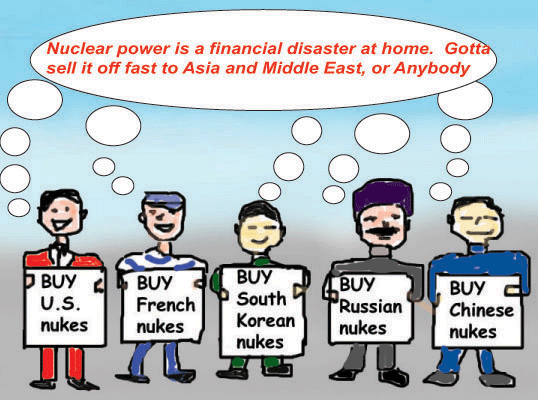
A straight handout from the nuclear lobby? Of course! Not a word about the costs. Not a word

Christina Macpherson’s websites & blogs
about safety, environmental issues. Not a word about the problem of radioactive trash produced. And, of course – no mention that medical radioisotopes can now be made safely and efficiently in non nuclear cyclotrons
Morocco, Hungary Sign Agreement On Nuclear Energy Cooperation. The agreement boosts bilateral cooperation in scientific and academic research. By Sanae Alouazen, Jan 20, 2021 Rabat- Morocco’s National Center for Nuclear Energy, Science and Technology (CNESTEN) and the Hungarian Center for Energy Research signed a cooperation agreement on Tuesday. The agreement aims to strengthen cooperation between the two research centers in the field of nuclear energy……. https://www.moroccoworldnews.com/2021/01/332545/morocco-hungary-sign-agreement-on-nuclear-energy-cooperation/
Helpful information as the nuclear ban treaty’s entry into force nears! — limitless life

Helpful information as the nuclear ban treaty’s entry into force nears! From: Felice and Jack Cohen-Joppa Date: January 18, 2021 at 9:55:29 PM EST To: Felice and Jack Cohen-Joppa Subject: Helpful information as the nuclear ban treaty’s entry into force nears! Dear friends, Thank you for participating in one or more of the November, December and January […]
Helpful information as the nuclear ban treaty’s entry into force nears! — limitless life
International Physicians for the Prevention of Nuclear War comment on “The great evasion”

Two related events—the 75th anniversary of the January 24, 1946 UN General Assembly Resolution 1 (which established a commission to plan for the abolition of nuclear weapons) and the January 22, 2021 entry into force of the UN Treaty on the Prohibition of Nuclear Weapons (designed to finally implement that goal)—should be a cause for worldwide celebration.
In fact, however, they are a cause for shame. The nine nuclear powers have refused to sign the treaty and, instead, today continue to engage in a nuclear arms race and to threaten nuclear war—a war capable of destroying virtually all life on earth.
A similarly reckless pattern characterized the nuclear arms race that emerged out of World War II. But an upsurge of popular protest and wise diplomacy led to nuclear arms control and disarmament treaties, as well as unilateral actions, that dramatically reduced nuclear arsenals. It also made nuclear war increasingly unthinkable.
Unfortunately, however, as the nuclear danger receded, the nuclear disarmament campaign ebbed. As a result, government officials, no longer constrained by popular pressure, began to revert to their traditional ways, based on the assumption that nuclear weapons promoted national “strength.” India and Pakistan became nuclear powers. North Korea developed nuclear weapons. In the United States, the administration of George W. Bush withdrew from the ABM Treaty and pressed hard to begin building “mini-nukes.”
Ascending to the presidency, Barack Obama made a dramatic attempt to rally the planet behind the goal of building a nuclear-free world. But neither Republican nor Russian leaders liked the idea, and the best he could deliver was the last of the major nuclear disarmament agreements, the New START Treaty. And even that came at a heavy price—an agreement with Senate Republicans, whose support was necessary for treaty ratification, to back a major U.S. nuclear weapons “modernization” program.
After Donald Trump entered the White House, nuclear arms control and disarmament were no longer on the agenda—for the United States or for the world. Trump not only failed to generate any new international constraints on nuclear weapons, but withdrew the United States from the Intermediate Range Nuclear Forces (INF) Treaty, the Iran nuclear agreement, and the Open Skies Treaty and allowed the New START Treaty to lapse without renewal. Nor did the other nuclear powers show much interest in retaining these agreements. Indeed, the Russian government, after a brief, perfunctory protest at Trump’s destruction of the INF Treaty—a treaty that it had long privately deplored—immediately ordered the development of the once-prohibited missiles. The Chinese government said that, although it favored maintaining the treaty for the United States and Russia, it would not accept treaty limits on its own weapons.
Meanwhile, all nine nuclear powers, instead of reducing the existential danger to the world from their possession of 13,400 nuclear weapons (91 percent of which are held by Russia and the United States), are busily “modernizing” their nuclear forces and planning to retain them into the indefinite future. In December 2019, the Russian governmentannounced the deployment of the world’s first hypersonic nuclear-capable missiles, which President Vladimir Putin boasted could bypass missile defense systems and hit almost any point on the planet. Indeed, the Russian president touted several new Russian nuclear weapons systems as ahead of their time. “Our equipment must be better than the world’s best if we want to come out as the winners,” he explained.
Trump, always determined to emerge a “winner,” had publicly stated in December 2016: “Let it be an arms race. We will outmatch them at every pass and outlast them all.” Consequently, expanding the earlier U.S. nuclear “modernization” plan to a $2 trillion extravaganza, he set the course for the upgrading of older U.S. nuclear weapons and the development and deployment of a vast array of new ones. These include the development of a new intercontinental ballistic missile (at a cost of $264 billion) and the production and deployment of a new submarine-launched ballistic missile warhead that will make starting a nuclear war easier.
The new nuclear weapons are designed to not only win the arms race, but to intimidate other nations and even “win” a nuclear war. Early in his administration, Trump publicly threatened to obliterate both North Korea and Iran through a nuclear onslaught. Similarly, North Korea’s Kim Jong-un has repeatedly threatened a nuclear attack upon the United States. Furthermore, the U.S. government has been engaging recently in a game of “nuclear chicken” with China and Russia, dispatching fleets of nuclear bombers and nuclear warships dangerously close to their borders. Such provocative action is in line with the Trump administration’s 2018 Nuclear Posture Review, which expanded possibilities for displays of nuclear “resolve” and the first use of nuclear weapons. Subsequently, the Russian government also lowered its threshold for initiating a nuclear war.
The incoming Biden administration has the opportunity and, apparently, the inclination to challenge this irresponsible behavior. As a long-time supporter of nuclear arms control and disarmament agreements—as well as a sharp critic of the Trump administration’s nuclear policies during the 2020 presidential campaign—the new president will probably advance measures dealing with nuclear issues that differ significantly from those of his predecessor. Although his ability to secure U.S. ratification of new treaties will be severely limited by Senate Republicans, he can (and probably will) use executive action to rejoin the Iran nuclear agreement, re-sign the Open Skies Treaty, block the U.S. production and deployment of particularly destabilizing nuclear weapons, and reduce the budget for nuclear “modernization.” He might even declare a no first use policy, unilaterally reduce the U.S. nuclear arsenal, and show some respect for the Treaty on the Prohibition of Nuclear Weapons.
Of course, this won’t be enough. But it would provide a start toward terminating the nuclear powers’ disgraceful evasion of their responsibility to safeguard human survival.
[Dr. Lawrence Wittner (https://www.lawrenceswittner.com/ ) is Professor of History Emeritus at SUNY/Albany and the author of Confronting the Bomb (Stanford University Press).]
First a comment on military smrs – then the enthusiastic article about them
 spikedpsycho169, 18 Jan 21, Small reactors on a battlefield where the enemy now has suicide drones, rpg’s and homemade rockets. What could possibly go wrong.? Other than electricity, reactors have little use on a field of combat. Some advocate the production of liquid fuels using in situ resources like ammonia, methanol, etc made using ambient materials like air/water. That requires temperatures above 600-800 degrees celsius, Which no reactor currently operates.
White House Accelerates Development Of Mini Nuclear Reactors For Space And The Battlefield
The order looks to accelerate and integrate the development of highly mobile nuclear reactors for space and the terrestrial battlefield. BY BRETT TINGLEY JANUARY 16, 2021
President Trump issued an Executive Order on January 12 that aims to promote small, modular nuclear reactors for defense and space exploration applications. According to a press statement issued by the White House, the order will “further revitalize the United States nuclear energy sector, reinvigorate America’s space exploration program, and produce diverse energy options for national defense needs.”
The order instructs NASA’s administrator to prepare a report within 180 days that will define NASA’s requirements and foreseeable issues for developing a nuclear energy system for human and robotic exploratory missions through 2040. The order also calls for a “Common Technology Roadmap” between NASA and the Departments of Energy, Defense, Commerce, and State for implementing new reactor technologies. The full text of the Executive Order can be read at WhiteHouse.gov ………
Section 4 of the Executive Order goes into further detail about the DoD’s energy needs, and outlines the role the Department of Defense will play in this new initiative to develop mobile nuclear reactors …….
The Executive Order also outlines a Common Technology Roadmap that “describes potential development programs and that coordinates, to the extent practicable, terrestrial-based advanced nuclear reactor and space-based nuclear power and propulsion efforts” between the Departments of Energy, Defense, Commerce, State, and NASA. This roadmap will also require “assessments of foreign nations’ space nuclear power and propulsion technological capabilities.” Naturally, one of the most pressing concerns with any nuclear technology is national security, and thus the order also instructs the DoD to work together with NASA and other agencies to identify security issues associated with any potential space-based nuclear systems.
With this new Executive Order, the White House seeks to propel the United States to the forefront of all of the work being conducted in compact reactor research. While the wording in the statement focuses more on space exploration, the Department of Defense’s involvement is highly important. Since space environments are similar in that resupply is a tricky, if not impossible, endeavor, NASA could help jump-start the DoD’s mobile nuclear program even further if both are really working on it collaboratively, although the requirements will be somewhat different. “There’s sometimes a risk of forcing too much commonality,” a White House official told SpaceNews.com. “What this executive order does is ensure that there is a deliberate look at what those opportunities may be.”
If realized, the Executive Order’s accompanying statement reads, this initiative could lead to a “transportable small modular reactor for a mission other than naval propulsion for the first time in half a century.”
Contact the author: Brett@TheDrive.com https://www.thedrive.com/the-war-zone/38687/white-house-accelerates-development-of-mini-nuclear-reactors-for-space-and-the-battlefield
We need parliamentarians to stop project, prevent Ottawa River from being permanently contaminated — Concerned Citizens of Renfrew County and Area

January 18, 2021 Re “CNL working to accomplish responsible action in managing Canada’s nuclear research and development legacy” (The Hill Times, Letters to the Editor, December 14, 2020). This letter from Joe McBrearty, President and CEO of Canadian Nuclear Laboratories (CNL) deepens my concern about the handling of Canada’s $8 billion nuclear waste liability. Mr. […]
Hill Times Letter to the Editor ~ We need parliamentarians to stop project, prevent Ottawa River from being permanently contaminated — Concerned Citizens of Renfrew County and Area
………….Last month CNL published its final environmental impact statement listing a partial inventory of radionuclides that would go into the gigantic five-to-seven story radioactive mound (aka the “NSDF”).Twenty-five out of the 30 radionuclides listed in the inventory are long-lived, with half-lives ranging from four centuries to more than four billion years. To take just one example, the man-made radionuclide, Neptunium-237, has a half-life of 2 million years such that, after 2 million years have elapsed, half of the material will still be radioactive.
The inventory includes four isotopes of plutonium, one of the most deadly radioactive materials known, if inhaled or ingested.
It is incorrect to say that these materials “require isolation and containment for only a few hundred years.” Many of them will be dangerously radioactive for more than one hundred thousand years. The International Atomic Energy Agency states that materials like this must be stored tens of meters or more underground, not in an above-ground mound.
The CNL inventory also includes a very large quantity of cobalt-60, a material that gives off so much strong gamma radiation that lead shielding must be used by workers who handle it in order to avoid dangerous radiation exposures. The International Atomic Energy Agency considers high-activity cobalt-60 sources to be “intermediate-level waste” and specifies that they must be stored underground. Addition of high-activity cobalt-60 sources means that hundreds of tons of lead shielding would be disposed of in the mound along with other hazardous materials such as arsenic, asbestos, PCBs, dioxins and mercury.
CNL’s environmental impact statement describes several ways that radioactive materials would leak into surrounding wetlands that drain into the Ottawa River during filling of the mound and after completion. It also describes CNL’s intent to pipe water polluted with tritium and other radioactive and hazardous substances from the waste treatment facility directly into Perch Lake which drains into the Ottawa River.
I stand by my original conclusion: We need parliamentarians to step up now to stop this deeply flawed project and prevent the Ottawa River from being permanently contaminated by a gigantic, leaking radioactive landfill that would do little to reduce Canada’s $8 billion nuclear waste liability.
“They’ll be able to dream up some bogus price” – UK nuclear proponents want financing system

|
UK needs new finance model for nuclear – experts, Montel News , KELLY PAUL, London 18 Jan 2021
The UK must adopt a regulated asset base model (RAB) to kickstart investment in nuclear development, or risk the country missing its target to be net zero by 2050, proponents of the financing mechanism say.
A RAB model for financing could attract pension funds, insurance firms, sovereign wealth funds and infrastructure asset managers to shore up French utility EDF’s funds and carry a new nuclear project through to completion, industry experts told Montel. The UK’s plans to build new nuclear infrastructure in the country have stalled against a backdrop of political reticence to commit, spiralling costs associated with Hinkley Point C, which EDF is building, and the steady retreat of potential investors. …… Under RAB, an economic regulator would grant a licence to a company to charge a regulated price to users in exchange for the provision of infrastructure, in this case a nuclear reactor. …….
The UK government recently confirmed it has entered into negotiations with EDF on the Sizewell C reactor in Suffolk and has pledged to reach an investment decision on at least one nuclear power station by the end of the current parliament. High cost EDF itself signalled that the cost for the Hinkley C reactor would be between GBP 21.5 billion and GBP 22.5 billion, a rise of between GBP 1.9 billion and GBP 2.9 billion as compared with previous estimates. In France, meanwhile, the operator’s Flamanville reactor is running 11 years behind schedule and EDF’s estimated cost of completion has spiralled to EUR 12.4bn, up from its original estimate of EUR 3.3bn.
Blank cheque Detractors of the RAB model have dismissed the mechanism as a “blank cheque” for UK consumers to sign, while others called into question the price competitiveness of new nuclear given the falling cost of renewables. Critics maintain that by guaranteeing a significant source of capital ahead of the expensive construction phase, as RAB does, consumers are essentially being asked to pay for a reactor when they have no way of assessing how costly it will be, or if any of the delays that have marred Hinkley could occur again. At the government’s recent consultation on the RAB model, specific figures relating to financing were not discussed. “They’ll be able to dream up some bogus price,” said Stephen Thomas, emeritus professor of energy policy at the University of Greenwich. https://www.montelnews.com/en/story/uk-needs-new-finance-model-for-nuclear-experts/1187367 |
|
The hidden costs of France’s old, past-their-use-by-date nuclear reactors
Ian Fairlie’s Blog 16th Jan 2021, In early 2019, four French EDF scientists wrote a 22 page report on load following in French nuclear reactors. The English version was first published on April 1 2020 but this has only recently been brought to my attention (ie mid Jan 2021).
This report is instructive and worrying, and requires careful reading. In essence, it discusses how French nuclear engineers have managed to retrofit and configure France’s reactors so that they can follow the diurnal loads increasingly required by France’s electricity needs.
It should be borne in mind that EDF’s 58 nuclear reactors are very old and past their sell-by dates. Most are between 30 and 40 years old with an average age of 33 years in 2018.
Some background is necessary to explain why this report was written. French reactors have been
operating since the 1980s. Since their gross output has usually exceeded French domestic requirements, especially at night, much is exported to France’s neighbours i.e. UK, Belgium, Netherlands, Germany, Italy and Spain.
Large amounts were until recently also sent to large pumped storage schemes in Switzerland at night. These transfers have been at a considerable financial loss to EDF and the French Treasury as the prices for such supplies are understood to be low. In addition, during the day, France imports significant amounts of electricity- mainly from the renewables in Germany.
https://www.ianfairlie.org/news/french-report-nuclear-power-plant-flexibility-at-edf/
22 January – Trident Ploughshares, Scotland to celebrate entry into force of nuclear weapons ban
 The National 18th Jan 2021, MEMBERS of the anti-nuclear weapons group Trident Ploughshares will celebrate the entry into force of the UN Treaty on the Prohibition of Nuclear Weapons (TPNW) on January 22 with banner drops, billboards and
projections on buildings, and bell ringing in town centres across the UK.
In Edinburgh, messages will be projected on city centre buildings with
billboards proclaiming “UN outlaws nuclear weapons. Time for a clean
break”, with a variation asking “What about Scotland?” depicting
Nicola Sturgeon alongside her words: “No ifs, no buts, no nuclear weapons
on the Clyde, or anywhere.”
Russia to withdraw form Open Skies Treaty, EU concerned
The media’s false concept of “balance”
|
Even After January 6, Some Media Can’t Kick Their Addiction to False Balance, Fair,
JULIE HOLLAR 18 Jan, 21, In the wake of the unprecedented events of January 6, many in corporate media—on both the editorial and reporting sides—have displayed a new and refreshing ability to apply accurate labels to people and their behaviors (“sedition,” “incitement,” “white nationalists,” etc.) and to apportion blame based on reality, not a wished-for fantasy of balance.
That false concept of balance, which FAIR has criticized for years (e.g., 9/30/04, 9/17/20), is finally coming under greater scrutiny. As Washington Post media critic Margaret Sullivan (1/17/21) recently wrote: “When one side consistently engages in bad-faith falsehoods, it’s downright destructive to give them equal time.” Considering that Trump has few allies left within the establishment—even many big businesses have publicly turned against him—perhaps it’s easier for journalists to cast off their commitment to false balance. But it’s far from inevitable. ……..https://fair.org/home/even-after-january-6-some-media-cant-kick-their-addiction-to-false-balance/ |
|
|
America’s Committee to Defend Australian citizen Julian Assange
|
A project of the Courage Foundation, the Assange Defense Committee is a national coalition fighting to free WikiLeaks founder Julian Assange. Comprising human rights defenders, press freedom advocates, civil liberties lawyers, and supporters across the United States, the Committee organizes public rallies, provides essential resources, and raises awareness about the unprecedented prosecution against Julian Assange and the threat it poses to the freedom of the press around the world. In supporting journalists’ right to publish, the Assange Defense Committee is upholding the public’s right to know what its government is doing in its name. Co-chairsThe Committee calls for Julian Assange’s immediate release, charges to be dropped, safe passage to the secure location of his choosing, and compensation for the psychological torture and arbitrary detention he has endured. Noam Chomsky Alice Walker Daniel Ellsberg Advisory BoardLeading journalists, lawyers, whistleblowers, and human rights defenders advising the Assange Defense Committee. See our supporters page for high-profile individuals and organizations who are standing up for Assange’s right to publish and your right to know………https://assangedefense.org/about/?fbclid=IwAR06__azOpLuMwwwNxlVcH2I3u7ZThlGnLHiVkhGmuX_HO-d4EDCo0N_fb0 |
|

1 This Month

Tell Congress: Prevent Nuclear Catastrophe in Iran

Tell Congress: Prevent Nuclear Catastrophe in Iran

Read the Public Inquiry Report, the Commissioners’ report, Surrendering Australia: The AUKUS Deception is available to download for free at aukuspublicinquiry.com. Or just watch the replay of the National Press Club Luncheon.


Shut down the radiation-damaged Heysham nuclear reactors now
To see nuclear-related stories in greater depth and intensity – go to https://nuclearinformation.wordpress.com

Say No to NASA’s Reckless Nuclear Reactor on the Moon
Say No to NASA’s Reckless Nuclear Reactor on the Moon
-
Archives
- November 2026 (255)
- October 2026 (302)
- September 2026 (339)
- August 2026 (330)
- July 2026 (355)
- June 2026 (287)
- May 2026 (306)
- April 2026 (356)
- March 2026 (251)
- February 2026 (267)
- January 2026 (308)
- December 2025 (358)
-
Categories
- 1
- 1 NUCLEAR ISSUES
- business and costs
- climate change
- culture and arts
- ENERGY
- environment
- health
- history
- indigenous issues
- Legal
- marketing of nuclear
- media
- opposition to nuclear
- PERSONAL STORIES
- politics
- politics international
- Religion and ethics
- safety
- secrets,lies and civil liberties
- spinbuster
- technology
- Uranium
- wastes
- weapons and war
- Women
- 2 WORLD
- ACTION
- AFRICA
- Atrocities
- AUSTRALIA
- Christina's notes
- Christina's themes
- culture and arts
- Events
- Fuk 2022
- Fuk 2023
- Fukushima 2017
- Fukushima 2018
- fukushima 2019
- Fukushima 2020
- Fukushima 2021
- general
- global warming
- Humour (God we need it)
- Nuclear
- RARE EARTHS
- Reference
- resources – print
- Resources -audiovicual
- Weekly Newsletter
- World
- World Nuclear
- YouTube
-
RSS
Entries RSS
Comments RSS

