How to Support the Treaty on the Prohibition of Nuclear Weapons Without Signing It
 How to Support the Treaty on the Prohibition  of Nuclear Weapons Without Signing It Lawfare By Jayita Sarkar, February 7, 2021, Editor’s Note: The Treaty on the Prohibition of Nuclear Weapons (TPNW), which outlaws nuclear weapons, entered force just after Biden’s inauguration. Although the Biden administration is highly unlikely to adhere to it directly, can it take smaller steps in line with the TPNW’s goals? Boston University’s Jayita Sarkar outlines a series of measures the administration could take, such as providing assistance to victims of radiation, that would advance the TPNW’s agenda but do not require complete adherence. – Daniel Byman ……….. How will the Biden administration respond now that it is international law? In recent weeks, former policymakers, including former Secretary of Defense William Perry and former Undersecretary of State for International Security and Nonproliferation Thomas Countryman, have called for the Biden administration to adopt a supportive position on the TPNW. Critics of the treaty, such as then-U.S. Ambassador to the United Nations Nikki Haley, have called for proactive opposition, or at least benign neglect. But perhaps there is a third option that the administration could consider: the middle ground of selective support. …………… When the world is viewed solely through the prism of nuclear deterrence, the TPNW seems unrealistic and its supporters appear as impractical idealists. The TPNW, though, was developed from the approach that foregrounds the “humanitarian consequences” of nuclear weapons. This approach encompasses much more than the notion of a fragile balance of power maintained by nuclear weapons. Much of the treaty is about the effects of nuclear weapons and nuclear explosive devices on the human body. The Biden administration can show its selective support on this issue, breaking with the policy of the past two U.S. administrations. The United States is responsible for the atomic bombings of Hiroshima and Nagasaki in August 1945 and for 1,032 nuclear weapons tests that took place between 1945 and 1992. The majority of the tests were conducted in New Mexico, Nevada, Alaska, and the Pacific Ocean. Article 6 of the TPNW, entitled “Victim assistance and environmental remediation,” calls on state parties to “adequately provide age- and gender-sensitive assistance, without discrimination, including medical care, rehabilitation and psychological support, as well as provide []social and economic inclusion” to those affected by nuclear weapons and nuclear explosive devices. Providing assistance to victims of radiation in the United States has been a slow, arduous and incomplete process. The Radiation Exposure Compensation Act (RECA) was passed only in October 1990 and expanded in 2000. Administered by the U.S. Department of Justice, RECA provides one-time benefits payments to those who have developed cancers and specified diseases as a consequence of radiation exposure caused by nuclear weapons testing and uranium mining, milling or transporting. RECA has provided $2.4 billion in benefits to more than 37,000 claimants since 1990 but is expected to sunset in July 2022. RECA itself has several limitations. First, it has a narrow definition of “downwinders”—the individuals living downwind of the Nevada Test Site who are eligible for compensation. Downwinder-eligibility requires individuals to have a diagnosis of a compensable disease caused by radiation exposure and proof of residence in selected counties of Arizona, Nevada, and Utah during the period of atmospheric testing at the Nevada Test Site. Second, RECA denies compensation to victims of uranium mining after 1971, when the U.S. Atomic Energy Commission’s mining activities were transferred to commercial firms. The 2020 Democratic Party platform explicitly called for increasing victim assistance under RECA. More broadly, the platform also pledged the party to “pursuing environmental justice and climate justice, including for Indigenous peoples and communities.” Given that the majority of downwinders and uranium miners are from Indigenous communities in the United States, the Democratic Party’s commitment to “protecting Native American health” is compatible with the humanitarian consequences approach to nuclear weapons. Moreover, for the first time in its history, the Department of the Interior, the federal agency responsible for appropriation of Indigenous lands since the 19th century westward expansion, will have a Native American head—Rep. Deb Haaland, an enrolled citizen of the Pueblo of Laguna. Haaland and her fellow Democrats from New Mexico have been proactive in pushing for legislation to expand radiation compensation. In other words, the Biden administration has already promised to act on the humanitarian consequences of nuclear testing in the United States. If the administration delivers on its promise, it would be addressing commitments covered in Article 6 of the TPNW, even without signing the treaty. The TPNW is a multilateral treaty, which requires policy harmonization through domestic legislation to be implemented. RECA offers preexisting legal infrastructure on which the Biden administration can build and, with its inclusion of uranium mining, even corrects a major weakness of the TPNW, which focuses solely on victims of nuclear weapons and nuclear explosive devices. To be sure, promoting an expanded RECA as evidence of U.S. selective support for the TPNW would require diplomatic finesse at the United Nations. But, if backed by political will, the State Department under Secretary of State Antony Blinken, Deputy Secretary of State-designee Wendy Sherman, and Undersecretary-designee for Arms Control and International Security Affairs Bonnie Jenkins will have the wherewithal for it. Selective U.S. support to the TPNW would be an unusual approach toward a new treaty, but it would not be unprecedented………… By selectively supporting the TPNW through Article 6 commitments while not acceding to it, the Biden administration can be at the forefront of an anti-racist global nuclear agenda. It can promote the U.S. image abroad, which has been tarnished by the Trump administration’s four years of isolationist “America First” rhetoric. It could also win support at home. According to a 2020 poll by the Chicago Council on Global Affairs, 66 percent of Americans want a world without nuclear weapons. The present moment offers the promise of unprecedented change in global nuclear politics. When the 10th NPT Review Conference takes place in New York in August 2021 (postponed from 2020), it will be the first time in the history of the nuclear age that there will be another nuclear treaty demanding attention and action. The Biden administration could seize the day and make history. https://www.lawfareblog.com/how-support-treaty-prohibition-nuclear-weapons-without-signing-it |
|
Planning inspectors recommended against Wylfa Newydd project on Anglesey

Planning inspectors recommended refusal for new nuclear power plant, Nation Cymru Gareth Williams, local democracy reporter
Plans to build a new nuclear power station were likely to be refused even before the project was shelved by backers.
UK Government appointed planning inspectors had recommended that the Wylfa Newydd project on Anglesey be rejected over a number of concerns from experts.
The application has since been withdrawn after Hitachi, the company behind the project, decided that the power plant was too expensive to build without a funding deal with the UK Government in place.
Energy company Horizon – a subsidiary of Hitatchi – needed an Approval of the Development Consent Order (DCO) to allow the £16bn project to go ahead.
DCOs are needed for any planning application regarded as a major UK infrastructure project and DCO process for Wylfa Newydd had been underway since 2018.
The Planning Inspectorate’s conclusion, which was made public for the first time on Thursday, was intended to be considered as a recommendation – with the final decision down to the UK Government.
But expert planning officers felt that the scheme would fail to meet some of the United Nations’ biological diversity standards.
Inspectors also told UK Government ministers it had concerns over the project’s impact on the local economy, housing stock and the Welsh language…..
The findings of the planning inspectors’ report, which were made public for the first time on Thursday, said there was a lack of scientific evidence put forward by developers to demonstrate that the Arctic and Sandwich tern populations around the Cemlyn Bay area, where the plant was set to be built, would not be disturbed by construction.
There were fears that these birds would subsequently abandon nearby Cemlyn Bay as a result.
It also raised wider concerns over the general impact on Cemlyn Bay, the Cae Gwyn site of special scientific interest and Tre’r Gof……..
It went on to conclude: “Having regard to all the matters referred in this report, the ExA’s conclusion is that, on balance, the matters weighing against the proposed development outweigh the matters weighing in favour of it.
“The ExA therefore finds the case for development is not made and it recommends accordingly.”
‘Pulling the plug’
Before pulling the plug on the DCO application last month, Hitachi confirmed that talks had been taking place with potential new investors. But with no concrete offer forthcoming, Hitachi announced it would wind up its Horizon Nuclear Power subsidiary by March 2021……… https://nation.cymru/news/planning-inspectors-recommended-refusal-for-new-nuclear-power-plant/
Daily Post 5th Feb 2021, The UK’s Planning Inspectorate has released its report into Wylfa Newydd –
showing they had recommended refusal over biodiversity issues.
USA ramps up production of nuclear bomb cores
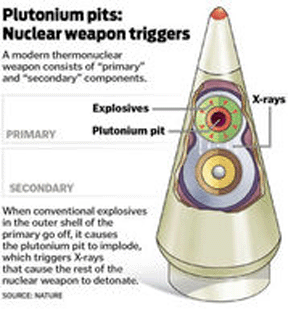 The U.S. is Boosting Production of Nuclear Bomb Cores (For More Nuclear Weapons), The National Interest. Thanks, arms race. by Michael Peck, 7 Feb 21, In another sign that the nuclear arms race is heating up, the U.S. is ramping up production of nuclear bomb cores. The National Nuclear Security Administration (NNSA) has announced that it plans to increase the production of plutonium pits to 80 per year. The grapefruit-sized pits contain the fissile material that give nuclear weapons such tremendous power. Production will center on the Mixed-Oxide Fuel Fabrication Facility at Savannah River site in North Carolina, which would be modified to manufacture at least 50 pits per year, and Los Alamos National Laboratory in New Mexico, which would generate at least 30, by 2030. America’s nuclear weapons cores are aging, with some pits dating back to the 1970s, leading to concerns about the reliability of the U.S. nuclear stockpile……… In its 2018 Nuclear Policy Review, the Trump administration called for 80 new plutonium pits per year. Congress has also allocated large sums, with $4.7 billion alone allocated in FY 2019 for maintenance and life extension of the nuclear stockpile. The NNSA says it is legally mandated to ensure a capacity of at least 80 pits per year. ……. Anti-nuclear groups are furious. “Expanded pit production will cost at least $43 billion over the next 30 years,” argues the Natural Resources Defense Council and other groups. Yet the Defense Department and NNSA have never explained why expanded plutonium pit production is necessary. More than 15,000 plutonium pits are stored at NNSA’s Pantex Plant near Amarillo, Texas. Independent experts have concluded that plutonium pits have reliable lifetimes of at least 100 years (the average pit age is less than 40 years). Crucially, there is no pit production scheduled to maintain the safety and reliability of the existing nuclear weapons stockpile. Instead, proposed future pit production is for speculative new-design nuclear weapons, but those designs have been canceled.” Introducing a new generation of nuclear weapons “could adversely impact national security because newly produced plutonium pits cannot be full-scale tested without violating the global nuclear weapons testing moratorium.” Michael Peck is a contributing writer for the National Interest. He can be found on Twitter and Facebook. https://nationalinterest.org/blog/reboot/us-boosting-production-nuclear-bomb-cores-more-nuclear-weapons-177825 |
|
The dangers and uncertainties in Andra’s radioactive waste disposal project in Bure (Meuse)
 Le Monde 5th Jan 2021, Environmentalists and unionists combine against the radioactive waste landfill project in Bure (Meuse). In a forum at the ”World”, they stated their concern at the dangers and uncertainties of the project. Their opinion is bolstered by a recent statement issued on January 13 by the Environmental Austhority, which stressed the uncertainties surrouding the waste disposal plan.
Vigorous opposition has never ceased to alert the public, since 1987, to the immense risks of the geological disposal of radioactive waste. The opinion of the Environmental Authority corroborates what thousands of citizens, elected officials and independent scientists have been denouncing for years, without being truly heard.
As outdated nuclear power closes down, pro nuclear shills viciously attack critics
 Uzbek & Rica 4th Feb 2021, No, nuclear power is not the medium-term solution to fight against global warming. France must stop its pharaonic investments in nuclear installations such as EPR reactors, which accumulate late delivery and explosion in costs, Julien Tchernia , co-founder andpresident of the renewable energy supplier ekWateur tells us in this forum.
When an article or a post is published about renewable energies, you will always find, following
it, a series of derogatory comments from nuclear advocates. Even if the content in question does not mention or refer to nuclear power, its aficionados take up pens to denigrate renewable production methods (but why so much hatred?)
And, incidentally, to write about their favorite mode of production. Why do they feel so threatened? Is the risk of this mode of production disappearing very real? And if so, would it not be less linked to the course of the political battle between pro and anti-nuclear than to
the complexity, to the costs of building and producing new nuclear power plants?
So, aren’t nuclear power stations shutting down on their own? In a manner analogous to the transition that took place for photography in the 2000s between film and digital, isn’t it time to let nuclear power stopquietly and fully accept the shift towards renewable energy?
What is the ”acceptable” death toll for China (and others) in planning for nuclear war?

|
Nuclear numbers: Assessing China’s threshold of ‘unacceptable damage’, TSG Sunday Guardian Live , Manpreet Sethi, February 6, 2021 Contemporary China appears to have a far lower threshold for taking damage than it once projected.Nuclear deterrence works on the principle of causing unacceptable damage in response to nuclear use. But what kind of damage do nations find unacceptable? How does one calculate what would be unacceptable to another? Answers to these questions are difficult, but important because a fair assessment of what the adversary would find unacceptable can help to right-size one’s own nuclear arsenal. Different countries, like different individuals, have disparate thresholds of damage absorption. For instance, during the Cold War, the US concluded that the USSR would be deterred if 50% of Soviet industry and 25% of its population were to be destroyed. Meanwhile, President Kennedy’s hesitation to lose even one American city during the Cuban missile crisis revealed America’s low damage threshold. Interestingly, in the case of Communist China, Premier Mao had created the image that his country had a high damage-taking capacity. Dismissing nuclear weapons as a “paper tiger”, he suggested that American nuclear use could not deter China because even if 50 million Chinese died, an equal number would survive to carry the country forward. But is this assumption true even today? How does modern China perceive damage? ……… Amongst the many factors that can help assess damage tolerance thresholds, five are particularly relevant. The first is to understand the historical experiences since a country that has been through more wars and experienced losses is expected to have a higher damage tolerance threshold. …….. Secondly, damage acceptability depends on the nature of the political system, with the assumption being that a closed, authoritarian system would be able to take more damage than a democracy…………damage acceptability depends on the nature of the political system, with the assumption being that a closed, authoritarian system would be able to take more damage than a democracy. While China is authoritarian, the Chinese Communist Party is extremely careful to sustain an image of legitimacy based on popular support. This, however, is not as easy to maintain today as it once was owing to society having become better educated, expressive and digitally connected. Therefore, the Party decision-making cannot afford to be insulated and ignore the mood of the masses. The third factor is the level of economic development, since an economically well-off and materially aspirational society is believed to have a low stomach for damage. ……….. Fourthly, the damage threshold varies depending on the value a country places on the objective it seeks. The more a country is politically, economically and emotionally invested in the objective, the greater its willingness to bear damage. For instance, in case of a conflict over Taiwan, which China considers an existential threat, its threshold of damage is likely to be higher than in case of conflict in high Himalayas or over areas disputed with India. Contemporary China, therefore, appears to have a far lower threshold for taking damage than it once projected. ……. These, and more such insights, should help India to calculate the “right” size of its nuclear arsenal in order to signal credible deterrence ……..https://www.sundayguardianlive.com/opinion/nuclear-numbers-assessing-chinas-threshold-unacceptable-damage |
|
Increasing risk of nuclear cataclysm , with today’s new technology weapons
 The risk of nuclear cataclysm is increasing, https://www.japantimes.co.jp/opinion/2021/02/07/commentary/world-commentary/us-russia-china-nuclear-weapons-arms-control/, BY ANDREAS KLUTH, BLOOMBERG, Feb 7, 2021
The world can breathe a small sigh of relief this week. The last remaining arms control treaty between the United States and Russia, called New START, will not expire on Feb. 5 after all, as recently feared.
In the nick of time, Russian President Vladimir Putin offered his new American counterpart an extension of the treaty for five years, an option stipulated in its text. Joe Biden agreed — after giving Putin the requisite talking to about Russia’s massive cyberattack on the United States, its jailing of the activist Alexey Navalny and other recent outrages.
In the short term, a new nuclear arms race between the two biggies has thus been avoided. Sort of. But not really — and there’s the rub. A wider glance at the world’s nuclear landscape reveals that the danger of cataclysm, by design or accident, keeps growing.
New START only covers the stockpiles of Russian and American “strategic” weapons. This refers to those warheads the two adversaries point at each other’s homeland. The treaty says nothing about “tactical” nukes, the more flexible and usually smaller warheads built for potential use in a war zone to win or avoid losing a conventional conflict.
But in that tactical category an arms race is already underway. Both the United States and Russia, in the name of upgrading their arsenals, have been designing new tactical nukes and deployment technologies. These include things that were science-fiction during the Cold War, such as nukes delivered by drones from submarines.
This race is thus fundamentally different from the one between the United States and the Soviet Union. Back then, the contest ultimately came down to a count of each side’s warheads. What ultimately stabilized that competition was the macabre but compelling logic of deterrence through “mutual assured destruction” (MAD).
Today’s competition is instead between newfangled technologies and, crucially, the military strategies thus made possible. This multiplication of scenarios and permutations undermines traditional calculations of strategy, which were largely based on the tools of game theory developed during the Cold War.
One upshot is that it’s becoming even more important for all nine of the nuclear powers to “signal” their “postures,” in the jargon. They should explain their intentions and make themselves as predictable as possible to others. And yet the most recent such signaling was hardly reassuring. In Article 4 of its Basic Principles issued last summer, Russia asserts that one purpose of its nuclear arsenal is “the prevention of an escalation of military actions and their termination on conditions that are acceptable for the Russian Federation.”
Translated, this wording suggests that Russia could respond to a conventional conflict with a tactical nuclear strike, as opposed to reserving nukes purely for retaliation in kind. But that makes any altercation potentially explosive in the fissile sense.
A conflict could, for instance, start with hybrid warfare (of the sort Russia used in its 2014 annexation of Crimea), or with cyberwar (as waged during last year’s Russian hack of some 18,000 U.S. computer systems) or with a strike in space against an adversary’s satellites. If the conflagration escalates and becomes “unacceptable,” the next step could be nukes. And then?
The first strike would still detonate somewhere — perhaps in the Baltic region, according to one hypothetical conflict between Russia and NATO. For the local population that would be far from “tactical,” and indeed terminal. It would also demand a response from the alliance.
But should that response be a nuclear counterstrike? At what scale? Against Russian forces, or a city? Moreover, how would Russia, in this hypothetical scenario, react to this “limited” NATO counterstrike? With missiles flying at supersonic speeds, all involved would have at most minutes to decide.
To make the global matrix even more complex, there are also the other seven nuclear powers to consider, and perhaps additional ones in future. Of these North Korea may appear to be the most unhinged. But China is the most ambitious. It could have 350 warheads already, according to some estimates. The Pentagon assumes China will double its arsenal in the coming decade.
China is the main reason why the United States and Russia couldn’t agree on properly renegotiating New START. Donald Trump, Biden’s predecessor, insisted on bringing Beijing into the talks. The Chinese refused. Sarcastically, they wondered aloud whether the Americans and Russians would prefer to let China raise its arsenal to their size or to cut their own down to China’s.
That makes for a good news conference zinger in Beijing. But it won’t help humanity get to grips with its conundrum: More actors are getting more weapons with more technological and tactical applications. The risk that somebody, somewhere pulls a trigger, intentionally or inadvertently, keeps rising.
In a gesture of global protest against this insanity, 86 non-nuclear countries have signed a Treaty on the Prohibition of Nuclear Weapons, with a goal of totally banning these satanic arms. It took effect on Jan. 22. But these — mainly smaller and poorer — states don’t hold the future in their hands.
The big nuclear powers do. They must put their daunting other differences aside and begin comprehensive talks to prevent the worst. And the best placed to extend the invitation is the leader who’s newest in office, and yet has the most experience with disarmament: Biden.
Zarif: compensation not pre-condition for reviving Iran nuclear deal
WASHINGTON — Iranian Foreign MinisterMohammad Javad Zarif said on Sunday that Iran receiving compensation from the United States for the U.S. withdrawal from the 2015 Iranian nuclear deal was not a “pre-condition” forreviving the agreement. (Reporting By Arshad Mohammed; Editing by Daniel Wallis)
The complicated politics of removing nuclear subsidies: the crooked Ohio legislation
COLUMBUS, Ohio (AP) — The new owners of two Ohio nuclear power plants have given indications they are no longer interested in receiving as much as $1 billion in subsidies handed out in a tainted energy bill, according to two state lawmakers.
One of the lawmakers, freshman GOP Sen. Jerry Cirino, last week cosponsored Senate Bill 44, legislation that would eradicate subsidies that would have been paid by electric customers across the state for the plants now owned by a privately held company called Energy Harbor.
The plants, one of which is in Cirino’s district, were operated by a wholly owned subsidiary of Akron-based FirstEnergy Corp. when the bill known as HB6 was approved in July 2019 and quickly signed by Republican Gov. Mike DeWine.
Messages were left Friday with Energy Harbor spokespersons seeking comment about the company’s plans.
“I believe there is extremely broad support for Senate Bill 44 in the Legislature and broad external support as well,” said Cirino, who added that recent discussions with Energy Harbor officials lead him to believe they will not find any problems with SB44.
One of the lawmakers, freshman GOP Sen. Jerry Cirino, last week cosponsored Senate Bill 44, legislation that would eradicate subsidies that would have been paid by electric customers across the state for the plants now owned by a privately held company called Energy Harbor.
The plants, one of which is in Cirino’s district, were operated by a wholly owned subsidiary of Akron-based FirstEnergy Corp. when the bill known as HB6 was approved in July 2019 and quickly signed by Republican Gov. Mike DeWine………..
Rep. Bill Seitz, a Cincinnati Republican who was a key player in pushing HB6 through the Legislature, said an Energy Harbor lobbyist told him in December that the company would like the option to decline the subsidies.
Both Seitz and Cirino said Energy Harbor officials were concerned that accepting subsidies would put the company at a disadvantage competing with non-subsidized suppliers, given priority on pricing in the 13-state PJM energy markets where electricity is bought and sold……….
HB6 critics have questioned whether Energy Harbor needs financial help to keep the plants operating after buying back $800 million of company shares last year. Energy Harbor officially took ownership of the plants in February 2020 in a deal struck with a FirstEnergy subsidiary in U.S. Bankruptcy Court.
“It’s quite a turnaround if Energy Harbor is now telling the legislature to repeal its billion-dollar corporate welfare subsidy from Ohioans,” said Ohio Consumers’ Counsel Bruce Weston in a statement. “Questions that come to mind include: Did the two nuclear plants really need the subsidy that they got from Ohioans’ state government? And were the nuclear plants really going to be closed without the subsidy?”
Former PUCO Chair Todd Snitchler, now president and CEO of the Washington-based Electric Supply Association, on Friday called HB6 a “shameful piece of legislation.”
“Ohioans don’t need to pay more only to support struggling plants,” Snitchler said in a statement. “Competitive power markets are delivering reliable power and billions in cost savings to electric customers while significantly reducing emissions and enabling new clean energy build — without subsidies and extra ratepayer charges.”
…………… HB6 has been under intense scrutiny since U.S. Attorney David DeVillers announced on July 21 that then-House Speaker Larry Householder and four others had been arrested for their involvement in a $60 million bribery scheme secretly funded by an unidentified company that clearly was FirstEnergy. Authorities have described it as the biggest bribery scheme in state history.
The five men and a dark money group were subsequently indicted on federal racketeering charges. Householder has pleaded not guilty and awaits trial. Two political operatives have pleaded guilty to charges. The dark money group called Generation Now filed a plea agreement on Friday.
Republicans who control both legislative chambers have not been able to reach a consensus so far on repealing or replacing the measure.
Sponsor testimony on the new bill eliminating the nuclear subsidies begins Tuesday. https://www.usnews.com/news/best-states/ohio/articles/2021-02-07/owners-of-two-ohio-nuclear-plants-may-decline-subsidies
Seizing the War Industry, by Christian Sorenson — Rise Up Times

“The War Industry infests the American economy like a cancer, sapping its strength and distorting its creativity while devouring its treasure.”
Seizing the War Industry, by Christian Sorenson — Rise Up Times
Aviva Investors doubtful about backing Sizewell nuclear power station
 Telegraph 6th Feb 2021, One of Britain’s biggest investors has cast doubt over whether it would
back new nuclear power stations due to environmental concerns. Aviva
Investors said nuclear’s ESG (environmental, social and corporate
governance) impact was “far from clear at this time”, even as the
Government backs the technology to help cut carbon emissions [ which it doesn’t anyway].
finance for the planned £20bn Sizewell C reactor in Suffolk. EDF is in
talks with the Government over public backing, but will also need to
attract institutional investors.
Nuclear power unaffordable in USA, Russia, India, France, even China, but NO SOLUTION TO WASTES
|
Germany: Nuclear phaseout or renaissance? https://www.dw.com/en/germany-looking-for-final-repository-for-nuclear-waste-global-outlook/a-56449115– 5 Feb 21,
Germany’s nuclear phaseout will be completed by the end of 2022. Safe final repositories for nuclear waste still haven’t been found, but some countries are still building new reactors. Does nuclear have a future? There are currently 413 nuclear reactors in operation in 32 countries around the globe. According to the annual World Nuclear Industry Status Report (WNISR), nuclear power accounted for about 10% of global electricity demand in 2019, the highest share being 17.5% in 1996. Most reactors were built between 1968 and 1986, mainly in Europe, the United States, the former Soviet Union and Japan. The global average age of these reactors is 31 years.
|
|
|





Canadian local community group opposes nuclear waste dump on farming land

South Bruce nuclear dump opponents address Minto council . Group: site near Teeswater would mean transporting waste through neighbouring communities, https://www.wellingtonadvertiser.com/south-bruce-nuclear-dump-opponents-address-minto-council/ , Wellington Advertiser, Patrick Raftis, February 4, 2021 MINTO – A group fighting a proposal to locate an underground dumpsite for radioactive nuclear waste in neighbouring South Bruce brought its concerns to council here on Feb. 2.
“Over 50 years ago the nuclear industry told the government to let them start producing nuclear power and they would have a solution for the waste within five years,” said Michelle Stein of Protect Our Waterways – No Nuclear Waste (POWNNW), during a council video-conference meeting.
“But they didn’t. Now they have a problem.”
Stein explained POWNNW was formed last February after an announcement that 1,300 acres of prime farmland had been purchased and optioned by the Nuclear Waste Management Organization (NWMO).
NWMO is proposing to locate a deep geologic repository (DGR) in South Bruce to contain high-level radioactive nuclear waste from all of Canada’s nuclear reactors.
Stein said the radioactive waste from Canada’s reactors is “safe where it is right now.
“But politically, it’s no longer acceptable and the government and the public are demanding a solution before they grant the nuclear industry permission to expand.”
Stein continued, “There’s a lot of money on the line. So the industry has set up [NWMO], which is funded and directed by the nuclear industry and the best idea they’ve come up with is to take this highly radioactive nuclear waste that is dangerous for over 100,000 years and bury it under prime farmland in the municipality of South Bruce.”
The proposed site near Teeswater was selected, said Stein, because “that’s where they found owners willing to sell them land” and “South Bruce was one of the municipalities who offered to learn more in exchange for money – lots of money.
“A lot of the money is spent on promoting the project, but there’s also donations to local organizations and community projects,” she noted.
Stein told council l the proposed site “has the Teeswater river running through it, wetlands at the edge of the Greenock Swamp, springtime floodplain and the town of Teeswater is close enough to see, with its elementary schools and the Teeswater Gay Lea plant.”
Stein called the proposed South Bruce repository “an experiment,” noting there are currently no operating DGRs for high level nuclear waste on the planet.
She noted an almost complete, but not yet licensed, DGR in Finland is presently the closest to coming on line.
According to the Canadian Nuclear Safety Commission, said Stein, the Waste Isolation Plant Pilot (WIPP) in New Mexico is the only operational DGR in the world.
It accepts only low/intermediate nuclear waste, not high level, and is located in a desert, 35 kilometres from the nearest town and surrounded by a controlled safety zone encompassing more than 10,000 acres.
“The only thing we can really learn from this project is that accident happens and you can’t predict human error,” said Stein.
She added that in 2014 the WIPP “became radio actively contaminated by explosion of an underground drum of nuclear waste due to human error.”
Stein said the 2014 incident was “a mistake that took three years and $500 million to clean up.”
She pointed out establishing a DGR in South Bruce would massively increase the amount of nuclear waste being transported through a wide region.
“Currently they are around five loads of high level waste being moved per year, but an operating DGR would increase that to one or two shipments per day. These loads would be transported through surrounding communities,” she stated.
“And what does this mean for agriculture? Will consumers want to purchase products produced next to a nuclear dump? Will people want to buy freezer beef or chicken raised on or beside a nuclear dump?”
With the NWMO publicly stating it is looking for a “willing host,” Stein said POPNNW wants to see a clear benchmark that defines the term.
The group is lobbying for a standard that would require a two-thirds vote in favour of the proposed DGR, using a community referendum with a clear yes or no question, supervised by an independent third party.
Councillor Ron Elliott asked Stein what her group believes would be a better solution to burying the waste.
“You’re recommending we can’t get rid of the nuclear waste underground. What do you recommend we do with it? Because it’s there, we’ve got nuclear waste to get rid of,” said Elliott.
Stein replied, “At this time we’re recommending they go with rolling stewardship, which is keeping it above ground in a monitored state until they come up with a real solution.”
“So wouldn’t that be more dangerous?” asked Elliott
“Building a DGR doesn’t remove it from above ground. It still needs to be above ground (in containment pools) for 30 years before it can even be moved,” said Stein.
“What is a safe recommendation?” Elliott persisted.
“At the end of the day the nuclear industry has had over 50 years to come up with an idea and they haven’t,” Stein responded.
“To be honest, most of us have only been thinking about it for a year. But to accept the wrong solution is in fact no solution at all.”
Bill Noll, another member of the POPNNW delegation, said Ontario Power Generation has stated nuclear waste has been stored safely above ground for 60 years “and it can be stored longer.”
Noll said the group would like to see Canada wait for the results from the planned Finnish DGR in 2024 before going ahead with one here.
“Let them experiment for a couple of decades while we keep it above ground safely and then maybe we can consider whether or not the DGR is safe,” said Noll.
Deputy mayor Dave Turton asked Stein if local officials in South Bruce responded to the group’s concerns.
“Are they listening to you?” he asked.
Noll replied, “We are up against the wall to some degree. Our council is very much interested to see some economic development in the area, and we certainly understand and appreciate that, and so they’re very much in tune with the agenda being put forward by the NWMO.”
Mayor George Bridge thanked the group for sharing information with council.
In desperate economic plight, two Japanese towns willing to host nuclear waste dump

It’s sad that small Japanese towns are being forced to these lengths to protect their economic stability.
Two Japanese Towns Want to Host an Underground Nuclear Waste Dump 5 Feb 21, https://earther.gizmodo.com/two-japanese-towns-want-to-host-an-underground-nuclear-1846200890 Dharna Noor
No matter how you feel about nuclear energy, nuclear waste is generally something you want to stay as far away from as possible—unless you’re two villages on the Hokkaido, Japan’s second-largest island. The two small fishing towns, Suttsu and Kamoenai, are competing to become the site for a high-level radioactive waste storage site as a means to stay afloat economically. But not everyone is so thrilled about the prospect.
According to national data, Japan has generated more than 19,000 tons of highly toxic atomic waste since it began using nuclear power in 1966. To keep it away from people, back in 2000, the country passed the Designated Radioactive Waste Final Disposal Act to open a call for an underground waste repository for some of it.
At the time, unsurprisingly, no municipalities to sign up to host the toxic stuff. The trepidation only grew when in 2011, an earthquake and tsunami triggered an explosion at Japan’s Fukushima Daiichi Nuclear Power Plant, releasing an unprecedented amount of radioactive contamination into the ocean. It was the most severe nuclear accident since Chernobyl.
But now, times are desperate in Japan’s small villages. Fishing, once a booming industry, is in decline. Many young people are moving into cities where economic prospects are better. As a result, populations are shrinking. Suttsu currently has a population of 2,885, down from nearly 5,000 in 1980, and Kamoenai is home to just more than 800. As Bloomberg noted, both towns were also hit hard by the economic downturn of the covid-19 pandemic last year.
Agreeing to host the nuclear storage facility would be a major boost for either town. By agreeing to preliminary research into hosting the nuclear storage facility, municipalities can rake in up to $19 million in government subsidies over two years. If that first stage goes well, another $66 million becomes available in exchange for a four-year field survey and preliminary drilling. If that goes smoothly, the town would go through a 14-year evaluation period, unlocking even more funding. In total, the potential prize for agreeing to host the facility could be up to $37 billion in investments. So in October, both towns’ officials came forward as potential candidates.
But of course, the prospect of living near an atomic waste dump has sparked opposition from concerned residents of both towns. Nuclear waste can contain toxic elements like uranium and plutonium. Anti-nuclear advocates in Suttsu even pushed for a referendum on the village’s application, but the municipal assembly voted it down. Japanese government officials said their review process is airtight and would protect locals, but in an interview with the magazine Aera, Yugo Ono, a geology professor at Hokkaido University, said the earthquake risk is high and could lead to the stored waste leaking.
It’s sad that small Japanese towns are being forced to these lengths to protect their economic stability. But at some point, Japan will need to put its nuclear waste somewhere. Let’s just hope when it does, it does so safely.
Deploying weapons in space crosses a threshold that cannot be walked back.

weaponizing space could become a classic case of trying to solve one problem while creating a much worse problem.
It’s time for arms control planning to address the issues raised by this drift toward militarization of space. Space is a place where billions of defense dollars can evaporate quickly and result in more threats about which to be concerned. China and Russia have been proposing mechanisms for space arms control at the United Nations for years; it’s time for the U.S. to cooperate in this effort.
Deploying weapons in space crosses a threshold that cannot be walked back.
The US should negotiate a ban on basing weapons in space, BY JOHN FAIRLAMB, — 02/04/21, https://thehill.com/opinion/national-security/536774-the-us-should-negotiate-a-ban-on-basing-weapons-in-space
The Biden administration is assembling a deep bench of personnel with experience negotiating arms control agreements and already has agreed with Russia to extend the New Start Treaty. It’s clear the administration intends to initiate another look at the 2018 Nuclear Posture Review and the massive buildup in nuclear weapons begun by the Trump administration. While it’s good that the Biden administration intends to resume negotiations to continue nuclear force reductions, the specter of placing weapons in space is another area that requires a serious arms control effort.
Now that separate space organizations have been established, major military commands are advocating to develop new capabilities. Pentagon buzzwords characterize space as a “contested domain” and some consider actual war-fighting in space to be inevitable. Some advocates argue that the U.S. should strive for technological superiority in space to ensure our dominance of that critical domain.
The history of technological advancement in weapons systems shows that any advantage gained usually lasts fewer than five years and guarantees a cycle of ever-increasing cost and new perceptions of threat. Already, there are weapons that can be targeted against space-based assets from non-space domains. Russia and China are believed to have deployed ground-based capabilities to attack satellites, and India joined this club last year by using a ground-based missile to bring down a satellite.
Although it isn’t clear how the Biden administration will shape space policy, during his confirmation hearing, Secretary of Defense Lloyd Austin seemed to signal a shift away from a more muscular approach and back to a focus on space resiliency and protecting U.S. space assets. As one analyst concluded, the language Austin used signals the Biden team wants to “start to lean away from … the pugilistic aspects of what’s been articulated [by the Trump administration].” Responding to a question about what his advice would be to the U.S. Space Command concerning military space operations, Austin stressed measures to protect U.S. assets that don’t include offensive options for taking the fight to adversaries. While not a fully articulated space policy, this is a welcome change of tone after the past few years of heavy breathing about waging war in space.
If the U.S. and other nations continue the current drift toward organizing and equipping to wage war in space, Russia, China and others will strive to improve capabilities to destroy U.S. space assets. Over time, this would greatly increase the threat to the full array of U.S. space-based capabilities. Intelligence, communications, surveillance, targeting and navigation assets already based in space, upon which the Department of Defense (DOD) depends for command and control of military operations, increasingly would be at significant risk. As a consequence, weaponizing space could become a classic case of trying to solve one problem while creating a much worse problem.
For example, buried in the DOD 2020 budget is $150 million for research into putting missile defense assets in space to attack enemy nuclear missiles in the boost phase. If the U.S. or another nation does deploy weapons in space, it would be the first country to do so and likely would be a disaster for strategic stability. To ensure the credibility of their nuclear deterrents, Russia, China and others could be expected to respond by deploying additional and new types of long-range ballistic missiles, as well as missiles employing non-ballistic trajectories that are harder to hit. Russia and China also would strive to improve their ability to destroy U.S. space-based interceptors, which would greatly increase the threat to the full array of U.S. space assets.
It’s time for arms control planning to address the issues raised by this drift toward militarization of space. Space is a place where billions of defense dollars can evaporate quickly and result in more threats about which to be concerned. China and Russia have been proposing mechanisms for space arms control at the United Nations for years; it’s time for the U.S. to cooperate in this effort.
In 2015, Frank Rose, assistant secretary for arms control, verification and compliance in the State Department, called for arms control in space at the Association of Southeast Asian Nations Regional Forum workshop on space security. But, he said the Obama administration opposed a 2008 Russian and Chinese proposal to ban all weapons in space because it was unverifiable, contained no prohibition on developing and stockpiling space arms, and did not address ground-based space weapons such as direct ascent anti-satellite missiles.
Instead of just criticizing others’ proposals, the U.S. should join in the effort and do the hard work of crafting a space arms control agreement that deals with the concerns we have and that can be verified. A legally binding international treaty banning the basing of weapons in space should be the objective.
Let’s be clear: Deploying weapons in space crosses a threshold that cannot be walked back. Given the implications for strategic stability, and the likelihood that such a decision by any nation would set off an expensive space arms race in which any advantage gained would likely be temporary, engaging now to prevent such a debacle seems warranted.
John Fairlamb, Ph.D., is a retired Army colonel with 45 years of government service, much of it in joint service positions formulating and implementing national security strategies and policies, including two four-year details in the Department of State and as the political-military affairs adviser for a major Army command. His doctorate is in comparative defense policy analysis.
1 This Month

Tell Congress: Prevent Nuclear Catastrophe in Iran

Tell Congress: Prevent Nuclear Catastrophe in Iran

Read the Public Inquiry Report, the Commissioners’ report, Surrendering Australia: The AUKUS Deception is available to download for free at aukuspublicinquiry.com. Or just watch the replay of the National Press Club Luncheon.


Shut down the radiation-damaged Heysham nuclear reactors now
To see nuclear-related stories in greater depth and intensity – go to https://nuclearinformation.wordpress.com

Say No to NASA’s Reckless Nuclear Reactor on the Moon
Say No to NASA’s Reckless Nuclear Reactor on the Moon
-
Archives
- November 2026 (255)
- October 2026 (302)
- September 2026 (339)
- August 2026 (330)
- July 2026 (355)
- June 2026 (287)
- May 2026 (306)
- April 2026 (356)
- March 2026 (251)
- February 2026 (267)
- January 2026 (308)
- December 2025 (358)
-
Categories
- 1
- 1 NUCLEAR ISSUES
- business and costs
- climate change
- culture and arts
- ENERGY
- environment
- health
- history
- indigenous issues
- Legal
- marketing of nuclear
- media
- opposition to nuclear
- PERSONAL STORIES
- politics
- politics international
- Religion and ethics
- safety
- secrets,lies and civil liberties
- spinbuster
- technology
- Uranium
- wastes
- weapons and war
- Women
- 2 WORLD
- ACTION
- AFRICA
- Atrocities
- AUSTRALIA
- Christina's notes
- Christina's themes
- culture and arts
- Events
- Fuk 2022
- Fuk 2023
- Fukushima 2017
- Fukushima 2018
- fukushima 2019
- Fukushima 2020
- Fukushima 2021
- general
- global warming
- Humour (God we need it)
- Nuclear
- RARE EARTHS
- Reference
- resources – print
- Resources -audiovicual
- Weekly Newsletter
- World
- World Nuclear
- YouTube
-
RSS
Entries RSS
Comments RSS

