July 5 Energy News — geoharvey

Opinion: ¶ “Green Dreams: Managing The Transition From Rust To Renewables” • Five years after the closure of South Australia’s last coal-fired generators, the Port Augusta region finds itself in the middle of a renewable energy boom. South Australia has a world-leading share of wind and solar, and that share is to jump even higher, […]
July 5 Energy News — geoharvey
EDF launches the “EPR2” After the Flamanville and Finland fiascoes, what could go wrong?

After the Flamanville and Finland fiascoes, what could go wrong?
EDF launches the “EPR2” — Beyond Nuclear International The politics of “fait accompli” will ensure a new industrial and financial disaster
Editor’s note: Despite the latest safety failures at the Taishan EPR in China; the endless delays and cost over-runs at the EPR projects in France and Finland; the technical fiascos and do-overs at the EPR construction sites in France, Finland and the UK; and the ongoing reckless plans for 6 EPRs in India, the French nuclear sector has far from abandoned its hubris. Instead, incredibly, and as Stéphane Lhomme tells us in a recent new blog on the topic, here translated into English, EDF has announced plans to begin construction of the “EPR2”. What could possibly go wrong?
By Stéphane Lhomme. 4 July 21,
Despite the fact that it has proven incapable of properly carrying out the construction of the EPR reactor at the never-ending Flamanville site underway since 2008, EDF leadership has nevertheless decided — according to the media outlet, Contexte — to allocate hundreds of millions of Euros to launch a construction program for new reactors, called “EPR2”.
Despite being fiercely pro-nuclear, President Macron has declared on several occasions that the EPR at Flamanville would need to be operational before any decision to build other reactors could be made.
However, it’s very likely that Mr. Macron is perfectly well aware of — and complicit in — this decision by EDF management to move forward with a new project.
Just as it has often done in the past, in its contempt for democracy and the interests of the French public, the leadership of EDF intends to use the politics of fait accompli: it proposes to spend hundreds of billions to start one or several “EPR2” reactor construction projects in order to then proclaim that the ship has sailed so the program cannot be stopped…. under threat of wasting hundreds of billions.
But it’s precisely by building nuclear reactors that EDF is already wasting astronomic sums, just as Areva did before that, going bankrupt due to the disastrous EPR construction project in Finland (which began in 2005, was supposed to come on line in 2009….but is still not complete)!
EDF claimed to have EPR construction under control despite Areva’s setbacks in Finland, but the construction at Flamanville is also a total catastrophe. So how can we possibly believe that, miraculously, EDF would be capable of building new EPR reactors, and moreover modified ones (hence the concept “EPR2”)?
For sure, from the anti-nuclear point of view, it is reassuring to be able to count on the incompetence and manifest inability of EDF to build nuclear reactors. But there is no justification for wasting incredible sums of money that are so needed for energy efficiency and renewable energy development.
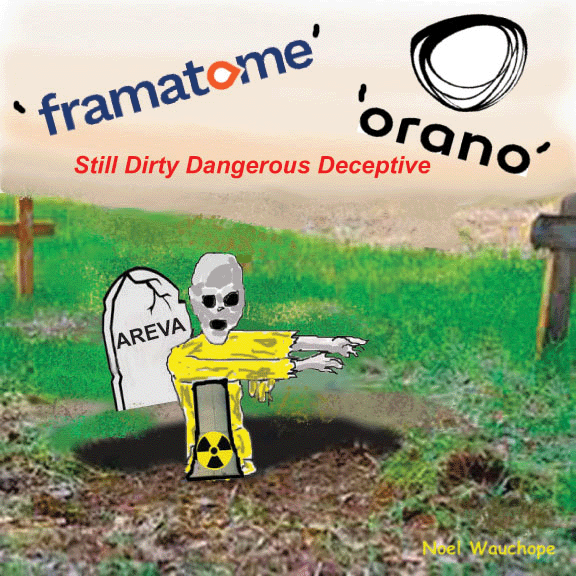
On the contrary, EDF is guaranteeing failure with these delusional nuclear projects, and, as is the case for Areva (renamed Orano), it is the public who will pay for the steep losses. If this “EPR2” program is not stopped as quickly as possible, it will end in a new industrial and financial disaster.
The least that the President of the Republic can do, assuming that he has a good grasp on democracy, is to prohibit EDF (which is 85% state-owned) from launching this new nuclear program before the startup of the Flamanville EPR.
But obviously the best decision would be to cancel all the new reactor projects and immediately to begin a rapid closure of the 56 reactors that pose a daily threat to the lives of French citizens and a majority of Europeans; reactors that produce radioactive waste for which there is no existing solution and that serve as a pretext for the totalitarian repression of citizens who oppose waste burial at the Cigéo at Bure in the Meuse.
Stéphane Lhomme is a longtime French anti-nuclear campaigner and runs the anti-nuclear network, Nuclear Observatory (Observatoire Du Nucléaire).
Headline photo of EPR protest in Colmar, France, by Linda Pentz Gunter.
Under cover of the nation’s preoccupation with the pandemic, France changes the rules, to permit nuclear installations in urbanised areas.

A government decree authorizes the construction of nuclear installations in urbanized or urbanizable areas. While the media, health and political institutions are grinding the brains of citizens with a virus, the government continues to issue decrees spiraling out of control.
This time, on June 29, 2021, a decree dispensing with the town planning code will allow the establishment of nuclear installations in urbanized areas, including where people reside! The ministers of ecology and housing signed this crap. The whole territory is now at the mercy of nuclear predation. It’s radioactivity in your garden or on the balcony.
Insanity presides over autocratic political power and lobbying.
Co-ordination Antinucleaire 2nd July 2021
How Taishan almost became China’s Chernobyl.
How Taishan almost became China’s Chernobyl. https://www.spectator.co.uk/article/how-taishan-almost-became-china-s-chernobyl Ian Williams, 4 July 21,
Days after a nuclear power plant began spewing deadly radiation, the ruling Communist party pushed ahead with a huge and self-indulgent celebration of the sort that had become a hallmark of its rule. This was no time for bad news, and the party delayed, dithered and hid the truth about the deadly events that were unfolding.
That was the Chernobyl disaster in 1986. Soviet leaders allowed Kiev’s International Workers’ Day celebrations to go ahead. The participants, meanwhile, were oblivious to events at the stricken reactor just 60 miles away. The images of those May Day celebrations have come to symbolise the party’s criminal dishonesty, and they were nearly echoed after a technical glitch hit the Taishan nuclear power plant in Guangdong province early last month, just weeks before the Chinese Communist party’s centenary.
Thankfully it did not turn into another Chernobyl, but the response of the authorities in China was chillingly reminiscent of those dark days in Ukraine.
On 16 June, the Chinese government said that there had been an incident with the fuel rods at a nuclear plant, but this information took over a week to get out: a close reminder that authoritarian states repel uncomfortable truths. On 8 June, US authorities were reportedly informed that there was an ‘imminent radiological event’ at the Taishan Nuclear Power Plant in Guangdong Province, just 80 miles from Hong Kong. The Chinese safety authorities were reportedly raising the acceptable limits for radiation detection outside the plant in order to avoid having to shut it down. The French company who part-owned the plant, Framatome, needed to obtain a US waiver to obtain the technical information needed to solve the problem – a problem the Chinese authorities at the time had not even acknowledged existed.
After reports were broadcast by CNN, Framatome issued a statement saying it was trying to resolve a ‘performance issue’ at the plant, in which it has a 30 per cent stake. The Chinese firm, CGN, refused to comment, though the plant said that everything was ‘normal’. Only on 16 June did the Chinese government inform the International Atomic Energy Authority that there had been an issue with some damaged fuel rods. It described the issue as a common occurrence, which did not trigger safety concerns.
It could have been far worse. The technical details are reassuring, but they were far too slow to come out. Had this been a wholly-owned Chinese plant, we would still be completely in the dark. It is chillingly reminiscent not only of the early days at Chernobyl, but also the beginning of the Covid-19 outbreak. During those early days in Wuhan there was open speculation that Xi Jinping had finally reached his ‘Chernobyl moment’ – the disaster that would hasten the demise of a monolithic communist party.
There is visibly a pattern emerging in China which we have seen in authoritarian regimes before. Bad news is quashed and denied. The Chinese Communist party is secretive by nature, and regards itself as accountable to nobody. This has been exacerbated by Xi Jinping’s concentration of power. Officials are afraid to pass bad news up the food chain, preferring to tell the emperor what he wants to hear. In democracies, bad news travels to the top quickly. In autocracies, less so.
Britain has an especially pressing reason to pay attention to events at the Chinese power plant. The Chinese and French firms are also collaborating on the £22 billion Hinkley Point nuclear plant now under construction in Somerset, which will use the same technology. A second joint project in Suffolk has yet to begin construction. The Chinese firm is also angling to build its own reactor at Bradwell in Essex – the first Chinese-designed plant outside its own borders, with Beijing wanting to widen markets for its nuclear technology.
Allowing the Chinese firm which has close links to the Communist party to play such a crucial role in such a sensitive part of Britain’s most critical infrastructure was always foolhardy. It looks even more so in the light of the CCP’s behaviour at Taishan. The party is so wilfully lacking in transparency that it should never be in charge of a nuclear power plant in its own country, let alone on the coast of Britain. The British government has the power to do something about it. The question is whether it has the will.
UK Treasury’s new green savings bonds says YES to wind energy, NO to nuclear

the nuclear energy aspect had been scrapped in the process of working out suitable investments.
Yes to wind, no to nuclear: the green bonds investment planSavers can be part of £15bn scheme with just £100m
Sunday July 04 2021, The Sunday Times The money raised through the Treasury’s new green savings bonds will not be used to fund any nuclear energy projects, despite the power source being a crucial part of the government’s ten-point plan towards net zero.
The term net zero means achieving a balance between the carbon emitted into the atmosphere and the carbon removed from it.
Investors might be able to help fund the government’s plans to “build back better and greener” as early as September, when it is expected that the first tranche of bonds will be launched.
Farnam Bidgoli, the head of environmental, social and governance (ESG) solutions at HSBC, said that the nuclear energy aspect had been scrapped in the process of working out suitable investments. “When doing our market research,……….. (subscribers only) https://www.thetimes.co.uk/article/yes-to-wind-no-to-nuclear-the-green-bonds-investment-plan-9pcrz6rsw
The space tourism plans of Bezos, Musk and Branson are morally reprehensible,

Ben Bramble sets out a problem that ought to be so obvious – that this space travel push is a wasteful, and even childish example of the rich boys club doing its thing – Bezos, Musk, Gates, Branson etc trying to outdo each other
But there is a more sinister side to space travel and space research – the national rivalries, started with Donald Trump’s plan for a Space Force – nuclear reactors, nuclear-powered rockets, and nuclear weapons in space. Those billionaires are all too well connected with NASA and this space military push. The thought of a nuclear war in space is horrendous. But what else could possibly go wrong?
The space tourism plans of Bezos, Musk and Branson are morally reprehensible, The Age, Ben Bramble, 5 July 21.
With billionaires Jeff Bezos, Elon Musk, and Richard Branson soon to send paying customers into space, members of US Congress are askingwhether and how to regulate commercial spaceflight. But there is a more basic question: Should there be such an industry in the first place?
Supporters of such an industry, such as Republican Kevin McCarthy, cast these billionaires as modern-day Wright brothers, innovating commercialspaceflight in a way governments either can’t or won’t. While billionaires will be the first in space, they say, soon everyone will get their chance.
But this is clearly not feasible any time soon, given Earth’s environmental crises. It is unsustainable for humans to keep consuming resources at the rate we currently are, let alone if space tourism were to become commonplace. The fact that a product can be made cheap enough for many people to afford it does not show that it is environmentally sustainable for many people to actually consume it.
Still, you might say, what could be wrong with commercial spaceflight reserved for the ultra-wealthy? This wouldn’t significantly worsen our environmental crises.–
But there is something morally distasteful in the extreme about space tourism exclusively for the ultra-wealthy when so many people on Earth are in such great need. Going into space, in full view of the many billions of humans who are struggling on a daily basis, is a little like enjoying a pop-up Michelin star meal in front of a homeless shelter.
This is not to decry all luxury goods. But there is something particularly objectionable about spending so much money on a fleeting experience for oneself and others, who are already among the best off on the planet, when so many cannot even make ends meet (through no fault of their own).
At present, there seems a clear tendency to reserve moral criticism for people who cause bad things or who set out to harm others. Such behaviour is certainly bad and merits criticism. But we should feel grumpy also at people for failing to help others when they easily can. Those who display an indifference to the plight of others or who are too wrapped up in themselves and their own self-serving projects are morally criticisable even if they are not the cause of others’ suffering. While it is true that Bezos has recently become a major sponsor of the environment, much more is needed. Every dollar spent on sending billionaires into space is money that could have been used instead to help save the planet or bring others out of poverty.
It is worth adding that many billionaires have contributed to Earth’s problems. Our environmental crises are largely due to excessive consumption, something that companies such as Amazon have played a major role in making possible, affordable and accepted……….
Bezos has said that one of his reasons for founding his company Blue Origin is that “we’re now big compared to the size of the planet”. Like Musk, he thinks we need to look beyond Earth to survive our present crises. But this is far too premature. We can still save the Earth. But to save it, we’re going to have to re-engineer our consumer cultures and economies. This, and not space tourism, is the great engineering challenge of the 21st century. I’d like to see these billionaires use their brilliant minds to help save the Earth, rather than flee it. If this means smaller growth for their own companies, so be it. ….. https://www.theage.com.au/national/the-space-tourism-plans-of-bezos-musk-and-branson-are-morally-reprehensible-20210704-p586o1.html
Global heating: “unprecedented” heatwave temperatures will become routine.

With the global climate warming, such “unprecedented” heatwave temperatures will start to become routine. Some parts of the world may simply become too hot for human habitation. Not only will heatwaves become more common, but hotter, drier conditions will lead to more wildfires.
Times 4th July 2021, Canada experienced its highest recorded temperature last week as the mercury surged to 49.6C in British Columbia on Tuesday. This is not onlythe highest temperature for Canada, but the hottest ever recorded above the 45th parallel north, roughly the latitude of Bordeaux and Bologna. In the US, the states of Washington, Oregon and Idaho also broke records.
The Pacific northwest is roasting. Hundreds have died. In Pakistan, the city of Jacobabad can reach 52C. As temperatures hit nearly 50C there last week, ts scorching streets were deserted as people tried to shelter at home, most without air-conditioning. The hospitals were flooded with heatstroke victims.
With the global climate warming, such “unprecedented” heatwave temperatures will start to become routine. Some parts of the world may simply become too hot for human habitation. Not only will heatwaves become more common, but hotter, drier conditions will lead to more wildfires.
In January last year, before Covid-19 dominated the news, Australia was aflame with massive areas of bushfire. Hurricanes and typhoons will also become more intense. Tropical diseases will spread. We’ll find it harder to feed
ourselves. And the problems won’t be shared evenly. Some regions will receive less rainfall and lose crops to drought, others will receive more and lose crops to flooding. There will be a global reconfiguration of where food can reliably be grown, and where people can safely live.
The climate refugees of today are only the first trickle of what could become a mass migration of people into parts of the world still offering habitable conditions – a movement of humanity unlike anything seen before in history. It is unlikely that this large-scale population disruption, combined with dwindling resources such as fresh water, will come without conflict.
The next wars could well be climate wars. It was human ingenuity and resourcefulness that got us into this mess, and I am hopeful that our same capabilities will find the way out again too.
https://www.thetimes.co.uk/article/how-to-live-in-a-climate-emergency-t6rfz7ckv
United Kingdom will not finance any nuclear-energy related expenditures under its Green Financing Framework

Nuclear energy has been excluded from the UK government’s Green Financing Framework, while several EU Member States have written to the European Commission to oppose nuclear’s inclusion in the bloc’s green taxonomy.
The UK’s Green Financing Framework describes how the government plans to finance expenditures through the issuance of green gilts and the retail Green Savings Bonds that it says will be critical in tackling climate change and other environmental challenges. The framework, which was produced and published yesterday by the Treasury, sets out the basis for identification, selection, verification and reporting of the green projects that are eligible for such financing.
Under ‘exclusions’, the document says: “Recognising that many sustainable investors have exclusionary criteria in place around nuclear energy, the UK government will not finance any nuclear energy-related expenditures under the Framework.”
World Nuclear News 2nd July 2021
https://www.world-nuclear-news.org/Articles/UK-excludes-nuclear-from-green-taxonomy
European Court of Justice condemns France for preventing anti-nuclear group from access to legal justice.
Le Figaro 1st July 2021

Bure: France condemned for having rejected the legal action of an
 antinuclear association. The European Court of Human Rights (ECHR) on
 Thursday condemned France for having "disproportionately" restricted access
to justice to an association opposed to the nuclear waste burial project in
 Bure (Meuse).

The seven judges of the judicial body of the Council of Europe which sits in Strasbourg considered that France had violated article 6.1 of the European Convention on Human Rights which guarantees "the right of access to a court »Regarding the Mirabel-LNE association.......


The Cigéo project, on the border of the Meuse and Haute-Marne, aims to eventually store some 85,000 m3 of nuclear waste at a depth of nearly 500 meters.
 Le Figaro 1st July 2021

 https://www.lefigaro.fr/flash-eco/bure-la-france-condamnee-pour-avoir-rejete-le-recours-en-justice-d-une-association-antinucleaire-20210701
In extreme heat wave, forest fire threatens Sakatchewan uranium mine – another example of global heating hitting nuclear activities.

Forest fire burns uncontained near Cigar Lake uranium mine in northern Sask., CBC, 2 July 21, All non-essential personnel have been evacuated due to the fire, Cameco said in a statement.
The Cameco Corporation has reported a forest fire in the vicinity of its Cigar Lake uranium mine in northern Saskatchewan.
In a statement Thursday morning, the company said it has evacuated about 230 workers from the mine and roughly 80 people remain on site to keep the facility in a safe state.
Cameco said, should the wildfire threat continue to grow, there is a plan to keep the workers there safe and a number of precautions have been implemented. It said it’s working closely with the Saskatchewan Public Safety Agency on site.
Cameco said the fire is complicated by extremely warm, dry weather resulting from the heat dome currently over Western Canada.
Production at the Cigar Lake mine has been temporarily suspended. …….
…… As of early Thursday afternoon, the provincial government’s website listed 19 active fires across Saskatchewan. Five are not contained, including the Briggs fire near the Cigar Lake mine. https://www.cbc.ca/news/canada/saskatchewan/forest-fire-cigar-lake-mine-1.6087459
Buried in the sand of Southern Algeria – the radioactive pollution from French nuclear tests

Algérie: sous le sable, les déchets nucléaires français, translation by
Hervé CourtoisC.A.N. Coalition Against Nukes, 2 July 21
This is one of the major issues in the reconciliation of memories between France and Algeria. A subject that has long remained buried in the sands of the Sahara: the pollution of southern Algeria by French nuclear tests.
More than fifty years after the last test in 1966, Algiers has just created an agency for the rehabilitation of former nuc;ea test sites.
The Propaganda
From 1960 to 1966, the French army conducted 17 nuclear tests in southern Algeria, on the sites of Reggane and In Ekker. At the time, Albdekrim Touhami, a native of Tamanrasset, was a teenager. In Ekker is 150 kilometers north. He remembers the installation of the French military base, seen then as a welcome source of employment.”For us, it was a godsend. Everyone came running to get a job as a laborer or simple worker on the site. We didn’t think that this bomb was going to be a disaster for the region. We were told, “Here it is, the bomb will go off at such and such a time. You may feel some shaking, like an earthquake. But don’t worry, there will be no problem.” “
Fifteen years after Hiroshima and Nagasaki, the danger of nuclear weapons is known. Southern Algeria is chosen to conduct these tests, because the area is considered quite deserted compared to the Southern Alps or Corsica, while being close to the French mainland.
France wanted to quickly demonstrate its capacity to use the bomb in the context of the Cold War and the race for nuclear deterrence.”France wanted to catch up with the other nuclear powers, the United States, Russia and the United Kingdom, to remain in what was called at the time “the big league”. This partly explains why the priority was the result, not the concern about the environmental impact or the collateral damage to the population. The priority was to explode the bomb,” recalls Patrice Bouveret, co-founder of the Observatoire de l’armement, an independent center of expertise.A highly polluted area .
In1962, Algeria became independent. The tests continued. Most of them, eleven, were carried out between 1962 and 1966 and therefore with the agreement of the new Algerian authorities. Systematically, the waste generated by these tests was buried, explains Jean-Marie Collin, spokesperson for Ican-France (International Campaign for the Abolition of Nuclear Weapons) who published a study with Patrice Bouveret, “Under the sand, the radioactivity! “.
Very clearly, France has a desire to bury,” emphasizes Jean-Marie Collin. It considers the desert as an ocean, an ocean of sand, and it buries everything that is likely to be contaminated. Algerian independence and the fact that France left Algeria under rather complicated conditions did not play in favor of depollution. On the contrary, even more waste was left behind. “Waste that goes from the simple screwdriver to the tank exposed to test the resistance of military equipment to the atomic bomb. Another pollution linked to nuclear tests, the accidental one during the Berryl underground test in 1962.
The reason for the tests was that the nuclear technology was not fully mastered and therefore there were accidents that released radioactive lava,” continues the Ican-France spokesman. The test concerned was in 1962. We were there in 2007. The scientists measured the radioactivity, which was extremely high, and they told us: “You should not stay more than twenty minutes on the spot, if you do not want to absorb radioactivity that is dangerous for your body. “
Only one victim compensated.
Contaminated rocks left in the open air, in areas of passage. Contaminated sand disseminated by the winds beyond the Algerian borders, particularly in neighboring Niger. For about fifteen years, in the area of Tamanrasset and with very few means, Abdelkrim Touhami and his association Taourirt tries to draw up a sanitary assessment.We learned that many people died of suspicious deaths,” he confides. People were dying little by little. Babies were being born with deformities. Cancers were occurring through this disaster. “
To date, no official census of the people exposed, whether French or Algerian. Only one Algerian victim has been compensated under the Morin Law (2010). The decree of May 31 creating an agency for the rehabilitation of test sites in Algeria is an important step for Jean-Marie Collin of Ican-France.
Until now,” he explains, “the Algerian state created a certain surveillance zone on these sites, but there had never been any action to protect these zones in order to avoid any real access. This decree opens up the possibility that international organizations such as States could come and help rehabilitate these nuclear test sites. What we have at the same time are discussions between France and Algeria, officially revealed in April, whereas until then, these discussions did not officially exist.
“These discussions took place within the framework of the Franco-Algerian working group on nuclear tests, created in 2008 under the presidency of Nicolas Sarkozy. This issue of rehabilitation was also included in the report by Benjamin Stora on the reconciliation of memories between France and Algeria. Algiers must ratify the Tian, the Treaty for the Prohibition of Nuclear Weapons, to which France is not a signatory, before mid-October.
.Supporters of the rehabilitation of former nuclear test sites want a joint Franco-Algerian mission to be sent to map the polluted sites in order to circumscribe them, and eventually treat them so that the inhabitants are no longer exposed to radioactivity. . https://www.rfi.fr/fr/afrique/20210629-alg%C3%A9rie-sous-le-sable-les-d%C3%A9chets-nucl%C3%A9aires-fran%C3%A7ais?fbclid=IwAR2Gn0qmn8xngwhyIaCBN1ut9lU9w_YwziHLSr9S2SkwmBGc9oaWL0f18As
5 European nations warn the European Commission that nuclear energy must be excluded from the EU’s green finance taxonomy.
A group of five EU member states led by Germany have sent a letter to the European Commission asking for nuclear energy to be kept out of the EU’s green finance taxonomy. The letter – signed by the environment or energy ministers of Austria, Denmark, Germany, Luxembourg, and Spain – points to “shortcomings” in a report by the European Commission’s Joint Research Centre published on 2 April, which concluded that nuclear energy is safe.
“Nuclear power is incompatible with the Taxonomy Regulation’s ‘do no significant harm’ principle,” the ministers wrote, urging the Commission to keep nuclear out of the EU’s green finance rules. “We are concerned that including nuclear power in the Taxonomy would permanently damage its integrity, credibility and therefore its usefulness,” they warned.
Euractiv 2nd July 2021
Fukushima: Radioactive boars create mutant hybrid species decade after nuclear disaster
A decade after the Fukushima disaster, wild boars have been mating with domestic pigs in the nuclear wasteland and creating a new mutant species, DNA researchers have determined, Daily Star, By Kirsty Car 2 JUL 2021
Radioactive wild boars have been breeding with Japan’s domestic pigs to create a new hybrid species, researchers say.
…. ..the area’s wild boars bred with domestic pigs that escaped from nearby properties after farmers had to flee, creating a new hybrid species.
A study has led by Donovan Anderson, a researcher at Fukushima University in Japan, analysed DNA samples from muscles of 243 wild boars, pigs and boar-pig hybrids, taken from local slaughterhouses.
The results proved that 31 wild boar, or 16% of the wild boar from the evacuated zone, were hybrids……… The team also claim that while the boar-pigs are radioactive, the study did not link radioactivity with the creation of the new hybrid species……..
 | |||
https://www.dailystar.co.uk/news/weird-news/fukushima-radioactive-boars-create-mutant-24439268
Biden’s Bombing of Iraq and Syria Only Serves the Weapons Industry, by Glenn Greenwald — Rise Up Times

“The U.S. government is a lawless entity. It violates the law, including its own Constitution, whenever it wants. The requirement that no wars be fought absent congressional authority is not some ancillary bureaucratic annoyance…”
Biden’s Bombing of Iraq and Syria Only Serves the Weapons Industry, by Glenn Greenwald — Rise Up Times
Even this conservative journal recognises renewables as the only meaningful future energy source – nuclear is irrelevant

Regardless of what the nuclear industry itself wants, the signs are that renewables may be defining themselves not only as the cheapest, but also as the only meaningful energy proposal for the future.
Let’s Leave Nuclear Power In The Past https://www.forbes.com/sites/enriquedans/2021/06/30/lets-leave-nuclear-power-in-thepast/?sh=4beadbb23864 Enrique Dans, Senior Contributor

It makes a lot of sense to start this article by linking to the old smiling sun badge that symbolizes the opposition to nuclear energy, to talk about the increasingly negative perceptions of nuclear power around the world, to the point where, with the exception of a few unconditional enthusiasts, it is beginning to be seen as a technology with less and less of a role in the world’s energy future.

During the 1950s, the term atomic age was widely used to describe a future where all energy would be based on nuclear fission, one in which energy would be so cheap and inexhaustible that it wouldn’t be worth metering it, to the point that it would be used not only to make weapons or provide energy, but even to power cars like the Ford Nucleon, to heat water in swimming pools, to keep artificial hearts beating and even for the mechanism of a ballpoint pen.
What happened? First, the obvious problem of safety: in a world with an increasingly unstable climate and more extreme weather phenomena, nuclear power plants are, as the tenth anniversary of the Fukushima accident on March 11 reminded us, a reckless option. Germany became the first major economy to commit to retiring its nuclear power plants by 2022, but China also seems to be losing interest in the technology due to cost and safety concerns, while nuclear power is relegated to a token role in the US energy map.

Large reactors cannot compete with low renewable energy prices. Many of them have already closed, and furthermore, due to their high cost, complexity and difficulties, it seems very unlikely that any new large plants will be built in the coming decades. Nuclear power has turned out to be a promise that never materializes, and looks increasingly remote as an answer to the climate emergency.

Some point to small modular reactors (SMRs) as the only option that could be implemented on a significant scale in the climate-critical period of the next few decades, but quite a few analyses suggest this is extremely unlikely to happen.
The option that seemed the most obvious can easily be sidelined as new technologies develop and undergo their own economies of scale. Nuclear power, which still generates around 10% of the world’s total energy, is now seen as too slow, too expensive and too dangerous, something no one wants to see being built near their home or town. Regardless of what the nuclear industry itself wants, the signs are that renewables may be defining themselves not only as the cheapest, but also as the only meaningful energy proposal for the future.
1 This Month
Tell Congress: Prevent Nuclear Catastrophe in Iran

Tell Congress: Prevent Nuclear Catastrophe in Iran

Read the Public Inquiry Report, the Commissioners’ report, Surrendering Australia: The AUKUS Deception is available to download for free at aukuspublicinquiry.com. Or just watch the replay of the National Press Club Luncheon.


Shut down the radiation-damaged Heysham nuclear reactors now
To see nuclear-related stories in greater depth and intensity – go to https://nuclearinformation.wordpress.com

Say No to NASA’s Reckless Nuclear Reactor on the Moon
Say No to NASA’s Reckless Nuclear Reactor on the Moon
-
Archives
- November 2026 (246)
- October 2026 (302)
- September 2026 (339)
- August 2026 (330)
- July 2026 (355)
- June 2026 (287)
- May 2026 (306)
- April 2026 (356)
- March 2026 (251)
- February 2026 (267)
- January 2026 (308)
- December 2025 (358)
-
Categories
- 1
- 1 NUCLEAR ISSUES
- business and costs
- climate change
- culture and arts
- ENERGY
- environment
- health
- history
- indigenous issues
- Legal
- marketing of nuclear
- media
- opposition to nuclear
- PERSONAL STORIES
- politics
- politics international
- Religion and ethics
- safety
- secrets,lies and civil liberties
- spinbuster
- technology
- Uranium
- wastes
- weapons and war
- Women
- 2 WORLD
- ACTION
- AFRICA
- Atrocities
- AUSTRALIA
- Christina's notes
- Christina's themes
- culture and arts
- Events
- Fuk 2022
- Fuk 2023
- Fukushima 2017
- Fukushima 2018
- fukushima 2019
- Fukushima 2020
- Fukushima 2021
- general
- global warming
- Humour (God we need it)
- Nuclear
- RARE EARTHS
- Reference
- resources – print
- Resources -audiovicual
- Weekly Newsletter
- World
- World Nuclear
- YouTube
-
RSS
Entries RSS
Comments RSS

