US Renewables Generated More Power Than Coal Or Nuclear In 2020 For First Time
US Renewables Generated More Power Than Coal Or Nuclear In 2020 For First Time, IFL SCience, Jack Dunhill, 3 Aug 21, Renewables produced more power than coal or nuclear power in the USA last year for the first time in history, according to a new report by the Energy Information Administration. With surges in wind, solar and hydroelectric power, the renewable industry produced 21 percent of all electricity generation in the US last year, a massive increase over the previous decade.
Over the past year, the US has seen record growth in renewable power generation, adding 26 gigawatts of production capability in 2020 alone, 80 percent more than 2019. Combined with previous infrastructure, it brought the total renewable power production up to 170 gigawatts, which edged out both nuclear and coal by just a few percent (20 percent and 19 percent of total energy production, respectively). ….. https://www.iflscience.com/environment/us-renewables-generated-more-power-than-coal-or-nuclear-in-2020-for-first-time
EDF’s plans to produce pink hydrogen at proposed 3.2GW nuclear plant are ‘daft’: argues influential independent analyst Liebreich
EDF’s plans to produce pink hydrogen at proposed 3.2GW nuclear plant are ‘daft’: Liebreich
French utility wants to divert nuclear power to electrolysers at times when the supply of wind and solar is high, but ‘the economics won’t work’, argues the influential independent analyst, Recharge, 2 August 2021 EDF is planning to produce low-carbon “pink” hydrogen at a controversial planned nuclear power plant in the UK only at times when the supply of wind and solar is plentiful — an idea that influential analyst Michael Liebreich has dismissed as “daft”
The French state-backed power giant wants to build the £20bn ($27.8bn) 3.2GW Sizewell C facility on the coast of eastern England, and the UK government is said to be keen to give it the go-ahead as it aims to reach net-zero emissions by 2050.
But in the wake of the hugely expensive Hinkley Point C nuclear power plant in southwest England — which is now under construction after receiving an eye-wateringly high strike price of £92.50/MWh for 35 years (rising with inflation) — the government is wary of committing so much taxpayer money to the project.
In what could be seen as an effort to firm up government support for Sizewell C, which would come on line in 2034, EDF has unveiled plans to use the proposed facility to produce clean hydrogen by diverting electricity to H2-producing electrolysers on days when the supply from wind, solar and hydro are high.
If new nuclear is to have any chance of succeeding it will be by being paired with demand-responsive processes like electrolysis or desalination,” Liebreich wrote on Twitter. “But the idea of making H2 [from nuclear] only with excess power on sunny or windy days is daft: the economics won’t work.”………
Producing hydrogen through electrolysis only at times of excess renewable power has long been derided as uneconomic. This is because using electrolysers only occasionally will significantly increase the levelised cost of the hydrogen (LCOH……….
UK’s nuclear problems
The UK government is said to be considering funding Sizewell C through a “regulated asset base” model, through which consumers would pay a top-up on their electricity bills way before the plant starts generating power. But this would potentially mean that consumers would also have to pay for any cost overruns — a very common problem for the nuclear industry.
According to researchers at the Massachusetts Institute of Technology, the typical nuclear power plant built since 1970 had a cost overrun of 241%. This has meant it has been hard for new nuclear projects to attract investment.
The UK government is said to be considering taking over the 20% stake in Sizewell C currently owned by China General Nuclear Power Group (CGN), after declaring that it no longer wanted Chinese state-owned companies involved in the UK atomic power sector. CGN owns a 33% stake in Hinkley Point C.
Former UK Energy Secretary Ed Davey, who is now the leader of the Liberal Democrat party, says the government’s focus should be on far cheaper wind and solar, rather than expensive, risky nuclear.
“Anything that passes nuclear’s costs on to the taxpayer — costs like nuclear waste management, nuclear station decommissioning, or delays and cost overruns — will be a total betrayal of taxpayers and cost every household in Britain a small fortune,” he said……….. https://www.rechargenews.com/energy-transition/edf-s-plans-to-produce-pink-hydrogen-at-proposed-3-2gw-nuclear-plant-are-daft-liebreich/2-1-1047159
Campaigners dismayed as application to dump Hinkley Point mud in the Bristol Channel is approved.
| Campaigners dismayed as application to dump Hinkley Point mud in the Bristol Channel is approved. Anti-nuclear campaigners have expressed ‘deep dismay’ following confirmation that the Marine Management Organisation (MMO) has approved EDF Energy’s application to dump mud and sediment from the construction of the Hinkley Point C nuclear power station into a coastal site close to the north Somerset town of Portishead. “The MMO document endangers health all around the estuary, including the coast of south Wales, as the Welsh Government Davidson Committee’s independent report makes it clear that material dumped at Portishead travels anticlockwise round the estuary,” Geiger Bay spokesperson Richard Bramhall said. “This includes a long-term threat from inhalable particles of uranium and plutonium. We are facing a culture of deliberate ignorance. Future generations will pay the price.” Nation Cymru 3rd Aug 2021 https://nation.cymru/news/campaigners-dismayed-as-application-to-dump-hinkley-point-mud-in-the-bristol-channel-is-approved/ |
UK Taxpayer funding will pour in, to get Rols Royce’s small modular nuclear reactors happening
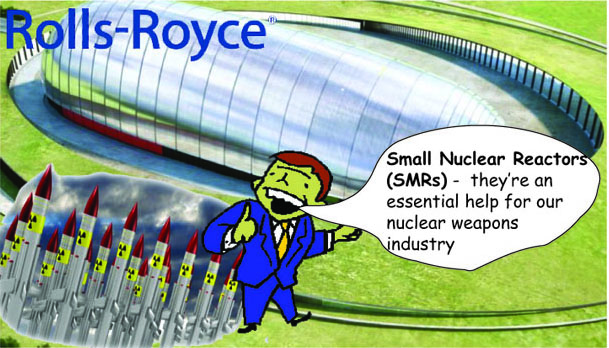
Rolls-Royce lines up funding for mini nuclear reactor revolution. Private
backing for Rolls-led consortium to build new generation of ‘mini nukes’
unlocks hundreds of millions of taxpayer support. Britain has taken a
crucial step towards creating a fleet of mini reactors that would reduce
reliance on Chinese money and nuclear technology after Rolls-Royce secured
investment to build the world’s first production line.
A consortium led by the FTSE 100 engineer has secured at least £210m needed to unlock a
matching amount of taxpayer funding, which will make it the first “small
modular reactors” (SMR) developer to submit its designs to regulators. It
is understood heavyweight financial investors specialising in energy are
now thrashing out the final details of their backing to drive work on the
so-called “mini nuke” power plants.
State support for SMRs – which
each generate about 450 megawatts, about a seventh of the output of
conventional nuclear power stations such as Hinkley Point – was revealed
in the Prime Minister’s ten-point plan for a green industrial revolution
released in the autumn. ………..
SMRs must play a
critical role in our clean energy transition and can open new export
markets worth billions of pounds. “To realise this potential, however,
the Government needs to establish a siting and policy framework by next
year to enable the deployment of a fleet of SMRs and capture the promise of
a net zero [that’s a lie] future.” Although officials are engaging with other businesses
on SMRs, one Whitehall source described the Rolls-led consortium as “by
far the most advanced”.
The UK SMR consortium also includes the National
Nuclear Laboratory and Laing O’Rourke, the construction firm. Ministers
are expected to push for the Office for Nuclear Regulation to prioritise
assessment of the consortium’s SMR design, while simultaneously driving the
planning process to get potential sites.
Telegraph 3rd Aug 2021
A 1967 Solar Storm Nearly Caused A Nuclear War
A 1967 Solar Storm Nearly Caused A Nuclear War, Earth Sky, Lia De La Cruz, August 3, 2021
The great 1967 solar storm
On May 23, 1967, more than two decades into the high drama of the Cold War, surveillance radars on far-northern parts of the globe (northern Alaska, Greenland, and the U.K.) suddenly and inexplicably jammed. These radars were designed to detect incoming Soviet nuclear missiles. An attack on them by another nation was considered an act of war.
It was a time when tensions between the U.S. and Soviet Union were running high. U.S. military commanders did consider that the jammed radars might be an attack by our enemies. On that fateful day in 1967, these commanders ordered a high alert. They authorized aircraft armed with nuclear weapons to take to the skies. Luckily, before they did, another reason for the jammed radar emerged.
In the end, an unlikely set of heroes – some of the earliest space-weather forecasters – emerged to save the day. They realized that the effects of a powerful solar flare had jammed the radar. Their knowledge of the sun averted what might have become an all-out nuclear war.
Atmospheric physicist Delores Knipp of the University of Colorado and the National Center for Atmospheric Research (both in Boulder, Colorado) collaborated with retired U.S. Air Force officers to bring this story to light in 2016. Their article – how a solar flare nearly triggered a nuclear war – was published on August 9, 2016, in the American Geophysical Union’s journal Space Weather. The authors wrote:
We explain how the May 1967 storm was nearly one with ultimate societal impact, were it not for the nascent efforts of the United States Air Force in expanding its terrestrial weather monitoring-analysis-warning-prediction efforts into the realm of space weather forecasting.
How could this happen?!
Solar flares are massive bursts of radiation from the sun, associated with sunspots. They’re our solar system’s largest explosive events, lasting from minutes to hours. They’re seen as bright patches on the sun’s surface. But solar flares are ordinary events. Especially near the peak of the sun’s 11-year cycle of activity, they happen often………….
As the flare’s effects on Earth unfolded, the three different Ballistic Missile Early Warning System radar sites – the Clear Air Force Station in Alaska, Thule Air Base in Greenland, and Fylingdales in the U.K. – all stopped working. The sudden influx of solar radio waves had overwhelmed their systems, the study authors wrote…………..
According to the study authors, it was NORAD’s correct diagnosis of the solar storm that prevented the U.S. military from taking disastrous action. Knipp noted in their paper that the critical information was likely relayed to the highest levels of government. It possibly even reached then-President Lyndon B. Johnson……….
How would a space superstorm affect us today?
The solar storm demonstrated why reliable forecasting of what’s come to be called space weather is so important. The world learned this lesson: intense solar flares are capable of disrupting radio communications……….
Bottom line: The U.S. Air Force began preparing for war on May 23, 1967, thinking that the Soviet Union had jammed a set of American surveillance radars. But military space-weather forecasters intervened in time, telling top officials that a powerful sun eruption was to blame. Physicists and Air Force officers described the close call in an August 2016 paper published by the American Geophysical Union.
Source: The May 1967 great storm and radio disruption event
Via Phys.org https://earthsky.org/human-world/1967-solar-storm-nearly-caused-nuclear-war/
Housing market affected in Lincolnshire, as villagers react against UK government plans for a nuclear waste dump.
A Lincolnshire estate agent has warned that plans for a radioactive waste
storage facility in Theddlethorpe are causing people to reconsider buying
houses in the area, and has urged for the proposals to be scrapped.
News of the plans came in late July, when Radioactive Waste Management (RWM)
confirmed it was in “early discussions” with Lincolnshire County
Council about using the former ConocoPhillips Gas Terminal as a nuclear
waste underground disposal facility.
RWM has promised to start a conversation with the community about the proposals, in order to hear and
understand people’s views on the matter, and LCC has stressed that no
decision will be made without public backing.
The Theddlethorpe community
organised a campaign meeting in opposition to the radioactive waste storage
plans, with around 100 people gathering at Mablethorpe Sherwood Playing
Fields to protest it.
Lincolnite 3rd Aug 2021
Nuclear Free Local Authorities (NFLA) publishes analysis of report of-”Just Transition Commission in Scotland” – moving to renewables, while providing jobs.
NFLA publishes report on the need for a ‘Just Transition’ to help communities and protects jobs in mitigating and adapting to climate change. The UK and Ireland Nuclear Free Local Authorities (NFLA) publishes today a detailed analysis on the work of the Just Transition Commission in Scotland and the importance of such policies being delivered across the UK and Ireland. The necessity of tackling climate change requires a move away from fossil fuels and towards renewables. In the view of the NFLA, the long time and huge cost required to build new nuclear facilities means they are not a practical alternative within a ‘just transition’, whilst there are extensive costs in nuclear decommissioning and radioactive waste management that will keep jobs in this sector going well into the next century. There are lots of jobs in the fossil fuel and related sectors, and it is important, given the lessons that took place from the end of the mining industry, to transfer these jobs and skills to other sectors as carefully and as fairly as possible. A ‘Just Transition’ was included, following extensive international trade union lobbying, in the 2015 Paris Climate Change Agreement in reference to providing “a just transition of the workforce and the creation of decent work and quality jobs”. The NFLA report focuses on, and very much welcomes, the work of the Scottish Just Transition Commission, which has reported to the Scottish Government. Its final report, published just before the recent Scottish Parliament elections, had four key conclusions. These included: Pursue an orderly, managed transition to net-zero that creates benefits and opportunities for people across Scotland. Delivery of this must be a national mission. Just transition roadmaps will give direction and confidence, driving investment that brings jobs, skills and value. Equip people with the skills and education they need to benefit from the transition. A just transition is shaped by Scotland’s citizens, not imposed on them – empowers and invigorates communities and strengthens local economies. Share benefits widely and ensure burdens are distributed on the basis of ability to pay. In this way a just transition refocuses on wellbeing; it uses the power of government intervention and public finance (such as the Scottish National Investment Bank and public pension funds) to drive action; it explores new funding methods for local projects; it fully explores the distributional impact of taxes; it ensures new technologies and services are delivered in a way that works for people, and improves the lives of the most vulnerable in our society. For the NFLA, this ground-breaking report could be a blueprint for action not just in Scotland, but provide detail for the rest of the UK, Ireland and the wider European Union. NFLA 3rd Aug 2021 https://www.nuclearpolicy.info/news/nfla-report-need-for-just-transition-help-communities-protects-jobs-mitigating-adapting-climate-change |
Exelon keeps up its drive for subsidies to keep uneconomic nuclear reactors going.

Lacking a lifeline, Exelon’s Illinois nuclear plants to retire in fall -CEO Aug 4 (Reuters) – U.S. energy company Exelon Corp (EXC.O) said on Wednesday it still plans to retire uneconomic nuclear reactors at Byron and Dresden in Illinois this autumn unless some state or federal program is passed to save the plants.
Exelon Chief Executive Christopher Crane said in an earnings release that the company remains “hopeful that a state solution will pass in time to save the plants,………
there is also lingering public and political anger at Exelon’s Commonwealth Edison unit after the Chicago-based utility agreed to pay $200 million to resolve a U.S. Justice Department probe over inappropriate lobbying practices in 2020…….
In 2016, Exelon, which operates six nuclear plants in Illinois, won state subsidies that analysts have said provide about $230 million a year to keep its Clinton and Quad Cities plants operating.
Exelon, however, has long sought subsidies for its other Illinois nuclear plants.
Exelon has been successful in winning subsidies in New York and New Jersey to keep reactors operating to help meet those states’ clean(?) energy goals.https://www.reuters.com/business/energy/lacking-lifeline-exelons-illinois-nuclear-plants-retire-fall-ceo-2021-08-04/
Sahil Shah Winner of the 2021 Gorbachev/Shultz, Voices Youth Award
Voices for a World Free of Nuclear Weapons, Announces Sahil Shah as Winner of the 2021 Gorbachev/Shultz, Voices Youth Award, Cision, NEWS PROVIDED BY Voices for a World Free of Nuclear Weapons
Aug 04, 2021, SAN FRANCISCO, Aug. 4, 2021 /PRNewswire/ — Voices for a World Free of Nuclear Weapons selects Sahil Shah as the 2021 Gorbachev/Shultz, Voices Youth Award Winner in recognition of his outstanding efforts to help abolish nuclear weapons. The award honors the legacy of former U.S.S.R. President Mikhail Gorbachev and former U.S.A. Secretary of State George Shultz in their efforts for nuclear disarmament. The first Voices Youth Award was given to Kehkashan Basu, President and Founder of Green Hope Foundation last year. Sahil will accept the award on August 6, at 9AM, PDT during a Voices webinar.
Sahil Shah (26) currently works as a Policy Fellow at the European Leadership Network (ELN) in London. In this role, Sahil advises senior transatlantic government stakeholders on reducing strategic and nuclear risks and convenes international security dialogues. In particular, he leads the organization’s efforts to stabilize and strengthen nuclear and regional security diplomacy with Iran and its neighbors, and also advises widely on other non-proliferation, disarmament, and arms control issues………..
Voices for a World Free of Nuclear Weapons is part of United Religions Initiative (URI) the largest grassroots interfaith network in the world: building bridges through working together on practical projects that enhance civil communities and understanding between people of different religious and cultural traditions.
Contact: Julie Schelling
P: 347.719.1518
Email: 315912@email4pr.com
SOURCE Voices for a World Free of Nuclear Weapons https://www.prnewswire.com/news-releases/voices-for-a-world-free-of-nuclear-weapons-announces-sahil-shah-as-winner-of-the-2021-gorbachevshultz-voices-youth-award-301348536.html
Stalemate between environmentalists and unions on keeping Illinois nuclear reactors going
Unions, Environmentalists Declare Impasse on Energy Deal wttw, Amanda Vinicky | August 3, 2021 With possibly just a few weeks left before Exelon shutters a nuclear reactor in Byron, feuding and politically powerful interests have failed to reach a deal that would keep the plant open and otherwise move Illinois toward its renewable energy goals.After years of negotiating on a major energy deal, environmentalists and unions agree that they’re deadlocked, and that it’s time for legislators and Gov. J.B. Pritzker to take over talks.Environmental groups, under the mantle of the Illinois Clean Jobs Coalition, blame organized labor working as the umbrella group Climate Jobs Illinois. “We write to regretfully inform you that negotiations between the Illinois Clean Jobs Coalition and Climate Jobs Illinois around passing a climate and equitable jobs bill in Illinois have reached an impasse,” the environmental advocates wrote Monday in a letter addressed to General Assembly leaders and Gov. J.B. Pritzker. Unions likewise sent a note to the governor and legislative leaders citing “intractable differences.”……..https://news.wttw.com/2021/08/03/unions-environmentalists-declare-impasse-energy-deal |
August 4 Energy News — geoharvey

Opinion: ¶ “The US Infrastructure Bill: Is Half A Loaf Better Than None?” • President Biden proposed spending $15 billion to install 500,000 EV charging points. In the draft infrastructure bill, that proposal has been cut in half. With similar cuts elsewhere in the bill, the odds are stacked against doing the hard work that […]
August 4 Energy News — geoharvey
Tokyo Olympics part of propaganda strategy to downplay Fukushima nuclear disaster, as Olympics have been previously used to downplay Hiroshima bombing.

Billions watching the games are imbibing the idea that, protests notwithstanding, Covid, Fukushima, the atomic bombings, and rising nuclear dangers today pose no impediment to normalcy
Olympics row: Tokyo dubbed ‘nuclear games’ as Fukushima disaster overshadows sport https://www.express.co.uk/news/uk/1471101/olympics-tokyo-fukushima-nuclear-disaster-tsunami-2011-yoshihide-suga-shinzo-abe
JAPAN has been accused of recklessly using the Tokyo Olympics as part of a propaganda strategy aimed at downplaying the seriousness of 2011’s Fukushima nuclear disaster.
By CIARAN MCGRATH , Aug 2, 2021 And Alyn Ware has questioned the wisdom of holding some events in the city, given the fact that the clean-up operation at the plant continues more than a decade later. Mr Ware, the co-founder of the Global Campaign for Peace Education, will outline his concerns at a webinar this afternoon to mark the release of a new online documentary, Nuclear Games, which suggests nuclear issues are consistently downplayed by governments including Japan’s.
Prior to this, he penned a piece for The Nation in which he claimed the Olympics had become inextricably intertwined with what he termed the country’s “nuclear politics”.
Mr Ware cited the ongoing controversy surrounding the decision to stage the games in the city in the first place, given the spread of Covid cases in the Olympics Village, suggesting misgivings had been largely ignored.
He said: “But the tone-deafness of these Olympics goes back further – to the Fukushima nuclear disaster.
“In 2019, then-Prime Minister Shinzo Abe dubbed the Tokyo Olympics the ‘Recovery Games’, meant ‘to showcase the affected regions of the tsunami’ and the nuclear meltdown of 2011, which continues to pose threats today.

That’s why some Olympic events are being held in Fukushima’s Azuma Stadium, and why Olympic torch runners have been routed through Fukushima prefecture, hitting what the official Olympic website calls ‘places of interest’ near the Fukushima Daiichi nuclear plant.
It started at J-Village, a former logistics hub for crews working to remediate the stricken reactors, now a sports complex, where Greenpeace detected a radiation hot spot in late 2019.
“It passed through Okuma and Futaba, where the plant is located, and other nearby towns long abandoned after the disaster.”
Mr Ware added: “This is intended to project an image of recovery and normalcy to the world.
“But it’s government propaganda, deaf to citizens’ concerns, and blind to ongoing threats. Fukushima Daiichi continues to leak radioactivity. New radiation hot spots and other impacts are being discovered all the time.”
Such an approach had been used before, in the 1964 Tokyo Olympics, Mr Ware pointed out
He explained: “Yoshinori Sakai, born in Hiroshima on the day the atomic bomb was dropped, lit the Olympic flame.
“A scant year and a half after the Cuban missile crisis, this gesture soft-pedalled the dangers of nuclear technology, nuclear weapons, and the burgeoning arms race.”

Mr Ware argued: “Billions watching the games are imbibing the idea that, protests notwithstanding, Covid, Fukushima, the atomic bombings, and rising nuclear dangers today pose no impediment to normalcy.
“This should be countered with factual context and truth-telling.”
Nuclear Games uses manga and interactive content to offer viewers a crash course in issues including the Cuban Missile Crisis, the Chernobyl disaster and North Korea’s nuclear program.
Mr Ware stressed: “We urgently need remedial education on nuclear issues.
“Most millennials believe nuclear war will occur within the next decade, yet they also rank nuclear weapons as the least important of 12 global issues.
“They’re both justifiably anxious and badly misinformed.”
Achieving what he called “basic nuclear literacy” was more crucial now than ever, Mr Ware argued.
He said: “Nuclear dangers are more acute than in 1964, the risk of nuclear war is growing, and the arms control regime is failing.
“This year, the Bulletin of the Atomic Scientists moved its Doomsday Clock ahead to 100 seconds before midnight – closer to the zero hour than during the Cuban missile crisis.
“Nuclear weapons states are turning away from arms control and embarking on a second Cold War–style arms race.”
Referring to recent alarming revelations, he said: “As China builds missile silos and Russia builds new types of nuclear weapons, the United Kingdom and Pakistan are expanding their nuclear arsenals, the United States is spending billions to ‘modernise’ its arsenal, and other nuclear powers are following suit.”
Mr Ware concluded: “US Senators Ed Markey and Jeff Merkley and their colleagues on the Nuclear Arms Control Working group recently called on Biden to guide the Nuclear Posture Review towards a pledge of no first use and the elimination of new types of nuclear weapons.
“But such things can hardly compete with a two-week Olympic media blitz that normalises nuclear disasters and shrugs at rising nuclear dangers, which illustrates why we need a new drive for mass nuclear literacy.
“With arms control in retreat, an informed citizenry could be our last, best line of defence.”
The impact of climate change on nuclear reactors should be a key part of COP26 Climate Summit

the UK’s coastal nuclear power stations are vulnerable to sea-level rise, storm surges and flooding of reactor and spent fuel stores – and soon
In other words, action to address the impact of climate change on nuclear energy should be a key part of the United Nation’s Cop26 climate summit.
Climate change: Why nuclear power isn’t part of the solution to this global crisis – Dr Paul Dorfman https://www.scotsman.com/news/opinion/columnists/climate-change-why-nuclear-power-isnt-part-of-the-solution-to-this-global-crisis-dr-paul-dorfman-3328894
Over the past few weeks, the intensity and scale of the floods from slow-moving storms have broken records, and climate models are running hot.By Paul Dorfman
Monday, 2nd August 2021 This has prompted some to champion nuclear power as a source of lower-carbon electricity. But this newfound USP needs to be considered within the bigger picture because UK coastal nuclear power stations will be one of the first, and most significant, casualties to ramping climate impact. Put simply, nuclear is quite literally on the front-line of climate change – and not in a good way.
This has prompted some to champion nuclear power as a source of lower-carbon electricity. But this newfound USP needs to be considered within the bigger picture because UK coastal nuclear power stations will be one of the first, and most significant, casualties to ramping climate impact. Put simply, nuclear is quite literally on the front-line of climate change – and not in a good way.
All recent scientific data points to ramping sea-levels, faster, harder, more destructive storms and storm surges – inevitably bringing into question the operational safety, security and viability of UK coastal nuclear infrastructure.
Not normally given to exaggeration, the Institute of Mechanical Engineers says we may have to ‘up sticks’, relocate or abandon nuclear sites. This will cost. Trying to defend coastal nuclear means significantly increased expense for nuclear operation, waste management, and the 100-year-plus programme to decontaminate the UK’s 17 old nuclear reactors.
For nuclear to be practical, reactors have to be built economically, efficiently and on time. But practical experience says otherwise. EDF’s flagship EPR reactor is vastly over-cost and over-time at the two sites where it’s being built, at Olkiluoto in Finland and Flamanville in France.
Problems include poor concrete, bad welding and a faulty reactor pressure vessel – the main safety component. Things were supposed to have gone better in China, until last month’s nuclear fuel debacle demonstrated their inadequate safety oversight.
As for nuclear fusion, for the last 60 years proponents have said the technology will be ready in 20 years’ time – so perhaps this is an experiment to prove that time doesn’t exist in modern nuclear physics.
The reality is nuclear is a high-risk option. And this plays out in real time. Worldwide, nuclear is in stark decline and renewables are rising. The obvious explanation is the ramping costs of the former and the plummeting costs of the latter. So, not all lower carbon options are equal, benign or effective – and there are choices to be made.
Happily, big finance is at a tipping point as key global debt and equity investors pour record capital into renewables. With wind and solar power capacity growing at a record rate, the International Energy Agency predicts that renewables will supply 90 per cent of global electric power by 2050.
In Europe, renewables overtook fossil fuels to become the EU’s main source of electricity for the first time in 2020. Perhaps because it’s 50 per cent cheaper to generate electricity from renewables compared with fossil fuel-powered plants, the EU will increase renewables share in the total energy mix to 40 per cent by 2030.
OK, running an integrated renewable energy system will mean not just more wind and solar, but also a power network that ensures a balance of supply and demand at all times.
So it’s reassuring that power supply in nuclear-free Germany, the strongest economy in Europe, is one of the most reliable in the world, with government and grid operators confident that it will stay this way. In its last session before the summer recess, the German parliament brought forward the deadline for achieving climate neutrality by five years to 2045.
Here in Scotland, BP plans to invest £10 billion to make Aberdeen a global hub for offshore wind. Meanwhile Shell and Scottish Power are developing the world’s first large-scale floating offshore windfarms in the north-east of Scotland. And a very recent report by Imperial University says a massive expansion of offshore wind to 108 gigawatt will drive new power in the UK.
There are no resounding new revelations about the vulnerability of nuclear power to natural disasters, human or engineering faults, accidental or deliberate harm. Accidents are, by nature, accidental, and we’ve learned the cost of ignoring this common-sense axiom.
The fact is, the UK’s coastal nuclear power stations are vulnerable to sea-level rise, storm surges and flooding of reactor and spent fuel stores – and soon. This means that nuclear flood risk based on ‘all case scenarios’ must be published and regularly updated as climate science evolves, including costings and a range of contingency plans for the swift onset of climate-driven severe weather.
In other words, action to address the impact of climate change on nuclear energy should be a key part of the United Nation’s Cop26 climate summit.
It’s time to think constructively. We need to secure clean, safe, affordable, sustainable, low-carbon energy to power industry, transport, homes and businesses.
Our energy transition will involve the expansion of renewable energy in all sectors, rapid growth and modernisation of the electricity grid, energy conservation and efficiency, rapidly evolving storage technology, market innovations from supply to service provision, and transport restructure.
Nuclear sucks funds and vital political attention from this imperative zero-carbon investment. It displaces renewables on the grid and diverts essential research. The ramping costs of new nuclear compromises better, flexible, safe, productive, cost-effective and affordable technologies – and comes at a time when the development of renewable, sustainable and affordable low-carbon energy is a growing economic sector with a huge potential for jobs.
In bidding a long goodbye to fossil fuels, we’re also saying farewell to nuclear, that quintessentially mid-20th century technology – and not before time. Nuclear just can’t compete with the technological, economic, safety and security advantages of the renewable evolution.
Nuclear is an out-dated technology – a tired non-starter in the 21st century. We can do better.
Dr Paul Dorfman, of the UCL Energy Institute, University College London, is founder and chair of the Nuclear Consulting Group
Britain joins the craze for war in space – reviving the evil ”Skynet”?
British military launches its own Space Command with official opening Space War by Ed Adamczyk
Washington DC (UPI) Jul 30, 2021 Britain established its Space Command on Friday in a ceremonial opening, with responsibilities split between three specific groups to form a joint space command, Britain’s Ministry of Defense announced on Friday.
The British military budget includes $1.95 billion, over 10 years, for space capabilities, part of a defense budget increase of $33.34 billion in the next four years.
Officially called the “U.K. Space Command,” the new agency will immediately take command and control of the country’s Space Operations Center, its SKYNET military communications center and the ballistic early warning radar station at RAF Flyingdales in northeastern England………..
”As our adversaries advance their space capabilities, it is vital we invest in space to ensure we maintain a battle-winning advantage across this fast-evolving operational domain,” Defense Minister for Procurement Jeremy Quin said in the ministry’s statement…..
The United States launched its Space Force as a separate military branch in 2019, charging it with a broad mission to organize, train and equip space forces to protect U.S. and allied interests in space.
On July 13, of this year, Germany opened its own space command center at the Center for Air Operations in Uedem, near the Dutch border. https://www.spacewar.com/reports/British_military_launches_its_own_Space_Command_with_official_opening_999.html
Bitcoin’s electricity use is boundless. No wonder that Elon Musk etc now want nuclear power to fuel it.
Here’s what a modern massive Bitcoin mining operation in upstate New York looks like:

How Bitcoin is Heating This Lake and Warming the Planet more https://earthjustice.org/blog/2021-june/bitcoin-dirty-power?utm_source=facebook&utm_medium=social&utm_term=page&fbclid=IwAR30Z3V5q_FlRtyr1NnIZCQ6tU34tMs1AQUp8rgFRVGNTYaNoXl7I6Au8dg
Bitcoin is bringing dirty power plants out of retirement. Earthjustice is fighting this new trend in order to put an end to fossil fuels once and for all.By Ben Arnoldy | June 1, 2021 Seneca Lake in upstate New York is drawing attention to Bitcoin’s impact on the environment. A nearby Bitcoin mining plant is heating the lake waters — and the climate.
Bitcoin, the first and most famous cryptocurrency, is now burning through as much energy and pumping out as much greenhouse gas as entire nations.
Current estimates put the currency’s electricity usage on par with countries like the Netherlands. This is, shall we say, not helpful at a time when humanity is racing to switch to clean energy before we cook the planet.
In fact, Bitcoin’s energy demands are so high that the people who get rich from producing it want to pull dirty power plants out of retirement to power their operations. Earthjustice is urging regulators not to let that happen.
Bitcoins aren’t physical coins, so you might be asking why does a virtual currency require much energy?
The appeal of Bitcoin for some people is it allows them to trust no person, bank, or government. Bitcoin is entirely decentralized. But there needs to be some system to prevent fraudsters from making copies of the coins and trying to spend them twice.
To solve this, the system incentivizes many people rather than one trusted entity to devote computing power to validating transactions. The system is competitive, awarding new Bitcoins only to one “miner” who completes the validating and other tasks first, leading to an arms race of ever faster and more powerful computer rigs. While other cryptocurrencies use much less energy, Bitcoin’s particular solution to security without trust, it turns out, is extremely energy-intensive.
That monster requires a lot of energy to run the machines and to keep them from overheating. The cooling system for this rig uses cold water from Seneca Lake and discharges it back at temperatures reportedly as high as 98 degrees — with a permit to go even higher — harming trout and promoting algal blooms. For years, Bitcoin miners have sleuthed for places to set up shop where power is cheap and the climate cool, such as China’s Inner Mongolia or the hydro-abundant Pacific Northwest.
But the mining operation pictured above went next level. They own their own damn power plant:
Investors bought this plant in 2014. It was a fixer-upper. Mothballed power plants lying around for sale tend to be dirty fossil fuel plants.
The Greenidge Generation station in New York had been built in the 1930s as a coal-fired power plant. By 2011, there was not enough demand for its costly, dirty power and it was shut down. After not operating for several years, the new owners switched its fuel to dirty gas and re-started its operations, using the plant’s old pollution permits.
The plant struggled to find demand for its electricity, and the operators turned their attention instead to mining Bitcoin. Pollution started to skyrocket. In just one year, emissions of greenhouse gases increased ten-fold. The plant currently uses 19 MW of power, enough to power 14,500 homes if it weren’t mining Bitcoin. And it has plans to go to 55 MW and the capacity to go to 106 MW. At full capacity, the plant would blow past its current pollution permit — but that permit is up for renewal.
Earthjustice and the Sierra Club have sent a letter to regulators urging them not to allow the company, Greenidge Generation LLC, to expand the air permit and to take notice of the emerging trend of cryptocurrency miners taking over power plants and operating them 24 hours a day, 7 days a week, 365 days a year. At least one other plant in the region is planning to get in on the game, and there are nearly 30 plants in upstate New York alone with the potential to convert to full-time Bitcoin mining. A coal plant in Montana is also ramping back up for cryptocurrency mining.
“The aim of the letter to the New York Department of Conservation is to say this is not some random or isolated thing. Cryptocurrency is real and increasingly important, and dirty power plants are coming back from the dead,” says Earthjustice attorney Mandy DeRoche. “Greenidge just gave other retired, retiring, or peaking plants a roadmap of how to do it, how to recruit investors, how to go public on NASDAQ.”
Earthjustice has spent years fighting in public utility commissions around the country to ensure old, dirty power plants get pushed into retirement — and if replacement power is needed, steer clear of dirty gas in favor of clean energy. Our goal is to hasten the day when everything is powered with 100% clean energy.
New York state has a new climate law, and DeRoche says the commitments made in that law won’t be met if dirty power plants get resurrected and operate 24/7. That should spur legislators and regulators to clarify the regulatory gray zone that miners have exploited here with power generation that’s not sent to the grid.
There are many ways to tackle this issue, and we are exploring them,” says DeRoche. “One solution may be to require renewable generation for cryptocurrency mining, with an excess renewable generation requirement on top, so that the mining is not preventing renewables from going directly into the grid. We need that clean power on the grid as fast as possible to mitigate the unequal and most harmful impacts of climate change.”
The climate crisis is accelerating, and we have less than a decade to dramatically cut our carbon emissions if we hope to preserve a livable planet. Tell your members of Congress it’s time to build a sustainable and just future with the American Jobs Plan.
1 This Month
Tell Congress: Prevent Nuclear Catastrophe in Iran

Tell Congress: Prevent Nuclear Catastrophe in Iran

Read the Public Inquiry Report, the Commissioners’ report, Surrendering Australia: The AUKUS Deception is available to download for free at aukuspublicinquiry.com. Or just watch the replay of the National Press Club Luncheon.


Shut down the radiation-damaged Heysham nuclear reactors now
To see nuclear-related stories in greater depth and intensity – go to https://nuclearinformation.wordpress.com

Say No to NASA’s Reckless Nuclear Reactor on the Moon
Say No to NASA’s Reckless Nuclear Reactor on the Moon
-
Archives
- November 2026 (246)
- October 2026 (302)
- September 2026 (339)
- August 2026 (330)
- July 2026 (355)
- June 2026 (287)
- May 2026 (306)
- April 2026 (356)
- March 2026 (251)
- February 2026 (267)
- January 2026 (308)
- December 2025 (358)
-
Categories
- 1
- 1 NUCLEAR ISSUES
- business and costs
- climate change
- culture and arts
- ENERGY
- environment
- health
- history
- indigenous issues
- Legal
- marketing of nuclear
- media
- opposition to nuclear
- PERSONAL STORIES
- politics
- politics international
- Religion and ethics
- safety
- secrets,lies and civil liberties
- spinbuster
- technology
- Uranium
- wastes
- weapons and war
- Women
- 2 WORLD
- ACTION
- AFRICA
- Atrocities
- AUSTRALIA
- Christina's notes
- Christina's themes
- culture and arts
- Events
- Fuk 2022
- Fuk 2023
- Fukushima 2017
- Fukushima 2018
- fukushima 2019
- Fukushima 2020
- Fukushima 2021
- general
- global warming
- Humour (God we need it)
- Nuclear
- RARE EARTHS
- Reference
- resources – print
- Resources -audiovicual
- Weekly Newsletter
- World
- World Nuclear
- YouTube
-
RSS
Entries RSS
Comments RSS

