Ontario’s Unfunded Nuclear Decommissioning Liability is in the $18-$27 Billion CAD Range
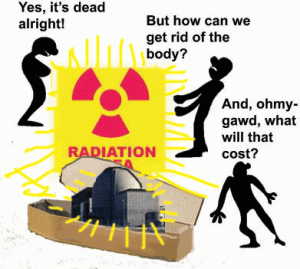
Ontario’s Unfunded Nuclear Decommissioning Liability is in the $18-$27 Billion CAD Range
https://tinyurl.com/5a9du4mz Editorial Team, August 6 2021 Late last year I worked up the likely amount of public money that would have to be thrown at the nuclear industry in order to successfully and safely decommission the 100 operational reactors and the now shut down ones. Unsurprisingly, the nuclear industry had been very optimistic in its estimates of decommissioning costs and timeframes, when the global empirical averages were trending to a billion USD and 100 years per reactor.
Recently I was asked by an Ontario journalist what I thought the likely situation in Ontario would be, and whether the decommissioning trusts were equally underfunded. I was unsurprised to find that Canada is in the same boat as the US, with highly optimistic schedule and cost projections which belie Canadian empirical experience with the CANDU reactor, and that the fund had nowhere near the money necessary for the job. Let’s run the numbers. [diagram on original]
Ontario Power Generation (OPG) is the chunk of the provincial utility that was carved apart in the late 1990s by the Mike Harris Conservatives to handle generation alone. It operates 18 aging CANDU reactors across three sites: Bruce, Pickering, and Darlington.
Table of operational nuclear generation reactors in Ontario
OPG has a nuclear decommissioning fund of about $5 billion CAD or US$4 billion right now. If the experience of other countries on the actual cost of a billion USD per reactor and an actual timeline of decommissioning of a century holds true, and I see no reason why it doesn’t, that means that there is currently a $17.5 billion CAD gap in Ontario, in addition to the existing $19.3 billion CAD in debt still being serviced from their construction. When the government of the era split up the utility, it moved all of the debt off of the components and into general debt. One of the many appropriate and sensible things that the McGuinty Administration did in the 2000s, in addition to shutting down coal generation entirely, was to move the debt back into the utility and set about servicing it from utility bills.
Most of the reactors at Bruce Nuclear are aging out, with several over 40 years old and the remainder approaching 40. Darlington’s are around 30, so they have a bit of runway. Pickering’s reactors are going to be shut down in 2024 and 2025 and start decommissioning in 2028. While refurbishment could bridge Ontario’s for another 20 years in many cases, that’s expensive and typically won’t pass any economic viability assessment compared to alternatives.
The likelihood is that all reactors in Ontario will reach end of life by 2035, and be replaced by some combination of renewable energy and HVDC transmission from neighboring jurisdictions, with both Manitoba and Quebec having excellent, low-carbon hydroelectric to spare.
Does the empirical experience of shutting down CANDU reactors track to the roughly billion USD that’s seen for other reactors? According to the World Nuclear Association, no.
The fourth unit is Gentilly 2, a more modern Candu 6 type, which was shut down at the end of 2012 after 30 years operation. It is being defuelled and the heavy water was to be treated over 18 months to mid-2014. A decommissioning licence was issued for 2016 to 2026 and the main part of the reactor will be closed up and left for 40 years to allow radioactivity to decay before demolition. All 27,000 fuel bundles are expected to be in dry storage (Macstor) by 2020. The decommissioning cost is put at C$ 1.8 billion over 50 years.”
That translates to US$1.44 billion, so it would appear as if CANDUs are on the expensive side to decommission. If that holds true, Ontario’s gap is actually in the range of $27 billion CAD.
Nuclear decommissioning funding comes from reactors operating revenue. In the US, it’s 0.01 to 0.02 cents per kWh as a set aside. I wasn’t able to find the required set aside for Ontario’s fleet, but obviously they aren’t setting aside sufficient funds now, or have absurdly optimistic fund growth expectations. They only have a decade to set aside more money from operating reactors, and have only set aside $5 billion CAD after 50 years, so the most generous assumption is that they will set aside perhaps $7 billion CAD in the OPG fund by end of life of the reactors, and have a liability for decommissioning of $15.5 to $27 billion CAD. For the next step, let’s assume $20 billion CAD for the sake of round numbers.
Given the likelihood of all of Ontario’s reactors being off of the grid by 2035, with major decommissioning occurring every few years until then, the kWh generated by Ontario’s nuclear fleet from now through 2060 will be in the range of about 1000 TWh assuming there are no lengthy outages at any of the plants, which to be clear is an awful lot of low carbon electricity.
However, $20 billion is a big number too. It turns into about 19 cents per kWh if you only count electricity generated from today through end of life for the reactors. It’s obviously a lot lower if you calculated from beginning of the lifetime of the reactors. However you count it though, that’s only the unfunded Ontario liability, and it’s on top of subsidized security costs Canada and Ontario and municipalities bear, and it’s on top of the outstanding $19.3 billion in debt that has only been receiving servicing on the interest since the McGuinty government brought it back into the utility. It’s likely that the majority of that debt will be outstanding in 2035 still, as it has gone from $20 billion to $19.3 billion in the last 11 years, so expecting it to be gone by 2035 is not realistic.
So yes, Ontario’s nuclear program will be a fiscal burden on Ontarians to the tune of around $40 billion CAD which will be spent through roughly 2135, finally being paid off by the great-grandchildren of babies born in 2021.
Nuclear, the gift that keeps on giving.
This article was originally published by Cleantechnica.com.
Read the original article here.
With its reprocessing plant in La Hague, France has the highest radioactive discharges at sea in Europe.

With its reprocessing plant in La Hague, France has the highest radioactive discharges at sea in Europe. And these discharges are not decreasing, despite the commitments made in 1998, in Sintra, Portugal, by
the Member States of the OSPAR Convention for the protection of the North-East Atlantic.
But the results of the citizen surveillance ofradioactivity in the environment carried out by ACRO for more than 25years, show that the account is not there: the discharges from the Orano reprocessing plant in La Hague are visible. all along the Channel coast and, in the summer of 2021, they could still be detected as far as the Danish border.
The association therefore urges France to respect its international commitments by significantly reducing its radioactive discharges at sea. It will, for its part, maintain its vigilance.
ACRO 29th Sept 2021
High rates of cancer and deaths among former nuclear workers at Ile-Longue nuclear submarine base.
Brest. A study points to the prevalence of cancer among former workers at
the Ile-Longue nuclear base. A sociologist from the University of Brest has
just completed a study on the former pyrotechnicians of Ile-Longue. From
1972 to 1996, these state workers assembled the warheads of nuclear
missiles “without any protection”. A quarter of them died early.
France Info 30th Sept 2021
Global nuclear agencies get together to launch the big propaganda show ”Group of Vienna” ahead of COP26
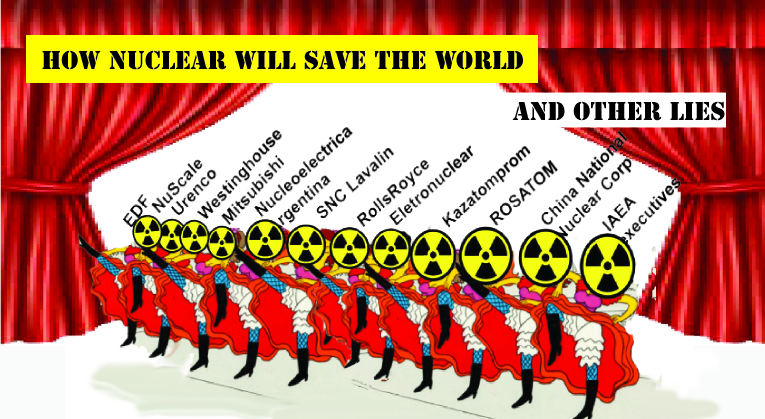
Global nuclear leaders unite in Vienna to create group for future advocacy of industry Power Engineering, 1 Oct 21, The heads of the International Atomic Energy Agency and more than a dozen industry leading firms are going to work more closely together on promoting the role of nuclear technology in dealing with major global challenges.
Those challenges include climate change, disease, hunger and more. Lofty goals, for certain, but the newly formed Group of Vienna believe that their industry is key to helping solve pressing issues worldwide.
IAEA Director General Rafael Mariano Grossi helped guide formation of the so-called Group of Vienna, which includes his agency’s chief executives and top leaders from 13 companies and utilizes in U.S., China, Russia, South America and Europe. They met in Vienna during the latest IAEA general conference……..
In addition to IAEA executives, the Group of Vienna includes founding members from China National Nuclear Corp., EDF, Eletronuclear, NA Kazatomprom, Mitsubishi Heavy Industries, Nucleoelectrica Argentina, NuScale Power, Rolls Royce SMR, ROSATOM, SNC-Lavalin Group, Urenco and Westinghouse Electric Co.
The high-level panel resolves to meet regulatory to discuss the latest developments in the nuclear field and how those contributions can factor into global challenges…..
New-build projects are extremely expensive to complete, such as the $27 billion Vogtle Unit 3-4 expansion in Georgia and the Hinkley Point C in the UK. https://www.power-eng.com/nuclear/global-nuclear-leaders-unite-in-vienna-to-create-group-for-future-advocacy-of-industry/
Russia confirms that ”Nuclear is Green”- George Orwell would be fascinated.
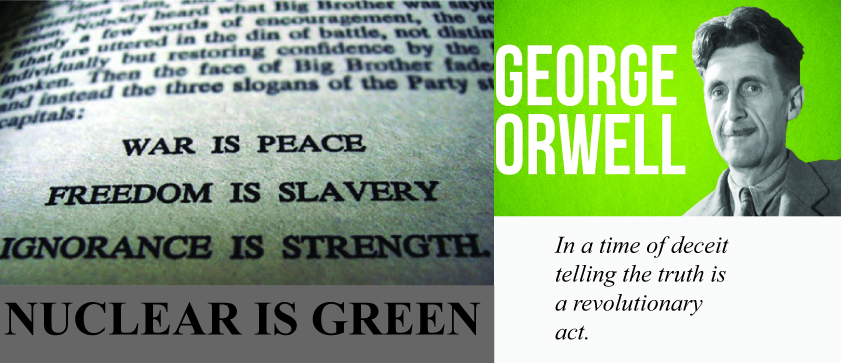
Russia confirms nuclear as green while EU remains undecided NEI, 30 September 2021 The assignment of the status of a “green” energy source to nuclear power generation in the Russian Federation should be a signal for other countries considering the inclusion of nuclear energy in their “green” lists, Rosatom Director General Alexei Likhachev said on 27 September. The previous week, Russian Prime Minister Mikhail Mishustin had approved the criteria for the selection of “green” projects and initiatives in the field of sustainable development for concessional financing.
Among the “green” areas of energy, nuclear energy is separately designated……….
The approval of the Russian“ green ”taxonomy is an important step within the framework of the national climate and environmental agenda, an incentive for the development of green industries and projects,” Likhachev noted. He added that the taxonomy officially established the status of nuclear energy as a “green” source, along with solar, wind and geothermal energy.
“This confirms the effectiveness of nuclear power plants in combating climate change and opens up access to green financing instruments. We hope that the Russian taxonomy will become a signal for foreign countries considering the issue of including nuclear energy in their green lists, he stressed.
Meanwhile, the European Union (EU) has pushed back the deadline for objections to proposed rules for green investments, allowing an additional two months to scrutinise the policy. EU countries will now have until early December, instead of October, to scrutinise these rules………
The Commission is due to publish a second proposal in the coming months, confirming whether the taxonomy will label investments in nuclear and gas as green………… Countries such as France and Hungary are strong supporters of nuclear power, and say investments the low-carbon energy source should be encouraged to fight climate change. Others, including Austria and Luxembourg, are strongly opposed. One EU official said the analysis suggested Austria may consider legal action if the EU included nuclear in the taxonomy, Reuters reported…….. https://www.neimagazine.com/news/newsrussia-confirms-nuclear-as-green-while-eu-remains-undecided-9120845
Entergy faces federal fine for violations at its nuclear power plant near St Francisville
 |
Entergy faces federal fine for violations at its nuclear power plant near St. Francisville, BY KRISTEN MOSBRUCKER | STAFF WRITER
The Nuclear Regulatory Commission is proposing a $150,000 fine against Entergy for three violations related to its River Bend Nuclear Station near St. Francisville.
The federal agency found there was an issue with an exam proctor falsifying a test and submitting it, an operator skimped on safety checks at the plant’s control building and a senior reactor operator gave an unauthorized employee an access key to a room with cybersecurity-related equipment inside.
The violations at the nuclear power plant occurred between 2018 and 2020, according to the commission’s report. ……………….. https://www.theadvocate.com/baton_rouge/news/business/article_e35480aa-22dc-11ec-a3fc-c75f751ef8a3.html
China supports North Korea’s call to revise sanctions, return to nuclear talks
China backs North Korean call to revise sanctions to revive nuclear talks SCMP, 2 Oct 21,
Instead of empty slogans, US should restart UN resolutions and ‘revise sanctions related to humanitarian aspects’, Beijing says
Denuclearisation talks stalled in 2019 and Pyongyang has resumed its missile tests
China has backed North Korea’s calls for the US to revise its sanctions to break the stalemate in denuclearisation talks.
Pyongyang resumed its missile tests last month after a six-month lull, the latest being a new hypersonic missile fired on Tuesday. It first fired a
nuclear-capable cruise missile on September 12, then followed up with two railway-borne ballistic missiles days later – in breach of UN Security Council resolutions.
Although the Chinese foreign ministry has continued to urge restraint from all parties in response to Pyongyang, spokeswoman Hua Chunying also called for North Korea’s “justified and reasonable concerns” to be taken seriously and addressed.
“The US should not fall back on empty slogans calling for dialogue, but should demonstrate sincerity and come up with a realistic dialogue proposal, restart the reversible UN resolutions at the Security Council, and revise sanctions that are related to humanitarian aspects,” Hua said on Thursday……………… https://www.scmp.com/news/china/diplomacy/article/3150921/china-backs-north-korean-call-revise-sanctions-revive-nuclear
Hungary’s nuclear watchdog withholds permits for two new reactors
Hungary watchdog withholds nuclear expansion permits, seeks further info, BUDAPEST, Oct 1 (Reuters) – Hungary’s nuclear watchdog withheld permits for two new reactors at the Paks nuclear power plant pending additional information from the Russia-led project’s managers, further hampering a planned expansion beset by years of delays………………………
Hungary has amended its nuclear safety protocols to allow some work to begin before the entire expansion – initially planned to start in 2018 and with the first bloc set for completion in 2025 – got the regulatory nod.
It was unclear how much more the latest setback could delay construction of a project still in its preliminary stages and on which Russia this year agreed to delay payments for five years. https://www.reuters.com/business/energy/hungary-watchdog-withholds-nuclear-expansion-permits-seeks-further-info-2021-10-01/
Elon Musk , world’s richest man, pays no tax, likes nuclear power

A flippant Elon Musk takes shots at Biden, the SEC and anti-nuclear sentiment , SEP 29 2021 Lora Kolodny Kolodny@lorakolodny
- At an appearance Tuesday at the Code Conference in Beverly Hills, California, Elon Musk criticized Joe Biden for not inviting Tesla to a White House summit on electric vehicles.
- He also poked at the SEC and explained his point of view on taxation practices.
- In addition, he said he didn’t quite understand why renewable energy supporters are against nuclear power.
- SpaceX and Tesla CEO Elon Musk criticized President Joe Biden on Tuesday, deeming his administration “biased” against Tesla and saying it appears to be “controlled” by unions during a speech on stage at the Code Conference in Beverly Hills, California.Musk, in his typically irreverent form, also repeated several of his prior taunts against federal financial regulators at the Securities and Exchange Commission, reiterated his support for cryptocurrency and nuclear energy, and said he is optimistic about Tesla and tech in China despite recent antitrust and cryptocurrency crackdowns there
…………….On taxes. Swisher asked Musk — who is currently the wealthiest person in the world, according to Bloomberg — to respond to criticism that while his companies have received a good deal of government contracts and subsidies, the CEO has avoided paying some taxes personally in the U.S. through creative, if legal, accounting practices.
In June, the investigative news site ProPublica reported on Musk’s tax bill as part of a massive analysis of billionaires’ finances. They found that Musk’s income tax bill amounted to zero in 2018.
- Musk insulted ProPublica’s reporting, calling it “tricky” and “misleading.”Then he said that the number was so low because he does not draw a salary, so his cash compensation is basically zero. Musk borrows money against stock options that vest over time instead.As he has amassed more and more shares in Tesla and SpaceX, he said, he has “not really bothered” to take money off the table by selling a stake……….
- When asked for comment by CNBC, ProPublica responded with the following statement from Editor-in-Chief Stephen Engelberg:
“Elon Musk’s remarks confirm the accuracy of our reporting, which disclosed that he paid no federal income taxes in 2018. As we pointed out in our story, Musk has supported his lifestyle by borrowing money against his stockholdings, a textbook example of the strategy known as ‘buy, borrow and die.’ We noted in our story that his tax payments to the government in recent years were a tiny portion of his multi-billion dollar gains in wealth.”………….
In 2018, the SEC sued Tesla and Musk for securities fraud after the CEO wrote on Twitter that he was considering taking Tesla private for $420 per share and had funding secured.They ultimately settled that lawsuit, with Musk and Tesla each paying a $20 million fine to the feds and Musk relinquishing his role as chairman of the board at Tesla. Musk also agreed to have his tweets reviewed by a compliance officer at Tesla before he posts them if they contain any material company information.
…………….. Crypto and China
Tesla made waves in February when it revealed it had purchased about $1.5 billion worth of bitcoin. After it disclosed the holdings, the price of bitcoin skyrocketed. In May, when Musk said on Twitter that Tesla would stop accepting bitcoin as a payment for its electric cars, the price of bitcoin plummeted.
When Musk tweets an endorsement of a particular coin — as he has done with dogecoin — its price tends to increase, at least temporarily.
When Swisher asked about cryptocurrency regulation, Musk said that the SEC should back off.
“Just let it fly,” he suggested.The People’s Bank of China recently declared all cryptocurrency-related activities illegal. …………
Space and energy Swisher and Musk discussed SpaceX, its competitors, plans to expand satellite internet service Starlink, and ambitions to make humanity a “multi-planet species” at length. During the course of their SpaceX discussion, Musk took the opportunity to mock the phallic shape of Blue Origin’s rocket and berate Jeff Bezos for his aerospace company’s litigiousness.……
…. “I’m also kind of pro-nuclear. And I’m sort of surprised by the public sentiment against nuclear. https://www.cnbc.com/2021/09/29/elon-musk-takes-shots-at-biden-sec-anti-nuclear-sentiment-at-code.html
Russia wants help to clean up sunken nuclear submarines – while it invests in new ones!
Norway celebrates 25-years paying for nuclear-dump cleanup. Russia showcases new reactor weapons
Rosatom officials and Norwegian project partners are Wednesday marking that it is 25 years since the first money check was sent from Oslo to help improve infrastructure at the ill-fated Andreeva Bay dump site for spent nuclear fuel and radioactive waste accumulated from the operation of Cold War submarines. The Barents Observer ,By Thomas Nilsen September 29, 2021
”………………….. Sunken reactors
Andrey Zolotkov with ANO Bellona Murmansk says there are problems in the sphere of nuclear safety that Russia can’t deal with alone.
“This is to raise the sunken nuclear submarines,” he says.
On the seafloor of the Barents Sea, the old November class K-159 that sank in August 2003 has two reactors with spent nuclear fuel on board. The submarine lays in an area of high importance for the fisheries of both Russia, Norway and the European Union. Further east, in the Kara Sea, the submarine K-27 was dumped on purpose, along with several other submarine reactors and thousands of containers with radioactive waste.
Zolotkov fears the submarines may corrode to the worse if nothing is done.
If we constantly postpone this for later, then something may happen. The lifting operation will sooner or later become impossible because supporting structures will be destroyed as a result of corrosion.”
A key question is how eager potential donor nations would be to cash out even more money to assist in reducing the environmental risks caused by the past nuclear legacy, like the dumped reactors in the Kara Sea, as long as Russia itself gives priority to creating nuclear weapons systems beyond what the world ever has seen before.
Rearmament of the north
Russia’s rearmament of the north includes a new generation of both multi-purpose submarines and ballistic missile submarines. Currently, some 12-13 reactor-powered subs are under construction at the Sevmash yard in Severodvinsk. The new vessels will sail for both the Northern Fleet and the Pacific Fleet. Little is known about 4th generation Russian navy reactors and uranium fuel enrichment.
Maybe more frightening than the new submarines are two other reactor-powered weapons systems currently under testing and development in northern Russia: the Poseidon underwater drone and the Burevestnik cruise missile. Both are said to carry nukes and have a nearly unlimited range.
New satellite images
In late August, Google Earth updated its satellite images from above the naval yards in Severodvinsk…………………
Nenoksa accident
In August 2019, five employees from Rosatom were killed when a nuclear object was about to be raised from the seabed outside Nenoksa in the White Sea, only a few kilometers west of Severodvinsk. What exactly happened remains secret, but radiation monitors in Severodvinsk saw a spike, and locals took photos of ambulances where both the interior and the drivers were wearing protective dressed against radiation.
As reported by the Barents Observer, the explosion was most likely involving the reactor from a Burevestnik test. This autumn, Russia’s top-secret testing of the Burevestnik nuclear-powered missile is moved to Novaya Zemlya in the Arctic, an archipelago under full military control and formerly used for real nuclear weapons tests in the atmosphere and underground.
This week, a large area both on land at Novaya Zemlya and in the waters along the west coast on the Barents Sea side is closed off with NOTAM-warnings (Notice to Airmen). The size of the closed-off areas fits with a likely test launch of the nuclear-powered missile……… https://thebarentsobserver.com/en/nuclear-safety/2021/09/while-norway-celebrates-25-years-paying-cleanup-nuclear-dumpsite-russia-gives
Japan’s independent English language newsletter, analysing nuclear issues, is struggling to survive
Japan NPO on nuke power issues struggling to retain English newsletter
September 27, 2021 (Mainichi Japan TOKYO (Kyodo) — A citizens’ organization in Japan that publishes independent analysis in English on nuclear power issues is struggling financially, threatening its ability to remain the major source of specialized public information on Japan’s nuclear industry for an international audience.
The Citizens’ Nuclear Information Center based in Tokyo has published the free bimonthly English newsletter Nuke Info Tokyo since 1987 but is having to crowdfund to keep publishing amid financial difficulties caused by the coronavirus pandemic.
The nonprofit organization, which also produces a monthly newsletter in Japanese for a domestic audience, had previously financed the cost of the English publication by holding paid seminars at which it also solicited donations and sold books, as well as collecting membership fees.
But it has been unable to hold the events since early 2020 when coronavirus infections began to impact Japan, Hajime Matsukubo, CNIC secretary general, told Kyodo News.
Membership — already in decline — has also dropped further amid the pandemic and its effect on the economy, he said.
“Membership decreased by about 100 last year alone under the coronavirus outbreaks and (membership) is around 2,100 now,” Matsukubo said, admitting the decline in membership also owed to a waning of public interest in nuclear issues in recent years.
…………. Philip White, a former editor of Nuke Info Tokyo, wrote that he fielded calls around the clock from the foreign media by referring to the archived English-language articles at the time of the disaster.
“The international media was hungry for critical information to counter the sanitized version offered by the government and the nuclear industry. Our English website offered clearly referenced Nuke Info Tokyo articles,” he wrote……………
Matsukubo argues that the government and electric power companies operating nuclear plants tend to withhold information, not just when accidents occur but also in normal times.
Although the government has said the Fukushima plant is under control, it is uncertain how many more years it will take to deal with over a million tons of treated radioactive water from the plant and decommission damaged reactors.
The government continues to deem nuclear power a major energy source, although, since 2014, it has said it aims to decrease its reliance on such power.
Running the English newsletter, staffed by Stronell, four freelance translators, and an editor who is also co-director of the group, costs around 1.5 million yen ($13,700) per year. While the translators used to work voluntarily, CNIC started to pay them in 2009 — though they receive half or less than the market rate.
At this time, the newsletter, which had been printed and mailed to readers with a postage fee charged only to readers in Japan, was made available for free online. Several hundred readers regularly refer to the newsletter, among them journalists, NGO staff, and academics.
Another co-director of CNIC, Hideyuki Ban, said that researchers worldwide have quoted Nuke Info Tokyo in their work.
“Nuke Info Tokyo is the only newsletter in English that specializes in the situation of nuclear power in Japan and has covered a wide range of issues from citizens’ standpoints for decades,” Ban said.
CNIC was founded in 1975 by scientists, including the late Jinzaburo Takagi, a nuclear chemist who began his career in the nuclear industry but later voiced concerns about atomic power……..
To coincide with the policy discussion, CNIC held a virtual seminar on Friday to draw attention to the issues and help people make up their minds on the right policy for Japan.
Stronell said she hopes to run an article on the seminar given by experts in the newsletter.
“I think the most important thing is having independent experts’ information on nuclear power accidents like Fukushima and other problems to let people make decisions about their own health and future,” Stronell said. “And so for us to continue to do this, and that’s what the crowdfunding project is about, any support is very much appreciated.” https://mainichi.jp/english/articles/20210927/p2g/00m/0na/078000c
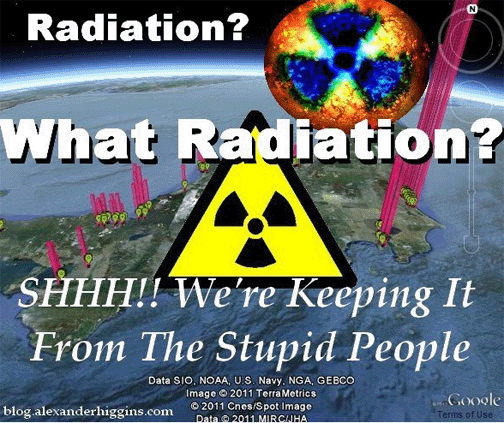
Nuclear for climate? – DON’T MENTION RADIATION! – theme for October 21.
Recommending nuclear power as a a cure for climate change is like recommending cigarette-smoking as a cure for obesity – Helen Caldicott
Well, it’s just not nice to talk about ionising radiation right now – when we’re all gearing up for the COP26 Glascow climate change talkfest . I mean, by now the nuclear lobby has probably bribed its way into the conference, along with other corporations.
You’re allowed to mention – costs , safety, even time delay – in assessing the relationship of the nuclear industry to global heating.
Strangely – you can talk about the rapid health effects of tiny invisible viruses. BUT NOT the slow drawn out effects of tiny particles of low-level ionising radiation. Health impacts of unseen dangers
Especially ignored are thg effects of Internal exposure – radioactive particles taken in by breathing or swallowing:
The dangers are probably still small for most foods, but hazards are tenfold to a hundredfold for children, infants, and fetuses, who have the fastest rates of mitosis and development. Rapidly dividing cells in the young are most sensitive in any organism. Similarly, organs with rapidly dividing cells are affected (bone marrow, digestive tract, skin). So risk avoidance is most important for the young.

Some of the list of long-term impacts for human health include the following:
- Circulatory damage (high blood pressure, rhythm disturbances, MI, stroke, cardiomyopathies, rhythm disturbances artery spasm, especially during cardiac stress such as temperature extremes, physical/emotional stress) (Bandazhevsky, 2001)
- Hematologic problems (leukemias especially)
- Endocrine problems (especially Hypothyroidism, thyroid nodules/Cancer, and Diabetes)
- Immune system
- Uro-genital system
- Musculoskeletal system
- Dental problems as cesium replaces calcium in teeth and bones
- Central nervous system and psyche
- The eye (cataracts and retinopathies)
- Increase in congenital malformations
- Increase in cancers
- Accelerated aging
- Increased frequency of mutations
- Fertility problems and Change in secondary sex ratio (Yablokov, 2012)
World Nuclear Industry Status Report 2021

The World Nuclear Industry Status Report 2021 (WNISR) was released overnight. For nearly 30 years, these reports have provided important factual antidotes to industry promotion and obfuscation. This year’s report is the work of 13 interdisciplinary experts from across the world.
Naoto Kan, Japan’s Prime Minister at the time of the Fukushima disaster, writes in the foreword: “As Prime Minister of Japan at the time of the disaster, I now believe that the time has come for Japan and the world to end its reliance on nuclear power.”
In broad terms, nuclear power has been stagnant for 30 years. WNISR notes that the world’s fleet of 415
power reactors is 23 fewer than the 2002 peak of 438, but nuclear capacity and generation have marginally increased due to uprating and larger reactors being built.
There is one big difference with the situation 30 years ago: the reactor fleet was young then, now it is old. The ageing of the reactor fleet is a huge problem for the industry (as is the ageing of the nuclear workforce ‒the silver tsunami). The average age of the world’s reactor fleet continues to rise, and by mid-2021 reached 30.9 years. The mean age of the 23 reactors shut down between 2016 and 2020 was 42.6 years. The International Atomic Energy Agency anticipates the closure of around 10 reactors or 10 gigawatts (GW) per year over the next three decades.
Reactor construction starts need to match closures just for the industry to maintain its 30-year pattern of stagnation. But construction starts have averaged only 4.8 per year over the past five years, and
there’s no indication of looming growth. Nuclear power’s contribution to global electricity supply has fallen from a peak of 17.5 percent in 1996 to 10.1 percent in 2020 (a 4.3 percent share of global commercial primary energy consumption).
Renewables reached an estimated 29 percent share of global electricity generation in 2020, a record share. Non-hydro renewables(10.7 percent in 2020) overtook nuclear in 2019 and the gap grew in 2020.
Criminality
In addition to a vast amount of energy data, WNISR includes detailed analyses of the Fukushima and Chernobyl disasters; the vulnerabilities of nuclear power to the impacts of climate change (e.g. dwindling and warming water resources, storm impacts, sea-level rise, etc.); and a chapter on nuclear decommissioning.
WNISR details the slow and unsteady progress of small modular reactors. The report notes that “so-called advanced reactors of various designs, including so-called Small Modular Reactors (SMRs), make a lot of noise in the media but their promoters have provided little evidence for any implementation scheme before a decade at the very least.”
WNISR notes that previous reports have covered irregularities, fraud, counterfeiting, corruption, and other criminal activities in the nuclear sector. This year’s report dedicates a chapter to nuclear criminality and includes 14 case studies with serious implications (safety, public governance) that came to trial in the period 2010-2020.
The report states:
“A stunning number of revelations in recent years on irregularities, fraud, counterfeiting, bribery, corruption, sabotage, theft, and other criminal activities in the nuclear industry in various countries suggest that there is a systemic issue of “criminal energy” in the sector. …
“Although not comprehensive, this analysis offers several noteworthy insights:
* Criminal activities in the nuclear sector are not new. Some major scandals date back decades or have been ongoing for decades.
* Organized crime organizations have been supplying workers to nuclear sites — e.g. the Yakuza in Japan — for over a decade.
* Serious insider sabotage has hit major nuclear countries in recent years — like a Belgian nuclear power plant — without ever leading to arrests.
There is no systematic, comprehensive, public database on the issue.
* In 2019, the IAEA released a report on cases of counterfeit or fraudulent items in at least seven countries since at least the 1990s.
* In Transparency International’s 2020 Corruption Perceptions Index about half of the 35 countries operating or constructing nuclear power plants on their territory rate under 50 out of 100.
* In the Bribery Payers Index (BPI, last published in 2011), seven out of the ten worst rated
countries operate or are building nuclear power plants on their territory.”
Author: Dr. Jim Green is the national nuclear campaigner with Friends of the Earth Australia
Renew Economy 29th Sept 2021
Greta Thunberg mocks world leaders’ words at Youth4Climate
The Swedish climate activist, Greta Thunberg, used her speech at the Youth4Climate conference in Milan to mock the words of world leaders, including UK PM Boris Johnson. The 18-year-old used soundbites from Mr Johnson, such as “expensive bunny hugging” and “build back better”, to highlight what she called the “empty words and promises” of politicians.
Later in the speech, she urged people not to give up hope, saying that change is “not only possible, but urgently necessary”. Many countries have announced ambitious targets to reduce their emissions to tackle climate change.
Analysts say some recent announcements, such as China’s statement that it would not build any more coal plants overseas and the US, EU and others pledging to cut methane emissions by 30% by 2030, are signs that progress is being made. But they caution that some major challenges remain.
The UK, for example, has pledged to cut 78% of its emissions by 2035, from a 1990 baseline. But the government’s current plans are projected to deliver less than a quarter of the cuts needed to meet the goal.
BBC 28th Sept 2021
https://www.bbc.co.uk/news/av/world-58726531
No, a nuclear-powered superyacht won’t save the world

Earth to CNN: No, a nuclear-powered superyacht won’t save the world, https://thebulletin.org/2021/09/earth-to-cnn-no-a-nuclear-powered-superyacht-wont-save-the-world/ By Dawn Stover | September 28, 2021 Who knew that a sexy nuclear superyacht could save us from climate catastrophe? That was the awesome news from CNN’s travel desk yesterday.
CNN wasn’t alone. Forbes, BBC Science Focus Magazine, and a host of other media outlets have previously hailed the world-rescuing potential of what CNN described as “an emissions-free megaship that will pit together climate scientists and the wealthy in a daring quest to save the planet.”
“Pit together” sounds like an apt description of a would-be merger between luxury tourism and climate action. You can put those two things together in a sentence, but in the real world they mix about as easily as oil and water.
And there’s another big problem with the plan for this overhyped 300-meter-long vessel and its global research: Earth 300, as the $700 million superyacht is called, will be powered by a molten salt nuclear reactor that doesn’t exist yet and won’t be certified for at least five years. The company’s website illustrates the reactor with a scale model of an experiment done in the 1960s at Oak Ridge National Laboratory.
The website also says the scientists onboard Earth 300 will have the world’s first ocean-going quantum computer. But that, too, has yet to be built.
Meanwhile, the climate crisis needs immediate attention. “We really are out of time,” UN Secretary-General António Guterres warned this month.
While they wait for a modular nuclear reactor that might never come, the developers of Earth 300 say they will use green synthetic fuels. These are liquid fuels derived from coal or natural gas in a process that captures carbon. However, they are much more expensive than fossil fuels. Aaron Olivera, the entrepreneur behind Earth 300, told CNN he plans to “eventually” retrofit the yacht with a reactor being developed by the UK company Core Power in collaboration with TerraPower, a US nuclear engineering firm chaired by Bill Gates.
Globally, there are at least 171 motorized megayachts that are 75 meters (246 feet) or more in length. Jeff Bezos, the world’s richest man, is rumored to be buying a superyacht so big that it will have a dock for its own “support yacht.” Eclipse, an even bigger superyacht owned by Russian-Israeli billionaire businessman Roman Abramovich, has its own missile defense system. The largest yacht currently operating, Azzam, is 180 meters (590 feet) long and consumes 13 metric tons of fuel per hour at its top speed of 33 knots. That’s about 0.01 miles (or a little over 50 feet) per gallon.
And the customers Olivera would like to attract—the wealthiest people in the world—also tend to have the world’s largest carbon footprints, thanks in no small part to their habit of traveling aboard superyachts and private airplanes. According to calculations by two researchers at Indiana University, a superyacht with a permanent crew and helicopter pad is “by far the worst asset to own from an environmental standpoint.”
Earth 300’s luxury suites will each rent for $300,000 a day, which presumably will cover the personnel and expenses needed to operate the ship and its 22 scientific laboratories. But construction won’t begin until 2025 at the earliest, and any groundbreaking scientific discoveries or billionaire epiphanies that could help stabilize the climate are even further into the future.
Construction is already delayed on another 600-foot-long yacht that will combine climate research with charters for paying customers. Financed by Kjell Inge Røkke, a Norwegian billionaire who made his fortune in fishing and oil drilling, REV Ocean will investigate climate change and ocean acidification, plastic pollution, and overfishing, but the nonprofit project is at least three years behind schedule.
Who will be aboard these superyachts? CNN asked Olivera which famous people he’d like to host on his future ship, and he named Elon Musk, Michelle Obama, Greta Thunberg, Naomi Klein and Yvon Chouinard. Like the superyacht itself, some of those potential guests seem more aspirational than realistic.
Greta Thunberg doesn’t take airplanes or motor yachts. Elon Musk doesn’t take vacations. And Bill Gates may be hurt that he’s not on the A-list.
1 This Month
Tell Congress: Prevent Nuclear Catastrophe in Iran

Tell Congress: Prevent Nuclear Catastrophe in Iran

Read the Public Inquiry Report, the Commissioners’ report, Surrendering Australia: The AUKUS Deception is available to download for free at aukuspublicinquiry.com. Or just watch the replay of the National Press Club Luncheon.


Shut down the radiation-damaged Heysham nuclear reactors now
To see nuclear-related stories in greater depth and intensity – go to https://nuclearinformation.wordpress.com

Say No to NASA’s Reckless Nuclear Reactor on the Moon
Say No to NASA’s Reckless Nuclear Reactor on the Moon
-
Archives
- November 2026 (238)
- October 2026 (302)
- September 2026 (339)
- August 2026 (330)
- July 2026 (355)
- June 2026 (287)
- May 2026 (306)
- April 2026 (356)
- March 2026 (251)
- February 2026 (267)
- January 2026 (308)
- December 2025 (358)
-
Categories
- 1
- 1 NUCLEAR ISSUES
- business and costs
- climate change
- culture and arts
- ENERGY
- environment
- health
- history
- indigenous issues
- Legal
- marketing of nuclear
- media
- opposition to nuclear
- PERSONAL STORIES
- politics
- politics international
- Religion and ethics
- safety
- secrets,lies and civil liberties
- spinbuster
- technology
- Uranium
- wastes
- weapons and war
- Women
- 2 WORLD
- ACTION
- AFRICA
- Atrocities
- AUSTRALIA
- Christina's notes
- Christina's themes
- culture and arts
- Events
- Fuk 2022
- Fuk 2023
- Fukushima 2017
- Fukushima 2018
- fukushima 2019
- Fukushima 2020
- Fukushima 2021
- general
- global warming
- Humour (God we need it)
- Nuclear
- RARE EARTHS
- Reference
- resources – print
- Resources -audiovicual
- Weekly Newsletter
- World
- World Nuclear
- YouTube
-
RSS
Entries RSS
Comments RSS

