The forgotten nuclear threat of North Korea
As the West remains focused on the war in Ukraine, Kim Jong Un has begun testing his most powerful missile to date. New Statesman, By Katie Stallard , 6 Apr 22, Even by the bombastic standards of North Korean propaganda, the video that accompanied Pyongyang’s missile launch on 24 March was extraordinary. The opening sequence showed Kim Jong Un, apparently channelling the late 1980s and Tom Cruise in Top Gun, striding out of a hangar in slow motion, wearing a black leather bomber jacket and dark sunglasses. Kim checked his watch……..
While the action movie-style montage was somewhat dated, the intercontinental ballistic missile (ICBM) test that followed demonstrated significant, and seriously concerning, new capabilities. The missile, which South Korea claimed was an updated version of a previous model rather than the weapon shown in the video, reached a height of more than 6,000 kilometres, 15 times higher than the International Space Station, putting the entire US mainland within range………………………
North Korea has steadily increased the pace and scale of its missile tests in recent months, launching newly developed weapons from submarines and trains, and test-firing what the regime said was its first hypersonic missile. …………………………….
“Kim has told us what he wants,” said Ankit Panda, a senior fellow in the nuclear policy programme at the Carnegie Endowment for International Peace and the author of Kim Jong Un and the Bomb. “He wants better missiles, more precise missiles, and larger missiles capable of carrying multiple warheads.” Kim has also called for the development of tactical nuclear weapons, Panda told me, and the regime is likely to carry out new nuclear tests as it experiments with smaller warheads and more compact designs. https://www.newstatesman.com/international-politics/geopolitics/2022/04/the-forgotten-nuclear-threat-of-north-korea
Chancellor Olaf Scholz reiterated Germany’s determination to close down all nuclear power stations
Scholz Shoots Down Appeal to Reverse Germany’s Nuclear Exit, Bloomberg, German Power Sources, Michael Nienaber and Arne Delfs, 6 April 2022,
Chancellor Olaf Scholz reiterated his opposition to reversing Germany’s exit from nuclear power to help cut reliance on Russian energy, saying the technical challenges would be too great.
Germany is rushing to end its heavy dependence on Russian fossil fuels following the invasion of Ukraine but the process has been complicated by the decision by former Chancellor Angela Merkel’s previous government to shut down the country’s nuclear power plants. The move was prompted by the disaster at Fukushima, Japan in 2011 and the remaining three reactors are due to go off line this year.
Does EDF really need even more subsidies for Sizewell C nuclear project?
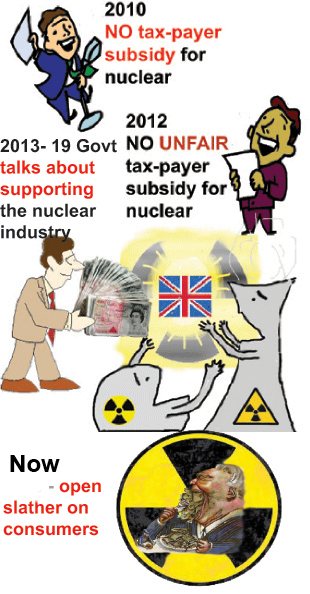
By doing so, our beloved leaders are ensuring
that Sizewell C will now have subsidised development, subsidised
construction, subsidised power production and subsidised waste management,
for a project still being run by Europe’s most subsidised company,
Electricité de France. Free markets? Don’t you believe it.
Does EDF really need even more subsidies for Sizewell C?even more subsidies for Sizewell C? Under new
legislation, our normally parsimonious government has just earmarked a
further £1.7 billion towards meeting their (uncosted) promise to ensure
that another new nuclear fission power plant may possibly begin being built
before the next election.
By doing so, our beloved leaders are ensuring
that Sizewell C will now have subsidised development, subsidised
construction, subsidised power production and subsidised waste management,
for a project still being run by Europe’s most subsidised company,
Electricité de France. Free markets? Don’t you believe it.
Electrical Review 6th April 2022 https://electricalreview.co.uk/2022/04/06/does-edf-really-need-even-more-subsidies-for-sizewell-c/
 | |||
April 6 Energy News — geoharvey

Opinion: ¶ “Who Cares About EV Fuel Efficiency? Drivers Don’t, But Investors Should” • Despite the daily disinformation from the oil industry and its enablers, driving electric is clearly cleaner than driving fossil, and if you do most of your charging at home, it’s substantially cheaper. But this doesn’t mean that the efficiency of an […]
April 6 Energy News — geoharvey
Shortening the kill chain: nuclear-capable U.S. B-52s integrate with NATO Eastern flank states — Anti-bellum
U.S. Air Forces in Europe and AfricaApril 1, 2022 BTF Bakes ACE Concepts Into Latest Round of Integrations B-52 aircraft from the 69th Expeditionary Bomb Squadron based out of RAF Fairford, England, conducted integration missions with NATO Allies from Denmark, Estonia, Lithuania, Latvia, Poland, and Czech Republic, March 31, 2022. During the most recent series […]
Shortening the kill chain: nuclear-capable U.S. B-52s integrate with NATO Eastern flank states — Anti-bellum
NATO is punishing China — Anti-bellum
B92April 5, 2022 NATO is punishing China, here’s in what way Due to the refusal to condemn the Russian operation in Ukraine, China received a warning from NATO. NATO Secretary General Jens Stoltenberg stated that the alliance will expand cooperation with partners in Asia due to China’s refusal to condemn Russia’s operation in Ukraine. Chinese […]
NATO is punishing China — Anti-bellum
Japan to match Germany’s NATO military spending level, develop first external strike ability since WWII — Anti-bellum
Kyodo NewsApril 5, 2022 Japan defense chief looks to boost defense capabilities “drastically” A meeting of foreign ministers of NATO member and allied states will take place on Wednesday and Thursday. The ministerial will gather officials of Australia, Finland, Georgia, Japan, Korea, New Zealand, Sweden and Ukraine. Japan’s defense minister said Monday his ministry will […]
Japan to match Germany’s NATO military spending level, develop first external strike ability since WWII — Anti-bellum
Today. Are we CERTAIN that these atrocities in Ukraine were done by Russian soldiers?

30 March, Russian troops leave Bucha. 31st March. Bucha Mayor Anatolii Fedoruk announces that all Russian trroops have gone from Bucha. ”A glorious day” – no mention of bodies littering the streets. New York Times was there, reported only ”dead soldiers and burned vehicles, according to witnesses, Ukrainian officials, satellite images and military analysts.”
2nd April The US and EU-funded Gorshenin Institute online [Ukrainian language] site Left Bank announced that:
‘Special forces have begun a clearing operation in the city of Bucha in the Kyiv region, which has been liberated by the Armed Forces of Ukraine. The city is being cleared from saboteurs and accomplices of Russian forces.’
Why did reports of slaughter of civilians appeared only 4 days after the Ukrainians retook the town
The AZOV battalian, known to be made up of Nazis, performed the clearing of ”saboteurs and accompliices”.
Ukraine has such a tortured history of ethnic hatreds – from Tsarist times, Napoleonic invasion, Stalinist repression, Nazi invasion……… no surprise that cruel retaliations continue.
But what is needed is indpendent investigation – not Russophobic knee-jerk propaganda.
Ukraine is ground zero for the expansion of the U.S.-Russia proxy war, (and the war industry is jubilant)

This six-week war surely has left the war industry jubilant. In Washington, Biden recently proposed what would be the largest U.S. “defense” budget in history, more than $813 billion.
The U.S. Has Its Own Agenda Against Russia Ukraine is ground zero for the expansion of the U.S.-Russia proxy war. The Intercept, Jeremy Scahill, April 2 2022 Ever since Vladimir Putin launched his invasion of Ukraine, there has been an unprecedented cohesion of messaging emanating from the U.S. government, its NATO and other European allies, and large segments of the Western media establishment. As massive quantities of weapons pour into Ukraine, there has been consistent media and political agitation for President Joe Biden and other Western leaders to “do more” or answer for why they are not further escalating the situation, including through the imposition of a no-fly zone.
The White House smells Putin’s blood in the waters of his disastrous invasion. The flow of weapons, the sweeping sanctions, and other acts of economic warfare are ultimately aimed not just at defending Ukraine and making the regime pay for the invasion in the immediate present, but also setting in motion its downfall. “For god’s sake, this man cannot remain in power,” Biden said during his recent visit to Poland. The White House sought to walk back the line and clarify that it did not constitute a change in policy but was merely an expression of the president’s righteous anger. The kerfuffle over what Biden really meant is less important than the very public actions of the U.S. and its allies.
It should not be assumed that the strategies and actions being employed by Washington and its allies in their proxy war against Moscow will always be in the best interest of Ukraine or its people. Likewise, Ukraine’s calls for military support and action from the West — however justifiable and sincere they are — may not be in the best interest of the rest of the world, particularly if they increase the likelihood of nuclear war or World War III. The desire to avoid this scenario by advocating for a negotiated solution to the war that addresses Russia’s stated concerns or its rationale for the invasion is not a capitulation to Putin and it is not appeasement. It is common sense.
While the fate of Ukraine and the lives of its civilian population are evoked in calls for more escalatory action from the West, it is these very people who will suffer and die in large numbers every day the war drags on. Western media coverage is often crafted to portray only one outcome as acceptable: a decisive Ukrainian victory, in which the government of Volodymyr Zelenskyy emerges from the horrors of the Russian invasion in complete control of all of its territory, including Crimea and the Donbas region. Ukraine, as a free and independent state, should be free to join NATO, and Russia has no legitimacy in questioning the implications of such a move. Advocacy for accepting anything short of this outcome is a victory for Russia and therefore traitorous to even consider………………
The routine belligerence exhibited by countless politicians, pundits, and media figures about taking the fight to Putin in Ukraine is largely chickenhawkery. …………
when you listen to the fine details of Ukraine’s own negotiators and leaders, it’s clear that they understand that the war does not end with the swift annihilation of Putin, the downfall of Russia, or with a clean and complete Ukrainian retention of its territorial sovereignty. That’s why Zelenskyy’s government has acknowledged that the issue of NATO membership, a formalized neutrality status, and an internationally brokered process on the status of Crimea will all be on the table.
There has been much noise about Russia’s recent indications that it was drawing down its military actions in parts of Ukraine, particularly around the capital Kyiv. The U.S. and NATO have acknowledged a partial drawdown but asserted that Russian forces appear to be repositioning, likely for use in the east. Russia has also said as much itself. Moscow’s position is that “the main goals of the first stage of the operation have generally been accomplished.”
There is a peculiar dynamic surrounding the analysis of Putin’s comments on his intentions for Ukraine. He is accused of lying when his remarks undermine the U.S. narrative, but we are told to believe he is absolutely telling the truth when his pugnacious threats bolster the U.S. position.
Whether or not Putin intended to seize all of Ukraine and become an imperial occupier, he did seem to believe his invasion could cause the Ukrainian government to collapse and its leaders to flee in fear. That did not happen. Instead, U.S. and NATO-armed Ukrainian forces outside Kyiv have fought the Russian troops ferociously and inflicted significant losses against them on the battlefield. At the same time, by opening multiple fronts, Moscow forced Ukraine to defend vital territory, including its capital. This strategy exacted a tremendous human toll on the Russian military, but it did take some heat off Russian forces in the Donbas territories in the east, which Putin has cited as his territorial priority in the operation.
But the question of Putin’s original intent — to take Kyiv or to use that threat as a strategy to spread Ukraine’s defenses thin — is now largely irrelevant except in the rhetorical battlespace focused on Russian weakness, incompetence, or failure.
The most contentious issue in the negotiations to end the war will likely have little to do with NATO membership. Zelenskyy has already conceded that to end the war Ukraine will have to drop that ambition and adopt a neutral and nonaligned status, though he does want to continue the pursuit of joining the European Union. Russia will certainly oppose any attempts for Kyiv to win a backdoor “Article 5” status that could trigger defense of Ukraine by Western powers in cases of future military actions by Moscow. Ukraine has suggested that it would also want China and Turkey to be a part of such a guarantee, not just adversaries of Russia. There are indications that the U.S. doesn’t think the proposal is viable, and Britain’s deputy prime minister bluntly stated, “Ukraine is not a NATO member,” adding, “We’re not going to engage Russia in direct military confrontation.”
Based on the reports out of the recent negotiations in Turkey, it seems that the most incendiary questions will revolve around the breakaway republics in the Donbas region. Ukraine has effectively said it wants a return to the pre-invasion status quo, which would mean erasing the Putin-recognized declarations of independence from Donetsk and Luhansk. Russia, which is currently expanding its control over the Donbas and seizing more territory, is unlikely to agree. This dynamic more than any other could delay or block any meaningful resolution and would be a central focus in a potential summit between Zelenskyy and Putin.
Once there is a brokered agreement, the flow of Western weapons into Ukraine and Russian military support for the separatists will result in a constant state of war footing for many years to come. A cloud portending more fighting and bloodshed will remain hovering over eastern Ukraine. If U.S. and other NATO troops resume their training exercises in Ukraine, as Biden has indicated they should, this means that there will always be a risk of incidents that could quickly escalate.
This six-week war surely has left the war industry jubilant. In Washington, Biden recently proposed what would be the largest U.S. “defense” budget in history, more than $813 billion. Germany and other European countries are publicly committing to buying and selling more weapons and spending more on defense. NATO is raising the prospect of expanding its permanent military presence in Europe and Washington is reasserting its political dominance over Europe on security matters.
But despite the image of global unity of cause being promoted by the U.S. and its NATO allies, several large and powerful nations, including China, India, Indonesia, and NATO member Turkey, are not marching to Washington’s drumbeat — not in the proxy-war business and not in the policy of sanctioning and vilifying Russia.
The overt war in Ukraine will have to end at the negotiating table. But the proxy war is escalating and will have consequences that extend far beyond the current battlefield. https://theintercept.com/2022/04/01/russia-ukraine-proxy-war-washington-diplomacy/
Nuclear missiles, bombs market to surge 73% by 2030, report says, industry worried that international treaties ”might hamper growth”

Nuclear missiles, bombs market to surge 73% by 2030, report says https://www.reuters.com/world/nuclear-missiles-bombs-market-surge-73-by-2030-report-2022-04-04/April 4 (Reuters) – The global market for nuclear missiles and bombs should surpass $126 billion within ten years, up nearly 73% from 2020 levels, according to a report by Allied Market Research on Monday, as Russian aggression in Ukraine spurs military spending.
The value of the market would jump 72.6% from the Portland-based research firm’s estimate of nearly $73 billion in 2020, when COVID-19 delays and reallocation of funds to support the health crisis “severely affected” the defence sector.
An increase in geopolitical conflicts and bigger military budgets would likely push the figure up at an annual compounded rate of 5.4% until 2030, the report said.
U.S. President Joe Biden last week requested a record peacetime national defence budget, which would prioritise modernizing its nuclear “triad” of ballistic missile submarines, bombers and land-based missiles. read more
The report predicted that demand for small nuclear warheads, which can be easily deployed through aircraft and land-based missiles, would fuel faster growth in these segments, although submarine-launched ballistic missiles (SLBMs) accounted for a quarter of the market in 2020.
While North America dominated more than half the global market in 2020, the report predicted the fastest growth would come from the Asia-Pacific region on initiatives by India, Pakistan and China to bolster their nuclear arsenals.
“However, international treaties and consortiums discourage nuclear testing,” the firm said in a report summary. “This hampers the market growth.”
It predicted that the rising influence of non-nuclear proliferation treaties and national efforts should increase the number of warheads in storage or awaiting dismantlement.
Active weapons, however, accounted for the “lion’s share” – more than two-thirds – of the market in 2020, it said, due to investment in nuclear arsenals and new warhead purchases.
Britain, China, France, Russia and the United States at the start of the year issued a joint statement saying there could be no winners in a nuclear war and it must be avoided
Ending Ukraine’s suffering. The decision to negotiate this is up to Ukraine, not USA
|
Putin, The Nuclear Threat, And Ending The War: To Squeeze Or Not To Squeeze? Michael Krepon, Forbes, 4 Apr 22,
To squeeze or not to squeeze. That is the question that tries analytically minded souls…………..
………..The majority view among the punditocracy counsels a negotiated settlement. One concern is that if Putin feels cornered, he could do something everyone will regret — like using a nuclear detonation in war. Even if he doesn’t, the longer this war lasts, the more Ukrainian city blocks will be reduced to rubble.
………….most analysts argue that we ought to give Putin a face-saving exit, which means conceding Ukrainian territory to Russia. How much territory to concede would be a hard issue in any negotiated settlement.
………. the deciding vote on the question of to squeeze or not to squeeze belongs to the government and people of Ukraine. It’s their land, their casualty counts, and their cities. NATO is obliged to take its cues from Volodymyr Zelensky. https://www.forbes.com/sites/michaelkrepon/2022/04/04/putin-the-nuclear-threat-and-ending-the-war-to-squeeze-or-not-to-squeeze/?sh=51ec25776109
Elon Musk joins the frenzy for small nuclear reactors in Wales, despite local opposition to nuclear development.

A company backed by investor in Elon Musk’s businesses is the latest to
say that it wants to build a nuclear power plant in Wales. Last Energy is
now the third company that wants to build nuclear power plants in Wales,
having settled on a not yet named site within the country.
They would join a Rolls-Royce led consortium who have mooted Wylfa on Anglesey and
Trawsfynydd in Gwynedd as the locations of new modular reactors. US nuclear
company Westinghouse have also put together a consortium with construction
group Bechtel to revive plans for two nuclear reactors at Wylfa since
Hitachi, a Japanese conglomerate, abandoned their own plans in 2019.
According to the Sunday Telegraph, Last Energy’s plans are very similar
to those of Rolls-Royce. They want to build a first “mini-nuclear”
power plant in Wales by 2025, as part of a plan to spend £1.4bn on 10
reactors by the end of the decade. Elon Musk, who is the world’s richest
person with assets worth an estimated £220bn, said on Twitter last month
that he was keen on investing in nuclear energy.
More nuclear power at Wylfa is not without its critics with campaign groups CADNO and PAWB among
the local opposition. Writing for Nation.Cymru, Dylan Morgan of PAWB
(People Against Wylfa B) warned that “nuclear power is a dirty, outdated,
dangerous, vastly expensive technology which threatens both human and
environmental health”. “It would also steal much-needed resources from
renewable technologies which are cheaper, much quicker to build and more
effective to combat the effects of climate change.”
Plaid Cymru leader Adam Price, whose party currently controls Anglesey Council, also spoke out
against nuclear power last week, calling it “the wrong answer” to
Wales’ energy needs. “We do not support nuclear power. It’s the wrong
answer. Renewables absolutely is the way to go. And I fear that, you know,
nuclear power, very expensive and unnecessary distraction,” he said.
The U.S. Must Take Responsibility for Nuclear Fallout in the Marshall Islands

One conclusion from our work is clear: absent a renewed effort to clean radiation from Bikini, it does not seem likely that people forced from their homes will be able to safely return until the radiation naturally diminishes. This is a process that could take decades if not thousands of years.
The U.S. Must Take Responsibility for Nuclear Fallout in the Marshall Islands, Congress needs to fund independent research on radioactive contamination and how to clean it up https://www.scientificamerican.com/article/the-u-s-must-take-responsibility-for-nuclear-fallout-in-the-marshall-islands/, By Hart Rapaport, Ivana Nikolić Hughes on April 4, 2022
In many ways, Russia’s aggression against Ukraine has resurfaced our global nuclear history. Fighting continues near nuclear power plants, including Chernobyl, the site of one of the largest nuclear energy accidents in history, invoking fear of their accidental or intentional weaponization. Russia’s placement of its nuclear weapon arsenal on high alert has unearthed anxieties and memories of the Cold War.
As governments across the world consider their own roles in lessening the risk of nuclear war, the United States cannot excuse itself. We can (and should) talk about stemming a future nuclear impact, but equally important is reckoning with our past. Not only is this reckoning a stark reminder of the dangers of nuclear weapons, but it is also a matter of justice.
Between 1946 and 1958, the U.S. nuclear testing program drenched the Marshall Islands with enough nuclear firepower to equal the energy yield of 7,000 Hiroshima bombs. Cancer rates have doubled in some places, displaced people have waited decades to return to their homes, and radiation still plagues the land and waters of this Pacific-island nation.
The U.S. must prioritize the restoration of these islands and the resettlement of its people as a matter of human rights and environmental justice. We are among the few independent researchers who have studied the radiological conditions on these islands. We call on our government to commit to the kind of research program that will help to uncover the full scope of the existing contamination and how best to mitigate it. What the U.S. has done so far is simply not enough, especially as the Marshall Islands are still a close American ally. We owe them that much.
The weapons tests most gravely affected four atolls in the north of the nation: Bikini, Enewetak, Rongelap and Utirik. Testing imposed substantial radiation on these islands, endangering human and other life. In the first two cases, members of the U.S. military resettled communities prior to testing that took place on those atolls, while people on Rongelap and Utirik left after fallout from tests conducted on Bikini, such as the infamous Bravo test, reached them. Today, only Enewetak and Utirik have substantial permanent populations (even while radioactivity remains close at hand for Enewetak residents), while refugees from Bikini and Rongelap, scattered across Majuro, Kili and other islands, in addition to the U.S., have waited for decades to return to their homes.

But the nuclear story of the Marshall Islands is not just one of bygone actions. If the U.S. doesn’t better manage this situation, we could have another radioactive incident on our hands. The structural integrity of the Runit Dome, a concrete shell covering over 100,000 cubic yards of nuclear waste on an island of Enewetak Atoll, is at risk because of rising sea levels. Leakage from the dome—already occurring—is likely to increase and higher tides threaten to break the structure open in the coming decades.
To better understand the effect of nuclear testing on the islands, scientists from the Department of Energy have conducted a wide range of studies, most often on environmental contamination. Members of the military have taken action based on these findings, most notably cleaning up parts of Enewetak Atoll. However, we believe that the DOE’s work has missed critical pieces of the puzzle. For example, its scientists have consistently relied upon simulations rather than direct values of background gamma radiation, the simplest of the measurements one can make. Such a failure has contributed to the mistrust by the Marshallese towards the DOE and its findings, which was borne out of the fact that it was the department’s predecessor, the Atomic Energy Commission, that harmed them in the first place.
We are a member (Rapaport) and the director (Nikolić Hughes) of Columbia University’s K=1 Project, Center for Nuclear Studies. For several years now, our group has gone to the Marshall Islands to research the fallout of this nuclear testing. We have published our findings to ensure that independent, reliable information exists to advise Marshallese communities and leaders so that they can help chart a path forward.
Considerable contamination remains. On islands such as Bikini, the average background gamma radiation is double the maximum value stipulated by an agreement between the governments of the Marshall Islands and United States. This is even without taking into account other pathways that could lead to radiation exposure for the Marshallese. Moreover, our findings, based on gathered data, run contrary to the DOE’s, which rely on simulations that predict far lower radiation levels.
One conclusion from our work is clear: absent a renewed effort to clean radiation from Bikini, it does not seem likely that people forced from their homes will be able to safely return until the radiation naturally diminishes. This is a process that could take decades if not thousands of years. For Rongelap, further research is needed to understand the large amount of background gamma radiation on one of the northern islands, called Naen, as well as the presence of plutonium isotopes in the soil. Although Rongelap was not used as a testing site, it may be that cleanup efforts will be needed there as well, given its proximity to the detonations.

But, beyond plutonium and uranium, what other radioisotopes are at play here? One is strontium-90, which can cause cancer in bones and bone marrow, as well as leukemia. It has long been a source of health concerns at other sites of nuclear disasters like Chernobyl and Fukushima. Despite international research interest, U.S. government scientists have largely ignored the effects of strontium-90 in the Marshall Islands. The DOE’s recent report to Congress, for example, mentioned strontium-90 only once. Their recently published data are similarly lacking in an examination of this dangerous nuclear isotope.
In a recent study, we tested sediment from two bomb craters in the northern Marshall Islands, and found consistently high values of strontium-90. Though the presence of this radioisotope in sediment does not neatly translate into contamination in soil or food, the finding does suggest the possibility of danger to ecosystems and people.
The scientific community needs to reexamine the general dismissal of strontium-90, given our findings. More than that, we need a full picture of the extant contamination on these islands, which will require categorical, regularly updated surveys beyond those that have been conducted by the U.S. government. A full understanding of potential dangers to humans, plants and animals would be a first step toward alleviating health impacts and resettling people following appropriate measures.
Unfortunately, a commitment from the United States to both ends of this equation—research and action—does not exist. We call on the federal government to do what it did in the 1970s in Enewetak Atoll. This atoll, home to hundreds of people, was where scientists first tested the hydrogen bomb in 1952. The U.S.-led cleanup was successful; contamination levels in parts of the atoll are now largely below international health guidelines.
Similar success is possible elsewhere in the Marshall Islands. Here’s a playbook for how this could happen. Congress should appropriate funds, and a research agency should initiate a call for proposals to fund independent research (through an agency like the NSF) with three aims:
(1) to further understand the current radiological conditions on Enewetak, Rongelap and elsewhere;
(2) to explore innovations for future cleanup activity on Bikini and possibly elsewhere; researchers and policy makers should look to other nuclear cleanups for methods and technologies that could be employed in the Marshall Islands;
(3) to train Marshallese scientists, such as those working with the nation’s National Nuclear Commission. This point is particularly critical in rebuilding the trust in science and scientists that the U.S. lost in conducting the testing in the first place.
On top of that, we need to modernize cleanup protocols first written in the 1970s to take into consideration the complexity of the radioactive waste involved and the enormous progress in technology developments that has been achieved some 50 years later.
Wherever nuclear weapons have been used, lives were irrevocably altered. By using the collective work of dozens of researchers, rather than a small group of scientists from the DOE, the world will benefit. Given that other countries engaged in nuclear testing—whether in other Pacific islands or elsewhere—what the U.S. learns about the Marshall Islands can inform remediation efforts the world over. The Marshallese people and other affected communities have been telling us for decades just how dangerous nuclear weapons are. Let’s acknowledge and address their sacrifices and heed their warning before it is too late.
Hart Rapaport is a researcher at Columbia University’s K=1 Project, Center for Nuclear Studies.
Ivana Nikolić Hughes is a senior lecturer in chemistry at Columbia University and the director of Frontiers of Science, a required course for Columbia College students. Ivana is also the director of the K=1 Project, Center for Nuclear Studies.
Pundits Who Advocate Hot War With Russia Are Enemies Of Humanity
Caitlin Johnstone 5 Apr 22,
In an appearance on the MSNBC show Velshi, The Modern War Institute’s John Spencer explicitly advocated direct US military conflict with Russia due to allegations of war crimes in the Ukrainian city of Bucha.
“I’m ready to commit at this moment — unlike I was before this day — to put people in direct contact with Russia, to stop Russia,” Spencer said. “Call it peacekeeping. Call it what you will. We have to do more than provide weapons. And by ‘we,’ I mean the United States. Yes, we’ll do it as a coalition with lots of other people, but we are the example. So put boots on the ground, send weapons directly at Russia.”
Notice the bizarre verbal gymnastics being used by Spencer to obfuscate the fact that he is advocating a hot war with a nuclear superpower: “put people in direct contact with Russia,” “send weapons directly at Russia”. Who talks like that? He’s calling for the US military to fire upon the Russian military, he’s just saying it really weird.
To be clear this isn’t just some arms industry-funded think tanker saying this; The Modern War Institute is part of the Department of Military Instruction for the United States Military Academy, which is operated directly by the Pentagon.
Asked by the show’s host Ali Velshi what he thought of warnings that direct military confrontation with Russia could lead to nuclear war, Spencer said, “It is a huge risk, I understand that. But today is different.
Velshi himself was much more to the point than his guest, both online and on social media……………………
“The turning point for the west and NATO will come when the sun rises over Kyiv on Sunday, and the war crimes against civilian non-combatants becomes visible to all,” Velshi said on Twitter over the weekend. “There is no more time for prevarication. If ‘never again’ means anything, then this is the time to act.”
Asked what specifically he meant by this, Velshi clarified that he was advocating “Direct military involvement.”………………………
he argued that going to war with Russia for Ukraine would not necessarily lead to nuclear war, claiming that “A no fly zone is not so different from the endless supply of weaponry the west is sending in to Ukraine.”
These are not sane or acceptable things for mainstream pundits to be telling people. Directly attacking the Russian military would indeed risk unleashing a chain of rapid escalations that could easily lead to full-scale nuclear war; there would be far too many small, moving parts for this to be anywhere remotely close to predictable or controllable. A no-fly zone over Ukraine would immediately put NATO powers in direct hot war with Russia, which is in fact completely different from shipping weapons to Ukrainian forces.
The fact that a nuclear superpower cannot be regarded in the same way as a nation without nukes has been basic, common sense orthodoxy for all major powers since Stalin got the bomb. This is not some kind of advanced esoteric understanding that you can only grasp if you’ve been studying this stuff for years; as far as I know children are still learning about the history of nuclear weapons and Mutually Assured Destruction in grade school. This isn’t something you should have to explain to grown adults, much less influential mainstream news media pundits.
But it’s becoming more and more common. The line that we’re already in World War 3 and need to begin acting accordingly is showing up more and more often. The idea that NATO powers might be able to get away with attacking the Russian military in Ukraine without sparking a nuclear exchange is fast becoming its own genre of western foreign policy punditry, and that trend looks to accelerate with the latest (arguably pretty dubious) claims of Russian atrocities in this war…………………………………
There’s also the galling White House press conferences in which ambitious reporters aggressively demand to know why the Biden administration isn’t doing more to escalate against Russia, as clear an illustration as you could ask for of the fact that the mainstream press are only allowed to be pushy and confrontational with US government officials when they’re demanding more bloodshed.
As we’ve discussed previously, even if these increasingly loud calls for hot war between nuclear superpowers don’t immediately succeed, what they do is push the Overton window of mainstream discourse all the way over toward the most warmongering extreme possible so that calls for more escalation seem moderate and calls for de-escalation look like extremist apologia for Vladimir Putin. In the very best-case scenario they leave people far more open to consenting to far more nuclear brinkmanship than any thinking person should ever consent to.
This is not okay. It is not okay for them to do this to us. It is not okay for them to normalize the idea of escalations that could easily end humankind. That is the most insane position that any person could possibly take. More insane than Nazism, or any other extremist ideology you could think of. Supporting actions that may lead to human extinction makes these people enemies of our entire species…………. https://caitlinjohnstone.substack.com/p/pundits-who-advocate-hot-war-with?token=eyJ1c2VyX2lkIjoyNTU2MjE3LCJwb3N0X2lkIjo1MTU3MjA2MywiXyI6IllKbC9qIiwiaWF0IjoxNjQ5MTA1NDE2LCJleHAiOjE2NDkxMDkwMTYsImlzcyI6InB1Yi04MjEyNCIsInN1YiI6InBvc3QtcmVhY3Rpb24ifQ.bmuRTEDt-AbWExPCsWYbp8vbEPSNoa6Jc3OVyw-4qL4&s=r
Ukraine planning to resume control of Chernobyl nuclear site, as Russians withdraw
The International Atomic Energy Agency (IAEA) has been notified by Ukraine
that it is examining the possibility to resume regulatory control of the
Chornobyl Nuclear Power Plant (NPP), after the withdrawal of the Russian
military from the site.
Ukraine also informed IAEA that it is also planning
to rotate staff members at the Chornobyl NPP but did not specify any date.
Last week, Ukraine told IAEA: “Russian forces were leaving the Chornobyl
NPP after controlling the site for five weeks.
The withdrawal was confirmed
by senior Russian officials at a meeting with Director General Grossi in
the Russian city of Kaliningrad on Friday morning. “Ukraine later told
the IAEA that while all Russian forces had left the NPP site, the situation
in the Exclusion Zone around the plant was unclear.
Power Technology 4th April 2022
1 This Month
Tell Congress: Prevent Nuclear Catastrophe in Iran

Tell Congress: Prevent Nuclear Catastrophe in Iran

Read the Public Inquiry Report, the Commissioners’ report, Surrendering Australia: The AUKUS Deception is available to download for free at aukuspublicinquiry.com. Or just watch the replay of the National Press Club Luncheon.


Shut down the radiation-damaged Heysham nuclear reactors now
To see nuclear-related stories in greater depth and intensity – go to https://nuclearinformation.wordpress.com

Say No to NASA’s Reckless Nuclear Reactor on the Moon
Say No to NASA’s Reckless Nuclear Reactor on the Moon
-
Archives
- November 2026 (224)
- October 2026 (302)
- September 2026 (339)
- August 2026 (330)
- July 2026 (355)
- June 2026 (287)
- May 2026 (306)
- April 2026 (356)
- March 2026 (251)
- February 2026 (267)
- January 2026 (308)
- December 2025 (358)
-
Categories
- 1
- 1 NUCLEAR ISSUES
- business and costs
- climate change
- culture and arts
- ENERGY
- environment
- health
- history
- indigenous issues
- Legal
- marketing of nuclear
- media
- opposition to nuclear
- PERSONAL STORIES
- politics
- politics international
- Religion and ethics
- safety
- secrets,lies and civil liberties
- spinbuster
- technology
- Uranium
- wastes
- weapons and war
- Women
- 2 WORLD
- ACTION
- AFRICA
- Atrocities
- AUSTRALIA
- Christina's notes
- Christina's themes
- culture and arts
- Events
- Fuk 2022
- Fuk 2023
- Fukushima 2017
- Fukushima 2018
- fukushima 2019
- Fukushima 2020
- Fukushima 2021
- general
- global warming
- Humour (God we need it)
- Nuclear
- RARE EARTHS
- Reference
- resources – print
- Resources -audiovicual
- Weekly Newsletter
- World
- World Nuclear
- YouTube
-
RSS
Entries RSS
Comments RSS

