Is a long, bloody war between Russia and Ukraine really in our national interest?

https://www.thenation.com/article/world/ukraine-us-nuclear-war/ By David Bromwich, 22 Apr 22
Russia invaded Ukraine in violation of international law, and now we stand on a precipice. Advocates of war are saying that World War III has already begun, and the United States should therefore plunge in. How can they say that? People may finally hurl themselves into an abyss from the sheer terror of falling.
I learned something about this mood from a retired Foreign Service veteran. On October 27, 1962, he was sitting in the next room, listening on an intercom with second-echelon State Department officials while President Kennedy and his advisers discussed the appropriate response to Russian missiles in Cuba. As we now know, Kennedy barely held off an almost unanimous recommendation to bomb. What my informant vividly recalled was the mood of decision. They all recognized that a nuclear war would be a catastrophe of unimaginable dimensions; but at a certain point, the momentum seemed irresistible. “I thought to myself,” he said, “OK, let’s just do this.”
That state of mind—of blank acceptance (because they had already come so far)—“lasted,” he continued, “for about 20 minutes. Then, somehow, I came to my senses. But I’ve thought of that moment ever since. I was willing to ‘live with’ the end of the world. It showed me what we are capable of—what I was capable of.”
Joe Biden has long been a man given to sentimental avowals and reckless denunciations. He was indulged for half a century; the slips were easily exposed and of no large consequence. His rhetorical effervescence took on a graver aspect in mid and late March, when he called Vladimir Putin a war criminal, broke with the US renunciation of chemical weapons by saying we would use them in retaliation if Russia used them, told members of the 82nd Airborne Division that they would soon be deployed in Ukraine, and signaled a wartime goal of regime change in Russia: “For God’s sake, this man cannot remain in power.”
When a leader speaks of an international rival with unbounded contempt, it renders negotiation impossible. Yet the president’s advisers, Secretary of State Antony Blinken and national security adviser Jake Sullivan, have done little to blunt his message. Congress, too, is full of members who yesterday could not have found Ukraine on a map but today want US missiles to shoot down Russian planes. The US/NATO plan looks forward to a long and bloody war, hundreds of thousands of Ukrainians and Russians killed, Ukraine vindicated and the Russian economy destroyed.
Is this a probable result? Is it desirable?
There is a broader allegorical battle in which many Americans now imagine us playing a part. We—along with our surrogate, Ukraine—stand for democracy, civilization, and enlightenment. Russia is tyranny, barbarism, darkness and dirt and gas.
The push for a bigger war draws enormous strength from the weapons lobby, of course, but another influence is the daily inundation of headlines. Consider The New York Times, April 10: “Russia Resets Military Command as Western Arms Pour In.” April 15: “Russian Flagship Sinks in Black Sea; E.U. Could Ban Oil” It has been permanent Ukraine, all day and every day, with a drumbeat that exceeds any comparable string of headlines during Afghanistan and Iraq. This is a foreign war that the Times and The Washington Post, CNN, NPR, and all the old networks cover as if it were being fought on American soil.
The columnists have followed close behind. On April 13, the Times’ Bret Stephens asked: “What Do We Do if Putin Uses Chemical Weapons?” His answers, fluent and brash, led off with approval of cyberwarfare against Russian pipelines, and proceeded to a series of excited subheads: “Tear apart Russia’s supply chains,” “Arm Ukraine with offensive weapons,” “Plan for a long war.” Writers of humbler strategic ambitions have written accusingly of American faintheartedness. A recent George Packer column in The Atlantic was listed in the magazine’s online “ideas archive” as “Can We Be Worthy of Ukraine?” while the article itself was titled “I Worry We’ll Soon Forget About Ukraine.”
This posture of sorrow and humility, the prayer We are not worthy in homage to people living a higher moral reality, owes much to an undeserved nostalgia for the Cold War. More insistently, our opinion-masters look to the example of World War II. The zealots want another good war like that one; and Volodymyr Zelensky has breathed new life into their yearning. He is courageous, and his appeals are convincing; but
the truth is that Zelensky is a target from more than one direction: the Russian Army facing him and, at his back, the Azov Battalion and the neofascist militias, who fear him as little as they love the Russians, and whose actions many months ago nullified his election promise to negotiate peace in the Donbas. Even now, Zelensky could save most of his country and many lives if the United States strongly backed negotiations; but our leaders and munitions-makers agree that Ukraine must go on fighting.
What still seems barely possible, at press time, is a solution that Zelensky has come halfway to suggesting, with no encouragement from the US or its European dependents: namely, a neutral Ukraine, part of the Western European community in most respects but not a member of NATO; autonomous status for the Donbas, the details to be decided perhaps by referendum; and Russian troops withdrawn, never to return. Admittedly, this would disappoint believers in a worldwide struggle-to-the-death from which either tyranny or democracy must emerge the final victor.
Words are going to matter more than usual in the next few weeks. The let’s just do this mood is as deranged now as it was in 1962. Trap the invader in a tight enough corner, choke off all the exits, make him feel he has nothing to lose, and he will drive the world off a cliff as surely as our generals and think-tank adepts, our senators and columnists. “I am,” says Macbeth, “in blood / Stepped in so far that, should I wade no more, / Returning were as tedious as go o’er.” We had better step back before we step any further. AT TOP https://www.thenation.com/article/world/ukraine-us-nuclear-war/
Mariupol – city under siege – the OTHER SIDE OF THIS STORY
Sonja van den Ende, an independent journalists, traveling with the Russian military into the liberated areas of The Donbass. She has been into the liberated cities, towns and villages and met with many of those who have survived. She saw Russian humanitarian aide trucks delivering food, water and other essentials, as well as many buses and ambulances to evacuate the people and the injured. She reports that many had been shot in the legs by Ukrainian Nationalist troops or Azov brigades. sonjavandenende@gmail.com
Ukraine: The End Game – A Proxy War and Armageddon – Who are the Flag Waivers supporting?
Bruce Gagnon in a wide-ranging discussion on the false flag in Bucha, Americans waiving Ukrainian flags, Elinsky a hero in the USA, tens of thousands of mercenaries fighting in Ukraine, armed, trained, and directed by the USA. One of the most important articles about the history and current events in Ukraine: https://www.thepostil.com/author/jacq..
Ukraine threatens ‘terrorist’ attack on Crimean Bridge – the longest bridge in Europe
 |
https://www.sott.net/article/467022-Ukraine-threatens-terrorist-attack-on-Crimean-Bridge
RT, Thu, 21 Apr 2022 ,
Ukrainian official said if Kiev had the chance, it would have struck the Crimean Bridge long ago and would still do so, if the possibility arises
Russia has responded to recent threats by Ukraine’s armed forces about a potential strike on the Crimean Bridge, which connects the peninsula to the rest of the country. Kremlin spokesperson Dmitry Peskov said on Thursday:
“Such statements are nothing less than the announcement of a possible terrorist act. This is unacceptable. There are many signs here of deeds that are subject to legal verification and subsequent punishment.”
It comes comes after Alexey Danilov, the secretary of the National Security and Defense Council of Ukraine, stated on Wednesday that if Kiev had the chance, it would have struck the Crimean Bridge long ago, and that its armed forces would do it now if possible.
Danilov, in an interview with Radio NV, when asked if Ukraine could strike the Crimean Bridge, since it is being used to send reinforcements, said:
“If we had the opportunity to do this, we would have done it already. If there is an opportunity to do this, we will definitely do it.”
Former Russian president and current head of the National Security Council Dmitriy Medvedev also replied to the threat by writing in his Telegram channel that
“One of the hard-nosed Ukrainian chiefs spoke of the need to strike at the Crimean Bridge. I hope he understands what will be the retaliatory target.”
Construction of the Crimean Bridge, also known as the Kerch Strait Bridge began in 2016 and was completed two years later. The multibillion-dollar infrastructure project connects the Crimean peninsula with Krasnodar Krai in Russia’s southwest. At 19km, it is the longest bridge in Europe and allows the passage of cars and trains, and has been used by Russia to transport armored vehicles into the southern regions of Ukraine amid the ongoing military conflict between Moscow and Kiev.
Russia attacked the neighboring state in late February, following Ukraine’s failure to implement the terms of the Minsk agreements, first signed in 2014, and Moscow’s eventual recognition of the Donbass republics of Donetsk and Lugansk. The German and French brokered protocols were designed to give the breakaway regions special status within the Ukrainian state.
The Kremlin has since demanded that Ukraine officially declare itself a neutral country that will never join the US-led NATO military bloc. Kiev insists the Russian offensive was completely unprovoked and has denied claims it was planning to retake the two republics by force.
The big mistake of sudden renewed optimism about nuclear power

The global scramble for fuel after Russia’s invasion of Ukraine has decidedly ended any debate over whether nuclear energy should be part of the world’s new renewable era. Governments in Europe, Asia and the US have all recently overridden environmental concerns about radioactive waste and nuclear accidents to recommit to nuclear power plants as a part of any transition away from oil and gas.
As the world celebrates Earth Day this weekend, the return of nuclear energy harks back to the 1970s, before the accidents at Three Mile Island and Chernobyl scarred its reputation as a safe and cheap alternative to oil and gas.
But the sudden spurt of nuclear optimism from Washington to London is little more than a political feint.
By the time most proposed nuclear projects are paid for and developed, in a decade or more, we will be either well into a new chapter of solar and wind energy dependence or dashed against the globally-warmed rocks of fossil fuel hubris.
Next week, the Biden administration will commit up to $6bn of its infrastructure bill to preserving almost 100 ailing nuclear power plants for future use. Plans to transform closing coal plants – and their
workers – into nuclear facilities, are taking shape. Nuclear power currently makes up about 20 per cent of US energy usage, compared to wind (9 per cent) and solar (3 per cent), according to the US Energy Information Administration.
In Europe, harsh condemnation of nuclear power in places such as Germany, the UK and Brussels has given way this spring to the political expediency of siding with countries such as France, which have
long supported nuclear power. Belgium, for example, has changed its mind and recommitted to building new power plants. Poland plans to build new ones. France has doubled down and even the UK’s Boris Johnson has placed new nuclear facilities squarely within his government’s new energy strategy, even at the expense of onshore wind farms. He wants to move Britain’s nuclear mix to 25 per cent by 2030 from 16 per cent.
The energy crunch caused by Ukraine is an immediate crisis, not one that can be fixed with long-term, expensive solutions. While Europe – and the rest of the world – must think long term to mitigate global heating and stop burning fossil fuels, the decreasing costs of other renewable energies such as wind, solar, and tidal will eventually catch up with expensive alternative plans. Likely faster than we all think, given the reduction in their costs over the past 10 years.
Independent 21st April 2022
https://www.independent.co.uk/voices/earth-day-nuclear-energy-fuel-energy-b2062615.html
Overwhelming majority of Members of European Parliament oppose inclusion of nuclear power in Europe’s taxonomy as ”green”

MEPs set to block plan deeming nuclear and gas energy ‘green’
McGuinness seeks to use EU taxonomy of environmentally sustainable activities
Irish Times, Naomi O’Leary, 22 Apr 22, Europe Correspondent A plan by Ireland’s European Commissioner Mairead McGuinness to classify nuclear and gas energy as “green” is facing major opposition in the European Parliament, with MEPs preparing to block the move.
The so-called EU taxonomy was intended as a classification system to label economic activities that are environmentally sustainable in an attempt to direct private investment to industries that help the green transition.
But an attempt by the commission, fronted by Ms McGuinness, to add gas and nuclear to this list is facing a kill vote in the parliament, backed by MEPs from her own centre-right political group, according to the results of an internal consultation seen by The Irish Times.
MEPs from the European People’s Party, of which Fine Gael is a member, have joined with those from the centre-left Socialists and Democrats; Renew, of which Fianna Fáil is a member; the Greens; and the Independents’ Left group, to which Sinn Féin is affiliated, to back an objection that could block the change from coming into force.
At the parliament’s environment and economy committees, an overwhelming majority of 115 MEPs chose to object to the commission’s move, with just 23 from the hard-right Identity and Democracy and ECR groups opting to acquiesce to the addition of nuclear and gas to the taxonomy, the results show.
The MEPs now have weeks to approve a joint objection text in committees. It would then go to a full vote in the European Parliament in its July session, where a majority of at least 353 MEPs would be sufficient to stop gas and nuclear being added to the taxonomy.
Russia’s invasion
The majority is easily achievable if the same political groups back the objection as they have in the committee stage. Observers believe that if the commission’s move is blocked in July, there would be little political will to make another attempt given the difficulties that have dogged the file and the additional controversy that now surrounds gas since Russia’s invasion of Ukraine……………………………………………
The move to add green and nuclear to this list is being done as a so-called “delegated act” – something which updates existing EU legislation rather than creating new law, and does not need the usual vote of approval by the European Parliament to come into force. It can, however, be blocked by an objection procedure backed by a majority of MEPs.
The opposition of MEPs to adding gas and nuclear to the taxonomy is grounded in doubts about the inherent merits of the move, but also in opposition to the commission’s method in using a delegated act to do it………………………….. https://www.irishtimes.com/news/politics/meps-set-to-block-plan-deeming-nuclear-and-gas-energy-green-1.485
Russia makes another offer to besieged Ukrainian forces

https://www.sott.net/article/467013-Russia-makes-another-offer-to-besieged-Ukrainian-forces RT, Fri, 22 Apr 2022,
Ukrainian troops and members of the Neo-Nazi Azov battalion, who remain at the surrounded Azovstal steel plant in Mariupol, can still surrender to the Russian military, the Defense Ministry explained on Friday.
A day earlier, Moscow announced the capture of Mariupol, with President Vladimir Putin calling off the assault on Azovstal, which remains the last holdout of the Ukrainian forces in the strategic port city. Russian troops should “seal the area so that a fly cannot get through,” he instead ordered.
In its fresh statement, the Defense Ministry pointed out that the offer to surrender for those inside the facility remained in place. “At any given moment, Russia is ready to introduce a ceasefire and announce a humanitarian pause in order to stage the evacuation of civilians (if they’re really in the underground structures of the steel plant) and troops of the Ukrainian armed forces and nationalist battalions.”
The commander of the Ukrainian marines, holed up at the plant, had earlier claimed that “hundreds” of civilians were trapped at the premises. He didn’t explain why the people would voluntarily decide to hide out together with Ukrainian troops, who are under attack by Russian forces.
The Ukrainian fighters and foreign mercenaries only need to raise white flags along the perimeter of Azovstal to be able to surrender. “This humanitarian offer by Russia remains in force 24/7,” according to the statement.
Their lives are guaranteed to be spared, and they will also be provided with medical assistance – just like other combatants, who chose to stop resisting earlier, the Russian side insisted.
According to the ministry, the humanitarian corridors, organized by the Russian forces in Mariupol, have allowed the evacuation of 143,631 Ukrainian civilians, 341 foreign citizens as well as 1,844 Ukrainian servicemen.
Those figures are more proof that claims by Ukraine and the West that Russia is hampering civilian evacuation, or is reluctant to provide necessary conditions for combatants to surrender, are absolutely groundless, it added.
The 2,000 fighters, according to Russia’s estimates, that are holed up at the Azovstal steelworks have been given several opportunities to lay down their arms in recent days, but they have refrained from availing of them.
Intercepted communications from the steel plant suggest that the Ukrainian troops and nationalist battalion fighters are short on food and water and are eager to surrender, but can’t do so without an order from Kiev over fears of being court-martialed.
However, Ukrainian authorities have so far been reluctant to give such a command. On Thursday, President Volodymyr Zelensky claimed that there was still “a military way” to recover Mariupol, but added that it would require the “help of our partners,” apparently referring to Kiev’s backers in the West.
Russia attacked the neighboring state in late February, following Ukraine’s failure to implement the terms of the Minsk agreements, first signed in 2014, and Moscow’s eventual recognition of the Donbass republics of Donetsk and Lugansk. The German and French brokered protocols were designed to give the breakaway regions special status within the Ukrainian state.
The Kremlin has since demanded that Ukraine officially declare itself a neutral country that will never join the US-led NATO military bloc. Kiev insists the Russian offensive was completely unprovoked and has denied claims it was planning to retake the two republics by force.
”Decommissioming” of UK’s dead nuclear reactors is likely to cost the tax-payer much more than planned for.
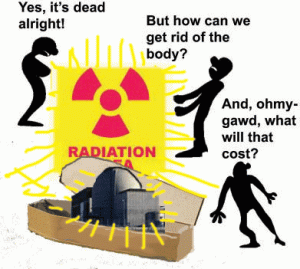
significant additional taxpayer support has been required, and more is likely to be necessary.
there is a risk that the taxpayer will have to make further
contributions.
A report from the UK’s National Audit Office examines whether the
government’s arrangements for decommissioning Britain’s fleet of
advanced-gas-cooled reactors offers value for money.
The UK has eight second generation nuclear power stations accounting for around 16% of total
UK electricity generation in 2020. Seven of the eight stations are Advanced
Gas-cooled Reactors (AGRs), the design of which built on that of the first
generation of now closed Magnox reactors.
Under current plans, all the AGR
stations will have stopped generating electricity by 2028. Decommissioning
is envisaged to take just over 100 years under current plans. The Nuclear
Liabilities Fund (the Fund) was established to meet the costs of
decommissioning all seven AGRs plus a pressurised water reactor at Sizewell
B, but significant additional taxpayer support has been required, and more
is likely to be necessary.
The UK government has provided a guarantee to
underwrite the Fund if its assets are insufficient to meet the total costs
of decommissioning. In 2020, government contributed £5.1 billion ($6.8bn)
to strengthen the Fund’s position and the Fund has recently requested a
further £5.6 billion. The Fund’s assets were valued at £14.8 billion at
the end of March 2021. The aim is that growth in the Fund’s investments
will be sufficient to meet the long-term costs of decommissioning
(currently £23.5 billion).
However, cost estimates have doubled in real
terms since 2004/5. If this trend is maintained and investment growth is
not sufficient, there is a risk that the taxpayer will have to make further
contributions. Last year, the government entered into new arrangements to
decommission the seven AGR nuclear power plants, making EDF Energy
responsible for defueling. The decommissioning of the AGR nuclear power
stations, a 66-page report published by the National Audit Office (NAO)
examines whether these arrangements will lead to better value for money.
The NAO scrutinises public spending to help Parliament hold government to
account and improve public services. It says that while the arrangements
could deliver savings, their success will ultimately depend on the relevant
parties working collaboratively to overcome risks.
Nuclear Engineering International 20th April 2022
https://www.neimagazine.com/features/featurearrangements-for-decommissioning-the-agrs-9640510/
How do we assess thre dangers of nuclear power plants in wartime?
For a night on March 3, Russian military forces seized the Zaporizhzhia
nuclear power plant in Ukraine, damaged its infrastructure, and spread fear
of a nuclear catastrophe. Fortunately, the attack did not threaten
sensitive areas of the nuclear power plant, and radiation levels around the
plant did not raise concern.
Still, the crisis underscored the danger posed
by a war that crosses paths with a nuclear power plant. Since this may be a
case of when, not if, the next wartime attack on a nuclear power plant
happens, scholars and policymakers would be wise to revisit concepts for
assessing and protocols for responding to nuclear power plant crises in war
zones.
Here are some unanswered questions that warrant immediate
consideration: How should experts redefine the boundaries between nuclear
security and nuclear safety? How can experts better understand and assess
the dangers of wartime attacks on nuclear power plants? How does war impact
nuclear safety management? How can a wartime nuclear accident lower the
nuclear threshold?
Bulletin of Atomic Scientists 19th April 2022
Four unanswered questions about the intersection of war and nuclear power
UK’s Nuclear Free Local Authorities join in Wales’call to Japan not to dump radiactive wastewater at sea
The Nuclear Free Local Authorities (NFLA) have joined with leading Welsh
anti-nuclear environmental campaign groups in writing to senior Japanese
Government ministers urging them not to dump radioactive waste from the
Fukushima disaster at sea.
Operated by the Tokyo Electric Power Company
(TEPCO), the Fukushima Daiichi Nuclear Power Plant was hit by an earthquake
and a tsunami on 11 March 2011. A disaster unfolded with three nuclear
meltdowns, three hydrogen explosions and a release of radiation from three
reactors, and Government authorities were forced to evacuate 154,000 people
from the surrounding area over a 20-mile radius. An average of 150 tons of
radioactive water was produced each day last year as rainwater and
groundwater flowed into the damaged reactor buildings mixing with seawater
which has been used to cool the melted nuclear fuel.
One million tons of this water is now stored in barrels on the site. Although the contaminated
water is treated it cannot remove deadly tritium, a beta-emitting
radioactive isotope of hydrogen, and other radioactive materials.
NFLA 21st April 2022
America’s nuclear waste dump in New Mexico is found to have serious safety issues.
The U.S. government´s nuclear waste repository in New Mexico has major
issues in fire training and firefighting vehicles, with its fleet in
disrepair after years of neglect, according to an investigation by the U.S.
Energy Department´s Office of Inspector General.
The investigation was
spurred by allegations regarding fire protection concerns at the
repository, which is the backbone of a multibillion-dollar effort to clean
up Cold War-era waste from past nuclear research and bomb making at
national laboratories and defense sites across the U.S.
Daily Mail 21st April 2022
Russia tests nuclear-capable missile that Vladimir Putin says will make enemies ‘think twice’
SBS, 22 Apr 22, The Sarmat, dubbed Satan 2 by Western analysts, is among Russia’s next-generation missiles that Russia’s president has called “invincible”. But the Pentagon says it is not concerned by the test launch.
Russian President Vladimir Putin said Wednesday that Russia has successfully tested the Sarmat intercontinental ballistic missile, saying the weapon capable of carrying nuclear charges will make Kremlin’s enemies “think twice.”
The Sarmat, dubbed Satan 2 by Western analysts, is among Russia’s next-generation missiles that Mr Putin has called “invincible,” and which also include the Kinzhal and Avangard hypersonic missiles.
Last month, Russia said it used Kinzhal for the first time in warfare to strike a target in Ukraine,
which Russia invaded on February 24………..
The Sarmat has been under development for years and so its test-launch is not a surprise for the West, but it comes at a moment of extreme geopolitical tension over the war in Ukraine.
Russia’s nuclear forces will start taking delivery of the new missile “in the autumn of this year” once testing is complete, Russian news agency TASS quoted Dmitry Rogozin, head of the Roscosmos space agency, as saying on Wednesday………
Mr Barrie said the Sarmat’s ability to carry 10 or more warheads and decoys, and Russia’s option of firing it over either of the Earth’s poles, posed a challenge to ground and satellite-based radar and tracking systems.
The Pentagon said the test was not seen as threatening to the United States and its allies.
Moscow “properly notified” Washington of the test following its obligations………….
Igor Korotchenko, editor in chief of Russia’s National Defence magazine, told RIA news agency it was a signal to the West that Moscow was capable of meting out “crushing retribution that will put an end to the history of any country that has encroached on the security of Russia and its people”. https://www.sbs.com.au/news/article/russia-tests-nuclear-capable-missile-that-vladimir-putin-says-will-make-enemies-think-twice/uks3pn9hn
Greenpeace chief urges Yoon to reevaluate nuclear-focused decarbonization plan
Greenpeace chief urges Yoon to reevaluate nuclear-focused decarbonization plan https://en.yna.co.kr/view/AEN20220422004700315
All News 11:20 April 22, 2022 SEOUL, April 22 (Yonhap) — The leader of Greenpeace urged President-elect Yoon Suk-yeol on Friday to “reevaluate” his nuclear-focused decarbonization plan in a letter sent to him on the occasion of Earth Day.
Yoon’s transition team is pushing to modify the country’s carbon neutrality plans that the outgoing Moon Jae-in administration declared with a goal to reduce its greenhouse gas emissions by 40 percent from the 2018 levels by 2030 and reach carbon neutrality by 2050.
The overhaul will likely include reversal of Moon’s nuclear phase-out policy and changes in energy mix.
“We urge you to reevaluate whether nuclear energy could be safe, fast, and affordable enough to achieve the 1.5 degree C temperature goal,” Greenpeace International Executive Director Norma Torres said in the letter.
She said, “Korea already has the highest nuclear power plant density in the world … we wonder whether further nuclear expansion will be acceptable by the public.”
Torres also said, “The unsolved nuclear waste problem is also a major issue you need to consider in your nuclear focused decarbonization plan.”
South Korea, instead, needs a new, ambitious energy transition strategy to employ more renewable energy coupled with an ambitious fossil fuel and nuclear phase-out plan, according to her.
“Needless to say, your term from 2022 to 2027 is a critical time to decide whether Korea will pull its weight and therefore contribute to the global mission to prevent disastrous climate change in time or not,” she said.
Today: Are we in West being manipulated on a grand scale with deceptive propaganda about the war in Ukraine?

Today I’m posting two videos from Regis Tremblay. I’m sure that Western viewers will hate these, and call the ”Russian propaganda”. And I wish that I could believe that, too,
But I do have an awful fear. Swamped as I am by the tsunami of TV, radio, news, barrage of hyper-emotional depiction of the Ukrainian war, – I cannot help my fearful thought that Regis Tremblay’s speakers are telling the truth.
It’s a painful thought – but I think that the anglophone world, and NATO – the European countries are pulling a giant confidence trick on us all, as we all are led into this frenzy of endless weapons-buying to further the destruction of Ukraine. We are standing by, cheering, as Zelensky and the Ukrainian people are used as pawns, sacrificed, in the cause of the USA discrediting and disrupting Russia
Tomorrow – Webinar to Learn About the Impacts of Radiation from Rocky Flats Nuclear Weapons Plant on the Environment and Health — RADIATION FREE LAKELAND

Below is an invitation from Physicians for Social Responsibility Colorado The invitation is to join this really interesting and important Webinar – starts at 8.30 Mountain Time Zone – 3.30pm Greenwich Mean Time April 23, 2022 Symposium on Rocky Flats:Impacts on the Environment and Health presented as a full-day webinar Histoautoradiograph of lung tissue of […]
Tomorrow – Webinar to Learn About the Impacts of Radiation from Rocky Flats Nuclear Weapons Plant on the Environment and Health — RADIATION FREE LAKELAND
1 This Month
Tell Congress: Prevent Nuclear Catastrophe in Iran

Tell Congress: Prevent Nuclear Catastrophe in Iran

Read the Public Inquiry Report, the Commissioners’ report, Surrendering Australia: The AUKUS Deception is available to download for free at aukuspublicinquiry.com. Or just watch the replay of the National Press Club Luncheon.


Shut down the radiation-damaged Heysham nuclear reactors now
To see nuclear-related stories in greater depth and intensity – go to https://nuclearinformation.wordpress.com

Say No to NASA’s Reckless Nuclear Reactor on the Moon
Say No to NASA’s Reckless Nuclear Reactor on the Moon
-
Archives
- November 2026 (224)
- October 2026 (302)
- September 2026 (339)
- August 2026 (330)
- July 2026 (355)
- June 2026 (287)
- May 2026 (306)
- April 2026 (356)
- March 2026 (251)
- February 2026 (267)
- January 2026 (308)
- December 2025 (358)
-
Categories
- 1
- 1 NUCLEAR ISSUES
- business and costs
- climate change
- culture and arts
- ENERGY
- environment
- health
- history
- indigenous issues
- Legal
- marketing of nuclear
- media
- opposition to nuclear
- PERSONAL STORIES
- politics
- politics international
- Religion and ethics
- safety
- secrets,lies and civil liberties
- spinbuster
- technology
- Uranium
- wastes
- weapons and war
- Women
- 2 WORLD
- ACTION
- AFRICA
- Atrocities
- AUSTRALIA
- Christina's notes
- Christina's themes
- culture and arts
- Events
- Fuk 2022
- Fuk 2023
- Fukushima 2017
- Fukushima 2018
- fukushima 2019
- Fukushima 2020
- Fukushima 2021
- general
- global warming
- Humour (God we need it)
- Nuclear
- RARE EARTHS
- Reference
- resources – print
- Resources -audiovicual
- Weekly Newsletter
- World
- World Nuclear
- YouTube
-
RSS
Entries RSS
Comments RSS

