40 years on we are still asking the wrong questions and getting a lot of wrong answers, writes Linda Pentz Gunter
Probably the most heinous crime, other than the avoidable accident itself and its immediate coverup, is the way that the Chornobyl (Ukrainian equivalent spelling) nuclear power disaster in Ukraine, 40 years old this week, has been used to downplay and normalize the long-lasting health impacts caused by that April 26, 1986 explosion.
Still today, the myth is repeated that “no one died” — meaning no one in the public. Instead, we are told over and over that it was only a handful of liquidators, sent in to deal with the immediate crisis, who were killed by the massive release of radiation resulting from the reactor explosion.
And still today, in part because of that myth, now so firmly cemented in the public and media narratives around the Chornobyl disaster, the true health effects of even just routine reactor operation, or the exposures suffered by communities living around active or abandoned uranium mines, or by those working in uranium enrichment or fuel fabrication facilities, are discounted and dismissed.
Worse still, we are now facing a concerted effort by the Trump administration to emasculate already weak radiation protection standards, once again ignoring females who are most vulnerable to harm, and especially pregnant women, babies and children.
Through yet another executive order accelerating nuclear power expansion while sparing the industry the costs it should incur to guarantee safety (an impossibility anyway), the White House wants to abandon the long-held Linear No Threshold (LNT) model.
LNT holds that radiation damage increases with higher exposures, and that harm is posed by all radiation exposure no matter how small. But LNT itself is already unsatisfactory, since health studies continue to indicate that more — not less — protection is needed for non-cancer impacts, and for radionuclides taken internally, than is already provided by applying LNT.
This is what makes the perpetual focus on “who died” when it comes to major nuclear accidents, fundamentally the wrong question. We will likely never know who or how many died as a result of the Chornobyl disaster. Registries and statistics weren’t kept, people moved around, and, as is so often the case, illnesses were ascribed to other causes. Certainty is hard to achieve.
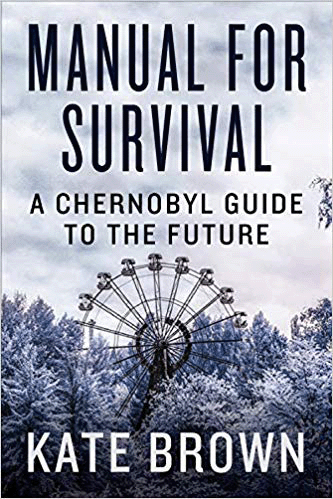
Nevertheless, perhaps one of the most important pieces of research on the health realities of the Chornobyl aftermath was done by historian Kate Brown in her book Manual For Survival. A Chernobyl Guide to the Future. It looks like a “hefty tome”, but it is anything but. Despite being nonfiction, it reads like a page-turning thriller and some of what she uncovers is eye-stretching. And, of course, by saying “uncovers,” we immediately understand that this was indeed a cover-up, first by the then Soviet Union, and then compliantly perpetuated by the United States and other western allies eager to avoid any shocking realization by the general public that nuclear power technology is phenomenally dangerous and human beings are liable to lose control of it, with disastrous results.
This returns us to the question about the protracted harm that can be caused if something goes very badly wrong at a nuclear power plant. And it returns us to dispensing with the wrong question, which is “how many people died?”
That wrong question, a favorite of headline writers and spin doctors, sets us on a perpetual path to dispute. The health figures, especially fatalities, have become the most misrepresented statistic related to the Chornobyl disaster. But focusing only on fatalities also serves to diminish the disaster’s impact. Nuclear power plant accidents often do not kill people instantly and sometimes not at all. It can take years before fatal illnesses triggered by a nuclear accident take hold. This creates a challenge in calculating just who eventually died due to the accident and who suffered non-fatal consequences.
Exposure to ionizing radiation released by a nuclear power plant (and not just from accidents but every day) can cause serious non-fatal illnesses as well. These should not be discounted. Arguably, neither should post-accident psychological trauma. Nuclear power plant accidents can and should be prevented. The only sure way to do so is to close them all down. Otherwise we risk another Chornobyl, or Three Mile Island, or Fukushima.
In our Thunderbird newsletter of 2018, we examined some of the key myths around the impacts of the Chornobyl disaster now 40 years ago. Below, is a synopsis of some of the key points, as they bear repeating and remain perpetually true. The full document can be read here.
What happened?
On April 26, 1986, Unit 4 at the Chornobyl nuclear power plant exploded. That explosion and the resulting fire, lofted huge amounts of radioactivity into the atmosphere. Unit 4 was relatively new, having only been in service for just over two years. The accident occurred during what should have been a routine test to see how the plant would operate if it lost power. The test involved shutting down safety systems but a series of human errors, compounded by design flaws, instead set in motion a catastrophic chain of events.
After shutting down the turbine system that provided the cooling water to the reactor, the water began boiling and workers desperately tried to re-insert control rods to slow down the nuclear reaction. But the rods jammed and control of Unit 4 was irrevocably lost. The explosion and fire — which took five months to put out — dispersed at least 200 times more radioactivity than that produced by the Hiroshima and Nagasaki bombs. The fallout contaminated several million square kilometers of land in the former Soviet Union and in Europe and was also detected in the US
Soviet authorities were slow to react. The accident was first detected by monitors in Sweden. The nearby city of Pripyat was not evacuated immediately. By the time they did so, radioactivity levels were 60,000 times higher than “normal”.
The financial cost of the accident, while difficult to calculate given the many unknowns, is estimated to be in the region of $700 billion and is expected to keep rising.
The Liquidators
The Chornobyl liquidators were dispatched to the stricken nuclear plant in the immediate aftermath, as well as for at least the subsequent two years, to manage and endeavor to “clean up” the disaster. They included military as well as civilian personnel such as firefighters, nuclear plant workers and other skilled professionals.
While estimates of the number of liquidators varies, the generally accepted figure is around 800,000. However, evaluating their fate has been difficult. Only a small portion of them were subject to medical examinations.
Yet, by 1992 it was estimated that 70,000 liquidators were invalids and 13,000 had died. These estimates rose to 50,000 then to 100,000 deaths among liquidators in 2006. By 2010, Yablokov et al. estimated a death toll of 112,000 to 125,000 liquidators.
Even the Russian authorities admit findings of liquidators aging prematurely, with a higher than average number having developed various forms of cancer, leukemia, somatic and neurological problems, psychiatric illnesses and cataracts.
The UN Office for the Coordination of Humanitarian Affairs found a statistically significant increase of leukemia among Russian liquidators who were in service at Chernobyl in 1986 and 1987.
General populations inside and outside the former Soviet Union
As with the liquidators, tracking the health of general populations exposed to the plume pathway of Chornobyl has been problematic. Within the Soviet Union, people moved away and neither they nor many living in other affected countries were tracked or monitored. While countless numbers may have died from their Chornobyl-related illnesses, equal or even greater numbers may have survived with debilitating or chronic physical as well as mental illnesses caused by the accident.
Establishing exact numbers may never be possible. Media reports often rely on the 2003-2005 Chernobyl Forum report produced by the nuclear promoting International Atomic Energy Agency. The agency ignored its own data that indicated there would be 9,000 future fatal future cancers in Belarus, Russia and Ukraine, claiming there would be no more than 4,000. Both numbers are gross underestimations. The report focused only on the most heavily exposed areas in making its predictions. It ignored the much larger populations in the affected countries as a whole, and in the rest of the world, who have been exposed to lower but chronic levels of radiation from Chornobyl.
In contrast, a comprehensive analysis by the late Soviet scientist, Alexey Yablokov and colleagues, examined more than 5,000 Russian studies. They concluded that almost a million premature deaths would result from Chornobyl. Meanwhile, the TORCH report (The Other Report on Chernobyl), by Dr. Ian Fairlie, predicts between 30,000 and 60,000 excess cancer deaths worldwide due to the accident.
More than half the Chornobyl fallout landed outside of the Ukraine, Belarus and Russia — in Europe, Asia and North America. Fallout from Chornobyl contaminated about 40% of Europe’s surface. Immediately after the accident, thyroid cancer was particularly rampant in Belarus, Ukraine and Russia, where no prophylactic remedy in the form of potassium iodide pills was offered. Consequently, as Baverstock and Williams found in 2006, “by far, the most prominent health consequence of the accident is the increase in thyroid cancer among those exposed as children . . . particularly in children living close to the reactor.”
In contrast, Poland, where potassium iodide was distributed, experienced relatively low rates of thyroid cancers. While thyroid cancer is considered one of the more treatable kinds of cancers, this does not mean it should be viewed as an acceptable consequence of a nuclear power plant accident. Such diseases — especially among children — impact emotional, social, and physical wellbeing. In the former Soviet Union, those operated on bear a scare referred to grimly as the “Chornobyl necklace.”
Dr. Wladimir Wertelecki, a physician and geneticist, has conducted research, particularly focused on Polissia, Ukraine. There he found clear indications of altered child development patterns, or teratogenesis. Wertelecki noted birth defects and other health disturbances among not only those who were adults at the time of the Chornobyl disaster, but their children who were in utero at the time and, most disturbingly, their later offspring.
Important research has also been conducted on psychological effects. Pierre Flor-Henry and others examined some of the psychological disorders resulting from Chornobyl and found a clinical pathology related to radiation exposure. Flor-Henry found that schizophrenia and chronic fatigue syndrome among a high percentage of liquidators were accompanied by organic changes in the brain. This suggested that various neurological and psychological illnesses could be caused by exposure to radiation levels between 0.15 and 0.5 sieverts.
There are of course many other non-cancerous diseases caused by nuclear accidents that release radioactivity. A peak in Down Syndrome cases was observed in newborns born in 1987 in Belarus, one year after the Chornobyl nuclear accident. This phenomenon has been found around other nuclear sites. Abnormally high rates of Down Syndrome were found in the Dundalk, Ireland population possibly tied to the operation of the Sellafield nuclear waste reprocessing plant across the Irish Sea in Cumbria, England.
While Iran has approached the current negotiations from a practical, reality-based posture predicated on resolving the actual major points of difference between the US and Iran, the US is being held hostage by the politicized whim of an American President who needs to shape domestic public opinion in a way which transforms the reality of a humiliating defeat into the perception of a bold victory.
The US lost the first round of the war with Iran decisively. If Trump decides to go a second round, the results will be disastrous for American and its allies.
For nearly 40 days, Israel and the United States carried out an extensive aerial campaign against Iran designed to topple the government and suppress Iran’s ability to defend itself. This campaign failed to achieve any of its stated objectives. Instead, it devolved into a numbers game where inflated outcomes were sold to an unquestioning public by military professionals and politicians alike. The Iranian government not only withstood the efforts at decapitation-induced regime change, but actually strengthened its hold on power when the people of Iran, instead of turning on the Islamic Republic, rallied to its cause. Moreover, rather than suppressing Iran’s ability to launch ballistic missiles and drones against US military bases, critical infrastructure in the Gulf Arab States, and Israel, Iran not only sustained its ability to strike, but deployed new generations of weapons that readily defeated all missile defense systems while, using intelligence information that permitted accurate targeting, destroyed critical military infrastructure worth tens of billions of dollars.
Regional experts had long warned about the consequences of entering an existential conflict with Iran, noting that Iran would not simply allow itself to be erased as a viable nation state without ensuring that the other nations of the region were subjected to similar existential threats to their survival, and that global energy security would be disrupted in such a manner as to trigger a world economic crisis. These assessments were backed up by a belied that Iran would not only be able to shut down shipping transiting the Strait of Hormuz, but also effectively target and destroy the major energy production potential of the Gulf Arab States.
It wasn’t that the politicians and military planners in the US and Israel doubted Iran’s ability to impact global energy markets or strike targets in Israel and the Gulf region.
They knew Iran had the potential.
They just believed that they would be able to achieve regime change in Tehran in relatively short order, thereby mooting any threat Iran might pose to energy supplies and infrastructure.
They were wrong, which is why the US was looking for an offramp from the war soon after it started.
The end result was this current ceasefire, which was ostensibly entered into to buy time for US and Iranian negotiators to hammer out a lasting peace plan.
There is a fundamental problem, however.
While Iran has approached the current negotiations from a practical, reality-based posture predicated on resolving the actual major points of difference between the US and Iran, the US is being held hostage by the politicized whim of an American President who needs to shape domestic public opinion in a way which transforms the reality of a humiliating defeat into the perception of a bold victory.
President Trump ran for office on a platform premised on the notion that he would keep America out of the kind of costly, open-ended military misadventures that had defined the US since the start of the 21st Century.
The war with Iran proved this promise to be a lie.
This lie, combined with numerous other political missteps that have transpired during the first year and a half of his second term in office, have put President Trump and his political legacy at risk, with critical midterm elections looming on the horizon that threaten to shift the balance of power in the US Congress away from the Republican Party, and to the Democratic Party. If the Republicans lose the House of Representatives, the impeachment of Donald Trump is all but a certainty. This alone would spell the end of Trump’s legislative agenda. But if the Democrats take the Senate as well, and with a wide enough margin, the Trump will not only find himself impeached, but possibly convicted.
And this would not only mean the end of the Trump Presidency, but also the end of the Trump brand, something Trump has been burnishing his entire adult life and which he has transformed into a political cult of personality that has redefined American politics.
Iran has entered the current round of negotiations focused on the practicalities and realities of geopolitics and national security.
Trump is about shaping perceptions to his political benefit.
These are not compatible goals and objectives, especially when Iran has emerged victorious from a war it did not want, and Trump is trying to invent a narrative that has him prevailing in a conflict his team not only should never have engaged in, but which they lost, and now Trump has to spin this dismal reality in a manner which benefits him politically.
Take the current impasse over the Strait of Hormuz.
Iran has asserted control over all shipping transiting this strategic waterway, and by being selective about which ships can transit, has created a global energy crisis which has detrimentally impacted US allies in Europe and Asia.
It was the reality that the US had no military solution to the problem of Iran’s compelled closure of the Strait that led the US to seek a diplomatic solution to the problems it alone had created.
There are other outstanding issues as well, such as Iran’s stockpile of 60% enriched uranium (which the US apparently tried to seize in a failed special operations raid), as well as the issue of Iran’s nuclear program in general, which the US insists can continue only if Iran forgoes enrichment altogether, something Iran has said it will never do.
The US also wishes to curtail Iran’s ballistic missile programs, despite the fact it is these very missiles which provided Iran with the ability to prevail militarily over the US, Israel and the Gulf Arab States.
The US also insists that Iran cease its relationship with regional allies such as Hezbollah in Lebanon (which is engaged in an open-ended conflict with Israel due to Israel’s ongoing occupation of southern Lebanon) and the Ansarullah movement in Yemen, which has been opposing a Saudi-led aggression since 2014.
There’s literally a snowball’s chance in hell Iran would concede any of these issues, especially after winning a war where all of the non-nuclear matters helped contribute to the Iranian victory.
And therein lies the rub.
Trump has largely bought into an Israeli-influenced narrative which defines victory as being predicated on Iran yielding on all of the issues listed above.
Something Iran will never do.
Trump has shown zero political acumen when it comes to trying to shape US public opinion in his favor.
Instead of taking credit for getting Iran to agree to open the Strait of Hormuz, Trump insists on posturing as a tough guy by insisting on continuing a naval blockade which exists in name only, prompting Iran to reverse course and close down the Strait.
And close down negotiations.
Leaving Trump further boxed into a corner of his own making.
With the only option available being the resumption of the very military operations that had proven unable to defeat Iran and, if initiated, will trigger consequences which will have a devastating impact on global energy markets—the very thing Trump was trying to avoid when seeking out the ceasefire to begin with.
But there may very well be other consequences.
Iran is at the point in this conflict where trying to play a game of escalation management is counterproductive.
If the US opts to resume its attacks on Iran, with or without Israel, Iran will have no choice but to go for the jugular from the start.
To strike not only the energy production capabilities of the regional actors, like the United Arab Emirates, Saudi Arabia, Kuwait, and Bahrain, that continue to provide assistance to the US when it comes to the conflict with Iran, but also their water desalinization plants and power production plants.
Denying these nations access to the very water they need to survive.
And power they need to provide air conditioning to the skyscrapers that have defined their status as modern oasis’ of civilization.
The hot summer months approach.
And if Iran eliminates water and air conditioning, then these modern Gulf Arab States become uninhabitable.
Cities like Dubai and Abu Dhabi become uninhabitable. So, too, Kuwait City, Riyadh, and Manama.
Everything the rulers of these Gulf nations have aspired to accomplish over the course of the past several decades will lie in ruins, ghost cities in place of thriving metropolis’.
And Iran would likely do the same to Israel, destroying the critical infrastructure the tiny Zionist enclave needs to survive as a modern nation states.
Making the land of milk and honey uninhabitable for millions of Israelis who will have no choice but to go back to their homes of origin.
These are all known knowns—there is no mystery about what the consequences of resuming military operations against Iran will bring.
Albert Einstein is widely quoted as once noting that the definition of insanity was doing the same thing over again and expecting a different result.
The US and Israel launched a surprise attack against Iran using the full strength of their respective air forces.
And they failed.
Today, Iran stands ready to receive a combined US-Israeli strike which will match, but not exceed, the destructive power of those initial attacks.
And Iran will respond with missile and drone attacks which will exceed by an order of magnitude the targeted destruction of its previous retaliatory strikes.
Iran will change the cycle of escalation by going straight for the jugular.
And Trump won’t know what hit him.
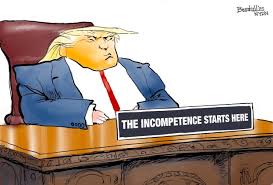
The consequences of incompetence are real.
Something Trump and the American people are about to find out in real time should the US go forward with the threats to resume bombing Iran in the next few days.
Black Hills Uranium Is More Dangerous. Tell Burgum: Stop the Extraction.
Trump is bombing Iran over uranium enrichment 6,000 miles away. He’s fast-tracking uranium extraction in the Black Hills on Lakota treaty land, above the aquifer that feeds Pine Ridge. Two fast tracks. Two manufactured crises. Both bypassing the consent of the governed. Tell Secretary Burgum the real uranium threat is here.
This administration has put two things on a fast track to destruction. One is a war in Iran. The other is a uranium mine in the Black Hills. Both manufactured crises. Both bypassing democratic oversight. Both moving at the speed of executive order, because if either one slowed down long enough for the people to weigh in, the answer would be no.
Congress never authorized the war in Iran. They’ve voted four times to stop it. Overruled. The Lakota people never consented to uranium extraction from treaty land. They’ve fought it for 20 years. Overruled.
On February 27, 2026, the U.S. Forest Service approved new drilling around Pe’ Sla — the ceremonial heart of He Sapa, the Black Hills — over formal tribal objections, with no environmental review, under a document falsely claiming there are “no known Native American or Alaska Native religious or cultural sites within the project area.” About land a half-mile from Pe’ Sla.
Now the Bureau of Land Management has opened a 30-day comment window on the Dewey-Burdock uranium project — 50 miles from Pine Ridge, in Lakota treaty territory. The 1868 Fort Laramie Treaty appears in the review exactly zero times. The document resolving cultural harm to Lakota sacred sites won’t be signed until six weeks after the comment period closes.
They will go to war over uranium in Iran. They will not protect our water from uranium 50 miles from Pine Ridge.
In the end, the only backstop on this runaway train is the consent of the governed. Use it.
Tell Secretary of the Interior Doug Burgum:
1. Reverse the Pe’ Sla drilling permit — now
2. Remove Dewey-Burdock from the FAST-41 federal fast-track program
3. Suspend all extractive permits on treaty lands until full tribal consultation and a complete Environmental Impact Statement are done
The Black Hills are not for sale. Mni wiconi — water is life
There is a difference between strategic ambiguity and strategic incoherence.
The first deters adversaries. The second unnerves allies, emboldens rivals, and corrodes the very architecture meant to prevent catastrophe.
Under President Donald Trump, the United States’ nuclear posture is drifting dangerously toward the latter, and the consequences are now rippling through the global non-proliferation regime.
The warning lights are not subtle. The Bulletin of the Atomic Scientists, hardly a sensationalist platform, has effectively accused Washington of taking a wrecking ball to decades of carefully constructed nuclear norms.
Across multiple recent analyses, the Bulletin outlines a pattern: erratic signalling, coercive use of force against nuclear-threshold states, and a cavalier attitude toward arms control obligations. The cumulative effect is not just instability. It is the potential unravelling of the Nuclear Non-Proliferation Treaty (NPT) itself.
Let’s start with the basics. The United States still possesses one of the largest nuclear arsenals in the world of around 3,700 warheads, according to the Bulletin’s Nuclear Notebook 2026.
That number alone is not the problem. It reflects decades of Cold War inheritance and gradual reductions. The real issue is how that arsenal is being politically framed and operationally signalled.
Trump’s approach has been marked by contradiction. On one hand, he speaks intermittently about arms control and reducing nuclear risks. On the other, he has openly floated resuming nuclear testing and declined to clarify whether the United States might actually conduct such tests.
Arms control depends on predictability. Treaties, verification regimes, and confidence-building measures exist precisely to eliminate guesswork.
When a nuclear superpower signals that it might abandon long-standing norms, such as the de facto moratorium on nuclear testing, it sends a clear message to others: restraint is optional.
Nowhere is this more evident than in Trump’s handling of Iran. According to the Bulletin’s April 2026 analysis, Washington’s actions risk teaching exactly the wrong lesson: that nuclear restraint does not guarantee security.
For decades, the NPT has functioned on a basic bargain. Non-nuclear states agree not to pursue weapons in exchange for access to peaceful nuclear technology and an implicit security framework backed by international norms.
But if a state that remains below the weaponisation threshold, maintaining “nuclear latency”, can still be attacked or coerced, that bargain begins to collapse.
The Bulletin puts it bluntly: states may conclude that only actual nuclear weapons, not compliance, not inspections, and not diplomacy, can ensure survival.
This is a profound shift. It transforms nuclear weapons from deterrents of last resort into perceived necessities for regime security. And once that logic takes hold, proliferation is no longer an aberration, it becomes rational behaviour.
The Bulletin’s other April piece goes further, accusing Washington of effectively undermining the NPT framework itself. The metaphor is deliberate: this is not erosion through neglect, but active damage.
The core problem lies in precedent.
International norms are not enforced by a global police force; they are sustained by consistent behaviour among major powers. When the United States disregards those norms, whether by sidelining diplomacy, undermining safeguards, or prioritising coercion, it weakens the legitimacy of the entire system
The NPT has survived for over half a century because it created a shared expectation: that nuclear powers would move, however slowly, toward disarmament, while non-nuclear states would abstain.
But that expectation is already fraying.
The expiry of the New START Treaty, the last major arms control agreement between Washington and Moscow, has removed a critical stabilising mechanism.
Experts warn that this opens the door to renewed arms competition and eliminates transparency measures that helped prevent miscalculation. Without such guardrails, the NPT’s credibility suffers further. The broader trajectory is unmistakable. The post-Cold War era of gradual nuclear restraint is giving way to a more volatile, competitive environment.
The United States and Russia still control the overwhelming majority of the world’s nuclear weapons, around 86 per cent of the global inventory. Historically, their bilateral agreements set the tone for global stability.
Today, that leadership vacuum is being filled not by cooperation, but by suspicion.
Trump’s push for “multilateral” arms control involving China might sound forward-looking, but in practice it has produced little tangible progress. Meanwhile, the absence of concrete negotiations and the collapse of existing treaties are accelerating uncertainty.
Even more troubling is the renewed emphasis on nuclear signalling as a tool of coercion.
The 2026 conflict with Iran, coupled with ambiguous nuclear rhetoric, suggests a willingness to blur the line between conventional and nuclear deterrence. That ambiguity increases the risk of escalation, intentional or otherwise.
The Bulletin of the Atomic Scientists has been ringing the alarm bell with increasing urgency. In 2026, it moved its famous Doomsday Clock to 85 seconds to midnight, the closest humanity has ever been to catastrophe.
This is not mere symbolism. It reflects a convergence of risks: nuclear, technological, and geopolitical. But nuclear weapons remain at the core of that assessment. The danger today is not just the existence of nuclear arsenals but the breakdown of the systems designed to manage them.
When arms control collapses, when norms erode, and when leadership becomes erratic, the probability of miscalculation rises sharply. And nuclear miscalculation is unforgiving. There are no second chances.
For countries like India, outside the NPT but deeply invested in strategic stability, the implications are particularly complex. A weakening non-proliferation regime could legitimise further expansion by nuclear and near-nuclear states across Asia.
If Iran, for instance, moves from latency to weaponisation, it could trigger a cascade of responses across West Asia. Similarly, the absence of US-Russia constraints may encourage China to accelerate its own arsenal expansion—already a concern in strategic circles.
In such a world, deterrence becomes more crowded, more opaque, and more dangerous. The risk is not just a bilateral arms race but a multipolar nuclear competition with fewer rules and weaker safeguards.
Perhaps the most insidious effect of Trump’s approach is not any single policy decision but the normalisation of instability.
When nuclear threats are used casually, when treaties are treated as optional, and when strategic clarity is replaced by improvisation, the entire system adapts to its own detriment.
What was once unthinkable becomes conceivable; what was once unacceptable becomes negotiable. The NPT does not collapse overnight. It erodes gradually, as states lose faith in its guarantees and begin hedging their bets. That process may already be underway.
The Bulletin’s warning is stark but credible: if current trends continue, the world could enter a new era where nuclear proliferation accelerates, arms control becomes an afterthought, and the threshold for nuclear use becomes dangerously blurred.
The global nuclear order has always been fragile, sustained less by enforcement than by mutual restraint. Under Donald Trump, that restraint is being tested as never before. An erratic doctrine, combined with coercive policies and the dismantling of arms control frameworks, is placing unprecedented strain on the non-proliferation regime.
The NPT, long considered the cornerstone of nuclear stability, is now under real pressure. Not from a single rogue state, but from the behaviour of its most powerful guarantor.
This is the paradox of the present moment: the country that helped build the system is now accelerating its decline.
And in the nuclear age, systemic decline is not an abstract risk. It is a countdown.
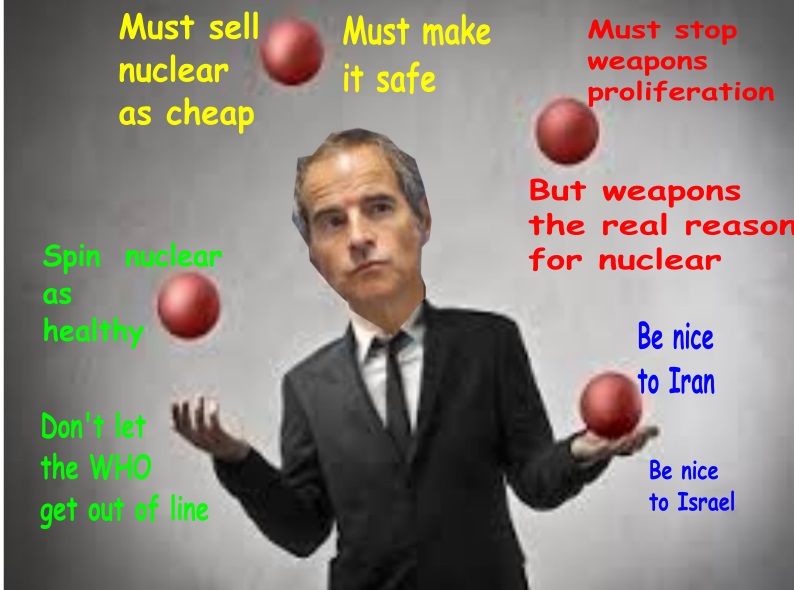
Of all the branches of the United Nations, none has a higher calling than the International Atomic Energy Agency (IAEA). In the end, its job is to preserve humanity from nuclear destruction and embody the survival instinct of our species.
Yet the whole intricate system designed to prevent calamity is crumbling before our eyes. Rafael Grossi, the director general of the IAEA, describes in his Telegraph interview how “important countries in Europe, in Asia minor and in the Far East” are publicly debating whether to build nuclear weapons, despite having promised never to do so.
America and Russia have allowed all their nuclear disarmament treaties either to collapse or expire without replacement. After invading Ukraine in 2022, Vladimir Putin took another step towards the brink by suspending the “strategic stability” arrangements with the US, under which the world’s biggest nuclear powers had previously reassured one another by sharing information about exercises and missile deployments.
One by one, the risk-reduction measures have fallen away, even as more countries consider building nuclear arsenals. That leaves only one question: Have we already passed the point of no return, or does humanity retain its survival instinct?
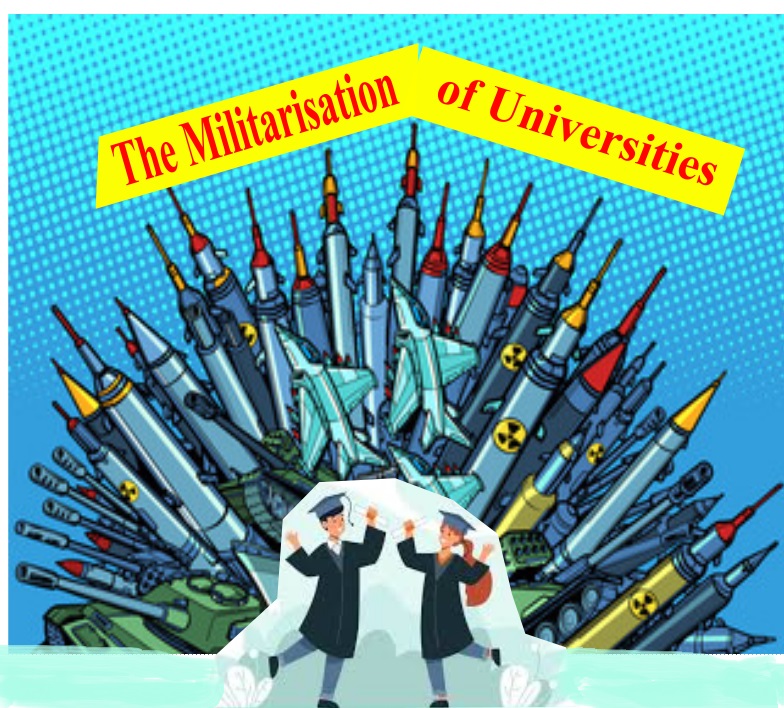
Arms industry executives have been given direct influence over British university courses, Declassified can reveal.
BAE Systems, Leonardo, Thales and Rolls-Royce are among the firms who have been invited to sit on at least 53 university advisory committees across the country.
They are usually asked to provide “strategic direction” for academic departments – and sometimes also review the progress of research projects.
Using the Freedom of Information Act, Declassified found that at least 21 universities had asked arms companies to sit on their committees. They include the universities of Southampton, Edinburgh, Glasgow, Leicester, Cardiff, York and Queens University Belfast.
Some institutions boast that the setup allows them to “respond to the needs of employers”. The minutes of one committee meeting show that arms executives – along with officials from other companies – were thanked for “ensuring that our programmes fit industry requirements and demand”.
During a meeting at the University of Hull, an official from BAE Systems said they would “welcome applications” from students for “industrial placements”, adding that they would “like to develop the relationship”.
And a committee at the University of Cardiff discussed whether “industry” could “teach material to students,” noting that this would be “an appealing prospect for the School but would also offer good exposure for industry”.
They also agreed to meet with Rolls-Royce to discuss “research challenges”.
‘Disturbing’
The finding comes two years after it was revealed how British universities had taken almost £100m from defence companies – including many that are arming Israel.
In one case, BAE Systems gave almost £50,000 in sponsorship to University College London (UCL) to fund its Centre for Ethics and Law – despite the company being accused of being party to alleged war crimes in Yemen in 2019.
Universities including Oxford, Cambridge and Sheffield were all found to have taken huge sums from arms firms – accepting £17m, £10m, and £42m respectively.
Sam Perlo-Freeman, of the Campaign Against the Arms Trade (CAAT), said: “Declassified’s disturbing findings add to CAAT’s growing concern about deepening ties between UK universities and the military-industrial complex.
“As purveyors of a deeply corrupt and immoral trade that blights human life and the planet like no other, arms company executives should be nowhere near institutions of learning and intellectual freedom.”
He added: “Universities should be treating arms trade representatives as pariahs. Instead, and thanks to Declassified, we now know that they sit on at least 53 different advisory committees across 21 universities.
“We have little doubt that this will have impacted academic freedom and the integrity of higher education research. The question is exactly how. We need answers.”
Responding to our investigation, the co-founder of Demiliterise Education, Jinsella Kennaway, said: “Academic freedom is undermined while arms companies hold such influence over what gets researched, funded, and legitimised on campus”.
“Students deserve pathways into work that make the world safer and more humane, not careers that contribute to mass killing and deepening global insecurity,” they said.
“University leaders have a responsibility to ensure Britain’s knowledge centres contribute to saving lives, rather than allowing education to become a pipeline into the war economy.”
Martin is Declassified UK’s chief investigator. He previously worked for The Guardian, Channel 4 News and openDemocracy, where he was UK Investigations Editor. His book, ‘Parliament Ltd’, exposed widespread corruption in British politics and sparked multiple inquiries by Westminster authorities. It was described as “ground-breaking” by the Sunday Times, while the New Statesman said the book was “a powerful reminder that reporters can serve the public good”. Martin has published investigations on issues ranging from lobbying and dark money, to espionage and human rights. He has also produced investigations for TV and YouTube, including going undercover. Between 2015 and 2016, he co-presented a live stage show with comedian Josie Long which combined investigative journalism with stand-up.
At that gathering of European officials in Berlin Wednesday, immediate pledges of new weapons supplies came to $4.7 billion, and there is more, much more, coming as Volodymyr Zelensky, Ukraine’s president, mooches his way around the European capitals.
Are the Western powers aware of the magnitude of the moment? I do not see how this can be anything other than so. Setting aside the Zionists’ obsessions and the visceral hatred Ukraine’s neo–Nazi regime nurses toward Russia and Russians, these conflicts are, when viewed broadly, about the defense of Western hegemony in its declining years.
In Iran and Ukraine, what is at stake — what is fought for and against — is a rebalancing of power that will prove of world-historical magnitude when it is at last accomplished.‘
First came news that, on April 8, Israeli jets bombed what is known as the China–Iran railway, a key component of Beijing’s ambitious Belt and Road Initiative. Of all the targets the Zionist terror machine might have hit, why a Chinese-sponsored infrastructure project, you had to wonder.
Then on Wednesday came reports that officials from nearly 50 nations — I would love a list of these 50 — met in Berlin to make sure the fires of war against Russia do not flicker out. “We cannot lose sight of Ukraine,” Mark Rutte, NATO’s new secretary-general, declared a little forlornly.
There are other reports such as these of late. Dan Caine, chairman of the Joint Chiefs of Staff, announced Thursday that the Pentagon has authorized the Pacific Fleet to interdict ships in the Indian and Pacific oceans if they are deemed to be carrying Iranian oil to Asian ports or “material support” from Asia — read China — to the Islamic Republic.
It is time for a stock-take.
The war in Ukraine drones (literally) on and on, the West showing no inclination whatsoever to take the Russian position seriously. In West Asia we find a variant: The United States and the rabid dog that Bibi Netanyahu has made of Israel have no intention of considering the 10–point document wherein Iran states its conditions for ending a war it appears perfectly willing to continue waging.
What are we looking at? What animates these two confrontations such that to understand our moment we must see Ukraine and Iran as two theaters of a single war?
I do not care for self-referencing commentators, but an exception to my rule is the swiftest way to my reply to these questions.
I have argued since the turn of the millennium that parity between the West and the non–West is the foundational imperative of the 21st century. Any given nation or bloc may favor or oppose this eventuality, but there will be no stopping the turn of history’s wheel: This was my take at the opening of the era that announced itself with the events of Sept. 11, 2001.
And it is the painful birth of this new time we witness as the wars in Europe and West Asia grind on. In each case what is at stake, what is fought for and against, is a rebalancing of power that will prove of world-historical magnitude when it is at last accomplished.
What have the Russians sought since Donald Trump began his second term and declared his intention to end the war in Ukraine and restore relations with Moscow to some kind of equilibrium?
It is the same thing Moscow hoped for at the Cold War’s end, and the same thing they proposed when, in December 2021, they sent draft treaties, one to Washington and one to NATO headquarters in Brussels, as the basis of negotiations for a comprehensive settlement between the Russian Federation and the West.
Moscow’s Push for Equal Standing
Moscow has been clear on this point the whole of the post–Soviet era: It seeks a security architecture that takes cognizance of its interests and, so, recognizes Russia as an equal partner in its relations with the West.
President Putin and Sergei Lavrov, his able foreign minister, speak of the “root causes” of the war in Ukraine and insist these must be addressed if any kind of enduring settlement between East and West is to be achieved. This is merely another way of saying what the Russians have said for the past 30–odd years. [See: Ukraine Timeline Tells the Tale]
Neither has the West’s reply been any different: It amounts to one long list of refusals, however directly, dishonestly or incompetently these have been conveyed.
Last November the Trump regime issued a 28–point peace plan that was not less than shocking when cast against the past three and some decades of history. It called for a nonaggression pact Russia, Europe and Ukraine were to negotiate and sign. “All ambiguities of the last 30 years will be considered settled,” it read in part.
And further in this line:
“A dialogue will be held between Russia and NATO… to resolve all security issues and create conditions for de-escalation in order to ensure global security…”
These 28 provisions proved too good to be true. The Americans who developed this document, Secretary of State Marco Rubio and Steve Witkoff, the incompetent Trump insists must act as his “peace envoy,” simply did not know where the fence posts lie: While they almost certainly did not understand this, implicit in their 28 points was an East–West relationship based on parity.
Out of the question, as was immediately evident.
The Trump regime quickly abandoned its plan, despite its favorable reception in Moscow, and seems to have dropped all thought of “a deal” with Russia. The Europeans, freaked out at the very thought of a negotiated settlement, now resort to upside-down versions of reality I find it hard to believe they even try on.
At that gathering of European officials in Berlin Wednesday, immediate pledges of new weapons supplies came to $4.7 billion, and there is more, much more, coming as Volodymyr Zelensky, Ukraine’s president, mooches his way around the European capitals.
Boris Pistorius seems to have spoken for the group when the subject of peace talks arose. “The truth is, anyway, Russia has never taken them seriously,” the German defense minister declared. “This is why it is all the more important to support Ukraine.”
Russia has never taken negotiations seriously: Can you imagine how this kind of talk lands in Moscow? Can you imagine how low are the Russians’ expectations that the West will take their legitimate interests seriously until events on the battlefield force them to do so?
Tehran’s Conditions
The Iranians, it seems to me, are in a similar predicament.
Read the text of the 10–point plan wherein Tehran advances its demands for ending the war with the United States and Israel. An end to U.S. and Israeli attacks is merely the Iranians’ opener. The withdrawal of all U.S. forces from the region, a nonaggression pact with the United States, recognition of Iran’s rights on the nuclear side, war reparations: To borrow from the Russians, this is a demand to address root causes, a demand for “a new security architecture,” a demand — returning to my principal point — for parity as a non–Western power.
There is a lot in the press these days about a return to negotiations after Vice–President J.D. Vance’s debacle in Islamabad last weekend. I have no trouble imagining the Iranians are eager to avoid more of the savage, indiscriminate bombing their civilian population suffered prior to the two-week ceasefire that went into effect April 8. But I do not think, at the horizon, they will abandon the 10 demands they have advanced any more than the Russian will abandon theirs.
Both nations appear to have concluded it is time to confront the West in the name of that 21st century imperative I noted earlier. Two reasons. One, Russia and Iran have both gathered strength as non–Western powers in recent years, forged in the heat of incessant confrontations. This, indeed, is what history’s wheel looks like as it turns.
Declining Coherence & Power
Two, it is not difficult to recognize the declining coherence and power — and so the creeping desperation — of the United States and its European allies.
Are the Western powers aware of the magnitude of the moment? I do not see how this can be anything other than so. Setting aside the Zionists’ obsessions and the visceral hatred Ukraine’s neo–Nazi regime nurses toward Russia and Russians, these conflicts are, when viewed broadly, about the defense of Western hegemony in its declining years.
This is how I read that attack on the China–Iran railway. O.K., the Israelis did the wet work, as they say, but the bombing of a significant Chinese asset was not without intent: It reflects the United States’ mounting anxiety as the non–West’s premier power advances an imaginative global agenda that has the policy cliques in Washington, now that they belatedly recognize its significance, quaking.
Look at the map in this link. This rail line is key to China’s long-term plan to build efficient connections through southeastern Europe and on to the European capitals. To date, Beijing has reportedly spent 40 billion yuan, about $6 billion, on the project. This is part of the $400 billion investment agreement Beijing and Tehran signed in June 2020.
A little to my surprise, the Chinese have not reacted since the Israelis bombed their asset. There are several considerations at work here, but the most operative appears to be Beijing’s desire to assist in diplomatic mediations while presenting itself as a responsible world power in the face of the Trump regime’s serial insanities.
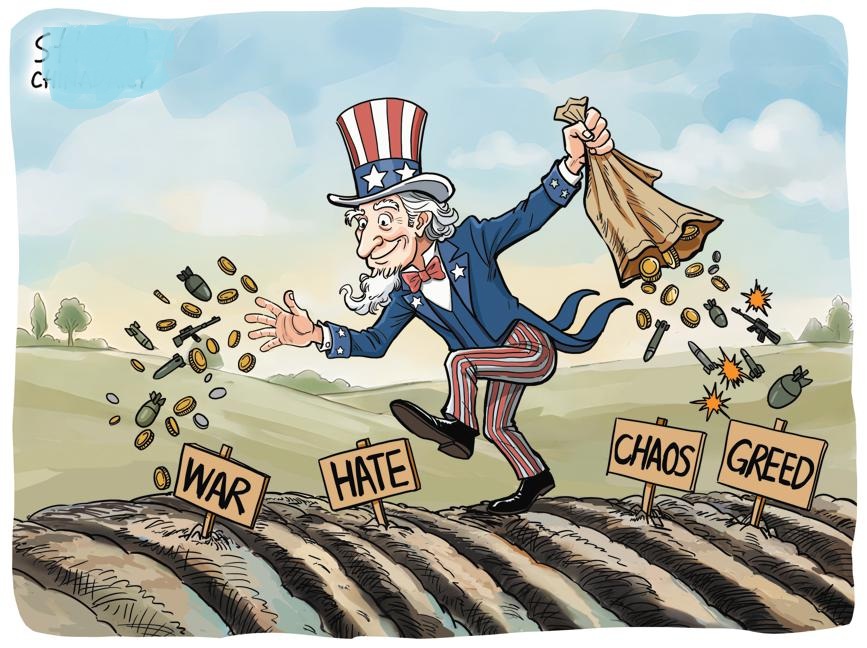
China Daily ran an editorial cartoon in its Tuesday editions that sheds useful light on Beijing’s perspective. It shows Uncle Sam profligately scattering money and weapons as he bounds through a field marked “War, Hate, Chaos and Greed.” The headline at the top is “The U.S. Reaps What It Sows.”
It is a darkly humorous reminder that Beijing knows very well what the war against Iran is fundamentally about and what time it is on history’s clock. You can always count on the Chinese to take the long view.
“Our assessment is that Trump effectively lacks both a coherent plan and the capacity to secure even a temporary agreement,” the official said. “His decision-making appears to be grounded in Israeli political and security assessments, conveyed to him on a daily basis.”
“Our assessment is that Trump effectively lacks both a coherent plan and the capacity to secure even a temporary agreement,” an Iranian official said.
Iran says it has no plans to negotiate with the US after President Donald Trumpsaid Sunday that “the whole country is going to get blown up” if Iran refuses to make a deal.
Trump claimed that Iranian officials were heading to Islamabad for another round of talks Monday with Vice President JD Vance, his son-in-law Jared Kushner, and Middle East envoy Steve Witkoff.
But Iran’s official IRNA news agency later reported that claims Iran was coming to negotiate were “not true” and described the announcement as “a media game and part of the blame game to pressure Iran.”
The Tasnim News Agency, which is linked to Iran’s Islamic Revolutionary Guard Corps, reiterated the government’s previous position that it would not negotiate unless Trump lifts his blockade of Iranian ports, which Tehran considers a violation of the ceasefire between the US and Iran.
After Trump said the blockade would continue, Iran again shut down travel through the Strait of Hormuz on Saturday, following a brief reopening Friday following the announcement of a ceasefire between Lebanon and Israel.
IRNA added that negotiators decided not to return because of “Washington’s excessive demands, unrealistic expectations, constant shifts in stance, repeated contradictions, and the ongoing naval blockade.”
An unnamed Iranian official familiar with Tehran’s internal deliberations told Drop Site News on Sunday that Tehran is prepared for a long war.
He said negotiators would prefer to make a deal with the US that would give Iran the right to enrich uranium, provide sanctions relief, and establish a long-term non-aggression framework.
But the official said Trump’s erratic behavior and maximalist demands—including that Iran surrender all its enriched uranium—are causing Iranian officials to sour on the idea that he could ever be a trustworthy negotiating partner.
“Our assessment is that Trump effectively lacks both a coherent plan and the capacity to secure even a temporary agreement,” the official said. “His decision-making appears to be grounded in Israeli political and security assessments, conveyed to him on a daily basis.”…………………………………………………………………………………………………………………………………………………………………
Trita Parsi, executive vice president of the Quincy Institute for Responsible Statecraft, said Sunday that Trump’s apparent belief that he can use threats of mass violence to bully Iran into a favorable deal is pushing Tehran further from the negotiating table
“Due to poor discipline, Trump ends up prioritizing the optics of victory over actually getting a deal,” Parsi said. “Instead of using deescalatory signals from Iran to get closer to a deal, he declares victory and seeks Iran’s humiliation, and by that, he undermines his own diplomacy.” https://www.commondreams.org/news/iran-no-talks-trump-threats
Defence is supposed to provide ‘cradle to grave’ costings for proposed capability before a procurement is approved. That doesn’t seem to have happened for AUKUS nuclear waste storage and disposal. Transparency Warrior Rex Patrick is pursuing answers.
A simple request
Imagine for a moment that you were the defence minister, and knowing that all defence capabilities must be costed from cradle to grave, you asked the Australian Submarine Agency for the latest cost estimates for a solution for the treatment and storage of high-level radioactive waste from AUKUS.
You’d expect that it might take a day or two to get the message to Defence and to get a response back to the ministerial wing of Parliament House.
In July 2025 MWM requested access under Freedom of Information laws to the latest cost estimates for a solution for the treatment and storage of high-level radioactive waste from AUKUS. The Agency did not answer the FOI request and its lack of response was referred to the Information Commissioner.
The Information Commissioner is trying to encourage the ASA to engage in a little bit of transparency. But … the Agency just can’t find a latest costing.
We’re disorganised
In a response to an engagement with MWM, the Agency has recently advised:
Preliminary searches have been carried out within one branch of one division of the ASA to identify documents falling within the scope of your request. That branch has advised that approximately 3,000 documents are potentially in scope. They would require manual examination to determine whether they contain information relating to the scope of your request. The documents within this set vary significantly in length and format and may comprise multiple pages requiring individual review.
Further, any cost information in relation to the scope of your request is likely to be dispersed across multiple documents and along timeframes, may appear in differing levels of detail, and may not be directly comparable. As a result, identifying which documents contain relevant cost information would require extensive searching, detailed examination, contextual analysis, and judgment.
Quite unbelievable!
Or is it unbelievable?
ASA is looking after a $368B project. And the Agency is in a mess.
In November 2024 the Government asked Boston Consulting Group to take a look at the organisational structure of the Australian Submarine Agency (ASA). A contract was signed for 2.7. million. In April 2025 it was amended to $7.4 million. Three months later it was amended again to a whopping $12.1 million.
In parallel the defence minister asked former Defence Secretary Dennis Richardson to undertake an urgent top-to-bottom review of the ASA amid serious concerns about how it was managing AUKUS.
The Integrated Investment Proposal laid out the Government’s estimates of, amongst other programs, the AUKUS and Collins Class submarine costs for the coming decade.
The 53-to-63 billion dollar AUKUS budget published in 2024 has grown to 71-to-96 billion (a change of 52% for the upper band). The 4-to-5 billion dollar Collins Submarine upgrade costs has grown to 8-to-11 billion dollar (change of 120% for the upper band).
Any thought that the Government is increasing the Defence budget to expand the Defence Force’s capabilities is illusory. The increase will struggle just to deal with cost blow outs.
Or implausible?
The numbers associated with the very long term disposal of AUKUS nuclear waste will be big. If the Minister asked for the latest cost estimates for a solution for the treatment and storage of high-level radioactive waste from AUKUS he’d get it almost instantly.
“The estimate must exist. “
The approach taken by the ASA in responding to MWM’s request reminds me of a teenager trying hid a bad school report from their parents. The kid simply doesn’t realise that mum and dad will find out eventually.
MWM is not about to give up.
Of course, there is a small possibility that we are wrong and there is no estimate. Maybe the Minister has told the ASA he won’t ask for one and they shouldn’t generate one.
The US has partly restricted intelligence sharing with South Korea after the country’s unification minister publicly identified a suspected North Korean nuclear site, according to reports in South Korean media.
Chung Dong-young told lawmakers in March that North Korea was operating uranium enrichment facilities in Kusong, a north-western area that had not previously been officially confirmed as a nuclear site alongside the known facilities at Yongbyon and Kangson.
A senior military official told the state-funded Yonhap news agency on Tuesday that Washington had imposed partial restrictions on sharing satellite-gathered intelligence about North Korean technology since early this month, though surveillance of missile activity continued normally and military readiness remained unaffected.
The restrictions followed what South Korean outlets described as multiple protests from US officials, who expressed concern that sensitive information had been disclosed without authorisation.
No US agency has confirmed the restrictions on record. The Guardian contacted the US embassy in Seoul for comment.
Chung has defended his remarks, saying they were based on publicly available research rather than classified intelligence.
He told reporters on Monday it was “deeply regrettable” that his policy explanation had been characterised as an information leak. “This is open information,” Chung said, citing a 2016 report by a US thinktank and South Korean media coverage.
He noted he had mentioned Kusong during his confirmation hearing last year without incident. Writing on Facebook, he said he was “bewildered” the issue had suddenly become a problem nine months later.
President Lee Jae Myung, whose administration is pursuing a conciliatory approach towards North Korea, backed his minister. Writing on X, Lee said it was a “clear fact” that Kusong’s existence had been widely reported in academic papers and media before Chung’s remarks.
“Any claims or actions premised on the assumption that minister Chung leaked classified information provided by the United States are wrong,” Lee wrote from Delhi during a state visit to India. “I must look closely into why such an absurd situation is unfolding.”
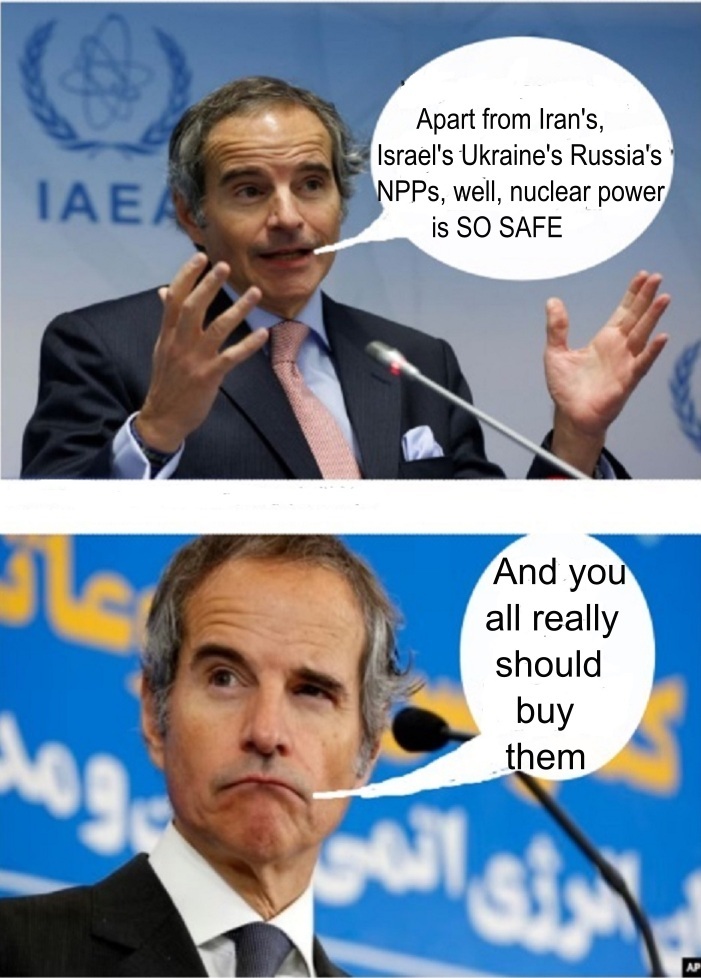
“Secretary Grossi is ignoring two key factors,” Pentz Gunter said. “The first is that the IAEA actively promotes the use and expansion of nuclear power around the world, so the agency must take responsibility for its role in the extreme danger we have found ourselves in, first in Ukraine and now Iran, with nuclear plants embroiled in war. Second, the “seven pillars” make an assumption we can now recognize as entirely unreliable — that the world leaders expected to abide by these protocols are sane and rational.
Trump’s threats to obliterate power plants in Iran could lead to a fatal nuclear disaster affecting the Middle East and beyond
The recklessness of the US and Israeli bombing attacks on Iran that now threaten to potentially destroy the Bushehr commercial nuclear power plant there, represents a radiological risk of monumental proportions, warned Beyond Nuclear today.
The 1,000 megawatt Russian built VVER reactor sits on the Iranian coast. It is the same design as the reactors in Ukraine where alarm has already been raised by the International Atomic Energy Agency and other international authorities, should any be struck or seriously damaged by Russian missiles as the war in Ukraine continues to drag on.
But there has been significantly less international comment about the similar risks at Bushehr, a disturbing trend as the US president dispenses with all the norms and protocols of war and threatens to obliterate all of Iran’s critical infrastructure including power plants by midnight on Tuesday if no agreement with Iran is met by then.
“Hitting the Bushehr civil nuclear power plant would be a war crime,” said Linda Pentz Gunter, executive director of Beyond Nuclear. “The Geneva Convention specifically defines a war crime to include hitting facilities that, if damaged or destroyed, would result in extensive loss of non-combatant life,” Pentz Gunter added. “A commercial nuclear power plant certainly falls into this category.”
The particular dangers at Bushehr stem from the highly radioactive uranium fuel inside the reactor and stored in cooling pools and on-site casks. Any extended loss of power caused by an attack or a direct hit could see the fuel overheat and ignite, potentially leading to explosions. The resulting radiological releases would result in long-lasting radioactive fallout affecting vast areas in Iran, neighboring countries and beyond, contaminating agricultural land as well as sea water, an essential drinking water source for a region that relies on desalination.
The International Atomic Energy Agency’s director general, Rafael Grossi, has called for restraint, citing the “Seven Indispensable Pillars” he created to try to discourage attacks on nuclear power plants.
“Secretary Grossi is ignoring two key factors,” Pentz Gunter said. “The first is that the IAEA actively promotes the use and expansion of nuclear power around the world, so the agency must take responsibility for its role in the extreme danger we have found ourselves in, first in Ukraine and now Iran, with nuclear plants embroiled in war. Second, the “seven pillars” make an assumption we can now recognize as entirely unreliable — that the world leaders expected to abide by these protocols are sane and rational.
“Grossi is effectively clinging to his pillars like a barrelman hanging onto the mast of a storm-tossed ship about to hit the rocks while his cries of alarm are drowned out by the mayhem around him,” Pentz Gunter said.
Nuclear meltdowns deposit radioactive contamination where the wind blows, coming down during rainfall as fallout. The 1986 Chernobyl nuclear power disaster resulted in a 1,000 square mile exclusion zone, still too radiologically contaminated for human habitation even today.
Japan experienced a triple meltdown in March 2011, when three of the four Fuskushima Daiichi reactors exploded. The long gestation period for some diseases caused by persistent exposure to radiation, means that the true health outcomes from that disaster, whether fatalities or debilitating diseases, will not be known for many years.
“To set up the possibility of another Chernobyl or Fukushima in the Middle East is criminally irresponsible,” Pentz Gunter concluded. “And even though we know Iran’s nuclear facilities were merely the pretext for the US-Israeli attack, we must remember that it was President Trump during his first term who effectively tore up a perfectly effective nuclear inspection and verification agreement — the Joint Comprehensive Plan of Action — that ensured Iran stayed within the boundaries of a civil nuclear program. Maintaining the JCPOA would have been the sensible way to keep those nuclear safeguards in place.”
New England’s governors (two Republicans and four Democrats) have signed a joint statement recklessly condemning their region to the extended operation of dangerously aging nuclear reactors and the deployment of expensive and untested new ones.
Moreover, Republican governors Kelly Ayotte (NH), Phil Scott (VT) and Democrats Maura Healey (MA), Janet Mills (ME), Ned Lamont (CT) and Dan McKee (RI) failed to account for the simultaneous expansion of the long-term and mounting threat of unmanaged high-level radioactive waste. Since the nuclear energy and weaponry technology’s inception, it has not yet conceived or demonstrated a scientifically valid or community accepted plan to isolate it from the biosphere for tens of thousands of years.
Indeed, the New England public demonstrated its opposition by making the distinct connection between the immorality of passing along nuclear power’s unresolved poisoned legacy to future generations and the environmental crime to continue generating highly radioactive nuclear waste.
A POLL has found a “miserable” level of support for nuclear power in Scotland while more than half believe the main focus should be on renewables.
In what will make “grim reading” for Scottish Labour and the LibDems as the election draws near, the study carried out by Survation showed just 14% thought Scotland should rely on uranium used in nuclear reactors for its long-term energy security needs. Just 20% said it was the energy source Scotland should focus on to “make the most effective contribution to tackling climate change”, while almost 60% supported renewables like wind and solar.
Only 12% said they trusted the nuclear industry “to tell the truth about their products” including costs, the pollutants they might produce and their safety record, which put it behind the oil and gas industry. Just 18% said it was the energy source most likely to reduce bills.
Pete Roche, of the Scottish Campaign to Resist the Atomic Menace (SCRAM), said: “The poll demonstrates that Scots are not as gullible as the lobbyists and pro-nuclear political parties seem to think. “A renewable energy future is not only possible, but is the most supported and most trusted sector by far. Relying on a uranium-fuelled nuclear future is like jumping out of the oil and gas frying pan and into a nuclear fire. It makes no sense and Scots seem to get that. “A score of 14% for a uranium-fuelled future is quite miserable. The crisis in the Middle East, with its heady mix of oil and gas dependency and uranium stockpiles is a wake up call.
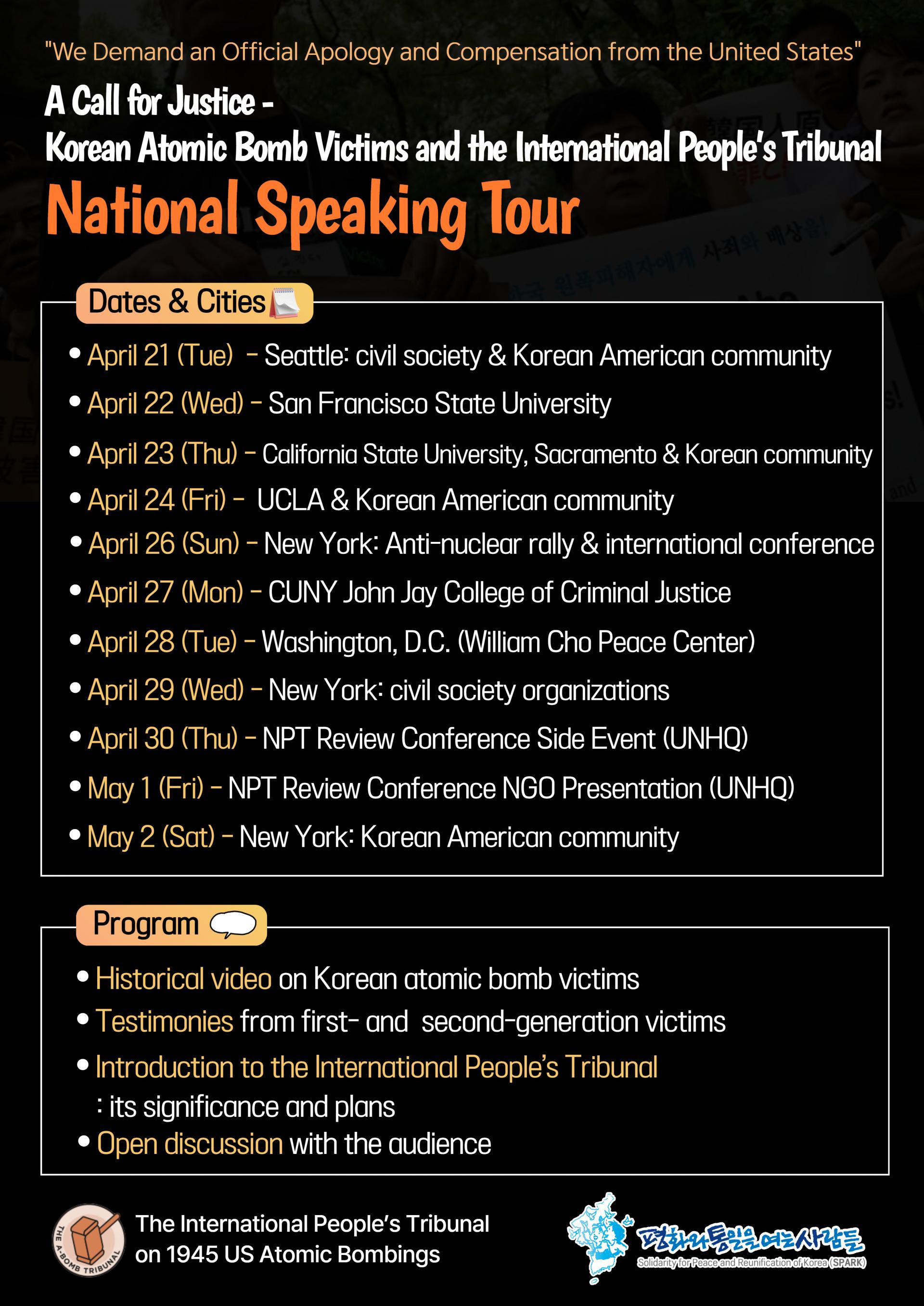
The International People’s Tribunal on 1945 US Atomic Bombings
Key Highlights:
First- and second-generation Korean atomic bomb victims will undertake a U.S. speaking tour from April 21 to May 3, visiting major cities
Survivors will share their long-overlooked experiences and call for a U.S. apology and compensation for the 1945 atomic bombings
“Victims exist, but no one takes responsibility” — testimonies highlight ongoing inter-generational suffering and struggle for redress more than 80 years after the bombings of Hiroshima and Nagasaki.
Organizers will invite global civil society to participate in the upcoming International People’s Tribunal on the 1945 Atomic Bombings (“A-Bomb Tribunal”), to be held in Seoul from November 13 to 15, 2026.
Many people are saying that Donald Trump is insane. He may be. So too Benjamin Netanyahu. But if so, it is a form of insanity that includes the calm sanity of Adolf Eichmann and Harry Truman as they went about their business of mass extermination.
Crazy, to use the vernacular, is an elusive word nearly impossible to define, especially when an entire society can be crazy, as Erich Fromm, the German-American social-psychologist, has argued. Obedience is a much touted virtue, not only in overt police regimes but in so-called democracies – but obedience to whom? To mass murderers?
Obedience can be imbibed through osmosis. I remember Regis, my Jesuit high school’s motto – Deo et Patriae, for God and country – and how it linked obedience to God with obedience to the United States. I am certain that such a linkage would be denied by school authorities, but of course the Jesuits are known for their guile. So it didn’t surprise me when I was applying for a discharge from the Marines during the Vietnam War and was being questioned by a group of Marine Officers and one starting screaming at me: “What the hell kind of God are you talking about? I’m a Catholic, too, and my God supports the Marines and the war in Vietnam.” It was hard not to laugh sardonically, especially as he gesticulated with his large cigar for emphasis. I was then sent to a psychiatrist for evaluation who told me, to my great surprise, that he agreed with me and that the country’s leaders were insane.
Adolf Eichmann was declared “perfectly sane” by a psychiatrist who examined him when he went on trial for his routine daily tasks of carrying out Hitler’s orders to exterminate Jews. It was just another day at the office for Eichmann.
Harry Truman was not examined after he ordered the dropping of atomic bombs on Hiroshima and Nagasaki; he was assumed to be sane in committing these satanic crimes of mass murder. Just another state executive doing his duty by carrying out the orders of his puppet masters.
Those were the good old days when everyone knew who was sane and who was nuts. Now we seem very confused. Perhaps Vietnam, Iraq, Afghanistan, Libya, Syria, Gaza, Ukraine, Iran, etc. have discombobulated many minds about who is sane or not, who is a mass murderer, who evil and who good, depending on which functionary is in the White House. Perhaps not.
If Trump is insane, how did he twice become the president of the United States? Do “sane” people – the well-adjusted ones? – not realize that Trump is the nominal head of an immense system whose history is one of mass murder from Wounded Knee to the recent U.S. slaughter of hundreds, mostly young girls, at the elementary school in Minab, Iran.
Trump gave the orders, but he did not launch those missiles. Nor did Netanyahu massacre Palestinians with his own hands. These fat boy killers prefer to keep their dainty hands clean of blood – to have their functionaries do the killing. I think of other functionaries and the names they gave to the atomic bombs they dropped on Japan: “Fat Man” and “Little Boy.” And we talk about sanity.
The “sane” obedient ones do the killing; the soldiers who carry out orders. As the Trappist monk Thomas Merton wrote in his profound book of essays, Raids on the Unspeakable, in 1966:
It is the sane ones, the well-adapted ones, who can without qualms and without nausea aim the missiles and press the buttons that will initiate the great festival of destruction that they, the sane ones, have prepared. What makes us so sure, after all, that the danger comes from a psychotic getting into position to fire the first shot in a nuclear war? Psychotics will be suspect. No one suspects the sane, and the sane ones will have perfectly good reasons, logical, well-adjusted reasons, for firing the shot. They will be obeying sane orders that have come sanely down the chain of command. And because of their sanity they will have no qualms at all. When the missiles take off, then, it will be no mistake. We can no longer assume that because a man is “sane” he is therefore in his “right mind.” The whole concept of sanity in a society where spiritual values have lost their meaning is itself meaningless.
Our problem, as the historian Howard Zinn once said, is civil obedience, surely not civil disobedience, that people everywhere are so submissive to authority that they will dutifully obey the orders of people like Trump and Netanyahu. Such obedience, all false rhetoric to the contrary, is drilled into us from birth through overt and covert methods of fear inculcation.
My dear departed mother’s father was a New York City cop. When she was young, he made her and her mother, trembling with fear, sit at the kitchen table, upon which he put his revolver, and warned them to obey him or else. Such tyrannical behavior was slightly mitigated decades later when he and my grandmother lived with us. When he heard that any of us eight kids were misbehaving, he, old, feeble, and long retired, would don his police uniform and stomp down the stairs waving his long baton to frighten us. I never got to ask my mother why she tolerated this. Such is the long life of fear.
There are reports that by April’s end the U.S. will have 60,000 troops in Iran’s vicinity. If Trump gives the orders to invade Iran, how many will refuse? How many will refuse to send missiles into more Iranian schools and homes? If Trump gives orders for a nuclear strike, can we expect military individuals with consciences to disobey? Will any heed Pope Leo’s voice about this war? That it is immoral.
It takes a system to wage war, and civil and military obedience to support it. That system – what former CIA analyst Ray McGovern has adroitly named MICIMATT: The Military-Industrial-Congressional-Intelligence-Media-Academia-Think-Tank system – is so deeply woven into American society and therefore the hearts and minds of its citizens and military personnel that one can only hope against hope that Trump’s orders will be disobeyed by many. It is a desperate hope, I realize.
War Is A Racket, as Marine Major General Smedley Butler once put it. It is waged for the tyrannical oligarchs and always kills mostly civilians. Over ninety percent now, probably more. Innocent people, little girls at school, babies in their mothers arms – it is organized state terror. War is immoral. It is not complex. It is simple. Like the gospel message the Pope is conveying.
Like all tyrants, Trump is surrounded by sycophants, fearful little people like Karoline Leavitt, JD Vance, Marco Rubio, Peter Hegseth, Robert Kennedy, Jr., et al. The whole crew groveling at his feet are implicated in his war crimes. To hear Kennedy defend Trump’s war on Iran, his Ukraine and other policies, by claiming his father, Senator Robert Kennedy, and his uncle, President Kennedy, would agree with Trump is to pass through the looking glass. Kennedy, also a staunch defender of Israel and its savage policies, makes me shake my head in wonder. Was his political conversion, like St. Paul’s, from a light from heaven that sent him to the ground where Trump’s divine voice asked him to hop on the MAGA train? Or was the voice more insidious and subtle, a quiet call from someone else late in the night? However it happened, it is complete, and he is now fully marching to the drums of war along with Trump’s ass-kissing entourage. I, once Bobby Kennedy, Jr.’s ardent supporter when he announced his run for the presidency, feel like a fool.
Let me recommend an important film – Terence Malik’s A Hidden Life – about a different type of man, Franz Jägerstätter, an Austrian peasant farmer from an isolated small mountainous village who refuses to take an oath to Hitler and fight in the German army. He knew that his refusal would not stop Hitler; but he also knew his conscience came from God and not the state. So he said no. NO! I will not follow orders, despite everyone telling him to do so. For his refusal, he suffered terribly and was beheaded. In my review of this film which I wrote six years ago as Joseph Biden was three weeks into his presidency, I said:
While Franz is eventually put on trial by the German government, it is we as viewers who must judge ourselves and ask how guilty or innocent are we for supporting or resisting the immoral killing machine of our own country now. Hitler and his Nazis were then, but we are faced with what Martin Luther King called ‘the fierce urgency of now.’
Many Americans surely ask with Franz, ‘What has happened to the country that we love?’ But how many look in the mirror and ask, “Am I a guilty bystander or an active supporter of the United States’ immoral and illegal wars all around the world that have been going on for so many years under presidents of both parties and have no end? Do I support the new cold war with its push for nuclear war with its first strike policy? Do I support, by my silence, a nuclear holocaust?’
The questions still linger. Let first Thomas Merton and then the twenty-two years-old Bob Dylan have the last words:
“For since man has decided to occupy the place of God he has shown himself to be by far the blindest, and cruelest, and pettiest and most ridiculous of all the false gods. We can call ourselves innocent only if we refuse to forget this, and if we also do everything we can to make others realize it.“