‘Tactical’ Nuclear Weapons Could Unleash Untold Damage, Experts Warn
By Ed Holt , BRATISLAVA, Nov 10 2022 (IPS) – Since the start of Russia’s invasion of Ukraine, the conflict’s potential to escalate to the use of nuclear weapons has been highlighted by political analysts and military experts alike.
Now growingly bellicose rhetoric from Russian president Vladimir Putin, particularly following the illegal annexations of four parts of Ukraine at the end of September, has raised fears he may be seriously considering using them. He has been quoted in September this year as saying that Russia would use “all available means to protect Russia and our people”, but last month said there was no need to consider the use of nuclear weapons. This week Russia ordered troops to withdraw from the Dnieper River’s west bank near the southern city of Kherson.
But while much of the media debate around this prospect has focused on the expected use of a so-called low-yield “tactical” nuclear weapon and what this might mean strategically for either side in the war, anti-nuclear campaigners say any discussion should be reframed to reflect the devastating reality of what the use of even the smallest weapons in modern nuclear arsenals would mean.
They say that even if only one such bomb was dropped, be it in Ukraine or in any other conflict, the consequences would cause a country – if not a continent-wide catastrophe, with horrific immediate and long-term health effects and a subsequent humanitarian disaster on a scale almost certainly not seen before.
Moreover, they say, a single strike would almost certainly be met with a similar response, quickly igniting a full-scale nuclear war that would threaten much of human life on earth.
“There is no conceivable reality in which a nuclear weapon is used, and life goes on as normal. It is very, very likely that there would be escalation and additional nuclear weapons used, but even the use of one nuclear weapon would break a decades-long taboo on the use of the most catastrophic, horrific weapon ever created,” Alicia Sanders-Zakre, Research, and Policy Coordinator, at the International Campaign to Abolish Nuclear Weapons (ICAN) told IPS.
“We have already seen the global impacts of the war in Ukraine just using conventional weapons, including worldwide rising inflation, and energy and food shortages. But the use of a nuclear weapon would really have consequences beyond what any of us can imagine,” she added……………………………………………
Campaigners against nuclear weapons worry the global public is not being made properly aware of the scale of the loss of life and ecological damage which would be wrought by the use of such a weapon.
“There has been a lot of discussion about using a tactical nuclear bomb in Ukraine. But the use of the word ‘tactical’ is no more than a rebranding exercise to make a nuclear weapon sound like a conventional one,” Dr Ruth Mitchell, Board Chair of the International Physicians for the Prevention of Nuclear War (IPPNW), told IPS.
“A tactical nuclear weapon would be about the same size as the one dropped on Hiroshima and Nagasaki, and we don’t need to imagine what the effects would be; we have already seen them,” she added.
The death toll itself would be massive, but authorities would also have to deal with radioactive fallout possibly contaminating large areas, while the event itself would trigger massive population dislocation.
And a report by ICAN also shows that even the most advanced healthcare systems would be unable to provide any effective response in such a situation, highlighting the likely destruction of local healthcare facilities and staff and pointing out that the 1945 atomic bombing of Hiroshima destroyed 80% of its hospitals and killed almost all its doctors and nurses………………………….more https://www.ipsnews.net/2022/11/tactical-nuclear-weapons-treat-could-unleash-untold-damage-experts-warn/?utm_source=rss&utm_medium=rss&utm_campaign=tactical-nuclear-weapons-treat-could-unleash-untold-damage-experts-warn
The definitive case against nuclear submarines for Australia

Australia needs submarines, but conventional ones are more than adequate for the nation’s security. Australia’s north is archipelagic, which means smaller, shorter-ranged submarines can close maritime avenues of approach.
Australia needs submarines, but conventional ones are more than adequate for the nation’s security. Australia’s north is archipelagic, which means smaller, shorter-ranged submarines can close maritime avenues of approach.
The Saturday Paper, Albert Palazzo -adjunct professor at UNSW Canberra. He was a former director of war studies for the Australian Army. November 12, 2022
It’s more than a year since Australia scuttled its submarine deal with France in favour of the nuclear-powered submarine arrangement Scott Morrison announced as part of the AUKUS agreement. There’s been a change of government and more announcing, yet any real detail on why we need such boats, how we’ll get them, which ones they’ll be and how much they’ll cost remains unknown. What has become increasingly clear, however, is that these warships are a massive boondoggle for which there is little strategic justification.
Australia maintains its defence forces to provide for the nation’s security. Every capability the Australian Defence Force acquires undergoes a detailed decision process that includes an examination of how the weapon meets national security requirements. With the nuclear-powered submarine program, however, Australia’s starting point was an announcement confirming the acquisition and the AUKUS agreement, an order of proceedings that conveniently bypassed the messy and challenging aspects of justification for the purchase.
Perhaps skipping this phase was necessary because the rationale given for the acquisition is unsound. At best, it is a desire to be seen to be supporting the ANZUS Treaty. What is not being asked is whether support for the alliance should be the main basis for the acquisition of such expensive platforms with such narrow utility.
Like a kid in a lolly shop, Australia has been given permission to buy the biggest treat on display … What is missed, however, is that being in the inner sanctum generates a massive obligation – and some day that bill may fall due.
What does Australia intend to do with its fleet of nuclear-powered submarines? The answer seems to be that we’ll project power into the East and South China seas, in order to deter our largest trading partner, China, from taking actions inimical to Australian and American interests.
If China is a threat today, why is the government planning to acquire a platform that will not be available for 15 years or more? Shouldn’t the priority be on more readily available weapons? These would include off-the-shelf conventional submarines, additional long-range strike missiles, and drones of all kinds.
Even once Australia has acquired its entire fleet of eight submarines, only two or three are likely to be available for operations at any one time. Deterrence necessitates the ability to intimidate one’s opponent. China is a large country with great industrial depth and a population accustomed to hardship. It also has 66 submarines of its own and more on the way. It is hubris to expect Australia will be able to intimidate a great power, at least on its own.
More worryingly, the seas in which Australia aims to operate are within China’s anti-access/area denial zone, an area guarded by missiles, mines, aircraft and ships, and of such lethality that even the United States is unsure it could penetrate without massive losses. Even if our future submarines did get inside this defensive zone, they would not last long. Essentially, these submarines should not be expected to return home.
Survivability is an important criterion for such an expensive purchase. Enthusiasts point to the better survival potential of nuclear-powered submarines because they remain submerged for longer periods, thereby making detection harder. By contrast, conventional subs must periodically surface to recharge their batteries. But this is an advantage that is fast becoming irrelevant. Sensor technology is improving and becoming pervasive, as demonstrated daily in the war in Ukraine. It is a very big gamble to act on a presumption that sub-surface sensors will not improve in the 15 to 20 years before Australia’s submarines become operational. In fact, a study from Australian National University’s National Security College expects that before 2050 the oceans will become fully transparent to hunters from above.
Any defensive advantage currently possessed by nuclear-powered submarines will be gone.
More questions need to be asked: What is the strategic benefit of being able to operate off the Chinese coast? How do nuclear-powered submarines improve Australia’s security? And are there better options for the nation’s defence?
The answers to the first two questions are: “There is none” and “They don’t.” The third answer is: “Yes, there are indeed better options.” Australia needs submarines, but conventional ones are more than adequate for the nation’s security. Australia’s north is archipelagic, which means smaller, shorter-ranged submarines can close maritime avenues of approach. …………
Supporters of the nuclear-powered submarine pay too little attention to the project’s opportunity cost. According to experts at the Australian Strategic Policy Institute, the eight planned submarines will cost at least $116 billion, and likely much more – upwards of $200 billion, according to some analysts. Australia needs submarines, but conventional ones are more than adequate for the nation’s security. Australia’s north is archipelagic, which means smaller, shorter-ranged submarines can close maritime avenues of approach………………………….. more https://www.thesaturdaypaper.com.au/opinion/topic/2022/11/12/the-definitive-case-against-nuclear-subs
Climate change, not China, is Australia’s real security danger

The definitive case against nuclear subs The Saturday Paper, Albert Palazzo -adjunct professor at UNSW Canberra. He was a former director of war studies for the Australian Army. November 12, 2022 “……………………………………………………………. Too many security officials hold to the mistaken belief that China is the most significant threat Australia faces. In fact, climate change deserves the top spot. Climate scientists, United Nations officials and military commanders themselves, including current US Secretary of Defense Lloyd Austin, consider climate change an existential threat to survival. Any threat posed by China is much more limited. At worst, China’s challenge to the US-led world order could result in America’s withdrawal from the Western Pacific. Climate change could lead to the end of the human project and take countless other species down with us.
China represents, at most, a second-order threat, but it is China that draws the obsessive focus of much of the current generation of security thinkers. It does not make sense for Australia to invest so much in a weapon system that has no utility against the nation’s most dangerous threat, yet this is what is happening.
Advocates of nuclear-powered submarines also propose that constructing these vessels in Adelaide will help sustain a sovereign shipbuilding industry. In fact, the opposite is the likely result. Once in service these vessels will actually increase Australia’s dependence on the US and foreign contractors. This is because many of the sub’s critical components, weapons and systems will be made by foreign parties. Australian sailors might even need shadow US sailors to co-staff technical positions until Australia generates enough nuclear-savvy personnel of its own.
The government has announced it will invest between $168 billion and $183 billion in what it has called a national naval shipbuilding enterprise, with the goal of sustaining and growing a domestic shipbuilding capability and securing Australian jobs for the future. Such a capability is a noble goal, but what has been left unexplained is why it should be such a priority compared with foreign-dominated industries that are more critical to the nation’s future wellbeing.
Last summer, for example, Australian transport risked grinding to a halt as a result of the urea crisis, which led to a serious shortage of AdBlue, a vital diesel fuel additive. Without AdBlue, the nation’s fleet of long-haul trucks would have stopped moving, resulting in supermarkets running out of food, farmers not harvesting their crops and the mining industry coming to a halt. Yet there has been no talk of taxpayer-supported AdBlue production in Australia. Similarly, many medicines are imported, as are a host of important everyday items, such as baking powder and matches. Unlike shipbuilding, these industries apparently warrant no support.
If one wanted a truly sovereign defence industry, then the product that might mandate the level of support proposed for the subs is microchips. Virtually all military and civilian technology contains chips, yet Australia is happy to remain fully reliant on overseas suppliers for this most important of components. Establishing a domestic industry would require a huge subsidy, as well as additional investment in tertiary education and precursor manufacturing processes. Without these chips, however, no weapon system is truly sovereign.
So why the nuclear-powered subs, if they make so little sense? The obvious answer is to support the alliance. Instead of aiming for self-reliance, Australia has always preferred to seek the protection of a great power. But there is another reason: like a kid in a lolly shop, Australia has been given permission to buy the biggest treat on display. Nuclear-powered subs are one of America’s most closely guarded technologies. If Australia gets them, it will be a clear sign that, like Britain, we have been admitted to a very exclusive club, the inner sanctum of US security. What is missed, however, is that being in the inner sanctum generates a massive obligation – and some day that bill may fall due. https://www.thesaturdaypaper.com.au/opinion/topic/2022/11/12/the-definitive-case-against-nuclear-subs
Pentagon exploits post 9/11 laws to wage ‘secret wars’ worldwide: Report
By abusing ‘security cooperation authorities,’ the US Department of Defense has waged war on dozens of fronts without the need to report to congressional authorities.
https://thecradle.co/Article/news/18028 ByNews Desk- November 09 2022,
A report released last week by the New York University School of Law’s Brennan Center for Justice details how the US Department of Defense (DoD) has been allowed to covertly deploy troops and wage secret wars over the past two decades in dozens of countries across the globe.
Among the nations in West Asia affected by these so-called ‘security cooperation authorities’ are Lebanon, Iraq, Syria, and Yemen; however, they also include many African and Latin American nations.
Known as ‘security cooperation authorities,’ they were passed by the US Congress in the years following the 11 September attacks, and are a continuation of the 2001 Authorization for Use of Military Force (AUMF), a piece of legislation that has been stretched by four successive governments.
According to the report, the AUMF covers “a broad assortment of terrorist groups, the full list of which the executive branch long withheld from Congress and still withholds from the public.”
Following in this tradition, the ‘security cooperation authorities’ being abused by the Pentagon are Section 333 and Section 127e of Title 10 of the United States Code (USC).
Section 333 authorizes the US army to “train and equip foreign forces anywhere in the world,” while Section 127e authorizes the Pentagon to “provide support to foreign forces, paramilitaries, and private individuals who are in turn supporting US counterterrorism operations,” with a spending limit of $100,000,000 per fiscal year.
However, thanks to the vague definition of ‘support’ and ‘training’ in the text of these laws, both Section 333 and Section 127e programs have been abused to target “adversarial” groups under a strained interpretation of constitutional self-defense; they have also allowed the US army to develop and control proxy forces that fight on behalf of – and sometimes alongside – their own.
As a result of this, in dozens of countries, these programs have been used as a springboard for hostilities, with the Pentagon often declining to inform Congress or the US public about their secret operations under the reasoning that the incidents are “too minor to trigger statutory reporting requirements.”
“Researchers and reporters uncovered Section 127e programs not only in Afghanistan and Iraq, but also in Cameroon, Egypt, Kenya, Lebanon, Libya, Mali, Mauritania, Niger, Nigeria, Somalia, Syria, Tunisia, and Yemen,” the report highlights.
Researchers also point out that defense authorities “have given little indication of how [they] interpret Section 333 and 127e.”
Even more concerning, and ignoring the damage caused by these ‘anti-terror’ laws, the US Congress recently expanded the Pentagon’s security cooperation authorities, particularly with Section 1202 of the National Defense Authorization Act (NDAA).
Section 1202 allows the US army to allow “irregular warfare operations” against “rogue states” like Iran or North Korea, or “near-peers,” like Russia and China.
The report comes at a time when the US army and its proxy militias are accused of illegally occupying vast regions of Syria and Yemen, looting oil from the war-torn countries, just over a year after their brutal occupation of Afghanistan ended. Moreover, a former US official on Tuesday revealed that anti-Iran militias are being armed in the Iraqi Kurdistan Region (IKR), where both the CIA and the Mossad are known to operate.
Another US nuclear marketing deal done ay COP27 – $3billion for Romania reactors project

The US Export–Import Bank said it intends to provide USD 3 billion for a project for two additional reactors in Romania’s Cernavodă nuclear power plant.
Romanian Prime Minister Nicolae Ciucă announced at the United Nations Climate Change Conference COP27 that a third of the required funds for units 3 and 4 in the Cernavodă nuclear power plant would be provided by the United States Export–Import Bank. The preparatory phase will be completed by the end of March, he said.
The US Exim Bank issued letters of intent for USD 50 million for the second phase and USD 3 billion for the construction of the two reactors, the prime minister revealed at the event in Egypt. The plan is to implement the second phase in the third quarter of 2025 and build the units in 2030, Ciucă said…….
The Cernavodă nuclear power plant operates under state-owned Nuclearelectrica. A contract was signed for the preparatory stage last November with Candu Energy, a subsidiary of SNC-Lavalin from Canada, through Romania’s project firm EnergoNuclear.
In addition, Nuclearelectrica intends to deploy US-based NuScale’s small modular reactor (SMR) technology for a 462 nuclear power plant on the site of a former coal plant.
Germany refuses to build nuclear Uniper plant in Sweden
By Charles Szumski | EURACTIV.com, Nov 11, 2022 Nikolaus Kurmayer contributed to reporting
Energy giant Uniper will not build any power plants in Sweden, the company that will be wholly owned by the German state from next year announced Thursday, flouting plans of its Swedish subsidiary Barsebäck Kraft to build a Clean Energy Park.
No new nuclear power plant will be built in Sweden by the German energy company Uniper, Sveriges Radios Ekot reported on Thursday.
“Neither in Sweden nor elsewhere does Uniper have any plans to build a new nuclear power plant, that’s a fact”, spokesman George Oppermann told the radio.
Uniper is part owner of all three active nuclear power plants in Sweden, Oskarshamn, Ringhals and Forsmark. It is also the owner of the Barsebäck powerplant, which is being dismantled…….
From the start of next year, Uniper will be taken over by the German state, who decided to close all remaining nuclear power plants in the country from April next year……….. https://www.euractiv.com/section/politics/news/germany-refuses-to-build-nuclear-uniper-plant-in-sweden/
The three parties making up Sweden’s new ruling right-wing coalition, as well as the supporting far-right Democrats of Sweden, signed a pro-nuclear coalition accord, promising 400 billion SEK (€36 billion) for new nuclear power, with Vattenfall to immediately start planning new nuclear power at Ringhals and other sites.
Concealing US Militarism By Making It Sacred
The depth of the militarization of the United States and the harshness of its wars abroad have been concealed by converting death into something sacred, writes Kelly Denton-Borhaug in an address to U.S. veterans on Veterans Day.
Consortium News. November 11, 2022 By Kelly Denton-Borhaug
TomDispatch.com
Dear Veterans,
I’m a civilian who, like many Americans, has strong ties to the U.S. Armed Forces. I never considered enlisting, but my father, uncles, cousins, and nephews did.
As a child I baked cookies to send with letters to my cousin Steven who was serving in Vietnam. My family tree includes soldiers on both sides of the Civil War. Some years before my father died, he shared with me his experience of being drafted during the Korean War and, while on leave, traveling to Hiroshima, Japan. There, just a few short years after an American atomic bomb had devastated that city as World War II ended, he was haunted by seeing the dark shadows of the dead cast onto concrete by the nuclear blast.
As Americans, all of us are, in some sense, linked to the violence of war. But most of us have very little understanding of what it means to be touched by war. Still, since the events of Sept. 11, 2001, as a scholar of religion, I’ve been trying to understand what I’ve come to call “U.S. war-culture.” For it was in the months after those terrible attacks more than 20 years ago that I awoke to the depth of our culture of war and our society’s pervasive militarization.
“American civilians deceive themselves by insisting that they’re a peaceful nation desiring the well-being of all peoples.”
Eventually, I saw how important truths about our country were concealed when we made the violence of war into something sacred. And most important of all, while trying to come to grips with this dissonant reality, I started listening to you, the veterans of our recent wars, and simply couldn’t stop.
Dismantling the Justifications……………………………………………………
U.S. political leaders annually approve a military budget that’s apocalyptically high (and may reach a trillion dollars a year before the end of this decade). The U.S. spends more on its military than the next nine nations combined to finance the violence of war.
Political leaders in the U.S. and many citizens insist that having such a staggering infrastructure of war is the only way Americans will be secure, while claiming that they’re anything but a warring people. Analysts of war-culture know better. As peace and conflict studies scholar Marc Pilisuk puts it: “Wars are products of a social order that plans for them and then accepts this planning as natural.”
Learning War Is Like Ingesting Poison
I’ve personally witnessed the confusion and conflicted responses of many veterans to this mystifying distortion of reality. How painful and destabilizing it must be to return from your military deployment to a society that insists on crassly celebrating and glorifying war, while so many of you had no choice but to absorb the terrible knowledge of what an atrocity it is.
“War damages all who wage it,” chaplain Michael Lapsley wrote. “The United States has been infected by endless war.” Veterans viscerally carry the violence of war in their bodies. It’s as if you became “sin-eaters” who had to swallow the evil of the conflicts the United States waged in these years and then live with their consequences inside you…………………………………………
The unimaginable losses to families, communities, infrastructure, and culture in the lands where such conflicts have been fought in this century are invisible to most citizens, while typical Veterans Day commemorations recast you as messianic redemptive figures who “have paid the price for our freedom.”
“War-culture in this country leaves us with a residual collective trauma that weighs us all down and is only made worse by a national blindness to it.”
But to convert war-making into something sacred means fashioning a deceitful myth. Violence is not a harmless tool. It’s not a coat that a person wears and takes off without consequences.
Violence instead brutalizes human beings to their core; chains people to the forces of dehumanization; and, over time, eats away at you like acid dripping into your very soul. That same dehumanization also undermines democracy, something you would never know from the way the United States glorifies its wars as foundational to what it means to be an American.
Silencing and Commodifying Veterans……………………………………………………………………
Addiction to War
More often than not, the invisible wounds of returning veterans are shrouded in silence. For some of you, unbearable pain led to disastrous consequences, including self-harm, loss of relationships, isolation, and self-destructive risk-taking. At least 1-in-3 female members of the armed forces has experienced sexual assault or harassment from fellow service members.
More than 17 of you veterans take your own lives every day. And you live with all of this, while so much of the rest of the nation fails to muster the will to see you, hear you, or face honestly the American addiction to war.
The truths about war that you might tell us are generally rejected and invalidated, cementing you into a heavy block of silence. Military chaplain Sean Levine describes how the U.S. must “deny the trauma of its warriors lest that trauma radically redefine our understanding of war.” He continues, “Blind patriotism has done inestimable damage to the souls of thousands of our returning warriors.”
If we civilians paid attention to your honesty, we would find ourselves slammed headlong into a conflict with a national culture that glorifies war, conceals the political and material interests of the titans of weaponry and war production, and successfully distracts us from the depth of its destruction.
We civilians are complicit and so lurch away from facing the inevitable revulsion, sorrow, mourning, and guilt that always accompany the reality of war.
An Alternative for Veterans Day
Honestly, the only way forward is for you to tell — and us to compassionately take in — the unadulterated stories of war. …………………….. https://consortiumnews.com/2022/11/11/concealing-us-militarism-by-making-it-sacred/
On Nuclear Treaty, at Least, Biden Aims for Fresh START With Russia
Washington and Moscow look set to keep New START alive with working-level talks, despite historic tensions.
Foreign Policy, By Robbie Gramer, a diplomacy and national security reporter at Foreign Policy. 11 Nov 22
The Biden administration has announced that it will restart nuclear arms control talks with Russia, even as tensions spike over the latter’s war in Ukraine, coupled with the threat of Moscow using nuclear weapons.
The talks are expected to take place in Cairo in the near future, current and former U.S. officials said, and represent the first move by both sides to revive their mutual arms control agenda since U.S. President Joe Biden first halted dialogue after Russia launched its invasion of Ukraine in February…………………………………
The existing arms reduction treaty, New START, caps the number of intercontinental-range nuclear weapons in both Washington’s and Moscow’s arsenals and allows each side to conduct on-site weapons facility inspections in the other country. This allows experts from each country to visit the other country’s weapons sites to view the number of nuclear weapons, launch vehicles, and other details to confirm that both sides are adhering to the treaty. The treaty allows up to 18 on-site inspections per year.
It is the last remaining arms control treaty in place between Russia and the United States, which respectively have the first- and second-largest nuclear arsenals in the world. Under the terms of the treaty, which was first signed in 2010, both countries agreed to cap the number of nuclear warheads they could deploy on delivery systems to 1,550…………………..
Reviving the New START talks has been a quiet goal of the White House and State Department since at least this summer, according to current and former U.S. officials familiar with the matter, and scheduling a new meeting with the Russians on the issue has been in the works for months. Rose Gottemoeller, a former NATO deputy secretary-general and top U.S. arms control envoy who helped negotiate New START in 2009-10, welcomed the move and said the latest nuclear discussions shouldn’t be seen as any sort of concession to Russia.
“We don’t always get to choose with whom we negotiate, but if we’ve got an issue that’s in our national security interest, we have to work it,” said Gottemoeller, now a scholar at Stanford University. “We’ve achieved agreements with the Russians during some very dark hours in our bilateral relationship in the past.” …………….. https://foreignpolicy.com/2022/11/10/nuclear-talks-russia-us-biden-putin-new-start-treaty/
Campaign for Nuclear Disarmament, International Campaign to Abolish Nuclear Weapons, Global Zero, and Black Lives Matter- the reinvigorated anti-nuclear movement
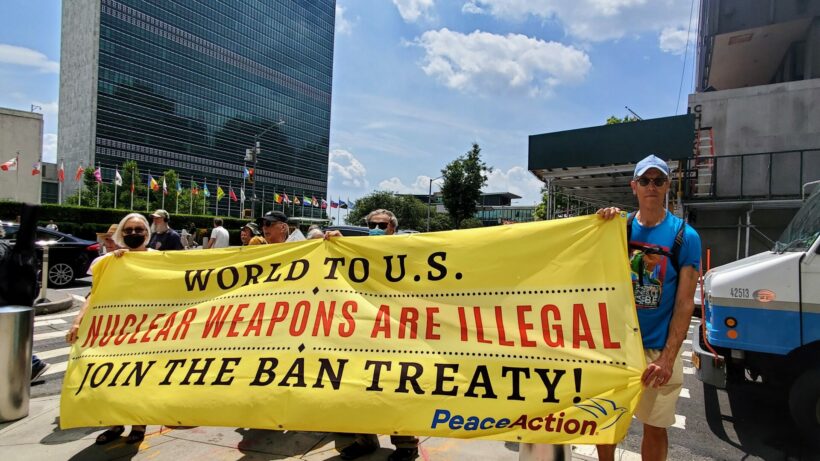
Fresh effort to ban the bomb as new generation bids for nuclear-free world,
Today’s disarmament activists are applying a new set of tactics to respond to threats including those from Putin in Ukraine
Guardian Julian Borger in Washington, Thu 10 Nov 2022
As nuclear dangers gather momentum three decades after the cold war, a disarmament movement is rising to meet them, with a new generation of activists.
In the late 50s and early 60s, and then again in the early 80s, when the US and the Soviet Union were pointing their missiles at each other in Europe, there were mass street protests against governments making plans for global annihilation.
The Campaign for Nuclear Disarmament (CND) was born in the UK and staged large-scale marches to the heart of the British nuclear weapons establishment at Aldermaston. More than four decades ago, a million Americans converged on New York’s Central Park to call a halt to the arms race and a nuclear freeze. At the end of 1982, more than 30,000 women formed a human chain around the Greenham Common air force base as an act of resistance to the deployment of US cruise missiles there. In October 1983, CND staged the biggest march through London the city had ever seen.
With Vladimir Putin’s invasion of Ukraine, and his repeated threats that he would use nuclear weapons if his regime felt in peril, the danger is every bit as real as it was during the Cuban missile crisis or the missile standoff in Europe. This time, there have not been any mass protests but there has been a popular response that has found other channels to express itself.
At the vanguard of the new movement is the International Campaign to Abolish Nuclear Weapons (Ican), which successfully canvassed support for a Treaty on the Prohibition of Nuclear Weapons (TPNW) at the UN general assembly, leading to its adoption in 2017.
Since then, more than 90 countries have signed the treaty and 68 have ratified it. It has not stopped the US and Russia from upgrading their arsenals and China from pursuing plans to become a third leading nuclear weapons power, but Beatrice Fihn, Ican’s executive director, said the ultimate aim was something more enduring: the delegitimization of nuclear weapons around the world.
“It makes it harder to see what is happening as you’re maybe not seeing so many people out on the streets,” said Fihn, who accepted the 2017 Nobel peace prize on Ican’s behalf. But she added: “The movement is very much here, and we’re definitely growing and building.”
While continuing the work of CND and the nuclear freeze movement, Ican and its 652 partner organisations around the world are seeking inspiration from other forms of civil society action, including the campaigns to ban landmines and cluster munitions, which sought to lay down new norms, and redraw the red lines of what is acceptable on the international stage.
“We’re trying to undo the brainwashing of accepting nuclear weapons as normal,” Fihn said. The movement’s greatest source of leverage, she argued, was the need of nuclear weapons for legitimacy.
“We see that with Russia right now. They’re fighting hard to re-establish legitimacy around the nuclear weapons and their security council seat and around the narrative of this war. And to me, it’s a sign that they are vulnerable.”
Kate Hudson, CND’s general secretary, says new membership has surged since Russia’s all-out invasion of Ukraine was unleashed.
“Activism is there in a big way, but it’s taking new forms, and it’s more fluid than previously: the way people understand and act on the links between issues, politically and in campaigning terms,” Hudson said.
The nuclear disarmament movement is no longer in a silo of its own, she argued, as it shares common concerns for those fighting to stop climate crisis, or to uphold social justice in a world where governments are spending huge amounts on nuclear stockpiles while the poorest people in their society are cold and hungry.
The Black Lives Matter (BLM) movement is now framing nuclear disarmament as a social justice issue for many newly recruited activists, making it a far more diverse field……………………………………
Mari Faines, partner for mobilisation in the Global Zero disarmament advocacy group, said BLM prompted her to see more clearly the “correlation between the systems of policing and militarism”, and the overlap between the nuclear weapons complex, social justice struggles and other existential threats.
Hurley is experimenting with new ways to talk about geopolitical threats. While working on her art degree, she writes a column on the Inkstick website, and her latest was about what the US and China might learn from the enemies-to-lovers trope in romantic fiction.
“You cannot fear-monger your way to a mass movement,” Molly Hurley said, arguing that what has been perceived as apathy within her generation was really a “coping mechanism for hopelessness”. The solution, she argued, was to offer some grounds for hope.
“There are things that we can do and we need to make clear all these feasible, very concrete steps that can be taken.” https://www.theguardian.com/world/2022/nov/10/nuclear-disarmament-activists-putin-ukraine
A bigger-than-ever pack of fossil fuel lobbyists at COP27.
New research from CEO, Corporate Accountability and Global Witness shows
there were over 100 more fossil fuel lobbyists registered to attend the
COP27 climate talks in Sharm El-Sheik, Egypt, than last year in Glasgow,
UK. Data analysis of the UN’s provisional list of named attendees
identified at least 636 fossil fuel lobbyists, affiliated with some of the
world’s biggest polluting oil and gas giants such as Shell, Chevron and BP.
This is an increase of over 25% from COP26, showing a rise in the influence
of the fossil fuel industry at the climate talks that are already rife with
accusations of civil society censorship and corporate influence.
Corporate Europe 10th Nov 2022
https://corporateeurope.org/en/2022/11/cop27-100-more-fossil-fuel-lobbyists-last-year
There are more than 600 fossil fuel lobbyists at the Cop27 climate
conference, a rise of more than 25% from last year and outnumbering any one
frontline community affected by the climate crisis.
Guardian 10th Nov 2022
Gas producers and their financial backers see Cop27 as an opportunity for
discussions about rebranding natural gas as a transition fuel rather than a
fossil fuel, experts have said. The push is coming from the host Egypt and
its gas-producing allies amid a global energy crisis compounded by
Russia’s invasion of Ukraine.
Guardian 11th Nov 2022
Sea level rise as Greenland ice thaws faster than expected
Sea levels might rise much faster than thought, data from Greenland
suggest. Greenland’s largest ice sheet is thawing at a much higher rate
than expected, a new study has revealed, suggesting it will add six times
more water to the rising sea levels than previously thought. And the trend
may not be limited to Greenland, scientists worry.
Space.com 10th Nov 2022
https://www.space.com/greenland-ice-melting-satellite-data-climate-change
Stress corrosion continues to trouble the French nuclear fleet
This week EDF updated its expectations for its nuclear fleet for this
winter, downgrading its output forecasts to 275-285 TWh, compared to the
previous estimate of 280-300 TWh.
The main driver of the downgraded
forecasts is a refusal by the French nuclear regulator, Autorité de
Sȗreté Nucléaire (“ASN”) to allow EDF to re-start number of reactors
with stress corrosion problems, in line with the planned schedule: Cattenom
1 (1.3 GW) will be offline for a further three and a half months until 26
February 2023; Chooz 1 (1.5 GW) will remain closed for about three months
until 29 January 2023; Penly 2 (1.33 GW) will be delayed by more than two
months until 29 January 2023; Cattenom 3 (1.3 GW) will be closed for a
further two and a half months until 26 February 2023. A couple of other
reactors are likely to have minor delays to their re-start schedules.
Watt Logic 10th Nov 2022
Closed Dounreay nuclear site records its highest number of radioactive particles in nearly two decades
. Fifteen radioactive particles have been discovered at a
nuclear site in Scotland that is currently being decommissioned, marking
the highest reported number in nearly two decades.
The particles contained niobium 94, which has a half life of 20,300 years, Americium-241, which has
a half life of 432.2 years, caesium 137, which has a half life of 30 years,
and cobalt 60, which has a half life of around 5.3 years. Eleven of the
finds were categorised as “significant”, which is the highest hazard
level used.
ENDS 9th Nov 2022
Finland’s Olkiluoto 3 repairs could take several months – expert

CARL-EMIL WICKSTRÖM, Helsinki, 10 Nov 2022, (Montel) Fixing the cracked feedwater pumps at Finnish nuclear reactor Olkiluoto 3 (1.6 GW) could take several months if the parts need to be manufactured, nuclear expert Juhani Hyvarinen told Montel on Thursday………………
The manufacturing of new impellers would take at least a few months. But changing them does not take long, a few days or maximum a few weeks, including testing.”
The Olkiluoto 3 reactor has been in test production since March but was stopped last month after cracks were found in feedwater pump impellers.
Operator TVO is investigating the issue but has not yet provided estimates of how long the repairs will take or details on part replacements……………………………………….
Risk of further issues?
The reactor’s launch is 13 years beyond schedule already and so the turbine had been idle since being installed over a decade ago.
The risk of further complications remained until the project was complete, said Hyvarinen.
“So far, the common denominator with the issues has been that the turbine facility is a prototype, it is not exactly like the ones used in Germany for decades,” he said…………..
However, the issue may be how the reactor was run, he said, pointing to the frequent ramp ups and down during the commissioning phase.
“Ramping up and down”
“The pumps are not really designed for that and the manufacturer might not have considered there would be so much ramping up and down,” Hyvarinen said.
“The initial problems were on the reactor’s side before moving to the turbine, he noted. “There is a wave of issues from inside of the facility towards the outside”, indicating that if any new issues arose, they would likely be linked to electrical equipment such as generators, he added. https://www.montelnews.com/news/1365685/ol3-repairs-could-take-several-months–expert
‘Clear case for inquiry into treatment of men in Britain’s nuclear test programme’
Mirror 10th Nov 2022, https://www.mirror.co.uk/news/politics/clear-case-inquiry-treatment-men-28463111
These brave men were exposed to levels of radiation subsequently linked to higher-than-average rates of cancer and birth defects
There is now a clear case for a public inquiry into the scandalous treatment of the men who took part Britain’s Cold War nuclear test programme.
Throughout our long campaign to win them justice, the Ministry of Defence has sought to confuse the issue and obstruct any inquiries.
These brave men were exposed to levels of radiation subsequently linked to higher-than-average rates of cancer and birth defects.
They have received no recognition, no medals and no compensation.
The MoD allegedly knew full well the dangers and sought to cover them up.
Nuclear test vet heroes denied truth as government ‘committed crimes against own servicemen’
Some documents which would reveal the truth have been withdrawn from the public record. Medical records have reportedly been falsified, withheld or destroyed.
An inquiry must examine not just the test programme but also the culture of secrecy which has added to families’ distress.
The poppy to be worn by Rishi Sunak at the Cenotaph this weekend is meant to be tribute to those who served the nation. If he really wants to support military personnel past and present he will act now
1 This Month

Tell Congress: Prevent Nuclear Catastrophe in Iran

Tell Congress: Prevent Nuclear Catastrophe in Iran

Read the Public Inquiry Report, the Commissioners’ report, Surrendering Australia: The AUKUS Deception is available to download for free at aukuspublicinquiry.com. Or just watch the replay of the National Press Club Luncheon.

19 November – Webinar – The Reality of Reprocessing
Time: 11:00 AM Pacific Time (US & Canada) / 2:00 PM Eastern / 7:00 PM UK / 8:00 PM CET
Register for the Zoom Event Here


Shut down the radiation-damaged Heysham nuclear reactors now
To see nuclear-related stories in greater depth and intensity – go to https://nuclearinformation.wordpress.com

Say No to NASA’s Reckless Nuclear Reactor on the Moon
Say No to NASA’s Reckless Nuclear Reactor on the Moon
-
Archives
- November 2026 (147)
- October 2026 (302)
- September 2026 (339)
- August 2026 (330)
- July 2026 (355)
- June 2026 (287)
- May 2026 (306)
- April 2026 (356)
- March 2026 (251)
- February 2026 (267)
- January 2026 (308)
- December 2025 (358)
-
Categories
- 1
- 1 NUCLEAR ISSUES
- business and costs
- climate change
- culture and arts
- ENERGY
- environment
- health
- history
- indigenous issues
- Legal
- marketing of nuclear
- media
- opposition to nuclear
- PERSONAL STORIES
- politics
- politics international
- Religion and ethics
- safety
- secrets,lies and civil liberties
- spinbuster
- technology
- Uranium
- wastes
- weapons and war
- Women
- 2 WORLD
- ACTION
- AFRICA
- Atrocities
- AUSTRALIA
- Christina's notes
- Christina's themes
- culture and arts
- Events
- Fuk 2022
- Fuk 2023
- Fukushima 2017
- Fukushima 2018
- fukushima 2019
- Fukushima 2020
- Fukushima 2021
- general
- global warming
- Humour (God we need it)
- Nuclear
- RARE EARTHS
- Reference
- resources – print
- Resources -audiovicual
- Weekly Newsletter
- World
- World Nuclear
- YouTube
-
RSS
Entries RSS
Comments RSS

