‘Iran Posed No Imminent Threat’: Trump’s Counterterrorism Director Resigns in Protest
Trump decided to attack Iran despite Director of National Intelligence Tulsi Gabbard testifying before Congress last year that it “is not building a nuclear weapon,” and that late Iranian Supreme Leader Ali Khamanei—who was assassinated last month by an Israeli airstrike—“has not authorized the nuclear weapons program he suspended in 2003.”
US intelligence agencies have repeatedly come to the same conclusion since the George W. Bush administration.
“I cannot support sending the next generation off to fight and die in a war that serves no benefit to the American people,” the far-right former Army Ranger and CIA officer
Brett Wilkins, Mar 17, 2026, https://www.commondreams.org/news/joe-kent-resigns
National Counterterrorism Center Director Joe Kent announced his resignation Tuesday, accusing President Donald Trump of being manipulated by Israel into launching a war on Iran.
“I cannot in good conscience support the ongoing war in Iran. Iran posed no imminent threat to our nation, and it is clear that we started this war due to pressure from Israel and its powerful American lobby,” Kent—a former Army Ranger and CIA paramilitary officer often described as a white nationalist and conspiracy theorist—wrote in his resignation letter to Trump.
National Counterterrorism Center Director Joe Kent announced his resignation Tuesday, accusing President Donald Trump of being manipulated by Israel into launching a war on Iran.
“I cannot in good conscience support the ongoing war in Iran. Iran posed no imminent threat to our nation, and it is clear that we started this war due to pressure from Israel and its powerful American lobby,” Kent—a former Army Ranger and CIA paramilitary officer often described as a white nationalist and conspiracy theorist—wrote in his resignation letter to Trump.
“Early in this administration, high-ranking Israeli officials and influential members of the American media deployed a misinformation campaign that wholly undermined your America First platform and sowed pro-war sentiments to encourage war with Iran,” Kent continued. “This echo chamber was used to deceive you into believing that Iran posed an imminent threat to the United States, and that should you strike now, there was a clear path to a swift victory.”
“This was a lie and is the same tactic the Israelis used to draw us into the disastrous Iraq War that cost our nation the lives of thousands of our best men and women,” he claimed.
While there is no solid evidence that Israel “drew” the US under then-President George W. Bush into invading Iraq and toppling longtime dictator and erstwhile US ally Saddam Hussein, then-Israeli opposition leader Minister Benjamin Netanyahu said in 2008 that the September 11, 2001 attacks on the United States—which Iraq had nothing to do with—were “benefiting” Israel. He also said two years later that “America is a thing you can move very easily, move it in the right direction.”
Kent, whose first wife, Navy intelligence officer Shannon Smith, was killed in a 2019 bombing targeting US forces invading Syria, said that “I cannot support sending the next generation off to fight and die in a war that serves no benefit to the American people nor justifies the cost of American lives,” said
“I pray that you will reflect upon what we are doing in Iran, and who we are doing it for,” he told the president.
Trump decided to attack Iran despite Director of National Intelligence Tulsi Gabbard testifying before Congress last year that it “is not building a nuclear weapon,” and that late Iranian Supreme Leader Ali Khamanei—who was assassinated last month by an Israeli airstrike—“has not authorized the nuclear weapons program he suspended in 2003.”
US intelligence agencies have repeatedly come to the same conclusion since the George W. Bush administration.
Kent—who has been a staunch Trump loyalist—is the most prominent US official to resign as the president, who infamously campaigned for reelection on a promise of no new wars, has attacked seven countries since returning to the White House and 10 over the course of his two terms.
In contrast to his vehement opposition to waging war on Iran, Kent led an effort to rewrite intelligence so that it did not clash with Trump’s dubious claim that the government of Venezuela was involved with the Tren de Aragua drug trafficking gang ahead of the recent US invasion of the South American country and kidnapping of its president, Nicolás Maduro.
While Kent’s resignation drew praise from many opponents of Trump and the illegal US-Israeli war of choice in Iran, others focused on his troubling record and associations.
“Joe Kent isn’t suddenly a good guy,” former Republican Congressman Adam Kinzinger (R-Ill.) said on X. “He’s a straight-up white nationalist. But there are fissures in the MAGA base.”
MeidasTouch News CEO Ron Filipowski also took to social media, writing, “Just for the record, I’m glad Joe Kent resigned but he is still a POS.”
US Congress near totally complicit in Trump’s criminal Iran war.
Walt Zlotow West Suburban Peace Coalition Glen Ellyn IL 17 March 26
There are 533 congresspersons (2 vacancies) all of whom have allowed Trump to launch his immoral, criminal war on Iran that has failed. Not a single one called out Trump’s criminality before his clear, obvious decision to invade.
Virtually all 271 Republicans are either supportively silent about its criminality or are, like Senator Lindsey Graham and Senator Ted Cruz, ecstatic Trump finally launched the war they have e spent years promoting. Even the lone antiwar Republicans, Senator Rand Paul and Representative Tom Massie, avoid calling out Trump’s criminality by focusing on his usurping Congress’ constitutional power to declare war.
Aside from fanatical Democratic war supporter Senator John Fetterman, the other 261 Democrats oppose the war for two political reasons. They support Rand Paul and Tom Massie’s constitutional argument regarding Congressional primacy in declaring war. But they are more motivated by using the war’s failure and rising US gas prices to demolish the Trump presidency and regain Democratic control of Congress this November. Their cynicism ignoring Trump’s international law criminality killing thousands including 13 US military, causing massive destruction in Iran, Israel and the Gulf States, pushing the world economy into decline is both stunning and reprehensible.
President Trump is a monstrous war criminal who, in a just world, would be answering to his war crimes in the dock at The Hague. But the 533 cowardly congresspersons who either support Trump’s war crimes or simply use them to collapse his presidency are near fully complicit in them. When the war ends and the wages of his sins are totaled up, President Trump can look toward the 533 congresspersons on Capitol Hill and beam…’Couldn’t have done it without you.’
Coalition Grows Against Hochul’s Nuclear Plan
By Karl Grossman South Shore Press 5th March 2026
As Gov. Kathy Hochul pushes to make New York the “center” of a revival of nuclear power in the United States, the third in a series of “Forums for a Nuclear-Free New York” was held last week to counter her drive.
Meanwhile, more than 100 organizations—including Sag Harbor-based Coalition Against Nukes, founded by Priscilla Star, its director, and Huntington-based Healthy Planet, its executive director Bob DiBenedetto—sent an “open letter” to Governor Hochul, with copies to other state officials, pushing back on what it called New York’s “failing energy vision.”
It charged there now is an “increasingly likely failure…of will if not the targets themselves…to meet” the climate goals set by a 2019 state law which emphasizes solar and other renewable energy sources.
The “Forums for a Nuclear-Free New York” have been organized by a coalition of environmental organizations. The first was titled “Safe and Affordable Energy,” featuring Dr. Mark Z. Jacobson, professor of civil and environmental engineering at Stanford University and author of “No Miracles Needed,” a book about how existing green power sources led by solar and wind could provide all the energy the U.S. and world require. Also featured was Joseph Mangano, executive director of the Radiation and Public Health Project, who presented research linking nuclear power plants to cancer and other illnesses in communities near them.
The second forum was titled “Why Nuclear Power is Neither Low-Carbon nor Emissions-Free,” and it featured Susan Shapiro, an environmental attorney, and Dr. Marvin Resnikoff, a nuclear physicist who has worked on radioactive issues in the U.S. and internationally for five decades. A main Hochul claim is that nuclear power is “zero-emission” and thus needed, she says, as an answer to climate change. They countered that the nuclear fuel cycle was heavily carbon-intensive and nuclear power plants themselves emit a radioactive form of carbon, Carbon-14. To claim nuclear is emissions-free “is a fraud on the public,” said Shapiro.
The third forum featured Dr. Gordon Edwards and was titled: “Debunking Nuclear Hopium—Small Modular Nuclear Reactors, Advanced Nuclear Reactors, and Fusion.” Gordon is president of the Canadian Coalition for Nuclear Responsibility. He refuted Hochul’s claim that nuclear power plants are of new “safe” designs, detailing how they continue to be dangerous and expensive………………………………………………………………………………………………………………………………………………..To see and hear the illuminating presentations at the forums, visit: http://www.grassrootsinfo.org/forums
Iran Is Forcing The World To Care About US-Israeli Warmongering
Caitlin Johnstone, Mar 19, 2026, https://www.caitlinjohnst.one/p/iran-is-forcing-the-world-to-care?utm_source=post-email-title&publication_id=82124&post_id=191429893&utm_campaign=email-post-title&isFreemail=true&r=1ise1&triedRedirect=true&utm_medium=email
Israel has bombed the world’s largest natural gas field in southwestern Iran, reportedly in coordination with the United States. Now that a major red line for Tehran has been crossed, retaliatory strikes have already begun pummeling the energy infrastructure of US allies in the region, with Qatar reporting that its primary gas facility has sustained “significant damage” from an attack after Iran issued evacuation warnings for energy facilities in Qatar, Saudi Arabia and the UAE.
Fuel prices are already surging. If middle eastern energy infrastructure starts taking extensive damage on top of the already hugely significant Iranian blockade on the Strait of Hormuz, this war could end up affecting virtually every corner of human civilization in one way or another.
Westerners are largely apathetic about US military explosives landing on populations on other continents. But once it starts having a direct impact on their personal bank accounts, you can expect them to get a lot more interested in US foreign policy.
This war has been a bit odd for me because as an anti-imperialist peacemonger I’m not yet entirely sure what my role is in my commentary here.
Normally I’d be begging westerners to care about another horrific act by the US war machine, but as things stand it looks like westerners are going to be forced to care about this one whether they want to or not.
Normally I’d be writing furiously about how people should not support this war, but the war has exceptionally low public support already.
Normally I’d be trying to help everyone open their eyes and recognize the US warmongers for the psychopaths that they are, but the Trumpanyahu administration is openly waging an unprovoked war of aggression while constantly thumping its chest and boasting about how it’s showing the Iranians “no quarter, no mercy” and saying it can kill whoever it wants with impunity.
Normally I’d be writing about how the mass media are churning out war propaganda to manufacture consent for more US military butchery, but the mass media keep putting out stories about how the US government is lying about a war that should never have happened while Trump administration figures have public tantrums about how the media isn’t churning out war propaganda for them.
President Trump is on social media babbling about how news outlets “should be brought up on Charges for TREASON” for not reporting on an embarrassing story about a US aircraft carrier fire the way he wants, while Secretary of War Pete Hegseth gave one of his fire-and-brimstone podium sermons bitching about how “an actual patriotic press” would be framing this war in a more positive light.
Do you see what I mean? What am I supposed to do with this? Where does that leave dissident fringesters like myself? All I can do is clear my throat and sheepishly go “Uh, yeah, I uh… agree with CNN.”
With Ukraine the mass media fell all over themselves to hide the west’s role in provoking the conflict, framing Putin as an evil maniacal Hitler figure who just spontaneously flipped out and invaded a country on Russia’s border because he hates freedom. With Gaza the western press gave nonstop narrative cover to Israel’s genocidal atrocities, constantly dragging public attention into an endless conversation about antisemitism and Jewish feelings whenever opposition to the slaughter got too hot.
That’s just not happening with Iran. It’s the first US war I’ve ever seen where a big chunk of the imperial power structure just refuses to get on board. The media’s not playing along, US allies are telling Trump to get stuffed when he asks for military assistance with the Strait of Hormuz, and the public’s not buying the lies.
This is a frightening time to be alive — but you can’t say we’re in a period of stasis. Things are moving faster and faster. They might get a whole lot worse. They might get a whole lot better. They might get a whole lot worse and then get a whole lot better. But it seems a safe bet that the situation won’t remain the same.
As the oil and gas crisis drives the world economy towards another financial crash, green energy is the only viable future

Could this be a watershed moment heralding US geopolitical and technological decline?
David Toke, Mar 19, 2026
Let’s not make a secret of this. The world is hurtling at breakneck speed towards the worst-ever energy crisis. This will be worse than the oil crises of the 1970s. It could be worse even than the oil crisis of 2007-2012, the latter which triggered the global financial meltdown of 2008. Maybe it is small comfort to those billions of people around the world facing hardship in this developing crisis. However, out of the ruins we shall see a market and state-driven renewed drive towards installation of wind, solar, batteries and Electric Vehicles.
Of course, if the US/Israel war with Iran ceased at once and The Straits of Hormuz were reopened by the end of March this apocalyptic scenario could be greatly reduced. Even then, the damage to oil and gas fields would take time to be repaired, and prices would remain high. Yet, time drags on. Reports circulate that the US is planning a military assault to secure the Straits (which would take a long time to assemble and execute), so the likelihood of deep damage to the world economy seems all but certain.
As can be seen in Figure 1 [on original] today’s oil crisis looks much worse than those of the 1970s with Saudi, Kuwaiti and Iraqi oil shut off from transport through the Straits of Hormuz. I take into account in Figure 1 that some oil from these countries, mainly from Iran, but also a minority of the oil from Saudi Arabia, and a trickle from Iraq, will keep on flowing. The release of oil from the IEA’s strategic reserve has some short-term public relations calming effect, but has modest physical effect. But on top of all of this gas production from Qatar and the UAE is shut down. This accounts for 6 per cent of the world’s gas production, although only around half of this is exported in the form of Liquified Natural Gas (LNG)……………………………………….
Regrettably, the energy crisis to which we are already entering may well be even worse than the 2007-2014 high price period. This is because our current crisis is not just an oil crisis, but also a crisis of shortage of natural gas. Added to that, as if more was needed, the closure of the Straits of Hormuz means that other important goods such as large amounts of nickel and material for fertilisers is also blocked off. A vicious round of inflation is striking the world, and what we are seeing now in terms of increases in oil and gas price increases are only the low foothills of the process.
Energy insiders recognise that current oil prices, increasing now above $100 per barrel (up from around $65 per barrel in February), are not yet reflecting the market shortages. Oil traders may be hedging on the conservative side, expecting a political deal, or at least an understanding, to end the War and open the Straits of Hormuz soon. But, if, as seems increasingly likely, the war drags on for months, then physical market realities will send the oil price into a very steep climb.
………………………………………. Indeed market price equilibrium will only come when the amount of oil and gas demanded shrinks to the amount of available supply. Logically, such dramatic contractions in capacity as currently exist can only ultimately happen with massive price increases. This will produce massive economic recession around of the world.
……………………………………..Trump’s USA and Israel can blow up Iranian gas fields and increase the profits of interests of US oil and gas companies without immediately affecting US consumers. This is because the US natural gas market is largely insulated from world gas prices. But Europe will pay heavily for this since natural gas prices in Europe are governed by prices of world LNG supplies. Further destruction of natural gas supplies will see European gas prices go even faster upwards and for much longer than they are anyway. Ultimately, the US economy will get blowback as the rest of the world’s economy collapses through the oil and gas crises – and of course also as US consumers see their gasoline bills spiral upwards beacuse of increases in oil prices.
Each oil crisis has created a new green energy revolution……………………………………..
This oil crisis will boost renewables, EVs and heat pumps
So what technological leaps will this latest oil crisis generate? Certainly, the crisis will make wind power, solar PV, batteries, heat pumps and Electric Vehicles essential means to help mitigate the effects of the coming economic cataclysm. Without solar and wind power the European gas crisis of 2022-3 would have been all the worse. This oil and gas crisis would be all the worse without the amount of solar PV, wind power, batteries and also heat pumps that are in operation.
According to the European Heat Pump Association, there were 25.5 million heat pumps operating in its 19 member states in 2025. This saves around 5 per cent of European gas supply. In the UK renewable energy generates getting on for half of UK electricity. If this were all produced from natural gas, then UK natural gas consumption would be around a third higher than it is………………………………………………………
……………………………. when the world rebuilds its energy systems there will be increased emphasis on green energy technologies. China, which is deeply involved in green energy technology, will see its economic and geopolitical position strengthened. Although US oil and gas companies will make enormous profits from the War, US citizens will be impoverished by rising fuel and food prices, and world respect for the US as a geopolitical actor will be much reduced into the bargain. The longer this current crisis continues, the greater the risk will be of another global financial crash.
Trump-USA’s attempt to prevent green technological progress will make the USA a loser compared to the rise of China. Finally, and crucially, the battle to combat the climate crisis through market/technological changes and changes in people’s behaviour will be boosted. It would, of course, be much better to do this through peace, not war. https://davidtoke.substack.com/p/as-the-oil-and-gas-crisis-drives
“Grow your own and buy local”: Networks seek change and flexibility to manage a 100 pct renewable grid.

RENEW ECONOMY. Giles Parkinson, Mar 19, 2026
The head of Australia’s peak network group has called for regulatory change and more flexibility for homes and their power assets, to help local networks manage the consumer-driven push towards 100 per cent renewables across the country.
Andrew Bills is the chair of Energy Networks Australia, and finds himself at the cutting edge of this transition as CEO of SA Power Networks, where the output of rooftop solar alone exceeds grid demand about every second day of the year.
South Australia is expected – within 18 months – to become the first gigawatt-scale grid in the world to reach 100 per cent “net” renewables (the net refers to the fact that it imports and exports at times and is not an isolated grid), and is already running at a 75 per cent share of wind and solar.
Much of that solar comes from households, with nearly half (48 pct) of all homes supporting a total of 3.2 gigawatts of rooftop solar capacity, which is significant in a grid with average demand less than half of that.
That solar penetration is also world leading, and at a level that stuns network peers in other countries. It is rapidly being followed by a faster uptake of home batteries (double that of the country average), and a growing interest in electric vehicles.
This has required South Australia to be at the forefront of key technologies designed manage this home energy revolution, initially with the blunt and rarely used “solar switch-off”, required by the market operator as a last resort to help maintain grid security.
That has been followed, more successfully, by the rollout of innovative technologies that allow for flexible exports for solar households, and no longer limits the amount of rooftop solar that can be installed.
iis now being augmented with the trial installation of home energy management systems and tariffs that reward homes for cutting imports, as well as exports, at key times………………………………………………………………………………………………………………………………………………………………………………………………. https://reneweconomy.com.au/grow-your-own-and-buy-local-networks-seek-change-and-flexibility-to-manage-a-100-pct-renewable-grid/
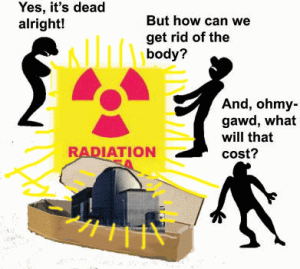
‘Significant milestone for nuclear sector’ as Hunterston B relicensed for decommissioning
The Office for Nuclear Regulation (ONR) has approved the relicensing of
the Hunterston B nuclear power station, ushering the North Ayrshire site
into its formal decommissioning phase.
From 1 April, Nuclear Restoration
Services (NRS), a subsidiary of the Nuclear Decommissioning Authority
(NDA), will take on full responsibility as site licence holder, replacing
EDF, which operated the Advanced Gas‑Cooled Reactor (AGR) until it ceased
generation in January 2022 after 46 years in service.
This first phase of
decommissioning work at Hunterston B, on the Firth of Clyde, will involve
the removal of all buildings and plant from the site, with the exception of
the reactor buildings and some adjoining structures which will be modified
to create a Safestore structure.
This Safestore is designed to maintain the
reactor buildings in a safe state through the Quiescence phase of around 70
years. Following this, the final site clearance phase will involve the
removal of the reactors and debris vaults housed in the Safestore
structure, making the site available for future use.
New Civil Engineer 19th March 2026 https://www.newcivilengineer.com/latest/significant-milestone-for-nuclear-sector-as-hunterston-b-relicensed-for-decommissioning-19-03-2026/
Scottish National Party face an uphill battle in home of UK’s nuclear subs
FIVE years ago, the SNP fell just one seat short of an overall majority in
the Scottish Parliament, and it perhaps isn’t over-egging the hyperbole to
suggest the one seat in question was Dumbarton.
Of the 11 constituency
seats across the country that the SNP failed to win, Dumbarton was the only
one they should have taken on the basis of national trends. After the
knife-edge result in the previous election, they required less than a 0.2%
swing from Labour to gain the seat, which was below the modest swing from
Labour to SNP of just over 1% that was actually achieved Scotland-wide.
But locally voters bolted in completely the opposite direction, and Labour’s
incumbent MSP Jackie Baillie increased her margin of victory to almost four
percentage points. It can’t be denied that many businesses in Helensburgh
do extremely well out of the presence of a facility that ultimately only
exists to give the UK Government the ability to obliterate foreign cities
at the press of a button.
That very specific type of dependence on the
status quo has created a large segment of the local electorate that is
highly motivated to thwart a party that not only wants Scotland to leave
the UK, but also wants its nuclear weapons to be banished from local
shores.
The National 18th March 2026,
https://www.thenational.scot/news/25948137.snp-face-uphill-battle-home-uks-nuclear-subs/
The Iran war is Australia’s margin call

the Greens’ Senator Larissa Waters captured the mood of many when she warned:
‘…every day Trump and Netanyahu’s demands of Australia keep growing.’
She accused Labor of having ‘no red lines’. Australia’s significant Iranian, Israeli, Lebanese, and broader Middle Eastern diaspora communities bring both personal grief and political intensity to the debate.
By Vince Hooper | 19 March 2026, https://independentaustralia.net/politics/politics-display/the-iran-war-is-australias-margin-call-,20830
Operation Epic Fury is exposing the true cost of alliance dependence, energy fragility, and strategic distraction from the Indo-Pacific, writes Vince Hooper.
ON 28 FEBRUARY 2026, the United States and Israel launched Operation Epic Fury against Iran. As the war enters its third week, the scale is staggering: at least 1,348 Iranian civilians killed and over 17,000 injured, 3.2 million displaced, approximately 6,000 U.S. strikes, and a new supreme leader – Mojtaba Khamenei – vowing to keep the Strait of Hormuz closed.
The International Energy Agency warns of the ‘largest supply disruption in the history of the global oil market’. Oil has breached US$100 (AU$142.11) a barrel. More than 820,000 have been displaced in Lebanon as Israel–Hezbollah hostilities reignite.
For Australia, geographically distant but entangled through alliance commitments, intelligence infrastructure, energy dependence and a 115,000-strong diaspora in the Middle East, the ramifications are immediate. In financial economics, alliance membership functions like a call option — the right to draw on a protector’s military power, but at a price paid in sovereignty foregone, bases hosted, and conflicts joined.
The Iran crisis is Australia’s margin call. The price is suddenly, painfully visible.
The alliance reflex
The Albanese Government endorsed Operation Epic Fury with speed that surprised even American officials, while insisting Australia was “not participating” offensively.
By 10 March, that distinction had eroded: Albanese deployed an E-7A Wedgetail early warning aircraft, air-to-air missiles for the UAE, and 85 Australian Defence Force personnel to the Gulf. The Wedgetail’s capacity to map missile launch locations and coordinate battle management in real time makes it far more than a passive shield — the line between defensive and offensive enablement is, as one analyst observed, a blurry one at best.
It has since emerged that three Royal Australian Navy sailors were aboard the U.S. submarine that torpedoed the Iranian frigate IRIS Dena near Sri Lanka on 4 March — the first U.S. submarine torpedo attack since the Second World War.
Albanese confirmed their presence but insisted they did not take part in offensive action. Meanwhile, the Joint Defence Facility Pine Gap near Alice Springs – now hosting 45 satellite radomes and dishes – continues to provide real-time intelligence across the Middle East. A former NSA analyst confirmed in 2023 that Pine Gap was collecting data on the Gaza conflict and “surrounding areas”.
That intelligence flows to Washington and, in turn, to Israel. Having invested decades in this facility, Australia cannot credibly claim neutrality. It is infrastructure that commits the country irrevocably — a strategic investment with no exit clause.
The Indo-Pacific opportunity cost
Here is the dimension that should concern Australian strategists most. In what economists call “real options” theory, the value of an investment depends on keeping the opportunity alive until conditions are ripe. AUKUS is precisely such an option: a ticket to a credible submarine deterrent, but only if the U.S. industrial base and technology transfers remain available. The Iran conflict is degrading every one of those conditions.
The U.S. submarine industrial base produces around 1.2 Virginia-class boats per year against a combined requirement of 2.3.
An Iran war that diverts Navy priorities means no spare construction capacity for Australian boats. Congressional approvals, State Department licences, and Department of Energy support all stall when those agencies are managing Iran’s nuclear fragments. Australia’s planned 2030s submarine delivery could slip to the 2040s. We know the cost of American distraction: between 2001 and 2020, while Afghanistan and Iraq consumed U.S. bandwidth, China militarised the South China Sea, developed carrier-killing missiles, and built the world’s largest navy.
The U.S. has already spent over US$11 billion (AU$15 billion) in Epic Fury’s first week. As the Hudson Institute’s Zineb Riboua has argued, every dollar spent defending Red Sea shipping lanes is a dollar unavailable for Pacific basing or Taiwan contingency planning.
Fat tails at the fuel bowser
Australia imports roughly 90 per cent of its refined liquid fuel. The Strait of Hormuz, carrying a fifth of global petroleum, has been reduced to what the IEA calls ‘a trickle’ — global supplies down an estimated eight million barrels per day. IEA members have agreed to release 400 million barrels from emergency stockpiles, the largest coordinated release in history, but analysts warn this only partially offsets prolonged disruption.
For anyone who studies what statisticians call ‘fat-tailed’ distributions — events that are rare but devastating when they occur — this is a textbook case. Australia’s fuel supply architecture is built for normal times: 36 days of strategic reserves against an IEA benchmark of 90.
According to Westpac’s modelling, a one-month Hormuz disruption lifts the Australian CPI by approximately 1 percentage point; a three-month closure spikes it by 1.5 points and reduces GDP by 0.5 points. Petrol prices could rise 40 cents per litre. LNG prices have surged 12 per cent, and Qatari production remains halted. These pressures compound: higher oil costs flow through shipping, fertilisers, and manufacturing into broader inflation, landing on an economy where the RBA is already navigating delicate disinflation.
115,000 reasons to worry
An estimated 115,000 Australians were in the Middle East when the conflict erupted.
Foreign Minister Penny Wong said:
“This is a consular crisis that dwarfs any that Australia has had to deal with in terms of numbers of people.”
The closure of airspace across Bahrain, Iraq, Iran, Qatar, Kuwait, and Syria stranded thousands.
By 10 March, over 2,600 had returned on 18 flights from the UAE.
Tens of thousands remain, with Smartraveller now advising against all travel to the UAE, Qatar, Kuwait, Bahrain, Israel, and Lebanon. Bus convoys to Kuwait and Bahrain, overland routes to Oman, and limited commercial flights have been the improvised lifelines. Canberra also granted asylum to five members of Iran’s women’s football team who were in Queensland for the AFC Women’s Asian Cup — a gesture that only hints at the potential for larger refugee flows if the conflict deepens further.
The rules-based order — selectively applied
Operation Epic Fury was launched without UN Security Council authorisation. Ben Saul the UN Special Rapporteur on the promotion and protection of human rights and fundamental freedoms while countering terrorism, has stated that Iran had not enriched uranium to the point of building a nuclear device — the case for self-defence, in his words, “does not fall anywhere close”.
Australia’s refusal to address the strikes’ legality places it in what ANU’s Don Rothwell calls a “say nothing” posture — conspicuously at odds with its willingness to assert the illegality of Russia’s invasion of Ukraine.
In my own work on alliance behaviour, I model geopolitical commitments using the same frameworks that price financial options. International law functions as a hedge — an insurance policy limiting everyone’s downside. When a country lets that insurance lapse for allies while enforcing it against adversaries, it is strategically exposed.
For a middle power whose influence rests on normative authority rather than military mass, this shapes standing in ASEAN, the Pacific Islands Forum, and every multilateral setting where Western double standards are a live issue.
Domestically, the Greens’ Senator Larissa Waters captured the mood of many when she warned:
‘…every day Trump and Netanyahu’s demands of Australia keep growing.’
She accused Labor of having ‘no red lines’. Australia’s significant Iranian, Israeli, Lebanese, and broader Middle Eastern diaspora communities bring both personal grief and political intensity to the debate.
The energy transition as strategic hedge
If the conflict carries a silver lining, it may be in strengthening the case for energy transition. Renewables and storage now provide nearly 45 per cent of electricity on Australia’s main grid and contributed to halving wholesale power prices in late 2025. Renewable energy is a natural insurance policy against geopolitical oil shocks: its fuel cost is zero and its supply chain is overwhelmingly domestic.
Accelerating electrification of transport, homes, and industry reduces exposure to precisely the kind of extreme energy price events that the Strait of Hormuz crisis illustrates. But the transition is capital-intensive: a one-year delay in wind or transmission projects could increase residential power prices by up to 20 per cent. The conflict sharpens both the urgency and the stakes.
The margin call
The Iran conflict is a stress test for Australian strategic policy on every front: alliance dependence, energy fragility, consular capacity, and commitment to international law. Most importantly, it reveals the opportunity cost in the Indo-Pacific.
Every month of Middle Eastern entanglement is a month in which AUKUS – and a credible deterrent posture in the Western Pacific – loses value. The conflict is not just consuming Australian resources. It is consuming the strategic future those resources were meant to buy.
For policymakers, the lessons are uncomfortable but clear. Diversification – of energy sources, strategic relationships, and economic exposure – is not merely desirable but urgent. The capacity to make independent strategic judgements, rather than reflexively aligning with allied positions, must be cultivated alongside the alliance itself. International law must be applied consistently, not selectively invoked when adversaries breach it and quietly set aside when allies do the same. The margin call has arrived. The question is whether Australia can pay it without liquidating the portfolio.
Vince Hooper is a proud Australian-British citizen and professor of finance and discipline head at SP Jain School of Global Management with campuses in London, Dubai, Mumbai, Singapore and Sydney.
UK universities getting more enmeshed in the nuclear lobby

Swansea University will play a key role in a new £65.6 million UK Research
and Innovation (UKRI) Doctoral Focal Award in Nuclear Skills, helping to
train specialists essential to future clean energy, national security and
advanced nuclear technologies. As part of DRIVERS (Developing Researchers
with an Interdisciplinary Vision for Engineering Reactor Systems), experts
from the School of Engineering and Applied Sciences will train more than 80
PhD researchers over the next seven years in reactor physics, thermal
hydraulics and through-life structural integrity.
Swansea University 18th March 2026, https://www.swansea.ac.uk/press-office/news-events/news/2026/03/swansea-university-part-of-major-656-million-ukri-investment-to-train-next-generation-of-nuclear-engineers-and-scientists.php
UN preparing for nuclear catastrophe ‘worst case scenario’ including use of nukes in Middle East
By ELIANA SILVER, SENIOR FOREIGN NEWS REPORTER, 18 March 2026
The United Nations is preparing for a nuclear catastrophe if the Middle East war escalates further.
World Health Organization officials are monitoring the consequences of joint US-Israeli strikes on Iranian atomic sites and are remaining ‘vigilant’ for nuclear threats in the region.
WHO director Hanan Balkhy said: ‘The worst-case scenario is a nuclear incident, and that’s something that worries us the most.’
‘As much as we prepare, there’s nothing that can prevent the harm that will come … the region’s way – and globally if this eventually happens – and the consequences are going to last for decades,’ she told POLITICO.
It comes as in recent days, Donald Trump‘s AI adviser David Sacks warned that Israel could be on a path to ‘escalate the war by contemplating using a nuclear weapon.’
The UN nuclear watchdog said Wednesday that Iranian authorities had reported projectile impact at the country’s only operational nuclear power plant that caused no damage.
The International Atomic Energy Agency (IAEA) ‘has been informed by Iran that a projectile hit the premises of the Bushehr NPP on Tuesday evening’, the Vienna-based agency posted on social media.
‘No damage to the plant or injuries to staff reported.’
Agency head Rafael Grossi ‘reiterates his call for restraint during the conflict to avoid any risk of a nuclear accident’, the statement said.
The Bushehr plant in southwestern Iran has the Islamic republic’s only operational nuclear power reactor and was first connected to the grid in 2011, according to the IAEA.
Tehran has been under biting US sanctions since 2018, when Washington withdrew from a deal that granted Iran sanctions relief in return for curbs on its nuclear activities designed to prevent it from developing an atomic warhead.
The US and Israel say that destroying whatever remains of Iran’s nuclear program is one of the central aims of the war.
They have long suspected Iran seeks nuclear weapons, while the Islamic Republic says its nuclear program is peaceful.
In June of last year, the US and Israel targeted shadowy nuclear infrastructure in Iran, hitting sites in Fordow, Natanz and Isfahan.
Balkhy explained that although there have not yet been any signs of radioactive contamination in the region, a nuclear incident could cause extreme health problems to those affected………………….
…………………….Donald Trump said those who claim Iran didn’t pose a threat are ‘not smart’ and ‘not savvy,’ adding, ‘We don’t want those people.’
His comments came after America’s top counterterrorism official resigned over the war with Iran.
In an extraordinary and unprecedented move for this administration, National Counterterrorism Center Director Joe Kent announced he was stepping down over his objections to the US launching joint strikes with Israel.
‘It’s a good thing that he’s out because he said that Iran was not a threat. Iran was a threat – every country realized what a threat Iran was,’ the President insisted.
Trump’s AI advisor recently warned that there are ‘risks’ of an ‘escalatory approach’ by Israel.
Speaking on a podcast, David Saks said: ‘Israel could get seriously destroyed.’
‘And then you have to worry about Israel escalating the war by contemplating using a nuclear weapon.’
Sacks urged Trump to find an ‘off-ramp’ and bring the war with Iran to a swift close.
‘This is a good time to declare victory and get out,’ he added. ‘I agree that we should try to find the off-ramp.’
Intelligence gathered in the months after the strikes in June revealed the Islamic Republic desperately reconstructing a program Trump said was obliterated.
The Daily Mail exposed Iranian ‘chillers’ – sophisticated industrial equipment essential for cooling uranium – being frantically moved back into fortified underground positions as early as September 2025…………………https://www.dailymail.co.uk/news/article-15656871/UN-preparing-nuclear-catastrophe-worst-case-scenario-including-use-nukes-Middle-East.html
Iran’s Bushehr Nuclear Power Plant ‘hit in strike’ as radiation update issued

A projectile struck the grounds of the Bushehr Nuclear Power Plant sparking fears of a terrifying nuclear incident, according to the CEO of the Russian company which runs the plant.
Joe Smith, 18 Mar 2026, https://www.mirror.co.uk/news/world-news/breaking-irans-bushehr-nuclear-power-36887601
An Iranian nuclear power plant has been hit, sparking fears of a nightmare radioactive incident.
A projectile struck the grounds of the Bushehr Nuclear Power Plant, both Russia and Iran said. Neither country has confirmed whether there has been a release of nuclear material in the incident on Tuesday evening.
Russia’s state-run Tass news agency quoted Rosatom CEO Alexey Likhachev late Tuesday as claiming “a strike hit the area adjacent to the metrology service building located at the Bushehr Nuclear Power Plant site, in close proximity to the operating power unit.” Russian technicians from Rosatom operate the plant, using Russian-made, low-enriched uranium.
Any strike on a nuclear plant risks radioactive material being released into the environment, a nightmare scenario in any war. Bushehr sits on the Persian Gulf meaning contamination of the waters could spell disaster for millions living in the Gulf States, which rely on desalination plants for their water supplies.
“There were no casualties among Rosatom State Corporation personnel,” Likhachev said. “The radiation situation at the site is normal.”
The Atomic Energy Organization of Iran later issued a statement saying “no financial, technical, or human damage occurred and no part of the plant was harmed.” Tass later reported that Iran blamed the strike on the United States and Israel.
The International Atomic Energy Agency said: “The IAEA has been informed by Iran that a projectile hit the premises of the Bushehr NPP on Tuesday evening.”
The United Nations agency added: “No damage to the plant or injuries to staff reported.”
It remains unclear what the “projectile” that hit the complex was and neither Iran nor Russia have published images of the damage.
Scottish Labour donation linked to ‘astroturf’ nuclear campaign

Anas Sarwar’s party accepted over £7,000 from Stonehaven, a lobbying firm which represents the owner of Scotland’s last nuclear power station. Scottish Labour has sought to make nuclear power a battleground in the May election.
Paul Dobson, Billy Briggs, March 19 2026, https://www.theferret.scot/scottish-labour-astroturf-nuclear/
Scottish Labour accepted a donation from a lobbying firm linked to a controversial “grassroots” campaign pushing to overturn Scotland’s ban on nuclear power.
The £7,200 contribution came from Stonehaven, a London-based public relations (PR) company which counts the French state-owned energy giant EDF as a paying client. EDF owns Scotland’s last nuclear plant at Torness and could be one of the biggest beneficiaries if the ban on new nuclear plants is overturned.
This week The Ferret revealed close ties between Stonehaven and Britain Remade, which claims it is a “grassroots”, “pro-growth” campaign group, and is leading calls for the Scottish Government to reverse its opposition to nuclear energy.

We found that the private company behind Britain Remade had appointed senior Stonehaven staff as directors, as well as other overlaps between the firms. Britain Remade has denied that it has ever taken corporate money and insists its campaigning is not influenced by funders.
Scottish Labour said the donation, made in May 2025, related to a commercial sponsorship. Stonehaven previously donated to the Conservative party while it was led by Boris Johnson.
We reported on the donation in January, but it was wildlife campaigner Danica Priest who first highlighted its potential significance in relation to Britain Remade and renewed pressure to overturn the nuclear ban.
Several figures in Scottish Labour have come out strongly in support of new nuclear power over the last few years, and the issue is set to be a battleground in May’s Holyrood election.
The party’s leader north of the border, Anas Sarwar, has described the SNP’s opposition to nuclear as “irrational” and accused first minister John Swinney of being “stuck in the politics of the 1970s”.
Labour argues that investing in new nuclear energy could create and protect jobs and provide important back up to renewable energy generation. The Scottish Government says it is too expensive and investment is “better placed” in renewable energy.
Norman Hampshire – the Labour leader of East Lothian council where Torness is located – was among the speakers at a launch event for the ‘Scotland for nuclear energy’ campaign which was organised by Britain Remade in Glasgow in February. Glasgow MSP Paul Sweeney was also in attendance.
Former co-leader of the Scottish Greens, Patrick Harvie, claimed Britain Remade was a “collection of the usual corporate suspects pretending to be a grassroots campaign”. He branded the group “radioactive astroturf”.
Re/insurers must plan for nuclear-powered ships, says Axa XL

Reinsurers must plan for nuclear-powered ships, says Axa XL. French
reinsurer’s global head of energy transition and chief risk consulting
officer describes the preparation needed for nuclear power in shipping. Any
future insurance for these vessels would need to be ‘bespoke, extremely
high in value and likely supported by governments’, Axa XL’s Vicky
Roberts-Mills and Jarek Klimczak say.
Lloyds List 18th March 2026,
https://www.lloydslist.com/LL1156646/Reinsurers-must-plan-for-nuclearpowered-ships-says-Axa-XL
1 This Month

of the week – Shut Down Drone Warfare!


Tell the Ukrainian Government to Drop Prosecution of Peace Activist Yurii Sheliazhenko

Petition to revoke the licensing of the Near Surface Nuclear Disposal Facility (NSDF) at Chalk River. https://www.ourcommons.ca/petitions/en/Petition/Details?Petition=e-7247
To see nuclear-related stories in greater depth and intensity – go to https://nuclearinformation.wordpress.com
-
Archives
- April 2026 (57)
- March 2026 (251)
- February 2026 (268)
- January 2026 (308)
- December 2025 (358)
- November 2025 (359)
- October 2025 (376)
- September 2025 (257)
- August 2025 (319)
- July 2025 (230)
- June 2025 (348)
- May 2025 (261)
-
Categories
- 1
- 1 NUCLEAR ISSUES
- business and costs
- climate change
- culture and arts
- ENERGY
- environment
- health
- history
- indigenous issues
- Legal
- marketing of nuclear
- media
- opposition to nuclear
- PERSONAL STORIES
- politics
- politics international
- Religion and ethics
- safety
- secrets,lies and civil liberties
- spinbuster
- technology
- Uranium
- wastes
- weapons and war
- Women
- 2 WORLD
- ACTION
- AFRICA
- Atrocities
- AUSTRALIA
- Christina's notes
- Christina's themes
- culture and arts
- Events
- Fuk 2022
- Fuk 2023
- Fukushima 2017
- Fukushima 2018
- fukushima 2019
- Fukushima 2020
- Fukushima 2021
- general
- global warming
- Humour (God we need it)
- Nuclear
- RARE EARTHS
- Reference
- resources – print
- Resources -audiovicual
- Weekly Newsletter
- World
- World Nuclear
- YouTube
-
RSS
Entries RSS
Comments RSS
 nuclear-news