William Perry’s memoir, ‘My Journey at the Nuclear Brink’
 On the Brink of Oblivion William Perry’s memoir, ‘My Journey at the Nuclear Brink,’ serves as a clarion global warning. US News, By Mortimer B. Zuckerman | Chairman, Editor-in-Chief June 7, 2016 Our planet today faces two existential dangers: an impending climate catastrophe, and the very real possibility of a nuclear calamity. Both of these dangers arise from human activity and are thus within our capacity to address. And both challenges are interconnected and require a new attitude that recognizes our common interests and need to cooperate. Public awareness and political will must be raised to levels commensurate with the threat.
The warnings about climate change are now part of our public consciousness, resulting in actions being taken that if continued and built upon might possibly stave off this catastrophe or at least reduce its damage. However, the public seems to believe that the danger from nuclear weapons ended with the Cold War.
But former Defense Secretary William Perry’s authoritative memoir, “My Journey at the Nuclear Brink,” is a clear, sobering and, for many, surprising warning that the danger of a nuclear catastrophe today is actually greater than it was during that era of U.S.-Soviet competition…….
Perry describes four ways a nuclear catastrophe could occur: nuclear terrorism; an accidental nuclear war (resulting, for example, from a false alarm); a nuclear war out of miscalculation; and a nuclear regional war
His special concern about the possibility of nuclear terrorism can be seen in the book’s preface, with an unblinking and transfixing account of a most believable scenario in which a terror group detonates a bomb in one of our cities. A seminal expert in worrying about such chilling contingencies, Perry outlines in quite credible steps how a terror group builds and sneaks a bomb into Washington, D.C., a scenario he describes as “a nuclear nightmare” and “all too real.” It is important to experience his powerfully understated dramatization:…….
The point is this: Any of the four scenarios could bring about the worst catastrophe we have ever experienced. Taken together they represent a higher likelihood of a nuclear catastrophe than we faced during the Cold War. (That judgment has also been reached by the Bulletin of the Atomic Scientists, which this year noted that its “Doomsday Clock” is at three minutes to midnight, closer to doomsday than they had judged we were for most of the Cold War years.)……..http://www.usnews.com/opinion/articles/2016-06-07/four-paths-to-nuclear-disaster
New book: Voices from Chernobyl, by Nobel laureate Svetlana Alexievich
 Chernobyl and the ghosts of a nuclear past A Nobel laureate captures the beginning of the “age of disasters”. New Statesman, BY LUCY HUGHES-HALLETT 17 Apr 16
THis is not a book on Chernobyl,” writes Svetlana Alexievich, “but on the world of Chernobyl.” It is not about what happened on 26 April 1986, when a nuclear reactor exploded near the border between Ukraine and Belarus. It is about an epoch that will last, like the radioactive material inside the reactor’s leaking ruin, for tens of thousands of years. Alexievich writes that, before the accident, “War was the yardstick of horror”, but at Chernobyl “the history of disasters began”.Alexievich, who won the Nobel Prize in Literature last year for her powerful works of oral history, was born in Ukraine and grew up in Belarus. The explosion took place close to her home ground. At once, people began to ask her whether she was writing about it. Others rushed out books of reportage or polemic. She hesitated. What had happened was uncanny, beyond words. There was, she writes, “a moment of muteness”.
Gradually, over many years, she interviewed people whose lives had been affected by the blast. Many have since died. Her book – first published in Russian in 1997 and now issued in a new translation of a revised text – is made up of their testimonies. Her own voice is heard only briefly. Even the prefatory summary of events is a patchwork of extracts from news reports………
Since Chernobyl, there has been Fukushima. Neither site has yet been made safe: it seems unlikely they ever will be. We are living in Alexievich’s “age of disasters”. This haunting book offers us at least some ways of thinking about that predicament.
Svetlana Alexievich will be in conversation with James Meek in Cambridge on 31 May. Details: cambridgeliteraryfestival.com http://www.newstatesman.com/culture/books/2016/04/chernobyl-and-ghosts-nuclear-past
The decline of a nuclear city – haunting photos of abandonment – (the nuclear future?)

Haunting photos of Idaho’s Atomic City, 30 years after nuclear disaster drove everyone away http://www.techinsider.io/the-atomic-city-nuclear-disaster-30-years-later-2016-3 Tech Insider Chris Weller 11 Mar 16 When photographer David Hanson arrived in Atomic City, Idaho in 1986, he knew he was capturing a still-cooling piece of American history.
While the Mountain West boomtown spent the early 1950s thriving on the power generated at the nearby nuclear complex, within a few years a string of nuclear meltdowns had sent the town’s residents searching for safer dwellings. Atomic City — current population: 29 — was left to become a shell of its former self.
Thirty years later, Hanson has finally released his haunting photographs in a book called“Wilderness to Wasteland.”
Here, he walks us through what he saw………
“It seems frightening yet somehow appropriate that the most enduring monuments America will leave for future generations will be the hazardous remains of our industry and technology,” he said.
Photo Book – Wilderness to Wasteland: the downfall of a nuclear city
David T. Hanson: Wilderness to Wasteland Published by Taverner Press
Foreword by Joyce Carol Oates. Introduction by David T. Hanson. Afterword by Miles Orvell.For 30 years, David T. Hanson (born 1948) has made photographs that are widely celebrated for their powerful depictions of the American landscape and its dramatic transformation and despoilment by humans. His newest collection, Wilderness to Wasteland,presents four series of previously unpublished and unexhibited photographs from Hanson’s early work, made between 1982 and 1987. Atomic City documents the former nuclear boomtown in Idaho, site of the world’s first nuclear power plant and first reactor meltdown. The Richest Hill on Earth is a study of the vast copper mines, housing and surrounding wasteland of Butte, Montana. The eponymous series is a dynamic group of aerial and ground-view photographs of hazardous waste sites, while the final series, Twilight in the Wilderness, comprises spectacular night views of industrial sites for power production. Together, these photographs constitute a haunting meditation on a ravaged landscape.
Featured image is reproduced from David T. Hanson: Wilderness to Wasteland.
Research into baby teeth showed the nuclear cancer link
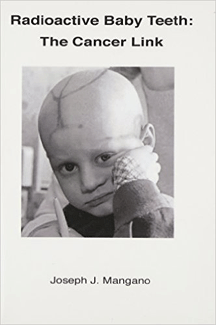 Radioactive Baby Teeth: The Cancer Link Paperback by Joseph J Mangan In 2001, college administrators entered a remote, musty storage room near St. Louis. Not knowing what was in the room, the group was puzzled to find a large wall with hundreds of long boxes stacked against it. They pulled out one of the boxes, took off the cover, and found —- baby teeth. Quite by accident, the group had unearthed 85,000 baby teeth left over from a study done decades before.
The study had found how much radiation from atomic bomb tests had entered human bodies, by testing teeth. News of the discovery spread like wildfire in newspapers across the country. Coverage focused on the fact that the teeth could answer a critical question – how much cancer was caused by radiation exposure?
In this book, read about the mystery faced by scientists of how much radiation from nuclear weapons and reactors actually infiltrated people’s bodies – and how much cancer it really caused. Learn about the furious opposition researchers faced from government and industry. Discover how the research helped end above-ground nuclear testing, how it challenged the claim that nuclear reactors are safe, and how it exposed an undeniable link with cancer. Joseph Mangano draws on his direct experience and his involvement with scientists and citizens to create a lively, intriguing story – a story that continues today. Mangano is a health researcher, and is Executive Director of the Radiation and Public Health Project, based in New York. http://www.amazon.com/Radioactive-Baby-Teeth-Cancer-Link/dp/0615168752/ref=sr_1_3?s=books&ie=UTF8&qid=1452117447&sr=1-3&keywords=joseph+mangano
Ralph Nader points to a book on America’s renewable energy future
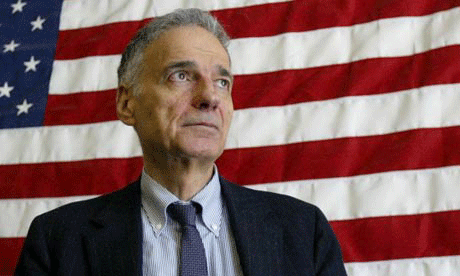 Ralph Nader: Building a renewable energy future – OpEd December 26, 2015. The U.S. has some big problems that require bold solutions. Unfortunately, books about solutions to our society’s problems are often given short shrift by reviewers or languish on our bookshelves. As I often say, this country has more problems than it deserves and more solutions than it uses. Now comes S. David Freeman. …
In January of 2016, in collaboration with his coauthor, Leah Y. Parks, he will publish a new and important book about our energy future: All-Electric America: A Climate Solution and the Hopeful Future. The book is scathing but optimistic, and manages to be bold while remaining pragmatic. …

When All-Electric America comes out … you will have a chance to make yourself knowledgeable about the real avenues available to us to transform our energy infrastructure for present and future generations by moving toward a new renewable energy economy with far more jobs, health, efficiency and security benefits than there are in relying on hydrocarbons and radioactive atoms.
To listen to my interview with David Freeman, visit ralphnaderradiohour.com
America’s secret plutonium experiments on humans
Then there is the horrifying reality that these experiments were taking place in the shadow of Nazi Germany; some of the scientists involved in the radiation experiments were the very men whose earlier experimental designs had tormented prisoners of concentration camps. Welsome describes Operation Paperclip, conducted under the auspices of the U.S. government. Paperclip imported Nazi scientists and supported their work, helping to confer, in the words of scientist Joseph G. Hamilton, “a little of the Buchenwald touch” on American medicine.
This valuable work represents an elegy to lost ideals, lost health, and lost trust. One can only hope it will serve as a cautionary tale.
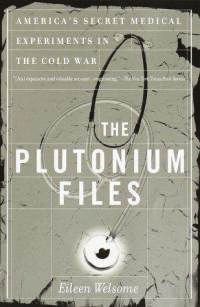 The Plutonium Files: America’s secret medical experiments in the Cold War N Engl J Med 1999; 341:1941-1942 December 16, 1999 Harriet A. Washington
The Plutonium Files: America’s secret medical experiments in the Cold WarBy Eileen Welsome. 580 pp. New York, Dial Press, 1999. $26.95. ISBN: 0-385-31402-7
Amid the embarrassments of Monicamania and of multiple public mea culpas, the past few years have not been exemplary ones for American journalism. This fact makes the triumph of The Plutonium Files all the sweeter, because this superlative book is a reminder of the purpose of investigative journalism.
This richly detailed, subtly nuanced history of government-engineered radiation experiments on unwitting Americans is based on the Pulitzer-prize–winning series Eileen Welsome wrote for the Albuquerque Tribune. Welsome’s tenacious and resourceful detective work has unveiled the saga of a sordid, tragic, yet fascinating chapter in the history of American medical science. The book succeeds on many levels. It is a gripping exposé of governmental exploitation and of medicine’s moral failures in an era in which blind trust defined the normal relationship between physicians and patients.
Between April 1945, scant months before the bombing of Hiroshima, and July 1947, the scientists of the Manhattan Project followed the construction of the atomic bomb with a chilling second act: medical experimentation on hundreds of unsuspecting Americans. Continue reading
Once again the world at the nuclear brink
The New Nuclear Arms Race Former Clinton Defense Secretary offers dire warning. The Nation 16 Dec 15 By Katrina vanden Heuvel
Two decades later, Perry has written a new book, “My Journey at the Nuclear Brink,” in which he offers a dire warning: “Far from continuing the nuclear disarmament that has been underway for the last two decades, we are starting a new nuclear arms race.”
This is not hyperbole. The United States and Russia are acting with increasing belligerence toward each other while actively pursuing monstrous weapons. As Joe Cirincione described in the Huffington Post, the Pentagon plans to spend $1 trillion over 30 years on “an entire new generation of nuclear bombs, bombers, missiles and submarines,” including a dozen submarines carrying more than 1,000 warheads, capable of decimating any country anywhere. In the meantime, President Obama has ordered 200 new nuclear bombs deployed in Europe.
Read the full text of Katrina’s column here. http://www.thenation.com/article/the-new-nuclear-arms-race/
Solar and wind ready and safe for investors, unlike nuclear power
 Solar or Wind vs. Nuclear http://www.nytimes.com/2015/12/08/opinion/solar-
or-wind-vs-nuclear.html?_r=0 PHILIP WARBURG The writer, an environmental lawyer, is the author of “Harness the Sun”and “Harvest the Wind.” DEC. 8, 2015 Re “The New Atomic Age We Need” , by Peter Thiel:In his zeal to portray nuclear power as our post-carbon panacea, Mr. Thiel belittles the devastation caused by past reactor accidents.
He also ignores the vulnerability of nuclear plants to sabotage and terrorism, makes no mention of the unsolved nuclear waste dilemma, and blithely declares that “the most fundamental obstacle to the success of nuclear power” is its “high cost.”
While Mr. Thiel, a venture capitalist, says he stands ready to invest in a next generation of unproven nuclear plants, he sweeps aside the wind and solar industries’ remarkable gains of the last decade. He claims that they are not “growing anywhere near fast enough to replace fossil fuels.”
Is he aware that wind power accounted for 28 percent of all new United States electric generating capacity from 2010 to  2014? Does he know that 40 percent of all new installed power capacity during the first half of 2015 came from utility-scale solar plants?
Notably, that doesn’t even include rooftop solar, which is growing by leaps and bounds and could supply a fifth of our total power needs using technology that is already in widespread use.
What we need is a vigorous, sustained commitment to developing our most promising renewable energy technologies. The last thing we need is a new atomic age.
New book Green Energy Futures
 A clean, green energy future beckons! Ecologist Dave Elliott 5th November 2015 The world could soon be generating all its electricity from renewable sources, writes Dave Elliott, by harnessing diverse technologies for generation, grid balancing and energy storage. Add to that the use of power surpluses to make fuels, and it could even be feasible to make all our energy – not just electricity – renewable. A clean green future beckons…….
Some renewables are now cheaper than conventional sources, even when the cost of providing backup to deal with their variability is included.
When the health costs associated with using conventional energy sources is also included, the comparison is even more favourable: air pollution from burning fossil fuel is a killer.
If the longer term global social, economic and health impacts of climate change are also added in, then most renewables win out across the board, although some may have local impacts, such as visual intrusion, and for some there will be potential land-use conflicts.
We need to decide on priorities, and on issues of scale, although most of these local impacts can be avoided or limited, as I illustrate in my new book Green Energy Futures. That also looks at how the variability of some renewables can be dealt with at low cost, an issue I will focus on here. It often seen as the Achilles heal of renewables.
Harnessing variability Continue reading
Harrowing account of the survivors of Nagasaki nuclear bombing

What made things worse for Japanese doctors who tried to ease the suffering of atom-bomb victims is that information about the bomb and its effects was censored by the American administration occupying Japan
It was bad enough for the Americans to have killed so many people, and then hide the gruesome facts for many years after the war. To forget about the massacre now would be an added insult to the victims. Southard has helped to make sure that this will not happen yet.
‘Nagasaki: Life After Nuclear War,’ by Susan Southard, NYT, By IAN BURUMAJULY 28, 2015 “………..Susan Southard’s harrowing descriptions give us some idea of what it must have been like for people who were unlucky enough not to be killed instantly: “A woman who covered her eyes from the flash lowered her hands to find that the skin of her face had melted into her palms”; “Hundreds of field workers and others staggered by, moaning and crying. Some were missing body parts, and others were so badly burned that even though they were naked, Yoshida couldn’t tell if they were men or women. He saw one person whose eyeballs hung down his face, the sockets empty.”
Gen. Leslie Groves, the director of the Manhattan Project, which had developed the atom bomb, testified before the United States Senate that death from high-dose radiation was “without undue suffering,” and indeed “a very pleasant way to die.”
Many survivors died later, always very unpleasantly, of radiation sickness. Their hair would fall out, they would be covered in purple spots, their skin would rot. And those who survived the first wave of sickness after the war had a much higher than average chance of dying of leukemia or other cancers even decades later. Continue reading
Three books showing the close risk of nuclear disaster
 Three books show how close nuclear catastrophe is, Green Left, , July 4, 2015 By Phil Shannon In 2003, half the US Air Force units responsible for nuclear weapons failed their safety inspections.
Eric Schlosser
Allen Lane, 2013
632 pages
A Short History Of Nuclear Folly
Rudolph Herzog
Melville House, 2014
252 pages
Atomic Comics: Cartoonists Confront The Nuclear Age
Ferenc Szasz
University of Nevada Press, 2013
179 pages
Atomic bombs have only been used in warfare twice, but they have nearly been detonated, through accident or mistake, many more times, writes Eric Schlosser in his book on nuclear weapons mishaps, Command and Control. Continue reading
New book on The Privatization of Nuclear War
 The Privatization of Nuclear War http://www.globalresearch.ca/the-privatization-of-nuclear-war/5458265 GRTV Report Produced by James Corbett, Featuring Michel Chossuodvsky By James Corbett and Prof Michel Chossudovsky Global Research, June 25, 2015 With tensions growing in Europe, Asia and the Middle East, a new generation of nuclear weapons technology is making nuclear warfare a very real prospect. And with very little fanfare, the US is embarking on the privatization of nuclear war under a first-strike doctrine.
“On August 6, 2003, on Hiroshima Day, commemorating when the first atomic bomb was dropped on Hiroshima (August 6 1945), a secret meeting was held behind closed doors at Strategic Command Headquarters at the Offutt Air Force Base in Nebraska. Senior executives from the nuclear industry and the military industrial complex were in attendance. This mingling of defense contractors, scientists and policy-makers was not intended to commemorate Hiroshima. The meeting was intended to set the stage for the development of a new generation of “smaller”, “safer” and “more usable” nuclear weapons, to be used in the “in-theater nuclear wars” of the 21st Century.
“Nuclear war has become a multibillion dollar undertaking, which fills the pockets of US defense contractors. What is at stake is the outright “privatization of nuclear war”.
US-NATO weapons of mass destruction are portrayed as instruments of peace. Mini-nukes are said to be “harmless to the surrounding civilian population”. Pre-emptive nuclear war is portrayed as a “humanitarian undertaking”.
Under the Obama administration, Islamic terrorists are said to be preparing to attack US cities. Proliferation is tacitly equated with “nuclear terrorism”. Obama’s nuclear doctrine puts particular emphasis on “nuclear terrorism” and on the alleged plans by Al Qaeda to develop and use nuclear weapons. …
While one can conceptualize the loss of life and destruction resulting from present-day wars including Iraq and Afghanistan, it is impossible to fully comprehend the devastation which might result from a Third World War, using “new technologies” and advanced weapons, until it occurs and becomes a reality. The international community has endorsed nuclear war in the name of world peace. “Making the world safer” is the justification for launching a military operation which could potentially result in a nuclear holocaust.”
(Excerpts from Michel Chossudovsky, Towards a World War III Scenario, The Dangers of Nuclear War, Global Research Montreal, 2011\
New book: Fukushima: The Story of a Nuclear Disaster
 Book: Fukushima: The Story of a Nuclear Disaster,Truth Dig, Jun 12, 2015 By Louise Rubacky “Fukushima: The Story of a Nuclear Disaster” A book by David Lochbaum, Edwin Lyman, Susan Q. Stranahan and the Union of Concerned Scientists
In “Fukushima: The Story of a Nuclear Disaster,” a team of scientists and a Pulitzer Prize-winning journalist recount what happens when a catastrophe strikes that no one imagines. No one with the clout to prevent it, that is. It’s a tale of entwined worlds that must cooperate intelligently in order to protect the public. The tensions and cross-purposes among them, however, lead to indecision, inaction and increased calamity. In crisis, these worlds—the nuclear energy industry, two powerful governments, and international regulatory commissions—are about as effective as a machine lubed with super glue.
Early and often comes the warning: HUBRIS AHEAD. Words and phrases like prevailing wisdom, low risk, practically unthinkable, unlikely, government assurances, assumptions, confidence, remote possibility and a situation we had never imaginedappear throughout; they indicate attitudes about potential dangers, and point to why the earthquake and tsunami had such dire effects on Fukushima Daiichi Nuclear Power Plant and Japan.
This chronicle, another in the continuing tragedy of the human gamble against nature, is mostly peopled by players who could be said to represent knowledge, fear, power and money. In standing, the first of these comes last. Corporate captains, regulators and leaders charged with public safety cover up or sidestep facts that, if acknowledged and addressed, could imperil their coffers or careers. As in the U.S., there’s a symbiotic and dangerous relationship between government and industry in Japan. The route from the public to the private sector is known here as the revolving door; there, the delicate name for that greasy highway is “amakudari,” translated as “descent from heaven.”…………..
“Fukushima” makes a fine reference volume for understanding nuclear power production and its still-critical dangers. It’s also a mosaic of determined reconstruction, and serves as a play-by-play guide to What Not to Believe during an industrial accident. As the prescient journalist I.F. Stone warned for decades about governments: They all lie. And so it goes for most large corporations, whose PR shields give “spinning”—formerly known as lying—a shiny sophistication. Eight days into the crisis, Chuck Casto, the NRC rep in Japan working on no sleep and with little cooperation, said, “I’m just trying to figure out who the power player is over here.” This too is a crux of the story, and others about high-stakes arenas. ….http://www.truthdig.com/arts_culture/item/fukushima_the_story_of_a_nuclear_disaster_20150612
the nuclear history of Port Hope – told in “Blind Faith”
 Blind Faith: The Nuclear History of Port Hope, Ontario January 15, 2015 by Dennis Riches @DennisRiches “……..hibakusha (the Japanese word for radiation victims) become invisible. When a new group of people become victims, such as in Fukushima in 2011, they feel that they have experienced a unique new kind of horror. For them, for their generation, it is new, but for those who know the historical record, it is a familiar replay of an old story. The people of Fukushima should know by now that they are bit players who have been handed down a tattered script from the past.
A case in point is “Blind Faith,” the superb 1981 book by journalist Penny Sanger, about the small irradiated Canadian town of Port Hope on the shores of Lake Ontario. (See the timeline at the end of this article) [2] In the 1970s it faced (and more often failed to face) the toxic legacy of processing first radium, then uranium for nuclear weapons and nuclear power plants.
In a saner world this book would not be out of print and forgotten. It would be a classic text known by everyone who has ever had to share his town with a dangerous corporate citizen. Then there would be no surprises when a nuclear reactor explodes or a cancer cluster appears somewhere new. It wouldn’t be a shock to see the victims themselves fall over each other in a rush to excuse their abuser, beg for a continuation of jobs and tax revenue, and threaten the minority who try to break the conspiracy of silence.
On the back cover of the 1981 paperback edition of “Blind Faith” there was an endorsement by the late great Canadian writer Farley Mowat, who passed away in the spring of 2014:
Penny Sanger has written a fascinating and fearsome account of the emotional turmoil that engulfs a small town when it discovers that its major industry is a threat to the health of its citizens. This is a classic account of how economic power enables industry to ride roughshod over those who must depend on it for their daily bread.
Although I wrote above that “Blind Faith” illustrates universal truths about what happens to communities contaminated with radiation, there are always unique aspects of the situation that come into play. In this case, we see the extreme complacency and obliviousness of Canadian society to the role that the country played in the development of nuclear weapons and nuclear power.
The uranium refinery in Port Hope was a key element in the Manhattan Project. ………
One stand-out account is that of a widow whose husband, a long-time Eldorado worker, had died of lung cancer at age 50. He had worked at Eldorado for over twenty years, during the era when workplace monitoring and standards were non-existent. Her husband was no longer there to say whether he too was “philosophical” about it and “couldn’t be bitter about it” like his wife and his daughter claimed. The widow said that in spite of her husband’s shortened life, they were grateful for the good jobs and university education that the children were able to get. Thanks to Eldorado, they had come up in the world.
Penny Sanger passed no judgment on this thinking, but I find it to be a rather disturbinging example of working man’s Stockholm Syndrome. The victim has internalized the values of the captor, and lost self-esteem and critical thinking skills in the process. The bereaved family shrugs that they “can’t be bitter about it.” They’ve internalized the value that children have to go to university to live worthwhile lives, and it’s alright if parents have to kill themselves to accomplish this goal.
It seemed to never occur to any of the Port Hope boosters that there were dozens of similar towns in rural Ontario that had found ways to survive without hosting toxic industries. I know a family of Polish immigrants who landed in Port Hope in the 1960s, and they managed to get by without working for Cameco. The children had the sense to leave town after high school when they saw their friends going straight to grim lives working with the yellowcake down at the plant. One of them managed somehow to get a couple of university degrees after he left town.
This lack of imagination among the terminally hopeful applies more widely. Not only do company towns fail to imagine less toxic ways to live, but large nations also fail to imagine new paradigms for energy and economic systems……..
“Blind Faith” is available on a website dedicated to the history of Port Hope. Since it is out of print and over thirty years old, I asked the author if she would allow its free distribution as a pdf file. She gave her permission, but of course the common sense rules apply. If you want to sell the book, ask the author for permission. If you redistribute it free, in whole or in part, do so with proper citation.Read it in a web browser:
http://www.porthopehistory.com/blindfaith/blindfaith.htm
Free download (permitted by author):
Penny Sanger, “Blind Faith” (pdf) (McGraw-Hill Ryerson, 1981), 135 pages. http://www.mintpressnews.com/MyMPN/blind-faith-nuclear-history-port-hope-ontario/
1 This Month

of the week – Shut Down Drone Warfare!


Tell the Ukrainian Government to Drop Prosecution of Peace Activist Yurii Sheliazhenko

Petition to revoke the licensing of the Near Surface Nuclear Disposal Facility (NSDF) at Chalk River. https://www.ourcommons.ca/petitions/en/Petition/Details?Petition=e-7247
To see nuclear-related stories in greater depth and intensity – go to https://nuclearinformation.wordpress.com
-
Archives
- March 2026 (244)
- February 2026 (268)
- January 2026 (308)
- December 2025 (358)
- November 2025 (359)
- October 2025 (376)
- September 2025 (257)
- August 2025 (319)
- July 2025 (230)
- June 2025 (348)
- May 2025 (261)
- April 2025 (305)
-
Categories
- 1
- 1 NUCLEAR ISSUES
- business and costs
- climate change
- culture and arts
- ENERGY
- environment
- health
- history
- indigenous issues
- Legal
- marketing of nuclear
- media
- opposition to nuclear
- PERSONAL STORIES
- politics
- politics international
- Religion and ethics
- safety
- secrets,lies and civil liberties
- spinbuster
- technology
- Uranium
- wastes
- weapons and war
- Women
- 2 WORLD
- ACTION
- AFRICA
- Atrocities
- AUSTRALIA
- Christina's notes
- Christina's themes
- culture and arts
- Events
- Fuk 2022
- Fuk 2023
- Fukushima 2017
- Fukushima 2018
- fukushima 2019
- Fukushima 2020
- Fukushima 2021
- general
- global warming
- Humour (God we need it)
- Nuclear
- RARE EARTHS
- Reference
- resources – print
- Resources -audiovicual
- Weekly Newsletter
- World
- World Nuclear
- YouTube
-
RSS
Entries RSS
Comments RSS
 nuclear-news