Book Review: Are We Ready to Head to Mars? Not So Fast.

“A City on Mars” is Kelly and Zach Weinersmith’s cheeky account of the many challenges to visiting the red planet.
Undark, BY CHRISTIE ASCHWANDEN, 11.10.2023
IN AUGUST 1998, 700 people came to Boulder, Colorado to attend the founding convention of the Mars Society. The group’s co-founder and president, Robert Zubrin, extolled the virtues of sending humans to Mars to terraform the planet and establish a human colony. The Mars Society’s founding declaration began, “The time has come for humanity to journey to the planet Mars,” and declared that “Given the will, we could have our first crews on Mars within a decade.” That was two and a half decades ago.
In their hilarious, highly informative and cheeky book, “A City on Mars: Can We Settle Space, Should We Settle Space, and Have We Really Thought This Through?”, Kelly and Zach Weinersmith inventory the challenges standing in the way of Zubrin-like visions for Mars settlement. The wife-and-husband team serves a strong, but never stern, counterargument to the visionaries promising that we’ll put humans on Mars in the very near future. “Think of this book as the straight-talking homesteader’s guide to the rest of the solar system,” they write.
Just as in their previous book, “Soonish: Ten Emerging Technologies That’ll Improve and/or Ruin Everything,” the authors — she’s a faculty member in the biosciences department at Rice University and he’s a cartoonist — use humor and science to douse techno dreams with a dose of reality. “After a few years of researching space settlements, we began in secret to refer to ourselves as the ‘space bastards’ because we found we were more pessimistic than almost everyone in the space-settlement field,” they write. “We weren’t always this way. The data made us do it.”
While working on their deeply researched book, the Weinersmiths came to view sending people to Mars as a problem far more complicated and difficult than you’d know by listening to enthusiasts like Elon Musk or Robert Zubrin. It’s a challenge that “won’t be solved simply by ambitious fantasies or giant rockets.” Eventually humans are likely to expand into space, the Weinersmiths write, but for now, “the discourse needs more realism — not in order to ruin everyone’s fun, but to provide guardrails against genuinely dangerous directions for planet Earth.”………………………………………………………………………………………………………………………..
Living on Mars, which has no birds or rain, gets less than half the sunlight per area that Earth does, and is often plagued by dust storms that further blot out the sun, could be a soul-deadening experience.
………………………………………. They also run through a list of “Bad Arguments for Space Settlement,” which include “Space Will Save Humanity from Near-Term Calamity by Providing a New Home,” and “Space Exploration Is a Natural Human Urge.” These detailed examinations of the stark realities regarding space travel and habitation serve as a foil to the breathlessly optimistic accounts that are so ubiquitous in popular media……………………. more https://undark.org/2023/11/10/review-city-on-mars/?utm_source=Undark%3A+News+%26+Updates&utm_campaign=448a889155-RSS_EMAIL_CAMPAIGN&utm_medium=email&utm_term=0_5cee408d66-185e4e09de-%5BLIST_EMAIL_ID%5D
Book review of “Too Hot to Touch: The Problem of High-Level Nuclear Waste”

This is a book review of “Too Hot to Touch: The Problem of High-Level
Nuclear Waste” and the best book I’ve read on the topic, as well as
additional research on the topic. Now that world wide production of
conventional and unconventional oil probably peaked in 2018 (coal in 2013,
and perhaps natural gas in 2019), our top priority should be to bury
nuclear wastes as soon as possible. Once severe shortages arrive, remaining
oil will to to agriculture and other essential needs. This short window of
time now may be our only chance to bury nuclear wastes — our descendants
certainly won’t have the energy, diesel equipment, or technology. Yucca
mountain is the best possible place to put nuclear waste in the U.S. The
only place to put it actually, a $15 billion facility that models put
through thousands of permutations of multiple calamities such as
earthquakes, volcanoes, flooding and more. Yucca was found to be a safe
place to put nuclear waste.
Energy Skeptic 1st Nov 2023 https://energyskeptic.com/2023/book-review-nuclear-waste-too-hot-to-touch/ #nuclear #antinuclear #nuclearfree #NoNukes
The Four Billionaires Who Want to Control the Universe
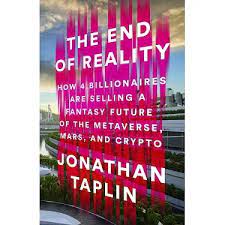
SCHEERPOST, September 8, 2023
In Jonathan Taplin’s new book, “The End of Reality: How Four Billionaires are Selling a Fantasy Future of the Metaverse, Mars and Crypto,” the internet innovation expert delves into activities of the gang-of-four powerful oligarchs: Elon Musk, Peter Thiel, Mark Zuckerberg and Marc Andreesen, breaking down their increasing profits and infinite ambitions to control and influence domestic and global affairs while sending our technology innovation in a profit-driven, dystopian direction, corrupting both sides of the political aisle. Host Robert Scheer’s question: “Wait a minute, what else is new” in capitalism?”
Taplin’s distinction between the oligarchs of new and old is that the modern tech billionaires are granted immunity for content published on their platforms through Section 230 of the Communications Decency Act. Taplin describes the control these oligarchs possess over the speech dictated on their platforms, “So here [Musk] controls this platform, Twitter, and what he wants pushed gets pushed, what he wants suppressed, gets suppressed. And nobody even doubts that that’s happening.”
Taplin also emphasizes that there is nowhere to turn within the party duopoly to crack down on these monopolies and thus — leaving it to us, the people “getting screwed” — to do something about it.
“If you tried to do a very powerful regulation and break up a Google or break up a Meta or break up one of these companies, there would be howls from both sides of the aisle because there’s so much money being spread around by these companies that, you know, the Democrats and the Republicans are both in the pocket of the big companies.
Video Transcript
Speaker 2………………………………………….there’s a lot the technology could do to save the planet and help reform our country and make us energy independent. But these guys are not interested in that. And so I’ll just take it one at a time and tell you what they’re thinking.
So we start with Musk. So Musk is a believer that the Earth is doomed and that we need to have another planet for our species to move to. And he’s chosen the planet of Mars. The trip to Mars, even with the latest rocketry, would take about 14 months. It would cost 10 trillion to move about 20 people up there to Mars. And then you’d have to build a kind of biosphere like Space Dome to live in because you couldn’t be outside because the radiation levels are so high that you would get cancer in 5 minutes. You would have to import all your oxygen since there’s no oxygen on Mars and you would live in an extraordinarily hostile environment as opposed to trying to use the $10 trillion to fix the problems here on Earth. Musk himself would make probably about 2 trillion on that deal because the deal he has with NASA, he makes about a 30% profit on every rocket flight he makes for them. And, you know, here’s a man who claims he’s a libertarian but is actually a crony capitalist. Certainly SpaceX has only one customer, and that’s NASA. The U.S. government and the taxpayers would be paying the 10 trillion to get to Mars. His other companies, such as his satellite company, which he is using to provide, for instance, communications to the Ukrainian army, as Ronan Farrow pointed out…………………………………………………………….
So let’s let’s go to Peter Thiel next. So Peter Thiel runs a company called Palantir. Palantir is the premier surveillance capitalism company in the world………………
Jonathan Taplin: And then then you’ve got Marc Andreessen. So Marc Andreessen is the most important venture capitalist in America. Lives in Silicon Valley and funded Facebook for, you know, funded, Instagram funded many of the early social media startups was the first really important guy into crypto. Solano is his company. Crypto.com is a company. Opensea is a company that he founded…………………………………………………………………………
the money that used to flow to the Democratic coffers from the unions was declining. And so they found two sources of new money. One was Wall Street and the other was Silicon Valley…………………………………………………the the laws, the digital laws that Bill Clinton and Al Gore, the champion of the information superhighway put through, were so beneficial to the Internet companies, early Internet companies that we have never been able to claw them back. So. Facebook and Twitter live under a regime called Safe Harbor. Section 230 of the Communications Decency Act, which basically says that they are not producers of content. They are simply a platform on which individuals post content and that they should have no responsibility for any speaker on their platform. So when Elon Musk decides, once he takes over Twitter to become, as he called it, a free speech absolutist, and he says no longer were the neo-Nazis be prohibited from being on my platform, then Twitter gets flooded with neo-Nazi propaganda. ……………………nobody can sue him for the hate speech that is on Twitter, on X because he has safe harbor……………………you can’t have a libel suit against Twitter. You can’t have a libel suit against Facebook.
Robert Scheer………………………….Section 230, which said that these people are basically neutral carriers. They’re not publishers, therefore they can’t be sued. That’s how Facebook and Google get this tremendous freedom……………………………. And and now Elon Musk is taking it in a different direction. He’s presenting himself as a champion of free speech and bringing other people in. But the real problem is the money. The real problem is that the money talks. Right.
……………………..And Google has, in effect, a monopoly. And, you know, and really what we’re up against is and what the solution sounds very old fashioned, but nobody brings it up is regulation. ………………………. I have no argument with you about the book. My argument with is why only these four guys? Because I just see a whole system now of massive concentration of wealth, extreme income inequality, corruption of everything. Certainly our political system. Really? Why my thieves that are called billionaires and the Democrats and Republicans are right in there complicit and enablers.
Jonathan Taplin:………………………………………………. So what these guys have done and what they promulgated with social media and I would put Facebook and Twitter at the center of that problem is they’ve created a world in which there is no shared set of facts………………………………………..You’re getting new information from social media and from a small group of friends who send them things that come from these incredibly random sources, whether it’s Q Anon or something else. And and part of this book is what is it that draws people down the rabbit holes of conspiracies? So in that sense, I believe these people are responsible for that and they are protected from anyone calling them out because of this safe harbor. …………………………………..Elon Musk is undoubtedly the most powerful voice on the right. He has 150 million followers on Twitter. ………..And the problem is that these people, especially Thiel and Musk have a very anti-democratic point of view……………………………………………………..
Robert Scheer……………………………………………………………………. I’m just asking you to put on your bipartisan cap. And I think the lesson of not that your book doesn’t call things accurately, but we live in an incredibly corrupt society. And the enemies of democracy are bipartisan. ……………………………..
Jonathan Taplin:…………………………………… So take Musk. So here he controls this platform, Twitter, and what he wants pushed gets pushed, what he wants suppressed, gets suppressed. And nobody even doubts that that’s happening. ……………………….. The problem is not just that he has that control, but he also has the sole provider of rockets to the space station. He is the sole provider with StarLink of Satellite communication capability to many armies around the world. And he personally has made decisions that says, well, these these people shouldn’t get communications in this place…………………….
………………………………………………………………………………………………………………………………. Jonathan Taplin: But here’s the thing. The scientists that worked on the bomb were doing it regardless of the ethical implications of their work. And it was only after the bomb was dropped that Oppenheimer had doubts. He began to think, Oh, maybe that was a screw up. And when he saw the pictures coming back from Hiroshima and he realized what he had done, I believe some of these same things are happening today in AI. In other words, I believe that the implications, you know, of this are such that they won’t really know what’s going to happen until it’s too late. And that worries me.
………………………………………….. And again, the book is The End of Reality How for Billionaires Are Selling a Fantasy Future of the Metaverse, Mars and Crypto. And that’s really the power of this book. It’s that fantasy I happen to stress. ……………………………………… https://scheerpost.com/2023/09/08/the-four-billionaires-who-want-to-control-the-universe/
NATO’s Secret Armies – Operation GLADIO and Terrorism in Western Europe

This fascinating new study shows how the CIA and the British secret service, in collaboration with the military alliance NATO and European military secret services, set up a network of clandestine anti-communist armies in Western Europe after World War II.
These secret soldiers were trained on remote islands in the Mediterranean and in unorthodox warfare centres in England and in the United States by the Green Berets and SAS Special Forces. The network was armed with explosives, machine guns and high-tech communication equipment hidden in underground bunkers and secret arms caches in forests and mountain meadows. In some countries the secret army linked up with right-wing terrorist who in a secret war engaged in political manipulation, harrassement of left wing parties, massacres, coup d’états and torture.
Codenamed ‘Gladio’ (‘the sword’), the Italian secret army was exposed in 1990 by Italian Prime Minister Giulio Andreotti to the Italian Senate, whereupon the press spoke of “The best kept, and most damaging, political-military secret since World War II” (Observer, 18. November 1990) and observed that “The story seems straight from the pages of a political thriller.” (The Times, November 19, 1990). Ever since, so-called ‘stay-behind’ armies of NATO have also been discovered in France, Spain, Portugal, Germany, Belgium, the Netherlands, Luxemburg, Denmark, Norway, Sweden, Finland, Switzerland, Austria, Greece and Turkey. They were internationally coordinated by the Pentagon and NATO and had their last known meeting in the NATO-linked Allied Clandestine Committee (ACC) in Brussels in October 1990.
Like ‘the tolling of a distant temple bell’, Ibuse Masuji’s Black Rain remembers the horrors of Hiroshima and warns of the inhumanity of war
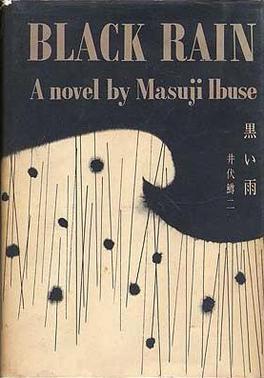
Jindan Ni, August 4, 2023 https://theconversation.com/like-the-tolling-of-a-distant-temple-bell-ibuse-masujis-black-rain-remembers-the-horrors-of-hiroshima-and-warns-of-the-inhumanity-of-war-205837?utm_medium=email&utm_campaign=The%20Weekend%20Conversation%20-%202700227280&utm_content=The%20Weekend%20Conversation%20-%202700227280+CID_e1af8a5e068132789cd3bffaecf54867&utm_source=campaign_monitor&utm_term=Like%20the%20tolling%20of%20a%20distant%20temple%20bell%20Ibuse%20Masujis%20Black%20Rain%20remembers%20the%20horrors%20of%20Hiroshima%20and%20warns%20of%20the%20inhumanity%20of%20war
In May 2023, almost 80 years after its devastation by an atomic bomb, Hiroshima again became the focus of world attention as the host city for the 49th G7 Summit.
On the summit’s official website, Hiroshima is presented as the exemplar of Japan’s postwar success. It is described as an “international city of peace and culture” and “resolute postwar advancement”. There are photos of its serene landscapes, its local delicacies and sake, and its modern sports and street culture.
The bombing of Hiroshima at the conclusion of World War II is mentioned just once. The Hiroshima Peace Memorial, according to the site, “speaks to the horrors of nuclear weapons”.
Hiroshima has more than this to tell us. But its stories, its “several pasts”, have been constantly abridged – or “refashioned”, as Michel Foucault would say. They have been adapted to serve political agendas.
On August 6, 1945, after the atomic bomb was dropped on Hiroshima, President Harry Truman released a statement that praised the scientific achievement:
“Sixteen hours ago an American airplane dropped one bomb on Hiroshima, an important Japanese Army base […]
It is an atomic bomb. It is a harnessing of the basic power of the universe. The force from which the sun draws its power has been loosed against those who brought war to the Far East […]
What has been done is the greatest achievement of organized science in history. It was done under high pressure and without failure”.
The atomic bomb was something altogether different for Japan. After the bombs fell on Hiroshima and Nagasaki, the Japanese emperor Hirohito broadcast his “jewel voice” to make the announcement of Japan’s surrender to his subjects. He spoke in an opaque, classical language almost incomprehensible to ordinary Japanese:
“The enemy has for the first time used cruel bombs to kill and maim extremely large numbers of the innocent and the heavy casualties are beyond measure; if the war were continued, it would lead not only to the downfall of our nation but also to the destruction of all human civilization.“
In these statements, we can see Truman and Hirohito attempting to justify their actions. We can see interpretations of the attacks on Hiroshima and Nagasaki taking different tracks. Such modified national memories install a kind of forgetting. They are ways of marginalising or erasing individual experiences of the war.In these statements, we can see Truman and Hirohito attempting to justify their actions. We can see interpretations of the attacks on Hiroshima and Nagasaki taking different tracks. Such modified national memories install a kind of forgetting. They are ways of marginalising or erasing individual experiences of the war.
During the postwar occupation of Japan, from 1945-1952, the Allied occupiers sought to remould the Japanese minds. The “horrors of nuclear weapons” could not be mentioned. Pictures and narratives about the atomic bombs were subject to strict censorship.
Only after the easing of censorship could Japanese writers begin to reveal the details of the horrendous suffering that occurred in Hiroshima and Nagasaki. These works became collectively known as genbaku bungaku, or “atomic bomb literature”. The explorations of the destructive power of war and institutionalised violence have left their mark on contemporary Japanese literature.
Ibuse Masuji’s Black Rain, which won the prestigious Noma Literary Prize after its publication in 1965, epitomises atomic bomb literature. It is now considered a classic of modern Japanese literature.
Black Rain records the scorching memories of the hibakusha – atomic bomb survivors – of the bombing and its aftermath. More significantly, it critiques the brutality of war, the militarised state, and the purposeful forgetting of history. Ibuse based his novel on journals and interviews with the bomb survivors, writing against amnesia using what he called the “crudest kind of realism”.
Forgetting and stigmatisation
Black Rain begins four years and nine months after the war. Shizuma Shigematsu and his family live a seemingly quiet and normal life in the village of Kobatake, about 100 kilometres from Hiroshima city. But the fact that they once lived and worked close to Hiroshima is still a weight upon their lives.
Shigematsu is vexed about his niece Yasuko’s poor marriage prospects. There are rumours circulating in the village that Yasuko was near the epicentre of the explosion and now has radiation sickness. As her guardian, Shigematsu is agonised with guilt, as it was at his instigation that Yasuko came to Hiroshima city, so as to avoid the army’s conscription of young women to work in the factories that produced military supplies.
During the war, “irresponsible talk” was strictly forbidden by the army. But after the war, Shigematsu laments, rumours stigmatising people like Yasuko are by no means under control. To prove that Yasuko was not exposed to radiation, Shigematsu decides to copy Yasuko’s wartime diary entries and show them to the village matchmaker.
For the survivors of Hiroshima, memories of the bombing return unbidden. The misery of past has to be revisited to ease their present predicament.
Initially, no one knew what happened when the bomb fell. It was beyond everyone’s comprehension. And it is this horror of not knowing that Black Rain agonisingly depicts. Because of this, people who were not at the epicentre went towards it. They went in search of their families and were thus unnecessarily exposed to radiation.
Yasuko was one of these victims. She was 10 kilometres from the epicentre, but became caught in the radioactive “black rain” on the way to find her uncle and aunt. The rain leaves ominous strange black stains on Yasuko. Her dread is heartwrenching:
I felt horrified, and then awfully sad. However many times I went to the ornamental spring to wash myself, the stains from the black rain wouldn’t come off.
Despite Shigematsu’s efforts to prove that Yasuko is free from radiation sickness, she develops symptoms eventually, almost five years after the bomb. There is no cure for this condition and the doctor asks Shigematsu to report Yasuko’s case to the Atomic Bomb Casualty Commission (ABCC), which was established by the Allied occupation in 1947 with “the highest ideals” in order to collect data of the victims.
The commission only documented cases like Yasuko’s; it provided no treatment for the victims.
Tradition versus modernity
In Black Rain, Ibuse boldly challenges the modernisation which Japan has been determined to achieve since the Meiji Restoration, which began in 1868.
His critique of modernity is highly nuanced, with a tinge of humour. For example, when Shigematsu decides to copy Yasuko’s diaries, his wife Shigeko asks him to use Chinese brush ink instead of ordinary pen ink which does not last. To convince him, she shows him a letter which was sent to his great-grandfather from Tokyo in 1870.
The letter sender proudly concludes his letter by emphasising “this letter, in accordance with my promise to you at the time, is written in the ‘ink’ commonly in use in the West.” But the ink has “faded to a pathetic light brown colour”.
Shigematsu agrees to his wife that they should use the traditional brush ink so that their diaries and memories can be well preserved.
In the introduction to his English translation of Black Rain, John Bester writes that Ibuse shows “infinite nostalgia” towards “the beauty of the Japanese countryside and the ancient customs of its people”. For Ibuse, it is only through traditional food and medicine that the damages brought by science and modernity, exemplified by the atomic bomb, can be eased and soothed.
Appeal to nature, humanity and peace
Black Rain dwells on the atrocity of war as it affects people, but it also documents damage that war inflicts on nature. Shigematsu recalls the massive gingko tree he liked to play under, which stood outside his friend Kōtarō’s place. It was cut down for the “national interest” during the war.
Similarly, the novel records that villagers were ordered to dig pine-tree roots to extract oil for “the engines of the planes whose job it was to shoot down B-29s”.
Animals also suffered as a result of the atomic bomb, just as people did. The fish in the lake died. Like the bomb survivors who lost teeth and hair, they lost their scales and could not swim normally.
In Black Rain, the collective forgetting of the direct experiences of the victims leads to systematic stigmatisation and bias against them, which exacerbates their struggle. Shōkichi – Shigematsu’s friend who also survived the bomb – stridently announces:
Everybody’s forgotten! Forgotten the hellfires we went through that day – forgotten them and everything else, with their damned anti-bomb rallies. It makes me sick, all the prancing and shouting they do about it.
Shōkichi’s visceral repulsion to the anti-bomb rallies speaks of a collective forgetting, in which the enduring sufferings of the “precious victims” have been deployed as convenient narratives to serve the “national interest”. As the historian John Dower succinctly puts it, the rallies and memorial activities conformed to the state’s need of “nuclear victimization”, which aimed to shape “new forms of nationalism in postwar Japan”.
One of the maimed survivors in Black Rain writes in his journal that he now has permanent ringing in his ears: “it persists in my ear day and night, like the tolling of a distant temple bell, warning man of the folly of the bomb”.
Black Rain calls for a proper remembering of the war. In Ibuse’s documentary novel, Hiroshima is allowed to speak more and remember more. Through Shigematsu’s voice, Ibuse expresses the anger and despair of the people forced to endure the war:
I hated war. Who cared, after all, which side won? The only important thing was to end it all soon as possible: rather an unjust peace, than a “just” war!
The planet’s economist: has Kate Raworth found a model for sustainable living?
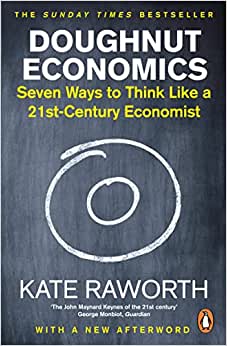
Her hit book Doughnut Economics laid out a path to a greener, more equal society. But can she turn her ideas into meaningful change?
by Hettie O’Brien, Guardian, 8 June 23
The problem is that there are few templates for an economy that
radically shrinks the world’s carbon footprint without also shrinking our
quality of life. The economist Kate Raworth believes she has a solution.
It is possible, she argues, to design an economy that allows humans and the
environment to thrive. Doing so will mean rejecting much of what defined
20th-century economics. This is the essential premise of her only book,
Doughnut Economics: Seven Ways to Think Like a 21st Century Economist,
which became a surprise hit when it was published in 2017.
The book, which
has been translated into 21 languages, brings to mind a charismatic
professor dispensing heterodox wisdom to a roomful of students. “Citizens
of 2050 are being taught an economic mindset that is rooted in the
textbooks of 1950, which in turn are rooted in the theories of 1850,”
Raworth writes.
By exposing the flaws in these old theories, such as the
idea that economic growth will massively reduce inequality, or that humans
are merely self-interested individuals, Raworth wants to show how our
thinking has been constrained by economic concepts that are fundamentally
unsuited to the great challenges of this century.
Guardian 8th June 2023
Winning and losing the nuclear peace

HOW TO AVOID NUCLEAR WAR, War on the Rocks, MICHAEL KREPON 8 Nov 21, Arms control has become passé. Russian and U.S. leaders have cast aside treaties as inconvenient to their pursuit of freedom of action. Republican presidents produced great arms control achievements. At present, most Republican senators and aspirants for higher office denigrate arms control and treaty-making as a failed, unnecessary, and unwise pursuit. Arms control provided necessary guardrails in the past. Now, dangerous military practices are on the rise, especially in Ukraine and across the Taiwan Strait. U.S.-Chinese relations are trending toward crisis. Four nuclear-armed states in Asia — China, Pakistan, India, and North Korea — are increasing their nuclear arsenals. Every nuclear-armed competitor is relying increasingly on deterrence as the diplomacy of arms control is in the doldrums. If unaltered, these trend lines point toward tragedy.
Many have forgotten what is crucial to remember: Deterrence is dangerous by design and has a track record of failure in lesser cases. ……………………………………..
Those who denigrate arms control forget that, by the end of the Cold War, conditions for lasting nuclear peace were in hand — not because of strengthened deterrence, but because champions of deterrence adopted the practices of arms control. The United States and Russia were no longer enemies. Crucial norms were in place alongside the Anti-Ballistic Missile Treaty, which codified national vulnerability, thereby removing one incentive for increased nuclear force levels. Strategic forces were no longer threatening: Indeed, Boris Yeltsin agreed in the second Strategic Arms Reduction Treaty to the prohibition of land-based missiles carrying multiple warheads. Conditions for strategic, crisis, and arms race stability were therefore at hand. Deep cuts were envisioned. Dangerous military practices were absent. Major powers respected the territorial integrity and national sovereignty of others.
This was the inheritance that Vladimir Putin, George W. Bush, and Donald Trump found unnecessary and inconvenient. ……………………..
In my book, Winning and Losing the Nuclear Peace: The Rise, Demise, and Revival of Arms Control, I propose that we embrace an ambitious goal of extending the three norms of no use, no testing, and no new proliferation to the 100th anniversary of Hiroshima and Nagasaki…………………………………………..
Michael Krepon is the co-founder of the Stimson Center and the author of Winning and Losing the Nuclear Peace: The Rise, Demise, and Revival of Arms Control, from which this essay is drawn. https://warontherocks.com/2021/11/how-to-avoid-nuclear-war/
Book reviews: Banning the Bomb. The Treaty Prohibiting Nuclear Weapons

Banning the Bomb: Smashing the Patriarchy and The Treaty Prohibiting Nuclear Weapons: How It Was Achieved and Why It Matters November 2021
Reviving Hopes for Nuclear Disarmament
Banning the Bomb: Smashing the Patriarchy
By Ray Acheson
The Treaty Prohibiting Nuclear Weapons: How It Was Achieved and Why It Matters
By Alexander Kmentt
Reviewed by Rebecca Davis Gibbons
As a former denizen of Washington working in the nuclear weapons space, I know how it can seem as though the only important conversations about nuclear weapons are happening in the U.S. capital, or Omaha, or Brussels, or in capitals of the other nuclear-armed states. Yet, two recent books on the Treaty on the Prohibition of Nuclear Weapons (TPNW), often called the nuclear ban treaty, demonstrate that activists around the world and diplomats from non-nuclear-weapon states have also been engaging in serious discussions about the future of these weapons. Both books make clear why so many diplomats and activists came together in 2017 to negotiate a treaty banning nuclear weapons despite significant criticism from nuclear-armed states and their allies. Understanding their arguments matters for the future of nuclear deterrence and U.S. alliance relationships, the nuclear Nonproliferation Treaty (NPT), and global governance of nuclear weapons more broadly.
In Ray Acheson’s Banning the Bomb: Smashing the Patriarchy and Alexander Kmentt’s The Treaty Prohibiting Nuclear Weapons: How It Was Achieved and Why It Matters, readers are offered two recent histories of the movement to change the discourse surrounding nuclear weapons and bring about the TPNW. The books offer unique but complementary views from two actors involved in the process. As the director of Reaching Critical Will and a member of the International Campaign to Abolish Nuclear Weapons (ICAN) steering committee, Acheson offers the insights of a nongovernmental organization (NGO) participant. Kmentt, a career diplomat who is the director of disarmament, arms control, and nonproliferation in the Austrian Ministry of Foreign Affairs, provides the perspective of someone operating within the core group of states leading the effort. The books are rich, behind-the-scenes accounts that reveal key details of the process of trying to ban nuclear weapons. Both would be enjoyable for general audiences interested in nuclear issues. More importantly, they should be read by those in the nuclear policy space, whether they support the ban treaty or not, because the arguments behind the movement have become part of the global conversation on the future of nuclear weapons and they are not going away.
Each book provides an account of the development of the humanitarian initiative, an effort to bring humanitarian considerations into global discourse about nuclear weapons, and the TPNW. The recent origin of these efforts lies in concern over the future of the 1968 NPT. In addition to prohibiting all but five countries from having nuclear weapons, NPT Article VI calls for all treaty members to pursue effective measures toward complete disarmament. Many non-nuclear-weapon states that signed the treaty never expected the five treaty members possessing nuclear weapons (China, France, Russia, the United Kingdom, and the United States) to
retain them permanently…………………………………..
Although government officials and nonstate actors cooperated to bring about TPNW negotiations, in the end it was states that had the final say in the treaty text. ICAN was disappointed that some of its recommendations were not included in the final document. Nonetheless, the umbrella group was a significant political force in bringing about the ban treaty negotiations and was awarded the Nobel Peace Prize for this effort in 2017.
After all this, what does the TPNW mean for the NPT and global governance? The fact that the TPNW came to fruition is an indictment of the NPT’s inability to foster progress on disarmament. In other words, states pursued the ban treaty in part because the NPT forum lost legitimacy after the nuclear-weapon states reneged on several disarmament commitments and pursued modernization programs to maintain and expand their arsenals for decades to come.
Maintaining the NPT and the strong nonproliferation norm it enshrines is undoubtedly in the interest of the United States and the rest of the international community. A key question for the NPT nuclear-weapon states is whether the treaty can survive in perpetuity with this loss of legitimacy. Can it continue for another 50 years when the most lethal armaments remain in the exclusive control of a select few powerful states while so many others clamor for disarmament?
Rebecca Davis Gibbons is an assistant professor of political science at the University of Southern Maine. She previously served as a fellow and associate of the Project on Managing the Atom at Harvard Kennedy School’s Belfer Center for Science and International Affairs. Her book The Hegemon’s Tool Kit: US Leadership and the Politics of the Nuclear Nonproliferation Regime will be published in spring 2022. https://www.armscontrol.org/act/2021-11/book-reviews/banning-bomb-smashing-patriarchy-treaty-prohibiting-nuclear-weapons
New Book ”The Wretched Atom”

| America’s Global Gamble with Peaceful Nuclear Technology https://global.oup.com/academic/product/the-wretched-atom-9780197526903?cc=au&lang=en& Jacob Darwin Hamblin, 13 July 21Includes formerly secret documents from the CIA and State Department about American efforts to shape nuclear programs in Japan, Iran, Israel, and many other countriesDraws on more than a decade of archival research in national and international institutions in several different countriesIncludes documents never published before about cover-ups at the International Atomic Energy Agency. |
Review of Michael Shellenberger’s book on ”Why Environmental Alarmism Hurts Us All”
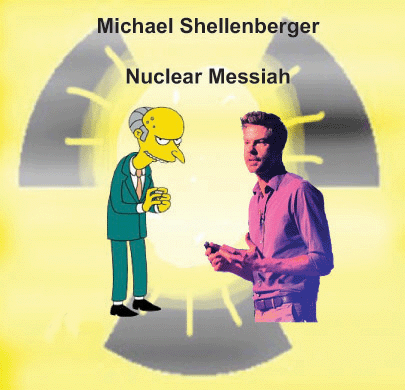 Book review: Bad science and bad arguments abound in ‘Apocalypse Never’ by Michael Shellenberger’, Yale Climate Connections , By Dr. Peter H. Gleick | Wednesday, July 15, 2020 ”……………….. A recent entry in this debate is Michael Shellenberger’s “Apocalypse Never: Why Environmental Alarmism Hurts Us All” (HarperCollins Publishers, 2020). Shellenberger explains in his introduction that he seeks to counter and dismiss what he considers irrational, overwrought arguments of pending Malthusian catastrophes; instead, he seeks to promote the Cornucopian view that environmental problems can be eliminated if we’d just pursue aggressive economic growth, simple technological advances, and increased tapping of abundant natural resources. In doing so, he echoes previous efforts of authors like Herman Kahn, Julian Simon, and Bjørn Lomborg.
Shellenberger self-describes as an environmentalist activist and a bringer of facts and science to counter “exaggeration,
Two Cornucopian ideas lie at the heart of this book: The first idea is that there are no real “limits to growth” and environmental problems are the result of poverty and will be solved by having everyone get richer. This idea isn’t original and has long been debunked by others (for a few examples see here, here, here, and here).
View that nuclear alone can address needs
The second idea – and the focus of much of Shellenberger’s past writings – is that climate and energy problems can and should be solved solely by nuclear power. He writes, “Only nuclear, not solar and wind, can provide abundant, reliable, and inexpensive heat,” and, “Only nuclear energy can power our high-energy human civilization while reducing humankind’s environmental footprint.” (“Apocalypse Never” – hereafter “AN” – pp. 153 and 278) The many economic, environmental, political, and social arguments levied against nuclear are simply dismissed as having no merit, for example: “As for nuclear waste, it is the best and safest kind of waste produced from electricity production. It has never hurt anyone and there is no reason to think it ever will.” (AN, p. 152) ……….
Using the facade of ‘strawman arguments’
Shellenberger regularly sets up other strawman arguments and then knocks them down. [A strawman argument is an effort to refute an argument that hasn’t been made by replacing your opponent’s actual argument with a different one.] One of the most prevalent strawman arguments in the climate debate is that scientists claim climate change “causes” extreme events, when in fact, climate scientists make careful distinctions between “causality” and “influence” – two very different things. This area, called “attribution science,” is one of the most exciting aspects of climate research today.
Shellenberger sets up the strawman argument that people are incorrectly claiming recent extreme events (like forest fires, floods, heat waves, and droughts) were caused by climate change, and then he debunks this strawman. “Many blamed climate change for wildfires that ravaged California” (AN, p.2) and “the fires would have occurred even had Australia’s climate not warmed.” (AN p. 21) He misrepresents how the media reported on the fires, describing a New York Times story on the 2019 Amazon fires: “As for the Amazon, The New York Times reported, correctly, that the ‘fires were not caused by climate change.’” But here Shellenberger is cherry-picking a quote: If you look at the actual article he cites, the journalist makes clear the “influence” of climate change just two sentences later:
These fires were not caused by climate change. They were, by and large, set by humans. However, climate change can make fires worse. Fires can burn hotter and spread more quickly under warmer and drier conditions. (emphasis added)
He also misunderstands or misrepresents the extensive and growing literature on the links between climate change and extreme events, ……
……. Another example of a serious conceptual confusion is his chapter dismissing the threat of species extinctions. The chapter is full of misunderstandings of extinction rates, ecosystem and biological functions, confusions about timescales, and misuses of data. For example, Shellenberger confuses the concept of species “richness” with “biodiversity” and makes the astounding claim that
Around the world, the biodiversity of islands has actually doubled on average, thanks to the migration of ‘invasive species.’ The introduction of new plant species has outnumbered plant extinctions one hundred fold. (AN, p. 66)
By this odd logic, if an island had 10 species of native birds found only there and they went extinct, but 20 other invasive bird species established themselves, the island’s “biodiversity” would double. This error results from a misunderstanding of the study he cites, which properly notes that simply assessing species numbers (richness not biodiversity) on islands ignores the critical issues of biodiversity raised by invasive species, including the disruption of endemic species interactions, weakening of ecosystem stability, alteration of ecosystem functions, and increasing homogenization of flora and fauna………………
Another classic logical fallacy is to try to discredit an opponent’s argument by attacking the person and her or his motives, rather than the argument – hence the Latin “ad hominem” (“against the man”). Ad hominem attacks are pervasive in this book and detract from its tone and the content.
Shellenberger attacks “apocalyptic environmentalists” as “oblivious, or worse, unconcerned” about poverty (AN, p. 35) or for opposing a massive dam on the Congo river. (AN, p. 276) He attacks the finances of leading environmental groups and leaders like the late David Brower, arguing they have taken donations from fossil fuel companies to “greenwash the closure of nuclear plants.” (AN, p. 205) And he attacks the motives, reputations, and science of many individual environmental and geophysical scientists whose work contradicts his arguments……
Shellenberger has a special level of animosity for the press:
News media, editors, and journalists might consider whether their constant sensationalizing of environmental problems is consistent with their professional commitment to fairness and accuracy, and their personal commitment to being a positive force in the world…….
In the most disturbing examples of vicious personal attacks, he paints broad categories of people who disagree with him as motivated by a hatred of humanity:
”When we hear activists, journalists, IPCC scientists, and others claim climate change will be apocalyptic unless we make immediate, radical changes, including massive reductions in energy consumption, we might consider whether they are motivated by love for humanity or something closer to its opposite (AN, p. 275, emphasis added). We must fight against Malthusian and apocalyptic environmentalists who condemn human civilization and humanity itself. (AN, p. 274) (emphasis added).”
He argues in his closing sections that people worried about environmental disasters are playing out “a kind of subconscious fantasy for people who dislike civilization” (AN, p. 270) and suggests that people who oppose the solutions he prefers do so because they long for the destruction of civilization – a nasty attack on the motives of all those working in this field.
Finally, the book is riddled with a variety of simple errors……. the number and scope of them here is problematic. …. one example is a massive misstatement of the amount of water required to produce energy. ….. in an important omission, he fails to note that key renewable energy sources such as wind and solar photovoltaics require far less water per unit of electricity produced than all fossil fuel and nuclear thermal plants. …. He claims, twice (AN pp. 211 and 241), that nuclear power plants produce “zero pollution” ………
Dr. Peter H. Gleick is president emeritus of the Pacific Institute, a member of the U.S. National Academy of Sciences, a MacArthur Fellow, and winner of the 2018 Carl Sagan Prize for Science Popularization. https://yaleclimateconnections.org/2020/07/review-bad-science-and-bad-arguments-abound-in-apocalypse-never/?fbclid=IwAR2jUB12zAF9WbluEtglePOQlOSKbLkIxdbWeeh9eSWbc366JXrHNIERzzY
Deceitful nuclear propaganda exposed in ”The Wretched Atom”
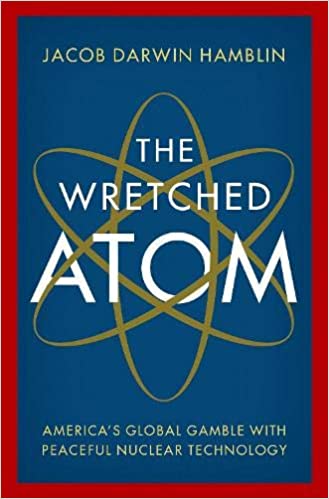
The Wretched Atom https://jacobdarwinhamblin.com/books/the-wretched-atom/
Coming in June 2021 from Oxford University Press
A groundbreaking narrative of how the United States offered the promise of nuclear technology to the developing world and its gamble that other nations would use it for peaceful purposes.
After the Second World War, the United States offered a new kind of atom that differed from the bombs that destroyed Hiroshima and Nagasaki. This atom would cure diseases, produce new foods, make deserts bloom, and provide abundant energy for all. It was an atom destined for the formerly colonized, recently occupied, and mostly non-white parts of the world that were dubbed the “wretched of the earth” by Frantz Fanon.
The “peaceful atom” had so much propaganda potential that President Dwight Eisenhower used it to distract the world from his plan to test even bigger thermonuclear weapons. His scientists said the peaceful atom would quicken the pulse of nature, speeding nations along the path of economic development and helping them to escape the clutches of disease, famine, and energy shortfalls. That promise became one of the most misunderstood political weapons of the twentieth century. It was adopted by every subsequent US president to exert leverage over other nations’ weapons programs, to corner world markets of uranium and thorium, and to secure petroleum supplies. Other countries embraced it, building reactors and training experts. Atomic promises were embedded in Japan’s postwar recovery, Ghana’s pan-Africanism, Israel’s quest for survival, Pakistan’s brinksmanship with India, and Iran’s pursuit of nuclear independence.
As The Wretched Atom shows, promoting civilian atomic energy was an immense gamble, and it was never truly peaceful. American promises ended up exporting violence and peace in equal measure. While the United States promised peace and plenty, it planted the seeds of dependency and set in motion the creation of today’s expanded nuclear club.
Book review: The Case for Degrowth
 Book review: The Case for Degrowth, Jeremy Williams, The Earthbound Report , 16 Nov 20, “…………. What are the objectives of degrowth? It’s not shrinking the economy for the sake of it. The aim is to get GDP growth out of the driving seat and then steer towards “what really matters: not GDP, but the health and wellbeing of our people and our planet.”
Or there’s the alternative, which is to stop taking growth as the primary measure of progress and get on with delivering what people need. So many political directions open up when GDP growth takes a back seat and we get on with delivering what people need more directly.
In fact, downsizing in the rich world may be a key enabler of flourishing elsewhere. “There is no technological or policy fix that can generalize to nine billion people the material standard of living currently enjoyed by a minority at high cost to others.” Instead, “high-consumption nations and people must degrow to free space for low-consumption ones.”
- A Green New Deal
- universal incomes and services
- policies to reclaim the commons
- shorter working hours
- public finance that supports the first four
Being a short book, it no doubt opens up lots of other questions that the authors don’t cover, though the frequently asked questions at the end captures many of them. Perhaps the one that still sticks out for me is the word ‘degrowth’ itself. In my opinion it doesn’t capture the positivity of a vision for qualitative progress, for improvement rather than enlargement. I know it’s an old debate. We had it when founding the Postgrowth Institute ten years ago, and it doesn’t feel resolved today.
Still, The Case for Degrowth is a brief and straightforward explainer, and a good starting point for anyone who wants to get their head around the degrowth movement and what it wants to acheive.
- You can get The Case for Degrowth from Earthbound Books UK or my US store. It’s powered by Bookshop.com and supports your local book store as well as this blog.
- More recommended degrowth books here. https://wordpress.com/read/feeds/95197302/posts/3025203412
Plutonium: How Nuclear Power’s Dream Fuel Became a Nightmare
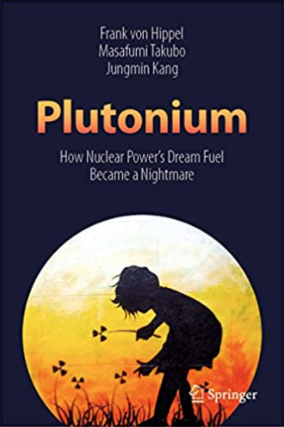 Nailing the Coffin of Civilian Plutonium, Plutonium: How Nuclear Power’s Dream Fuel
 Became a Nightmare, By Frank von Hippel, Masafumi Takubo, and Jungmin KangSpringer Press, Reviewed by Thomas Countryman, November 2020
Even in the world of speculative investment bubbles, it would be difficult to find a parallel to the business of making plutonium. This “industry” has seen massive investment by private and mostly governmental funds in pursuit of creating the world’s most dangerous material, an investment that has failed to yield a single dollar in returns. Nevertheless, a combination of scientific ambition, bureaucratic inertia, and governmental hubris keeps alive a dream that should have been smothered long ago.
Leave it to three highly experienced specialists to briefly recount the history, clearly explain the physical realities, and precisely pick apart the ever-weakening arguments that have supported reprocessing spent nuclear fuel into a new plutonium-based fuel. Frank von Hippel, Masafumi Takubo, and Jungmin Kang accomplish all of this in Plutonium: How Nuclear Power’s Dream Fuel Became a Nightmare. Its planned translation into Japanese and Korean should help citizens participate in critical upcoming decisions about continuing plutonium projects by governments in Tokyo and Seoul.
The earliest rationale for using plutonium as a nuclear fuel rested on the fact that spent nuclear fuel, the leftover material from civilian nuclear power plants, still contained far more potential energy than had yet been consumed. In the 1970s, uranium was believed to be scarce in the natural environment, and the full utilization of its energy capacity made some engineering, logical, and economic sense. In succeeding decades, the economic rationale has been constantly undermined by the realization that natural uranium is sufficiently plentiful that its price is no longer the primary cost factor in nuclear power generation, by the unanticipated complexity of building advanced reactors optimized to use plutonium as fuel, by the cost of new and necessary safety regulations applicable to all reactors, and most recently by the continued fall in the cost of generating renewable energy.
In the face of these realities, only France, at a substantial economic loss, currently operates a full program for recovering plutonium from spent fuel for use as new nuclear fuel. Russia reprocesses spent fuel and is now testing plutonium in a breeder reactor. Japan has indicated it plans to open one of the world’s largest reprocessing plants in Rokkasho in the next two years, but that two-year time frame has been the boilerplate forecast for each of the past 10 years. India is actively reprocessing civilian spent fuel, and China is constructing a major facility for that purpose. South Korea has announced an end to its nuclear power program, but some officials and experts retain the aspiration to pursue civilian reprocessing.
No other nuclear-powered nation is actively pursuing “closing” the nuclear fuel cycle by reprocessing plutonium for energy generation. The economic and technical realities forced one country after another—Germany, Belgium, Switzerland, the United Kingdom, then the United States—to end their own efforts.
This weak support highlights the merits of the authors’ arguments. They systematically deconstruct the political and technical arguments in favor of such programs. Crucially, they demonstrate the factual inaccuracy of the primary argument advanced by Japanese and South Korean advocates that reprocessing spent fuel will diminish the volume and danger of nuclear waste that must ultimately be stored in geological repositories. They also knock down convincingly the claim that plutonium that is reactor grade, as opposed to weapons grade, is unusable in an explosive device.
Although it may be the prerogative of sovereign states to spend their own money irrationally, the authors focus also on important externalities, in particular the threat to the world’s security and environment from the continued production of plutonium. A commitment to the closed fuel cycle delays the inevitable decision that must be made by Japan and South Korea concerning permanent safe storage of spent fuels, a decision on which the United States also continues to procrastinate. In addition, it leads to unsafe practices concerning the storage of spent fuel rods destined for reprocessing. The authors describe for the first time how close the world was to a greater disaster in 2011, as overcrowded spent fuel cooling ponds could have led to a much greater radiation release following the accident at Japan’s Fukushima Daiichi nuclear plant. The authors explain that moving the spent fuel to interim dry cask storage would avert such catastrophic risks.
Of still greater concern is the risk that even a sliver of the massive plutonium stockpiles could be acquired by terrorists to use in a nuclear explosive device or a panic-inducing radiological dispersion device. Since plutonium was first fabricated 80 years ago, nations have created more than 500 tons of what is arguably the world’s most dangerous material. The International Atomic Energy Agency defines a “significant quantity” of plutonium, or enough to make a nuclear weapon, as eight kilograms, although even a Nagasaki-size blast could be generated with significantly less plutonium. Thus, the 300 tons of plutonium designated for civilian use would be sufficient to create more than 35,000 warheads.
Continuing to accumulate plutonium is not only a terrorism risk, but also a source of tension between states. There is concern in Beijing that Japan holds greater stocks of separated plutonium than China and in Seoul that South Korea holds none. The authors note briefly but tellingly the normally unstated security considerations that in part motivate civilian reprocessing programs: an intention to sustain a latent weapons capacity.
The authors make a convincing case for the international community to act together to end further production of separated plutonium. The effort to negotiate a fissile material cutoff treaty, which would ban production of plutonium for weapons, remains frozen in a glacier at the Conference on Disarmament. Whether or when it moves ahead, there is a separate compelling need to negotiate a ban on civilian separation of plutonium.
Although less than 200 pages, Plutonium is not light reading. Its economic and scientific arguments are compact, thoroughly documented, and clear even to lay people. For policymakers and the public, it provides a clear picture of a dream whose claimed benefits have all evaporated but whose danger remains ominously present.
Thomas Countryman is the chair of the Arms Control Association Board of Directors. He served 35 years in the U.S. Foreign Service, retiring in 2017 as acting undersecretary of state for arms control and international security.
Book review: GAMBLING WITH ARMAGEDDON

Coming Close to Nuclear Holocaust, NYT, By Talmage Boston, GAMBLING WITH ARMAGEDDON, Nuclear Roulette From Hiroshima to the Cuban Missile Crisis, 1945-1962, By Martin J. Sherwin On Aug. 6, 1945, after Hiroshima was destroyed, President Truman declared the atomic bomb “the greatest thing in history.” On Oct. 21, 1962, during the Cuban missile crisis, President Kennedy confided to a friend, “The world really is impossible to manage so long as we have nuclear weapons.” The two statements sum up the changes in thinking between those two dates.
Benefiting from more than a half century of hindsight, the Pulitzer-winning historian Martin J. Sherwin delivers a well-researched and reasoned analysis of nuclear weapons’ impact from 1945 to 1962 in “Gambling With Armageddon.” The book should become the definitive account of its subject.
Sherwin has three themes. First, history proves that the disadvantages of nuclear weapons outweigh their advantages. Yes, the A-bomb brought a quick end to World War II, but Dwight Eisenhower and Robert Oppenheimer both believed Japan’s defeat was imminent without the bomb. And while it tipped the balance of power until the Soviets developed their own nuclear weapon in 1949, this brief American advantage produced no geopolitical gains…….
The book’s final lesson is the unsettling one that regardless of how many wise decisions get made by prudent leaders,
In “The Button,” former Defense Secretary William J. Perry and Tom Z. Collina survey the dangers of nuclear escalation.
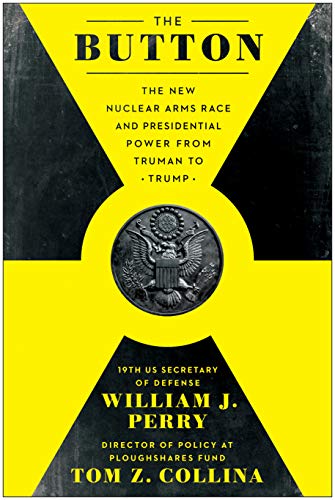 Book Review: The Nuclear Arms Race, Then and Now, Undark, BY MARK WOLVERTON 11 Sept 20, In “The Button,” former Defense Secretary William J. Perry and Tom Z. Collina survey the dangers of nuclear escalation.
IN THE bad old days of the Cold War, both the United States and the USSR maintained thousands of nuclear weapons, ready to be launched at a moment’s notice. Only one person had the authority to unleash America’s nuclear forces: the president of the United States. He could do so at any time, without consulting Congress or the military or anyone else save his own conscience. Although the mechanism for doing so never actually consisted of pushing a button, that became the popular metaphor for setting off doomsday.
|
It was a precarious state of affairs, but there was a certain cold reasoning, or perhaps rationalization, behind it. If the U.S. was attacked, went the argument, there would be no time for careful consideration before nuclear blasts began going off on American soil. Retaliation would have to be immediate. The only way to assure deterrence was to maintain the unquestioned ability for immediate retaliation. So wherever the president went, a military aide followed close behind, carrying the “football,” a special briefcase containing all the secret codes and communication equipment needed to launch World War III at any time. Almost 30 years after the fall of the Soviet Union and the end of the Cold War, little has changed. American and Russian nuclear arsenals, while reduced in numbers due to significant arms control agreements (which have been largely abandoned), still remain on hair-trigger alert, poised to respond to the nonexistent threat of a surprise “bolt from the blue” attack. And the man with the football, the only individual who can order the use of U.S. nuclear weapons, remains the president of the United States: Donald J. Trump. As William J. Perry, former defense secretary in the Clinton administration, and Tom Z. Collina, policy director of the Ploughshares Fund, a nonprofit nuclear disarmament foundation, note in “The Button: The New Nuclear Arms Race and Presidential Power From Truman to Trump,” “the U.S. president can still unilaterally launch a nuclear war in about the same time it takes to order a pizza.” ……….. Casting aside treaties and any logical military necessity, the U.S. and Russia are gearing up for a second nuclear arms race more dangerous than the first, developing new weapons and “modernizing” old ones while extending the potential battlefield into the previously sacrosanct realm of outer space. Yet their rationales remain essentially unchanged from the Cold War, and just as invalid. Rather than a nuclear Pearl Harbor, “The greatest danger of a nuclear exchange during the Cold War came not from a deliberately planned attack, but through bad information, unstable leadership, or false alarms,” Perry and Collina write, chronicling a wide variety of historical examples, some from Perry’s personal experience in the Pentagon. “We have been focused on the wrong threat,” they note, which coupled with the policy of presidential sole authority, makes the U.S. as well as the rest of the world more vulnerable to nuclear catastrophe. “We are preparing for a first strike from Russia that is very unlikely; what is not so unlikely is that we will blunder into a nuclear war. Yet by preparing for the surprise first strike, we actually make the blunder more likely.” And there’s a new wrinkle that didn’t exist during the Cold War: the threat of cyberattacks directed at nuclear weapons command and control systems……….. Perry and Collina depict just such a nightmare scenario in the preface of “The Button,” in which an unnamed U.S. president is interrupted on the golf course by a nuclear attack warning and impulsively orders massive retaliation without waiting for confirmation, only to find out too late that the attack was a false alarm created by a hacking attack on Strategic Command computers. Such a possibility only magnifies the risks of placing nuclear authority in the hands of a single individual who would have only minutes to make the decision to launch. …….. https://undark.org/2020/09/11/book-review-the-button/ |
|
1 This Month

of the week – Shut Down Drone Warfare!


Tell the Ukrainian Government to Drop Prosecution of Peace Activist Yurii Sheliazhenko

Petition to revoke the licensing of the Near Surface Nuclear Disposal Facility (NSDF) at Chalk River. https://www.ourcommons.ca/petitions/en/Petition/Details?Petition=e-7247
To see nuclear-related stories in greater depth and intensity – go to https://nuclearinformation.wordpress.com
-
Archives
- March 2026 (237)
- February 2026 (268)
- January 2026 (308)
- December 2025 (358)
- November 2025 (359)
- October 2025 (376)
- September 2025 (257)
- August 2025 (319)
- July 2025 (230)
- June 2025 (348)
- May 2025 (261)
- April 2025 (305)
-
Categories
- 1
- 1 NUCLEAR ISSUES
- business and costs
- climate change
- culture and arts
- ENERGY
- environment
- health
- history
- indigenous issues
- Legal
- marketing of nuclear
- media
- opposition to nuclear
- PERSONAL STORIES
- politics
- politics international
- Religion and ethics
- safety
- secrets,lies and civil liberties
- spinbuster
- technology
- Uranium
- wastes
- weapons and war
- Women
- 2 WORLD
- ACTION
- AFRICA
- Atrocities
- AUSTRALIA
- Christina's notes
- Christina's themes
- culture and arts
- Events
- Fuk 2022
- Fuk 2023
- Fukushima 2017
- Fukushima 2018
- fukushima 2019
- Fukushima 2020
- Fukushima 2021
- general
- global warming
- Humour (God we need it)
- Nuclear
- RARE EARTHS
- Reference
- resources – print
- Resources -audiovicual
- Weekly Newsletter
- World
- World Nuclear
- YouTube
-
RSS
Entries RSS
Comments RSS
 nuclear-news
