A Short History of Nuclear Folly – book and audio
 AUDIO –– ‘A Short History of Nuclear Folly’ and the lasting effects of the nuclear arms race
 Book ‘A Short History of Nuclear Folly’ and the lasting effects of the nuclear arms race Jacob Margolis with Michelle Lanz | Take Two | April 30th, 2013, Though Russia and the U.S. are working together when it comes to investigating the bombing suspects in Boston – their relationship wasn’t always so amicable. Even today we have our problems.
Back in the 1980s there was always the threat of mutually assured nuclear destruction. Many people probably remember a time when, as schoolchildren, they were trained to hide under their wooden desks during nuclear blast drills. Had a blast actually happened they’d essentially be hiding under kindling, but that’s beside the point.
Before the threat of World War III, however, countries at the forefront of the nuclear arms race had to test these new weapons of mass destruction. The United States in particular tested weapons across the West, and radiation is still found in places like Nevada and Utah today. They treated Earth as their own nuclear testing playground, but that process could have a nasty effect on the environment.
In Rudolph Herzog’s new book, “A Short History of Nuclear Folly: Mad Scientists, Dithering Nazis, Lost Nukes and Catastrophic Cover-ups,” he traces the history of the nuclear race and what effects it has on the world today.
Interview Highlights:….http://www.scpr.org/programs/take-two/2013/04/30/31559/a-short-history-of-nuclear-folly-and-the-lasting-e/
New book “Plutopia” exposes the horror legacy of nuclear weapons making
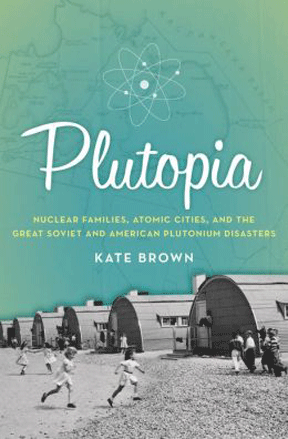 Plutopia: Nuclear Families, Atomic Cities, and the Great Soviet and American Plutonium Disasters Kate Brown http://www.amazon.com/gp/product/0199855765/ref=as_li_ss_tl?ie=UTF8&camp=1789&creative=390957&creativeASIN=0199855765&linkCode=as2&tag=slatmaga-20 While many transnational histories of the nuclear arms race have been written, Kate Brown provides the first definitive account of the great plutonium disasters of the United States and the Soviet Union.
In Plutopia, Brown draws on official records and dozens of interviews to tell the extraordinary stories of Richland, Washington and Ozersk, Russia-the first two cities in the world to produce plutonium. To contain secrets, American and Soviet leaders created plutopias–communities of nuclear families living in highly-subsidized, limited-access atomic cities. Fully employed and medically monitored, the residents of Richland and Ozersk enjoyed all the pleasures of consumer society, while nearby, migrants, prisoners, and soldiers were banned from plutopia–they lived in temporary “staging grounds” and often performed the most dangerous work at the plant.
Brown shows that the plants’ segregation of permanent and temporary workers and of nuclear and non-nuclear zones created a bubble of immunity, where dumps and accidents were glossed over and plant managers freely embezzled and polluted. In four decades, the Hanford plant near Richland and the Maiak plant near Ozersk each issued at least 200 million curies of radioactive isotopes into the surrounding environment–equaling four Chernobyls–laying waste to hundreds of square miles and contaminating rivers, fields, forests, and food supplies.
Because of the decades of secrecy, downwind and downriver neighbors of the plutonium plants had difficulty proving what they suspected, that the rash of illnesses, cancers, and birth defects in their communities were caused by the plants’ radioactive emissions. Plutopia was successful because in its zoned-off isolation it appeared to deliver the promises of the American dream and Soviet communism; in reality, it concealed disasters that remain highly unstable and threatening today.
A plan to crash plane into Oak Ridge nuclear reactor
Book: Hijackers had airplane in nosedive heading for U.S. nuclear reactor — “A very, very scary situation” -Energy Official http://enenews.com/book-hijackers-had-airplane-in-nosedive-heading-for-u-s-nuclear-reactor-a-very-very-scary-situation-energy-official
Title: The odd side of Oak Ridge history
Source: Knoxville News
Author: Frank Munger
Date: April 16, 2013
On the morning of Nov. 11, 1972, Oak Ridge stood still — or nearly so — while a hijacked Southern Airways jetliner circled above.
“It was a very, very scary situation,” Jim Alexander, a retired public affairs officer at the Department of Energy, recalled in a 2001 interview.
The hijackers threatened to crash the airplane into the Oak Ridge nuclear facilities if their demands, including $10 million in cash, were not met. […]
The threat was real, according to a 1977 book, “The Odyssey of Terror.”
The author, Ed Blair, wrote that the hijackers went berserk after placing a call to the White House and being shunned by John Ehrlichman, an aide to President Nixon, who apparently was unaware of the crisis. Blair reported that the hijackers held a grenade to the pilot’s head and ordered him to dive the plane toward the Oak Ridge reactor. The plane was actually in a nosedive when a report came over the radio that the money demands were being met […]
See also: Japan Gov’t Experts: Airplane crash affecting Fukushima spent fuel pool a key security issue for future
50 Soviet Union atomic bombs missing
Lawyer’s second book chronicles missing nuclear bombs Seacoastonline, By Elizabeth Dinan March 01, 2013 PORTSMOUTH — After the collapse of the former Soviet Union, Portsmouth attorney Bob Shaines was living in the post-communist country as a U. S. Defense Department consultant when he learned that 50 Russian, 10-kiloton, suitcase-sized, plutonium bombs were unaccounted for.
“The bombs, he said, “were small enough to be transported by diplomatic pouch and designed to give the Soviets a potential retaliatory weapon in the event of a nuclear war by placing them at various sites in Western cities.”
The missing bombs, and efforts by a global task force to find them, lays the foundation for Shaines’ new book, “Secrets In A Time of Peace.” He calls the book a memoir, but says it’s fiction, though based on actual events, real people, and personal experiences from his time living in Russia between 1991 and 1996…… http://www.seacoastonline.com/articles/20130301-NEWS-130309984
Dispelling the myths that nuclear weapons are necessary or even useful
On the uselessness of nuclear weapons Scientific American By Ashutosh Jogalekar | January 13, 2013 Two foundational beliefs have colored our views of nuclear weapons since the end of World War 2; one, that they were essential or at least very significant for ending the war, and two, that they have been and will continue to be linchpins of deterrence. These beliefs have, in one way or another, guided all our thinking about these mythic creations. Ward Wilson who is at the Monterey Institute of International Studies wants to demolish these and other myths about nukes in a new book titled “5 Myths about Nuclear Weapons“, and I have seen few volumes which deliver their message so effectively in such few words. Below are Wilson’s thoughts about the two dominant nuclear myths interspersed with a few of my own.
“Nuclear weapons were paramount in ending World War 2″.
This is where it all begins. Continue reading
Reviewing latest book on the state of the nuclear world
Book Review Podcast: The State of the Nuclear World, January 11, 2013, Arts Beat, By JOHN WILLIAMS This week in The New York Times Book Review, Bill Keller reviews three new books that address the current thinking about nuclear weapons. Mr. Keller writes:
Fear of nuclear weapons spiked for a time after 9/11, when we confronted the possibility of fissile material in the hands of stateless enemies, and you can find a reservoir of existential fear today in Israel, as it contemplates a nuclear Iran. The nuclear weapons of fragile Pakistan and inscrutable North Korea preoccupy large sectors of our intelligence community. But for most of us anxiety has given way to a kind of complacency. The longer we have gone without seeing nuclear weapons used, the more we assume they will not be used. Three new books challenge that complacency, from three different directions.
This week, Mr. Keller discusses those books…. http://artsbeat.blogs.nytimes.com/2013/01/11/book-review-podcast-the-state-of-the-nuclear-world/
What made the atomic scientists tick?
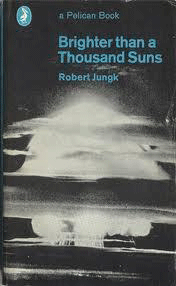 Character before knowledge, Online Opinion, by Noel Wauchope 10 Jan 13, ” Brighter than a Thousand Suns”, A Personal History of the Atomic Scientists, by Robert Jungk, was first published in 1956. “Why are we interested only in what scientists do, and not in what they are? ” This opening question informs Jungk’s entire book. Jungk conversed with many of the scientists of the early days of atomic research, and through until 1954. With the earliest conversations, Jungk was struck by ”the arbitrary and unnatural separation of scientific research from the reality of the individual personality”. To Jungk, it was this division that ”allowed the creation of such monstrosities as the atomic bomb and the hydrogen bomb”.
To this day, many nuclear scientists think of their work as purely mathematical and technical. The human results of nuclear weapons are none of their business. Others, especially after Hiroshima, suffered “their great crisis of conscience”……..
From then on, it was a rush to test the bomb, and then use it, before the Japanese surrendered. Three atomic bombs were built. The first – tested: if the test was a failure – it would be reported as a “girl” – if successful a “boy”.
For the second and third bombs, 67 Scientists petitioned the government to warn the Japanese first – a petition that was prevented by General Groves from reaching the White House. Enrico Fermi commented “Don’t bother me with your conscientious scruples! After all, the thing is superb physics!”
The $2 billion Manhattan Project would be seen as a senseless waste of money, if Japan surrendered. Truman authorised the bombing of Hiroshima and Nagasaki. Oppenheimer explained later that his Interim Committee’s recommendation was “a technical opinion”.
The reactions of the scientists were conflicted……
Robert Jungk’s account of the men, and some women, too, who developed atomic weapons , is set against the background of the big events of the time, with a sympathetic attitude to the pressures and problems that surrounded these people.
From 1951 to 1955 the general attitude of atomic scientists was one of enthusiasm for the hydrogen bomb (1000 times more powerful than the first atomic bomb). Jungk muses on this: “How is one to explain such macabre enthusiasm which had swept away all the earlier scruples and objections to the Super monster?” http://www.onlineopinion.com.au/view.asp?article=14554
Book Review: Atomic bombing of Hiroshima was not necessary
 BOOK REVIEW The rush to the nuclear The Nation, 6 Jan 13, The end of World War II needn’t have been so terrible as to witness the birth of the bomb,says author Paul Ham
Hiroshima Nagasaki: The Real Story
In six decades the story behind the birth of the atomic
age has lost none of fascination, in equal parts because the power of
the nucleus was immediately put to such horrific use, and because its
risks have still not been fully contained, in conflict or in peace.
While Australian journalist Paul Ham’s book “Hiroshima Nagasaki”
appears to offer nothing new as claimed, it’s an enlightening analysis
of those dangerous early years, drawn into a modern context….. In
the end he comes firmly down on the side of those who say the bombing
of Hiroshima and Nagasaki was utterly without justification, and these
voices include many wartime generals. Japan was blockaded, its supply
lines strangled, meaning that the Allies didn’t even need to launch a
dreaded, costly invasion of the mainland, let alone unleash nuclear
terror…… http://www.nationmultimedia.com/life/The-rush-to-the-nuclear-30197326.html
New book on the heroic “Fukushima 50”
 now a recently published book sheds light on dozens of those workers, including their real names and numerous quotes, and an account by the plant’s heroic operations chief, Masao Yoshida, who has largely avoided giving interviews despite intense public interest in
his role in the saga.
 Book reveals human drama in Fukushima No. 1 crisis http://www.japantimes.co.jp/text/nn20121211f2.html#.UMf-ohGksug.twitter By KAZUAKI NAGATA, 12 Dec 12 Experts and journalists have written a number of reports, some even running several hundred pages, about the cause of the triple meltdown crisis at the Fukushima No. 1 power plant and the chain of events that followed.
Behind the scenes: “Shino Fuchi wo Mita Otoko” (“A Man Who Was on the Brink of Death”) interviews the people involved in battling the Fukushima nuclear crisis in March 2011 and takes the rare step of using their real names. YOSHIAKI MIURA
But little has come to light about the human drama of how the plant workers who came to be dubbed the “Fukushima 50,” fought against incredible odds to avert catastrophic reactor explosions that would have led to the contamination of all eastern Japan. Continue reading
Wikileaks book warns on Internet surveillance
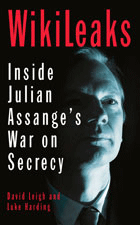 Julian Assange’s book an exercise in dystopian musings WikiLeaks founder’s Cypherpunks warns tool he relies on and used to make his name is ‘global surveillance industry’ target Esther Addley guardian.co.uk, 26 November 2012 Julian Assange‘s new book is not a manifesto, he writes in its introduction – “There is no time for that”. Instead the short volume,entitledCypherpunks: Freedom and the Future of the Internet and published on Monday, is intended to be what the Wikileaks founder calls “a watchman’s shout in the night”, warning of an imminent threat to all civilisation from “the most dangerous facilitator of totalitarianism we have ever seen” – the web……
New book, ‘FUKUSHIMA: THE DEATH KNELL FOR NUCLEAR ENERGY?’
Fukushima should warn us off nuclear power, says eco-theologian http://www.indcatholicnews.com/news.php?viewStory=21443 By: Ellen Teague, November 15, 2012 Columban priest Sean McDonagh takes the view that nuclear power should not be seen as the solution to global warming. He will be saying as much next Thursday when he launches his latest book, ‘FUKUSHIMA: THE DEATH KNELL FOR NUCLEAR ENERGY?’ at Heythrop College in London. More emphasis on energy efficiency and the promotion of green energy is preferable to any expansion of nuclear power, says the eco-theologian. Continue reading
“Strong in the Rain” – new book about Fukushima’s catastrophe
Fukushima Daiichi Worker: “We’re looking at a Chernobyl-type situation, maybe worse” -Book http://enenews.com/fukushima-daiichi-worker-were-looking-at-a-chernobyl-type-situation-maybe-worse
November 4th, 2012
Title: Chapter 4: Meltdown
Source: The Asia-Pacific Journal
Authors: Lucy Birmingham and David McNeill
Date: November 5, 2012
Strong in the Rain, a new book co-authored by Japan Focus coordinator David McNeill and Lucy Birmingham, Time magazine’s Tokyo correspondent, tells the story of Japan’s 2001 [sic] triple disaster through the eyes of six ordinary Japanese people. […] In this except from Chapter Four, [a maintenance worker at the Fukushima Daiichi nuclear plant] Watanabe Kai (a pseudonym) and Mayor Sakurai Katsunobu begin to realize the full scale of the triple meltdown at the Daiichi plant and what it will mean for their lives.
[…] It was just after 3:00 pm. Kai and thousands of workers had been allowed to leave to check on their families. […]
Trying to put together what happened at the refugee center in Iwaki, Kai feared the worst. The center was crowded with people from his town who sat fearful and transfixed in front of the TV, but few were as qualified as he was to imagine how bad this could get. A professor from the elite University of Tokyo was saying that there was no cause for alarm but it was obvious that there was no water in the reactors and that the fuel was melting. Why were they saying it isn’t melting down?, he wondered. We’re looking at a Chernobyl-type situation, maybe worse. Eventually, he thought, the evacuation area could stretch to 100km or perhaps 200 km. […]
Still, as soon as he saw the explosion on March 12, he began waiting for a call from his company, asking him to save the plant and clean up the mess. […]
The call came later, about a week after the crisis began. “We have to go back,” said Kai’s manager. He used a military term; “final battle orders.” […]
“Fresh Currents” – a must-read book for Japan and the world
Even if you don’t live in Japan, “Fresh Currents” has something profound to offer. As the Kyoto Journal’s Einarsen notes, “The writings in ‘Fresh Currents’ explore Japan’s path forward from Fukushima to a renewable energy future — and why this is important, wherever you live.”
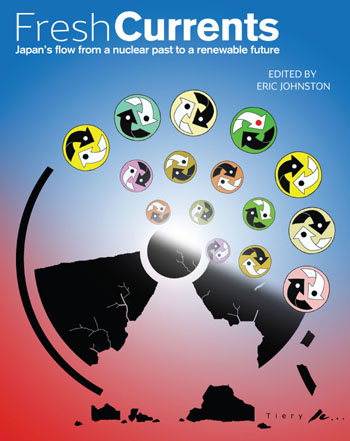
“Fresh Currents” can be downloaded free. It is also available from good bookstores, priced ¥2,000. For more details, including news updates, visit:www.freshcurrents.org. Stephen Hesse is a professor in the Law Faculty of Chuo University. He can be reached at stevehesse@hotmail.com.
‘Fresh Currents’ charts the way to, and from, Fukushima, Japan Times, 28 Oct 12, By STEPHEN HESSE This month’s column is about a book that is very much more than just a book: It is a work of art, a labor of love and a realizable dream of a better future for Japan…..
Japan has limited options regarding its energy future: To accept the status quo and the cronyism that taints its government-industry relations, leaving energy policy in the hands of those who prioritize political gain; or to pursue national energy security that puts a priority on safety and on sharing the costs and benefits, financial and technological, across all of the nation’s regions and residents.
In a nutshell, Japan can either remain nuclear, with all the dangers that portends for these islands perched on the Pacific Rim of Fire — or it can pursue policies that foster and reward dramatic increases in energy conservation and efficiency and the development of alternative energies that are safe and widely decentralized. Continue reading
New book – Nuclear Roulette
 All-Time Darwin Award: The Nuclear Industry Rady Ananda Activist Post 18 Oct 12, Gar Smith’s Nuclear Roulette: The Truth about the Most Dangerous Energy Source on Earth is a 14-point condemnation of President Eisenhower’s “peaceful atom,” an exposé of official and corporate lies, and a multi-pronged platform of alternatives.
“In 2000 alone, civilian reactors produced enough plutonium to make more than 34,000 nuclear bombs,” writes Smith. [1] Continue reading
Global nuclear war danger still, 50 years after Cuban missile crisis
Nuclear weapons still have the power to instantly destroy the world October 23, 2012, This month is the 50th anniversary of the Cuban Missile Crisis — which took place Oct. 16-28 in 1962 — so we’re going to hear a great deal about the weeks when the world almost died. But the past is a foreign country, a place where everything was in black and white, and men still wore hats, so it’s just scary stories about a long-gone time.
Or so it seems.
The outlines of the tale are well known. It was 17 years since the United States had used nuclear weapons on Japan, and the Soviet Union now had them, too. Lots of them. The American and Soviet arsenals included some 30,000 nuclear weapons, and not all of them were carried by bombers any more. Some were mounted on rockets that could reach
their targets in the other country in half an hour……
What almost nobody knew until very recently is that the crisis did not really end on Oct. 28. A new book by Sergo Mikoyan — “The Soviet Cuban Missile Crisis: Castro, Mikoyan, Kennedy, Khrushchev, and the Missiles of November” — reveals that it continued all the way through November……. the whole world could have ended.
As Robert McNamara, Kennedy’s defence secretary in 1962, said 40 years later: “We were just plain lucky in October 1962 — and without that luck most of you would never have been born because the world would have been destroyed instantly or made unlivable in October 1962.”
Then he said the bit that applies to us. “Something like that could happen today, tomorrow, next year. It will happen at some point. That is why we must abolish nuclear weapons as soon as possible.” They are still there, you know, and human beings still make mistakes.
http://www.capebretonpost.com/Opinion/Columns/2012-10-23/article-3105130/Nuclear-weapons-still-have-the-power-to-instantly-destroy-the-world/1
1 This Month

of the week – Shut Down Drone Warfare!


Tell the Ukrainian Government to Drop Prosecution of Peace Activist Yurii Sheliazhenko

Petition to revoke the licensing of the Near Surface Nuclear Disposal Facility (NSDF) at Chalk River. https://www.ourcommons.ca/petitions/en/Petition/Details?Petition=e-7247
To see nuclear-related stories in greater depth and intensity – go to https://nuclearinformation.wordpress.com
-
Archives
- April 2026 (7)
- March 2026 (251)
- February 2026 (268)
- January 2026 (308)
- December 2025 (358)
- November 2025 (359)
- October 2025 (376)
- September 2025 (257)
- August 2025 (319)
- July 2025 (230)
- June 2025 (348)
- May 2025 (261)
-
Categories
- 1
- 1 NUCLEAR ISSUES
- business and costs
- climate change
- culture and arts
- ENERGY
- environment
- health
- history
- indigenous issues
- Legal
- marketing of nuclear
- media
- opposition to nuclear
- PERSONAL STORIES
- politics
- politics international
- Religion and ethics
- safety
- secrets,lies and civil liberties
- spinbuster
- technology
- Uranium
- wastes
- weapons and war
- Women
- 2 WORLD
- ACTION
- AFRICA
- Atrocities
- AUSTRALIA
- Christina's notes
- Christina's themes
- culture and arts
- Events
- Fuk 2022
- Fuk 2023
- Fukushima 2017
- Fukushima 2018
- fukushima 2019
- Fukushima 2020
- Fukushima 2021
- general
- global warming
- Humour (God we need it)
- Nuclear
- RARE EARTHS
- Reference
- resources – print
- Resources -audiovicual
- Weekly Newsletter
- World
- World Nuclear
- YouTube
-
RSS
Entries RSS
Comments RSS
 nuclear-news