Nuclear catastrophe avoided in USA – so far
 We’re Incredibly Lucky There Hasn’t Been a U.S. Nuclear Catastrophe…Yet Atlantic Wire ERIC LEVENSON, 30 Sept 13 Know that popular Liberty Insurance Mutual commercial that jokingly shows people making small mistakes — dropping an air conditioning unit from an upper-story window or forgetting to put on the emergency brake — that destroy their cars? Funny, right? Now imagine that, but with nuclear weapons.
That’s the frightening picture that author Eric Schlosser paints in his new book Command and Control, a look at the many accidents involving nuclear weapons that almost led to massive destruction. His conclusion isn’t very comforting — it’s partly plain old luck that has kept an explosion from happening, one of several points he made in a phone interview with The Atlantic Wire………
The book is scarily full of stories like the Damascus Accident, which Schlosser worked to get declassified for the book. In another case, a B-52 plane exploded above North Carolina during a supposedly-routine flight, dropping two hydrogen bombs below. They failed to explode because of a single low-voltage switch, the last safety measure available for the explosives. Other gut-wrenching examples were reported in The New Yorker, Los Angeles Times, and The New York Times Book Review.
Just as we are lucky that none of these accidents ever resulted in an explosion, we’re equally lucky that no unhinged military members had a Dr. Strangelove-like desire to take nuclear action into their own hands, a possibility which, despite Air Force claims to the contrary, was very real. “The reality was until the early 1970s, there was nothing to prevent a bomber crew from just flying to the Soviet Union with their hydrogen bombs and dropping them,” Schlosser said. “There were no codes that they had to type in to unlock the bombs or unlock the missiles. So we’re glad that never happened but it’s a pretty risky way to manage a nuclear weapon.”
Even more disconcerting — two people in charge of safety protocols for nuclear weapons didn’t even know about all of these accidents until Schlosser told them. That’s because of the Air Force’s compartmentalized secrecy, which prevents the bomb users from interacting with its developers, Schlosser explained. “There were bomb handlers and pilots who didn’t realize some of the safety problems with the weapons, and there were weapons developers who didn’t realize how these weapons were being handled. And that’s a very bad combination,” he said.
And this isn’t just a historical problem; many of these same issues remain today. “I’m concerned about the arsenal right now, and the morale of the people who are running it, and some of the safety violations we’ve been having for the last two years,” Schlosser said. While his work highlights the potentially huge problems of human infallibility, the solutions he suggests don’t offer much. “But if we’re gonna have these weapons, we need to take care of them properly,” he said. Any other options? “Or just get rid of them.” http://www.theatlanticwire.com/national/2013/09/eric-schlosser-book-command-and-control-review-nuclear-explosion/69949/
South Carolina was very nearly nuclear bombed by US military
 The Time the U.S. Military Came This Close To Dropping a Nuclear Bomb on North Carolina Slate, By Will Oremus, Sept. 20, 2013 Remember fallout shelters? Air raid drills? Duck and cover?
At the height of the Cold War, Americans lived in perpetual fear of a nuclear attack by the Soviet Union. But perhaps we were afraid of the wrong side.
A declassified document obtained by author Eric Schlosser sheds new light on the 1961 Goldsboro accident, in which a U.S. Air Force B-52 broke apart in midair over  North Carolina, dropping a pair of Mark 39 nuclear bombs on the countryside below. The accident is not news, but just how close the military came to wiping out a swath of the Eastern Seaboard has long been debated. For years the military insisted that the hydrogen bombs were never in danger of detonating.
The secret document, written by a nuclear weapons safety supervisor in 1969 and first published by The Guardian today, makes it clearer than ever that was not the case. In fact, three of the four safety mechanisms on one of the bombs were unlocked in the course of the fall. By the time the bomb reached the ground, the only thing preventing it from detonating was a single, simple, low-voltage switch. A short-circuit of that switch as a result of the mid-air breakup—“a postulate that seems credible,” the supervisor writes—could have resulted in mass destruction.
The Mark 39 bombs, Schlosser notes in his new book Command and Control, were some 250 times as powerful as the device that the United States dropped on Hiroshima……..http://www.slate.com/blogs/future_tense/2013/09/20/goldsboro_nuclear_accident_declassified_document_u_s_nearly_nuked_north.html
New report on America’s renewable energy policy
2013 America Renewable Energy Policy Handbook Report http://www.environmental-expert.com/news/2013-america-renewable-energy-policy-handbook-report-393874
|
Sep. 19, 2013 North and South America Renewable Energy Policy Handbook 2013 report presents an in-depth analysis of the renewable energy policies across the major countries in North and South America namely the US, Canada, Brazil, Argentina and Mexico. The report provides the current and future renewable energy targets and plans along with the present policy framework, giving a fair idea of overall growth potential of their renewable energy industry.
The report also provides major technology specific policies and incentives provided in each of these countries. The report also provides insights to major policy initiatives for the market development of renewable energy sources such as wind, solar, geothermal, biopower and biofuels. The report ( http://www.reportsnreports.com/reports/268267-north-and-south-america-renewable-energy-policy-handbook-2013.html ) is built using data and information sourced from industry associations, government websites and statutory bodies. The information is also sourced through other secondary research sources such as industry and trade magazines. Scope
Table of Contents for the report North and South America Renewable Energy Policy Handbook 2013 include: Continue reading |
New book ‘Command and Control’ spills the beans on America’s nuclear weapons unsafety
In a new book, the ‘Fast Food Nation’ author investigates the many near-misses that could have caused catastrophes Rolling Stone, By Ryan Devereaux September 16, 2013 Longtime RS contributor Eric Schlosser’s new book, ‘Command and Control,’ reveals long-hidden secrets about America’s nuclear weapons program
It was a one-in-a-million bounce: A socket slipped from a wrench and fell about 70 feet before piercing the fuel tank of the most powerful missile in the United States’ nuclear arsenal. What followed was a race to prevent an explosion that could have incinerated the state of Arkansas.
In his new book, Command and Control, award-winning investigative journalist and longtime Rolling Stone contributor Eric Schlosser reveals how this disaster was narrowly avoided at a Damascus, Arkansas missile silo in 1980 – and shows that it was just one incident in an ongoing pattern of near-misses and bureaucratic blunders that have brought America to the nuclear brink again and again. Drawing on six years of research, Schlosser challenges and expands on the U.S. government’s secretive record regarding nuclear accidents.
The best-selling author of 2001’s Fast Food Nation – which began as an exposé published in RS – likens his new book to a foot soldier’s history of World War II, relying on the firsthand accounts of U.S. service members. His interview subjects, many of whom served at the height of the Cold War, have been called on time and again to prevent nuclear devastation, often at tremendous personal risk.
Command and Control hits bookstores tomorrow. Schlosser called RS to explain the results of his latest eye-opening research, and make the case for nuclear disarmament. “I’m not apocalyptic,” he says. “But I think we have to confront this issue.”
Let’s get the big question out of the way: How many times have we just barely avoided nuclear armageddon in the U.S.?
That’s a good question. It’s a very secretive subject, and I did my best, through interviews and through the Freedom of Information Act, to get as much information as I could on these accidents……. http://www.rollingstone.com/politics/news/q-a-eric-schlosser-on-the-secret-history-of-americas-nuclear-arsenal-20130916#ixzz2fCZT9OzE
“Dealing in Doubt” – new book exposes the climate scepticism industry
Report offers field guide to the climate change denial industry, Guardian, Graham Readfearn, 13 Sept 13, Greenpeace report documents the who, what, when and how of a long-running campaign to block action on climate change It writes boilerplate legislation, runs extensive PR campaigns, puffs CVs with fake credibility, facilitates or promotes the intimidation of climate scientists and advocates, publishes books, organises speaking tours and conferences, gets on the telly and radio a lot, uses Freedom of Information laws as a surveillance tool, pays scientists to speak and – crucially – it manufactures doubt and confusion among policy makers, politicians and the public about climate change.
To get this work done, it has accepted many millions of dollars from fossil fuel interests or ideologically-driven conservative donors who funnel their cash through anonymous trust funds because they are too cowardly to put their mouths and their money in the same place.
We’re talking about the international climate science denial industry. Now it has a field guide, of sorts, courtesy of researchers at environment group Greenpeace.
 Published this week, Dealing in Doubt: The Climate Denial Machine Vs Climate Science recounts the history of efforts to underplay the risks of human-caused climate change, to deny the scientific evidence and to misrepresent the state of the collective knowledge of genuine scientists on the issue.
Oh, and it comes with fun little caricatures of some of the key characters in the denial industry.

The title of the report “Dealing in Doubt” comes from a tactic employed and articulated by tobacco industry executives in a 1969 memo, which read: Continue reading
“Earthmasters”- new book on geo-engineering
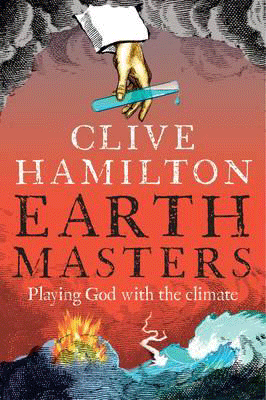
CLIVE HAMILTON: – One thing I noticed while doing this research and looking at scientists involved was the density of the linkages with the Lawrence Livermore National Laboratory. So I investigated further and thought it’s really quite astonishing the extent to which many, if not most, prominent scientific researchers in geoengineering in the U.S. worked at Livermore or have close links with people there now or those who used to work there.
Then when I read Hugh Gusterson’s book on Livermore and it’s role in the cold war and nuclear weapons development, I started to think much more carefully about the type of mindset that is especially drawn to geoengineering as a technological response to global warming. I think it’s quite alarming in its implications.
Climate Change’s Silver Bullet? Our Interview With One Of The World’s Top Geoengineering ScholarsBY ARI PHILLIPS ON SEPTEMBER 6, 2013 MELBOURNE, AUSTRALIA — SINCE COMING TO AUSTRALIA ALMOST TWO MONTHS AGO I’VE HEARD ABOUT CLIVE HAMILTON IN THE PROCESS OF REPORTING JUST ABOUT EVERY STORY I’VE DONE. THEN I PICKED UP HIS NEW BOOK EARTHMASTERS: THE DAWN OF THE AGE OF CLIMATE ENGINEERINGAND NOW I SEE WHAT ALL THE FUSS IS ABOUT.
In all of the debates over how to address climate change, climate engineering — or geoengineering — is among the most contentious. It involves large-scale manipulation of the Earth’s climate using grand technological interventions, such as fertilizing the oceans with iron to absorb carbon dioxide or releasing sulfur into the atmosphere to reduce radiation. While its proponents call geoengineering a silver bullet for our climate woes, its skeptics are far more critical. Joe Romm, for one, likens geoengineering to a dangerous course of chemotherapy and radiation to treat a condition curable through diet and exercise — or, in this case, emissions reduction.
According to the cover of Hamilton’s new book, “The potential risks are enormous. It is messing with nature on a scale we’ve never seen before, and it’s attracting a flood of interest from scientists, venture capitalists and oil companies.” Continue reading
Book ‘The Power of Promise’ -India’s nuclear industry rotten to the core
 In case of a catastrophic accident, almost the entire fiscal burden will be borne by Indians – as will, of course, all the death and despair. What is worse, as Ramana points out, the reactor suppliers now have diminished incentive to ensure quality and safety……
A rotten core 26 August 2013 By Madhusree Mukerjee M V Ramana’s book dissects India’s nuclear-power lobby to expose its lies and deceit. “……The delusions If the majority of Indians are unaware of the risks, it may be because they have been always kept in the dark about nuclear matters. Ramana demonstrates that the nuclear establishment in India has insulated itself from the people it purports to serve by means of a culture of secrecy and mendacity that obscures the true fiscal, environmental and human cost of nuclear energy. By publishing The Power of Promise, he has opened the windows of a long-shuttered room and let the sunlight stream in.
Latest market resource: Europe Renewable Energy Policy Handbook 2013
 Europe Renewable Energy Policy Handbook 2013 Market Watch NEW YORK, Aug. 22, 2013 /PRNewswire via COMTEX/ — Reportlinker.com announces that a new market research report is available in its catalogue:
Europe Renewable Energy Policy Handbook 2013http://www.reportlinker.com/p0254459/Europe-Renewable-Energy-Policy-Handbook-2013.html#utm_source=prnewswire&utm_medium=pr&utm_campaign=Renewable_energy
Europe Renewable Energy Policy Handbook 2013
Summary
“Europe Renewable Energy Policy Handbook 2013” is the latest policy report from GlobalData, the industry analysis specialists that offer comprehensive information on major policies governing renewable energy market in the region. The report presents an in-depth analysis of the renewable energy policies across the major countries in Europe namely Germany, France, Italy, the UK, Spain, Austria, the Netherlands, Norway, Poland, Sweden and Turkey.
The report provides the current and future renewable energy targets and plans along with the present policy framework, giving a fair idea of overall growth potential of their renewable energy industry. The report also provides major technology specific policies and incentives provided in each of these countries.
The report also provides insights to major policy initiatives for the market development of renewable energy sources such as wind, solar, geothermal, biopower and biofuels A comparative snapshot of major policy instruments in these countries to support the renewable energy industry has also been provided. Information related to energy efficiency schemes in these countries has also ben provided.
The report is built using data and information sourced from industry associations, government websites and statutory bodies. The information is also sourced through other secondary research sources such as industry and trade magazines…..To order this report:Renewable_energy Industry: Europe Renewable Energy Policy Handbook 2013
__________________________Contact Clare: clare@reportlinker.comUS:(339) 368 6001Intl:+1 339 368 6001
SOURCE Reportlinker. http://www.marketwatch.com/story/europe-renewable-energy-policy-handbook-2013-2013-08-22
250 tonnes of documents about UK’s Dounreay nuclear reactor
Dounreay documents set for nuclear archive The Scotsman, 20 Aug 13, A STAGGERING 250 tonnes of historic documents, charting the development of Britain’s first fast-breeder nuclear reactor at Dounreay, will be among the first items to be stored in the new National Nuclear Archive to be built in Caithness, it was revealed today.
The £20 million national archive centre for the nuclear industry is to be built close to Wick Airport, near the Dounreay experimental power complex, and will eventually house an estimated 30 million digital, paper and photographic records from civil nuclear sites throughout the UK, dating back to the 1940s.
The archive will include records from the UK Atomic Energy Authority in Harwell where the Atomic Energy Research Establishment, the UK centre for research and development into civil nuclear power, was first based.
A spokesman for the Nuclear Decommissioning Authority (NDA) said that the new archive building would be open for business by 2016, just in time for the majority of the documents in the Dounreay archive to be moved offsite, before the existing archive building is vacated.
Ian Pearson, the Dounreay archivist, explained that the site’s archive currently held 250 tonnes of records which if laid out would stretch nearly two-and-a-half miles. Some of these date back to the early days on construction and operation of Dounreay……. http://www.scotsman.com/lifestyle/heritage/dounreay-documents-set-for-nuclear-archive-1-3052390
New Book: Being Nuclear
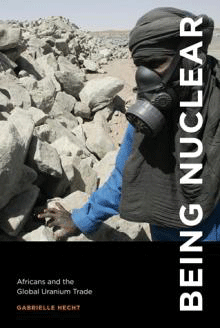 Being Nuclear Africans and the Global Uranium Trade, By Gabrielle Hecht http://mitpress.mit.edu/books/being-nuclear Overview
Uranium from Africa has long been a major source of fuel for nuclear power and atomic weapons, including the bomb dropped on Hiroshima. In 2002, George W. Bush claimed that Saddam Hussein had “sought significant quantities of uranium from Africa” (later specified as the infamous “yellowcake from Niger”). Africa suddenly became notorious as a source of uranium, a component of nuclear weapons. But did that admit Niger, or any of Africa’s other uranium-producing countries, to the select society of nuclear states? Does uranium itself count as a nuclear thing? In this book, Gabrielle Hecht lucidly probes the question of what it means for something–a state, an object, an industry, a workplace–to be “nuclear.”
Hecht shows that questions about being nuclear–a state that she calls “nuclearity”–lie at the heart of today’s global nuclear order and the relationships between “developing nations” (often former colonies) and “nuclear powers” (often former colonizers). Nuclearity, she says, is not a straightforward scientific classification but a contested technopolitical one.
Hecht follows uranium’s path out of Africa and describes the invention of the global uranium market. She then enters African nuclear worlds, focusing on miners and the occupational hazard of radiation exposure. Could a mine be a nuclear workplace if (as in some South African mines) its radiation levels went undetected and unmeasured? With this book, Hecht is the first to put Africa in the nuclear world, and the nuclear world in Africa. Doing so, she remakes our understanding of the nuclear age.
Yoshito Matsushige, photographer of iconic Hiroshima bombing pictures
the American military confiscated all of the post-bomb prints, just as they seized the Japanese newsreel footage,
 Journalist Took Five Historic Pictures—That Must Never Be Repeated The Nation, Greg Mitchell on August 8, 2013 Yoshito Matsushige, a photographer for the Chugoku Shimbun, took the only pictures in Hiroshima on August 6, 1945, that have surfaced since. It was these five photos Life magazine published on September 29, 1952, hailing them as the “First Pictures—Atom Blasts Through Eyes of Victims,” breaking the long media blackout on graphic images from Hiroshima and Nagasaki.
On August 6, 1945, Matsushige wandered around Hiroshima for ten hours, carrying one of the few cameras that survived the atomic bombing and two rolls of film with twenty-four possible exposures. This was no ordinary photo opportunity. He lined up one gripping shot after another, but he could only push the shutter seven times. Continue reading
The Amazing foolishness of nuclear weapons and nuclear power building
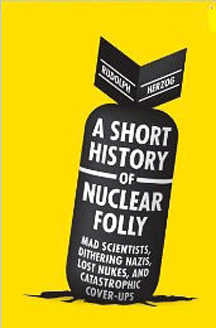 Book Review: A Short History Of Nuclear Folly http://www2.macleans.ca/2013/07/19/a-short-history-of-nuclear-folly/ by Bookmarked and Andrew Stobo Sniderman on Friday, July 19, 2013 A Short History Of Nuclear Folly By Rudolph Herzog
Reading about human courtship of nuclear destruction is like watching the wobbles of an amateur tightrope walker: one gawks in terror and amazement. Herzog, son of the eminent filmmaker, offers a snapshot tour of the “frivolity, naïveté, and unscrupulousness” with which nuclear devices have been used since physicists figured out how to get a big bang out of a wee atom. This is not a scholarly or particularly well-structured book, and it reads more like a collection of cool stuff the author found while reading around the subject of nuclear madness. Yet Herzog will make your jaw drop with regularity.
For examples: Cold-Warring Soviets forced 40,000 soldiers to march into the site of a nuclear test explosion immediately after the ascension of its mushroom cloud, just to see what happened to the poor fellows; an influential American physicist sought to blast an alternative international shipping route to the Panama and Suez canals using nuclear bombs as convenient excavation devices; and, my favourite, plutonium-powered pacemakers enraptured doctors with their long-lasting convenience, except that no one bothered to keep track of them once the patients eventually died. Woe to the cremators.
Beyond the shocking “indifference to the fate of individuals” of the superpowers as they tinkered with their nuclear toys, Herzog identifies one central problem with the nuclear fixation: persistent failures of imagination. “No one was able to picture the worst-case scenario.” So it was typical that the Soviet Union gleefully built nuclear-powered satellites, but didn’t prepare for the possibility of them crashing back to Earth. As it happened, in 1977 a malfunctioning Soviet satellite with 45 kilograms of radioactive uranium on board crashed in the Yukon. American radiation detectors didn’t work in the Canadian winter cold, but thankfully some random mushers stumbled upon the wreckage. It could have been worse. Indeed, though there was plenty of folly, often fatal, we somehow avoided Armageddon.
New Book: A Short History of Nuclear Folly
A Short History of Nuclear Folly [Hardcover] http://www.amazon.com/A-Short-History-Nuclear-Folly/dp/1612191738/ref=sr_1_1?ie=UTF8&qid=1369261455&sr=8-1&keywords=short+history+of+nuclear+folly Release date: April 30, 2013
In an unprecedented people’s history, Herzog digs deep into archives, interviews nuclear scientists, and collects dozens of rare photos. He explores the “accidental” drop of a Nagasaki-type bomb on a train conductor’s home, the implanting of plutonium into patients’ hearts, and the invention of wild tactical nukes, including weapons designed to kill enemy astronauts.
Told in a riveting narrative voice, Herzog—the son of filmmaker Werner Herzog—also draws on childhood memories of the final period of the Cold War in Germany, the country once seen as the nuclear battleground for NATO and the Warsaw Pact countries, and discusses evidence that Nazi scientists knew how to make atomic weaponry . . . and chose not to.
USA Safety Issue – Nuclear Missile Launch Crews
Overlooked Story of the Week: ‘Rot’ and ‘Crisis’ For Nuclear Missile Launch Crews, The Nation, Greg Mitchell on May 10, 2013 “…..Sadly overlooked, however, was an exclusive from the Associated Press. Oh, no big deal. Just “rot” and “crisis” and a wave of firings in one program you especially don’t want to witness this in: Our nuclear missle launch program.
At Minot Air Force Base in North Dakota the commander confirmed, as the story put it, “the willful violation of safety rules—including a possible compromise of launch codes—was tolerated.” Seventeen members of launch crews have been fired, an unprecedented action in its scope……
As I’ve done for, oh, the past thirty years, in numeous articles and three books, this is where I remind readers that the US still has a first-strike nuclear policy, and thousands of nuclear weapons, more than two decades after the end of the Cold War—and that we have used nuclear weapons before, setting (and for most Americans, defending) a precedent.
Greg Mitchell’s new book is “Hollywood Bomb.” His previous books on this subject were “Atomic Cover-up” and, with Robert Jay Lifton, “Hiroshima in America.”
The New York Times is again pushing for war in the Middle East, while McClatchy news outlets are again advising caution, Greg Mitchell writes. http://www.thenation.com/blog/174272/overlooked-story-week-rot-and-crisis-nuclear-missile-launch-crews#
An unpopular truth – Iran does not have nuclear weapons
No, Iran does not posses nuclear weapons, The Spectator, Peter Oborne 1 May 2013 “…… two weeks ago I published a book, co-authored with David Morrison, A Dangerous Delusion: Why the West is Wrong about Nuclear Iran. Since then my co-author and I have been subject to a series of misrepresentations and innuendo on a scale and (in some cases) virulence that I have never encountered before…….
not one of our critics have even tried to deal with the central, factual points of our short book: that Iran isn’t in possession of nuclear weapons and isn’t building them; that the US and Israeli intelligence agencies don’t think they are; that Iran is entitled under the Non-Proliferation Treaty to develop peaceful nuclear power; that in 2005 it put proposals on the table to do this under full international scrutiny (including co-ownership).
We acknowledge that Iran’s human rights record – as Geoffrey Robertson has graphically portrayed in his recent book – is dreadful. We view President Ahmadinejad’s denials of the Holocaust as utterly odious. However, to judge Iran by Ahmadinejad alone would be a mistake. He steps down in a few weeks, and in any case the final decision on nuclear matters lies with the Supreme Leader, who has repeatedly denounced nuclear weapons as forbidden under Islam. It is in the best interest of the west, let alone ordinary Iranians whose lives are being made miserable by sanctions, to engage with Iran pragmatically rather than carry on with the current policy of isolation.
In the wake of June’s elections we hope and believe that a solution satisfactory to all parties can be agreed. We passionately believe that the alternative is too ghastly to contemplate. However, if an agreement is to be reached, we in the west need to recognize that Iran – with all its faults – is an independent nation with legitimate interests, and is a fully signed up member of the Non-Proliferation Treaty, with every right to enrich uranium.
We also need to be clear about the facts. This is why in our book we have attempted to expose the myths, falsehoods and delusions that surround this grave and troubling subject. There is an argument of massive importance to be engaged in here. If my critics wish to challenge me to open debate about the thesis of our book, I would be delighted to engage. They know how to get hold of me: any time, any place. http://blogs.spectator.co.uk/peter-oborne/2013/05/no-iran-is-an-independent-nation-with-legitimate-interests-that-does-not-posses-nuclear-weapons/
1 This Month

of the week – Shut Down Drone Warfare!


Tell the Ukrainian Government to Drop Prosecution of Peace Activist Yurii Sheliazhenko

Petition to revoke the licensing of the Near Surface Nuclear Disposal Facility (NSDF) at Chalk River. https://www.ourcommons.ca/petitions/en/Petition/Details?Petition=e-7247
To see nuclear-related stories in greater depth and intensity – go to https://nuclearinformation.wordpress.com
-
Archives
- March 2026 (244)
- February 2026 (268)
- January 2026 (308)
- December 2025 (358)
- November 2025 (359)
- October 2025 (376)
- September 2025 (257)
- August 2025 (319)
- July 2025 (230)
- June 2025 (348)
- May 2025 (261)
- April 2025 (305)
-
Categories
- 1
- 1 NUCLEAR ISSUES
- business and costs
- climate change
- culture and arts
- ENERGY
- environment
- health
- history
- indigenous issues
- Legal
- marketing of nuclear
- media
- opposition to nuclear
- PERSONAL STORIES
- politics
- politics international
- Religion and ethics
- safety
- secrets,lies and civil liberties
- spinbuster
- technology
- Uranium
- wastes
- weapons and war
- Women
- 2 WORLD
- ACTION
- AFRICA
- Atrocities
- AUSTRALIA
- Christina's notes
- Christina's themes
- culture and arts
- Events
- Fuk 2022
- Fuk 2023
- Fukushima 2017
- Fukushima 2018
- fukushima 2019
- Fukushima 2020
- Fukushima 2021
- general
- global warming
- Humour (God we need it)
- Nuclear
- RARE EARTHS
- Reference
- resources – print
- Resources -audiovicual
- Weekly Newsletter
- World
- World Nuclear
- YouTube
-
RSS
Entries RSS
Comments RSS
 nuclear-news