Review of climate film “Time to Choose”
Review: ‘Time to Choose’ Extols Renewable Energy to Combat Global Warming, NYT,
TIME TO CHOOSE NYT Critics’ Pick Directed by Charles Ferguson Documentary 1h 40m
Filmed on five continents, “Time to Choose” is divided into three chapters: coal and electricity, oil and gas, and land and food. Hopscotching from country to country, it begins in the United States with scenes ofmountaintop removal mining in Appalachia and its destructive environmental effects. Much of the film’s power derives from devastating visual juxtapositions. The glamorous skyline of Shanghai at night is contrasted with daytime images of its smoggy harbor, crowded with ships carrying coal to fuel China’s insatiable energy appetite……..The biggest obstacle to change may be people’s assumptions that global warming is beyond human intervention.
4COMMENTS
In the language of Mary Nichols, chairwoman of the California Air Resources Board, who works closely with Gov. Jerry Brown of California, one of the film’s heroes: “First people deny that they’re part of the problem. Then they deny there’s a solution. Then they tell you that if there is a solution, it’s too expensive.”
“Time to Choose” is not rated. Running time: 1 hour 46 minutes.
Special Report on Nuclear America
Nuclear America: RT special report on state of US nuclear facilities 27 May, 2016 Over the past 18 months, a number of nuclear facilities across the country have experienced problems. From the Hanford Site in Washington state to Indian Point in New York, RT America takes a close look at the disastrous conditions at US nuclear sites.
Nuclear America: Special Report
Taking a look at the past, present and future of nuclear facilities in the US, Friday’s special report seeks to fill in the gap about America’s crumbling radioactive infrastructure that the mainstream media has ignored….https://www.rt.com/usa/344636-nuclear-america-special-report/
Maps show the devastation of Europe, if nuclear bomb dropped there
 Was YOUR home at risk? Terrifying maps reveal the devastation America’s cold war nuclear arsenal would have wreaked on Europe’s largest cities [EXCELLENT PHOTOS] http://www.dailymail.co.uk/sciencetech/article-3588721/Is-home-risk-Terrifying-map-reveals-devastation-nuclear-fallout-cause-Europe-s-popular-cities.html
Map shows what the terrible effects of nuclear fallout might look it if a bomb was to be dropped on European cities
Estimates number of fatalities and injuries in cities such as Warsaw and Berlin, for example
Other maps show result of 1,100 targets being hit simultaneously in a nuclear exchange between the US and Russia
By SARAH GRIFFITHS FOR MAILONLINE 14 May 2016
The image of the atomic bomb and accompanying devastation in Hiroshima is seared into many people’s minds.
Now there’s a collection of maps that show what the terrible effects of nuclear fallout might look it if a similar bomb was to be dropped on cities in Europe.
The researchers used data from a declassified list of US nuclear targets compiled in 1956 in the midst of the Cold War, while a second map shows what would happen if all 1,100 of the US’ targets – across China, Europe, Russia and North Korea – were hit by nuclear bombs at once.
To use the interactive tool visit the Future of Life Institute’s website
The terrifying maps, showing a potential nuclear exchange between the US and Russia, were created by the Future of Life Institute (FLI) and
Stevens Institute of Technology researcher Alex Wellerstein, who previously created the ‘NukeMap’
The two superpowers are thought to possess 93 per cent of the world’s nuclear arsenal, with Europe potentially caught in the crossfire.
For example, it shows detonating a 1,200 kiloton (kt) bomb in the centre of Berlin would probably result in 160,830 fatalities and 1,354,400 injuries, as well as flattening iconic landmarks such as the Brandenburg Gate and the Fernsehturm.
Similarly, if France’s largest warhead – a 300kt bomb was dropped on Moskva, Russia, it would result in 611,190 fatalities and 1,861,240 injuries.
The Institute notes volatile weather could cause devastation in a neighbouring country to that of the target.
A second map depicts a fortunately unlikely scenario that would see all 1,000 targets hit by nuclear bombs between 50kt and 10,000kt in size on a certain day, showing how local weather patterns push the fallout away from its target.
A third set of maps show the impact of a bombs being dropped on three consecutive days in April this year.
The aim of the maps is to remind of the ongoing threat of nuclear weapons and whether it is a good idea for powerful countries to stockpile nukes, when others will be caught in the crossfire if they are ever used.
It said the US has around 1,900 nuclear warheads deployed on missiles and bombers, with thousands in reserve, which could be launched at a moment’s notice to hit targets within 30 minutes.
‘This unstable situation is extremely risky and has repeatedly come close to triggering nuclear war by accident,’ the Institute explained.
And today’s bombs would have even more catastrophic consequences than Hiroshima and Nagasaki in 1945.
The FLI said that enough bombs were dropped and a ‘nuclear winter’ sparked, most of the Earth’s seven billion people would die as winds spread soot across the sky to block the sun
A Bailout for the Nuclear Industry – the Pepco-Exelon Merger
Is the Pepco-Exelon Merger A Bailout for the Nuclear Industry? – Big Picture with Thom Hartmann
March 27, 2016 Pepco and Exelon are about to merge and create the biggest utility company in the country. But is this merger – which is being sold as a pro-consumer – actually just a glorified bailout for the nuclear industry? Kevin Kamps joins Thom Hartmann to discuss this.
Radio: Fukushima – Reflections on the Crime, the Cover-up and the Future of Nuclear Energy
 Fukushima At Five: Reflections on the Crime, the Cover-up and the Future of Nuclear Energy http://www.globalresearch.ca/fukushima-at-five-reflections-on-the-crime-the-cover-up-and-future-of-nuclear/5513770
Global Research News Hour Episode 134 By Michael Welch and Linda Pentz Gunter March 13, 2016 “The Fukushima disaster is not over and will never end.
The radioactive fallout which remains toxic for hundreds to thousands of years covers large swaths of Japan will never be ‘cleaned up’ and will contaminate food, humans and animals virtually forever.” -Dr. Helen Caldicott [1]
LISTEN TO THE SHOW Length (58:59)
Click to Download audio (MP3 Format)
Nuclear expert Arnold Gundersen called it, “the biggest industrial catastrophe in the history of mankind.”[2]
It’s been five years since a tsunami triggered by a magnitude 9.0 earthquake struck the Fukushima Daiichi nuclear facility resulting in three meltdowns and the release of copious amounts of radioactive debris into the atmosphere and the Pacific Ocean.[3]
Mainstream press reports do not seem to reflect the severity of this ongoing disaster. For example, on the eve of the five year anniversary, Canada’s national broadcaster, the CBC, virtually ignored the radiation concerns. The report stated that there were “zero deaths or cases of radiation sickness as a result of radiation exposure” and attributed this low mortality to “the quick-thinking, preventative actions taken by the Japanese government.” [4]
Such reporting is misleading. As Gundersen explained in a June 2011 interview:
“One cigarette doesn’t get you, but over time they do. These [hot particles] can cause cancer, but you can’t measure them with a Geiger counter. Clearly people in Fukushima prefecture have breathed in a large amount of these particles. Clearly the upper West Coast of the US has people being affected. That area got hit pretty heavy in April (2011).” [5]
We know that radioactive Plutonium 239 has escaped into the ocean from Fukushima. According to Dr. Helen Caldicott, a single microgram of this toxic substance can cause leukemia and bone cancers. [6]
Not only has the mainstream media failed to address these environmental perils, it has also failed to adequately report on the extent of the cover-up by Japanese, U.S. and international authorities. In a 2014 article for Counterpunch, State University of New York/College of New York journalism professor Karl Grossman detailed the Japanese government’s efforts to defend the nuclear industry at the expense of the welfare of the public. For instance, the Japanese government increased the maximum allowable radiation exposure level from 1 mSv (millisievert) per year to 20 mSv per year, allowing authorities to reduce the number of required evacuations.
In his free internet e-book, independent journalist Patrick Henry has unveiled an even more comprehensive account of multi-agency involvement in a cover-up of the severity of the situation. Among his discoveries were NOAA tracking of major 60 kilometre mile long plumes of radioactive clouds along the Japanese coast and officials statements acknowledging Spent Fuel Pools #3 and #4 “going dry.”
On the occasion of this anniversary, the Global Research News Hour brings listeners two related interviews on the topic of Fukushima and lessons learned.
The first interview is with Linda Pentz Gunter, international specialist for the environmental advocacy group ‘Beyond Nuclear.’ In this conversation, Gunter addresses the question of whether nuclear is being seriously explored as an alternative to the climate-ravaging fossil fuel industry. She also outlines aspects of the Fukushima cover-up, and why international bodies and media are failing to hold nuclear and government agencies to account.
In the final half hour, Portland-based Mimi German, Earth activist and founder of Radcast.org, speaks more about the cover-up, the nuclear situation in the U.S. and the consequences for society and all life on earth.
For more on Fukushima, please read Global Research’s comprehensive report.
Radio Ecoshock on THE DEATH OF NUCLEAR POWER
 THE DEATH OF NUCLEAR POWER http://www.ecoshock.info/2016/01/the-death-of-nuclear-power.html

It isn’t happening. As you’ll hear, nuclear power is shrinking, not expanding. World-wide, major nuclear companies are going bankrupt, or soaking up billions more of your taxes, or both.
Expert Mycle Schneider looks into secrets of the Great Nuclear Leap Forward in China. Remember, after Chernobyl and Fukushima, an accident anywhere in the world can irradiate the Northern Hemisphere. China’s new untested reactors are your reactors. Their radiation can land in your backyard.
All our lives, we’ve been told the problem of storing nuclear waste for a million years will be solved by science and technology. Instead, you will hear how hot waste from 70 years ago continues to threaten and poison a suburb of St. Louis Missouri. Dr. Helen Caldicott also reports on the mad rush to turn beautiful South Australia into a nuclear waste dump for the world.
Boiling water with reactors has become a time-bomb, a failed technology, a path better not taken, a threat and a burden to all succeeding generations.
This is Radio Ecoshock. I’m Alex Smith.
Listen to/download this Radio Ecoshock show in CD Quality (56 MB) or Lo-Fi (14 MB).
Or listen on Soundcloud right now!
New educational video on Canada’s plan for nuclear waste dump near Great Lakes
That’s the nut-shelled version of the new 3.5-minute video from Stop the Great Lakes Nuclear Dump, the Canadian group that has been spearheading an international petition drive to convince the Canadian government not to proceed with a plan to build a Deep Geological Repository to store low- and intermediate-level nuclear waste in Kincardine, Ontario, on the shore of Lake Huron.
“We had been thinking about making a video for some time,” said Beverly Fernandez, founder of Stop the Great Lakes Nuclear Dump. “With the decision coming up from the Trudeau government, we decided to go ahead with it.”
Catherine McKenna, the Canadian Minister of Environment and Climate Change, is scheduled to decide the fate of the dump on March 1.
The video has a dual purpose. “The first goal is to build awareness and opposition in Canada and the U.S. to the proposed dump,” said Fernandez, who lives in Southampton, a lakefront community just north of Kincardine. “Second is to get a flood of emails going to Prime Minister Justin Trudeau and Minister McKenna so they can see how large the opposition is to this.”
“The three sites are Asse II and Morsleben in Germany and the Western Isolation Pilot Plant in New Mexico,” Fernandez said as an aside in the interview.Published: Saturday, January 23, 20162
“They all leaked,” the video continues. “The protection of the Great Lakes from buried radioactive nuclear waste is responsible stewardship and is of national and international importance. Canadians, Americans and indigenous peoples have a right to clean, safe drinking water. It is imperative that a responsible solution for dealing with Ontario’s nuclear waste be found. Burying and abandoning radioactive nuclear waste right beside the drinking water of 40 million people is not the answer. The fate of Ontario’s nuclear waste burial plan is in the hands of Prime Minister Justin Trudeau.”
“Would you bury poison beside your well? Email Prime Minister Trudeau, Minister McKenna and your Member of Parliament. Urge them to say no to Ontario’s planned nuclear waste dump … before it’s too late,” the video says.
The video can be found online at youtube.com/watch?v=_s6C4ClH17U&feature=youtu.be or the group’s website at stopthegreatlakesnucleardump.com. http://www.voicenews.com/articles/2016/01/23/news/doc56a252c2461a4623903048.txt?viewmode=3
The fate of Chernobyl- affected victims – photojournalist exposes their tragedy
Making the Chernobyl-affected kids ‘visible’ to Belarus http://www.bbc.co.uk/programmes/p03fzylg?ocid=socialflow_facebook
The Chernobyl nuclear disaster in Ukraine contaminated vast swathes of the surrounding area nearly 30 years ago. But Ukraine wasn’t even the worst hit. Belarus suffered about 70% of the nuclear fallout. And some of the radiation victims there are the focus of a project by Polish photojournalist Jadwiga Bronte. She hopes to change the way people in Belarus see its disabled children of Chernobyl.
Corporations and climate change
http://www.abc.net.au/radionational/programs/ockhamsrazor/corporations-and-climate-change/6947120ABC Radio National, Ockhams Razor 22 Nov 15 In the lead-up to the Paris Climate Talks, Christopher Wright, examines how environmental destruction became a business opportunity. He explores the complex relationship between the corporate world and climate change, and the central role of corporations in shaping political and social responses to the climate crisis………
These proclamations need to be viewed in the broader context of business opposition to the fundamental economic change necessary to avoid dangerous climate change. A good example of the duality of this corporate engagement has been the recent revelation that oil-giant Exxon, for decades a leading opponent of carbon regulation and funder of climate change denial, has since the mid-1980s been well aware of the disastrous implications of fossil fuel use for the Earth’s climate. This self-serving logic parallels other well-known examples of business obfuscation such as BP’s infamous ‘Beyond Petroleum’ greenwashing in the early 2000s, and more recently Peabody Energy’s marketing of coal as a response to “energy poverty” in the developing world.
How then to make sense of the mixed messages from corporations on climate change?

In our new book, Climate Change, Capitalism and Corporations: Processes of Creative Self-Destruction, Daniel Nyberg and I explore the role of corporations and corporate capitalism within the climate crisis. We argue that while many global businesses promote a message of “action” and “leadership”, this ignores the deeper problem 0f how corporate capitalism is locked into a cycle of promoting ever more creative ways of exploiting nature and destroying a habitable climate……..
In our book we argue that global capitalism is now locked into a process of what we term “creative self-destruction”…….
sparkling image of corporate environmentalism and business sustainability falsely promises no conflicts and no trade-offs. Here, it is seen as possible to address climate change while continuing the current global expansion of consumption. In contrast to the blinding evidence of ever-escalating greenhouse gas emissions, this comforting political myth promises no contradiction between material affluence and environmental well-being. We can have it all and, according to the myth of corporate environmentalism, avoid climate catastrophe!……..
Ultimately the “success” or otherwise of the Paris climate talks are unlikely to threaten the fundamental dynamics underlying the climate crisis. Dramatic decarbonisation based around mandatory limits upon consumption, economic growth, and corporate influence are not on the agenda nor open for discussion. Rather, global elites have framed the response to climate change around an accentuation of the very causes of the crisis.
In essence, the prevailing corporate view is that capitalism should be seen not as a cause of climate change but as an answer to it. Thus a problem brought about by overconsumption, the logic goes, should be addressed through more consumption………http://www.abc.net.au/radionational/programs/ockhamsrazor/corporations-and-climate-change/6947120#transcript
Chilling Fukushima photos by Arkadiusz Podniesinski
Four years after nuclear incident, chilling Fukushima photos show healing is still not complete, Rocket News 24 chilling Fukushima photos by Arkadiusz Podniesinski Casey Basee, 10 Oct 15
“………..More than four years later, access to much of Fukushima is still restricted due to dangerous amounts of radiation, but Podniesinski recently traveled to the affected area and brought back haunting images that drive home how abruptly the end of life as residents knew it came, and how many sings of the devastation still remain.
Access to contaminated areas is still restricted, however, and in the case of the towns with the highest radiation levels, separate government-issued passes must be obtained for each one. Podniesinski says that these passes are difficult to come by, with the authorities reluctant to grant them even to journalists. Through his network of contacts, though, and also the reputation he’s earned through his Chernobl projects, he was eventually able to obtain the permissions he needed, although not until after arriving in Japan.
As part of the ongoing clean-up process in Fukushima, workers are removing the top, most irradiated layer of soil from the earth in contaminated areas. The soil is then placed in sacks, stacked one atop another and awaiting transportation to a yet-to-be-determined storage area.

Even more concerning is that large-scale soil removal is difficult to carry out in heavily wooded or mountainous areas. Podniesinski points out the potential danger of contaminated soil, left on hillsides and the forest floor, eroding to city lowlands during storms.
▼ Along with bags of contaminated soil, abandoned vehicles were a common sight on Podniesinski’s trip. The photographer says many cannot be removed without first obtaining the owner’s permission.
Podniesinski quotes a survey stating that only 10 percent of the approximately 120,000 still-displaced residents of the disaster area have a firm desire to return to it someday. Some 65 percent said they have no intention of coming back. In light of some of the conditions he saw, Podniesinski can understand why they came to that decision……….
These are just a sample of Podniesinski’s Fukushima photographs, and there are many more, along with additional stories from his trip, on his website here. As he did with Chernobyl, Podniesinski intends to return to Fukushima again to continue to document the damage and recovery, and also to remind us all of the dangers of taking the issue of nuclear power lightly.
Related: Arkadiusz Podniesinski website, Facebook
Source: Yuruku Yaru
Images: Arkadiusz Podniesinski website
http://en.rocketnews24.com/2015/10/09/four-years-after-nuclear-incident-chilling-fukushima-photos-show-healing-is-still-not-complete/
Photoessay on thde most devastated areas of Japan’sFukushima Exclusion Zone.
Stepping inside the nuclear red zones of Fukushima [Great photos] By: Catie Leary. Mother Nature Network, October 1, 2015, In his eye-opening photo essay, Polish photojournalist Arkadiusz Podniesiński ventures into the most devastated areas of Japan’s Fukushima Exclusion Zone.
The essay, simply titled “Fukushima,” gives readers an exclusive look at how the orange and red zones have changed in the years since the 2011 Tōhoku earthquake and tsunami, which triggered the Fukushima Daiichi nuclear disaster.
Access to the red zones (sometimes referred to as the “no-go zones”) is strictly prohibited unless you are a former resident or have a special permit, but getting one of these permits is exceptionally difficult.
“No tourists are allowed. Even journalists are not welcome,” Podniesiński explains. “The authorities are wary, they [inquire] after the reason, the topic being covered, and attitude towards the disaster. They are worried that journalists will not be accurate and objective when presenting the topic, but they are most likely scared of being criticized for their actions.”
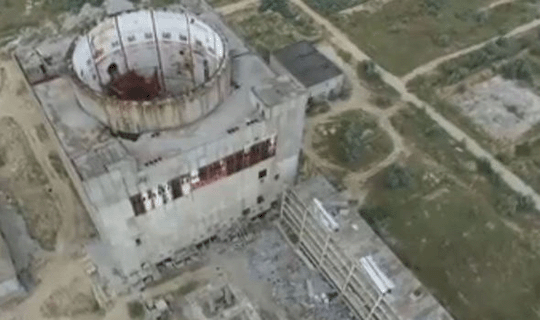
VIDEO: Drone captures rare footage of abandoned Chernobyl-era nuclear plant in Crimea
Drone captures rare footage of abandoned Chernobyl-era nuclear plant in Crimea (VIDEO)RT.com Sep, 2015 Footage captured from a bird’s-eye view of a Chernobyl-era nuclear power plant in Crimea shows its heart – the reactor. The unfinished plant has been standing abandoned for almost three decades………https://www.rt.com/news/316529-drone-video-nuclear-plant/
Nuclear propaganda film “Pandora’s Promise” scrutinised again
The film’s claim that nuclear is cheaper than energy from clean, renewable sources is completely false.
The film minimizes the question of what to do with high-level nuclear waste.
The very reasons not to support nuclear power are ignored by the film. The risks, economic realities, waste disposal problems, regulatory issues, and environmental and health impacts from the complete nuclear fuel chain are not addressed in “Pandora’s Promise.” Anyone who is interested is these issues should continue to ask questions and seek answers outside industry propaganda.
 Don’t believe the pro nuclear hype, http://www.moabsunnews.com/opinion/article_c24fc8cc-62d2-11e5-8359-e3fcae67ba87.html?mode=story— Sarah Fields, Director, Uranium Watch,
24 Sept 15 On Thursday, September 24, the Grand County Library and Utah Film Society will be showing the film,  “Pandora’s Promise,” at Star Hall, starting at 7 p.m. The film is a one-sided and factually challenged look at nuclear power as an answer to climate change. The film’s premise is that nuclear power will provide clean energy and help developing countries end poverty. This claim is presented in interviews with several former opponents of nuclear power who have had a change of heart, and with some nuclear scientists.There were no interviews with citizens, environmentalists, legal experts, or scientists who are currently involved with the many serious and complex issues related to the production of nuclear power in the U.S.
The film neglects to discuss the environmental impacts of the whole nuclear fuel chain, from uranium mining and milling to the disposal and long-term care of low- and high-level nuclear waste. As we know here in southeast Utah, uranium mining and milling is not carbon-free and impacts our land, air, water and public health. There are hundreds of abandoned uranium mines in Utah and nearby states that have yet to be remediated. Hundreds of uranium mine and mill workers died or continue to suffer severe health impacts from the production of uranium.
The film’s claim that nuclear is cheaper than energy from clean, renewable sources is completely false. Nuclear reactors cost billions of dollars to construct, taking 10 years or longer to license and bring online. Reactors under construction in the U.S. have construction delays and serious cost overruns, which are passed onto the ratepayers. The cost of reactors keeps going up and the cost of renewables keeps going down.
The film minimizes the question of what to do with high-level nuclear waste. For decades, that problem has been pushed back for future generations to deal with. The type of spent fuel casket that the proposed Yucca Mountain disposal site was designed for is no longer being developed. There is no approved casket for the storage of high-burn up fuel — the fuel used at most reactors today. The government and industry has no long-term solution for high-level nuclear waste, except for indefinite storage at reactor sites. If Yucca Mountain were approved, much of the spent fuel would be transported through Utah, including Grand County.
The proposed reactor near Green River is an example the realities of nuclear power development. The Blue Castle Project would require about 87 million gallons of water per day in a time of drought and reduced runoff. It would impact the recovery program for threatened and endangered fish species in the Green River. Thus far, the proponent of the reactor, Blue Castle Holdings, has only raised $19 million. It will take from $50 to $100 million to obtain an Early Site Permit from the Nuclear Regulatory Commission and many millions more to obtain a construction and operation license. It will take billions to construct the reactor. Thus far, no utility has joined this project, so there is no place for the electricity to go and no outside funding.
The very reasons not to support nuclear power are ignored by the film. The risks, economic realities, waste disposal problems, regulatory issues, and environmental and health impacts from the complete nuclear fuel chain are not addressed in “Pandora’s Promise.” Anyone who is interested is these issues should continue to ask questions and seek answers outside industry propaganda.
Nevada test site videos on nuclear bomb testing
Building the atom bomb – Nevada test site videos, Guardian By Laurence Topham , Alok Jha and Will Franklin 22 September 2015 From 1951, over four decades, the US government carried out almost a thousand nuclear tests at this test site, earning it the nickname of the “most bombed place on Earth”. Here, they took the crude nuclear weapons that had been dropped over Hiroshima and Nagasaki in 1945 and honed their destructive power.
A hundred of these tests, known as atmospheric shots, took place above ground, creating the characteristic mushroom clouds that have become synonymous with nuclear detonations.
The government still carries out classified work on the site, and access is limited to a small number of carefully vetted visitors each year, who are not allowed to take photographs. The Guardian was given extremely rare access to film at the site……..
In nearby towns such as St George in Utah, which were downwind of the Nevada Test Site, people found the nuclear programme more troubling.
After decades of campaigns by the so-called Downwinders, Congress passed the Radiation Exposure Compensation Act in 1990 to make payments to some of those who claimed to have been affected by fallout from nuclear tests at the Nevada Test Site.
So far, $2bn (£1.3bn) has been paid out to more than 32,000 claimants. The compensation is only available to a limited number of those who claim to have been affected and for a limited set of conditions…..http://www.theguardian.com/us-news/ng-interactive/2015/sep/21/building-the-atom-bomb-the-full-story-of-the-nevada-test-site
1 This Month

of the week – Shut Down Drone Warfare!


Tell the Ukrainian Government to Drop Prosecution of Peace Activist Yurii Sheliazhenko

Petition to revoke the licensing of the Near Surface Nuclear Disposal Facility (NSDF) at Chalk River. https://www.ourcommons.ca/petitions/en/Petition/Details?Petition=e-7247
To see nuclear-related stories in greater depth and intensity – go to https://nuclearinformation.wordpress.com
-
Archives
- April 2026 (91)
- March 2026 (251)
- February 2026 (268)
- January 2026 (308)
- December 2025 (358)
- November 2025 (359)
- October 2025 (376)
- September 2025 (257)
- August 2025 (319)
- July 2025 (230)
- June 2025 (348)
- May 2025 (261)
-
Categories
- 1
- 1 NUCLEAR ISSUES
- business and costs
- climate change
- culture and arts
- ENERGY
- environment
- health
- history
- indigenous issues
- Legal
- marketing of nuclear
- media
- opposition to nuclear
- PERSONAL STORIES
- politics
- politics international
- Religion and ethics
- safety
- secrets,lies and civil liberties
- spinbuster
- technology
- Uranium
- wastes
- weapons and war
- Women
- 2 WORLD
- ACTION
- AFRICA
- Atrocities
- AUSTRALIA
- Christina's notes
- Christina's themes
- culture and arts
- Events
- Fuk 2022
- Fuk 2023
- Fukushima 2017
- Fukushima 2018
- fukushima 2019
- Fukushima 2020
- Fukushima 2021
- general
- global warming
- Humour (God we need it)
- Nuclear
- RARE EARTHS
- Reference
- resources – print
- Resources -audiovicual
- Weekly Newsletter
- World
- World Nuclear
- YouTube
-
RSS
Entries RSS
Comments RSS
 nuclear-news