Thorium Molten Salt Nuclear reactor (MSR) No Better Than Uranium Process
The safety issue is also not resolved, as stated above: pressurized water leaking from the steam generator into the hot, radioactive molten salt will explosively turn to steam and cause incredible damage. The chances are great that the radioactive molten salt would be discharged out of the reactor system and create more than havoc. Finally, controlling the reaction and power output, finding materials that last safely for 3 or 4 decades, and consuming vast quantities of cooling water are all serious problems.
The greatest problem, though, is likely the scale-up by a factor of 500 to 1, from the tiny project at ORNL to a full-scale commercial plant with 3500 MWth output. Perhaps these technical problems can be overcome, but why would anyone bother to try, knowing in advance that the MSR plant will be uneconomic due to huge construction costs and operating costs, plus will explode and rain radioactive molten salt when (not if) the steam generator tubes leak.
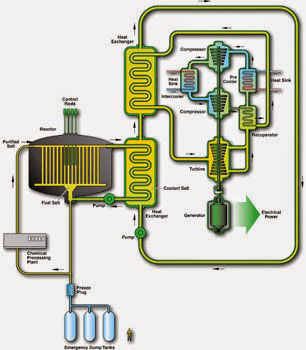 The Truth About Nuclear Power – Part 28, Sowells Law Blog , 14 July 2014 Thorium MSR No Better Than Uranium Process,

It is interesting, though, that nuclear advocates must bring up the MSR process. If the uranium fission process was any good at all, there would be no need for research and development of any other type of process, such as MSR and fusion. Continue reading
Another nuclear film advertisement – “The New Fire”

Film review: ‘The New Fire’ and the old Gen IV rhetoric Author: Jim Green ‒ Nuclear Monitor editor NM866.4751, October 2018 The New Fire is a pro-nuclear propaganda film directed and produced by musician and film-maker David Schumacher.It’s similar in some respects to the 2013 film Pandora’s Promise.1,2 The New Fire premiere was held in October 2017 and it can be streamed online from 18 October 2018.
Promotional material claims that the film lacked “a supportive grant” (and celebrity endorsements and the backing of a major NGO) but the end-credits list numerous financial contributors: Berk Foundation, Isdell Foundation, Steven & Michele Kirsch Foundation, Rachel Pritzker, Roland Pritzker, Ray Rothrock, and Eric Uhrhane.
The film includes interviews with around 30 people (an overwhelming majority of them male) interspersed with footage of interviewees walking into buildings, and interviewees smiling. The musical underlay is a tedious drone ‒ a disappointment given Schumacher’s musical background.
A highlight is hearing Eric Meyer ‒ an opera singer turned pro-nuclear activist ‒ bursting into song at various locations around the COP21 climate conference in Paris in December
2015, while he and his colleagues handed out free copies of the pro-nuclear book Climate Gamble Interviewees are mostly aging but the film’s main message is that young entrepreneurs may save the planet and its inhabitants with their Generation IV reactor projects. The film’s website states: “David Schumacher’s film focuses on how the generation facing the most severe impact of climate change is fighting back with ingenuity and hope. The New Fire tells a provocative and startlingly positive story about a planet in crisis and the young heroes who are trying to save it.”3
Schumacher writes (in the press kit): “These brilliant young people – some of the most gifted engineers of their  generation, who in all likelihood could have cashed in for a fortune by doing something else – believe deeply that nuclear power could play a key role in saving the planet. And they are acting on that conviction. They did the research. They raised the money. They used cutting edge computer technology to perfect their designs. They are the new face of nuclear power, and to me, the newest and most unlikely climate heroes.”
These climate heroes are contrasted with anti-nuclear environmentalists. One interviewee says that “people of our generation are the first ones that have the opportunity to look at nuclear power without all the emotional baggage that previous generations have felt.” Another argues that anti-nuclear environmentalists are “very good, decent, smart people” but the “organizational DNA … that they have inherited is strongly anti-nuclear.” Another argues that environmental organizations “have been using nuclear power as a whipping boy for decades to raise funds”. Another interviewee attributes opposition to nuclear power to an “irrational fear of the unknown” (which surely poses a problem for the exotic Generation IV concepts promoted in the film) and another says that “once people sort of understand what’s going on withnuclear, they are much more open to it”.
The film trots out the usual anti-renewables tropes and falsehoods: 100% renewables is “just a fantasy”, renewables can contribute up to 20% of power supply and the remainder must be baseload: fossil fuels or nuclear power.
In rural Senegal, solar power has brought many benefits but places like Senegalese capital Dakar, with a population of one million, need electricity whether the sun is shining or not. A Senegalese man interviewed in the film states: “Many places in Africa definitely need a low cost, reliable, carbon neutral power plant that provides electricity 24/7. Nuclear offers one of the best options we have to do that kind of baseload.” The film doesn’t explain how a 1,000 megawatt nuclear plant would fit into Senegal’s electricity grid, which has a total installed capacity of 633MW.4 The ‘microreactors’ featured in The New Fire might help … if they existed.
Accidents such as those at Fukushima and Chernobyl get in the news because they are “so unusual” according to interviewee Ken Caldeira. And they get in the news, he might have added, because of the estimated death tolls (in the thousands for Fukushima5, ranging to tens of thousands for Chernobyl6), the costs (around US$700 billion for Chernobyl7, and US$192 billion (and counting) for Fukushima8), the evacuation of 160,000 people after the Fukushima disaster and the permanent relocation of over 350,000 people after the Chernobyl disaster.9
“Most people understand that it’s impossible for a nuclear power plant to literally explode in the sense of an atomic explosion”, an interviewee states. And most people understand that chemical and steam explosions at Chernobyl and Fukushima spread radionuclides over vast distances. The interviewee wants to change the name of nuclear power plants to avoid any conflation between nuclear power and weapons. Evidently he didn’t get the memo that the potential to use nuclear power plants (and related facilities) to produce weapons is fast becoming one of the industry’s key marketing points.
Conspicuously absent from the film’s list of interviewees is pro-nuclear lobbyist Michael Shellenberger. We’ve taken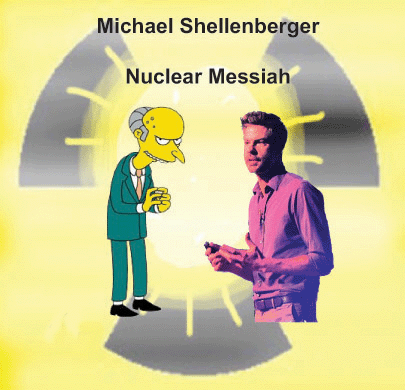 Shellenberger to task for his litany of falsehoods on nuclear and energy issues10 and his bizarre conversion into an advocate of worldwide nuclear weapons proliferation.11 But a recent article by Shellenberger on Generation IV nuclear technology is informative and insightful ‒ and directly at odds with the propaganda in The New Fire.12
So, let’s compare the Generation IV commentary in The New Fire with that in Shellenberger’s recent article.
Transatomic Power’s molten salt reactor concept The film spends most of its time promoting Generation IV reactor projects including Transatomic Power’s molten salt reactor (MSR) concept. [Ed note. recently failed and abandoned] .
Scott Nolan from venture capital firm Founders Fund says that Transatomic satisfies his four concerns about nuclear power: safety, waste, cost, proliferation. And he’s right ‒ Transatomic’s MSRs are faultless on all four counts, because they don’t exist. It’s doubtful whether they would satisfy any of the four criteria if they did actually exist.
Shellenberger quotes Admiral Hyman Rickover, who played a leading role in the development of nuclear-powered and armed submarines and aircraft carriers in the US: “Any plant you haven’t built yet is always more efficient than the one you have built. This is obvious. They are all efficient when you haven’t done anything on them, in the talking stage. Then they are all efficient, they are all cheap. They are all easy to build, and none have any problems.”
Shellenberger goes on to say:12 “The radical innovation fantasy rests upon design essentialism and reactor reductionism. We conflate the 2-D design with a 3-D design which we conflate with actual building plans which we conflate with a test reactor which we conflate with a full-sized power plant.
“These unconscious conflations blind us to the many, inevitable, and sometimes catastrophic “unknowns” that only become apparent through the building and operating of a real world plant. They can be small, like the need for a midget welder, or massive, like the manufacturing failures of the AP1000.
“Some of the biggest unknowns have to do with radically altering the existing nuclear workforce, supply chain, and regulations. Such wholesale transformations of the actually existing nuclear industry are, literally and figuratively, outside the frame of alternative designs.
“Everyone has a plan until they get punched in the face,” a wise man once said. The debacles with the AP1000 and EPR are just the latest episodes of nuclear reactor designers getting punched in the face by reality.”
Shellenberger comments on MSR technology:12
New designs often solve one problem while creating new ones. For example, a test reactor at Oak Ridge National Laboratory used chemical salts with uranium fuel dissolved within, instead of water surrounding solid uranium fuel. “The distinctive advantage of such a reactor was that it avoided the expensive process of fabricating fuel elements, moderator, control rods, and other high precision core components,” noted Hewlett and Holl.
“In the eyes of many nuclear scientists and engineers these advantages made the homogeneous reactor potentially the most promising of all types under study, but once again the experiment did not reveal how the tricky problems of handling a highly radioactive and corrosive fluid were to be resolved.”
In The New Fire, Mark Massie from Transatomic promotes a “simpler approach that gives you safety through physics, and there’s no way to break physics”. True, you can’t break physics, but highly radioactive and corrosive fluids in MSRs could break and rust pipes and other machinery.
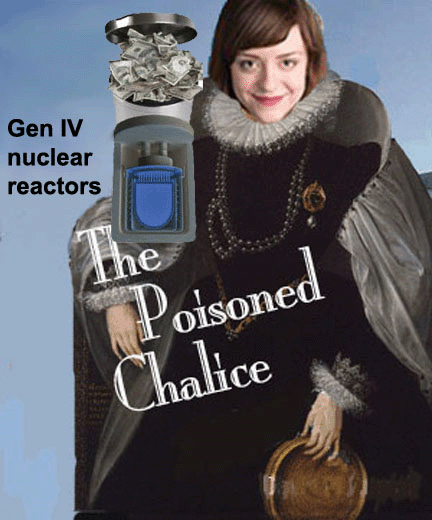 Leslie Dewan from Transatomic trots out the silliest advantage attributed to MSRs: that they are meltdown-proof. Of course they are meltdown-proof ‒ and not just in the sense that they don’t exist. The fuel is liquid. You can’t melt liquids. SMR liquid fuel is susceptible to dispersion in the event of steam explosions or chemical explosions or fire, perhaps more so than solid fuels.
Michael Short from MIT says in the film that over the next 2‒3 years they should have preliminary answers as to whether the materials in Transatomic MSRs are going to survive the problems of corrosion and radiation resistance. In other words, they are working on the problems ‒ but there’s no guarantee of progress let alone success.
Dewan claims that Transatomic took an earlier MSR design from Oak Ridge and “we were able to make it 20 times as power dense, much more compact, orders of magnitude cheaper, and so we are commercializing our design for a new type of reactor that can consume existing stockpiles of nuclear waste.”
Likewise, Jessica Lovering from the Breakthrough Institute says: “Waste is a concern for a lot of people. For a lot of people it’s their first concern about nuclear power. But what’s really amazing about it is that most of what we call nuclear waste could actually be used again for fuel. And if you use it again for fuel, you don’t have to store it for tens of thousands of years. With these advanced reactors you can close the fuel cycle, you can start using up spent fuel, recycling it, turning it into new fuel over and over again.”
But in fact, prototype MSRs and fast neutron reactors produce troublesome waste streams (even more so than conventional light-water reactors) and they don’t obviate the need for deep geological repositories. A recent article in the Bulletin of the Atomic Scientists ‒ co-authored by a former chair of the US Nuclear Regulatory Commission ‒ states that “molten salt reactors and sodium-cooled fast reactors – due to the unusual chemical compositions of their fuels – will actually exacerbate spent fuel storage and disposal issues.”13 It also raises proliferation concerns about ‘integral fast reactor’ and MSR technology:
 “Pyroprocessing and fluoride volatility-reductive extraction systems optimized for spent fuel treatment can – through minor changes to the chemical conditions – also extract plutonium (or uranium 233 bred from thorium).”
Near the end of the film, it states: “Transatomic encountered challenges with its original design, and is now moving forward with an updated reactor that uses uranium fuel.” Transatomic’s claim that its ‘Waste-Annihilating Molten-Salt Reactor’ could “generate up to 75 times more electricity per ton of mined uranium than a light-water reactor” was severely downgraded to “more than twice” after calculation errors were discovered. And the company now says that a reactor based on the current design would not use waste as fuel and thus would “not reduce existing\ stockpiles of spent nuclear fuel”
So much for all the waste-to-fuel rhetoric scattered throughout The New Fire.
Michael Short from MIT claims MSRs will cost a “couple of billion dollars” and Dewan claims they will be “orders of magnitude cheaper” than the Oak Ridge experimental MSR. In their imaginations, perhaps. Shellenberger notes that “in the popular media and among policymakers, there has remained a widespread faith that what will make nuclear power cheaper is not greater experience but rather greater novelty. How else to explain the excitement for reactor designs invented by teenagers in their garages and famous software developers [Bill Gates / TerraPower] with zero experience whatsoever building or operating a nuclear plant?”12
Shellenberger continues:12
“Rather than address the public’s fears, nuclear industry leaders, scientists, and engineers have for decades repeatedly retreated to their comfort zone: reactor design innovation. Designers say the problem isn’t that innovation has been too radical, but that it hasn’t been radical enough. If only the coolant were different, the reactors smaller, and the building methods less conventional, they insist, nuclear plants would be easier and cheaper to build.
“Unfortunately, the historical record is clear: the more radical the design, the higher the cost. This is true not only with the dominant water-cooled designs but also with the more exotic designs ‒ and particularly sodium-cooled ones.”
Oklo’s sodium-cooled fast neutron microreactor The New Fire promotes Oklo’s sodium-cooled fast neutron microreactor concept, and TerraPower’s sodium cooled fast neutron ‘traveling wave’ reactor (TerraPower is also exploring a molten chloride fast reactor concept).
Oklo co-founder Jacob DeWitte says: “There’s this huge, awesome opportunity in off-grid markets, where they need power and they are relying on diesel generators … We were talking to some of these communities and we realized they use diesel because it’s the most energy dense fuel they know of. And I was like, man, nuclear power’s two million times as energy dense … And they were like, ‘Wait, are you serious, can you build a reactor that would be at that size?’ And I said, ‘Sure’.”
Which is all well and good apart from the claim that Oklo could build such a reactor: the company has a myriad of economic, technological and regulatory hurdles to overcome. The film claims that Oklo “has begun submission of its reactor’s license application to the [US] Nuclear Regulatory Commission” but according to the NRC, Oklo is a “pre-applicant” that has gone no further than to notify the NRC of its intention to “engage in regulatory interactions”.16
There’s lots of rhetoric in the film about small reactors that “you can roll … off the assembly line like Boeings”, factory-fabricated reactors that “can look a lot like Ikea furniture”, economies of scale once there is a mass market for small reactors, and mass-produced reactors leading to “a big transition to clean energy globally”. But first you would need to invest billions to set up the infrastructure to mass produce reactors ‒ and no-one has any intention of making that investment. And there’s no mass market for small reactors ‒ there is scarcely any market at all.17
TerraPower TerraPower is one step ahead of Transatomic and Oklo ‒ it has some serious funding. But it’s still a long way off ‒ Nick Touran from TerraPower says in the film that tests will “take years” and the company is investing in a project with “really long horizons … [it] may take a very long time”.
TerraPower’s sodium-cooled fast neutron reactor remains a paper reactor. Shellenberger writes:12
“In 2008, The New Yorker profiled Nathan Myhrvold, a former Microsoft executive, on his plans to re-invent nuclear power with Bill Gates. Nuclear scientist Edward “Teller had this idea way back when that you could make a very safe, passive nuclear reactor,” Myhrvold explained. “No moving parts. Proliferation-resistant. Dead simple.”
“Gates and Myhrvold started a company, Terrapower, that will break ground next year in China on a test reactor. “TerraPower’s engineers,” wrote a reporter recently, will “find out if their design really works.”
“And yet the history of nuclear power suggests we should have more modest expectations. While a nuclear reactor “experiment often produced valuable clues,” Hewlett and Holl wrote, “it almost never revealed a clear pathway to success.” …
“For example, in 1951, a reactor in Idaho used sodium rather than water to cool the uranium ‒ like Terrapower’s design proposes to do. “The facility verified scientific principles,” Hewlett and Holl noted, but “did not address the host of extraordinary difficult engineering problems.” …
“Why do so many entrepreneurs, journalists, and policy analysts get the basic economics of nuclear power so terribly wrong? In part, everybody’s confusing nuclear reactor designs with real world nuclear plants. Consider how frequently advocates of novel nuclear designs use the future or even present tense to describe qualities and behaviors of reactors when they should be using future conditional tense.
“Terrapower’s reactor, an IEEE Spectrum reporter noted “will be able to use depleted uranium … the heat will be absorbed by a looping stream of liquid sodium … Terrapower’s reactor stays cool”.
“Given that such “reactors” do not actually exist as real world machines, and only exist as computer-aided designs, it is misleading to claim that Terrapower’s reactor “will” be able to do anything. The appropriate verbs for\ that sentence are “might,” “may,” and “could.” …
“Myhrvold expressed great confidence that he had proven that Terrapower’s nuclear plant could run on nuclear waste at a low cost. How could he be so sure? He had modeled it. “Lowell and I had a month-long, no-holdsbarred nuclear-physics battle. He didn’t believe waste would work. It turns out it does.” Myhrvold grinned. “He concedes it now.”
“Rickover was unsparing in his judgement of this kind of thinking. “I believe this confusion stems from a failure to distinguish between the academic and the practical,” he wrote. “The academic-reactor designer is a dilettante. He has not had to assume any real responsibility in connection with his projects. He is free to luxuriate in elegant ideas, the practical shortcomings of which can be relegated to the category of ‘mere technical details.””
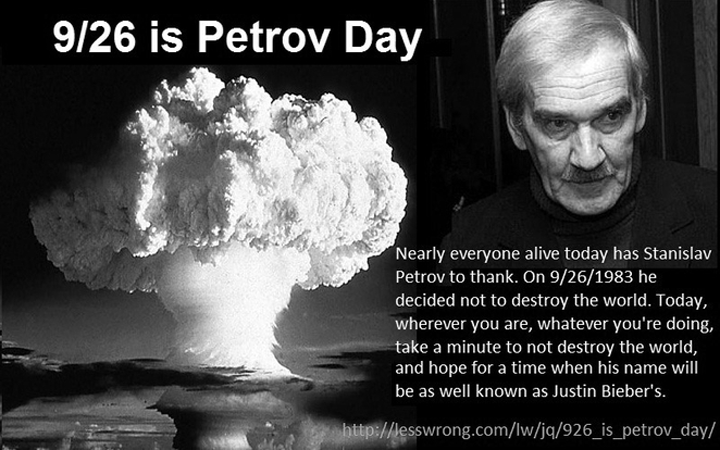
On September 26, 1983, Stanislav Petrov saved the world
|
35 years ago today, one man saved us from world-ending nuclear war https://www.vox.com/2018/9/26/17905796/nuclear-war-1983-stanislav-petrov-soviet-union
On September 26, 1983, Stanislav Petrov saved the world. By On September 26, 1983, the planet came terrifyingly close to a nuclear holocaust. The Soviet Union’s missile attack early warning system displayed, in large red letters, the word “LAUNCH”; a computer screen stated to the officer on duty, Soviet Lt. Col. Stanislav Petrov, that it could say with “high reliability” that an American intercontinental ballistic missile (ICBM) had been launched and was headed toward the Soviet Union. First, it was just one missile, but then another, and another, until the system reported that a total of five Minuteman ICBMshad been launched. “Petrov had to make a decision: Would he report an incoming American strike?” my colleague Max Fisher explained. “If he did, Soviet nuclear doctrine called for a full nuclear retaliation; there would be no time to double-check the warning system, much less seek negotiations with the US.” Reporting it would have made a certain degree of sense. The Reagan administration had a far more hardline stance against the Soviets than the Carter, Ford, or Nixon administrations before it. Months earlier President Reagan had announced the Strategic Defense Initiative(mockingly dubbed “Star Wars,” a plan to shoot down ballistic missiles before they reached the US), and his administration was in the process of deploying Pershing II nuclear-armed missiles to West Germany and Great Britain, which were capable of striking the Soviet Union. There were reasons for Petrov to think Reagan’s brinkmanship had escalated to an actual nuclear exchange. But Petrov did not report the incoming strike. He and others on his staff concluded that what they were seeing was a false alarm. And it was; the system mistook the sun’s reflection off clouds for a missile. Petrov prevented a nuclear war between the Soviets, who had 35,804 nuclear warheads in 1983, and the US, which had 23,305. A 1979 report by Congress’s Office of Technology Assessment estimated that a full-scale Soviet assault on the US would kill 35 to 77 percent of the US population — or between 82 million and 180 million people in 1983. The inevitable US counterstrike would kill 20 to 40 percent of the Soviet population, or between 54 million and 108 million people. The combined death toll there (between 136 million and 288 million) swamps the death toll of any war, genocide, or other violent catastrophe in human history. Proportional to world population, it would be rivaled only by the An Lushan rebellion in eighth-century China and the Mongol conquests of the 13th century. And it’s likely hundreds of millions more would have died once the conflict disrupted global temperatures and severely hampered agriculture. International Physicians for the Prevention of Nuclear War put the potential death toll from starvation at about 2 billion. Petrov, almost single-handedly, prevented those deaths. Preventing the deaths of hundreds of millions, if not billions, of people was a costly decision for Petrov. If he had been wrong, and he somehow survived the American nuclear strike, he likely would’ve been executed for treason. Even though he was right, he was, according to the Washington Post’s David Hoffman, “relentlessly interrogated afterward [and] never rewarded for his decision.” After the Cold War, Petrov would receive a number of commendations for saving the world. He was honored at the United Nations, received the Dresden Peace Prize, and was profiled in the documentary The Man Who Saved the World. “I was just at the right place at the right time,” he told the filmmakers. He died in May 2017, at the age of 77. Two new books about the Petrov incident and other nuclear close calls in 1983 (related to the NATO exercise Able Archer) came out just this year: Taylor Downing’s 1983 and Marc Ambinder’s The Brink. Petrov isn’t the only man who’s prevented nuclear warPetrov was not the only Russian official who’s saved the world. On October 27, 1962, Vasili Arkhipov, a Soviet navy officer, was in a nuclear submarine near Cuba when US naval forces started dropping depth charges (a kind of explosive targeting submarines) on him. Two senior officers on the submarine thought that a nuclear war could’ve already begun and wanted to launch a nuclear torpedo at a US vessel. But all three senior officers had to agree for the missile to fire, and Arkhipov dissented, preventing a nuclear exchange and potentially preventing the end of the world. Even more recently, on January 25, 1995, Russian early warning radars suggested that an American first strike was incoming. President Boris Yeltsin was alerted and given a suitcase with instructions for launching a nuclear strike at the US. Russian nuclear forces were given an alert to increase combat readiness. Yeltsin eventually declined to launch a counterstrike — which is good, because this was another false alarm. It turns out that Russian early warning systems had picked up a Norwegian-US joint research rocket, launched by scientists studying the northern lights. But September 26, Stanislav Petrov Day, is as good a time as any to celebrate the ordinary officers who took a stand when it counted to prevent hundreds of millions of deaths. And it’s as good a time as any to remember that as long as the US and Russia retain massive nuclear arsenals, these kinds of close calls will remain possible — and in the future, a false alarm could result in an accidental first strike. |
|
|
Debunking the claims about generation IV nuclear waste
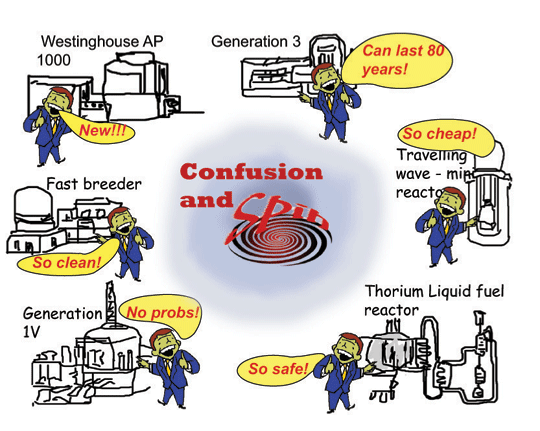
Generation IV nuclear waste claims debunked, Nuclear Monitor 24 Sept 18 Lindsay Krall and Allison Macfarlane have written an important article in the Bulletin of the Atomic Scientists debunking claims that certain Generation IV reactor concepts promise major advantages with respect to nuclear waste management. Krall is a post-doctoral fellow at the George Washington University. Macfarlane is a professor at the same university, a former chair of the US Nuclear Regulatory Commission from July 2012 to December 2014, and a member of the Blue Ribbon Commission on America’s Nuclear Future from 2010 to 2012.
Krall and Macfarlane focus on molten salt reactors and sodium-cooled fast reactors, and draw on the experiences of the US Experimental Breeder Reactor II and the US Molten Salt Reactor Experiment.
The article abstract notes that Generation IV developers and advocates “are receiving substantial funding on the pretense that extraordinary waste management benefits can be reaped through adoption of these technologies” yet “molten salt reactors and sodium-cooled fast reactors – due to the unusual chemical compositions of their fuels – will actually exacerbate spent fuel storage and disposal issues.”
Here is the concluding section of the article: Continue reading
The relative hazards of nuclear fuel in reactor cores, spent fuel pools, and dry storage
|
Nuclear Reactor Fuel Safety: The Waiting Gain, Union of Concerned Scientists,
DAVE LOCHBAUM, DIRECTOR, NUCLEAR SAFETY PROJECT | SEPTEMBER 27, 2018, Nuclear power reactors spilt atoms to release energy used to generate electricity. Many of the byproducts formed when atoms split are unstable (radioactive) and release particles or gamma rays in search of stability. These radioactive emissions produce energy. Whether in the core of an operating reactor, in the core of a shutdown reactor, in the spent fuel pool after discharge from a reactor core, or in dry storage after offloading from a spent fuel pool, the energy released from nuclear reactor fuel must be removed before it damages the fuel from overheating. This commentary describes the energy levels associated with nuclear fuel in various locations at various times to illustrate the factors that affect the associated hazard levels.
Nuclear Fuel Locations The San Onofre nuclear plant near San Clemente, California is used to describe the nuclear reactor fuel locations and energy levels for this commentary. San Onofre has been permanently shut down, but data from when its reactors operated and for the spent fuel remaining onsite represent conditions at nuclear plants across the country…….. [excellent photos and tables] ……UCS Perspective …… the relative hazards of nuclear fuel in reactor cores, spent fuel pools, and dry storage. Nuclear fuel in the reactor core, even in the core of a shutdown reactor, has a significantly higher energy level than when in the spent fuel pool or dry storage. The higher energy level has two associated hazard implications. First, it translates into less time to successfully intervene to prevent fuel damage when cooling is lost or impaired. Second, it provides a larger catalyst or engine to expel radioactive materials from damaged fuel. Risk is defined as the product of the probability of an accident times its consequences. The first factor affects the probability of an accident while the second factor affects its consequences. Combined, these factors can cause risk to increase. Nuclear fuel in spent fuel pools has lower energy levels than when in reactor cores. The average fuel assembly energy levels are lower than the maximum energy level permitted in a MPC-37 canister. But the associated inventories indicate why spent fuel pools have higher risks than dry storage. The collective higher energy levels in spent fuel pools once again translate into less time to respond should cooling be lost or impaired. And the larger inventory of fuel assemblies emits a larger radioactive cloud should intervention fail. Nuclear fuel in dry storage represents the least amount of fuel at the lowest energy level. If cooling is lost or impaired, more time is available to successfully intervene and less nasty spread gets out when efforts fail. But fuel in dry storage is far from absolutely safe. If it were even close to being so safe, the US would not be spending billions of dollars looking for, but not yet finding, a geological repository that can isolate this hazardous material from people and the environment for at least 10,000 years into the future. Dry storage is the safest and securest way to manage nuclear fuel risks today. However, the more of the 10,000-year period we waste looking for a geological repository, the less competent and responsible we reveal ourselves to be. We can do better. And not just because it would be hard for us to mess this mess up any worse than we’ve mismanaged so far. https://allthingsnuclear.org/dlochbaum/nuclear-waiting-gain |
|
Facing up to the reality of nuclear wastes: it requires longterm continuing stewardship
Gordon Edwards: Nuclear Waste Mismanagement
 A conversation with Dr. Gordon Edwards: contemporary issues in the Canadian nuclear industry, and a look back at the achievements of the Canadian Coalition for Nuclear Responsibility (CCNR), http://www.ccnr.org/ Montreal, August 25, 2018, Nuclear waste management: an exercise in cynical thinking. DiaNuke.org, 24 Sept 2018 “…….. Proliferation of thousands of non-naturally occurring radioactive isotopes
Our organization has come to the conclusion that these wastes did not exist seventy-five years ago. It’s only in the last 70 some years that these wastes have been produced, and there are thousands of human-made radioactive materials, in addition to the couple of dozen radioactive materials that exist in nature. There are naturally occurring radioactive materials, but the difference is most of the existing radioactive materials are different chemical species from the non-radioactive materials. You can separate them chemically. Uranium, thorium, radium and so on are different chemical species than normal non-radioactive atoms.
In a nuclear power plant what you’re-creating is hundreds and hundreds of radioactive varieties of otherwise non-radioactive materials. Non-radioactive iodine is now contaminated with radioactive iodine. Non-radioactive cesium is contaminated with radioactive cesium—non-radioactive strontium and so on. And the result is that once these things are blended together, the radioactive and the non-radioactive, you can’t separate them anymore. It is an impossible task to separate out the radioactive from the non-radioactive once you have created duplicates of virtually every element in the periodic table of a radioactive variety.
15. Rolling stewardship
So we feel that for the foreseeable future, and that means for however long it takes, 100 years 200 years or more, we should not fool ourselves into thinking we have a solution. We should adopt a policy of rolling stewardship which means that we have to keep these things under constant surveillance, constant monitoring and they must be retrievable, and they must be guarded, and they must also have a built-in mechanism, a social mechanism, for ensuring that there is funding and knowledge and resources and tools available to future generations so that they can, in fact, know what these wastes are, that they can monitor them, and that they can take corrective measures when things start going wrong, and that they can improve the containment so that this is not just a status quo.
This is not an idea of just leaving it where it is and ignoring it. On the contrary, it’s an active involvement, an active engagement to continually improve the storage of these materials because we know how to do this. We know how to store the materials in such a way that they do not get out into the environment, and we can do this for periods of decades or even centuries, depending on the circumstances.
We feel that this is the policy that we should be following, not that this is an acceptable long-term solution, either, but it is something that can be managed over an intergenerational period of time indefinitely. The point here is that rather than abandoning the waste, which is what the industry now wants to do…
And by the way, it’s not only industry that wants to abandon the waste. It’s also the regulatory agency because the regulatory agency wants to also cut its liability. They don’t want to have to look after or be responsible for these wastes beyond a certain point in time. So they have a conflict of interest. Institutionally, they have an interest in abandoning the waste and saying it’s not our problem anymore. Any problems that are caused are your problem, not ours. Unfortunately, the people who are more likely to suffer the consequences of major leakage or major failure of containment will not have the resources or the knowledge. So abandonment actually presupposes amnesia. It means that you’re saying that we’re just going to forget it, and that means that when these things do come back to the surface, if they do, and do contaminate surface waters and food paths and so on, nobody knows anymore. It’s a question of rediscovering what these materials are, how we contain them, and so on.
So we feel that rolling stewardship is a more responsible approach and that entails really admitting that we don’t have a solution, and admitting that we should stop producing the waste. One of the reasons why we continue to produce this waste is because we are continually being presented with a dangled carrot, with the idea that the solution is just around the corner, and that we’re working on the solution. As long as we’re working on the solution, how can you possibly object to us just continuing?
So we feel that that’s the fundamental track of the nuclear power dilemma and that somehow we have to wake people up to this and make them realize that this is not leading us to a sustainable future. It’s leading us quite in the opposite direction……..https://www.dianuke.org/a-conversation-with-dr-gordon-edwards-contemporary-issues-in-the-canadian-nuclear-industry-and-a-look-back-at-the-achievements-of-the-canadian-coalition-for-nuclear-responsibility-ccnr-http-ww/
Don’t miss this conversation with Dr Gordon Edwards – about Canada’s nuclear wastes
 A conversation with Dr. Gordon Edwards: contemporary issues in
  the Canadian nuclear industry, and a look back at the achievements of the Canadian Coalition for Nuclear Responsibility (CCNR), http://www.ccnr.org/ Montreal, August 25, 2018, DIANUKE.ORG, SEPTEMBER 24, 2018
 Introduction.
- Nuclear waste management: an exercise in cynical thinking.
- Private solutions for public problems.
- Early days: ignorance about nuclear waste.
- Belated realization of the problem.
- Barbaric plans for nuclear waste.
- In situ abandonment of nuclear facilities.
- Wrong people in charge, telling rather than consulting.
- The next big thing: unfeasible small modular reactors.
- The elusive “willing host community.”
- The great unknowable: long term care for nuclear waste. Who pays? Who cares?.
- A disturbed “undisturbed” geological formation is no longer undisturbed.
- Six hundred Lake Superiors needed to dilute nuclear waste to a safe level.
- No solution assumed.
- Proliferation of thousands of non-naturally occurring radioactive isotopes.
- Rolling stewardship.
- Opportunity costs of sticking with nuclear energy.
- Convenient disposal of a problem, no disposal of nuclear materials.
- What to expect from media and politicians.
- Victories.
- Cross-border activism for environmental protection.
- High, medium or low-level waste: similar ingredients in all of them.
- About the CCNR.
- Demystifying nuclear energy.
- Nuclear moratoria.
- Public hearings are a waste of time.
- Old nuclear plants are living on borrowed time.
- “I would do what I’m doing regardless whether it was effective or not.”
- Activism as scientific method: try it and see what happens.
- Being a conservative radical.
- The all-important nuclear weapons question.
- Propaganda battle over the film No act of God.
- The slowpoke journal: the short, lonely life of a district heating reactor.………….https://www.dianuke.org/a-conversation-with-dr-gordon-edwards-contemporary-issues-in-the-canadian-nuclear-industry-and-a-look-back-at-the-achievements-of-the-canadian-coalition-for-nuclear-responsibility-ccnr-http-ww/
Authorities deceive the public on radiation from Fukushima Daiichi
 Informal Labour, Local Citizens and the Tokyo Electric Fukushima Daiichi Nuclear Crisis: Responses to Neoliberal Disaster Management Adam Broinowski {extensive footnotes and references on original] September 2018, “……… (Official Medicine: The (Il)logic of Radiation Dosimetry On what basis have these policies on radiation from Fukushima Daiichi been made? Instead of containing contamination, the authorities have mounted a concerted campaign to convince the public that it is safe to live with radiation in areas that should be considered uninhabitable and unusable according to internationally accepted standards. To do so, they have concealed from public knowledge the material conditions of radiation contamination so as to facilitate the return of the evacuee population to ‘normalcy’, or life as it was before 3.11. This position has been further supported by the International Atomic Energy Agency (IAEA), which stated annual doses of up to 20 mSv/y are safe for the total population including women and children.43 The World Health Organisation (WHO) and United Nations Scientific Commission on the Effects of Atomic Radiation (UNSCEAR) also asserted that there were no ‘immediate’ radiation related illnesses or deaths (genpatsu kanren shi 原発 関連死) and declared the major health impact to be psychological.
While the central and prefectural governments have repeatedly reassured the public since the beginning of the disaster that there is no immediate health risk, in May 2011 access to official statistics for cancer-related illnesses (including leukaemia) in Fukushima and southern Miyagi prefectures was shut down. On 6 December 2013, the Special Secrets Protection Law (Tokutei Himitsu Hogo Hō 特定秘密保護法) aimed at restricting government employees and experts from giving journalists access to information deemed sensitive to national security was passed (effective December 2014). Passed at the same time was the Cancer Registration Law (Gan Tōroku Hō 癌登録法), which made it illegal to share medical data or information on radiation-related issues including evaluation of medical data obtained through screenings, and denied public access to certain medical records, with violations punishable with a 2 million yen fine or 5–10 years’ imprisonment. In January 2014, the IAEA, UNSCEAR and Fukushima Prefecture and Fukushima Medical University (FMU) signed a confidentiality agreement to control medical data on radiation. All medical personnel (hospitals) must submit data (mortality, morbidity, general illnesses from radiation exposures) to a central repository run by the FMU and IAEA.44 It is likely this data has been collected in the large Fukushima Centre for Environmental Creation, which opened in Minami-Sōma in late 2015 to communicate ‘accurate information on radiation to the public and dispel anxiety’. This official position contrasts with the results of the first round of the Fukushima Health Management Survey (October 2011 – April 2015) of 370,000 young people (under 18 at the time of the disaster) in Fukushima prefecture since 3.11, as mandated in the Children and Disaster Victims Support Act (June 2012).45 The survey report admitted that paediatric thyroid cancers were ‘several tens of times larger’ (suitei sareru yūbyōsū ni kurabete sūjūbai no ōdā de ōi 推定される有病数に比べて数十倍の オーダーで多い) than the amount estimated.46 By 30 September 2015, as part of the second-round screening (April 2014– March 2016) to be conducted once every two years until the age of 20 and once every five years after 20, there were 15 additional confirmed thyroid cancers coming to a total of 152 malignant or suspected paediatric thyroid cancer cases with 115 surgically confirmed and 37 awaiting surgical confirmation. Almost all have been papillary thyroid cancer with only three as poorly differentiated thyroid cancer (these are no less dangerous). By June 2016, this had increased to 173 confirmed (131) or suspected (42) paediatric thyroid cancer cases.47
The National Cancer Research Center also estimated an increase of childhood thyroid cancer by 61 times, from the 2010 national average of 1–3 per million to 1 in 3,000 children. Continue reading
Plutonium a risk to humans and environment for thousands of years
Even if the optimism of the scientists and engineers is well-founded, it will still take almost two more decades for the vitrification plant to run at full bore. So it may be 2047—or later—before the ghosts of plutonium are finally laid to rest.

illustration by Abigail Malate, Staff Illustrator, American Institute of Physics
|
Plutonium Waste Continues to Haunt Nuclear Site https://www.laboratoryequipment.com/news/2018/09/plutonium-waste-continues-haunt-nuclear-site 09/20/2018 – by Valerie Brown, Inside Science Nearly 30 years ago, the state of Washington and two federal agencies agreed to clean up the Hanford Nuclear Reservation, a 586-square-mile chunk of sagebrush desert where the U.S. produced plutonium for nuclear weapons starting 75 years ago. In the process, half a trillion gallons of chemically toxic and radioactive waste was dumped on the ground or injected into groundwater. Some of it has reached the Columbia River. Another 56 million gallons of concentrated, radioactive sludge and crystallized salts sit corroding within 177 steel-and-concrete underground tanks.Although the tank waste is only a fraction of the total, its safe disposal is one of the site’s most urgent priorities, especially to the policymakers and residents of Washington and Oregon. Eighteen years ago, workers began constructing a plant for “immobilizing” the remaining waste by vitrifying it—a process whereby it is mixed with molten glass, cooled and encased in stainless steel canisters for long-term storage underground in an as yet undesignated location.
Today the task remains unfinished. Prominent among the reasons for this is that designing, building and operating the infrastructure to treat the waste may be the most complicated project of its kind ever attempted. And that’s because the waste itself is, well, complicated. Although plutonium is no longer being created at Hanford this most peculiar element continues to loom ghostlike over the government’s efforts to mitigate the damage its creation caused and prevent any further environmental and human risk for centuries to come. Continue reading |
Civil and military nuclear industries locked in dependence on each other
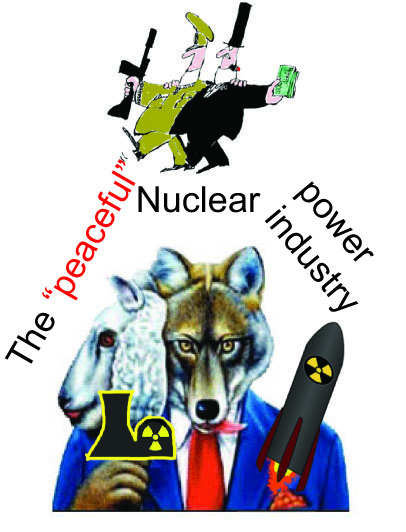 questions arise over many well-documented military entanglements of nuclear power
the “reliable provision of Russia’s defense capability is the main priority of the nuclear industry” – Rosatom
a host of other defense policy discussions are very clear that the UK nuclear ‘submarine industrial base’ would not be sustainable, if a decision were taken to discontinue civil nuclear power…statements from UK submarine industry sources note incentives to “mask” the costs of this military programme behind the related civilian industrial infrastructure…. a programme of submarine-derived small modular reactors should be adopted in UK energy policy in order to “relieve the Ministry of the burden of developing and retaining skills and capability” on the military side. – Rolls Royce
focused on facilitating ‘mobility’ between the civil and defense nuclear workforce – UK
In the USA, powerful imperatives have recently been openly declared in high level policy debate, to maintain support for otherwise-uncompetitive nuclear power in order to sustain a continuing nuclear navy.
How much of the costs of these shared underpinnings for military nuclear ambitions, are being concealed by otherwise uneconomic joint civil-military nuclear infrastructures?
A Global Picture of Industrial Interdependencies Between Civil and Military Nuclear Infrastructures https://www.sussex.ac.uk/webteam/gateway/file.php?name=2018-13-swps-stirling-and-johnstone.pdf&site=25 (this paper is richly supplied with comprehensive footnotes and references. Andy Stirling, Phil Johnstone, SPRU, August 2018 (This is an extended, updated and more fully referenced version of a chapter appearing in M. Schneider, A. Froggatt, J. Hazemann, T. Katsuta, M.V. Ramana, A. Stirling, P. Johnstone, C. von Hirschhausen, B. Wealer, The World Nuclear Industry Status Report 2018, Mycle Schneider Consulting, Paris, 2018)
Abstract
Noting the increasingly unfavourable economic and operational position of nuclear power around the world, this paper reviews evidence for a hitherto neglected connection between international commitments to civil and military nuclear infrastructures. Continue reading
THE HIGH TOXICITY AND RADIOTOXICITY OF TRITIUM
 Ken Raskin, Tritium is mostly what the Japanese want to dump from Fukushima. Millions of tons of water with tritium in it. Massive amounts of nuclear waste from Fukushima.
Tritium bombards, and even attaches to tissue covalently. There is usually a lot of UNACCOUNTED FOR RADIONUCLIDE-TRITIUM, around nuclear reactors. That is because the nucleoapes that run the reactors are psychopaths. They have little value for life, human or otherwise. Like radioactice Carbon 14 can, Tritium, binds to tissue. TRITIUM then permanently bombards the heck out of surrounding tissue, with beta rays!
 There was a large study, that showed tritium increases cancer 20 times. It is teratogenic. There are several case studies, of workers with increased rates of granulomas and lymphomas who were chronically exposed for years.
The pronukers go on and on, about k40 which is a nonstart. Even the gaslighters do it. It is Irrelevent, then they trurn around and lie their asses off about the extreme radiotoxicity and biological toxicity of tritium!
The nuclearists encourage the myth of how harmless tritium is. It does not just mostly pass through the body in water. Another blatant lie. It biocumulates in worse ways than radioactive, iodine, cesium, uranium because it becomes a part of the human body. It impairs and destroys reproductive capabilities. There is a comprehensive study done showing it increased cancer several times. It can covalently take the place of hydrogen in the body, in tissue.
‘Key insights’ from the 2018 World Nuclear Industry Status Report
 The World Nuclear Industry Status Report 2018 As always there is much of interest in the latest edition of the World
NM865.4747 The 2018 edition of the World Nuclear Industry Status Report has just been released. Here are the ‘key insights’ from the report:
China Still Dominates Developments
• Nuclear power generation in the world increased by 1% in 2017 due to an 18% increase in China.
• Global nuclear power generation excluding China declined for the third year in a row.
• Four reactors started up in 2017 of which three were in China and one in Pakistan (built by a Chinese company).
• Five units started up in the first half of 2018, of which three were in China ‒ including the world’s first EPR and AP1000 ‒ and two in Russia.
• Five construction starts in the world in 2017.
• No start of construction of any commercial reactors in China since December 2016.
• The number of units under construction globally declined for the fifth year in a row, from 68 reactors at the end of 2013 to 50 by mid-2018, of which 16 are in China.
Operational Status and Construction Delays
• The nuclear share of global electricity generation remained roughly stable over the past five years with a long-term declining trend, from 17.5% in 1996 to 10.3% in 2017.
• Seven years after the Fukushima events, Japan had restarted five units by the end of 2017 ‒ generating still only 3.6% of the power in the country in 2017 ‒ and nine by mid-2018.
• As of mid-2018, 32 reactors ‒ including 26 in Japan ‒ are in Long-Term Outage (LTO).
• At least 33 of the 50 units under construction are behind schedule, mostly by several years. China is no exception, at least half of 16 units under construction are delayed. Of the 33 delayed construction projects, 15 have reported increased delays over the past year.
Only a quarter of the 16 units scheduled for startup in 2017 were actually connected to the grid.
• New-build plans have been cancelled including in Jordan, Malaysia and the U.S. or postponed such as in Argentina, Indonesia, Kazakhstan.
Decommissioning Status Report
• As of mid-2018, 115 units are undergoing decommissioning ‒ 70% of the 173 permanently shut-down reactors in the world.
• Only 19 units have been fully decommissioned: 13 in the U.S., five in Germany, and one in Japan. Of these, only 10 have been returned to greenfield sites.
Interdependencies Between Civil and Military
Infrastructures
• Nuclear weapon states remain the main proponents of nuclear power programs. A first look into the question whether military interests serve as one of the drivers for plant-life extension and new-build.
Renewables Accelerate Take-Over
• Globally, wind power output grew by 17% in 2017, solar by 35%, nuclear by 1%. Non-hydro renewables generate over 3,000 TWh more power than a decade ago, while nuclear produces less.
• Auctions resulted in record low prices for onshore wind (<US$20/MWh) offshore wind (<US$45/MWh) and solar (<US$25/MWh). This compares with the “strike price” for the Hinkley Point C Project in the U.K. (US$120/MWh).
• Nine of the 31 nuclear countries ‒ Brazil, China, Germany, India, Japan, Mexico, Netherlands, Spain and United Kingdom (U.K.) ‒ generated more electricity in 2017 from non-hydro renewables than from nuclear power.
Mycle Schneider, Antony Froggatt et al., Sept 2018,
‘The World Nuclear Industry Status Report 2018’, www.
worldnuclearreport.org/Nuclear-Power-Strategic-Asset- Liability-or-Increasingly-Irrelevant.html
Deplorable conditions of Japan’s ‘informal’ nuclear workers: Fukushima, radiation and leukaemia
Sworn to secrecy, after a superficial safety education drill, they are sent into highly contaminated, hot and wet labyrinthine areas.
the state also raised nuclear workers’ limits from no more than 50 mSv per year (mSv/y) and 100 mSv/5 years to 250 mSv/y to deal with emergency conditions, and determined that there would be no follow-up health treatment for those exposed to doses below 50 mSv/y, while TEPCO decided to not record radiation levels below 2 mSv/y in the misplaced justification that the effects  would be negligible.
poor monitoring and record-keeping has meant that many former nuclear workers who develop leukaemia and other illnesses have been denied government compensation
Informal Labour, Local Citizens and the Tokyo Electric Fukushima Daiichi Nuclear Crisis: Chapter Author(s): Adam Broinowski Book Title: New Worlds from Below [many footnotes and references on original] Sept 18
Nuclear workers are important as sentinels for a broader epidemic of radiation related diseases that may affect the general population. We live with contradictions everyday
Introduction The ongoing disaster at the Fukushima Daiichi nuclear power station (FDNPS), operated by Tokyo Electric Power Company (TEPCO), since 11 March 2011 can be recognised as part of a global phenomenon that has been in development over some time. This disaster occurred within a social and political shift that began in the mid-1970s and that became more acute in the early 1990s in Japan with the downturn of economic growth and greater deregulation and financialisation in the global economy. After 40 years of corporate fealty in return for lifetime contracts guaranteed by corporate unions, as tariff protections were lifted further and the workforce was increasingly casualised, those most acutely affected by a weakening welfare regime were irregular day labourers, or what we might call ‘informal labour’.
During this period, many day labourers evacuated rented rooms (doya どや) and left the various yoseba (urban day labour market よせば, or lit. ‘meeting place’) to take up communal tent living in parks and on riverbanks, where they were increasingly victimised. With independent unions having long been rendered powerless, growing numbers of unemployed, unskilled and precarious youths (freeters フリーター) alongside older, vulnerable and homeless day labourers (these groups together comprising roughly 38 per cent of the workforce in 2015)3 found themselves not only lacking insurance or industrial protection but also in many cases basic living needs. With increasing deindustrialisation and capital flight, regular public outbursts of frustration and anger from these groups have manifested since the Osaka riots of 1992.
In this chapter, first I outline the conditions of irregular workers at nuclear power plants and the excess burden they have borne with the rise of nuclear labour in Japan since the 1970s. I then turn to post-3.11 conditions experienced by residents in radiation-contaminated areas. Contextualising these conditions within the genealogy of radiodosimetry standards, I seek to show, through personal interviews and localised responses, how those who are regularly exposed to radiation from Fukushima Daiichi are now confronting problems similar to those faced by informal nuclear labour for decades in Japan. This analysis shows how, after 40 years or more of environmental movements as discussed in Chapter Four, the struggle continues to find viable solutions to the systemic production of the intertwined problems of environmental crises and labour exploitation, and suggests how potential alternative directions for affected populations may lie in their mutual combination.
Conditions for Informal Labour Employed in Nuclear Power Stations Continue reading
USA and Russia – in 20th Century -devised hideously elaborate ways of blowing each other up
 Top-secret ‘doomsday machine’ documents reveal terrifying nuclear apocalypse plans https://metro.co.uk/2018/09/04/top-secret-doomsday-machine-documents-reveal-terrifying-nuclear-apocalypse-plans-7911916/ Jasper Hamill 4 Sep 2018 It’s no secret that the US and Russia spent much of the 20th century devising hideously elaborate ways of blowing each other up. Now declassified documents written in 1964 have revealed the true extent of the apocalyptic atomic broadside Washington planned to unleash against its greatest enemy. A pair of top-secret memos written by top military chiefs shows the US was intending to implement an ‘overkill’ strategy which would have flattened Russian cities and killed tens of millions of people.
They demonstrate how generals were considering the possibility of unleashing thousands of nukes in a bid to cause ‘95% damage’ to targets such as military facilities and ‘urban-industrial centres’ including major cities. The files also document plans to blow up 30% of all the people living in 30 Chinese cities, saying this outcome would be ‘desirable’. The secret files were unearthed by George Washington University’s National Security Archive and shed light on a secret nuclear strategy called the Single Integrated Operational Plan (SIOP), which is often referred to as a ‘doomsday machine’ and has never been declassified. Researchers are only able to learn about this highly disturbing scheme by reading other documents which discuss it, meaning the release of the two memorandums is a major step forward in understanding the grim fate which would have befallen the world if a nuclear war erupted.
‘US nuclear war plans [made] during the Johnson administration included the option of a retaliatory strike against nuclear, conventional military, and urban-industrial targets with the purpose of removing the Soviet Union “from the category of a major industrial power” and destroying it as a “viable” society,’ wrote the National Security Archive in a statement. ‘The document, the Joint Staff’s review of SIOP guidance in June 1964, showed continued acceptance by policymakers of the cataclysmic nuclear strike options that had been integral to the plan since its inception. Accordingly, the SIOP set high damage requirements – 95% for the top priority nuclear targets – ensuring that it remained an “overkill” plan, referring to its massively destructive effects. ‘Prepared and continually updated by the Joint Strategic Target Planning Staff, the SIOP has been characterized by some as a “doomsday machine”.’ The latest declassified document is a review of SIOP conducted by the Joint Staff, a group of senior military leaders.
It lays out plans for retaliatory and preemptive strikes against Russia or China which range in severity from an assault aimed at knocking out nuclear weapons facilities to a blitzkrieg designed to ‘destroy the will and ability of the Sino-Soviet bloc to wage, remove the enemy from the category of a major industrial power and assure a post-war balance of power favourable to the United States’. The plans also expose a scheme to use ‘population loss as the primary yardstick for effectiveness in destroying the enemy society with only collateral attention to industrial damage’, the National Security Archive added. What this means is that the US was willing to bomb Russia back to the Stone Age and viewed the destruction of its population as a valid strategy of war…. https://metro.co.uk/2018/09/04/top-secret-doomsday-machine-documents-reveal-terrifying-nuclear-apocalypse-plans-7911916/?ito=cbshare
Politicians, media, the world – does no-one care about the unfolding horror of the melting Arctic?
It’s not only summer weather that is changing. Earlier this year, one study showed that when the Arctic is unusually warm, extreme winter weather is two-to-four times more likely in the eastern U.S.
Think of the Arctic as our early warning system, a big screaming alarm that is alerting us to the fact that the planet we will live on tomorrow is nothing like the planet we lived on yesterday, and we better get ready
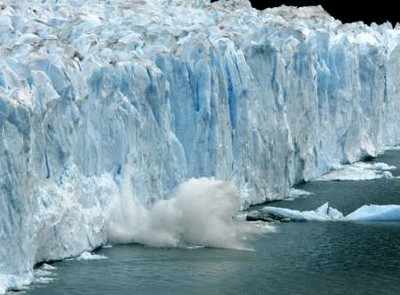
 The Melting Arctic Is a Real-Time Horror Story — Why Doesn’t Anyone Care?https://www.rollingstone.com/politics/politics-news/arctic-ice-melting-716647/ This summer’s epic wildfires and other extreme weather events have a root cause By JEFF GOODELL , 2 Sept 128
1 This Month



26 September – International Day for the Total Elimination of Nuclear Weapons


PLEASE OPPOSE HR 8255 AND S.3639 – bills would accelerate satellite deployment, with no environmental review or safeguards – https://ncstd5li.quorum.us/campaign/169331/
To see nuclear-related stories in greater depth and intensity – go to https://nuclearinformation.wordpress.com
-
Archives
- September 2026 (219)
- August 2026 (330)
- July 2026 (355)
- June 2026 (287)
- May 2026 (306)
- April 2026 (356)
- March 2026 (251)
- February 2026 (267)
- January 2026 (308)
- December 2025 (358)
- November 2025 (359)
- October 2025 (375)
-
Categories
- 1
- 1 NUCLEAR ISSUES
- business and costs
- climate change
- culture and arts
- ENERGY
- environment
- health
- history
- indigenous issues
- Legal
- marketing of nuclear
- media
- opposition to nuclear
- PERSONAL STORIES
- politics
- politics international
- Religion and ethics
- safety
- secrets,lies and civil liberties
- spinbuster
- technology
- Uranium
- wastes
- weapons and war
- Women
- 2 WORLD
- ACTION
- AFRICA
- Atrocities
- AUSTRALIA
- Christina's notes
- Christina's themes
- culture and arts
- Events
- Fuk 2022
- Fuk 2023
- Fukushima 2017
- Fukushima 2018
- fukushima 2019
- Fukushima 2020
- Fukushima 2021
- general
- global warming
- Humour (God we need it)
- Nuclear
- RARE EARTHS
- Reference
- resources – print
- Resources -audiovicual
- Weekly Newsletter
- World
- World Nuclear
- YouTube
-
RSS
Entries RSS
Comments RSS
 nuclear-news