Nuclear weapons and children
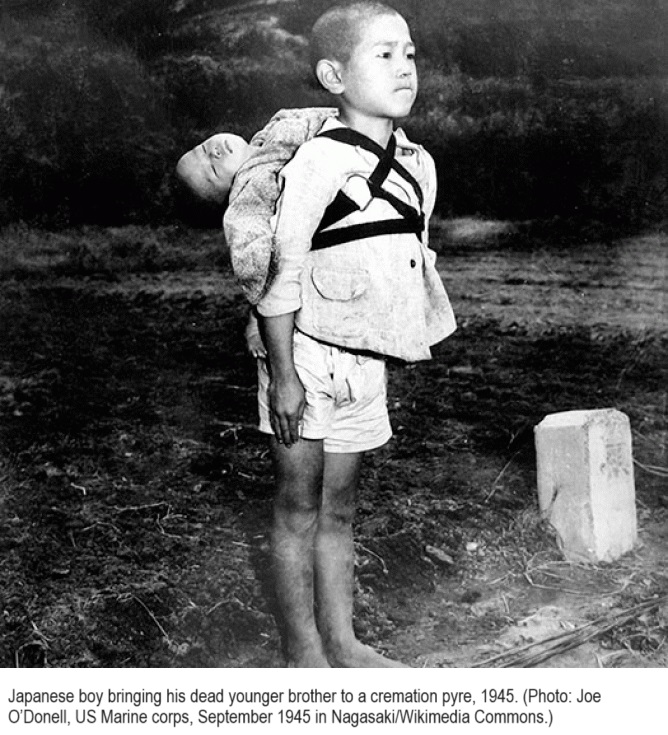
The main perpetrators of violence against children are states armed with nuclear weapons, writes Tim Wright.
Nuclear weapons are designed to destroy cities; to kill and maim whole populations, children among them.
In a nuclear attack, children are more likely than adults to die or suffer severe injuries, given their greater vulnerability to the effects of nuclear weapons: heat, blast and radiation. The fact that children depend on adults for their survival also places them at higher risk of death and hardship in the aftermath of a nuclear attack, with support systems destroyed.
Tens of thousands of children were killed when the United States detonated two relatively small nuclear weapons (by today’s standard) over the Japanese cities of Hiroshima and Nagasaki in 1945.
Many were instantly reduced to ash and vapour. Others died in agony minutes, hours, days or weeks after the attacks from burn and blast injuries or acute radiation sickness. Countless more died years or even decades later from radiation-related cancers and other illnesses. Leukaemia – cancer of the blood – was especially prevalent among the young.
In Hiroshima and Nagasaki, the scenes of devastation were apocalyptic: Playgrounds scattered with the dead bodies of young girls and boys. Mothers cradling their lifeless babies. Children with their intestines hanging out of their bellies and strips of skin dangling from their limbs.
At some of the schools close to ground zero, the entire student population of several hundred perished in an instant. At others, there were but a few survivors. In Hiroshima, thousands of school students were working outside to create firebreaks on the morning of the attack. Approximately 6,300 of them were killed.
Those children who, by chance, escaped death carried with them severe physical and psychological scars throughout their lifetimes. What they witnessed and experienced on 6 August and 9 August 1945 and in the days that followed was permanently seared into their memories.
Thousands of children lost one or both parents, as well as siblings. Some “A-bomb orphans” were left to roam the streets, with orphanages exceeding capacity.
Many of the babies who were in their mothers’ wombs at the time of the atomic bombings were also harmed as a result of their exposure to ionising radiation. They had a greater risk of dying soon after birth or suffering from congenital abnormalities such as brain damage and microcephaly, as well as cancers and other illnesses later in life.
Pregnant women in Hiroshima and Nagasaki also experienced higher rates of spontaneous abortions and stillbirths.
In communities around the world exposed to fallout from nuclear testing, children have experienced similar harm from radiation.
Since 1945, nuclear-armed states have conducted more than two thousand nuclear test explosions at dozens of locations, dispersing radioactive material far and wide
Among the general population, children and infants have been the most severely affected, due to their higher vulnerability to the effects of ionising radiation. Young children are three to five times more susceptible to cancer in the long term than adults from a given dose of radiation, and girls are particularly vulnerable.
In the Marshall Islands, where the United States conducted 67 nuclear tests, children played in the radioactive ash that fell from the sky, unaware of the danger. They called it “Bikini snow” – a reference to the atoll where many of the explosions took place. It burned their skin and eyes, and they quickly developed symptoms of acute radiation sickness.
For decades after the tests, women in the Marshall Islands gave birth to severely deformed babies at unusually high rates. Those born alive rarely survived more than a few days. Some had translucent skin and no discernible bones. They would refer to them as “jellyfish babies”, for they could scarcely be recognised as human beings.
Similar stories have been told by people living downwind or downstream of nuclear test sites in the United States, Kazakhstan, Ma’ohi Nui, Algeria, Kiribati, China, Australia and elsewhere.
We have a collective moral duty to honour the memories of the thousands of children killed in Hiroshima and Nagasaki, as well as those harmed by the development and testing of nuclear weapons globally. And we must pursue the goal of a nuclear-weapon-free world with determination and urgency, lest there be any more victims, young or old.
Under international humanitarian law and the Convention on the Rights of the Child, governments have a legal obligation to protect children against harm in armed conflict. To fulfil this obligation, it is imperative that they work together now to eliminate the scourge of nuclear weapons from the world.
In this report, we describe how nuclear weapons are uniquely harmful to children, based on the experiences of children in Hiroshima and Nagasaki and those living near nuclear test sites. We share their first-hand testimonies and depictions of the toll of nuclear weapons on their lives. And we explain how the ever-present fear of nuclear war – the possibility that entire cities might be destroyed at any given moment – causes psychological harm to children everywhere.
Finally, we make an urgent appeal to all governments to protect current and future generations of children by eliminating nuclear weapons, via the landmark UN Treaty on the Prohibition of Nuclear Weapons, which entered into force in 2021.
Key Findings
So long as nuclear weapons exist in the world, there is a very real risk that they will be used again, and that risk at present appears to be increasing.
In the event of their use, it is all but certain that many thousands of children – perhaps hundreds of thousands or more – would be counted among the dead and injured, and they would suffer in unique ways and out of proportion to the rest of the population.
In a nuclear attack, children would be more likely than adults:
To die from burn injuries, as their skin is thinner and more delicate and burns deeper, more quickly and at a lower temperature;- To die from blast injuries, given the relative frailty of their smaller bodies;
- To die from acute radiation sickness, as they have more cells that are growing and dividing rapidly and are significantly more vulnerable to radiation effects;
- To be unable to free themselves from collapsed and burning buildings or take other steps in the aftermath that would increase their chances of survival;
- To suffer from leukaemia, solid cancers, strokes, heart attacks and other illnesses years later as a result of the delayed effects of radiation damage to their cells; and
- To suffer privation in the aftermath of the attacks, as well as psychological trauma leading to mental disorders and suicide.
Furthermore, babies who were in their mothers’ wombs at the time of the attack would be at greater risk of:
Death soon after birth or in early childhood;- Microcephaly, accompanied by intellectual disability, given the higher vulnerability of the developing brain to radiation damage;
- Other developmental abnormalities;
- Growth impairment due to the reduced functioning of the thyroid; and
- Cancers and other radiation-related illnesses during childhood or later in life.
These horrifying realities should have profound implications for policy-making in countries that currently possess nuclear weapons or those that support their retention as part of military alliances.
They should also prompt organisations dedicated to the protection of children and the promotion of their rights to work to address the grave global threat posed by nuclear weapons.
While children played no part in developing these doomsday devices, it is children who would suffer the most in the event of their future use – one of the myriad reasons why such weapons must be urgently eliminated.
Tim Wright is Treaty Coordinator of the International Campaign to Abolish Nuclear Weapons.
This is the Executive Summary from the longer report, The Impact of Nuclear Weapons on Children, by Tim Wright and published by ICAN, which can be found in full on the ICAN website. It is republished with permission of the author.
Michael Hudson and Richard Wolff: Middle East Exploding, Ukraine Crumbling, US to Take Action?
Mr Zelenskyy in the Ukraine, and Mr. Netanyahu in Israel have no hope of prevailing, given the odds against them – the sheer numbers.
Israel can’t fight five wars at the same time…………….Their only hope is to bring the United States in……………………………….fighting to the last Ukrainian is now being superseded by fighting to the last Israeli.
that visceral hatred of Islam that the Zionists had, or also the visceral hatred of Russia, specifically for anti-Semitism of past centuries,
there’s no solution to the black hole that Israel’s painted itself into………And yet, there’s no willingness to have a single state
marriage of convenience here between the Zionists …and…it’s in the evangelical community…..The biggest festivals every year of Israeli films are held in mega-churches of the Protestant faith in this country, not in synagogues.
the opponents of all this are the U.S. military……who say that if you really want to extend the war, it’s not going to work
I think that the State Department and the National Security Agency and the Democratic Party leadership, with its basis in the military-industrial complex, is absolutely committed to “if we can’t have our way, then who wants to live in such a world.” …………. what Putin said was, “well, who wants to live in a world without Russia after all?”……………………………..That’s the mentality we’re dealing with
By Dialogue Works, October 8, 2024, https://scheerpost.com/2024/10/08/michael-hudson-and-richard-wolff-middle-east-exploding-ukraine-crumbling-us-take-action/
Transcript
NIMA: So nice to have you back, Richard and Michael. And let me just manage this. And let’s get started with the main question here that would be: Why is the United States not interested in putting an end to the conflict in the Middle East and in Ukraine? Which we know in both of these cases, they’re capable of doing this.
And before going to the answer of this question, I’m going to play a clip that the foreign minister of Lebanon is talking with Christiane Amanpour about his point of view and why they couldn’t reach a ceasefire.
CHRISTIANE AMANPOUR: … I spoke with Lebanon’s Foreign Minister, Abdallah Bou Habib, who’s in Washington to meet with American officials and he joined us for his first interview since the latest escalations. Foreign minister, welcome back to the program.
ABDALLAH BOU HABIB: Thank you. Thank you.
CHRISTIANE: Things have reached a major crisis in your country since we last spoke. And I want to ask you, you are in the United States right now. You know that several of the administration officials agree with Israel’s ground incursion into your country. What do you make of that as you’re in Washington trying to get support for a ceasefire?
ABDALLAH: Well, they also agreed on the Biden-Macron statement that calls for a ceasefire and that calls also for the implementation of a 21 days ceasefire. And then Mr. Hochstein would go to Lebanon and negotiate a ceasefire. And they told us that Mr. Netanyahu agreed on this. And so we also got the agreement of Hezbollah on that. And you know what happened since then. That was the day we saw you in New York.
CHRISTIANE: I know. And you were talking about going into the Security Council for this ceasefire. And barely 24 hours later, the head of Hezbollah was assassinated. Are you saying Hassan Nasrallah had agreed to a ceasefire just moments before he was assassinated?
ADBALLAH: He agreed, he agreed. Yes, yes. We agreed completely; Lebanon agreed to a ceasefire by consulting with Hezbollah. The Speaker, Mr. Berri, consulted with Hezbollah and we informed the Americans and the French that [that is] what happened. And they told us that Mr. Netanyahu also agreed on the statement that was issued by both presidents.
NIMA: Yeah. Here is the question here, because if you remember, with the assassination of Ismail Haniyeh while they were talking with Ismail Haniyeh, negotiating with Ismail Haniyeh in Qatar, they assassinated him.
And right after they reached some sort of agreement with the government in Lebanon and just Hezbollah said, okay, we’re going to go with that plan, they assassinated him.
And the question right now is here, why is this with the United States, Michael? Go ahead.
MICHAEL HUDSON: Well, the United States doesn’t want a ceasefire because it wants to take over the entire Near East. It wants to use Israel as the cat’s paw. Everything that’s happened today was planned out just 50 years ago back in 1973 and 1974. I sat in on meetings with Uzi Arad, who became Netanyahu’s chief military advisor after heading Mossad.
And the whole strategy was worked out essentially by the Defense Department, by neoliberals, and almost in a series of stages that I’ll explain.
[Henry Martin] “Scoop” Jackson is the main name to remember. Scoop Jackson was the ultra right wing neo-con was sponsored them all. And he was the head of the Democratic National Committee in 1960 and then worked with military advisors.
I was with Herman Kahn, the model for Dr. Strange Love, at the Hudson Institute during these years, and I sat in on meetings and I’ll describe them, but I want to describe how the whole strategy that led to the United States today, not wanting peace, wanting to take over the whole Near East, took shape gradually.
And this was all spelled out. I wrote a book about the meetings that I had at War College and the White House and various Air Force and Army think tanks back in the 1970s.
The starting point for all the U.S. strategy here was that democracies no longer can field a domestic army with a military draft. America is not in a position to really field enough of an army to invade a country, and without invading a country you can’t really take it over. You can bomb it but that just is going to incite resistance. But you can’t take it over.
The Vietnam War showed that any attempted draft would be met by so much anti-draft resistance taking the form of an anti-war [sentiment] that no country whose leaders have to be elected can ever take that role again.
Now it’s true that America sent a small army into Iraq, and there are 800 U.S. military bases around the world, but this wasn’t a fighting army – it was an army of occupation without really much resistance of the kind that Ukraine is experiencing with Russia for instance, as we’re seeing there. That situation in the Near East is very different.
The anti-war students showed that Lyndon Johnson in 1968 had to withdraw from running for election because everywhere he’d go there would be demonstrations against him to stop the war. No such demonstrations are occurring today, needless to say.
So I won’t call the U.S. or the European Union democracies, but there is no government that has to be elected that is able to send their own soldiers into a big war.
And what that means is that today’s tactics are limited to bombing, not occupying, countries. They are limited to what the Israeli forces can drop the bombs on Gaza and Hezbollah and try to knock out things, but neither the Israeli army, nor any other army, would really be able to invade and try to take over a country in the way that armies did in World War II.
Everything has changed now and there can’t be another occupation by the United States of foreign countries, given today’s alliances with Russia and Iran and China.
So, this was recognized 50 years ago and it seemed at that time that the U.S.-backed wars were going to have to be scaled down . But that hasn’t happened. And the reason is the United States had a fallback position: it was going to rely on foreign troops to do the fighting as proxies instead of itself. That was a solution to get a force.
“The first example was the creation of Wahhabi jihadists in Afghanistan, who later became al-Qaeda. Jimmy Carter mobilized them against secular Afghan interests and justified it by saying, ‘Well, yes, they’re Muslims, but after all, we all believe in God.’”
So the answer to the secular state of Afghanistan was Wahhabi fanaticism and jihads, and the United States realized that in order to have an army that’s willing to fight to the last member of its country — the last Afghan, the last Israeli, the last Ukrainian — you really need a country whose spirit is one of hatred towards the other, a spirit very different from the American and European spirit.
Well, Brzezinski was the grand planner who did all that. The Sunni Jihad fighters became America’s foreign legion in the Middle East and that includes Iraq, Syria and Iran and also Muslim states going up to Russia’s border.
And the aim of the United States was, oil was the center of this policy. That meant the United States had to secure the Near East and there were two proxy armies for it. And these two armies fought together as allies down to today. On the one hand, the al-Qaeda jihadis, on the other hand, their managers, the Israelis, hand in hand.
And they’ve done the fighting so that the United States doesn’t have to do it.
The foreign policy has backed Israel and Ukraine, providing them with arms, bribing their leaders with enormous sums of money, and electronic satellite guidance for everything they’re doing.
President Biden keeps telling Netanyahu, “Well, we’ve just given you a brand new bunker, cluster bombs and huge bombs – please drop them on your enemies, but do it gently. We don’t want you to hurt anybody when you drop these bombs.”
Well, that’s the hypocrisy – it’s a good cop bad cop. Biden and the United States for the last 50 years has posed as a good cop criticizing the bad cops that it’s been backing. Bad cop ISIS and al-Qaeda, bad cop Netanyahu.
But when all of this strategy was being put together, Herman Kahn’s great achievement was to convince the U.S. Empire builders that the key to achieving their control in the Middle East was to rely on Israel as its foreign legion.
And that arms-length arrangement enabled the United States to play the role, as I said, of the good cop, designating Israel to play its role, and Israel has organized and supplied al-Nusra, al-Qaeda while the United States pretends to denounce them. And it’s all part of a plan that’s been backed by the military, the State Department, and the National Security Operation.
And that’s why the State Department has turned over management of U.S. diplomacy to Zionists, seemingly distinguishing Israeli behavior from U.S. empire building. But in a nutshell, the Israelis have joined al-Qaeda and ISIS as troops, as America’s foreign legion.
NIMA: Yeah. As you were talking about, the question was: why is the United States not interested in putting an end to the conflicts in the Middle East and in Ukraine? And Michael was pointing out the endgame of the United States in this type of behavior. And what’s your take right now?
RICHARD WOLFF: Well, I think in the case of Ukraine, at this point, it is merely a kind of vague, left-over desire to weaken Russia. It isn’t working very well, so my guess is it’ll be over pretty soon. And in the case of Israel, I think, Michael is right, that this is a deal: the Israelis, hopefully, will give the Americans some kind of leverage over what happens in the Middle East, that they wouldn’t have if they didn’t have Israel. Otherwise I do not understand why the United States allows its policies to be made by Mr. Netanyahu. We have the strange situation that the people holding back Mr. Netanyahu are Israelis, not Americans, which given that it’s two different countries is rather strange, Americans feel more difficulty in opposing Netanyahu than Israelis do. But I don’t want to take away from the fact that there is a mutuality of interest in shaping the Middle East and hoping to be able to do it.
But I don’t think this is working very well. And I think my suspicion is that they are going, particularly after the election, to do a lot of rethinking about all of this, because this is not going well.
NIMA: Yeah. And Michael?
MICHAEL: Yeah, I think we can use more of the context. Because after I mentioned that the U.S. realized it needs foreign troops, it also realized that the only kind of full-scale war that democracy could afford is atomic war. And the problem is that that only works against adversaries that can’t retaliate.
But in recent years, U.S. military policy has been so aggressive that it’s driven other countries to band together and back their allies with nuclear powers. So all of the countries of the world now are associated with nuclear backups. And we’ve discussed that before.
The result is that today’s military alliances mean that any attempt to use nuclear weapons is going to risk a full-scale nuclear war that’s going to destroy all the participants and the rest of the world as well. So what is left for the United States? Well, I think there’s only one form of non-atomic war that democracies can afford, and that’s terrorism. And I think you should look at Ukraine and Israel as the terrorist alternative to atomic war. I think Andrei Martyanov recently has explained that that’s the alternative to atomic war. And this, unless NATO-West is willing to risk atomic war, which it doesn’t seem to be willing to, then terrorism is the only alternative left to it. And that is the basis of the regime change plans that the United States has in countries bordering Russia, China, and other countries that it views as adversaries. That’s what we’re seeing in Ukraine and above all in Israel, as it fights against the Palestinian population in Gaza.
The whole idea of the Ukrainians and Israelis is to bomb civilians, not military targets, but civilians. It’s a fight literally to destroy the population under an ideology of genocide. And that is absolutely central. It’s not an accident – it’s built in, built into the program. And Lebanon, even though it’s largely Christian, is part of that.
So the other weapon that the United States has is economic. And that’s oil and grain – it was decided way back in 1973-74. That was right the time of the oil war, when oil prices were quadrupled in response to the United States quadrupling its grain prices. So the United States said, well, “the way to avoid a war, terrorism, regime change, is just to starve countries into submission – either by cutting off their food supply or cutting off their oil supply. Because without oil, how can they run their industry, heat their homes and produce electricity?”
And oil is the largest private sector monopoly in the country. The seven sisters controlled the oil trade ever since World War I, and England have been their coordinator.
And after the oil war, Saudi Arabia promised – sort of was told, “you can raise your oil prices as much as you want, but you have to keep all of your export earnings in the United States. You can buy treasury bills, you can buy corporate bonds, you can buy stocks, but you cannot use more than a portion of it for your own development; you have to turn it over to the U.S. financial sector. So Saudi Arabia became the key and the result was the petrodollar that was put into U.S. banks and just increased the liquidity, the whole growth of third world debt that exploded in the 1970s, leading to the debt crisis of the ‘80s was all of that. And basically the United States realized, “okay, we want to extend control to conquer the Near East, conquer countries that have vital raw materials; we want to use the World Bank to make sure that global South countries don’t feed themselves – we’ll give money for plantation export crops, not for food.”
The condition of foreign Latin America and Africa being an ally of the United States was not to grow their own grain and food, but to depend on U.S. grain export. You know, that’s the sort of economic plan that goes together with the military plan to be the organizing force of the American empire.
RICHARD WOLFF: Let me introduce a couple of other considerations, just to add to the stew here. It is my understanding that many forces in the American political establishment interpret the collapse of the Soviet Union in 1989, ‘90 and ’91 as the fruit of a long-term U.S. policy that included the arms race and other mechanisms where the Soviet Union could not afford the level of military activity that the United States could afford, but for political and military reasons could not afford not to do it.
And so the Soviet Union tried to ride that either-or and collapsed between the demands of the nuclear arms race, the cost of their occupation of Afghanistan. They couldn’t do it. And they scrimped here and there and they didn’t quite fulfill the consumer growth plan that they had promised their people and they couldn’t do it.
If you believe that that’s what went on, then you might try to understand that what they’re doing with Russia now is the same policy. In other words, it’s again the arms race, but this time not to fight in Afghanistan, but to fight in Ukraine. Fight them there, draw them out, cost them a fortune and assume that they cannot manage all that they’re doing and that it’s much easier for you, being a richer – much, much richer – country to do this than it is for them.
And the big mistake here was not to understand that the Russians were acutely aware of what their shortcomings were and have worked very hard in the last 25 years not to be in that position again. There’s an aphorism in military thinking: “Everybody fights the last war.” That you got to fight this one, not the last one. The winner of the last one thinks they found the magic bullet. The loser of the last one realizes they have to do something different. Russia is surprising everybody by the extent of its military capability and its military preparation. They’re winning the war in Ukraine because of it. That’s a miscalculation here.
Okay, that’s the first thing. And I suspect that not only is Ukraine re-running the old strategy, but that they hope that by imposing a kind of arms race on the Middle East, partly an arms race between Israel and the Arabs and the Islamists, but also arms races where they could between Shiite and Sunni.
Remember, the war in Iraq and Iran, by splitting them up, by buying off Abu Dhabi or Dubai, or all of the machinations that are going on – they hope that they can fund their ally -Israel- and exhaust all the enemies of Israel, forcing them eventually into some sort of deal with Israel. And Israel has to be very, very careful: it needs to appease the United States to make these deals, but it also has to try to make sure these deals don’t work out, because it wants to be the American agent in that part of the world.
And so my last point. Here’s another similarity between Israel and Ukraine: Mr Zelenskyy in the Ukraine, and Mr. Netanyahu in Israel have no hope of prevailing, given the odds against them – the sheer numbers. And let’s remember, Americans are not understanding: it’s not just now that Israel is at war with Hamas – whom they have not yet defeated in the Gaza – and they are at war with Hezbollah on the West Bank and in Lebanon, bu they are at war with the Houthis in Yemen and they are at war with the Iranians behind all of that, and they are at war, more or less, with the Lebanese.
And then there are the Shiite militias, which are very close to Iran, and are very powerful in both Iraq and Syria. Well, I got news for you: that’s too many enemies. The Houthis recently showed they can send missiles into Israel. My guess is all of the others I’ve just named either can also do that already or will soon be able to do that.
Israel can’t fight five wars at the same time. It’s a small country. God knows what has happened to its economy, which has effectively shut down in order to fight a war. Their only hope is to bring the United States in; it’s the only hope for Ukraine. Otherwise, Ukraine will lose quickly and Israel will lose slowly.
That’s how it looks to me and that’s for me what governs the hysteria around trying to figure out what to do. But it leaves me also with a question: Why is Israel unable or unwilling to cut deals? My sense is, the Egyptians would cut them. And my sense is, many of its neighbors would at least in principle be willing to sit down and at least try to reach some. And then Israel, instead of expanding geographically would go up, build high rises. What are you doing? Stealing land from Palestinian peasants. What are you doing? Is your future agricultural? Don’t be silly – it isn’t; it doesn’t need to be.
It’s as if we were suddenly confronted with Luxembourg demanding pieces of Belgium or Netherlands or France or something because they had to expand. They’ve been perfectly happy building vertical rather than horizontal. For many, many, many decades longer than Israel has been concerned. So what is this?
Anyway, I thought these would be, you know, I’m trying to learn how to think about this in ways that are not constricted by the way the mainstream media analysts do, which is useless.
MICHAEL: Well Richard, you’ve described exactly what’s going on and you’ve shown how fighting to the last Ukrainian is now being superseded by fighting to the last Israeli. Why are they doing this? Well, the answer is: If they were peace – if Egypt and the other countries that you mentioned were to make a peaceful arrangement with Israel – then there’d be no war. And with no war, how could the United States take over the other countries in the region? The U.S. policy, as I said, 50 years ago, and I’ll go into that more now, was based on the U.S. actually taking over all of these countries, again using Israel as the battering ram, as what the army called “America’s landed aircraft carrier” there. Well, all this began to take place in the 1960s with Henry “Scoop” Jackson.
It initially, Israel didn’t really play a role in the U.S. plan. Jackson simply hated communism, he hated the Russians, and he had got a lot of support within the Democratic Party. He was a senator from Washington State, and that was the center of military-industrial complex.
He was called, nicknamed, “The Senator from Boeing,” for his support for the military-industrial complex. And the military-industrial complex backed him for becoming chair of the Democratic National Committee. Well, he was backed by Herman Kahn – as I said, the model for Dr. Strangelove – who became the key strategist for U.S. military hegemony and the Hudson Institute – no relation to me, an ancestor discovered the river we were both named after. They used the Hudson Institute and its predecessor, the Rand Corporation, where Herman came from, as its major long-term planner.
And I was brought in to discuss the dollar exchange rate and the balance of payments. My field was international finance. Well, Herman set up the institute to be a training ground for Mossad and other Israeli agencies. There were numerous Mossad people there, and I made two trips to Asia, as I mentioned, with Uzi Arad, who became, as I said, the head of Mossad.
So we had discussions about just what was going to happen for the long term, and they were about just what’s happening today. Herman told me over dinner one night that the most important thing in his life was Israel. And that’s why he couldn’t get military information even from U.S. allies, like Canada, because he said he wouldn’t pledge allegiance to their country or even the United States, were he to swear loyalty to any other country. And he described the virtue of Jackson for Zionists was precisely that he was not Jewish, but a defender of the dominant U.S. military complex and an opponent of the arms control system that was underway. Jackson was fighting all the arms control – “we’ve got to have war.” And he proceeded to stuff the State Department and other U.S. agencies, with neo-cons, who were planned from the beginning for a permanent worldwide war, and this takeover of government policy was led by Jackson’s former senate aids.
These senate aides were Paul Wolfowitz, Richard Pearl, Douglas Fife, and others who were catapulted into the commanding heights of the State Department and more recently the National Security Council. The Jackson-Vanik amendment to the U.S. Trade Act of 1974 became the model for subsequent sanctions against the Soviet Union.
The claim was it limited Jewish immigration and other human rights. So right then, the State Department realized: here is a group of people who we can use as the theoreticians and the executors of the U.S. policy that we want – they both want to take over all of the Arab countries.
On one occasion, I’d brought my mentor, Terrence McCarthy, to the Hudson Institute, to talk about the Islamic worldview, and every two sentences, Uzi would interrupt: “No, no, we’ve got to kill them all.” And other people, members of the Institute, were also just talking continually about killing Arabs.
I don’t think there were any non-Jewish Americans that had that visceral hatred of Islam that the Zionists had, or also the visceral hatred of Russia, specifically for anti-Semitism of past centuries, most of which was in Ukraine and Kiev, by the way.
Well, that was 50 years ago, and these sanctions that Jackson introduced, the U.S. Trade, became the prototypes for today’s sanctions against all the countries that the neo-cons viewed as adversaries. Joe Lieberman was in the tradition of the Jackson Democrats – the word for them – the pro-Zionist Cold War hawks with this hatred of Russia, and that made Israel the cat’s paw for these Cold Warriors.
They were completely different from most of my Jewish friends, who I grew up with in the 1950s. The Jewish population that I know were all assimilated – they were successful middle-class people. That was not true of the people Jackson brought in. They did not want to be assimilated, and they said just what Netanyahu said earlier this year, that “the enemy of Zionism are the secular Jews who want to assimilate – you can’t have both.” This policy of the 1970s has split Judaism into these two camps: assimilationists, who are for peace and the Cold Warriors, who were for war. And the Cold Warriors were nurtured and financed by the United States – the Defense Department gave a big grant of over $100 million to the Jackson Institute to help work out essentially race-hatred military policies to use to spur this anti-Islamic hatred throughout the Near East. It’s not a pretty sight.
There are not many people around today that were there then, and to remember how all of this was occurring, but what we’re seeing is, as I said, a charade that somehow what Israel is doing is “all Netanyahu’s fault, all the fault of the neo-cons there,” and yet from the very beginning they were promoted, supported with huge amounts of money, all of the bombs they needed, all the armaments they needed, all the funding they needed, and Israel is a country whose economy needs foreign exchange in order to keep its currency solvent. All of that was given to them precisely to do exactly what they’re doing today. So when Biden pretended to say, “can’t there be two-state solution?” No, there can’t be a two-state solution because Netanyahu said, “we hate the Gazans, we hate the Palestinians, we hate the Arabs – there cannot be a two-state solution and here’s my map,” before the United Nations, “here’s Israel: there’s no one who’s not Jewish in Israel – we’re a Jewish state” – he comes right out and says it.

This could not have been said explicitly 50 years ago. That would have been shocking, but it was being said by the neo-cons who were brought in from the beginning to do exactly what they’re doing today. To act as America’s proxy, to conquer the oil-producing countries and make it part of greater Israel as much of a satellite of the United States that England or Germany or Japan have become. The idea that they will continue the U.S. policy to receive all the support they need has become a precondition for their own solvency that, as Richard has just said, looks like it’s not working anymore. It isn’t solvent – there’s no solution to the black hole that Israel’s painted itself into.
And yet, there’s no willingness to have a single state because Biden and the entire national security council – Congress, and the military, and especially the military industrial complex, says there cannot be any common living between Palestinians and Israelis anymore than there can be in Ukraine, Ukrainians speakers and Russian speakers in the same country. It’s exactly the same, it’s following exactly the same policy and all of this is planned and sponsored by the United States and funded with enormous amounts of money.
RICHARD WOLFF: Yeah, let’s take a look at this from the Israeli Zionist perspective because it takes two to tango: whatever the American goals were, they also have to somehow mesh with what the Israelis -at least those in power- are trying to do or else it doesn’t work.
Put yourself in the position of a Zionist: you’ve left the European Asian origins. You’ve left and you’ve resettled thanks to the Balfour Declaration and the British Imperialists. They gave you other people’s land there in the Middle East in Palestine. Fundamental recognition: the independent existence of a state of Israel is fragile.
It is logical to understand, if you’re a Zionist, that given the disagreement of large numbers of Jews around the world with the whole idea of a country and the fact that the majority of Jews of the world didn’t go to Israel even when they could have. They know that their support from the rest of the Jewish community is mixed.
They also know that the only country that could sustain them, that they could rely on after the war in Europe – the Second World War – was the United States. It was certainly the one they would want to rely on, because it came out of the war basically richer than it went in with no competitor. Why would you choose England or France, even if it were possible, if you could have the United States? Okay, now they have to worry – and I believe they do, deeply – that sooner or later, the United States, for its own reasons, will realize that the better bet for the future is on the Arabs, not the Israelis, because the Arabs are many and the Israelis are few, and the wealth gap between them is not working in Israel’s favor. It’s going the other way.
A few weeks ago I learned about a meeting that was held not so long ago. In Beijing, the Chinese government invited all of the factions involved in the Palestinian movement to send representatives for a meeting to unite them all – that included Hamas, Hezbollah, and a whole bunch of others. And they had those meetings in the sponsorship of China. That’s got to worry Mr. Netanyahu, that’s got to worry him a lot.
Why? Not because of some fanciful motion that the Chinese would enter. They’re not going to do that. But that the Chinese, in their complicated negotiation with the United States, will eventually come to agreements by sacrificing somebody else and getting along with each other that way.
How do I know it? Because it’s the subtext of half of Europe’s anxiety – that Europe will be the fall guy, that Europe will be carved up in the interests of the United States and China, much as Europe carved up Africa in the interests of its conflicts. So now the Israelis desperately need… what?
They need an ongoing economic, political, and military support from the United States. And they will be willing to do anything and everything to secure it. If you remember, not that many years ago, there were heavy rumors that the Iran-Contra scandal was brokered by Israelis; that secret support for the apartheid regime in South Africa was coming from Israel. Recently there was a claim – I don’t know if it’s true – that the Russians discovered a Israeli mercenary operation within the Ukrainian army. Okay, I’m not surprised at any of that. That’s what a country like Israel offers: it will be the bad guy; it will say the unsayable; it will advocate for the United States; it will take the heat, including the rage of the Arab world and the rage of the Islamic world. Because if it weren’t focused on Israel, where the hell do you think it would be focused? Here. 9/11 happened here. It was celebrated around the Islamic world for that reason. So there’s what the French would call “un mariage de convenance.”
There’s a marriage of convenience here between the Zionists who feel that they are dependent on the United States – and they are. That’s why their major push diplomatically in the United States of their personnel is not in the Jewish community – they don’t get the support they want – it’s in the evangelical community. They found that scriptural arrangement in which when Jesus returns, he has to find the Jews in charge of the Holy Land. Oh good, the Jews discovered that in that New Testament story they could build an alliance. The biggest festivals every year of Israeli films are held in mega-churches of the Protestant faith in this country, not in synagogues. What the hell is going on? The Israelis are desperate to have support here. And they’re constantly frightened – the very evangelicals who they counted on are going more towards Trump , and they’re worried about that. Right?
It’s the irony: the Jews go more the other way, the Jews seem more interested in helping Ukraine, the secular, the non-Zionists. So this is a constantly shifting scenario. But my guess is, and Michael, maybe you know about this, my guess is that there are voices – no matter how strong Henry Jackson was or his progeny had become – that there are also voices pretty high up that keep wondering out loud whether the United States isn’t betting on the wrong horse in the Middle East. And whether maybe there’s someone you can find to do the job better than the Israelis Zionists.
The minute that happens, Mr. Netanyahu disappears. And the person who worries a lot about that is Mr. and Mrs. Netanyahu.
MICHAEL: Well, you’ve described exactly the dynamics that are as work.
And for the last few weeks, Nima has had numerous guests on who have been explaining that the opponents of all this are the U.S. military, because every war game, according to his guests, that has been done, the U.S. loses in the Near East. Every war game that it does in Ukraine against Russia, the U.S. loses.
So obviously there is an opposition right now between the army – we’ll call them the realists – who say that if you really want to extend the war, it’s not going to work. But against them are, as you point out, not only a logic of the American Empire, but a virtual religion, a religion of hatred. Zionism has been Christianized – it’s accepted all of the hatred of the other that has taken place. And U.S. military strategists don’t want to put an end to the war in Asia and Ukraine, because if there was an end, as I said, then the status quo remains. And the United States couldn’t take over these countries as satellites. Peace would mean dependent country – Iraq would regain independence; Syria would; Iran would be left alone to be independent – that would not give the United States personal direct ownership of the oil.
And if you look at the neo-cons, they had a virtual religion. I met many at the Hudson Institute; some of them, or their fathers, were Trotskyists. And they picked up Trotsky’s idea of permanent revolution. That is, an unfolding revolution – what Trotsky said began in Soviet Russia was going to spread to other countries, Germany and the others. But the neo-cons adopted this and said, “No, the permanent revolution is the American Empire – it’s going to expand and expand and nothing can stop us for the entire world.”
So what you have is a more or less realistic military -if not at the top, which is sort of a political appointee, at least the generals who have actually done the war games – is realism against a religious fanaticism that has been back because fanatics are more willing to die to the last Israeli or the last Ukrainian than realists who look at the situation and try to do what, let’s say, President Xi and China talks about: the win-win situation. Well already, when this split began to occur in the 1970s, I actually heard discussions of the idea that: let’s rethink World War II, that it was really fought over was “what kind of socialism is going to be after the war? Is it going to be national socialism -Nazism- or democratic socialism emerging out of the dynamics and self-interest of industrial capitalism?” Well, much of the government was backing from 1945, the minute of peace, the American government began supporting Nazism. We talked before about this.
The government recruited Nazi leaders and put them, if not in America, throughout Latin America, to fight the communists. As soon as the United States decided, “we’ve got to destroy the Soviet Union,” they found the Nazis to be the fighters who were willing to die for their belief. Not sit and think, “is what I’m doing rational? Is it going to work?” So one of the problems with Israel is, just as Richard has discussed, that it’s not taking a path that is going to lead to the survival of Israel as an economic state. It’s already been put on rations by the United States economically, financially and militarily, just as England was put on rations after World War II and all of Europe was put on rations after World War I. Trotsky wrote an article -America and Europe- and said, “America has put Europe on rations.” Right around 1921, he wrote that.
So again, you could say that the Nazi spirit has won -the spirit of trying to extend an empire by “it’s us or them” – it’s a spirit of hatred and a spirit of terrorism, personally by assassination and anti-war crimes, is the alternative to well-to-atomic war. The Americans realize “well, we really don’t want atomic war, but we can come as close as we can to it by terrorism.” And that’s why the United States today is backing an openly Nazi regime in Ukraine and similar terrorists in Israel to make essentially West Asia part of greater Israel over time. That is a mentality and almost a religious war that we’re in.
RICHARD WOLFF: Again, let me extend it a little bit, and let me pick up on something you said, Michael, earlier at the beginning, which I agree with: that the anxiety in the United States is a long drawn-out land war for fear that the American population will not tolerate it beyond a few months or something like that.
Well, the Israelis can’t survive where they are without these military explosions. We’ve had the Yom Kippur war, the ’67 war, the ’73 war – I mean, we keep having wars, every one of which is justified -at least on the Israelis side- by the need for peace and security, which clearly these wars do not secure.
And so they have another one. And now they have the biggest and the worst one ever. And why is there any reason to believe it’s not going to continue? And what are they doing about it? Well, they’re widening the war, they’re doing much more terrible destruction in Gaza, and now they’re widening it to Hezbollah and to Yemen, they’re bombing and all of that. Okay.
The only way they can not be producing their own demise – literally organizing the cooperation, first among all the Shiite communities, and then eventually beyond that with the Sunni and the broader Islamic communities – their only hope in that eventuality to bring the United States in. As I’ve said, just like Mr. Zelensky has no hope unless he brings… Even this latest business with getting the authority to send missiles deep into Russia, that’s not going to work either – the Russians have hidden those, their missiles, or moved them further away so they can’t be reached. So there’s nothing left.
There is nothing left, but to bring the United States in. And yet your argument is: the United States looks at that situation and says, “We can’t do that. It’s not that we don’t have missiles – we do. It’s not that we can’t do much damage – we can.” Well, we can’t make a quick winning of this war.
Lord knows we couldn’t do it in the poorest countries on Earth, like Afghanistan and Vietnam. Be sure as hell are not going to do it in Europe or for that matter in the Middle East, which means that the only success of the Israelis is to bring the U.S. in and the U.S. can’t go in because of the constraints it feels.
And that means that at some point something’s got to give here, and wouldn’t the logical thing be to expect that the United States will have an epiphany moment in which it decides that Arabs are better allies for us than Israelis. And that if that requires purging the highest levels of government of neo-cons, well, we know after World War II, they know how to purge if they want to purge – they can do that and go after them as Jews, if that’s there, or as Zionists, or as mistaken advisors. There’s lots of ways of doing it. It’s just that a decision has to be made.
And maybe, I think if that’s what I heard you say, the obvious hesitancy of Lloyd Austin to authorize anything – to almost openly now be a voice saying, “don’t go there, don’t do that” to his fellow advisors of Mr. Biden, suggested maybe we have a point in what we’re saying here.
MICHAEL: Well, you’ve said it wonderfully, Richard – that’s exactly the point.
What does it mean to bring the United States in? It’s not going to send troops, because you can just imagine how the American troops, either in Ukraine or in Israel, where many of them would die. You can imagine what that would do to the Democratic administration that would be sending it there. So they can’t do that.
They’ve tried terrorism and the result of terrorism is to align the whole rest of the world against us. But still, we’re in a pre-revolutionary situation. The rest of the world is appalled by the terrorism that it sees, by the breaking of all of the rules of war and rules of civilization that the United Nations wrote into its original articles of agreement and is not following. So what you’re seeing is a whole breakdown of the ability of the rest of the world to enforce civilization. And of course, the hope of you and me is that somehow there would be right-thinking people in the U.S. government.
I don’t see many people in Congress supporting the candidacy of Jill Stein, who’s against the war. I don’t see Congress being reasonable. I think that the State Department and the National Security Agency and the Democratic Party leadership, with its basis in the military-industrial complex, is absolutely committed to “if we can’t have our way, then who wants to live in such a world.” Well, you remember how President Putin, when threatened with American atomic war and people were saying, well, would Russia really retaliate atomically? And what Putin said was, “well, who wants to live in a world without Russia after all?”
Well, the neo-cons and the Senate and the House of Representatives and the President and the Press and the campaign donors to both parties say, “well, who wants to live in a world where we can’t control? Who wants to live in a world where other countries are independent, where they have their own policy? Who wants to live in a world where we can’t siphon off their economic surplus for us? If we can’t take everything and dominate the world, well, who wants to live in that kind of a world?”
That’s the mentality we’re dealing with. And I’m watching what China is doing and Iran is doing: they kept hoping, for instance two days ago, when Iran sent missiles to the United States missiles against one of the airfields in Israel that had the F-16s and other airplanes, it let the United States know -and warned Israel- that Iran’s going to blow up your airfield. You better get all the airplanes in the air.
Well, Iran said, “oh, we don’t want to upset anybody. Can we just show them that a war doesn’t make sense?” Well, and then now there’s an argument in Israel saying, “wait a minute, these airplanes that you didn’t blow up are now going to be flying over Iran and dropping bombs on us.”
The country that does the first strike is going to get an advantage – we had a chance to wipe out the air force so they could stop bombing Lebanon, stop bombing Gaza Strip and other countries and stop bombing us and we didn’t do it because we wanted to keep showing the world that we’re the good guys.
Well, it’s like you’re a good guy naked walking right up against the Nazi tanks that are coming right at you in World War II, or today in the Ukraine – that’s really the problem.
RICHARD WOLFF: If we’re right, then why isn’t… or are we missing it? Where’s the evidence that the United States understands it’s being pulled in a direction it really doesn’t want to go. Just to pick up on your last point, Michael, hear me out for a minute.
The United States understands… let’s suppose they understand it the way you do, that they got the notification -and I picked up on that too- that the Iranians told the United States beforehand that they were going to do it, giving them the time to let the Israelis know.
Okay, where are the Americans who are saying “they did us a service,” because had they not, had they not, had they wrecked the Israeli Air Force or whatever, then the Israelis would have come to us requiring us to give them even more immediate massive support – and this isn’t good; this is dangerous.
The next step will be for the Iranians to target us. Look, the Houthis who are, if I understand correctly, supported by Iran, have been rocket-missiling American warships. Okay, it’s getting close, it’s getting close that you’re drawn in and then your own internal politics will make you respond and then you’re in, and then the Israelis have won, they’ve got you in there. And now it has its own logic, its own escalatory mechanisms and you’ve got what everybody thought you were committed never to do: a land war in Asia that cost you your own troops. Every president after Vietnam said they would never do that again.
There were some who even said it after Korea, because they understood. So I would be more comfortable that we’re onto something, if I could see some sign that there are American voices that sense one or another version of this that we could point to.
MICHAEL: Well, I think there has been a change of consciousness, but it’s been mainly on the Arab and Persian side. I think now that they didn’t shoot down the airplanes. Now, I think the Iranians are saying “no more Mr. Nice Guy.” They made it clear exactly what they can do to retaliate; they’ve said that if Israel tries to attack them or if the United States tries to attack them, they’re going to wipe out the American military bases in Iraq and Syria, which they’ve already shown they can pinpoint and do very well. I think in Iran’s mind, what they’ve achieved is showing the rest of the world, saying “the United States has been trying to goad to the war for the last half year, just as the United States has been trying to goad to Russia in the war in Ukraine,” and Putin has been able to resist that because he’s the longer he takes – he’s winning the war; Europe is being pulled apart.
Well, similarly, the Iranians can say: “the United States would have attacked us and said we’re only defending the poor little Israel because of the Iranian attack. But now that the Iranians did the attack -without killing civilians, first of all only bombing the military sites- whereas the Israeli wants to kill people; they want to kill Arabs, because they hate them. The Iranians only hit military sites, not the population. So now there’s no question, I think, that the whole rest of the world -China, Russia, the global South, the global majority- is not going to fall. It has deprived the United States military and state department from the ability to claim that they are responding to Iran’s unprovoked attack on Israel and to the Gaza, unprovoked attack on Israel that after 100,000 Gazans were killed, a few Israelis were killed. And Russia’s unprovoked attack on the Ukrainians, who were killing the civilians in Luhansk and Donetsk.
They’ve deprived the United States of any pretense of having any ideology or foreign policy besides terrorism and destruction and violating every civilized rule of war that is under land international law for the last few few centuries.
So the United States is in a war against civilization, and the rest of the world is realizing that. And so you’re right, where is the voice in the United States saying what you and I are saying, why somebody like us in a position of authority? Well, we’re on a Nima’s show, not in the New York Times or the Wall Street Journal; we don’t have any money coming to us from the military-industrial complex, from the non-government organizations that the State Department and the National Endowment for Democracy fund; we’re by ourselves and people who think like that find themselves obliged to resign from the State Department, resign from the CIA like McGovern, resign from the army like the guests that Nima’s had – Colonel MacGregor and Scott Ritter – they’ve been excluded from the discussion. That’s the tension that the world’s in today and that’s what makes it so violent.
Are these people really… will the Americans really force atomic war by saying, “oh, we’re only using tactical weapons?” That’s really the question – the Americans are taking a position against the most basic principles of civilization. What are other countries going to do about it? Are they going to realize the threat? Or are they going to say, “let’s explain to you what your self-interest is America: your self-interest is doing what Richard suggests – work with the Arab countries, work with us, it’s a win-win situation.”
Who are the Americans, who, with their donors backing them, who are going to say, “yes, we prefer saving civilization to making money this week and next week for living in the short term.” The American point of view is short term; the rest of the world is taking a longer term position – who’s going to win?
RICHARD WOLFF: Well, the irony is if the history is any guide, they will make a war and then it will drag on and then all of these arguments that we’re making now will find their voices and will have it, you know, will have the argument and then the hard decisions will be made.
The problem is that there are many dimensions of the United States, waltzing itself into a dead end and that has its own dangers and dynamics when there is no way out. If it is correct that after Netanyahu bombed Beirut, his polling numbers in Israel improved dramatically, which I read they did.
That is a very serious fact because it means that one cannot see this as just a right-wing government doing X, Y, and Z. One has to see a right-wing government that has been able to bring its people along with it at least so far, which is what we have to say about the Democrats and Republicans in this country who have done that too.
And that’s frightening because that suggests there are some more steps that they’re going to be able to take, and they probably will, and we will be left as I have been in the last two weeks, I don’t mind telling you, genuinely frightened about where this is going and how close we are coming to something to unspeakably stupid and unspeakably destructive.
The only thing that I can say is that the glib disinterest in all these questions, evidenced by what comes out of Trump’s mouth or Harris’ mouth or Vance’s or Wolz’s… these people are all pretending that the Pax Americana is alive and well and that we can talk endlessly about border incursions and the ingestion of cats and dogs and other minor matters because the big ones aren’t a problem and you and I and all three of us have just spent a long time dealing with all the other problems that they don’t feel the need to talk about ever… it’s remarkable.
MICHAEL: We’re sitting right here in New York, underneath the bomb, you know, whoever wants to live in the world once it’s fallen.
You used the word right wing, and it’s very humorous that the anti-war candidates in Europe are all called right wing – it used to be left wing. Austria has just had an election where the right winger won opposing the war in Ukraine. We’ve had three German elections, the right wing is one basically all three for opposing the war in Ukraine – the German government has found, you know, their true Naziism and said “we’re going to ban the AFG for opposing the war,” they’re calling it a right wing government. So you’re having the Nazis in Europe banning the anti-war parties and yet the anti-war is called “right wing” and the Nazis are called “Democrats and the social Democrats”. That’s what’s so amazing – the whole language is part of this – the world being turned inside out.
RICHARD WOLFF: Not only that, everybody is saving democracy from everybody else. You know, it’s the deterioration… anyway, yes, yes.
MICHAEL: Well, I know you and I like the word “oligarchy.”
RICHARD WOLFF: Yes. But unlike you, I reserve it for only in Russia – they have oligarchs; we have captains of industry.
MICHAEL: Yes.
NIMA: So nice to come to this and then thank you so much for being with us today, Richard and Michael. That was so great to talk with you.
RICHARD WOLFF: Okay. Thank you also. And it’s a pleasure to be part of this ongoing three-way conversation.
MICHAEL: You’ve got to have 200,000 views of this Nima.
NIMA: By the way, I don’t interfere because I do find that you two talk to each other, it’s just perfect, it doesn’t need me to be there. Yeah, it’s just going well. Thank you so much.
RICHARD: Okay. Bye bye.
“Escalation dominance” and the new nuclear threat: We face more than 1,000 Holocausts

Nuclear arsenals are vastly more powerful today than during the Cold War — and the risk of apocalypse keeps growing
By Norman Solomon, 6 Oct 24, https://www.salon.com/2024/10/06/escalation-dominance-and-the-new-nuclear-threat-we-face-more-than-1000-holocausts/?fbclid=IwY2xjawFxjVhleHRuA2FlbQIxMQABHYLvOjzWp_vKRXdaiTZlKovXxdlnIxjKp_6EBAU3dN7rFD8OsR-o1Kd2eQ_aem_pgdCaz3-fGi_NP8MdUsIfw
Everything is at stake. Everything is at stake with nuclear weapons.
While working as a nuclear war planner for the Kennedy administration, Daniel Ellsberg was shown a document calculating that a U.S. nuclear attack on Communist countries would result in 600 million dead. As he put it later: “A hundred Holocausts.”
That was in 1961.
Today, with nuclear arsenals vastly larger and more powerful, scientists know that a nuclear exchange would cause “nuclear winter.” And the nearly complete end of agriculture on the planet. Some estimates put the survival rate of humans on Earth at 1 or 2 percent.
No longer 100 Holocausts.
More than 1,000 Holocausts.
If such a nuclear war happens, of course we won’t be around for any retrospective analysis. Or regrets. So candid introspection is in a category of now or never.
What if we did have the opportunity for hindsight? What if we could somehow hover over this planet? And see what had become a global crematorium and an unspeakable ordeal of human agony? Where, in words attributed to both Nikita Khrushchev and Winston Churchill, “the living would envy the dead.”
What might we Americans say about the actions and inaction of our leaders?
In 2023, the nine nuclear-armed countries spent $91 billion on their nuclear weapons. Most of that amount, $51 billion, was the U.S. share. And our country accounted for 80 percent of the increase in nuclear weapons spending.
The United States is leading the way in the nuclear arms race. And we’re encouraged to see that as a good thing: “escalation dominance.”
But escalation doesn’t remain unipolar. As time goes on, “Do as we say, not as we do” isn’t convincing to other nations.
China is now expanding its nuclear arsenal. That escalation does not exist in a vacuum. Official Washington pretends that Chinese policies are shifting without regard to the U.S. pursuit of “escalation dominance.” But that’s a disingenuous pretense. What the great critic of Vietnam War escalation during the 1960s, Sen. William Fulbright, called “the arrogance of power.”
Of course there’s plenty to deplore about Russia’s approach to nuclear weapons. Irresponsible threats about using “tactical” nukes in Ukraine have come from Moscow. There’s now public discussion — by Russian military and political elites — of putting nuclear weapons in space.
We should face the realities of the U.S. government’s role in fueling such ominous trends, in part by dismantling key arms control agreements. Among crucial steps, it’s long past time to restore three treaties that the United States abrogated — ABM, Intermediate-Range Nuclear Forces and Open Skies.
On the non-proliferation front, opportunities are being spurned by Washington. For instance, as former CIA analyst Melvin Goodman wrote in September: “Iran’s Ayatollah has indicated a readiness to open discussions with the United States on nuclear matters, but the Biden administration has turned a deaf ear to such a possibility.”
That deaf ear greatly pleases Israel, the only nuclear-weapons state in the Middle East. On Sept. 22, former Defense Secretary Leon Panetta said unequivocally that Israel’s pager attack in Lebanon was “a form of terrorism.” The U.S. keeps arming Israel, but won’t negotiate with Iran.
The U.S. government has a responsibility to follow up on every lead, and respond to every overture. Without communication, we vastly increase the risk of devastation.
We can too easily forget what’s truly at stake.
Despite diametrical differences in ideologies, in values, in ideals and systems, programs for extermination are in place at a magnitude dwarfing what occurred during the first half of the 1940s.
Today, Congress and the White House are in the grip of what Martin Luther King Jr. called “the madness of militarism.” In a toxic mix with the arrogance of power. Propelling a new and more dangerous Cold War.
And so, at the State Department, the leadership talks about a “rules-based order,” which all too often actually means: “We make the rules, we break the rules.”
Meanwhile, the Doomsday Clock set by the Bulletin of the Atomic Scientists is now just 90 seconds away from apocalyptic midnight.
Six decades ago, the Doomsday Clock was a full 12 minutes away. And President Lyndon Johnson was willing to approach Moscow with the kind of wisdom that is now absent at both ends of Pennsylvania Avenue.
Here’s what Johnson said at the end of his extensive summit meeting with Soviet Premier Alexei Kosygin in June 1967 in Glassboro, New Jersey: “We have made further progress in an effort to improve our understanding of each other’s thinking on a number of questions.”
Two decades later, President Ronald Reagan — formerly a supreme Cold Warrior — stood next to Soviet leader Mikhail Gorbachev and said: “We decided to talk to each other instead of about each other.”
But such attitudes would be heresy today.
As each day brings escalation toward a global nuclear inferno, standard-issue legislators on both sides of the aisle keep boosting the Pentagon budget. Huge new appropriations for nuclear weapons are voted under the euphemism of “modernization.”
And here’s a sad irony: The few members of Congress willing to issue urgent warnings about the danger of nuclear war often stoke that danger with calls for “victory” in the Ukraine war. Instead, what’s urgently needed is a sober push for actual diplomacy to end it.
The U.S. should not use the Ukraine war as a rationale for pursuing a mutually destructive set of policies toward Russia. It’s an approach that maintains and worsens the daily reality on the knife-edge of nuclear war.
We don’t know how far negotiations with Russia could get on an array of pivotal issues. But refusing to negotiate is a catastrophic path.
Continuation of the war in Ukraine markedly increases the likelihood of spinning out from a regional to a Europe-wide to a nuclear war. Yet calls for vigorously pursuing diplomacy to end the Ukraine war are dismissed out of hand as serving Vladimir Putin’s interests.
That’s a zero-sum view of the world. A one-way ticket to omnicide.
The world has gotten even closer to the precipice of a military clash between the nuclear superpowers, with a push to green-light NATO-backed Ukrainian attacks heading deeper into Russia.
Consider what John F. Kennedy had to say, eight months after the Cuban missile crisis, in his historic speech at American University: “Above all, while defending our own vital interests, nuclear powers must avert those confrontations which bring an adversary to a choice of either a humiliating retreat or a nuclear war. To adopt that kind of course in the nuclear age would be evidence only of the bankruptcy of our policy, or of a collective death wish for the world.”
That crucial insight from Kennedy is currently in the dumpsters at the White House and on Capitol Hill.
And where is this all headed?
Daniel Ellsberg tried to alert members of Congress. Five years ago, in a letter that was hand-delivered to the offices of every senator and House member, he wrote: “I am concerned that the public, most members of Congress, and possibly even high members of the Executive branch have remained in the dark, or in a state of denial, about the implications of rigorous studies by environmental scientists over the last dozen years.” Those studies “confirm that using even a large fraction of the existing U.S. or Russian nuclear weapons that are on high alert would bring about nuclear winter, leading to global famine and near extinction of humanity.”
In the quest for sanity and survival, isn’t it time for reconstruction of the nuclear arms control infrastructure? Yes, the Russian war against Ukraine violates international law and “norms,” as did U.S. wars in Iraq and Afghanistan. But real diplomacy with Russia is in the interests of global security.
And some great options don’t depend on what happens at the negotiation table.
Many experts say that the most important initial step our country could take to reduce the chances of nuclear war would be a shutdown of all ICBMs.
The word “deterrence” is often heard. But the land-based part of the triad is actually the opposite of deterrence — it’s an invitation to be attacked. That’s the reality of the 400 intercontinental ballistic missiles that are on hair-trigger alert in five Western states.
Uniquely, ICBMs invite a counterforce attack. And they allow a president just minutes to determine whether what’s incoming is actually a set of missiles — or, as in the past, a flock of geese or a drill message that’s mistaken for the real thing.
Former Secretary of Defense William Perry wrote that ICBMs are “some of the most dangerous weapons in the world” and “they could even trigger an accidental nuclear war.”
And yet, so far, we can’t get anywhere with Congress in order to shut down ICBMs. “Oh no,” we’re told, “that would be unilateral disarmament.”
Imagine that you’re standing in a pool of gasoline, with your adversary. You’re lighting matches, and your adversary is lighting matches. If you stop lighting matches, that could be condemned as “unilateral disarmament.” It would also be a sane step to reduce the danger — whether or not the other side follows suit.
Mistaking a false alarm for a nuclear-missile attack becomes more likely amid the stresses, fatigue and paranoia that come with the protracted war in Ukraine and extending war into Russia.
The ongoing refusal to shut down the ICBMs is akin to insisting that our side must keep lighting matches while standing in gasoline.
The chances of ICBMs starting a nuclear conflagration have increased with sky-high tensions between the world’s two nuclear superpowers. Mistaking a false alarm for a nuclear-missile attack becomes more likely amid the stresses, fatigue and paranoia that come with the protracted war in Ukraine and extending war into Russia.
Their unique vulnerability as land-based strategic weapons puts ICBMs in the unique category of “use them or lose them.” So, as Secretary Perry explained, “If our sensors indicate that enemy missiles are en route to the United States, the president would have to consider launching ICBMs before the enemy missiles could destroy them. Once they are launched, they cannot be recalled. The president would have less than 30 minutes to make that terrible decision.”
The U.S. should dismantle its entire ICBM force. Former ICBM launch officer Bruce Blair and Gen. James Cartwright, former vice chair of the Joint Chiefs of Staff, wrote: “By scrapping the vulnerable land-based missile force, any need for launching on warning disappears.”
In July, the Union of Concerned Scientists released a letter signed by more than 700 scientists. They not only called for cancellation of the Sentinel program for a new version of ICBMs, they also called for getting rid of the entire land-based leg of the triad.
Meanwhile, the current dispute in Congress about ICBMs has focused on whether it would be cheaper to build the cost-overrunning Sentinel system or upgrade the existing Minuteman III missiles. But either way, the matches keep being lit for a global holocaust.
During his Nobel Peace Prize speech, Martin Luther King Jr. declared: “I refuse to accept the cynical notion that nation after nation must spiral down a militaristic stairway into the hell of thermonuclear destruction.”
I want to close with some words from Daniel Ellsberg’s book “The Doomsday Machine: Confessions of a Nuclear War Planner,” summing up the preparations for nuclear war. He wrote:
No policies in human history have more deserved to be recognized as immoral, or insane. The story of how this calamitous predicament came about, and how and why it has persisted for over half a century is a chronicle of human madness. Whether Americans, Russians and other humans can rise to the challenge of reversing these policies and eliminating the danger of near-term extinction caused by their own inventions and proclivities remains to be seen. I choose to join with others in acting as if that is still possible.
Unrealisable Justice: Julian Assange in Strasbourg
October 2, 2024, by: Dr Binoy Kampmark, https://theaimn.com/unrealisable-justice-julian-assange-in-strasbourg/
It was good to hear that voice again. A voice of provoking interest that pitter patters, feline across a parquet, followed by the usual devastating conclusion. Julian Assange’s last public address was made in the Ecuadorian Embassy in London. There, he was a guest vulnerable to the capricious wishes of changing governments. At Belmarsh Prison in London, he was rendered silent, his views conveyed through visitors, legal emissaries and his family.
The hearing in Strasbourg on October 1, organised by the Committee on Legal Affairs and Human Rights of the Parliamentary Assembly of the Council of Europe (PACE), arose from concerns raised in a report by Iceland’s Thórhildur Sunna Ævarsdóttir, in which she expressed the view that Assange’s case was “a classic example of ‘shooting the messenger’.” She found it “appalling that Mr Assange’s prosecution was portrayed as if it was supposed to bring justice to some unnamed victims the existence of whom has never been proven, whereas perpetrators of torture or arbitrary detention enjoy absolute impunity.”
His prosecution, Ævarsdóttir went onto explain, had been designed to obscure and deflect the revelations found in WikiLeaks’ disclosures, among them abundant evidence of war crimes committed by US and coalition forces in Iraq and Afghanistan, instances of torture and arbitrary detention in the infamous Guantánamo Bay camp facility, illegal rendition programs implicating member states of the Council of Europe and unlawful mass surveillance, among others.
A draft resolution was accordingly formulated, expressing, among other things, alarm at Assange’s treatment and disproportionate punishment “for engaging in activities that journalists perform on a daily basis” which made him, effectively, a political prisoner; the importance of holding state security and intelligence services accountable; the need to “urgently reform the 1917 Espionage Act” to include conditional maliciousness to cause harm to the security of the US or aid a foreign power and exclude its application to publishers, journalists and whistleblowers.
Assange’s full testimony began with reflection and foreboding: the stripping away of his self in incarceration, the search, as yet, for words to convey that experience, and the fate of various prisoners who died through hanging, murder and medical neglect. While filled with gratitude by the efforts made by PACE and the Legal Affairs and Human Rights Committee, not to mention innumerable parliamentarians, presidents, prime ministers, even the Pope, none of their interventions “should have been necessary.” But they proved invaluable, as “the legal protections that did exist, many existed only on paper or were not effective in any remotely reasonable time frame.”
The legal system facing Assange was described as encouraging an “unrealisable justice”. Choosing freedom instead of purgatorial process, he could not seek it, the plea deal with the US government effectively barring his filing of a case at the European Court of Human Rights or a freedom of information request. “I am not free today because the system worked,” he insisted. “I am free today because after years of incarceration because I plead guilty to journalism. I plead guilty to seeking information from a source. I plead guilty to informing the public what that information was. I did not plead guilty to anything else.”
When founded, WikiLeaks was intended to enlighten people about the workings of the world. “Having a map of where we are lets us understand where we might go.” Power can be held to account by those informed, justice sought where there is none. The organisation did not just expose assassinations, torture, rendition and mass surveillance, but “the policies, the agreements and the structures behind them.”
Since leaving Belmarsh prison, Assange rued the abstracting of truth. It seemed “less discernible”. Much ground had been “lost” in the interim; truth had been battered, “undermined, attacked, weakened and diminished. I see more impunity, more secrecy, more retaliation for telling the truth and more self–censorship
Much of the critique offered by Assange focused on the source of power behind any legal actions. Laws, in themselves, “are just pieces of paper and they can be reinterpreted for political expedience.” The ruling class dictates them and reinterprets or changes them depending on circumstances.
In his case, the security state “was powerful enough to push for a reinterpretation of the US constitution,” thereby denuding the expansive, “black and white” effect of the First Amendment. Mike Pompeo, when director of the Central Intelligence Agency, simply lent on Attorney General William Barr, himself a former CIA officer, to seek the publisher’s extradition and re-arrest of Chelsea Manning. Along the way, Pompeo directed the agency to draw up plans of abduction and assassination while targeting Assange’s European colleagues and his family.
The US Department of Justice, Assange could only reflect, cared little for moderating tonic of legalities – that was something to be postponed to a later date. “In the meantime, the deterrent effect that it seeks, the retributive actions that it seeks, have had their effect.” A “dangerous new global legal position” had been established as a result: “Only US citizens have free speech rights. Europeans and other nationalities do not have free speech rights.”
PACE had, before it, an opportunity to set norms, that “the freedom to speak and the freedom to publish the truth are not privileges enjoyed by a few but rights guaranteed to all”. “The criminalisation of newsgathering activities is a threat to investigative journalism everywhere. I was formally convicted, by a foreign power, for asking for, receiving, and publishing truthful information about that power while I was in Europe.”
A spectator, reader or listener might leave such an address deflated. But it is fitting that a man subjected to the labyrinthine, life-draining nature of several legal systems should be the one to exhort to a commitment: that all do their part to keep the light bright, “that the pursuit of truth will live on, and the voices of the many are not silenced by the interests of the few.”
Despite vastly different social and political contexts, Finland, Germany and France are all grappling with the question of safe nuclear waste disposal.
“At first, there was strong opposition to the reactors, but it eventually disappeared”,……… One explanation lies in the massive financial support provided by the nuclear power plant operator, TVO, to the municipality of Eurajoki. ……………………………..[Opponents] all share a common trait: they feel that they have been silenced, either by unspoken ostracisation or by more explicit confrontations.
The waste to be stored in Cigéo amounts to only 3 per cent of France’s waste, but 99 per cent of its radioactivity.
in a leaked document produced by a Land Operations Engineer of Andra, consulted by Equal Times, farmers of the region are listed and labelled according to whether they have been or can be “managed”.
By Guillaume Amouret, Michalina Kowol, Maxime Riché, 24 September 2024 https://www.equaltimes.org/despite-vastly-different-social?lang=en
“It looks just like wallpaper,” Jean-Pierre Simon says, pointing at the dark green line of trees that separate the fields, now glimmering in the setting sun. It is a landscape that he has admired for decades. “But soon, there will be a railway, and a train carrying nuclear waste on the horizon,” laments the farmer, his voice becoming bitter. His family has been living here, near Bure in the Meuse department of north-eastern France, for three generations. The question is, how many more generations will stay here to cultivate these fields in the future.
“Our goal is to reconcile the economy with our planet,” promised Ursula von der Leyen when she presented the adoption of the European Green Deal in 2019, shortly after she first assumed the presidency of the European Commission. Two years later, the European Parliament adopted the European Climate Law, which promised to turn the European Union climate-neutral by 2050. Another year later, in 2022, the European Parliament agreed to label both natural gas and nuclear power investments as climate-friendly sources of energy. In the latest European elections, held in June 2024, the centre-right European People’s Party, led by von der Leyen, again secured the majority of the seats.
But EU member states remain divided when it comes to investing in – and relying on – nuclear energy. On one hand, there’s France, which currently produces around 70 per cent of its electricity using nuclear power, and which recently passed a law to facilitate the construction of six (and up to 14) new reactors. In 2023, Finland’s first European Pressurised Water Reactor (EPR) in the country’s second nuclear power plant, Olkiluoto, started regular production; the country’s first nuclear power plant, Loviisa, began operating in 1977. And while some EU countries, like Poland, are planning to start building their first nuclear power plants in the coming years, others – like Germany – have opted out of nuclear energy production. The country’s last remaining nuclear power plants were closed in April 2023.
But it is not only the process of producing nuclear energy that sparks controversy, especially after the devastation caused by the accidents in Chernobyl (in Ukraine in 1986) and Fukushima (in Japan in 2011). Countries that have produced and relied on nuclear energy, like France, Germany and Finland, all face the same question: how to safely dispose of nuclear waste?
Finland: silenced detractors amid widespread support
Finland is considered one of the forerunners when it comes to nuclear energy. Roughly 20 years ago, the municipality of Eurajoki in western Finland not only accepted the erection of an EPR nuclear power generator but also the digging of Onkalo. Finnish for ‘cave’, it is a repository for spent nuclear fuel. It will become the first of its kind in the world at its opening, planned for 2025, after €900 million of construction costs. The overall cost is expected to reach €5 billion.
Finland: silenced detractors amid widespread support
Finland is considered one of the forerunners when it comes to nuclear energy. Roughly 20 years ago, the municipality of Eurajoki in western Finland not only accepted the erection of an EPR nuclear power generator but also the digging of Onkalo. Finnish for ‘cave’, it is a repository for spent nuclear fuel. It will become the first of its kind in the world at its opening, planned for 2025, after €900 million of construction costs. The overall cost is expected to reach €5 billion.
Run by the Finnish energy company Posiva Oy about 240 kilometres from Helsinki and situated 400 metres under the surface of the Earth, dug into the Finnish granite bedrock, Onkalo will become the final resting place for used nuclear fuel rods originating from the country’s five reactors: three on the island of Olkiluoto, right next door, and two in Loviisa in the south-east of the country.
The Onkalo project works according to the KBS-3 model, first developed in Sweden: spent fuel rods are inserted in copper cylinders, which offer the first barrier against the propagation of radioactive materials. The cylinders are then put in slots dug into granite. Finally, bentonite clay seals the copper capsules in their slots and fills in the deposition tunnels, and acts as a buffer between the copper and the granite.
One explanation lies in the massive financial support provided by the nuclear power plant operator, TVO, to the municipality of Eurajoki. In 2022, over a total of €57 million in tax revenues for the town, TVO would have paid €20 million in property taxes, according to Eurajoki’s mayor.
Sirkka supports the presence of TVO and the Onkalo, like most of the inhabitants of Eurajoki that Equal Times spoke to. Their trust could be considered as representative of the Finnish population nowadays. If acceptance of nuclear power was under 25 per cent back in 1983, it jumped to 61 per cent in 2024, according to a recent poll. And negative views decreased from 40 per cent to 9 per cent during the same time period.
But this does not mean that everyone agrees to the project.
We spoke to several residents – either historical opposition figures involved for decades in the protests against the construction of Onkalo or younger people, active until recently – who asked to remain anonymous. They all share a common trait: they feel that they have been silenced, either by unspoken ostracisation or by more explicit confrontations.
Some went as far as intimidating those against the plan, “sometimes walking under their windows with rifle guns”, as one person recalls. Another person we met had the feeling that because her opposition to the project was publicly known, she slowly lost her friends and had to search for work in other cities, further and further away from her hometown. She felt local employers would not want to hire her because of her opinions – although none explicitly gave this reason. Another opponent, after being involved in one of the marches organised against nuclear energy a few years ago, suffered from violent police repression and also decided to drop the fight, seeking refuge in a secluded property, far away from those painful memories.
On the other side of the Bothnia Gulf, work by researchers at the KTH Royal Institute of Technology in Stockholm, Sweden, questions the durability of copper containers in the long term. To offer protection from any radiation, the capsules would have to hold the nuclear waste safely for 100,000 years. But in a study published in January 2023, the corrosion scientist Jinshan Pan and his team point out the risks regarding embrittlements, cracks and corrosion due to sulphides in groundwater and called for “a comprehensive understanding of the corrosion mechanism […] to provide a solid scientific basis for the risk assessment of copper canisters in the final disposal of nuclear waste”. In a nutshell, he called for more studies on copper corrosion. The operator of Onkalo, Posiva, opposed these findings, arguing that sulphide levels are low enough to ignore this particular type of corrosion. It has not conducted any new research on the topic so far.
Germany’s nuclear phase-out
While Finland races ahead to be the first country to have a fully functioning spent nuclear fuel deposit, other countries like Germany seem to be far from even designing a location.
It all started on shaky ground in 1977, as a salt dome near Gorleben, right between Hamburg and Berlin, was designated to be the last resting place for spent nuclear fuel.
This decision sparked a massive opposition movement, which contributed to forming the ‘Anti-Atom-Bewegung’, the anti-nuclear-movement in Germany. Wolfgang Ehmke, spokesperson of the Bürgerinitiative Lüchow-Dannenberg, the anti-nuclear movement near Gorleben, is an activist of the first hour. To him, the nuclear phase-out in Germany is “not only due to our action, but also a series of lucky and unlucky events”.
The first phase of the new search terminated in 2020 and stated de facto that Gorleben is not suited for such an infrastructure. Its geological characteristics did not meet the conditions which the future disposal site should respond to.
The location analysis is currently making slow but steady progress. In a recent interview with the local newspaper Braunschweiger Zeitung, the president of the federal agency for nuclear wastes disposal (BGE), Iris Graffunder, explained that ten potential locations should be set for 2027. However, a final decision on the location will not be announced before 2046.
As for Gorleben, the federal agency for nuclear waste disposal announced its dismantlement last year. The salt that was dug out from the site for the construction and stored in a heap ever since, should be returned to the dome later this year. Observing every action and gesture of the agency, Bürgerinitiative Lüchow-Dannenberg remains critical concerning the date: “We are still waiting for the announced test run, before the final dismantlement,” explains Ehmke. Until then, its maintenance will have cost €20 million per year.
High tension over new waste repositories in France
Swallows fly in and out of Jean-Pierre’s barn, which provides shelter and shade on a hot June evening. JP, as everybody in Bure knows him, now armed with a rake, has been working since the early morning – like he does every day. A row of white and brown cows chew lazily on their hay. Only every now and then a low-pitched moo breaks the silence.
But Bure, in north-eastern France, about 300 km east of Paris, is far from quiet. The village, home to about 80 people, is the main stage of a political fight between the French state and anti-nuclear activists. Here, demonstrators have clashed with police on numerous occasions. In 2018, about 500 policemen were mobilised to evacuate protesters occupying a nearby forest. Even today, tensions are still palpable in Bure and the neighbouring villages. Police cars patrol the streets frequently, inhabitants denounce house searches and living under constant police supervision.
The reason? Bure’s underground is a construction site. France’s nuclear waste repository – named Cigéo for “industrial centre for geological deposit” – is supposed to store a total of 83,000m³ of high-level, long-life and medium-level nuclear waste. France produces around 70 per cent of its electricity from nuclear power.
Some of the demonstrators who came to Bure to support the local protest decided to stay and revive the countryside with sustainable farming. Like Mila and Jan, who hoped to start a new chapter in their lives here, far from the clamour of the city. Their dream is to raise goats: “We would like to produce our own goat cheese, to have just enough for ourselves and perhaps sell or exchange with others,” says the young couple who until recently, lived in an old house in a village next to Bure. However, this summer, they were forced out by the prefecture. While local authorities invoked the apparently ‘unsanitary conditions’ of the habitation, Jan and Mila’s landlord is convinced that the mayor of the village simply doesn’t want anyone who opposes Andra, the French national agency for nuclear waste management, to settle in the municipality. Since last year, Andra embarked on an unprecedented large-scale appropriation programme to acquire the land needed to construct the deposit.
Despite the nuclear waste’s high radioactivity levels, Andra has offered assurances that the location in Bure is safe: Cigéo is being constructed within a layer of Callovo-Oxfordian clay, deposited on-site about 160 million years ago. The conditioning of the waste and the protective layer of clay rock will help to avoid radioactive dispersion, the agency says. The storage is designed to remain safe during its operation for 100 years, as well as after its closure, for another 100,000 years. The deep storage project should enter its pilot phase in 2035.
But whether generations-old farmers like JP, or newcomers like Jan and Mila, will be able to continue their lives here is a different question. Andra plans to acquire an additional 550 plots to continue with the construction of its mega-project. Cigéo was declared of public interest in 2022, so the company now has the right to expropriate landowners. “I am 64, it is time for me to retire,” says JP. “My son applied to take over the farm, but Cigéo also covets some of my land parcels,” he laments. The agency recently asked for an extra strip of land alongside the former railway that will become the transportation channel for incoming spent nuclear fuel, and this further threatens the viability of JP’s plots, which would become much harder to work – or sell – if Andra’s request is granted.
In January 2023, Andra submitted an application to the national nuclear security agency, IRSN (Institute for Radiation Protection and Nuclear Safety), to authorise the construction of the final disposal in place of the current underground laboratory. After a reform of the nuclear security agency last year, and the termination of its previous president’s mandate, its new head was nominated in May 2024. And it is no less than the current president of Andra, Pierre-Marie Abadie, designated by President Emmanuel Macron. This choice raised doubts regarding the integrity of the entire project’s authorisation process, as critics pointed out conflict of interests.
“For now, we don’t see the bulldozers smashing the ground,” says JP. But he still remains sceptical: “I have doubts about my ability to stay here, should my farm be taken over. But I don’t have much time to reflect and think,” he says.
For now, JP must go back to work.
This article was developed with the support of Journalismfund.eu.
Karen Silkwood and Kerr-McGee: A Reinvestigation

Silkwood was an outspoken advocate of both maintaining union representation and taking precautions to protect the workers from plutonium contamination caused by the company’s poor handling practices.
Van De Steeg’s analysis is definitive proof that Silkwood never spiked her samples. Kerr-McGee argued that she did it to embarrass the company……… Van De Steeg testified that after Bill Silkwood filed his lawsuit, his lab notebook containing his notes on Silkwood’s samples was removed from his lab and was never seen again.
[The film] Silkwood poorly portrays the real Silkwood…………………. she cared about the lives of her friends and co-workers at the plant and channeled that care about others into activism.
the real Karen Silkwood “died defending her trade union and coworkers against a powerful employer—one whose lax practices threatened not only its employees, but also the community and possibly the entire nation.
By Steven H. Wodka, September 25, 2024, https://www.wodkalaw.com/karen-silkwood-and-kerr-mcgee?fbclid=IwY2xjawFi1zBleHRuA2FlbQIxMAABHbdJGAfN8QXm-MRvButaJeYwt7KZrRu3b1OHQNkIkSlxxJ8rmbk2rRMLvQ_aem_Laom06PdDllnHMWJxw7Wsg
In 1974, Karen Silkwood and her union, the Oil, Chemical and Atomic Workers, were engaged in a confrontation with her employer, the Kerr-McGee Corporation, and its regulator, the Atomic Energy Commission. On November 5th, Silkwood became contaminated with plutonium and died in a car crash a few days later. Fifty years later, even after repeated investigations, the basic questions on how these events occurred have gone unanswered.
On November 7, 1974, the Atomic Energy Commission (AEC) took responsibility for determining “the cause and extent of the contamination.” But by December 16, 1974, the AEC had given up and stated that its “investigation did not reveal exactly how the contamination occurred.”
After Silkwood’s death on November 13, 1974, the US Department of Justice (DOJ) ordered the Federal Bureau of Investigation (FBI) to commence an investigation of her car crash. On February 21, 1975, the DOJ further ordered the FBI, after a request from the newly formed Nuclear Regulatory Commission (the NRC, a successor to the AEC), to expand its investigation to include the circumstances of Silkwood’s contamination with plutonium. The unauthorized possession and use of plutonium is prohibited by the Atomic Energy Act of 1954.
Silkwood’s union, the OCAW, had high hopes for a thorough investigation. The FBI was known for its massive response to the 1964 murders of three civil rights workers in Philadelphia, Mississippi. Within six months, even though it was operating in hostile territory, the FBI had their suspects, which included the county sheriff and his deputy. We expected no less for Silkwood.
However, neither the DOJ nor the FBI effectively supervised the FBI agent placed in charge of the Silkwood investigation, Lawrence J. Olson, Sr. There was no dispute that plutonium from Kerr-McGee’s nuclear fuel manufacturing plant at Crescent, Oklahoma had escaped and contaminated Silkwood’s apartment. Yet Olson failed to treat anyone associated with the plant with suspicion, except for Silkwood.
Olson joined forces with Kerr-McGee’s internal security to defend the corporation and destroy Silkwood’s credibility. In the course of his investigation, Olson uncovered critical evidence that indicated that someone other than Silkwood had placed plutonium in her urine and fecal sample kits. Olson also obtained information that it was likely that an anti-union worker had spiked her kits. But Olson never pursued any investigation into a potential perpetrator.
Read more: Karen Silkwood and Kerr-McGee: A ReinvestigationUltimately, the DOJ conceded that the FBI’s investigation “did not determine” how the plutonium was taken out of the plant. The FBI’s failure allowed for rampant speculation. On March 9, 1976, The Washington Star reported, without any supporting facts, that Silkwood “managed to carry a small quantity of plutonium oxide out of the plant without being detected.”
The failures of the AEC and the FBI led to Congressional investigations. In the Senate, the Government Operations Committee led by Sen. Lee Metcalf (D-MT), started to look into the matter, but Kerr-McGee intervened and Metcalf backed off. In the House, Rep. John Dingell (D-MI) led a two day hearing by his Subcommittee on Energy and the Environment. But Jacque Srouji, who claimed to have a “special relationship” with the FBI, successfully sidetracked the Subcommittee’s investigation before it could make any meaningful progress.
In November 1976, Silkwood’s father, Bill Silkwood, as administrator of his daughter’s estate and on behalf of her children, filed a civil action against Kerr-McGee in Federal court in Oklahoma City. This action presented Bill Silkwood with the opportunity to use the court’s discovery process to pick up the leads that Olson had dropped.
Instead, Silkwood’s attorney, Danny Sheehan, used the discovery process to pursue nonsensical conspiracy theories concerning the Oklahoma City police, wiretapping, physical surveillance, and anti-nuclear dissidents. Sheehan took eight depositions of members of the Oklahoma City Police Department that went nowhere. As a result, most of the available time and money, as well as the patience of the court, was wasted by Sheehan, who never pursued the evidence before him on Silkwood’s contamination.
At the trial of the lawsuit, from March 7 to May 18, 1979, Silkwood’s personal injury claim was saved by brilliant lawyering conducted by another attorney, Gerry Spence. The circumstances of Silkwood’s contamination pervaded the trial. Kerr-McGee contended that Silkwood contaminated herself while spiking her urine and fecal samples in order to embarrass the company. Bill Silkwood, the plaintiff, didn’t offer any proof on how the samples were spiked. Rather, the plaintiff followed a tort rule of strict liability that applied to ultra-hazardous activity, such as the handling of plutonium. Under strict liability, if such dangerous activity gets out of control and hurts someone, the owner or operator of the dangerous activity is liable, regardless of how much care was taken.
But before reaching that issue, the jury had to determine whether “Karen Silkwood intentionally, that is knowingly and consciously, carried from work to her apartment the plutonium that caused her contamination.”
The jury answered that question in the negative and went on to award Silkwood $10,505,000 in damages, a sum that included $10 million for punitive damages that was ultimately affirmed by the US Supreme Court. But the last word on that award was issued by the US Court of Appeals for the Tenth Circuit, which ordered a new trial and took away $10.5 million of the award. The Tenth Circuit held that Silkwood’s contamination arose in the course of her employment. Accordingly, the exclusivity of workers’ compensation barred any tort recovery against Kerr-McGee for personal injuries suffered by Karen Silkwood. As a result, the case settled for $1.38 million.
The question of how Silkwood got contaminated was never answered during the trial.
My Reinvestigation
Since 1974, I have attempted to follow every twist and turn of this case. At the time, I was a staff representative for the Oil, Chemical, and Atomic Workers International Union (OCAW) at its legislative office in Washington, DC. In 1981, I left the union, went to law school, and then practiced law for 37 years representing workers who had developed cancer as a result of exposure to toxic chemicals.
I retired in 2023. I finally had unlimited time to explore the obscure edges of this case and double and triple check the claims that others had made. I still had my notes and files from 1974. I also had multiple responses from Freedom of Information Act requests that I had made to the AEC and the FBI. I also obtained the entire discovery record and trial transcript of Silkwood v. Kerr-McGee that had been held in the National Archives repository in Kansas City.
In 1974, Kerr-McGee was known by the OCAW as a brutal and ruthless employer. From May through November 1973, the OCAW members who worked at Kerr-McGee’s uranium mine in Grants, New Mexico went on strike for more than six months in order to obtain a new contract. At Grants, Kerr-McGee followed the same tactic that it had successfully used in the prior year against Silkwood’s local at the Crescent plant.
Instead of negotiating with its union for a new contract, Kerr-McGee would impose a new contract on the union. If the union didn’t like the terms of the contract that Kerr-McGee sought to impose, the local could go on strike. In fact, Kerr-McGee took a nine week strike at Crescent from late 1972 to early 1973, but Kerr-McGee got its way. Silkwood and her co-workers went back to work in February 1973 under a contract that was worse than the one they had before the strike. This defeat for the union set the stage for a vote on whether to decertify the OCAW as the bargaining agent for the workers in October 1974.
Kerr-McGee was also vindictive. The Grants local believed that Kerr-McGee’s uncompromising stance was directly connected with the union’s successful efforts in 1971 to get the State of New Mexico to reduce the allowable radiation exposure in the mines, which was a proven cause of lung cancer in the miners. At Crescent, the exposures were far worse than in the mines because plutonium was much more radioactive than the radon gas found in the uranium mines. Thus, if Silkwood’s local union managed to win the decertification election in October 1974, it would still need all the leverage imaginable in order to obtain a decent new contract in November 1974 without going on a lengthy strike.
I had known Silkwood during this tumultuous period of her life. We first met on September 27, 1974, when she came to Washington, DC to meet in person with the AEC with her fellow local union leaders Jack Tice and Gerald Brewer. We saw each other again on October 10, 1974, when the OCAW arranged for an educational session for the members of her local union on the health effects of exposure to plutonium. The last time I saw her was on November 8 and 9, 1974, in Oklahoma City, when she was being interviewed by the AEC after her plutonium contamination and I was arranging for her medical care.
In March 2023, I set to work to see if I could answer the still unanswered questions about what had happened to Karen Silkwood in 1974. Here is what I found.
The Events Leading up to November 9th
When we met in Washington, DC on September 27, 1974, Silkwood and Brewer, who worked in the plant’s laboratory where quality checks were run, described a multi-faceted effort by Kerr-McGee to speed up production by shipping plutonium fuel rods which should have been rejected. According to Silkwood and Brewer, the results of quality control checks were being manipulated. Anthony Mazzocchi, the OCAW’s legislative director, and I had never encountered such an effort by any manufacturer. Our first instinct was that if the OCAW was going to make an accusation against Kerr-McGee on its manipulation of such quality control checks, such a charge needed to be documented, or no one would believe our claim.
Even though Brewer had brought his personal notes that identified specific welding samples, rods and pellet lots that had passed quality control checks when they should have been failed, it was Silkwood who volunteered to assemble the documentation upon her return to Oklahoma. Brewer didn’t have any company documents that contained any incriminating data or statements. This is what Silkwood offered to find.
Within ten days of her arriving back in Oklahoma, Silkwood called me on October 7th and described the information that she had amassed to date. On October 10th we met at an educational session sponsored by the local union to inform the members about the hazards of plutonium. She told me that she was still collecting records. The contract negotiations were set to begin on November 6th. The contract expiration date was December 1, 1974. On October 30th, we made arrangements for her to meet with reporter David Burnham of The New York Times on November 13th in Dallas.
It is well documented that Silkwood was found to be contaminated at work with plutonium on Tuesday, November 5, 1974, and again at work the next day. However, there were no leaks or exposures at work that could have accounted for the contamination on either day. After being decontaminated on November 6th, she was instructed to report directly to the Health Physics (HP) office upon her arrival at work the next day, and not go into any work areas where there was any potential for exposure. Health physics is the science and practice of radiation protection.
On Thursday, November 7, 1974, Silkwood did as she was instructed and came directly to the HP office after parking her car and walking in the door. She was very hot (heavily contaminated with plutonium) and the urine and fecal samples that she was carrying with her were very hot as well. It was evident to the HPs that the source of her contamination was off-site. Her car was first checked but it was clean of any contamination.
Silkwood and the HPs then went to her apartment and discovered that it was contaminated. Kerr-McGee started the process of decontaminating it and discarding her possessions. The AEC was notified.
Karen called me and asked me to come down from Washington. She was quite upset and told me that she had no idea whether she was going to live another day. She called her mother and told her that she thought that she was dying from radiation. Her boyfriend, Drew Stephens, reported that Silkwood arrived at his home that night “crying and shaking.”
As for the meeting with Burnham, I assumed that all bets were off. First, if Silkwood lived, I thought that she would be bedridden or at least far too ill to travel or engage in meetings. I also assumed that whatever Kerr-McGee documents that she had collected were now back in Kerr-McGee’s hands. As of November 7th, Kerr-McGee had complete control over her apartment and everything in it. She couldn’t store such documents at the plant. They must have been in her home. She could have easily called off the meeting and no one would have questioned her decision.
I arrived in Oklahoma City the next day, November 8th. Silkwood’s short life was dissected in back to back interviews of her by the AEC investigators, by the AEC’s medical consultant, and by Kerr-McGee’s medical consultant, Charles Sternhagen, MD. She cried often. Her skin was so raw from the decontamination treatments that she told us that her tears were burning the skin on her face.
Plans were made for Silkwood to be examined by Sternhagen the next day, November 9th, at Oklahoma City’s Baptist Hospital. Additional arrangements were made for Silkwood, her roommate Sherri Ellis, and Drew Stephens to fly to New Mexico on November 10th for two days of testing at the AEC facility in Los Alamos.
On November 8th, I was surprised when Silkwood made it clear that she still had her documentation against Kerr-McGee and that she still wanted to go forward with the planned meeting with Burnham on November 13th. To accommodate her upcoming trip to New Mexico, we moved the site of the meeting to Oklahoma City. Burnham agreed.
Throughout this time period, beginning on the evening of November 5th, and lasting for the next five days, Silkwood was required to collect all of her urine and fecal voidings into sample jars that were part of a kit prepared by the HPs. The kit was placed on a shelf in a hallway approximately 30 steps from the HP office, a location that all employees passed on entry to and exit from the plutonium plant. It was labeled with her name and badge number. It consisted of four one-liter plastic bottles in a cardboard carrying box. Silkwood was instructed to pick it up on her way out of the plant.
The urine and fecal samples that Silkwood brought with her to the plant on the morning of November 7th were heavily contaminated with plutonium that was not the result of Silkwood’s exposure to, inhalation of, or excretion of this highly radioactive substance. Rather, the plutonium had been intentionally placed into the sample containers. They had been “spiked.” Moreover, on November 7th, the spiked plutonium had evidently gotten out of the sample container and contaminated Silkwood’s apartment.
Plutonium is a special nuclear material under the Atomic Energy Act of 1954. It is an intense emitter of alpha radiation and can be made into a nuclear weapon. As described at the trial by Dr. John Gofman, sixteen billionths of a gram of plutonium will release two thousand alpha particles per minute. The half-life of plutonium-239, one of the isotopes that Silkwood was handling, is 24,300 years. Plutonium is poorly excreted from the body. It can be readily taken into the lung and absorbed during inhalation. According to Gofman, when these plutonium particles get into the lung, they are “hitting right through the cells of the lung with two and a half million times the energy that you would get from a carbon burning.”
The Atomic Energy Commission had the responsibility for making certain that plutonium could not leave Kerr-McGee’s nuclear fuel fabrication plant in any unauthorized manner. It was evident that the AEC safeguards had failed. Yet, the AEC never attempted to determine the identity of the perpetrator, nor did it ever penalize Kerr-McGee for its failure to protect this weapons-grade material.
On December 16, 1974, the AEC investigators signed off on their report of Silkwood’s contamination. They admitted that their “investigation did not reveal exactly how the contamination occurred.” The agency’s report did indicate that the spiking of Silkwood’s samples had begun earlier than first believed and also continued after November 7th.
At some point between October 15 and 22, 1974, and again on October 31, 1974, Silkwood used urine sample kits that had been spiked. In addition, the fecal sample kit that Silkwood used on Saturday, November 9, 1974, at the Baptist Hospital when she was undergoing an examination by Dr. Sternhagen, contained an extraordinary amount of insoluble plutonium. The fact that the spiking of the samples began in October and continued through November 9th is significant.
On October 16, 1974, Silkwood and her union achieved an upset victory. On that day, the National Labor Relations Board (NLRB) conducted the decertification election. In September 1974, more than 80 hourly workers had signed a petition to the NLRB to have the OCAW decertified as their collective bargaining agent. On October 16th, the union only had 30 dues paying members. But the union won the “decert” by a vote of 80 votes for the union and 61 votes for no union.
Silkwood was an outspoken advocate of both maintaining union representation and taking precautions to protect the workers from plutonium contamination caused by the company’s poor handling practices. In the laboratory section where Silkwood worked, 19 out of the 21 hourly workers opposed the union. Even after the decert vote, the lab workers circulated a petition that was submitted to the company and the union on November 6th. The petition demanded that the lab workers be excised from the union’s jurisdiction and be placed on salaried status. But the petition was too little and too late. Under the NLRB rules, the decert election was the only opportunity for the workers to vote the union out.
In this plant handling radioactive materials, there was another way to silence a union activist. If a worker’s urine or fecal samples indicated potential contamination, the worker is deemed “hot” and is restricted from working in areas where there is potential exposure. At Kerr-McGee, a sample result greater than 10 disintegrations per minute is cause to “[i]mpose work restrictions that prevents [the] individual from entering any radiation area.”
Kerr-McGee’s normal handling of such samples allowed for a delay between the collection of the sample and receipt of the results. Normal, routine samples, where no contamination was expected, were analyzed for Kerr-McGee by an outside testing company. The collection, mailing, and routine analytical process typically consumed a month or more between the collection date and the date when the results were received. Thus, on November 5th, the results of the samples provided by Silkwood in mid and late October were not known. Negotiations between the OCAW and Kerr-McGee on a new contract were set to begin on November 6th.
When Silkwood was found to be contaminated while working in the lab on the evening of Tuesday, November 5th, the investigators could not find any source for the exposure. The deposition and trial testimony of Kerr-McGee’s HPs convinced me that they had properly tested both the gloves and the glovebox at which Silkwood was found contaminated and could not find any leaks.
On November 5th, Silkwood had arrived at the plant at 1:20 PM. She was carrying with her a routine urine sample that she had voided earlier that day at home. She handed in the sample at the HP office before proceeding to her work area. Because it was routine, this sample was not checked when it arrived at the plant. Weeks later this sample was reported as hot, containing 27,000 disintegrations per minute per 100 milliliters of urine. The AEC designated this sample as “spiked,” the same label that was applied to the two prior urine samples that were provided in October.
During the AEC’s interrogation in my presence on November 8th, Silkwood stated that she checked herself twice on November 5th, at 3:15 PM and again at 5:30 PM, and did not find any contamination. Only after working in a glovebox and testing herself at 6:30 PM did Silkwood discover the contamination.
During this late afternoon period, after the day shift workers had left, very few people remained in the lab. It would have taken only seconds for another lab worker to walk by the glovebox and, by using a syringe (which were plentiful in the lab), eject a tiny dab of plutonium into the recesses of the glove, where Silkwood would soon place her hands and forearms. Kerr-McGee estimated that the entire amount of plutonium involved in all of Silkwood’s contamination from October through November 1974 was “about the amount of a No. 8 shot, which is smaller than the head of a pin.”
The identity of the workers present in the lab during the late afternoon of November 5th could have been easily determined by Olson. Yet he never subjected any of them to an interview as to their animus to Silkwood and the union, or as to their activities on November 5th
The Sample at Baptist Hospital
Olson also failed to investigate the spiked fecal sample that Silkwood provided at the Baptist Hospital on Saturday, November 9th. This sample provides the most compelling evidence that Silkwood could not have been spiking her samples.
By November 9th, Silkwood’s life was in tatters. She had been exposed to plutonium and inhaled it. She didn’t know how much was in her. She didn’t know whether she would soon become ill from the effects of acute radiation exposure. Even though she had been decontaminated at the plant for the third time on the morning of November 7th, and checked again on November 8th by the AEC investigators with Geiger counters, Silkwood felt that she was radioactive and that she was exhaling plutonium particles. She was placing all of her tissues from blowing her nose into a plastic bag.
The process of being decontaminated was horrifying. Wayne Norwood, Kerr-McGee’s Health and Safety Manager, was present in the HP office on November 6th and described at trial what Silkwood underwent in order to remove the “fixed” contamination from her skin:
Her and Mr. Fine went into the first aid room area there at the wash basin and proceeded to decontaminate the fixed area. They used a de-con solution of clorox and water, which is 25 percent clorox with a little Tide thrown in for sudsing to remove it. That removed part of the contamination.
There was still some left that was even more stubborn. So, we applied potassium permanganate to that, and normally applied several applications and wait for each application to dry. So, it takes some time to wait between applications, and then we used sodium bisulfite to remove the potassium permanganate, which removed the fixed contamination.
Not mentioned by Norwood is that the mixture of Tide and Clorox was applied to Silkwood’s skin with a vegetable brush.
She had no place to live. Kerr-McGee’s HPs dressed in moon suits and breathing through respirators were in her apartment, going through all of her possessions, testing them for plutonium contamination, and if they were contaminated, tossing them into 55 gallon drums for disposal as radioactive trash. She was under intense scrutiny from Kerr-McGee and the AEC. Even the local news media was camped outside her motel room at the Holiday Inn. Yet, Kerr-McGee argued at the trial that throughout this time period she continued with her “scheme” to spike her samples.
At around 6:00 PM on November 9th, Silkwood met with Dr. Sternhagen at the emergency department of the Baptist Hospital in Oklahoma City. She had complained of constipation and Sternhagen had advised her to take a laxative. It had the desired effect. Silkwood assumed that the hospital would have a kit for the collection. But none was available.
She had been driven to the hospital by Drew Stephens. Since she knew that she was on a total collection, they had brought a sample kit with them in the trunk of his car. Drew went out to his car in the parking lot, retrieved the sample kit, brought it into the hospital, and handed it to Silkwood. Silkwood used the kit in the examining room at the emergency department.
Gerald Sinke was Kerr-McGee’s Coordinator for Radiation Health and Safety. He told Olson that he had responsibility for auditing the health physics program at the plant and writing health physics procedures. He had accompanied Sternhagen to the hospital. Sinke took possession of the kit from Silkwood. Sinke locked the kit in the trunk of his car. But before he left the hospital, he checked Room 8 of the emergency department for contamination with a survey meter. He found none.
On November 10th, Sinke took the fecal samples to the plant and examined them through the exterior of the containers using a wound counter which measures gamma radiation. He told Olson that he was “surprised that they were highly contaminated.” He even returned to the emergency department at the Baptist Hospital to check again with survey meter to make sure that it wasn’t contaminated. These surveys were again negative. But no effort was made by Sinke or by anyone else with Kerr-McGee to track down Silkwood or Stephens, determine the origin of this fecal kit, and confiscate the remaining kits that they had.
On Monday, November 11th, Sinke drove Silkwood’s sample directly to Kerr-McGee’s Technical Center at 3301 NW 150th Street in Oklahoma City. There, the sample was analyzed by Garet Van De Steeg, a PhD radiochemist who had been heading up Kerr-McGee’s radiochemistry program since 1972. Van De Steeg’s function, in the event of a release of plutonium, was “to analyze the urine and fecal samples from the employees on a rush basis to provide the company with as rapid information as possible regarding any potential contamination of the individual.”
Van De Steeg was interviewed by Olson on April 2, 1975. Olson recorded the interview on a FBI form FD-302, which is used by FBI agents to memorialize their interviews and report their results. The contents of a FD-302 are meant to be used for potential court testimony and are supposed to be truthful. Olson dictated the FD-302 the following day, April 3, 1975.
Van De Steeg told Olson that there was “an extremely high amount of radioactive material” in the fecal sample. Olson wrote, “[t]here was a total of twenty micrograms in the sample he saw.” Van De Steeg concluded, with respect to the fecal samples provided by Silkwood earlier on November 7th and then on November 9th at the Baptist Hospital, that “it does not appear to him that the plutonium seen in these two samples was ingested.”
Van De Steeg’s analysis is definitive proof that Silkwood never spiked her samples. Kerr-McGee argued that she did it to embarrass the company, but after November 7th Kerr-McGee was already embarrassed and under intense investigation by the AEC. Kerr-McGee had violated its license with the government. If Silkwood had thought that she could spike her samples without hurting herself, the events of November 7th demonstrated that she had miscalculated. By November 7th, Silkwood knew that her life, as well as the lives of her friends and lovers, were now in danger from the plutonium contamination spread throughout her apartment.
Van De Steeg made his observations on Monday, November 11th. Silkwood had already left for New Mexico the previous day, but was scheduled to return on Tuesday, November 12th. Based on Van De Steeg’s findings, Kerr-McGee should have moved immediately to confiscate and analyze any unused sample kits in Silkwood’s possession. Such action was never taken.
But Kerr-McGee did confiscate Van De Steeg’s handwritten record of his observations. In his deposition, Van De Steeg testified that after Bill Silkwood filed his lawsuit, his lab notebook containing his notes on Silkwood’s samples was removed from his lab and was never seen again.
Norwood, Kerr-McGee’s Health and Safety Manager, also drew similar conclusions about Silkwood’s November 9th fecal sample. On March 26, 1975, Olson recorded an interview with Norwood in a FD-302. Norwood told Olson that the evidence suggested that “one of the containers furnished by STEPHENS to SILKWOOD was contaminated prior to her voiding therein.” Norwood further advised Olson “that the containers utilized by SILKWOOD had been furnished to her by DREW STEPHENS who got the containers from his car.”
On June 5, 1975, Olson interviewed Drew Stephens for the third time. By this time, Olson knew that Silkwood had not used a bathroom at the hospital, but rather she had provided the fecal sample in an examining room of the emergency department. It would have been highly unlikely that Silkwood could have spiked a sample there, assuming that she was engaging in such conduct, as a hospital staff member could have walked into the room at any time. The sample container that Stephens took out of his car must have been already spiked.
There is no record of Olson asking Stephens about the origin of this kit. The interview is totally silent on the subject. Rather, Stephens repeated his earlier statement to Olson, that he “still does not feel that KAREN would have knowingly contaminated herself nor does he feel that KAREN would have spiked her urine and fecal samples.”
Another Lab Employee Likely Caused Silkwood’s Contamination
I submit that another employee of Kerr-McGee, with access to plutonium at the plant, must have intentionally contaminated Silkwood’s urine and fecal sample kits beginning in October 1974. Such criminal conduct violated the Atomic Energy Act of 1954. There has never been an arrest.
One month after interviewing Van De Steeg, Olson interviewed Gerald Brewer, Silkwood’s closest confidant at the plant and the only other lab worker who supported the union. Brewer was one of the three members of the local union leadership committee, along with Silkwood and Jack Tice, who met with Mazzocchi and I, in Washington, DC on September 27, 1974.
While both Silkwood and Brewer had witnessed the quality control procedures in the lab being compromised, Brewer brought notes to the meeting that identified specific welding samples, rods and pellet lots that had passed quality control checks when they should have been failed. Brewer also described the improper practice of another lab analyst who used a felt-tipped pen to touch up photographic negatives taken of weld samples. Both Kerr-McGee and the US Energy Research and Development Administration ultimately confirmed Brewer’s allegation that this lab analyst had improperly touched up the negatives. In real life, Brewer was far removed from the country bumpkin as he was portrayed in Mike Nichols’ and Nora Ephron’s movie, Silkwood.
On May 5, 1975, Olson interviewed Brewer. As recorded by Olson in a FD-302, Brewer stated that “it would be very possible that some unknown employee who disliked SILKWOOD and her union activities, may have acted on his own without the knowledge of the company and in so doing, spiked SILKWOOD’s urine samples and contaminated SILKWOOD’s apartment.” On June 18, 1975, Olson sent this FD-302 to FBI headquarters in Washington where it was reviewed. There is no record that the Bureau directed Olson to follow up on Brewer’s suggestion, nor is there any indication that Olson attempted to determine which employees disliked Silkwood and her union activity.
In 1975, Olson was a FBI Special Agent, assigned to the Oklahoma City Field Office, having served as a Special Agent of the FBI since September 1961. The contamination investigation was deemed a “Special” by the FBI. Due to this designation, Olson was required to prepare daily and weekly summaries of his investigative efforts which were forwarded to FBI Headquarters. According to Olson, the results of his investigation were set forth on internal FBI reports which were reviewed by his supervisor, George C. Robb. These reports were then forwarded to Andrew J. Duffin, supervisor of Atomic Energy Desk, Intelligence Division, at FBI Headquarters in Washington, DC. Olson has further asserted that his reports “were forwarded by the FBI to the Internal Security Section, Criminal Division, Department of Justice for review to determine whether there had been violations of the federal laws.”
On April 26, 1976, Jacque Srouji testified before Congressman John Dingell’s Subcommittee on Energy and Environment of the House Committee on Small Business. Srouji enraged Dingell and his staff with her testimony implying that she, as a journalist from Tennessee, due to a “special relationship” that she had with the FBI and specifically with Olson, was able to obtain access to Olson’s entire file. That file, of course, was being sought by Dingell’s committee and the FBI had denied them access to it. Srouji’s testimony was highly successful in derailing Dingell’s investigation into Silkwood’s contamination. Two years later, Srouji was equally successful in diverting Sheehan and causing him to spend scarce time and funds on depositions, hearings and motions that went nowhere.
Srouji did focus Dingell’s attention onto Olson. The FBI resisted providing Olson for public testimony. Ultimately, Attorney General Edward Levi intervened and arranged for Olson to be interviewed privately by the Subcommittee counsel, but on the record and under oath. The interview occurred on May 7, 1976, but the transcript was not published by the Subcommittee until 1977.
Olson testified that he had “thoroughly studied and understood how one would obtain the kits.” According to Olson, the workers obtained the urine and fecal sample kits on a “random” basis from a storage area on the “clean” side of the men’s and women’s locker rooms. Thus, Olson testified, the “likelihood of people being able to predict a particular kit to Silkwood was very remote” and that Silkwood’s name would only be “applied to the kit after–by the employee after donation.”
Olson lied to the Subcommittee while under oath. Olson never interviewed Kerr-McGee’s HPs who reported that they had issued specific urine and fecal sampling kits to Silkwood. Even the AEC report did not support Olson’s testimony. In its December 16, 1974 report on Silkwood’s contamination, the AEC stated that on November 5th:
[a] urine kit and a fecal kit were prepared for her use by a health physics technician and she was requested to begin a total collection program which was to last for the next five days. Between 9 and 10 p.m. these kits, which bore a label with her name and badge number, were placed on a shelf situated for this purpose in the hallway leading to the air lock through which all personnel must pass.
The Subcommittee counsel had this AEC report as well. Their failure to stop Olson at this point and use the AEC report to cross-examine him is inexplicable.
At trial, under direct examination by Bill Paul, counsel for Kerr-McGee, Norwood further confirmed that Olson’s testimony was erroneous:
Q. Now, who writes in the name, the badge number, the location, and so on?
A. The health physics technician.
Q. And on November 5th that was Mr. Fine who did that, who testified here earlier, isn’t that so?
A. That is correct.
Q. Okay. Then the kit is issued to the employee?
A. Yes, sir.
After 1974, Kerr-McGee moved the shelf with the marked sample kits to an area within the view of the plant guards.
Ten days after Olson’s testimony, on May 17, 1976, the FBI Intelligence Division issued the following report in order to close out their investigation into Silkwood’s contamination:
Intensive investigation into the contamination incidents resulted in no evidence being found that would definitely prove that Silkwood was contaminated accidentally, purposefully by her own hand or purposefully by someone else without her knowledge. Indications are however that she purposefully contaminated herself in an attempt to discredit KMC [Kerr-McGee Corporation]. These indications are a result of the fact that Silkwood was uncooperative in the submission of body samples for analysis and the fact that many of her samples indicated that they had been “salted” and were not the result of normal bodily functions. A thorough review of this case fails to locate any possible loop holes.
That was it. No explanation was provided for how “the fact that many of her samples indicated that they had been ‘salted’” supports the Bureau’s conclusion that she did it. By the time that the FBI got involved, it was already established that the samples had been spiked. Rather, the Nuclear Regulatory Commission had asked the FBI to determine the who, how, and why of the spiking.
On January 12, 1977, the majority and minority counsels to Dingell’s Subcommittee issued a joint statement “that the FBI did not conduct an encompassing investigation, and this has resulted in continuing problems.” Remarkably, the Subcommittee counsels acknowledged that the “Silkwood investigation of this Subcommittee ends not with a bang, but a whimper.”
The Missing Documents
I am convinced that Silkwood had some form of documentation on quality control when she left the Hub Café in Crescent about 7:00 PM on the night of November 13th. Co-worker Jean Jung was the last person to see Silkwood alive and talk to her. For several months, Silkwood had confided in Jung that she was gathering information on the poor safety conditions and the falsification of the quality control checks.
Jung stated in a subsequent affidavit that she noticed Silkwood carrying a “brown manila folder filled with papers, about an inch thick.” Silkwood also had a “reddish-brown spiral notebook about 8 by 10 in size.” Jung noticed that some of the papers in the folder “were quite heavy — almost like cardboard — and smaller than typewriter paper.” According to Jung, they “looked to me like they might be photographs.” Jung further described some of the papers as “yellow, apparently from a yellow tablet.”
Silkwood then told Jung that there was one thing she was glad about, that she had all of the proof concerning the health and safety conditions in the plant, and concerning falsification of records. As she said this, she clenched her hand more firmly on the folder and the notebook she was holding. She told me she was on her way to meet Steven Wodka and a New York Times reporter at the Holiday Inn Northwest to give them this material.
None of the material described by Jung ever got to me. Silkwood left the Hub Café shortly after 7:00 PM. By 7:30 PM she was dead.
Seven miles south of Crescent, Silkwood, in her 52 horsepower, 1600 pound, 1973 Honda Civic, went off the left hand side of the two-lane highway, traveled approximately 255 feet on the grass adjacent to the road’s shoulder, flew through the air over a culvert carrying a small stream, and then hit a concrete wingwall head on. The Oklahoma Highway Patrol (OHP) estimated that her car was traveling about 40 to 45 miles per hour at the moment of impact. The collision crumpled the front-end of her car. The impact pushed the firewall, dashboard, and steering wheel of the car into the driver’s compartment. The windshield flew out. The car landed on its driver’s side into the red mud of the stream. The steering wheel pinned Silkwood to the ceiling of the car. She died instantly.
The first three people who arrived at the scene of the accident were John Trindle, James Mullins, and Dalton Ervin. Trindle was interviewed on January 29, 1975 by Kerr-McGee’s security department. When Trindle saw the wreck, he drove to a gas station and called the Oklahoma Highway Patrol. He returned to the wreck site. According to Kerr-McGee’s report of this interview,
TRINDLE stated while he was in the creek near the wrecked car assisting, he noticed some scattered papers and the victim’s purse on the ground in front of the wreck. He said he did not bother thesearticles and they were gathered up by the patrolman and placed in the wrecked car.
Mullins and Ervin confirmed Trindle’s observation to Kerr-McGee’s investigators.
Rick Fagan was the officer for the Oklahoma Highway Patrol who responded to Trindle’s call. On November 19, 1974, Fagan told Jim Reading, the head of Kerr-McGee’s security, that his original inspection of the interior of the vehicle revealed a red notebook and two bundles of paper, 8-½ x 11, in the vehicle. His second inspection of the vehicle was with the AEC inspectors in Crescent, Oklahoma, where the vehicle had been stored after the accident. At this time, these papers and notebook was checked for contamination and proved to be negative. During this inspection, he noted the contents referred to the Kerr-McGee operations and labor negotiations at the Cimmaron facility.
Eight days later, on November 27, 1974, Fagan was interviewed by Olson. According to Olson’s FD-302, Fagan said that he observed on the “rear seat there were two stacks of paper approximately one-half inch thick each which contained papers relative to Kerr-McGee – Union Bargaining Session.” Fagan also said that he saw “a thin spiral notebook, red in color, approximately nine inches by eleven inches in size.”
More than four years later on February 20, 1979, Fagan was deposed by Sheehan. Fagan testified that when he arrived at the crash site at 8:15 PM on November 13th, he didn’t recall seeing any documents scattered around the crash nor did he recall ever picking up documents around the car and putting them back in the car. Fagan did recall that he saw a “red notebook” in the car.
It is difficult to reconcile the recollections of Jung, Trindle, Mullins, and Ervin with Fagan. Fagan claims that two stacks of paper remained resting on the rear seat of the car when he arrived at the crash site. Such an observation would defy the law of physics. Fagan had estimated that Silkwood’s Honda was traveling at 40 to 45 miles per hour when it hit a concrete wall head on. Anything unrestrained that was sitting on the rear seat would have continued moving forward at 40 to 45 miles per hour until it hit something else. Even the windshield of the car flew out. In addition, according to Fagan and confirmed by other eyewitnesses, the car came to rest on its left hand, driver’s side, in the mud created by the stream flowing through the culvert. It would have been difficult for papers resting on the back seat to have remained in two stacks.
During the afternoon of November 14th, the day after the accident, Bill Silkwood authorized the garage, to which the Honda had been towed, to release all of Silkwood’s possessions in the car to Stephens and me. In these materials, there was no “reddish-brown spiral notebook about 8 by 10 in size” as described by Jung, nor “a thin spiral notebook, red in color, approximately nine inches by eleven inches in size” as described by Fagan. None of the documents concerned quality control. Rather, they were all connected with the company-union bargaining sessions for a new contract. In addition, all of the documents released to us were clean. None of them were dirtied by any mud from the crash site.
In his deposition, Fagan testified that earlier that day, at about 1:00 AM on November 14th, he met a Crescent police officer and three men who said that they were with the AEC at Sebring’s garage in Crescent where the car had been towed. The AEC also confirmed that it sent two representatives to Sebring’s garage that night, but that the third person was with Kerr-McGee, not the AEC. Olson ultimately determined that this third person was Kerr-McGee’s Gerald Sinke. All three surveyed Silkwood’s automobile for contamination, but none was found.
According to Fagan, it took about 15 to 20 minutes for them to check the car for “radiation.” Fagan testified that “they handled the documents in her car” and checked them with Geiger counters. Such checking for plutonium contamination, if done properly, would have required every piece of paper to be individually surveyed. To the extent that there were Kerr-McGee quality control documents in the wreck, as well as the red or reddish-brown notebook that was seen by both Jung and Fagan, Sinke had the opportunity to remove them during the wee hours of the morning of November 14th.
Silkwood poorly portrays the real Silkwood
Dr. Karl Z. Morgan, the renowned “father” of the science of health physics, has characterized Silkwood as one of the worst cases of plutonium contamination. At the trial, he testified that the Kerr-McGee plant “was one of the worst operations” that he had ever studied because of the “wanton disregard for the health and safety of the employees” and “a burning desire and motivation to put production first.” Morgan found that Silkwood “had a terrific insight and realized that plutonium was extremely hazardous material, and it was very much to her credit that she did all she could to bring this to the attention of the authorities, not only for her own protection but for her fellow-employees.”
There is much speculation as to what drove Karen Silkwood to speak up at the plant and talk back to the Kerr-McGee management. In the movie, Silkwood, she was wrongly portrayed by Meryl Streep as a careless, chain-smoking, and apolitical woman, who was living in squalor and who was consumed by a lonely fight against the world. At age 28, Silkwood was already the mother of three children. At bottom, she cared about the lives of her friends and co-workers at the plant and channeled that care about others into activism. In a phone conversation with me on October 7, 1974, these instincts were apparent. She told me that
in the laboratory we’ve got 18 and 19 year old boys, you know, 20 and 21. I mean and they didn’t have the schooling so they don’t understand what radiation is. They don’t understand, Steve, they don’t understand.
Her union, however, did understand what she was trying to do, but we should have done more. We should not have allowed her to leave the Hub Café alone that night for the drive to Oklahoma City. We should have met her there.
Suzanne Gordon wrote in Ms. Magazine that the real Karen Silkwood “died defending her trade union and coworkers against a powerful employer—one whose lax practices threatened not only its employees, but also the community and possibly the entire nation.” It was a privilege to have known her.
The Madness of Antony Blinken

it would be a NATO attack on Russia, dressed up as a Ukrainian one. It would mean the U.S. and Britain were at war with Moscow, something Blinken seems to want and said was going to happen.
Blinken has emerged as the undisputed leader of who George H.W. Bush called the “crazies in the basement.”
Two years after the Pentagon shot down his ploy for a no-fly zone against Russia in Ukraine, the U.S. “top diplomat” has been at it again pushing an even more insane idea, writes Joe Lauria.
By Joe Lauria, Consortium News, https://consortiumnews.com/2024/09/20/the-madness-of-antony-blinken/
On March 7, 2022, two weeks after Moscow entered the civil war in Ukraine, U.S. Secretary of State Antony Blinken told CBS News from Moldova that the U.S. would give NATO-member Poland a “green light” to send Mig-29 fighter jets to Ukraine to enforce a no-fly zone against Russian aircraft.
U.S. House Speaker Nancy Pelosi and Senate Majority Leader Chuck Schumer then also backed the no-fly zone. But within days the Pentagon shot down the idea as it engaged in a consequential battle with the State Department and members of Congress to prevent a direct NATO military confrontation with Russia that could unleash history’s most unimaginable horrors.
A no-fly zone “could result in significant Russian reaction that might increase the prospects of a military escalation with NATO,” according to then Pentagon spokesman John Kirby.
President Joe Biden was caught in the middle of the fray. Pressure on the White House from some members of Congress and the press corps was unrelenting to recklessly bring NATO directly into the war.
Biden ultimately sided with the Defense Department, and he couldn’t be more explicit why. He opposed a NATO no-fly zone over Ukraine fighting Russian aircraft, he said, because “that’s called World War III, okay? Let’s get it straight here, guys. We will not fight the third world war in Ukraine.”
U.S. Defense Secretary Lloyd Austin backed him up:
President Biden’s been clear that U.S. troops won’t fight Russia in Ukraine, and if you establish a no-fly zone, certainly in order to enforce that no-fly zone, you’ll have to engage Russian aircraft. And again, that would put us at war with Russia.”
(The administration plan was, and apparently still is, to bring down the Russian government through a proxy counteroffensive and an economic and information war, not a direct military one.)
Blinken, who stepped out of line to speak above the heads of the president and the Pentagon, lost that round. It’s surprising he kept his job. But he survived and now he’s come back for more.
Relentless
Blinken’s recklessness emerged yet again last week when he peddled a story — eagerly picked up by The Guardian and The New York Times — that Biden would approve a British request to fire its Storm Shadow missiles deep into Russia.
The Guardian story on Sept. 11 said:
“The US secretary of state, Antony Blinken, gave his strongest hint yet that the White House is about to lift its restrictions on Ukraine using long-range weapons supplied by the west on key military targets inside Russia, with a decision understood to have already been made in private.”
Speaking in Kyiv alongside the UK foreign secretary, David Lammy, Blinken said the US had ‘from day one’ been willing to adapt its policy as the situation on the battlefield in Ukraine changed. ‘We will continue to do this,’ he emphasised.”
To fire British Storm Shadows, Ukraine would have to depend on British technical soldiers on the ground in Ukraine to actually launch them and on U.S. geolocation technology. German Chancellor Olaf Scholz revealed those British soldiers are already in Ukraine
In other words, it would be a NATO attack on Russia, dressed up as a Ukrainian one. It would mean the U.S. and Britain were at war with Moscow, something Blinken seems to want and said was going to happen.
The next day Russian President Vladimir Putin warned that launching such missiles into Russia “will mean that NATO countries — the United States and European countries — are at war with Russia. And if this is the case, then, bearing in mind the change in the essence of the conflict, we will make appropriate decisions in response to the threats that will be posed to us.”
Nevertheless, The New York Times ran a story on the same day with the headline: “Biden Poised to Approve Ukraine’s Use of Long-Range Western Weapons in Russia.”
The Guardian added:
“British government sources indicated that a decision had already been made to allow Ukraine to use Storm Shadow cruise missiles on targets inside Russia, although it is not expected to be publicly announced on Friday when Starmer meets Biden in Washington DC.”
Blinken’s words evidently raised British Prime Minister Keir Starmer‘s hopes that he would satisfy his desire to strike Russia with his nation’s arsenal of long-range missiles, despite Putin saying that meant direct war with NATO.
Blinken and the British are trying to lead us to the brink.
Sanity in Arlington
Except that the Pentagon, the purveyor of the most monstrous violence in world history, has pulled the world back from it.
For at least the second time — publicly known — the Department of War secured peace from neocon recklessness fronted by Blinken.
Starmer was sent back on his chartered British Airways flight from the White House meeting licking his wounds. He’d evidently been led by Blinken to believe that it was a done deal: the U.S. would let Britain attack Russia with its long-range missiles using U.S. technology — even if the U.S. wouldn’t allow its own long-range ATACMS to be used.
The Times of London reported that Biden withholding approval “surprised British officials who had listened closely to hints from Antony Blinken, the US secretary of state, that America was edging towards authorising Storm Shadow, an Anglo-French weapon which relies on American GPS guidance systems.”
Starmer’s mania to strike Russia illustrates the British elite’s continuing pathological hatred of Russia, extending back centuries, compared to a perhaps more tempered, though determined, American geostrategic rivalry with Moscow.
Biden’s Limits With the Neocons
Biden has proven himself a supreme warmonger, his advocacy for the illegal invasion of Iraq and his complicity in the genocide in Gaza as the most egregious examples.
Like the two presidents before him, Biden allowed neocons to worm themselves into positions of power in his administration. But the extent to which Biden himself is a neocon, as opposed to a traditional warmonger, is subject to question.
As a creature of Washington of more than half a century, he seems to respect the military’s judgement about military matters and, on his good days, understands that even America has limits.
Barack Obama let Hillary Clinton, the “Queen of Warmongers,” bring Neocon Queen Victoria Nuland into his administration. Donald Trump let neocons John Bolton and Mike Pompeo into his. And Biden has Blinken (and for a time Nuland too.)
Instead of banishing these people, they are allowed to linger and drag the U.S. into evermore perilous failures: Iraq, Afghanistan, Gaza and Ukraine, leaving behind a mountain of squandered dollars and an ocean of blood.
As a careerist, Blinken said what he had to say to get to where he is. Obama in 2015 wisely decided against arming Ukraine after the Nuland and Biden-led 2014 coup because he did not want to antagonize Russia, for whom he said Ukraine was a vital interest, while it was not for the U.S. Obama also feared U.S. arms would fall into the hands of “thugs” — meaning neo-Nazi Azov types, whom Obama was well aware of.
Blinken at the time was Obama’s deputy secretary of state. To support the president’s position, he told a conference in Berlin:
“If you’re playing on the military terrain in Ukraine, you’re playing to Russia’s strength, because Russia is right next door. It has a huge amount of military equipment and military force right on the border. Anything we did as countries in terms of military support for Ukraine is likely to be matched and then doubled and tripled and quadrupled by Russia.”
But once he was freed of the restraints of Obama, he joined Biden’s aggressive Ukraine policy at the top of the State Department. From that position, and with a power vacuum in the White House because of Biden’s dementia, Blinken has been openly pushing the neocon agenda, laid out plainly in the 2000 report of the Project for a New American Century.
And what is that agenda? In another age, before it became a dirty word, it would have been proudly proclaimed as imperialism. It contains all of the hubris and sense of invincibility and impunity of any empire in history.
PNAC plainly promulgates that no power or alliance of powers will be allowed to rise up to stand in the way of the neocons’ mad quest to harness American power to achieve world domination. An alliance of powers such as that of China, Russia and the BRICS countries, which has only accelerated in opposition to unhinged, neoconservative adventurism.
No matter the many disasters piling up, notably Iraq, Palestine and now Ukraine, the neocons are undeterred and unrestrained. It’s about power and murder but it is made palatable to themselves with flowery language about America saving the world for democracy.
Their belief in their own supremacy, cloaked in an American flag, remains fanatic, no matter the death and destruction they cause. They do not understand that American power has limits and to test that, they risk everything.
In 2019, Blinken teamed up with arch-neoconservative Robert Kagan to write a Washington Post op-ed arguing for more aggressive use of U.S. power abroad and against U.S. domestic trends towards non-interventionism.
With Kagan’s wife Nuland out of the Biden Administration and National Security Advisor Jake Sullivan crucially siding with the realists, Blinken has emerged as the undisputed leader of who George H.W. Bush called the “crazies in the basement.”
That was 30 years ago. The neocons are in the penthouse now and only the restraint of the Pentagon and Sullivan’s persuasion brought Biden back from the brink.
Selling War: How Raytheon and Boeing Fund the Push for NATO’s Nuclear Expansion

World Beyond War, By Alan Macleod, Mint Press, September 20, 2024
To “counter Russia’s nuclear blackmail,” the Atlantic Council confidently asserted, “NATO must adapt its nuclear sharing program.” This includes moving B-61 atomic bombs to Eastern Europe and building a network of medium-range missile bases across the continent. The think tank praised Washington’s recent decision to send Tomahawk and SM-6 missiles to Germany as a “good start” but insisted that it “does not impose a high enough price” on Russia.
What the Atlantic Council does not divulge at any time is that not only would this drastically increase the likelihood of a catastrophic nuclear war, but that the weapons they specifically recommend come directly from manufacturers that fund them in the first place.
The B-61 bombs are assembled by Boeing, who, according to its most recent financial reports, gave tens of thousands of dollars to the organization. And the Tomahawk and SM-6 are produced by Raytheon, who recently supplied the Atlantic Council with a six-figure sum.
Thus, their recommendations not only put the world at risk but also directly benefit their funders.
Unfortunately, this gigantic conflict of interest that affects us all is par for the course among foreign policy think tanks. A MintPress News investigation into the funding sources of U.S. foreign policy think tanks has found that they are sponsored to the tune of millions of dollars every year by weapons contractors. Arms manufacturing companies donated at least $7.8 million last year to the top fifty U.S. think tanks, who, in turn, pump out reports demanding more war and higher military spending, which significantly increase their sponsors’ profits. The only losers in this closed, circular system are the American public, saddled with higher taxes, and the tens of millions of people around the world who are victims of the U.S. war machine.
The think tanks receiving the most tainted cash were, in order, the Atlantic Council, CSIS, CNAS, the Hudson Institute, and the Council on Foreign Relations, while the weapons manufacturers most active on K-Street were Northrop Grumman, Lockheed Martin, and General Atomics.
These think tanks directly affect conflicts around the world. CSIS, for example, are among the loudest advocates for arming Ukraine, Taiwan and Israel, even as the latter carries out a genocide in Palestine. A recent report lays out a shopping list of U.S. weapons that would help the Israeli military, including Excalibur artillery projectiles, JDAM bomb guidance systems, and Javelin missiles. Those weapons are manufactured by Raytheon, Boeing, and Lockheed Martin, respectively, all of whom are among CSIS’ top funders.
U.S. arms are being used daily to carry out illegal and deadly attacks against civilian populations in Palestine, Lebanon, and Syria, making arms manufacturers directly complicit in war crimes.
One example of this is the recent Israeli bombing of the Al Mawasi humanitarian zone in Gaza. Israel dropped three one-ton MK-84 bombs on the camp, killing at least 19 people. Dozens more are still missing.
According to the UN, MK-84 bomb blasts rupture lungs, tear limbs and heads from bodies, and burst sinus cavities up to hundreds of meters away.
The MK-84 bombs were produced in the U.S. by General Dynamics and sent to Israel with Washington’s blessing. General Dynamics has made huge profits from the slaughter; the D.C.-based arms manufacturer’s stock price has jumped by 42% since October 7.
Conflicts and Conflicts of Interest
Think tanks are an essential part of K-Street, the collective term for the assembly of lobbyists, trade associations and other organizations that attempt to alter government policy……………………………………………………………………………………
There is obviously a massive conflict of interest if groups advising the U.S. government on military policy are awash with cash from the arms industry. This study attempts to quantify that conflict of interest. It analyzed the top 50 most influential foreign policy think tanks in the U.S., according to the University of Pennsylvania’s Global Go to Think Tank Index, and tracked the funding of these 50 organizations to ascertain how much money each received from the weapons industry. A comprehensive funding spreadsheet containing all the numbers used in this study can be found here.
Figures were taken from each group’s websites, funding lists, and financial declarations for the last financial year available. In total, the arms industry donated at least $7.8 million to those think tanks.
This, however, is certainly a significant underestimate for several reasons. ……………………………….
Tanks and Think Tanks
The results were both worrying and unsurprising, as this study found that giant arms manufacturers quietly bankrolled many of the largest and most influential groups advising the U.S. government on its foreign policy. The Atlantic Council alone is funded by 22 weapons companies, totaling at least $2.69 million last year. Even a group like the Carnegie Endowment for Peace, established in 1910 as an organization dedicated to reducing global conflict, is sponsored by corporations making weapons of war, including Boeing and Leonardo, who donate tens of thousands of dollars annually.
The five think tanks that received the most funding from the arms industry are: The Atlantic Council, $2.69 million; Center for Strategic and International Studies (CSIS), $2.46 million; Center for a New American Security (CNAS), $950,000; Hudson Institute, $635,000; and the Council on Foreign Relations, $300,000.
At least 36 weapons manufacturers provided funding to major American think tanks. The most “generous” among them were Northrop Grumman, $1.07 million; Lockheed Martin, $838,000; General Atomics, $510,000; Leonardo S.p.A., $485,000; and Mitsubishi, $443,000.
When presented with these findings, peace activist David Swanson, author of “War is a Lie,” appeared disgusted but not surprised. Swanson described the role of arms industry-funded think tanks as such:
They have to build up through endless repetition and through debates that remain within their bizarre parameters the idea that wars are won, that wars are defensive, that nuclear weapons deter wars, that enemies cannot be spoken with, that weapons spending is a public service that nations should do to the maximum extent possible while stripping funding away from human needs, and similar outrageous pieces of nonsense.”
He Who Pays the Piper
It is no coincidence that the groups receiving the most weapons industry money are home to some of the most hawkish, pro-war voices to be found anywhere. The arms industry, like all corporations, does not donate out of the goodness of their hearts but is instead looking for a return on their investments.
Influential think tanks like CSIS are certainly giving their benefactors bang for their buck, consistently agitating for more military spending and more war around the world, whatever the consequences.
………………………..European countries, CSIS also insisted, must “pull their weight” in NATO, transforming their societies into ones every bit as militarized as the U.S., for the sake of “global democracy.”
Meanwhile, writing in The Atlantic, Eliot A. Cohen, CSIS’ Arleigh A. Burke Chair in Strategy, demanded an escalation in the West’s involvement in Ukraine. “We need to see masses of Russians fleeing, deserting, shooting their officers, taken captive, or dead. The Russian defeat must be an unmistakably big, bloody shambles,” he wrote, adding that “To that end, with the utmost urgency, the West should give everything that Ukraine could possibly use.”
This included long-range missiles and F-16 and F-35 fighter jets.
What neither Cohen nor the Atlantic noted, however, was that the weapons he demanded to be bought and sent to Ukraine are made by General Dynamics and Lockheed Martin, groups that directly fund CSIS……………………….
the relentless pro-war voices were hardly limited to CSIS. In fact, every think tank taking substantial arms industry cash maintained a notably hawkish stance. The Atlantic Council, for instance, policed European nations’ NATO spending in an attempt to pressure them to purchase more arms and has advocated that the U.S. create a new “Indo-Pacific intelligence coalition” that would ramp up tensions with China. CNAS, meanwhile, has claimed that the U.S.’ supposedly muted response to “Chinese provocations” has eroded its “credibility” on the world stage.
Speaking on what think tanks have achieved, Swanson told MintPress:
They’ve normalized the idea of measuring war spending as a percentage of an economy, and the idea that there is no such thing as too much of it. They’ve normalized the idea of only one solution to all problems, even problems created by that one solution, namely war. [And] they present endlessly endlessly endlessly ‘defensive alliance NATO’ with not a soul noticing that NATO’s wars have all been blatantly aggressive.”
The American public is generally skeptical of war. Surveys show that two-thirds of the country wants Washington and Ukraine to directly engage in diplomacy with Russia, even if that means conceding Ukrainian territory. Most Americans are against sending more U.S. troops to the Middle East as well, even if it were only to “defend Israel.”
They hold these positions despite what they are constantly told in the media. A study by the Quincy Institute found that, when discussing Ukraine, 85% of all think tanks quoted in major outlets like the New York Times, Washington Post and The Wall Street Journal received funding from the military-industrial complex. Most prominent among these were CSIS and the Atlantic Council.
Making a Killing from Killing
In his hit 1970 song, “War,” Edwin Starr claimed that the practice was a “friend only to the undertaker.” But war has also been excellent news for weapons contractors. In the past five years, General Dynamics’ stock price has jumped by 103%, Lockheed Martin’s by 107%, and Northrop Grumman’s by 110%.
Arms industry shareholders have seen massive returns on investment, thanks to the actions of a nation addicted to conflict. The United States has been engaged in warfare for 231 of its 248 years as an independent country. According to a report by the Congressional Research Service, a U.S. government institution, America has launched 469 foreign military interventions between 1798 and 2022 and 251 since 1991 alone. This has included special operations, targeted assassinations of foreign leaders, military coups, and outright invasions and occupations of other countries.
More than half of all discretionary Federal spending goes to the military, whose budget is closing in on $1 trillion annually. American military spending rivals that of all other nations combined. The United States also maintains a network of around 1,000 bases around the world, including nearly 400 in a ring encircling China.
This feeds the insatiable appetites of weapons manufacturers, who, therefore, have even more money to spend buying influence and lobbying the government for more war and antagonistic policies that benefit them.
Part of their strategy is funding think tanks in Washington, D.C. For the likes of Lockheed Martin and Raytheon, it is a no-brainer, an astute business investment. A few hundred thousand dollars per year spent bankrolling think tanks like CSIS, CNAS or the Atlantic Council translates into billions of dollars worth of more orders for tanks, ships and aircraft.
By 2016, the United States was bombing seven countries simultaneously. And yet, militarism and the danger to the planet have only increased since then. The U.S. is currently gearing up for potential wars against both Russia and China – two of the largest and most populous states on the planet, and both ones with large stockpiles of atomic weapons. A war with either would risk Armageddon.
This is all great news for the military-industrial-complex, however, who are making a killing. And that is why it is imperative that they be stopped; it is literally a life-and-death issue for all of us.
Feature photo | The North Atlantic Council meeting begins to fill during the meeting of Defence Ministerials at NATO Headquarters, Brussels, Belgium, February 12, 2020. Photo |DVIDS
Alan MacLeod is Senior Staff Writer for MintPress News. After completing his PhD in 2017 he published two books: Bad News From Venezuela: Twenty Years of Fake News and Misreporting and Propaganda in the Information Age: Still Manufacturing Consent, as well as a number of academic articles. He has also contributed to FAIR.org, The Guardian, Salon, The Grayzone, Jacobin Magazine, and Common Dreams.
https://worldbeyondwar.org/selling-war-how-raytheon-and-boeing-fund-the-push-for-natos-nuclear-expansion/
Tritium into the air?

“You get layers and layers and layers and layers of denial.”
Venting plans at Los Alamos have received scant attention, writes Alicia Inez Guzmán of Searchlight New Mexico
Beyond Nuclear International, 16 Sept 24
Last fall, the international community rose up in defense of the Pacific Ocean. Seafood and salt purveyors, public policy professors, scientists and environmentalists, all lambasted Japan’s release of radioactive wastewater from the disastrously damaged Fukushima Daiichi nuclear plant into the sea.
At the heart of the contention was tritium, an element that, by mass, is 150,000 times more radioactive than the plutonium used in the cores of nuclear weapons. Odorless and colorless, tritium — the radioactive form of hydrogen — combines with oxygen to form water. Just one teaspoon is enough to contaminate 100 billion gallons more water up to the U.S. drinking water standard, according to Arjun Makhijani, an expert on nuclear fusion and author of the monograph, “Exploring Tritium Dangers.”
What didn’t make international headlines — but was quietly taking place on the other side of the world — was Los Alamos National Laboratory’s own plans to vent the same radioactive substance into northern New Mexico’s mountain air. Japan’s releases would take place over three decades. LANL’s would include up to three times more tritium — and take place in a matter of days.
There is no hard timeline for the release, but if the plans are approved by the Environmental Protection Agency, LANL is looking at a period with “sufficiently warm weather,” a spokesperson from the National Nuclear Security Administration wrote by email. That could mean as soon as this summer.
Those controversial plans date back to 2016, when LANL discovered that a potentially explosive amount of hydrogen and oxygen was building up in four containers of tritium waste stored in a decades-old nuclear dump called Area G. The safest and most technically viable solution, the lab decided — and the best way to protect workers — would be to release the pressure and, with it, thousands of curies of tritium into the air.
When advocates caught wind of the venting in March 2020, Covid was in its earliest and most unnerving phase. Pueblo leaders, advocates and environmentalists wrote impassioned letters to the lab and the EPA, demanding that they change or, at the very least, postpone the release until after the pandemic. At the same time, Tewa Women United, a nonprofit founded by Indigenous women from northern New Mexico, issued its first online petition, focusing on tritium’s ability to cross the placental barrier and possibly harm pregnant women and their fetuses. Only after a maelstrom of opposition did the lab pause its plans and begin briefing local tribes and other concerned members of the community.
“We see this as a generational health issue,” said Kayleigh Warren, Tewa Women United’s food and seed sovereignty coordinator. “Just like all the issues of radioactive exposure are generational health issues.”
Last fall, the lab again sought the EPA’s consent. A second petition from Tewa Women United followed. Eight months later, the federal agency’s decision is still pending.
The NNSA, which oversees the health of America’s nuclear weapons stockpile from within the Department of Energy, declined Searchlight New Mexico’s requests for an interview.
The crux of the issue comes down to what is and isn’t known about the state of the containers’ contents. Computer modeling suggests they are pressurized and flammable, but the actual explosive risk has not been measured, the lab has conceded.
Critics have requested that the contents be sampled first to determine whether there is any explosive risk and whether venting is even needed. The EPA says that sampling would require going through the same red tape as venting. The lab, for its part, plans to sample and vent the contents in one fell swoop.
But why, critics wonder, are these containers in this state in the first place? Were they knowingly over packed and left for years to grow into ticking time bombs?…………………………………………………………………………………………………………………………………..
……………..Tritium 101
Plutonium and uranium are familiar to most people, if by name only. But few know anything at all about tritium — a radioactive isotope of hydrogen that is used to make watch dials and EXIT signs glow bright neon. Tritium’s other, lesser-known use is as a “boost gas,” which, when inserted into the hollow core of a plutonium pit, amplifies a nuclear weapon’s yield. Globally, hundreds of atmospheric weapons tests dispersed tritium into the atmosphere, steeping rain, sea, and groundwater with the element and, ultimately, lacing sediment worldwide.
Tritium is widely produced at nuclear reactors and is today tested, handled and routinely released at Los Alamos National Laboratory
Criticisms of this venting have always centered on two of the element’s key characteristics: First, it travels “tens to hundreds of miles,” according to lab documents. Second, when tritium is in the form of water, it becomes omnipresent and easy for bodies to absorb.
“Tritium is unique in this,” wrote Makhijani. “It makes water, the stuff of life, most of the mass of living beings, radioactive.”
Years of LANL reports depict tritium’s ubiquity in the lands and ecosystem within its bounds, a palimpsest of radioactive decay. This is measured in curies, a basic unit that counts the rate of decay second by second.
The lab’s first environmental impact statement, published in 1979, estimated that it had buried close to 262,000 curies of tritium at Area G and released tens of thousands more into the air from various stacks over the decades. The lab had two major accidental releases of tritium around the same time — 22,000 curies in the summer of 1976 and nearly 31,000 curies in the fall of 1977.
Today, trees have taken it into their root systems on Area G’s southeast edge. Rodents scurrying in and out of waste shafts are riddled with the substance, owing to tritium vapors from years past. A barn owl ate those rodents and had 740 times more tritium concentration in its body than the U.S. drinking water standard, the common reference value for indicating tritium contamination. The lab’s honeybee colonies — kept to determine how radioactive contaminants are absorbed — produced tritiated honey up to 380 times more concentrated than the drinking water standard, reports show.
The EPA set the current standard for radioactive emissions at DOE facilities in 1989, but that didn’t stop the lab from releasing thousands of curies of tritium into the air shortly afterward. In 1991, the EPA issued a notice of non-compliance to the lab for not calculating how much of a radiation dose the public received. Another notice followed in 1992.
Concerned Citizens for Nuclear Safety filed a lawsuit two years later alleging that the DOE hadn’t properly monitored radioactive emissions, as required by the Clean Air Act. At the time, a former lab safety officer, Luke Bartlein, observed what he described in an affidavit as a “pattern and practice of deception at LANL with respect to the radionuclide air monitoring system.” It was routine for lab staffers and management to vent glove boxes and other materials contaminated with tritium outside so that the contamination would deliberately “not register” on the stack monitors, he recounted, leading to false emissions reports.
The lab settled in 1997; a consent decree followed and would stay in effect until 2003. The lab says it has maintained low annual emissions ever since……………………………………………………………………………………………………………..
Tewa Women United and others now worry that the region’s famously fitful winds will carry tritium, a consummate shapeshifter, to corners far beyond the lab’s bounds.
The movement will be invisible. First, tritium will transform moisture in the air. Then, that moisture will quickly contaminate other “open water surfaces and biota downwind, including food growing in the area and food in open-air markets, and humans themselves,” according to Ian Fairlie, a London-based radiation consultant for the European Parliament.
A fraction of that tritium can linger in the body, if ingested. In pregnant women, tritium can then stage another imperceptible passage across the placental barrier, concentrating 60 percent more of the element in the fetus than in the mother, according to Makhijani. Radiation exposure can lead to early failed pregnancies and neurological damage in the first weeks of gestation.
While the Nuclear Regulatory Commission has radiation exposure limits for pregnant women in the workplace, there are no specific radiation protections for pregnant women in the public — or their fetuses.
In 1999, Makhijani and more than 100 scientists, activists and physicians across the country and worldwide signed a letter to the National Academy of Sciences. Their ask? To evaluate how radionuclides that cross the placental boundary, including tritium, impact the fetus, a request Makhijani renewed in 2022.
As he put it, tritium — the “most ubiquitous pollutant from both nuclear power and nuclear weapons” — has largely escaped regulatory and scientific scrutiny when it comes to matters of pregnancy.
Cindy Folkers, the radiation and health hazard specialist at Beyond Nuclear, a national advocacy organization, believes the reason is rooted in the radiation establishment’s fear of liability. “You get layers and layers and layers and layers of denial.”
The scant research that does exist comes from pregnant women who survived atomic bombs in Hiroshima and Nagasaki. In 1986, the International Commission on Radiation Protection concluded that exposing a fetus to ionizing radiation, the kind that tritium emits, has a “damaging effect…upon the development of the embryonic and fetal brain.” The area most at risk of harm, it went on, is the forebrain, which controls complex and fundamental functions like thinking and processing information, eating, sleeping and reproduction.
Ionizing radiation damages the cell in two ways. On the one hand, it breaks apart the building blocks from which humans are made, causing rifts in DNA. On the other, it fundamentally changes the chemistry of the cell, breaking apart its water molecules and upsetting its metabolism.
That’s what makes it different from, say, an X-ray, Folkers said. “A machine can be shut off,” but “a radioactive particle that’s inside your body will continue irradiating you.” For a pregnant woman, this adds up to “cumulative biological damage,” the kind that cuts across generations.
“We’re dealing with a life cycle,” Folkers said. “And females are an integral part of that life cycle. Not only are they more damaged by radioactivity, and their risks are higher for cancer, but they are also carrying in them the future generations. So when you’re dealing with a female baby who’s developing in the womb, you are dealing with that child’s children at the very least.”
In other words, a mother is like a Russian nesting doll. She holds a fetus and that fetus, if a female, holds all future eggs. Exposure to her is exposure to future generations.
Alicia Inez Guzmán was raised in the northern New Mexican village of Truchas and has written about histories of place, identity and land use in New Mexico. She brings this knowledge to her current role at Searchlight, where she focuses on nuclear issues and the impacts of the nuclear industry. https://beyondnuclearinternational.org/2024/09/16/tritium-into-the-air/
How to Make a ‘War Reserve’ Nuclear Bomb

Earlier this year, at the annual Nuclear Deterrence Summit in Washington, D.C., there was a palpable sense of excitement at the return to Cold War strategies of shoring up our nuclear arsenal. Today, with what some call the two-peer problem—Russia and China—and the specter of nuclear-armed rogue nations and terrorists, the NSE is racing against what-if targets. The language is aggressive. Opposition is largely mute. Congress has opened the tap. The NSE is hiring, training, building, and spending billions a year.
The dark art of crafting nuclear ‘pits’ was almost lost. Now it’s ramped up into a multibillion dollar industry.
The Progressive Magazine, by Jim Carrier , September 5, 2024
Sometime in the next few months a technician at Los Alamos National Laboratory, using an arc welder, will seal together two half-domes of plutonium, creating a “pit,” a seven-pound ball the size of a grapefruit, which, if tucked into America’s newest nuclear warhead and triggered above Times Square, would destroy most of Manhattan and kill more than 1.2 million people.
The bomb is part of a $1.7 trillion plan to rebuild the U.S. nuclear arsenal. The new pit, and hundreds like it, are being made for the W87-1, a new warhead designed to sit atop the Sentinel, a new intercontinental ballistic missile design that will replace all 400 Minuteman III missiles that have been on alert in silos across the Upper Midwest for the last five decades.
Not since the Manhattan Project, the crash program during World War II to invent the atomic bomb, has so much money and urgent energy been spent by the United States to create a weapon of mass destruction. In a paradox of nuclear madness, production of the W87-1—each one with a yield of around 400 kilotons, twenty times larger than the bombs that destroyed Hiroshima and Nagasaki—is breathing life into the U.S. Nuclear Security Enterprise (NSE), the agency that makes nuclear weapons and runs the planes, missiles, and submarines that deliver them.
The warhead “is reinvigorating and transforming the production complex such that NSE can once again produce all of the components typically required for modern nuclear warheads,” according to the Lawrence Livermore National Laboratory, which designed the W87-1. “This work will give the nation expanded options for maintaining an effective nuclear deterrence posture for decades to come.”
Earlier this year, at the annual Nuclear Deterrence Summit in Washington, D.C., there was a palpable sense of excitement at the return to Cold War strategies of shoring up our nuclear arsenal. Today, with what some call the two-peer problem—Russia and China—and the specter of nuclear-armed rogue nations and terrorists, the NSE is racing against what-if targets. The language is aggressive. Opposition is largely mute. Congress has opened the tap. The NSE is hiring, training, building, and spending billions a year.
At Los Alamos, the urgency can be seen inside Plutonium Facility Building 4, known as PF-4, the only building in the United States where plutonium pits are made. Working around the clock, technicians are dismantling old contaminated glove boxes—the laboratory apparatus that allow technicians using built-in gloves to work with toxic or volatile substances inside a sealed chamber—before a new shift of workers arrives to install shiny new steel glove boxes for work on the new pits…………………….
The process of turning plutonium into a bomb is a dark art—an alchemy invented in 1945 on the same New Mexico mesa. Wizards of physics and math who divined the immense energy locked within its atoms, together with master machinists, created the first atomic bomb, “Trinity,” and its copy, “Fat Man,” which destroyed Nagasaki with the power of twenty kilotons, or 20,000 tons of TNT. These two plutonium bombs produced enough heat and radiation to ignite, or trigger, the kind of fusion fire present in the sun.
One year later, as Baby Boom children were teething, Los Alamos blew up a similar plutonium bomb named “Baker” on Bikini Atoll. Its twenty-one-kiloton underwater eruption captured both the bounty of nuclear power and America’s intent to weaponize it.
During the Cold War, Los Alamos produced ninety-four different nuclear weapons—bigger, smaller, deadlier, more accurate. Many were thermonuclear, or hydrogen bombs, whose design, first revealed to the public by Howard Morland in this magazine in 1979, was theorized during the Manhattan Project. In 1952, Los Alamos, using a plutonium pit as a trigger, detonated its first thermonuclear bomb. That same year, the United States built the Rocky Flats Plant, a plutonium pit factory outside Denver. It produced 1,000 pits a year.
The hands-on, metallurgical master craft of fashioning pits was almost lost, though, when Rocky Flats was raided and closed in 1989 by the FBI for massive environmental crimes—the year the Soviet Union began to collapse, ending the Cold War. The NSE fell into a funk, reduced to cleaning up its messes and “stockpile stewardship.”……………………………………………………………………………………………….
“The reestablishment of pit production capabilities is the largest and most complex infrastructure undertaking at NNSA since shortly after the Manhattan Project,” Jill Hruby, administrator of the National Nuclear Security Administration, told the Strategic Weapons in the 21st Century Symposium on April 18. “Our current total estimated acquisition cost range for pit production is $28-37 billion . . . . I know that’s a lot of money . . . . Los Alamos is on track to diamond stamp the first fully qualified War Reserve pit for the W87-1 this year. We anticipate Los Alamos achieving the capability to produce the thirty pits per year envisioned by the two-site plan in or near 2028, with increased manufacturing rate confidence as we install equipment through 2030.”
he United States will never need to make plutonium again. During the Cold War, nuclear reactors at Hanford, Washington, produced more than sixty tons of plutonium. Some 14,000 pits, made by Rocky Flats, each bearing the War Reserve diamond stamp, are warehoused in Pantex, Texas.
As Los Alamos cranks up its program, pits are brought from Pantex, torn apart, and subjected to pyrochemistry, which removes impurities. The metal is then heated into a hot syrup and poured into molds, creating two halves of a sphere. These are welded together. This process is done in rows of connected glove boxes, the plutonium moving from one to another in an overhead trolley system, and dumbwaiters that raise and lower it.
Today at Los Alamos, hundreds of people work at the plutonium factory, some of them making plutonium heaters for space vehicles. But on the pit side, fewer than ten people in the world are trained or are being trained to perform final pit assembly, which must be done by hand inside a large, walk-in glove box, wearing multiple layers of personal protective equipment to prevent plutonium contamination. These master machinists and welders hold Q clearances and undergo annual physical and mental exams. It can take up to four years to train them.
…………………………………………………………………………… fundamental questions are being raised. Scientists debate whether new pits are really needed when existing pits might last for decades. And the need for the W87-1 and the Sentinel missile itself is being questioned because of rising costs and its vulnerability as a land-based, easily targeted weapon. The Pentagon reported in July that the missile’s estimated cost has risen 81 percent over budget to $141 billion.
In New Mexico, two longtime watchdog organizations, the Los Alamos Study Group and Nuclear Watch New Mexico, list dozens of reasons to not make pits at Los Alamos: waste disposal, radiation deposits, earthquake potential, cost and schedule overruns among them.
“Every dollar spent at LANL [Los Alamos National Laboratory] on this program is wasted,” wrote Greg Mello of the Los Alamos Study Group. “Every drum of waste produced in the process need not have been produced. Every career spent making these pits, or supporting the work, is a career that could have been spent building a sustainable, moral, responsible future. The LANL pit production program is a symptom of pure arrogance, greed, and management failure at the highest levels of government.”
………………………. As America’s nuclear train chugs forward, it is virtually certain that if the Sentinel missiles containing the Los Alamos pits are in their silos by the early 2030s, as planned, they will inflame an arms race that is already underway, while posing—if we’re lucky—nothing more than an apocalyptic threat in a new Cold War. https://progressive.org/magazine/how-to-make-a-war-reserve-nuclear-bomb-carrier-20240905/
Leukaemia, lymphoma, and multiple myeloma mortality after low-level exposure to ionising radiation in nuclear workers (INWORKS): updated findings from an international cohort study

Klervi Leuraud, PhDa klervi.leuraud@irsn.fr ∙ Dominique Laurier, PhDa ∙ Michael Gillies, MScb ∙ Richard Haylock, PhDb ∙ Kaitlin Kelly-Reif, PhDc ∙ Stephen Bertke, PhDc∙ et al. August 30, 2024 Link: https://www.thelancet.com/journals/lanhae/article/PIIS2352-3026(24)00240-0/abstract
Summary
Background
A major update to the International Nuclear Workers Study (INWORKS) was undertaken to strengthen understanding of associations between low-dose exposure to penetrating forms of ionising radiation and mortality. Here, we report on associations between radiation dose and mortality due to haematological malignancies.
Methods
We assembled a cohort of 309 932 radiation-monitored workers (269 487 [87%] males and 40 445 [13%] females) employed for at least 1 year by a nuclear facility in France (60 697 workers), the UK (147 872 workers), and the USA (101 363 workers). Workers were individually monitored for external radiation exposure and followed-up from Jan 1, 1944, to Dec 31, 2016, accruing 10·72 million person-years of follow-up. Radiation-mortality associations were quantified in terms of the excess relative rate (ERR) per Gy of radiation dose to red bone marrow for leukaemia excluding chronic lymphocytic leukaemia (CLL), as well as subtypes of leukaemia, myelodysplastic syndromes, non-Hodgkin and Hodgkin lymphomas, and multiple myeloma. Estimates of association were obtained using Poisson regression methods.
Findings
The association between cumulative dose to red bone marrow, lagged 2 years, and leukaemia (excluding CLL) mortality was well described by a linear model (ERR per Gy 2·68, 90% CI 1·13 to 4·55, n=771) and was not modified by neutron exposure, internal contamination monitoring status, or period of hire. Positive associations were also observed for chronic myeloid leukaemia (9·57, 4·00 to 17·91, n=122) and myelodysplastic syndromes alone (3·19, 0·35 to 7·33, n=163) or combined with acute myeloid leukaemia (1·55, 0·05 to 3·42, n=598). No significant association was observed for acute lymphoblastic leukaemia (4·25, –4·19 to 19·32, n=49) or CLL (0·20, –1·81 to 2·21, n=242). A positive association was observed between radiation dose and multiple myeloma (1·62, 0·06 to 3·64, n=527) whereas minimal evidence of association was observed between radiation dose and non-Hodgkin lymphoma (0·27, –0·61 to 1·39, n=1146) or Hodgkin lymphoma (0·60, –3·64 to 4·83, n=122) mortality.
Interpretation
This study reports a positive association between protracted low dose exposure to ionising radiation and mortality due to some haematological malignancies. Given the relatively low doses typically accrued by workers in this study (16 mGy average cumulative red bone marrow dose) the radiation attributable absolute risk of leukaemia mortality in this population is low (one excess death in 10 000 workers over a 35-year period). These results can inform radiation protection standards and will provide input for discussions on the radiation protection system.
Funding
National Cancer Institute, Centers for Disease Control and Prevention, National Institute for Occupational Safety and Health, Institut de Radioprotection et de Sûreté Nucléaire, Orano, Electricité de France, UK Health Security Agency.
Translation
For the French translation of the abstract see Supplementary Materials section.
References – (many)
Biden’s ‘new’ nuclear strategy and the super-fuse that sets it off.
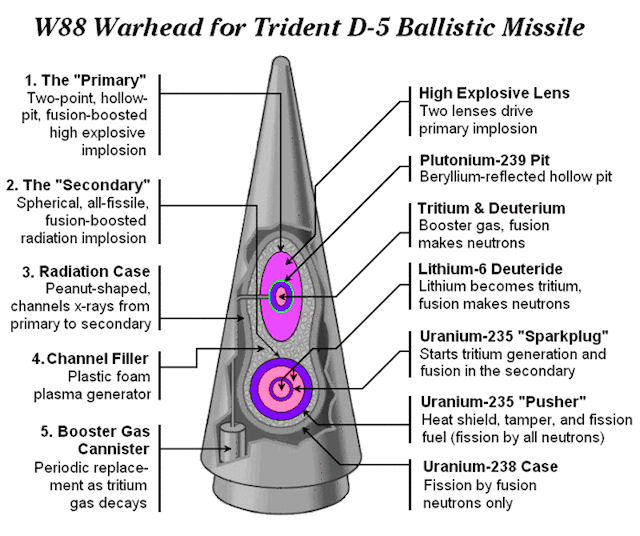
Although any technically accurate assessment of the physical consequences of the large-scale use of nuclear weapons instantly shows that “winning” a nuclear war has no meaning, the United States has strenuously emphasized the development of nuclear weapons technologies that could only make sense if their intended purpose is for fighting and winning nuclear wars.
The super-fuze is exactly that kind of technology.
The military is already upgrading warheads capable of fighting a war with both China and Russia simultaneously
Theodore Postol, Aug 29, 2024, Responsible Statecraft,
The New York Timesreported last week that President Biden has approved a secret nuclear strategy refocusing on Chinese and Russian nuclear forces.
According to the paper, the new nuclear guidance “reorients America’s deterrent strategy” to meet “the need to deter Russia, the PRC (China) and North Korea simultaneously.”
However, Biden’s approval of this strategy is no more than a tacit acknowledgment of a two-decade-long U.S. technical program that has been more than just a “slight modernization” of weapons components, but a dramatic step towards the capability to fight and win nuclear wars with both China and Russia. In other words, there is nothing really “new” here at all, save the very public nature of the strategy’s acknowledgement.
In the face of all of this, Chinese and Russian leaders will have no choice but to implement countermeasures that further increase the already dangerously high readiness of their nuclear forces. This includes intensified worst-case planning that will increase the chances of nuclear responses to false warnings of attack.
The technical source of this vast improvement in U.S. nuclear firepower is a relatively new super fuse or “super fuze” that is already being fitted onto all U.S. strategic ballistic missiles. This fuse more than doubles the ability of the Trident II Submarine Launched Ballistic Missiles (SLBMs) carrying W-76 100kt warheads to destroy Chinese and Russian nuclear-tipped Intercontinental Ballistic Missiles (ICBMs) in hardened silos.
The currently (not fully loaded) U.S. Trident Submarine force carries about 890 W-76 100kt and 400 W-88 475kt warheads. The 400 W-88 warheads have been outfitted with the super-fuze and were originally supposed to have the combination of accuracy and yield to destroy Russian silo-based ICBMs before they are launched. But there are not enough W-88s to attack both Russian and Chinese silo-based ICBMs before they can be launched.
So, with the fuse upgrade of W-76s, the W-88 warheads are no longer needed for this job. Numerous upgraded W-76 warheads can instead be used for planned missions against silo-based missiles in Russia and China.
Although 890 W-76s are currently on Trident II submarines, the U.S. has 1600 in total, making the W-76 the most numerous warhead in the American arsenal today. In the eventuality that arms control limitations no longer constrain the size of U.S. nuclear forces, these warheads could readily be added to and carried by the already available at-sea Trident II ballistic missiles, each of which can carry up to 12 W-76 warheads.
With such an “uploading,” there would still be more than enough remaining Trident II ballistic missiles on submarines to carry all of the 400 available 475kt W-88 “heavy” warheads as well.
But let’s talk more about the secret super-fuze or Burst Height Compensating Fuse.
Figure 1 [above on original] illustrates how the super-fuze drastically increases the “killing power” of a ballistic missile delivered warhead…………………………………………………………………………..
The super-fuze achieves its fantastic increase in killing efficiency by measuring its altitude at a chosen time while it is still outside the atmosphere but relatively close to its target. …………………………………………………………………………….
The military implications of this “technically sweet” added capability to U.S. ballistic missile warheads has major implications for the war-fighting capabilities of the United States.
Although any technically accurate assessment of the physical consequences of the large-scale use of nuclear weapons instantly shows that “winning” a nuclear war has no meaning, the United States has strenuously emphasized the development of nuclear weapons technologies that could only make sense if their intended purpose is for fighting and winning nuclear wars.
The super-fuze is exactly that kind of technology.
………………………………….Couching the development and deployment of these kinds of preemptive strike technologies in misleading terms like “enhancing deterrence,” does not fool the military and political leadership of Russia and China. It instead leaves them no choice but to consider ways of deterring a dangerous U.S. preemption-oriented nuclear-weaponized nation that is constantly striving for better ways to “disarm” large parts of their nuclear forces.
It is no accident that Russian President Vladimir Putin himself approved the development and revealed the existence of the ultimate doomsday weapon — the Poseidon robot submarine, which can carry a 100Mt warhead into the harbors of U.S., European, and east Asian cities — capable of destroying urban areas to ranges beyond 50 miles (80 km) from its underwater detonation point.
The deployment of the Poseidon system by Russia serves as a warning to those who think they can fight and win nuclear wars by preemptively destroying significant parts of China and Russia’s nuclear retaliation forces. No matter how successful a planned preemptive nuclear attack might look like on paper, the reality of a nuclear war initiated with the delusional belief it could be won will be global destruction so great in scale that the very end of human civilization cannot be ruled out.
This is the real bequest of Biden’s new nuclear strategy and the super-fuze. https://responsiblestatecraft.org/biden-nuclear-strategy/
Molten salt reactors were trouble in the 1960s—and they remain trouble today

Many molten salt reactor developers and proponents seem to have decided that the Molten Salt Reactor Experiment experience was so successful that all that remains is for it to be scaled up and deployed across the world. But is this really the case? A careful look suggests otherwise.
A few years after the Molten Salt Reactor Experiment was shut down, the Atomic Energy Commission terminated the entire molten salt reactor program, although it continued to fund the molten salt breeder reactor program until the end of fiscal year 1976.
Bulletin, By M.V. Ramana | June 20, 2022
Molten salt nuclear reactors are all the rage among some nuclear power enthusiasts. They promise designs that will soon lower emissions from shipping, be cheaper to run and consume nuclear waste, and be transportable in shipping containers. The Canadian government has provided two companies, Terrestrial Energy and Moltex, with tens of millions of dollars in funding. Indonesia’s Ministry of Defense has sponsored a study of thorium-based molten salt reactors. The International Atomic Energy Agency organized a webinar calling molten salt reactors “A game changer in the nuclear industry.” Unsurprisingly, China has plans to build one.
Unlike other nuclear reactor designs that can claim multiple roots, the technology underlying molten salt reactors has a fairly clear origin: the Oak Ridge National Laboratory in Tennessee. All molten salt reactors are based, in one way or another, on the Molten Salt Reactor Experiment that operated at Oak Ridge from 1965 to 1969. That experimental reactor, in turn, was based on another experimental reactor, the Aircraft Reactor Experiment, that had operated a decade earlier at the same facility.
Among developers, the Molten Salt Reactor Experiment has a legendary status. For example, in 2015, an official from Terrapower, the nuclear venture funded in part by Bill Gates, noted that his company was “excited to celebrate and build upon” the experiment by designing a molten chloride fast reactor. His accompanying slide show reinforced the message with pictures of the Molten Salt Reactor Experiment assembly, the red hot heat exchanger, and Alvin Weinberg, the leader of Oak Ridge at that time, noting that the experiment had operated for 6,000 hours. Also in 2015, Terrestrial Energy’s David LeBlanc made “a kind of pilgrimage to Oak Ridge” to celebrate the 50th anniversary of the Molten Salt Reactor Experiment becoming critical.
Many molten salt reactor developers and proponents seem to have decided that the Molten Salt Reactor Experiment experience was so successful that all that remains is for it to be scaled up and deployed across the world. But is this really the case? A careful look suggests otherwise.
Molten salt reactors’ early history. Molten salt reactors go back to the US Air Force’s failed effort to build a nuclear-powered, long-range bomber aircraft. The Air Force spent more than $1 billion (over $7 billion in today’s dollars) between 1946 and 1961 on its Aircraft Nuclear Propulsion program. President John F. Kennedy, seeing how little had been achieved, told Congress on March 28, 1961 that the possibility of success in the foreseeable future was “still very remote” and recommended terminating the program.
As part of this effort, the Air Force made Oak Ridge National Laboratory responsible for building the Aircraft Reactor Experiment as part of its effort to fly a bomber on nuclear power. The 2.5 megawatt reactor operated for a mere nine days in November 1954. Some Oak Ridge officials considered running the reactor longer, but others grew concerned about overheating of one of the reactor components. That concern was legitimate; five days later, this component failed and “released radioactive gas into the reactor compartment.” But Oak Ridge National Lab officials were undeterred. For them, the experience showed “the feasibility of molten-salt fuel” and they “persuaded the Atomic Energy Commission to fund a study of molten-salt power reactors.” In 1958, the commission did just that, and thus began the Molten Salt Reactor Experiment.
To understand the interest in molten salt reactors, start by adopting a 1950s mindset. At the time, nuclear power was expected to expand rapidly, and some energy planners were worried that there would be insufficient uranium to fuel all the reactors to be built over upcoming decades. Alvin Weinberg, the head of Oak Ridge, expressed this eloquently when he prophesized that humanity would need to “burn the rocks” in what are called breeder reactors in order to live a “passably abundant life.” While the dominant types of reactors around the world (light water reactors and heavy water reactors) use only a small fraction of the uranium and thorium found in the Earth’s crust, breeder reactors can exploit a much larger fraction of these minerals.
The concern among nuclear power advocates about running out of uranium was also at the heart of another major nuclear development during this period: the liquid metal (sodium) cooled fast breeder reactor. These reactors were an effort to tap the energy present in the uranium-238 isotope that is not used in standard light and heavy water reactors by converting it into plutonium. Glenn Seaborg, who discovered the element and rose to become Chairman of the US Atomic Energy Commission from 1961 to 1971, predicted in 1970 that, by the year 2000, plutonium “can be expected to be a predominant energy source in our lives.” By contrast, the molten salt reactors were mostly intended as a pathway to use thorium, which was more plentiful than uranium, by converting it into uranium-233.
In retrospect, these expectations proved mistaken in three ways. First, energy demand has risen much more slowly, both in the United States and globally, than predicted. For example, in 1959, Weinberg assumed that the global population would stabilize at 7 billion and that it would need at least 1.9 billion, billion BTU per year. In comparison, in 2020, the world used a little over a quarter of this level of energy for nearly 8 billion people.
Second, nuclear energy proved much more expensive than envisioned in the heady “too cheap to meter” era. As nuclear power’s poor economics became apparent, reactor construction declined dramatically and has never achieved anywhere near the levels seen in the 1970s and 1980s………………………………………………………
Third, uranium proved to be more ubiquitous than anticipated, and global uranium resource estimates have continuously increased. ………………………………………..
…..the Molten Salt Reactor Experiment, Oak Ridge’s proposal for the next step in the molten salt reactor research process, was designed and constructed. As one of the Oak Ridge team leaders described it, “Design of the [Molten Salt Reactor Experiment] started in the summer of 1960, and construction started 18 months later, at the beginning of 1962. The reactor went critical in June 1965.”
In 1965, when the reactor started operating, it was fueled by a mixture of 150 kilograms of depleted uranium and 90 kilograms of weapons-grade, highly-enriched uranium (93 percent of uranium-235). After March 1968, the fuel was changed to one involving another weapons-usable material, uranium-233, which was derived from thorium. After this switch, the Molten Salt Reactor Experiment went critical in October 1968 and reached full power in January 1969. But at the end of that year, the experiment shut down. No more molten salt reactors have been built since.
The Molten Salt Reactor Experiment operation. Proponents of molten salt reactors have claimed for decades that the Molten Salt Reactor Experiment operated successfully. Indeed, they started making this claim even when it had barely started operating. In May 1966, for example, Paul Haubenreich, Oak Ridge National Laboratory associate director, cockily announced that the experiment “will live up to the name which we think goes with the initials M.S.R.E.—Mighty Smooth Running Experiment.” This, after listing many problems, including a basic one that was never resolved.
That basic problem was the reactor’s power level. The Molten Salt Reactor Experiment was designed to produce 10 megawatts (MW) of heat. The power level is given only in terms of heat production because its designers did not even try to generate electricity from the power produced in the reactor. Instead, the experiment just dissipated the heat produced to the surrounding air.
But this design power level was never reached. As Haubenreich described while pronouncing that the experiment was running “mighty smooth,” the operators “ran into some difficulties” and could only operate “at powers up to 5 MW.” …………………It turned out that the designers of the reactor had “miscalculated the heat transfer characteristics” of the system used for dissipating the heat produced into the atmosphere, and the reactor could not operate at its intended power level.
……………the reactor operated for just 13,172 hours over those four years, or only around 40 percent of the time……………….
During its operational lifetime, the Molten Salt Reactor Experiment was shut down 225 times. Of these 225 interruptions, only 58 were planned………………….
One persistent problem was with the electrical system, which experienced “eleven important failures.”…………………………………….. unexpected failures and shutdowns ended only in December 1969, when the Molten Salt Reactor Experiment was shut down.
The patchy experience of the experiment was by no means unique. Many other reactor designs have been plagued by unreliable operations and frequent shutdowns, that in many cases only became worse when scaled up. Consider, for example, sodium cooled fast breeder reactors. France, the country most reliant on nuclear power, tried to commercialize this technology after operating pilot-scale and demonstration reactors. This “commercial” version was the Superphénix, which started operating in 1986, experienced a series of accidents, and was shut down in 1997. During this period, it generated less than 8 percent of the electrical energy of what it would have generated running at full power round-the-clock. In the United States, the first and only commercial sodium cooled breeder reactor, Fermi-1, suffered a disastrous meltdown in 1966 as a result of a series of failures that had been dismissed as not credible by reactor engineers. Likewise, high-temperature, gas-cooled reactors have historically performed poorly.
The Molten Salt Reactor Experiment aftermath. For Oak Ridge officials and other molten salt reactor proponents, these problems with the Molten Salt Reactor Experiment were not worthy of significant concern. They moved forward with plans to build a larger molten salt breeder reactor. (Remember that the ultimate goal was to use thorium to breed nuclear fuel.) But the experiment did identify major hurdles in the path of building reliable molten salt reactors.
Here’s a key concern: Materials used to manufacture molten-salt-reactor components must maintain their integrity in highly radioactive and corrosive environments at elevated temperatures. The corrosion is a result of the reactor’s nature, which involves the use of a fuel consisting of uranium mixed with the hot salts for which the reactor is named. As anyone living near a seashore knows, chemically corrosive salt water eats most metallic objects.
To deal with this problem, Oak Ridge developed a new alloy known as IN0R-8 or Hastelloy-N in the late 1950s. While Hastelloy-N did not get significantly corroded—at least during the four years of intermittent operations—it had two significant problems. First, the material had trouble managing stresses. It became brittle, for example. Second the material developed cracks on surfaces exposed to the fuel salt. Both of these could lead to the component failing.
These problems remain relevant. Even today, no material can perform satisfactorily in the high-radiation, high-temperature, and corrosive environment inside a molten salt reactor. In 2018, scientists at the Idaho National Laboratory conducted an extensive review of different materials and, in the end, could only recommend that “a systematic development program be initiated.” In other words, fifty years after the molten salt reactor was shut down, technical experts still have questions about materials development for a new molten salt reactor design.
A few years after the Molten Salt Reactor Experiment was shut down, the Atomic Energy Commission terminated the entire molten salt reactor program, although it continued to fund the molten salt breeder reactor program until the end of fiscal year 1976…………………………………………………………………………………………………………………………
The Atomic Energy Commission, for its part, justified its decision in a devastating report that listed a number of problems with the large molten salt reactor that Oak Ridge scientists had conceptualized. The list included problems with materials, some of which have been earlier described; the challenge of controlling the radioactive tritium gas that is produced in molten salt reactors; the many large components, such as steam generators, that woud have to be developed from scratch (as researchers had no experience with such components for a molten salt reactor); the difficulties associated with molten-salt-reactor maintenance because radioactive fission products would be dispersed throughout the reactor; some safety disadvantages (though these are balanced by pointing out some of the safety advantages); and problems with graphite, which is used in molten-salt-reactor designs to slow down neutrons, because it swells when subjected to the nuclear reactor’s high radiation doses.
Other institutions too questioned the idea. A 1975 Office of Technology Assessment report listed the pros and cons of maintaining support for the molten salt breeder reactor program. An important set of arguments listed there proved prescient: “the [molten salt breeder reactor] may never work, its economics would be doubtful even if it did, and the chances of needing it are small.” As a result, in the years after the Molten Salt Reactor Experiment was shut down, many arguments were advanced to abandon the molten salt route, including not throwing good money after bad.
The Molten Salt Reactor Experiment’s long difficult tail.………………………………………………………. The distribution of the numbers of papers indicates the challenge of dealing with the waste resulting from a small molten salt reactor.
Dealing with radioactive salt wastes involves at least two separate concerns. The first, ongoing problem is that managing the radioactive salts that contain the uranium isotopes and the fission products is difficult. In the 1990s, researchers discovered that uranium had migrated and settled in other parts of the facility, leading to the possibility of an accidental criticality.
The second challenge is that of securely storing the uranium-233 from the Molten Salt Reactor Experiment. Although the uranium-233 used in the Molten Salt Reactor Experiment is but a small part of the larger US stockpile of the substance, it occurs in chemical forms that are difficult to manage. Further, urarnium-233 is usable in nuclear weapons, and any loss of this material might lead to security concerns.
In all, the costs incurred so far have run into the hundreds of millions of dollars—dozens of times the cost of constructing the reactor itself. …………………………………………………………………………………
Molten salt reactors are a bad idea. The Molten Salt Reactor Experiment’s history is riddled with extensive problems, both during its operational lifetime and the half century thereafter. These problems were not accidental but a result of the many material challenges faced by the reactor itself………………………………………………………………..
Should molten salt reactors ever be constructed, they are unlikely to operate reliably. And if they are deployed, they would likely result in various safety and security risks. And they would produce several different waste streams, all of which would require extensive processing and would face disposal related challenges. Investing in molten salt reactors is not worth the cost or the effort.
This article has benefited from research support from Maggie Chong, a materials engineering student at the University of British Columbia. une 2022
https://thebulletin.org/2022/06/molten-salt-reactors-were-trouble-in-the-1960s-and-they-remain-trouble-today/
The heroes who saved the world from Chernobyl Two.
they were facing a life-or-death decision – stay or go. The Russians had told them they could leave – but what would happen if there was no one to monitor the radiation and ensure its safety?
the choices they made saved the world from another Chernobyl disaster.
Daily Mail, By Serhii Plokhy, 25 August 2024
Even though he had one of the most challenging jobs in the world as the man in charge of the night-shift at the Chernobyl nuclear power station, nothing fazed Valentyn Heiko. Three-and-a-half decades after the disastrous meltdown in 1986, round-the-clock monitoring of the site in Ukraine continued for deadly radioactive fallout from its defunct reactors and facilities.
On March 1, 2022, Heiko wished staff via loudspeaker ‘peace of the spirit’. It was a brave and apt message in the circumstances – and a defiant one. Because the corridors around the control rooms of the closed – but still lethally contaminated – nuclear compound were being patrolled by machine-gun toting, trigger-happy Russian soldiers.
Following Vladimir Putin’s invasion of Ukraine six days previously, they had burst their way in and taken over the plant.
Back in 1986, a massive explosion in one of Chernobyl’s reactors had blasted about 300 tons of radioactive graphite into the air, sparking a worldwide emergency.
With the collapse of the Soviet Union five years later, the area became part of an independent Ukraine, whose nuclear specialists have since been undertaking the monumental task of containing all possible contamination.
The danger was far from over. Indeed, just a year before, engineers had detected worrying signs that fission had restarted in one of the supposedly defunct reactors, threatening another accident.
After Putin’s decision to invade, the quickest route to the capital, Kyiv, was to go through the wasteland of the Chernobyl exclusion zone. One of the Russian leader’s excuses for invading was his claim that Ukraine was secretly building a nuclear bomb there and enriching irradiated materials to turn into weapons of mass destruction.
On February 24, 2022 – the first day of the invasion – a column of armoured vehicles broke through the security perimeter and hauled down the Ukrainian flag.
Inside the administrative building, soldiers of the Ukrainian National Guard unit took up positions, ready to fight. Two Russian officers, general Sergei Burakov and colonel Andrei Frolenkov, announced that they were assuming control of the plant.
Hopelessly outnumbered, the 170 Ukrainian guards put down their weapons and became prisoners of war, while the plant’s 50 engineers and operators and 80 firefighters found themselves under occupation.
Suddenly, they were facing a life-or-death decision – stay or go. The Russians had told them they could leave – but what would happen if there was no one to monitor the radiation and ensure its safety?
They knew they had to stay. So, for weeks, they worked at gunpoint with no change of clothing, medication or hygienic supplies.
In effect, these men and women were hostages, stuck on an endless shift, uncertain if they would ever see their loved ones or their homes again. But the choices they made saved the world from another Chernobyl disaster.
Their foreman, Heiko, had to cooperate with the Russians but was determined to do so on his own terms. He came up with a daring plan – he would use his technical know-how to frighten them.
Calmly, he introduced himself to his captors: ‘I am the shift supervisor and represent the state of Ukraine.’ After Heiko had confirmed the identity of his Russian ‘guests’, Burakov and Frolenkov declared that the Chernobyl plant was now behind Russian lines.
Though a captive, Heiko laid down his ground rules. He told them that no matter how powerful the Russian military, at the nuclear plant they were not in charge.
They didn’t understand how the plant worked and, as such, any interference would risk nuclear disaster – and all their lives.
As one observer noted: ‘He made it clear to the occupiers that either they would behave decently or be up s**t creek. That is why they did not touch any workers.’
They agreed his terms. Operational control would remain in the hands of the staff, who would be free to move around as necessary and without interference.
The Russian soldiers were allowed in the administration building but would stay away from the obsolete reactor and spent nuclear fuel facilities, and arms would be prohibited in operational areas.
The Russians accepted that they had captured a dangerous site and, to survive, they would have to follow Heiko’s recommendations.
He even bamboozled them into believing that three reactors were still operational when, in fact, the last one had shut in 2000.
As the days of occupation continued, Heiko turned the screws even more, particularly after Putin hinted at the use of nuclear weapons. He told his captors that if the Kremlin used nuclear weapons against Ukraine, he would sabotage the plant and unleash Chernobyl radiation to kill the Russians.
‘I promise you,’ he spelt out, ‘that you will slowly and certainly die here, together with me. I have enough knowledge and skill to ensure that you will remain here with us forever.’
Despite Heiko’s master manipulation, his fellow Ukrainian staff were totally unprepared for the situation they found themselves in. They lived and worked in appalling conditions, jammed into tiny spaces, four to a room
The work was unrelenting. Under normal circumstances, they were to take a 24-hour rest after a 12-hour shift, but now a new shift began immediately after the previous one. ‘We worked almost round the clock, resting for just a few hours,’ remembered engineer Liudmyla Kozak. ‘We were walking around like ghosts.’
Exhausted and homesick, they felt hunted as they were continuously under surveillance. Some succumbed to depression or panic, feeling ‘trapped, stressed and desperate for relief’ in the words of an article in the Wall Street Journal.
………………………………………..Troops started searching for those ‘nuclear bomb’ laboratories imagined by Putin. All the plant’s buildings were checked, with no result. Then, Russian officers considered opening up the mounds of earth erected over the sites where radioactive debris had been buried after the meltdown in 1986.
Valerii Semenov, a senior engineer, told them they were mad as exposing radioactive debris would put everyone in danger of contamination. Faced with the prospect of digging their own radioactive graves, the Russians desisted. Instead, they fortified their military position by digging trenches.
When Semenov discovered sandbags used to protect firing positions had been sourced from contaminated earth, he exploded: ‘You’re bringing in radioactive dirt from outside. Are you out of your mind?’ He also found trenches dug in some of the most contaminated areas – including one where, in 1986, radiation had discoloured the pine trees ginger brown.
The fact was that morale among the 1,000 Russian troops occupying the plant was very low. They drank heavily, with up to half of their rubbish consisting of empty bottles. Fights were frequent. So was looting as they combed the offices for alcohol.
Semenov recalled that many of the Russians were not prepared for a long war. They had expected it to be over within days.
What happened next was arguably the most heroic episode of the whole Chernobyl saga. It was increasingly obvious that staff at the plant had had enough. Even the Russian commanders agreed, realising the exhaustion and resentment of the Ukrainian personnel might lead to an accident that would jeopardise the lives of the occupiers.
They proposed a change of shift, allowing those on duty ever since the occupation to go home, to be replaced by a crew from the nearby town of Slavutych. But this depended on finding experienced staff prepared to risk their freedom – and perhaps their lives – by going into Russian captivity.
Amazingly, there was no lack of volunteers. Forty-six men and women came forward, with two senior men, Volodymyr Falshovnyk and Serhii Makliuk, offering to lead the new shift. Makliuk recalled: ‘We were worried because we were going into the unknown. But our anxiety was less about how we would work at the plant and more what would happen to the families we were leaving behind.’
It was a complicated process getting the original shift out and the new one in, not least because it had to be done in stages so there would always be some staff left to monitor the place. On the 26th day of what had begun as a 12-hour shift, 50 workers were on their way home – 16 engineers and mechanics stayed, including Semenov.
The two shifts met on the side of a river and the exchange took place. ‘We had just seconds to embrace and shed tears,’ recalled a woman from Heiko’s shift.
Heiko considered the volunteers true heroes. ‘They were going into the unknown,’ he said later. ‘No one knew how it would end or how long they would be there.’
Heiko and his crew had spent 600 hours on duty at the occupied nuclear power plant. It was anyone’s guess how long the replacement shift would be there………………………………………………………….
the Russians locked Falshovnyk in his office and presented him with a document.
It was titled ‘Act of Acceptance and Transfer of Protection of the Chernobyl Atomic Station’ and stated the troops of the Russian Guard had provided ‘reliable protection and defence’ of the Chernobyl nuclear station, which they were now transferring back to the Ukrainians. Men carrying automatic rifles demanded that he and Makliuk sign the document or they would be arrested.
They were being asked to confirm that the Russians had behaved well but, faced with the threat of arrest, they signed.
And then, the Russians were gone. A security camera captured an image of one soldier leaving with a Russian flag trailing behind him like the low-hanging tail of a defeated dog.
The next day, April 3, those inside the plant were astonished to hear a voice on a loudspeaker coming from beyond the perimeter. ‘Good morning,’ it said. ‘We are the armed forces of Ukraine. Please let us in.’
And then a Ukrainian armoured personnel carrier and two trucks rolled into Chernobyl.
It really was over.
The Chernobyl staff got to work cleaning up. The extent of the Russian troops’ damage and looting was astounding.
Missing were some 1,500 meters for checking radiation levels, 698 computers and 344 vehicles, amounting to a total value of $135million (£102million).
The only thing the retreating Russian soldiers left behind was an increased level of radiation – up more than 40 times, almost certainly the result of digging trenches in the highly contaminated Red Forest.
There were unverified reports from inside Russia that one soldier had died, 26 had been admitted to hospital and 73 sent for treatment after exposure to radiation in the Chernobyl zone.
The Ukrainians believed that one reason they departed in such a hurry was in panic that so many of them were falling sick.
The Russian troops may have left Chernobyl, but there was every chance that Chernobyl would never leave them. And the threat of nuclear disaster remains very real elsewhere in Ukraine.
Zaporizhia, a nuclear plant in southern Ukraine and the largest power facility in Europe, remains under Russian control.
And last Saturday, following a drone strike nearby, the UN’s nuclear watchdog warned that the safety situation at the plant was ‘deteriorating’.
At Chernobyl, the brave actions of the plant workers prevented nuclear disaster, but we cannot always count on individual heroism to produce such endings in the future.
Unless the world acts to protect nuclear reactors from attack during wartime, instead of being a solution to the problem of climate change, nuclear power will solidify its reputation as the destroyer of worlds.
Adapted from Chernobyl Roulette by Serhii Plokhy (Allen Lane, £25), out on September 3. © Serhii Plokhy 2024. To order a copy for £22.50 (offer valid to 06/09/24; UK P&P free on orders over £25) see tomailshop.co.uk/books or call 020 3176 2937
1 This Month
To see nuclear-related stories in greater depth and intensity – go to https://nuclearinformation.wordpress.com/
31st January – Challenging the War Machine – a DECLASSIFIED UK SUMMIT




Website of the Week
Now until to February 10, 2026 Radioactive waste storage in France: the debate is finally open! How to participate?
-
Archives
- January 2026 (306)
- December 2025 (358)
- November 2025 (359)
- October 2025 (376)
- September 2025 (258)
- August 2025 (319)
- July 2025 (230)
- June 2025 (348)
- May 2025 (261)
- April 2025 (305)
- March 2025 (319)
- February 2025 (234)
-
Categories
- 1
- 1 NUCLEAR ISSUES
- business and costs
- climate change
- culture and arts
- ENERGY
- environment
- health
- history
- indigenous issues
- Legal
- marketing of nuclear
- media
- opposition to nuclear
- PERSONAL STORIES
- politics
- politics international
- Religion and ethics
- safety
- secrets,lies and civil liberties
- spinbuster
- technology
- Uranium
- wastes
- weapons and war
- Women
- 2 WORLD
- ACTION
- AFRICA
- Atrocities
- AUSTRALIA
- Christina's notes
- Christina's themes
- culture and arts
- Events
- Fuk 2022
- Fuk 2023
- Fukushima 2017
- Fukushima 2018
- fukushima 2019
- Fukushima 2020
- Fukushima 2021
- general
- global warming
- Humour (God we need it)
- Nuclear
- RARE EARTHS
- Reference
- resources – print
- Resources -audiovicual
- Weekly Newsletter
- World
- World Nuclear
- YouTube
-
RSS
Entries RSS
Comments RSS
 nuclear-news