The Kyshtym disaster: Russia’s hidden nuclear crisis

The Kyshtym disaster in 1957 was the Soviet Union’s biggest nuclear crisis until Chernobyl. So, why did the Soviets keep quiet about the former for decades?
28 July 25, https://www.history.co.uk/articles/kyshtym-disaster-russia-hidden-nuclear-crisis
What would be considered the worst nuclear disaster in history? Many scholars would say Chernobyl, when an explosion at a nuclear power plant in northern Ukraine released dangerous levels of radiation.
This was on 26th April 1986, when Ukraine was still part of the Soviet Union. Was Chernobyl inevitable? Many historians do believe that Soviet authorities failed to learn lessons from an earlier nuclear crisis on their own soil. Below, we at Sky HISTORY look back at the 1957 Kyshtym disaster — and how the Soviets kept it under wraps for decades.
Was there really a nuclear plant in Kyshtym?
The nuclear plant at the heart of the Kyshtym disaster was not actually in the Russian town of that name. Instead, it was in a secretive ‘closed city’ nearby, called Chelyabinsk-40. Today, it is called Ozyorsk. (Both Kyshtym and Ozyorsk are in Russia’s Chelyabinsk Oblast.)
In the 1940s, the Soviets realised that they were trailing the United States in the development of nuclear weapons. To help themselves catch up, they hastily built what is now commonly known as the Mayak nuclear plant.
This facility, which still stands today, was tasked with processing plutonium needed to make nuclear weapons. However, because the plant was assembled in a rush, many safety risks of the project were not considered sufficiently.
The Kyshtym explosion and its immediate aftermath
Before the Kyshtym disaster, it was routine for Mayak workers to deposit radioactive waste into the Techa River. This bode ill (literally) for villagers along the river who used it as a source of drinking water.
So, Mayak staff later decided to store such waste in an underground storage compartment of the plant itself. This space comprised 14 stainless steel containers attached to a concrete base.
However, in the 1950s, the cooling system in one of these tanks started to malfunction. This led the waste in the container to heat up and eventually, on 29th September 1957, explode. The force sent 20 curies of radioactive material flying a kilometre into the air.
The wind blew the radioactive particles over an area of about 20,000 square kilometres inhabited by approximately 270,000 people. This was generally to the northeast, away from Chelyabinsk-40, which lay upwind from the Mayak plant.
How did authorities initially react?
Residents of nearby areas were not initially notified of what had happened. This was largely due to the Soviet Union’s strong culture of secrecy during the Cold War. The national government didn’t want to let slip that Mayak even existed, let alone that a nuclear explosion had happened there.
It was also around the same time that the Soviet Union launched its Sputnik satellite, a big PR coup. Admitting responsibility for what was the world’s biggest nuclear disaster to date would have been more than an inconvenient fly in the ointment.
Still, the Soviets also knew that doing what they could to limit the radioactive contamination would go some way towards keeping everyone in the dark. So, while about 10,000 local residents were evacuated over the next two years, they weren’t told exactly why.
A cover-up lasting for decades
Almost 17,000 hectares of the contaminated area was turned into East Ural Nature Reserve in 1968. Members of the public were barred from entry, which remains the case to this day. Scientists have studied the reserve to monitor the long-term effects of nuclear radiation on its ecology.
The Kyshtym disaster was kept secret from the public until 1976, when Soviet dissident Zhores Medvedev reported about it in New Scientist magazine. However, the Soviet government still did not openly acknowledge the Kyshtym disaster before accidentally revealing it to the United Nations in the late 1980s.
It is estimated that thousands of cancer cases may have resulted from exposure to radiation caused by the nuclear explosion way back in 1957.
How does Kyshtym compare to Chernobyl?
On the International Nuclear and Radiological Event Scale (INES), Kyshtym is classified as Level 6. Chernobyl, an even bigger catastrophe, is ranked just one level higher (Level 7) on the INES. Kyshtym released about 40% as much radioactivity as Chernobyl.
Chernobyl is thought to have affected a larger population, too, as 335,000 people were evacuated in the wake of the 1986 disaster. Also, while Chernobyl quickly claimed 31 lives, none were lost in the immediate aftermath of Kyshtym.
Israel’s genocide is big business – and the face of the future

“Gaza not only looks like a dress rehearsal for the kind of combat US soldiers may face. It is a test of the American public’s tolerance for the levels of death and destruction that such kinds of warfare entail.”
21 July 2025, https://www.jonathan-cook.net/2025-07-21/israel-genocide-big-business/
US corporations and military planners welcome the ‘legal maneuver space’ Israel has opened up for them to profit from warfare that slaughters and starves civilians
[An audio version of this article is available here]
The Financial Times revealed this month that a cabal of Israeli investors, one of the world’s top business consulting groups and a think-tank headed by former British prime minister Tony Blair had been secretly working on plans to exploit the ruins of Gaza as prime real estate.
The secret consortium appears to have been seeking practical ways to realise US President Donlad Trump’s “vision” of Gaza as the “Riviera of the Middle East”: transforming the small coastal enclave into a playground for the rich and an enticing investment opportunity, once it can be ethnically cleansed of its Palestinian population.
Meanwhile, the UK government has declared Palestine Action a terrorist organisation – the first time in British history that a direct-action campaign group has been banned under Britain’s already draconian terrorism legislation.
Notably, the government of Keir Starmer took the decision to proscribe Palestine Action after lobbying from Elbit Systems, an Israeli weapons maker whose factories in the UK have been targeted by Palestine Action for disruption. Elbit supplies Israel with killer drones and other weapons central to Israel’s genocide in Gaza.
These revelations came to light as the United Nation’s special rapporteur on the occupied Palestinian territories, Francesca Albanese, published a report – titled “From economy of occupation to economy of genocide” – exposing Big Business’ extensive involvement in, and profits from, Israel’s crimes in Gaza.
Albanese lists dozens of major western companies that are deeply invested in Israel’s oppression of the Palestinian people.
This is not a new development, as she notes. These firms have exploited business opportunities associated with Israel’s violent occupation of the Palestinian people’s lands for years, and in some cases decades.
The switch from Israel’s occupation of Gaza to its current genocide hasn’t threatened profits; it has enhanced them. Or as Albanese puts it: “The profits have increased as the economy of the occupation transformed into an economy of genocide.”
The special rapporteur has been a growing thorn in the side of Israel and its western sponsors over the past 21 months of slaughter in Gaza.
That explains why Marco Rubio, Trump’s secretary of state, announced soon after her report was issued that he was imposing sanctions on Albanese for her efforts to shed light on the crimes of Israeli and US officials.
Revealingly, he called her statements – rooted in international law – “economic warfare against the United States and Israel”. Albanese and the UN system of universal human rights that stands behind her, it seems, represent a threat to western profiteering.
Window on the future
Israel effectively serves as the world’s largest business incubator – though, in its case, not just by nurturing start-up companies.
Rather, it offers global corporations the chance to test and refine new weapons, machinery, technologies, data collection and automation processes in the occupied territories. These developments are associated with mass oppression, control, surveillance, incarceration, ethnic cleansing – and now genocide.
In a world of shrinking resources and growing climate chaos, such innovative technologies of subjugation are likely to have domestic, in addition to overseas, applications. Gaza is the corporate world’s laboratory, and a window into our own future.
In her 60-page report, Albanese writes that her research “reveals how the forever-occupation has become the ideal testing ground for arms manufacturers and Big Tech… while investors and private and public institutions profit freely”.
Her point was underscored by the Israeli arms firm Rafael, which issued a promotional video of its Spike FireFly drone that showed it locating, chasing and killing a Palestinian in what it called “urban warfare” in Gaza.
As the UN special rapporteur points out, quite aside from the issue of genocide in Gaza, western companies have been under a legal and moral obligation to sever ties with Israel’s system of occupation since last summer.
That was when the world’s highest court, the International Court of Justice, ruled Israel’s decades-old occupation was a criminal enterprise based on apartheid and forcible transfer – or what Albanese refers to as policies of “displacement and replacement”.
Instead, the corporate sector – and western governments – continue to deepen their involvement in Israel’s crimes.
It is not just arms manufacturers profiting from the genocidal levelling of Gaza and the occupations of the West Bank and East Jerusalem.
Big Tech, construction and materials firms, agribusiness, the tourism industry, the goods and services sector, and supply chains have also got in on the act.
And enabling it all is a finance sector – which includes banks, pension funds, universities, insurers and charities – keen to continue investing in this architecture of oppression.
Albanese describes the mosaic of companies partnering with Israel as “an eco-system sustaining this illegality”.
Escaping scrutiny
For these corporations and their enablers, international law – the legal system Albanese and her fellow UN rapporteurs are there to uphold – serves as an impediment to the pursuit of profit.
Albanese notes that the business sector can escape scrutiny by shielding behind other actors.
Israel and its senior officials are on notice for committing genocide, crimes against humanity and war crimes.
When she wrote to 48 companies to warn them that they were colluding in this criminality, they either responded that this was Israel’s responsibility, not theirs, or that it was for states, not international law, to regulate their business activities.
Corporations, Albanese points out, can secure their biggest profits in the “grey areas of the law” – laws they have helped to shape.
Lockheed Martin’s F-35 jets, whose “beast mode” has been shop-windowed by Israel as it has destroyed Gaza, depend on some 1,600 other specialist firms operating in eight separate states, including Britain.
Late last month the UK high court, while admitting British-made components used in the F-35 were likely to contribute to war crimes in Gaza, ruled that it was up to Starmer’s government to make “acutely sensitive and political” decisions about the export of these parts.
UK foreign secretary David Lammy, by contrast, told a parliamentary committee it was not for the government to assess whether Israel was committing war crimes in Gaza, using British arms, it was “a decision for the court”.
Lockheed Martin has joined the buck-passing. A spokesperson said: “Foreign military sales are government-to-government transactions. Discussions about those sales are best addressed by the US government.”
Big Tech collusion
Albanese also points the finger at leading tech firms for rapidly and deeply embedding in Israel’s illegal occupation, including by acquiring Israeli start-ups that exploit expertise gained from the oppression of Palestinians.
The NSO Group has developed Pegasus phone spyware that is now being used to surveill politicians, journalists and human rights activists around the world.
Last year the Biden administration signed a contract with another Israeli spyware firm, Paragon. Will we learn one day that the US used exactly this kind of technology to spy on Albanese and other international law experts, on the pretext that they were waging so-called “economic warfare”?
IBM trains Israeli military and intelligence personnel, and is central to the collection and storage of biometric data on Palestinians. Hewlett Packard Enterprises supplies technology to Israel’s occupation regime, prison service and police.
Microsoft has developed its largest centre outside the US in Israel, from which it has fashioned systems for use by the Israeli military, while Google and Amazon have a $1.2 billion contract to provide it with tech infrastructure.
The prestigious research university MIT, the Massachusetts Institute of Technology, has collaborated with Israel and companies like Elbit to develop automated weapons systems for drones and refine their swarm formations.
Palantir, which supplies the Israeli military with Artificial Intelligence platforms, announced a deeper strategic partnership in January 2024, early in Israel’s slaughter in Gaza, over what the Bloomberg news agency termed “Battle Tech”.
Over the past 21 months, Israel has been introducing new automated programs driven by AI – such as “Lavendar”, “Gospel” and “Where’s Daddy?” – to select huge numbers of targets in Gaza with little or no human oversight.
Albanese calls this “the dark side of the start-up nation that is so embedded, so intimately related to the military industry aims and gains.”
Not surprisingly, tech firms are falling back on all-too-familiar smears against the special rapporteur and the UN for pulling back the veil on their activities. The Washington Post reported that, in the wake of Albanese’s report, Google’s co-founder, Sergey Brin, called the UN “transparently antisemitic” in a chat on a staff forum.
Concentration camp
There are a long list of other household names in Albanese’s report: Caterpillar, Volvo and Hyundai are accused of supplying heavy machinery to destroy homes, mosques and infrastructure in Gaza and the West Bank.
Leading banks such as BNP Paribas and Barclays have underwritten treasury bonds to boost market confidence in Israel through the genocide and maintain its favourable interest rates.
BP, Chevron and other energy firms are profiting from existing gas fields in the eastern Mediterranean and pipelines that pass through Palestinian maritime waters off Gaza. Israel issued exploration licences for Gaza’s own undeveloped gas field, off the coast, shortly after launching its genocidal slaughter.
Israel’s latest plan to create, in its own words, a “concentration” camp inside Gaza – where Palestinian civilians are to be tightly confined under armed guard – will doubtless rely on business partnerships similar to those behind the bogus “aid distribution hubs” Israel has already imposed on the enclave’s people.
Israeli soldiers have testified that they are being ordered to shoot into crowds of starving Palestinians queueing for food at these hubs – explaining why dozens of Palestinians have been killed daily for weeks on end.
Those hubs, run by the misleadingly named Gaza Humanitarian Foundation, were in part the brainchild of the Boston Consulting Group, the same management consultants caught this month plotting to turn Gaza into Trump’s Palestinian-free “Riviera of the Middle East”.
Israel’s planned concentration camp built on the ruins of the city of Rafah – to be termed, again deceptively, a “humanitarian zone” – will require all those entering to be “security screened”, using biometric data, before their incarceration.
Doubtless other contractors, using largely automated systems, will control the camp’s interior until, in the Israeli government’s words, “an emigration plan” can be implemented to expel the population from Gaza.
Albanese points to the many precedents for private corporations driving some of the most horrifying crimes in history, from slavery to the Holocaust.
Albanese urges lawyers and civil society actors to pursue legal avenues against these firms in the countries in which they are registered. Where possible, consumers should exert what pressure they can by boycotting these corporations.
She concludes by recommending that states impose sanctions and an arms embargo on Israel.
Further, she calls on the besieged International Criminal Court – four of whose judges are, like her, under US sanctions – as well as national courts “to investigate and prosecute corporate executives and/or corporate entities for their part in the commission of international crimes and laundering of the proceeds from those crimes”.
Psychopathic culture
All of this is crucial to understanding why western capitals have continued to partner in Israel’s slaughter, even as Holocaust and genocide scholars – many of them Israeli – have reached a firm consensus that its actions amount to genocide.
Governing parties in western countries like the US and Britain are largely dependent on Big Business, both for their electoral success and, after victory at the polling booth, in maintaining popularity through the promotion of “economic stability”.
Keir Starmer reached power in the UK after spurning the popular grassroots funding model of his predecessor, Jeremy Corbyn, and wooing instead the corporate sector with promises that the party would be in its pocket.
His reassurances were also key to making sure the billionaire-owned media – which had ferociously turned on Corbyn, constantly vilifying him as an “antisemite” for his democratic socialist and pro-Palestinian positions – smoothed Starmer’s path to Downing Street.
In the US, the billionaires even have one of their own in power, in Donald Trump. But even his campaign depended on funding from big donors like Miriam Adelson, the Israeli widow of casino magnate Sheldon Adelson.
Adelson is among a number of top donors, funding both main parties, who make no bones about their number one political priority being Israel.
Once in power, parties are then effectively held to ransom by major corporations on large areas of domestic and foreign policy.
The financial sector had to be bailed out by taxpayers – and still is through so-called “austerity measures” – after its reckless excesses crashed the global ecomomy in the late 2000s. Western governments considered the banks “too big to fail”.
Similarly, Israel – the world’s biggest incubator for the arms and surveillance industries – is just too big to be allowed to fail as well. Even as it commits genocide.
Critics of the rise of globalised corporations over the past half century, such as famed linguist Noam Chomsky and law professor Joel Bakan, have long noted the inherently psychopathic traits of corporate culture.
Corporations are legally obligated to pursue profit and prioritise shareholder value over other considerations. Limitations on their freedoms to do so are near non-existent after waves of deregulation from suborned western governments.
Bakan observes that corporations are indifferent to the suffering or safety of others. They are incapable of maintaining enduring relationships. They lack any sense of guilt, or capacity for self-restraint. And they lie, cheat and deceive to maximise profits.
These psychopathic tendencies have been on show in scandal after scandal, whether from the tobacco and banking industries, or from pharmaceutical and energy companies.
Why would Big Business behave any better in pursuing profits tied up in the Gaza genocide?
Bakan addresses those who confuse his argument with a conspiracy theory. The psychopathic behaviours of corporations simply reflect the legal imperatives on them as institutions – what he calls their “logical dynamic” – to maximise profit and sideline rivals, whatever the consequences for the wider society, future generations or the planet.
Growing fat on genocide
The stakes in Gaza are high for western governments precisely because they are so high for the business world growing fat on Israel’s genocide.
Governments and corporations have an overwhelming shared interest in protecting Israel from scrutiny and criticism: it serves as their colonial attack dog in the oil-rich Middle East, and it acts as a cash-cow for the weapons, surveillance and incarceration industries.
Which explains why Trump and Starmer, on one side, and university administrations, on the other, have invested so much political and moral capital in crushing the spaces, especially in academia, where free speech and protest are supposed to be most prized.
The unversities are far from a disinterested party. Before their campus encampments were trashed by police, student demonstrators sought to highlight how heavily invested the universities are in the economy of occupation and genocide, both financially and through research partnerships with the Israeli military and Israeli universities.
The need to ringfence Israel from scrutiny also explains rapid moves in the West both to impute “antisemitism” to every effort to hold Israel, or its genocidal army, to account.
The desperate lengths to which governments will go was on display this month as UK officials and the establishment media kicked up a storm of outrage after a punk band at Glastonbury chanted “Death, death to the IDF!” – a reference to Israel’s genocidal army.
And as the power of the antisemitism accusation has weakened from misuse, western capitals are now rewriting their statutes to designate as “terrorism” any attempt to put a spoke in the wheels of the genocide economy, by for example sabotaging weapons factories.
Morality and international law are being scattered to the winds to keep the West’s most important colonial spin-off a money-maker.
Business as usual
Israel’s indispensability to the corporate sector and a captured western political class extends far beyond tiny Gaza. Israel is playing an outsize role as a war-industries incubator on a global battlefield in which the West seeks to ensure its continuing military and economic primacy over China.
Last month the global business elite – comprising tech billionaires and corporate titans, joined by political leaders, media editors, and military and intelligence officials – met once again at the publicity-shy Bilderberg summit, this year hosted in Stockholm.
Prominent were the CEOs of major “defence” suppliers and arms manufacturers such as Palantir, Thales, Helsing, Anduril and Saab.
Drone warfare – being used in innovative ways by key military clients like Israel and Ukraine – was high on the agenda. The greater integration of AI into drones appears to have been a mainstay of the discussions.
The subtext this year, as in recent years, was a supposed rising threat from China and an associated “authoritarian axis” comprising Russia, Iran and North Korea. This threat is seen chiefly in economic and technological terms.
In May, Eric Schmidt, the former head of Google and a Bilderberg board member, wrote with alarm in the New York Times: “China is at parity or pulling ahead of the United States in a variety of technologies, notably at the AI frontier.”
He added that the West was in a race against China over the imminent development of super-intelligent AI, which would give the winner “the keys to control the entire world”.
Schmidt, like other Bilderberg regulars, predicts that the power-draining needs of super AI will lead to ever-intensifying energy wars for the West to stay top dog.
Or as a Guardian report on the conference summed up the mood: “In this desperate winner-takes-all race for the keys to the world, in which the ‘geopolitics of energy’ becomes ever more important, power stations – along with the data centers they feed – are going to become the No 1 military targets.”
Israel’s slaughter in Gaza is seen as playing a critical role in opening up the “battlescape”.
The same corporations cashing in on the Gaza genocide stand to benefit from the more permissive environment – legally and militarily – created by Israel for future wars, ones where massacred civilians count only as “incidental deaths”.
An April article in the New Yorker magazine set out the challenge facing US military planners, who have considered themselves hobbled since the 1980s by the rise of a human rights community that developed an expertise in the laws of war independently from the Pentagon’s self-serving interpretations.
The result, say US generals regretfully, has been a “general aversion to collateral damage risk” – that is, killing civilians.
Pentagon military planners are keen to use the slaughter in Gaza as a precedent for their own genocidal violence in subduing future economic rivals like China and Russia who threaten the official US doctrine of “global full-spectrum dominance”.
The New Yorker sets out this thinking: “Gaza not only looks like a dress rehearsal for the kind of combat US soldiers may face. It is a test of the American public’s tolerance for the levels of death and destruction that such kinds of warfare entail.”
According to the magazine, the genocidal violence being unleashed by Israel is opening up the “legal maneuver space” – the space needed to commit crimes against humanity in full view.
This is where much of the impulse comes from in western capitals to normalise the genocide – present it as business as usual – and demonise its opponents.
The arms makers and tech companies whose coffers have been swollen by Israel’s genocide in Gaza stand to make far greater riches from a similarly devastating war against China.
Whatever the script we are sold, there will be nothing moral or existential about this coming battle. As ever, it will be about rich people keen to get even richer.
Nuclear waste exposure in childhood associated with higher cancer incidence

Harvard T.H. Chan School of Public Health, Jul 17 2025, https://www.news-medical.net/news/20250717/Nuclear-waste-exposure-in-childhood-associated-with-higher-cancer-incidence.aspx
Living near Coldwater Creek-a Missouri River tributary north of St. Louis that was polluted by nuclear waste from the development of the first atomic bomb-in childhood in the 1940s, ’50s, and ’60s was associated with an elevated risk of cancer, according to a new study led by Harvard T.H. Chan School of Public Health. The researchers say the findings corroborate health concerns long held by community members.
The study will be published July 16 in JAMA Network Open. It coincides with Congress having passed an expanded version of the Radiation Exposure Compensation Act (RECA) as part of the Trump tax bill, through which Americans, including Coldwater Creek residents, can receive compensation for medical bills associated with radiation exposure.
Most studies of radiation exposure have focused on bomb survivors who have had very high levels of exposure; far less is known about the health impacts of lower levels of radiation exposure.
Nuclear waste exposure in childhood associated with higher cancer incidence

Harvard T.H. Chan School of Public HealthJul 17 2025
Living near Coldwater Creek-a Missouri River tributary north of St. Louis that was polluted by nuclear waste from the development of the first atomic bomb-in childhood in the 1940s, ’50s, and ’60s was associated with an elevated risk of cancer, according to a new study led by Harvard T.H. Chan School of Public Health. The researchers say the findings corroborate health concerns long held by community members.
The study will be published July 16 in JAMA Network Open. It coincides with Congress having passed an expanded version of the Radiation Exposure Compensation Act (RECA) as part of the Trump tax bill, through which Americans, including Coldwater Creek residents, can receive compensation for medical bills associated with radiation exposure.
Most studies of radiation exposure have focused on bomb survivors who have had very high levels of exposure; far less is known about the health impacts of lower levels of radiation exposure.
For this study, the researchers used a subsample of 4,209 participants from the St. Louis Baby Tooth – Later Life Health Study (SLBT), a cohort composed of many individuals who lived near Coldwater Creek as children and who donated their baby teeth beginning in 1958 to measure exposure to radiation from atmospheric nuclear testing. The participants, who lived in the Greater St. Louis area between 1958 and 1972, self-reported incidences of cancer, allowing the researchers to calculate cancer risk in accordance with childhood residence proximity to Coldwater Creek.
The findings showed a dose-response effect-those living nearest to the creek had a higher risk for most cancers than those living farther away. There were 1,009 individuals (24% of the study population) who reported having cancer. Of those, the proportion was higher for those living near the creek-30% lived less than one kilometer away, 28% between one and five kilometers away, 25% between five and 20 kilometers away, and 24% 20 kilometers or more away).
The researchers estimated that those living more than 20 kilometers away from the creek had a 24% risk of any type of cancer. Compared to this group, among those who lived less than one kilometer away from the creek, the risk of developing any type of cancer was 44% higher; solid cancers (cancers that form a mass, as opposed to blood cancers), 52% higher; radiosensitive cancers (thyroid, breast, leukemia, and basal cell), 85% higher; and non-radiosensitive cancers (all except thyroid, breast, leukemia, and basal cell), 41% higher. The risk went down among those who lived between one and 5 kilometers away from the creek, and then down a little more among those who lived 5-20 kilometers away, but was still slightly higher than those living more than 20 kilometers away.
“Our research indicates that the communities around North St. Louis appear to have had excess cancer from exposure to the contaminated Coldwater Creek,” said corresponding author Marc Weisskopf, Cecil K. and Philip Drinker Professor of Environmental Epidemiology and Physiology.
These findings may have broader implications-as countries think about increasing nuclear power and developing more nuclear weapons, the waste from these entities could have huge impacts on people’s health, even at these lower levels of exposure.”
Marc Weisskopf, Cecil K. and Philip Drinker Professor, Environmental Epidemiology and Physiology, Harvard T.H. Chan School of Public Health
Other Harvard Chan School authors included Michael Leung, Ian Tang, Joyce Lin, Lorelei Mucci, Justin Farmer, and Kaleigh McAlaine.
Source:
Harvard T.H. Chan School of Public Health
Journal reference:
Leung, M., et al. (2025) Cancer Incidence and Childhood Residence Near the Coldwater Creek Radioactive Waste Site. JAMA Network Open.
Nuclear waste exposure in childhood associated with higher cancer incidence
Harvard T.H. Chan School of Public Health, Jul 17 2025, https://www.news-medical.net/news/20250717/Nuclear-waste-exposure-in-childhood-associated-with-higher-cancer-incidence.aspx
Living near Coldwater Creek-a Missouri River tributary north of St. Louis that was polluted by nuclear waste from the development of the first atomic bomb-in childhood in the 1940s, ’50s, and ’60s was associated with an elevated risk of cancer, according to a new study led by Harvard T.H. Chan School of Public Health. The researchers say the findings corroborate health concerns long held by community members.
The study will be published July 16 in JAMA Network Open. It coincides with Congress having passed an expanded version of the Radiation Exposure Compensation Act (RECA) as part of the Trump tax bill, through which Americans, including Coldwater Creek residents, can receive compensation for medical bills associated with radiation exposure.
Most studies of radiation exposure have focused on bomb survivors who have had very high levels of exposure; far less is known about the health impacts of lower levels of radiation exposure.
For this study, the researchers used a subsample of 4,209 participants from the St. Louis Baby Tooth – Later Life Health Study (SLBT), a cohort composed of many individuals who lived near Coldwater Creek as children and who donated their baby teeth beginning in 1958 to measure exposure to radiation from atmospheric nuclear testing. The participants, who lived in the Greater St. Louis area between 1958 and 1972, self-reported incidences of cancer, allowing the researchers to calculate cancer risk in accordance with childhood residence proximity to Coldwater Creek.
The findings showed a dose-response effect-those living nearest to the creek had a higher risk for most cancers than those living farther away. There were 1,009 individuals (24% of the study population) who reported having cancer. Of those, the proportion was higher for those living near the creek-30% lived less than one kilometer away, 28% between one and five kilometers away, 25% between five and 20 kilometers away, and 24% 20 kilometers or more away).
The researchers estimated that those living more than 20 kilometers away from the creek had a 24% risk of any type of cancer. Compared to this group, among those who lived less than one kilometer away from the creek, the risk of developing any type of cancer was 44% higher; solid cancers (cancers that form a mass, as opposed to blood cancers), 52% higher; radiosensitive cancers (thyroid, breast, leukemia, and basal cell), 85% higher; and non-radiosensitive cancers (all except thyroid, breast, leukemia, and basal cell), 41% higher. The risk went down among those who lived between one and 5 kilometers away from the creek, and then down a little more among those who lived 5-20 kilometers away, but was still slightly higher than those living more than 20 kilometers away.
“Our research indicates that the communities around North St. Louis appear to have had excess cancer from exposure to the contaminated Coldwater Creek,” said corresponding author Marc Weisskopf, Cecil K. and Philip Drinker Professor of Environmental Epidemiology and Physiology.
These findings may have broader implications-as countries think about increasing nuclear power and developing more nuclear weapons, the waste from these entities could have huge impacts on people’s health, even at these lower levels of exposure.”
Marc Weisskopf, Cecil K. and Philip Drinker Professor, Environmental Epidemiology and Physiology, Harvard T.H. Chan School of Public Health
Other Harvard Chan School authors included Michael Leung, Ian Tang, Joyce Lin, Lorelei Mucci, Justin Farmer, and Kaleigh McAlaine.
Source:
Harvard T.H. Chan School of Public Health
Journal reference:
Leung, M., et al. (2025) Cancer Incidence and Childhood Residence Near the Coldwater Creek Radioactive Waste Site. JAMA Network Open. doi.org/10.1001/jamanetworkopen.2025.21926.
How the US and Israel Used Rafael Grossi to Hijack the IAEA and Start a War on Iran

Rafael Grossi, director General of the International Atomic Energy Agency (IAEA), allowed the IAEA to be used by the United States and Israel—an undeclared nuclear weapons state in long-term violation of IAEA rules—to manufacture a pretext for war on Iran, despite his agency’s own conclusion that Iran had no nuclear weapons program.
Israel began working on a nuclear weapon in the 1950s, with substantial help from Western countries, including France, Britain and Argentina, and made its first weapons in 1966 or 1967. By 2015, when Iran signed the JCPOA nuclear agreement, former Secretary of State Colin Powell wrote in a leaked email that a nuclear weapon would be useless to Iran because “Israel has 200, all targeted on Tehran.”
The agency’s chief has not only continued its subservience to U.S. and Western interests, but also its practice of turning a blind eye to Israel’s nuclear weapons.
Medea BenjaminNicolas J.S. Davies, Jun 23, 2025, https://www.commondreams.org/opinion/how-the-us-and-israel-used-rafael-grossi-to-hijack-the-iaea-and-start-a-war-on-iran
Rafael Grossi, director General of the International Atomic Energy Agency (IAEA), allowed the IAEA to be used by the United States and Israel—an undeclared nuclear weapons state in long-term violation of IAEA rules—to manufacture a pretext for war on Iran, despite his agency’s own conclusion that Iran had no nuclear weapons program.
On June 12th, based on a damning report by Grossi, a slim majority of the IAEA Board of Governors voted to find Iran in non-compliance with its obligations as an IAEA member. Of the 35 countries represented on the Board, only 19 voted for the resolution, while 3 voted against it, 11 abstained and 2 did not vote.
Rafael Grossi, director General of the International Atomic Energy Agency (IAEA), allowed the IAEA to be used by the United States and Israel—an undeclared nuclear weapons state in long-term violation of IAEA rules—to manufacture a pretext for war on Iran, despite his agency’s own conclusion that Iran had no nuclear weapons program.
On June 12th, based on a damning report by Grossi, a slim majority of the IAEA Board of Governors voted to find Iran in non-compliance with its obligations as an IAEA member. Of the 35 countries represented on the Board, only 19 voted for the resolution, while 3 voted against it, 11 abstained and 2 did not vote.
Without you, Common Dreams simply wouldn’t exist.
In a moment that demands fearless reporting, Common Dreams needs your support to keep our independent journalism alive.
about:blank
The United States contacted eight board member governments on June 10th to persuade them to either vote for the resolution or not to vote. Israeli officials said they saw the U.S. arm-twisting for the IAEA resolution as a significant signal of U.S. support for Israel’s war plans, revealing how much Israel valued the IAEA resolution as diplomatic cover for the war.
The IAEA board meeting was timed for the final day of President Trump’s 60-day ultimatum to Iran to negotiate a new nuclear agreement. Even as the IAEA board voted, Israel was loading weapons, fuel and drop-tanks on its warplanes for the long flight to Iran and briefing its aircrews on their targets. The first Israeli air strikes hit Iran at 3 a.m. that night.
On June 20th, Iran filed a formal complaint against Director General Grossi with the UN Secretary General and the UN Security Council for undermining his agency’s impartiality, both by his failure to mention the illegality of Israel’s threats and uses of force against Iran in his public statements and by his singular focus on Iran’s alleged violations.
The source of the IAEA investigation that led to this resolution was a 2018 Israeli intelligence report that its agents had identified three previously undisclosed sites in Iran where Iran had conducted uranium enrichment prior to 2003. In 2019, Grossi opened an investigation, and the IAEA eventually gained access to the sites and detected traces of enriched uranium..
Despite the fateful consequences of his actions, Grossi has never explained publicly how the IAEA can be sure that Israel’s Mossad intelligence agency or its Iranian collaborators, such as the Mojahedin-e-Khalq (or MEK), did not put the enriched uranium in those sites themselves, as Iranian officials have suggested.
While the IAEA resolution that triggered this war dealt only with Iran’s enrichment activities prior to 2003, U.S. and Israeli politicians quickly pivoted to unsubstantiated claims that Iran was on the verge of making a nuclear weapon. U.S. intelligence agencies had previously reported that such a complex process would take up to three years, even before Israel and the United States began bombing and degrading Iran’s existing civilian nuclear facilities.
The IAEA’s previous investigations into unreported nuclear activities in Iran were officially completed in December 2015, when IAEA Director General Yukiya Amano published its “Final Assessment on Past and Present Outstanding Issues regarding Iran’s Nuclear Program.”
The IAEA assessed that, while some of Iran’s past activities might have been relevant to nuclear weapons, they “did not advance beyond feasibility and scientific studies, and the acquisition of certain relevant technical competences and capabilities.” The IAEA “found no credible indications of the diversion of nuclear material in connection with the possible military dimensions to Iran’s nuclear program.”
When Yukiya Amano died before the end of his term in 2019, Argentinian diplomat Rafael Grossi was appointed IAEA Director General. Grossi had served as Deputy Director General under Amano and, before that, as Chief of Staff under Director General Mohamed ElBaradei.
The Israelis have a long record of fabricating false evidence about Iran’s nuclear activities, like the notorious “laptop documents” given to the CIA by the MEK in 2004 and believed to have been created by the Mossad. Douglas Frantz, who wrote a report on Iran’s nuclear program for the Senate Foreign Relations Committee in 2009, revealed that the Mossad created a special unit in 2003 to provide secret briefings on Iran’s nuclear program, using “documents from inside Iran and elsewhere.”
And yet Grossi collaborated with Israel to pursue its latest allegations. After several years of meetings in Israel and negotiations and inspections in Iran, he wrote his report to the IAEA Board of Governors and scheduled a board meeting to coincide with the planned start date for Israel’s war.
Israel made its final war preparations in full view of the satellites and intelligence agencies of the western countries that drafted and voted for the resolution. It is no wonder that 13 countries abstained or did not vote, but it is tragic that more neutral countries could not find the wisdom and courage to vote against this insidious resolution.
The official purpose of the International Atomic Energy Agency, or IAEA, is “to promote the safe, secure and peaceful use of nuclear technologies.” Since 1965, all of its 180 member countries have been subject to IAEA safeguards to ensure that their nuclear programs are “not used in such a way as to further any military purpose.”
The IAEA’s work is obviously compromised in dealing with countries that already have nuclear weapons. North Korea withdrew from the IAEA in 1994, and from all safeguards in 2009. The United States, Russia, the United Kingdom, France and China have IAEA safeguard agreements that are based only on “voluntary offers” for “selected” non-military sites. India has a 2009 safeguard agreement that requires it to keep its military and civilian nuclear programs separate, and Pakistan has 10 separate safeguard agreements, but only for civilian nuclear projects, the latest being from 2017 to cover two Chinese-built power stations.
Israel, however, has only a limited 1975 safeguards agreement for a 1955 civilian nuclear cooperation agreement with the United States. An addendum in 1977 extended the IAEA safeguards agreement indefinitely, even though the cooperation agreement with the U.S. that it covered expired four days later. So, by a parody of compliance that the United States and the IAEA have played along with for half a century, Israel has escaped the scrutiny of IAEA safeguards just as effectively as North Korea.
Israel began working on a nuclear weapon in the 1950s, with substantial help from Western countries, including France, Britain and Argentina, and made its first weapons in 1966 or 1967. By 2015, when Iran signed the JCPOA nuclear agreement, former Secretary of State Colin Powell wrote in a leaked email that a nuclear weapon would be useless to Iran because “Israel has 200, all targeted on Tehran.” Powell quoted former Iranian President Mahmoud Ahmadinejad asking, “What would we do with a nuclear weapon? Polish it?”
In 2003, while Powell tried but failed to make a case for war on Iraq to the UN Security Council, President Bush smeared Iran, Iraq and North Korea as an “axis of evil,” based on their alleged pursuit of “weapons of mass destruction.” The Egyptian IAEA Director, Mohamed ElBaradei, repeatedly assured the Security Council that the IAEA could find no evidence that Iraq was developing a nuclear weapon.
When the CIA produced a document that showed Iraq importing yellowcake uranium from Niger, just as Israel had secretly imported it from Argentina in the 1960s, the IAEA only took a few hours to recognize the document as a forgery, which ElBaradei immediately reported to the Security Council.
Rafael Grossi, director General of the International Atomic Energy Agency (IAEA), allowed the IAEA to be used by the United States and Israel—an undeclared nuclear weapons state in long-term violation of IAEA rules—to manufacture a pretext for war on Iran, despite his agency’s own conclusion that Iran had no nuclear weapons program.
On June 12th, based on a damning report by Grossi, a slim majority of the IAEA Board of Governors voted to find Iran in non-compliance with its obligations as an IAEA member. Of the 35 countries represented on the Board, only 19 voted for the resolution, while 3 voted against it, 11 abstained and 2 did not vote.
Without you, Common Dreams simply wouldn’t exist.
In a moment that demands fearless reporting, Common Dreams needs your support to keep our independent journalism alive.
about:blank
The United States contacted eight board member governments on June 10th to persuade them to either vote for the resolution or not to vote. Israeli officials said they saw the U.S. arm-twisting for the IAEA resolution as a significant signal of U.S. support for Israel’s war plans, revealing how much Israel valued the IAEA resolution as diplomatic cover for the war.
The IAEA board meeting was timed for the final day of President Trump’s 60-day ultimatum to Iran to negotiate a new nuclear agreement. Even as the IAEA board voted, Israel was loading weapons, fuel and drop-tanks on its warplanes for the long flight to Iran and briefing its aircrews on their targets. The first Israeli air strikes hit Iran at 3 a.m. that night.
On June 20th, Iran filed a formal complaint against Director General Grossi with the UN Secretary General and the UN Security Council for undermining his agency’s impartiality, both by his failure to mention the illegality of Israel’s threats and uses of force against Iran in his public statements and by his singular focus on Iran’s alleged violations.
The source of the IAEA investigation that led to this resolution was a 2018 Israeli intelligence report that its agents had identified three previously undisclosed sites in Iran where Iran had conducted uranium enrichment prior to 2003. In 2019, Grossi opened an investigation, and the IAEA eventually gained access to the sites and detected traces of enriched uranium.
Despite the fateful consequences of his actions, Grossi has never explained publicly how the IAEA can be sure that Israel’s Mossad intelligence agency or its Iranian collaborators, such as the Mojahedin-e-Khalq (or MEK), did not put the enriched uranium in those sites themselves, as Iranian officials have suggested.
While the IAEA resolution that triggered this war dealt only with Iran’s enrichment activities prior to 2003, U.S. and Israeli politicians quickly pivoted to unsubstantiated claims that Iran was on the verge of making a nuclear weapon. U.S. intelligence agencies had previously reported that such a complex process would take up to three years, even before Israel and the United States began bombing and degrading Iran’s existing civilian nuclear facilities.
The IAEA’s previous investigations into unreported nuclear activities in Iran were officially completed in December 2015, when IAEA Director General Yukiya Amano published its “Final Assessment on Past and Present Outstanding Issues regarding Iran’s Nuclear Program.”
The IAEA assessed that, while some of Iran’s past activities might have been relevant to nuclear weapons, they “did not advance beyond feasibility and scientific studies, and the acquisition of certain relevant technical competences and capabilities.” The IAEA “found no credible indications of the diversion of nuclear material in connection with the possible military dimensions to Iran’s nuclear program.”
When Yukiya Amano died before the end of his term in 2019, Argentinian diplomat Rafael Grossi was appointed IAEA Director General. Grossi had served as Deputy Director General under Amano and, before that, as Chief of Staff under Director General Mohamed ElBaradei.
The Israelis have a long record of fabricating false evidence about Iran’s nuclear activities, like the notorious “laptop documents” given to the CIA by the MEK in 2004 and believed to have been created by the Mossad. Douglas Frantz, who wrote a report on Iran’s nuclear program for the Senate Foreign Relations Committee in 2009, revealed that the Mossad created a special unit in 2003 to provide secret briefings on Iran’s nuclear program, using “documents from inside Iran and elsewhere.”
And yet Grossi collaborated with Israel to pursue its latest allegations. After several years of meetings in Israel and negotiations and inspections in Iran, he wrote his report to the IAEA Board of Governors and scheduled a board meeting to coincide with the planned start date for Israel’s war.
Israel made its final war preparations in full view of the satellites and intelligence agencies of the western countries that drafted and voted for the resolution. It is no wonder that 13 countries abstained or did not vote, but it is tragic that more neutral countries could not find the wisdom and courage to vote against this insidious resolution.
The official purpose of the International Atomic Energy Agency, or IAEA, is “to promote the safe, secure and peaceful use of nuclear technologies.” Since 1965, all of its 180 member countries have been subject to IAEA safeguards to ensure that their nuclear programs are “not used in such a way as to further any military purpose.”
The IAEA’s work is obviously compromised in dealing with countries that already have nuclear weapons. North Korea withdrew from the IAEA in 1994, and from all safeguards in 2009. The United States, Russia, the United Kingdom, France and China have IAEA safeguard agreements that are based only on “voluntary offers” for “selected” non-military sites. India has a 2009 safeguard agreement that requires it to keep its military and civilian nuclear programs separate, and Pakistan has 10 separate safeguard agreements, but only for civilian nuclear projects, the latest being from 2017 to cover two Chinese-built power stations.
Israel, however, has only a limited 1975 safeguards agreement for a 1955 civilian nuclear cooperation agreement with the United States. An addendum in 1977 extended the IAEA safeguards agreement indefinitely, even though the cooperation agreement with the U.S. that it covered expired four days later. So, by a parody of compliance that the United States and the IAEA have played along with for half a century, Israel has escaped the scrutiny of IAEA safeguards just as effectively as North Korea.
Israel began working on a nuclear weapon in the 1950s, with substantial help from Western countries, including France, Britain and Argentina, and made its first weapons in 1966 or 1967. By 2015, when Iran signed the JCPOA nuclear agreement, former Secretary of State Colin Powell wrote in a leaked email that a nuclear weapon would be useless to Iran because “Israel has 200, all targeted on Tehran.” Powell quoted former Iranian President Mahmoud Ahmadinejad asking, “What would we do with a nuclear weapon? Polish it?”
In 2003, while Powell tried but failed to make a case for war on Iraq to the UN Security Council, President Bush smeared Iran, Iraq and North Korea as an “axis of evil,” based on their alleged pursuit of “weapons of mass destruction.” The Egyptian IAEA Director, Mohamed ElBaradei, repeatedly assured the Security Council that the IAEA could find no evidence that Iraq was developing a nuclear weapon.
When the CIA produced a document that showed Iraq importing yellowcake uranium from Niger, just as Israel had secretly imported it from Argentina in the 1960s, the IAEA only took a few hours to recognize the document as a forgery, which ElBaradei immediately reported to the Security Council.
Bush kept repeating the lie about yellowcake from Niger, and other flagrant lies about Iraq, and the United States invaded and destroyed Iraq based on his lies, a war crime of historic proportions. Most of the world knew that ElBaradei and the IAEA were right all along, and, in 2005, they were awarded the Nobel Peace Prize, for exposing Bush’s lies, speaking truth to power and strengthening nuclear non-proliferation.
In 2007, a U.S. National Intelligence Estimate (NIE) by all 16 U.S. intelligence agencies agreed with the IAEA’s finding that Iran, like Iraq, had no nuclear weapons program. As Bush wrote in his memoirs, “…after the NIE, how could I possibly explain using the military to destroy the nuclear facilities of a country the intelligence community said had no active nuclear weapons program?” Even Bush couldn’t believe he would get away with recycling the same lies to destroy Iran as well as Iraq, and Trump is playing with fire by doing so now.
ElBaradei wrote in his own memoir, The Age of Deception: Nuclear Diplomacy in Treacherous Times, that if Iran did do some preliminary research on nuclear weapons, it probably began during the Iran-Iraq War in the 1980s, after the US and its allies helped Iraq to manufacture chemical weapons that killed up to 100,000 Iranians.
The neocons who dominate U.S. post-Cold War foreign policy viewed the Nobel Prize winner ElBaradei as an obstacle to their regime change ambitions around the world, and conducted a covert campaign to find a more compliant new IAEA Director General when his term expired in 2009.
After Japanese diplomat Yukiya Amano was appointed as the new Director General, U.S. diplomatic cables published by Wikileaks revealed details of his extensive vetting by U.S. diplomats, who reported back to Washington that Amano “was solidly in the U.S. court on every key strategic decision, from high-level personnel appointments to the handling of Iran’s alleged nuclear weapons program.”
After becoming IAEA Director General in 2019, Rafael Grossi not only continued the IAEA’s subservience to U.S. and Western interests and its practice of turning a blind eye to Israel’s nuclear weapons, but also ensured that the IAEA played a critical role in Israel’s march to war on Iran.
Even as he publicly acknowledged that Iran had no nuclear weapons program and that diplomacy was the only way to resolve the West’s concerns about Iran, Grossi helped Israel to set the stage for war by reopening the IAEA’s investigation into Iran’s past activities. Then, on the very day that Israeli warplanes were being loaded with weapons to bomb Iran, he made sure that the IAEA Board of Governors passed a resolution to give Israel and the U.S. the pretext for war that they wanted.
In his last year as IAEA Director, Mohamed ElBaradei faced a similar dilemma to the one that Grossi has faced since 2019. In 2008, U.S. and Israeli intelligence agencies gave the IAEA copies of documents that appeared to show Iran conducting four distinct types of nuclear weapons research.
Whereas, in 2003, Bush’s yellowcake document from Niger was clearly a forgery, the IAEA could not establish whether the Israeli documents were authentic or not. So ElBaradei refused to act on them or to make them public, despite considerable political pressure, because, as he wrote in The Age of Deception, he knew the U.S. and Israel “wanted to create the impression that Iran presented an imminent threat, perhaps preparing the grounds for the use of force.” ElBaradei retired in 2009, and those allegations were among the “outstanding issues” that he left to be resolved by Yukiya Amano in 2015.
If Rafael Grossi had exercised the same caution, impartiality and wisdom as Mohamed ElBaradei did in 2009, it is very possible that the United States and Israel would not be at war with Iran today.
Mohamed ElBaradei wrote in a tweet on June 17th 2025, “To rely on force and not negotiations is a sure way to destroy the NPT and the nuclear non-proliferation regime (imperfect as it is), and sends a clear message to many countries “that their ‘ultimate security’ is to develop nuclear weapons!!!”
Despite Grossi’s role in U.S.-Israeli war plans as IAEA Director General, or maybe because of it, he has been touted as a Western-backed candidate to succeed Antonio Guterres as UN Secretary General in 2026. That would be a disaster for the world. Fortunately, there are many more qualified candidates to lead the world out of the crisis that Rafael Grossi has helped the U.S. and Israel to plunge it into.
Rafael Grossi should resign as IAEA Director before he further undermines nuclear non-proliferation and drags the world any closer to nuclear war. And he should also withdraw his name from consideration as a candidate for UN Secretary General.
Trump Has Bombed Iran. What Happens Next Is His Fault.
Caitlin Johnstone, Jun 22, 2025,https://www.caitlinjohnst.one/p/trump-has-bombed-iran-what-happens?utm_source=post-email-title&publication_id=82124&post_id=166504460&utm_campaign=email-post-title&isFreemail=true&r=1ise1&triedRedirect=true&utm_medium=email
The US military has bombed multiple Iranian nuclear sites on the orders of President Trump, immediately putting tens of thousands of US military personnel in the region at risk of an Iranian retaliation which can then escalate to full-scale war.
Earlier this month Iran’s Defense Minister Aziz Nasirzadeh explicitly warned the United States that a direct US attack would result in Tehran ordering strikes on US bases in the middle east, saying “all US bases are within our reach and we will boldly target them in host countries.”
In the lead-up to Trump’s act of war on Iran, the president told the press that an attack on American troops will mean a harsh response from the US, saying, “We’ll come down so hard if they do anything to our people. We’ll come down so hard. The gloves are off. I think they know not to touch our troops.”
Trump reiterated this threat to Iran in his announcement of the US attack today.
“There will be either peace, or there will be tragedy for Iran, far greater than we have witnessed over the last eight days,” Trump said. “Remember, there are many targets left. Tonight’s was the most difficult of them all, by far, and perhaps the most lethal. But if peace does not come quickly, we will go after those other targets with precision, speed and skill. Most of them can be taken out in a matter of minutes.”
So you can see how we might already be on our way toward a war of nightmarish proportions as a result of the president’s unprovoked act of aggression. Tehran now has to choose between reestablishing deterrence with extreme aggression or opening the floodgates to a whole host of existential threats from both outside and inside the country. Add to that the possibility of Iran blockading the Strait of Hormuz and the fact that Iran has now been strongly incentivized to actually obtain a nuclear weapon, and it looks very likely that we are plunging into a situation that could unfold in any number of horrific ways.
Right now American political discourse is rife with the narrative that the US has been “dragged” into Israel’s war, which I reject entirely. Every step of the way this entire thing has been signed off on by US leadership. We are at this point because Trump and his regime knowingly chose to take us here.
US troops within reach of Iran’s missiles are reportedly being briefed that they can expect to be on the receiving end of retaliatory strikes in the coming days.
Again, Iran explicitly warned it would attack the US military if the US military did the thing it just did. If and when these retaliatory strikes come, the warmongers will try to argue that this is a valid reason to escalate this war. They will be lying. They chose to make this happen.
Whatever transpires from this point on is the fault of Donald Trump and the unelected thugs he listens to. If US troops are killed, the war sluts in Washington and the Pentagon propagandists in the press will list their names and bandy about their photos and demand that their deaths be avenged with further acts of war — but it will not be Iran’s fault that they died.
It will be Trump’s fault. It will be the fault of everyone whose decisions led up to bombs being dropped on Iranian energy infrastructure, and the fault of everyone who put those soldiers in harm’s way.
None of this needed to happen. Iran was at the negotiating table. The Iran deal was working fine before Trump shredded it to put us on this terrible trajectory. The warmongers artificially manufactured this situation and knowingly inflicted this horror upon our world.
I am really not looking forward to all the melodramatic victim-LARPing if and when Iran kills US military personnel stationed in west Asia. The US is the only nation on earth that can rival Israel in its ability to play the victim when the ball they’ve thrown at the wall bounces back.
Israel – Iran: The Confrontation

while the Iranian documents seized by the Mossad did not reveal a military nuclear program, [ 18 ] despite the statements of Benyamin Netanyahu, the neutrality of the Argentine Rafael Grossi, director of the International Atomic Energy Agency (IAEA), has been questioned based on the first Israeli documents seized by the Iranian Ministry of Intelligence. They show that he passed on observations of his organization to Israel, even though Israel is not a member. Among the IAEA governors, Russia, China and Burkina Faso opposed this resolution.
Coincidentally, Rafael Grossi has already been grilled about his strange silence during the Russian special operation in Ukraine: during a speech at the Davos Forum in 2022, he revealed that the Ukrainian regime had stored 30,000 kilos of plutonium and 40,000 kilos of enriched uranium at the Zaporijia plant. After that, nothing more, despite Russian objections.
The day after the publication of the documents seized by Iran, Tel Aviv attacked Iran. This is exactly the same behavior as during the 2006 war against Lebanon…………In reality, it attacked to block investigations by the Lebanese police and judiciary into a vast network of Israeli espionage and terrorism in Lebanon
Thierry Meyssan
Voltairenet.org
Tue, 17 Jun 2025 https://www.sott.net/article/500180-Israel-Iran-The-Confrontation
The confrontation between Israel and Iran does not correspond at all to the image presented by the media. Its roots go back to the time before the Islamic Republic and have nothing to do with the production of a nuclear bomb.The current start of the war is intended to cover up the misdeeds of the Argentine Rafael Grossi, director of the International Atomic Energy Agency.
The time has come: the confrontation between Israel and Persia has begun. Its origins lie not in the Islamic Republic, but in everything that preceded it. This war will continue until one of the opponents is exhausted.
To understand what is happening and avoid falling into one of the two official narratives that obscure the reality of the problem, we need to take a few steps back.
Iran’s Enemies in the 20th Century
All demonstrations in Iran against external enemies end with the inevitable “Death to the United Kingdom, Death to the United States, Death to Israel!” It is a cry that comes from the depths of Persian suffering since World War I.
Although we in the West are not aware of it, Iran was the victim of the largest genocide of the First World War in 1917-1919 [ 1 ] . 6 to 8 million people died of hunger out of a population of 18 to 20 million, i.e. between a quarter and a third of Iranians. Iran, although neutral, was crushed by the British armies, against a background of rivalry with the Bolsheviks and the Ottomans. This horror left a traumatic memory that is still very much present in Iran [ 2 ] For an Iranian there is no doubt that the United Kingdom is the first enemy of his country.
The British, who had colonized Iran with the help of one of his officers, Reza Shah (1925-1941), overthrew him to install his son, Mohammad Reza Pahlavi (1941-1979), in power. Behind these guises, they plundered the country’s oil. In 1951, the Shah appointed Mohammad Mossadegh as prime minister. Mossadegh nationalized oil at the expense of London. What followed was a conflict in which the British attacked viciously and organized a color revolution with the help of the Americans. This was “Operation Ajax” [ 3 ] . The new [Persian] regime was no longer led by London, but by Washington. The American embassy, which installed the telephone system, tapped all the ministers’ lines so that they could listen in live, without their knowledge. This system was discovered during the 1978 revolution. So Iranians have no doubt that the United States is their second enemy.
When Mossadegh was ousted, the British appointed General Fazlollah Zahedi in his place. Zahedi was a Nazi they had imprisoned in Cairo, but London was counting on him to restore “order.” So he set up a secret police force modeled on the Gestapo. He recruited former Nazis to train them, and several hundred “revisionist Zionists” were sent by Yitzhak Shamir (then working for the Mossad) to supervise them [ 4 ] . The horrors of the Savak, the most horrific secret police in the world at the time, can still be seen in the museum dedicated to it in Tehran [ 5 ] . So there is no doubt in the Iranian mindset that Israel is their third enemy.
Israel’s Only Enemy in the 20th Century
Contrary to what the Israeli public believes after 25 years of “revisionist Zionist” propaganda, Iran – neither that of the Shah nor that of the Islamic Republic – has never had the goal of destroying the Jewish population of occupied Palestine. As President Mahmoud Ahmadinejad made clear, the goal was to destroy the State of Israel in the same way that Russia had destroyed the USSR [ 6 ] .
No, the only enemy of the State of Israel is the one that has sabotaged every attempt at peace between Jews and Arabs for 80 years: the United Kingdom. As I have often explained, when the Foreign Office drew up its plan, The Future of Palestine, in 1915, it specified that a Jewish state should be established in Mandatory Palestine, but that it should in no way be able to guarantee its own security.
It was not until two years later that the government of David Lloyd George drew up the Balfour Declaration, which announced the establishment of a Jewish National Home, and the government of Woodrow Wilson committed itself to the establishment of an independent state for the Jews of the Ottoman Empire.
The author of this text, Lord Herbert Samuel, became the British High Commissioner in Palestine. True to himself, he preferred the “revisionist Zionists” of Jabotinsky on the one hand and the anti-Semite Mohammed Amin al-Husseini as Grand Mufti of Jerusalem on the other. He was subsequently appointed Under-Secretary of State for the Home Department in the government of Archibald Sinclair.
This policy continues unabated to this day, with the UK still supporting the “revisionist Zionist” Benjamin Netanyahu on one side and the Muslim Brotherhood, of which Hamas is the Palestinian branch, on the other.
The continuation of the conflict between the “revisionist Zionists” and Iran
Continue readingPoll: 82% of Israelis want to expel Palestinians from Gaza; 47% want to kill every man, woman, child

A poll found that 82% of full citizens of Israel want to expel Palestinians from Gaza. 47% want to kill every single man, woman, and child in Gaza. Former Prime Minister Ehud Olmert wrote that Israel is waging a “war of extermination: the indiscriminate, unrestrained, cruel, and criminal killing of civilians”.
By Ben Norton, https://geopoliticaleconomy.com/2025/05/30/poll-israelis-expel-palestinians-gaza-genocide/
Support for genocide, mass murder, and ethnic cleansing is widespread in Israel.
Israel’s former Prime Minister Ehud Olmert admitted that his country is waging a “war of extermination: the indiscriminate, unrestrained, cruel, and criminal killing of civilians”.
Meanwhile, the vast majority of Israelis want to expel Palestinians from Gaza, and roughly half want to kill every single man, woman, and child in the besieged strip.
This is according to a poll that was published by the major Israeli newspaper Haaretz.
It found that 82% of Israelis want to expel Gazans, and 47% support killing all Palestinians in Gaza.
The more religious an Israeli is, the more likely they are to support genocide and ethnic cleansing.
The survey was conducted in March by Israeli scholar Tamir Sorek, a professor at Pennsylvania State University. He worked with the Israeli polling firm Geocartography Knowledge Group.
Most Israelis want to expel Palestinian citizens
Roughly 21% of citizens of Israel are Palestinians, although they are not considered to be fully Israeli. They are third-class citizens, and are denied equal treatment by the Israeli regime.
“Israel is not a state of all its citizens”, Prime Minister Benjamin Netanyahu declared with pride in 2019.
“According to the basic nationality law we passed, Israel is the nation state of the Jewish people – and only it”, Netanyahu stressed, making it clear that Palestinians are not truly considered to be Israelis.
The March 2025 poll commissioned by Pennsylvania State University found that 56% of Jewish Israelis — who are the only ones considered to be true, full citizens — want to expel all Palestinian citizens. This includes 66% of Israelis under the age 40.
The younger an Israeli is, the more likely they are to be a far-right extremist, the survey showed.
How the political systems of Israel and the USA promote far-right extremism
Professor Tamir Sorek, the Israeli scholar who conducted the poll, noted that some prominent religious leaders in Israel have advocated for the mass murder of Palestinian civilians.
As an example, Sorek cited Rabbi Yitzchak Ginsburgh, an influential Israeli settler leader in the West Bank, which according to international law is Palestinian territory that has been illegally occupied by Israel since 1967.
Ginsburgh, who wants to eliminate Palestinians and establish a theocratic monarchy in Israel, is also an American. He was born and raised in the United States, and did not move to Israel until he was in his 20s.
Sorek wrote that the attack on Israel on 7 October 2023 “only unleashed demons that had been nurtured for decades in the media and the legal and educational systems”.
In Haaretz, Sorek wrote (emphasis added):
Zionism, besides being a national movement, is also a movement of immigrant-settlers, seeking to displace the local population. Settler-immigrant societies always encounter indiscriminate violent resistance from indigenous groups. The desire for absolute and permanent security can lead to an aspiration to eliminate the resisting population. Therefore, virtually every settlement project has the potential for ethnic cleansing and genocide, as indeed happened in North America in the 17th through 19th centuries or in Namibia in the early 1900s.
Sorek warned in another article in April that, “In Israel, calls for genocide have migrated from the margins to the mainstream”.
A clear example of how fascism has become mainstream in Israel is the country’s extreme-right Finance Minister Bezalel Smotrich, a member of the government’s powerful security cabinet.
Smotrich described himself as a “fascist homophobe”. The top Israeli official has called for the “total annihilation” of Gaza, and he argued it would be “justified and moral” to starve to death all 2.1 million Palestinians in the strip.
Former Prime Minister Ehud Olmert says Israel is waging a “war of extermination” in Gaza
Israel’s former Prime Minister Ehud Olmert has accused his country of committing war crimes and waging a “war of extermination” in Gaza.
Olmert led the Israeli regime from 2006 to 2009. He was previously a decades-long member of Netanyahu’s right-wing political party, Likud.
He made these frank admissions in a Hebrew-language article in Haaretz in May. (The following quotes are from Google Translate.)
“What we are doing in Gaza is a war of extermination: the indiscriminate, unrestrained, cruel, and criminal killing of civilians”, Olmert stated.
He made it clear that this is the “result of a policy dictated by the government, knowingly, intentionally, viciously, maliciously, recklessly”.
Olmert explained that, in 2023 and 2024, he denied that the Israeli regime was intentionally committing war crimes, but he now realizes that he was wrong.
“There are too many cases of brutal shooting of civilians, of destruction of property and homes”, the former Israeli prime minister said. “Looting of property, thefts from homes, which in many cases IDF soldiers have also taken pride in and published in personal posts. We are committing war crimes”.
Olmert stated in no uncertain terms that Israel is using hunger as a weapons: “Yes, we are depriving the residents of Gaza of food, medicine, and minimal means of subsistence as part of a declared policy”.
He referred to the Israeli regime as a “gang of criminals”, and wrote that “the ministers of the Israeli government, led by the head of the gang, Netanyahu, are actually adopting, without forethought, without hesitation, a policy of starvation and humanitarian pressure whose outcome could be catastrophic”.
Israel officially calls its war in Gaza “Operation Gideon’s Chariots”. Olmert said this is an “illegitimate military campaign”, in which Israeli soldiers have gone on a “rampage”, and have turned Gaza into a “humanitarian disaster zone”.
The army is acting “recklessly, carelessly, and excessively aggressively”, he added.
The large number of Palestinian civilians killed in Gaza is “unreasonable, unjustifiable, unacceptable”, he wrote.
Olmert also admitted that Israelis “massacre Palestinian civilians in the West Bank as well”, and “commit heinous crimes every day in the West Bank”.
In an interview with ABC News, the former Israeli prime minister acknowledged, “We have destroyed Gaza”.
Legacy of US nuclear weapons tests in the Marshall Islands created global radiation exposure: new study
Hamburg, Germany – Nearly seven decades since the US government ended nuclear weapons testing in the Marshall Islands, a new study has revealed the impacts were far greater than what the US government has so far publicly acknowledged. According to a new study, all atolls, including the southern atolls, received radioactive fallout, but only three of the 24 atolls, all northern and inhabited at the time of fallout, received medical cancer screening.[1]
“The Legacy of U.S. Nuclear Testing in the Marshall Islands” by the Institute for Energy and Environmental Research (IEER) and commissioned by Greenpeace Germany, has comprehensively analyzed official documents from US government military and energy archives, scientific analyses, and medical sources from 1945 to the present day.
“Among the many troubling aspects of the Marshall Islands’ nuclear legacy is that the United States had concluded, in 1948, after just three tests that the Marshall Islands was not ‘a suitable site for atomic experiments’ because it did not meet the required meteorological criteria. Yet testing went on,” said Arjun Makhijani, report author and President of IEER.
Among the key findings of the study:
- U.S. government radioactivity measurements and dose estimates show that the entire country was impacted by fallout.
In the immediate aftermath of Castle Bravo – the US government’s largest ever nuclear weapons test – its capital, Majuro, was officially considered a “very low exposure” atoll. However, radiation levels were tens of times, and up to 300 times more, relative to background gamma radiation levels - Nuclear testing in the Marshall Islands created radiation exposures globally, with “hotspots” detected as far west of the Marshall Islands as Colombo, Sri Lanka and as far east as Mexico City.
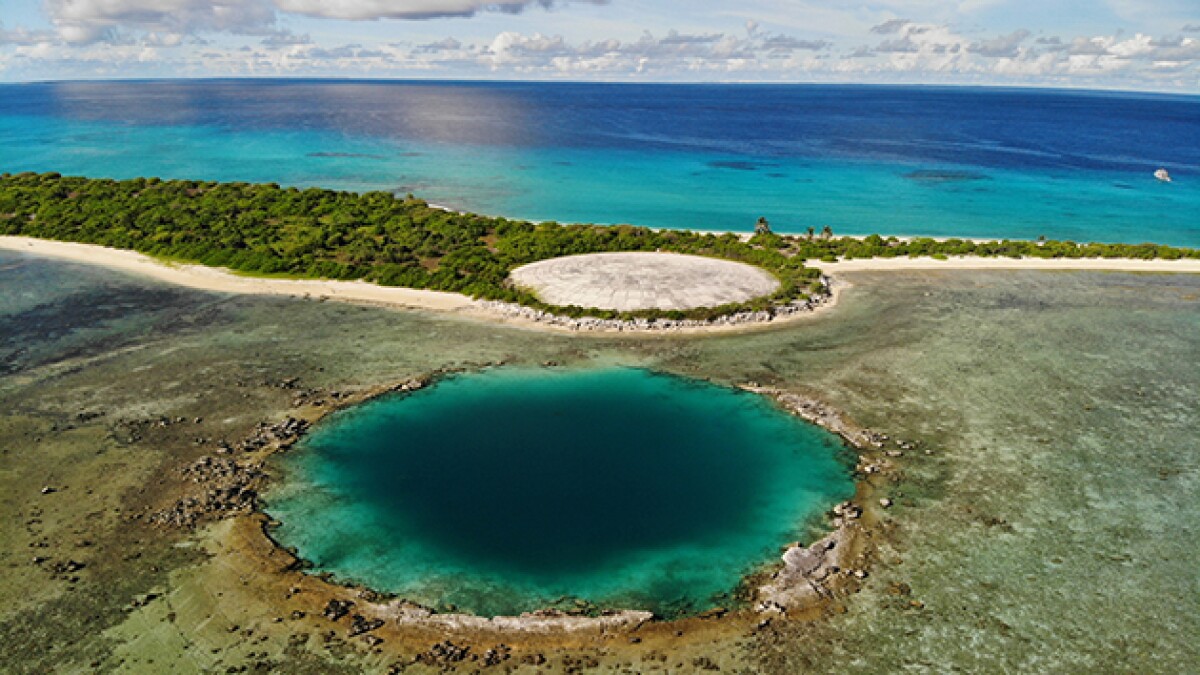
The total explosive force detonated on the Marshall Islands was 108 megatons – the equivalent of dropping a Hiroshima bomb every single day for twenty years. On a proportional basis, the nuclear fall out is estimated to result in roughly 100,000 excess cancer deaths worldwide (rounded).[2] - Remediation of contaminated areas is complex and costly. The Marshall Islands lacks technical capacity in a number of fields crucial to health, environmental protection, and possible resettlement. The history of damage by, and distrust of the United States is compounded by Marshallese dependence on the United States for funds and for scientific and medical expertise. As an example, the Runit Dome, which houses decades of nuclear waste, has been deemed “safe” by the US Department of Energy despite cracks and the impact of climate change and sea level rise.
“The tests on the Marshall Islands are exemplary of an inhumane, imperial policy that deliberately sacrificed human lives and ignored Pacific cultures. As a result of this nuclear legacy, the Marshallese have been robbed of their land, traditions, and culture, with the people of Bikini and Rongelap forever displaced,” said Shiva Gounden, Head of Pacific at Greenpeace Australia Pacific. “The US still fails to acknowledge the full extent of the deep impact. However, these atomic bomb tests are not a closed chapter and they are still having an impact today. Reparations that fit the extent of the harms caused by testing are long overdue.”
In March and April, Greenpeace and its flagship vessel, the Rainbow Warrior, completed a six-week mission with radiation specialists and independent scientists to conduct research across the atolls to support the Marshall Island’s government in its ongoing fight for nuclear justice and compensation.[3] It also marked 40 years (May 1985) when Greenpeace helped answer a call and evacuated the people of Rongelap Island to Mejatto due to nuclear fallout from Castle Bravo, which rendered their home uninhabitable.
In July, Greenpeace and the Rainbow Warrior will mark another 40 year anniversary – the bombing of the Rainbow Warrior I by the French secret service, who were attempting to halt Greenpeace’s campaign against nuclear testing in French Polynesia (Maohi Nui).
Why small modular reactors do not exist – history gives the answer.
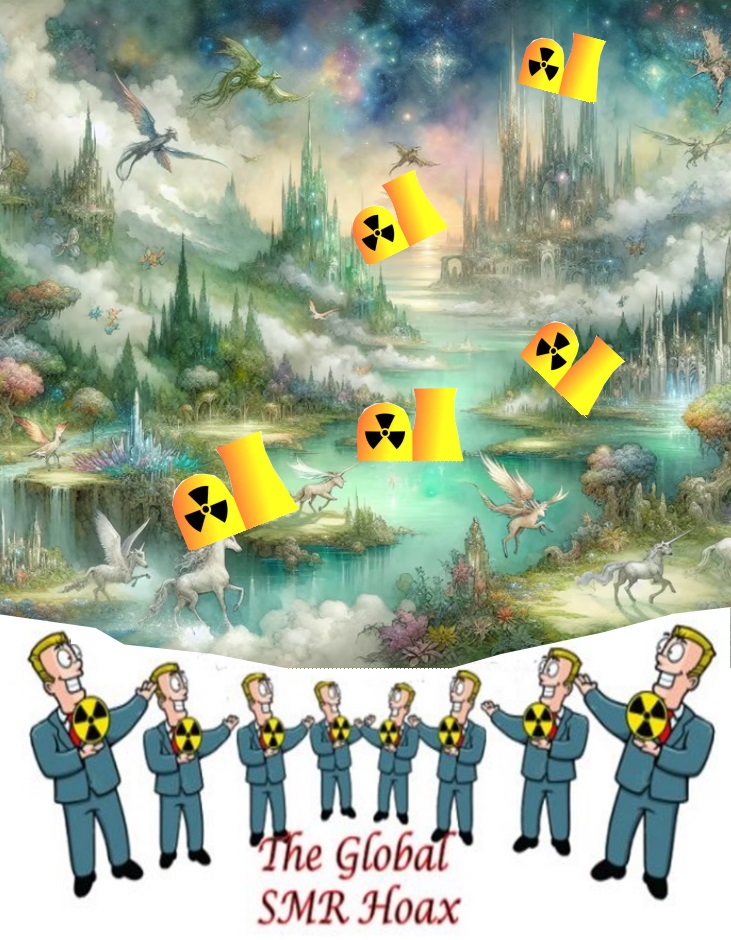
David Toke, Jan 15, 2025, https://davidtoke.substack.com/p/why-small-modular-reactors-do-not
In recent years we have seen many stories with an upbeat message about small modular reactors (SMRs) and ‘races’ to develop them. But in fact, the concept of SMR is a bogus term that tries to give the impression that something new in nuclear power is afoot. It most certainly is not. In fact what are called SMRs cannot easily be distinguished from nuclear power plants that were built in the 1940s to 1960s, long before the SMR notion was invented. The term SMR does not exist as a useful definable concept.
Even examples of new so-called SMRs are practically non-existent around the world when it comes to operating projects. But there has been a tremendous amount of hype. Indeed the hype seems to grow in inverse proportion to the lack of any projects being completed. First, a definition:
According to the International Atomic Energy Agency:
‘Small modular reactors (SMRs) are advanced nuclear reactors that have a power capacity of up to 300 MW(e) per unit, which is about one-third of the generating capacity of traditional nuclear power reactors. SMRs, which can produce a large amount of low-carbon electricity, are:
- Small – physically a fraction of the size of a conventional nuclear power reactor.
- Modular – making it possible for systems and components to be factory-assembled and transported as a unit to a location for installation.
- Reactors – harnessing nuclear fission to generate heat to produce energy.’ (Ref: see HERE
Yet the problem with this definition is that none of this represents anything new i.e. something that has not been done long ago. The term ‘advanced’ is vague and does not seem to exclude approaches that have been tried before. The notion of modular is even more misleading in practice. That is because having smaller reactors reduces the scope for factory production of components.
There are fewer economies of scale for small reactors compared to making parts for larger-scale reactors (which require more parts of a particular type). The word ‘reactor’ is not new. So what’s new? Certainly nothing, in my view, to warrant the ascription of ‘fourth generation’ nuclear designs that these so-called SMR proposals have often been given.
In practice, even projects that are called SMRs are very, very few in operation around the world. There are very few even under construction, and the ones that are seem to be taking a long time to build. That is, according to the International Atomic Energy Agency. So how can we explain this apparent contrast between, as the media stories put it ‘races’ to develop SMRs, and reality?
The problems with the concept of SMRs can be explained by reference to the historical development of nuclear power. In the 1950s and 1960s, the nuclear industry found that the (then) existing designs of small(er) reactors, what is now called SMRs, were uneconomic compared to larger reactors. As a result, the industry developed larger reactor types. The larger reactors, of course, have had very big construction problems and costs. However, this should not obscure the fact that in comparison the smaller reactors were even worse. Let us look at some of the reactor history in terms of size.
Originally, after WW2, the first electricity-generating nuclear reactors were designed for nuclear submarines. These pressurised water reactors (PWRs) range from a few MWe to over 100MWe for the largest submarines today. I would say that they are the original small nuclear reactors. Indeed here it gets a bit confusing. Why aren’t these submarine reactors called small modular reactors? Essentially, I think, because they do not fit into the current narrative which tries to give the impression that there is a new type of advanced reactor called an SMR.
Small reactors were then designed, starting in the 1950s, for land-based operations to supply mainstream electricity grids. Then design sizes increased and PWRs became the dominant technology throughout the world. Chart 1 shows how nuclear reactor sizes have increased over the decades in the case of the UK. You can see how the average design size for reactors increased from around 100 MW in the 1950s, to 400 MW in the 1960s, over 500 MW in the 1970s, and then to over 1000MW since the 1980s.
There is a very good reason that design sizes increased from the 1950s onwards. Indeed this reason seems to have been mostly overlooked in the blizzard of press releases about small modular reactors. It is all to do with the economies of scale.
There was a (at the time, well-regarded) book published in 1978 by Bupp and Derian (see later reference). This summed up the reason why the rush of ordering nuclear reactors in the USA came to an end in the 1970s. It has great relevance to the issue of small reactors today. It is all to do with the size and cost and also the safety requirements of reactors. They said:
‘In 1955 a 180 MW light water reactor design called for more than 30 tons of structural steel and about one-third of a cubic yard of concrete per MW. By 1965 a much larger plant of about 550MW required less than half as much of these materials per megawatt of capacity. These efficiencies reflect classic ‘economies of scale’. Then, in the late 1960s, the trend reversed. Larger light water plants began to require more, not less, structural materials per unit of capacity; by 1975, the steel and concrete needed per megawatt for 1,200 MW plant approximately equaled the 1960 requirement for a 200-300 MW design. This reversal was a direct consequence of stricter safety and environmental protection requirements laid down during this period. More stringent safety requirements meant thicker concrete walls.’1
So, essentially, nuclear power plants became bigger because of the drive for economies of scale. A big reason why nuclear power did not continue to become cheaper was because, by the 1970s, demands for stricter safety precautions were being translated into regulations. This meant that the progress in reduced costs had been reversed. More recent (so-called Generation 3) nuclear designs have been based on the hope that ever-bigger reactors with better safety designs would once again pave the way to cheaper nuclear reactors. It has not, of course, happened.
In other words, small modular reactors will not produce cheaper outcomes. Arguing for such a proposition flies in the face of history, not to mention basic engineering economic theory. That is, of course, if we assume that small reactors have to deliver the same safety levels as big reactors. Yet it is difficult to see the regulators scrapping the main safety requirements accumulated since the 1960s just for small nuclear reactors. Why would they? Having a much larger number of smaller reactors would increase the risk of there being a serious accident at one of them.
Progress in constructing new small reactors
This is extremely thin. Only two operating so-called SMRs were identified by the International Atomic Energy Agency in 2024, and there are very few others (three in fact) listed as under construction (see HERE page 13). So far as I can see all are very well supported by direct state or research demonstration funds. That is they are nowhere near becoming commercial propositions able to survive on the promise of privately funded bank loans and equity investment.
Of the two so-called SMR plants in operation, one is a 200 MWe reactor built in China (See HERE) – which as you can see in Chart 1 is actually rather bigger than the average reactor size in the UK designed in the 1950s. Not only that, but it took a total of 12 years to construct (see HERE). The other operational project is based on a ship in Russia. This could be described as a variation on a submarine reactor built to support a very niche market, with financing details not available.
One of the three of the three so-called SMRs under construction is being built in Argentina (and whose funding stream is threatened by Government cutbacks). This has a 32MWe reactor and is a variant of a PWR. Construction began in 2014. This is oriented mainly not to electricity production but to an extremely limited market in radioactive products.
The second is a 300 MWe ‘fast’ reactor being built in Russia. Fast reactors are certainly not new. They have been tried in various countries before (including the UK) and have not been commercially successful.
A third, much publicised, development is the 150 MWe Kairos reactor in the USA. This power plant is sited at East Tennessee Technology Park. The US Government’s Department of Energy is supporting the construction of the project. It is a ‘pebble’ bed high temperature, gas cooled reactor. Although called ‘Advanced’ pebble bed reactors were first mooted in the 1940s and have been tried and discontinued before.
Indeed, as Steve Thomas has said about the notion of ‘Advanced’ reactors (see HERE) ‘The advanced designs are not new. For example, sodium cooled fast reactors and high temperature reactors were built as prototypes in the 1950s and 1960s but successive attempts to build demonstration plants have been short-lived failures. It is hard to see why these technologies should now succeed given their poor record. Other designs have been talked about for decades but have not even been built as prototype power reactors – so again it is hard to see why the problems that prevented their deployment to date will be overcome.’
Other variants, including thorium-based plants are proposed (most recently in China). On the one hand, all of these ideas have been tried before, but are being presented as ‘new’ developments. They have failed before. These warmed-up versions of previously tried technical nuclear fission variants do not solve nuclear power’s basic cost problems. These problems involve too much steel, and concrete and the need for unique, very expensive, types of parts and techniques that are too specialist to be sourced from standard industrial supply chains.
This (Kairos) project was made famous by an announcement from Google to buy power from it. However, beyond that, I have no information about how much money Google has actually spent on the project or indeed how much it has agreed to pay for the power the reactor will produce.
Indeed the Autumn of 2024 saw a flurry of announcements of support for so-called SMRs from ‘Tech Giants’. However, the terms of the financial support were generally vague. The announcements were made just prior to the General Election and seemed to respond to the rising hype about powerful AI. In a different blog post I analyse this AI over-hype, (see HERE).
Of course, we can all agree to buy power from people for a specified price by agreeing to PPAs. No commitment to part with money is necessarily required. Whether banks and equity investors are willing to lend money to the energy project in question on the basis of such PPAs is an entirely separate matter.
SMRs in the UK
There are no projects called SMRs operating in the UK. None are under construction and none are in the process of getting anywhere near construction starts. The UK Government for its part, amongst a fanfare of publicity about support for SMRs, promises an aim of ‘deploying a First-of-a-Kind SMR by the early 2030s’ (See HERE). Of course, as Chart 1 above implies, there used to be reactors that are small enough to fit the definition of ‘SMR’. They just weren’t called SMRs at the time.
Indeed, Rolls Royce, has, for several years been promoting their so-called small modular reactor (SMR) design. This is rather larger than a lot of past British nuclear power plants, albeit none still in operation. Their proposed (so-called) SMR design has gone up to 470MWe (See HERE). It uses PWR technology.
This proposed project is rather larger, for example than the 235 MW units which comprised Hinkley A nuclear power station. This power plant began construction in 1957, started generation in 1966, and stopped generating electricity to the grid in 1999. When construction of this project began such a nuclear power plant would have been called large, not small!
I do not understand the claims made by Rolls Royce for their ‘SMR’ to be called modular. The power plant has to be constructed on-site. As I have already stated I do not understand why there is more, or even as much, scope for mass production of parts compared to a conventional reactor such as that being built at Hinkley C.
I could say much the same about Holtec, a US nuclear services company who are promoting a 300 MW reactor – again not really that small. Like Rolls Royce, it has been exciting local people in places in Yorkshire with talk of building factories. This seems unlikely to happen without, essentially the UK Government paying for all or at least much of the project.
My prize for the most ingenious piece of SMR promotion are the claims made by ‘Last Energy’, who are promoting what they describe as a 20 MW PWR reactor. A headline appeared on the Data Centre Dynamics website saying ‘Last Energy claims to have sold 24 nuclear reactors in the UK for £2.4 billion’ (see HERE). Associated with this was another story in Power Magazine saying (see HERE) that the company had secured PPAs for 34 power plants in the UK and Poland, something that was described as ‘extraordinary progress’.
I cannot see any evidence that these power plants are being constructed, ie ‘concrete poured’ at any site. However, it is claimed that the first project will be finished by 2027. There are reports that the company has been conducting site surveys in Wales (see HERE).
What I find especially puzzling about the Last Energy promotion is the lack of a mention on a specific page on the website of the Office of Nuclear Regulation (ONR). In order for a new design of a nuclear power plant to be licensed to generate in the UK, it has to be approved for what is a very lengthy (several years) and very expensive (many £millions) Generic Design Assessment (GDA). However, there is no mention of Last Energy on the ONR information page giving the current and completed GDAs (see HERE).
Why is all this so-called ‘SMR’ activity happening now?
There are two interrelated factors in operation here; material rewards and political-psychological pressures. Material factors include the designation of governmental programmes to fund demonstrations of so-called SMRs. The second is the possibility of raising share capital to fund projects labeled as ‘SMR’.
Of course this in itself does not explain why this has happened in recent years. An excerpt from an opinion piece published in the Guardian in September 2015 can give us an important clue to the political psychology involved. In an article entitled ‘We are pro-nuclear, but Hinkley C must be scrapped’, written by George Monbiot, Mark Lynas and Chris Goodall, there was a subtitle: ‘Overpriced, overcomplicated and overdue, the Hinkley project needs to be killed off and the money invested into other low-carbon technologies’. The authors’ recommendations for alternative funding went on to say: ‘We would like to see the government produce a comparative study of nuclear technologies, including the many proposed designs for small modular reactor, and make decisions according to viability and price’ (See HERE)
What this looks like to me is a face-saving device. It tries to deal with the (recently re-discovered) fact that new nuclear power stations are much too expensive. I interpret this as a piece of cognitive dissonance to deal with the very apparent limitations of environmentalists trying to promote nuclear power as a response to climate change.
This is a form of cognitive denial of the obvious; that nuclear power is extremely expensive and difficult and very longwinded to deliver. SMRs have been at least partly invented to serve the purpose of shifting mental attention from this fact, a form of denial. The denial is sugar-coated with the notion that we can escape reality by embracing so-called SMRs.
This cognitive dissonance allows people to carry on believing in and promoting nuclear power in spite of reality. A new SMR alternative reality is created. This fills the void created by dull reality.
This, in practice, diverts attention from the central cost problems of nuclear power. These are the quantities of steel and concrete needed to build nuclear power stations, the need for unique types of very expensive parts, and the need for exacting, highly specialised processes of building the reactors. Making smaller nuclear plants will not solve these problems. Indeed it makes them worse insofar as this reduces the possibilities for economies of scale.
Now I am not trying to heap the blame for the SMR fantasies on Monbiot, Lynas, and Goodall – at least not entirely! There is a large well of public wishful thinking attached to things with the word ‘nuclear’ in them and this well can be tapped by concerted, if flimsily-based efforts. The promoters of the so-called SMR technologies are the ones who have ignored history to produce what is, in essence, a warmed-up version of a long-discarded set of nuclear technological ideas and practices. Indeed I would class this stream of historical re-interpretation as an example of the use of postmodernism in the nuclear industry.
SMRs as nuclear postmodernism
Postmodernism emerged originally in architecture. It was, put simply, about reviving ancient, or at least old, building designs and using them in contemporary building design (See HERE). The old is presented therefore as the new. For buildings, that’s a pretty harmless, indeed often pleasing, pathway to adopt. However, to present old (smaller) sizes of nuclear power stations (often mixed in with long discarded design ideas) as new and call them ‘Advanced’ nuclear technologies is, in my view, doing a great disservice to us all. It skews public debate relatively against real green energy options by presenting an option (so-called SMRs) that does not exist.
Social scientists are often derided for talking about postmodernism. Yet here we see the apparent apotheosis of natural science, the nuclear sector, engaging in precisely this sort of approach. They are presenting the technologies of the 1940s to 1960s as ‘new’. We should not have to take it seriously. Many people in the nuclear industry are either living in their own alternative postmodern reality or at least are tolerating this non-existent vision.
There may be a small number of demonstration projects constructed that are called SMRs. They are, and will be, expensive and take a long to build. But they are really just warmed-up old-style versions of the 1950s-1960s-sized reactors, mixed in sometimes with tried and failed techniques. They certainly do not represent an ‘advanced’ path for a nuclear-powered future. As a concept, Small Modular Reactors have no existence outside of a postmodernist nuclear industry fantasy.
I invite people to listen to Bonzo Dog’s old hit ‘Urban Spaceman’ (see HERE). The general spirit and especially the last couple of lines of the song seem especially apposite to a discussion of so-called SMRs.
After I wrote this post came the news that the Ontario Government has given the go-ahead to the so-called SMR project at Darlington. Acclaimed as a breakthrough, it may only be a breakthrough as being the most expensive nuclear power scheme in history. Its starting price, as around $21 billion (Canadian dollars, see HERE) for 1.2 GW is almost exactly the same as the final price of the Flamanville EPR reactor in France built by EDF. This came in at €13 billion, roughly 4 times its original price tag (see HERE). Yet Flamanville has a generating capacity of 1.63 GW, that is around a third larger than the sum of the capacities of the four new Ontario reactors! So the Darlington scheme is already a third more expensive than Flamanville!

The crucial difference between the new Ontario scheme and the French power plant at Flamanville is that construction is only about to start at the Canadian scheme. So, let's repeat this. The (spuriously) acclaimed Ontario SMR scheme is already around a third more expensive than the widely panned super-expensive French Flamanville EPR even before the inevitable construction cost increases start piling up!

Given that all nuclear power plant built in the West this century have all come in a great deal more expensive than projected before construction, the cost will spiral even farther upwards. It is likely that the Ontario SMR project will win the prize of the most expensive nuclear project (per GW) this century! Even at its projected price the Ontario SMR scheme is calculated by the Ontario Clean Air Alliance to be up to 8xs more expensive than wind power (See HERE) This puts my arguments in this post in perspective, SMRs are going to be a lot more expensive than conventional nuclear power!
pages 156-157, Bupp, I, and Derian, J-C. 1978. Light Water: How the Nuclear Dream Dissolved. New York: Basic Books
Tracing radiation through the Marshall Islands: Reflections from a Greenpeace nuclear specialist
Greenpeace, Shaun Burnie, 30 April 2025
We’ve visited ground zero. Not once, but three times. But for generations, before these locations were designated as such, they were the ancestral home to the people of the Marshall Islands.
As part of a team of Greenpeace scientists and specialists from the Radiation Protection Advisors team, we have embarked on a six-week tour on-board the Rainbow Warrior, sailing through one of the most disturbing chapters in human history: between 1946 and 1958, the United States detonated 67 nuclear bombs across the Marshall Islands — equivalent to 7,200 Hiroshima explosions.
During this period, testing nuclear weapons at the expense of wonderful ocean nations like the Marshall Islands was considered an acceptable practice, or as the US put it, “for the good of mankind”. Instead, the radioactive fallout left a deep and complex legacy—one that is both scientific and profoundly human, with communities displaced for generations.
Between March and April, we traveled on the Greenpeace flagship vessel, the Rainbow Warrior, throughout the Marshall Islands, including to three northern atolls that bear the most severe scars of Cold War nuclear weapons testing:
- Enewetak atoll, where, on Runit Island, stands a massive leaking concrete dome beneath which lies plutonium-contaminated waste, a result of from a partial “clean-up” of some of the islands after the nuclear tests
- Bikini atoll, a place so beautiful, yet rendered uninhabitable by some of the most powerful nuclear detonations ever conducted;
- And Rongelap atoll, where residents were exposed to radiation fallout and later convinced to return to contaminated land, part of what is now known as Project 4.1, a U.S. medical experiment to test humans’ exposure to radiation.
This isn’t fiction, nor distant past. It’s a chapter of history still alive through the environment, the health of communities, and the data we’re collecting today. Each location we visit, each sample we take, adds to a clearer picture of some of the long-term impacts of nuclear testing—and highlights the importance of continuing to document, investigate, and attempt to understand and share these findings.
These are our field notes from a journey through places that hold important lessons for science, justice, and global accountability……………………………………………………………………………………………………
Stop 1: Enewetak Atoll – the dome that shouldn’t exist
At the far western edge of the Marshall Islands is Enewetak. The name might not ring a bell for many, but this atoll was the site of 43 U.S. nuclear detonations. Today, it houses what may be one of the most radioactive places in the world: the Runit Dome
Once a tropical paradise thick with coconut palms, now Runit Island is capped by a massive concrete structure the size of a football field. Under this dome—cracked, weather-worn, and only 46 centimeters thick in some places—lies 85,000 cubic meters of radioactive waste. These substances are not only confined to the crater—they are also found across the island’s soil, rendering Runit Island uninhabitable for all time. The contrast between what it once was and what it has become is staggering. We took samples near the dome’s base, where rising sea levels now routinely flood the area.
We collected coconut from the island which will be processed and prepared in the Rainbow Warrior’s onboard laboratory. Crops such as coconut are a known vector for radioactive isotope transfer, and tracking levels in food sources is essential for understanding long-term environmental and health risks. The local consequences of this simple fact are deeply unjust. While some atolls in the Marshall Islands can harvest and sell coconut products, the people of Enewetak are prohibited from doing so because of radioactive contamination. They have lost not only their land and safety but also their ability to sustain themselves economically. The radioactive legacy has robbed them of income and opportunity.
One of the most alarming details about this dome is that there is no lining beneath the structure – it is in direct contact with the environment – while containing some of the most hazardous long lived substances ever to exist on planet earth. It was never built to withstand flooding, sea level rise, and climate change. The scientific questions are urgent: how much of this material is already leaking into the lagoon? What are the exposure risks to marine ecosystems and local communities?
We are here to help answer questions with new, independent data, but still, being in the craters and walking on this ground where nuclear Armageddon was unleashed, is an emotional and surreal journey.
Stop 2: Bikini – a nuclear catastrophe, labeled “for the good of mankind”
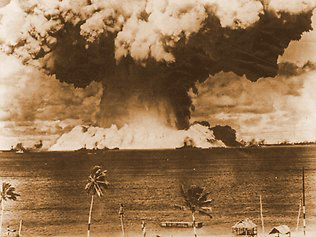
Unlike Chernobyl or Fukushima, where communities were devastated by catastrophic accidents, Bikini tells a different story. This was not an accident. The nuclear destruction of Bikini was deliberate, calculated, and executed with full knowledge that entire ways of life were going to be destroyed.
Bikini atoll is incredibly beautiful and would look idyllic on any postcard. But we know what lies beneath: the site of 23 nuclear detonations, including Castle Bravo, the largest ever nuclear weapons test conducted by the United States.
Castle Bravo alone released more than 1,000 times the explosive yield of the Hiroshima bomb. The radioactive fallout massively contaminated nearby islands and their populations together with thousands of U.S. military personnel. Bikini’s former residents were forcibly relocated in 1946 before nuclear testing began, and with promises of a safe return. But the atoll is still uninhabited and most of the new generations of Bikinians have never seen their home island. As we stood deep in the forest next to a massive concrete blast bunker, reality hit hard – behind its narrow lead-glass viewing window, U.S. military personnel once watched the evaporation of Bikini lagoon.
On our visit we notice there’s a spectral quality to Bikini. The homes of the Bikini islanders are long gone. In its place now stand a scattering of buildings left by the U.S. Department of Energy: rusting canteens, rotting offices, sleeping quarters with peeling walls, and traces of the scientific experiments conducted here after the bombs fell.
On dusty desks we found radiation reports, notes detailing crop trials, and a notebook meticulously tracking the application of potassium to test plots of corn, alfalfa, lime, and native foods like coconut, pandanus, and banana. The potassium was intended to block the uptake of caesium-137, a radioactive isotope, by plant roots. The logic was simple: if these crops could be decontaminated, perhaps one day Bikini could be repopulated.
We collected samples of coconuts and soil—key indicators of internal exposure risk if humans were to return. Bikini raises a stark question: what does “safe” mean, and who gets to decide? The U.S. declared parts of Bikini habitable in 1970, only to evacuate people again eight years later after resettled families suffered from radiation exposure. The science is not abstract here. It is personal. It is human. It has real consequences.
Stop 3: Rongelap – setting for Project 4.1

The Rainbow Warrior arrived at the eastern side of Rongelap atoll anchoring one mile from the center of Rongelap Island, the church spire and roofs of “new” buildings reflecting the bright sun. In 1954, fallout from the Castle Bravo nuclear detonation on Bikini blanketed this atoll in radioactive ash—fine, white powder that children played in, thinking it was snow. The U.S. government waited three days to evacuate residents, despite knowing the risks. The U.S. government declared it safe to return to Rongelap in 1957 – but it was a severely contaminated environment. The very significant radiation exposure to the Rongelap population caused severe health impacts: thyroid cancers, birth defects such as “jellyfish babies”, miscarriages, and much more.
In 1985, after a request to the US government to evacuate was dismissed, the Rongelap community asked Greenpeace to help relocate them from their ancestral lands. Using the first Rainbow Warrior, and over a period of 10 days and three trips, 350 residents collectively dismantled their homes bringing everything with them – including livestock, and 100 metric tons of building material – where they resettled on the islands of Mejatto and Ebeye on Kwajalein atoll. It is a part of history that lives on in the minds of the Marshallese people we meet in this ship voyage – in the gratitude they still express, the pride in keeping the fight for justice, and in the pain of still not having a permanent, safe home.
Now, once again, we are standing on their island of Rongelap, walking past abandoned buildings and rusting equipment, some of it dating from the 1980s and 1990s – a period when the U.S. Department of Energy launched a push to encourage resettlement declaring that the island was safe – a declaration that this time, the population welcomed with mistrust, not having access to independent scientific data and remembering the deceitful relocation of some decades before.
Here, once again we sample soil and fruits that could become food if people came back. It is essential to understand ongoing risks—especially for communities considering whether and how to return.
This is not the end. It is just the beginning
Our scientific mission is to take measurements, collect samples, and document contamination. But that’s not all we’re bringing back.
We carry with us the voices of the Marshallese who survived these tests and are still living their consequences. We carry images of graves swallowed by tides near Runit Dome, stories of entire cultures displaced from their homelands, and measurements of radiation showing contamination still persists after many decades. There are 9,700 nuclear warheads still held by military powers around the world – mostly in the United States and Russian arsenals. The Marshall Islands was one of the first nations to suffer the consequences of nuclear weapons – and the legacy persists today.
We didn’t come to speak for the Marshallese. We came to listen, to bear witness, and to support their demand for justice. We plan to return next year, to follow up on our research and to make results available to the people of the Marshall Islands. And we will keep telling these stories—until justice is more than just a word…….. https://www.greenpeace.org/international/story/74328/tracing-radiation-through-the-marshall-islands-reflections-from-a-greenpeace-nuclear-specialist/
Kingston Fossil Plant and Oakridge Nuclear Facility – an unholy alliance of radioactive pollution,
While no one was killed by the 2008 coal ash spill itself, dozens of workers have died from illnesses that emerged during or after the cleanup. Hundreds of other workers are sick from respiratory, cardiac, neurological, and blood disorders, as well as cancers.
The apparent mixing of fossil fuel and nuclear waste streams underscores the long relationship between the Kingston and Oak Ridge facilities.
Between the 1950s and 1980s, so much cesium-137 and mercury was released into the Clinch from Oak Ridge that the Department of Energy, or DOE, said that the river and its feeder stream “served as pipelines for contaminants.” Yet TVA and its contractors, with the blessing of both state and federal regulators, classified all 4 million tons of material they recovered from the Emory as “non-hazardous.”
A U.S. Environmental Protection Agency analysis confirms that the ash that was left in the river was “found to be commingled with contamination from the Department of Energy (DOE) Oak Ridge Reservation site.
For nearly a century, both Oak Ridge and TVA treated their waste with less care than most families treat household garbage. It was often dumped into unlined, and sometimes unmarked, pits that continue to leak into waterways. For decades, Oak Ridge served as the Southeast’s burial ground for nuclear waste. It was stored within watersheds and floodplains that fed the Clinch River. But exactly where and how this waste was buried has been notoriously hard to track.
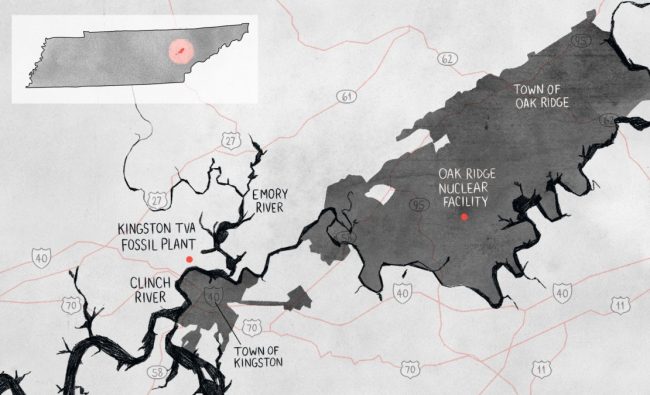
A Legacy of Contamination, How the Kingston coal ash spill unearthed a nuclear nightmare, Grist By Austyn Gaffney on Dec  15, 2020 This story was published in partnership with the Daily Yonder.
In 2009, App Thacker was hired to run a dredge along the Emory River in eastern Tennessee. Picture an industrialized fleet modeled after Huck Finn’s raft: Nicknamed Adelyn, Kylee, and Shirley, the blue, flat-bottomed boats used mechanical arms called cutterheads to dig up riverbeds and siphon the excavated sediment into shoreline canals. The largest dredge, a two-story behemoth called the Sandpiper, had pipes wide enough to swallow a push lawnmower. Smaller dredges like Thacker’s scuttled behind it, scooping up excess muck like fish skimming a whale’s corpse. They all had the same directive: Remove the thick grey sludge that clogged the Emory.
The sludge was coal ash, the waste leftover when coal is burned to generate electricity. Twelve years ago this month, more than a billion gallons of wet ash burst from a holding pond monitored by the region’s major utility, the Tennessee Valley Authority, or TVA. Thacker, a heavy machinery operator with Knoxville’s 917 union, became one of hundreds of people that TVA contractors hired to clean up the spill. For about four years, Thacker spent every afternoon driving 35 miles from his home to arrive in time for his 5 p.m. shift, just as the makeshift overhead lights illuminating the canals of ash flicked on.
Dredging at night was hard work. The pump inside the dredge clogged repeatedly, so Thacker took off his shirt and entered water up to his armpits to remove rocks, tree limbs, tires, and other debris, sometimes in below-freezing temperatures. Soon, ringworm-like sores crested along his arms, interwoven with his fading red and blue tattoos. Thacker’s supervisors gave him a cream for the skin lesions, and he began wearing long black cow-birthing gloves while he unclogged pumps. While Thacker knew that the water was contaminated — that was the point of the dredging — he felt relatively safe. After all, TVA was one of the oldest and most respected employers in the state, with a sterling reputation for worker safety.
Then, one night, the dredging stopped.
Sometime between December 2009 and January 2010, roughly halfway through the final, 500-foot-wide section of the Emory designated for cleanup, operators turned off the pumps that sucked the ash from the river. For a multi-billion dollar remediation project, this order was unprecedented. The dredges had been operating 24/7 in an effort to clean up the disaster area as quickly as possible, removing roughly 3,000 cubic yards of material — almost enough to fill an Olympic-sized swimming pool — each day. But official reports from TVA show that the dredging of the Emory encountered unusually high levels of contamination: Sediment samples showed that mercury levels were three times higher in the river than they were in coal ash from the holding pond that caused the disaster.
Then there was the nuclear waste. Continue reading
The Conservative Argument Against Nuclear Power in Japan

It has been said that nuclear power stations are like nuclear weapons directed at your own country. I couldn’t agree more.
Getting rid of these “nuclear weapons directed at our own country” will not require huge defense spending or difficult diplomatic negotiations. All that is required is the ability to look square at the facts, and a conservative mindset determined to protect our rich and productive land and pass it on to the next generation.
Higuchi Hideak, Apr 15, 2025, https://www.nippon.com/en/in-depth/d01111/
A Devastating Loss of Territory
“Conservatism is essentially realism. A conservatism that refuses to confront reality is as worthless as a progressivism without ideals.”
This is how I opened my Hoshu no tame no genpatsu nyūmon (Nuclear Power: An Introduction for Conservatives), which came out last summer. In the book, I tried to bring attention to the contradictions inherent in the policies of the Liberal Democratic Party: a party that claims to support conservative values and uphold the ideals of patriotism but nevertheless advocates that Japan should continue or increase its reliance on nuclear power, even in the aftermath of the Fukushima disaster.
In the book, I made three main points. First, nuclear power is fundamentally incompatible with conservatism and patriotism. Second, nuclear power stations are inherently vulnerable to earthquakes, for structural reasons. And third, nuclear power stations are also vulnerable from a national security perspective.
The disaster at the Tokyo Electric Power Company’s Fukushima Daiichi Nuclear Power Station in March 2011 led to the evacuation of more than 150,000 people. More than 20,000 are still not able to return to their homes even today. And the state of emergency declared shortly after the disaster has still not been lifted, 14 years later.
In Fukushima Prefecture, evacuation orders are still in effect across more than 300 square kilometers, in what the government has designated as “closed to inhabitation indefinitely.” This is in spite of the fact that the annual safety limits for radiation exposure among the general population were lifted from 1 millisievert to 20 millisieverts. An area of more than 300 square kilometers—equivalent to the size of Nagoya, one of Japan’s key economic centers—is still effectively under evacuation orders. The country has effectively lost territory 50 times larger than the Senkaku Islands in Okinawa Prefecture, controversially claimed by China and the frequent focus of national security anxiety. As if this weren’t bad enough, more than 300 young people have been diagnosed with childhood thyroid cancer, a condition that would normally be expected to affect only around one in a million. Many of these have been serious cases requiring invasive surgery.
When I sat as presiding judge in the case brought before the Fukui District Court to stop the planned reactivation of the Ōi Nuclear Power Station, operated by the Kansai Electric Power Company, the argument put forward by the Liberal Democratic Party (then newly returned to power) and the business lobby was that shutting down nuclear plants would force Japan to import vast amounts of oil and natural gas to fuel thermal power stations. This would result in a massive outflow of the nation’s wealth and lead to national impoverishment.
On May 21, 2014, the court handed down its verdict. Even if shutting down the plant did lead to a trade deficit, the court rejected the idea that this would represent a loss of national wealth. True national wealth, the court held, consists of rich and productive land—a place where people can put down roots and make a living. The risk of losing this, and being unable to recover it, would represent a more serious loss of national wealth. Compare the arguments of the LDP and economic business lobby with the decision of the Fukui District Court. Which represents true conservatism, unafraid to look squarely at the facts about nuclear disasters? Which best represents the true spirit of patriotism?
Disaster Caused by a Power Failure
Let’s consider a few of the characteristics of nuclear power stations. First, they must be continuously monitored and supplied with a constant flow of water to cool the reactor. Second, if the supply of electricity or water is interrupted, there is the risk of an immediate meltdown. A serious accident could potentially mean the end of Japan as a nation.
The accident at Fukushima Daiichi came perilously close to rendering much of the eastern part of Japan uninhabitable. Yoshida Masao, the director in charge at the time, feared that radioactive fallout would contaminate all of eastern Japan when it looked as though the containment building at the Unit 2 reactor would rupture after venting became impossible. The chair of the Japan Atomic Energy Commission also expected it would be necessary to evacuate the population from a 250-kilometer radius of the plant, including Tokyo.
The accident at Fukushima did not happen because the reactor was damaged directly by the earthquake or tsunami. The initial earthquake interrupted the external supply of electricity, and the tsunami that followed cut off the emergency supply as well. Essentially, a power failure made it impossible to cool the reactor, and this was enough to trigger a catastrophe.
These characteristics mean that the resilience of nuclear power stations depends not on how physically robust the reactors and containment buildings are, but on the dependability of the electricity supplied to them. Nuclear power plants in Japan are designed to be able to withstand seismic activity between 600 to 1,000 gals (a gal being a unit of acceleration used in gravimetry to measure the local impact of an earthquake). But earthquakes over 1,000 gals are not unusual in Japan, and some have exceeded 4,000 gals. For this reason, some construction companies build housing that is designed to withstand seismic shocks up to 5,000 gals.
There are only 17 fully constructed nuclear power stations across the country. Six earthquakes exceeding the safety standards have already occurred at four of these: Onagawa, Shika, Kashiwazaki-Kariwa, and Fukushima Daiichi (twice each at Onagawa and Shika). Japan experiences more earthquakes than any other country on earth. Although the country accounts for just 0.3% of the world’s landmass, more than 10% of all the world’s earthquakes happen here. Despite the inherent dangers, there are 54 nuclear reactors along the coasts, around 10% of the world’s total.
Since it is impossible to forecast what scale of earthquake might hit a given site in an earthquake-prone country like Japan, construction companies operate on the principle that houses should be able to withstand seismic events equivalent to the strongest earthquake on record in the past.
The government ratified the Seventh Strategic Energy Plan at a cabinet meeting in February this year. This latest iteration of the plan removed references to an ambition to reduce the country’s dependence on nuclear power as much as possible, and signaled a clear intention to restore nuclear power to a more prominent position in the country’s energy strategy. Despite this, the seismic planning standards for nuclear power stations still assume that it is possible to accurately predict the maximum size of any earthquake that will hit in the future by analyzing past seismic data and running a site assessment of local geotechnical conditions. Whose position demonstrates better scientific judgement and a more realistic assessment of the facts—the government’s or the construction companies’?
Why Europe’s Biggest Nuclear Power Plant Fell into the Hands of the Enemy
TEPCO was a huge company, with annual revenue of around ¥5 trillion and a profit margin of 5%, meaning the company was making ¥250 billion every year. But the economic damages from the Fukushima accident came to at least ¥25 trillion, equivalent to 100 years in revenue for the company. What can we say about an approach to electricity generation in which a single accident can wipe out a century’s worth of revenue and essentially bankrupt a huge company like TEPCO? It is an energy source that is not just cost-ineffective but unsustainable.
For example, it is estimated that if an accident on a similar scale happened at the Tōkai Daini Nuclear Power Station in Ibaraki Prefecture, it would cause damage worth ¥660 trillion (compared to the national government budget of ¥110 trillion). As head of the Fukushima plant, Yoshida was resigned to losing the containment building of the unit 2 reactor to an explosion. He was saved by a “miracle” when a weakness somewhere in the structure of the building allowed pressure to escape and a rupture was avoided. Without this lucky intervention, it is estimated that the economic damages might have reached ¥2.4 quadrillion.
These figures make clear that the problem of nuclear power is not merely an energy issue. It has profound implications for national survival, and should be regarded as a national security priority. Russia’s war in Ukraine has provided a stark reminder of the seriousness of this threat. The Zaporizhzhia station on the Dnieper River is the largest nuclear power plant in Europe. A threat from Russia to attack it was enough to persuade Ukraine to hand over the plant to Russian control. If the plant really had been attacked, it might have caused a crisis with the potential to lay waste to large parts of Eastern Europe.
It has been said that nuclear power stations are like nuclear weapons directed at your own country. I couldn’t agree more. And in Japan we have 54 of these reactors bristling our shores, all but unprotected against earthquakes, potential enemies, and terrorist attacks. The LDP government mocks those who oppose Japan’s holding the offensive capability to attack enemy bases and argue for an exclusively defense-oriented posture as indulging in “flower garden” thinking. At the same time, the party is blind to the fact that nuclear power stations represent this country’s biggest national defense vulnerability.
Getting rid of these “nuclear weapons directed at our own country” will not require huge defense spending or difficult diplomatic negotiations. All that is required is the ability to look square at the facts, and a conservative mindset determined to protect our rich and productive land and pass it on to the next generation.
In my previous books and articles, I addressed the legal issues involved in nuclear power. In my Nuclear Power: An Introduction for Conservatives, I made clear that my own political stance is conservative. I was prepared for a backlash from progressives, who make up the bulk of the antinuclear movement, but in fact I received no pushback from that quarter all. In fact, I was taken aback by the resounding support I received.
Most of the criticism came from supposed conservatives who were apparently determined to discredit my sincere intentions and grumbled that it was unseemly for a former judge to be sticking his nose into politics. On Amazon, my reviews were flooded with apparently coordinated personal attacks and slander. But I am still convinced that true and fair-minded conservatives will understand my true intentions.
Geologists acknowledge that it is simply not possible to accurately predict earthquakes with today’s science. A huge earthquake could strike tomorrow, causing a catastrophe at one of the nation’s nuclear power stations that could wipe out or render inhabitable large parts of the country. My aim is simply to make as many people as possible aware of this terrifying fact.
(Originally written in Japanese. )
How and where is nuclear waste stored in the US?

Gerald Frankel , Distinguished Professor of Materials Science and Engineering, The Ohio State University, April 14, 2025, https://theconversation.com/how-and-where-is-nuclear-waste-stored-in-the-us-252475
Around the U.S., about 90,000 tons of nuclear waste is stored at over 100 sites in 39 states, in a range of different structures and containers.
For decades, the nation has been trying to send it all to one secure location.
A 1987 federal law named Yucca Mountain, in Nevada, as a permanent disposal site for nuclear waste – but political and legal challenges led to construction delays. Work on the site had barely started before Congress ended the project’s funding altogether in 2011.
The 94 nuclear reactors currently operating at 54 power plants continue to generate more radioactive waste. Public and commercial interest in nuclear power is rising because of concerns regarding emissions from fossil fuel power plants and the possibility of new applications for smaller-scale nuclear plants to power data centers and manufacturing. This renewed interest gives new urgency to the effort to find a place to put the waste.
In March 2025, the U.S. Supreme Court heard arguments related to the effort to find a temporary storage location for the nation’s nuclear waste – a ruling is expected by late June. No matter the outcome, the decades-long struggle to find a permanent place to dispose of nuclear waste will probably continue for many years to come.
I am a scholar who specializes in corrosion; one focus of my work has been containing nuclear waste during temporary storage and permanent disposal. There are generally two forms of significantly radioactive waste in the U.S.: waste from making nuclear weapons during the Cold War, and waste from generating electricity at nuclear power plants. There are also small amounts of other radioactive waste, such as that associated with medical treatments.
Waste from weapons manufacturing
Remnants of the chemical processing of radioactive material needed to manufacture nuclear weapons, often called “defense waste,” will eventually be melted along with glass, with the resulting material poured into stainless steel containers. These canisters are 10 feet tall and 2 feet in diameter, weighing approximately 5,000 pounds when filled.
For now, though, most of it is stored in underground steel tanks, primarily at Hanford, Washington, and Savannah River, South Carolina, key sites in U.S. nuclear weapons development. At Savannah River, some of the waste has already been processed with glass, but much of it remains untreated.
At both of those locations, some of the radioactive waste has already leaked into the soil beneath the tanks, though officials have said there is no danger to human health. Most of the current efforts to contain the waste focus on protecting the tanks from corrosion and cracking to prevent further leakage.
Waste from electricity generation
The vast majority of nuclear waste in the U.S. is spent nuclear fuel from commercial nuclear power plants.
Before it is used, nuclear fuel exists as uranium oxide pellets that are sealed within zirconium tubes, which are themselves bundled together. These bundles of fuel rods are about 12 to 16 feet long and about 5 to 8 inches in diameter. In a nuclear reactor, the fission reactions fueled by the uranium in those rods emit heat that is used to create hot water or steam to drive turbines and generate electricity.
After about three to five years, the fission reactions in a given bundle of fuel slow down significantly, even though the material remains highly radioactive. The spent fuel bundles are removed from the reactor and moved elsewhere on the power plant’s property, where they are placed into a massive pool of water to cool them down.
After about five years, the fuel bundles are removed, dried and sealed in welded stainless steel canisters. These canisters are still radioactive and thermally hot, so they are stored outdoors in concrete vaults that sit on concrete pads, also on the power plant’s property. These vaults have vents to ensure air flows past the canisters to continue cooling them.
As of December 2024, there were over 315,000 bundles of spent nuclear fuel rods in the U.S., and over 3,800 dry storage casks in concrete vaults above ground, located at current and former power plants across the country.
Even reactors that have been decommissioned and demolished still have concrete vaults storing radioactive waste, which must be secured and maintained by the power company that owned the nuclear plant.
The threat of water
One threat to these storage methods is corrosion.
Because they need water to both transfer nuclear energy into electricity and to cool the reactor, nuclear power plants are always located alongside sources of water.
In the U.S., nine are within two miles of the ocean, which poses a particular threat to the waste containers. As waves break on the coastline, saltwater is sprayed into the air as particles. When those salt and water particles settle on metal surfaces, they can cause corrosion, which is why it’s common to see heavily corroded structures near the ocean.
At nuclear waste storage locations near the ocean, that salt spray can settle on the steel canisters. Generally, stainless steel is resistant to corrosion, which you can see in the shiny pots and pans in many Americans’ kitchens. But in certain circumstances, localized pits and cracks can form on stainless steel surfaces.
In recent years, the U.S. Department of Energy has funded research, including my own, into the potential dangers of this type of corrosion. The general findings are that stainless steel canisters could pit or crack when stored near a seashore. But a radioactive leak would require not only corrosion of the container but also of the zirconium rods and of the fuel inside them. So it is unlikely that this type of corrosion would result in the release of radioactivity.
A long way off
A more permanent solution is likely years, or decades, away.
Not only must a long-term site be geologically suitable to store nuclear waste for thousands of years, but it must also be politically palatable to the American people. In addition, there will be many challenges associated with transporting the waste, in its containers, by road or rail, from reactors across the country to wherever that permanent site ultimately is.
Perhaps there will be a temporary site whose location passes muster with the Supreme Court. But in the meantime, the waste will stay where it is.
‘We thought it was the end of the world’: How the US dropped four nuclear bombs on Spain in 1966
Myles Burke https://www.bbc.com/culture/article/20250404-how-the-us-dropped-nuclear-bombs-on-spain-in-1966 7 Apr 25
In 1966, the remote Spanish village of Palomares found that the “nuclear age had fallen on them from a clear blue sky”. Two years after the terrifying accident, BBC reporter Chris Brasher went to find what happened when the US lost a hydrogen bomb.
On 7 April 1966, almost 60 years ago this week, a missing nuclear weapon for which the US military had been desperately searching for 80 days was finally found. The warhead, with an explosive power 100 times that of the bomb dropped on Hiroshima, was carefully winched from a depth of 2,850ft (869m) out of the Mediterranean Sea and delicately lowered onto the USS Petrel. Once it was on board, officers painstakingly cut into the thermonuclear device’s casing to disarm it. It was only then that everyone could breathe a sigh of relief – the last of the four hydrogen bombs that the US had accidentally dropped on Spain had been recovered.
“This was not the first accident involving nuclear weapons,” said BBC reporter Chris Brasher when he reported from the scene in 1968. “The Pentagon lists at least nine previous accidents to aircraft carrying hydrogen bombs. But this was the first accident on foreign soil, the first to involve civilians and the first to excite the attention of the world.”
This terrifying situation had come about because of a US operation code-named Chrome Dome. At the beginning of the 1960s, the US had developed a project to deter its Cold War rival, the Soviet Union, from launching a pre-emptive strike. A patrol of nuclear-armed B-52 bombers would continuously criss-cross the skies, primed to attack Moscow at a moment’s notice. But to stay airborne on these long looping routes, the planes needed to refuel while in flight.
On 17 January 1966, one such bomber was flying at a height of 31,000ft (9.5km) over the Almería region of southern Spain, and attempted a routine air-to-air refuelling with a KC-135 tanker plane. “I believe what happened was the bomber was closing at a too-high rate of closure speed and he didn’t stabilise his position,” US Maj Gen Delmar Wilson, the man in charge of dealing with the catastrophic accident, told Brasher, “with the result that they got too close and collided.”
The B-52 bomber’s impact with the refuelling plane tore it open, igniting the jet fuel the KC-135 was carrying and killing all four of the crew onboard. The ensuing explosion also killed two men in the B-52’s tail section. A third managed to eject, but died when his parachute did not open. The other four members of the bomber’s crew successfully bailed out of their burning plane before it broke apart and fell to earth, raining down both flaming aircraft fragments and its lethal thermonuclear cargo onto the remote Spanish village of Palomares.
Everyone kept talking about a ‘broken arrow’. I learnt then that ‘broken arrow’ was the code word for a nuclear accident – Capt Joe Ramirez
The huge fireball was seen a mile away. Thankfully, it did not trigger a nuclear explosion. The bomber’s warheads were not armed and had built-in safeguards to prevent an unintended atomic chain reaction. But the thermonuclear devices did have explosives surrounding their plutonium cores as part of the triggering mechanism. In the event of an accident, the bombs had parachutes attached to them designed to cushion the impact on landing and prevent radioactive contamination. And indeed, one undetonated bomb did land safely in a riverbed and was recovered intact the following day. Unfortunately, two of the plummeting nuclear bombs’ parachutes failed to open.
That morning, Spanish farmer Pedro Alarcón was walking to his house with his grandchildren when one of the nuclear bombs landed in his tomato field and blew apart on impact. “We were blown flat. The children started to cry. I was paralysed with fear. A stone hit me in the stomach, I thought I’d been killed. I lay there feeling like death with the children crying,” he told the BBC in 1968.
Devastation and chaos
The other hydrogen bomb also exploded when it hit the ground near a cemetery. These dual blasts created vast craters and scattered highly toxic, radioactive plutonium dust across several hundred acres. Burning aircraft debris also showered the Spanish village. “I was crying and running about,” a villager called Señora Flores told the BBC in 1968. “My little girl was crying, ‘Mama, Mama, look at our house, it is burning.’ Because of all the smoke I thought what she said must be true. There were a lot of stones and debris falling around us. I thought it would hit us. It was this terrific explosion. We thought it was the end of the world.”
Once the news that the bomber had come down with nuclear weapons aboard reached US military command, a huge operation was launched. At the time of the disaster, Capt Joe Ramirez was an US Air Force lawyer stationed in Madrid. “There were a lot of people talking, there was a lot of excitement in the conference room. Everyone kept talking about a ‘broken arrow’. I learnt then that ‘broken arrow’ was the code word for a nuclear accident,” he told BBC’s Witness History in 2011.
US military personnel were scrambled to the area by helicopter. When Capt Ramirez arrived in Palomares, he immediately saw the devastation and chaos wrought by the accident. Huge pieces of smoking wreckage were strewn all over the area – a large part of the burning B-52 bomber had landed in the school’s yard. “It’s a small village but there were people scrambling in different directions. I could see smouldering debris, I could see some fires.”
Despite the carnage, miraculously no one in the village was killed. “Nearly 100 tonnes of flaming debris had fallen on the village but not even a chicken had died,” said Brasher. A local school teacher and doctor climbed up to the fire-scarred hillside to retrieve the remains of the US airmen who had been killed. “Later still, they sorted the pieces and the limbs into five coffins, an act that was to cause a certain amount of bureaucratic difficulty when the Americans came to claim only four bodies from that hillside,” said Brasher.
Three of the B-52 crew who managed to eject landed in the Mediterranean several miles off the coast and were rescued by local fishing boats within an hour of the accident. The fourth, the B-52 radar-navigator, ejected through the plane’s explosion, which left him badly burned, and was unable to separate himself from his ejection seat. Despite this, he managed to open his parachute and was found alive near the village and taken to hospital.
However, this still left the problem of locating the plane’s deadly nuclear payload. “My main concern was to recover those bombs, that was number-one priority,” Gen Wilson told the BBC in 1968.
One of our nuclear bombs is missing
“The first night, the Guardia Civil [the Spanish national police force] had come to the little bar in Palomares, and that was about the only place that had electricity. And they had reported what they considered to be a bomb, so we immediately despatched some of our people to this riverbed which is not far from the centre of town, and, in fact, it was a bomb, so we placed a guard on that. And then the next morning, at first daylight, we started conducting our search, and I believe it was something in the order of 10am or 11am the following morning, we located two other bombs.”
This accounted for three of the nuclear bombs, but there was still one missing. By the next day, trucks filled with US troops had been sent from nearby bases, with the beach in Palomares becoming a base for some 700 US airmen and scientists urgently trying to contain any radioactive contamination and locate the fourth warhead.
“The first thing that you could see as the search really got underway in earnest was Air Force personnel linking up hand-by-hand and 40 or 50 people in a line. They would have designated search areas. There were some people with Geiger counters who started arriving, and so they started marking off the areas which were contaminated,” said Capt Ramirez in 2011. When US personnel registered an area contaminated with radiation, they would scrape up the first three inches of topsoil and seal it in barrels to be shipped back to the US. Some 1,400 tonnes of irradiated soil ended up being sent to a storage facility in South Carolina.
Both the US and Spain, which at the time was under the brutal rule of Francisco Franco’s military dictatorship, were keen to downplay the devastating accident. Franco was especially worried that radiation fears would hurt Spain’s tourism industry, a major source of revenue for his regime. In an effort to reassure the local population and the wider world that there was no danger, the US Ambassador to Spain, Angier Biddle Duke, would end up taking a swim in the sea off Palomares coast in front of the international press just weeks after the accident.
But despite hundreds of US personnel conducting an intensive and meticulous search of the surrounding area for a week, they still couldn’t find the fourth bomb. Then Capt Ramirez spoke to a local fisherman who had helped rescue some of the surviving airmen who had splashed down in the sea. The fisherman kept apologising to Capt Ramirez for not being able to save one of the US flyers, whom he thought he had witnessed drifting down into the depths.
Capt Ramirez realised that the fisherman could have actually seen the missing nuclear bomb. “All the bodies had been accounted for, I knew that,” he said. The search then quickly shifted to the Mediterranean Sea, with the US Navy mobilising a flotilla of more than 30 ships, including mine-sweepers and submersibles, to scour the seabed. The exploration of miles of ocean floor was both technically complicated and a very slow process, but after weeks of exhaustive searching, a newly developed deep-diving vessel, Alvin, finally located the missing bomb in an underwater trench.
Nearly four months after it was first lost, the warhead was finally made safe and back in US hands. The next day, despite the secrecy with which the US military had surrounding its nuclear arsenal, it took the unusual step of showing the bomb to the world’s press. Ambassador Duke reasoned that unless people saw the bomb for themselves, they would never feel certain that it had actually been recovered.
1 This Month


No Nuclear in Cwm Llynfi! Stop the nuclear power station near Maesteg.


4 August – WEBINAR – Hiroshima & Nagasaki: Nuclear Bombs Never Again
Tuesday, Aug. 4 at 5 pm PT / 8 pm ET.
Aug 5, 2026 10:00 AM in Australia/Melbourne
Join the Nuclear Bombs Never Again webinar on August 4th at 5pm Pacific Time / 8pm Eastern Time / 9am Japan Standard Time.
Cross generational voices at the intersection of Japan-Korea-US policy and militarization will share their lived experiences, nuclear impacts in these contexts, anti-war strategies, and actions you can take to advocate for a world with Nuclear Bombs Never Again. This 75-minute event is co-hosted by WILPF US and Korea Peace Now.

22,000+ miles voyaging for nuclear disarmament
and a radiation-free environment https://vfpgoldenruleproject.org/
To see nuclear-related stories in greater depth and intensity – go to https://nuclearinformation.wordpress.com
-
Archives
- July 2026 (332)
- June 2026 (287)
- May 2026 (306)
- April 2026 (356)
- March 2026 (251)
- February 2026 (267)
- January 2026 (308)
- December 2025 (358)
- November 2025 (359)
- October 2025 (375)
- September 2025 (257)
- August 2025 (319)
-
Categories
- 1
- 1 NUCLEAR ISSUES
- business and costs
- climate change
- culture and arts
- ENERGY
- environment
- health
- history
- indigenous issues
- Legal
- marketing of nuclear
- media
- opposition to nuclear
- PERSONAL STORIES
- politics
- politics international
- Religion and ethics
- safety
- secrets,lies and civil liberties
- spinbuster
- technology
- Uranium
- wastes
- weapons and war
- Women
- 2 WORLD
- ACTION
- AFRICA
- Atrocities
- AUSTRALIA
- Christina's notes
- Christina's themes
- culture and arts
- Events
- Fuk 2022
- Fuk 2023
- Fukushima 2017
- Fukushima 2018
- fukushima 2019
- Fukushima 2020
- Fukushima 2021
- general
- global warming
- Humour (God we need it)
- Nuclear
- RARE EARTHS
- Reference
- resources – print
- Resources -audiovicual
- Weekly Newsletter
- World
- World Nuclear
- YouTube
-
RSS
Entries RSS
Comments RSS
 nuclear-news
