High Iodine distribution, low intake among children after Fukushima nuclear accident
https://www.healio.com/endocrinology/thyroid/news/in-the-journals/%7B33ecf315-c68e-474b-aeda-81c5271d2371%7D/high-iodine-distribution-low-intake-among-children-after-fukushima-nuclear-accident Despite a high distribution rate of stable iodine after the 2011 Fukushima nuclear accident in Japan, only 63.5% of parents reported children took the tablets, with many citing safety concerns in questionnaires, according to findings published in The Journal of Clinical Endocrinology & Metabolism.
The intake of stable iodine after a nuclear emergency is a key strategy for preventing childhood thyroid cancer, along with evacuation and other measures, Yoshitaka Nishikawa, MD, a physician and medical researcher in the department of internal medicine at Hirata Central Hospital in Fukushima, Japan, and colleagues wrote in the study background. The timing of iodine administration is optimally between 24 hours before and up to 2 hours after the expected onset of exposure, they noted; however, iodine is still reasonably effective when taken up to 8 hours later. To date, there is limited information about the acceptability and feasibility of implementation of iodine distribution in actual cases, they wrote.
“To prepare for future nuclear emergencies, investigations of the operational issues in an actual case are needed,” the researchers wrote.
In a retrospective, observational study, Nishikawa and colleagues analyzed data from 961 children from Miharu, a town in Fukushima prefecture, who underwent biennial thyroid screenings at Hirata Central Hospital between August and November 2017 (median age at time of accident, 5 years). In addition to the Fukushima Health Management Survey, Miharu has continued thyroid screenings for all primary and secondary school students.
In Miharu, health care professionals distributed stable iodine to 3,134 households (94.9% distribution rate) after explosions at the Fukushima nuclear plant caused by the 2011 earthquake in eastern Japan, along with instructions provided by the local government. Screening and questionnaire records included age of participants at the time of the nuclear accident, sex, region of residence before the accident, whether the participant was evacuated, whether the child and parents took stable iodine orally after the accident and dietary habits, including iodine intake. Researchers used logistic regression models to identify factors associated with stable iodine intake.
Within the cohort, 610 children (63.5%) had taken stable iodine, according to questionnaire data.
Researchers found that children were more likely to take stable iodine provided after the accident if their parents took stable iodine (OR = 61; 95% CI, 37.9-102.9). Compared with preschool and school-aged children, infants (aged 2 years or younger) were less likely to take stable iodine (OR = 0.21; 95% CI, 0.11-0.36).
In assessing questionnaire data from parents who reported children did not take stable iodine (n = 351), concern about safety was the most frequent reason provided (n = 164; 46.2%), followed by evacuation to other areas, no national or prefectural instruction and iodine not being delivered.
“Qualitative analysis revealed that concern about safety was the major reason for avoiding intake,” the researchers wrote. “Other issues related to distribution methods, information about the effects and adverse events and instruction about intake. In future nuclear disasters, it would be important to explain to both children and parents the effects and adverse effects of iodine intake and to provide detailed instructions about the intake of iodine by infants.” – by Regina Schaffer
Disclosures: The authors report no relevant financial disclosures.
Britain’s nuclear nightmare -the Thermal Oxide Reprocessing Plant
 UK’s dream is now its nuclear nightmare https://climatenewsnetwork.net/uks-dream-is-now-its-nuclear-nightmare/?fbclid=IwAR3CEunSXXOxdK_-N8Ka9kwpCMzvHFXNkZf23VGjd6oFuDecember 14, 2018, by Paul Brown
Nobody knows what to do with a vast uranium and plutonium stockpile built up in the UK by reprocessing spent fuel. It is now a nuclear nightmare.
LONDON, 14 December, 2018 − Thirty years ago it seemed like a dream: now it is a nuclear nightmare. A project presented to the world in the 1990s by the UK government as a £2.85 billion triumph of British engineering, capable of recycling thousands of tons of spent nuclear fuel into reusable uranium and plutonium is shutting down – with its role still controversial.
Launched amid fears of future uranium shortages and plans to use the plutonium produced from the plant to feed a generation of fast breeder reactors, the Thermal Oxide Reprocessing Plant, known as THORP, was thought to herald a rapid expansion of the industry.
In the event there were no uranium shortages, fast breeder reactors could not be made to work, and nuclear new build of all kinds stalled. Despite this THORP continued as if nothing had happened, recycling thousands of tons of uranium and producing 56 tons of plutonium that no one wants. The plutonium, once the world’s most valuable commodity, is now classed in Britain as “an asset of zero value.” Continue reading
Amazon planning to run a “global brain” for the Pentagon.
To understand the implications of JEDI, we must realize that the information being gathered and sorted will inevitably be used for the targeting and killing of not only opposing government-based military forces, but also nongovernmental individuals and groups who are viewed as political or potential military threats by the US.
The transfer of a massive amount of military information into a privately owned and built cloud, as will happen with the creation of JEDI, raises the possibility that the owner or owners of that cloud will — because of their knowledge of the cloud structure, capabilities and content — become more powerful than military and elected officials.
 “Alexa, Drop a Bomb”: Amazon Wants in on US Warfare, Nick Mottern, Truthout https://truthout.org/articles/alexa-drop-a-bomb-amazon-wants-in-on-us-warfare/December 16, 2018
Amazon is seeking to build a global “brain” for the Pentagon called JEDI, a weapon of unprecedented surveillance and killing power, a profoundly aggressive weapon that should not be allowed to be created.
Founded in 1994 as an online book seller, Amazon is now the world’s largest online retailer, with more than 300 million customers worldwide, and net sales of $178 billion in 2017.
Amazon has built a vast, globally distributed data storage capacity and sophisticated artificial intelligence programs to propel its retail business that it hopes to use to win a $10 billion Pentagon contract to create the aforementioned “brain” that goes by the project name Joint Enterprise Defense Infrastructure, a moniker obviously concocted to yield the Star Wars acronym — JEDI.
As of the October 12, 2018, deadline for submitting proposals for JEDI, Amazon is the betting favorite for the contract, which will go to just one bidder, in spite of protests by competitors, chief among them Microsoft and IBM. The Pentagon appears likely to select a winner for the contract in 2019.
Jedi Powers? Continue reading
Radioactive reindeer in Finland and Norway
Rudolph the radioactive reindeer https://beyondnuclearinternational.org/2018/12/16/rudolph-the-radioactive-reindeer/ December 16, 2018
Dosed by Chernobyl and atomic tests, reindeer and their herders are carrying a heavy nuclear burden, By Linda Pentz GunterFallout from Soviet atomic bomb tests over the Arctic Ocean, compounded by the 1986 Chernobyl nuclear power plant explosion, have left reindeer too radioactive to eat, even today. That may be good news for the reindeer, sort of. But it’s bad news for the indigenous Laplanders in Finland and Sami herders in Norway, who carry high levels of radiation in their own bodies as well as in the reindeer on which they depend for sustenance and sales.
Reindeer carry heavy radioactive doses, mainly of cesium-137, because they devour lichen, moss and fungi, which bioaccumulate radioactive deposits from fallout. Norway’s radioactive contamination is primarily from Chernobyl, made worse because it was snowing heavily at the time of the April 26 accident.
The Sami story is beautifully explained in this stunning photo essay by Amos Chapple and Wojtek Grojec for Radio Free Europe/Radio Liberty.
As the essay describes it, despite the length of time since the Chernobyl disaster, the fallout is a nasty gift that keeps on giving. “In 2014, there was a huge spike in radiation levels that scientists put down to a bumper season for mushrooms. Hundreds of Norwegian reindeer intended for slaughter had to be released back into the wild.” Levels apparently shot from 1,500 becquerels per kilogram to 8,200.
A video of Chapple and Grojec’s work, on Tech Insider, also explains the impact of cesium-137 fallout on reindeer and their herders. [0n originall]
Unfortunately, Norway’s “allowable” radiation standards are far higher than in other parts of Europe, at 3,000 becquerels per kilogram of food compared to the EU standard of 600 becquerels. When Chapple and Grojec were compiling their story, the herd they visited was testing at 2,100 becquerels, passing the Norwegian test for “safe”. The authors say that the higher levels were established by the Norwegian government in “response to radiation levels in reindeer that threatened the very existence of the Sami herders.”
This practice of simply moving the radiation goalposts to make dangerous levels safe still goes on today, of course, most notably in Japan. As was pointed out in an earlier story on our site, the Japanese government, eager to show the world that the Fukushima region could quickly be made safe for habitation, simply raised the “allowable” annual exposure rate from 1 millisievert to 20, an entirely unacceptable dose for most people, especially women and children.
In Finland, most of the persistent radiation levels are due to atomic testing during the Cold War. Measurements continue to be taken among the Lapland reindeer herders where cesium levels are ten times higher than in the rest of Finland. Although cesium levels in humans were a shocking 45,000 becquerels per kilo in the 1960s according to one report, they still hover at over 1,000 today.
The reduction in slaughter of reindeer comes with other side effects as well. As far back as 1997, it was already being observed that the increase in reindeer population, leading to “Over-grazing and trampling, is causing more damage to the fragile tundra than some of the world’s most seriously polluting factories,” wrote Geoffrey Lean in The Independent.
Now, as Russia begins using floating nuclear reactors to plunder the Arctic Ocean for oil, the region has been placed under threat of a radioactive catastrophe again. From both an economic and health perspective, neither the reindeer nor their indigenous herders can afford a second assault.
The drying of soils due to climate change is shrinking the world’s water supply
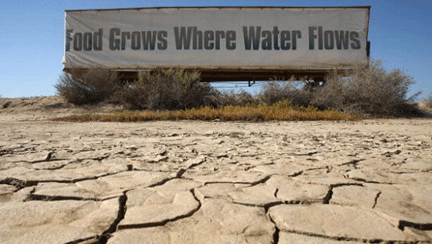
 The long dry: why the world’s water supply is shrinking, EurekAlert, : 13-DEC-2018
Global water supplies are shrinking, even as rainfall is rising; the culprit? The drying of soils due to climate change
UNIVERSITY OF NEW SOUTH WALES A global study has found a paradox: our water supplies are shrinking at the same time as climate change is generating more intense rain. And the culprit is the drying of soils, say researchers, pointing to a world where drought-like conditions will become the new normal, especially in regions that are already dry.
The study – the most exhaustive global analysis of rainfall and rivers – was conducted by a team led by Professor Ashish Sharma at Australia’s University of New South Wales (UNSW) in Sydney. It relied on actual data from 43,000 rainfall stations and 5,300 river monitoring sites in 160 countries, instead of basing its findings on model simulations of a future climate, which can be uncertain and at times questionable
“This is something that has been missed,” said Sharma, an ARC Future Fellow at UNSW’s School of Civil and Environmental Engineering. “We expected rainfall to increase, since warmer air stores more moisture – and that is what climate models predicted too. What we did not expect is that, despite all the extra rain everywhere in the world, is that the large rivers are drying out.
“We believe the cause is the drying of soils in our catchments. Where once these were moist before a storm event – allowing excess rainfall to run-off into rivers – they are now drier and soak up more of the rain, so less water makes it as flow.
“Less water into our rivers means less water for cities and farms. And drier soils means farmers need more water to grow the same crops. Worse, this pattern is repeated all over the world, assuming serious proportions in places that were already dry. It is extremely concerning,” he added.
For every 100 raindrops that fall on land, only 36 drops are ‘blue water’ – the rainfall that enters lakes, rivers and aquifers – and therefore, all the water extracted for human needs. The remaining two thirds of rainfall is mostly retained as soil moisture – known as ‘green water’ – and used by the landscape and the ecosystem.
As warming temperatures cause more water to evaporate from soils, those dry soils are absorbing more of the rainfall when it does occur – leaving less ‘blue water’ for human use.
“It’s a double whammy,” said Sharma. “Less water is ending up where we can store it for later use. At the same time, more rain is overwhelming drainage infrastructure in towns and cities, leading to more urban flooding.”
Professor Mark Hoffman, UNSW’s Dean of Engineering, welcomed Sharma’s research and called for a global conversation about how to deal with this unfolding scenario, especially in Australia, which is already the driest inhabited continent (apart from Antarctica).
“It’s clear there’s no simple fix, so we need to start preparing for this,” he said. “Climate change keeps delivering us unpleasant surprises. Nevertheless, as engineers, our role is to identify the problem and develop solutions. Knowing the problem is often half the battle, and this study has definitely identified some major ones.”
The findings were made over the past four years, in research that appeared in Nature Geoscience, Geophysical Research Letters, Scientific Reports and, most recently, in the American Geophysical Union’s Water Resources Research………..
Sharma said the answer was not just more dams. “Re-engineering solutions are not simple, they have to be analysed on a region-by-region basis, looking at the costs and the benefits, looking at the change expected into the future, while also studying past projects so mistakes are not repeated. There are no silver bullets. Any large-scale re-engineering project will require significant investment, but the cost of inaction could be monstrous.”
In urban areas, the reverse will be needed: flooding is becoming more common and more intense. Global economic losses from flooding have risen from an average of $500 million a year in the 1980s to around $20 billion annually by 2010; by 2013, this rose to more than US$50 billion. The Intergovernmental Panel on Climate Change expects this to more than double in the next 20 years as extreme storms and rainfall intensify and growing numbers of people move into urban centres.
Adapting to this is possible, but will require large-scale re-engineering of many cities, says Sharma. “Tokyo used to get clobbered by floods every year, but they built a massive underground tank beneath the city that stores the floodwater, and releases it later. You never see floods there now.” https://www.eurekalert.org/pub_releases/2018-12/uons-tld121118.php
How France multiplies hazardous nuclear waste.
 Reporterre 11th Dec 2018 Claiming to ” recycle ” used nuclear fuel, the reprocessing industry complicates the management of waste by increasing the amount of plutonium and hazardous materials.
Most countries engaged in this dead-end way come out … but not France.
According to the official communication, the reprocessing does not generate
contamination, only ” authorized discharges ” . They are spit by the
chimneys, dumped at the end of a pipe buried in the Channel.
According to the official communication, the reprocessing does not generate
contamination, only ” authorized discharges ” . They are spit by the
chimneys, dumped at the end of a pipe buried in the Channel.
In reality, according to the independent expert Mycle Schneider, ” the plant is
authorized to reject 20,000 times more radioactive rare gases and more than
500 times the amount of liquid tritium that only one of the Flamanville
reactors located 15 km away. ” . It contributes ” almost half to the
radiological impact of all civilian nuclear installations in Europe ” .
https://reporterre.net/Comment-la-France-multiplie-les-dechets-nucleaires-dangereux
authorized to reject 20,000 times more radioactive rare gases and more than
500 times the amount of liquid tritium that only one of the Flamanville
reactors located 15 km away. ” . It contributes ” almost half to the
radiological impact of all civilian nuclear installations in Europe ” .
https://reporterre.net/Comment-la-France-multiplie-les-dechets-nucleaires-dangereux
No answer to clean up Washington’s Hanford nuclear site
|
There’s no easy fix for our nuclear past At Washington’s Hanford nuclear site, failing infrastructure and make-do plans as the West prepares for a new round of radioactivity. High Country News, Heather Hansman, Dec. 10, 2018, Fhe Hanford nuclear complex in eastern Washington lies in a green-gold sagebrush steppe, so big you can’t see the edges of it and shimmery in the summer heat. The only landmarks are low-slung buildings on the horizon and ancient sand dunes scrubbed bare when the glaciers melted. There’s almost no trace that this is the biggest nuclear waste dump in the country. The scale of nuclear waste is like that: sprawling out into the metaphysical distance, too big for the human mind to hold. Over the ridge north of us, the Columbia River curves around the site, appearing motionless until you get close and see how much water is pushing past the banks. Over the past year, a series of accidents has put the spotlight on Hanford, its aging infrastructure and the lack of a long-term solution. In May 2017, part of the Plutonium Uranium Extraction Facility, which holds rail cars full of solid waste, collapsed. Later that year, workers tearing down the Plutonium Finishing Plant were contaminated with plutonium and americium particles when an open-air demolition went wrong. In December, others inhaled radioactive dust at the same site, halting work indefinitely. Then, in June of this year, the Department of Energy (DOE), which is responsible for the site, released a proposal to reclassify some of the high-level waste as less toxic, with what’s called a “Waste Incidental to Reprocessing” evaluation, so they could clean it up sooner and more cheaply. “There’s a lot more work to do than there is money to get it accomplished,” Price said. “We’ve really come to a fork in the road.” Across the country, big energy companies are considering a move from coal to nuclear-fueled plants even as sites like Hanford remain mired in many-decades-long cleanups of radioactive landscapes. As the possibility of more waste looms, Hanford has become a flashpoint for people who fear that there’s no safe way to deal with our nuclear legacy. In this era of climate change and large-scale environmental degradation, the site raises the question: Can we ever clean up the mistakes of our past? ………….The Government Accountability Office estimates cleaning up Hanford could total more than $100 billion. Since 1989, when Hanford was first designated as a Superfund site, 889 buildings have been demolished, 18.5 million tons of debris have been put in controlled landfills, and 20 billion gallons of groundwater have been treated. With three decades of work, the scope of the problem has been greatly reduced, but the really toxic stuff is still on site. The groundwater beneath Hanford is never going to be clean enough to drink, thanks to a cocktail of chemicals: strontium-90, which deteriorates marrow in the bones of humans and animals and takes 300 years to break down; hexavalent chromium, which mutates salmon eggs; and technetium-99, which dissolves like salt in water and has a half-life of 211,000 years.
The 586 square miles of sage still hold the 324 Building, home to highly radioactive nuclear containment chambers called hot cells, less than 1,000 feet from the Columbia and right across from the town of Richland, where many of the Hanford workers live. In the central plateau, where the ghostly vitrification plant stands, the Waste Encapsulation Storage Facility holds 1,936 radioactive cesium and strontium capsules currently kept in a glorified swimming pool. If an earthquake were to crack the pool, or the water supply were to run dry, those isotopes, physically hot and linked to bone cancer, would spread quickly.
The knotty heart of the cleanup is the tank farm, on the central plateau, where 56 million gallons of high-level waste — the official term for the long-lived radioactive material leftover from plutonium production — sit in 177 underground tanks. Each tank holds a unique mixture of sludge, solid, supernate liquid and crusty saltcake — a witch’s brew of 1,800 different chemicals that are buzzing, off-gassing and breaking down. Sixty-seven of the 149 carbon-steel single-shell tanks and one of the newer 28 double shells have leaked, but the Energy Department refuses to build new ones, and every year the timeframe for cleanup gets longer.
If you think it’s nearly intractable, that’s because it is,” said Randy Bradbury, the communications director from Washington’s Department of Ecology, one of the three parties that regulates the site. “The biggest mind-boggling thing about it is that we’re all going to be dead before this is cleaned up.” That timespan challenges our decision-making, which is much more suited to responding to accidents than to multigenerational cleanup projects. Philosopher Timothy Morton categorizes nuclear weapons, waste and explosions (not to mention climate change and the longevity of Styrofoam cups) as “hyperobjects” — real-life objects that are too large in time and space for humans to fully grasp. How, then, can we calculate all their costs? The Department of Energy spends billions of dollars on the cleanup each year; next year, it has a $2.4 billion budget. But those billions are barely enough to keep the wheels on, and the Government Accountability Office estimates that the last 15 percent of the cleanup could be as expensive as the first 85 percent, which has already taken 30 years. Maintaining the tanks alone costs $300 million a year, and the minimum amount needed to keep things safe increases as time goes on and infrastructure ages. There currently isn’t enough federal funding to meet cleanup benchmarks, and no money has been allocated for accidents like the tunnel collapse that contaminated workers. At the current rate of funding and cleanup, the DOE’s Richland Office, which manages most of the site, falls another year behind schedule every two years, and the Office of River Protection, which oversees the tank waste, slips back a year every three. This year, President Donald Trump proposed slashing the budget for Hanford cleanup by $230 million. ….….. Cleaning up the tank farm requires moving the waste out of the single-shell tanks, which are each as wide across as a tennis court and can hold up to a million gallons of waste, and into the sturdier double-shell tanks. From there, it will — theoretically — be vitrified, or turned into glass, at the as-yet-unbuilt vitrification plant and then sent to the stalled-out proposed federal nuclear repository at Yucca Mountain in Nevada, or to another long-term storage facility. Every step is excruciatingly complex. The massive tanks were designed to hold radioactive materials, not release them, so any material in these tanks has to come out through a pipe just 12 inches around. Challenges like this have forced Hanford managers to invent every step of the cleanup process, from how to sample the contents to how to keep video cameras from burning up in the radioactive heat inside. It’s a constant guessing game, where the questions of how to store the waste and neuter its effects change endlessly. That’s why in June, the Energy Department proposed reclassifying the remaining high-level waste in the C section of the tank farm as low-activity waste, and then filling the tanks with grout to stabilize the remaining 66,000 gallons of waste, so it could be kept onsite permanently. The department thinks that it would be safe enough to close the door on the tank cleanup once the grout is in, except for long-term monitoring. ……… Some people believe a fast response may be safer than a slower, more thorough response. “Until all the waste is out of those tanks, it’s almost inevitable that more of them will leak,” Bradbury says. The tanks, built starting in the 1940s, were designed to safely contain waste for up to 40 years on the assumption that we’d have figured out a long-term plan by then. But we haven’t, at Hanford or anywhere else. High-level waste was never supposed to stay on site permanently. The waste from the tanks is intended to be vitrified, turned into glass rods, then sent to a federal repository, where it would sit, isolated, forever. But that repository doesn’t exist yet, and it’s possible that it never will. The Nuclear Waste Policy Act of 1987 designated Yucca Mountain, Nevada, as the spot to store the waste. Despite $15 billion spent studying the site, and a growing cost to hold the waste at other sites, plans for Yucca have been in limbo for decades, in large part because of opposition from Nevadans, including former Senate Majority Leader Harry Reid, D-Nev., who don’t want the waste transported through or stored in their state. A bill to reopen Yucca passed the U.S. House of Representatives as recently as May, but failed in the Senate. “We’ve made stuff that will be dangerous for millennia and we deal with it in two-year congressional cycles,” said William Kinsella, a North Carolina State University professor whose research includes nuclear weapons cleanup. “We don’t want to make hasty decisions, but it’s a chokepoint for nuclear constipation.”That has created expensive and dangerous blockages throughout the nuclear waste management system. Without a place to send waste, the cleanup at Hanford has no real endgame. Because of the long-term impossibility, the Hanford Advisory Board — a coalition of tribal members, community volunteers and government workers who advise the agencies that manage the site — is constantly worried that the funds might dry up while the tanks are still full. The fear of slashed funding, and the cleanup’s long delay, is part of what drove the Department of Energy to consider grouting.
But the proposal worries watchdog groups, who are concerned about short-sighted cost-saving measures that could put surrounding communities at lasting risk by keeping 700,00 gallons of waste that’s currently classified as high-level, and that might ultimately leak to the river on site. “What the DOE is proposing is to make the Hanford site a high-level waste repository in all but name,” said Tom Carpenter, executive director of the Hanford Challenge, an environmental advocacy group. “That does not belong in an agriculture zone in a major river system in an earthquake zone.” ……… I ask Price what he thinks the worst-case scenario might be, and he says there are two things that keep him up at night. The first is a dramatic natural disaster, such as an earthquake or a fire, that would damage the fragile infrastructure and cause a massive spill. The site sits at the drought-prone edge of the Cascadia subduction zone, so both are likely. The week before our visit, a fire burned 2,500 acres here, and we can still smell the charred sage. But Price’s second fear is about the equally insidious threat people pose to themselves: A lack of long-term protection and the erosion of care. He says the paradox of Hanford is trying to convince people that the site is safe now, but that in 500 — or 1,000 — years, it might not be, and that we have to make decisions with those unknown risks in mind. “I’m not really worried about today, broad-scale, but I’m worried about the future,”………… Heather Hansman lives in Seattle, where she writes about water and the West. Downriver, her first book, will be out in April. https://www.hcn.org/issues/50.21/nuclear-energy-theres-no-easy-fix-for-our-nuclear-past |
|

New nuclear power plants, prolong existing ones – to solve global warming?
 Evaluation of Nuclear Power as a Proposed Solution to Global Warming, Air Pollution, and Energy Security In 100% Clean, Renewable Energy and Storage for Everything Textbook in Preparation Mark Z. Jacobson December 10, 2018 Contact: Jacobson@stanford.edu; Twitter @mzjacobson
Summary In evaluating solutions to global warming, air pollution, and energy security, two important questions arise are (1) should new nuclear plants be built to help solve these problems, and (2) should existing, aged nuclear plants be kept open as long as possible to help solve these problems? To answer these questions, the main risks associated with nuclear power are examined.
The risks associated with nuclear power can be broken down into two categories: (1) risks affecting its ability to reduce global warming and air pollution and (2) risks affecting its ability to provide energy and environmental (aside from climate and air pollution) security. Risks in the former category include delays between planning and operation, emissions contributing to global warming and outdoor air pollution, and costs. Risks in the latter category include weapons proliferation risk, reactor meltdown risk, radioactive waste risk, and mining cancer and land despoilment risks. These risks are discussed, in this section. Here are additional specific findings:
New nuclear power plants cost over 3.5 times those per kWh of onshore wind or utility solar PV, take 7-14 years longer between planning and operation, and produce 9 to 37 times the emissions per unit electricity generated.
As such, a fix amount of money spent on a new nuclear plant means much less power generation, a much longer wait for power, and much greater emission rate than the same money spent on WWS technologies.
There is no such thing as a zero- or close-to-zero emission nuclear power plant. Even existing plants emit due to the continuous mining and refining of uranium needed for the plant. However, all plants also emit 4.4 g-CO2e/kWh from the water vapor and heat of reaction they release. This contrasts with solar panels and wind turbines, which reduce heat or water vapor fluxes to the air by ~2.2 gCO2e/kWh for a net difference from this factor alone of 6.6 g-CO2e/kWh.
On top of that, because all nuclear reactors take 10-19 years or more between planning and operation vs. 2-5 year for a utility solar or wind plant, nuclear emits 64-102 g-CO2/kWh more over 100 years just due emissions from the background grid waiting for it to come online or be refurbished vs. a wind or solar farm.
Overall, emissions from new nuclear are 78-178 g-CO2/kWh, not close to 0 [detailed chart on original, compares emissions from various technologies]…….
3.3. Why Nuclear Power Represents an Opportunity Cost In evaluating solutions to global warming, air pollution, and energy security, two important questions arise are (1) should new nuclear plants be built to help solve these problems, and (2) should existing, aged nuclear plants be kept open as long as possible to help solve these problems? To answer these questions, the main risks associated with nuclear power are first examined. The risks associated with nuclear power can be broken down into two categories: (1) risks affecting its ability to reduce global warming and air pollution and (2) risks affecting its ability to provide energy and environmental (aside from climate and air pollution) security. Risks in the former category include delays between planning and operation, emissions contributing to global warming and outdoor air pollution, and costs. Risks in the latter category include weapons proliferation risk, reactor meltdown risk, radioactive waste risk, and mining cancer and land despoilment risks. These risks are discussed, in this section. ………..
3.3.1. Risks Affecting the Ability of Nuclear Power to Address Global Warming and Air Pollution The first category of risk associated with nuclear power includes risks affecting nuclear power’s ability to reduce global warming and air pollution. These risks include the long lag time between planning and operating and for refurbishing a nuclear reactor, nuclear’s higher carbon equivalent emissions than WWS technologies, and nuclear’s high costs.
3.3.1.1. Delays Between Planning and Operation and Due to Refurbishing Reactors As discussed in Section 3.2.2, the longer the time lag between the planning and operation of an energy facility, the more the air pollution and climate-relevant emissions from the background electric power grid. Similarly, the longer the time required to refurbish a plant for continued use at the end of its life, the greater the emissions from the background grid while the plant is down. The time between planning and operation of a nuclear power plant includes the time to obtain a site, a construction permit, financing, and insurance; the time between construction permit approval and issue; and the construction time of the plant.
In March 2007, the United States Nuclear Regulatory Commission approved the first request for a site permit in 30 years. This process took 3.5 years. The time to review and approve a construction permit is another 2 years and the time between the construction permit approval and issue is about 0.5 years. Thus, the minimum time for preconstruction approvals (and financing) in the United States is 6 years. An estimated maximum time is 10 years. The time to construct a nuclear reactor depends significantly on regulatory requirements and costs. Although recent nuclear reactor construction times worldwide are often shorter than the 9-year median construction times in the United States since 1970 (Koomey and Hultman, 2007), they still averaged 6.5 years worldwide in 2007 (Ramana, 2009). As such, a reasonable range estimate for construction time is 4-9 years, bringing the overall estimated time between planning and operation of a nuclear power plant worldwide from 10-19 years.
An examination of some recent nuclear plant developments confirms that this range is not only reasonable, but is an underestimate in at least one case. The Olkiluoto 3 reactor in Finland was proposed to the Finnish cabinet in December 2000 to be added to an existing nuclear power plant. Its latest estimated completion date is 2020, giving a planning-to-operation (PTO) time of 20 years. The Hinkley Point nuclear plant was planned starting in 2008 and, as of 2019, has an estimated completion year of 2025-27, giving it a PTO time of 17-19 years. The Vogtle 3 and 4 reactors in Georgia were first proposed in August 2006 to be added to an existing site. The anticipated completion dates are November 2021 and November 2022, respectively, given them PTO times of 15 and 16 years, respectively. The Haiyang 1 and 2 reactors in China were planned starting in 2005. Construction started in 2009 and 2010, respectively. Haiyang 1 was commissioned October 22, 2018 and Haiyang 2 is expected in 2019, giving them construction times of 9 years and PTO times of 13 and 14 years, respectively. The Taishan 1 and 2 reactors in China were bid in 2006. Construction began in 2008. Taishan 1 was connected to the grid in August 2018 and Taishan 2 is not expected to be connected until 2019, giving them construction times of 10 and 11 years and PTO times of 12 and 13 years, respectively. Planning and procurement for four reactors in Ringhals, Sweden started in 1965. One took 10 years, the second took 11 years, the third took 16 years, and the fourth took 18 years to complete. In sum, PTO times for both recent and historic nuclear plants have mostly been in the range of 10-19 years.
…….. 3.3.1.2. Global Warming Relevant Emissions From Nuclear Nuclear power contributes to global warming in the following ways: (1) Emissions from the background grid due to its long planning-to-operation times and refurbishment times (Section 3.2.2.1), (2) its lifecycle emissions (constructing, operating, and decommissioning the plant), (3) emissions from its heat and water vapor emissions (Sections 3.2.2.2 and 3.2.2.3), (4) emissions due to covering soil or clearing vegetation due to it (Section 3.2.2.5), and (5) the risk of emissions due to nuclear weapons proliferation (Section 3.3.2.1). Every one of these categories represents an actual emission or emission risk, yet most of these emissions, except for lifecycle emissions, are incorrectly ignored in virtually all lifecycle studies, thereby distorting the impacts on climate associated with some technologies over others.
Table 3.5 [ on original] summarizes the CO2e emissions from nuclear power from each of the five categories ….
Emissions from the heat and water vapor fluxes from nuclear (totaling 4.4 g-CO2-kWh) alone suggest that during the life of an existing nuclear power plant, nuclear can never be a zero-carbon-equivalent technology, even if its lifecycle emissions from mining and refining uranium were zero. On the other hand, the emissions from nuclear due to covering and clearing soil are relatively small (0.17-0.28 g-CO2e/kWh). Finally, Table 3.5 provides a low estimate (zero) and a high estimate (1.4 g-CO2e/kWh) for the 100-year risk of CO2e emissions associated with nuclear weapons proliferation due to nuclear energy. This issue is discussed in Section 3.3.2.1
The total CO2e emissions from nuclear power in Table 3.5 are 78 to 178 g-CO2e/kWh. These emissions are 7.2-25 times the emissions from onshore wind power. Although the emissions are lower than from coal and natural gas with carbon capture, nuclear power’s high CO2e emissions coupled with its long planning-tooperation time render it an opportunity cost relative to the faster-to-operation and lower-emitting alternative WWS technologies.
. 3.3.1.3. Nuclear Costs The third risk of nuclear power related to its ability to reduce global warming and air pollution is the high cost for a new nuclear reactor relative to most WWS technologies. In addition, the cost of running existing nuclear reactors has increases sufficiently and the costs of new WWS technologies have dropped so much that many existing reactors are scheduled to shut down early. Others have requested large subsidies to stay open. In this section, nuclear costs are discussed briefly.
The levelized cost of energy for a new nuclear plant in 2018 according to Lazard (2018), is $15.1 (11.2 to 18.9)/MWh, which compares with $4.3 (2.9 to 5.6) for onshore wind and $4.1 (3.6 to 4.6) for utility-scale solar PV. A good portion of the high cost of nuclear is related to its long planning-to-operation time, which in turn is partly due to construction delays.
The spiraling costs of new nuclear plants in recent years has resulted in the cancelling of several nuclear reactors under construction (e.g., two reactors in South Carolina) and in requests for subsidies to keep construction projects alive (e.g., the two Vogtle reactors in Georgia). High costs have also reduced the number of new constructions to a crawl in liberalized markets of the world. However, in some countries, such as China, nuclear reactor growth continues due to large government subsidies, albeit with the same 10-19 time lag between planning and operation and escalating costs.
In sum, a new nuclear power plant costs over 3.5 times that of onshore wind or utility solar PV, take 7-14 years longer between planning and operation, and produce 9 to 37 times the emissions per unit electricity generated. As such, a fix amount of money spent on a new nuclear plant means much less power generation, a much longer wait for power, and much greater emission rate than the same money spent on WWS technologies.
The Intergovernmental Panel on Climate Change similarly concluded that the economic, social, and technical feasibility of nuclear power have not improved over time,
“The political, economic, social and technical feasibility of solar energy, wind energy and electricity storage technologies has improved dramatically over the past few years, while that of nuclear energy and Carbon Dioxide Capture and Storage (CCS) in the electricity sector has not shown similar improvements.” (de Coninck et al., 2018, page 4- 5)
Costs of operating existing nuclear plants have also escalated tremendously, forcing some plants either to shut down early or request large subsidies to stay open. Whether an existing nuclear plant should be subsidized to stay open should be evaluated on a case-by-case basis. The risk of shutting a functioning nuclear plant is that its energy may be replaced by higher-emitting fossil fuel generation. However, the risk of subsidizing the plant is that the funds could otherwise be used to replace the nuclear plant with lowercost and lower-emitting wind or solar electricity generation, which the nuclear plant would likely need to be replaced by within a decade in any case.
For example, three existing upstate New York nuclear plants requested and received subsidies to stay open using the argument that the plants were needed to keep emissions low. However, Cebulla and Jacobson (2018) found that subsidizing such plants may increase carbon emissions and costs relative to replacing the plants with wind or solar. For different nuclear plants and subsidy levels, however, the results could change, which is why each plant needs to be evaluated individually.
3.3.2. Risks Affecting the Ability of Nuclear Power to Address Energy and Environmental Security The second category of risk related to nuclear power is its risk of not being able to provide energy and environmental (aside from climate and air pollution) security. One reason for this is risk of nuclear meltdown. Others are its risks related to weapons proliferation, waste disposal, and uranium mining (cancer and land degradation). WWS technologies do not have these risks. ……https://web.stanford.edu/group/efmh/jacobson/Articles/I/NuclearVsWWS.pdf
Assessing the effects of planetary electromagnetic pollution
Planetary electromagnetic pollution: it is time to assess its impact, https://www.thelancet.com/journals/lanplh/article/PIIS2542-5196%2818%2930221-3/fulltext?dgcid=raven_jbs_etoc_email
Priyanka Bandara
David O Carpenter
Open AccessPublished:December, 20 As the Planetary Health Alliance moves forward after a productive second annual meeting, a discussion on the rapid global proliferation of artificial electromagnetic fields would now be apt. The most notable is the blanket of radiofrequency electromagnetic radiation, largely microwave radiation generated for wireless communication and surveillance technologies, as mounting scientific evidence suggests that prolonged exposure to radiofrequency electromagnetic radiation has serious biological and health effects. However, public exposure regulations in most countries continue to be based on the guidelines of the International Commission on Non-Ionizing Radiation Protection and Institute of Electrical and Electronics Engineers, which were established in the 1990s on the belief that only acute thermal effects are hazardous. Prevention of tissue heating by radiofrequency electromagnetic radiation is now proven to be ineffective in preventing biochemical and physiological interference. For example, acute non-thermal exposure has been shown to alter human brain metabolism by NIH scientists, electrical activity in the brain, and systemic immune responses.
Chronic exposure has been associated with increased oxidative stress and DNA damage and cancer risk.
Laboratory studies, including large rodent studies by the US National Toxicology Program and Ramazzini Institute of Italy, confirm these biological and health effects in vivo. As we address the threats to human health from the changing environmental conditions due to human activity, the increasing exposure to artificial electromagnetic radiation needs to be included in this discussion.
Due to the exponential increase in the use of wireless personal communication devices (eg, mobile or cordless phones and WiFi or Bluetooth-enabled devices) and the infrastructure facilitating them, levels of exposure to radiofrequency electromagnetic radiation around the 1 GHz frequency band, which is mostly used for modern wireless communications, have increased from extremely low natural levels by about 1018 times (figure). Radiofrequency electromagnetic radiation is also used for radar, security scanners, smart meters, and medical equipment (MRI, diathermy, and radiofrequency ablation). It is plausibly the most rapidly increasing anthropogenic environmental exposure since the mid-20th century, and levels will surge considerably again, as technologies like the Internet of Things and 5G add millions more radiofrequency transmitters around us.
Unprecedented human exposure to radiofrequency electromagnetic radiation from conception until death has been occurring in the past two decades. Evidence of its effects on the CNS, including altered neurodevelopment and increased risk of some neurodegenerative diseases, is a major concern considering the steady increase in their incidence. Evidence exists for an association between neurodevelopmental or behavioural disorders in children and exposure to wireless devices, and experimental evidence, such as the Yale finding, shows that prenatal exposure could cause structural and functional changes in the brain associated with ADHD-like behaviour. These findings deserve urgent attention
At the Oceania Radiofrequency Scientific Advisory Association, an independent scientific organisation, volunteering scientists have constructed the world’s largest categorised online database of peer-reviewed studies on radiofrequency electromagnetic radiation and other man-made electromagnetic fields of lower frequencies. A recent evaluation of 2266 studies (including in-vitro and in-vivo studies in human, animal, and plant experimental systems and population studies) found that most studies (n=1546, 68·2%) have demonstrated significant biological or health effects associated with exposure to anthropogenic electromagnetic fields. We have published our preliminary data on radiofrequency electromagnetic radiation, which shows that 89% (216 of 242) of experimental studies that investigated oxidative stress endpoints showed significant effects.
This weight of scientific evidence refutes the prominent claim that the deployment of wireless technologies poses no health risks at the currently permitted non-thermal radiofrequency exposure levels. Instead, the evidence supports the International EMF Scientist Appeal by 244 scientists from 41 countries who have published on the subject in peer-reviewed literature and collectively petitioned the WHO and the UN for immediate measures to reduce public exposure to artificial electromagnetic fields and radiation.
Evidence also exists of the effects of radiofrequency electromagnetic radiation on flora and fauna. For example, the reported global reduction in bees and other insects is plausibly linked to the increased radiofrequency electromagnetic radiation in the environment.
Honeybees are among the species that use magnetoreception, which is sensitive to anthropogenic electromagnetic fields, for navigation.
Man-made electromagnetic fields range from extremely low frequency (associated with electricity supplies and electrical appliances) to low, medium, high, and extremely high frequency (mostly associated with wireless communication). The potential effects of these anthropogenic electromagnetic fields on natural electromagnetic fields, such as the Schumann Resonance that controls the weather and climate, have not been properly studied. Similarly, we do not adequately understand the effects of anthropogenic radiofrequency electromagnetic radiation on other natural and man-made atmospheric components or the ionosphere. It has been widely claimed that radiofrequency electromagnetic radiation, being non-ionising radiation, does not possess enough photon energy to cause DNA damage. This has now been proven wrong experimentally. Radiofrequency electromagnetic radiation causes DNA damage apparently through oxidative stress, similar to near-UV radiation, which was also long thought to be harmless.
At a time when environmental health scientists tackle serious global issues such as climate change and chemical toxicants in public health, there is an urgent need to address so-called electrosmog. A genuine evidence-based approach to the risk assessment and regulation of anthropogenic electromagnetic fields will help the health of us all, as well as that of our planetary home. Some government health authorities have recently taken steps to reduce public exposure to radiofrequency electromagnetic radiation by regulating use of wireless devices by children and recommending preferential use of wired communication devices in general, but this ought to be a coordinated international effort.
We declare no competing interests. We thank Alasdair Philips for assistance with the figure and Victor Leach and Steve Weller for assistance with the ORSAA Database, which has enabled our overview of the scientific evidence in this area of research.
References……

U.N Climate Conference – but the climate future is grim

Portrait of a planet on the verge of climate catastrophe As the UN sits down for its annual climate conference this week, many experts believe we have passed the point of no return, Guardian, by Robin McKie, 2 Dec 18
On Sunday morning hundreds of politicians, government officials and scientists will gather in the grandeur of the International Congress Centre in Katowice, Poland. It will be a familiar experience for many. For 24 years the annual UN climate conference has served up a reliable diet of rhetoric, backroom talks and dramatic last-minute deals aimed at halting global warming.
But this year’s will be a grimmer affair – by far. As recent reports have made clear, the world may no longer be hovering at the edge of destruction but has probably staggered beyond a crucial point of no return. Climate catastrophe is now looking inevitable. We have simply left it too late to hold rising global temperatures to under 1.5C and so prevent a future of drowned coasts, ruined coral reefs, spreading deserts and melted glaciers.
One example was provided last week by a UN report that revealed attempts to ensure fossil fuel emissions peak by 2020 will fail. Indeed the target will not even be reached by 2030. Another, by the World Meteorological Organization, said the past four years had been the warmest on record and warned that global temperatures could easily rise by 3-5C by 2100, well above that sought-after goal of 1.5C. The UK will not be exempt either. The Met Office said summer temperatures could now be 5.4C hotter by 2070.
At the same time, prospects of reaching global deals to halt emissions have been weakened by the spread of rightwing populism. Not much to smile about in Katowice.
Nor will the planet’s woes end in 2100. Although most discussions use the year as a convenient cut-off point for describing Earth’s likely fate, the changes we have already triggered will last well beyond that date, Continue reading
Why nuclear power is a hindrance, not a help, to climate change action

nuclear emits twice as much carbon as solar PV and six times as much as onshore wind.
Beyond Nuclear, 2 Dec 18 Nuclear power has no constructive role to play in climate change solutions. In fact, it is a hindrance.
Nuclear power does have a carbon footprint When nuclear power is said to have “zero emissions,” this refers only to the electricity generation phase and only to greenhouse gas emissions. There are emissions at this stage, especially heat and radioactivity. Certain emissions during reactor operations, such as carbon-14 in CO2 form and methane, are greenhouse gases.
However, there are plenty of carbon emissions involved in making a nuclear power plant a reality. Therefore, when discussing the carbon footprint of nuclear energy compared to other energy forms, the entire uranium fuel chain needs to be taken into account. In doing so, nuclear energy compares poorly to renewable energy and energy efficiency. Lifecycle emissions along the nuclear fuel chain occur through uranium mining and milling, transportation, plant construction, operation, reactor site decommissioning, and nuclear waste management.1
Life-cycle carbon emissions of a nuclear power plant When taking into account planning, permitting, construction, operation, refurbishing and decommissioning, a nuclear power plant emits at least 6-24 times more carbon-dioxide equivalent emissions than wind per unit energy produced over the same 100-year period.2
Life-cycle carbon emissions from the entire nuclear fuel chain How do we calculate this? Evaluating the total carbon output of the nuclear industry involves calculating emissions from every carbon-emitting phase of the uranium fuel chain, then dividing them by the electricity produced over the entire lifetime of the plant.3 Some of the most reliable analysis on this has been done by Dr. Benjamin Sovacool whose data we use here (see footnote 1).
Let’s take a look at the mean carbon emissions of each phase:
The entire uranium fuel chain. This includes every phase from uranium mining to decommissioning and waste management. 66 gCO2e/kWh. (StormSmith has 80-130 gram CO2/kWh.)4
» Uranium mining, milling, processing, refining and fuel fabrication. Calculations can vary depending on factors such as grade of uranium ore, energy source used to mine etc. 25.09g/kWh
» Construction of a nuclear power plant. This includes fabrication, transportation and use of materials. 8.20 g/kWh » Reactor operation and maintenance. 11.58g/kWh
» Radioactive Waste Management and storage. 9.20 g/KWh » Decommissioning. 12.01 g/KWh
Carbon emissions broken down by percentage Percentage of total carbon emissions released by each stage of the uranium fuel chain.
Uranium mining, milling, and enrichment: 38%
Construction: 13%
Operation (inc. backup diesel generators): 17%
Fuel processing and waste management: 14% Decommissioning: 18%
Life-cycle carbon emissions of the nuclear fuel chain compared to other resources
Scrubbed coal-fired plants: 960 gCO2e/kWh
Natural gas-fired plants: 443 gCO2e/kWh
Nuclear power plants: 66 gCO2e/kWh
Solar photovoltaic: 32 gCO2e/kWh
Onshore wind farms: 10 gCO2e/kWh
So nuclear emits twice as much carbon as solar PV and six times as much as onshore wind.
Here’s one way Sovacool sums it up:
“Every dollar you spend on nuclear, you could have saved five or six times as much carbon with efficiency, or wind farms.”
“Every dollar you spend on nuclear, you could have saved five or six times as much carbon with efficiency, or wind farms.”
1 https://www.sciencedirect.com/science/article/pii/S0301421508001997
2 https://web.stanford.edu/group/efmh/jacobson/Articles/I/15-12-30-ResponseHansen.pdf
Almost truly incredible – the farce of Saudi Arabia’s Investigation of Jamal Khashoggi’s Murder
Saudi Arabia’s Investigation of Jamal Khashoggi’s Murder Is a Tragic Farce, New Yorker, By Robin Wright, November 16, 2018 Despite six weeks of ferocious denials by Saudi Arabia, U.S. intelligence has concluded that the kingdom’s ambitious young crown prince, Mohammed Bin Salman, personally ordered the execution of journalist Jamal Khashoggi, who was killed in Istanbul last month, the Washington Postreported late Friday. The U.S. assessment was reportedly based on a growing array of hard data as well as a psychological study of the thirty-three-year-old prince. The most damning and specific intelligence was provided by Turkey, including audio recordings of the murder inside the Saudi consulate and a call from the diplomatic mission back to Saudi Arabia immediately afterwards. Turkey shared both with the C.I.A. director Gina Haspel. But the United States also had its own electronic intercepts of conversations, some retrieved in a search of its electronic archives after Khashoggi’s murder on October 2nd, the Post reported. One was reportedly between the crown prince’s brother Khalid, who was the Saudi Ambassador to Washington at the time, and Khashoggi, who was told to go to Istanbul to get official papers proving his divorce so he could remarry.
Success of Exxon and the fossil fuel industries in developing climate change denialism
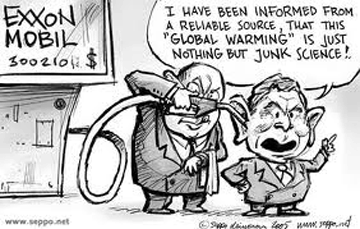
The strategy of muddling the public’s impression of climate science has proved to be highly effective. In 2017, polls found that almost ninety per cent of Americans did not know that there was a scientific consensus on global warming.
What is certain is that the industry’s campaign cost us the efforts of the human generation that might have made the crucial difference in the climate fight
 How Extreme Weather Is Shrinking the Planet, New Yorker, by Bill McKibben November 18, 2018 “………The climatologist James Hansen testified before Congress about the dangers of human-caused climate change thirty years ago. Since then, carbon emissions have increased with each year except 2009 (the height of the global recession) and the newest data show that 2018 will set another record. Simple inertia and the human tendency to prioritize short-term gains have played a role, but the fossil-fuel industry’s contribution has been by far the most damaging. Alex Steffen, an environmental writer, coined the term “predatory delay” to describe “the blocking or slowing of needed change, in order to make money off unsustainable, unjust systems in the meantime.” The behavior of the oil companies, which have pulled off perhaps the most consequential deception in mankind’s history, is a prime example.
As journalists at InsideClimate News and the Los Angeles Times have revealed since 2015, Exxon, the world’s largest oil company, understood that its product was contributing to climate change a decade before Hansen testified. In July, 1977, James F. Black, one of Exxon’s senior scientists, addressed many of the company’s top leaders in New York, explaining the earliest research on the greenhouse effect. “There is general scientific agreement that the most likely manner in which mankind is influencing the global climate is through carbon-dioxide release from the burning of fossil fuels,” he said, according to a written version of the speech which was later recorded, and which was obtained by InsideClimate News. In 1978, speaking to the company’s executives, Black estimated that a doubling of the carbon-dioxide concentration in the atmosphere would increase average global temperatures by between two and three degrees Celsius (5.4 degrees Fahrenheit), and as much as ten degrees Celsius (eighteen degrees Fahrenheit) at the poles.
Exxon spent millions of dollars researching the problem. It outfitted an oil tanker, the Esso Atlantic, with CO2 detectors to measure how fast the oceans could absorb excess carbon, and hired mathematicians to build sophisticated climate models. By 1982, they had concluded that even the company’s earlier estimates were probably too low. In a private corporate primer, they wrote that heading off global warming and “potentially catastrophic events” would “require major reductions in fossil fuel combustion.”
An investigation by the L.A. Times revealed that Exxon executives took these warnings seriously. Ken Croasdale, a senior researcher for the company’s Canadian subsidiary, led a team that investigated the positive and negative effects of warming on Exxon’s Arctic operations. In 1991, he found that greenhouse gases were rising due to the burning of fossil fuels. “Nobody disputes this fact,” he said. The following year, he wrote that “global warming can only help lower exploration and development costs” in the Beaufort Sea. Drilling season in the Arctic, he correctly predicted, would increase from two months to as many as five months. At the same time, he said, the rise in the sea level could threaten onshore infrastructure and create bigger waves that would damage offshore drilling structures. Thawing permafrost could make the earth buckle and slide under buildings and pipelines. As a result of these findings, Exxon and other major oil companies began laying plans to move into the Arctic, and started to build their new drilling platforms with higher decks, to compensate for the anticipated rises in sea level.
The implications of the exposés were startling. Not only did Exxon and other companies know that scientists like Hansen were right; they used his nasaclimate models to figure out how low their drilling costs in the Arctic would eventually fall. Had Exxon and its peers passed on what they knew to the public, geological history would look very different today. The problem of climate change would not be solved, but the crisis would, most likely, now be receding. In 1989, an international ban on chlorine-containing man-made chemicals that had been eroding the earth’s ozone layer went into effect. Last month, researchers reported that the ozone layer was on track to fully heal by 2060. But that was a relatively easy fight, because the chemicals in question were not central to the world’s economy, and the manufacturers had readily available substitutes to sell. In the case of global warming, the culprit is fossil fuel, the most lucrative commodity on earth, and so the companies responsible took a different tack.
A document uncovered by the L.A. Times showed that, a month after Hansen’s testimony, in 1988, an unnamed Exxon “public affairs manager” issued an internal memo recommending that the company “emphasize the uncertainty” in the scientific data about climate change. Within a few years, Exxon, Chevron, Shell, Amoco, and others had joined the Global Climate Coalition, “to coordinate business participation in the international policy debate” on global warming. The G.C.C. coördinated with the National Coal Association and the American Petroleum Institute on a campaign, via letters and telephone calls, to prevent a tax on fossil fuels, and produced a video in which the agency insisted that more carbon dioxide would “end world hunger” by promoting plant growth. With such efforts, it ginned up opposition to the Kyoto Protocol, the first global initiative to address climate change.
In October, 1997, two months before the Kyoto meeting, Lee Raymond, Exxon’s president and C.E.O., who had overseen the science department that in the nineteen-eighties produced the findings about climate change, gave a speech in Beijing to the World Petroleum Congress, in which he maintained that the earth was actually cooling. The idea that cutting fossil-fuel emissions could have an effect on the climate, he said, defied common sense. “It is highly unlikely that the temperature in the middle of the next century will be affected whether policies are enacted now, or twenty years from now,” he went on. Exxon’s own scientists had already shown each of these premises to be wrong.
On a December morning in 1997 at the Kyoto Convention Center, after a long night of negotiation, the developed nations reached a tentative accord on climate change. Exhausted delegates lay slumped on couches in the corridor, or on the floor in their suits, but most of them were grinning. Imperfect and limited though the agreement was, it seemed that momentum had gathered behind fighting climate change. But as I watched the delegates cheering and clapping, an American lobbyist, who had been coördinating much of the opposition to the accord, turned to me and said, “I can’t wait to get back to Washington, where we’ve got this under control.”
He was right. On January 29, 2001, nine days after George W. Bush was inaugurated, Lee Raymond visited his old friend Vice-President Dick Cheney, who had just stepped down as the C.E.O. of the oil-drilling giant Halliburton. Cheney helped persuade Bush to abandon his campaign promise to treat carbon dioxide as a pollutant. Within the year, Frank Luntz, a Republican consultant for Bush, had produced an internal memo that made a doctrine of the strategy that the G.C.C. had hit on a decade earlier. “Voters believe that there is no consensus about global warming within the scientific community,” Luntz wrote in the memo, which was obtained by the Environmental Working Group, a Washington-based organization. “Should the public come to believe that the scientific issues are settled, their views about global warming will change accordingly. Therefore, you need to continue to make the lack of scientific certainty a primary issue in the debate.”
The strategy of muddling the public’s impression of climate science has proved to be highly effective. In 2017, polls found that almost ninety per cent of Americans did not know that there was a scientific consensus on global warming. Raymond retired in 2006, after the company posted the biggest corporate profits in history, and his final annual salary was four hundred million dollars. His successor, Rex Tillerson, signed a five-hundred-billion-dollar deal to explore for oil in the rapidly thawing Russian Arctic, and in 2012 was awarded the Russian Order of Friendship. In 2016, Tillerson, at his last shareholder meeting before he briefly joined the Trump Administration as Secretary of State, said, “The world is going to have to continue using fossil fuels, whether they like it or not.”
It’s by no means clear whether Exxon’s deception and obfuscation are illegal. The company has long maintained that it “has tracked the scientific consensus on climate change, and its research on the issue has been published in publicly available peer-reviewed journals.” The First Amendment preserves one’s right to lie, although, in October, New York State Attorney General Barbara D. Underwood filed suit against Exxon for lying to investors, which is a crime. What is certain is that the industry’s campaign cost us the efforts of the human generation that might have made the crucial difference in the climate fight.…..https://www.newyorker.com/magazine/2018/11/26/how-extreme-weather-is-shrinking-the-planet?mbid=nl_Daily%20111718&CNDID=53818310&utm_source=nl&utm_medium=email&utm_campaign=Daily%20111718&utm_content=&utm_brand=tny&utm_mailing=Daily%20111718&hasha=8c9f4
The cancer toll on nuclear workers: $15.5 billion in compensation and counting

Nuclear fallout: $15.5 billion in compensation and counting
They built our atomic bombs; now they’re dying of cancer
Nearly 33,500 former nuclear site workers died due to radiation exposure- report
 Nuclear Fallout: This story produced in partnership with ProPublica and the Santa Fe New Mexican. (Richly illustrated with photographs, videos, charts, documents interactive map)
Wave 3, By Jamie Grey and Lee Zurik |
LOS ALAMOS, NEW MEXICO (InvestigateTV) – Clear, plastic water bottles, with the caps all slightly twisted open, fill a small refrigerator under Gilbert Mondragon’s kitchen counter. The lids all loosened by his 4- and 6-year old daughters because, at just 38, Mondragon suffers from limited mobility and strength. He blames his conditions on years of exposure to chemicals and radiation at the facility that produced the world’s first atomic bomb: Los Alamos National Laboratory.
Gilbert Mondragon, 38, pulls the cap off a plastic water bottle that had been twisted open by his young daughters. He hasn’t the strength for those simple tasks anymore and blames his 20-year career at the Los Alamos National Lab. He quit this year because of his serious lung issues, which he suspects were caused by exposures at the nuclear facility. (InvestigateTV/Andy Miller)
Mondragon is hardly alone in his thinking; there are thousands more nuclear weapons workers who are sick or dead. The government too recognizes that workers have been harmed; the Department of Labor administers programs to compensate “the men and women who sacrificed so much for our country’s national security.”
But InvestigateTV found workers with medical issues struggling to get compensated from a program that has ballooned ten times original cost estimates. More than 6,000 workers from Los Alamos alone have filed to get money for their medical problems, with around 53 percent of claims approved.
The Los Alamos lab, the top-secret site for bomb design in 1943, has had numerous safety violations and evidence of improper monitoring, federal inspection reports show. Continue reading
Nuclear meltdown at Santa Susana Lab and the government cover-up
L.A.’s Secret Meltdown; Simi Valley, CA(1959)Largest Nuclear Incident in U.S. history.
LA’s Nuclear Secret: Part 1 link https://www.nbclosangeles.com/investigations/LA-Nuclear-Secret-327896591.html– Sep 22, 2015 Tucked away in the hills above the San Fernando and Simi valleys was a 2,800-acre laboratory with a mission that was a mystery to the thousands of people who lived in its shadow, By Joel Grover and Matthew Glasser The U.S. government secretly allowed radiation from a damaged reactor to be released into air over the San Fernando and Simi valleys in the wake of a major nuclear meltdown in Southern California more than 50 years ago — fallout that nearby residents contend continues to cause serious health consequences and, in some cases, death. LA’s Nuclear Secret: Timelines, Documents, FAQ
Those are the findings of a yearlong NBC4 I-Team investigation into “Area Four,” which is part of the once-secret Santa Susana Field Lab. Founded in 1947 to test experimental nuclear reactors and rocket systems, the research facility was built in the hills above the two valleys. In 1959, Area Four was the site of one of the worst nuclear accidents in U.S. history. But the federal government still hasn’t told the public that radiation was released into the atmosphere as a result of the partial nuclear meltdown.
Now, whistleblowers interviewed on camera by NBC4 have recounted how during and after that accident they were ordered to release dangerous radioactive gases into the air above Los Angeles and Ventura counties, often under cover of night, and how their bosses swore them to secrecy.
In addition, the I-Team reviewed over 15,000 pages of studies and government documents, and interviewed other insiders, uncovering that for years starting in 1959, workers at Area Four were routinely instructed to release radioactive materials into the air above neighboring communities, through the exhaust stacks of nuclear reactors, open doors, and by burning radioactive waste.
How It Began
On July 13, 1959, the day of the meltdown, John Pace was working as a reactor operator for Atomics International at Area Four’s largest reactor, under the watch of the U.S. government’s Atomic Energy Commission.
“Nobody knows the truth of what actually happened,” Pace told the I-Team.
In fact, Pace said, the meltdown was verging on a major radioactive explosion.
“The radiation in that building got so high, it went clear off the scale,” he said.
To prevent a potentially devastating explosion, one that in hindsight the 76-year-old Pace believes would have been “just like Chernobyl,” he and other workers were instructed to open the exhaust stacks and release massive amounts of radiation into the sky.
“This was very dangerous radioactive material,” he said. “It went straight out into the atmosphere and went straight to Simi Valley, to Chatsworth, to Canoga Park.”
Pace and his co-workers frantically tried to repair the damaged reactor. Instead, he said they realized, their efforts were only generating more radioactive gas. So for weeks, often in the dark of night, Pace and other workers were ordered to open the large door in the reactor building and vent the radiation into the air.
“It was getting out towards the public,” he said. “The public would be bombarded by it.”
Pace said he and his co-workers knew they were venting dangerous radiation over populated areas, but they were following orders.
“They felt terrible that it had to be done,” he said. “They had to let it out over their own families.”
Area Four workers “were sworn to secrecy that they would not tell anyone what they had done,” Pace explained.
He remembered his boss getting right in his face and saying, “You will not say a word. Not one word.”
That was more than five decades ago, but radioactive contamination didn’t just vanish. It remains in the soil and water of Area Four and in some areas off-site, according to state and federal records obtained by the I-Team. And, evidence suggests that the fallout could be linked to illnesses, including cancer, among residents living nearby.
Arline Mathews lived with her family in Chatsworth, downwind of Area Four during some of the radiation releases. Her middle son, Bobby, was a champion runner on the Chatsworth High School track team for three years, running to the Santa Susana Field Lab and back to school every day. Bobby died of glioblastoma, a rare brain cancer often linked to radiation exposure. Mathews said there is no known family history of cancer and she blames the radiation from Area Four for her son’s illness.
“He was exposed to the chemical hazardous waste and radioactivity up there,” Mathews said. “There’s no getting over the loss of son.”
The Government Cover-up
Six weeks after the meltdown, the Atomic Energy Commission issued a press release saying that there had been a minor “fuel element failure” at Area Four’s largest reactor in July. But they said there had been “no release of radioactive materials” to the environment.
“What they had written in that report is not even close to what actually happened,” Pace said. “To see our government talk that way and lie about those things that happened, it was very disappointing.”
In 1979, NBC4 first broke the story that there was a partial meltdown at Area Four’s largest reactor, called the Sodium Reactor Experiment. But at the time, the U.S. government was still saying no radiation was released into the air over LA.
But during its current yearlong investigation, the I-Team found a NASA report that confirmed “the 1959 meltdown… led to a release of radioactive contaminants.”
For years, NASA used part of the site for rocket testing and research.
More Radioactive Releases
After filing a Freedom of Information request, the I-Team obtained more than 200 pages of government interviews with former Santa Susana workers. One of those workers, Dan Parks, was a health physicist at Area Four in the 1960s.
In the early 60s, Parks said, he often witnessed workers releasing radiation into the sky through the exhaust stacks of at least three of Area Four’s ten nuclear reactors.
“They would vent it to the atmosphere,” he said. “The release was done with the flick of a switch.”
Radioactive Waste Up in Smoke
Parks said he often witnessed workers releasing radioactive smoke into the air when they disposed of barrels of radioactive waste from Area Four’s 10 nuclear reactors.
“We were all workers,” he said. “Just taking orders.”
Workers would often take those barrels of waste to a pond called “the burn pits” and proceed to shoot the barrels with a high-powered rifle causing an explosion. The radioactive smoke would drift into the air over nearby suburbs and toward a summer camp for children.
“It was a volatile explosion, beyond belief,” Parks said.
Whatever direction the wind was blowing, the radioactive smoke would travel that way.
“If the wind was blowing to the Valley, it would blow it in the Valley,” he said.
Ralph Powell, who worked as a security officer at Area Four in the mid-60s, recalled being blanketed by that radioactive smoke.
“I saw clouds of smoke that was engulfing my friends, that are dying now,” Powell said.
Powell believes it wasn’t just his friends who suffered the consequences. He fears he may have exposed his own family to radiation, tracking it home on his clothes and car.
While Powell was working at Area Four, his son Michael was diagnosed with leukemia — a cancer linked to radiation exposure — and died at age 11.
“I suspect it caused the death of my son,” he said. “I’ve never gotten that out of my mind.”
Toxic Chemical Contamination
In addition to the radiation, dozens of toxic chemicals, including TCE and Perchlorate, were also released into the air and dumped on the soil and into ground and surface water from thousands of rocket tests conducted at the Santa Susana Field lab from the 1950s to 80s. The tests were conducted by NASA, and by Rocketdyne, a government aerospace contractor.
According to a federally funded study obtained by the I-Team, “emissions associated with rocket engine testing” could have been inhaled by residents of “West Hills, Bell Canyon, Dayton Canyon, Simi Valley, Canoga Park, Chatsworth, Woodland Hills, and Hidden Hills.”
Contamination Moves into Neighborhoods
Radiation released at Area Four continues to contaminate the soil and water of the Santa Susana Field Lab.
In 2012, the U.S. Environmental Protection Agency completed a $40 million soil test of the site and found 423 hot spots — places contaminated with high levels of man-made radiation.
Other studies and government documents obtained by the I-Team show that radiation has moved off-site, and has been found in the ground and water in suburbs to the south, northeast and northwest of the Field Lab.
“Radiation doesn’t know any boundaries,” said Dr. Robert Dodge, a national board member of the Nobel Prize-winning nonprofit Physicians For Social Responsibility, which studies the health effects of radiation.
Dodge, who has reviewed numerous government and academic studies about the contamination at Santa Susana, said he believes the contamination has spread far beyond the facility’s borders.
“If the wind is blowing and carrying radiation from Santa Susana, it doesn’t stop because there’s a fence,” he said.
One of the places radiation has been found, in a 1995 study overseen by the U.S. EPA, was the Brandeis-Bardin Institute in Simi Valley. The Institute is a nationally-known center of Jewish learning, and the home to Camp Alonim, a beloved summer sleepaway camp that has hosted some 30,000 children.
In December 1995, The Brandeis-Bardin Institute filed a federal lawsuit against the present and past owners of the Santa Susana Field Lab, alleging that toxic chemicals and radiation from the field lab “have subsequently seeped into and come to be located in the soil and groundwater” of Brandeis “is injurious to the environment” and “will cause great and irreparable injury.”
Brandeis settled the lawsuit in a confidential agreement in 1997.
A spokesman for the Brandeis-Bardin Institute, Rabbi Jay Strear, told NBC4 that the groundwater and soil is “tested routinely,” and the results have shown the “the site is safe.”
The I-Team asked Brandeis-Bardin to provide NBC4 with those test results showing the site is safe and free of hazardous substances. The Institute refused, and in an email said “we are not in a position to devote the required staff time to respond to your more detailed inquiries, nor do we see the necessity for doing so.”
A government scientist who has studied the contamination at Santa Susana told the I-Team he thinks there’s a continued threat of radiation and toxic chemicals flowing from the field lab to places like Brandeis-Bardin, via groundwater and airborne dust.
Clusters of Cancer
Researchers inside and out of government have contended that the radiation and toxic chemicals from Santa Susana might have caused many cancer cases.
“The radiation that was released in 1959 and thereafter from Santa Susana is still a danger today,” Dr.Dodge said. “There is absolutely a link between radiation and cancer.”
The I-Team tracked down dozens of people diagnosed with cancer and other illnesses who grew up in the shadow of Santa Susana — in Canoga Park, West Hills, Chatsworth, Thousand Oaks, Simi Valley. Many of them believe their cancers were caused by radiation and chemicals from the field lab.
Kathryn Seltzer Carlson, 56, and her sisters, Judy and Jennifer, all grew up in Canoga Park around the time of the nuclear meltdown and for years after, and all have battled cancer.
“I played in the water, I swam in the water, I drank the water” that ran off the Santa Susana Field Lab, said Carlson, who finished treatment for ovarian cancer earlier this year and is now undergoing chemotherapy for lymphoma. “I’ve had, I don’t know how many cancers.”
Bonnie Klea, a former Santa Susana employee who has lived in West Hills since the 60s, also battled bladder cancer, which is frequently linked to radiation exposure.
“Every single house on my street had cancer,” Klea said.
A 2007 Centers for Disease Control study found that people living within two miles of the Santa Susana site had a 60 percent higher rate of some cancers.
“There’s some provocative evidence,” said Dr. Hal Morgenstern, an epidemiologist who oversaw the study. “It’s like circumstantial evidence, suggesting there’s a link” between the contamination from Santa Susana and the higher cancer rates.
Silence From the Government
For more than two months, the I-Team asked to speak with someone from the U.S. Department of Energy (DOE), the federal agency that’s responsible for all nuclear testing, to ask why workers were ordered to release dangerous radiation over Los Angeles, why the DOE has never publicly admitted this happened, and what it plans to do to help get the site cleaned up.
The DOE emailed the I-Team, “We will not have anyone available for this segment.”
So the I-Team showed up at a public meeting this month about Santa Susana and asked the DOE’s project manager for the site, Jon Jones, to speak with us. He walked away and wouldn’t speak.
Will the Contamination Ever Be Cleaned Up?
Community residents, many stricken with cancer and other radiation-related illnesses, have been fighting for years to get the government and the private owners of the Santa Susana Field Lab to clean up the contamination that remains on the site.
But efforts in the state legislature and state agencies that oversee toxic sites have, so far, stalled.
But residents, with the support of some lawmakers, continue to fight for a full cleanup.
“People are continuing to breathe that (radiation) in and to die,” Chatsworth resident Arline Mathews said.
“See that this is done immediately, before more lives are lost.”
1 This Month



26 September – International Day for the Total Elimination of Nuclear Weapons


PLEASE OPPOSE HR 8255 AND S.3639 – bills would accelerate satellite deployment, with no environmental review or safeguards – https://ncstd5li.quorum.us/campaign/169331/
To see nuclear-related stories in greater depth and intensity – go to https://nuclearinformation.wordpress.com
-
Archives
- September 2026 (219)
- August 2026 (330)
- July 2026 (355)
- June 2026 (287)
- May 2026 (306)
- April 2026 (356)
- March 2026 (251)
- February 2026 (267)
- January 2026 (308)
- December 2025 (358)
- November 2025 (359)
- October 2025 (375)
-
Categories
- 1
- 1 NUCLEAR ISSUES
- business and costs
- climate change
- culture and arts
- ENERGY
- environment
- health
- history
- indigenous issues
- Legal
- marketing of nuclear
- media
- opposition to nuclear
- PERSONAL STORIES
- politics
- politics international
- Religion and ethics
- safety
- secrets,lies and civil liberties
- spinbuster
- technology
- Uranium
- wastes
- weapons and war
- Women
- 2 WORLD
- ACTION
- AFRICA
- Atrocities
- AUSTRALIA
- Christina's notes
- Christina's themes
- culture and arts
- Events
- Fuk 2022
- Fuk 2023
- Fukushima 2017
- Fukushima 2018
- fukushima 2019
- Fukushima 2020
- Fukushima 2021
- general
- global warming
- Humour (God we need it)
- Nuclear
- RARE EARTHS
- Reference
- resources – print
- Resources -audiovicual
- Weekly Newsletter
- World
- World Nuclear
- YouTube
-
RSS
Entries RSS
Comments RSS
 nuclear-news