San Onofre’s nuclear waste buried under the beach – the best example of the failure of the nuclear industry and its poor outlook for the future
A combination of failures:’ why 3.6m pounds of nuclear waste is buried on a popular California beach, Guardian, Kate Mishkin 24 Aug 21,

The San Onofre reactors are among dozens across the United States phasing out, but experts say they best represent the uncertain future of nuclear energy.
“It’s a combination of failures, really,”
Spent fuel is stored at 76 reactor sites in 34 states
“It’s a self-reporting industry,” Hering, the retired rear admiral, said. “And they simply can’t be trusted.”
More than 2 million visitors flock each year to California’s San Onofre state beach, a dreamy slice of coastline just north of San Diego. The beach is popular with surfers, lies across one of the largest Marine Corps bases in the Unites States and has a 10,000-year-old sacred Native American site nearby. It even landed a shout-out in the Beach Boys’ 1963 classic Surfin’ USA.
But for all the good vibes and stellar sunsets, beneath the surface hides a potential threat: 3.6m lb of nuclear waste from a group of nuclear reactors shut down nearly a decade ago. Decades of political gridlock have left it indefinitely stranded, susceptible to threats including corrosion, earthquakes and sea level rise.
The San Onofre reactors are among dozens across the United States phasing out, but experts say they best represent the uncertain future of nuclear energy.
“It’s a combination of failures, really,” said Gregory Jaczko, who chaired the US Nuclear Regulatory Commission (NRC), the top federal enforcer, between 2009 and 2012, of the situation at San Onofre.
That waste is the byproduct of the San Onofre Nuclear Generating Station (Songs), three nuclear reactors primarily owned by the utility Southern California Edison (SCE).
Buried waste
Federal regulators had already cited SCE for several safety issues, including leaking radioactive waste and falsified firewatch records. But when a new steam generator began leaking a small amount of radioactivity in January 2012, just one year after it was replaced, it was SCE’s most serious problem yet. A subsequent report from the NRC’s inspector general found federal inspectors had overlooked red flags in 2009, and that SCE had replaced its own steam generators without proper approval. SCE tried to fix the problem but decided in 2013 to shut the plant down for good.Activists thought they had scored a victory when the reactor shut down – until they learned that the nuclear waste they had produced would remain on-site……
Without a government-designated place to store the waste, the California Coastal Commission in 2015 approved the construction of an installation at San Onofre to store it until 2035. In August 2020, workers concluded the multi-year burial process, loading the last of 73 canisters of waste into a concrete enclosure.
San Onofre is not the only place where waste is left stranded. As more nuclear sites shut down, communities across the country are stuck with the waste left behind. Spent fuel is stored at 76 reactor sites in 34 states, according to the Department of Energy.
Handling those stockpiles has been an afterthought to the NRC, the federal enforcer, said Allison Macfarlane, another former commission chair.
“It was not a big topic at the NRC, unfortunately,” Macfarlane said. “In the nuclear industry in general the backend of the nuclear cycle gets very little attention. So it just never rises to ‘oh this is a very important issue, we should be doing something.’”
Plenty of risks, and not enough oversight
The waste is buried about 100ft from the shoreline, along the I-5 highway, one of the nation’s busiest thoroughfares, and not far from a pair of faults that experts say could generate a 7.4 magnitude earthquake.
Another potential problem is corrosion. In its 2015 approval, the Coastal Commission noted the site could have a serious impact on the environment down the line, including on coastal access and marine life. “The [installation] would eventually be exposed to coastal flooding and erosion hazards beyond its design capacity, or else would require protection by replacing or expanding the existing Songs shoreline armoring,” the document says.
Concerns have also been raised about government oversight of the site. Just after San Onofre closed, SCE began seeking exemptions from the NRC’s operating rules for nuclear plants. The utility asked and received permission to loosen rules on-site, including those dealing with record-keeping, radiological emergency plans for reactors, emergency planning zones and on-site staffing.
San Onofre isn’t the only closed reactor to receive exemptions to its operating licence. The NRC’s regulations historically focused on operating reactors and assumed that, when a reactor shut down, the waste would be removed quickly.
It’s true that the risk of accidents decreases when a plant isn’t operating, said Dave Lochbaum, former director of the nuclear safety project for the Union of Concerned Scientists. But adapting regulations through exemptions greatly reduces public transparency, he argued.
“Exemptions are wink-wink, nudge-nudge deals with the NRC,” he said.
In general, it’s not really a great practice,” former NRC chair Jaczko said about the exemptions. “If the NRC is regulating by exemption, it means that there’s something wrong with the rules … either the NRC believes the rules are not effective, and they’re not really useful, or the NRC is not holding the line where the NRC should be holding line,” he said.
Close calls
In 2015, the NRC tried unsuccessfully to revise its decommissioning rules and reduce the need for exemptions. But commissioners never acted, despite a 2019 Office of Inspector General audit that questioned whether the rule would ever see the light of day and that estimated that eliminating exemptions could save the NRC, utility and taxpayers about $19m for each reactor.
In general, it’s not really a great practice,” former NRC chair Jaczko said about the exemptions. “If the NRC is regulating by exemption, it means that there’s something wrong with the rules … either the NRC believes the rules are not effective, and they’re not really useful, or the NRC is not holding the line where the NRC should be holding line,” he said.
Meanwhile, at San Onofre, two close calls drew the ire of activists and townspeople. In 2018, workers found a loose piece of equipment in one of the canisters, causing a 10-day work stoppage to ensure the error didn’t pose a threat to the public. In a separate incident several months later, a canister filled with radioactive waste became wedged when employees were loading it into the ground and nearly dropped 18ft. The second incident was not made public until a whistleblower brought it up at a community event.
After these incidents, the NRC cited SCE for failing to ensure equipment was available to protect the canister from a drop, and failing to notify the NRC in a timely manner. In a memo, NRC staff told SCE it was “concerned about apparent weaknesses” in managing storage oversight. SCE was fined $116,000 but permitted to continue loading casks within one year.
Another concern is that the CEO of Holtec, the manufacturer of the canisters, told a 2014 community meeting that the canisters are difficult to repair. “It’s not practical to repair a canister if it were damaged,” Kris Singh said.
According to a plan the California Coastal Commission approved in July 2020, SCE will also inspect two of the 73 buried canisters every five years, and a test canister every two and a half years, starting in 2024.
But critics say they are not confident SCE would self-report given the utility’s record. “It’s a self-reporting industry,” Hering, the retired rear admiral, said. “And they simply can’t be trusted.”……….. https://www.theguardian.com/environment/2021/aug/24/san-onofre-nuclear-power-plant-radioactive-waste-unsafe
Nuclear ”ethics” – fatally ill man kept alive against his will, in the cause of nuclear research

In 1999 an accident at a Japanese Nuclear Power Plant caused one of its technicians, Hisashi Ouchi, to be exposed to high levels of radiation. He was kept alive for 83 days, against his will, by doctors so they could use his body to study the effects of radiation on humans.Hisashi Ouchi was one of three employees of the Tokaimura nuclear plant to be heavily impacted by the accident on 30 September 1999.
The Man Kept Alive Against His Will
How modern medicine kept a ‘husk’ of a man alive for 83 days against his will
https://historyofyesterday.com/the-man-kept-alive-againsthttps://historyofyesterday.com/the-man-kept-alive-against-his-will-647c7a24784 Colin Aneculaese 27 July 2020, Radiation has always been a subject of great interest for many scientists. Since its discovery and weaponisation, many have looked into its impact on living organisms, especially humans. As a result, many living being suffered at the hands of those who sought to find the real impact of radiation on living beings. Throughout the years this experimentation was mainly focused on animals as it would be unethical to test such a thing on humans.
Outside of major nuclear events such as the bombing of Hiroshima and Nagasaki and the meltdowns of nuclear facilities such as nuclear power plants, the effect of radiation on humans could not be tested. As such after the 1999 Tokaimura nuclear accident, many scientists jumped at the opportunity to study the victims of such a high amount of explosion to radiation. Out of all the victims of the disaster, the case of Hisashi Ouchi stands out.
Tokaimura nuclear plant
Hisashi Ouchi was one of three employees of the Tokaimura nuclear plant to be heavily impacted by the accident on 30 September 1999. Leading up to the 30th of the month the staff at the Tokaimura nuclear plant were in charge of looking after the process of dissolving and mixing enriched uranium oxide with nitric acid to produce uranyl nitrate, a product which the bosses of the nuclear plant wanted to have ready by the 28th.
Due to the tight time constraints, the uranyl nitrate wasn’t prepared properly by the staff with many shortcuts being used to achieve the tight deadline. One of these shortcuts was to handle the highly radioactive produce by hand. During their handling of the radioactive produce while trying to convert it into nuclear fuel (uranyl nitrate is used as nuclear fuel) for transportation the inexperienced three-man crew handling the operation made a mistake.
During the mixing process, a specific compound had to be added to the mixture, the inexperienced technicians added seven times the recommended amount of the compound to the mixture leading to an uncontrollable chain reaction being started in the solution. As soon as the Gamma radiation alarms sounded the three technicians knew they made a mistake. All three were exposed to deadly levels of radiation, more specifically Ouchi receiving 17 Sv of radiation due to his proximity to the reaction, Shinohara 10 Sv and Yokokawa 3 Sv due to his placement at a desk several meters away from the accidents. When being exposed to radiation it is said that anything over 10 Sv is deadly, this would prove to be true in this instance.
The fallout of radiation
Shinohara, the least affected out of the two who received a deadly dose of radiation, lasted 7 months in hospital until 27 April 2000. The technician died of lung and liver failure after a long battle against the effects of the radiation he endured. During his, 7-month stay at the University of Tokyo Hospital several skin grafts, blood transfusions and cancer treatments were performed on him with minimal success. Shinohara’s time at the University of Tokyo Hospital would be much less painful than Ouchi’s.
In China, wind and solar energy are the clear winners over nuclear.
A Decade Of Wind, Solar, & Nuclear In China Shows Clear Scalability Winners
China’s natural experiment in deploying low-carbon energy generation shows that wind and solar are the clear winners. https://cleantechnica.com/2021/09/05/a-decade-of-wind-solar-nuclear-in-china-shows-clear-scalability-winners/ By Michael Barnard, 6 Sept 21,

My 2014 thesis continues to be supported by the natural experiment being played out in China. In my recent published assessment of small modular nuclear reactors (tl’dr: bad idea, not going to work), it became clear to me that China has fallen into one of the many failure conditions of rapid deployment of nuclear, which is to say an expanding set of technologies instead of a standardized single technology, something that is one of the many reasons why SMRs won’t be deployed in any great numbers.
Wind and solar are going to be the primary providers of low-carbon energy for the coming century, and as we electrify everything, the electrons will be coming mostly from the wind and sun, in an efficient, effective and low-cost energy model that doesn’t pollute or cause global warming. Good news indeed that these technologies are so clearly delivering on their promise to help us deal with the climate crisis.
 |
In 2014, I made the strong assertion that China’s track record on wind and nuclear generation deployments showed clearly that wind energy was more scalable. In 2019, I returned to the subject, and assessed wind, solar and nuclear total TWh of generation, asserting that wind and solar were outperforming nuclear substantially in total annual generation, and projected that the two renewable forms of generation would be producing 4 times the total TWh of nuclear by 2030 each year between them. Mea culpa: in the 2019 assessment, I overstated the experienced capacity factor for wind generation in China, which still lags US experiences, but has improved substantially in the past few years.
My thesis on scalability of deployment has remained unchanged: the massive numerical economies of scale for manufacturing and distributing wind and solar components, combined with the massive parallelization of construction that is possible with those technologies, will always make them faster and easier to scale in capacity and generation than the megaprojects of GW-scale nuclear plants. This was obvious in 2014, it was obviously true in 2019, and it remains clearly demonstrable today. Further, my point was that China was the perfect natural experiment for this assessment, as it was treating both deployments as national strategies (an absolute condition of success for nuclear) and had the ability and will to override local regulations and any NIMBYism. No other country could be used to easily assess which technologies could be deployed more quickly.
In March of this year I was giving the WWEA USA+Canada wind energy update as part of WWEA’s regular round-the-world presentation by industry analysts in the different geographies. My report was unsurprising. In 2020’s update, the focus had been on what the impact of COVID-19 would be on wind deployments around the world. My update focused on the much greater focus on the force majeure portions of wind construction contracts, and I expected that Canada and the USA would miss expectations substantially. The story was much the same in other geographies. And that was true for Canada, the USA and most of the rest of the geographies.
But China surprised the world in 2020, deploying not only 72 GW of wind energy, vastly more than expected, but also 48 GW of solar capacity. The wind deployment was a Chinese and global record for a single country, and the solar deployment was over 50% more than the previous year. Meanwhile, exactly zero nuclear reactors were commissioned in 2020.
And so, I return to my analysis of Chinese low-carbon energy deployment, looking at installed capacity and annual added extra generation.

Cosmic radiation will probably prevent growing crops on Mars
Greenhouses Probably Won’t Work for Growing Crops on Mars Because of Cosmic Radiation https://scitechdaily.com/greenhouses-probably-wont-work-for-growing-crops-on-mars-because-of-cosmic-radiation/
By ANDY TOMASWICK, UNIVERSE TODAY SEPTEMBER 4, 2021 MARS is a lifeless wasteland for more than one reason. Not only are the temperatures and lack of water difficult for life to deal with, the lack of a magnetic field means radiation constantly pummels the surface. If humans ever plan to spend prolonged periods of time on the red planet, they’ll need to support an additional type of life – crops. However, it appears that even greenhouses on the surface won’t do enough to protect their plants from the deadly radiation of the Martian surface, at least according to a new paper published by researchers at Wageningen University and the Delft University of Technology.
Ideally, agriculture on the Maritan surface would consist of greenhouse domes and allow what limited sunlight hits the planet to make it through to the crops they house directly. However, current technology greenhouse glass is incapable of blocking the deadly gamma radiation that constantly irradiates Mars. Those gamma radiation levels, which are about 17 times higher on Mars than on Earth, are enough to affect crops grown in greenhouses on the surface significantly.
The researchers ran an experiment where they planted garden cress and rye and measured the crop output of a group irradiated with Martian levels of gamma radiation with those grown in a “normal” environment with only Earth-level radiation. The crops in the irradiated group ended up as dwarves, with brown leaves, and resulted in a significantly decreased harvest after 28 days of growth.
To mimic the gamma radiation environment, Nyncke Tack, an undergraduate researcher who performed much of the work for the project, used 5 separate cobalt-60 radiation sources. These were scattered evenly overhead of the test crops to create a “radiation plane” similar to the ever-present radiation field on Mars.
Other confounding factors, including adding beta and alpha radiation, could also contribute to crop deterioration, though solid objects more easily stop those types of radiation. The research team, who was not surprised by their findings, suggests building underground farms where the planet’s regolith blocks most if not all of that radiation. This would have the obvious disadvantage of losing access to sunlight, but would have the added benefit of being a much more controllable environment, with LEDs and temperature control filling in for environmental conditions on the surface.
To prove their theory, the team is next commandeering a Cold War-era bunker in the Netherlands to see if their same irradiation experiments affect crops grown inside if the irradiation is coming from outside. While not a direct analog for Martian regolith, it’s a novel approach to understanding how humans might eventually farm the sky.
Chinon nuclear site again leaks coolants that turn into powerful greenhouse gases.
The Chinon nuclear site (Center – Val de Loire) declared in August 2021 to have exceeded the annual authorized limit for coolant leaks. 100 kilos in 1 year is the quantity of refrigerants that each EDF nuclear power plant has
the right to allow to evaporate in nature. Because at normal pressure, these liquids turn into powerful greenhouse gases.
This is equivalent to several thousand kilos of CO2 released into the atmosphere each year by EDF nuclear facilities, which have very high cooling needs. The manufacturer does not brag about it, but this limit is regularly exceeded.
Sortir du nucleaire 31st Aug 2021
Weaponising space -the high road to World War 3, but profitable for weapon and space companies

Insane U.S. Plan to Spend Billions on Weaponizing Space Makes Defense Contractors Jump for Joy—But Rest of World Cowers in Horror at Prospect of New Arms Race Leading to World War IIICovertAction Magazine By Karl Grossman – August 25, 2021 Imagine this scenario from the year 2045: The U.S. and China, after years of belligerence, go to war over control of the Taiwan straits; most of the battles are fought through cyber-attacks and space-based weapons systems that had been perfected over the previous decades.
In a desperate maneuver, the U.S. activates its “rods from God”—a scheme developed in Project Thor involving telephone-pole-sized tungsten rods being dropped from orbit reaching a speed ten times the speed of sound [7,500 miles per hour] hitting with the force of nuclear weapons—and Beijing’s military command centers and other significant targets are destroyed.
The above scenario looks increasingly plausible given a) the growing prospect of war between the U.S. and China; and b) the growing militarization of space by the U.S.—in violation of the landmark Outer Space Treaty of 1967 that sets aside space “for peaceful purposes.”
U.S. Space Force and the Evisceration of the 1967 Outer Space Treaty
Donald Trump declared at a meeting of the National Space Council of the U.S. in 2018 that “it is not enough to merely have an American presence in space, we must have American dominance in space…. I’m hereby directing the Department of Defense and Pentagon to immediately begin the process necessary to establish a Space Force as the sixth branch of the armed forces … It is going to be something.”

Indeed, the U.S. Space Force, established in December 2019, is something—and can, if not will, destroy the visionary Outer Space Treaty of keeping space for peace.
The Outer Space Treaty of 1967 was put together by the U.S., Great Britain and the former Soviet Union and has wide support from nations around the world. 111 countries are parties to the treaty, while another 23 have signed the treaty but have not completed ratification.
As Craig Eisendrath, who as a young U.S. State Department officer was involved in the treaty’s creation, told me—and I quote him in my book Weapons in Space—“we sought to de-weaponize space before it got weaponized … to keep war out of space.”
“This foundational treaty has allowed for half a century of ever expanding peaceful activity in space, free from man-made threats,” writes Paul Meyer, in his chapter “Arms Control in Outer Space: A Diplomatic Alternative to Star Wars” in the book Security in the Global Commons and Beyond.[1]
The Outer Space Treaty bars placement “in orbit around the Earth any objects carrying nuclear weapons or any other kinds of weapons of mass destruction or from installing such weapons on celestial bodies.”
Biden Signs Off on Space Force
Republican Trump’s successor as U.S. president, Democrat Joe Biden, has not pulled back on the U.S. Space Force. As Defense News headlined in 2021: “With Biden’s ‘full support,’ the Space Force is officially here to stay.”
Its article opened: “U.S. President Joe Biden will not seek to eliminate the Space Force and roll military space functions back into the Air Force, the White House confirmed.” It continued: “White House spokeswoman Jen Psaki told reporters during a Feb. 3 briefing that the new service has the ‘full support’ of the Biden administration.” And it went on: “‘We’re not revisiting the decision,’ she said.”
Most Democrats in the U.S. Congress voted for the legislation providing for formation of the U.S. Space Force as pushed by Trump. All Republicans in the U.S. Congress voted for it.
False Pretext
For decades there has been an effort to extend the Outer Space Treaty and enact the Prevention of an Arms Race, the PAROS treaty, which would bar any weapons in space.
China, Russia (and U.S. neighbor Canada) have been leaders in seeking passage of the PAROS treaty. But the U.S.—through administration after administration, Republican and Democrat—has opposed the PAROS treaty and effectively vetoed it at the United Nations.
Although the PAROS treaty has broad backing from nations around the world, it must move through the UN’s Conference on Disarmament which functions on a consensual basis.
A rationale for the U.S. Space Force now being claimed is that it is necessary to counter moves by China and Russia in space, particularly development of anti-satellite weapons.
That is what a CNN report in August 2021, titled “An Exclusive Look into How Space Force Is Defending America,” centrally asserted. There was no mention in the six-minute-plus CNN piece of how China and Russia (and Canada) have led for decades in the push for PAROS, and how China and Russia in recent times have reiterated their calls for space to be weapons-free.
“We are calling on the international community to start negotiations and reach agreement on arms control in order to ensure space safety as soon as possible,” said the Chinese Foreign Ministry spokesperson, Zhao Lijian, in April 2021. “China has always been in favor of preventing an arms race in space; it has been actively promoting negotiations on a legally binding agreement on space arms control jointly with Russia.”
A day earlier, Russian Foreign Minister Sergey Lavrov called for talks to create an “international legally binding instrument” to ban the deployment of “any types of weapons” in space. Lavrov said: “We consistently believe that only a guaranteed prevention of an arms race in space will make it possible to use it for creative purposes, for the benefit of the entire mankind. We call for negotiations on the development of an international legally binding instrument that would prohibit the deployment of any types of weapons there, as well as the use of force or the threat of force.”
Onward and Upward!

Meanwhile, the U.S. Space Force drives ahead.
It has requested a budget of $17.4 billion for 2020 to “grow the service,” reports Air Force Magazine. “Space Force 2022 Budget Adds Satellites, Warfighting Center, More Guardians,” was the headline of its article. And in the first paragraph, it adds “and fund more than $800 million in new classified programs.” (“Guardians” is the name adopted by the U.S. Space Force in 2021 for its members.)
A recruitment drive is under way.
The U.S. Space Force “received its first offensive weapon … satellite jammers,” reported American Military News in 2020. “The weapon does not destroy enemy satellites, but can be used to interrupt enemy satellite communications and hinder enemy early warning systems meant to detect a U.S. attack,” it stated…………
“US Space Command—dominating the space dimension of military operations to protect US interests and investment. Integrating Space Forces into war-fighting capabilities across the full spectrum of conflict,” trumpeted Vision for 2020……….
I displayed the comments of U.S. Space Command Commander-in-Chief Joseph W. Ashy in Aviation Week and Space Technology in 1996: “It’s politically sensitive, but it’s going to happen,” said the general.

Some people don’t want to hear this … but—absolutely—we’re going to fight in space. We’re going to fight from space and we’re going to fight into space…. We will engage terrestrial targets someday—ships, airplanes, land targets—from space.” U.S. Space Command Commander-in-Chief General Joseph W. Ashy……………
Star Wars and America’s Nazis

German Major General Walter Dornberger, who had been in charge of the entire Nazi rocket program, and how he “in 1947 as a consultant to the U.S Air Force and adviser to the Department of Defense … wrote a planning paper for his new employers.
He proposed a system of hundreds of nuclear-armed satellites all orbiting at different altitudes and angles, each capable of re-entering the atmosphere on command from Earth to proceed to its target. The Air Force began early work on Dornberger’s idea under the acronym NABS (Nuclear Armed Bombardment Satellites).”
Insane U.S. Plan to Spend Billions on Weaponizing Space Makes Defense Contractors Jump for Joy—But Rest of World Cowers in Horror at Prospect of New Arms Race Leading to World War III CovertAction Magazine By Karl Grossman – August 25, 2021 ” ……………………………………..Star Wars and America’s Nazis
U.S. interest in militarizing and weaponizing space goes back well before the Vision for 2020 and other bellicose U.S. plans for space in the 1990s, or Ronald Reagan’s Strategic Defense Initiative dubbed “Star Wars,” in the 1980s. Its roots are with the former Nazi rocket scientists and engineers brought to the U.S. from Germany after World War II under the U.S.’s Operation Paperclip, where more than 1,600 German scientists, engineers and technicians were taken from former Nazi Germany to the U.S. for government employment after the end of World War II in Europe, between 1945 and 1959.
They ended up at the U.S. Army’s Redstone Arsenal in Huntsville, Alabama—to use “their technological expertise to help create the U.S. space and weapons program,” writes Jack Manno, a State University of New York professor, in his 1984 book Arming the Heavens: The Hidden Military Agenda for Space, 1945-1995 (1984).
“Many of the early space war schemes were dreamt up by scientists working for the German military, scientists who brought their rockets and their ideas to America after the war,” he writes. Many of these scientists and engineers “later rose to positions of power in the U.S. military, NASA, and the aerospace industry.”

Among them were “Wernher von Braun and his V-2 colleagues,” who began “working on rockets for the U.S. Army” and, at the Redstone Arsenal, “were given the task of producing an intermediate range ballistic missile to carry battlefield atomic weapons up to 200 miles. The Germans produced a modified V-2 renamed the Redstone…. Huntsville became a major center of U.S. space military activities.”
Manno tells the story of former German Major General Walter Dornberger, who had been in charge of the entire Nazi rocket program, and how he “in 1947 as a consultant to the U.S Air Force and adviser to the Department of Defense … wrote a planning paper for his new employers.
He proposed a system of hundreds of nuclear-armed satellites all orbiting at different altitudes and angles, each capable of re-entering the atmosphere on command from Earth to proceed to its target. The Air Force began early work on Dornberger’s idea under the acronym NABS (Nuclear Armed Bombardment Satellites).”
In my subsequent Weapons in Space, Manno tells me that “control over the Earth” was what those who have wanted to weaponize space seek. He said the Nazi scientists are an important “historical and technical link, and also an ideological link…. The aim is to … have the capacity to carry out global warfare, including weapons systems that reside in space.”
Dornberger’s nuclear link continues in various forms throughout the U.S. military space program. The Strategic Defense Initiative scheme of Reagan—although this was barely disclosed at the time—was predicated on orbiting battle platforms with on-board hypervelocity guns, particle beams and laser weapons. They were to be energized by on-board nuclear reactors.
As General James Abrahamson, SDI director, said at a Symposium on Space Nuclear Power and Propulsion, “without reactors in orbit [there is] going to be a long, long light [extension] cord that goes down to the surface of the Earth” to bring up power to energize space weaponry………………….[2] https://covertactionmagazine.com/2021/08/25/insane-u-s-plan-to-spend-billions-on-weaponizing-space-makes-defense-contractors-jump-for-joy-but-rest-of-world-cowers-in-horror-at-prospect-of-new-arms-race-leading-to-world-war-iii/
Arnie Gundersen writes to Bill Gates – about public funding for Gates’ false Natrium nuclear solution to climate change
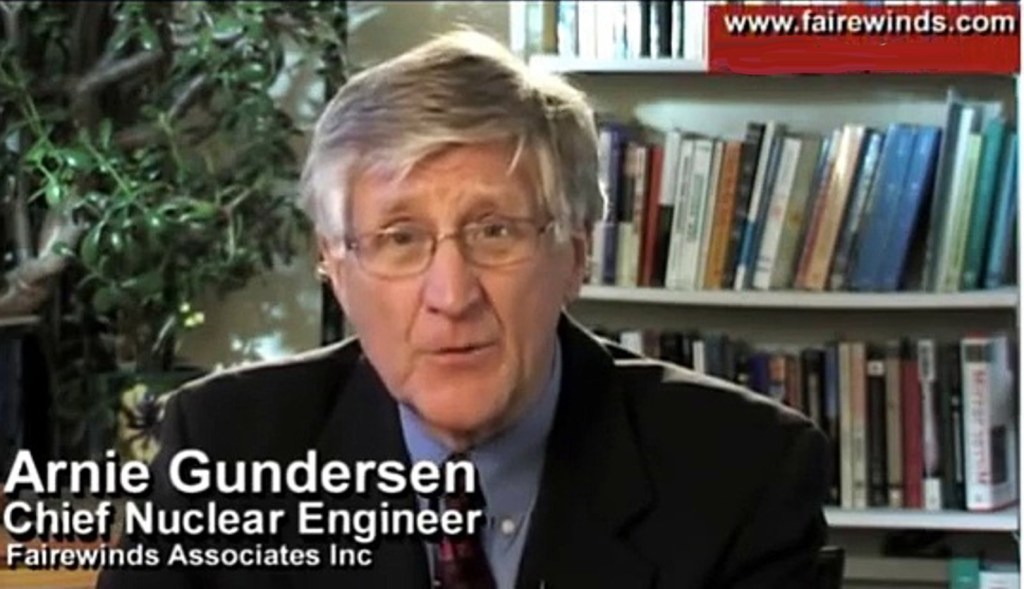
History shows a legacy of failures in the pursuit of the sodium reactor fantasy. As Admiral Rickover said almost 70 years ago, sodium reactors are “expensive to build, complex to operate, susceptible to prolonged shutdown as a result of even minor malfunctions, and difficult and time-consuming to repair.”
Mr. Gates, it’s time to face the music (and the facts) – your supposedly foolproof, sodium-cooled Natrium brainchild will encounter those same obstacles. In my fifty years of nuclear power expertise, I have learned that sooner or later, in any foolproof system, the fools are going to exceed the proofs. Now is the time to stop the Natrium marketing hype and instead use those precious public funds to pursue renewable energy options with a proven history of actually working inexpensively in a time frame that will prevent catastrophic climate change!
An Open Letter to Bill Gates About his Wyoming Atomic Reactor, https://www.counterpunch.org/2021/08/20/an-open-letter-to-bill-gates-about-his-wyoming-atomic-reactor/
BY ARNIE GUNDERSEN Dear Mr. Gates,
I am writing this open letter to you because I believe you have crossed the line by leveraging your fortune maneuvering State Governments and indeed the US Government to syphon precious taxpayer funds in support your latest atomic contrivance in Wyoming. How you spend your personal fortune is your decision and yours alone, but I question your zeal to leverage that fortune by securing additional public funds for an unproductive techno-solution[1] that claims to solve the climate crisis! Your latest technofix is the scheme to have taxpayers fund your new nuclear power concept in Wyoming, claiming that it will mitigate the climate crisis. It won’t!
Atomic power generation is not part of your skillset, but it is mine. The many facets of nuclear energy have been areas of my professional focus for the last 50 years. Beginning in 1971 with two nuclear engineering degrees, a Reactor Operator’s license, a corporate Senior Vice President position for an atomic licensee, a nuclear safety patent, two peer reviewed papers on radiation, and a best-selling book on Fukushima, nuclear power is in my wheelhouse, not yours.
Based on my experience, I am writing this public letter to express my fear that you have made a huge mistake by proposing to build a sodium-cooled small modular reactor (SMR) in Wyoming. Mr. Gates, your atomic power company Natrium (for the Latin word for sodium) is following in the footsteps of a seventy-year long record of sodium-cooled nuclear technological failures. Your plan to recycle those old failed attempts to resurrect liquid sodium yet again will siphon valuable public funds and research from much more inexpensive and proven renewable energy alternatives. Spending public funds on Natrium will make the global climate crisis worse, not better!
Let me explain why Natrium is doomed. As you probably have already been told, all present-day atomic reactors are cooled by water and are called Light Water Reactors (LWRs). Similarly, all US coal, oil, and gas-fired electric plants heat water, not exotic coolants. While some Small Modular Reactors concepts retain water cooling, Natrium’s proposed design deviates from this pattern by cooling the atomic chain reaction using an exotic coolant and specially designed steam generators to remove the atomic heat. Nuclear power concepts that do not use water for cooling are called Non-Light Water Reactors (or NLWRs), and Natrium claims that cooing with liquid sodium is safer and more reliable than traditional water-cooled reactors. What evidence exists to support that assertion?
World renowned energy economist Mycle Schneider calls Natrium and other proposed conceptual reactors “PowerPoint Reactors” as none are close to being fully designed yet all are being marketed as though their successful and safe operation were a fait accompli. According to Mycle Schneider, as reported in Politico EU:
All they have right now are basically PowerPoint reactors — it looks nice on the slide but they’re far from an operating pilot plant. We are more than a decade away from anything on the ground.”
The Union of Concerned Scientists (UCS) recently completed an exhaustive, 140-page study of the supposed safety improvements claimed by NLWR manufactures like Natrium. Entitled Advanced Isn’t Always Better, UCS concludes:
“But a fundamental question remains: Is different actually better? The short answer is no. Nearly all of the NLWRs currently on the drawing board fail to provide significant enough improvements over LWRs to justify their considerable risks.”
Recently, the media and governors in western states have become enthralled with one NLWR design hyped by you and your publicity team at Natrium. Using your successes at Microsoft, you are now asking state and national governments to bankroll a “fast reactor” concept that is cooled by liquid sodium.
“Wyoming To Lead The Coal-To-Nuclear Transition
Interest for new nuclear plants is growing beyond Wyoming as states in the western region like Montana, Nebraska, Utah, Idaho and North Dakota reevaluate the role of nuclear energy – particularly applications for advanced nuclear reactors … the brainchild of Bill Gates, … has developed a 345 MW sodium-cooled fast reactor with a molten salt-based energy storage system.”
The history of sodium as an atomic coolant does not support your grandiose claims for its success. Mr. Gates, the marketing hype associated with your latest “brainchild” ignores 70 years of failures using liquid sodium as an atomic reactor coolant. What follows are just a few examples of the monumental failures that have used liquid sodium that I am not so sure you have studied carefully before pressing for government funds in pursuit your idea.
According to Scientific American, liquid sodium “is no mere novelty; as dangerous as it is captivating… Sodium has significant disadvantages. On contact with air, it burns; plunged into water, it explodes.”
The Bulletin of Atomic Scientists goes even further stating:
“Unfortunately, this pitch glossed over stubborn facts… because plutonium fast-breeder reactors use liquid metal coolants, such as liquid sodium, operating them safely is far more challenging and expensive than conventional reactors. When private industry tried in the early 1960s to operate its own commercial-sized fast-breeder, Fermi I, the benefits were negative. Barely three years after Fermi 1 came online, a partial fuel meltdown in 1966 brought it down… These facts, however, are rarely emphasized….”
In addition to the meltdown at Fermi 1, whose failure is highlighted in the book We Almost Lost Detroit, other sodium cooled reactors have failed in the United States and worldwide. Beginning in 1950, the Navy attempted to develop a sodium-cooled reactor for the Seawolf submarine. According to the American Nuclear Society, Admiral Rickover, the founder of the nuclear Navy, testified to Congress in 1957 stating:
“We went to full power on the Seawolf alongside the dock on August 20 of last year. Shortly thereafter, she developed a small leak. It took us 3 months, working 24 hours a day, to locate and correct the leak. This is one of the serious difficulties in sodium plants.”
Rickover killed the Navy’s sodium powered reactor because of sodium leaks, sodium’s volatility and because sodium repairs take too long and radiation exposure to workers was too high. The problem of high radiation exposures to maintenance personnel while repairing inevitable sodium leaks was also highlighted by Rickover in that same 1957 testimony when he stated:
“Sodium becomes 30,000 times as radioactive as water. Furthermore, sodium has a half-life of 14.7 hours, while water has a half-life of about 8 seconds.”
Making rapid repairs in a sodium-cooled reactor is impossible because sodium becomes highly radioactive as it flows through the reactor core and it stays radioactive for weeks after shutdown. In contrast, water used to cool conventional reactors stays highly radioactive for about one minute.
After failed attempts to use liquid sodium on the Seawolf and on Fermi 1, nuclear zealots convinced the US Congress to subsidize yet another sodium-cooled reactor at Clinch River in Tennessee. The concept of a sodium reactor at Clinch River originated before the meltdown at Fermi 1, but was continued with huge government subsidies until 1984. Overcoming the safety issues presented by cooling atoms using liquid sodium led to delays and cost overruns that were certainly significant factors when the project was finally killed by Congress. However, serious, game-changing, safety concerns were also a factor in the cancelation of the project. According to The Rise and Demise of the Clinch River Breeder Reactor in Scientific American:
“In 1982 … the Energy Department videotaped safety tests it had conducted of how molten sodium might react once it came in contact with the reactor’s concrete containment structure. Concrete contains water crystals. Molten sodium reacts explosively when it comes in contact with oxygen, including oxygen contained in water. What the test demonstrated and the video showed was concrete exploding when it came in contact with liquid sodium.”
Even after the cancelation of the Clinch River fiasco, those same nuclear zealots continued to pursue the fantasy of a sodium-cooled reactor at the Monju site in Japan. Construction began in 1985 and about a decade later, the Monju sodium-cooled reactor was finally ready to operate. It did not operate long, however. After operating only 4 months, Monju had an emergency shutdown when the inevitable sodium leak caused an inevitable sodium fire.
According to a report issued by the Monju Construction Office entitled Sodium Leak at Monju-Causes and Consequences, the failure mode that caused the leak could not have been anticipated by Monju’s designers.
“On December 8, 1995, a sodium leak from the Secondary Heat Transport System (SHTS) occurred in a piping room of the reactor auxiliary building at Monju. The sodium leaked through a thermocouple temperature sensor due to the breakage of the well tube of the sensor installed near the outlet of the Intermediate Heat Exchanger (IHX) in SHTS Loop C… On the basis of the investigations, it was concluded that the breakage of the thermocouple well was caused by high cycle fatigue due to flow induced vibration in the direction of sodium flow.”
After ten years of construction, Monju’s four months of operation were followed by a fifteen year shutdown, Monju again restarted in 2010, but operated for less than a year when the equipment used for refueling fell into the reactor while a refueling was in progress. It never restarted. The simple fact is that the Monju sodium reactor took ten years to construct, ran intermittently for one year, and failed operate for twenty years. And then there is the matter of Japan’s government subsidized costs which exceeded $11 Billion USD.
“The move to shut the Monju prototype fast breeder reactor in Fukui prefecture west of Tokyo adds to a list of failed attempts around the world to make the technology commercially viable and potentially cut stockpiles of dangerous nuclear waste…. With Monju’s shutdown, Japan’s taxpayers are now left with an estimated bill of at least 375 billion yen ($3.2 billion) to decommission its reactor, on top of the 1 trillion yen ($8.5 billion) spent on the project.”
A half a world away from Japan, France generates 75% of its electricity for light water cooled atomic reactors and has also considered sodium reactors. Given the repeated failures of sodium-cooled technology in Japan and the US, and with the falling price of renewable power, in 2019 France chose not to pursue the path chosen by you and Natrium. According to Reuters, France has decided to pull the plug on its sodium-cooled reactor designs for at least half a century!
PARIS (Reuters) – France’s CEA nuclear agency has dropped plans to build a prototype sodium-cooled nuclear reactor, it said on Friday, after decades of research and hundreds of millions of euros in development costs. Confirming a report in daily newspaper Le Monde, the state agency said it …is no longer planning to build a prototype in the short or medium term. “In the current energy market situation, the perspective of industrial development of fourth-generation reactors is not planned before the second half of this century,”
There are more reports I could outline but I think I have made my point! History shows a legacy of failures in the pursuit of the sodium reactor fantasy. As Admiral Rickover said almost 70 years ago, sodium reactors are “expensive to build, complex to operate, susceptible to prolonged shutdown as a result of even minor malfunctions, and difficult and time-consuming to repair.”
Mr. Gates, it’s time to face the music (and the facts) – your supposedly foolproof, sodium-cooled Natrium brainchild will encounter those same obstacles. In my fifty years of nuclear power expertise, I have learned that sooner or later, in any foolproof system, the fools are going to exceed the proofs. Now is the time to stop the Natrium marketing hype and instead use those precious public funds to pursue renewable energy options with a proven history of actually working inexpensively in a time frame that will prevent catastrophic climate change!
Signed,
Arnold “Arnie” Gundersen
New research on baby teeth will show the impact of nuclear bomb testing, and the connection with later cancers

Three decades later, [after the 1950s] Washington University staff discovered thousands of abandoned baby teeth that had gone untested. The school donated the teeth to the Radiation and Public Health Project, which was conducting a study of strontium-90 in teeth of U.S. children near nuclear reactors.
Now, using strontium-90 still present in teeth, the Radiation and Public Health Project will conduct an analysis of health risk, which was not addressed in the original tooth study, and minimally addressed by government agencies. Based on actual radiation exposure in bodies, the issue of how many Americans suffered from cancer and other diseases from nuclear testing fallout will be clarified.
Baby teeth collected six decades ago will reveal the damage to Americans’ health caused by US nuclear weapons tests https://peaceandhealthblog.com/2021/08/16/baby-teeth-collected-six-decades-ago-will-reveal-the-damage-to-americans-health-caused-by-us-nuclear-weapons-tests/ AUGUST 16, 2021 by Lawrence Wittner by Lawrence Wittner and Joseph Mangano
In 2020, Harvard University’s T. C. Chan School of Public Health began a five-year study, funded by the National Institutes of Health, that will examine the connection between early life exposure to toxic metals and later-life risk of neurological disease. A collaborator with Harvard, the Radiation and Public Health Project, will analyze the relationship of strontium-90 (a radioactive element in nuclear weapons explosions) and disease risk in later life.
The centerpiece of the study is a collection of nearly 100,000 baby teeth, gathered in the late 1950s and early 1960s by the St. Louis Committee for Nuclear Information.
The collection of these teeth occurred during a time of intense public agitation over the escalating nuclear arms race between the U.S. and Soviet governments that featured the new hydrogen bomb (H-bomb), a weapon more than a thousand times as powerful as the bomb that had annihilated Hiroshima. To prepare themselves for nuclear war, the two Cold War rivals conducted well-publicized, sometimes televised nuclear weapons tests in the atmosphere—434 of them between 1945 and 1963. These tests sent vast clouds of radioactive debris aloft where, carried along by the winds, it often traveled substantial distances before it fell to earth and was absorbed by the soil, plants, animals, and human beings.
Continue readingReclassifying nuclear wastes, and other ethical and technical problems at Hanford

“DOE sort of granted itself the authority to do that reclassifying,”
“We’re not convinced of any need to reclassify any of the high-level wastes,” said Ecology Department spokesman Randy Bradbury.
“We believe this rule lays the groundwork for the department to abandon significant amounts of radioactive waste in Washington State precipitously close to the Columbia River,”
Reclassifying a significant amount of high-level waste into low-activity waste is key to reaching that 80%, the report said.
Ultimately, this project, originally scheduled to be finished this decade, will likely be completed in the latter half of this century. In other words, it could take 70 to 75 years (mid-1990s to 2069) to deal with the 56 million gallons of radioactive tank waste created by 42 years of manufacturing plutonium.
A plan to turn radioactive waste into glass logs has raised a lot of questions, many of which don’t appear to have public answers. CrossCut, by John Stang, August 16, 2021”……………………..Whistleblower alarm
Red flags have also been raised over the quality of construction of the new treatment facilities.
In 2010, Walt Tamosaitis, a senior manager at a subcontractor designing the pretreatment plant, URS Corp., alerted his superiors and managers at lead contractor Bechtel to a risk of hydrogen gas explosions that could bend and burst pipes in the plant, spraying radioactive fluids. He also pointed out that radioactive sludge could clog the pipes and tanks in the plant, increasing the chance of uncontrolled releases of radiation. And he raised the issue of corrosion causing leaks in the pretreatment plant.
Tamosaitis’ superiors told the Energy Department that the design problems were fixed as of July 1, 2010 — over Tamosaitis’ protests, but in time for Bechtel to collect a $5 million bonus from the department.
For raising the alarm, he was demoted and exiled to an insignificant offsite job, Tamosaitis alleged in a lawsuit against Bechtel. He alleged illegal retaliation, eventually reaching a $4.1 million settlement with the company. Meanwhile, in 2011 and 2012, the Defense Nuclear Facilities Safety Board, a technical advisory body monitoring DOE, plus the Government Accounting Office, confirmed Tamosaitis’ concerns.
In 2015, the Energy Department announced that it would not have the entire complex operational by 2022, the deadline at the time. Department officials pointed to the same issues Tamosaitis had identified in 2010.
Also on hold is construction of the pretreatment plant — a prerequisite to the high-level waste glassification project, which is scheduled to begin production in 2023, according to the current state and federal agreement.
What the future holds
The U.S. Department of Energy has been giving contradictory signals about new plans for dealing with some of the high-level waste.
Continue readingSecrecy, delays, budget problems as USA tries to clean up Hanford, the most radioactively polluted site in the nation.

Hanford has 56 million gallons of radioactive waste in those 177 underground tanks at this remote decommissioned nuclear production site near the Columbia River in Benton County.
Those leak-prone tanks are arguably the most radiologically contaminated place in the Western Hemisphere.
At least 1 million gallons of radioactive liquids have leaked into the ground, seeping into the aquifer 200 feet below and then into the Columbia River, roughly seven miles away. Since the mid-1990s, Hanford’s plans involve mixing the waste in the tanks with benign melted glass and then storing it in glass logs.
Today, the project’s budget is at least $17 billion, and the first glassification plant for low-activity waste is scheduled to start up in late 2023. So far, the federal government has spent $11 billion on the glassification project, according to the Government Accountability Office, the investigative agency of Congress.
That one plant, however, will only handle 40% to 50% of the low-activity wastes, depending on who is doing the estimating. A second low-activity waste plant or a stil-to-be-determined new approach is needed to the remaining wastes.is What will happen to the rest of the waste is still up for debate.
All of the single-shell tanks and the majority of the double-shell tanks are way past their design lives
Cleaning up nuclear waste at Hanford: Secrecy, delays and budget debates
A plan to turn radioactive waste into glass logs has raised a lot of questions, many of which don’t appear to have public answers. CrossCut, by John Stang, August 16, 2021 Stephen Wiesman has worked for about three decades on the Hanford Nuclear Reservation’s project to convert the radioactive waste in its huge underground tanks into safer glass logs.
Although he’s retired now and involved in an advisory capacity, he understands the project — and its ongoing challenges — better than almost anyone.
Wiesman sees this task with a mix of cautious optimism, frustration, sympathy for the people dealing with its complexities, and a deep belief that the tank wastes must be dealt with. “There isn’t an emotion that I haven’t felt,” he said.
The project faces a cluster of challenges: financial, technical and political. And the secrecy around the plans to solve these issues makes it difficult for anyone to gauge whether the most polluted spot in the nation will ever become a benign stain on the landscape of eastern Washington.
Continue readingThe myth that the nuclear destruction of Hiroshima and Nagasaki was justified

Over the years, the myth that the “nuking” of two Japanese cities was justified, has lost much of its appeal on both sides of the Pacific
Mythmaking and the Atomic Destruction of Hiroshima and Nagasaki, CounterPunch BY JACQUES R. PAUWELS, 8 Aug 21, Myth: The war in the Far East only ended in the summer of 1945, when the US president and his advisors felt that, to force the fanatical Japanese to surrender unconditionally, they had no other option than to destroy not one but two cities, Hiroshima and Nagasaki, with atom bombs. This decision saved the lives of countless Americans and Japanese who would have perished if the war had continued and required an invasion of Japan.
Reality: Hiroshima and Nagasaki were destroyed to prevent the Soviets from making a contribution to the victory against Japan, which would have forced Washington to allow Moscow to participate in the postwar occupation and reconstruction of the country. It was also the intention to intimidate the Soviet leadership and thus to wrest concessions from it with respect to the postwar arrangements in Germany and Eastern Europe. Finally, it was not the destruction of Hiroshima and Nagasaki, but the Soviet entry into the war against Japan, which caused Tokyo to surrender.
With the German capitulation in early May 1945, the war in Europe was over. The victors, the Big Three,[1] now faced the complex and delicate problem of the postwar reorganization of Europe. The United States had entered the war rather late, namely in December 1941. And the Americans only started to make a major contribution to the victory against Germany with the landings in Normandy in June 1944, that is, less than one year before the end of the hostilities in Europe. When the war against Germany came to an end, however, Uncle Sam occupied a seat at the table of the victors, ready and eager to look after his interests, to achieve what one might call the American war aims. (It is a myth that the presumably deeply isolationist Americans just wanted to withdraw from Europe: the country’s political, military, and economic leaders had urgent reasons for maintaining a presence on the old continent.) The other big victorious powers, Britain and the Soviet Union, also looked to pursue their interests. It was clear that it would be impossible for one of the three to “have it all”, that compromises would have to be reached. From the American point of view, the British expectations did not present much of a problem, but Soviet aspirations were a concern. What, then, were the war aims of the Soviet Union?
As the country that had made the biggest contribution by far to the common victory over Nazi Germany and suffered enormous casualties in the process, the Soviet Union had two major objectives. First, hefty reparation payments from Germany as compensation for the huge destruction wrought by Nazi aggression, a demand similar to the French and Belgian demands for reparations payments from the Reich after World War I. Second, security against potential future threats emanating from Germany………………………….
on April 25, 1945, only days before the German capitulation, the president received electrifying news. He was briefed about the top-secret Manhattan Project, or S-1, the code name for the construction of the atom bomb. That new and powerful weapon, on which the Americans had been working for years, was almost ready and, if tested successfully, would soon be available for use. Truman and his advisors thus fell under the spell of what the renowned American historian William Appleman Williams has called a “vision of omnipotence”. They convinced themselves that the new weapon would enable them to force their will on the Soviet Union. The atomic bomb was “a hammer”, as Truman himself put it, that he would wave over the heads of “those boys in the Kremlin”.[3]
Thanks to the bomb, it would now be possible to force Moscow to withdraw the Red Army from Germany and to deny Stalin a say in its postwar affairs. It now also seemed a feasible proposition to install pro-Western and even anticommunist regimes in Poland and elsewhere in Eastern Europe, and to prevent Stalin from exerting any influence there. It even became thinkable that the Soviet Union itself might be opened up to American investment capital as well as American political and economic influence,………… Indeed, with the nuclear pistol on his hip, the American president did not feel that he had to treat “the boys in the Kremlin”, who did not have such a super-weapon, as his equals……….
Possession of a mighty new weapon also opened up all sorts of possibilities with respect to the ongoing war in the Far East and the postwar arrangements to be made for that part of the world, of great importance to the leaders of the US, as we have seen when dealing with Pearl Harbor. Nevertheless, playing that powerful trump card would only be possible after the bomb had been successfully tested and was available to be used………
Truman concluded that only an actual demonstration of the atomic bomb could persuade the Soviets to give way.
…………………The Americans thus knew only too well that the situation of the Japanese was hopeless. “Fini Japs when that comes about”, Truman wrote in his diary, referring to the expected Soviet intervention in the war in the Far East.[9]
…………….. In order to finish the war against Japan without having to make more sacrifices, Truman thus had a range of attractive options. He could accept the trivial Japanese condition, immunity for their emperor; he could also wait until the Red Army attacked the Japanese in China, thus forcing Tokyo into accepting an unconditional surrender after all; and he could have instituted a naval blockade that would have forced Tokyo to sue for peace sooner or later. But Truman and his advisors chose none of these options. Instead, they decided to knock Japan out with the atomic bomb.
This fateful decision, which was to cost the lives of hundreds of thousands of people, mostly civilians, offered the Americans considerable advantages.
………………… The atom bomb seemed to offer the American leaders an additional important advantage. Truman’s experience in Potsdam had persuaded him that only an actual demonstration of this new weapon would make Stalin pliable. Using the atom bomb to obliterate a Japanese city seemed to be the perfect stratagem to intimidate the Soviets and coerce them to make major concessions with respect to postwar arrangements in Germany, Poland, and elsewhere in Central and Eastern Europe. Truman’s secretary of state, James F. Byrnes, reportedly declared later that the atom bomb had been used because such a demonstration of power was likely to make the Soviets more accommodating in Europe.
To make the desired terrifying impression on the Soviets – and the rest of the world -, the bomb obviously had to be dropped on a big city. It is probably for this reason that Truman turned down a proposal, made by some of the scientists involved in the Manhattan Project, to demonstrate the power of the bomb by dropping it on some uninhabited Pacific island: there would not have been sufficient death and destruction. It would also have been extremely embarrassing if the weapon had failed to work its deadly magic; but if the unannounced atomic bombing of a Japanese city backfired, no one would have known and no one would have been embarrassed. A big Japanese city had to be selected, but the capital, Tokyo, did not qualify, since it was already flattened by previous conventional bombing raids, so that additional damage was unlikely to loom sufficiently impressive. In fact, very few cities qualified as the required “virgin” target. ……….
The atom bomb was ready just in time to be put to use before the USSR had a chance to become involved in the Far East………………
Already on August 10, 1945, just one day after the Soviet Union’s entry into the war in the Far East, a second bomb was dropped, this time on the city of Nagasaki. About this bombardment, in which many Japanese Catholics perished, a former American army chaplain later stated: “That’s one of the reasons I think they dropped the second bomb. To hurry it up. To make them surrender before Russians came”.[11] (The chaplain may or may not have been aware that among the 75,000 human beings who were “instantaneously incinerated, carbonized and evaporated” in Nagasaki were many Japanese Catholics as well an unknown number of inmates of a camp for allied POWs, whose presence had been reported to the air command, to no avail.)[12]
Japan capitulated not because of the atom bombs but because of the Soviet entry into the conflict. ………………………
Truman, however, wanted to use the bomb for a number of reasons, and not just to get the Japanese to surrender. He expected that dropping the atom bomb would keep the Soviets out of the Far East and terrorize that country’s leaders, so that Washington could impose its will on the Kremlin with respect to European affairs. And so, Hiroshima and Nagasaki were pulverized. Many American historians realize this only too well. Sean Dennis Cashman writes:
With the passing of time, many historians have concluded that the bomb was used as much for political reasons . . . Vannevar Bush [the head of the US Office of Scientific Research and Development] stated that the bomb “was also delivered on time, so that there was no necessity for any concessions to Russia at the end of the war”. Secretary of State James F. Byrnes [Truman’s secretary of state] never denied a statement attributed to him that the bomb had been used to demonstrate American power to the Soviet Union in order to make [the Soviets] more manageable in Europe.[16]
Truman himself, however, hypocritically declared at the time that the purpose of the two nuclear bombardments had been “to bring the boys home”, that is, to quickly finish the war without any further major loss of life on the American side. This explanation was uncritically broadcast in the American media and thus was born a myth eagerly propagated by them and by mainstream historians in the US and in the Western World in general, and of course by Hollywood.
The myth that two Japanese cities were nuked to force Tokyo to surrender, thus shortening the war and saving lives, was “made in USA”, but it was to be eagerly espoused in Japan, whose post-war leaders, vassals of the US, found it extremely useful for a number of reasons, as War Wilson has pointed out in his excellent article on the Bomb. First, the emperor and his ministers, who were in many ways responsible for a war that had caused so much misery for the Japanese people, found it extremely convenient to blame their defeat, as Wilson puts it, on “an amazing scientific breakthrough that no one could have predicted”. The blinding light of the atomic blasts made it impossible, so to speak, to see their “mistakes and misjudgments”. The Japanese people had been lied to about how bad the situation really was, and how the misery had dragged on so long just to save the emperor, but the Bomb provided the perfect excuse for having lost the war. No need to apportion blame; no court of enquiry need be held. Japan’s leaders were able to claim they had done their best. So, at the most general level the Bomb served to deflect blame from Japan’s leaders.
Second, the Bomb earned Japan international sympathy. Like Germany, Japan had waged a war of aggression and committed all sorts of war crimes. Both countries looked for ways to improve their image, seeking to exchange the mantle of perpetrator. for that of victim…………
Third, echoing the American notion that the Bomb had ended the war was certain to please Japan’s post-war American overlords. The latter would protect Japan’s upper class against the demands for radical societal change emanating from radical elements, including communists,………………..
Over the years, the myth that the “nuking” of two Japanese cities was justified, has lost much of its appeal on both sides of the Pacific……………
References: multiple sources are quoted . https://www.counterpunch.org/2021/08/06/mythmaking-and-the-atomic-destruction-of-hiroshima-and-nagasaki/
The ”Think Tanks” that get funding from nuclear weapons makers

The countries, companies and think tanks that support the deadly nuclear arms trade, From ICAN 8 Aug 21, ”’……………Think tank reported income from nuclear weapon producers
Atlantic Council: $835,000 – $1,724,998
Brookings Institution: $275,000 – $549,998
Carnegie Endowment for International Peace: $50,000 – 199,998
Center for New American Security: $1,085,000 – $1,874,991
Center for Strategic and International Studies: $1,530,000 – $2,794,997
Fondation pour la recherche stratégique (FRS): amount not specified
French Institute of International Relations: amount not specified
Hudson Institute: $170,000 – $350,000
International Institute of Strategic Studies: $800,640 – $1,146,744
Observer Research Foundation: $71,539
Royal United Services Institute: $610,210 – $1,445,581
Stimson Center: $50,500
Total $5 – 10 million
Headline photo: “Nuclear Nightmare – Open Your Eyes And Awake !” by Daniel Arrhakis is licensed under CC BY-NC 2.0 https://wordpress.com/read/feeds/72759838/posts/3488978062
more https://wordpress.com/read/feeds/72759838/posts/3488978062
How the USA fabricated a movie, full of falsehoods about the nuclear bombing in 1945.

Over and over we’re told that bigger bombs will bring peace and end war.
We’re told and shown completely fabricated nonsense
At the time The Beginning or the End was being scripted and filmed, the U.S. government was seizing and hiding away every scrap it could find of actual photographic or filmed documentation of the bomb sites.
Hiroshima Is A Lie Endangerment By David Swanson, World BEYOND War, August 5, 2021 ”……………………… In Greg Mitchell’s 2020 book, The Beginning or the End: How Hollywood — and America — Learned to Stop Worrying and Love the Bomb, we have an account of the making of the 1947 MGM film, The Beginning or the End, which was carefully shaped by the U.S. government to promote falsehoods.[xxiii] The film bombed. It lost money. The ideal for a member of the U.S. public was clearly not to watch a really bad and boring pseudo-documentary with actors playing the scientists and warmongers who had produced a new form of mass-murder. The ideal action was to avoid any thought of the matter. But those who couldn’t avoid it were handed a glossy big-screen myth. You can watch it online for free, and as Mark Twain would have said, it’s worth every penny.[xxiv]
The film opens with what Mitchell describes as giving credit to the UK and Canada for their roles in producing the death machine — supposedly a cynical if falsified means of appealing to a larger market for the movie. But it really appears to be more blaming than crediting. This is an effort to spread the guilt. The film jumps quickly to blaming Germany for an imminent threat of nuking the world if the United States didn’t nuke it first. (You can actually have difficulty today getting young people to believe that Germany had surrendered prior to Hiroshima, or that the U.S. government knew in 1944 that Germany had abandoned atomic bomb research in 1942.[xxv]) Then an actor doing a bad Einstein impression blames a long list of scientists from all over the world. Then some other personage suggests that the good guys are losing the war and had better hurry up and invent new bombs if they want to win it.
Over and over we’re told that bigger bombs will bring peace and end war. A Franklin Roosevelt impersonator even puts on a Woodrow Wilson act, claiming the atom bomb might end all war (something a surprising number of people actually believe it did, even in the face of the past 75 years of wars, which some U.S. professors describe as the Great Peace). We’re told and shown completely fabricated nonsense, such as that the U.S. dropped leaflets on Hiroshima to warn people (and for 10 days — “That’s 10 days more warning than they gave us at Pearl Harbor,” a character pronounces) and that the Japanese fired at the plane as it approached its target. In reality, the U.S. never dropped a single leaflet on Hiroshima but did — in good SNAFU fashion — drop tons of leaflets on Nagasaki the day after Nagasaki was bombed. Also, the hero of the movie dies from an accident while fiddling with the bomb to get it ready for use — a brave sacrifice for humanity on behalf of the war’s real victims — the members of the U.S. military. The film also claims that the people bombed “will never know what hit them,” despite the film makers knowing of the agonizing suffering of those who died slowly.
One communication from the movie makers to their consultant and editor, General Leslie Groves, included these words: “Any implication tending to make the Army look foolish will be eliminated.”[xxvi]
The main reason the movie is deadly boring, I think, is not that movies have sped up their action sequences every year for 75 years, added color, and devised all kinds of shock devices, but simply that the reason anybody should think the bomb that the characters all talk about for the entire length of the film is a big deal is left out. We don’t see what it does, not from the ground, only from the sky.
Mitchell’s book is a bit like watching sausage made, but also a bit like reading the transcripts from a committee that cobbled together some section of the Bible. This is an origin myth of the Global Policeman in the making. And it’s ugly. It’s even tragic. The very idea for the film came from a scientist who wanted people to understand the danger, not glorify the destruction. This scientist wrote to Donna Reed, that nice lady who gets married to Jimmy Stewart in It’s a Wonderful Life, and she got the ball rolling. Then it rolled around an oozing wound for 15 months and voilà, a cinematic turd emerged.
There was never any question of telling the truth. It’s a movie. You make stuff up. And you make it all up in one direction. The script for this movie contained at times all sorts of nonsense that didn’t last, such as the Nazis giving the Japanese the atomic bomb — and the Japanese setting up a laboratory for Nazi scientists, exactly as back in the real world at this very time the U.S. military was setting up laboratories for Nazi scientists (not to mention making use of Japanese scientists). None of this is more ludicrous than The Man in the High Castle, to take a recent example of 75 years of this stuff, but this was early, this was seminal. Nonsense that didn’t make it into this film, everybody didn’t end up believing and teaching to students for decades, but easily could have. The movie makers gave final editing control to the U.S. military and the White House, and not to the scientists who had qualms. Many good bits as well as crazy bits were temporarily in the script, but excised for the sake of proper propaganda.
If it’s any consolation, it could have been worse. Paramount was in a nuclear arms film race with MGM and employed Ayn Rand to draft the hyper-patriotic-capitalist script. Her closing line was “Man can harness the universe — but nobody can harness man.” Fortunately for all of us, it didn’t work out. Unfortunately, despite John Hersey’s A Bell for Adano being a better movie than The Beginning or the End, his best-selling book on Hiroshima didn’t appeal to any studios as a good story for movie production. Unfortunately, Dr. Strangelove would not appear until 1964, by which point many were ready to question future use of “the bomb” but not past use, making all questioning of future use rather weak. This relationship to nuclear weapons parallels that to wars in general. The U.S. public can question all future wars, and even those wars it’s heard of from the past 75 years, but not WWII, rendering all questioning of future wars weak. In fact, recent polling finds horrific willingness to support future nuclear war by the U.S. public.
At the time The Beginning or the End was being scripted and filmed, the U.S. government was seizing and hiding away every scrap it could find of actual photographic or filmed documentation of the bomb sites. Henry Stimson was having his Colin Powell moment, being pushed forward to publicly make the case in writing for having dropped the bombs. More bombs were rapidly being built and developed, and whole populations evicted from their island homes, lied to, and used as props for newsreels in which they are depicted as happy participants in their destruction.
Mitchell writes that one reason Hollywood deferred to the military was in order to use its airplanes, etc., in the production, as well as in order to use the real names of characters in the story. I find it very hard to believe these factors were terribly important. With the unlimited budget it was dumping into this thing — including paying the people it was giving veto power to — MGM could have created its own quite unimpressive props and its own mushroom cloud. It’s fun to fantasize that someday those who oppose mass murder could take over something like the unique building of the U.S. Institute of “Peace” and require that Hollywood meet peace movement standards in order to film there. But of course the peace movement has no money, Hollywood has no interest, and any building can be simulated elsewhere. Hiroshima could have been simulated elsewhere, and in the movie wasn’t shown at all. The main problem here was ideology and habits of subservience.
There were reasons to fear the government. The FBI was spying on people involved, including wishy-washy scientists like J. Robert Oppenheimer who kept consulting on the film, lamenting its awfulness, but never daring to oppose it. A new Red Scare was just kicking in. The powerful were exercising their power through the usual variety of means.
As the production of The Beginning or the End winds toward completion, it builds the same momentum the bomb did. After so many scripts and bills and revisions, and so much work and ass-kissing, there was no way the studio wouldn’t release it. When it finally came out, the audiences were small and the reviews mixed. The New York daily PM found the film “reassuring,” which I think was the basic point. Mission accomplished.https://worldbeyondwar.org/hiroshima-is-a-lie/
The nuclear industry is dying. Bitcoin to the rescue?

Some lawmakers have called for greater regulation of cryptocurrency, citing the enormous amount of resources required to produce it. “There are computers all over the world right now spitting out random numbers around the clock, in a competition to try to solve a useless puzzle and win the bitcoin reward,” Sen. Elizabeth Warren (D., Mass.) said in June, calling for a crackdown on “environmentally wasteful cryptocurrencies.”
Zero-carbon [?] bitcoin? The owner of a Pennsylvania nuclear plant thinks it could strike gold
Talen Energy plans to build a $400 million bitcoin mine at its Pa. nuclear plant. “I think this is a great opportunity to prolong the life of a lot of nuclear plants.”
Could bitcoin mining be the salvation of the embattled nuclear energy industry in America?
The owners of several nuclear power plants, including two in Pennsylvania, have formed ventures with cryptocurrency companies to provide the electricity needed to run computer centers that “mine” bitcoin. Since nuclear energy does not emit greenhouse gases, [ except that the whole nuclear fuel chain DOES] the project’s investors say, the zero-carbon [ a lie] bitcoin would address climate concerns that have tarnished the energy-intensive cryptocurrency industry.
Talen Energy, the owner of the Susquehanna Steam Electric Station near Berwick, Pa., announced this week that it has signed a deal with TeraWulf Inc., an Easton, Md. cryptocurrency mining firm, to build a giant bitcoin factory next to its twin reactors in northern Pennsylvania. The first phase of the venture, dubbed Nautilus Cryptomine, could cost up to $400 million.
Talen’s project could eventually use up to 300 megawatts — or 12% of Susquehanna’s 2,500 MW capacity. It’s the second bitcoin-mining venture in the last month that involves owners of Pennsylvania nuclear facilities.
Last month Energy Harbor Corp., the former power-generation subsidiary of First Energy Corp., announced it signed a five-year agreement to provide zero-carbon [nuclear is NOT zero-carbon] electricity to a new bitcoin mining center operated by Standard Power in Coshocton, Ohio. Energy Harbor owns two nuclear units in Ohio and the twin-unit Beaver Valley Power Station in Western Pennsylvania.
A nuclear fission start-up, Oklo, also announced last month it signed a 20-year deal with a bitcoin miner to supply it with power, though the company has not yet built a power plant.
In recent years, commercial nuclear operators have struggled to compete in competitive electricity markets against natural gas plants and upstart renewable sources such as wind and solar. Unfavorable market conditions have hastened the retirements of several single-unit reactors, such as Three Mile Island Unit 1 in Pennsylvania. Lawmakers in New Jersey, New York and Illinois have enacted nuclear bailouts, paid by electricity customers, to stave off early retirement for other plants.
The cryptocurrency deals would provide nuclear generators with reliable outlets for their power, and bitcoin miners with predictable sources of power at cheap prices, along with a zero-carbon [nuclear is NOT zero-carbon] cachet…….
The nuclear industry views the crypto craze not as a crutch but as a launching pad for expansion. “U.S. nuclear power plants are ready and able to supply miners with abundant, reliable carbon-free [ but nuclear is NOT carbon-free] power while also providing new business pathways for the nuclear developers and utilities, increasing their operating profits, and potentially accelerating the deployment of the next generation of reactors,” John Kotek, senior vice president of policy development and government affairs at Nuclear Energy Institute, said……
Energy and cryptocurrency experts say several trends are shifting the market in favor of U.S. nuclear power producers.
In May, Chinese regulators announced new measures to limit bitcoin mining in several regions that failed to meet Beijing’s energy-use targets. Bitcoin production levels have fallen since then, forcing bitcoin producers to relocate to places with low operating costs and cool climates to reduce the costs of cooling the bitcoin data centers. The state of Washington, which has lots of inexpensive hydroelectric power, has undergone a huge boom in bitcoin mining.
How mining is done
Bitcoin is a peer-to-peer virtual currency, operating without a central authority, and which can be exchanged for traditional currency such as the U.S. dollar. It is the most successful of hundreds of attempts to create virtual money through the use of cryptography, the science of making and breaking codes — hence, they are called cryptocurrency.
Bitcoin mining is built around blockchain technology, and it involves generating a string of code that decrypts a collection of previously executed bitcoin transactions. Successful decryption is rewarded with a new bitcoin. The supply of bitcoins is limited to 21 million — nearly 90% have already been mined. So the remaining bitcoins become increasingly scarce and more difficult to extract
Data centers operated by bitcoin miners randomly generate code strings, called “hashes,” to solve the puzzle and earn new coins. Worldwide, miners on the bitcoin network generate more than 100 quintillion hashes per second — that’s 100,000,000,000,000,000,000 guesses per second, according to Blockchain.com. The first phase of the Nautilus project in Pennsylvania would generate five quintillion hashes per second.

Such guesswork requires muscular [doncha love that word ”muscular” when they mean ”huge”] computing power, robust internet connections, and lots of electricity. Smaller bitcoin miners have teamed up in consortiums to pool their computing power. Bigger players have built huge data centers devoted exclusively to producing lines of random code.
“Mining cryptocurrency is an international, profitable, and energy-intensive business,” ScottMadden a management consulting firm, said in a paper it published last year. Bitcoin mining consumes an estimated 0.5% of the electricity produced worldwide or about as much as the country of Greece.
Some lawmakers have called for greater regulation of cryptocurrency, citing the enormous amount of resources required to produce it. “There are computers all over the world right now spitting out random numbers around the clock, in a competition to try to solve a useless puzzle and win the bitcoin reward,” Sen. Elizabeth Warren (D., Mass.) said in June, calling for a crackdown on “environmentally wasteful cryptocurrencies.”
………. Unlike other crypto projects in which the power generator is an arms-length electricity supplier, the Nautilus Cryptomine is a 50-50 venture between Talen and TeraWulf. The project would be directly connected to the Susquehanna plant — “behind the meter,” in industry parlance — and would avoid any transmission costs from the grid…….
The cryptomine would be located inside a 200,000-square-foot building — about four football fields. The mining operation would be built on a data center campus that Talen is developing next to the Susquehanna plant……..
“As you look across the United States, and you look at kind of the challenges that are facing nuclear plants, I think this is a great opportunity to prolong the life of a lot of plants,” said Dustin Wertheimer, vice president and divisional chief financial officer of Talen Energy https://www.inquirer.com/business/cryptocurrency-bitcoin-pennsylvania-nuclear-power-talen-susquehanna-20210806.html
1 This Month


PLEASE OPPOSE HR 8255 AND S.3639 – bills would accelerate satellite deployment, with no environmental review or safeguards – https://ncstd5li.quorum.us/campaign/169331/
To see nuclear-related stories in greater depth and intensity – go to https://nuclearinformation.wordpress.com
-
Archives
- September 2026 (194)
- August 2026 (330)
- July 2026 (355)
- June 2026 (287)
- May 2026 (306)
- April 2026 (356)
- March 2026 (251)
- February 2026 (267)
- January 2026 (308)
- December 2025 (358)
- November 2025 (359)
- October 2025 (375)
-
Categories
- 1
- 1 NUCLEAR ISSUES
- business and costs
- climate change
- culture and arts
- ENERGY
- environment
- health
- history
- indigenous issues
- Legal
- marketing of nuclear
- media
- opposition to nuclear
- PERSONAL STORIES
- politics
- politics international
- Religion and ethics
- safety
- secrets,lies and civil liberties
- spinbuster
- technology
- Uranium
- wastes
- weapons and war
- Women
- 2 WORLD
- ACTION
- AFRICA
- Atrocities
- AUSTRALIA
- Christina's notes
- Christina's themes
- culture and arts
- Events
- Fuk 2022
- Fuk 2023
- Fukushima 2017
- Fukushima 2018
- fukushima 2019
- Fukushima 2020
- Fukushima 2021
- general
- global warming
- Humour (God we need it)
- Nuclear
- RARE EARTHS
- Reference
- resources – print
- Resources -audiovicual
- Weekly Newsletter
- World
- World Nuclear
- YouTube
-
RSS
Entries RSS
Comments RSS
 nuclear-news