Russia’s secret nuclear waste city – Ozersk, City 40
Russian city hiding chilling Cold War secret from world https://www.9news.com.au/world/ozersk-city-40-secret-russian-city-cold-war-graveyard-of-the-earth/9644dcbb-e94f-44c6-b69e-4e3e4ca96455
By Richard Wood • Senior Journalist Jan 9, 2022 There has been a “slow-motion” disaster unfolding over the past 70 years at one of Russia’s most secretive sites. Ozersk, codenamed City 40, was the birthplace of the former Soviet Union’s nuclear weapons program at the dawn of the Cold War.

On the surface, it was a clean modern city that boasted good housing, spacious parks and high quality schools to attract the country’s top nuclear scientists.And its purpose was seen as so important that Russian authorities effectively hid it from the rest of the country and the world. But while, the work of Ozersk’s army of scientists developing Russia’s plutonium supplies was cloaked in secrecy, its environmental impact proved harder to contain.Today its legacy of radiation pollution has earned Ozersk the title ‘Graveyard of the Earth’.
Building Russia’s nuclear shield
Ozersk’s origins can be traced to the US dropping atomic bombs on the Japanese cities of Hiroshima and Nagasaki in 1945 at the end of World War II.
Alarmed at the terrifying new weapon of mass destruction, Russian leader Josef Stalin ordered his scientists to build a nuclear arsenal to combat the American threat.The Mayak plant deep in the Urals was founded in 1948 to develop essential large scale plutonium supplies for the Soviet atomic bomb. The work needed hundreds of workers.
Ozersk was founded nearby, initially as a sort of shanty town of wooden huts to house the workers. But over ensuing yeas, it grew to become a modern city of 100,000 people, with many of its citizens working at the Mayak plant.
‘Plutopias’

US environmental historian Kate Brown has described Ozersk and its counterpart nuclear cities in the US as “Plutopias”, a merging of the words plutonium and utopia. Professor Brown, who wrote Plutopia: Nuclear Families, Atomic Cities, and the Great Soviet and American Plutonium Disasters, told Nine.com.au that Ozersk residents were the envy of most Russians.
‘When I wrote about plutopia, I mean by that special, limited-access cities exclusively for plutonium plant operators who were well paid and lived comfortably. The people who lived in them were ‘chosen’,” Professor Brown said.”The plutonium cities such as Ozersk provided wonderful opportunities because not only was the housing very cheap and the wages very good, but the schools were good.”
But in Cold War Russia this all came at the price of intrusive security and curbs on personal freedom.Ozersk did not appear on maps and its citizens were struck from the national census.Residents were even forbidden to contact families and friends for up to years.
And for decades, the city was ringed by barbed wire fences and guard posts and entry was strictly controlled.
Lake of Death’
Professor Brown said both the Russians and American governments were prepared to cut corners in their dash to develop an edge in nuclear weapons.
And in 1957 one of the cooling systems at the Mayak plant, near Ozersk, failed, causing one of the tanks that contained the plant’s nuclear waste to overheat and explode.
While there were no casualties from the blast itself, more than 20 million curies of nuclear waste were swept up by the wind and scattered around the nearby countryside.The full effects of the Mayak radiation release and other incidents took years, even decades to become fully apparent, Professor Brown said.

The plutonium disasters were not big, explosive overnight affairs. They were slow-motion disasters that occurred over four decades,” she sai d.Officials from the Mayak plant also ordered the dumping of its waste into nearby lakes and rivers, which flow into the the Arctic Ocean.
Prof Brown said one of the lakes near Mayak has been so heavily contaminated by plutonium that local people have renamed it the ‘Lake of Death’.
‘Cover up’
The scale of the pollution was hushed up by Russian authorities for decades.
“Thanks to exhaustive efforts by the Soviet government and the already secretive nature of the location, for a long time, no one outside of the Ozersk area was even aware that it happened.
“It wasn’t until renegade Soviet scientists exposed the cover-up in the 1970s that scientists started to grasp the extent of the disaster.”
Radioactive spills have also happened at other secret Russian military and industry sites.In August 2019 a brief spike in radioactivity was recorded following a mysterious and deadly explosion at the Russian navy’s testing range in Nyonoksa on the White Sea.The explosion killed two servicemen and five nuclear engineers.
Campaigners expose contamination
Today the Mayak plant now serves the more peaceful purpose of reprocessing spent radioactive fuel.In Ozersk many restrictions have been eased, with residents free to leave when they want.
But the city is still surrounded by thick walls and guard fences, and entry by outsiders is strictly controlled by government officials.And while efforts have been made to clean up the environment, radiation pollution remains a threat to the health of residents.
A recent study showed that Ozersk residents are more than twice as likely to develop lung, liver, and skeletal cancers and far more likely to experience chronic radiation syndrome.Prof Brown says Russian environmental activists still face threats and persecution for exposing the radiation levels.
“They’ve paid a heavy price in terms of prosecution by the state and receiving threats of fines and even jail,” she said. “But they were determined to expose what really was disaster by design.”
Dangerous Diablo Canyon nuclear power plant, and incompetent Pacific Gas and Electric Co.

Nuclear energy backers say it’s vital for the fight against global warming. Don’t be so sure, Los Angeles Times, BY MICHAEL HILTZIKBUSINESS COLUMNIST , JAN. 6, 2022
”……………………………………. Diablo Canyon, which is on the Pacific shoreline about 250 miles south of San Francisco and 190 miles north of Los Angeles, was the third location chosen by Pacific Gas & Electric Co. for a nuclear generating plant starting in the early 1960s.
The previous choices were abandoned because they were judged too close to active earthquake faults — even though PG&E initially asserted in both cases that no faults were nearby. The company then turned to Diablo Canyon, again asserting that there were no active faults within about 20 miles of the site.
As it eventually emerged, there are at least four major active faults within that range, prompting David Brower, the first executive director of the Sierra Club and the founder of Friends of the Earth, to jokingly describe nuclear reactors as “complex technological devices for locating earthquake faults.” (It was the Sierra Club’s endorsement of Diablo Canyon that prompted Brower to resign and form Friends of the Earth.)
With every discovery of a new fault in Diablo Canyon’s vicinity, PG&E minimized the threat and persuaded the Nuclear Regulatory Commission, the federal regulator responsible for licensing nuclear plants, to go along.
The NRC’s decision in 1981 to allow construction to proceed after a fault discovery without reexamining the plant’s seismic engineering provoked two commissioners, Peter A. Bradford and Victor Gilinsky, to issue a blistering dissent.
They described the confidence of two NRC advisory boards in the utility’s reassurances as “almost mystical,” and charged that the boards’ rationales for accepting PG&E’s arguments as evidence that neither board “had any idea what it was talking about.”
Then there’s PG&E’s atrocious safety record, which should curdle the blood at the thought of leaving the plant under its control. The company’s consistent failures include the 2010 pipeline explosion that killed eight and leveled an entire residential neighborhood in San Bruno.
PG&E’s equipment sparked more than 1,500 fires from 2014 through 2017, according to state records. In 2020, it pleaded guilty to 84 counts of criminal manslaughter related to the 2018 wildfire that all but destroyed the town of Paradise and ranks as the deadliest blaze in California history.
In September, the company was charged with 11 felonies and 20 misdemeanor counts related to what Shasta County Dist. Atty. Stephanie Bridgett called its “reckless and criminally negligent” operations, resulting in the deaths of four people. (“My co-workers are not criminals,” PG&E Chief Executive Patti Poppe said after the charges were unveiled. “We welcome our day in court so people can learn just that.”)
As recently as Tuesday, California state investigators concluded that a PG&E power line sparked last year’s massive Dixie fire, which burned more than 960,000 acres in five Northern California counties. The investigators referred the case to local criminal prosecutors.
“PG&E seems to be incapable of operating safely,” says Daniel O. Hirsch, a former environmental faculty member at UC Santa Cruz and president of the Committee to Bridge the Gap, an anti-nuclear group. “You’re mixing an incompetent utility with an unforgiving technology.”…………………….. https://www.latimes.com/business/story/2022-01-06/column-nuclear-energy-backers-say-its-vital-for-the-fight-against-global-warming-dont-believe-them?fbclid=IwAR015ej03ZDoUA2kcNoc_mAqJS3D2N8T
Thorium and nuclear weapons.
The Hype About Thorium Reactors, by Gordon Edwards, Canadian Coalition for Nuclear Responsibility, December 26 2021.
There has recently been an upsurge of uninformed babble about thorium as if it were a new discovery with astounding potentiality. Some describe it as a nearly miraculous material that can provide unlimited amounts of problem-free energy. Such hype is grossly exaggerated.
Thorium and Nuclear Weapons
One of the most irresponsible statements is that thorium has no connection with nuclear weapons. On the contrary, the initial motivation for using thorium in nuclear reactors was precisely for the purposes of nuclear weaponry.
It was known from the earliest days of nuclear fission that naturally-occurring thorium can be converted into a powerful nuclear explosive – not found in nature – called uranium-233, in much the same way that naturally-occurring uranium can be converted into plutonium.
Working at a secret laboratory in Montreal during World War II, nuclear scientists from France and Britain collaborated with Canadians and others to study the best way to obtain human-made nuclear explosives for bombs. That objective can be met by converting natural uranium into human-made plutonium-239, or by converting natural thorium into human-made uranium-233. These conversions can only be made inside a nuclear reactor.
The Montreal team designed the famous and very powerful NRX research reactor for that military purpose as well as other non-military objectives. The war-time decision to allow the building of the NRX reactor was made in Washington DC by a six-person committee (3 Americans, 2 Brits and 1 Canadian) in the spring of 1944.
The NRX reactor began operation in 1947 at Chalk River, Ontario, on the Ottawa River, 200 kilometres northwest of the nation’s capital. The American military insisted that thorium rods as well as uranium rods be inserted into the reactor core. Two chemical “reprocessing” plants were built and operated at Chalk River, one to extract plutonium-239 from irradiated uranium rods, and a second to extract uranium-233 from irradiated thorium rods. This dangerous operation required dissolving intensely radioactive rods in boiling nitric acid and chemically separating out the small quantity of nuclear explosive material contained in those rods. Both plants were shut down in the 1950s after three men were killed in an explosion.
The USA detonated a nuclear weapon made from a mix of uranium-233 and plutonium-239 in 1955. In that same year the Soviet Union detonated its first H-bomb (a thermonuclear weapon, using nuclear fusion as well as nuclear fission) with a fissile core of natural uranium-235 and human-made uranium-233.
In 1998, India tested a nuclear weapon using uranium-233 as part of its series of nuclear test explosions in that year. A few years earlier, In 1994, the US government declassified a 1966 memo that states that uranium-233 has been demonstrated to be highly satisfactory as a weapons material.
Uranium Reactors are really U-235 reactors
Uranium is the only naturally-occurring material that can be used to make an atomic bomb or to fuel a nuclear reactor. In either case, the energy release is due to the fissioning of uranium-235 atoms in a self-sustaining “chain reaction”. But uranium-235 is rather scarce. When uranium is found in nature, usually as a metallic ore in a rocky formation, it is about 99.3 percent uranium-238 and only 0.7 percent uranium-235. That’s just seven atoms out of a thousand!
Uranium-238, the heavier and more abundant isotope of uranium, cannot be used to make an A-Bomb or to fuel a reactor. It is only the lighter isotope, uranium-235, that can sustain a nuclear chain reaction. If the chain reaction is uncontrolled, you have a nuclear explosion; if it is controlled, as it is in a nuclear reactor, you have a steady supply of energy.
But you cannot make a nuclear explosion with uranium unless the concentration of uranium-238 is greatly reduced and the concentration of uranium-235 is drastically increased. This procedure is called “uranium enrichment”, and the enrichment must be to a high degree – preferably more than 90 percent U-235, or at the very least 20 percent U-235 – to get a nuclear explosion. For this reason, the ordinary uranium fuel used in commercial power reactors is not weapons-usable; the concentration of U-235 is typically less than five percent.
However, as these uranium-235 atoms are split inside a nuclear reactor, the broken fragments form new smaller atoms called “fission products”. There are hundreds of varieties of fission products, and they are collectively millions of times more radioactive than the uranium fuel itself. They are the main constituents of “high-level radioactive waste” (or “irradiated nuclear fuel”) that must be kept out of the environment of living things for millions of years.
In addition, stray neutrons from the fissioning U-235 atoms convert many of the uranium-238 atoms into atoms if plutonium-239. Reactor-produced plutonium is always weapons-usable, regardless of the mixture of different isotopes; no enrichment is needed! But that plutonium can only be extracted from the used nuclear fuel by “reprocessing” the used fuel. That requires separating the plutonium from the fiercely radioactive fission products that will otherwise give a lethal dose of radiation to workers in a short time.
Thorium Reactors are really U-233 reactors
Unlike uranium, thorium cannot sustain a nuclear chain reaction under any circumstances. Thorium can therefore not be used to make an atomic bomb or to fuel a nuclear reactor. However, if thorium is inserted into an operating nuclear reactor (fuelled by uranium or plutonium), some of the thorium atoms are converted to uranium-233 atoms by absorbing stray neutrons. That newly created material, uranium-233, is even better than uranium-235 at sustaining a chain reaction. That’s why uranium-233 can be used as a powerful nuclear explosive or as an exemplary reactor fuel.
But thorium cannot be used directly as a nuclear fuel. It has to be converted into uranium-233 and then the human-made isotope uranium-233 becomes the reactor fuel. And to perform that conversion, some other nuclear fuel must be used – either enriched uranium or plutonium
Of course, when uranium-233 atoms are split, hundreds of fission products are created from the broken fragments, and they are collectively far more radioactive than the uranium-233 itself – or the thorium from which it was created. So once again, we see that high-level radioactive waste is being produced even in a thorium reactor (as in a normal present-day uranium reactor).
In summary, a so-called “thorium reactor” is in reality a uranium-233 reactor.
Some other nuclear fuel (enriched uranium-235 or plutonium) must be used to convert thorium atoms into uranium-233 atoms. Some form of reprocessing must then be used to extract uranium-233 from the irradiated thorium. The fissioning of uranium-233, like the fissioning of uranium-235 or plutonium, creates hundreds of new fission products that make up the bulk of the high-level radioactive waste from any nuclear reactor. And, as previously remarked, uranium-233 is also a powerful nuclear explosive, posing serious weapons proliferation risks. Moreover, uranium-233 – unlike the uranium fuel that is currently used in commercial power reactors around the world – is immediately usable as a nuclear explosive. The moment uranium-233 is created it is very close to 100 percent enriched – perfect for use in any nuclear weapon of suitable design.
Uranium-232 — A Fly in the Ointment
Continue readingThorium nuclear reactors pose the same weapons proliferation and safety problems, and mining pollution problems – as uranium nuclear reactors.

Is the thorium-fueled “Molten Salt” reactor a proven technology?
The first thorium-fueled molten salt reactor ever built was intended to power an aircraft engine in a long-range strategic bomber armed with nuclear weapons. Despite massive expenditures, the project proved unviable as well as prohibitively costly and was ultimately cancelled by President Kennedy. However, the Oak Ridge team responsible for the aircraft engine reactor project, under the direction of Alvin Weinberg, was allowed to conduct a further thorium-fuelled molten salt reactor experiment for a period of four years, from 1965 to 1969. At the beginning, only U-235 was used; soon afterwards, a smaller amount of U-233 was used.
During its four years of operation under experimental conditions, the Oak Ridge molten salt reactor experienced over 250 shutdowns, most of them completely unplanned. The molten-salt thorium fuelled experience of 52 years ago at Oak Ridge – the only such experience available to date – consumed about one quarter of the total budget of the entire Oak Ridge nuclear complex. It is difficult to understand how anyone could construe this experiment as demonstrating that such a technology would be viable in a commercial environment.
There are, at the present time, no thorium reactors operating anywhere in the world.
Summary (Thorium Reactors)
It appears that thorium-fuelled reactors pose the same kinds of problems, qualitatively speaking, that afflict existing nuclear reactors. Problems associated with the long-term management of nuclear waste, and the potential for proliferating nuclear weapons, are not fundamentally different even though the detailed considerations are by no means identical.
Since a nuclear reactor accident will have off-site consequences only due to the unintended release of high-level nuclear waste materials into the environment, there is no qualitative difference there either. Thorium reactors pose the same risk of reactor accident risks as in the case of a comparable non-thorium reactor.
The “Front End” of the Nuclear Fuel Chain
So much for the “back end” of the fuel chain, but what about the “front end”? What about the dangers and environmental consequences associated with mining a radioactive ore body to obtain the uranium or thorium needed to sustain a uranium-based or thorium-based reactor system?
Thorium versus Uranium
Uranium and thorium are naturally occurring heavy metals, both discovered a couple of centuries ago. Uranium was identified in 1789. It was named after the planet Uranus, that was discovered just 8 years earlier. Thorium was identified in 1828. It was named after Thor, the Norse god of thunder.
In 1896, Henri Becquerel accidentally discovered radioactivity. He found that rocks containing either uranium or thorium give off a kind of invisible penetrating light (gamma radiation) that can expose photographic plates even if they are wrapped in thick black paper.
In 1898, Marie Curie discovered that when uranium ore is crushed and the uranium itself is extracted, it is indeed found to be a radioactive substance, but the crushed rock contains much more radioactivity (5 to 7 times more) than the uranium itself. She identified two new elements in the crushed rock, radium and polonium – both radioactive and highly dangerous – and won two Nobel Prizes, one in Physics and one in Chemistry.
The radioactive properties of both radium and thorium were used in medical treatments prior to the discovery of fission in 1939. Because of the extraordinary damage done to living tissues by atomic radiation (a fact that was observed before the advent of the twentieth century) these radioactive materials derived from natural sources were used to shrink cancerous tumours and to destroy ringworm infections in the scalps of young children. It was later observed that while acute doses of atomic radiation can indeed kill malignant as well as benign growths, atomic radiation can also cause latent cancers that will not appear until decades later, even at chronic low dose radiation levels that cause no immediately perceptible biological damage.
Uranium Mining and Mill Tailings
It turns out that 85 percent of the radioactivity in uranium ore is found in the pulverized residues after uranium is extracted, as a result of many natural radioactive byproducts of uranium called “decay products” or “progeny” that are left behind. They include radioactive isotopes of lead, bismuth, polonium, radium, radon gas, and others. Uranium mining is dangerous mainly because of the harmful effects of these radioactive byproducts, which are invariably discarded in the voluminous sand-like tailings left over from milling the ore. All of these radioactive decay products are much more radioactive and much more biologically damaging than uranium itself.
Thorium Mining and Mill Tailings
Thorium is estimated to be about three to four times more plentiful than uranium. Like uranium, it also produces radioactive “decay products” or “progeny” – including additional radioactive isotopes of lead, bismuth, polonium, radium, radon gas, thallium, and others. These radioactive byproducts are discarded in the mill tailings when thorium ore is milled. See
www.ccnr.org/Th-232_decay_chain.png .
Most of the naturally-occurring radioactivity found in the soil and rocks of planet Earth are due to the two primordial radioactive elements, uranium and thorium, and their many decay products. There is one additional primordial radioactive element, potassium-40, but it has no radioactive decay products and so contributes much less to the natural radioactive inventory.
Gordon Edwards.
P.S. I have written about thorium as a nuclear fuel several times before, beginning in 1978.
See www.ccnr.org/AECL_plute.html ; www.ccnr.org/aecl_plute_seminar.html ;
www.ccnr.org/think_about_thorium.pdf ; and www.ccnr.org/Thorium_Reactors.html
The reasons for the USA’s persecution of Julian Assange : Glenn Greenwald spells it out
“much of the conduct described in the indictment is conduct that journalists engage in routinely — and that they must engage in in order to do the work the public needs them to do.”
Julian Assange Loses Appeal: British High Court Accepts U.S. Request to Extradite Him for Trial
Press freedom groups have warned Assange’s prosecution is a grave threat. The Biden DOJ ignored them, and today won a major victory toward permanently silencing the pioneering transparency activist.
| Glenn Greenwald 11 December In a London courtroom on Friday morning, Julian Assange suffered a devastating blow to his quest for freedom. A two-judge appellate panel of the United Kingdom’s High Court ruled that the U.S.’s request to extradite Assange to the U.S. to stand trial on espionage charges is legally valid. |
As a result, that extradition request will now be sent to British Home Secretary Prita Patel, who technically must approve all extradition requests but, given the U.K. Government’s long-time subservience to the U.S. security state, is all but certain to rubber-stamp it. Assange’s representatives, including his fiancee Stella Morris, have vowed to appeal the ruling, but today’s victory for the U.S. means that Assange’s freedom, if it ever comes, is further away than ever: not months but years even under the best of circumstances…………
In response to that January victory for Assange, the Biden DOJ appealed the ruling and convinced Judge Baraitser to deny Assange bail and ordered him imprisoned pending appeal. The U.S. then offered multiple assurances that Assange would be treated “humanely” in U.S. prison once he was extradited and convicted. They guaranteed that he would not be held in the most repressive “supermax” prison in Florence, Colorado — whose conditions are so repressive that it has been condemned and declared illegal by numerous human rights groups around the world — nor, vowed U.S. prosecutors, would he be subjected to the most extreme regimen of restrictions and isolation called Special Administrative Measures (“SAMs”) unless subsequent behavior by Assange justified it. American prosecutors also agreed that they would consent to any request from Assange that, once convicted, he could serve his prison term in his home country of Australia rather than the U.S. Those guarantees, ruled the High Court this morning, rendered the U.S. extradition request legal under British law.
What makes the High Court’s faith in these guarantees from the U.S. Government particularly striking is that it comes less than two months after Yahoo News reported that the CIA and other U.S. security state agencies hate Assange so much that they plotted to kidnap or even assassinate him during the time he had asylum protection from Ecuador. Despite all that, Lord Justice Timothy Holroyde announced today that “the court is satisfied that these assurances” will serve to protect Assange’s physical and mental health.
The effective detention by the U.S. and British governments of Assange is just months shy of a full decade. ……………………….. Assange has been imprisoned in the high-security Belmarsh prison, described in the BBC in 2004 as “Britain’s Guantanamo Bay.” He has thus spent close to seven years inside the embassy and two years and eight months inside Belmarsh: just five months shy of a decade with no freedom………..
………. In May 2019,the British government unveiled an 18-count felony indictment against him for espionage charges, based on the role he played in WikiLeaks’ 2010 publication of the Iraq and Afghanistan War Logs and diplomatic cables, which revealed multiple war crimes by the U.S. and U.K. as well as rampant corruption by numerous U.S. allies throughout the world. Even though major newspapers around the world published the same documents in partnership with WikiLeaks — including The New York Times, The Guardian, El Pais and others — the DOJ claimed that Assange went further than those newspapers by encouraging WikiLeaks’ source, Chelsea Manning, to obtain more documents and by trying to help her evade detection: something all journalists have not only the right but the duty to their sources to do.
Because the acts of Assange that serve as the basis of the U.S. indictment are acts in which investigative journalists routinely engage with their sources, press freedom and civil liberties groups throughout the West vehemently condemned the Assange indictment as one of the gravest threats to press freedoms in years. In February, following Assange’s victory in court, “a coalition of civil liberties and human rights groups urged the Biden administration to drop efforts to extradite” Assange, as The New York Times put it.
That coalition — which includes the ACLU, Amnesty International, the Knight First Amendment Institute at Columbia University and the Committee to Protect Journalists — warned that the Biden DOJ’s ongoing attempt to extradite and prosecute Assange is “a grave threat to press freedom,” adding that “much of the conduct described in the indictment is conduct that journalists engage in routinely — and that they must engage in in order to do the work the public needs them to do.” Kenneth Roth, Director of Human Rights Watch, told The New York Times that “most of the charges against Assange concern activities that are no different from those used by investigative journalists around the world every day.” ………………
But the Biden administration — led by officials who, during the Trump years, flamboyantly trumpeted the vital importance of press freedoms — ignored those pleas from this coalition of groups and instead aggressively pressed ahead with the prosecution of Assange. The Obama DOJ had spent years trying to concoct charges against Assange using a Grand Jury investigation, but ultimately concluded back in 2013 that prosecuting him would pose too great a threat to press freedom. But the Biden administration appears to have no such qualms, and The New York Times made clear exactly why they are so eager to see Assange in prison:
Democrats like the new Biden team are no fan of Mr. Assange, whose publication in 2016 of Democratic emails stolen by Russia aided Donald J. Trump’s narrow victory over Hillary Clinton.
In other words, the Biden administration is eager to see Assange punished and silenced for life not out of any national security concerns but instead due to a thirst for vengeance over the role he played in publishing documents during the 2016 election that reflected poorly on Hillary Clinton and the Democratic National Committee. Those documents published by WikiLeaks revealed widespread corruption at the DNC, specifically revealing how they cheated in order to help Clinton stave off a surprisingly robust primary challenge from Sen. Bernie Sanders (I-VT). WikiLeaks’ reporting led to the resignation of the top five DNC officials, including its then-Chair, Rep. Debbie Wassserman Schultz (D-FL). Democratic luminaries such as Sen. Elizabeth Warren (D-MA) and Al Gore’s 2000 campaign chair Donna Brazile both said, in the wake of WikiLeak’s reporting, that the DNC cheated to help Clinton……………………………
It is difficult at this point to avoid the conclusion that Julian Assange is not only imprisoned for the crime of journalism which exposed serious crimes and lies by the west’s most powerful security state agencies, but he is also a classic political prisoner. When the Obama DOJ was first pursuing the possibility of prosecution, media outlets and liberal advocacy groups were vocal in their opposition. One thing and only one thing has changed since then: in the interim, Assange published documents that were incriminating of Hillary Clinton and the Democratic Party, and Democrats, as part of their long list of villains who they blamed for Clinton’s defeat (essentially everyone in the world except Clinton and the Democratic Party itself), viewed WikiLeaks’ reporting as a major factor in Trump’s victory.
That is why they and their liberal allies in corporate media harbor so much bloodlust to see Assange imprisoned. Julian Assange is a pioneer of modern journalism, a visionary who was the first to see that a major vulnerability of corrupt power centers in the digital age was mass data leaks that could expose their misconduct. Based on that prescient recognition, he created a technological and journalistic system to enable noble sources to safely blow the whistle on corrupt institutions by protecting their anonymity: a system now copied and implemented by major news organizations around the world.
Assange, over the last fifteen years, has broken more major stories and done more consequential journalism than all the corporate journalists who hate him combined. He is not being imprisoned despite his pioneering journalism and dissent from the hegemony of the U.S. security state. He is imprisoned precisely because of that. The accumulated hostility toward Assange from employees of media corporations who hate him due to professional jealousy and the belief that he undermined the Democratic Party, and from the U.S. security state apparatus which hates him for exposing its crimes and refusing to bow to its dictates, has created a climate where the Biden administration and their British servants feel perfectly comfortable imprisoning arguably the most consequential journalist of his generation even as they continue to lecture the rest of the world about the importance of press freedoms and democratic values.
No matter the outcome of further proceedings in this case, today’s ruling means that the U.S. has succeeded in ensuring that Assange remains imprisoned, hidden and silenced into the foreseeable future. If they have not yet permanently broken him, they are undoubtedly close to doing so. His own physicians and family members have warned of this repeatedly. Citizens of the U.S. and subjects of the British Crown are inculcated from birth to believe that we are blessed to live under a benevolent and freedom-protecting government, and that tyranny only resides in enemy states. Today’s judicial approval by the U.K. High Court of the U.S.’s attack on core press freedom demonstrates yet again the fundamental lie at the heart of this mythology. https://greenwald.substack.com/p/julian-assange-loses-appeal-british
Small nuclear reactors for military use would be too dangerous – excellent targets for the enemy

In normal operation, they release potentially hazardous quantities of fission products that would be widely distributed by any penetration of the reactor vessel. More worryingly, the resiliency of tri-structural isotropic particles to kinetic impact is questionable: The silicon carbide coating around the fuel material is brittle and may fracture if impacted by munitions.
Further, graphite moderator material, which is used extensively in most mobile power plant cores, is vulnerable to oxidation when exposed to air or water at high temperatures, creating the possibility of a catastrophic graphite fire distributing radioactive ash. Even in the case of intact (non-leaking) fuel fragments being distributed by a strike, the radiological consequences for readiness and effectiveness are dire.
Given these vulnerabilities, sophisticated adversaries seeking to hinder U.S. forces are likely to realize the utility of the reactor as an area-denial target…….. , a reactor strike offers months of exclusion at the cost of only a few well-placed high-explosive warheads, a capability well within reach of even regional adversaries
Even an unsuccessful or minimally damaging attack on a reactor could offer an adversary significant benefits…………..placing these reactors in combat zones introduces nuclear reactors as valid military targets,
MOBILE NUCLEAR POWER REACTORS WON’T SOLVE THE ARMY’S ENERGY PROBLEMS, War on the Rocks, 14 Dec 21, JAKE HECLA ”………… As China and Russia develop microreactors for propulsion, the U.S. Army is pursuing the ultimate in self-sufficient energy solutions: the capability to field mobile nuclear power plants. In this vision of a nuclearized future, the Army will replace diesel generator banks with microreactors the size of shipping containers for electricity production by the mid-2020s.
……. the question is whether or not reactors can truly be made suitable for military use. Are they an energy panacea, or will they prove to be high-value targets capable of crippling entire bases with a single strike?
nuclear power program is confidently sprinting into uncharted territory in pursuit of a solution to its growing energy needs and has promised to put power on the grid within three years. However, the Army has not fielded a reactor since the 1960s and has made claims of safety and accident tolerance that contradict a half-century of nuclear industry experience.
The Army appears set to credulously accept industry claims of complete safety that are founded in wishful thinking and characterized by willful circumvention of basic design safety principles………..
Dr Jim Green dissects the hype surrounding Small ”Modular” Nuclear Reactors

Nuclear power’s economic failure, Ecologist, Dr Jim Green, 13th December 2021 Small modular reactors
Small modular reactors (SMRs) are heavily promoted but construction projects are few and far between and have exhibited disastrous cost overruns and multi-year delays.
It should be noted that none of the projects discussed below meet the ‘modular’ definition of serial factory production of reactor components, which could potentially drive down costs.
Using that definition, no SMRs have ever been built and no country, company or utility is building the infrastructure for SMR construction.
In 2004, when the CAREM SMR in Argentina was in the planning stage, Argentina’s Bariloche Atomic Center estimated a cost of US$1 billion / GW for an integrated 300 MW plant (while acknowledging that to achieve such a cost would be a “very difficult task”).

Now, the cost estimate for the CAREM reactor is a mind-boggling US$23.4 billion / GW (US$750 million / 32 MW). That’s a truckload of money for a reactor with the capacity of two large wind turbines. The project is seven years behind schedule and costs will likely increase further.
Russia’s floating plant
Russia’s floating nuclear power plant (with two 35 MW reactors) is said to be the only operating SMR anywhere in the world (although it doesn’t fit the ‘modular’ definition of serial factory production).
The construction cost increased six-fold from 6 billion rubles to 37 billion rubles (US$502 million).
According to the OECD’s Nuclear Energy Agency, electricity produced by the Russian floating plant costs an estimated US$200 / MWh, with the high cost due to large staffing requirements, high fuel costs, and resources required to maintain the barge and coastal infrastructure.

The cost of electricity produced by the Russian plant exceeds costs from large reactors (US$131-204) even though SMRs are being promoted as the solution to the exorbitant costs of large nuclear plants.
Climate solution?
SMRs are being promoted as important potential contributors to climate change abatement but the primary purpose of the Russian plant is to power fossil fuel mining operations in the Arctic.
A 2016 report said that the estimated construction cost of China’s demonstration 210 MW high-temperature gas-cooled reactor (HTGR) is about US$5 billion / GW, about twice the initial cost estimates, and that cost increases have arisen from higher material and component costs, increases in labour costs, and project delays.
The World Nuclear Association states that the cost is US$6 billion / GW.
Those figures are 2-3 times higher than the US$2 billion / GW estimate in a 2009 paper by Tsinghua University researchers.
China reportedly plans to upscale the HTGR design to 655 MW but the Institute of Nuclear and New Energy Technology at Tsinghua University expects the cost of a 655 MW HTGR will be 15-20 percent higher than the cost of a conventional 600 MW pressurised water reactor.
HTGR plans dropped
NucNet reported in 2020 that China’s State Nuclear Power Technology Corp dropped plans to manufacture 20 HTGR units after levelised cost of electricity estimates rose to levels higher than a conventional pressurised water reactor such as China’s indigenous Hualong One.
Likewise, the World Nuclear Association states that plans for 18 additional HTGRs at the same site as the demonstration plant have been “dropped”.
In addition to the CAREM reactor in Argentina and the HTGR in China, the World Nuclear Association lists just two other SMR construction projects.
In July 2021, China National Nuclear Corporation (CNNC) New Energy Corporation began construction of the 125 MW pressurised water reactor ACP100.
According to CNNC, construction costs per kilowatt will be twice the cost of large reactors, and the levelised cost of electricity will be 50 percent higher than large reactors.
Fast reactor
In June 2021, construction of the 300 MW demonstration lead-cooled BREST fast reactor began in Russia.
In 2012, the estimated cost for the reactor and associated facilities was 42 billion rubles; now, the estimate is 100 billion rubles (US$1.36 billion).
Much more could be said about the proliferation of SMRs in the ‘planning’ stage, and the accompanying hype.
For example a recent review asserts that more than 30 demonstrations of different ‘advanced’ reactor designs are in progress across the globe.

In fact, few have progressed beyond the planning stage, and few will. Private-sector funding has been scant and taxpayer funding has generally been well short of that required for SMR construction projects to proceed.
Subsidies

Large taxpayer subsidies might get some projects, such as the NuScale project in the US or the Rolls-Royce mid-sized reactor project in the UK, to the construction stage.

Or they may join the growing list of abandoned SMR projects:
* The French government abandoned the planned 100-200 MW ASTRID demonstration fast reactor in 2019.
* Babcock & Wilcox abandoned its Generation mPower SMR project in the US despite receiving government funding of US$111 million.
* Transatomic Power gave up on its molten salt reactor R&D in 2018.
* MidAmerican Energy gave up on its plans for SMRs in Iowa in 2013 after failing to secure legislation that would require rate-payers to partially fund construction costs.
* TerraPower abandoned its plan for a prototype fast neutron reactor in China due to restrictions placed on nuclear trade with China by the Trump administration.
* The UK government abandoned consideration of ‘integral fast reactors’ for plutonium disposition in 2019 and the US government did the same in 2015.
Hype
So we have a history of failed small reactor projects.
And a handful of recent construction projects, most subject to major cost overruns and multi-year delays.
And the possibility of a small number of SMR construction projects over the next decade.
Clearly the hype surrounding SMRs lacks justification.
Moreover, there are disturbing, multifaceted connections between SMR projects and nuclear weapons proliferation, and between SMRs and fossil fuel mining.
Hype cycle
Dr Mark Cooper connects the current SMR hype to the hype surrounding the ‘nuclear renaissance’ in the late 2000s:
“The vendors and academic institutions that were among the most avid enthusiasts in propagating the early, extremely optimistic cost estimates of the “nuclear renaissance” are the same entities now producing extremely optimistic cost estimates for the next nuclear technology. We are now in the midst of the SMR hype cycle.
* Vendors produce low-cost estimates.
* Advocates offer theoretical explanations as to why the new nuclear technology will be cost competitive.
* Government authorities then bless the estimates by funding studies from friendly academics.” ………………. https://theecologist.org/2021/dec/13/nuclear-powers-economic-failure
Radionuclides found from Hinkley nuclear mud Bristol Channel Citizens Radiation Survey .
Radionuclides found…! Bristol Channel Citizens Radiation Survey, Tim Deere-Jones, Stop Hinkley C. A new survey has concluded the spread of man-made radioactivity from reactor discharges into the Bristol Channel is far more extensive and widespread than previously reported.
The research has also detected a high concentration of radioactivity in Splott Bay, which could be linked to the controversial dumping of dredged waste off the Cardiff coast in 2018.The survey was undertaken over the summer by groups from both sides of the Bristol Channel after EDF Energy refused to carry
out pre-dumping surveys of the Cardiff Grounds and Portishead sea dump sites where they have disposed of waste from the construction of the Hinkley Point C nuclear power plant.
The survey found that shoreline concentrations of two radio nuclides (Caesium 137 and Americium 241)
typical of the effluents from the Hinkley reactors and indicators of the presence of Plutonium 239/240 and 241, do not decline significantly with distance from the Hinkley site as Government and Industry surveys had previously reportedOverall, the study found significant concentrations of Hinkley derived radioactivity in samples from all 11 sites, seven along the Somerset coast and four in south Wales and found unexpectedly high concentrations in sediments from Bristol Docks, the tidal River Avon, the
Portishead shoreline, Burnham-on-Sea and Woodspring Bay.
Public Enquiry 11th Dec 2021
Research finds ‘significant concentrations’ of radioactivity in
samples taken from across the Somerset and south Wales coast. Nation Cymru 9th Dec 2021
‘The Catalog of Nuclear Death’: The U.S.’s Hair Raising Plan to Obliterate Russia

‘The Catalog of Nuclear Death’: The U.S.’s Hair Raising Plan to Obliterate Russia, The U.S. Air Force’s titled 1956 Atomic Weapons Requirement Study outlined all the targets it planned to hit if World War III broke out and how many bombers and nuclear weapons it would need to get the job done. In short, the report is a catalog of nuclear death. The National Interest, by WarIsBoring 10 Dec 21, Here’s What You Need to Know: The Air Force’s 1956 Atomic Weapons Requirement Study detailed the U.S.’s nuclear plan to attack Russia if the need should ever arrive.
In one scene from Stanley Kubrick’s iconic Cold War film Dr. Strangelove, an irate president Merkin Muffley refuses to get on board with a massive nuclear attack already in progress. Played by Peter Sellers, Muffley is trying to decide what to do after a rogue U.S. Air Force general sends his planes to bomb the Soviet Union.
“You’re talking about mass murder, general, not war!” Muffley angrily tells George C. Scott’s Gen. Turgidson, after the officer suggests the impending strikes could actually work. “Mr. President, I’m not saying we wouldn’t get our hair mussed,” Turgidson quips.
“But I do say no more than 10 to 20 million killed … tops,” the general stammers. “Uh, depending on the breaks.”
Released to a public faced with the ever present threat of nuclear annihilation in 1964, Kubrick probably had no idea just how close he was to the truth. Eight years earlier, the Air Force put together a report detailing how to obliterate the Soviet Union, China and their allies.
The National Security Archive at George Washington University obtained the document through a Mandatory Declassification Review and released it online on Dec. 22, 2015.
The flying branch’s blandly titled 1956 Atomic Weapons Requirement Study outlined all the targets it planned to hit if World War III broke out and how many bombers and nuclear weapons it would need to get the job done. Over the course of more than 800 pages, intelligence analysts identified more than 2,000 potential “designated ground zeroes” in the Soviet Union and elsewhere, including both military bases and cities.
“The SAC study includes chilling details,” William Burr, a nuclear researcher and analyst at the National Security Archive, wrote along with the release. “According to its authors, their target priorities and nuclear bombing tactics would expose nearby civilians and ‘friendly forces and people’ to high levels of deadly radioactive fallout.”
In short, the report is a catalog of nuclear death.
In 1956, Washington no longer had a monopoly on atomic bombs, but appeared to be winning the nuclear arms race. While Moscow had set off its first atomic weapon seven years before, the Pentagon had already started fielding even more powerful thermonuclear hydrogen bombs.
With long-range ballistic missiles still in development, the Air Force relied on a fleet of lumbering bombers and faster fighters to lob the nuclear arsenal in any actual war. The attack would come from warplanes armed with free-fall bombs or from early cruise missiles like the much maligned Snark………………
Those targets or target complexes that do not have a direct bearing on the destruction of SovBloc air power objective are part of the systematic destruction objective,” the authors explained. “The importance of the latter is not minimized.”
H-bombs would be reserved for important military targets, like air bases. American planes would drop atomic bombs on the rest……
The report includes a five-page key to every single category that might appear in the voluminous lists of bombing targets. It includes country codes for various facilities in all eight members of the Warsaw Pact. Depending on the type of target, three digit identifiers for Communist China, North Korea, North Vietnam and pre-Shah Iran might also be present.
Every single entry has a special eight-number code corresponding to an entry in a master “bombing encyclopedia.” The first four digits indicate a general zone, while the last four digits indicate the particular site or collection of sites within that particular area. This recording method theoretically allows for up to 9,999 individual targets within a given space.
The analysts clearly tried to pick out anything and everything that might have any effect on the war effort, from facilities producing cutting tools to rubber tires to the antibiotic streptomycin. Most notably, the Air Force defined “275” as the code for “population.”
Every single entry has a special eight-number code corresponding to an entry in a master “bombing encyclopedia.” The first four digits indicate a general zone, while the last four digits indicate the particular site or collection of sites within that particular area. This recording method theoretically allows for up to 9,999 individual targets within a given space.
The analysts clearly tried to pick out anything and everything that might have any effect on the war effort, from facilities producing cutting tools to rubber tires to the antibiotic streptomycin. Most notably, the Air Force defined “275” as the code for “population.”
“The authors developed a plan for the ‘systematic destruction’ of Soviet bloc urban-industrial targets that specifically and explicitly targeted ‘population’ in all cities, including Beijing, Moscow, Leningrad, East Berlin and Warsaw,” Burr pointed out. “Purposefully targeting civilian populations as such directly conflicted with the international norms of the day, which prohibited attacks on people per se (as opposed to military installations with civilians nearby).”
But other contemporary sources make it abundantly clear the Pentagon saw any person tied to a war effort as a viable military target. A now declassified 1952 U.S. Navy film on chemical and biological warfare specifically states a goal “to incapacitate the enemy’s armed forces and that portion of his human population that directly supports them.” With similar thoughts in mind, the U.S. Army had looked into radiological warfare and built deadly dirty bombs………
“The anonymous authors may not have been scientists,” Burr said. “But in light of the 1954 Castle Bravo test, which spread radioactive debris globally, they should have known better.”……. This first appeared in WarIsBoring here. https://nationalinterest.org/blog/reboot/catalog-nuclear-death-uss-hair-raising-plan-obliterate-russia-197705
.
Scenarios of the release of radioactive ions if high precision missiles were to strike Middle East nuclear reactors.
Report: Missile strike risks to Middle East nuclear reactors, A new study explores potential radiological fallout and evacuations from a missile strike on commercial nuclear power plants. Aljazeera, By Patricia Sabga, 8 Dec 21 ” ………………Scenarios and reactors
To illustrate the potential vulnerability of a nuclear power facility to a high precision missile strike, NPEC analysed four current and planned nuclear power plants in the region for three scenarios involving the radiological release of caesium-137 (Cs-137) into the atmosphere.
“Caesium-137 is one isotope that is particularly concerning for several reasons and it’s one of the most common isotopes looked at when evaluating the danger of a nuclear accident or some kind of radioactive release,” the report’s lead researcher Eva Lisowski told Al Jazeera. “It’s dangerous enough and lasts long enough that it can cause a significant increase in the chances of developing cancer.”
Significant contamination with Cs-137 can result in hundreds of thousands of people being evacuated from their homes, the report warns, and they may not be able to return for decades, given it has a 30-year half-life.
The first scenario Lisowski modelled examined what would happen if a nuclear reactor containment building is breached by an air strike, resulting in the core being released. The second scenario mapped what would happen if a spent fuel pond were hit and a fire broke out. The third scenario assessed what would happen if a spent fuel pond that is densely packed with radioactive rods were targeted and caught fire.
The four facilities chosen for the scenarios include the UAE’s Barakah power plant, Iran’s Bushehr, the plant under construction at Akkuyu in Turkey, and the site of Egypt’s planned commercial nuclear power station at El Dabaa.
The study focused only on select commercial nuclear power reactors. Research reactors, such as the one Israel maintains at the Shimon Peres Negev Nuclear Research Center near the city of Dimona, Iran’s Tehran Research Reactor, Egypt’s research reactor at Inshas, or Algeria’s research reactor at Es-Salam were not included in the study.
Sokolski also notes that containment buildings and spent fuel ponds are not the only targets for potential sabotage.
“You can go after the electricity lines that go into the plant that are necessary to keep the cooling system operating. You can go after the emergency generators, you can calibrate any number of effects with precision against that kind of sympathetic target,” he said.
The findings
The amounts of Cs-137 released in each scenario, as well as the estimated number of evacuees in each contamination zone, were simulated for four different months of the year based on 2020 weather patterns: March, June, September and December.
The simulations all include neighbouring countries that could be affected by mandatory evacuations.
The report examined scenarios for both a large release of Cs-137 (75 percent) and a smaller release (10 percent or 5 percent) to illustrate the potential differences between a densely-packed spent fuel pool catching fire, versus one that is not full.
The three scenarios involving a missile or drone attack on the Barakah nuclear power plant predicted average population displacements ranging from 800 mandatory and 40,000 voluntary evacuations in a low-radiological release simulation involving a core breach, to 4 million mandatory and 8 million voluntary evacuations if a densely packed spent fuel pond is hit resulting in a high release of Cs-137.
The three scenarios involving a missile or drone attack on the Bushehr nuclear power plant predicted average population displacements ranging from 53,000 mandatory and 120,000 voluntary evacuations in low-radiological release simulation involving a core breach, to 6.7 million mandatory and 4.8 million voluntary evacuations if a densely packed spent fuel pond is hit resulting in a high release of Cs-137.
The three scenarios involving a missile or drone attack on the Akkuyu nuclear power plant predicted average population displacements ranging from 1,000 mandatory and 28,000 voluntary evacuations in low-radiological release simulation involving a reactor core breach, to 4.6 million mandatory and 10 million voluntary evacuations if a densely packed spent fuel pond is hit resulting in a high release of Cs-137. https://www.aljazeera.com/economy/2021/12/8/report-missile-strike-risks-to-middle-east-nuclear-reactors
The nuclear consequences of cyber vulnerabilities
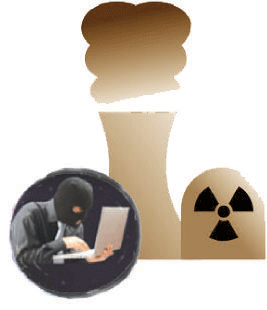
The nuclear consequences of cyber vulnerabilities, https://www.europeanleadershipnetwork.org/commentary/the-nuclear-consequences-of-cyber-vulnerabilities/ Wilfred Wan |Researcher at the United Nations Institute for Disarmament Research (UNIDIR), 29 Nov 21,
A recent report about a massive cyber surveillance campaign allegedly conducted by Russian intelligence against US government agencies reflects disturbing trends in cyberspace. The number of reported data breaches in 2021 is on pace to set a record, with government entities constituting the most targeted sector, and global supply chains increasingly impacted. The planning and sophistication that characterizes some of these operations in recent years also suggest more frequent State-level involvement, underlining the fact that cyber—or information security—capabilities increasingly constitute part of national strategic toolkits.
Operations in cyberspace have also targeted elements of the nuclear weapons enterprise across states. Recent known cases include the discovery in December 2020 of “long duration activity” against the US National Nuclear Security Administration (responsible for the management of the US stockpile), and in April 2021 of operations against a firm linked to the design of Russian nuclear submarines. In neither instance was there any indication that functions related to nuclear weapons systems were impacted.
Yet these revelations should heighten concerns beyond the states targeted, as the existence of these operations could have implications for potential nuclear weapon use. Cyber operations of the kind cited are unlikely to cause detonation events directly. Yet operations that successfully interact with nuclear forces can undermine states’ confidence in their nuclear deterrence capability or credibility, which can trigger forceful military response and even prompt ‘use it or lose it’ nuclear dilemmas. The clearest path to this end involves intrusions into weapons systems themselves. This is not far-fetched. In limited testing with “relatively simple tools and techniques”, the US Department of Defense in 2018 “routinely found mission-critical cyber vulnerabilities” in their weapons systems under development. Other nuclear-armed states are likely to be similarly vulnerable.
Other infringements on deterrence include cyber operations that impact nuclear command, control, and communication. Increased digitalization is likely to create new vulnerabilities, exacerbated by reliance on the supply chain. Even systems isolated from the internet can be compromised. The militarization of cyberspace—and a legacy of Cold War electronic warfare — also raises the possibility that adversaries could now induce the kind of malfunctions (such as erroneous warnings in early warning systems) that in the past have fuelled several nuclear ‘close calls’. Additionally, cyber operations that amplify conventional capabilities to evade radar and air or missile defence may increase nuclear force vulnerability, real or perceived.
The reason why such intrusions may escalate to a scale even beyond the intentions of perpetrators centres on a lack of clarity around so-called cyber ‘red lines’. Several nuclear-armed states have acknowledged the possibility of escalation linked to the cyber domain, or in their nuclear doctrines open the door to use in response to cyber operations. Further precision on thresholds is generally absent, with deliberate ambiguity held in service of deterrence credibility. Yet notions of achievable strategic stability are undermined by the secretive nature of cyber operations, the many potential points of entry for cyber operations, and context-dependent concepts such as ‘critical infrastructure’. Cyber-nuclear interactions open the door for misperception, miscalculation, or misunderstanding.
Reducing cyber-nuclear risks requires preventing interactions between cyber operations and nuclear forces; it also requires mitigating the consequences of interactions when they do take place. Developments in cyber space suggest the potential development of voluntary ‘rules of the road’ that can support the former. Last month the US and Russia submitted a joint resolution to the UN General Assembly (co-sponsored by 104 States) on responsible behaviour in cyberspace. Cyberspace policy also features in ongoing US-Russia strategic stability talks; President Biden in June 2021 had provided President Putin a list of critical infrastructure sectors meant to be “off-limits” from cyber operations. Such negotiations of State behaviours would be significant but would only address part of the risk picture.
It is incumbent on nuclear-armed states to strengthen the cyber security of their weapons and related systems and to elaborate standards across the entirety of their supply chains. Dialogue among nuclear-armed and nuclear-allied states can inform common understandings of risk perceptions, and chip away at the ambiguity around red lines. States can also look to establish guard rails through the conflict-prevention toolkit. In fact, information exchange around cyber military exercises, memorandums of understanding on engagement with communications and radar systems, and political declarations that nuclear command and control lies outside cyber bounds can build a foundation for formal agreements down the line.
Cyber-nuclear interactions are likely to increase given trends in the militarisation of the cyber domain and the digitalisation of nuclear weapons systems. The secrecy across both domains presents significant challenges: not only in their regulation but also to underlining the urgency of the situation and creating the prerequisite momentum for such action. After all, the cyber equivalent of the Cuban Missile Crisis is unlikely to ever play out in public. Yet the very real risk of cyber-nuclear interactions driving inadvertent nuclear war should provide ready incentive for immediate action.
Wilfred Wan is the co-author of a new UNIDIR report on The Cyber-Nuclear Nexus: Interactions and Risks.
France quietly benefiting from the neglect of international commitments to protect the seas from radioactive discharges.

SafeEnergy E Journal No.92. December 21, Radioactive Discharges The OSPAR Convention for the Protection of the North-East Atlantic has discreetly postponed its commitment to reduce radioactive discharges at sea from 2020 to 2050. Following a meeting on October 1st, the participating ministers discreetly postponed until 2050 the commitment made in 1998 in Sintra to reduce radioactive discharges into the sea to levels close to zero by 2020.
Once again, international commitments to the environment are being disregarded. This does not bode well for the upcoming COP26 in Glasgow. France is the first beneficiary of this 30-year postponement because, with its reprocessing plant at La Hague, it has the highest radioactive discharges to the sea in Europe. And these discharges are not decreasing, as shown by the results of the citizen monitoring of radioactivity in the environment carried out by Association pour le Contrôle de la Radioactivité dans l’Oues (ACRO) for over 25 years. (1)
The “Cascais Declaration” signed at a Ministerial Meeting in October 2021 said:“We aim to achieve zero pollution by 2050 and commit to reduce single-use plastic items and maritime related plastic items on our beaches by 50% by 2025 and 75% by 2030. We will take action to eliminate anthropogenic eutrophication and continue to reduce hazardous and radioactive substances to near background levels for naturally occurring substances and close to zero for human made substances.” (2)
Remi Parmentier, who was the lead Greenpeace International campaigner when the Sintra Decalation was signed in 1998 tweeted:
“30 yrs backward presented as progress. The OSPAR Commission is using Orwellian language: “We *aim* to achieve zero pollution by 2050” [“aim”, not “commit”], wiping out the previous target date (agreed in 1998) which was…2020.”
Meanwhile, the NDA is now saying all Magnox reprocessing will be completed in 2022. The Magnox reprocessing plant was expected to close in 2020 before delays caused by Covid. (3
2. OSPAR Cascais Declaration October 2021 https://www.ospar.org/site/assets/files/46205/cascaisdeclaration2021.pdf
3. NDA Mission Progress Report 2021. 4th Nov 2021 https://assets.publishing.service.gov.uk/government/uploads/system/uploads/attachment_data/file/103121https://www.no2nuclearpower.org.uk/wp/wp-content/uploads/2021/11/SafeEnergy_No92.pdf
Europe to pay half for raising Russia’s dangerous sunken submarines, – while Russia builds new ones!

“The sunken submarines K-27 and K-159 are the potential source of contamination of the Arctic, the riskiest ones,”
As Moscow this spring took the Chair of the Arctic Council, the need to lift dangerous nuclear materials from the seabed was highlighted as a priority.
No other places in the world’s oceans have more radioactive and nuclear waste than the Kara Sea.
Europe to pay half … it is a dilemma that international partners are providing financial support to lift old Cold War submarines from the ocean, while Russia gives priority to building new nuclear-powered submarines threatening the security landscape in northern Europe.
EU willing to co-fund lifting of sunken nuclear subs from Arctic seabed https://thebarentsobserver.com/en/nuclear-safety/2021/11/europe-offers-pay-russia-raise-sunken-nuclear-subs The Northern Dimension Environmental Partnership (NDEP) has decided to start a technical review aimed to find a safe way to lift two Cold War submarines from the Barents- and Kara Seas. By Thomas Nilsen
“We are proceeding now,” says a smiling Jari Vilén, Finland’s Ambassador for Barents and Northern Dimension.
Projects aimed to improve nuclear safety are some of the few successful arenas for cooperation still going strong between the European Union and Russia.
“In roughly two years time we will have the understanding on what and how it can be done, what kind of technology has to be used,” Vilén elaborates with reference to the two old Soviet submarines K-159 and K-27, both rusting on the Arctic seabed with highly radioactive spent nuclear fuel elements in their reactors.
Continue readingNuclear Fusion Recedes Into Far Future For The 57th Time
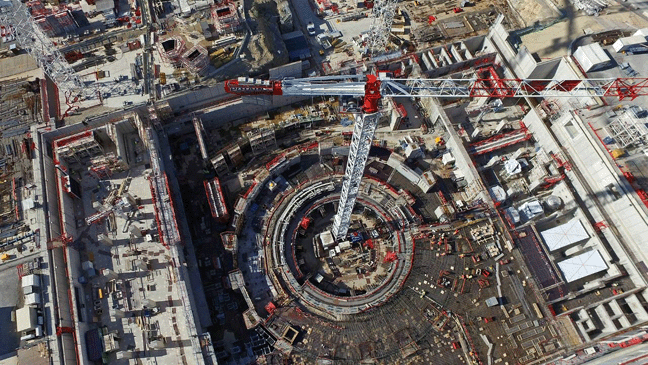
Fusion Recedes Into Far Future For The 57th Time, Clean Technica, Fusion has an amazing future as a source of energy. In space craft beyond the orbit of Jupiter sometime in the next two centuries. By Michael Barnard, November 9, 2021 Fusion has an amazing future as a source of energy. Which is to say, in space craft beyond the orbit of Jupiter, sometime in the next two centuries. Here on Earth? Not so much. At least, that’s my opinion.
Nuclear electrical generation has 2.5 paths. The first is nuclear fission, the part that is the major electrical generation source that provides about 10% of the electricity in the world today.
And then there’s fusion. Where fission splits atoms, fusion merges them. Instead of radioactive fuel, there’s a lot of radioactive emissions from the merging of things like hydrogen-3, deuterium, and tritium that irradiates the containment structures. Lower radioactive waste that doesn’t last as long, but still radioactive waste for those who think that’s a concern…….
fusion generation of electricity, as opposed to big honking nuclear weapons using fusion, is a perpetual source of interest. When Lewis Strauss, then chairman of the United States Atomic Energy Commission, talked about nuclear being “too cheap to meter” in 1954, he was talking about fusion, not fission. Like everyone since the mid-1950s, he assumed that fusion would be generating power in 20 years.
And so here we are, 67 years later. How is fusion doing?
Let’s start with the only credible fusion project on the planet, the ITER Tokamak project. It’s been around for decades. It planted its roots in 1985 with Gorbachev and Reagan. 35 countries are involved. Oddly, ITER isn’t an acronym, it’s Latin for “The Way,” a typically optimistic and indeed somewhat arrogant assumption about its place in the universe.
It’s supposed to light up around 2040. That’s so far away I hadn’t bothered to think much about it, as we have to decarbonize well over 50% of our economy long before that. As a result, I had a lazy read on it. I had assumed, as most press and indeed pretty much everyone involved with it asserted, that it would be generating more energy than it consumed, when it finally lit up…………..
ITER will require about 200 MW of energy input in total running as it creates 500 MW of heat. But the exergy of heat means that if it were tapped, it would only return about 200 MW of electricity. So it might be a perpetual motion machine, but one that wouldn’t do anything more than keep its lights running as long as you fed it tritium, about $140 million worth of the stuff a year.
And it gets worse. ITER is planning at the end of this process to maintain this for less than 3000 seconds at a time. That’s 50 minutes. This is at the end of the process. As they build up to less than an hour, mostly they’ll be working on fusion that lasts five minutes, several times a day. It’s a very expensive physics experiment that will not produce climate-friendly energy. It’s going to teach us a bunch, which I completely respect, but it’s not going to help us deal with climate change.
I expected more from ITER. Not much more. I mean, it is a million-component fission reactor expected to light up in 2040 and not generate any electricity at that point. But I had assumed based on all the press that it would generate more electricity than it used to operate if you bolted a boiler and some turbines to it, even if it were grossly expensive. Apparently not. Just grossly expensive, no net new electricity………..
However, ITER is not the only fusion reactor in the game. There are startups! And we all know startups make no promises that they can’t keep and are excellent at disclosure.
Like Helion. They have a photo-shopped peanut asserting it’s a 6th prototype with regenerative power creation that’s never achieved fusion that is backed by Peter Thiel! It just received $500 million more of VC funding, with an option to get up to $2.2 billion if they hit their targets!
I’m not sure if I could have made up a paragraph less likely to make me think that there was some there there.
The website is likely intentionally lacking in anything approaching detail. It’s low-information and VC friendly, which in the energy space is Thiel’s jam. He’s the guy who, despite being partnered with Elon Musk, has never realized that electrical generation was already being disrupted by wind and solar. His acolytes in startups disrupting energy crashed and burned, because he and they never bothered to do the hard work of understanding how electricity actually works at grid scale. At least Musk was solid on solar, although he got the wrong end of it and hasn’t quite figured that out yet.
While Helion has achieved 100 million degrees Celsius, it’s with a high-energy laser pulse — not new ideas, in fact 1950s ideas, just easier now — and they are incredibly coy about duration. The assumption to be taken is that it lasts for a picosecond at a time. They talk about their prototype having worked for months, but that means it’s maintaining a vacuum and occasionally creating plasma, a precursor to fueled fusion. Many years and tens of millions of dollars in, they are promising the moon, and soon. And to be clear, they are well behind on their initial schedule…………..
fusion generating electricity appears to be as far away as ever. https://cleantechnica.com/2021/11/09/breaking-news-fusion-recedes-into-far-future-for-the-57th-time/
1 This Month

22 June – Virtual Event –Climate Change: New Data, New Debate

Monday, June 22, 2026 2:30 p.m. – 3:15 p.m. CT
YouTube. Register here

Protect Sazan Island from the Trump family! https://secure.avaaz.org/campaign/en/protect_sazan_island_from_the_trump_family_loc/?bqFCVab&v=174511&cl=22707147157&_checksum=5e9dde668860e8231c33699735e16a1fbf22ab2cb01da50c999fe8732b9775ef&utm_source=email&utm_medium=blast_email&utm_campaign=174511
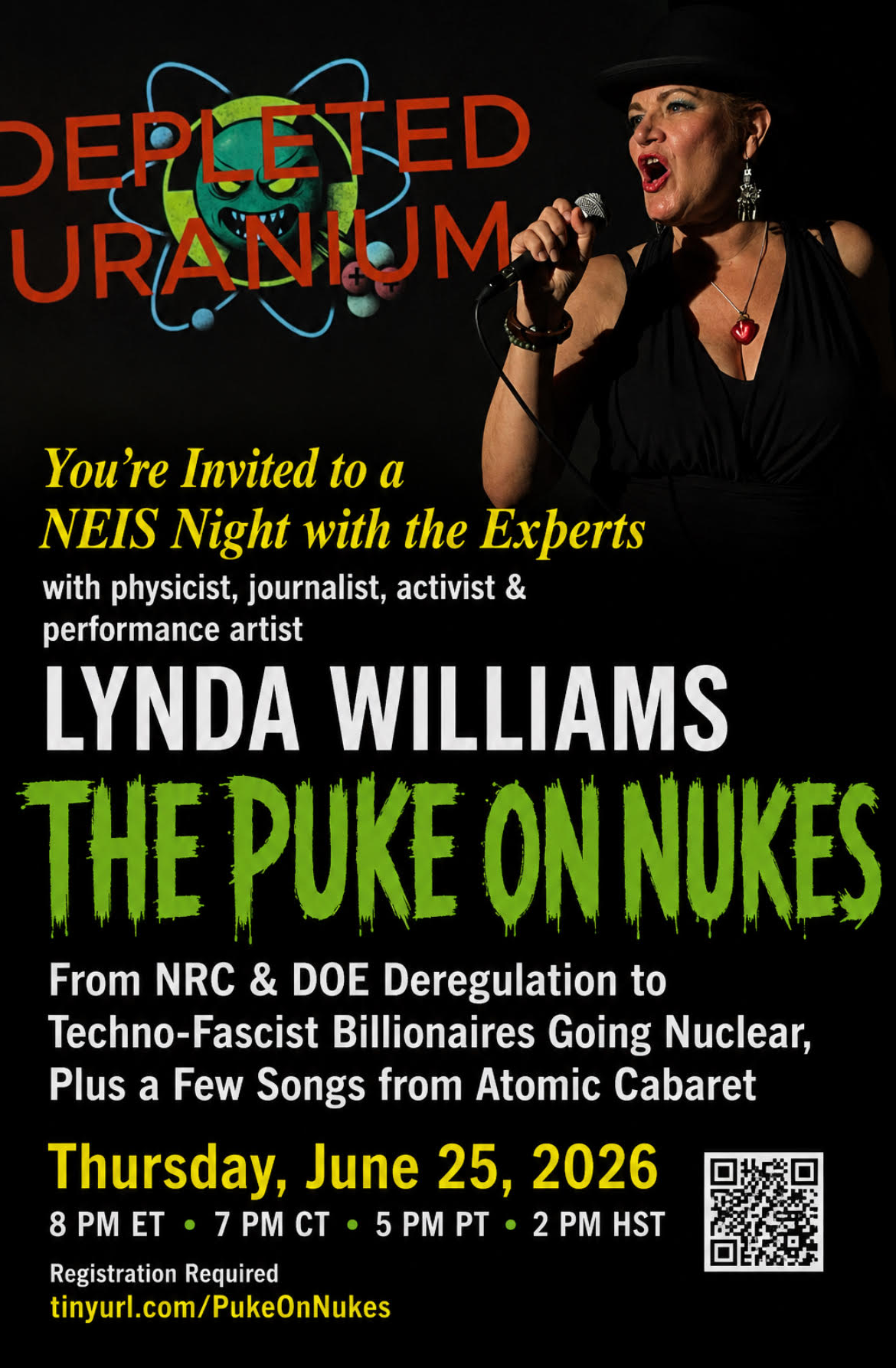
25 June- THE PUKE ON NUKES
Thursday, June 25, 2026
7pm Central Time (8pm ET, 6pm MT, 5pm PT) UTC – 5
From NRC & DOE Deregulation to Techno-Fascist Billionaires Going Nuclear, Plus a Few Songs from Atomic Cabaret REGISTER
26 June – Radiation Trainwreck at the NRC / Join the Protect Better Campaign – https://us02web.zoom.us/meeting/register/4ZlZ5_qLSHGiLSCg8FF6Bg#/registration


Cuba Is Not a Failed State – It Is a Besieged State
PETITION: “Global Appeal to Endorse Palestinian Right of Return of Refugees”
To see nuclear-related stories in greater depth and intensity – go to https://nuclearinformation.wordpress.com
-
Archives
- June 2026 (193)
- May 2026 (306)
- April 2026 (356)
- March 2026 (251)
- February 2026 (268)
- January 2026 (308)
- December 2025 (358)
- November 2025 (359)
- October 2025 (376)
- September 2025 (257)
- August 2025 (319)
- July 2025 (230)
-
Categories
- 1
- 1 NUCLEAR ISSUES
- business and costs
- climate change
- culture and arts
- ENERGY
- environment
- health
- history
- indigenous issues
- Legal
- marketing of nuclear
- media
- opposition to nuclear
- PERSONAL STORIES
- politics
- politics international
- Religion and ethics
- safety
- secrets,lies and civil liberties
- spinbuster
- technology
- Uranium
- wastes
- weapons and war
- Women
- 2 WORLD
- ACTION
- AFRICA
- Atrocities
- AUSTRALIA
- Christina's notes
- Christina's themes
- culture and arts
- Events
- Fuk 2022
- Fuk 2023
- Fukushima 2017
- Fukushima 2018
- fukushima 2019
- Fukushima 2020
- Fukushima 2021
- general
- global warming
- Humour (God we need it)
- Nuclear
- RARE EARTHS
- Reference
- resources – print
- Resources -audiovicual
- Weekly Newsletter
- World
- World Nuclear
- YouTube
-
RSS
Entries RSS
Comments RSS
 nuclear-news