Cost of Small Nuclear Reactors is greater than cost of large ones

The many ways in which fracking is radioactively contaminated
Radioactive isotopes that contaminate fracking industry waste and its machinery include radon, radium-226, uranium-238, and thorium-232. According to the Health Department’s website, these long-lived radioactive pollutants come in six forms:
* “Produced water” which is injected underground but later brought to the surface as waste;
* “Sulfate scales,” which are hard, insoluble deposits that accumulate on frack sand and inside drilling and processing equipment;
* Contaminated soil and machinery;
* Filter socks, contaminated by filtering “produced water”;
* Synthetic “proppants” or sand; and
* Sludge and “filter cake” solids of mud, sand, scale and rust that precipitate or are filtered out of contaminated “produced water. They build up in “filter socks,” and in waste water pipes and storage tanks that can leak
Fracking Radiation- North Dakota Considers Weaker Landfill Rules, Less Oversight , CounterPunch, MARCH 19, 201 by JOHN LaFORGE Radioactive waste produced by hydraulic fracturing or “fracking” is making headlines all over gas land, particularly in North Dakota’s booming Bakken gas and oil field. Continue reading
Nuclear regulatory Commission deceives on nuclear radionuclides
 US NRC Radioactive Dilute and Deceive Scam – Comment Deadline June 22nd (Extended) Mining Awareness Plus, 18 Mar 15 US NRC Comment Deadline extended to 22 June 2015:https://www.federalregister.gov/articles/2014/11/20/2014-27519/radiation-protection http://www.regulations.gov/#!documentDetail;D=NRC-2009-0279-0098
The most strange and deadly scam, which the US NRC is running, is the dilute to deceive scam, where they actually tell the nuclear industry (and labs) that if they dilute the radionuclides with a certain amount of water (or air), then it is ok to put it into the rivers, ocean, air and even into regular sewerage drains! This is what they call “effluent concentration”. Even then the amounts allowed exceed amounts allowed under the EPA’s Clean Water Act, though it doesn’t really matter because what matters is how much radionuclide is actually emitted into the environment and how many months, years, decades, centuries, it’s going to stay there.
So, now it is easy to see that the following question by the NRC is meaningless BS. The actual amounts – not concentration – of the various radionuclides must be modelled. And, how long they stay in the environment:
“Q1-3: How should the calculations of effluent concentration, currently in the 10 CFR part 20 radiation protection regulations, be modified to reflect advances in modeling that are now available? In particular, the NRC is interested in preliminary views on the age and gender averaged approach.”
What the F(ukushima Daiichi) would age and gender averaged approach mean? Assuming they were speaking of actual amounts, then the amounts should be “appropriate” for the most fragile. If you are considering age and gender then the fragile must be considered – period. There is no average! Fragility varies according to disease. But, until they start modeling for actual emissions and actual half-life of the radionuclides, then it is meaningless. Half-life in the body is also meaningless because at some point the body will enter steady-state with the environment. And, actually the “appropriate” amount of exposure is none.
Here’s another crazy NRC question “Q1-4: Should the public dose limit of 0.5 mSv (50 mrem) continue to be the basis for the effluent concentration limits for the radionuclides in 10 CFR part 20, appendix B, Table 2, Columns 1 and 2? Should it be reduced or otherwise modified?”
As noted above, effluent concentrations are a dilute to deceive scam. What matters is the amounts and not the concentration. 10 CFR part 20, appendix B, Table 2 should be modified to reflect actual amounts allowed and not concentrations. And, really, any short-lived radionuclides should be contained until they are no longer radioactive, and long-lived radionuclides should never be emitted at all.
It’s not clear where they are getting the 0.5 mSv from. On the NRC web site 1 mSv per year is mentioned. Is this right or wrong? The US EPA has a standard of 0.25 mSv for the body and 0.75 mSv for the thyroid. The ICRP 103 (2007) which they pretend to be coming up to speed with has a dose constraint of less than or equal to 0.1 mSv per year where “prolonged component from long-lived nuclides” (p. 116)
How many cancers will there be in a lifetime from the 1 mSv per year proposed by the US NRC? According to National Academy of Sciences BEIR report, it would be 1 (or more) per 100 people. The ICRP has it at about 0.55 which would round up to one. However, this is assuming that the 1 mSv per year is new, whereas the radionuclides will be building up in the environment and even in the body. If half of the 1mSv emitted were short lived, the next year there would still be 1 mSv emitted plus 0.5 mSv (half) already emitted. Some of the radionuclides (cesium and strontium) have half-lives of about 30 years; other radionuclides like plutonium-americium in the 100s or 1000s of years: “The half-life of plutonium-239 is 24,065 years. This half-life is short enough that 1 microgram of material will undergo more than 2000 decay events per second, but it is long enough to allow that microgram to decay at an approximately constant rate for thousands of years. If plutonium had uranium’s half-life of 4 billion years, there would be so few decays over the span of a human’s lifetime that the radiological toxicity of plutonium would be much less severe. [3] However, that is not the case… [3 Uranium is also much more soluble than plutonium and leaves the body rapidly.]” Los Alamos Science Number 26 2000, p. 78 (That’s straight from the heart of the beast – Los Alamos Nuclear Lab – hardly anti-nuclear!)
Plutonium 241 has a half life of 14 years, which is used to trick people since it becomes more dangerous 241 Americium with a half life of around 432 years.
Furthermore, BEIR is based on low-LET external, radiation. ICRP appears more appropriate for low-LET, as well. ICRP inappropriately lumps medical radiology and the nuclear industry together. BEIR is excluding more dangerous high-LET and internal radiation in their calculation. However, they recognize high LET such as alpha and neutrons as more dangerous. Most of the ICRP research would seem to be based on either external or very short-lived internal low LET radiation. While they are supposed to add weighting factors for high LET and amount of time spent in the body, it’s difficult to see if they can or will add enough weighting factors to thoroughly account for plutonium and americium, which even in a totally clean environment would stay in the body for a lifetime. It takes 20 to 50 years to excrete one half of them, in a clean environment. Furthermore, the US gov has at least one so-called expert who has messed up the formula, making more radiation safer and less more dangerous! Then he’s prancing around the world as an “expert”:https://miningawareness.wordpress.com/2014/07/31/nuclear-effective-dose-radiation-icrp-vs-us-epa/ (This topic is important for the March 24th deadline too.) To err is human, but there is no room for blunders with something so dangerous as radiation, especially not gross blunders………https://miningawareness.wordpress.com/2015/03/18/us-nrc-radioactive-dilute-and-deceive-scam-comment-deadline-march-24th/
Cesium -137 – a particularly dangerous nuclear isotope
 Note the immense inventories of Cesium-137: 150 million Curies that are located in the nearby spent fuel pool at Indian Point Nuclear Power Plant which is about 40 miles from here by road and less than that as the radioactive cloud flies. Many of the 104 US commercial nuclear reactors and power plants have more than 100 million Curies of Cesium-137 in their spent fuel pools. This is many times more than in the spent pools at Fukushima
 The Implications of The Massive Contamination of Japan With Radioactive Cesium
  Steven Starr
Senior Scientist, Physicians for Social Responsibility
Director, University of Missouri, Clinical Laboratory Science Program
Helen Caldicott Foundation Fukushima Symposium
New York Academy of Medicine, 11 March 2013 “….. A large number of highly radioactive isotopes released by the destruction of the Fukushima Daiichi nuclear power plant grossly contaminated the Japanese mainland. Most of these radionuclides had short half lives which meant they would essentially disappear in a matter of days or months. For many of those who were exposed to them there will be major health consequences.
However, there were some radioactive elements that will not rapidly disappear. And it is these long-lived radionuclides that will remain to negatively affect the health of all complex life forms that are exposed to them.
 Chief among them is Cesium-137, which has taken on special significance because it is has proven to be the most abundant of the long-lived radionuclides that has remained in the environment following the nuclear disasters at Chernobyl and Fukushima. It has a 30 year radioactive half life which is why it persists in the environment. Scientists now believe that it will be 180 to 320 years before the Cesium-137 around the destroyed Chernobyl reactor actually disappears from the environment.
Cesium is water soluble and quickly makes its way into soils and waters. It is in the same atomic family as potassium and it mimics it, acting as a macronutrient. It quickly becomes ubiquitous in contaminated ecosystems.
It is distributed by the catastrophic accidents at nuclear power plants because large quantities of volatile radioactive cesium build up inside the fuel rods of nuclear reactors. Thus any accident at a nuclear reactor that causes the fuel rods to rupture, melt, or burn will cause the release of highly radioactive cesium gas.
Long-lived radionuclides such as Cesium-137 are something new to us as a species. They did not exist on Earth in any appreciable quantities during the entire evolution of complex life. Although they are invisible to our senses they are millions of times more poisonous than most of the common poisons we are familiar with. They cause cancer, leukemia, genetic mutations, birth defects, malformations, and abortions at concentrations almost below human recognition and comprehension. They are lethal at the atomic or molecular level. Continue reading
Greater cancer risk for girls – radioactive fallout from Fukushima
it is very important that we recognize the danger posed to children by the routine ingestion of contaminated food with Cesium-137 where ever they might live. It is also important to prevent further nuclear disasters which release these fiendishly toxic poisons into the global ecosystems. Given the immense amounts of long-lived radionuclides which exist at every nuclear power plant this is an urgent task.
The Implications of The Massive Contamination of Japan With Radioactive Cesium [excellent slides and graphs]
Steven Starr
Senior Scientist, Physicians for Social Responsibility
Director, University of Missouri, Clinical Laboratory Science Program
Helen Caldicott Foundation Fukushima Symposium New York Academy of Medicine, 11 March 2013 “……..So now that we have some idea of the extreme toxicity of Cesium-137, let’s look at the extent of the contamination of the Japanese mainland.
It is now known that the reactors 1, 2, and 3 at Fukushima Daiichi all melted down and melted through the steel reactor vessels within a few days following the earthquake and tsunami of March 11, 2011. This was not made public by either TEPCO or the Japanese government for two months.
The greatest amounts of highly radioactive gases were released shortly after the meltdowns and 80% of this gas released by the reactors is believed to have traveled away from Japan over the Pacific. However the remaining 20% was dispersed over the Japanese mainland.
On March 11th, the US National Nuclear Security Administration offered the use of its NA-42 Aerial Measuring System to the Japanese and US governments. The National Atmospheric Release Advisory Center of the Lawrence Livermore Lab stood up to provide atmospheric modeling projections. The next two slides were produced by Lawrence Livermore and presumably given to the Japanese government.
On March 14th, the easterly winds which had been blowing the highly-radioactive gases and aerosols coming from Fukushima out to sea, shifted and pushed the radioactive plume back over the Japanese mainland. You can see the progression. The red indicates the radioactive plume.
Note that the images indicate that the plume first went south over Tokyo and then reversed and went north as the wind changed. All the areas where the radioactive gases passed over were contaminated. However the heaviest contamination occurred where rainfall was occurring and the radiation rained out. This accounts for the patchy deposition of the radioactive fallout.
Eight months after the disaster, the Japanese Science Ministry released this map, which shows that 11,580 square miles, which is 30,000 square kilometers, which represents 13% of the Japanese mainland, had been contaminated with long-lived radioactive cesium. Note that the official map does not note any Cesium-137 contamination in the Tokyo metropolitan area, unlike an unofficial survey done at about the same time by Professor Yukio Hayakawa of Gunma University. Given the fact that the Japanese government and TEPCO denied for two months that any meltdowns had occurred at Fukushima, one must look at all official data with a healthy degree of skepticism.
4500 square miles (or earlier today we heard 7700 square miles)—which is an area larger than the size of Connecticut—was found to have radiation levels that exceeded Japan’s previously allowable exposure rate of 1 millisievert per year.
Rather than evacuate this area, Japan chose to raise its acceptable radiation-exposure rate by 20 times, from 1 millisievert to 20 millisieverts per year.
However, approximately 300 square miles adjacent to the destroyed Fukushima reactors were so contaminated that they were declared uninhabitable. 159,000 Japanese were evicted from this radioactive “exclusion zone.” They lost their homes, property, and businesses, and most have received only a small compensation to cover the costs of their living as evacuees.
Note here that the criteria used for evacuation is the millisievert. It is not a measured quantity of radiation per unit area that I have described such as the Curie or Becquerel. Rather the Sievert is a calculated quantity. It’s calculated to represent the biological effects of ionizing radiation. In other words, the millisievert is a derived number, based on the mathematical models which are used to convert the absorbed dose to “effective dose.”
So what is the increased health risk to Japanese based upon their exposure to 20 millisieverts per year? Let us examine figures constructed on the basis of data published by the National Academy of Sciences, courtesy of Ian Goddard.
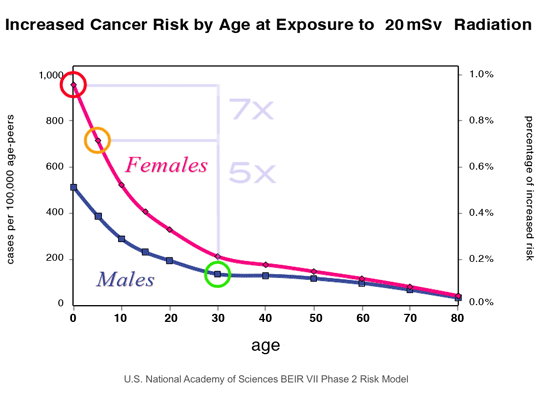
The vertical Y-axis is calibrated to the number of cancer cases per 100,000 age-peers, and the horizontal X-axis depicts the age of the population, beginning at zero years and moving towards old age. Now examine the allegedly safe dose of 20 millisieverts per year.
As a result of this exposure, there will be about 1000 additional cases of cancer in female infants and 500 cases of cancer in infant boys per 100,000 in their age groups. There will be an additional 100 cases of cancer in 30 year old males per 100,000 in this age peer group.
Notice that children, especially girls, are at the most risk from radiation-induced cancer. In fact a female infant has 7 times greater risk and a 5 year old girl has 5 times greater risk of getting a radiation-induced cancer than does a 30 year old man. Continue reading
Depleted uranium for Utah – mind boggling scenario
 Will Utah bury nation’s leftover depleted uranium?
 The Utah Department of Environmental Quality just received this week additional information from EnergySolutions related to potential erosion and other “deep time” problems suspected to impact its Tooele County disposal site, pushing back the start of a public review to April 13.
Helge Gabert, project manager for the state on the depleted uranium issue, said the requested information was about a month late. It was submitted Wednesday for review. It will be incorporated into a subsequent analysis or safety evaluation that the agency will release for public comment about a week beyond its earlier time frame.
In addition, a pair of public meetings will be held the week of May 4, with a decision on disposal due July 1 from Rusty Lundberg, director of the Utah Division of Radiation Control.
To take the nation’s leftovers of 750,000 metric tons of depleted uranium, EnergySolutions has to first convince Utah regulators that its site will be safe for 10,000 years. Beyond that, it has to prove that the threat to public health will be minimal in the advent of a return of a Lake Bonneville or other “deep time geologic events” over 2.1 million years.
It is a mind boggling scenario, planning for all manner of circumstances that could play out, modeling time and performance over such an extended period that it is difficult to grasp.
EnergySolutions must account for the farmer who wanders onto the disposal site, unaware of the radiological hazard underneath his feet. Or the burrowing rodent that could cause vulnerabilities to the at-grade disposal site.
The company must try to figure out how the wind will deposit the sand, how dunes will form and when the lake returns — as some say it inevitably will — how the water might disperse the radiological hazard from an anticipated breach of the disposal barrier.
Such planning is something Utah is requiring because of the unique nature of depleted uranium, which is the byproduct of the uranium enrichment process for nuclear fuel. While depleted uranium has commercial applications, such as antitank armaments, demand for it is far outpaced by the amount that is generated. The U.S. Department of Energy has responsibility for its disposal.
Depleted uranium gets more radioactive as its isotopes try to get back to their natural state, and as these “daughter products” break down, they not only multiply, but increase in intensity.
The instability that occurs in the decay process occurs over 2.1 million years, with what was once classified as “low-level” radioactive waste breaching Utah-imposed limits on what is allowed to be buried in the state.
Gabert said there is no question that by 40,000 years, depleted uranium will violate the state’s prohibition on anything “hotter” than Class A waste, so it becomes a policy issue for current regulators to decide if its disposal is acceptable in the here and now.
“You could argue why does not the state just make the decision based on the science, but we have not made that. We are willing to hear out what the facility has to say,” Gabert said.
The deep time analysis looks in particular if the threat will be mitigated enough — if the doses of radioactivity would be diluted to the degree that even exposure to a higher “category” of waste would not cause harm.
Critics of the EnergySolutions’ proposal to dispose of the depleted uranium say no amount of assurances or analysis can safeguard human health given the sheer amount of unknowns.
Nuclear wastes out of control? Fukushima’s bags of radioactive trash pile up
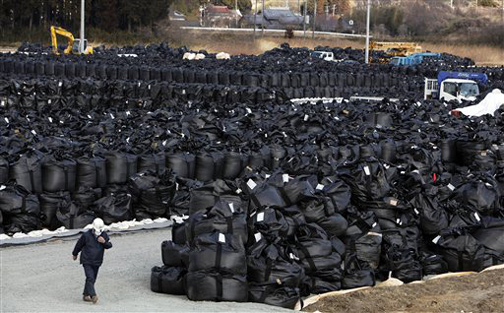
The fruits of the laborers’ efforts are stacked in those giant sacks—5.5 million of them and counting. They are spread out across Fukushima province, along roadsides, in parking lots and backyards. They are tagged and bar-coded so authorities know what’s inside and how radioactive it is – and when the bags might start to wear out.
As the bags pile up and workers fan out across the landscape, some locals are questioning the cost-benefit analysis.
Fukushima nuclear plant cleanup has cost $13 billion and counting After 4 years, Fukushima nuclear cleanup remains daunting, vast LA Times, By JULIE MAKINEN contact the reporter 12 Mar 15 “…..Karimata is in charge of the work here in an evacuation zone about 12 miles north of the Fukushima Dai-ichi nuclear plant—part of the most extensive, and expensive, nuclear cleanup ever attempted.
The scale and complexity of what Japan is trying to do in the aftermath of the 2011 meltdown at Fukushima is mind-boggling. Decontamination plans are being executed for 105 cities, towns and villages affected by the accident at Fukusima Dai-ichi, 140 miles northeast of Tokyo.
Many Japanese regard this massive undertaking as a solemn obligation to right a terrible wrong. Others, even some of the people directly affected, question whether it’s a quixotic waste of resources.
Karimata’s delegation marches up a side street to check on a brigade of laborers wearing gloves, masks, helmets and fluorescent vests with radiation detectors tucked in their chest pockets. Some are spreading fresh soil in the yard of an uninhabited home. Next door, workers are up on a scaffold, preparing to wipe down the roof and gutters.
Across the street, near a bamboo grove, two men are erecting a plastic frame to support a massive double-lined garbage bag about the size of a hot tub. Dozens of identical black sacks, each weighing about a ton and stuffed with radiation-contaminated soil, leaves, wood chippings and other debris, stretch out behind them, awaiting transport at some uncertain date to a yet-unspecified final resting place.
Four years after the Great Tohoku Earthquake shook northern Japan to its core, touched off a deadly tsunami and precipitated the Fukushima Dai-ichi disaster, hundreds of square miles remain off-limits for habitation due to radioactivity. Some 79,000 people still cannot return home.
But unlike the 1986 accident at Chernobyl, where authorities simply declared a 1,000 square-mile no-habitation zone, resettled 350,000 people and essentially decided to let the radiation dissipate over decades or centuries, Japan is attempting to make the Fukushima region livable again. It is an unprecedented effort.
The sheer manpower and money dedicated to the house-to-house effort is staggering: Continue reading
U.S. news media coverage of the Fukushima disaster largely minimized health risks to the general population.
 News coverage of Fukushima disaster minimized health risks to general population http://www.sciencedaily.com/releases/2015/03/150311124202.htm March 11, 2015 Source: American University
A new analysis by American University sociology professor Celine Marie Pascale finds that U.S. news media coverage of the disaster largely minimized health risks to the general population. Pascale analyzed more than 2,000 news articles from four major U.S. outlets following the disaster’s occurrence March 11, 2011 through the second anniversary on March 11, 2013. Only 6 percent of the coverage — 129 articles — focused on health risks to the public in Japan or elsewhere. Human risks were framed, instead, in terms of workers in the disabled nuclear plant.
Disproportionate access
“It’s shocking to see how few articles discussed risk to the general population, and when they did, they typically characterized risk as low,” said Pascale, who studies the social construction of risk and meanings of risk in the 21st century. “We see articles in prestigious news outlets claiming that radioactivity from cosmic rays and rocks is more dangerous than the radiation emanating from the collapsing Fukushima Daiichi nuclear plant.”
Pascale studied news articles, editorials, and letters from two newspapers, The Washington Post and The New York Times, and two nationally prominent online news sites, Politico and The Huffington Post. These four media outlets are not only among the most prominent in the United States, they are also among the most cited by television news and talk shows, by other newspapers and blogs and are often taken up in social media, Pascale said. In this sense, she added, understanding how risk is constructed in media gives insight into how national concerns and conversations get framed.
Pascale’s analysis identified three primary ways in which the news outlets minimized the risk posed by radioactive contamination to the general population. Articles made comparisons to mundane, low-level forms of radiation;defined the risks as unknowable, given the lack of long-term studies; and largely excluded concerns expressed by experts and residents who challenged the dominant narrative.
The research shows that corporations and government agencies had disproportionate access to framing the event in the media, Pascale says. Even years after the disaster, government and corporate spokespersons constituted the majority of voices published. News accounts about local impact — for example, parents organizing to protect their children from radiation in school lunches — were also scarce.
Globalization of risk
Pascale says her findings show the need for the public to be critical consumers of news; expert knowledge can be used to create misinformation and uncertainty — especially in the information vacuums that arise during disasters.
“The mainstream media — in print and online — did little to report on health risks to the general population or to challenge the narratives of public officials and their experts,” Pascale said. “Discourses of the risks surrounding disasters are political struggles to control the presence and meaning of events and their consequences. How knowledge about disasters is reported can have more to do with relations of power than it does with the material consequences to people’s lives.”
While it is clear that the Fukushima Daiichi nuclear meltdown was a consequence of an earthquake and tsunami, like all disasters, it was also the result of political, economic and social choices that created or exacerbated broad-scale risks. In the 21st century, there’s an increasing “globalization of risk,” Pascale argues. Major disasters have potentially large-scale and long-term consequences for people, environments, and economies.
“People’s understanding of disasters will continue to be constructed by media. How media members frame the presence of risk and the nature of disaster matters,” she said.
Story Source:
The above story is based on materials provided by American University. The original article was written by Rebecca Basu. Note: Materials may be edited for content and length.
Japan must face the problems and politics of demolishing dead nuclear reactors
Questions remain over future plan for Japan’s aging nuclear plants Japan Times, 12 Mar 15 BY ERIC JOHNSTON As the debate about what to do with Japan’s aging nuclear reactors intensifies, questions remain about the ramifications of decommissioning plants, and how to tear down the facilities in a way that’s efficient, affordable, safe, and that has the support of the local community.
In the United Kingdom, these concerns formed the basis of a policy that has led to the decommission of numerous power stations, two of which began operating in the 1950s……
Seven of Japan’s 48 commercial reactors are at least 40 years old — in principle their maximum operating life. Another five are at least 35 years old and their fate will have to be decided within the next few years.
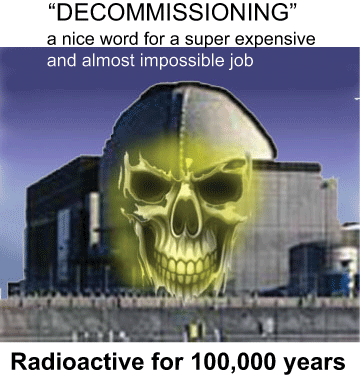
Kyushu Electric plans to decommission the 40-year-old Genkai No. 1 plant, while Kepco is expected to shut down the Mihama No. 1 and 2 reactors, both of which are over 40 years old. Chugoku Electric plans to decommission the 41-year-old Shimane No. 1 reactor, while the Tsuruga No. 1 reactor, which is 45 years old and run by Japan Atomic Power, will be closed.
Decommissioning a plant is a decades-long process that does not necessarily immediately involve the most crucial step of tearing down the reactors and hauling away radioactive material.
“During the decommissioning of the Berkeley power station in southwest England, we’ve left the reactor building standing because it’s safer to remove the nuclear material in another 60 years,” Franklin said. “We’ve closed the doors on the reactor building until 2074.”
However, he acknowledged publicly visible gestures were important because they could help reassure local communities that the plant was actually being dismantled.
“A skyline change helps garner support for the decommissioning process and for difficult decisions, such as not tearing down and hauling away nuclear materials in reactor buildings,” he said.
“In one case, we destroyed the plant’s cooling towers, which were not actually a major hazard but could be seen for miles. If you live nearby and you see them come down, you feel progress is being made, and that’s more effective than simply telling people about the progress.”
Perhaps the biggest lesson the U.K. learned was that effective decommissioning starts with addressing the corporate and bureaucratic culture at a nuclear plant.
“Changing your culture from making something — electricity — to actually taking power stations down requires a huge cultural change on a nuclear site. That’s something we’re really working on sharing with Japanese nuclear operators,” Franklin said. http://www.japantimes.co.jp/news/2015/03/11/national/questions-remain-over-future-plan-for-japans-aging-nuclear-plants/#.VQH9CNKUcnk
Halliburton & Co used fracking to Inject Nuclear Waste Underground for Decades
Shock: Fracking Used to Inject Nuclear Waste Underground for Decades By Aaron Dykes and Melissa Melton Global Research, March 06, 2015 Activist Post 5 March 2015 Unearthed articles from the 1960s detail how nuclear waste was buried beneath the Earth’s surface by Halliburton & Co. for decades as a means of disposing the by-products of post-World War II atomic energy production.
Fracking is already a controversial practice on its face; allowing U.S. industries to inject slurries of toxic, potentially carcinogenic compounds deep beneath the planet’s surface — as a means of “see no evil” waste disposal — already sounds ridiculous, dangerous, and stupid anyway without even going into further detail.Alleged fracking links to the contamination of the public water supply and critical aquifers, as well as ties to earthquake upticks near drilling locations that are otherwise not prone to seismic activity have created uproar in the years since the 2005 “Cheney loophole,” which allowed the industry to circumvent the Safe Drinking Water Act by exempting fracking fluids, thus fast tracking shale fracking as a source of cheap natural gas.
Now, it is apparent that the fracking industry is also privy to many secrets of the nuclear energy industry and, specifically, where the bodies are buried, err… dangerous nuclear waste is buried, rather — waste that atomic researchers have otherwise found so difficult to eliminate. Continue reading
Radionuclides from Fukushima found in fish at long distances
 Report: Fukushima fallout detected in U.S. fish — Dose equal to samples caught 100 miles from plant — Persistently high levels detected in marine life offshore “not anticipated… orders of magnitude” more than expected — “Measurements needed… along predicted plume trajectory” http://enenews.com/report-fallout-japan-reactors-detected-freshwater-fish-radioactive-dose-equivalent-fish-caught-100-miles-fukushima-reactors-ongoing-measurements-needed-along-predicted-plume-trajectory
Excerpts from ‘Radiological Dose Rates to Marine Fish from the Fukushima Daiichi Accident: The First Three Years Across the North Pacific’, includes authors from Japan’s National Institute of Radiological Sciences and Oregon St. Univ., 2015 (emphasis added):
- A more complete record is emerging of radionuclide measurements in fish [from]across the Pacific… Fish 100–200 km east of [Fukushima], coastal fish in the Aleutian Islands… and trans-Pacific migratory species, all had increased dose rates as a consequence of the FDNPP accident.
- FDNPP produced the largest single-event influx of radioactive cesium isotopes into the Pacific [137Cs up to 90 PBq; Chernobyl total: 70-85 PBq].
- Dose rates to the most impacted fish species near the FDNPP have remained above benchmark levels for potential dose effects at least three years longer than was indicated by previous, data-limited, evaluations.
- [Strontium-90] was estimated to contribute up to approximately one-half of the total 2013 dose rate to fish near the FDNPP.
- Evaluations… suggested that the dose rates to fish near the FDNPP… only briefly remained above the benchmark levels for potential harmful effects… However, subsequent data have indicated highly elevated and persistent accumulation of Cs.
- Maximally exposed fish near the FDNPP [had] an increase of more than six orders of magnitude… The elevated activity concentrations were not isolated to one sample, or one species. In 2013, activity concentrations of 134,137Cs exceeding [100,000 Bq] kg were measured in more than 100 fish from ten species sampled from FDNPP port… concentrations in [some species] are orders of magnitude higher than predicted.
- Some of the released radionuclides are being carried long distances…
- At Amchitka Island [in Alaska] the 134,137Cs dose rates to [greenling and rockfish] were only slightly higher than pre-event levels… The increase… appears to be due to atmospheric transport from Fukushima as 134Cs was measured… in freshwater fish[11 Bq/kg in trout].
- Detections of 134Cs in California water samples gathered in August 2014… suggest incremental dose rate increases to resident fish.
- Fish at 100–200 km east of the FDNPP, coastal fish in the Aleutian Islands, and trans-Pacific migratory species all had increased dose rates.
- Persistence of the radionuclides in fish was not anticipated by existing models…ongoing measurements are needed at locations near the FDNPP and further along the predicted plume trajectory… Some areas that have experienced air deposition in 2011 (e.g. Aleutian Islands), should continue monitoring as they may experience a second arrival of 134,137Cs in subsequent years via an oceanic plume.
- This study was in collaboration with the… IAEA
One way to dispose of SOME of the nuclear waste burden
 Can’t We Just Throw Our Nuclear Waste Down A Deep Hole? http://www.forbes.com/sites/jamesconca/2015/03/05/cant-we-just-throw-our-nuclear-waste-down-a-deep-hole/ James Conca 5 Mar 15 Um…yes, we can. It’s called Deep Borehole Disposal and is pretty easy for some nuclear waste. Especially some highly radioactive materials that have sat in some fairly small capsules for almost 40 years.
This was exactly the topic of discussion in Washington this week when Secretary of Energy Ernest Moniz answered questions from Rep. Dan Newhouse (R-WA) at a House Science, Space and Technology committee hearing (Tri-City Herald).
The answer from Moniz was positive. He discussed a pilot project that would demonstrate the idea of deep borehole disposal using these capsules.
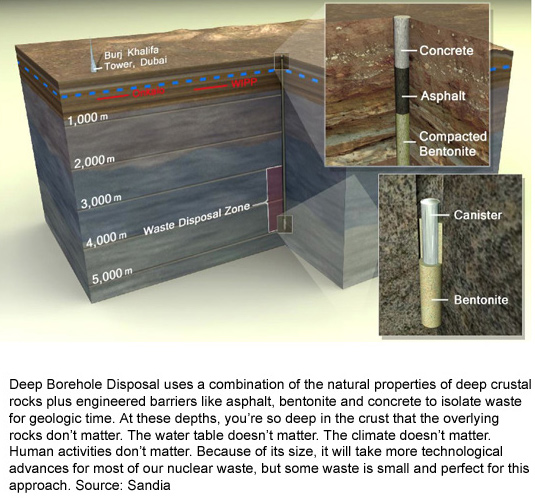
Deep borehole disposal is simple. Drill a very deep hole – 3 miles or so – put the waste in it and fill it up with some special layers, but mainly crushed rock and cement. As geologists, we know how many millions of years it takes for anything to get up from that depth in the Earth’s crust.
As long as you don’t put it under an active volcano!
The nice thing about deep borehole disposal is that it doesn’t matter where you put it in the country. At that depth, you’re so deep in the crust that the overlying rocks don’t matter. The water table doesn’t matter. The climate doesn’t matter. Human activities don’t matter.
But why these capsules? Because the material, cesium-137 and strontium-90 chloride salts (137CsCl and 90SrCl2), is in an easy waste form compared to that sludgy gooey stuff that makes up most of the tank waste left over from weapons production. These capsules are dry solid material in relatively small containers – less than 3-inches in diameter and only 2-feet long – very small compared to the large spent fuel assemblies and high-level waste glass logs usually discussed in geologic disposal plans.
Deep borehole disposal for the larger waste containers is trickier and more expensive because we haven’t yet drilled large-diameter holes that deep. Like all technological advances, we will (Sandia National Labs; Ethan Bates et al 2014). But these capsules are less than 3-inches wide, and we’ve drilled 6 and 8 inch holes that deep many times, so nothing really new needs to be developed for this project.
There are 1,936 capsules filled with radioactive 137CsCl and 90SrCl2 that are stored underwater at the Waste Encapsulation Storage Facility at DOE’s Hanford site in Washington State. Because these radionuclides, left over from plutonium production for weapons, are the primary heat-generator in nuclear waste, they were separated from the rest of the waste almost 40 years ago to reduce heat in the tanks, as well as to use in research.
But there is a time-sensitive nature to these capsules. Although CsCl doesn’t melt until 645°C (1,193°F), it goes through a bizarre solid-state phase change at 450°C (842°F). This means that without melting it’s atoms change their arrangement in space from one structure to another with a very different density. So as the temperature changes across this boundary, the material swells and shrinks. And that tends to degrade the containers it’s in.
The existing containers are beginning to get a little degraded, so best to get rid of them as soon as possible. They’re small, so deep borehole disposal would be cheap and easy.
Since there isn’t much of this boutique nuclear waste, only 5 cubic yards, and it’s in a great form, this is a perfect opportunity to demonstrate deep borehole disposal and clean out this facility.
Like all really hot nuclear waste, these capsules were destined for the proposed deep geologic nuclear waste repository at Yucca Mountain, Nevada, which was halted in 2010. Since a new permanent federal repository for high-level waste won’t be chosen for decades, we need to rethink our nuclear disposal program.
And this is a good idea, one of the few looked at by thePresident’s Blue Ribbon Commission on America’s Nuclear Future that was formed to come up with a new strategy in the wake of Yucca Mountain’s closure. Their recommendations were basically to pick disposal options suited to the waste and the need. And to get everyone to buy off on them before you start!
These capsules “could be very well suited perhaps for much earlier disposal through a borehole approach,” Moniz said. “We have to drill — we have to do the demonstration project, do the science, which is what we want to do in 2016.”
Budget proposal documents show $2 million for technology development to support plans in fiscal 2016 for what is anticipated to be a multi-year test using a non-radioactive waste substitute. Since Yucca Mountain was projected to cost over $200 billion, this is a steal.
The test would demonstrate technology for sealing the borehole, tools to characterize waste in the borehole and controls on waste isolation. DOE has also sought communities interested in being the site for the borehole test.
Chronology of the radioactive thorium pollution, Bukit Merah, Malaysia
The Star has discovered that 80,000 200-litre drums containing radioactive waste are currently being kept at the dump located in the Kledang Range behind Papan town. The site is about 3km from Bukit Merah and Papan and about 15km from Ipoh. And the waste is thorium hydroxide, not amang.
 Chronology of events in the Bukit Merah Asian Rare Earth development http://www.consumer.org.my/index.php/health/454-chronology-of-events-in-the-bukit-merah-asian-rare-earth-developments Eight men — a welder, a shoemaker, a general worker, a pensioner, a barber, a tractor driver, a crane-operator and a cancer victim who was to die shortly — sued Asian Rare Earth in 1985 on behalf of themselves and 10,000 other residents of Bukit Merah and the environs in Perak. They wanted to shut down this rare earth plant in their village near Ipoh because its radioactive waste was endangering their lives.
When the Mitsubishi joint venture plant opened over 1982, the villagers soon began complaining of the factory’s stinging smoke and bad smell which made them choke and cry. Worse was to come. Their health began failing, indicated not only by frequent bouts of coughs and colds, but a sharp rise in the incidence of leukaemia, infant deaths, congenital disease and lead poisoning.
For the first time in Malaysian legal history, an entire community has risen to act over an environmental issue, to protect their health and environment from radioactive pollution.
Below is the chronology of what happened when a radioactive rare earth plant was set up in Bukit Merah. Today, about 30 years later, the Government is allowing a new rare earth plant to be set up by Lynas in Gebeng, Kuantan. This new project should be scrapped if the Malaysian Government puts the health of Malaysians before profits. Continue reading
The quietly covered up story of thorium toxicity, leukaemias and birth defects, in Malaysia
Mitsubishi Quietly Cleans Up Its Former Refinery http://www.nytimes.com/2011/03/09/business/energy-environment/09rareside.html?_r=0 By KEITH BRADSHER : March 8, 2011 BUKIT MERAH, Malaysia — Hidden here in the jungles of north-central Malaysia, in a broad valley fringed with cave-pocked limestone cliffs topped with acacia and durian trees, lies the site of the largest radiation cleanup yet in the rare earth industry.
Residents blamed a rare earth refinery for birth defects and eight leukemia cases within five years in a community of 11,000 — after many years with no leukemia cases. Seven of the leukemia victims have since died.
The Bukit Merah case is little known even elsewhere in Malaysia, and virtually unknown in the West, because Mitsubishi Chemical quietly agreed to fix the problem even without a legal order to do so. Local protesters had contacted Japanese environmentalists and politicians, who in turn helped persuade the image-conscious company to close the refinery in 1992 and subsequently spend an estimated $100 million to clean up the site.
Image-burnishing was important because the company is part of the Mitsubishi Group of Companies, which has long made Malaysia the cornerstone of its southeast Asian operations. The group has dominant positions in manufacturing a range of products, including air-conditioners and cars.
Mitsubishi Chemical also reached an out-of-court settlement with residents here by agreeing to donate $164,000 to the community’s schools, while denying any responsibility for illnesses.
Osamu Shimizu, the director of Asian Rare Earth, the Mitsubishi Chemical subsidiary that owns the mine, declined to discuss details of the factory’s operation before it closed in 1992. But he said that the company was committed to a safe and complete cleanup.
Workers in protective gear have already removed 11,000 truckloads of radioactively contaminated material, hauling away every trace of the old refinery and even tainted soil from beneath it, down to the bedrock as much as 25 feet below, said Anthony Goh, the consultant overseeing the project for one of Mitsubishi’s contractors, GeoSyntec, an Atlanta-based firm.
To dispose of the radioactive material, engineers have cut the top off a hill three miles away in a forest reserve, buried the material inside the hill’s core and then entombed it under more than 20 feet of clay and granite.
The toughest part of the Bukit Merah cleanup will come this summer, when robots and workers in protective gear are to start trying to move more than 80,000 steel barrels of radioactive waste from a concrete bunker. They will mix it with cement and gypsum, and then permanently store it in the hilltop repository.
The refinery processed slag from old tin mines — material rich in rare earth ore. The company and Malaysian regulators said that it was statistically possible that the leukemia cases were a coincidence because tin mining towns tend to have above-average levels of background radiation. But an academic study of another tin mining town suggested that communities of Bukit Merah’s size should only have one leukemia case every 30 years.
Lai Kwan, aged 69, still recalls how she cheerfully moved in the 1980s from a sawmill job to a better-paying position in the refinery that involved proximity to radioactive materials. She remembers that while pregnant, she was told to take an unpaid day off only on days when the factory bosses said that a particularly dangerous consignment of ore had arrived.
She has spent the last 29 years washing, dressing, feeding and otherwise taking care of her son from that pregnancy, who was born with severe mental and physical disabilities. She and other local residents blame the refinery for the problems, although birth defects can have many causes.
“We saw it as a chance to get better pay,” Ms. Lai recalled. “We didn’t know what they were producing.”
US Navy knew that sailors on USS Reagan received dangerous radiation
Documents Say Navy Knew Fukushima Dangerously Contaminated the USS Reagan http://ecowatch.com/2014/02/26/navy-knew-fukushima-contaminated-uss-reagan/Harvey Wasserman | February 26, 2014
A stunning new report indicates the U.S. Navy knew that sailors from the nuclear-powered USS Ronald Reagan took major radiation hits from the Fukushima atomic power plant after its meltdowns and explosions nearly three years ago.
1 This Month



26 September – International Day for the Total Elimination of Nuclear Weapons


PLEASE OPPOSE HR 8255 AND S.3639 – bills would accelerate satellite deployment, with no environmental review or safeguards – https://ncstd5li.quorum.us/campaign/169331/
To see nuclear-related stories in greater depth and intensity – go to https://nuclearinformation.wordpress.com
-
Archives
- September 2026 (245)
- August 2026 (330)
- July 2026 (355)
- June 2026 (287)
- May 2026 (306)
- April 2026 (356)
- March 2026 (251)
- February 2026 (267)
- January 2026 (308)
- December 2025 (358)
- November 2025 (359)
- October 2025 (375)
-
Categories
- 1
- 1 NUCLEAR ISSUES
- business and costs
- climate change
- culture and arts
- ENERGY
- environment
- health
- history
- indigenous issues
- Legal
- marketing of nuclear
- media
- opposition to nuclear
- PERSONAL STORIES
- politics
- politics international
- Religion and ethics
- safety
- secrets,lies and civil liberties
- spinbuster
- technology
- Uranium
- wastes
- weapons and war
- Women
- 2 WORLD
- ACTION
- AFRICA
- Atrocities
- AUSTRALIA
- Christina's notes
- Christina's themes
- culture and arts
- Events
- Fuk 2022
- Fuk 2023
- Fukushima 2017
- Fukushima 2018
- fukushima 2019
- Fukushima 2020
- Fukushima 2021
- general
- global warming
- Humour (God we need it)
- Nuclear
- RARE EARTHS
- Reference
- resources – print
- Resources -audiovicual
- Weekly Newsletter
- World
- World Nuclear
- YouTube
-
RSS
Entries RSS
Comments RSS
 nuclear-news