Growing danger of cyber attack on Britain’s nuclear facilities
 ISIS could target British nuclear plants with its army of hackers, Mirror UK 26 MAR 2016 BY JOHN SHAMMAS A document from the Office for Nuclear Regulation warns of “the threat of terrorism in the nuclear sector” Britain’s nuclear plants are a target for terrorists such as Islamic State militants, it has been claimed.
The warning comes from the Office for Nuclear Regulation’s 2016-20 strategic plan document. It also warns of the growing threat posed by hackers, alongside espionage from rival powers……….
ISIS supporters posted a video threatening the UK in the wake of the Brussels terror attacks…….http://www.mirror.co.uk/news/uk-news/isis-could-target-british-nuclear-7633012
Nuclear security beyond the 2016 summit?
What path for nuclear security beyond the 2016 summit? Bulletin of the Atomic Scientists HUBERT FOY NILSU GOREN, 27 Mar 16 In his oft-cited Prague speech of 2009, Barack Obama announced “a new international effort to secure all vulnerable nuclear material around the world within four years.” The effort’s highest-profile element was a series of Nuclear Security Summits that began in Washington in 2010 and concludes, again in Washington, in 2016. Clearly the initiative hasn’t “secure[d] all vulnerable nuclear material,” much less done so within four years. But that isn’t necessarily to say that the effort has failed—or that it shouldn’t be perpetuated. Below, experts from Ghana, Turkey, and the United States debate how much the Nuclear Security Summits have accomplished; what still must be achieved to ensure the security of nuclear materials worldwide; and whether, after the final scheduled summit, the international community should seek to continue the process……. http://thebulletin.org/what-path-nuclear-security-beyond-2016-summit
Fears that Brussels bombers were plotting to build a radiological dirty bomb.
 Fears grow over radioactive plot as nuclear workers have passes revoked, Business Post BY POST REPORTER ON MARCH 25, 2016 SIX ARRESTS IN BRUSSELS AND FRANCE FOILS SEPARATE TERROR PLOTEleven Belgian nuclear workers have had their work passes revoked amid fears that the Brussels bombers were plotting to build a radiological dirty bomb.
Ibrahim and Khalid el-Bakraoui, the brothers suspected of suicide strikes on Brussels airport and Metro, are believed to have been involved in an Islamic State plan to create a bomb to scatter radioactive material over a populated area.
A senior Belgian nuclear industry official was secretly filmed by jihadists late last year, according to the country’s nuclear authority. Yesterday the brothers were linked to the surveillance.
An official at the Federal Agency for Nuclear Control told The London Times: “When you start filming someone in the way they did, the logical conclusion is that they wanted to abduct that person and to obtain radioactive material.” A conspiracy to build a dirty bomb, with the aim of contaminating a crowded public space, was “the big question” faced by the authorities, the official added.
About 140 soldiers were guarding Belgium’s two atomic power plants, a nuclear research facility and a company that makes medical isotopes, with two members of the terrorist cell behind Tuesday’s attacks at large last night.
Criticism grew over Belgium’s handling of intelligence before the bombs that killed 31 and left more than 300 injured. Two government ministers offered to resign. However, police raids on flats in Brussels last week — which led to one suspect being shot and others captured — may have disrupted an even larger Paris-style massacre, involving gun attacks, planned to coincide with the bombings.
Since those raids seven workers at the Tihange nuclear power station in eastern Belgium have had their work entry passes withdrawn and a further four passes were revoked after the latest attacks following vetting by a committee including intelligence and security agencies.
The key figure in the alleged dirty bomb plot is Mohammed Bakkali, 28, from Brussels, who was arrested in November on suspicion of helping to plan the Paris massacre. Police raided his wife’s flat and found a ten-hour video taken by a camera hidden opposite the home of an executive at the Centre for the Study of Nuclear Energy in Mol, northern Belgium. The executive had access to radioactive isotopes at the country’s national nuclear research centre…….https://www.businesspost.ie/fears-grow-over-radioactive-plot-as-nuclear-workers-have-passes-revoked/
Nuclear power far too slow to have any impact on climate change
This Map Of All The Nuclear Reactors In The World Is A Reality Check, CO.Exist ADELE PETERS 03.23.16
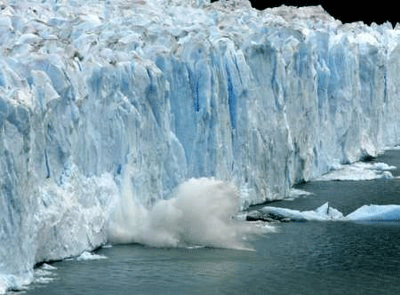 There are fewer nuclear reactors than you may realize. And by the time more
  are financed and built, the Arctic ice will be all gone anyway. Seventy years ago, some experts were convinced that nuclear power would change the world for the better. “Here was the power that would do all work…of a veritable Utopia,” the editors of a book on the Atomic Age wrote in 1945.
They also thought it would quickly grow. In the mid-1960s, one estimate predicted that by the year 2000, nuclear power would supply more than half of all the electricity in the U.S. As of 2016, it’s at a little less than 20%; globally, it’s only about 14%.
A new map from Carbon Brief shows the location of every reactor ever built around the world, including the 400 nuclear power stations now in use and others under construction. “Once you see it visually like that, you really get a sense of where the history of nuclear power is, and where it’s future is going to be,” says Simon Evans, policy editor for the U.K.-based Carbon Brief.
New nuclear power would be a real setback in terms of trying to solve the climate problem,” says Mark Jacobson, an engineering professor at Stanford who has researched how renewable power could meet all energy needs in the U.S. “Even if there were no issues like meltdown or waste proliferation—which are serious issues—it’s just so costly and it takes so long to put up new nuclear reactors that by the time the next set of nuclear reactors are planned, permitted, constructed, it takes 10-19 years. The Arctic ice will be gone.”
Nuclear power isn’t entirely “clean,” in terms of greenhouse gas pollution, because the large amount of energy used to refine uranium often comes from fossil fuels.Even keeping old reactors running may not make financial sense. In California, for example, extending the life of the Diablo Canyon plant will require new cooling towers that cost around $8 billion. It may also need billions in earthquake retrofits, because engineers realized after the project was built that it’s on a fault line.”For $8 billion, you can replace the entire Diablo Canyon with the same power produced by a combination of on-shore wind and utility-scale solar PV,” says Jacobson.
There’s also the inherent risk of even the “safest” nuclear reactors, and the problem of what happens when a plant is decommissioned. “You can’t do anything with the property for at least 60 years,” he says. “Probably there’s enough radioactivity for thousands of years.”
Instead, Jacobson says, it’s possible to produce cost-effective, reliable power from solar, wind, and hydroelectricity. It’s also possible to provide that power around-the-clock, as recent projects like a 24-hour solar farm near Las Vegas proves.
“People who are pushing nuclear aren’t driven by science or logic, but idealism and passion,” he says.http://www.fastcoexist.com/3058064/this-map-of-all-the-nuclear-reactors-in-the-world-is-a-reality-check
Safety upgrade costs spur Shikoku Electric to ditch plan to restart aging Ehime reactor
Japan Times 25 Mar 16 OSAKA – Shikoku Electric Power Co. plans to give up restarting reactor 1 of its Ikata nuclear complex in Ehime Prefecture and scrap it because extending the aging unit’s lifespan would be hugely expensive, company sources said Friday. – (subscribers only) http://www.japantimes.co.jp/news/2016/03/25/national/safety-upgrade-costs-spur-shikoku-electric-ditch-plan-restart-aging-ehime-reactor/#.VvS2Sex97Gh

Critics at NRC meeting not happy with dangers and costs of nuclear power
“…….The consumer group AARP submitted measured testimony, saying the group is “fuel neutral,” but concerned with reliability and affordability.
“Any proposed bailouts should focus primarily on the cost to consumers and the alternatives to such bailouts,” said John Erlingheuser of AARP. “Unintended consequences should be studied. For example, will bailouts stifle the development of low-cost natural gas-powered plants or renewables?”
Environmental advocates were also present during the forum and testified in opposition to subsidizing the plant when funds could be invested in renewable energy.
Chris Phelps, director of Environment Connecticut, expressed skepticism at Dominion’s claim about the effect of falling energy prices on its ability to stay profitable. He said it is the technology that is at fault, not the price of energy.
“The economics are working against the nuclear industry,” Phelps said. Mirror 24 Mar 16
The Atomic Church of the Last Gasp
Plutonium Pie in the Sky: the Dangerous Delusion of New Nukes CounterPunch by JAMES HEDDLE MARCH 22, 2016 “….. The Atomic Church of the Last Gasp New Nuclearists avoid coming to terms with the risks and failures of the existing world fleet of aging, ill-designed reactors. Some even advocate re-licensing embrittled reactors from the 1960s to extend their operation decades beyond their 40-year design life.)
NeoNuclearists believe – without operational proof-of-concept – in a pie-in-the-sky, perpetually not-yet-but-soon-to-be-born generation of ‘new, small modular nuclear reactors (SMRs).’ They will consume and eliminate existing nuclear waste and be so ‘inherently safe’ you can bury them in your back yard. Any day now……..
 The blind faith with which latter-day nuclear advocates approach the issues of human, ecological and economic risk associated with nuclear technologies, reminds one of the Melanesian millenarian movement called ‘cargo cults,’ in which indigenous tribes, following charismatic figures, built wooden aircraft replicas on mountain tops in the vain hopes – despite repeated failures – to lure down the western cargo planes loaded with commodities they saw flying overhead as portrayed in the 1962 film Mondo Cane.
Or, if the definition of ‘insanity’ is: ‘persisting in behavior which consistently fails,’ neo-nuclearism is clearly a form of collective insanity – atomic psychosis……….
Recovering from Nuclear Delusion The facts of the failure of the nuclear dream are there, for any who are not blinded by ideology or self-interest to see: in addition to its history of totalitarianism, incompetence and global disasters, nuclear energy deployment is plagued by public opposition, investor disinterest, consistently mounting cost and schedule over-runs and dependence on contiminating dwindling water supplies. Energy consultant Amory Lovins sees nuclear energy “dying a slow death from an overdose of market forces.” Futurist Jeremy Rifkin agrees, “From a business perspective, its dead.” Expert witness and nuclear engineer Arnie Gundersen puts it succinctly, “nuclear energy is just too expensive and too slow to have an impact on climate change.”
The 20th century ‘nuclear dream’ of global full-spectrum dominance and energy too cheap to meter has become a 21st century nightmare. It is time to wake up. As retired top U.S. energy administrator S. David Freeman puts it, “We have to kill nuclear power before it kills us.”
NeoNuclearists are entitled to their own opinions…but not to their own facts.http://www.counterpunch.org/2016/03/22/plutonium-pie-in-the-sky-the-dangerous-delusion-of-new-nukes/
Nuclear fallout is far more toxic to the living environment than previously thought’
Nuclear Radiation Is Far More Toxic to the Living Environment Than Previously Thought. CodeShutdown March 20, 2016 ‘for reasons only partly understood, nuclear fallout is far more toxic to the living environment than previously thought’ That’s it in a nutshell
The fallout doesn’t seem to disperse to a level of non toxicity, as is commonly believed. Biological response seems to linger even after an element has decayed to very low levels, for reasons science has not adequately examined. It is known that animals can re-concentrate radioactive and non radioactive elements thousands and even millions of times, but science does not apply this knowledge adequately to risk factors. – See more at: http://nukeprofessional.blogspot.com.au/2016/03/nuclear-radiation-is-far-more-toxic-to.html#sthash.INzr7inG.dpuf
Public opinion turning against nuclear power – important handicap to the nuclear industry
Nuclear power is losing popularity in the US. Here’s why. Vox, by Brad Plumer on March 21, 2016, T @bradplumer brad@vox.com “…….. Why public opinion on nuclear matters
So does this public opposition matter much? It matters quite a bit for many of the existing reactors around the country, which are currently facing brutal competition from cheap natural gas and wind power. In places like Vermont where nuclear power faces fierce local opposition, regulators have moved to shut down existing plants rather than pay for needed upgrades. (That’s typically bad news for climate change, since these reactors often get partly replaced by natural gas, which emits far more CO2.)
And, of course, if the United States is ever to build a new generation of nuclear reactors in order to help tackle global warming, then public opinion will prove even more important……..
Today, just five new reactors are under construction: two in Georgia, two in South Carolina, and one in Tennessee. These next-generation reactors are all being built at existing plant sites, which helps minimize public opposition. But these projects have also been plagued by delays and cost overruns: The two reactors at the Vogtle Plant in Georgia, for instance, are now estimated to cost $16 billion, some $3 billion over budget and three years behind schedule…….http://www.vox.com/2016/3/21/11277574/nuclear-power-public-opinion
Huge stockpile of weapons grade plutonium to sail from Japan to USA
 Stockpile of weapons-grade plutonium big enough to make FIFTY nuclear bombs to be shipped to US from Japan after it was loaned for research
- Huge stockpile has caused disquiet among various anti-nuclear groups
- Some 730 pounds of plutonium will be sent by armed UK transport ship
- Departure from north of Tokyo port could happen as soon as this weekend
- Material will be disposed of in United States, says Japanese spokesman
Daily Mail, By MATT HUNTER FOR MAILONLINE 19 March 201
Japan will return enough plutonium to produce 50 nuclear bombs to the US starting this weekend.
The stockpile, provided by the US, Britain and France decades ago for research purposes, has caused disquiet among anti-nuclear groups and neighbouring countries given Japan has the know-how to produce a nuclear weapon, although it does not possess any.
Some 730 pounds of plutonium will be sent by ‘an armed British nuclear transport ship… under armed escort to the United States,’ said a joint statement by five groups, including Greenpeace.
Shaun Burnie, senior nuclear specialist at Greenpeace said: ‘The departure from a port north of Tokyo could occur as early as Sunday.’
The shipment, which comes ahead of a nuclear security summit in Washington this month, is meant to underscore both countries’ commitment to nuclear non-proliferation. apaneses government official, Tsukasa Yamamura, said: ‘The material will be disposed of in the United States.’
The government confirmed in January the plutonium would be sent to the US and said that preparations for the shipment were under way.
But Yamamura declined to elaborate. ‘We can’t comment on details such as the departure date and route for security reasons,’ he said.It will take two months for the ship to arrive at a nuclear facility in South Carolina, the campaign groups said
Mr Burnie added: ‘Hailing a shipment of hundreds of kilogrammes of plutonium as a triumph for nuclear security, while ignoring over nine tonnes of the weapons material stockpiled in Japan and in a region of rising tensions, is not just a failure of nuclear non-proliferation and security policy but a dangerous delusion.’ …….http://www.dailymail.co.uk/news/article-3499089/Stockpile-weapons-grade-plutonium-big-make-FIFTY-nuclear-bombs-shipped-Japan-loaned-research.html
Disastrous nuclear deal puts UK energy security at risk
 Karl Sheridan, Yorkshire Post 18 Mar 16 I FERVENTLY pray that EDF do, indeed, pull the plug on the proposed new build nuclear reactor at Hinkley Point. Although the Government is all for it, surely common sense would dictate that it just doesn’t make sense for our country to invest billions on a design that is already outdated and, according to figures, will be highly expensive to run?
We, as a nation, should be investing in this country, not allowing other countries to fleece us, as is already happening. EDF is already proving to be a lame duck in the energy market place and to form a partnership with them would be disastrous in the long term. Why couldn’t the money being wasted on HS2 be used instead? Far better for us to have a secure UK-owned energy supply than knocking half an hour off a train journey, surely? http://www.yorkshirepost.co.uk/news/opinion/yp-letters-disastrous-nuclear-deal-puts-uk-energy-security-at-risk-1-7805594#ixzz43I4nTGfT
US official criticizes E Asia plans for nuclear reprocessing
http://news.yahoo.com/us-official-criticizes-e-asia-plans-nuclear-reprocessing-200240679.html By MATTHEW PENNINGTON, 18 Mar 16 WASHINGTON (AP) — A senior U.S. official has come out strongly against major powers in East Asia pursuing nuclear reprocessing that nonproliferation experts warn could lead to spiraling quantities of weapons-usable material in a tense region.
Assistant Secretary of State Thomas Countryman told a Senate Foreign Relations Committee hearing Thursday that the reprocessing of spent nuclear fuel “has little if any economic justification” and raises concerns about nuclear security and nonproliferation.
The committee’s chairman, Republican Sen. Bob Corker, accused the Obama administration of encouraging the production of plutonium, after it eased restrictions on civilian nuclear cooperation with China to allow the reprocessing of fuel from U.S.-designed reactors for nonmilitary purposes.
The U.S. has a similar arrangement with its close ally Japan. It has deferred a decision on giving similar consent to South Korea.
The Importance Of The Nuclear Security Summit – five points
Five Points On The Importance Of The Nuclear Security Summit , TPM, By5 PRIORITIES FOR GLOBAL NUCLEAR SECURITY, 17 MAR 16 On April 1, world leaders will gather in Washington, DC for the fourth and final Nuclear Security Summit, which concludes a pivotal process started by President Obama in 2010 to intensify global efforts to prevent nuclear terrorism. With the summits coming to a close along with Obama’s presidency, it could be a long time before the next international meeting of top leaders devoted solely to nuclear security.
Here are 5 reasons why the upcoming summit is so important.
But bomb-grade materials aren’t the only danger. Any highly-radioactive material—the kind used in cancer treatment, energy exploration, and food safety around the world—could be spread by conventional explosives in a “dirty bomb,” causing widespread chaos. Alarmingly, due to often-weak security, these materials regularly go missing—and aren’t always recovered.
There aren’t any mandatory international standards for securing all nuclear materials
Under the current system, every country basically gets to make up its own rules for securing nuclear materials—and none of them have to tell anyone else what those rules are, or be held accountable for following them.
The nuclear security treaties that are in force are limited in scope and effectiveness. The Convention on the Physical Protection of Nuclear Material was written for a pre-9/11 world, and isn’t fully effective because a critical amendment to bring it up to date hasn’t yet been ratified by enough countries. And the International Convention for the Suppression of Acts of Nuclear Terrorism is about responding to terrorism—not preventing it.
The Nuclear Security Summits have been important but inadequate……….
Experts agree on what we need to do next……..We need to demand that our leaders act…….. http://talkingpointsmemo.com/fivepoints/five-points-importance-nuclear-security-summit
New UK nuclear project Hinkley Point C – now a”dead duck” ?
 Resignation of EDF finance chief shows new UK nuclear plant ‘a dead duck’ By Molly Scott Cato | EurActiv.com, 16 Mar 16, Five years on from the Fukushima, the human and environmental impacts of the disaster continue to grow in scale, writes UK Green MEP Molly Scott-Cato.
Molly Scott-Cato is an MEP for South-West England and Gibraltar, whose constiutency covers the Hinkley Point nuclear reactor.
This is a key reason why I am fighting so hard to prevent the new reactors at Hinkley point in Somerset from being built.
Nuclear-power is not commercial; it cannot survive without government subsidy and never has been able to during the 60 years of its existence. That in itself should be enough to close the question of whether we wish to build new nuclear power stations in Europe. But somehow the commercially unviable deal to build at Hinkley has slipped between the scrutiny of commercial and political interests, and between the political authorities at Westminster and in Brussels. It is extraordinary that such a shaky deal could have got so far and endured for so long as it was never going to survive in a commercial market.
For me one of the most shocking aspects of the deal was how little concern was raised by UK politicians. We are talking about a deal that involves two Chinese nuclear companies that are ultimately under the control of the Chinese Communist Party gaining access to our civilian nuclear industry. I am astonished that Conservative MPs are prepared to countenance such a risk to our national security. And this is to say nothing of the risk of suicide terrorism which we are left open to when nuclear stations are operational anywhere in the country.
Commercially the Hinkley deal has been a dead duck for some time. ………
The issue of most concern in this whole sorry saga is the total absence of genuine political scrutiny. Most UK MPs only seem to have woken up and taken any interest about a week before the deal was signed off last autumn. Cameron and Osborne have been operating as though in a legal vacuum. The British media has paid no attention to the rules of the single market and my continual efforts to interest them in the issue of state aid have failed……..https://www.euractiv.com/section/climate-environment/opinion/resignation-of-edf-finance-chief-shows-uk-new-nuclear-plant-a-dead-duck/
A high-level nuclear waste dump for South Australia?
A high-level nuclear waste dump for South Australia: The big questions
Conservation Council South Australia 18 Mar 16

1 This Month

of the week – Shut Down Drone Warfare!


Tell the Ukrainian Government to Drop Prosecution of Peace Activist Yurii Sheliazhenko

Petition to revoke the licensing of the Near Surface Nuclear Disposal Facility (NSDF) at Chalk River. https://www.ourcommons.ca/petitions/en/Petition/Details?Petition=e-7247
To see nuclear-related stories in greater depth and intensity – go to https://nuclearinformation.wordpress.com
-
Archives
- April 2026 (57)
- March 2026 (251)
- February 2026 (268)
- January 2026 (308)
- December 2025 (358)
- November 2025 (359)
- October 2025 (376)
- September 2025 (257)
- August 2025 (319)
- July 2025 (230)
- June 2025 (348)
- May 2025 (261)
-
Categories
- 1
- 1 NUCLEAR ISSUES
- business and costs
- climate change
- culture and arts
- ENERGY
- environment
- health
- history
- indigenous issues
- Legal
- marketing of nuclear
- media
- opposition to nuclear
- PERSONAL STORIES
- politics
- politics international
- Religion and ethics
- safety
- secrets,lies and civil liberties
- spinbuster
- technology
- Uranium
- wastes
- weapons and war
- Women
- 2 WORLD
- ACTION
- AFRICA
- Atrocities
- AUSTRALIA
- Christina's notes
- Christina's themes
- culture and arts
- Events
- Fuk 2022
- Fuk 2023
- Fukushima 2017
- Fukushima 2018
- fukushima 2019
- Fukushima 2020
- Fukushima 2021
- general
- global warming
- Humour (God we need it)
- Nuclear
- RARE EARTHS
- Reference
- resources – print
- Resources -audiovicual
- Weekly Newsletter
- World
- World Nuclear
- YouTube
-
RSS
Entries RSS
Comments RSS
 nuclear-news