An Unexpected Radiation Spike Has Been Detected Over Europe
A mysterious increase in radiation levels over northern Europe was detected this month by authorities from several countries, although no nation has yet come forward to claim responsibility for the anomaly. The subtle radiation spike – at levels that are considered harmless to humans, but significant enough to be picked up by radiation monitoring stations – began to make headlines last week, with European authorities announcing new readings of human-made radionuclide particles in the atmosphere.
“Very low levels of the radioactive substances cesium-134, cesium-137, cobalt-60 and ruthenium-103 were measured,” the Swedish Radiation Safety Authority tweeted on Tuesday.
“The levels measured are so low that they pose no danger to people or the environment.”
Similar observations were also made by radiation protection authorities in Norway and Finland.
Later in the week, Lassina Zerbo, the Executive Secretary of the Comprehensive Nuclear-Test-Ban Treaty Organisation, tweeted a map outlining the possible source region of the anomaly, most of which was territory inside Russia, but also parts of Finland, Sweden, Denmark, and Norway.
“These isotopes are most likely from a civil source,” Zerbo tweeted, suggesting a source related to nuclear power production, not nuclear weapons.
“We are able to indicate the likely region of the source, but it’s outside the CTBTO’s [Comprehensive Nuclear-Test-Ban Treaty Organization] mandate to identify the exact origin.”
On Friday, the Dutch National Institute for Public Health and the Environment (RIVM) announced that, based on an analysis of the available data, the “combination of radionuclides may be explained by an anomaly in the fuel elements of a nuclear power plant”.
On the available evidence, the organisation suggested that the radioactive particles detected had come from the direction of western Russia, but clarified that this did not mean they were definitively linked with Russian power plants.
“Some recent media reports claimed, possibly based on a mistranslation of our original report (in Dutch), that the radionuclides originated from western Russia,” RIVM said in a statement.
“The claim RIVM makes is that the radionuclides travelled from the direction of western Russia to Scandinavia, but that no specific country of origin can be pointed out at this moment.”
In response to online speculation that Russia was behind the radiation spike, a spokesperson for Rosenergoatom, part of Rosatom state nuclear energy corporation, said the nation’s two nuclear power plants in the region were operating normally, with normal radiation levels being reported.
“Both stations are working in normal regime. There have been no complaints about the equipment’s work,” Rosenergoatom told Russian news agency TASS.
“Aggregated emissions of all specified isotopes in the above-mentioned period did not exceed the reference numbers. No incidents related to release of radionuclide outside containment structures have been reported.”
As it stands, it’s hard to say whether additional evidence will be able to confirm where this slight radiation surge originated, but the incident recalls a similar situation that took place in 2017, in which another radioactive cloud was detected over Europe.
During that episode – which was also detected at levels harmless to people – many suggested Russian power plants were responsible – a hypothesis that was later supported by scientific findings, although disputed by Rosatom.
Mysterious radiation spike detected over Scandinavia
It may have come from a nuclear power plant in Russia. Radioactivity levels have spiked in the atmosphere over northern Europe, and that could indicate damage at a nuclear power plant in western Russia, according to a Dutch health agency that has analyzed the data. The radioactive spike suggests damage to a nuclear fuel element, the Associated Press reported.
However, the Russian nuclear power operator Rosenergoatom has denied problems related to facilities in Kola and Leningrad, the two nuclear plants operating in the region, according to TASS, a Russian news agency, as reported by the AP.
Several Scandinavian watchdog agencies detected the elevated levels of the radionuclides (or radioactive isotopes). Radionuclides are atoms whose nuclei are unstable; the excess energy inside the nucleus gets released through radioactive decay. In particular, concentrations of the radionuclides cesium-134, cesium-137 and ruthenium-103 rose in parts of Finland, southern Scandinavia and the Arctic, Lassina Zerbo, the Executive Secretary of the Comprehensive Nuclear-Test-Ban Treaty Organization, wrote on Twitter. Though these pose no harm to humans, they are byproducts of nuclear fission, Zerbo wrote.
“The radionuclides are artificial, that is to say they are man-made. The composition of the nuclides may indicate damage to a fuel element in a nuclear power plant,” an official with the National Institute for Public Health and the Environment in the Netherlands, which analyzed the isotope data, said on Friday (June 26).
Because so few measurements have been taken, monitoring agencies weren’t able to identify a specific source, NIPHE officials said.
The sudden radioactivity spike echoes the events following the Chernobyl nuclear meltdown, the biggest nuclear disaster in history. Within a few days of the 1986 disaster, a Swedish nuclear power plant detected elevated radioactivity levels, according to an account from the European parliament.
In recent years, another radioactive mystery cloud wafting over Europe was tied to Russia. In 2017, a plume holding 1,000 times the normal levels of ruthenium-106 was detected over Europe, The Washington Post reported. Russia denied any involvement, though a nuclear reprocessing plant in Russia was a strong suspect, according to a 2019 study in the journal Proceedings of the National Academy of Sciences.
Radiation level increase in northern Europe may ‘indicate damage’ to nuclear power plant in Russia
- Russian authorities deny any leakage or fault with power plants in St Petersburg and Murmansk Independent Tim Wyatt 27 June 20Low levels of radiation spotted in northern Europe may have come from a malfunctioning nuclear power plant in western Russia.
- Nuclear safety officials from Finland, Norway and Sweden have all announced earlier this week they have detected increased radioactive isotopes across Scandinavia and in some Arctic regions.
While the Swedish Radiation Safety Authority said on Tuesday it was not possible to confirm the source of radiation, Dutch authorities have analysed data from their Nordic neighbours and concluded it originated in western Russia………
- The Russian news agency Tass quoted an unnamed spokesperson from Rosenergoatom who said both a plant near St Petersburg and another near Murmansk were operating “normally, with radiation levels being within the norm”.
Radiation levels at the two plants had not changed for the whole month of June, the spokesperson added.
“Both stations are working in normal regime. There have been no complaints about the equipment’s work. No incidents related to release of radionuclide outside containment structures have been reported.”…..
- Other groups have also spotted the slight rise, however. The Comprehensive Nuclear-Test-Ban Treaty Organisation said on Friday their radiation-monitoring sensors in Sweden had also detected a slight increase of several harmless isotopes in northwestern European airspace.
Russia is one of the largest producers of nuclear power in the world, with 10 currently operational plants and several more under construction.
The country’s nuclear power operator has also signed billions of dollars-worth of contracts to build nuclear power plants using Russian technology in other countries, such as India, Turkey and Iran. https://www.independent.co.uk/news/world/europe/radiation-scandinavia-nuclear-power-plant-russia-
Bradwell nuclear power station – an unwise plan
http://www.leightimes.co.uk/article.cfm?id=127423&headline=Letter%20from:%20Paul%20Fox,%20Woodfield%20Road,%20Leigh%20-%20Nuclear%20Power%20Station§ionIs=news&searchyear=2020Saturday, 27 June 2020 –
I am concerned about the building of this Nuclear Power Station, as it is very close to Leigh, as the crow flies.
Our government may go ahead on the July 1 and build a Nuclear Power Station at Bradwell. I write because of my concern about the increasing involvement of Chinese companies/Government in British infrastructure in general and the above Power Station in particular.
There are several issues about the proposed new nuclear stations.
1. As renewable sources of energy become cheaper and more reliable do we need more nuclear sources at all?
2. Have the dangers and problems of disposal of nuclear waste been fully resolved yet?
3. Although the carbon footprint of nuclear production is low, building in this low lying, flood prone area will be very high and detrimental to the surrounding land.
4.Even though because of Brexit the government wants to develop trade with as many countries as possible, do we want to be in hock to the Chinese. Their track record in Africa where they have been responsible for a massive amount of infrastructure, is with the passage of time not proving as beneficial as hoped.
Also the State-owned China General Nuclear Power Group specified as a designer and operator of the plant, is blacklisted by the United States Department of Commerce for attempting to acquire advanced U.S. nuclear technology and material for diversion to military use.
I believe my fears are similar to those of Mr Tom Tugenhardt MP and Mr Duncan Smith MP even if without their depth of knowledge, I think the country should be made more aware of the risks we may be taking on especially as regards the Nuclear industry.
Can anything be done to halt the above development? You may not realise how much bigger the new power station will be.
Radioactive hotspots near Fukushima Olympic facilities: will Japan be ready for 2012 Games?
Fukushima’s Olympic makeover: Will the ‘cursed’ area be safe from radioactivity in time for Games? France 24, By: Constantin SIMON Aruna POPURI Ryusuke MURATA, 26 June, 20
In a year’s time, the Olympic Games, dubbed the “reconstruction Olympics”, should allow Japan to move on from the Fukushima tragedy. The region, a symbol of the 2011 disaster, has officially been cleaned up but many problems remain, such as radioactivity and “forbidden cities”. Over the course of several months, our reporters followed the daily lives of the inhabitants of this “cursed” region…….
Although the work undertaken over the past 10 years is colossal and the region is partly rebuilt, it’s still not free from radioactivity. The NGO Greenpeace has detected radioactive hotspots near the Olympic facilities. And at the Fukushima power plant, Tepco engineers continue to battle against radioactive leaks. They also face new issues such as contaminated water, which is accumulating at the site and poses a new-fangled problem for Japan. Our reporters were able to visit the notorious nuclear power plant. .. https://www.france24.com/en/asia-pacific/20200626-fukushima-s-olympic-makeover-will-the-cursed-area-be-safe-from-radioactivity-in-time
Scientists urge US not to resume nuclear tests
Joint Project Nuclear Risk and Public Control
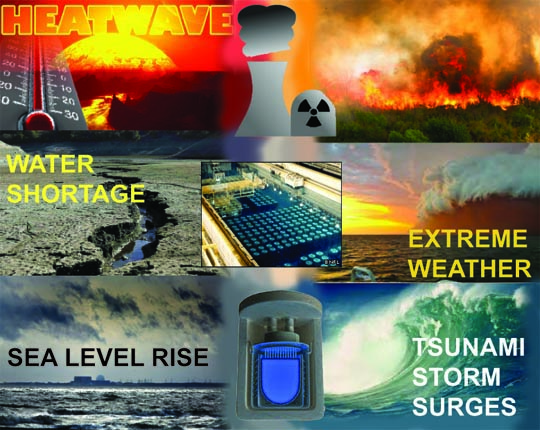 Nuclear Risk & Public Control (accessed) 17th June 2020, Currently nuclear energy promoters are trying to make use the climate crisis for their goals by claiming that nuclear energy is a solution. But can nuclear energy contribute to a decarbonized future?
Rather the contrary: climate change poses new challenges and risks to the operation of nuclear power plants, increasing nuclear risk and challenging supply security. In this Joint Project – Nuclear Risk & Public Control webinar we presented our new working paper “Impacts of Climate Change on Nuclear Safety and Supply Security”. A report of the webinar can be downloaded here.
Nuclear Regulatory Commission will prepare a full environmental impact statement (EIS) on nuclear license renewal for Columbia Fuel Fabrication Facility
As pandemic costs rise, USA plans costly,dangerous nuclear weapons tests
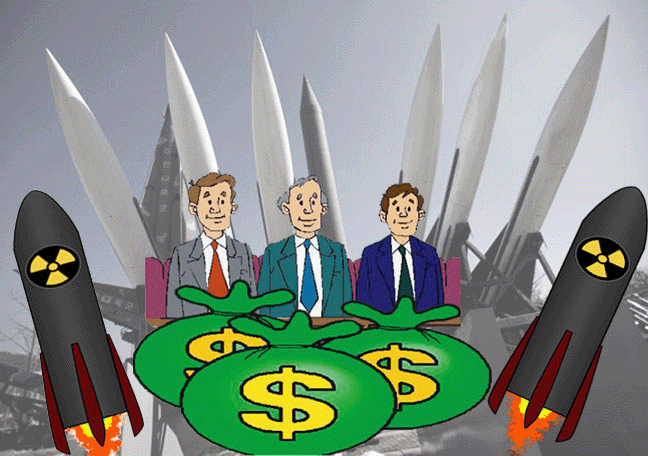 US may spend billions on a nuclear bargaining chip https://www.mercurynews.com/2020/06/10/letter-us-may-spend-billions-on-a-nuclear-bargaining-chip/ Mary Perner US may spend billions on a nuclear bargaining chip https://www.mercurynews.com/2020/06/10/letter-us-may-spend-billions-on-a-nuclear-bargaining-chip/ Mary PernerLivermore, Board President, Tri-Valley CAREs Tri-Valley CAREs sent Congress a letter on reports US may conduct its first nuclear weapon tests since 1992, Public interest organizations, including Tri-Valley CAREs, sent Congress a letter recently responding to reports senior White House officials discussed conducting the first U.S. nuclear weapon test explosion since 1992.The proposal, a chest-thumping gesture aimed at Russia and China, is likely to spur the two countries and other nuclear states to conduct their own nuclear tests. The groups urged Congress to “demand prohibition on use of any funds to resume or prepare to resume such a test.” Sen. Ed Markey, D-Mass., has drafted a bill using similar language. Nuclear testing sickened and killed military personnel involved in detonations, as well as civilians in the fallout pathways. Now officials consider spending billions on a high-risk nuclear bargaining chip, while the costs of the pandemic and unemployment continue to rise. |
|
Choosing nuclear narrows future energy choices
Childhood cancers near nuclear facilities
have told us that the high incidence of childhood cancer in the North West
should be the subject of a government inquiry – suspect it is the same
tale wherever people are downwind of nuclear installations and transports
of nuclear materials.
Trump Administration Weighs First Nuclear Test in Decades
|
Trump Administration Weighs First Nuclear Test in Decades: WaPo https://www.thedailybeast.com/trump-administration-weighs-first-nuclear-test-in-decades-report-says ALARMING Blake Montgomery May. 22, 2020 Top U.S. national security officials discussed performing the United States’ first nuclear test since 1992 at a meeting last Friday, The Washington Post reports. Multiple members of the Trump administration say Russia and China have both performed low-yield nuclear tests, accusations both countries have denied and which have not been independently verified. The topic of renewing testing reportedly arose at a meeting of the heads of national security agencies on May 15, though officials did not come to an agreement. Testing nuclear weapons would likely strain relations with other nuclear powers.
|
|
Coronavirus: How to prevent a new nuclear arms race – and future pandemics

Coronavirus: How to prevent a new nuclear arms race – and future pandemics, The National, Gavin Esler, May 18, 2020
Despite numerous warnings from virologists and epidemiologists that Sars and Mers would eventually be followed by something much worse, the world is still playing catch up on coronavirus.
Perhaps even more surprising, the danger of nuclear war has been forgotten in the public imagination but it has not gone away. The threat to the Gulf region and beyond from Iran’s nuclear programme has not been eliminated. North Korea has not abandoned its own extremely provocative missile programme. And figures released in the past few days have shown continuing reinvestment round the world in nuclear arsenals.
In 2019, according to the International Campaign to Abolish Nuclear Weapons (ICAN) the nine countries with nuclear weapons spent a total of $72.9 billion on those weapons, a 10 per cent increase on 2018. Of that sum, around half – $35.4bn – was spent by the Trump administration.
ICAN, as its name suggests, wants nuclear weapons to be banned. It points out that so much money that could be spent on making the world healthier – and preparing for the certainty of future pandemics – is being spent on the unlikelihood of a nuclear conflict.
|
While this argument is attention-grabbing, it does not face up to hard reality. Just because we were unprepared for Covid-19 does not of itself mean nuclear states should simply destroy their stockpiles. Events in the sea lanes of the Gulf remind us of the old Cold War saying, that the price of peace is eternal vigilance. Nevertheless, the dislocation caused by the virus has made many of us re-think our personal priorities – family, friends, work and what makes us happy. Perhaps the pandemic may also make governments reassess their own priorities. How many nuclear weapons are “enough”? Do we still believe in the doctrine of Mutually Assured Destruction – or MAD? Could we cut nuclear arsenals and put more effort into engagement with Iran and North Korea – difficult though that is – to try to prevent a new nuclear arms race? This year’s US presidential election, combined with an economic shock and the biggest threat to world health for a century, provides an opportunity to re-think our priorities. If we can spend billions every year on bunkers, missiles and early warning systems in the hope of preventing global conflict – and not see that investment as wasted – can we switch more investment to preventing and treating global health threats? https://www.thenational.ae/opinion/comment/coronavirus-how-to-prevent-a-new-nuclear-arms-race-and-future-pandemics-1.1021110 |
|
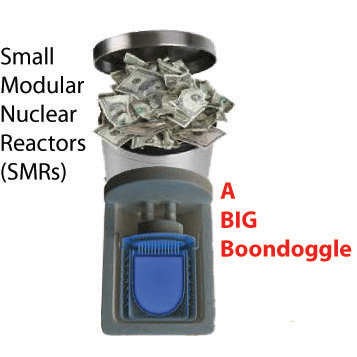
University experts urge that UK promote renewable energy, drop expensive plans for small nuclear reactors
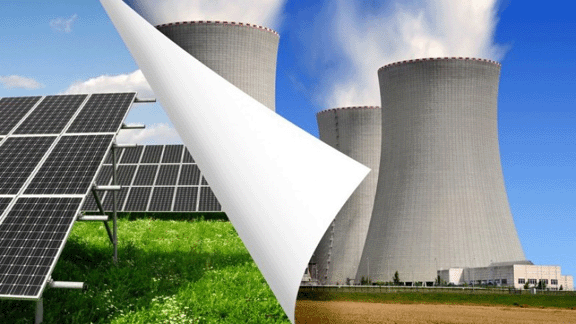 Observer 17th May 2020. Professor Andy Stirling, Sussex University; Professor Andrew Blowers, OpenUniversity; Dr Phil Johnstone, Sussex University; Dr David Lowry, Institute
for Resource and Security Studies, Cambridge, Massachusetts; Dr Ian
Fairlie, formerly UK committee examining the radiation risks of internal
 emitters.
 Even well-established forms of nuclear are rapidly declining in competitiveness worldwide. The nuclear industry has a track record of catastrophically expensive hype and disappointment on speculative new ventures like this, so there are no rational grounds to divert investment or employment away from renewables in the way you urge so strongly.
https://www.theguardian.com/commentisfree/2020/may/17/letters-isolated-in-care-home-lockdown-hell
How an innovative community overcame Ukraine’s nuclear trauma.
FoE Europe 15th May 2020 How an innovative community overcame Ukraine’s nuclear trauma. All over Europe, people are rising up to fix climate breakdown – demanding urgent
transformation to a fair, fossil free future. Communities, cities and
people are at the forefront of building community-owned renewable energy,
creating green jobs, and tackling energy poverty. Here is one such story
from the frontlines of climate hope, from Ukraine.
1 This Month


31st January – Challenging the War Machine – a DECLASSIFIED UK SUMMIT



Website of the Week
Now until to February 10, 2026 Radioactive waste storage in France: the debate is finally open! How to participate?
-
Archives
- January 2026 (227)
- December 2025 (358)
- November 2025 (359)
- October 2025 (377)
- September 2025 (258)
- August 2025 (319)
- July 2025 (230)
- June 2025 (348)
- May 2025 (261)
- April 2025 (305)
- March 2025 (319)
- February 2025 (234)
-
Categories
- 1
- 1 NUCLEAR ISSUES
- business and costs
- climate change
- culture and arts
- ENERGY
- environment
- health
- history
- indigenous issues
- Legal
- marketing of nuclear
- media
- opposition to nuclear
- PERSONAL STORIES
- politics
- politics international
- Religion and ethics
- safety
- secrets,lies and civil liberties
- spinbuster
- technology
- Uranium
- wastes
- weapons and war
- Women
- 2 WORLD
- ACTION
- AFRICA
- Atrocities
- AUSTRALIA
- Christina's notes
- Christina's themes
- culture and arts
- Events
- Fuk 2022
- Fuk 2023
- Fukushima 2017
- Fukushima 2018
- fukushima 2019
- Fukushima 2020
- Fukushima 2021
- general
- global warming
- Humour (God we need it)
- Nuclear
- RARE EARTHS
- Reference
- resources – print
- Resources -audiovicual
- Weekly Newsletter
- World
- World Nuclear
- YouTube
-
RSS
Entries RSS
Comments RSS
 nuclear-news