Steam generator dropped at French reactor
04 April 2016 A used steam generator was dropped within the reactor building of unit 2 of the Paluel nuclear power plant in France, operator EDF has informed the country’s nuclear regulator. The plant is currently offline for a maintenance outage, including replacement of all four steam generators……..http://www.world-nuclear-news.org/RS-Steam-generator-dropped-at-French-reactor-0404165.html
The very real threat of a terrorist Fukushima
 Could There Be a Terrorist Fukushima?, NYT, By GRAHAM ALLISON and WILLIAM H. TOBEY, APRIL 4, 2016 “……..Discussions about nuclear terrorism also tend to focus on the risk of terrorists stealing weapons-grade material or making a dirty bomb. But they often overlook the danger of terrorists attacking a nuclear plant in order to set off a Chernobyl- or Fukushima-like disaster.
That risk is real, however, and has been known for a while. The master planner of the 9/11 attacks had considered crashing a jumbo jet into a nuclear facility near New York City. A Qaeda training manual lists nuclear plants as among the best targets for spreading fear in the United States.
Striking a nuclear plant or the cooling ponds in which nuclear waste is stored wouldn’t set off a mushroom cloud or kill hundreds of thousands of people. But it would spew large amounts of radiation, spark a mass panic and render vast swaths of land uninhabitable. And it could cause thousands of early deaths from cancer.
Nuclear plants have built-in safety mechanisms, typically multiple systems that are unlikely to fail simultaneously: If one of them malfunctions, there’s always a backup, the theory goes. But redundancy is effective protection only against accidents, not against terrorists who set out to cause simultaneous system failures. For example, by targeting power and water supplies at the same time, attackers could cause a reactor to melt down or a cooling pond to ignite……..http://www.nytimes.com/2016/04/05/opinion/could-there-be-a-terrorist-fukushima.html?smid=tw-share&_r=1
Takeaways from Obama’s last Nuclear Security Summit
The 2016 Nuclear Security Summit (NSS) concluded on April 1—four days shy of the 7th anniversary of President Barack Obama’s Prague speech, in which, among other things, he announced a “new international effort to secure all vulnerable nuclear material around the world within four years.” The 2016 NSS was the fourth and final summit held in its current format.Obama expressed the hope that the 2016 summit would leave behind an enduring international nuclear architecture for securing highly enriched uranium (HEU) and plutonium.
Leaders and representatives of 52 countries and four regional and international organizations attended the summit. It produced gift baskets (political commitments signed by groups of participants), five action plans for existing international bodies, new national and multilateral commitments, a contact group to oversee implementation of commitments made, and a final communiqué.
A total of 13 gift baskets were presented during the summit, though many of them built upon previous commitments. Three were particularly notable:………
Judge refuses to block release of Navy nuclear data
A federal court judge has declined to permanently block the release of Kitsap County documents about response plans to a nuclear emergency at the Navy Kitsap-Bangor base or other Navy facilities.
U.S. District Court Judge Ronald Leighton on Dec. 15 had issued a temporary injunction restricting the release of what was termed “sensitive and protected national security information” contained in these federal government documents.
Since then, public-records requests to access the documents have been withdrawn, and the judge has found that most of the issues involved in the case have now been rendered moot.
“Because no request is pending … a live case or controversy regarding the County’s potential disclosure does not exist,” Leighton wrote in a ruling he signed Thursday.
The unusual case was filed in U.S. District Court in Tacoma, and resulted from a dispute between the Navy and Kitsap County over what information could be released under state public-records laws.
“From our perspective, we have the state laws — the public-records act — to comply with, so we were a little bit caught in the middle in this,” said Shelly Kneip, senior deputy prosecuting attorney for Kitsap County.
The case centers on a public-records request made bypeace activist Glen Milner in January 2015. He asked Kitsap County to release documents about the consequences of a nuclear incident at Kitsap County Navy facilities, and also information about emergency response.
By the summer, that public-records request had yielded nearly 6,000 pages of documents from Kitsap County.
But Kitsap County and federal officials were at odds about what information in additional documents could be released, including details about a county exercise that simulated the response to a nuclear incident.
At one point, the county was warned the release of protected information would expose their employees to the risk of criminal prosecution, according to a footnote in a brief filed by the U.S. Attorney’s Office in Seattle, which represents the Navy in the case………http://www.seattletimes.com/seattle-news/puget-sound/judge-wont-block-release-of-navy-nuclear-data-in-kitsap-county-after-records-requests-withdrawn/
Growing global threat of nuclear terrorism
Terrorism is in the news a lot these days. Beautiful European capitals like Paris and Brussels have been attacked. Historic cities in the Middle East like Baghdad and Aleppo have suffered carnage. A splinter group from the Taliban struck Lahore in Pakistan, once home of the Mughals, at the end of March. Even idyllic places in Africa have not been spared.
Paul Ashley, a retired professional from the British Armed Forces, has mused that 2016 could be the year of terrorism. Many worry about a “dirty bomb” that might combine conventional explosives with radioactive material. Two of the bombers involved in the Brussels attacks appear to have monitored a senior researcher who worked at a Belgian nuclear center.
This week, US President Barack Obama hosted the Nuclear Security Summit and fretted about mad men getting “their hands on a nuclear bomb or nuclear material.” A 2014 report by the Nuclear Threat Initiative (NTI) estimated that “nearly 2,000 metric tons of weapons-usable nuclear materials remain spread across hundreds of sites around the globe.” The NTI report points out that some of these sites are poorly secured and that terrorists might have acquired the ability to build a bomb………
Pakistan’s nuclear material is at great risk of theft or misappropriation. –
…….As a state, India functions much better than Pakistan. Yet its nuclear material is not as safe as it seems. India’s military is in disarray, its intelligence is in shambles and the corruption of its bureaucracy is legendary. Its short-sighted elites care little for strategic matters and India’s nuclear material is not as safe as it seems.
North Korea makes India look good. Russia makes India look angelic. President Vladimir Putin did not even show up in Washington, DC. With the Pakistanis and the Russians not present, Obama’s summit did not quite have the oomph he desired.
The US itself is going through strange times. Donald Trump, the leading Republican candidate, has suggested that South Korea and Japan could do well to have nuclear deterrents of their own instead of rely on the US. This flies in the face of nonproliferation efforts by the US for decades and did not leave Obama too pleased. To add to his woes, the summit might be living on borrowed time because no US presidential candidate seems interested in keeping it going.
In his early career in the US Senate, Obama worked with Dick Lugar, a Republican senator, to get rid of weapons of mass destruction. States like Ukraine and Azerbaijan participated. Things have changed since. As stated earlier, many states are declining and their writs are weakening. At some point, some crazy group will acquire the knowledge, ability and material to make a dirty bomb. Of course, states have a duty to prevent the making and using of such a bomb, but at some point they will fail. When this happens, the best response for all decent good people around the world has to be to keep calm and carry on.
Sadly, a nuclear terrorist strike is not merely possible or probable. It is inevitable. It is time to start preparing for it.
This article was first published on Fair Observer.
– See more at: http://www.thenewsminute.com/article/yes-nuclear-terrorism-real-threat-world-over-41204#sthash.n6BKMDGZ.dpuf
Terrorists could target nuclear arsenals of Pakistan and India
Pakistan’s mini nuclear weapons easy targets for terrorists: US President Barack Obama By Chidanand Rajghatta, TNN | 3 Apr, 2016, WASHINGTON: US President Barack Obama on Friday counselled India and Pakistan to contain aggressive military doctrines and nuclear arsenals as he wrapped up the fourth Nuclear Security Summit, his signature international effort to curtail the spread of nuclear weapons and source material.
At a press conference towards the end of the summit that attracted leaders from all major powers save Russia, Obama sought to “see progress in Pakistan and India…making sure that as they develop .. http://economictimes.indiatimes.com/news/defence/pakistans-mini-nuclear-weapons-easy-targets-for-terrorists-us-president-barack-obama/articleshow/51668359.cms
Renewable energy taking over – already
 How green energy is already taking over the world, Independent Australia 31 March 2016 Investment in renewables galloped ahead of fossil fuels in 2015 with a majority of plants planned for developing countries. Professor Juan Cole reports.
IN 2015 energy companies invested more in new renewables power plants in 2015 than in fossil fuel plants for the first time in history. The majority of these plants were planned for the developing countries, which is a sign that the technology is viewed as now less expensive.
The United Nations Environment Programme (UNEP) press release said,
Coal and gas-fired electricity generation last year drew less than half the record investment made in solar, wind and other renewables capacity — one of several important firsts for green energy announced today in a UN-backed report. Global Trends in Renewable Energy Investment 2016 . . . says the annual global investment in new renewables capacity, at $266 billion, was more than double the estimated $130 billion invested in coal and gas power station s in 2015.
All investments in renewables, including early-stage technology and R&D as well as spending on new capacity, totalled $286 billion in 2015, some 3% higher than the previous record in 2011. Since 2004, the world has invested $ 2.3 trillion in renewable energy (unadjusted for inflation). (All figures for renewables in this release include wind, solar, biomass and waste-to-energy, biofuels, geothermal, marine and small hydro, but exclude large hydro-electric projects of more than 50 megawatts).
Just as significantly, developing world investments in renewables topped those of developed nations for the first time in 20 15. Helped by further falls in generating costs per megawatt-hour, particularly in solar photovoltaics, renewables excluding large hydro made up 54% of added gigawatt (GW) capacity of all technologies last year. It marks the first time new installed renewables have topped the capacity added from all conventional technologies.
The 134 gigawatts of renewable power added worldwide in 2015 compares to 106GW in 2014 and 87GW in 2013. Were it not for renewables excluding large hydro, annual global CO2 emissions would have been an estimated 1.5 gigatonnes higher in 2015……….
Lauren Kubiak: Report: Clean Energy Economy Employs More than 2.5 Million Americans, Poised for More Growth
 March 30, 2016. More than 2.5 million Americans work in clean energy, according to a new study released yesterday from the national nonpartisan business group Environmental Entrepreneurs (E2), an NRDC affiliate. These men and women install solar panels, manufacture electric vehicle parts, and retrofit our homes, schools and businesses to make them more energy efficient. They build wind turbine blades, invent battery technologies, and assemble the most energy-efficient appliances on the planet……
Isolated French Island Becoming a Nuclear Monitoring Outpost (VIDEO)
 An anti-nuclear test agency installs a key part of a hydroacoustic monitoring system on the remote French-administered Crozet Islands. http://www.scientificamerican.com/video/isolated-french-island-becoming-a-nuclear-monitoring-outpost/
St Louis radioactive landfill – West Lake Landfill Moms Meet with Head of EPA
Kevin Killeen (@KMOXKilleen)March 30, 2016 ST. LOUIS (KMOX) – Members of the West Lake Landfill Moms group meet with the head of the EPA in Washington, D.C., calling for a buyout of homes near the landfill, and transfer of the site from the EPA to the Army Corps of Engineers.
In a phone interview afterwards, Dawn Chapman of Just Moms described the meeting with EPA Administrator Gina McCarthy as positive and constructive.
“It was really emotional talking to her, sitting in front of a Presidential appointee who can with the snap of her finger change so many people’s lives,” Chapman said.
Chapman says McCarthy made no promises about supporting federal buyouts for homeowners close to the landfill, but indicated she would evaluate the request.
The other action item sought–transfer of the West Lake Landfill to the Army Corps of Engineers–remains stalled in a House committee, after the plan passed the Senate.
After the meeting with McCarthy, Chapman says the group, along with a representative of Missouri Attorney General Chris Koster, met for about an hour with the White House Council on Environmental Quality.
Chapman says the discussion centered on widespread frustration over “EPA inaction ” on the site, and the desire to give the site to the Army Corps………http://stlouis.cbslocal.com/2016/03/30/west-lake-landfill-moms-meet-with-head-of-epa/
Nuclear power’s ever rising costs

 Nuclear Power, Once Cheap, Squeezed by Mounting Costs Reactors were supposed to provide near-limitless electricity at low prices. But as they’ve aged, their costs have climbed. US News, By Alan Neuhauser March 30, 2016 “……..Fuel costs have climbed, but age is also a chief culprit: The plants are an average 36 years old, requiring expensive and more frequent repairs.
“It gets harder to keep them running at the same price, even as competitors get cheaper and the market gets thinner,” says Peter Bradford, a commissioner with the Nuclear Regulatory Commission from 1977-1982 and a professor at Vermont Law School.
Electricity markets – flooded not only by cheap gas but also new solar and wind – paid as little as 2 cents per kilowatt-hour of electricity last year. Nuclear plants at times needed a full cent more – an additional 50 percent – to break even…..
the pressure on nuclear plants to cut costs is enormous, industry insiders say, even perhaps at the expense of safety. More than 75 percent of the nation’s nuclear plants have reported a radioactive leak in their lifetimes, for example, most recently outside New York City and Miami in February. They’ve also suffered explosions, fires and corrosion, and the Nuclear Regulatory Commission has repeatedly weakened its rules to allow plants to skirt potentially costly safety standards.
“They are expending as little amount of money on the plant as possible,” says Paul Blanch, a longtime engineer and industry worker turned watchdog.
At least four plants in the past four years have gone offline or been slated to be decommissioned, all casualties of rising costs and cheap competitors……http://www.usnews.com/news/articles/2016-03-30/nuclear-power-once-cheap-squeezed-by-mounting-costs
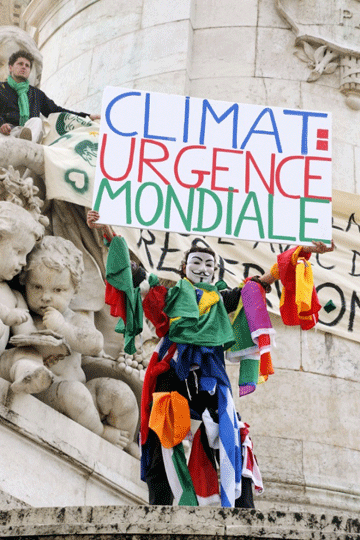
Climate action must be fast tracked
 https://www.project-syndicate.org/commentary/focus-on-reducing-short-lived-climate-pollutants-by-achim-steiner-and-christiana-figueres-2016-03 ACHIM STEINERAchim Steiner is United Nations Under-Secretary-General and Executive Director of the UN Environment Programme (UNEP). CHRISTIANA FIGUERES Christiana Figueres is Executive Secretary of the United Nations Framework Convention on Climate Change (UNFCCC). BONN –
Last December in Paris, world leaders came together to agree on a set of goals and pathways for decarbonizing the global economy and increasing our capacity to adapt to climate change. It was a landmark achievement, but it was just the beginning. Every country – with the support of cities, the private sector, and citizens – must now move swiftly to fulfill its promises and bring climate change under control.
The need for urgent, concerted action cannot be emphasized enough. Any delay will cause negative consequences to continue to accumulate. This will not only cause tremendous suffering, especially to the world’s most vulnerable people; it will reverberate for decades to come, making the key goal of keeping the increase in global temperature below 2º Celsius (relative to pre-industrial levels) increasingly costly.
All about the terrorists’ plan to attack Belgium’s nuclear power station
 Reuters: Bombers “switched target from nuke plant at last minute” — Report: Terror cell plotted to blow up nuclear plant… Threat of “most devastating terror attack in history” — Murder of nuclear worker increasing fear of more attacks — Police worry other cells “poised to unleash further terror” (VIDEOS) http://enenews.com/reuters-terrorists-switched-target-nuke-plant-last-minute-tv-bombers-planned-nuclear-power-plant-attack-murder-nuclear-security-guard-increases-fear-attacks-cbs-chilling-development-sparked-w?utm_source=feedburner&utm_medium=email&utm_campaign=Feed%3A+ENENews+%28Energy+News%29
The Independent, Mar 25, 2016 (emphasis added): Brussels bombings: Terror group ‘were planning to attack nuclear power station’, surveillance suggests — The Brussels bombers were allegedly planning to attack a nuclear power plant and had recorded 10 hours of surveillance footage of Belgium’s nuclear power chief, it has been reported… It is believed they may have been spying on the director as part of a possible kidnap plan to make him help them get into a plant, Belgian newspaper La Derniere Heure reports.
The Australian, Mar 26, 2016: Brussels: jihadists ‘planned attack’ on nuclear plant — Suicide bombers who blew themselves up in Brussels were reportedly originally considering an attack on a Belgian nuclear site, but arrests last week may have forced them to switch to targets in the nation’s capital… Police fear that at least two people directly linked to the Brussels bombings are at large and that other cells of terrorists are poised to unleash further terror.
Reuters, Mar 25, 2016: Attackers switched target from nuke plant at last minute, says paper
Reuters, Mar 24, 2016: Suicide bombers who blew themselves up in Brussels were originally considering an attack on a nuclear site in Belgium, but arrests started last week may have forced them to switch to targets… “Even if one couldn’t prevent these (Brussels) attacks, one can say that their magnitude could have been much bigger if the terrorists had been able to implement their original plan and not opted for easier targets,” said the police source.
Time, Mar 25, 2016: ISIS Attackers May Have Targeted Nuclear Power Station… A Belgiannuclear power plant may have been the target of an aborted plot by the ISIS cell that carried out this week’s terrorist attacks in Brussels… [There are] fears that an “insider” might offer access to terrorists… ISIS actually had a follower inside the Doel plant…
FOX 5 NY, Mar 24 2016: Report: Brussels bombers planned nuclear power plant attack… The newspaper Derniere Heure report that the ISIS cell was spying on the head of the Belgian nuclear program to possibly kidnap him to force their way into an atomic facility…
New Zealand Herald, Mar 26, 2016: 11 nuclear power plant workers have had their site access revoked amid fears of “insider help”…
CBS News, Mar 24, 2016: Brussels suspects linked to nuclear facility plot… It also emerged Thursday that the brothers were part of a plan uncovered earlier this year to try and target a Belgian nuclear facility… In light of that ISIS surveillance earlier this year, CBS News senior national security analyst Juan Zarate called the evacuation order for Belgium’s Tihange nuclear power plant, immediately following the Tuesday bombings, a “chilling development.”
CBS News, Mar 25, 2016: The terror attacks in Brussels are raising new questions about the security of nuclear plants… “If terrorists were able to successfully attack a nuclear facility, there could be a serious loss of life,” said Dr. Page Stoutland of the Nuclear Threat Initiative.
CBS News, Mar 25, 2016: Brussels attacks raise safety concerns of nuclear plants — The terror attacks in Brussels are raising new questions about the security of nuclear plants. An American official says two of the suspected terrorists may have been targeting a facility in Belgium. This revelation has sparked worldwide concern.
Sky News, Mar 25, 2016: [Investigators] conclude the terrorists “could have put national security in danger like never before”, according to Belgian media…
Sputnik, Mar 25, 2016: Brussels Terror Cell Was Plotting to Blow Up a Nuclear Plant… [with] sights set on a high-casualty strike against a nuclear power plant in Flanders, Belgium. When Belgian police apprehended Salah Abdeslam on Friday, March 18, theyprevented what could have been the single most devastating terror attack in history…
Sputnik, Mar 24, 2016: It is clear that Belgium’s secuity services were aware of plans to attack… Immediately after… security was tightened at Belgium’s nuclear power plants.
Telegraph, Mar 27, 2016: A security guard who worked at a Belgian nuclear medical research facility was murdered two days after the Brussels bombings… deepening fears that Islamist terror cells are plotting attacks against nuclear installations… He was found dead in his bathroom by his three children… A source from [his employer] told The Telegraph: “He was killed at gunpoint at his home [and] can’t rule out” [it] was to do with the terrorist attacks…
Nuclear Summit: Belgium’s terrorism hightens need for nuclear security
 Belgium Highlights the Nuclear Terrorism Threat and Security Measures to Stop it, Huffington Post, Matthew Bunn, Professor, Harvard University; Co-Principal Investigator, Project on Managing the Atom , 28 Mar 16,
As world leaders gather for the fourth nuclear security summit this week, in the aftermath of the horrifying terrorist attacks in Brussels, it seems likely that Belgian Prime Minister Charles Michel will have more to say than anyone else — both about real nuclear terrorist dangers and about real steps taken to improve nuclear security.
Since the 2014 summit, Belgium has suffered a number of suspicious and alarming activities at its nuclear sites and against some of its nuclear technicians. In Aug. 2014, for example, someone with inside access at the Doel-4 nuclear reactordrained the lubricant for the reactor turbine, causing it to overheat and resulting in an estimated $100-$200 million in damage. The perpetrator and the motive remain unknown.
In Nov. 2015, Belgian police discovered that the terror cell that carried out the Paris attacks used a secret video camera to monitor an official at nuclear research sites with a wide range of nuclear and radiological materials, including enough highly enriched uranium for several nuclear bombs.
In response to what seemed to be a growing terrorist threat to the country’s nuclear infrastructure, the authorities beefed up protection against insider threats, toughened access control, deployed armed troops to protect reactors and, following the airport and subway attacks, removed all non-essential personnel from nuclear sites in order to reduce the number of potential insiders.
With a variety of different takes on these events swirling in recent news stories (seehere and here), it’s worth clarifying what we know and what is still unknown about the scale of this threat and how best Belgium — and the rest of Europe — can protect itself. (A just-released Harvard study also has details up through February.)
What was the video monitoring of a nuclear official about? Continue reading
Ben Jervey: Subsidized to the end – not even corporate welfare can save Big Coal.
This year, two energy companies that have each received billions of dollars in subsidies and financial support from the federal government are going into bankruptcy. You might think, in this post-Solyndra political environment, that conservative commentators and politicians would be lining up at the Fox News studios to call for some heads to roll.
But, no. Even though these companies have benefited from enough federal subsidies to make the Solyndra loan look like pocket change, there’s no outrage. Because they are coal companies (not solar), the story isn’t about how the federal government spent decades propping them up, it’s about how the president’s Clean Power Plan is taking them down.
http://www.desmogblog.com/2016/03/25/not-even-corporate-welfare-can-save-big-coal & http://www.dailyclimate.org/t/5863920798415471988
1 This Month
Watch the 2026 Doomsday Clock unveiling live here on January 27 at 10 a.m. EST

To see nuclear-related stories in greater depth and intensity – go to https://nuclearinformation.wordpress.com/

29 Jan. Thursday 7-8 p.m. Webinar – World’s Largest Nuclear Station in Port Hope, ON?


31st January – Challenging the War Machine – a DECLASSIFIED UK SUMMIT


Website of the Week
Now until to February 10, 2026 Radioactive waste storage in France: the debate is finally open! How to participate?
-
Archives
- January 2026 (277)
- December 2025 (358)
- November 2025 (359)
- October 2025 (376)
- September 2025 (258)
- August 2025 (319)
- July 2025 (230)
- June 2025 (348)
- May 2025 (261)
- April 2025 (305)
- March 2025 (319)
- February 2025 (234)
-
Categories
- 1
- 1 NUCLEAR ISSUES
- business and costs
- climate change
- culture and arts
- ENERGY
- environment
- health
- history
- indigenous issues
- Legal
- marketing of nuclear
- media
- opposition to nuclear
- PERSONAL STORIES
- politics
- politics international
- Religion and ethics
- safety
- secrets,lies and civil liberties
- spinbuster
- technology
- Uranium
- wastes
- weapons and war
- Women
- 2 WORLD
- ACTION
- AFRICA
- Atrocities
- AUSTRALIA
- Christina's notes
- Christina's themes
- culture and arts
- Events
- Fuk 2022
- Fuk 2023
- Fukushima 2017
- Fukushima 2018
- fukushima 2019
- Fukushima 2020
- Fukushima 2021
- general
- global warming
- Humour (God we need it)
- Nuclear
- RARE EARTHS
- Reference
- resources – print
- Resources -audiovicual
- Weekly Newsletter
- World
- World Nuclear
- YouTube
-
RSS
Entries RSS
Comments RSS
 nuclear-news