Tunnel Collapse at Hanford Nuclear Dump—Harbinger of the Collapse of the Entire Industry?, The Progressive by Harvey WassermanMay 10, 2017 The collapse of a tunnel at the massive nuclear waste dump at Hanford,Washington, 200 miles east of Seattle, has sent shock waves through a nuclear power industry already in the process of a global collapse…….
Robert Alvarez, a former DOE official, told the Post in an email that “the tunnels now store contaminated train cars and a considerable amount of highly radioactive, ignitable wastes including possible organic vapors.” Inspection of the tunnels has not been possible, he said, because radiation levels are too high.
We may never know the full extent of the damage from this latest incident at Hanford, which has been plagued by serious problems for years. Many critical nuclear industry oversight positions remain unfilled by the Trump Administration.
The 580-square-mile Hanford facility dates back to the 1940s production of the first atomic bombs, and is the nation’s major repository for high-level radioactive wastes from seven decades of nuclear weapons production. Since 1989, the Department of Energy has spent billions cleaning up nine reactors and other radioactive facilities there. One commercial reactor, the Columbia Generating Station, still operates at Hanford.
The tunnel collapse happens at a time when the nuclear power industry appears to be in an accelerating death spiral……..
Some atomic devotees are pushing small-scale “modular” reactors as a possible future energy source. But they’re untested, underfinanced, uncompetitive and unlikely to come to fruition…….
Throughout the United States, reactor owners are now flooding state legislatures with bailout scams. In Ohio, FirstEnergy’s pleadings for $4.5 billion for Davis-Besse near Toledo and Perry near Cleveland are meeting stiff resistance. How long the nation’s operable reactors stay open will depend entirely on how much money their owners can gouge out of the public.
Meanwhile the Hanford tunnel collapse further challenges the industry’s credibility on dealing with radioactive waste. Three years ago America’s only major operable waste storage facility, at Carlsbad, New Mexico, exploded due to the use of inappropriate kitty litter (truly!). Some twenty-one workers were exposed and the facility was shut for three years. Fierce debate has erupted over the disposal of wastes left behind by the shutdown of California’s San Onofre reactors, between Los Angeles and San Diego, with billions of dollars at stake. Other such fights are sure to escalate as more reactors close…..
Africa can be a leader in renewable energy – GNA, 8 May 17Mr Bill McKibben, Co-Founder of 350.org, says African countries could be great leaders in the use of renewable energy sources globally if they commited to using their resources.
He said countries that progressed fast in the use of renewable energy would lead in the future and Africa was blessed with vast amounts of sunlight and wind to lead in that regard.
Speaking at a press conference organised by 350 Ghana- Reducing our Carbon (G-ROC) he said Germany and other Scandinavian countries were investing heavily in renewable energy, with Germany having 85 percent of its energy mix in renewable energy.
Mr McKibben said climate change, which was caused by the use of fossil fuels, was the greatest crisis the world had ever faced and could also be the greatest opportunity for socio-economic development in Africa if its leaders increased efforts at prioritising renewable energy.
He said Africa had to choose the use of Solar Energy over other forms such as Nuclear, coal or other fossil fuels.
He explained that nuclear energy was very expensive and took decades to build. “Africa can make good use of the sunshine”, he added. Mr Mckibben said although investing in Solar Energy panels could be expensive in the beginning, it was worth it in the long run since the energy from the sun would be for free, saying “that is the cheapest deal”.
Rock Canyon Poets show nuclear power’s cost in ‘Nuclear Impact Utah’,Court Mann, Daily Herald, May 6, 2017The new poetry anthology “Nuclear Impact: Broken Atoms in Our Hands” is pretty massive: nearly 500 pages long, with pieces from 163 poets from 16 nations.
“If you think about it, there are only nine nations in the world in control of nuclear power,” said Bonnie Shiffler-Olsen, a Utah resident and cofounder of Rock Canyon Poets, a growing local poetry group. “And so obviously, it doesn’t just impact those of us who have the buttons to push.”
Shiffler-Olsen and other members of Rock Canyon Poets have contributed to the new anthology, which explores the human cost of nuclear power around the world. From the world’s first nuclear test in 1945 (a New Mexico-based explosion known as Trinity) to the Fukushima nuclear disaster in 2011, “Nuclear Impact” covers the broad spectrum of world-changing nuclear events on a personal level. It’s not about dates and figures, but individuals and families.
The anthology also hits close to home in Utah: Many of America’s aboveground nuclear tests happened near the Nevada-Utah border. Utah residents felt the effects, many through radiation-induced disease and eventual death. On Monday, Rock Canyon Poets host “Nuclear Impact Utah – Poets on the Nuclear West” at Pioneer Book in downtown Provo. The event will include readings from the anthology, as well as showings from the recent documentary “Downwinders,” which examines how those nuclear tests affected citizens of the Intermountain West, and a Q&A with the “Downwinders” filmmakers………http://www.heraldextra.com/entertainment/arts-and-theater/rock-canyon-poets-show-nuclear-power-s-cost-in-nuclear/article_3ac09bee-1861-5bb3-94dd-0c31a5f74b84.html
It is time for Europe to face its nuclear challenge, Ft.com 30 Apr 17 Nick Butler, This post is co-authored by Shahin Vallée The energy market in Europe is being radically transformed by formidable forces, but governments and companies alike are so far failing to adapt to a changing world. Some of the greatest risks lie in the nuclear sector. The scale of the challenge suggests that only a pan-European approach can produce viable solutions but can the continent, in the wake of Brexit, deliver the necessary co-operation? Three principal factors are at work:
The rapidly declining marginal cost of renewable energy (solar and wind), is threatening the economics of nuclear and fossil-fuel powered generation and, starting in Germany, breaking down the business models of the established utilities.
The increasing openness of the European energy market is such that policy decisions taken in one country immediately weigh on others. This is accelerating the pressure on the business models of utilities.
An entire generation of nuclear power plants built in the 1960s and 1970s is reaching the end of its working life. Plants will need to be retired, decommissioned securely and in some cases replaced at very high cost. Decommissioning know-how, however, is minimal and there is no standardised and affordable model for the development of new nuclear capacity or its integration into a system in which renewables will be a growing force. The response to the common challenges has been disparate and unco-ordinated…….https://www.ft.com/content/2b79ac79-aef0-3252-b712-7c5cddeef171
THE ‘FUNNY DEMOCRACY’ OF JACOB ZUMA, EyeWitness News, Judith February , 5 May 17 –“………..- Government’s dogged pursuit of nuclear above everything else is confusing in many ways. Joemat-Pettersson was on record as saying that that the deal would create thousands of jobs and also ‘place a considerable order to local industrial enterprises worth at least $10 billion’. That really did sound like arms deal déjà vu and the so-called National and Defence Industrial Participation Plans. The nuclear deal will in fact dwarf the arms deal of 1999 in both size as well as its potential for corruption.
In 1999 then Treasury official Roland White warned that South Africa’s commitment to the arms deal would depend on its ‘appetite for risk’. The failure of the arms deal and the associated corruption has caused an inestimable amount of damage to our democracy and its institutions. It’s worth learning the lessons from the past.
In addition, Section 217 of the Constitution is quite clear regarding procurement processes when it says they should be, ‘in accordance with a system which is fair, equitable, transparent, competitive and cost-effective…’ Parliament also has a constitutional duty to ensure that it exercises oversight over the executive and now has a fresh opportunity to redeem itself after its failure to deal with the breach of procedure by the minister in tabling the international agreements mentioned above.
The bold Western Cape High Court ruling shows that this nuclear deal is all of our business and there can be no place for secrecy when the state is about to commit us all to billions of rands in expenditure and bind future generations.
New Energy Minister Mmamoloka Kubayi has committed herself to transparency.
There are hints that government will appeal the Western Cape High court decision. Zuma, in all likelihood, will want to forge ahead in some way. He has, after all, shown a casual disregard for the courts and has little appetite for accountability. Given the intense scrutiny from the prying public and vigilant civil society organisations, this will prove challenging. At the very least Zuma will find that court processes will delay any potential deal. That will be somewhat inconvenient for those who stand to benefit handsomely from the proposed deal.
Zuma once said democracy is a ‘funny thing’. His associates must be standing in the wings somewhat irritated and perhaps not finding it so funny after all.
Does Trump think America could win a nuclear war?, The Week, DavidFaris, 2 May 17 In between another failed congressional push for TrumpCare and President Trump musing inanely about why the Civil War happened, there’s been lots of loose talk about North Korea. The president, who was only recently issuing menacing threats from his Twitter account, now says he is willing to be the first president to meet with his North Korean counterpart, Kim Jong Un, even as White House Chief of Staff Reince Priebus says he can’t see it happening. U.N. Ambassador Nikki Haley recently threatened a strike on the nuclear-armed dictatorship, while Secretary of State Rex Tillerson contradictedVice President Pence by saying that the U.S. might sit down for multiparty negotiations.
The policy and rhetorical incoherence from the White House is sadly typical for a group of amateur leaders that can’t seem to do something as simple as call a meeting and agree on a set of talking points. Far from projecting strength or throwing adversaries off balance with some kind of Nixonian “madman theory” of foreign policy, the failure to get America’s key decision-makers on the same page only makes the administration look feckless and adrift — and makes it more likely that a misunderstanding could lead to an even more serious crisis.
But the more important questions are whether the president and his advisers have an end game, and how they view nuclear weapons in general. From the moment he took office, President Trump has seemed weirdly determined to get the 24 million people of metropolitan Seoul incinerated in a pointless war, and his team is reacting to every provocation from Pyongyang as if this is the first time North Korea has ever tested a missile or released an unhinged statement.
It is not clear what the Trump administration hopes to achieve with its recent escalation of tensions. There are only two things that would represent an improvement over the status quo on the Korean Peninsula (assuming that reunification is a nonstarter). One is a negotiated agreement that leads North Korea to surrender the nuclear weapons it has already built and rejoin the Non-Proliferation Treaty (NPT) from which it withdrew in 2003, or to at least freeze its missile and weapons programs.
However, the U.S. is governed by people who don’t believe other countries can be trusted to adhere to international agreements and who keep threatening obliquely or overtly to blow apart the Iran deal. If Trump and his advisers are trying to get North Korea back to the table, they are also pursuing a gravely mistaken path by threatening the agreement with Iran. Not only would undermining the Iran deal convince the North Koreans that we can’t be trusted, it will also make North Korea’s neighbors less likely to cooperate in any sanctions effort that could squeeze Pyongyang hard enough to get them to change their behavior.
The second potential improvement on the Korean Peninsula would be if the odious regime of Kim Jong Un were replaced. Yet self-preservation is what drove Pyongyang to acquire nuclear weapons in the first place. The regime views its small nuclear deterrent as the only thing preventing the U.S. from leading an Iraq-style adventure straight to Pyongyang, and the aggressive and inconsistent messaging from Washington will do nothing to ease those concerns.
So what is the administration up to, exactly? One possibility might be that it doesn’t fear a nuclear exchange in the same way that most other U.S. presidents have since the dawn of the nuclear age……
To this day, the U.S. maintains in its nuclear posture the right to be the first to introduce nuclear weapons in a conflict, and you can assume that the idea is not to start a large-scale nuclear war that would kill everyone on Earth.
Howard Margolis and Jack Ruina coined the term Nuclear Utilization Theory in an influential 1979 article to describe these ideas, but during the heyday of the Cold War it was also called NUTS — Nuclear Utilization and Target Selection. Proponents believed that a nuclear war could be fought and won without escalating to a full-scale, civilization-obliterating thermonuclear exchange. In particular, they believed in the tactical utility of using small numbers of nuclear weapons in the event of a conventional war to gain and press advantages on the battlefield. NUTS proponents never had much luck convincing planners or the general public that nuclear weapons are just another gizmo in the great power toolbox.
How does this all fit into the North Korea crisis? During the campaign, Trump was credibly rumored to have asked a foreign policy adviser, during a conversation about nuclear weapons, “If we have them, why can’t we use them?” In January, he told Morning Joe co-host Mika Brzezinski, “Let it be an arms race.” His December tweet that “the United States must greatly strengthen and expand its nuclear capability until such time as the world comes to its senses regarding nukes” is precisely the opposite of the process called for by the Non-Proliferation Treaty, which requires states that possess nukes to work toward their elimination. And he recently approved the use of America’s most destructive non-nuclear bomb, the Massive Ordnance Air Blast, in Afghanistan.
In other words, it is not that hard to imagine Trump believing some half-baked, inchoate, Fox News version of NUTS and then acting on it. ……
NUTS was always a fringe movement because no one could really envision a plausible scenario where policymakers calmly de-escalate a situation after a nuke has gone off. Can Defense Secretary Mattis — who was firm during his confirmation hearings that nuclear weapons must never be used — convince his boss that NUTS is, well, nuts?
The question is far from academic. …. the threat of accidental nuclear annihilation remains quite real. ….The fact that the United States is now led by an erratic, ill-tempered novice makes the situation even more unstable. One of the genuinely terrifying things about Donald Trump is how little he appears to know about anything, and how he frequently discovers new facts about the world that would strike most people as self-evident. He’s like the imbecile son of a hereditary monarch who becomes king at age 13 when dad chokes to death on a tenderloin. He requires, at all times, a team of educated adults to tutor him on the the basics of diplomacy and history even as he makes momentous decisions about life and death. Mattis, National Security Adviser H.R. McMaster, and Vice President Pence are basically operating a regency for a president who is incapacitated by his own ignorance and stupidity.
This may all be bluster, and at the end of the day, war with North Korea remains unlikely. But one of these regents (and God bless them) needs to get our dude caught up on nuclear strategy, unless the few survivors of a nuclear exchange would like to hear him musing, post-apocalypse, about how nuclear weapons are so much deadlier than he thought before he accidentally became leader of the most powerful country in the world. http://theweek.com/articles/692923/does-trump-think-america-could-win-nuclear-war
More worries over Cumbrian nuclear new build, Times and Star, By Duncan Bick, 2 May 17 The company behind Cumbria’s proposed nuclear new build is having a “review of its options”, raising more fears over the project.
NuGen – which has plans for a power plant at Moorside, near Sellafield – has made the announcement following the news that troubled Japanese giant Toshiba is set to become its sole owner.
Toshiba already has a 60 per cent stake in NuGen.
After its American subsidiary Westinghouse filed for Chapter 11 bankruptcy the other shareholder, French firm ENGIE, has used legal agreements to sell its stake to Toshiba.
The Japanese company is in serious financial difficulties after it reported a 532bn yen (£3.8bn) loss for the period of April-December last year and said it had “substantial doubt” about its ability to continue as a going concern.
The Bond Buyer, Shelly Sigo, 1 May 17, BRADENTON, Fla. – For the first time, the Georgia and South Carolina owners of the two nuclear power projects at the core of Westinghouse’s bankruptcy case appear to have diverged in their negotiations.
Eight nations now have sufficient weapons of mass destruction to end civilization worldwide in a nuclear winter, a leading science writer has warned.
“Far from receding, the nuclear threat to human survival has never been greater,” says Julian Cribb, author of ‘Surviving the 21st Century’ (Springer 2017), a new book on how humanity can solve the growing mega-risks that confront it.
“One of the huge advances from recent climate science is a far better understanding of the world’s atmosphere. From this, leading scientists have concluded it would take the release of no more than 50-100 small nuclear weapons to wreck global food production for everyone,” he says.
“This is a tiny proportion of the total nuclear arsenal of around 14,900 warheads. Eight countries – the US, Russia, China, UK, Pakistan, India, France and Israel – now have sufficient WMD capacity to eliminate civilization on their own. Two more, Iran and North Korea, are believed to aspire to that power also.”
Mr Cribb said that old nuclear imagery from the Cold War and disaster movies had left the public with a belief that the main impact of a nuclear clash would be local effects from blast, fireball and fallout.
“This is not correct. The latest science is saying that the tens of billions of tonnes of smoke and dust thrown up by nuclear blasts would block sunlight, chilling the whole planet by several degrees for several years, restricting plant growth and destroying crop harvests with frost globally. With only three months’ supply of food in stock at any time, this could be catastrophic.
“It means even a limited or localised nuclear exchange could potentially cause a worldwide famine, affecting everyone, no matter how far from the war zone they were. In theory, the use of just a half of one percent of the world nuclear stockpile could end civilization as we know it.”
The dangers of WMD getting into the wrong hands are growing: the International Atomic Energy Agency (IAEA) trafficking database listed 2889 known cases of nuclear theft up to December 2015.
“This highlights the fact that no form of nuclear energy is safe for the planet, if its materials and wastes can be stolen to make bombs. So far nobody can guarantee their security,” Cribb says. “The old arithmetic of mutually assured destruction no longer applies if rogue states, fanatics and non-state players acquire nuclear capability by such means.”
“There is also a dangerous illusion that, because the numbers of nuclear devices are coming down slowly, as the US and Russia retire old Cold War stocks, the world is becoming safer. It isn’t. Nuclear drones and robotic weapons, AI systems, hypersonic missiles, stealth weapons, space weapons, mini-nukes, dirty weapons and ‘smart’ bombs are escalating the dangers for everyone.”
Furthermore, the world still has no agreement to ban all nuclear weapons – unlike chemical and biological weapons. A current proposed nuclear weapons ban before the United Nations, has received the vote of 113 countries, while 35 remain opposed and 13 are abstaining. Thus, the proposal to end the nuclear nightmare remains deadlocked.
“The issue of whether or not civilization suffers one or more devastating nuclear conflicts in the 21st Century will be decided by nation states – not by ordinary human beings,” Mr Cribb warns.
“Only nations own and control nuclear weapons. Not cities, corporations, ethnic groups, tribes or religious orders. If humanity is to be destroyed, it will be because of nationalistic governments.”
The wars of the past two centuries claimed more than 200 million lives, mostly civilian, and were almost entirely started by national governments.
In the meantime, doctors, scientists, concerned citizens and the Catholic Church worldwide are speaking out against the nuclear menace. “It is up to every individual citizen and parent, if they wish for a safer world for their children, to oppose the adoption and deployment of nuclear weapons by their governments. There is no other way this will happen,” Cribb says.
“If even a tenth of the US$1.8 trillion spent every year on new weapons were invested in food production and economic development, we could end both world hunger and poverty within a decade – as well as making the world a much safer place for our children.
“Currently, humans are the only creature than devotes 35 times more of its resources to better ways to kill itself than it does on better ways to feed itself.”
Surviving the 21st Century (Springer International 2017) is a powerful new book exploring the main risks facing humanity: ecological collapse, resource depletion, weapons of mass destruction, climate change, global poisoning, food crises, population and urban overexpansion, pandemic disease, dangerous new technologies and self-delusion – and what can and should be done to limit them.
Ukraine clings to nuclear power despite Chernobyl trauma, Yahoo 7 news, by Dmitry ZAKS – AFP on April 30, 2017 “………Ukraine Wednesday marked 31 years since the disaster in which thousands died with the country extending the lifespan of its communist-era nuclear reactors and turning atomic power into a workhorse that will be around for generations to come.
The Chernobyl plant’s fourth reactor in the north of former Soviet Ukraine exploded in 1986 after a safety test went horribly wrong at 1:23 am on April 26.
Some Ukrainians remain worried that a similar catastrophe could hit their country again.
“The main risk in using nuclear energy in Ukraine is associated with reactors that have exhausted their lifespans,” says Iryna Golovko of the National Ecological Centre of Ukraine’s energy projects department.
“Today six of Ukraine’s 15 operating reactors have surpassed their designed service lives,” she told AFP. “And by 2020, there will be 12 of them.”………
What Now For South Africa’s Nuclear Energy Plans? Any deals with Russia, the U.S. and South Korea are off and government must go back to the drawing board.Pieter du Toit, Deputy Editor, HuffPost South Africa 26/04/2017The official request for information (RFI) issued by Eskom for its nuclear build programme is off the table. What does this mean? That the government must completely start again when it comes to its nuclear energy plans for South Africa.
Liz McDaid, of Earthlife Africa, one of the two applicants who asked the Western Cape High Court to set aside government’s nuclear plans, says the only option left to Eskom and government is to “go back to the drawing board”.
“The entire nuclear procurement programme has been found to be unlawful. The whole thing has been stopped, which includes the RFI issued in December and which closes on Friday,” McDaid told HuffPost.
The nuclear procurement programme was moved from the department of energy in December and Eskom issued the RFI — a process whereby parties indicate their interest in tendering for the deal — just before Christmas.
Trump moves to lift bans on Arctic oil and gas drilling, Donald Trump says lifting bans on drilling for oil and gas in offshore Arctic and Atlantic areas will pull in “billions of dollars” for America.SBS News 29 APR 2017 –
US President Donald Trump has signed an executive order aimed at lifting bans on drilling for oil and gas in offshore Arctic and Atlantic areas, saying it would pull in “billions of dollars” for America and create jobs.
However, Trump made no mention of the environmental rationale for the bans, brought in by his predecessor Barack Obama.
“Our country’s blessed with incredible natural resources, including abundant offshore oil and natural gas reserves, but the federal government has kept 94 per cent of these offshore areas closed for exploration and production,” the president said before journalists in the White House……..http://www.sbs.com.au/news/article/2017/04/29/trump-moves-lift-bans-arctic-oil-and-gas-drilling
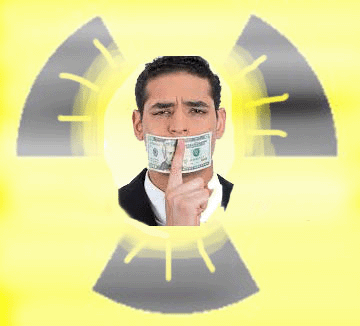
Eskom may have paid millions to keep anti-nuclear research groups quiet: report, Business Tech By Staff WriterApril 28, 2017Millions of rands in Eskom funding appears to have silenced two well-respected research institutions, previously critical of the state-owned utility’s plans to procure a fleet of nuclear power stations, according to a new report by amaBhungane.
According to amaBhungane, the Centre for Scientific and Industrial Research (CSIR) was “effectively gagged” after a meeting in March between acting Eskom CEO Matshela Koko and CSIR head, Dr Thulani Dlamini.
Insiders speaking to amaBhungane noted that a strong rumour had emerged from the meeting, pointing to R100 million pledge by Eskom for CSIR research on technology related to nuclear energy……
CRSES amaBhungane reported that it appears that a similar agreement was reached between the state-owned power utility and the Centre for Renewable and Sustainable Energy Studies (CRSES), who at the last second decided to withdraw comments it had submitted for publication that were highly critical of Eskom’s nuclear plans.
Further email correspondence seen by amaBhungane suggested that the CRSES was unwilling to offend Eskom for fear of having its funding pulled.
In an email seen by amaBhungane, CRSES director Wikus van Niekerk acknowledged the censorship saying, “We receive significant funding from Eskom, some from a programme where Matshela is personally involved in, and I need to be careful how I react in public not to put this at risk.”
Eskom, the CSIR and CRSES have all denied that Eskom has in any way tried to rein in independent research or debate on nuclear or renewable energy options.
Speaking at a Climate Week event, Colin Butterfield, Harvard Management Company’s (HMC) Managing Director of the Committee of Natural Resources, said that they will be “pausing” direct investments in oil, gas, and coal.
“What I can tell you is, from my area, I could honestly say that I doubt — I can’t say never, because never say never — but I doubt that we would ever make a direct investment with fossil fuels,” he said. “But that’s more of an Investment Committee decision, and I cannot talk on their behalf.”
“We’re heartened to hear Butterfield acknowledge the gross injustice of climate change,” said Isa Flores-Jones ‘19, Divest Harvard Coordinator. “Oil, coal, and natural gas are no longer economically, or morally, viable options.”
It’s been a long road for Harvard divestment proponents, with numerous campaigns and recent blockades all designed to pressure the University’s decision making. The Harvard Crimsonprovides a comprehensive rundown of the campaigns and the incremental moves made by Harvard administrators.
There will be more to come, as the decision is not binding or long-term, and Harvard divestment campaigners will continue to push the University to make hard-line commitments to completely and permanently divest from fossil fuel investments. But the tide is turning in their favor, and a growing consensus about the harmful nature of fossil fuel investment continues to sway more and more people.
“I clearly feel that we are stealing from the future generations,” said Butterfield. “When you go out there and invest in natural resources, and you start looking at what’s happening in the world of natural resources, it’s pretty scary — we need to have more of these conversations.”
Redglass Pictures and StarTalk Radio created a short film in which the brilliant scientist and communicator Neil deGrasse Tyson – though not specifically talking about the science marches – perfectly articulated the motivations behind them.
For example, last weekend’s March for Science was largely a pushback against the creeping science denial among today’s political leaders, about which Dr. Tyson said:
But in this, the 21stCentury, when it comes time to make decisions about science, it seems to me people have lost the ability to judge what is true and what is not; what is reliable and what is not reliable; what should you believe, what should you not believe. And, when you have people who don’t know much about science standing in denial of it, and rising to power, that is a recipe for the complete dismantling of our informed democracy.
The climate march is in response to so many of our political leaders using science denial to obstruct the important debate about policy solutions:
So once you understand that humans are warming the planet, you can then have a political conversation about that … [policy solutions] have political answers. And every minute one is in denial, you are delaying the political solution that should have been established years ago.
we live in a time where people are passing legislation like in North Carolina to not pay attention to science when making legislation about coastal water levels rising. That is absolutely ludicrous and anti-human. We need to make, as you just said, policies based on the best evidence we have available to us, and that’s why I’m marching.
The underlying problem is that it’s been decades since we’ve known enough about the threats posed by human-caused climate change to mitigate those risks. It should be a no-brainer: we have one planet with one climate that we depend upon entirely for our survival. We are in the process of fundamentally changing its atmosphere by dumping 35 billion tons of carbon dioxide into it every year. Our only reasonable option is to curb that carbon pollution as quickly as possible before we destabilize the Earth’s climate.
It’s madness. We are risking the future of our society on the slim chance that a 3% fringe minority of climate scientists is right and 97% are wrong. It’s like playing Russian roulette, but with far worse odds. At least with Russian roulette there’s a 5-in-6 chance (83%) you’ll be fine. That’s a far sight better than the 3-in-100 (3%) gamble our leaders are taking on climate change. Worse yet, even the 3% don’t deny that humans are altering Earth’s climate, which is an inherently risky proposition.








 nuclear-news