What if terrorists unleashed a dirty bomb, or even a small nuclear bomb, on a city?
Bulletin of Atomic Scientists 21st Feb 2018, As seen by recent events such as the bombing in Manchester, UK, terrorism can occur anywhere, at any time. So far, the terrorist incidents have been
relatively low-tech – such as improvised explosive devices detonating
inside pressure cookers, trucks driving down crowded sidewalks, or bombs
exploding in backpacks containing metal bolts and screws.
But what if terrorists were to build a dirty bomb that contained radioactive materials
instead of bits of metal shrapnel, and set it off in a major city? Or,
worse, what if they managed to build a fully functioning nuclear weapon,
cart it to the downtown of a city, and then detonate it – even a small,
rudimentary one that was much smaller than the atomic bomb dropped on
Hiroshima?
What would the social, economic, and political impacts of the
successful terrorist use of a nuclear weapon look like? What planning has
the international community done for such an event?
https://www.tandfonline.com/doi/full/10.1080/00963402.2018.1436812
The dramatic melting of Arctic icebergs – in pictures
c thttps://www.theguardian.com/environment/gallery/2018/apr/04/the-dramatic-melting-of-arctic-icebergs-in-pictures
Photographer Francesco Bosso travelled to Greenland to capture images of the melting icebergs, which he describes as ‘gems of nature in danger of extinction’. The results are presented in his new book, Last Diamonds
Madeleine Allbright on Donald Trump and the threat of fascism
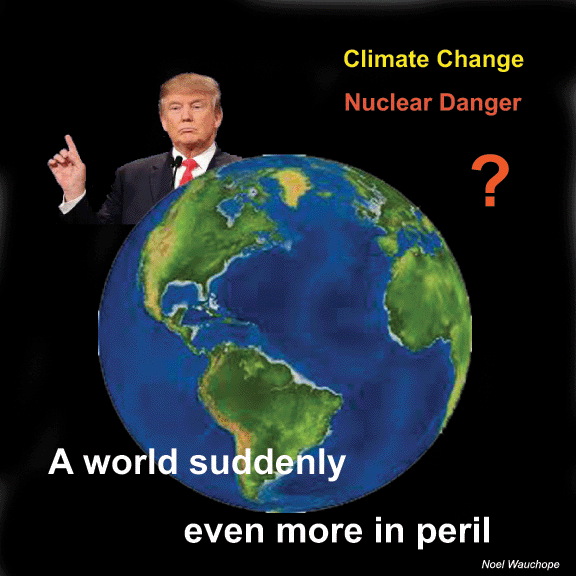 Will We Stop Trump
Before It’s Too Late? https://www.nytimes.com/2018/04/06/opinion/sunday/trump-fascism-madeleine-albright.html Fascism poses a more serious threat now than
at any time since the end of World War II.
On April 28, 1945 — 73 years ago — Italians hung the corpse of their former dictator Benito Mussolini upside down next to a gas station in Milan. Two days later, Adolf Hitler committed suicide in his bunker beneath the streets of war-ravaged Berlin. Fascism, it appeared, was dead.
To guard against a recurrence, the survivors of war and the Holocaust joined forces to create the United Nations, forge global financial institutions and — through the Universal Declaration of Human Rights — strengthen the rule of law. In 1989, the Berlin Wall came down and the honor roll of elected governments swelled not only in Central Europe, but also Latin America, Africa and Asia. Almost everywhere, it seemed, dictators were out and democrats were in. Freedom was ascendant.
Today, we are in a new era, testing whether the democratic banner can remain aloft amid terrorism, sectarian conflicts, vulnerable borders, rogue social media and the cynical schemes of ambitious men. The answer is not self-evident. We may be encouraged that most people in most countries still want to live freely and in peace, but there is no ignoring the storm clouds that have gathered. In fact, fascism — and the tendencies that lead toward fascism — pose a more serious threat now than at any time since the end of World War II.
Warning signs include the relentless grab for more authority by governing parties in Hungary, the Philippines, Poland and Turkey — all United States allies. The raw anger that feeds fascism is evident across the Atlantic in the growth of nativist movements opposed to the idea of a united Europe, including in Germany, where the right-wing Alternative für Deutschland has emerged as the principal opposition party. The danger of despotism is on display in the Russia of Vladimir Putin — invader of Ukraine, meddler in foreign democracies, accused political assassin, brazen liar and proud son of the K.G.B. Putin has just been re-elected to a new six-year term, while in Venezuela, Nicolás Maduro, a ruthless ideologue, is poised to triumph in sham balloting next month. In China, Xi Jinping has persuaded a docile National People’s Congress to lift the constitutional limit on his tenure in power.
Around the Mediterranean, the once bright promise of the Arab Spring has been betrayed by autocratic leaders, such as Abdel Fattah el-Sisi of Egypt (also just re-elected), who use security to justify the jailing of reporters and political opponents. Thanks to allies in Moscow and Tehran, the tyrant Bashar al-Assad retains his stranglehold over much of Syria. In Africa, the presidents who serve longest are often the most corrupt, multiplying the harm they inflict with each passing year. Meanwhile, the possibility that fascism will be accorded a fresh chance to strut around the world stage is enhanced by the volatile presidency of Donald Trump.
If freedom is to prevail over the many challenges to it, American leadership is urgently required. This was among the indelible lessons of the 20th century. But by what he has said, done and failed to do, Mr. Trump has steadily diminished America’s positive clout in global councils.
Instead of mobilizing international coalitions to take on world problems, he touts the doctrine of “every nation for itself” and has led America into isolated positions on trade, climate change and Middle East peace. Instead of engaging in creative diplomacy, he has insulted United States neighbors and allies, walked away from key international agreements, mocked multilateral organizations and stripped the State Department of its resources and role. Instead of standing up for the values of a free society, Mr. Trump, with his oft-vented scorn for democracy’s building blocks, has strengthened the hands of dictators. No longer need they fear United States criticism regarding human rights or civil liberties. On the contrary, they can and do point to Mr. Trump’s own words to justify their repressive actions.
 At one time or another, Mr. Trump has attacked the judiciary, ridiculed the media, defended torture, condoned police brutality, urged supporters to rough up hecklers and — jokingly or not — equated mere policy disagreements with treason. He tried to undermine faith in America’s electoral process through a bogus advisory commission on voter integrity. He routinely vilifies federal law enforcement institutions. He libels immigrants and the countries from which they come. His words are so often at odds with the truth that they can appear ignorant, yet are in fact calculated to exacerbate religious, social and racial divisions. Overseas, rather than stand up to bullies, Mr. Trump appears to like bullies, and they are delighted to have him represent the American brand. If one were to draft a script chronicling fascism’s resurrection, the abdication of America’s moral leadership would make a credible first scene.
Equally alarming is the chance that Mr. Trump will set in motion events that neither he nor anyone else can control. His policy toward North Korea changes by the day and might quickly return to saber-rattling should Pyongyang prove stubborn before or during talks. His threat to withdraw from the 2015 Iran nuclear agreement could unravel a pact that has made the world safer and could undermine America’s reputation for trustworthiness at a critical moment. His support of protectionist tariffs invites retaliation from major trading partners — creating unnecessary conflicts and putting at risk millions of export-dependent jobs. The recent purge of his national security team raises new questions about the quality of advice he will receive. John Bolton starts work in the White House on Monday.
What is to be done? First, defend the truth. A free press, for example, is not the enemy of the American people; it is the protector of the American people. Second, we must reinforce the principle that no one, not even the president, is above the law. Third, we should each do our part to energize the democratic process by registering new voters, listening respectfully to those with whom we disagree, knocking on doors for favored candidates, and ignoring the cynical counsel: “There’s nothing to be done.”
I’m 80 years old, but I can still be inspired when I see young people coming together to demand the right to study without having to wear a flak jacket.
We should also reflect on the definition of greatness. Can a nation merit that label by aligning itself with dictators and autocrats, ignoring human rights, declaring open season on the environment, and disdaining the use of diplomacy at a time when virtually every serious problem requires international cooperation?
Experts reject Japanese claim about North Korea preparing for a new nuclear weapons test
Experts push back at Japanese claim on North Korean nuclear work, American monitoring website contends satellite imagery does not support foreign minister, Nikkei Asian Review,
TOKYO — The recent assertion by Japan’s top diplomat that North Korea is preparing for a new nuclear weapons test has drawn a rebuttal from a U.S.-based monitoring website maintaining that such activity is not confirmed by satellite imagery.
Pyongyang appears to be “working hard to get ready for the next nuclear test,” Foreign Minister Taro Kono said at a Saturday lecture in the western Japanese city of Kochi. He cited the removal of soil from a tunnel at the site.
But Johns Hopkins University’s 38 North blog, which monitors the reclusive state, said in an analysis dated Monday that “commercial satellite imagery from March 23 shows quite a different picture: namely, that activity at the test site has been significantly reduced compared to previous months.”
Turkey’s nuclear ambitions might not be feasible
With a political regulator, Turkey’s nuclear ambitions could go kaboom https://ahvalnews.com/nuclear-energy/political-regulator-turkeys-nuclear-ambitions-could-go-kaboom
In a symbolic gesture after years of not seeing eye to eye, Russian President Vladimir Putin and Turkish President Recep Tayyip Erdoğan attended via teleconference a ground-breaking ceremony for a Russian-built nuclear power plant near the Mediterranean coast on Tuesday.
However, the $20 billion project may not rest on firm foundations, as despite years of promises by the government to bring in a new law governing the regulation of nuclear power, the project is beginning construction before that legal framework is in place.
Until Turkey’s nuclear law is redrafted, the regulation of nuclear energy will be carried out by an institution controlled by the Turkish prime ministry. That means it will not be insulated from political pressure.
Turkey’s media environment means that it cannot air serious criticism of the safety risks, and the plant’s stakeholders – the Turkish government, the Russian government, and possibly businessmen known to be close to Erdoğan – have ample incentives to cut corners in terms of plant safety in order to speed up construction.
For one thing, the plant is likely to be a loss-leader for the Russian side: a goodwill gesture towards Turkey and a subsidy for its ailing industrial sector. But the sooner the plant comes online, the fewer losses the Russian state will have to bear.
In Turkey’s eyes, the project is a matter of prestige. Having a nuclear power plant operative by the hundredth anniversary of the founding of the republic in 2023 will be one of the crowning achievements of the government’s dash to prove itself worthy of the legacy of founder Mustafa Kemal Atatürk.
Rosatom, the Russian company behind the project, says it is committed to meeting the 2023 deadline, despite the technical difficulties that speeding the project up might pose. And it only begins recouping its capital once the plant is producing money. Any overruns or extra costs will push further into its bottom line.
It is still trying to sell a 49 percent share in the project after foreign investors turned their noses up at the idea and a consortium of companies close to Erdoğan pulled out of the deal in February.
And Russia’s reserve fund, which was formerly used to subsidise the country’s export of civilian nuclear technology, has dried up as a result of drops in the price of oil.
Turkey is also seeking to ease Rosatom’s financial burden by promising generous tax exemptions for the entire duration that the plant is in operation.
Amid all this pressure to cut corners, the need for a strong, independent nuclear regulator that can ensure that the plant is properly built is overwhelming.
The International Atomic Energy Agency (IAEA) has been pushing Turkey to create one for many years.
Its recommendations to Turkey in 2014 included “enacting a law on nuclear energy which establishes an independent regulatory body and putting a national policy in place that covers a wide range of issues, as well as further developing the required human resources”.
But in the present circumstances, the costs associated with careful construction and operation may render unfeasible the completion of the project in time to act as a symbol of the present government’s achievements as Turkey hits its centenary.
Cancer Stats Skyrocket Around Nuclear Reactors: Epidemiologist Joseph Mangano.
Nuclear Hotseat 4th April 2018
Hole found in pipe at Genkai nuclear plant
https://www3.nhk.or.jp/nhkworld/en/news/20180401_18/The operator of the Genkai nuclear plant in southwestern Japan says it has found a hole in a reactor pipe where a steam leak was detected on Friday.
Kyushu Electric Power Company began inspecting the No.3 reactor of the plant in Saga Prefecture on Sunday afternoon.
The reactor went back online on March 23rd, after a suspension of more than 7 years. It began generating and transmitting power 2 days later.
But Kyushu Electric found a small amount of steam leaking from a pipe connected to equipment that removes oxygen, carbon dioxide and other substances.
It suspended power generation early on Saturday.
The utility says the steam does not contain radioactive substances, and there has been no impact on the environment.
The company says it is trying to find out what made the hole, which is about one centimeter across.
Kyushu Electric says there is currently no need to shut down the reactor, but the results of the inspection may affect some plans.
The utility plans to resume commercial operation of the No.3 reactor on April 24th and put No.4 back online in May.
As China’s nuclear power industry flounders, should India and Pakistan take note?
China pursued nuclear energy even as countries around the world abandoned it. But slowing demand and competition from renewables have halted new approvals. Scroll In , Feng Hao
As countries around the world abandoned nuclear power, China had bucked the trend, embracing nuclear power as a reliable and cheap energy source that would help reduce air pollution from burning coal. Now nuclear development in China is floundering, with the overcapacity in the power sector and fierce price competition with solar, wind and hydropower. Wider concerns about safety and lack of water (of which nuclear power plants demands a huge amount) also play a part.The tribulations of China’s nuclear industry should be of interest to South Asian countries like India and Pakistan that harbour their own nuclear ambitions, often for similar reasons that China had continued pursuing it. With water availability a growing challenge in these countries, the amount of water that nuclear power plants need will create a three-way demand between need for domestic use, agriculture, and nuclear power. Nor will large centralised plants, with the consequent challenges of distribution of power to remote regions, deal with the problem of providing electricity to the most marginalised regions, something that flexible and distributed energy models using renewable energy do far, far better……….https://scroll.in/article/873386/as-chinas-nuclear-power-industry-flounders-should-india-and-pakistan-take-note
Trump’s new national security adviser John Bolton – a threat to the Iran Nuclear deal
The Bolton threat to the Iran nuclear deal, Bulletin of Atomic Scientists, Ariane Tabatabai, 29 Mar 18 On the campaign trail, Donald Trump often denounced the failures of the US foreign policy establishment, including the trigger-happy Washington insiders who, too often, had led the country down the path of devastating wars. In particular, leading up to and since his election, President Trump has often invoked the example of the 2003 invasion of Iraq as a monumental mistake in contemporary US foreign policy. But, recently, President Trump appointed one of the architects of the Iraq war, John Bolton, to serve as his third national security adviser, replacing H.R. McMaster, a three-star general with a moderate outlook. Bolton’s track record in the nonproliferation space—as the undersecretary of state for arms control and international security affairs from 2001 to 2005, his brief tenure as the US Ambassador to the United Nations in 2005 to 2006, and his writings and media appearances in recent years—all point to the end of the nuclear deal with Iran and a generally more aggressive stance on the Islamic Republic……….
UK Labour must renew the planning for nuclear disarmament – and prevent the apocalypse that no-one is talking about
 We’ve stopped talking about nuclear disarmament. Labour cannot let that happen, Guardian,
In the next few hours, the end of human civilisation may commence. We’ve had a good run – about 6,500 years, actually – and now we will perish in fire, famine, drought, never-ending winters, disease and chaos. A single megaton nuclear weapon dropped on the House of Commons would kill more than a million people outright. Nearly 2.5 million would be burned, maimed and injured. The fireball radius – the area that represents total annihilation – would stretch for nearly a kilometre.
That’s just one bomb, of course. What if 100 nuclear warheads with a much lower yield – 15 kilotons, say, the size of the bomb dropped on Hiroshima – were exchanged on the Indian subcontinent? Well, scientists have modelled this scenario, and the calamity extends far beyond the borders of India and Pakistan. As five megatons of black carbon instantly enter the atmosphere, temperatures will suddenly fall, rainfall will decline, the ozone layer will thin dramatically and the frost-free growing period for crops will shorten by between 10 and 40 days. According to the International Physicians for the Prevention of Nuclear War, 2 billion people could starve in the aftermath. In a full east-west exchange billions would also die. Infrastructure would collapse. The survivors would, it is often said, envy the dead. They would suffer torturous protracted deaths from radiation; they would scrabble for food in irradiated soil; as healthcare systems implode, their illnesses and cancers would be untreated. For the diminishing minority who remained alive, it would be everyone for themselves in a struggle for survival in a ravaged hellscape.
There have been many close calls. ………..
the arguments for replacing Trident are based on utter delusion, the cost of acting on these delusions is grotesque, and we are rendered colossal hypocrites by lecturing the world about weapons of mass destruction while renewing our own. CND believes the lifetime cost will be at least £205bn. What would that money mean for an NHS that last year, the Red Cross said, faced a “humanitarian crisis”; for our struggling education system; and for eliminating the housing crisis?
Listen to Tony Blair’s former defence secretary Des Browne, who suggested that cyber attacks against Trident could render it obsolete. Or take former Tory defence secretary Michael Portillo, who said that Trident’s replacement was “a waste of money” and that “our independent nuclear deterrent is not independent and doesn’t constitute a deterrent”. Tony Blair himself said he could see “the common sense and practical argument” against Trident, that “the expense is huge, and the utility in a post-cold war world is less in terms of deterrent, and nonexistent in terms of military use”. So why throw all that money at it? Because in Blair’s own words it would be “too big a downgrading of our status as a nation”. All that wasted money for status alone.
Another mechanical problem at Pilgrim nuclear plant
Problems at Pilgrim nuclear plant continue, Cape Cod Times, Incorrectly installed clamps must be fixed before reactor starts up again
PLYMOUTH — Another equipment snafu at Pilgrim Nuclear Power Station was discovered on Sunday, this time in the critical safety system used to stop fission from occurring in the plant’s reactor during an emergency.
It marked the third mechanical problem at the 45-year-old beleaguered plant in as many weeks. The reactor is going into its fourth week of shutdown.
During a check on Sunday, a Pilgrim engineer found the support clamps for nine pipes that are part of the hydraulic control rod system appeared to be incorrectly installed.
The control rods are a key component in getting a reactor to shut down. They contain a powdered form of neutron-absorbing boron, slowing or stopping the fission process as the rods are inserted into the reactor core………http://www.capecodtimes.com/news/20180326/problems-at-pilgrim-nuclear-plant-continue
Iran nuclear deal hangs in the balance
https://www.aljazeera.com/news/2018/03/iran-nuclear-deal-hangs-balance-180324140424213.html Many Iranians say they won’t miss the deal if it is scrapped.
25 Mar 2018
The addition of John Bolton to Trump’s national security team is another boost for critics of the 2015 nuclear deal with Iran.
Bolton is in favour of killing the deal and has previously supported the idea of bombing Iran.
Many Iranians say they won’t miss the deal if it is scrapped, as small businesses feel it hasn’t helped them much.
Al Jazeera’s Zein Basravi reports from Tehran, Iran.
Earth Hour 24 March
Scotsman 21st March 2018, WWF’s Earth Hour is the biggest global campaign for the
environment. Its unique display of darkness has become a phenomenon over
the past decade, with last year proving to be the biggest and best yet.
https://www.scotsman.com/news/opinion/dr-sam-gardner-world-embraces-the-dark-side-for-earth-hour-1-4708872
Don’t let Idaho become the transportation hub for radioactive material
http://magicvalley.com/opinion/letters/letter-don-t-let-idaho-become-the-transportation-hub-for/article_69ca6d43-c8bd-52d5-a7c4-1bb00edf7174.html Donna Pence What is it that Governors Andrus and Batt knew that current state officials seem to not understand concerning highly radioactive material entering Idaho? Could it be these gentlemen were more concerned about the people of Idaho than the money entering the state through the Department of Energy? I was disturbed, but not surprised, when I read that the DOE now wants our state to become the transportation hub for highly radioactive nuclear waste from all around the country. This will include nearly 50 million gallons from the Hanford site in the state of Washington. This hazardous material will need to be transported by rail or truck through southern Idaho to its destination at the Idaho Nuclear Laboratory (INL) in eastern Idaho. I still remember when Governor Andrus placed a blockade at the Idaho border to stop such shipments because of the risk to the public should an accident occur.
Nuclearization and the public’s need to know
The Hill Times By MILAN ILNYCKYJ, PETER H. RUSSELL MAR. 19, 2018 The consequences of any large-scale nuclear attack are also now known. Unlike weapons tested in remote regions those targeted, as Russia’s and the U.S.’s are, on cities will inject masses of soot into the upper atmosphere dimming the sun for years with severe consequences for agriculture. Nuclear winter could result in omnicide: the extinction of most living creatures, including humankind.
TORONTO—For matters states keep secret, history unfolds in onion layers as memoirs are written and documents are declassified. This matter should be remembered when interpreting the world’s cautious relief about possible talks on denuclearization by Donald Trump and Kim Jung Un. These new accounts of possessing nuclear weapons make it nuclear that a nuclear detonation can arise as plausibly from a tool dropped in a silo as from a deliberate act of policy and that nuclear war is…….(subscribers only) https://www.hilltimes.com/2018/03/19/nuclearization-publics-need-know/137667
1 This Month



Tell the Ukrainian Government to Drop Prosecution of Peace Activist Yurii Sheliazhenko

Petition to revoke the licensing of the Near Surface Nuclear Disposal Facility (NSDF) at Chalk River. https://www.ourcommons.ca/petitions/en/Petition/Details?Petition=e-7247


of the week – STOP SMALL MODULAR REACTORS IN CANADA
To see nuclear-related stories in greater depth and intensity – go to https://nuclearinformation.wordpress.com
-
Archives
- March 2026 (222)
- February 2026 (268)
- January 2026 (308)
- December 2025 (358)
- November 2025 (359)
- October 2025 (376)
- September 2025 (258)
- August 2025 (319)
- July 2025 (230)
- June 2025 (348)
- May 2025 (261)
- April 2025 (305)
-
Categories
- 1
- 1 NUCLEAR ISSUES
- business and costs
- climate change
- culture and arts
- ENERGY
- environment
- health
- history
- indigenous issues
- Legal
- marketing of nuclear
- media
- opposition to nuclear
- PERSONAL STORIES
- politics
- politics international
- Religion and ethics
- safety
- secrets,lies and civil liberties
- spinbuster
- technology
- Uranium
- wastes
- weapons and war
- Women
- 2 WORLD
- ACTION
- AFRICA
- Atrocities
- AUSTRALIA
- Christina's notes
- Christina's themes
- culture and arts
- Events
- Fuk 2022
- Fuk 2023
- Fukushima 2017
- Fukushima 2018
- fukushima 2019
- Fukushima 2020
- Fukushima 2021
- general
- global warming
- Humour (God we need it)
- Nuclear
- RARE EARTHS
- Reference
- resources – print
- Resources -audiovicual
- Weekly Newsletter
- World
- World Nuclear
- YouTube
-
RSS
Entries RSS
Comments RSS
 nuclear-news