Plans to expand South Texas nuclear plant are shelved, as the economics of nuclear get worse
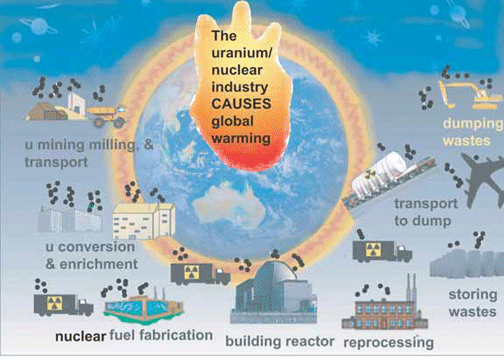 Nuclear power is no solution to climate change. Nuclear proponents conveniently omit the carbon emissions at all stages of the nuclear fuel chain – from uranium mining through to burial of wastes and dead reactor – and even some emissions from the reactor’s operation itself.
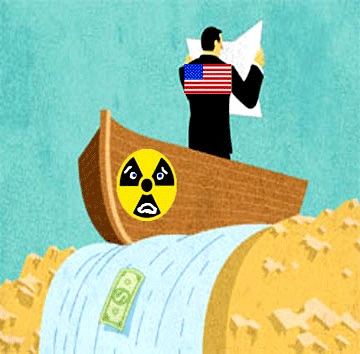 “…….As cutting carbon emissions becomes a priority for government and business, proponents of the nuclear power sector say their technology is the perfect way to fill a void as coal plants close under the weight of new environmental rules.
But they also acknowledge that in the age of cheap natural gas, the economic headwinds might be too strong to allow a nuclear renaissance.
“The economics of new nuclear just don’t permit the construction of those units today,” NRG spokesman David Knox said………
Those rules require electric producers to generate – or buy from other generators – a certain amount of electricity from renewable sources. In Texas and most other states, eligible sources include wind, solar and biomass power, but not nuclear……..
Another hurdle for nuclear power is the largely flat U.S. electricity demand, held down by a sluggish economic recovery and increasing energy efficiency of houses and appliances.
For now at least, the industry struggles to overcome the obstacles…….
Krancer argues that federal tax credits for wind power make it difficult for nuclear to compete on a level playing field in competitive electric markets.
That message falls flat among most environmental advocates. The Sierra Club, for example, says the 2011 Fukushima disaster triggered by an earthquake and tsunami in Japan shows nuclear is still too risky.
And, the organization says, the lack of a long-term federal plan on nuclear waste disposal leaves safety questions unanswered.
The Sierra Club also contends that the billions of dollars it costs to build nuclear reactors would be spent more wisely on developing renewable sources like solar and wind.
The economic hurdles facing nuclear plants are especially acute in Texas and other deregulated electricity markets, said Julien Dumoulin-Smith, a utilities equities analyst at investment bank UBS…….
John Coequyt, director of the Sierra Club’s federal and international climate campaign: – “All the environmental groups understand: nuclear isn’t a good solution to climate change. It’s too expensive and it’s too slow.”
Dubious public relations announcements from TEPCO
 TEPCO Unleashes Series Of Dodgy PR Announcements, Simply Info March 31st, 2015 TEPCO’s paid consultant from the US, Dale Klein is pushing TEPCO’s continuing quest to dump contaminated water into the ocean. The reason given today is that he claims it is harmless if you dilute it with other water. A ton of highly contaminated water is a ton of highly contaminated water, even if you add another ton of cleaner water to the release. This is an old industry PR tactic that is in dire need of retirement………http://www.fukuleaks.org/web/?p=14627
India’s nuclear safety, and regulator independence not satisfactory – says IAEA
IAEA team completes review of Indian regulator, World Nuclear News 30 Mar 15 “…… the mission also provided recommendations and suggestions for improvement, many at the governmental level. The government should promulgate a national policy and strategy for safety and a strategy for radioactive waste management, it said. The team also recommended that the Indian government ensure that the AERB’s independence is embedded in law, ensuring its separation from other entities that could unduly influence the regulator’s decision making. The AERB itself should also review its policy and arrangements to ensure it maintains independence in its regulatory functions, the mission said.
The regulator should also consider increasing the frequency of on-site inspections and should develop and implement its own internal emergency arrangements, the reviewers found….The mission’s final report will be provided to the Indian government in about three months.http://www.world-nuclear-news.org/RS-IAEA-team-completes-review-of-Indian-regulator-2703158.html?utm_source=twitterfeed&utm_medium=twitter
Support for Iran nuclear talks, from Americans
In a Pew Research Center poll published Monday, 49 percent of Americans said they approve of talks over a nuclear deal with Iran while 40 percent expressed disapproval. Eleven percent were unsure………….
If a deal is reached, 62 percent of Americans believe Congress should have the final authority to approve agreements while 29 percent think Obama should have the final say.
In terms of party affiliation, Democrats are much more likely to support a nuclear deal with Iran. Sixty-two percent of Democrats and 36 percent of Republicans said they approve of the U.S. negotiating directly with Iran over a nuclear program.
This poll was taken March 25-29 among 1,500 adults and has a margin of error of plus or minus 2.9 percentage points.
China moves away from coal power plants, starting in Beijing
Beijing to shut all major coal power plants to cut pollution Tulsa World 27 Mar 15 BEIJING — Beijing, where pollution averaged more than twice China’s national standard last year, will close the last of its four major coal-fired power plants next year.
The capital city will shutter China Huaneng Group Corp.’s 845-megawatt power plant in 2016, after last week closing plants owned by Guohua Electric Power Corp. and Beijing Energy Investment Holding Co., according to a statement Monday on the website of the city’s economic planning agency. A fourth major power plant, owned by China Datang Corp., was shut last year………
The closures are part of a broader trend in China, which is the world’s biggest carbon emitter. Facing pressure at home and abroad, policymakers are racing to address the environmental damage seen as a byproduct of breakneck economic growth. Beijing plans to cut annual coal consumption by 13 million metric tons by 2017 from the 2012 level in a bid to slash pollutants.
Shutting all the major coal power plants in the city, equivalent to reducing annual coal use by 9.2 million metric tons, is estimated to cut carbon emissions of about 30 million tons, said Tian Miao, a Beijing-based analyst at North Square Blue Oak Ltd., a London-based research company with a focus on China………http://www.tulsaworld.com/business/energy/beijing-to-shut-all-major-coal-power-plants-to-cut/article_155d6921-87f5-59fc-9a87-7233a6728527.html
Last ditch effort to conclude nuclear deal with Iran

 Final push for Iran nuclear deal as time runs out http://www.news.com.au/world/final-push-for-iran-nuclear-deal-as-time-runs-out/story-fndir2ev-1227283969636 MARCH 30, 2015IRAN and world powers have reached tentative agreement on parts of a deal sharply curtailing Tehran’s nuclear program, Western diplomats have said while cautioning that the deal is by no means done.
As negotiators raced against the clock in a rainy Switzerland on Sunday, in Israel Prime Minister Benjamin Netanyahu launched a blistering attack on the “dangerous” accord that may be emerging.
- One Western diplomat said Iran had “more or less” agreed to slash the number of its centrifuge machines by more than two-thirds and to ship abroad most of its stockpile of nuclear material.
A senior Iranian negotiator denied any such thing, saying any such claims were aimed at “disturbing” the talks.
“No deal has been reached, and the remaining issues have to be resolved,” the Iranian official said.
But at the same time Iranian officials have expressed guarded optimism that after 18 months of tortuous negotiations and two missed deadlines, a breakthrough might be in sight for a deal ending 12 years of tensions……..
- The aim is to agree broad outlines for an accord by Tuesday’s midnight deadline, and then flesh out a series of complex annexes containing all the technical details by June 30.
The mooted deal would see Iran scale down its nuclear program and allow unprecedented inspections of its remaining activities.
- The hope is to prolong the theoretical “breakout” time that Iran would need to produce enough fissile material to build a nuclear bomb to at least a year from the current estimate of several months.
This would require a combination of slashing the number of centrifuges, converting existing nuclear plants such as the underground Fordo facility, exporting its stocks of enriched uranium and limiting the development of newer, faster equipment.
Iran is insisting that in exchange global powers must lift sanctions that have choked its economy by strangling its oil exports and banks.
The issue of UN sanctions is proving particularly thorny, diplomats said, with global powers insisting the sanctions should be eased only gradually to ensure that they can be “snapped” back into place if Iran violates the deal.
Only tax-payer funding can save the unprofitable nuclear industry
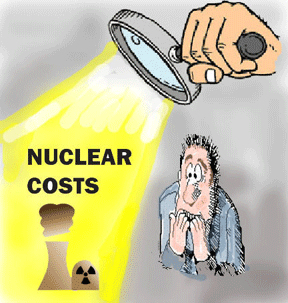 James Corbett: The nuclear industry is not profitable and could not exist without government subsidy.http://investmentwatchblog.com/james-corbett-the-nuclear-industry-is-not-profitable-and-could-not-exist-without-government-subsidy/
$6.8 billion Great Wall of Japan: Four years after the nuclear meltdown at Fukushima, TEPCO, the company that owns the plant, is still struggling to deal with the outpouring of radioactive water. Rainwater flows downhill and through the mangled nuclear plant every day and becomes contaminated on its way to the ocean. TEPCO plans to build a wall of ice by freezing soil surrounding the facility to re-direct the water.
http://finance.yahoo.com/news/6-8-billion-great-wall-235810448.html
Washington wants to screw Nevada again on nuclear waste dumping?
If the government is serious about crafting a new national nuclear waste solution that involves asking states to accept and store dangerous military and commercial radioactive material, the least it can do is deliver a pitch to the state it tried to force the waste upon all those years ago.
Obviously, Washington has learned some lessons from the Yucca Mountain Project, the boondoggle to end all boondoggles, one of the most cynical exercises in political power the country has ever seen. About three decades ago, what was supposed to be an objective, scientific exercise in selecting a permanent storage site for the country’s high-level nuclear waste became a rigged game. Congress amended the Nuclear Waste Policy Act in 1987 to make Yucca Mountain, a ridge inside the Nevada Test Site about 100 miles northwest of Las Vegas, theonly site under study for the dump. Nevada had no political clout, so the rest of the country ganged up, scratched other potential locations from the list and said, “You’ll take our waste — and like it.” The legislation became known as the “Screw Nevada bill.”
Sri Lanka Renewable Energy By 2030 ?
Renewable Energy By 2030, Sunday Leader, By Camelia Nathaniel The power and energy sector is set for a dramatic change by the year 2030. According to reliable sources, the country will be heading towards the renewable energy sources, where resources such as coal and petroleum will become things of the past…….
There is speculation that the power sector will be operational under eight categories mainly renewable energy sources such as wind, biomass and even hitherto undeveloped low head hydropower. At present Sri Lanka relies heavily on coal, oil, and hydro power for its energy. Fossil fuels are non-renewable, that is, they draw on finite resources that will eventually dwindle, becoming too expensive or too environmentally damaging to retrieve. In contrast, the many types of renewable energy resources – such as wind and solar energy – are constantly replenished and will never run out…….
The grid and off grid energy systems are planned to ensure the access to electricity to 98% of the households by 2016. Together with economic benefits, renewable resources provide the advantage of achieving ecological efficiencies as minimizing pollution and mitigating adverse climatic factors through the provision of clean environment friendly energy.
The Sunday Leader reliably learns that by the 31st of this month the power and energy sector will make huge strides in the direction of renewable energy to fulfill the energy requirements of the country. http://www.thesundayleader.lk/2015/03/29/renewable-energy-by-2030/
Changing political relations in Middle East as Iran-US nuclear deal approaches
Unholy Alliance” between Saudi Arabia and Israel. A US-Iran Nuclear Deal Would Trigger Regional Political Re-alignments By Salman Rafi Sheikh Global Research, March 29, 2015 Any probable nuclear deal between the United States of America and Iran is likely to result in giving a new trajectory to their bi-lateral relations; however, it is not the US-Iran relations alone that would enter a new phase of political history. As a matter of fact, this deal is most likely to send political jolts across the entire Middle Eastern political landscape, with Saudi Arabia and Israel standing as the most sensitive areas to bear its shocks; and as such, are most likely to clutch their hands into an alliance against Iran, and by default, against the US ambitions as well.
It is not, however, to suggest that Saudia and Israel would essentially adopt an anti-US strategic posture. What is becoming evident is that these three states will be re-negotiating the terms of their mutual relations to meet changing geo-political realities in a more ‘composite’ manner. This strategic negotiation is not, however, to be manned by the US itself, nor would it be playing the role of a crucial “balancer” between regional players. The US, in the contrary, would itself be a party to this process, and as such, would be more concerned about maintaining its own relations with Israel, Iran and Saudi Arabia than about merely assuring Israel and Saudia about the ‘harmless’ nature of the nuclear deal with Iran……..
The central issue between Saudia and USA on the one hand, and the US and Israel on the other hand, is not the deal itself; it is the place Iran would have in the future Middle East. …..http://www.globalresearch.ca/unholy-alliance-between-saudi-arabia-and-israel-a-us-iran-nuclear-deal-would-trigger-regional-political-re-alignments/5439349
Worker exposed to radiation at TVA nuclear plant in Alabama
Worker exposed to radiation at TVA nuclear plant in Alabama THE ASSOCIATED PRESS 03/27/2015 ATHENS, ALA. The Tennessee Valley Authority says a worker at a north Alabama nuclear plant suffered cuts and radiation exposure after a fall at the plant……http://www.heraldonline.com/living/health-fitness/article16449320.html
Video on fictitious Fukushima (nuclear) energy drink
 Fukushima energy drink video raises nuclear concern, Eco Business By Medilyn Manibo Thursday 26 March 2015 New ad takes aim at Tepco’s lack of transparency on the water contamination at Fukushima’s nuclear site. Watch the video here: A new energy drink made in Fukushima which promises to be 30 per cent stronger than any other energy drink has taken Japan by storm and has been “flooding the market” in the past year, according to a new video ad campaign released this month on various social media.
But the video which carries the ad is fictitious.
Three German activists launched the video to feature a fake energy drink called ‘Fukushima Water’ that has gone on to sell millions of bottles in Japan. The ad said the popular beverage may have the potential to “go global and become the next must-have”. The drink has already been tested in Canada, it added.
The video ad is part of a campaign to raise awareness on how little information the world has about water contamination in Fukushima’s nuclear site, four years after a strong earthquake triggered the meltdown of three reactors in the Daiichi plant run by Japanese utility firm Tokyo Electric Power Company (Tepco).
Activists Kenzi Benabdallah, Stefan Wittemann and Florian Tscharf, who are also art directors in Berlin, believe the parody video, which is making the rounds on social media, is one effective way to put pressure on Tepco to be more transparent. …..
News agencies reported the utlility firm continues to battle to contain the leakage, with daily flood of rainwater creating nearly 300 tonnes of radioactive water everyday.
Tepco has not warned the public promptly about the leakage, which may have slipped into the Pacific Ocean, claimed the German activists. “The best way to force change is through social media. Expose the company and force them to share with the public what is going on,” Benabdallah told The Guardian.http://www.eco-business.com/news/fukushima-energy-drink-video-raises-nuclear-concern/
Japan’s erroneus safety myth must not be reborn
Prospects for ending the crisis at the disaster site or laying the foundation for post-disaster rebuilding are nowhere in sight. We should not allow the propensity of nuclear insiders to rely on wishful thinking to come back to life.
‘Wishful thinking’ of nuclear insiders must not be allowed to be reborn Asahi Shimbun By TOSHIHIDE UEDA/ Senior Staff Writer “……A joint survey conducted recently by The Asahi Shimbun Co. and Fukushima Broadcasting Co. showed that 69 percent of Fukushima Prefecture residents believed that little or no foundation has been laid for post-disaster rebuilding. That finding is not surprising at all.
Just as disaster areas remain in such a plight, a subcommittee of the industry ministry began meeting on Jan. 30 to discuss what energy sources should be used, and to what extent, to cover Japan’s electricity demand in the years to come.
“I believe Japan’s (nuclear) safety regulation system has become a global standard,” the minutes of the proceedings quote one former industry ministry official as saying during a subcommittee meeting. “I just hope the public will fully understand that safety standards that are at the world’s top level are now in place.”
Those remarks stupefied me.
In Japan, emergency evacuation plans have yet to be covered by the government’s safety screenings, and anti-terrorist measures are also slow in being worked out. And Japan is one of the most earthquake-prone countries in the world.
Even if we had standards of the “world’s top level,” would that be enough? Well, the public remains unconvinced.
‘LAUGHABLE’ GOAL
The remarks probably only represented “wishful thinking” of the speaker, who hopes things will be like what he said.
It is the wishful thinking of stakeholders that is talked about in Japan’s nuclear policy–I have had that impression more than a few times during the many years I have covered the nuclear issue.
Such a reliance on wishful thinking has reigned over Japan’s nuclear power community since its cradle days.
Physicist Eizo Tajima (1913-1998), who was involved his entire life in Japan’s nuclear power development, wrote an autobiography, “Aru Genshi Butsurigakusha no Shogai” (Life of a nuclear physicist), published by Shin Jinbutsu Oraisha.
Tajima engaged in research for developing atomic bombs at the Institute of Physical and Chemical Research, today’s Riken research institute, during World War II. He served on the Japan Atomic Energy Commission, as one of the inaugural commissioners of the now-defunct Nuclear Safety Commission of Japan, and in other posts in postwar years.
While serving on the JAEC, Tajima proposed adding a safety expert to the lineup of its permanent commissioners. When his proposal was rejected, he resigned as commissioner to protest the government’s attitude………
FORGOTTEN WARNING
The government warned itself against a reliance on wishful thinking at least once in the past, when it issued the 2000 White Paper on Nuclear Safety.
The making of that year’s white paper followed the 1999 criticality accident at JCO Co.’s Tokai works in Tokai, Ibaraki Prefecture, during which three workers of the nuclear fuel processing company were exposed to large radiation doses, with two of them dying. The reliance of nuclear power community insiders on a “safety myth,” which assumed nuclear power was absolutely safe, came under heavy criticism.
“Why was an erroneous ‘safety myth’ formed?” the white paper asked, and cited “excessive confidence in track records,” “loss of memory of past accidents,” “wishes for absolute safety” and other reasons as potential factors.
But that warning was left to fade into oblivion……. Prospects for ending the crisis at the disaster site or laying the foundation for post-disaster rebuilding are nowhere in sight. We should not allow the propensity of nuclear insiders to rely on wishful thinking to come back to life. http://ajw.asahi.com/article/views/column/AJ201503240005
The Northern Hemisphere in peril from its many nuclear power plants
The Northern Hemisphere’s Nuclear Power Plant Problem, Event Horizon Chronicle, 24 Mar 15
“……..But Fukushima Daichi is the least of it. There are hundreds of other nuclear power plants, and something like 99% of them are in the northern hemisphere. They are notoriously complex, high maintenance, prone to catastrophic failure and all of them are ageing.
In the event of an emergency situation, they quickly fail, melt down and/or blow up (as at Chernobyl, Ukraine and Fukushima, Japan) and can never be repaired. They then spew massive amounts of deadly radionuclides to the global environment for a geological age to come.
There are one hundred of them in the USSA; there are still more in Europe. It is virtually a certainty that more of them will be failing, melting down and/or blowing up in the coming years, maybe even later this year.

A lot of the nuclear power reactors in the USSA are directly on the sea coast, or on major rivers, and/or near major cities and/or near major military bases.
If there is a shooting nuclear war, or serious natural disasters such as tsunamis, major earthquakes (on the New Madrid Fault, for instance), powerful storms, etc., multiple nuclear power plants will either be destroyed or fail, maybe even scores or hundreds of them, as would easily be the case in the event of a nuclear war.
You can bet on that. And the northern hemisphere of this planet will then become a sterile, “no go,” Death Zone. I am not being alarmist in the slightest. The average person has simply not thought through the dire implications of having built all of these hundreds of ticking time bombs called “nuclear power plants” and sprinkling them all over the world, almost all of them in the northern hemisphere.
What They Aren’t Telling You About Nuclear War
Let me impress upon you that I am not being melodramatic about the possibility of a shooting nuclear war. A wide range of political commentators and analysts are warning about the real risk of nuclear war, including well-known public figures such as Mikhail Gorbachev and Dr. Paul Craig Roberts, and many other, well-known and less-well-known figures.
If NATO and the USSA continue their economic and military pressure against Russia, the situation could deteriorate from a Cold War into a hot, military conflict that could easily turn nuclear, with terrible consequences.
In the Eastern Pacific region, there is also growing tension between the USSA, and China and North Korea.http://eventhorizonchronicle.blogspot.com.au/
South Africa keeps grip on its stash of weapons grade nuclear fuel
South Africa refuses to let go of its nuclear explosives, Business Tech By MyBroadbandMarch 22, 2015 The Centre for Public Integrity, a US-based non-profit investigative news organisation, has published a report which says that South Africa has enough nuclear explosives to fuel half-a-dozen bombs.
According to the report, the nuclear explosives are locked in a former silver vault at the Pelindaba Nuclear Research Centre close to the Hartbeespoort Dam.
Pelindaba is operated by The South African Nuclear Energy Corporation, and was were South Africa’s atomic weapons under apartheid were developed, built, and stored.
These explosives were created by the apartheid government as part of its nuclear weapons programme. According to a report by Marcus Duvenhage, South Africa had six nuclear devices, and was busy constructing a seventh, by the time the programme stopped.
South Africa ended its nuclear weapons programme in 1989, and these weapons were dismantled.
However, the highly-enriched uranium fuel was extracted, melted down, and cast into ingots.
The report states that roughly 220kg of this fuel remains, and that South Africa is “keeping a tight grip on it”.
This weapons-grade nuclear fuel means South Africa can easily become a nuclear state again. However, the biggest concern to the United States is that it will be stolen by militants and used in a terrorist attack……..http://businesstech.co.za/news/general/83023/south-africa-refuses-to-let-go-of-its-nuclear-explosives/
1 This Month

of the week – Shut Down Drone Warfare!


Tell the Ukrainian Government to Drop Prosecution of Peace Activist Yurii Sheliazhenko

Petition to revoke the licensing of the Near Surface Nuclear Disposal Facility (NSDF) at Chalk River. https://www.ourcommons.ca/petitions/en/Petition/Details?Petition=e-7247
To see nuclear-related stories in greater depth and intensity – go to https://nuclearinformation.wordpress.com
-
Archives
- April 2026 (103)
- March 2026 (251)
- February 2026 (268)
- January 2026 (308)
- December 2025 (358)
- November 2025 (359)
- October 2025 (376)
- September 2025 (257)
- August 2025 (319)
- July 2025 (230)
- June 2025 (348)
- May 2025 (261)
-
Categories
- 1
- 1 NUCLEAR ISSUES
- business and costs
- climate change
- culture and arts
- ENERGY
- environment
- health
- history
- indigenous issues
- Legal
- marketing of nuclear
- media
- opposition to nuclear
- PERSONAL STORIES
- politics
- politics international
- Religion and ethics
- safety
- secrets,lies and civil liberties
- spinbuster
- technology
- Uranium
- wastes
- weapons and war
- Women
- 2 WORLD
- ACTION
- AFRICA
- Atrocities
- AUSTRALIA
- Christina's notes
- Christina's themes
- culture and arts
- Events
- Fuk 2022
- Fuk 2023
- Fukushima 2017
- Fukushima 2018
- fukushima 2019
- Fukushima 2020
- Fukushima 2021
- general
- global warming
- Humour (God we need it)
- Nuclear
- RARE EARTHS
- Reference
- resources – print
- Resources -audiovicual
- Weekly Newsletter
- World
- World Nuclear
- YouTube
-
RSS
Entries RSS
Comments RSS
 nuclear-news