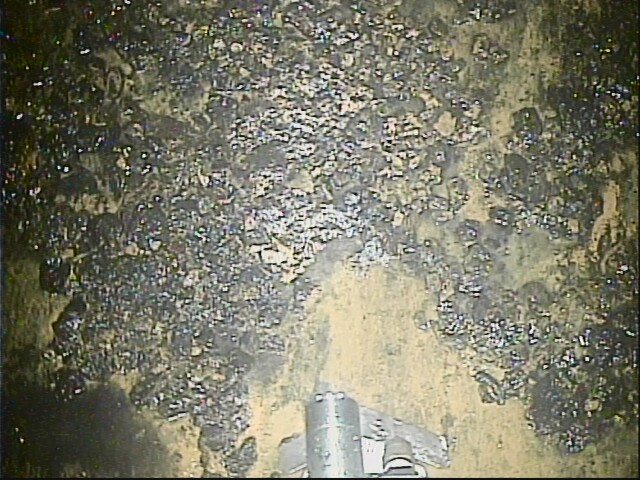
Reactor 2’s Platform has 3 Holes

Tepco released a new image of the reactor 2: at least three holes in the platform and still no corium.
The platform is made of metal (grating), just below the tank, intended to access the control rods. The bottom of the containment is a little over 3 m below.

Tepco’s document in Japanese:
http://www.tepco.co.jp/nu/fukushima-np/handouts/2017/images1/handouts_170215_08-j.pdf
Latest probe of reactor 2 fails after Fukushima robot blocked by obstacles

A robot shown in this photo by the International Research Institute for Nuclear Decommissioning was put inside reactor 2 at the Fukushima No. 1 nuclear plant on Thursday
Robot stops working in Fukushima reactor
The operator of the crippled Fukushima Daiichi nuclear power plant says it suspended a survey by a robot at one of its reactors after the device stopped working.
Tokyo Electric Power Company, or TEPCO, sent the scorpion-shaped robot into the containment vessel of the plant’s No. 2 reactor on Thursday.
The company believes fuel in the reactor melted through its core during the 2011 accident and accumulated at the bottom of the facility’s containment vessel.
The survey was aimed at getting a close look at what could be fuel debris — a mixture of nuclear fuel and melted parts of the reactor.
The robot was also expected to measure radiation and temperatures there to gather data for scrapping the reactor.
TEPCO officials say the device was advancing on a metal rail leading to a central area below the reactor’s core, but stopped moving before it could reach the center.
The officials say they decided to give up the robot and cut its remote-control cable.
TEPCO plans to analyze data collected by the robot and figure out how to carry out future probes.
https://www3.nhk.or.jp/nhkworld/en/news/20170216_34/

Robot survey of crippled Fukushima reactor ends in failure
The operator of the crisis-hit Fukushima Daiichi nuclear power plant said Thursday its attempt to take a close look at the crippled No. 2 reactor using a scorpion-shaped robot ended in failure due to a technical flaw.
A track glitch meant the self-propelled robot was unable to climb over obstacles, Tokyo Electric Power Company Holdings Inc. said. It gave up on retrieving the robot by cutting its remote control cables.
TEPCO, however, said, “We have received new important information about the radiation level and temperature inside the (reactor) containment vessel,” emphasizing it did not view Thursday’s survey as a failure.
http://english.kyodonews.jp/news/2017/02/459048.html
Latest probe of reactor 2 fails after Fukushima robot blocked by obstacles
A renewed attempt to survey reactor 2 at the damaged Fukushima No. 1 nuclear power plant failed Thursday when the latest robot probe became obstructed.
The robot was inserted into the primary containment vessel at around 7:50 a.m. to approach the metal grating directly underneath the pressure vessel, where a black mass has been found.
Tokyo Electric Power Company Holdings Inc. had hoped to take a closer look at what could be melted nuclear fuel, but it was forced to abandon the operation shortly after 3 p.m.
The robot didn’t reach its objective, Tepco said, and the utility eventually severed its controller cable.
Having detected an extraordinarily high radiation level —estimated at 650 sieverts per hour — in a preparatory survey, Tepco had hoped to obtain more precise readings, images and data needed to remove fuel and other debris to decommission the plant.
In previous surveys, the utility found deposits on the grating believed to be nuclear debris and a 1-sq.-meter hole believed to have been created by molten fuel escaping from the pressure vessel.
Challenges dogged the latest attempt from the start. There was little clear surface for the robot to move around, and the radiation could kill the unit as with the preliminary surveys.
Next month, Tepco plans to survey the No. 1 reactor.
Operation of communication about the “scorpion” robot which will be sent to the confinement enclosure of reactor n ° 2
TEPCO and its partners launched a communication operation about the “scorpion” robot, which will be sent to the containment reactor of reactor n ° 2 in an attempt to locate the corium, ie the highly radioactive molten fuel, mixed with debris. It is not certain that the mission will be a success, the cleaning robot having lasted only two hours in this enclosure because of the extreme radiations, without being able to finish its task.
A press release announces what we already know and insists on the challenges: “every step is a new challenge for TEPCO, but TEPCo welcomes the challenges”. The company would be almost happy with the accident? It is accompanied by a promotional video with a comparison to the kendô fights posted on its Facebook page.
http://www.tepco.co.jp/en/press/corp-com/release/2017/1377951_10469.html
https://www.facebook.com/OfficialTEPCOen/videos/1346869308705698/
The Japanese nuclear industry wants to place itself on the decommissioning market and highlights the technologies being developed. This robot was designed by IRID, Toshiba and TEPCO. IRID benefits from public funds. As for Toshiba, it is almost bankrupt because of its nuclear branch and TEPCO is financially in a bad shape.
The press release and the video do not provide any relevant information and are in complete discrepancy with reality.
1. Current conditions of Unit 2 Primary Containment Vessel (PCV)
Nuclear fuel in the Primary Containment vessel (PCV) was exposed to the air and melted from the impact of March 2011 Great Earthquake.
As a result of the accident analysis, it was found that a portion of melted nuclear fuel might have been fallen inside the pedestal.
To remove fuel debris, it is necessary to investigate the PCV and clarify the conditions of debris and surrounding structures.

2. Outline of Unit 2 PCV investigation
[Purpose]: To obtain feedback information (deformation of platform, etc.) for the design and
development of next investigation devices inside the pedestal
To inspect conditions on the platform inside pedestal, fuel debris fallen to the CRD housing, and conditions of structures inside pedestal.
[Investigation point]: Platform and Control Rod Drive (CRD) will be investigated from the platform inside pedestal

3. Work steps for Unit 2 PCV investigation

4. Preparatory investigation results from X-6 penetration to CRD rail

4. Preparatory investigation results at the entrance of pedestal area

4. Preparatory investigation results of pedestal area

5. Additional results expected from the self-propelled investigation device

6. Investigation by the self-propelled investigation device to the end of CRD rail

6. Investigation by the self-propelled investigation device to the end of CRD rail

Reference: Investigation results on the platform inside the pedestal

Technical information for the media is available here:
In Japanese about the upcoming mission http://www.tepco.co.jp/nu/fukushima-np/handouts/2017/images1/handouts_170215_08-j.pdf
And in English http://www.tepco.co.jp/en/nu/fukushima-np/handouts/2017/images/handouts_170215_01-e.pdf
And about radiation protection measures http://www.tepco.co.jp/nu/fukushima-np/handouts/2017/images1/handouts_170215_09-j.pdf
And in English http://www.tepco.co.jp/en/nu/fukushima-np/handouts/2017/images/handouts_170215_02-e.pdf
Translated from L’ACROnique de Fukushima http://fukushima.eu.org/operation-de-communication-sur-le-robot-scorpion-qui-va-etre-envoye-dans-lenceinte-de-confinement-du-reacteur-n2/
Fukushima Crisis Management Center

By Pierre Fetet, translation Hervé Courtois
Difficult to be innovative on the subject of Fukushima. Would we have already said everything for the last six years that the catastrophe is going on?
Well, no, with the film of Linda Bendali, “From Paris to Fukushima, the secrets of a catastrophe”, the subject of the attitude of nuclear France in March 2011 had never been approached from this angle: while Japanese Prime Minister Naoto Kan faced with nuclear fire became anti-nuclear, the Fillon government launched the heavy artillery to counter any vehemence of debate on this subject in France.
For the french Minister of Industry, Eric Besson, it was an just incident. Nicolas Sarkozy invited himself to Japan while he was not expected, to promote nuclear in the midst of the atomic crisis. And France pretended to help Japan by sending unusable or outdated products.
Therefore a good documentary pointing both Japanese and French dysfunctions that we can see in replay here again a few days. http://pluzz.francetv.fr/videos/cellule_de_crise_,153344813.html
And a good synthesis by Arnaud Vaulerin there. http://www.liberation.fr/planete/2017/02/12/fukushima-la-bataille-de-la-france-au-nom-de-l-atome_1547304
That said, this report has awakened in me an old anger, never really extinct since 1986, and you will not escape the comments that inspires me this report.
Pierre Fetet
At the beginning of the documentary, Tepco, champion of the lie and the unspoken is expressed by the voice of his spokesman Yuichi Okamura: “We never imagined that such an accident could happen. From the statistics, we calculated that the tsunami should not exceed 5 meters. Our forecasts were exceeded. “
He is then contradicted by the film director. I very much thank Linda Bendali for insisting that the report of the parliamentary inquiry commission on Fukushima gave as first conclusion that the Fukushima disaster was of human origin. Because few people understand the sequence of events and it is too often heard that “the Fukushima disaster was caused by the tsunami”.
Now, the real logical chain of events was this:
1) Irresponsibility: Tepco decides to build a nuclear power plant at sea level.
2) Stupidity: While seven tsunamis of 12 to 28 meters in height took place in Japan in the twentieth century, they decided to construct a protective dike of 5 m.
3) Corruption: Japan Nuclear Safety Organizations accept the construction project.
4) A natural event: a 15 m tsunami falls on the east coast of Honshu, and therefore on the Fukushima Daiichi power plant.
The IRSN is advertising its own self
The IRSN is always taken as an example and looks after its image. Normal, it is the official reference body. Yet I have already taken this institute several times in flagrante delicto of lie: Assurance that the evacuees would return within three months in 2011, http://fukushima.over-blog.fr/article-le-nouveau-pellerin-est-arrive-71748502.html
Assurance that there was no discharge of strontium and plutonium into Japan, http://www.fukushima-blog.com/2016/05/pourquoi-l-irsn-ment.html
Assurance that a nuclear power plant cannot explode in France … http://www.fukushima-blog.com/2016/05/pourquoi-l-irsn-ment.html
Thierry Charles even recently claimed to know where the corium is, even though Tepco itself does not know … http://www.lefigaro.fr/sciences/2017/02/10/01008-20170210ARTFIG00213–fukushima-tepco-evalue-peu-a-peu-l-ampleur-des-degats.php
In the documentary, the narrator assures that “IRSN is the first organization in the world to announce that the molten core has escaped from its confinement”. Indeed, listening to Jacques Repussard we get the impression that his institute communicated on this subject in March 2011.
However, six months after the catastrophe began, the IRSN still was writing: “It remains unclear whether molten fuel could be relocated to the bottom of the enclosure and in what quantity. “ (Communiqué of 25 August 2011) http://www.irsn.fr/FR/connaissances/Installations_nucleaires/Les-accidents-nucleaires/accident-fukushima-2011/crise-2011/impact-japon/Documents/IRSN_Seisme-Japon_25082011.pdf
Yet the Japanese government had already received a report from the IAEA on June 7 recognizing the possibility of perforations in the tanks of reactors 1 to 3 …
No seriously. The first organization that announced the me of the three cores is Tepco, on 24 May 2011. And the IRSN announced it the next day. Previously, IRSN never wrote anything else, for reactors 1, 2 and 3, that “The injection of fresh water continues. The flow rate of the water injection is adjusted in order to ensure the cooling of the core, which remains partially depleted. “
In 2011, the first person who dared to break the omerta of the nuclear lobby is Mishio Ishikawa, founder of Japan Nuclear Technology Institute (JANTI): During a Japanese TV show on April 29, 2011, he stated that the hearts of Fukushima Daiichi reactors 1, 2 and 3 were 100% melted. http://www.fukushima-blog.com/article-les-coeurs-des-reacteurs-1-2-et-3-de-fukushima-dai-ichi-auraient-fondu-a-100-73003947.html
That’s the story, that’s how it happened. IRSN never said that before anyone. The IRSN respected the omerta on the total meltdown of the three hearts like all the actors of the nuclear world and obediently waited for Tepco to announce the reality to acquiesce, no matter what Jacques Repussard is saying now six years later.
The image of the then Prime Minister of Japan is to be nuanced. After seeing the documentary, it seems as though Naoto Kan acted as hero. It must also be admitted that he made several errors:
– Naoto Kan went to the Fukushima Daiichi plant in full crisis and greatly disturbed the ongoing management of the ongoing crisis. Director Masao Yoshida was asked to explain and explain what he was doing, wasting precious time on those who tried to solve problems one by one (It was just before the explosions of No. 2 and No. 4!). The documentary suggests that Masao Yoshida was going to leave the nuclear plant with all the workers, and that through Kan’s intervention they were forced to stay. It’s not true. Tepco may have intended to leave the ship, but the plant’s director denied any plan to abandon the site.
– The documentary shows Naoto Kan kneeling before Nicolas Sarkozy. Politeness or industrial pressures? It is not known why he did not dare to counter the French nuclear VRP.
– Naoto Kan will remain for all inhabitants of evacuated areas the one who decided to raise the standard from 1 to 20 mSv / year. On the one hand, he was ready to evacuate Tokyo, but on the other he made a whole region irradiated with a very high radiation rate. Something is bizarre in these contradictory attitudes.
Pierre Pellerin, even disappeared, is still doing damages … Between the two parts of the documentary, Frédéric Boisset, editor-in-chief of Brainworks Press, presents the story of Chernobyl in this way: “In 1986, the radioactive cloud spread throughout Europe. The authorities do not have the technical means to measure the fallout, to give instructions to the French. Can we eat fruit and vegetables? Should we caulk indoors? It was to avoid this type of failure that this institute was created [the IRSN]. “
But this is not an interview taken on the spot, it is a carefully prepared text before the recording. Frédéric Boisset therefore pretends without blushing that the SCPRI of 1986, the ancestor of the IRSN, did not have the means to alert the French of the dangers of radioactivity! What an enormity! In Germany, they had the means to prohibit the sale of spinach and salads, to confine the students inside but not in France. Frédéric Boisset refeeds us the story of the Chernobyl radioactive plume that stops at the border? It is unbelievable that still in 2017 a journalist perpetuates the disinformation lie that began in 1986.
However, the IRSN, worthy successor of SCPRI, made this statement on March 15, 2011, the day when the radioactive cloud of Fukushima arrived in Tokyo: “A slight increase in ambient radioactivity in Tokyo is noted by a few measures. This elevation is not significant in terms of radiological impact. “ Pierre Pellerin would not have said better! At the same time, Olivier Isnard, an IRSN expert sent to Tokyo, advocated caulking the premises of the French embassy. Fortunately, Philippe Faure, the French ambassador to Japan, communicated to his expatriates at 10 am: “Stay in your houses, making sure to caulk them to the maximum, this effectively protects against the low-intensity radioactive elements that could pass through Tokyo. ” But at 8 pm, he changed his tone and resumed the official speech dictated by the IRSN: “The situation remains at this time quite safe in Tokyo. A very slight increase in radioactivity was recorded. It represents no danger for human health. “ 100 Bq / m3 would pose no health hazard for a radioactive cloud coming directly from a nuclear reactor? I am feeling not any more safe than in 1986 unfortunately.
The taboo of the steam explosion
One last deception. The IRSN has purposedly mistranslated the words of Masao Yoshida, director of the Fukushima Daiichi power station. Immediately after the explosion of Unit 3, the latter, distraught, called the headquarters to inform them of the situation. Tepco released this recording and the IRSN broadcasted it in a video in 2013. I do not know Japanese but I have Japanese friends who have assured me of the translation of his words. I give you both versions, that of my friends and that of the IRSN. The people knowing japanese will be able to check for themselves.

The Japanese TV version : https://youtu.be/OWCLXjEdwJM
The IRNS version : https://youtu.be/tjEHCGUx9JQ
The documentary gives another version: “HQ, HQ, it’s terrible! This is very serious ! “Yes, here HQ.” “It seems there was an explosion on reactor 3, which looks like a hydrogen explosion.” Who recommended this text to journalists? Even though Yoshida himself said “suijôki” (steam) and not “suiso” (hydrogen). The IRSN’s translation therefore censures the hypothesis put forward by the director of the nuclear plant: the steam explosion. This is normal, it is the official version of the Japanese government and the IRSN can not go against it.
The steam explosion is a taboo issue among nuclear communicators. Experts talk about it to each other, carry out studies about it, write theses about it, but never talk about it to the public because the subject of a nuclear power plant explosion is too anxiogenic. If we ever learned that a steam explosion had arrived in Fukushima, it would undermine the image of nuclear power worldwide.
http://www.fukushima-blog.com/2014/09/unite-3-de-fukushima-la-theorie-de-l-explosion-de-vapeur.html
In France, the political-industrial lobby has axed its communication on the control of hydrogen: All French power plants have hydrogen recombiners to avoid hydrogen explosions. But against an steam explosion, nothing can be done. When the containment vessel is full of water and the corium at 3000 ° C falls in it, it’s boom, whether in Japan or in France, whether it be a boiling water reactor or a pressurized water reactor.
http://www.fukushima-blog.com/2015/08/l-explosion-de-l-unite-3-de-fukushima-daiichi-1.html
Fukushima: the battle of France on behalf of nuclear
This french documentary does not go into much details. Still it shows the French government eagerness to minimize the Fukushima catastrophe in the eyes of the public, of the world, to push for the continuation of nuclear, so as to save its own nuclear industries from economic repercussions.

A documentary broadcasted last Sunday February 12, 2017 in the program “Cellule de Crisis” exposed how France worked since March 11, 2011 to “safeguard the interests of nuclear”.
The matter was heard and investigated. The Fukushima disaster, which took place almost six years ago, is a “man-made disaster” as Kiyoshi Kurokawa, the chairman of the parliamentary commission of inquiry, wrote in black and white.
https://www.nirs.org/wp-content/uploads/fukushima/naiic_report.pdf
Since March 11, 2011, reports, investigations, Japanese and international documentaries have not failed to describe the sequence of events, unpreparedness, serial errors and the panic that seized the political- Industrialist powers in the early days of the worst nuclear crisis since Chernobyl.
The merit of this documentary is not so much in this reminder of those March days which gave cold sweats to the whole planet and during which the worst was avoided just by little.
Even though it is still necessary to remember that the Japanese authorities envisaged the catastrophic scenario: a total loss of control of the Fukushima-daiichi power plant and a nuclear crisis that would have condemned much of Japan for decades and Authorities to evacuate more than 50 million people, as told in these columns Naoto Kan, Prime Minister at the time.
Journalist Linda Bendali, who signed the investigation in this documentary, had access to key witnesses on the Naoto Kan team, among the rescuers, soldiers and members of the Tokyo Electric Power Company (Tepco), which manages the plant. But if this documentary reveals secrets, it is especially on its French side that it brings a welcome light.
In constructing a narrative between Japan and France, it explains the “strategy of the French government to safeguard the interests of nuclear power”. And shows how Paris embarked on a “diplomatic and industrial battle crucial for France”.
“Risks of contamination in Europe”
Even though EDF, François Fillon – then Prime Minister – and his advisors, and Eric Besson, the then Minister of Industry, refused interview requests, the journalist was able to reconstruct the narrative on the French side. Informed by a Tepco source, the Institute of Radiation Protection and Nuclear Safety (IRSN) was among the first to be informed of the crisis.
In Paris, IRSN is mobilizing its crisis center with 40 engineers, translators to try to understand the situation at the plant and to face possible “risks of contamination throughout Europe”.
At Areva, eight engineers give the alarm by buckling their suitcases. “The Japanese have lost control of the plant,” they said, leaving Japan in a hurry. Panic seizes expatriates in Tokyo.
From March 12, the explosions caused by concentrated hydrogen in the Fukushima plant and the tinkering of the interventions are “very scary”, as Anne Lauvergeon, then president of Areva, said.
https://www.youtube.com/watch?v=5hD54E6uD58
France, the country of nuclear with the EDF and Areva giants, is seing falling prices of its nuclear industries and of uranium on its stock exchanges. It must be countered. The Prime Minister and the Industry and Ecology Ministers, the IRSN, will enter the battle to “lower the pressure and the anguish”.
Press conference, language elements, audit of French reactors, etc. Paris maneuvered so that “nuclear power does not become a subject of debate” and that “the place of the atom is not called into question in Europe”. France opposes the “hallucinatory decision of Germany”, to disconnect its power stations, in the words of Frank Supplisson, cabinet director of Eric Besson, Minister of Industry, Energy and Economy at the time, and does not hesitate to threaten its European partners who do not seem to share its views, and pressured European diplomats.
In Tokyo, the French ambassador, Philippe Faure, put online a statement recommending to French nationals to leave for a few days the Japanese capital. The Quai d’Orsay Foreign Affairs Ministry ordered him to withdraw the text. Then, with delay, Paris dispatches an plane of aid with “tons of useless material”, tells a member of the embassy. “In the country of Nissan and Toyota, what was sent was bulk, not dazzling,” recalls Philippe Faure.
The documentary also tells a fine fiasco when French technical aid was refused by Japan.
“Paris rented a very expensive Antonov to transport its robots able to intervene in a contaminated environment, but Tokyo wanted French experts to pilot them. “The engineers agreed to come to Tokyo,” says Linda Bendali, “but not at the foot of the reactors.” As a result, the Japanese declined the offer.
In this diplomatic-industrial offensive, the presidential Elysee palace was not left behind. The french president, Nicolas Sarkozy, went out of his way to be the first head of state to come to Japan. Twenty days after March 11, he arrived in Tokyo to remind the need to pursue nuclear power.
Naoto Kan finally agreed to host him despite an overloaded schedule. On that day, “I was convinced that we had to stop” using nuclear, says today the former Prime Minister who became one of the most ardent anti-nuclear militants of the archipelago. But facing Nicolas Sarkozy on March 31, 2011, he kept silent.
Cellule de crise. De Paris à Fukushima, les secrets d’une catastrophe. Dimanche 12 février à 22h40. France 2. Rediffusion, jeudi 16 février à 1h40
China warns nationals visiting Japan over high radiation levels in Fukushima

The Chinese Embassy in Japan on Sunday issued an alert to its nationals who have plans to travel in Japan, reminding them of the high-level radiation inside a damaged reactor of the Fukushima Daiichi nuclear plant.
Tokyo Electric Power Company (TEPCO), the facility’s operator, announced last week that the radiation levels detected inside the plant’s No. 2 reactor had reached 650 Sieverts per hour, even higher than the previous record of 530 Sieverts per hour in January.
Even with a 30 percent margin of error, the reading is described by many experts as “unimaginable.” It is much higher than the 73 Sieverts an hour, which was detected in 2012, one year after the nuclear plant’s collapse. Under such exposure, a person would only be able to survive a few minutes at most.
The TEPCO on Thursday sent a remotely controlled robot into the reactor, equipped with a camera that is designed to withstand up to 1,000 Sieverts of cumulative exposure. The robot was pulled out after it broke down only two hours into the probe.
The company is planning to send better robots to conduct more detailed probes. However, it insists that radiation has not leaked outside the reactor.
Last week, Chinese Foreign Ministry spokesman Lu Kang said China has issued safety alerts to its nationals over the high-level radiation. He added that China hopes that the Japanese government could clarify how they are going to thoroughly eliminate the impact caused by the nuclear accident.
Six years have now passed after three reactors at Fukushima’s nuclear power plant were damaged by a devastating 9.0-magnitude earthquake and a subsequent tsunami on March 11, 2011. After the accident, the local government ordered residents living within 30-kilometer radius around the Fukushima nuclear plant to evacuate.
HELEN CALDICOTT: The Fukushima nuclear meltdown continues unabated

Dr Helen Caldicott, explains recent robot photos taken of Fukushima’s Daiichi nuclear reactors: radiation levels have not peaked, but have continued to spill toxic waste into the Pacific Ocean — but it’s only now the damage has been photographed.
RECENT reporting of a huge radiation measurement at Unit 2 in the Fukushima Daichi reactor complex does not signify that there is a peak in radiation in the reactor building.
All that it indicates is that, for the first time, the Japanese have been able to measure the intense radiation given off by the molten fuel, as each previous attempt has led to failure because the radiation is so intense the robotic parts were functionally destroyed.
The radiation measurement was 530 sieverts, or 53,000 rems (Roentgen Equivalent for Man). The dose at which half an exposed population would die is 250 to 500 rems, so this is a massive measurement. It is quite likely had the robot been able to penetrate deeper into the inner cavern containing the molten corium, the measurement would have been much greater.
These facts illustrate why it will be almost impossible to “decommission” units 1, 2 and 3 as no human could ever be exposed to such extreme radiation. This fact means that Fukushima Daichi will remain a diabolical blot upon Japan and the world for the rest of time, sitting as it does on active earthquake zones.
What the photos taken by the robot did reveal was that some of the structural supports of Unit 2 have been damaged. It is also true that all four buildings were structurally damaged by the original earthquake some five years ago and by the subsequent hydrogen explosions so, should there be an earthquake greater than seven on the Richter scale, it is very possible that one or more of these structures could collapse, leading to a massive release of radiation as the building fell on the molten core beneath. But units 1, 2 and 3 also contain cooling pools with very radioactive fuel rods — numbering 392 in Unit 1, 615 in Unit 2, and 566 in Unit 3; if an earthquake were to breach a pool, the gamma rays would be so intense that the site would have to be permanently evacuated. The fuel from Unit 4 and its cooling pool has been removed.
But there is more to fear.
The reactor complex was built adjacent to a mountain range and millions of gallons of water emanate from the mountains daily beneath the reactor complex, causing some of the earth below the reactor buildings to partially liquefy. As the water flows beneath the damaged reactors, it immerses the three molten cores and becomes extremely radioactive as it continues its journey into the adjacent Pacific Ocean.
Every day since the accident began, 300 to 400 tons of water has poured into the Pacific where numerous isotopes – including cesium 137, 134, strontium 90, tritium, plutonium, americium and up to 100 more – enter the ocean and bio-concentrate by orders of magnitude at each step of the food chain — algae, crustaceans, little fish, big fish then us.
Fish swim thousands of miles and tuna, salmon and other species found on the American west coast now contain some of these radioactive elements, which are tasteless, odourless and invisible. Entering the human body by ingestion they concentrate in various organs, irradiating adjacent cells for many years. The cancer cycle is initiated by a single mutation in a single regulatory gene in a single cell and the incubation time for cancer is any time from 2 to 90 years. And no cancer defines its origin.
We could be catching radioactive fish in Australia or the fish that are imported could contain radioactive isotopes, but unless they are consistently tested we will never know.
As well as the mountain water reaching the Pacific Ocean, since the accident, TEPCO has daily pumped over 300 tons of sea water into the damaged reactors to keep them cool. It becomes intensely radioactive and is pumped out again and stored in over 1,200 huge storage tanks scattered over the Daichi site. These tanks could not withstand a large earthquake and could rupture releasing their contents into the ocean.
But even if that does not happen, TEPCO is rapidly running out of storage space and is trying to convince the local fishermen that it would be okay to empty the tanks into the sea. The Bremsstrahlung radiation like x-rays given off by these tanks is quite high – measuring 10 milirems – presenting a danger to the workers. There are over 4,000 workers on site each day, many recruited by the Yakuza (the Japanese Mafia) and include men who are homeless, drug addicts and those who are mentally unstable.
There’s another problem. Because the molten cores are continuously generating hydrogen, which is explosive, TEPCO has been pumping nitrogen into the reactors to dilute the hydrogen dangers.
Vast areas of Japan are now contaminated, including some areas of Tokyo, which are so radioactive that roadside soil measuring 7,000 becquerels (bc) per kilo would qualify to be buried in a radioactive waste facility in the U.S..
As previously explained, these radioactive elements concentrate in the food chain. The Fukushima Prefecture has always been a food bowl for Japan and, although much of the rice, vegetables and fruit now grown here is radioactive, there is a big push to sell this food both in the Japanese market and overseas. Taiwan has banned the sale of Japanese food, but Australia and the U.S. have not.
Prime Minister Abe recently passed a law that any reporter who told the truth about the situation could be gaoled for ten years. In addition, doctors who tell their patients their disease could be radiation related will not be paid, so there is an immense cover-up in Japan as well as the global media.
The Prefectural Oversite Committee for Fukushima Health is only looking at thyroid cancer among the population and by June 2016, 172 people who were under the age of 18 at the time of the accident have developed, or have suspected, thyroid cancer; the normal incidence in this population is 1 to 2 per million.
However, other cancers and leukemia that are caused by radiation are not being routinely documented, nor are congenital malformations, which were, and are, still rife among the exposed Chernobyl population.
Bottom line, these reactors will never be cleaned up nor decommissioned because such a task is not humanly possible. Hence, they will continue to pour water into the Pacific for the rest of time and threaten Japan and the northern hemisphere with massive releases of radiation should there be another large earthquake.
Clean-up robot pulled from Fukushima Reactor 2 due to extremely high radiation

Cleaner Robot Pulled From Fukushima Reactor Due to Immense Radiation
The camera on the bot was compromised by the high levels of radiation.
A remote-controlled cleaning robot sent into a damaged reactor at Japan’s Fukushima nuclear plant had to be removed Thursday before it completed its work because of camera problems most likely caused by high radiation levels.
It was the first time a robot has entered the chamber inside the Unit 2 reactor since a March 2011 earthquake and tsunami critically damaged the Fukushima Da-ichi nuclear plant.
Tokyo Electric Power Co. said it was trying to inspect and clean a passage before another robot does a fuller examination to assess damage to the structure and its fuel. The second robot, known as the “scorpion,” will also measure radiation and temperatures.
Thursday’s problem underscores the challenges in decommissioning the wrecked nuclear plant. Inadequate cleaning, high radiation and structural damage could limit subsequent probes, and may require more radiation-resistant cameras and other equipment, TEPCO spokesman Takahiro Kimoto said.
“We will further study (Thursday’s) outcome before deciding on the deployment of the scorpion,” he said.
TEPCO needs to know the melted fuel’s exact location and condition and other structural damage in each of the three wrecked reactors to figure out the best and safest ways to remove the fuel. It is part of the decommissioning work, which is expected to take decades.
During Thursday’s cleaning mission, the robot went only part way into a space under the core that TEPCO wants to inspect closely. It crawled down the passage while peeling debris with a scraper and using water spray to blow some debris away. The dark brown deposits grew thicker and harder to remove as the robot went further.
After about two hours, the two cameras on the robot suddenly developed a lot of noise and their images quickly darkened — a sign of a problem caused by high radiation. Operators of the robot pulled it out of the chamber before completely losing control of it.
The outcome means the second robot will encounter more obstacles and have less time than expected for examination on its mission, currently planned for later this month, though Thursday’s results may cause a delay.
Both of the robots are designed to withstand up to 1,000 Sieverts of radiation. The cleaner’s two-hour endurance roughly matches an estimated radiation of 650 Sieverts per hour based on noise analysis of the images transmitted by the robot-mounted cameras. That’s less than one-tenth of the radiation levels inside a running reactor, but still would kill a person almost instantly.
Kimoto said the noise-based radiation analysis of the Unit 2’s condition showed a spike in radioactivity along a connecting bridge used to slide control rods in and out, a sign of a nearby source of high radioactivity, while levels were much lower in areas underneath the core, the opposite of what would normally be the case. He said the results are puzzling and require further analysis.
TEPCO officials said that despite the dangerously high figures, radiation is not leaking outside of the reactor.
Images recently captured from inside the chamber showed damage and structures coated with molten material, possibly mixed with melted nuclear fuel, and part of a disc platform hanging below the core that had been melted through.

Extremely high radiation breaks down Fukushima clean-up robot at damaged nuclear reactor
A clean-up mission using a remotely operated robot at Japan’s crippled Fukushima nuclear plant has had to be aborted, as officials feared they could completely lose control of the probe affected by unexpectedly high levels of radiation.
The robot equipped with a high-pressure water pump and a camera designed to withstand up to 1,000 Sieverts of cumulative exposure had been pulled off the inactive Reactor 2 at the Fukushima Daiichi nuclear complex earlier this week, The Japan Times reported Friday, citing the plant operator, Tokyo Electric Power Company (TEPCO). The device reportedly broke down just two hour into the probe.
The failure led experts to rethink estimated levels of radiation inside the damaged reactor.
While last week TEPCO said it might stand at 530 Sieverts per hour – a dose that can almost instantly kill a human being, following the latest aborted mission a company official has said a reading of up to 600 Sieverts should be “basically correct.”
Even despite the considerable 30-percent margin of error for the revised estimate, the latest probe left no doubt that radiation levels are at record highs within the reactor. Even though it cannot be measured directly with a Geiger counter or dosimeter, the dose is calculated by its effect on the equipment.
Last month, a hole of no less than one square meter in size was discovered beneath the same reactor’s pressure vessel. The apparent opening in the metal grating is believed to have been caused by melted nuclear fuel, TEPCO then said.
The recent mission has demonstrated that the melted fuel is close to the studied area.
While extreme radiation levels have been registered within the reactor, officials insist that no leaks or increases outside have been detected.
The failure might force Japan to rethink the robot-based strategy it has adopted for locating melted fuel at Fukushima, according to The Japan Times.
The robot affected by radiation was supposed to wash off thick layers of dirt and other wreckage, clearing ways for another remotely controlled probe to enter the area, tasked with carrying out a more proper investigation to assess the state of the damaged nuclear reactor. Previously, even specially-made robots designed to probe the underwater depths beneath the power plant have crumbled and shut down affected by the radioactive substance inside the reactor.

The Fukushima Daiichi nuclear power plant suffered a blackout and subsequent failure of its cooling systems in March 2011, when it was hit by an earthquake and tsunami. Three of the plant’s six reactors were hit by meltdowns, making the Fukushima nuclear disaster the worst since the Chernobyl catastrophe in Ukraine in 1986. TEPCO is so far in the early stages of assessing the damage, with the decommissioning of the nuclear facility expected to take decades.
https://www.rt.com/news/377025-fukushima-radiation-breaks-robot/
Fukushima Is Still Melting Down…
Kevin Kamps, Beyond Nuclear. Almost 6 years after a massive meltdown – radiation levels at the crippled Fukushima Daiichi power plant in Japan are as dangerously high as ever. So is nuclear power ever worth the risk?
….A number of commentators, Arnie Gundersen at Fairwinds, Kendra Ulrich at Greenpeace International, Nancy Foust at Simply Info, have pointed out that the levels of radioactivity that are being talked about by Tokyo Electric (TEPCO), 53,000 rem per hour levels that were documented just a week ago have probably been there this whole time since March 2011 since the meltdown happened because what they are doing is they are getting closer where the melted core is at, they still don’t know where they ‘re at but what they are doing they are getting closer to that dangerous place and so sure enough it stands to reason that they would find these levels….
http://www.thomhartmann.com/bigpicture/fukushima-still-melting-down
Reactor # 2: the cleaner robot had to turn around after two hours

Guiding pipe camera (before the removal
As announced, TEPCO has inserted a cleaner robot onto the gangway in the Reactor 2 containment enclosure. It is equipped with a snowplow at the front, two cameras and a jet of pressurized water.
The robot was able to clean only one meter instead of the 5 expected. According to the Japanese document put online by TEPCO, in some places deposits were more adherent than expected, which slowed down the robot’s progress.
There are areas where the robot could not move forward. There are up to 2 cm of deposits that can be insulation and paint that have melted before sticking to the bridge. On a first attempt, the water pump did not work.
http://www.tepco.co.jp/nu/fukushima-np/handouts/2017/images1/handouts_170209_08-j.pdf
After two hours of activity, the cameras became obscured and the robot was quickly removed. TEPCO believes this is due to extremely high radiation levels.
The camera can only withstand a cumulative dose of about 1000 Sv. The analysis of the images gives an approximate dose rate of 650 Sv / h. This is even more than the recorded dose few days ago (530 Sv / h).
The company is reluctant to send the scorpion measuring robot because it could only take data for two hours.
It is not under the reactor vessel that the dose rates are the highest and TEPCO does not understand why.
TEPCo has released a new series of photos and a video. The video shows the magnitude and the difficulty of the task expected for this small robot.
http://photo.tepco.co.jp/date/2017/201702-j/170209-01j.html
TEPCO issued a press release in English, accompanied by the same photos and video and the technical note.
http://www.tepco.co.jp/en/press/corp-com/release/2017/1375551_10469.html
http://photo.tepco.co.jp/en/date/2017/201702-e/170209-01e.html
http://fukushima.eu.org/reacteur-n2-le-robot-nettoyeur-a-du-faire-demi-tour-apres-deux-heures/
Video of the Fukushima Daiichi nuclear power plant, February 10, 2017
The daily Asahi has posted a video report on the Fukushima dai-ichi plant. This is in Japanese.
One sees first the reactor n ° 1 where there are 150 microsieverts per hour in the vicinity and then the reactor n ° 3 where the dose rate in the vicinity rises to 335 microsievert per hour.
Then we see the Reactor No. 2 and the recent images taken by TEPCO on the inside of the confinement enclosure.
Then the tanks with contaminated water, followed by archive images without the tanks. It is explained that the water stock is increasing by 200 m3 per day currently. There are nearly a thousand tanks now.
See the latest TEPCo data on this: http://www.tepco.co.jp/en/nu/fukushima-np/handouts/2017/images/handouts_170206_01-e.pdf
At the end of the report, we see that the working and living conditions on the site have improved and that there is no need to wear a full face mask anywhere.
http://www.asahi.com/articles/ASK2954Z0K29PLZU004.html?iref=comtop_photo
Radiation level in Fukushima No. 2 reactor measured higher:650 sieverts
A pressure washer-equipped robot clears the path inside the containment vessel of Fukushima No. 1 nuclear power plant’s No. 2 reactor on Feb. 9. The black lumps are believed to be melted fuel. (Provided by Tokyo Electric Power Co.)
The road to decommissioning Fukushima No. 1 nuclear power plant’s No. 2 reactor could be rockier than expected, as radiation levels on Feb. 9 were even deadlier than those recorded in late January.
Tokyo Electric Power Co. announced that day that radiation levels inside the reactor were estimated at up to 650 sieverts per hour, much higher than the record 530 sieverts per hour marked by the previous survey.

A camera attached to the robot deployed inside Fukushima No. 1 nuclear power plant’s No. 2 reactor shows how it clears its path covered with debris and deposits using a pressure washer. (Captured from video provided by Tokyo Electric Power Co.)
A camera made its way inside the reactor’s containment vessel for the first time on Jan. 30 and spotted fuel rods that had melted into black lumps in the nuclear accident in the aftermath of the 2011 Great East Japan Earthquake and tsunami disaster.
The plant operator made the latest estimate from the amount of camera noise experienced by the robot that ventured into the lion’s den that morning.
Equipped with a pressure washer, the machine was deployed to pave the way for the Sasori (scorpion) robot that is set to survey the reactor’s interior in greater detail.
The robot’s task was to hose down melted fuel and other substances as it traveled along a rail measuring 7 meters long and 0.6 meter wide connecting the outer wall of the containment vessel with the reactor’s core. It started operating from a point located 2 meters from the exit of the tunnel bored into the side of the vessel.
But about two hours into its journey, in which it had progressed about a meter, the camera footage started getting dark, TEPCO said. The amount of radiation emitted by the melted fuel may have taken a toll on the camera’s well-being.
As the robot could be left stranded inside the vessel if the camera broke down completely, the utility called off the operation seven hours earlier than scheduled and retrieved the device.
TEPCO analyzed the footage and concluded that the doses amounted to about 650 sieverts per hour, which is deadly enough to kill a human in less than a minute.
As the robot’s camera was designed to withstand a cumulative dosage of 1,000 sieverts per hour, the utility commented that “it’s consistent with how the camera started to break down after two hours.”
The plant operator plans to deploy the Sasori surveyor robot before the end of February.
“We will be assessing the amount of deposits and debris to decide how far Sasori can advance,” a TEPCO official said.
No Legitimacy, No Principle in Japan’s Nuclear Victim Support Policy

By Toshinori Shishido
In July 2015, the Fukushima prefectural government announced its plan to terminate housing assistance for nuclear evacuees who fled areas outside of the restricted zone at the end of March 2017. It has absolutely no intention to change this policy as of this moment in February 2016.
In addition, by March 2017, the Fukushima Prefectural Office will lift evacuation orders for the entire prefecture, except for the immediate vicinity of the power plant designated the “difficult-to-return zone,” that has “equal to or greater than the external exposure dose of 50mSv/year.” (Insert: “translator’s note: the internationally recognized standard dose limit per year is 1mSv/year.) For residents who may eventually move back to these areas, the Prefectural Office has determined that it will only pay one year’s worth of compensation (1.2 million yen or US$ 10,500) per person and will terminate other special protective measures and financial incentives.
For residents of regions that have been designated as “difficult-to-return areas”, the Office has reportedly finished the payments of reparations in bulk, and is not going to make additional payments.
And for residents outside of Fukushima Prefecture, there has been almost no official support for damages from the nuclear power plant accident in the first place.
While the government has provided extremely limited housing support for very few residents from prefectures adjacent to Fukushima and for evacuees from these prefectures, it has gradually decreased the target population over time and plans to end all financial assistance for them by March 2018.
Although there is room to compensate local industries for damages, even in cases where the “Nuclear Damages Dispute Resolution Center” (or Alternative Dispute Resolution Center, ADR for short), established to bring speedy resolutions, has sought payment from Tokyo Electric Power Company, there are an increasing number of cases in which TEPCO has refused to pay. In addition, even though the ADR Center has repeatedly demanded that the Japanese government instruct TEPCO to comply with the settlements and make payments quickly, the Japanese government has not directed TEPCO to do so.
For sources related to above, please refer to:
It is clear to us that Japanese officials have neglected to work on compensation, reparation, fact-finding, clarification of causes, and information disclosure from the nuclear accident until now. Not only that, but Japanese government agencies have destroyed some official documents from immediately after the nuclear accident without even notifying the public, on the grounds that there is a “legal obligation to preserve these documents for three years”.
Thanks to the destruction of documents from early stages, it has become extremely difficult to obtain proof that there have been measures that should have been implemented immediately after the nuclear accident, and it has become difficult to investigate and prove government blunders.
On matters besides those related to the nuclear accident, both the Japanese government and the Fukushima prefectural government are promoting and activating economic activities, including capital improvement projects fueled with tax money.
As for the motorways, all of Route 6, the main national highway, has been re-opened, and all of the Joban Expressway opened in 2015, ahead of the original construction schedule, which had been planned prior to the nuclear accident.
As for the railway, Japan Railway East Japan is aiming to reopen its entire Joban Line in the summer of 2020, prior to the Tokyo Olympics.
Click to enlarge (source: wikipedia)
“Recovery” can be realized on roads and railroads through ample budgeting, gathering materials, and investing labor. The same is also true for most infrastructure, such as local government offices and electricity. The exception, however, is the water supply – there is no guarantee that radioactive isotopes that have accumulated at the bottom of the lake upstream of the intake will not be mixed into the water supply.
Including the issue of water supply, the fundamental causes of the troubles related to the current “revitalization” programs come from the government and Prefecture’s attitude that ignores the wishes of the residents who are victims. If I may borrow the phrase that has been used over time, there has been no “revitalization of humans.”
In other words, why doesn’t the “revitalization” from the nuclear accident that is promoted by the Japanese national government and the Fukushima prefectural government become the “revitalization” of people? Let us return to the starting point to consider this.
The reasons I propose are two-fold.
First, both the Japanese government and the Fukushima prefectural government continue to avert their eyes from the fact that this is a nuclear disaster. They never told residents about the extremely long timeline and difficulty of managing the aftermath of a nuclear disaster. Most of the media are constantly releasing words straight from the government and Fukushima prefecture without even investigating the contents. Hence, the majority of victims have been unable to face the complexity of the issues.
While it will soon be five years since March 11, 2011, it is hard to say that authorities have correctly communicated to the public how dangerous the situation had become, not only at the Fukushima Daiichi and Daini power plants under declaration of a Nuclear Emergency Situation, but also at the nearby Tokai 2 and Onagawa power plants.
Even Diet members and nuclear “scientists” have spoken unabashedly in the Diet and on television that “no problems occurred at [these] state-of-the-art nuclear power plants”, without being prompted to correct themselves. To say nothing of what happened to the ten reactors in Fukushima Prefecture and what is happening to them today, which is not even known.
On December 16, 2012, then-Prime Minister Noda used what had until then been only a scientific term, “cold shutdown,” to declare a “state of cold shutdown” in circumstances where this could not be [scientifically] declared. In other words, it was so necessary for the Japanese government to domestically fabricate the impression that “the nuclear crisis is over” that it used the term in a way not internationally recognized as a scientific concept.
And in regard to Reactors 1 to 4 at Daiichi, the government didn’t even bother making potentially realizable countermeasures an object of debate. They called issues inside the power plant “on-site” issues, implying there was little room for off-site intervention, and no projects after the “cold shutdown” declaration were deemed urgent. Naturally, we are left with no option to even ask beyond what options are available; how long these options will take to be effective or how long they will last.
Assuming this unstable situation at the power plant, it is impossible to discuss how
people’s daily existence around the accident plant [Daiichi] is possible to what distance, in what way.
The problem is not limited to within the facility. As long as we are unable to see distinctly what types of radioactive isotopes and how much they are present, at least within the vicinity of several miles off the plant, the “revitalization” planning would draw direct link from the clean up of the plant.
However, even in the areas within 10km (6.2 miles) radius of the plant where the airborne radioactive levels are relatively lower than its surroundings, the government has already decided to lift evacuation order by March of 2017.
Therefore, to those who will be living in the close proximity to the plant, the fate of the nuclear crisis is a matter of life and death. The government however insist that on-site (within plant facility) and off-site issues are two separate issues, refusing to incorporate clean-up plans into the “revitalization” roadmap.
Even if I give it extra compromise as to say the situation inside fences of the power plant is not related to “revitalization” activities, I must stress that both the government and Fukushima prefecture continue to defend an absurd stance on any potential radiological effects in the future, stating “any potential impact would be would be small enough to be unrecognizable.”
The state-led plans to proceed with human recovery as if the “disaster wasn’t a nuclear disaster” is extremely reckless, considering cases of Chernobyl nuclear accident and nuclear testings at Marshall Islands.However, the Japanese government and the Fukushima prefectural government continue to be reckless, ignoring “the people.”
My second point is that the Japanese government, the Fukushima prefecture as well as many local municipal offices have been deceiving us without a directly facing the human beings as victims and by neglecting the whereabouts of them.Essentially, when disasters and accidents bring damage, state bodies would have to desperately gather information from the first day in order to clarify the extent of the damage.
On the flip side, in regards to the victims and damages caused by the earthquake and tsunami that occurred on March 11, there have been evidences across the country that municipalities and governments put extensive efforts to grasp and understand the extent of damages as much as possible.even in municipalities where almost all of residences and even offices were damaged by the tsunami, there were attempts to understand the scale and circumstances of the damage.In places where the damages was too great for local municipalities to maintain their functions, prefectural governments cooperated trying to figure out actual damage.
However, with respect to the current nuclear accident, the government did not try to figure out scale of the damage or the actual situations of the victims.There is no way to find out the reason why they chose not to, unless you have access to confidential information by the government.
I suppose that the Japanese government and prefectural offices would have been liable for investigating the nuclear accident and not the local municipalities which didn’t have necessary human, organizational and technical resources. Yet there is no evidence of the government or prefectural offices having actively looked into the actual damages and status of evacuations caused by the nuclear contamination.
Rather, even when evacuees themselves demanded for official investigation, the authorities refused to act on their behalf and at times delayed publications of data they obtained.
I am yet to see a single governmental document on how nuclear evacuations took place. Perhaps such documents never even existed.
To my knowledge, in Japan, there has not been any official agencies or staff positions for creating and maintaining historical records of national events. Due to this, there is a serious lack of documentation that could be used as future reference. Nor the involvement of the responsible parties is ever questioned.
In fact, after writing the above paragraph I attempted to summarize evacuation processes as much as I could within my knowledge, only to find such efforts would require vast amount of writings and I would not know when I could finish such a project. Thus for the time being I would like to conclude my thesis here.
In conclusion, I will verify my points in summary.
The so-called “nuclear disaster victim assistance program” orchestrated by the Japanese government and Fukushima prefecture has been fraudulent since its inception. For the goal of their program has never been to protect the livelihood and safety of the victims and it lacked logical foundation.
By ending the inherently fraudulent assistance program, the government and Fukushima prefecture are crying out loud to the world that Fukushima has been recovered. The Fukushima prefectural government continues to actively send delegations overseas solely for the publicity purpose.
I repeat.
Fukushima Prefecture sends the delegations in order to round down the nuclear disaster victims and to disguise to the world the fact that the “reconstruction” they are proposing is ignoring the voices of victims.
https://jfissures.wordpress.com/2016/02/21/japans-nuclear-victim-support-policy/

Can 3.11 Radiation Victims Speak?

Can 3.11 Radiation Victims Speak? Translators’ Notes: The article below began circulating in Japanese just a few days after we found out that Chikanobu Michiba (道場親信), a well known sociologist who wrote on Japanese social movements, had passed away. He was the partner of Mari Matsumoto, who has been a long-time inspiration for us through her work on the radiological effects of 3.11. We felt it was important to translate the article into English because it articulated a dimension of the disaster that has been difficult to put into words, and that is critical to intervening in the “myth of safety” (安全神話) – a widespread discourse that attempts to mitigate the consequences of the 3.11 nuclear disaster.
The Japanese state and nuclear industry’s implementation of the “myth of safety,” which has been supported by international regulatory agencies such as the International Commission on Radiological Protection (ICRP) and World Health Organization (WHO), has been very successful, both domestically and internationally. In part, this may be due to the previous success of similar discourses in the wake of extensive nuclear weapons testing, [1] nuclear war, [2] and other nuclear disasters such as the 1986 Chernobyl disaster. [3] In the National Museum of Nuclear Science & History in New Mexico, a short panel on the Fukushima Daiichi nuclear disaster reads:
“There were no deaths caused by the immediate exposure to radiation, while approximately 18,500 people died due to the earthquake and tsunami. Future cancer deaths from accumulated radiation exposures in the population living near Fukushima are predicted to be extremely low to none. In 2013 (two years after the incident), the World Health Organization (WHO) indicated that the residents of the area, who were evacuated, were exposed to so little radiation that radiation induced health impacts are likely to be below detectable levels. Plant workers and emergency responders received radiation doses which increased their risk of developing cancer in the future.”
While we believe that avoiding radiation exposure should be a focus for anti-nuclear struggles, we recognize that it is at the moment perhaps one of the most difficult aspects to fight for, especially for low-income and working class people. Invisible, odorless, and tasteless radioactive isotopes attack the human body at the cellular level, manifesting as innumerable illnesses across different time spans. Few people, including Matsumoto and Matsudaira, who is fighting late-stage cancer, have publicly spoken out about health damage (健康被害) as everyday people living the consequences of the 3.11 disaster. It may be useful for readers of this article to familiarize themselves with a number of state policy and state-supported public discourses that emerged in post-3.11 Japanese society:
– Support by Eating program
A state-led campaign which enlists food businesses to purchase produce from the Tohoku area (the northeastern region of Japan, including Fukushima). This is a tactic to shift responsibility for the consequences of nuclear disaster onto consumer relations: i.e. the only way to support farmers and others making their livelihoods in affected regions is to consume their products.
– Lack of financial assistance for evacuation
Tens of thousands of people who lived outside the state-mandated evacuation zone fled without much financial assistance, and continue to live away from home to this day. A mother of two shared that she decided to move from Fukushima because she witnessed her son suffering heavy nosebleeds on multiple occasions. He asked in tears if he would be okay living in Fukushima. [4] In March 2017, the government of Japan will be ending subsidies to support housing costs for those they call “voluntary evacuees” (自主避難者). These evacuees will ultimately be given two options: bear the financial burden of living in their new homes (many of these evacuees already face poverty and have been forced to live on welfare programs), or be forced to return to their hometowns in Fukushima where radioactive contamination still remains. Naturally, because of the lack of governmental assistance, most of the population in Eastern Japan, including Tokyo, never even moved out of the area.
– Recovery programs & businesses
This includes implementation of festive events on a national scale (i.e. the 2020 Summer Olympics in Tokyo) to actively orchestrate the population to turn their attention toward the positive activities and away from the gloomy state of affairs that has dominated the country since March of 2011. This was also the case internationally. In 2012, the Japanese National Tourist Organization began hosting an annual “Japan Week” in New York City on the anniversary of 3.11. Their 2016 exhibit was themed around the revival of Tohoku to “commemorate” the disaster. Global nuclear capitalists have begun attacking the population through rezoning and development, which also corners poor people into further marginalized positions.
It is also important to note that even liberal NGOs and civic groups have participated in government-led recovery programs and uncritically endorsed standards and information on radiation disseminated by the government and TEPCO.
In this context, Matsumoto and Matsudaira’s statements about the policing of discussions about radiation, and the difficulty of deciding whether they have experienced tangible effects/losses/damages from radiation exposure, are especially critical. Accounts that emphasize the health consequences of the disaster tend to focus on identifiable syndromes or illnesses that can be directly linked to the triple meltdown. Who should decide whether these are “real” injuries or not? Should that even be up for debate? Members of the 3.11 Health Victims Group are speaking out to us.
We’d like to thank the authors Matsudaira Kōichi, Matsumoto Mari, and the magazine Jyōkyō for letting us translate the article.
Support the activities of 3.11 Radiation Health Victims! We are running a fundraiser to support Matsudaira Kōichi’s medical expenses. You can send him food items and more through his amazon wishlist (in Japanese) or donate through our paypal (credit cards accepted):
Can 3.11 Radiation Victims Speak?
by Matsudaira Kōichi
Original text: 3.11被曝被害者は語ることができるか
English translation by Sloths Against Nuclear State & Friends
What, and who, are the “radiation [5] victims of 3.11?” I want to raise this question. The Fukushima nuclear accident [6] caused untold damage to Fukushima prefecture’s local residents and the workers at Fukushima nuclear power plant, yet we still do not understand the true extent of the disaster. The term “disaster victims” [7] of the Fukushima nuclear accident refers mainly to residents of the government’s mandatory evacuation zone in Fukushima prefecture. And when speaking of the “health victims” of the accident, the focus today is on laborers at the Fukushima Daiichi Nuclear Power Plant, and on young patients with thyroid cancer in Fukushima prefecture. However, I would like to broaden the denotation of “3.11 radiation victims” here. All beings residing in the prefectures neighboring Fukushima, or eastern Japan including even the Kantō area, [8] could potentially be “3.11 radiation victims.” And many people living in eastern Japan who have fallen ill could, in fact, be potential “health victims.” However, in order to argue that specific patients residing in eastern Japan could be “radiation victims” or “health victims,” epidemiological and scientific examination becomes necessary. If this is carelessly argued, one runs the chance of being denounced and criticized as having “radiation brain.” [9]
Radioactive contamination was observed in many areas of eastern Japan after the nuclear accident. According to the ICRP’s 2007 recommendation, [10] the annual radiation exposure limit was set at one millisievert (mSv) or less. However, there is a terrifying number of people who were exposed to radiation beyond this limit in eastern Japan.
If we rethink what damage from radiation exposure should really mean, we can say that people who received even a tiny amount of radioactive contamination from the nuclear accident, excepting natural radiation, should all be defined as “3.11 radiation victims.” In this sense, I can say that I, Matsudaira Kōichi, born and raised a Tokyo-ite these 38 years, am surely a 3.11 radiation victim.
And now the name Matsudaira has been added to the list of people with an illness that is unremarkable these days. And there is a possibility that Matusdaira is also the name of a health victim of the Fukushima nuclear accident. In other words I, we, the afflicted residing in eastern Japan, can identify ourselves as “3.11 radiation victims.” But at the same time, as for whether we can say we are “health victims of the Fukushima nuclear accident,” a brute courage is sometimes necessary. In this cultural criticism column [11] I hope to use the imaginative potential of language to shift from the position of “3.11 radiation victims” to the position of “health victims from the nuclear accident,” and to thereby reexamine the historical role that health victims should take.
Interview with Matsumoto Mari
“Thinking About Radiation Damage Five Years After the Accident from a Feminist Perspective”
(This piece was formed by editing the comments that Matsumoto Mari delivered at the May 5, 2016 assembly of Health Victims of the Fukushima Nuclear Accident (below, Health Victims Group), Kantō Area Radiation Damage Vol. 2: Expanding Damage, Connections, the Hope of Evacuation. They were edited into the format of an interview with Matsumoto Mari.) [12]
The Health Victims Group was a gathering started by people who met each other through the anti-nuclear movement after 3.11, or during demonstrations in front of the Diet. [13] Originally, we were protesting to reveal the state and TEPCO’s responsibility for the nuclear accident, and to push for support for Fukushima children who had suffered health damages and for struggling evacuees. However, five years have passed since the accident, and it was in the fifth year after the 1986 Chernobyl accident when various types of damage to people’s health began to increase explosively. In this context, we began discussing whether we noticed various health damages appearing around us. We then realized anew that we had many friends suffering from illnesses like colon cancer, heart problems, thyroid abnormalities, the aggravation of skin diseases and allergies, exacerbated inflammation of the esophagus, and the aggravation of multiple-chemical sensitivity syndrome. We are also aware of exactly how hard it is to talk about health damage from Fukushima, or about wanting to evacuate. To change these conditions, those of us suffering health damages in Kantō, young and old, have to raise our voices. We hope to create a climate where people can openly say that anyone can suffer health damages from radiation exposure, and that the state and TEPCO must fulfill their responsibilities for this.
Today, we would like to speak with Matsumoto Mari from the Health Victims Group. Matsumoto-san was originally publishing feminist research and articles in the field of contemporary philosophy. Since the nuclear accident, she has been writing articles precisely on this problem of radiation exposure. What is necessary for us, as people who suffer from health damage and those who are concerned?
Matsumoto:
In the past I was wrote on feminism and various issues related to women. After 3.11, at first I wrote a few pieces about the nuclear disaster. However, after that, I became sick. I had argued in my writings that [protection from] radiation exposure should be our main objective, but the response from those around me was so cold and indifferent—when I reflect on why I became sick, it was because of this indifference about radiation that was normalized around me. [14]
There were a lot of simplistic criticisms that portrayed mothers trying to protect their children from radiation exposure as “maternalistic.” I felt it was horrible that even the left and feminists were heavily criticizing them. Looking back, given that health damages are manifesting today, these criticisms actually benefited the discourse of the “reassurance wing” [15] which basically ended up benefiting from insulting mothers as being “overprotective”.
This is a somewhat personal story, but in 1985 I was in Kiev for a short while, just one year before Chernobyl. Afterwards I kept in touch with some of the people who were studying Japanese there, but we slowly fell out of touch. There were issues with the postal system, but I remember being shocked, even though I was still young, when one time a young person said that she had developed cataracts. I had no idea that young people could get them. Of course now I know better. But I think I remembered it so clearly because I felt like that society, a society that had experienced a nuclear accident, was slowly beginning to crumble.
Because of this, the first thing I thought about after the nuclear meltdown on 3.11 was radiation exposure. But in the metropolis in particular—and let me say first that I don’t want to criticize this outright, and that I am certainly against restarting [the nuclear power plants]—most people at that point were still mainly talking about opposition to restarting the nuclear power plants. There were lots of protests and gatherings organized around this issue. But I felt like something was getting left behind in the midst of this, that there was something that we needed to say that was getting bottled up while people were getting involved in movements and political activities, that we were going forward while ignoring the thing that we should actually be seriously focusing on. I couldn’t talk about that thing directly, and even if I say something I can’t reject [people’s need] to say things like, “It’s fine,” or, “I just want to think positively.” I can’t deny that people want to think that it will be ok as long as they are careful.
But because I was suppressing this unease somewhere deep down in my heart, I started to be harsh to people sometimes. For five years, people around me didn’t understand what was wrong, and I also put up walls of my own.
During all of this, I kept in touch with mothers who had evacuated. There are also lots of people, probably across the entire country, who evacuated voluntarily and are now doing their best to make themselves heard, or who have started their own autonomous activities in their new homes. I do feel more connected with people who are doing work based on their experience of this diaspora. It’s like I can’t talk to those close to me, but can with those far away, which makes me feel like I’m experiencing this strange kind of recalibration of distance that’s been produced by the nuclear accident. You can’t see it, and you can’t reduce it to something economic or physical, but this breakdown of relationality is, to some degree, another injury caused by the nuclear accident, and is part of the current situation.
In the meantime, in January of this year my partner was suddenly diagnosed with an intractable form of cancer at the age of 48. There were no signs whatsoever beforehand, and it’s a difficult type to detect in the first place. He’s in treatment now, but it was already in stage four when it was discovered. This is hard to understand unless you experience it yourself, but I knew from the beginning, at least on an intellectual level, that thyroid cancer would be more common because there was a nuclear disaster. But now we’re fighting a completely different battle than something as simple as having the statistical knowledge that the number of cancer patients will increase. As someone who now provides care and nursing, I’ve realized what it means for an individual human to get cancer, and I’m in the process of learning. While I can accept that indeed statistically the number of health problems will increase, I also feel resistance to thinking about things only from a statistical perspective. I feel like I’m still not quite able to express this feeling.
Our bodies are all individual, and our illnesses and symptoms are individual. With cancer, a child’s thyroid cancer is different from a 48-year-old’s, which is different from an elderly person’s. It’s different for men and women. Each person’s treatment and the problems that they face and must overcome are all radically different. So even though it is not wrong to say things like, “The number of cancer cases increases after a nuclear accident,” or, “More people get sick,” I feel that today we need different language, a different approach, words that can help people who are sick connect with each other. We need an environment in which people who are sick, people who care for them, and people who are offering support can speak more easily.
For myself, when I speak about my partner’s cancer, it’s not that he is thinking, “This is an effect of radiation exposure.” In other words he hasn’t concluded that radiation exposure was the only influence, and there are no materials [to prove] that either. But, he and I think it is probably one cause among many; we don’t “deny” it. That is our position.
And in January 2016, when we were informed [of the cancer diagnosis] and were running around pell-mell, the 3.11 Thyroid Cancer Families’ Society was established in Fukushima. When I saw an interview with them—and let me say young children getting cancer is different from getting it one’s 40s—but I thought, on the verge of tears, “This kind of [message] is really needed.” Apparently there were extremely few cases of children’s thyroid cancer until then. Rare cases.
Now there are self-help groups and organizations for patients at hospitals and other places. That is something that’s really great. But there have been few cases of rare cancers, rare cases until now, so it is difficult [for people] to connect. I was impressed by people’s efforts to get on their feet by at least connecting at first, to do necessary mutual aid kinds of things, in such circumstances.
At the same time, reading articles on blogs like “Health Victims’ Group,” I was also moved by passages like, “Instead of the rallies, now our own bodies and hospitals are becoming the site of struggle.” It made me realize that this is a crucial awareness to have in a society in which a nuclear accident, with its irreversible impact, has occurred.
This is what I wanted to say right after the accident. Until now radioactive material has been falling on the metropolis, which is both a political issue and simultaneously a problem that individuals must face. At the same time, voluntary evacuation and relocation are problems that are being “individualized.” While these issues must be fought on the individual level, we should also hold on to their political and social aspects. And although damage to health is something that affects people of all genders, it’s also true that care and nursing generally end up being women’s issues.
Right after the nuclear accident, I wrote about mothers’ care for their children from the perspective of “reproductive labor” and “care work” within the context of capitalism. The issue is who has to bear the liability for massive environmental disasters. This is also a sphere that can’t be converted into currency. Some feminists said that this was “simple maternalism” or that it would “strengthen familism,” but they are missing the point. These days such people have stopped saying anything at all, maybe because their initial stance is inconvenient for them now. They offer no helping hand regarding the outbreak of pediatric thyroid cancer in Fukushima, and offer no support for the single-mother households of voluntary evacuees. At some point they need to seriously consider their criticism of people tied to the accident, and the incorrect assessments of the situation they made initially.
Thinking back on it now, right after the accident there was a massive surge of both accurate and inaccurate information about the damage to health caused by radiation exposure. Honestly it was a difficult mix of good and bad, a kind of informational anarchy.
Even so, people wisely chose from among the available information, and eventually formed and attained a certain kind of literacy and understanding of the situation. And yet slowly there developed a very clear sense of “moment” or “instance” that silenced this kind of understanding, and which functioned more strongly than the visible forms of systemic censorship. It’s impossible to determinedly say that this sense was manufactured by the media or the government or the Ministry of the Environment. It was an unintended outcome, but it did create a climate in which people hesitate to talk about damage to health.
For instance, you might have heard of the “Oishimbo nosebleed incident.” [16] What I find problematic about this whole fuss—although some might find this sort of expression itself problematic—is that a town in Fukushima went and made a complaint against the comic series, which led to an additional complaint from Fukushima prefecture, which finally led to the Ministry of Environment officially making a conclusive statement that “there is no such thing” as increased nosebleeds in Fukushima.
Since I have grown quite familiar with feminism, I know that historically the repressive authority of dominant discourses has prohibited us from speaking about our own bodies. For example, menstruation has been regarded as an unclean or private matter in different historical periods. Even so, there have been efforts by women to speak up about topics that are difficult to talk about and to gain social recognition on such topics. One such effort was the fight for menstrual sick days, or to gain recognition that symptoms can be unique for different individuals.
As for health concerns and everyday concerns after 3.11, even in political spaces we’ve been coerced to be silent about these concerns and made to accept that even speaking about them is taboo. It isn’t that there is visible censorship or regulations, but there is censorship that arises from people’s own minds; we are all are expected to perform self-censorship. People around you say “That is a very complicated thing to talk about,” or, “Are you still afraid of radiation?” This kind of thing can even make you feel like your worth as a human is being judged.
It is precisely because we are obstructed from each other in this society that we need to speak up about radiation issues. To people who react to me by saying, “Still talking about it?” or, “Still worrying about it?” I’d like to respond immediately and ask, “Have we ever seen any policy or system developed or improved regarding measures against radiation exposure? For compensation for evacuees? There hasn’t been anything, has there?”
Philosopher Paul Virilio has called Chernobyl a “time accident”, meaning that it is one that will last for generations. In this climate too in Japan, we need to carefully watch and observe our society as it is being destroyed over a long time span.
Ryo Omatsu, a scholar of Russia, has studied the Chernobyl [nuclear disaster] and has published work introducing social movements ignited by residents and nuclear cleanup workers at the Chernobyl site. Similarly, we are familiar with a number of movements led by people with illnesses and people who became ill due to different types of industrial contamination.
There have been many lawsuits against nuclear power plants in the past 70 plus years since the end of WWII, and there are still many today. With these facts in mind, we need to carefully create environments and discursive spaces where people who feel that they have been affected are comfortable speaking up and where they can connect. When we refer to post-Chernobyl support systems, we are immediately met with the argument that we can’t replicate them because we have a different social system in Japan. However, I believe that Chernobyl must be studied as a historical reference regarding social support systems for nuclear disasters.
Those who are pro-nuclear can use as their strength the uncertain nature of how radioactive exposure manifests as illness. It is tricky that experiencing a nuclear accident and becoming ill are not in a direct one-to-one relationship. Nevertheless I think people need to not only keep the nuclear accident in their minds but also make some kind of record of their experiences.
The fact that those who suffered damages need to prove the damage is absurd in itself. Nevertheless, you can create records of what you were doing before and after 3.11; where you were; if you are in the Kantō region, then what the radiation levels are in the soil around your home. For instance I participated in a project where I wore a film badge dosimeter [17] to study my radioactive doses for a week (although the dosimeter is only capable of measuring doses on the external surface of your body, not total contamination levels). We could start something like this even now. An accumulation [of this data] could be our strength in the future.
I want to remind everyone that people with cancer and other intractable illnesses have always organized themselves to share their experiences, offer mutual aid, and share information. It is very necessary for people to have this kind of space today. While we hear “radiation exposure is scary” and “radiation exposure is terrible” these phrases are often used as vague images without the concreteness of illness [as it manifests in our bodies].
It has been five years since the accident; we are past the point of arguing about what is right and what is wrong. It is not a question of that. Instead we need to share concrete knowledge about how to protect our bodies, and how to act if we become sick. We need to communicate with, not isolate, each other as much as possible. It should be something like a self-support group. While being a self-support group, it should not settle itself as a closed group—its members should take political stances and open themselves to the wider society. That’s the kind of organization we need.
Mastudaira:
Regarding the Oishimbo incident and other issues, I feel that there is an implicit network of physicists and scientists of all sorts who suppress any statements by those who oppose nuclear energy. What do you think about this?
Matsumoto:
Here we’re talking about where the discourse known as “radiation exposure crushing” (hibaku tsubushi) [18] emerges from. We can consider three possibilities: whether this discourse originates in economic concerns, is linked to power relations, or if it is solely an internal issue. There are many uncertainties on these points, but I think if we look into it deeply enough, we will find some definite conclusions. What I’m concerned about, though, is the the third possibility I raised, that hibaku tsubushi discourse is coming from self-censorship. There are many people who are self-censoring and actively adopting the myth of radiation safety. I am terrified of the power that these acts have on people.
In thinking about who is producing this discourse in an organized way, it’s possible to build a solid argument by finding where exactly the money is coming from. We have seen this in the work of Ryu Honma who investigates public relations in the nuclear industry. Somewhat differently, Takashi Soeda has demonstrated the falsity of the phrase “this accident was unforeseeable” (sōteigai), which is often used by nuclear apologists when describing the nature of the 2011 disaster. There have been many investigative journalists making enormous efforts to bust those myths. Kosuke Hino’s work has also been an indispensable contribution.
We must use these exceptional reports as a guide to fully investigate discourses that have underemphasized radiation exposure post-3.11. Another troubling aspect of this discourse lies within our everyday life; what ruptures our human relations is self-censorship and willing acceptance [of safety myths]. I’d like to suggest that we constantly take note of why we actively participate in reinforcing the discourse of the ruling class.
It’s difficult for nuclear victims to connect and act in solidarity due to the fact that damage can manifest in a wide range of forms both spatially and temporally, which is one characteristic of nuclear disasters. This is especially true in today’s society where, thanks to neoliberalism, we are expected to act at our own risk and work out our own salvation.
This accident was also the first since the development of social networking. In the European Atomic Energy Community (EAEC/Euratom), the ways in which social networking performs during a nuclear disaster has already become a research theme and subject of analysis.
In the first two or three years after the accident, I saw my friends and acquaintances start to actively believe in the myth of radiation safety and wondered to myself, “Why are they turning against themselves like that.” But thinking these kinds of thoughts too much just tires me out, and now I catch myself observing them as subjects who are mobilized in the creation of public consensus, when clearly the discourse of hibaku tsubushi actively minimizes the damage of the incident. I observe them to try and understand why people decide to actively conform to such discourse. This is a different case, but I’m sure similar things probably happened with Minamata disease [19] or the atomic bomb. I believe it is necessary to look at these cases and compare them to what is happening today.
It is the sixth year since the accident now. Forces that divide people, along with both tangible and intangible damage—including actualized health damages—will continue to become stronger. In March 2017, the government will terminate financial assistance for voluntary evacuees. More recently, the government began speaking about ending restrictions to the entire “difficult-to-return” [20] zone in 2021. The government of Japan is desperately fabricating the final end of the nuclear disaster, with the help of events like the 2020 Tokyo Olympics. People say that it is wrong to diminish memories because they are personal, while the social phenomenon of “structural diminishment” is getting stronger and stronger. This phenomenon obscures responsibility for the accident and for the management of its aftermath.
In this context, there is an urgent need to create concrete spaces of mutual aid and rebuild relationality, which includes modifying our own language and thought.
Testimony: Matsudaira Kōichi’s colon cancer—radiation damage and cancer patients
Matsumoto went to Kiev right after the Chernobyl accident, and she became concerned about the issue of radiation damage in the Kantō area very early on. I think she has spoken candidly about her very incisive hesitations regarding those who were indifferent about radiation damage from the Fukushima nuclear accident. Matsumoto says that it is important to document, and the Health Victims Group has argued since its founding that it is important to leave “testimonies as victims.” Members of the Health Victims Group and I tentatively created the following questionnaire to collect testimonies:
1. Name, age, gender
2. Where did you live until 3.11? (Please include your prefecture and municipality.)
3. If your residence changed after 3.11, please tell us the new place and when you moved.
4. What symptoms do you have, or what is the condition of your health now?
5. Did you have any symptoms of illnesses listed above before 3.11? If so, were there any differences before and after 3.11?
6. Please describe your everyday habits.
7. Were you getting regular health check-ups?
8. Do you think [your condition] is related to the nuclear accident?
9. What do you find most difficult since you became ill?
10. What are your current hopes?
In the Health Victims Group, we are seeking people who would like to share their experiences of health damage with each other.”
I responded to these items in the following way. This is my simple self-introduction concerning my condition as a radiation victim, and it is also the health record of one patient. Below is my testimony (taken May 8, 2016) as a member of the Health Victims Group.
How is the condition of your health now?
My name is Matsudaira Kōichi and I’m a cancer patient. I am 38 years old. I was diagnosed with colon cancer in November of last year (2015). It has been almost half a year since I learned that I have cancer. When they found it, it was already stage four and had spread to my liver. I was told that my five-year survival rate is 18%. The cancer has spread widely throughout my body, and surgical resection was not possible. I am receiving chemotherapy, but there has not been much change since the diagnosis. Chemotherapy apparently helps to prolong one’s life, but I understand that it eventually stops working. Right now, because of the side effects, I always feel unwell, and I often end up sleeping the entire day. I keep going back to the hospital for stomach pain and constipation. My colon is not functioning, so I have a stoma (colostomy). I feel miserable since my problems are related to fecal matter.
How was your health until your illness was discovered?
In November, I was attacked by horrible stomach pain and went to the hospital, where I learned that I had cancer. Until it was discovered, for about a year, there were many times I felt unwell, like having diarrhea. I would have diarrhea 6 or 7 times a day. I thought it was psychological. I felt anxious leaving for work every day. In October and November, I became unable to stand in front of the toilet. It was so painful I stayed curled up on the floor, wondering if I should call an ambulance.
Please describe your everyday habits.
In terms of my habits, I ate at Yoshinoya very frequently. [21] There were some days I would go to Yoshinoya twice in one day. I also went to Saizeriya [22] often. I ate out often from ages 20 to 37.
Where do you live? Where do you work?
I have mostly lived in Fuchū city in Tokyo since I was born. Around the time the nuclear accident occurred, I would stand in the street in Ginza (Chūō ward) every day for work. I worked there from March 2011 to February 2012. From April to June 2012, I worked in Tameikesannō (Chiyoda ward); from November 2012 to October 2015 in Ariake in Kōtō ward. Although I didn’t want to drink the water around there, I drank the tap water. I also tended to drink a good amount of alcohol. When my cancer symptoms became worse, there was one time I felt so sick the day after I went out drinking that I couldn’t get up for the entire day.
Were you getting health checkups?
I got a health check-up once a year. Besides having a low pulse, I didn’t have any abnormalities. In 2015 alone, I had a routine check-up through my job in the summer. Then in October I worked for a clinical trial of new drug and was briefly hospitalized. During the checkup for the drug trial, they did not find any abnormalities. I assume that there must have been a pretty significant cancerous tumor in my body around that time. In May and September, I had two instances of pain below my right chest area, which I had assumed was caused by falling off my bike and bumping my chest. I felt sick for about 25 days [in May ’15], and about 14 days [in September ’15]. I saw an orthopedist for this pain but they didn’t find anything wrong. Had I received a thorough examination at that time, I think they would have found the cancer. I think my internal organs were probably inflamed from the cancer.
Do you think [your illness] is related to radiation from the nuclear accident?
In my case, I think the causes of cancer were too much intake of beef and food additives, a lifestyle lacking in vegetables, and everyday stress. But, it is also rare to get cancer at my age, and I think it may be related to the nuclear accident. Yoshinoya and Saizeriya are both “support by eating” [23] companies, so it is possible that radiation from the accident increased my chances of cancer. Right after 3.11 happened, I thought that I would become sick if I did not evacuate, but I didn’t dare evacuate. I think it makes sense that I would get a major life-threatening illness living in Tokyo, where it is possible to be affected by exposure to radiation.
What is the hardest thing about being sick?
I used to like cross-dressing as a woman. I am sad that I can’t anymore because having a stoma and being constantly ill prevents me from doing what I want to do. My hair has fallen out and become thin. I was also interested in marriage and raising children, but sadly I realize that it is probably no longer possible. Lately, I have started watching the anime Assassination Classroom—I cry thinking about the relationality of fate between the students who have to kill their teacher, and the teacher who has been mentoring the students yet becomes their target of assassination.
What are your current hopes?
To destroy TEPCO and Japan. I’ve been hearing a lot about the Minamata disease these days as it’s approaching the 60th year since the disease was officially recognized by the state as an illness caused by industrial pollution. I think the movement led by Minamata disease victims was a really long struggle. But if it is going to take over 10,000 years before radioactive waste is no longer toxic, then for health victims of nuclear power plants, it may take us a “hundred thousand years of war.” We are being shot from somewhere by an invisible gun called radiation, and those who have been hit are dying one by one. We must resist this. We should carry on the ambition of past anti-nuclear movements and of the victims of the Chernobyl nuclear disaster, and have a “hundred thousand year war” with Japan and with “worldwide nuclear empire.” [24] I will participate in this war, and my hope is that even if I am defeated, I can entrust the spirit of struggle to the future generation.
That is the extent of my testimony. However, I have an unresolved question I must continue to investigate: whether I am a “true” “health victim” “of the Fukushima nuclear accident.” To begin with, historically, the number of cancer patients in Japan has been increasing since before the nuclear accident.
In July 2016, the National Cancer Center of Japan reported its estimates of the number of new cancer diagnoses and the number of people who will die from cancer. The number of diagnoses was 1,010,200 and the number of deaths was 374,000. A tremendous number of Japanese have cancer and are dying. And there certainly isn’t one uniform cause for developing cancer.
Furthermore, although I’ll leave out the full explanation of the evidence here, even if we use a very conservative estimate employing the ICRP model, we can estimate the impact on humans of the radioactive contamination from the Fukushima nuclear disaster will likely lead to thousands of additional deaths from cancer in the Tokyo metropolitan area alone. We should recognize this.
One thing I want to stress in this discussion is that even if “over a million cancer cases emerge” and “thousands end up dying of cancer in Tokyo,” you are talking only in terms of a statistical figure. But each and every cancer patient in that figure struggles in their own different way in their sickbed.
By the way, I did not know this because I hate television and do not watch it, but while I was penning this article, I heard about a person named Shuntaro Torigoe who ran in the Tokyo gubernatorial election. Like me, he had colon cancer which had spread to his liver. I received encouragement from people who would say that mine “hadn’t spread yet,” and, “Torigoe had cancer even in his lungs but he’s better now and running in the gubernatorial election, so you should keep at it too.” I understand that these people acted with good intentions to help me stay optimistic. But, just because someone else recovered from late-stage colon cancer does not mean that I will too.
After being a cancer patient for a while, I feel that at times there is a kind of “cancer harassment” that happens. It doesn’t matter if someone “has the same colon cancer” or “there are other people with stage four cancer who have survived.” The fate that awaits each person is never bound to be the same.
This is completely irrelevant, but Torigoe was involved in a sex scandal, alleged to have seduced a university student, and I think that he is innocent of this. Anyhow, I got a hernia when I recently had sex for the first time in a while. A slight amount of pressure on my abdomen will cause my intestine to protrude out of the colostomy site on my abdomen. By now, stoma prolapsing is normal, and whenever I raise my body, or have some kind of emotional stress, or after I eat, my intestines spill out like a samurai who has committed harakiri. It will keep spilling out unless I hold it in with my hand. Apparently this is because my intestines are loose inside of my body. My doctor tells me that it may be the side effect of the cancer medicine working, or it could be that my cancer is becoming worse.
In this condition, it scares me to be alone with a woman. My mind goes completely blank whenever I imagine it being like this until I die. I remembered feeling frustrated at my parents who, a few days earlier, told me they “would like to see [their] grandchild’s face.” The symptoms of the hernia get better if I stay laying down, but in that case, I will have to live sideways forever. The struggle against an illness varies from person to person, even among people with colon cancer like me.
Someone compared nuclear power plants to cancer. A malignant tumor pretends that it is a companion to a human and avoids being attacked by immune cells. Malignant tumors then send their own cancerous cells to healthy organs, infect them, spread all over the body, and continue to grow more tumors. One by one, these tumors destroy major organs in the body until the body dies. For the earth, nuclear power plants are a cancer. Pro-nuclear people use flowery words to convince others of the necessity of nuclear power plants and dupe people into the idea of “energy for our bright future.” They rooted the power plants deeply into Japanese society.
The disease of pro-nuclear forces in the world is a serious problem.
I don’t know if I am a “victim of a nuclear accident,” but as a “3.11 radiation victim” there is one thing I want to say: nuclear power can never be forgiven, because it continues to increase the number of people that must die terrible deaths due to cancer.
Cancer irreversibly damages organs one by one in people, causing painful death. Cancer patients who die each have their own life, full of poetry. We cannot allow even one more person to die of cancer because of nuclear policies propelling this old and futureless technology. Enough is enough.
1, See Barker and Johnston 2008, The Rongelap Report: Consequential Damages of Nuclear War for a thorough review of research on the effects of American nuclear testing on the Marshall Islands and the systematic censorship of evidence pointing to American culpability for health damages suffered by the Marshallese.
2. See Lindee 1994, Suffering Made Real: American Science and the Survivors at Hiroshima.
3. See Stephens 2002, “Bounding Uncertainty: The Post-Chernobyl Culture of Radiation Protection Experts,” in Catastrophe and Culture: the Anthropology of Disaster; Petryna 2006, Life Exposed: Biological Citizens After Chernobyl.
4. See discussions of the “Oishimbo incident” for more information on these politics and the success of the myth of safety, such as Ochiai 2013, “The Manga ‘Oishinbo’ Controversy: Radiation and Nose Bleeding in the Wake of 3.11”.
5. “Radiation exposure” (hibaku) is expressed as one word in Japanese, with the characters for “suffer/receive” (被) and either “bomb” (爆) when referring to exposure from nuclear weapons, or “expose” (曝) when referring to exposure from other sources. Here, the term used is hibaku higaisha (被曝被害者).
6. The official Japanese term uses the word “accident” (事故) rather than “disaster” (災害).
7. The term used here, hisaisha (被災者), can be translated as “victim,” but refers primarily to victims of natural disasters, as opposed to higaisha (被害者), which refers mainly to the victims of accidents. Except for this first instance, higaisha is used throughout this article. In the context of the Chernobyl disaster, the Ukrainian state introduced the legal category of “sufferer” in 1991 to recognize those affected. We have chosen to translate the term higaisha as “victim” to convey the sense in Japanese that harm has been wrongfully caused. For more on Chernobyl “sufferers,” see Petryna 2013 [2002], Life Exposed: Biological Citizens After Chernobyl and Alexievich 2006, Voices From Chernobyl: the Oral History of a Nuclear Disaster.
8. The Kantō region comprises the Greater Tokyo Area and the prefectures of Gunma, Tochigi, Ibaraki, Saitama, Chiba, and Kanagawa.
9. This is a reference to the way that concerns about the effects of radiation, or discussion of actual injuries from radiation exposure, have been stigmatized as a psychological or emotional hypersensitivity to (fear of, or anxieties about) radiation. This is conveyed through a play on the word for radiation, hōshanō (放射能), where the last character has been replaced with the character for “brain” or “mind” (脳), which is also read “nō”. C.f. Kimura 2016, Radiation Brain Moms and Citizen Scientists: the Gender Politics of Food Contamination after Fukushima. There have also been many cases where those who discuss concerns about “low-level” radiation exposure have been described as “hysterical,” “irrational,” divisive, and unpatriotic. This is similar to attributions of “radiophobia” directed at victims of the Chernobyl nuclear disaster of 1986. C.f. Petryna 2013 [2002].
10. See ICRP, The 2007 Recommendations of the International Commission on Radiological Protection.
11. The author writes a cultural criticism column for the magazine, Jōkyō (情況).
12. This text is based on the transcription of a speech by Matsumoto Mari. A recording of the event can be found here: https://youtu.be/pU4mjehgcaA
13. The National Diet is Japan’s legislature.
14. Translation adapted to reflect past conversations with the author.
15. Those who endorse the safety of radiation exposure, mostly standardized by the state and nuclear industry interests.
16. The popular comic series Oishimbo ran episodes about Fukushima in which the author portrayed residents in Fukushima claiming that they experienced frequent nosebleeds due to radiation exposure. The series immediately came under fire upon publication, criticized by media and government offices.
17. Referred to as a “glass badge” in Japanese (garasu bajji; ガラスバッジ).
18. Discourses that suppress or “crush” (tsubusu; 潰す) any talk about radiation exposure and its effects, effectively censoring dissident voices post-3.11. Such voices are usually labeled as overly radiophobic, or afraid of radiation.
19. Minamata disease is a neurological syndrome caused by mercury poisoning. It received national attention in Japan when the wastewater of a chemical factory in a small fishing village in southern Japan became contaminated with mercury. The disease began to appear first in 1953, and although the government officially recognized it in 1956, it took the factory owner years to acknowledge its liability. The victims’ families have fought for decades, and still continue to fight for recognition and compensation.
20. The official designation of the most contaminated zone around the Fukushima Daiichi Nuclear Power Plant, with an annual exposure dose exceeding 50 mSv/year. This zone includes areas from seven municipalities declared “difficult to return to” by the Japanese government.
21. Yoshinoya is a Japanese fast food chain serving gyūdon (beef over rice). In 2013 the company established joint venture, Yoshinoya Farm Fukushima Co. in Shirakawa City, 40 miles west of Fukushima Daiichi Nuclear Power Plant, to grow rice and vegetables for their restaurants.
22. Another chain, referred to as “family restaurants” in Japanese. Comparable to Applebee’s in the U.S.
23. State-led campaign which enlists food businesses to purchase produce from the Tohoku area (around Fukushima). This is a tactic to shift responsibility for the consequences of nuclear disaster onto consumer relations: i.e. the only way to support farmers and others making their livelihoods in affected regions is to consume their products.
24. In Japanese, quotation marks are often used to distinguish a concept. Here, Matsudaira advocates fighting against both actual countries with nuclear power, and with an imperialist system of nation-states/the system that produces them.
Support Matsudaira Kōichi’s medical expenses:
https://www.amazon.co.jp/gp/registry/wishlist/3VR2NDHRC1XS7/ref=cm_wl_rlist_go_v?
https://jfissures.wordpress.com/2017/02/09/can-3-11-radiation-victims-speak/
“Abita”, an animated film about the plight of 360,000 Fukushima Children
This is an animation from 2013 made by a japanese student living in Germany. A girl living in Fukushima suffers fron radiation exposure.
“Abita”, is an animated short film about Fukushima children who can’t play outside because of the radioactivity. About their dreams and realities.

Children in Fukushima can no longer play in nature due to radioactive radiation.
For nature is not 100% decontaminable.
This is just a story of 360,000 children who stay at home and dream of their freedom in nature and experience reality.
Abita was given many international prize, but this not reported in Japan. Sad country!!
Awards:
Best Animated Film, International Uranium Filmfestival, Rio de Janeiro, 2013
Special Mention, Back-up Filmfestival, Weimar, 2013
Upcoming Competitions:
Eco-Filmtour, Potsdam, 2014 (nominated)
Winter Film Awards, New York City, 2014 (nominated)
Screenings:
International Festival of Animated Film ITFS 2013, BW-Rolle
Japanese Symposium, Bonn, 2013
Nippon Connection, 2013
International Uranium Filmfestival, Rio de Janeiro, 2013
International Uranium Filmfestival, Munich, 2013
International Uranium Filmfestival, New Mexico, 2013
International Uranium Filmfestival, Arizona, 2013
International Uranium Filmfestival, Washington DC, 2013
International Uranium Filmfestival, New York City, 2013
Back-up Filmfestival, Weimar, 2013
Mediafestival, Tübingen, 2013
zwergWERK – Oldenburg Short Film Days, 2013
Konstanzer Filmfestspiele, 2013
Green Citizen’s Action Alliance GCAA, Taipei, Taiwan, 2013
Stuttgart Night, Cinema, 2013
Yerevan, Armenien, ReAnimania, 2013
Minshar for Art, The Israel Animation College, Tel Aviv, Israel, 2013
IAD, Warschau, Gdansk, Wroclaw/Polen, 2013
IAD (BW-Rolle, Best of IC, Best of TFK) Sofia, Bulgarien, 2013
05. November 2013: Stuttgart Stadtbibliothek (BW-Rolle) , 2013
PISAF Puchon, Southkorea, (BW-Rolle, Best of IC, Best of TFK) , 2013
Freiburg, Trickfilm-Abend im Kommunalen Kino (BW-Rolle), Freiburg, 2013
Zimbabwe, ZIMFAIA (BW-Rolle, Best of IC, Best of TFK), Zimbabwe, 2013
Upcoming Screenings:
18. Dezember 2013: Böblingen – Kunstverein Böblingen (BW-Rolle)
21.-22. Dezember 2013: Schorndorf – Kino Kleine Fluchten (BW-Rolle, Best of IC, Best of TFK)
27. August 2014: Künzelsau – Galerie am Kocher (BW-Rolle)
Movie Night for the anniversary of the Fukushima desaster,Zurich, 2014
:引用終了
1 This Month


10 March A LIVE WEBINAR THE REAL EFFECTS OF NUCLEAR POWER
What the Industry Isn’t Telling Us
1:00 PM Mountain, 2 pm Central, 3 pm Eastern. Live on the Keepers of the Water Facebook page


18 March Webinar @ 1 PM EST: An Assessment of SMR Projects: The Case of Canada
register for the zoom:
https://us02web.zoom.us/webinar/register/WN_o8BIIOUvQ2ONJR1nta65DQ#/registration


of the week – STOP SMALL MODULAR REACTORS IN CANADA
To see nuclear-related stories in greater depth and intensity – go to https://nuclearinformation.wordpress.com
-
Archives
- March 2026 (76)
- February 2026 (268)
- January 2026 (308)
- December 2025 (358)
- November 2025 (359)
- October 2025 (376)
- September 2025 (258)
- August 2025 (319)
- July 2025 (230)
- June 2025 (348)
- May 2025 (261)
- April 2025 (305)
-
Categories
- 1
- 1 NUCLEAR ISSUES
- business and costs
- climate change
- culture and arts
- ENERGY
- environment
- health
- history
- indigenous issues
- Legal
- marketing of nuclear
- media
- opposition to nuclear
- PERSONAL STORIES
- politics
- politics international
- Religion and ethics
- safety
- secrets,lies and civil liberties
- spinbuster
- technology
- Uranium
- wastes
- weapons and war
- Women
- 2 WORLD
- ACTION
- AFRICA
- Atrocities
- AUSTRALIA
- Christina's notes
- Christina's themes
- culture and arts
- Events
- Fuk 2022
- Fuk 2023
- Fukushima 2017
- Fukushima 2018
- fukushima 2019
- Fukushima 2020
- Fukushima 2021
- general
- global warming
- Humour (God we need it)
- Nuclear
- RARE EARTHS
- Reference
- resources – print
- Resources -audiovicual
- Weekly Newsletter
- World
- World Nuclear
- YouTube
-
RSS
Entries RSS
Comments RSS
 nuclear-news